“Yakuza and cops are just the same. We respect the law instead of a code. We’re the dropouts who couldn’t get good jobs.”
“We too are the dropouts of society. We all are!”
Kinji Fukasaku’s yakuza films are perhaps best described as being surrounded by an almost impenetrable, bleak aura of despair and nihilism. The cops who are supposed to be the protectors of the people are corrupt to the core, Fukasaku basically presents them as a mercenary force — one that can be bought if the bid is high enough. Government officials often use the police to do their bidding and much like their underlings are as corrupt as they come. This damning indictment of these systems does not mean that the director sides with the yakuza — often portraying them as morally reprehensible criminals — whilst their code may be one of honour, post-war Japan has created a society that allows for greedy capitalists to gain power simply at the expense of sullying their morals and code. Those who stick to a code of honour become the dead that litters the senseless gang wars that follow. Corruption is a recurring theme throughout Fukasaku’s yakuza films and Cops Vs. Thugs is perhaps his most interesting example of this outside of his famous Battles Without Honour and Humanity series.
Much like the aforementioned series of films, Fukasaku looks to highlight the corrupting nature of power and that those who seek power are often those who are corrupted the easiest. The police of the film are split between those who are corrupt but perhaps honourable in their own, twisted way — as characterised by Bunta Sugawara’s Kuno whose corruption is described as a way of keeping the peace — and the new faction led by Kaida who is vehemently against collaboration with the yakuza. However, Kaida’s allegiances should not be mistaken as honourability as Fukasaku is certain to illustrate. Kaida’s behaviour humiliates his co-workers in public spectacles — including repeatedly using his judo skills on an elderly police officer — where his power is cemented amongst the other police officers. This damning indictment of the police is nothing new to the films of Fukasaku but here, the director highlights that those who seek the position of a police officer are those who are power-hungry and susceptible to corruption from many outside forces. As Sugawara’s Kuno states when asked why he became a cop:
“I wanted to carry a gun. After the war only cops and narcotic agents could carry guns….we were short of food…every time we tried to buy rice on the black market, the cops snatched it away. So I decided to be a snatcher”.
Unlike the famous notion that power corrupts, Fukasaku’s films prove that it is not power that corrupts but it is in the nature of those who seek positions of power in a patriarchal, capitalist system to become corrupt. It is the damaged system’s cyclical nature that corrupts individuals.
The fates of those characters who have a shred of honour — Kuno and Kawamoto — ultimately end in tragedy. Kuno’s honour and trust in his friend Hirotani ultimately leads to his escape attempt and forces Kuno’s hand in killing Hirotani. Violence begets violence and Kuno — after being demoted and transferred as a reward for saving Kaida’s life — is killed by the remaining members of Hirotani’s gang. The yakuza honour forces them to avenge the death of their leader. Kawamoto, on the other hand, attempts to save his friend’s life by getting them to surrender and is gunned down by the very friend he tried to save. The honour and trust showcased have no place within the world of the police and the yakuza. Corrupt institutions whose original purposes have become eroded and replaced by pawns of the capitalist society they inherit. This ever-changing, impermeable alliance between characters is highlighted by Fukasaku’s camera. Battles devolve into a sweeping landscape of betrayal with snitches followed by the judging eye of the camera and gunfights where the action can barely be contained within the confines of the screen. Fukasaku’s frantic kineticism within these scenes is indicative of the disorientating landscape of unknown allegiances which these characters inhabit and thrive.
The world which is represented in Cops Vs. Thugs is one that is inherently damaged from its systems of government to its criminals whose honour and code have become meaningless in the current political landscape. The real threat presented to the governing officials is not the yakuza who seek to exploit the corrupted system but a change in ideology that would bring the system crashing down. Fukasaku even highlights this own threat with the police officer whose entire character consists of his hatred of communists even ahead of the very criminals that are terrorising the streets he is meant to protect. Fukasaku’s (literal) red herring of communism here is one that rewards those who buy into the paranoia. The anti-communist officer is inexplicably a member of Kaida’s team and Fukasaku ensures that he is the first officer seen to be arresting the yakuza once they surrender. This perhaps explains that Kaida’s corruption does not lie with the yakuza but the capitalist government which seeks to strengthen its own resolve within society. The film’s epilogue showing the demotion and untimely fate of Kuno also highlights that Kaida is now a leading figure in Nikko Oil — a company that was mentioned to be corrupt as well. Hiding behind a facade of friendly exercising with his co-workers — Fukasaku pulls out from a close-up to a wide shot allowing the audience to realise that this corrupt institution is just one of many within the industrial landscape. Corruption does not just lie with the police working with the yakuza but also — and more dangerously so — lies with the police collaborating with the government.
A man resigns from his previous post. He is followed and taken captive into a surreal resort town. He tries his best to escape over and over but the location proves inescapable. But the man never backs down from the challenge. He will not conform to his prison. He will escape it.
This is The Prisoner. And this is its pilot.
The adversaries in the Village want the main character to answer this question: “Why did you resign?” They’re not interested in facts and statistics because they have plenty of those. They’re interested in the reasons behind the events—the hard-to-quantify process an individual goes through as they make decisions.
We learn the main character—most often referred to as Number Six—draws this line in the sand: “I will not be pushed, filed, stamped, indexed, briefed, debriefed, or numbered. My life is my own.”
That, ladies and gentleman, is The Prisoner’s main conflict. Six thinks in terms of conformity versus individualism. The Village thinks in terms of security and power at all cost versus breach of security.
In this pilot episode we are introduced to the Village—its physical boundaries and its social ecosystem—and we learn how long Six could be trapped in it. We meet some of the people who run it and why they’re interested in keeping Number Six under their thumb. We see an escape plan and we see that the main villain, Number Two, is easily replaceable with different actors. We also see how the other villagers are pawns for whatever the Village wants of them. There is a lot of world-building necessary to understand The Prisoner’s high-concept premise yet it does so organically, with minimal words, and all within 49 minutes.
By the end of this pilot episode, it’s hard to decide if Number Six should trust anyone. It’s even difficult to know for sure if Number Six deserves our trust, but compared to how inhumanely the Village treats people with its ends-justify-the-means methods, Six sure behaves like one of the good guys. The one thing that you do understand, however, is Six’s situation. Fight at all costs and escape. Remain an individual. The Prisoner is a moody show about big ideas such as privacy and surveillance, and you understand this struggle well after just one episode.
That is an achievement all by itself, yet the camera work is worthy of its own discussion. It is visually stunning and surreal. When Six is disconcerted and making his first escape, we see rapid camera cuts between him moving through a “garden” and statues turning as Six moves past them.
There’s similar frantic camera work as Six looks around the #6 apartment for the source of the omnipresent classical music filling his room. You could tell how necessary it was for Six to have the option to turn that radio on and off himself. The show regularly makes the viewer feel the interior space of its characters without saying a word.
The show is purposely quiet. We don’t get a word of dialogue (counting the opening credits sequence) until four minutes in. Every chance it gets, The Prisoner shows rather than tells. Its ethos is baked into every stage of the show, and I’m glad that holds true with its dialogue.
I’ll show you with my subheadings how organically information is revealed to us over the course of this episode.
The Main Character Resigns
Each week, the show opens with the main character—played by auteur show-creator Patrick McGoohan—driving his Lotus into a parking garage. He walks down a hallway and announces something to a man behind a desk. There are no words in this sequence but the character is grandstanding—emphatic and demanding. Then he storms out and drives away while a file with his picture is being typed over with “X”s. The word “resigned” is shown. The main character heads home and begins to pack quickly, but a man in a top hat has been following him and gasses the main character’s apartment. The next thing we see is McGoohan’s character waking up in the new location.
The Village Gets Its Name
The room looks identical to the flat in London, except the view outside the window is of the eccentric buildings found in Portmeirion, Wales. Not that we knew that at the time; the resort town was not listed by name until The Prisoner’s final episode. Not even viewers knew where this location was.
We get a minute and a half of the disoriented main character searching for people he’d seen off in the distance. We finally get dialogue when he comes across a woman setting up an outdoor café. After being rebuffed a few times for his question, “where is this place?” she finally tells him, “the Village.”
Local Service Only For This Multinational Operation
The café worker tells the main character where to find a phone but he can’t use the service without a number. He takes a taxi, which is basically a golf cart, and the driver speaks to the main character in English and French, proving they deal with multiple nationalities there. She also tells him that she only does local service inside the Village, just like the phone system. She takes him to a general store where he tries to buy a map. The small map looks like this:
The larger map is the same image, only bigger and in color. There is no way to pinpoint where The Village is in relation to the rest of the known world.
An Announcement System Tells You How to Feel about the Day and Doors Tell You to Enter Them
The main character leaves the store and a nearby speaker broadcasts (in Fenella Fielding’s voice, as always) about how today is another beautiful day. He returns to the room he woke up in. There is a “6” on its sign and the door opens automatically for him, beckoning him to enter.
The main character looks out his window and sees a maid walking away from the place. Absolutely nothing is left to the individual’s responsibility in the Village, and this is told to us with action rather than exposition.
Six Gets His Title and Number Two Is the Adversary
The phone rings and a man’s voice declares him “Number Six” and that he should stop by to get acquainted. “Number Two, Green Dome,” the man says.
“Pop Goes the Weasel” is a musical cue referenced in the soundtrack as the main character heads to the Green Dome. This cue will be referenced regularly and, in my interpretation, seems to be related to the logical conclusion of the Village’s method of ruling.
When the main character arrives, the unnamed butler (Angelo Muscat) opens the door and takes him into Number Two’s chamber.
Intimidation by Breakfast: The Village Knows Everything about Their Prisoners
Number Two asks Six what he’d like for breakfast. As Six answers him, the butler immediately uncovers the exact choices as asked for. The Village keeps track of the most normal behaviors and shows that they know how predictable people are.
Yet Number Two does not know why Six resigned. The information inside Six’s head makes him a valuable commodity to many different parties. This tells us that Six knows important secrets. The Village needs to protect these secrets from falling into the wrong hands. We do not, however, learn the Village’s allegiances.
This is the entire crux of the show’s conflict. If Six reveals his motives, the Village will get what they want. If Six does not reveal his secrets and escapes, he maintains his individuality and achieves his goal.
Over the course of Six and Two’s battle of words and wills, we are shown that the Village has multiple pictures of Six’s littlest decisions from before his capture. They surveyed every part of his life before he was captured.
A Helicopter Tour Reveals the Time Frame of a Sentence
In addition to Six revealing why he resigned, Number Two wants him to conform to the Village’s rule. It will help them break him. To that end, they take a helicopter tour of the Village grounds. It serves as exposition for viewers, but it’s organic and there’s a bite to it. There’s a council building where villagers put on amateur theatrics, implying that the villagers are expected to be there a while—but how long? Number Two points out that they have their own graveyard. It sounds like a standard town detail, but the threat is clear.
People Make the Choice to Conform or Face Rover
After the characters land, Six walks around the village and notices how extremely happy everyone appears. He has a conversation with Number Two, even though Two is across the square from Six using a bullhorn and everyone is listening. Yet the villagers appear completely oblivious until Two says “be still!”
Everyone freezes in place except for one man who freaks out. He is then chased by a creepy white bubble. We learn later that its name is Rover but when Six asks, “what’s that?” Number Two only says, “That would be telling.” The Village thinks it holds all the cards. They need not reveal anything, but they must know everything.
These people in the village square had a choice to come around to Number Two’s way of thinking: the choice to survive through conformity or die as a free thinker.
Six Refuses to Conform and First Speaks of Escape
Two takes Six to the labor exchange where they test Six to conform him to a role within the community. Inside we see creepy signs on the wall such as this one: “Questions are burdens to others. Answers a prison to oneself.”
True to form, Six refuses to answer the overly invasive questions asked of him. Therefore, he is not assigned a job; instead, he goes home.
He kicks the maid out because he doesn’t want the Village doing anything for him. He also searches everywhere for the music filling his house. He did not turn it on himself, therefore it must go. An announcement call for radio repair happens just as Six destroyed his radio speaker, showing the extent to which he is under surveillance.
The maid then returns and Six begins to grill her about whether anyone has ever escaped the Village. She is visibly uncomfortable with this. She also pleads with Six to tell her his secrets so she can get what she wants in return. It’s official: all the villagers work for the Village on all levels. It’s also official that Six is always being watched. This scene is being broadcast on a giant screen in the creepy camera room where both the unnamed director and Number Two are watching it play out.
This reinforces that Six is an important person with particularly special information in his head. Only necessary force is sanctioned, nothing extreme.
The Hospital Reveals the Extent of the Village’s Methods for Conforming
Six leaves his apartment and sneaks through the garden with the unnerving statues I described earlier. He sneaks past Rover, but the director is calling Station 14 to collect Number Six before his escape is finalized. Two men catch up with him on the beach and Six wins a round of fisticuffs. It takes Rover to stop him.
Six wakes up in a hospital with a creepily pleasant woman watching over him. When she leaves to get the doctor, Six notices an old colleague, Cobb, a few beds down. Then men exchange a few sentences and it’s revealed that Cobb is in the same boat as Six. But before anything else can be said, the doctor collects Six for his physical.
On the way, Six witnesses what group therapy looks like in the Village:
We hear Number Two conversing on the phone with an unknown party about Six’s progress, and we also learn that Six’s old clothes have been burned. The only clothes he has now are from the Village. Also, Cobb is declared dead after having jumped out a window, taking away an avenue of answers for Six.
The first thing Six does as he leaves the hospital is ditch the hat and his number badge. Then he makes an abrupt visit to the Green Dome.
The First New Number Two
Six wants answers from Number Two, but instead all he learns is that a different man wears the badge and sits in the office now. He announces himself as the new Number Two.
In the first episode, we learn that the power of the office is more important than the power of the individual in that office. You have to applaud the Village for message consistency.
The face may change, but the goal remains the same. The new Number Two is all business and matter-of-factly says, “I need facts.”
Six’s First Escape Plan
Back at his apartment, Six sees Cobb’s funeral procession and meets a villager woman who appears conflicted about the whole thing. They talk about Cobb, and how she and Cobb had a plan to escape but the Village got to him before they could enact it. In the episode’s final 12 minutes, she decides to help Six escape in the same manner.
Six sees her leave the Green Dome later on but he doesn’t know he wasn’t her assignment before then. She wants to help him anyway and tells Six they’re onto him so they have to move fast. He trusts her enough to try the plan. She gives him the device that will activate a helicopter. He moves past a suspicious Rover, gets in the helicopter, and takes off.
It looks like it’s going to work—at first—but then a villager tells the woman that she should learn to play chess, “because we’re all pawns, m’dear.” It looks like the woman was trustworthy after all. She was just playing a game rigged against her.
At that moment, the Director uses a remote control to bring Six’s helicopter right back to where it started.
Escape Is Predetermined to Fail
It turns out that Cobb was part of a plan to manipulate Six into revealing his secret. Send in someone he trusts from outside. Make Six feel that they’re in the same situation. Let them commiserate. What are you in for? Same thing you are, what secret are you holding onto?
But it didn’t work, and Cobb is not surprised by this. He says as much to the new Number Two, declaring Six a challenge for the Village. Not only do we know Six is seen as important, now we know he is seen as a formidable opponent.
Yet the episode still ends with the face of Six coming towards the screen, before prison bars slam shut on him before he can get to us. He did not escape, but they did not break him. Stalemate. This is the kind of victory we get in The Prisoner.
Who Is Number Six?
There are clues to this question’s answer: McGoohan played spy John Drake on his previous show, Danger Man. Most people think this is that character continuing into a new story. Another clue: when Six tells Number Two his birthday, the shot is of Patrick McGoohan right in front of the camera, telling us his own birthday. Is this show that meta? I would believe it.
We don’t know what occupation Six held in his previous life. He could be a spy, a politician, a scientist. He could have some other kind of job entirely, maybe in the military. We understand well the world he is in now, but we don’t know who he is or, for that matter, who his captors are. As Cobb—the only person with a spoken name—left the show for other masters, there’s a distinct feeling that names don’t belong on this show and they get ushered out the second we learn one.
Even though we may never know the names of characters, we understand the high concept and dynamic of Six’s struggle fairly well. This is a major victory of The Prisoner’s pilot, especially considering how out-there this concept was when it debuted in 1967.
What is the pilot’s other victory? It makes you need to watch the other 16 episodes. Get on it!
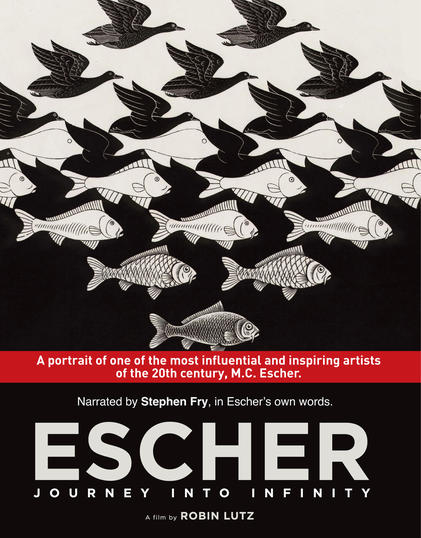
Documentaries about visual artists tend to be so boringly conceived—talk about the life, show a picture, talk about the life, show another picture—that you may not realize what you’ve been missing until you see one as excellent as “M.C. Escher: Journey to Infinity.”
Written and directed by Robin Lutz, this is a rare feature that takes the trouble not just to understand its subject and communicate his significance, but find ways to show us, visually, how his style evolved, and the principles behind that evolution.
The tale begins with the standard-issue “This is a movie about a great artist, here are a few summary details abut his life and art,” with some landscape and architecture shots and images of Escher’s work. Then it becomes increasingly daring and fanciful, yet always remaining in service to the M.C. Escher, the Dutch draftsman and printmaker whose art became internationally famous during the post-World War II era.
Escher was a rare artist who managed to combine his influences into something genuinely new. His work is a geometric/mathematical surrealist vision of the objectively perceivable world, but also a subjective interior, evoking ancient Arabic-North African graphics; the Salvador Dali-Pablo Picasso-Georges Braque anti-realist sensibilities of the ’20s and ’30s, and computer models that would not become popular until decades after Escher’s own experiments.
Lutz and his collaborators, including a team of graphic designers and animators, make Escher’s art come to life in surprising and amusing ways, from having one of his trademark salamanders appear in an otherwise “realistic” frame and travel across increasingly “unreal” panoramas until we’re in an Escher print, to re-imagining intricately patterned Escher artworks so that we seem to glide along them, or into them/through them. This happens slowly enough so that we can appreciate how deftly the artist translated negative space into positive space, in ways that made the distinction seem arbitrary: for instance, the black spaces between joined silhouettes of lizards or amphibians might become black birds with white spaces between them, then go back again. Or people and animals might move along one stretch of diagonal stairs and jump to another, seeming to go upside down or sideways, in defiance of gravity, emphasizing the brain-teasing techniques Escher perfected.
Lutz and his team have found a cinematic analogy for the movement of the eye over static pictorial art reproduced in a book or hanging on a museum wall. The movie is especially good at evoking that “wow” moment when you realize that a thing you were looking at has turned into another thing. It’s explaining the magic trick without ruining the magic, a magic trick of a different sort.
This approach is so dazzling that one wishes the filmmakers had pushed it a bit further, deploying it even more often, or in more and subtler variations—perhaps figuring out a way to have the film itself flip back on itself structurally at key points, or end precisely where it started, so that the project itself seemed to have no beginning or end. (There’s a hint of this, but not much more.)
Musician Graham Nash, a devotee of Escher who contacted him late in his life, says Escher dismissed the idea that he was an artist. Throughout the movie, we hear Escher align himself with scientists and mathematicians, often trashing his own skills as a representational draftsman and speaking of his heroes and colleagues with awe.
This isn’t to say that Escher was down on himself at all times, or that that he entirely rejected the notion he was making art. Escher’s letters, performed in voice-over by actor Stephen Fry, make it clear that he challenged himself to improve his abilities and expand his vision and grew irritable when stuck in a groove. And yet there was always a sense—particularly once Escher hit his forties and realized he was indeed a global phenomenon—that a “real” artist wouldn’t be as entertaining. This is the world’s misconception, not Escher’s, but it’s still a shame that he let himself feel diminished by it. There’s power and profundity in Escher’s art, yet the puzzle-box aspect is what pulls you into it.
The movie makes a case that we should talk about Escher the way we talk about one of his inspirations, Johann Sebastian Bach, who like Escher was clever as well as substantive. Escher earned the comparison. Why do we resist it? Perhaps there’s still something in us, even this late into human development, that worries that if you’re having fun, it can’t be art. Escher struggled with that misconception, too, right up to the end.
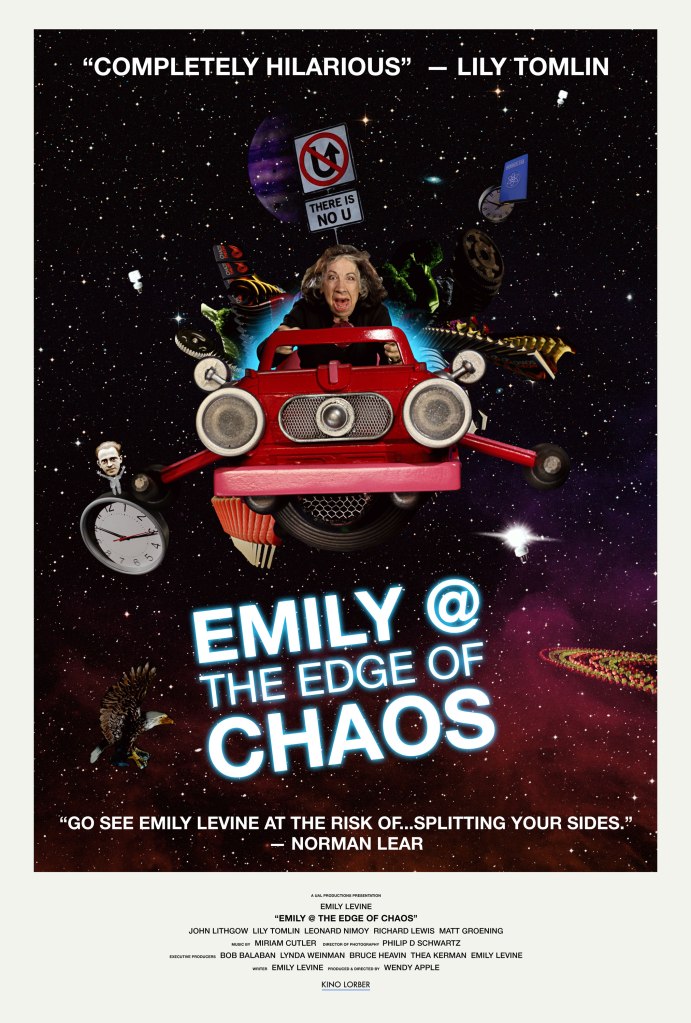
The brilliantly illuminating Emily @ the Edge of Chaos interweaves Emily Levine’s live performance with animation, appearances by scientists, and animated characters (John Lithgow as Sir Isaac Newton, Lily Tomlin as Ayn Rand, Leonard Nimoy as Sigmund Freud, Richard Lewis as Aristotle, Matt Groening as Aldo Leopold). The film uses physics – which explains how the universe works – to explain our metaphysics – the story of our values, our institutions, our interactions. Using her own experience and a custom blend of insight and humor, provocation and inspiration, personal story and social commentary, Emily takes her audience through its own paradigm shift: from the Fear of Change to the Edge of Chaos.
Emily Levine, like her film, was one-of-a-kind. She was a television writer, a stand-up performer, and an out-of-the box-thinker, whose brilliant TED talks have been seen by millions. She made this film with Wendy Apple, who produced and directed it. Wendy died in 2017 and Emily continued working on the film until she also passed away in 2019.



 After the Crash