Two for Tuesday
Reply

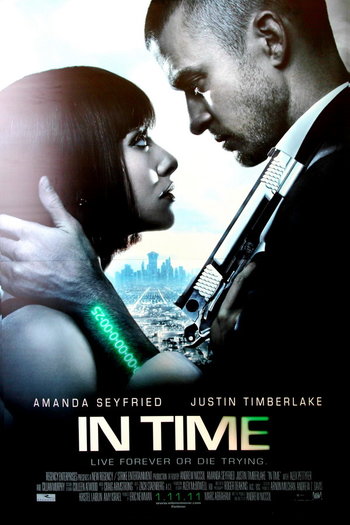
A thought-provoking sci-fi thriller set in the future that taps into some of the most troubling inequities and problems of our era, the lack of time.
By Frederic and Mary Ann Brussat
Source: Spirituality and Practice
The best science fiction always uses some trend or policy of the present as a foundation and projects it into the future with a picture of some possible results. Through this glimpse of tomorrow, we can ponder anew the spiritual or philosophical ramifications of what we are doing today. In The Adjustment Bureau, we were given a chance to assess the idea of free will or the alternative of following a plan mapped out by God. In Gattaca the idea of genetically engineered perfection is explored. Writer and director Andrew Niccol who wrote and directed the latter thriller is also at the helm of this thought-provoking sci-fi drama that has many resonances with today’s world.
The Preeminence of Time
A search on Google for “time” yields more than 11 billion hits whereas there are fewer than 3 billion hits for “money” and 241 million hits for “sex.” Time is very much on our minds and at the hub of our concerns. We speak of “having” and “saving” and “wasting” time but we never seem to find a way of “conquering” it. We are caught up in the obsessive-compulsive need to make the most of the time we have each day. Pagers and cell phones are taken everywhere. We don’t want to miss a moment of connection.
In Time is set in a future dystopia where living zones separate the rich from the poor. Will Salas (Justin Timberlake) lives in a ghetto zone with his mother Rachel (Olivia Wilde). She looks very young since all aging stops at 25.
Will works in a factory and she has a job as well, but still it is hard to make ends meet. Time in this society is literally money. Each person has a timer on his or her arm and at 25 you are given one year of free time after which you die — unless you can find a way to get more time. Wages are doled out in days of added longevity. All expenses (rent, a cup of coffee, clothes, phone calls) are paid for with time and scanners are used to deduct the time for the purchase. The biggest fear in the ghetto is that your time will run out unexpectedly. That is exactly what happens to Will’s mother.
Time Is Strange
“Time is stranger and deeper than anything else in our lives.”
— Jacob Needleman
The biggest dream in the ghetto is acquiring a surplus of years and the prospect of immortality. When Will saves a young man with a century on his clock, the fellow gives the years to him and then commits suicide. An intrepid “Timekeeper,” Raymond Leon (Cillian Murphy), is convinced that Will stole the years from the dead man. He launches a man hunt for him. Also hot on Will’s trail are some nasty time thieves.
Caught in Time
“Time is the element in which we exist. We are either borne along with it or drowned in it.”
— Joyce Carol Oates
Will begins a daring journey into the zone for the time rich called New Greenwich. After winning more than a millennium at a casino, he meets Sylvia (Amanda Seyfried), the daughter of Philippe Weis (Vincent Kartheiser), an immensely wealthy and powerful banker who has been exploiting the poor by making high interest time loans. A believer in “Darwinian capitalism,” he’s stored up enough years to be immortal. But Sylvia thinks there must be more to life than the favored existence she knows. She is intrigued by Will’s wild ideas about changing the system which favors the rich over the poor and allows many to die so a few can be immortal. After he takes her hostage when the Timekeeper is closing in on him, Sylvia doesn’t take very long to pledge her allegiance to what becomes their own mutual crusade. They begin robbing time banks and giving time to the poor and the down-and-out.
In Time is a winning sci-fi thriller that taps into some of the troubling problems of our era, such as the view of time as money, the growing gap between the rich and the poor, and all the ways that we waste time and fail to value every moment. It is also a meditation on the healing and restorative medicine of generosity and sharing. Writer and director Niccol has given us a cautionary tale about the possible future consequences of class consciousness, the high cost of trying to stay young or live forever, and the need for something more meaningful than just spending time to get ahead of the game.

By Stuart Bramhall
Source: The Most Revolutionary Act
Monopoly – Follow the Money
Directed by Tim Gielen (2021)
Translated by Vrouwen voor Vrijeid (Women for Freedom)
This Dutch documentary attempts to pinpoint the main corporations and individuals responsible for the Covid plandemic.
It begins by examining the key institutional investors that own the vast majority of the global share market. Going company by company, filmmakers reveal that approximately 8-10 institutional investors own 80% of the stock of nearly all global corporations. Some of the smaller institutional investors include mutual and pension funds. However the top three of every corporation they examine include BlackRock* and the Vanguard Group.**
The film looks at the institutional shareholdings of company after company, including Google, Twitter, Apple, Microsoft, Sony, Phillips, Boeing, Airbus, Coca Cola, Pepsi, all the mining companies, all the oil companies, Cargill, ADM, Bayer (the largest seed producer in the world since their acquisition of Monsanto), all the textile and fashion brands, Amazon, Ebay, Master Card, Visa, Paypal, and all the banks, tobacco companies, defense contractors, insurance companies, processed food companies, cosmetic brands and publishers and media outlets.***
In every case, both Vanguard Group and BlackRock are both within the top three institutional investors.
They also own stock in each other’s companies. In fact, Vanguard is the biggest shareholder in BlackRock, which Bloomberg refers to as the “fourth branch of government” because it both advises central banks and lends them money.
We don’t know exactly who owns shares in Vanguard as it’s not a publicly traded company. However we do know that it’s a safe place for many of the most powerful families in the world to hide their wealth (eg the Rockefellers, Rothschilds and British royal family).
The film also explores how wealthy families use nonprofit foundations to shape global politics in their own interest without attracting public attention. The big three featured in the film are George Soros’s Open Society Foundation, the Clinton Foundation and the Bill and Melinda Gates Foundation.
All these rich and powerful elites meet at the World Economic Forum in Davos Switzerland every January and mingle with world leaders and significant non-profit groups, such as Greenpeace and UNESCO.
Chairman and founder of the WEF is Klaus Schwab, a Swiss professor and businessman. In his book, The Great Reset, he states that the coronavirus is a great “opportunity” to reset our societies. According, to Schwab, our old society must switch to a new one because the consumption society the elite has forced on us is no longer sustainable. Under the new society he proposes, people will own nothing and rely primarily on the state to get their needs met.
*BlackRock, Inc. is an American multinational investment management corporation based in New York City. Founded in 1988, initially as a risk management and fixed income institutional asset manager, BlackRock is the world’s largest asset manager, with $8.67 trillion in assets under management as of January 2021.
**The Vanguard Group, Inc. is an American registered investment advisor based in Malvern, Pennsylvania with about $7 trillion in global assets under management, as of January 13, 2021. It is the largest provider of mutual funds and the second-largest provider of exchange-traded funds in the world after BlackRock’s iShares.
***What this means, In essence, is that a handful of individuals control all public information.

Bong Joon-ho delivers a biting satirical thriller about class warfare and social inequality
By Prahlad Srihari
Source: Firstpost.
Bong Joon-ho has always been interested in the mechanics of genre cinema. The South Korean director has made a career of subverting established genres in an intelligent, meaningful manner. In The Host and Okja, he took the creature feature and added socio-political subtext to it. The serial killer thriller, Memories of Murder, highlighted police incompetence in South Korea and the Hitchcockian murder mystery, Mother, revealed the cultural divide between men and women in Korean society.
Fortunes change when Ki-woo falsifies his credentials to land a tutoring job with a wealthy couple, Mr Park (Lee Sun-kyun) and his gullible wife Yeon-kyo (Cho Yeo-jeong). While he teaches their daughter Da-hye (Jung Ziso), he learns that their troublesome son Da-song (Jung Hyeon-jun) also needs help improving his drawing skills. Ever the opportunist, he recommends his sister — not revealing her real identity of course. She recommends her father as a driver after getting the previous one fired by setting him up as a sex fiend. Ki-taek then recommends his wife to take over as housekeeper after a scheme involving the most creative use of peaches since Call Me By Your Name. After their clandestine infiltration operation into the Parks’ lives is complete, the story makes so many intense and unexpected twists and turns, it turns into a whole different beast altogether.
The cast of Parasite deliver performances of exceptional psychological acuity and perverse frivolity. Led by Bong’s frequent collaborator Song Kang-ho, they are sure to conjure the loudest of laughs and the strongest of emotional reactions from their audiences.
Bong brilliantly uses the upstairs-downstairs distinction in the Parks’ house to reveal a socially divided society. And the society is not just divided by wealth but also culture. Bong revisits a familiar theme of the proliferation of American values over traditional Korean ones. The Parks are a Westernised family who live in a sleek, modernist home with white picket fences — and who buy toys and gadgets from the US, exemplifing the upper crust. Ki-taek’s family, meanwhile, lives in a sordid apartment in the basement, where cockroaches thrive and drunkards urinate on their windows. So, with Parasite, Bong tries to bring to light this deep, festering malady at the heart of Korean society.
Parasite offers a cleverly paced, thoroughly entertaining blend of sumptuous visuals and wickedly dark humour. The music too makes the plot twists and revelations hit that much harder.
Despite the cultural and language barriers, Parasite is an unforgettable cinematic experience as it speaks to universal ideas, themes and emotions. If Bong Joon-ho’s style of genre filmmaking hasn’t become an adjective already, it sure is time now.
Watch Parasite on Kanopy here: https://www.kanopy.com/product/parasite-2

Source: Top Documentary Films
The assassination of President John F. Kennedy lingers as one of the most traumatic events of the twentieth century. The open and shut nature of the investigation which ensued left many global citizens unsettled and dissatisfied, and nagging questions concerning the truth behind the events of that fateful day remain to this day. Evidence of this can be found in the endless volumes of conspiracy-based materials which have attempted to unravel and capitalize on the greatest murder mystery in American history.
Now, a hugely ambitious documentary titled Everything is a Rich Man’s Trick adds fuel to those embers of uncertainty, and points to many potential culprits whose possible involvement in the assassination has long been obscured by official historical record.
Authoritatively written and narrated by Francis Richard Conolly, the film begins its labyrinthine tale during the era of World War I, when the wealthiest and most powerful figures of industry discovered the immense profits to be had from a landscape of ongoing military conflict. The film presents a persuasive and exhaustively researched argument that these towering figures formed a secret society by which they could orchestrate or manipulate war-mongering policies to their advantage on a global scale, and maintain complete anonymity in their actions from an unsuspecting public. Conolly contends that these sinister puppet masters have functioned and thrived throughout history – from the formation of Nazism to the build-up and aftermath of September 11.
The election of President Kennedy in 1960 represented a formidable threat to these shadowy structures of power, including high-profile figures within the Mafia, crooked politicians, and the world’s most influential and notorious war profiteers. Thus, a plot was hatched which would end Kennedy’s reign prior to any chance of re-election, thereby restoring the order and freedoms of these secret societies.
At nearly three and a half hours, Everything is a Rich Man’s Trick examines a defining event of our times from a perspective not often explored. While it may or may not win over viewers who remain skeptical of mass-scale conspiracy, it presents its findings in a measured and meticulous manner which demands attention and consideration.
INDIAN COUNTRY NEWS
"It is the duty of every man, as far as his ability extends, to detect and expose delusion and error"..Thomas Paine
Human in Algorithms
100% Accurate Google Sheets + KDP Book Formatting | 24hr Delivery
From the Roof Top
I See This
blog of the post capitalist transition.. Read or download the novel here + latest relevant posts
अध्ययन-अनुसन्धानको सार
 After the Crash