

Many are familiar with Marcus Garvey through numerous references to him in Reggae music since he’s a prophet in the Rastafarian religion. However, those of us in the US who value civil rights should be particularly thankful for Garvey’s legacy, for his life and the ideas he promoted were an influence on Malcolm X and Martin Luther King Jr. among many others and the organization he founded, the Universal Negro Improvement Association and African Communities League, continues his work to this day. This biography is from the Marcus Garvey Foundation:
The Honorable Marcus Mosiah Garvey was born in St. Ann Bay in the parish of St. Ann on the north coast of the island of Jamaica on 17 August 1887. He described it like this, “I was born in the beautiful Parish of St. Ann, near the falls of the Roaring River. I grew up with nature and drank much of her inspiration.” He developed an interest in playing cricket early in life. Apprenticed to his godfather who was a printer, young Marcus early evinced an interest in the printed word. He read widely and was always anxious to discuss current events as well as history. At the age of eighteen he was already a foreman at P.J. Benjamin’s Printing Shop in Jamaica’s capital city of Kingston. He could be seen grounding with his brethren at Victoria Pier on Sunday nights. Garvey joined the printer’s trade union and gained a reputation as courageous, dedicated and highly concerned young leader. At the age of twenty-three he embarked upon a most significant journey that carried him to both Latin America and Europe. He found employment on the docks of London, Liverpool and Cardiff like many West Indians and Africans at the time.
Meeting Duse Mohammed Ali, an Egyptian editor and publisher of the African Times and Orient Review, made a lasting impression on Marcus Garvey. Duse Ali later became active in the UNIA and later a newspaper publisher in Nigeria. Five days after he returned to Kingston, Jamaica, Marcus Garvey founded the Universal Negro Improvement Association, a mass based organization designed to unite people of African ascent around the world. Those who joined Garvey in founding the UNIA shared with him an interest in working hard to overcome conditions of oppression. The organization’s motto is “One God, One Aim, One Destiny.” Seeking the advice and assistance of Booker T. Washington, a well-known leader in the Black world community and at the helm of Tuskegee Institute, Marcus Garvey arrived in the U.S.A. several months after Washington’s death. He traveled from city to city spreading the word of Pan African unity. On May 10, l916, he kicked off the lecture tour at St. Mark’s Roman Catholic Church Hall on 138th Street and reportedly visited 38 states in a year. The cities Garvey visited later were to become major sites of UNIA activity. From those formative years at Liberty Hall on West 138th Street, this mass movement engulfed the African world, increasing from a few to millions worldwide. It wasn’t long before the establishment of the Negro World, Negro Factories Corporation, grocery stores, markets, steamships, and steam laundry companies occurred. The launching of the Black Star Line in 1919 and the successful First International Convention of the Negro Peoples of the World in 1920 catapulted this organization on to the world stage. Between World Wars I and II the UNIA rose and declined, never to be rivaled by another black mass movement.
Currently, the UNIA lives not only in its present form, but also in the memories of so many around the world. It is clear that the Universal Negro Improvement Association and African Communities League served as the model and foundation for 20th century Pan African movements.
Source: AmericanDrugWar.com
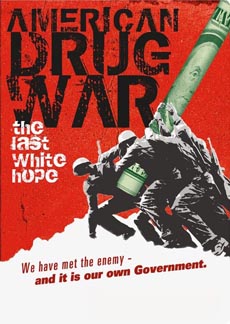
The War on Drugs has become the longest and most costly war in American history, the question has become, how much more can the country endure? Inspired by the death of four family members from “legal drugs” Texas filmmaker Kevin Booth sets out to discover why the Drug War has become such a big failure. Three and a half years in the making the film follows gang members, former DEA agents, CIA officers, narcotics officers, judges, politicians, prisoners and celebrities. Most notably the film befriends Freeway Ricky Ross; the man many accuse for starting the Crack epidemic, who after being arrested discovered that his cocaine source had been working for the CIA.
AMERICAN DRUG WAR shows how money, power and greed have corrupted not just dope fiends but an entire government. More importantly, it shows what can be done about it. This is not some ‘pro-drug’ stoner film, but a collection of expert testimonials from the ground troops on the front lines of the drug war, the ones who are fighting it and the ones who are living it.
Source: AKATommyChong.com
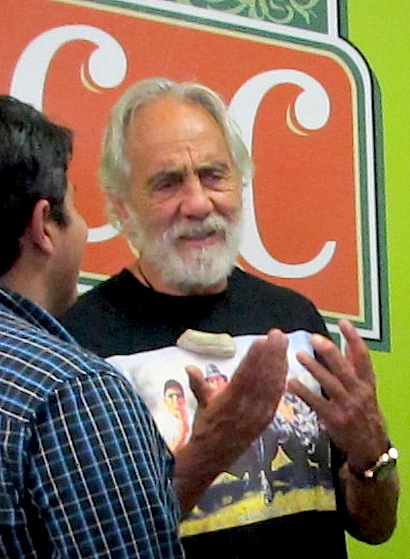
At the height of popularity of the Bush administration — the federal government entrapped and subsequently imprisoned Tommy Chong. Josh Gilbert began documenting the federal case against his long time friend, for the terrible crime of selling bongs.
This film examines the personal effects on Tommy, the motivations and tactics of the politicized Justice Department under George Bush, set against the back drop of the War on Drugs and the legal issues involved. The film premiered at the Toronto Film Festival to huge press and critical acclaim, and appeared at many other film festivals. It premiered theatrically at Film Forum in New York City and went on to a successful arthouse theatrical release throughout North America. It was recently broadcast on Showtime and the CBC in Canada.
 Tomorrow marks the birthday of working class poet and author Charles Bukowski (he would have been 94). Bukowski’s creativity had been stifled for most of his adult life as a wage slave until at age 49 he seized an opportunity to break free. Bukowski showed his gratitude to his benefactor, Black Sparrow Press, by publishing most of his subsequent major works with them while supporting countless other independent presses across the country with numerous poetry and short story submissions. He also wrote a letter of thanks to John Martin, owner of Black Sparrow Press in 1986, (also containing thoughts on modern life many of us can relate to) featured in the following article:
By Maria Popova
Source: Brain Pickings
“To not have entirely wasted one’s life seems to be a worthy accomplishment, if only for myself.”
“Unless it comes unasked out of your heart and your mind and your mouth and your gut,” Charles Bukowski wrote in his famous poem about what it takes to be a writer, “don’t do it.” But Bukowski himself was a late bloomer in the journey of finding one’s purpose, as his own “it” — that irrepressible impulse to create — took decades to coalesce into a career.
Like many celebrated authors who once had ordinary day jobs, Buk tried a variety of blue-collar occupations before becoming a full-time writer and settling into his notorious writing routine. In his mid-thirties, he took a position as a fill-in mailman for the U.S. Postal Service. But even though he’d later passionately argue that no day job or practical limitation can stand in the way of true creativity, he found himself stifled by working for the man. By his late forties, he was still a postal worker by day, writing a column for LA’s underground magazine Open City in his spare time and collaborating on a short-lived literary magazine with another poet.
In 1969, the year before Bukowski’s fiftieth birthday, he caught the attention of Black Sparrow Press publisher John Martin, who offered Buk a monthly stipend of $100 to quit his day job and dedicate himself fully to writing. (It was by no means a novel idea — the King of Poland had done essentially the same for the great astronomer Johannes Hevelius five centuries earlier.) Bukowski gladly complied. Less than two years later, Black Sparrow Press published his first novel, appropriately titled Post Office.
But our appreciation for those early champions often comes to light with a slow burn. Seventeen years later, in August of 1986, Bukowski sent his first patron a belated but beautiful letter of gratitude. Found in Reach for the Sun: Selected Letters 1978–1994 (public library), the missive emanates Buk’s characteristic blend of playfulness and poignancy, political incorrectness and deep sensitivity, cynicism and self-conscious earnestness.
August 12, 1986
Hello John:
Thanks for the good letter. I don’t think it hurts, sometimes, to remember where you came from. You know the places where I came from. Even the people who try to write about that or make films about it, they don’t get it right. They call it “9 to 5.” It’s never 9 to 5, there’s no free lunch break at those places, in fact, at many of them in order to keep your job you don’t take lunch. Then there’s overtime and the books never seem to get the overtime right and if you complain about that, there’s another sucker to take your place.
You know my old saying, “Slavery was never abolished, it was only extended to include all the colors.”
And what hurts is the steadily diminishing humanity of those fighting to hold jobs they don’t want but fear the alternative worse. People simply empty out. They are bodies with fearful and obedient minds. The color leaves the eye. The voice becomes ugly. And the body. The hair. The fingernails. The shoes. Everything does.
As a young man I could not believe that people could give their lives over to those conditions. As an old man, I still can’t believe it. What do they do it for? Sex? TV? An automobile on monthly payments? Or children? Children who are just going to do the same things that they did?
Early on, when I was quite young and going from job to job I was foolish enough to sometimes speak to my fellow workers: “Hey, the boss can come in here at any moment and lay all of us off, just like that, don’t you realize that?”
They would just look at me. I was posing something that they didn’t want to enter their minds.
Now in industry, there are vast layoffs (steel mills dead, technical changes in other factors of the work place). They are layed off by the hundreds of thousands and their faces are stunned:
“I put in 35 years…”
“It ain’t right…”
“I don’t know what to do…”
They never pay the slaves enough so they can get free, just enough so they can stay alive and come back to work. I could see all this. Why couldn’t they? I figured the park bench was just as good or being a barfly was just as good. Why not get there first before they put me there? Why wait?
I just wrote in disgust against it all, it was a relief to get the shit out of my system. And now that I’m here, a so-called professional writer, after giving the first 50 years away, I’ve found out that there are other disgusts beyond the system.
I remember once, working as a packer in this lighting fixture company, one of the packers suddenly said: “I’ll never be free!”
One of the bosses was walking by (his name was Morrie) and he let out this delicious cackle of a laugh, enjoying the fact that this fellow was trapped for life.
So, the luck I finally had in getting out of those places, no matter how long it took, has given me a kind of joy, the jolly joy of the miracle. I now write from an old mind and an old body, long beyond the time when most men would ever think of continuing such a thing, but since I started so late I owe it to myself to continue, and when the words begin to falter and I must be helped up stairways and I can no longer tell a bluebird from a paperclip, I still feel that something in me is going to remember (no matter how far I’m gone) how I’ve come through the murder and the mess and the moil, to at least a generous way to die.
To not to have entirely wasted one’s life seems to be a worthy accomplishment, if only for myself.
yr boy,
Hank
Complement with Bukowski’s “so you want to be a writer,” then revisit this essential compendium of advice on how to find your purpose and do what you love and the spectacular resignation letter Sherwood Anderson wrote when he decided to quit his soul-sucking corporate job and become a full-time writer.

Actor and comedian Robin Williams died yesterday at age 63, reportedly by suicide. He will be remembered for his charitable work with Comic Relief, contributions to numerous films including (my favorites of his) Club Paradise, Death to Smoochy and World’s Greatest Dad, and of course his ability to improvise hilariously absurd monologues with a rapidfire delivery. Like the best comedians he was also a comforting voice for generations of weirdos and outsiders.
“Is That All There Is?”(1995) was part of a series commissioned by the BBC documenting directors around the world and their surroundings. This episode featuring anarchist director Lindsay Anderson depicts his home life and community in North London and offers a glimpse into his personality and interests. Anderson is best known for his groundbreaking films “If…” and “O Lucky Man”, and this film serves as a final tribute since he passed away shortly after.

By Aaron Dykes and Melissa Melton
After all, people were dying of Ebola in the hundreds in West Africa before this week. Aid workers and doctors were getting infected before. These things are not new, but the sudden media focus raises lots of questions.
To start…
Why are they shipping Ebola-infected patients onto American soil for the first time?
As many have pointed out, this move seems particularly…ill-advised. The U.S. Centers for Disease Control and Prevention cautioned people not to fly to the affected areas, but our State Department is going to go out of its way to put together heavily publicized, special containment tents inside planes to fly two Americans here while the media in lockstep makes a huge play-by-play deal?
It isn’t exactly level 4 containment all the way, either, as Underground Medic‘s Lizzie Bennett pointed out yesterday: the one guy arrived at the hospital and just got out of the ambulance and walked on in.
Why is Obama amending executive orders about quarantining people infected with Ebola when he already had that power?
The president just amended a G.W. Bush-era executive order 13295 which allows “apprehension, detention, or conditional release of individuals to prevent the introduction, transmission, or spread of suspected communicable diseases.”
Section 1, subjection b has now been replaced with the following:
“(b) Severe acute respiratory syndromes, which are diseases that are associated with fever and signs and symptoms of pneumonia or other respiratory illness, are capable of being transmitted from person to person, and that either are causing, or have the potential to cause, a pandemic, or, upon infection, are highly likely to cause mortality or serious morbidity if not properly controlled. This subsection does not apply to influenza.”
Sure sounds like Ebola, doesn’t it?
But in reality, those quarantine powers were already in place. It even says so on this CDC map of U.S. quarantine stations fact sheet the agency released in August 2013.

Ebola definitely counts under the category “viral hemorrhagic fevers”.
So why make a big deal amending an executive order when the power to detain people who have, or are suspected to have Ebola, already exists?
The CDC also just released a brand new, timely webpage “Infection Prevention and Control Recommendations for Hospitalized Patients with Known or Suspected Ebola Hemorrhagic Fever in U.S. Hospitals” as if it just completely slipped the agency’s mind to disseminate information to medical professionals on how to deal with Ebola before now. Come on. The page does, however, mention guidance for exposure to “contaminated air,” which is odd considering the CDC director has gone out of his way to say that there’s no way an Ebola outbreak could ever happen in the U.S.
What exactly have Ft. Detrick biowarfare researchers been doing in the Ebola hot zone in West Africa all this time?
Independent investigative reporter Jon Rappaport asked this very same question the day before yesterday, but it seems like a good one. He had several other questions, and they are all good ones:
What exactly have they been doing?
Exactly what diagnostic tests have they been performing on citizens of Sierra Leone?
Why do we have reports that the government of Sierra Leone has recently told Tulane researchers to stop this testing?
Have Tulane researchers and their associates attempted any experimental treatments (e.g., injecting monoclonal antibodies) using citizens of the region? If so, what adverse events have occurred?
The research program, occurring in Sierra Leone, the Republic of Guinea, and Liberia—said to be the epicenter of the 2014 Ebola outbreak—has the announced purpose, among others, of detecting the future use of fever-viruses as bioweapons.
Is this purely defensive research? Or as we have seen in the past, is this research being covertly used to develop offensive bioweapons?
The same day, Navy Times published an article talking about how U.S. biowarfare scientists have been highly interested in Ebola since at least the late 1970s for engineering bioweapons: “mainly because Ebola and its fellow viruses have high mortality rates…and its stable nature in aerosol make it attractive as a potential biological weapon.”
But the article goes on to say that scientists from the U.S. Army Medical Research Institute of Infectious Diseases (USAMRIID) have been working on a vaccine since then, a purely defensive measure. Of course, they can’t come out and say they’re working on offensive weapons. The Biological Weapons Convention went into effect in 1975, supposedly putting an end to the government’s biological weapons program.
Why does the U.S. government own a patent on a novel strain of Ebola that those same Ft. Detrick researchers quietly admitted in a CDC journal article last month may actually be the cause of the current Sierra Leone outbreak, not Ebola Zaire as widely reported?
This one gets tricky.
There are five types of Ebola virus and the newest strain is named Bundibugyo, or Ebobun for short. The U.S. government actually holds a patent on this strain — US 20120251502 A1, for “Human Ebola Virus Species and Compositions and Methods Thereof” related to the Bundibugyo version of the virus.
Last month, the same Ft. Detrick researchers who have been over in the Ebola hot zone published an article in the CDC’s Emerging Infectious Diseases where they discuss the human testing that has been going on over there and down near the bottom of the article, they quietly admit, “Ebolavirus infections in Sierra Leone might be the result of Bundibugyo virus or an ebolavirus genetic variant and not EBOV.”
The kicker?
The Ebobun version of Ebola, which is apparently been found to be “genetically distinct,” as it differs by more than 30% at the genome level from all other known ebolavirus species, apparently has a much lower death rate than the Zaire version the media keeps talking about.
Not that Ebola in any form isn’t dangerous. It’s deadly, period. But Ebobun had a 36% mortality rate at the initial outbreak in 2007, versus 70-90% on average for Zaire.
Additionally, because it is much more unique, researchers have suggested that if a vaccine or treatment is created for Ebola and the Ebobun strain is not taken into account, the resulting treatment or vaccine obviously might not work on it.
Regardless, all the mainstream media seems interested in driving home on repeat these days is that this outbreak is the Zaire strain which has a 90% mortality rate and no cure. Well…even that isn’t entirely true…
A NOVA presentation from 1995 clearly shows survivors and discusses how a nurse named Nicole was given blood transfusions from an infected patient who survived, to build up antibodies. A review sums it up:
After one week, Nicole began to recover. Spurred by this result, the Zairian doctors transfused an additional eight patients. Seven of the eight patients survived, but the Western doctors remain unconvinced. Because the experiment was completely uncontrolled, they argue that we will never know that the transfusion saved the lives of those patients.
That was 20 years ago. Current news stories even discuss how the doctor who was flown here infected with Ebola was given a unit of blood from a 14-year-old who survived Ebola. The female patient flown in was also reportedly given an experimental serum no one seems to elaborate much on.
On top of that, articles from 2008 show a vaccine was highly effective in monkeys and even used experimentally in a human patient with success. Where did those vaccines go? Why aren’t they widely available six years later?
And finally, as with any crisis, who stands to gain from this, and what is it they are ultimately after?
Just asking.
One company Tekmira, who has been performing Phase I clinical trials for an Ebola drug it has been working on in otherwise healthy adult patients has seen its stock skyrocket over the last two weeks, even though its experiments in humans have now been halted due to safety concerns.
Tekmira apparently has a $140 million contract with none other than the USAMRIID to work on this drug, along with a multi-million contract with biotech giant Monsanto for the same technology. The drug was granted FDA fast track status back in March. As the company’s site says, however, the drug is apparently for the Zaire strain of the virus.
So has Tekmira taken the Ebobun strain into account?
In addition, now Reuters is reporting that Ebola vaccines have been fast tracked as well, with human experiments starting as early as next month. Wow, that was fast. Will those vaccines take Ebobun into account?
The last time a vaccine was fast tracked in such a manner, it was for the purposefully overblown swine flu “pandemic” — a created “campaign of panic” basically designed to sell vaccines and grant more emergency powers.
As Aaron Dykes reported in 2010:
Wolfgang Wodarg, head of health at the Council of Europe, claims that the threshold for alert was deliberately lowered at the WHO, allowing a “pandemic” to be declared despite the mildness of the ‘swine flu.’ That designation would force a demand for the vaccine, which was subsequently purchased by governments or health facilities and pushed on the public through a full-scale fear campaign in the media…
Wodarg is focusing on the motives for profit, as well as the ties between the World Health Organization (WHO), the pharmaceutical-industrial complex and research scientists, a nexus which Canada Free Press points out is eerily similar to the Climategate revelations that CRU research scientists fudged data to “hide the decline” in proxy temperatures in order to support global warming claims.
Wodarg made several disconcerting statements to the media, including:
“Never before the search for traces of a virus was carried out so broadly and intensively, besides, many cases of death that happen to coincide with seropositive H1N1 lab-findings were simply attributed to “swine-flu” and used to foster fear.”
“A group of people in the WHO is associated very closely with the pharmaceutical industry.”
“The great campaign of panic we have seen provided a golden opportunity for representatives from labs who knew they would hit the jackpot in the case of a pandemic being declared.”
In fact, that’s what CBS investigative reporter Sharyl Attkisson was set to expose, but her bosses refused to air her story. The mainstream media completely shut her down. Fear sells. The truth, by contrast, doesn’t.
“With the CDC keeping the true Swine Flu stats secret, it meant that many in the public took and gave their children an experimental vaccine that may not have been necessary,” Attkisson said. Read this piece on her 2009 interview with Jon Rappaport for more on how the CDC stopped counting cases of swine flu altogether and hyped the public into a panic that ultimately led to millions of people receiving potentially dangerous, fast-tracked vaccinations.
That’s right. Countries the world over reported many deaths and disabilities suffered in the wake of the fast-tracked H1N1 vaccine, a vaccine people scrambled to get after the hysteria over swine flu was over hyped everywhere, from government agencies to the mainstream media.
But hey, a lot of people in the military-medical-media industrial complex made a lot of money.
Much worse than mere greed, though, is the possibility of martial law and a forced mass vaccination scenario — a scenario where the military is “forced” to step in to contain “bio-threats” (regardless of whether or not those threats are real or made up). For more on that, see DARPA’s “Blue Angel” project.
Talking about something scary isn’t automatically scaremongering — but if the powers that shouldn’t be are scaremongering, we should talk about it.
(Meanwhile, headlines about ‘Ebola fear going viral’ are already screaming at people to be afraid…very very afraid.)
INDIAN COUNTRY NEWS
"It is the duty of every man, as far as his ability extends, to detect and expose delusion and error"..Thomas Paine
Human in Algorithms
From the Roof Top
I See This
blog of the post capitalist transition.. Read or download the novel here + latest relevant posts
अध्ययन-अनुसन्धानको सार
 After the Crash