Why Chaos Always Seems To Have Such Grand Potential

tahrir

By Shauna Janz

Source: Collective Evolution

We have been experiencing “chaos as grand potential” throughout our entire history. From the first potential of life that exploded from the stars and hurled across a universe in chaotic fashion, to the evolution of all species on our Earth, to the splitting of cells that form life in a mother’s womb.

Growth and evolution emerge from chaos.

Another way of thinking about chaos is the process of positive disintegration – originally used in psychology by Kazimierz Dąbrowski, who viewed tension and anxiety as a necessary part of any personal growth process. This term has also been used by Joanna Macy to describe how living systems evolve; when continued feedback tells a system that it has become dysfunctional, the system responds by changing.

In other words, when old ways of doing things are no longer adaptive or effective, we are catapulted into a disintegration process, or chaos, so that new ways of doing things can emerge that are positive for a sustainable life.

Chaos is a necessary part of the process any living system, individual, or community goes through to adapt, evolve, and remain sustainable in their environment.

For people, that environment may be our own personal body/mind, our families, our workplace, our society, or our collective global community.

From the chaos, or disintegration, comes the grand potential for something wholly new to arise – something that surpasses the old way of being and has become a more inclusive and integrated way of being.

I am reminded of Pema Chodron’s book When Things Fall Apart, dedicated to finding hope when we are suffering from change or loss; when we are in the midst of disintegration. Through her soothing words, she assists her readers to remain open and aware through the confusion and anxiety of chaos.

Pain and grief often inhabit the space of chaos. As familiar ways prove no longer useful, we are thrust into a space of unknowing and chaos before new ways can fully develop.

I reflect on the grief I have experienced in my own life, and on the grief in others that I have witnessed and supported. When loss and change erupt in our lives, we are left in the emotional wake to re-create who it is we are in our changed world.

We are left to find a new way to make meaning and to find adaptive strategies to live on and continue to thrive. It may mean letting go of certain roles or identities, or it may mean embracing new ones and honouring the process.

This doesn’t happen overnight. Before new ways emerge, we are left in confusion. We are left in anxiety. We are left in pain and grief.

In this chaotic space we may feel fearful, uncertain, and out of control. We may react and grasp for anything that might give us a sense of comfort or control, or allow us to numb out from feeling at all.

We see this on a personal scale as well as on a global scale – whether grasping for escape through another drink, Netflix series, or new pair of shoes, or whether grasping for control through declaring another war or engaging in oppressive acts against others.

Positive disintegration can only happen if we stay aware, open, and conscious to see the potential that lies within the chaos, and to then act to create new ways that are sustainable.

If we learn to navigate our own personal grief and chaos in conscious ways remaining calm, open, and trusting, then we gain the ability to navigate the grief and chaos in our world in the same way.

Remaining conscious and open is absolutely necessary because globally we are in the midst of a significant disintegration process, and we need to change how we live.

We know that the capitalist industrial growth complex that currently defines our global economics and social systems has become dysfunctional. We are witnessing extreme abuses of power, violence. and tactics of separation – all rooted in fear and grasping for control.

We are all experiencing the impacts of this global chaotic time – grief, anxiety, uncertainty. We are also witnessing efforts to make changes for a sustainable and equitable future.

Joanna Macy calls this time “The Great Turning.” In her book Coming Back to Life – Practices to Reconnect Our Lives, Our World she exemplifies many of the ways we are seeing the process of positive disintegration carry out in our world.

From direct action and legislative work to slow down the process of environmental and social destruction, to academics and grassroot groups working to educate about the impacts of our capitalist industrial system, to the cognitive revolutions and spiritual awakenings that deeply shift our consciousness toward a sustainable way of being on this Earth — we have the ability to stand strong in the winds of chaos, to choose openness and compassion, to hold fast to our vision of a vibrant and sustainable future, and to act in loving ways, now.

We are seeing new forms of sustainable practices emerge, witnessing the resurgence of ancestral ways of knowing, and experiencing shifts of consciousness.

There is no one person that will save our planet or human family. It takes the whole global community to respond, which means it takes each and every one of us to step forward in our own ways to shine our light and hold hope, trust, and compassion through this time of chaos.

Each one of us has a gift – has words to share, actions to motivate, art to show, or ways of being that exude love, trust and connection.

There is a place for everyone – whether it is the frontlines of direct action and resistance, raising conscious and compassionate children, or actively healing your own wounds – these all contribute to the healing of our world.

Joanna Macy says, you cannot “fix” the world, but you can take part in its self-healing. Healing wounded relationships within you and between you is integral to the healing of our world.

Each one of us who chooses love over fear, feeling over numbing, and compassionate action over apathy, contributes to the emergence of a sustainable new way of being in our world.

I invite you to reflect on the ways you are responding in your own life to a global future of love and sustainability. What are the gifts you bring to this world? How are you actively living your gifts every day?

And I thank you for remaining open and compassionate amidst this time of chaos as grand potential.

The West Is Reduced To Looting Itself

wPGF1

By Paul Craig Roberts

Source: PaulCraigRoberts.org

I, Michael Hudson, John Perkins, and a few others have reported the multi-pronged looting of peoples by Western economic institutions, principally the big New York Banks with the aid of the International Monetary Fund (IMF).

Third World countries were and are looted by being inticed into development plans for electrification or some such purpose. The gullible and trusting governments are told that they can make their countries rich by taking out foreign loans to implement a Western-presented development plan, with the result being sufficient tax revenues from economic development to service the foreign loan.

Seldom, if ever, does this happen. What happens is that the plan results in the country becoming indebted to the limit and beyond of its foreign currency earnings. When the country is unable to service the development loan, the creditors send the IMF to tell the indebted government that the IMF will protect the government’s credit rating by lending it the money to pay its bank creditors. However, the conditions are that the government take necessary austerity measures so that the government can repay the IMF. These measures are to curtail public services and the government sector, reduce public pensions, and sell national resources to foreigners. The money saved by reduced social benefits and raised by selling off the country’s assets to foreigners serves to repay the IMF.

This is the way the West has historically looted Third World countries. If a country’s president is reluctant to enter into such a deal, he is simply paid bribes, as the Greek governments were, to go along with the looting of the country the president pretends to represent.

When this method of looting became exhausted, the West bought up agricultural lands and pushed a policy on Third World countries of abandoning food self-sufficiency and producing one or two crops for export earnings. This policy makes Third World populations dependent on food imports from the West. Typically the export earnings are drained off by corrupt governments or by foreign purchasers who pay little while the foreigners selling food charge much. Thus, self-sufficiency is transformed into indebtedness.

With the entire Third World now exploited to the limits possible, the West has turned to looting its own. Ireland has been looted, and the looting of Greece and Portugal is so severe that it has forced large numbers of young women into prostitution. But this doesn’t bother the Western conscience.

Previously, when a sovereign country found itself with more debt than could be serviced, creditors had to write down the debt to an amount that the country could service. In the 21st century, as I relate in my book, The Failure of Laissez Faire Capitalism, this traditional rule was abandoned.

The new rule is that the people of a country, even a country whose top offiials accepted bribes in order to indebt the country to foreigners, must have their pensions, employment, and social services slashed and valuable national resources such as municipal water systems, ports, the national lottery, and protected national lands, such as the protected Greek islands, sold to foreigners, who have the freedom to raise water prices, deny the Greek government the revenues from the national lottery, and sell the protected national heritage of Greece to real estate developers.

What has happened to Greece and Portugal is underway in Spain and Italy. The peoples are powerless because their governments do not represent them. Not only are their governments receiving bribes, the members of the governments are brainwashed that their countries must be in the European Union. Otherwise, they are bypassed by history. The oppressed and suffering peoples themselves are brainwashed in the same way. For example, in Greece the government elected to prevent the looting of Greece was powerless, because the Greek people are brainwashed that no matter the cost to them, they must be in the EU.

The combination of propaganda, financial power, stupidity and bribes means that there is no hope for European peoples.

The same is true in the United States, Canada, Australia, and the UK. In the US tens of millions of US citizens have quietly accepted the absence of any interest income on their savings for seven years. Instead of raising questions and protesting, Americans have accepted without thought the propaganda that their existence depends upon the success of a handful of artificially created mega-banks that are “too big to fail.” Millions of Americans are convinced that it is better for them to draw down their savings than for a corrupt bank to fail.

To keep Western peoples confused about the real threat that they face, the people are told that there are terrorists behind every tree, every passport, under every bed, and that all will be killed unless the government’s overarching power is unquestioned. So far this has worked perfectly, with one false flag after another reinforcing the faked terror attacks that serve to prevent any awareness that this a hoax for accumulating all income and wealth in a few hands.

Not content with their supremacy over “democratic peoples,” the One Percent has come forward with the Trans-Atlanta and Trans-Pacific partnerships. Allegedly these are “free trade deals” that will benefit everyone. In truth, these are carefully hidden, secret, deals that give private businesses control over the laws of sovereign governments.

For example, it has come to light that under the Trans-Atlantic partnership the National Health Service in the UK could be ruled in the private tribunals set up under the partnership as an impediment to private medical insurance and sued for damages by private firms and even forced into abolishment.

The corrupt UK government under Washington’s vassal David Cameron has blocked access to legal documents that show the impact of the Trans-Atlantic partnership on Britain’s National Health Service. http://www.globalresearch.ca/cameron-desperate-to-stop-scandal-as-secret-plans-to-sell-the-national-health-service-are-discovered/5504306

For any citizen of any Western country who is so stupid or brainwashed as not to have caught on, the entire thrust of “their” government’s policy is to turn every aspect of their lives over to grasping private interests.

In the UK the postal service was sold at a nominal price to politically connected private interests. In the US the Republicans, and perhaps the Democrats, intend to privatize Medicare and Social Security, just as they have privatized many aspects of the military and the prison system. Public functions are targets for private profit-making.

One of the reasons for the escalation in the cost of the US military budget is its privatization. The privatization of the US prison system has resulted in huge numbers of innocent people being sent to prison, where they are forced to work for Apple Computer, IT services, clothing companies that manufacture for the US military, and a large number of other private businesses. The prison laborers are paid as low as 69 cents per hour, below the Chinese wage.

This is America today. Corrupt police. Corrupt prosecutors. Corrupt judges. But maximum profits for US Capitalism from prison labor. Free market economists glorified private prisons, alleging that they would be more efficient. And indeed they are efficient in providing the profits of slave labor for capitalists.

Here is a news report on UK Prime Minister Cameron denying information about the effect of the Trans-Atlantic partnership on Britains’ National Health.
http://www.theguardian.com/business/2016/jan/26/anger-government-blocks-ttip-legal-documents-nhs-health-service

The UK Guardian, which often has to prostitute itself in order to maintain a bit of independence, describes the anger that the British people feel toward the government’s secrecy about an issue so fundamental to the well being of the British people. Yet, the British continue to vote for political parties that have betrayed the British people.

All over Europe, the corrupt Washington-contolled governments have distracted people from their sellout by “their” governments by focusing their attention on immigrants, whose presence is a consequence of the European governments representing Washington’s interests and not the interest of their own peoples.

Somthing dire has happened to the intelligence and awareness of Western peoples who seem no longer capable of comprehending the machinations of “their” governments.

Accountable government in the West is history. Nothing but failure and collapse awaits Western civilization.

Gandhi the Anarchist

5e0fc8e70e7f794d27662ed00910928f

Editor’s note: Tomorrow marks the 67th anniversary of the assassination of Mohandas Gandhi. Society often celebrates such influential rebels while forgetting what made them great. Articles such as this help us avoid that trap.

By Jason Farrell

Source: Center for a Stateless Society

A complex man with a controversial legacy, Mohandas Gandhi remains one of the pioneers of civil disobedience as a political weapon and a giant in 20th century anti-colonialism. An individualist anarchist who motivated millions to fight to liberate themselves from British rule, his success showed a potentially powerful application of libertarian ideas during a major political crisis and the ability of those values to inspire positive, peaceful outcomes.

Gandhi’s principles of radical liberation existed within a moral framework that abhorred violence but empowered ordinary people, intellectually and spiritually, to prevail against oppressors and shatter a miserable status quo. According to the research of Erica Chenoweth, Gandhi’s template of non-violent resistance has been immensely successful for later generations around the world in creating lasting improvements in civil rights.

Modern activists and political thinkers shouldn’t discount the essential libertarian qualities of Gandhi’s philosophy, as they were among its most powerful and effective attributes. A commitment to natural law, self-determination, individualism and an abhorrence of government were core to his thinking and largely responsible for his success as an activist.

Gandhi’s Philosophy

Satyagraha, Gandhi’s philosophy of non-violence, which translates to “truth force” or “love force” carries with it some distinctly libertarian ideas. It incorporates elements of both the “knowledge problem” (applied in a moral sense) and the non-aggression axiom, although taken a step further into moral obligation to others — which is more than libertarianism demands. According to Gandhi:

In the application of Satyagraha, I discovered in the earliest stages that pursuit of truth did not admit of violence being inflicted on one’s opponent but that he must be weaned from error by patience and compassion. For what appears to be truth to the one may appear to be error to the other. And patience means self-suffering. So the doctrine came to mean vindication of truth, not by infliction of suffering on the opponent, but on oneself.

Gandhi noted the purpose of Satyagraha was to “convert, not to coerce, the wrong-doer.” Success is thus defined as cooperation towards a just end, rather than a political “win.” He also spoke of means and ends as inseparable, rejecting the use of violence or the “victory, by any means necessary,” mentality of some who have practiced passive resistance in the West. Gandhi knew using violent means would embed injustice in whatever ends are attained, exacerbating the cycle of violence that plagues so many societies. In this way, the practitioner’s authority is rooted in moral force instead of violence, and has the potential to reduce antagonisms within a society without harming the antagonists.

Gandhi developed a set of very particular rules and mores for Satyagrahis to follow, including mandatory spinning, chastity and abstinence from alcohol. With these we are unconcerned, since different disobedience movements employed different particulars in their belief systems. What is interesting and relevant is the commonality among them, and the parallels to libertarian beliefs: The notion of the moral abhorrence of coercion, and the acknowledgement of coercion’s role in perpetuating injustice; the belief in natural rights that oblige disobedience to unjust laws; finally, and most pertinently, the almost mystical ability of this approach to inspire entire populations to mass action is an historical fact.

Foundations of Indian Liberty: Satyagraha in Action

The Jallianwala Bagh massacre of April 13, 1919 (also known as the Amritsar massacre) has been characterized as the turning point in the history of British India, the event that lost Britain her ‘jewel in the crown’ and eventually her empire. The event, condemned by Winston Churchill, nevertheless produced an escalation of tension and insults against Indian subjects and shattered the notion that Indians were British subjects with the same rights as the British themselves, much in the way the Easter Rising created that same clarity for the Irish.

The Tribune of India described the massacre as a

[M]ilestone in the struggle for freedom which brought Mahatma Gandhi on the scene in his capacity as a leader of the masses whose presence inspired millions of people for three decades.

In the annals of our freedom struggle the Jallianwala Bagh massacre occupies an unforgettable place. Overnight, men and women resolved to defy the British might. For Gandhiji, the incident was a turning point. He became a ‘rebel’ and realised the futility of achieving freedom through British cooperation. The seeds of his ‘do or die’ movement were thus sown then and there.

Noted the Tribune:

History bears ample testimony to the fact that the ill-conceived and unwarranted 1919 military operation proved to be a catalyst for bringing the doom of the British Raj as it created an unbridgeable gulf between the British Government and the Indian people, leaving the British with no other option but to transfer power to the Indians.

Gandhi capitalized on the anger against British rule with the first concerted civil disobedience campaigns, the non-cooperation movement that began in the 1920’s. The Salt March of 1930 was among his most famous successes. The march began with a mere 78 people, swelling to throngs of 30,000-50,000 as they marched through four provinces to protest the salt tax. Gandhi went to sea to make illegal salt, a highly symbolic and dangerous act that challenged British authority. The result was widespread support and media attention, and the building of a broad-based movement. That movement contributed to Indian independence from the British in 1947.

Gandhi’s Libertarian Ideology

Though Gandhi the monolithic figure is widely revered, his actual political philosophy is seldom discussed, perhaps because he was an anarchist who believed in a cooperative agrarian economic model that prevented stratification of classes and political power.

It is well known that Gandhi was motivated by a desire to see India gain independence from the British Empire. Beyond that, his experience with governments seemed to have led him to a deep abhorrence of the institution, and an embracing of individualism, self-reliance and spontaneous order, part of a moral system he called the Swaraj, which translates literally to “self-rule.”

According to Swaraj.org:

The call for Swaraj represents a genuine attempt to regain control of the ‘self’ — our self-respect, self-responsibility, and capacities for self-realization — from institutions of dehumanization. As Gandhi states, “It is Swaraj when we learn to rule ourselves.” The real goal of the freedom struggle was not only to secure political azadi (independence) from Britain, but rather to gain true Swaraj (liberation and self-rule).

Gandhi scorned the representative democracy due to its conflict with his deeply held reverence for the rights of the individual, noting “Swaraj will be an absurdity if individuals have to surrender their judgment to a majority.”

Gandhi recognized inequalities would persist. He was, however, deeply skeptical of government as a tool of social improvement:

I look upon an increase of the power of the State with the greatest fear, because although while apparently doing good by minimizing exploitation, it does the greatest harm to mankind by destroying individuality, which lies at the root of all progress. We know of so many cases where men have adopted trusteeship, but none where the State has really lived for the poor.

It is my firm conviction that if the State suppressed capitalism by violence, it will be caught in the coils of violence itself, and will fail to develop non-violence at any time. The State represents violence in a concentrated and organized form. The individual has a soul, but as the State is a soulless machine, it can never be weaned from violence to which it owes its very existence.

Gandhi was a believer in spontaneous order as well: “We find the general work of mankind is being carried on from day to day be the mass of people acting as if by instinct.”

Influenced by Western traditions in part due to the time he spent in Britain in his youth, Gandhi was also a believer in individualism, and the use of reason to underwrite a person’s morality. According to Professor T.N. Madan, Honorary Professor of Sociology at New Delhi University:

One of Gandhi’s outstanding contributions to social and political thought, I suggest, was the conception of altruistic individualism within a cultural setting that was generally considered group-centred … In regarding reason and moral sense as the primary sources of good conduct, Gandhi asserted the right of the individual to arrive at judgments and, if necessary, to defend them against collective opinion, whether traditional or contemporary. His excoriation of the practice of untouchability was not merely an assertion of his own individual right to make moral judgments — indeed he considered this an obligation  but more importantly the assertion of the moral worth of every single human being, irrespective of his or her ascribed social status. Such moral worth is the basic premise of good society; whether it is enhanced or eroded depends on the dialectic of social pressures and individual agency.

Gandhi not only believed in asserting individual rights against the coercion of the state, he evidently believed market processes and private property would best meet man’s needs and scorned the use of parliamentary systems in attempting to achieve social ends. He was hostile to centralized authority of any kind and believed strongly in individualism and self-rule. “If we become free,” he said, “India becomes free and in this thought you have a definition of Swaraj. It is Swaraj when we learn to rule ourselves.”

It is worthwhile to note the relevance of natural law in radical liberation. Like with most governments, the British claim that their colonies enjoyed rights as British subjects was farcical. Whenever conflict arose, those rights seemed to dissolve quickly into coercion and bloodshed as the British fought to maintain unquestioned supremacy. Gandhi, like the Sinn Fein and the American founders before him, used the notion of a higher “natural” law and an emphasis on self-rule to motivate the oppressed to seize their own freedom.

Gandhi angered some by extending his notion of power and Swaraj to the history of colonization. While acknowledging the British Empire’s cynical intentions in India, he placesthe responsibility for the disaster of colonization on the Indian people. “It is truer to say that we gave India to the English than that India was lost … to blame them for this is to perpetuate their power.” Because power resides in the people and they can only lose it by relinquishing it (often through coercion by others), petitions to the government get a new meaning with Gandhi. “A petition of an equal is a sign of courtesy; a petition from a slave is a symbol of his slavery.”

Here again is a similarity with Sinn Fein’s embrace of natural rights — rights don’t come from government, but from within. Therefore, rights continue to exist when they cannot be openly expressed due to coercion. This is a crucial intersection for libertarians. Radical ideologies succeed in part by inculcating oppressed and apathetic populations with a sense of self-worth. The concept of natural rights was important during the colonial period, when colonized people believed rights were rare morsels tossed to them on the whim of their superiors. Gandhi’s philosophy sought to rob Britain of their power to determine the law as a sort of demystification of white rule.

Anarchic India of course, was not to be. Gandhi, not being able to realize his “oceanic villages” system with Indian liberation in 1947, settled on minarchism:

Gandhi recognized that there would be a national government, and his anarchic, oceanic circle would not yet be possible. Nevertheless, he used the terms of nationalism to move towards the ideal of Anarchy. He advocated for a minimal level of State organization to fund some education programs and to promote his economic concept of trusteeship. Hence, Gandhi was a compromising Anarchist.

Gandhi had to compromise his principles in some cases. But of greater import is the fact that his individualist principles caught fire and exploded in popularity in the face of severe oppression. Indian independence was a complicated endeavor, but in the end, Gandhi proved to be on the right side of history. The radical anarchist who had been repeatedly imprisoned, classified as a terrorist by the British parliament and derided as a threat to law and order, was described by former U.S. Secretary of Defense George C. Marshall as “a spokesman for the conscience of all mankind.” With the positive impact non-violent resistance movements have had in the last seven decades, he might also be considered a true political visionary.

When Collapse Is Cheaper and More Effective Than Reform

a-falling-house-of-cards

By Charles Hugh Smith

Source: Of Two Minds

Collapse begins when real reform becomes impossible.

We all know why reforms fail: everyone whose share of the power and money is being crimped by reforms fights back with everything they’ve got.

Reforms that can’t be stopped by the outright purchase of politicos are watered down in committee, and loopholes wide enough for jumbo-jets of cash to fly through are inserted.

The reform quickly becomes “reform”–a simulacrum that maintains the facade of fixing what’s broken while maintaining the Status Quo. Another layer of costly bureaucracy is added, along with hundreds or thousands of pages of additional regulations, all of which add cost and friction without actually solving what was broken.

The added friction increases the system’s operating costs at multiple levels. Practitioners must stop doing actual work to fill out forms that are filed and forgotten; lobbyists milk the system to eradicate any tiny reductions in the flow of swag; attorneys probe the new regulations for weaknesses with lawsuits, and the enforcing agencies add staff to issue fines.

None of this actually fixes what was broken; all these fake-reforms add costs and reduce whatever efficiencies kept the system afloat. Recent examples include the banking regulations passed in the wake of the 2008 meltdown and the ObamaCare Affordable Care Act (ACA).

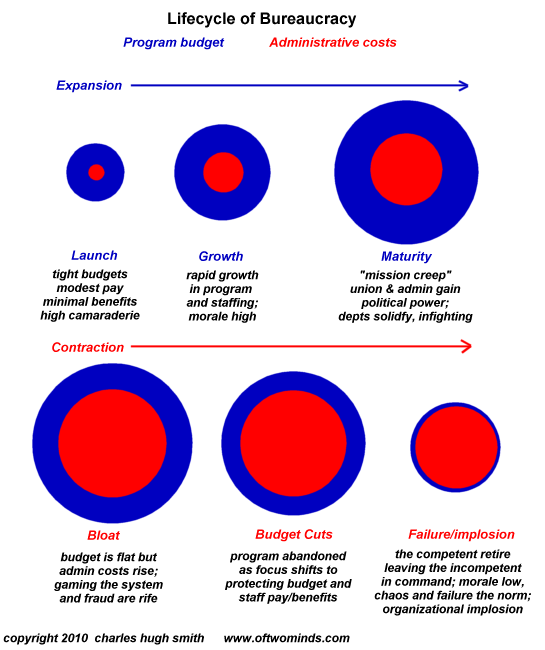
Back in 2010 I prepared this chart of The Lifecycle of Bureaucracy: as bureaucracies expand, they inevitably become less accountable, less efficient, more bloated with legacy staffing and requirements that no longer make sense, etc.

As costs soar, the bureaucracy’s budget is attacked, and the agency circles the wagons and focuses on lobbying politicos and the public to leave the budget untouched.

Since accountability has been dissipated, management becomes increasingly incompetent and larded with people who can’t be fired so they were kicked upstairs. Staff morale plummets as the competent quit/transfer out in disgust, leaving the least productive and those clinging on in order to retire with generous government benefits.

In this state of terminal decline, the agency’s original function is no longer performed adequately and the system implodes from the dead weight of its high costs, lack of accountability, gross incompetence, inability to adapt and staggering inefficiency.

lifecycle-bureaucracy

I’ve covered this dynamic a number of times:

Our Legacy Systems: Dysfunctional, Unreformable (July 1, 2013)

The Way Forward (April 25, 2013)

When Escape from a Previously Successful Model Is Impossible (November 29, 2012)

Complexity: Bureaucratic (Death Spiral) and Self-Organizing (Sustainable) (February 17, 2011)

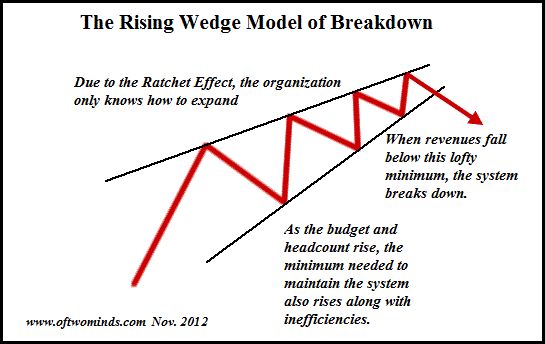
This generates a ratchet effect, where costs increase even as the bureaucracy’s output declines. The ratchet effect can also be visualized as a rising wedge, in which costs and inefficiencies continue rising until any slight decrease in funding collapses the organization.

Dislocations Ahead: The Ratchet Effect, Stick-Slip and QE3 (February 14, 2011)

The Ratchet Effect: Fiefdom Bloat and Resistance to Declining Incomes (August 23, 2010)

rising-wedge

The net result of the Ratchet Effect and the impossibility of reform is this: it’s cheaper and more effective to let the system collapse than squander time and treasure attempting reforms that are bound to fail as vested interests will fight to the death to retain every shred of power and swag.

Since the constituent parts refuse to accept any real reforms, the entire system implodes. We can look at healthcare, higher education and the National Security State as trillion-dollar examples of systems that become increasingly costly even as their performance declines or falls off the cliff.

This is the lesson of history, as described in the seminal book The Upside of Down: Catastrophe, Creativity, and the Renewal of Civilization.

Collapse does not need to be complete or sudden. Collapse tends to be a process, not an event.

Collapse begins when you can’t find any doctors willing to accept Medicaid payments, when the potholes don’t get filled even when voters approve millions of dollars in new taxes, and when kids aren’t learning anything remotely useful or practical despite the school board raising tens of millions of dollars in additional property taxes.

Collapse begins when real reform becomes impossible.

Dead, White, and Blue

Supporters hold signs as Republican US presidential candidate Donald Trump speaks at a campaign rally in Norcross, Georgia, USA, 10 October 2015. The visit, attended by thousands, is Trump's first rally in metro Atlanta since he joined the race. (EPA/ERIK S. LESSER)

The Great Die-Off of America’s Blue Collar Whites 

By Barbara Ehrenreich

Source: TomDispatch.com

The white working class, which usually inspires liberal concern only for its paradoxical, Republican-leaning voting habits, has recently become newsworthy for something else: according to economist Anne Case and Angus Deaton, the winner of the latest Nobel Prize in economics, its members in the 45- to 54-year-old age group are dying at an immoderate rate. While the lifespan of affluent whites continues to lengthen, the lifespan of poor whites has been shrinking. As a result, in just the last four years, the gap between poor white men and wealthier ones has widened by up to four years. The New York Times summed up the Deaton and Case study with this headline: “Income Gap, Meet the Longevity Gap.”

This was not supposed to happen. For almost a century, the comforting American narrative was that better nutrition and medical care would guarantee longer lives for all. So the great blue-collar die-off has come out of the blue and is, as the Wall Street Journal says, “startling.”

It was especially not supposed to happen to whites who, in relation to people of color, have long had the advantage of higher earnings, better access to health care, safer neighborhoods, and of course freedom from the daily insults and harms inflicted on the darker-skinned. There has also been a major racial gap in longevity — 5.3 years between white and black men and 3.8 years between white and black women — though, hardly noticed, it has been narrowing for the last two decades. Only whites, however, are now dying off in unexpectedly large numbers in middle age, their excess deaths accounted for by suicide, alcoholism, and drug (usually opiate) addiction.

There are some practical reasons why whites are likely to be more efficient than blacks at killing themselves. For one thing, they are more likely to be gun-owners, and white men favor gunshots as a means of suicide. For another, doctors, undoubtedly acting in part on stereotypes of non-whites as drug addicts, are more likely to prescribe powerful opiate painkillers to whites than to people of color. (I’ve been offered enough oxycodone prescriptions over the years to stock a small illegal business.)

Manual labor — from waitressing to construction work — tends to wear the body down quickly, from knees to back and rotator cuffs, and when Tylenol fails, the doctor may opt for an opiate just to get you through the day.

The Wages of Despair

But something more profound is going on here, too. As New York Times columnist Paul Krugman puts it, the “diseases” leading to excess white working class deaths are those of “despair,” and some of the obvious causes are economic. In the last few decades, things have not been going well for working class people of any color.

I grew up in an America where a man with a strong back — and better yet, a strong union — could reasonably expect to support a family on his own without a college degree. In 2015, those jobs are long gone, leaving only the kind of work once relegated to women and people of color available in areas like retail, landscaping, and delivery-truck driving. This means that those in the bottom 20% of white income distribution face material circumstances like those long familiar to poor blacks, including erratic employment and crowded, hazardous living spaces.

White privilege was never, however, simply a matter of economic advantage. As the great African-American scholar W.E.B. Du Bois wrote in 1935, “It must be remembered that the white group of laborers, while they received a low wage, were compensated in part by a sort of public and psychological wage.”

Some of the elements of this invisible wage sound almost quaint today, like Du Bois’s assertion that white working class people were “admitted freely with all classes of white people to public functions, public parks, and the best schools.” Today, there are few public spaces that are not open, at least legally speaking, to blacks, while the “best” schools are reserved for the affluent — mostly white and Asian American along with a sprinkling of other people of color to provide the fairy dust of “diversity.” While whites have lost ground economically, blacks have made gains, at least in the de jure sense. As a result, the “psychological wage” awarded to white people has been shrinking.

For most of American history, government could be counted on to maintain white power and privilege by enforcing slavery and later segregation. When the federal government finally weighed in on the side of desegregation, working class whites were left to defend their own diminishing privilege by moving rightward toward the likes of Alabama Governor (and later presidential candidate) George Wallace and his many white pseudo-populist successors down to Donald Trump.

At the same time, the day-to-day task of upholding white power devolved from the federal government to the state and then local level, specifically to local police forces, which, as we know, have taken it up with such enthusiasm as to become both a national and international scandal. The Guardian, for instance, now keeps a running tally of the number of Americans (mostly black) killed by cops (as of this moment, 1,209 for 2015), while black protest, in the form of the Black Lives Matter movement and a wave of on-campus demonstrations, has largely recaptured the moral high ground formerly occupied by the civil rights movement.

The culture, too, has been inching bit by bit toward racial equality, if not, in some limited areas, black ascendency. If the stock image of the early twentieth century “Negro” was the minstrel, the role of rural simpleton in popular culture has been taken over in this century by the characters in Duck Dynasty and Here Comes Honey Boo Boo. At least in the entertainment world, working class whites are now regularly portrayed as moronic, while blacks are often hyper-articulate, street-smart, and sometimes as wealthy as Kanye West. It’s not easy to maintain the usual sense of white superiority when parts of the media are squeezing laughs from the contrast between savvy blacks and rural white bumpkins, as in the Tina Fey comedy Unbreakable Kimmy Schmidt. White, presumably upper-middle class people generally conceive of these characters and plot lines, which, to a child of white working class parents like myself, sting with condescension.

Of course, there was also the election of the first black president. White, native-born Americans began to talk of “taking our country back.” The more affluent ones formed the Tea Party; less affluent ones often contented themselves with affixing Confederate flag decals to their trucks.

On the American Downward Slope

All of this means that the maintenance of white privilege, especially among the least privileged whites, has become more difficult and so, for some, more urgent than ever. Poor whites always had the comfort of knowing that someone was worse off and more despised than they were; racial subjugation was the ground under their feet, the rock they stood upon, even when their own situation was deteriorating.

If the government, especially at the federal level, is no longer as reliable an enforcer of white privilege, then it’s grassroots initiatives by individuals and small groups that are helping to fill the gap — perpetrating the micro-aggressions that roil college campuses, the racial slurs yelled from pickup trucks, or, at a deadly extreme, the shooting up of a black church renowned for its efforts in the Civil Rights era. Dylann Roof, the Charleston killer who did just that, was a jobless high school dropout and reportedly a heavy user of alcohol and opiates. Even without a death sentence hanging over him, Roof was surely headed toward an early demise.

Acts of racial aggression may provide their white perpetrators with a fleeting sense of triumph, but they also take a special kind of effort. It takes effort, for instance, to target a black runner and swerve over to insult her from your truck; it takes such effort — and a strong stomach — to paint a racial slur in excrement on a dormitory bathroom wall. College students may do such things in part out of a sense of economic vulnerability, the knowledge that as soon as school is over their college-debt payments will come due. No matter the effort expended, however, it is especially hard to maintain a feeling of racial superiority while struggling to hold onto one’s own place near the bottom of an undependable economy.

While there is no medical evidence that racism is toxic to those who express it — after all, generations of wealthy slave owners survived quite nicely — the combination of downward mobility and racial resentment may be a potent invitation to the kind of despair that leads to suicide in one form or another, whether by gunshots or drugs. You can’t break a glass ceiling if you’re standing on ice.

It’s easy for the liberal intelligentsia to feel righteous in their disgust for lower-class white racism, but the college-educated elite that produces the intelligentsia is in trouble, too, with diminishing prospects and an ever-slipperier slope for the young. Whole professions have fallen on hard times, from college teaching to journalism and the law. One of the worst mistakes this relative elite could make is to try to pump up its own pride by hating on those — of any color or ethnicity — who are falling even faster.

Barbara Ehrenreich, a TomDispatch regular and founding editor of the Economic Hardship Reporting Project, is the author of Nickel and Dimed: On (Not) Getting By in America (now in a 10th anniversary edition with a new afterword) and most recently the autobiographical Living with a Wild God: A Nonbeliever’s Search for the Truth about Everything.

Leviathan and Behemoth

images

By Chris Shaw

Source: Center for a Stateless Society

Introduction

The capitalist economy has gone through another shock, and the potential for another, larger one is on the horizon. While it’s seemingly in its death throes, capitalism continues to fuel growth. Under such a system we have seen a vast improvement in general living standards across the globe, despite rigged markets and the omnipresent power of the state. However, who is this growth for? While absolute poverty has been rolled back, and in many Western nations completely eliminated, we still see a large, indebted underclass, a Global South regularly sold out to the interests of capital and a system of vast wealth that only seems accessible to a privileged few. Economists may say that if we look at BRIC countries we see an equalisation of wealth and growth with the West, but these BRIC markets are used as cogs in a hegemonic state-corporate machine. Third World entrepreneurship isn’t encouraged, but rather sidelined for corporate dominance. This is a system that needs to end. The debt economy, big government, the corporate-state partnership and modern globalisation all need to end. In their place we need truly free markets, where cooperation and exchange are paramount and aren’t controlled by corporate or government interests.

Our neoliberal society is composed of corporate hegemony backed by state power. By corporate hegemony I mean the power modern capital has over governance. This isn’t just found within corporations, but within guild-like occupational boards (Lawyers and Doctors and their licencing requirements) and corporate trade unions that support the maintenance of wage labour at the expense of worker independence from the structure of capital. Any markets we see are rigged in favour of corporate interests. The major monopolies of government control make sure that markets are a tool of big business and the ability of workers to break free from this paradigm is limited if not impossible. The entry barriers to markets, the restrictions on self-employment and the continued lobbying of government for patronage and favourable legislation leads to a corrupt, crony system that relies on the indenture of the poor in favour of employers and business.

There are many libertarians who unfortunately see this system as just and fair. They see sweatshop labour as an excellent solution to Third World poverty. The idea of growth is given religious prescience, without realising cultural antecedents and the importance of community within the realm of the individual. They don’t understand the power dynamics at play, and the continued collusion of corporate and state interests. They fail to see the monopolisation of social institutions and the commodification of culture and life. The destruction of livelihoods all in the name of GDP growth. This is not a free market, but rather capitalism at work. To move away from this we need to understand that free, or freed, markets are economic organisations free from coercive control, where the individual and community are the key players and profit is not reliant on its exploitative features, but rather the ability to meet real demand.

We need to look at the current capitalist system from the anarchist perspective that I put forward in this paper. Modern capitalism is a state-based system, reliant on enforced hierarchies and the provision of false choice. Real choice would confer power on individuals and communities, while under today’s system real choice is in the hands of bureaucrats and corporate oligarchies. Chartier’s definitions of capitalism, “capitalism: an economic system that features a symbiotic relationship between big business and government”[1] and “capitalism: rule—of workplaces, society, and (if there is one) the state—by capitalists (that is, by a relatively small number of people who control investable wealth and the means of production)”[2] shines light on this conception. Rather than capitalism being a system of free markets as posited by some libertarians (Block, Mises, Hayek, etc.) it is instead a system reliant on big government and its institutions and the control of said institutions via capital.

The vulgar libertarians who view the capitalist economy as some form of free market do not understand the forms of power present. If a worker wants to start a collectively-owned business, can he? Not without huge capital requirements and regulatory hoops to jump through. How about setting up a mutual credit system with a different currency? Well there are legal tender laws that in the United State are enforced with more brutality than the punishments given for heinous crimes[3]. When talking of free markets, we need to understand that freedom is only relative to where the power lies. If it lies with the state and its subsidiaries, then freedom is conferred on large employers and corporate unions whom receive forms of state funding and favourable regulation. If it lay with individuals and communities, we would most likely see a move away from one-size-fits-all regulation, the processes of commodification through rentierism and arbitrary entry barriers.

The Regulatory Apparatus

The regulatory apparatuses found within the economy also benefit the capitalist structure. While generally seen as a bulwark against corporate power, the regulations found in an economy create entry barriers to markets and a form of implicit subsidy to big business, as these businesses rent-seek government for more regulation, allowing for a monopoly within particular economic sectors. We can see in the banking, energy, manufacturing and retail sectors that this is the case. Childs noted this in relation to the development of monopoly power in American business during the late 19th and early 20th centuries. He states “this, then, was the basic context of big business; these were the problems that it faced. How did it react? Almost unanimously, it turned to the power of the state to get what it could not get by voluntary means”[4]. In particular Childs saw this occurring in the rail industry in America during the late 19th century. Massive competition had begun in the rail industry, which massively sunk profits for established companies and encouraged many start ups and smaller competitors. As large rail companies weren’t competitive enough in this environment, they came to rely on government intervention, where regulatory boards were created staffed mostly by executives from the large rail companies.

This is what regulation is really about. It isn’t a way of protecting the hapless consumer from the ravages of a free market, but is rather a tool of corporate power that forms entry barriers and enforces particular dichotomies of ownership and organisation in an economy. Capitalism becomes a system of patronage, where corporations gain favour due to their money and power, which itself comes from the state in the first place. As Paul notes “the rich are more than happy to secure for themselves a share of the loot – for example, in the form of subsidised low-interest loans…bailouts when their risky loans go sour, or regulatory schemes that hurt their smaller competitors”[5]. Rifkin shows a similar process, describing how “the critical industries that made up the infrastructure…banded together in a mega lobby to ensure…financial underwriting, as well as industry-friendly codes, regulations, and standards to ensure market success”[6].

The regulatory apparatuses also have the effect of distorting economies of scale, decoupling supply from demand and favouring largesse in business and ownership models. Thus we see the development of high overhead costs which restrict market entry to best capitalised of entrepreneurs. By limiting competition, we see perverse operations occurring that favour the interests of business over the worker and consumer. Thus things like planned obsolescence, guaranteed markets and a continuation of private gain and socialised loss. As had been noted by Childs, private cartels were difficult to maintain. Even the rail trusts, themselves built in contrived, government-produced markets, were ravaged by competition from smaller rail providers[7] that favoured more local economies of scale. So these corporations looked to the government, who enshrined their demands into acts and legislation which created cartels that were much more easily enforced. We just need to look where wage laws, licensure laws and planning/zoning laws are coming from and who lobbies for them. Invariably its dome by corporations and their lobbying arms. We also forms of legal privilege, as in the case of limited liability and corporate personhood, which are really only accessible with very high capital costs and a developed shareholder clientele. These systems are purely artificial, and whether they would work voluntarily is not the question. Rather it is, if they are efficient, why do they need the government to provide these privileges and apparatuses. The answer is simple, they aren’t efficient.

Even when there are laws supposedly to ameliorate the effects of marketisation, as in the case of welfare and government-provided services, they are usually built on the back of resilient communities who developed their own systems, and usually end up allowing employers to pay subpar wages and benefits and lessen the strength of community relations. It builds layers onto a poor foundation. Or to put it another way, the corporate-state nexus is putting a cinderblock on toothpicks. Bureaucrats don’t fully understand the problem with this but realise it is unstable. So to stabilise it, they put more toothpicks under the cinderblock, thinking it will stabilise. However, the system is inherently unstable and propping it up denies the inevitable.

This assurance of market success shows that under a truly free market they wouldn’t exist, or if they did it would be on a much smaller scale. The regulatory web is just another power dynamic that allows for capture and control. To describe this as a free market is laughable. These processes are completely involuntary, reliant on extortion through taxation and allow for the redistribution of wealth from the poor and middle class to the rich and privileged.

The Money Monopoly

While regulation, which “far from coming against the wishes of the regulated interests, was openly welcomed by them in nearly every case”[8], is an important part of the corporate state, the original four legal monopolies (as identified by Tucker), money, land, tariffs and patents, allowed for the development of rent-seeking corporations. These four monopolies, or as I see them structural monopolies as they create the structure of the socio-economic paradigm, are fundamentals of capitalism.

The money monopoly allows for the restriction of credit and the development of debt-based models that destroy stores of value and make individuals slaves to the desires of governments and banks through modern forms of debt peonage. As Dowd notes, over the 20th century “the US dollar has lost almost 85 per cent of its purchasing power even by official government statistics; for its part, sterling has lost 98 per cent of its value over the last century”[9]. The restriction of credit coupled with the inflationary tendencies of modern fiat currencies mean the poorest are effectively forced into wage labour, as they rely on pitiable increases in nominal wages and are unable to gain any real credit for self-employment or collective worker-owned enterprises. What happens is a redistribution of wealth from the poorest to the richest. Long shows that “inflationary monetary policies on the part of central banks also tend to benefit those businesses that receive the inflated money first in the form of loans and investments, when they are still facing the old, lower prices”[10]. The pre-inflation money allows investors and banks to capitalise on new production and investment while the poorer elements of a society receive minimal benefits as the inflationary course makes its run, with prices rising and wages following later.

This also leads to massive levels of debt found currently throughout the globe, as credit instruments are used to make up for stagnant wages that can’t afford increasing land prices and subsequently rent prices, as well as an increase in the price of consumer goods that are a significant chunk of working people’s wages. The process of rent extraction via high interest rates follows from this, as “the money monopoly also includes entry barriers against cooperative banks and prohibitions against private issuance of banknotes, by which access to finance capital is restricted and interest rates are kept artificially high”[11]. Carson notes further that the elimination of controlled interest rates would lead to “significant numbers (of workers) retiring in their forties or fifties, cutting back to part-time, or starting businesses; with jobs competing for workers, the effect on bargaining power would be revolutionary”[12]. The current banking system leads to the necessitation of wage labour through restricted credit dissemination and debt-based forms of finance.

The Land Monopoly

The land monopoly is another lynchpin of capitalism. Most modern land is either nationalised or corporatised through state structures, leading to massive land centralisation and the process of land expropriation that is visible in much of the Third World. Alternative land arrangements, such as those organised by tribes and local networks, are swallowed up in this process. Many commons regimes that have existed for centuries are being eliminated in favour of the interests of capital. This process of enclosure of common lands began at “the end of the Medieval Age, when royal and feudal landowners began to enclose common lands, especially in Tudor England and Trastamara Spain. Through legal and political manoeuvres, wealthy landowners marked and hedged off sections of the commons for their own profits, impoverishing many villagers and ultimately destroying their communitarian way of life”[13]. The enclosures have continued into the 20th century, where “common lands have suffered a third, global wave of commodification and enclosure, ‘land grabbing’ spurred by the dominant neoliberal doctrine and competition for non-renewable natural resources and supported now by the evolutionary theory of land rights”[14]. The modern enclosures of land occur most noticeably in Africa and South America. We see the elimination of common land owned by native tribes and the raping of natural resources. The Niger Delta and its oil reserves show this acutely, with oil spills being common and almost no compensation to the farmers and workers who rely on the Delta for their livelihoods.

In effect this is a process of neo-colonialism pushed through via the Washington Consensus that is epitomised in international groups like the IMF and WTO. The plight of Bangladeshi workers is caused by this problem of neocolonial practices. In Bangladesh “wealthy and influential people have encroached on public lands…, often with help of officials in land-administration and management departments”[15] which has led to a result of “Many of the rural poor in Bangladesh are landless, have only small plots of land, are depending on tenancy, or sharecropping”[16]. What follows is a continuation of the development of a landless mass of cheap labour as a result of the nationalisation and corporatisation of land.

Then there are planning and zoning laws and property laws which act as a form of implicit land nationalisation in many Western countries. Among their many effects, they artificially inflate land prices, which has a knock on effect of making housing unaffordable and making the purchase of land extremely difficult for small businesses. This further encourages the process of rentierism and indebtedness as individuals have to get out mortgages or rent accommodation, and individuals looking to start a business are priced out, thus favouring large corporations. If you want to self-build a home or business, it becomes impossible. Instead a series of state-favoured land developers are able to land bank and rent out at extortionate rates. They aren’t subject to competition and making new land isn’t possible, so you create a system of patronage and favouritism, simply adding to the enforced necessitation of wage labour.

These processes of land appropriation lead to the development of land speculation via government-favoured industries, creating artificially high land prices which price out small businesses, community groups and anyone who isn’t able seek rent from the state. This speculation also fuels boom-bust cycles, with much of the credit used by investors and businesses being put into the easy investments of land and housing. This creates economic bubbles through the wide diffusion of mortgages and an increase in house and infrastructure building that isn’t necessarily needed. In London, we see this playing out with high-price apartments and high-rises that don’t address the needs of the wider population and are fueled, at least partially, via QE-induced credit. The development of a rentier society occurs. With land prices held artificially high, rich landowners are able to rent out their properties at high prices, creating economic precarity and stimulating the larger wage labour monopoly that is caused by a combination of this monopoly and the money monopoly.

The Larger Wage Labour Monopoly

As previously mentioned, credit is restricted thus funding options are limited for workers. Add to this high land prices, and the ability to buy a house or develop a business are severely restricted, developing the large pool of wage labour seen today. This obviously favours large-scale employers such as corporations who are able develop to their current size due to this wage labour monopoly. It leads to a means of surplus value, or rent, extraction. As Solow notes “one important reason for the failure of real wages to keep up with productivity is that the division of rent in industry has been shifting against the labor side for several decades”[17].

Alongside the two monopolies, the increase in precarious wage labour is compounded by the restriction of collective action and the development of monopolist unions that complement the centralised economic actors. The legislation governing strikes and the ability to make a union add to this problem, making it difficult for freelance workers to unionise and stopping the development of radical trade unions and company unions. Thatcher’s trade union reforms in the UK created such a problem as the majority of private sector unions are part of the corporate system of economic centralisation. The final nail in the coffin is the minimum wage. This creates a wage ceiling and simply allows corporations to price smaller competitors out of the market while subsequently limiting the hours and benefits workers receive. As most minimum wages aren’t enough to live on, many workers rely on debt-based credit which pushes individuals further into wage labour, creating debt-led wage slavery and maintaining a massive, centralising economic monopoly on the choice of workers.

As Solow explains, in the US “in the past 10 years productivity has increased 12.3 percent in the non-farm business sector of our economy while real compensation of labor has increased by only 5.1 percent”[18]. So what we see is a form of surplus value extraction, whereby the excess product of labour is captured by the interests of capital and removed from the compensation of labour. This can’t simply be explained away by using the marginalist critique. The value of a product is at least partially informed by its labour input. Marshall’s analysis shows that “price was determined, at any given time, by the balance between the demand and supply that actually existed at that moment. As the time factor came into play…price approached closer and closer to cost”[19] thus showing that the equilibrium of supply to demand moves from subjective criteria of value toward the input of labour in that value. Again looking at Solow’s productivity figures, the compensation of labour isn’t in proportion to production.

Hodgskin’s idea of a market artificially privileged with rents, profits and interest becomes a reality in the modern context. The increase in freelancing and labour market individuation means the expropriation of rent and the limitation of choice, particularly as unions are simply a representation of the corporate interest, particularly since the Wagner Act in America and the trade union reforms in Britain. The individualisation of labour serves to increase these artificial privileges, meaning can be paid less and thus become more reliant on debt instruments such as mortgages and credit cards to simply earn a living and have a roof over their head. This system is even more acute in the Global South, with the restriction of choice via the structural monopolies being almost explicitly enforced via the government as land in enclosed and regulations used to restrict microeconomic activity that doesn’t serve the interests of global value chains. Their human capital is monopolised, wages restricted, collective action completely banned and working conditions extremely poor. The main profit garnered from this is simply the mark-up created by internal tariffs and intellectual property (to be discussed later in this paper), which limits domestic market production and serves only the interests of capital and big business, as both the workers and consumers are given low wages and higher prices respectively.

What happens then is the construction of a monopsony situation in wages and labour, where the product of labour isn’t adequately paid, becoming widespread due to companies paying below this level. This is compounded by wage laws favoured by corporate interests, and an inability for the worker to capture this value through collective bargaining or through the means of owning one’s productive capacities due to market entry barriers that restrict self-employment and worker or community ownership. It constrains the real choice of workers and puts the power dynamics upon employers and bureaucrats.

Tariffs

The next two monopolies that Tucker highlighted further the centralisation of economic power toward corporations. Tariffs are simply a form of direct state intervention to favour domestic industry over foreign competitors. There are arguments favourable to this position, such as those by List and Chang. However, there is a significant time limit on the ability of tariffs to produce any sort of growth (usually artificially induced by state policies), and eventually many of the protected industries become bloated and begin to rely on further government subsidy.

The use of tariffs today is much more limited than it was during the mercantile years of the 17th and 18th centuries. However, one area where tariffs are still largely used is modern agriculture in the West, particularly the US and the EU. The Farm Bill in the US creates price distortions within food markets that favours large agribusiness over small, family farms. As Reitzig explains “the farm bill perpetuates the myth of cheap food. It subsidizes Big Ag so that BA can sell its food to the market cheap and you find it at the grocery store for less than you’d pay for it from your local farmer”[20]. However as “it costs the small local farmer about the same to produce the same food as the Big Ag farmer”[21], all the Farm Bill does is redistribute tax money toward large agricultural firms. The economies of scale thus get changed, with farmers forced into retail sector bulk sell offs that are increasingly inefficient and perpetuate the agricultural tariffs and subsidies.

There also forms of internal tariffs that protect large industry through direct subsidisation. For example “between 1973 and 2003, the US government paid out $74 billion in energy subsidies to promote R&D in fossil fuels and nuclear power”[22]. This was despite these companies having huge profit margins, which shows the actual profitability of these industries. They are reliant on institutions of theft to simply develop critical infrastructure as a result of their internal unproductiveness and their falling foul of the economic calculation problem. It creates a system of perverse incentives as these firms aren’t induced to work and develop in smarter, cleaner ways and instead produce the same limited output. This is corporatism at its finest, with government purposefully favouring large firms over small firms, and thus encouraging wasteful practices. Returning to farming, the EU holds similar policies, which in many ways restrict crop diversification and mean that certain farmers are favoured over others. This leads to artificially low prices which allows for retail monopolisation due to farmers being unable to sell their own product due to EU regulations which create this system. It is a continuation of the obstinate incentives that leads to overproduction, false demand and the entrenchment of economic disadvantages and inefficiencies.

Patents

Patents act in a similar way. They privilege large businesses in rigged markets and allow for centralisation and monopolisation. “The patent privilege has been used on a massive scale to promote concentration of capital, erect entry barriers, and maintain a monopoly of advanced technology in the hands of western corporations. It is hard even to imagine how much more decentralized the economy would be without it”[23]. Patents act to lock up innovation in a legal quagmire. It puts new technology into the hands of capital, limiting its distribution and creating a rentier system, where the privilege to use new technology and even knowledge is commodified by large corporations in collusion with the state.

This inability to access new technologies and knowledge creates a form of entry barrier, with smaller competitors being unable to afford this access. Most modern tech companies (Google, Apple, Microsoft) are in effect monopolists of knowledge and technology, limiting its accessibility and collecting the rent they charge on these products. Their market position becomes entrenched with restrictive data laws and copyrights that mean the passage of information is blocked by virtual, artificial toll gates that wouldn’t exist if not for coercive legislation.

Then there is the direct government subsidisation of research and development (R&D) spending that allows for large companies to reap “monopoly profits from technology it didn’t spend a penny to develop”[24]. Modern tech companies then are not only monopolists of patented of knowledge but also rentiers of technology they had no real part in developing. So while small inventors and start ups toil away trying to create a product that can only be sold on a rigged market, large firms benefit purely because of their power and the revolving door of government benefaction. Similar processes occur in military-based R&D spending, where corporations are given large grants and procurement contracts to develop military hardware and weaponry that on a freed market would not even necessarily be required by any customer or business. As Chomsky notes, in the US “the Pentagon system has long been the country’s biggest welfare program, transferring massive public funds to high-tech industry on the pretext of defense and security”[25]. These companies’ profits and growth are not then created in a market mechanism of competition and demand-led supply, but rather in a bubble of government-led protection, where they ride on the coattails of stolen innovation and forms of theft AKA patents and taxation respectively. “If they had to face the market, they’d be out selling rags or something, but they need a nanny state, a powerful nanny state to pour money into their pockets”[26].

Further, this process of patenting becomes a pure form of commodification as they remove products and ideas from their cultural origins. For example, the Human Genome Diversity Project used DNA from certain indigenous tribes in Central and South America. Some of this DNA was patented, and thus removed from the culture it came from without any sort of compensation by the HGDP and the beneficiaries of this knowledge. Biocolonialism and biopiracy are the best terms for this occurrence. By extracting culturally sensitive information and knowledge, a process of commodification occurs, and the whole concept of property, that of the sovereign ownership of the individual or collective, becomes redundant. Further the innovative capacities that supposedly come from intellectual property are limited if not completely negative. In fact the information that was patented was found to be 30% less innovative than the information released for full public use[27].

This analysis is backed by evidence from Scherer, who showed “a survey of 91 companies in which only seven ‘accorded high significance to patent protection as a factor in their R & D investments.’ Most of them described patents as “the least important of considerations.’ Most companies considered their chief motivation in R & D decisions to be ‘the necessity of remaining competitive, the desire for efficient production, and the desire to expand and diversify their sales”[28]. Thus patents and intellectual property “eliminate ‘the competitive spur for further research’ because incremental innovation based on others’ patents is prohibited, and because the holder can ‘rest on his laurels for the entire period of the patent.’ with no fear of a competitor improving his invention”[29].

Transport Subsidies

The fifth monopoly, transport subsidies, is one that has been identified by Carson. As Carson describes, “spending on transportation and communications networks from general revenues, rather than from taxes and user fees, allows big business to ‘externalize its costs’ on the public, and conceal its true operating expenses”[30]. These transportation subsidies allow for the development of large business operations, particularly in the retail and manufacturing sectors. By subsidising the movement of goods by heavy duty vehicles, it means they are given a state-based competitive advantage against smaller, local competitors.

Companies like Wal-Mart and Tesco are able to price their goods artificially cheaply as a result of not adding the transportation costs. Many of these companies actively lobbied for such infrastructure projects. When the interstate system was being built, it “had both an immediate stimulus effect on the industries that participated…oil companies, general contractors, cement manufacturers, steel companies…were among the dozens of industries involved in the building of the great interstate highway system”[31] showing the degree of corporate-state cooperation. It was because these infrastructure projects benefitted their products and models that they lobbied for them.

Of course Carson’s view of this quite US-centric. In much of Europe, particularly the UK, we see other regulations that create a very different kind of transport subsidy. While these nations do subsidise transport via taxation to pay for roads rather than using user fees or road pricing, they also have high fuel duties and regulation on forms of transport, such as regulations on truck design and usage. The fuel duties act as a subsidy in the sense that they destroy small transport firms and simply monopolise the transport industry as only larger companies can afford the higher prices. The forms of regulation mentioned mean that innovation into new vehicle design and competition between firms is limited and simply continues the dominance of particular transport and production companies that aren’t subject to market competition. Thus what we see are two different types of transport subsidies that both act to continue the current economic paradigm.

These subsidies serve to amplify economies of scale, creating national and international markets largely in the control of corporate interests. These large markets create systems of disequilibrium, with monopoly interests being able to develop oligopoly markets from which rents can be extracted. A modern example of this is the creation of HS2 in the UK. It serves as a vanity project for political and bureaucratic elites, who can gain well-paying jobs as political advisors and construction directors. It also allows for the continuation of the North-South divide, with large London-centric firms sucking out talent from the North and Midlands, at little expense to themselves. As Wellings describes it, it’s an example of externalised costs and internalised benefits, with vested interests serving to gain[32]. Economies of scale are created artificially, with competition in local markets suffering due to a project only favourable to London-based businesses. Local economies of scale, which are more natural and more open to individual considerations and supply and demand, are priced out by government intervention. Local transport projects, like roads linking market towns and local rail infrastructure, are ignored due to a lack of political prestige for politicians and their donors and lobbyists.

Road and rail subsidised by the state leads to the current economies of scale that favour large, centralised business entities. It also prices out and discourages private infrastructure projects that could actually make an economic difference by increasing competition and lowering prices, while maintaining local economies of scale which benefit large swathes of areas that currently don’t benefit from the subsidised corporate model. These three monopolies further the wage labour monopoly, by erecting entry barriers against small business and self-employment and by creating feudalistic patent regimes and transport systems that create favourable economies of scale. National markets serve larger companies and hierarchical organisation, and international markets continue to serve and enlarge this. It pushes real costs onto the consumer/taxpayer, and further creates illegitimate profits taken from oligopoly markets.

The Corporate Infrastructure

This wage labour monopoly, with the five structural monopolies feeding it, is the basis of the modern corporate dominated economy. As a result, modern corporations act as oppressive actors on the world stage, using wage slaves and forms of indebtedness to develop the massive growth seen in the 20th and 21st centuries. As Carson states “in a very real sense, every subsidy and privilege described above is a form of slavery. Slavery, simply put, is the use of coercion to live off of someone else’s labor. For example, consider the worker who pays $300 a month for a drug under patent, that would cost $30 in a free market. If he is paid $15 an hour, the eighteen hours he works every month to pay the difference are slavery. Every hour worked to pay usury on a credit card or mortgage is slavery. The hours worked to pay unnecessary distribution and marketing costs (comprising half of retail prices), because of subsidies to economic centralization, is slavery. Every additional hour someone works to meet his basic needs, because the state tilts the field in favor of the bosses and forces him to sell his labor for less than it is worth, is slavery”[33].

Then there is the system of incentives created by this corporate-state monopoly. Infrastructures are developed that maintain the inefficiencies. Rifkin’s analysis of a series of Industrial Revolutions shows this to be the case. The Second Industrial Revolution, the current economic system we live in according to Rifkin, is reliant on state-invested infrastructure and subsidisation[34]. The subsidisation of natural capital is one example of this. Roberts shows that “the total unpriced natural capital consumed by the more than 1,000 “global primary production and primary processing region-sectors” amounts to $7.3 trillion a year — 13 percent of 2009 global GDP”[35]. The term natural capital is obviously a broad, all-encompassing term. The specifics are those of the production of pollutants that is subsidised by specific tax breaks and forms of limited liability. These follow from elements of the land monopoly which means pollution becomes an externalised cost upon taxpayers, furthering the inefficiencies of a particular economic paradigm, which Rifkin calls the Second Industrial Revolution but what I would call capitalism.

The maintenance of this system means most companies that are reliant on fossil fuels and the energy and transport infrastructures that follow from them have no incentive to divest into new market ventures, but instead have an interest in resource and capital accumulation. It creates ‘revolving door’ government, where lobbyists persist in convincing policy makers for subsidies here and tax breaks there all the while relying on the rent extraction they gain from state intervention.

This process within resource extraction and energy use is more widely seen in the general production processes of capitalism. The levels of overproduction and continued consumption are fed by the structural monopolies, as well as justifying the wage labour monopoly. To fund the levels of consumption needed to continue production means people are put into a paradigm of working longer to buy more things to enjoy. Its paradoxical as you spend more time at work, thus limiting the amount of time you have to actually enjoy consumer goods. Further, as goods become more expensive due to increasing cost mark-ups and inflationary policies, and housing prices and rents go up due to land speculation and monopoly ownership, more people become reliant on debt instruments to fund their everyday lives and their increasing consumer spending. This has created a precipitous debt bubble as Steve Keen’s work has shown. It has also meant that much of the current growth seen since the Great Recession has been on the back of consumer spending, as Blanchflower has documented.

Incentives are created which lead to increasing, unnatural growth and increasing levels of debt. In particular, levels of corporate debt have skyrocketed during the recession of 2008. This is due to systemic overproduction and waste that has developed due to mass production systems used by most multinationals. The structural subsidies create this system where large production facilities with forms of guaranteed profit are needed for massive market areas, usually on a national or international level. Carson has pointed out that modern markets are hardly an example of spontaneous order and aren’t reliant on supply and demand[36]. Rather the system is reliant on a system of planning, with codified relations between suppliers and distributors and systems of guaranteed consumption through external market control in the form of internal sales tariffs and the financialisation of the economy.

Internal sales tariffs limit what stores/areas products can be sold in, and are only viable as a result of intellectual property regimes that allow for increased costs and a further disconnect between production and consumption. Financialisation on the other hand simply maintains the production systems as well as processes of commodification. It makes corporate debt a commodity, and puts value into meaningless products, which allows for more accumulation and overproduction as business isn’t rewarded for genuine wealth production and creation, which comes from artificial processes, but is rewarded rather by debt financialisation, unsustainable growth in bureaucracy and the continued expropriation of surplus value, or human capital. This also represents a commodification process, as the social relation of debt, as identified by Graeber and Martin, is put into an economistic context, with debt serving the purposes of profit and capital. The debt relationship, that’s shaped by community relations and gift-giving and receiving[37], is taken as a value of capital. And this debt is allowed to build up and shape other economic activity. Consumer purchase after consumer purchase represents this. It is encouraged, and when it slows the government takes over and funds through quantitative easing programs, allowing for the construction of bigger, more complex bubbles. It shows that corporation and government are two sides of the same coin.

We have to remember that as much as governments, corporations are just as likely to be effected by the knowledge problem. To get around, every relationship and process is effectively planned. Business to business relations, as seen in distribution and supply chains, are maintained for decades by large manufacturers so as to continue guaranteed buyers of their products. In other cases, the supply and warehousing operations are subsumed by the manufacturer, owning every process from production to sale. Global value chains are an outgrowth of this hierarchalised control and planning, with much of their success being guaranteed by government. It is dictatorial governments in the Global South (who usually have the backing of the US government and its interests) that ban collective action among labourers through extraordinarily harsh measures, it is trade agreements with their backing by Western governments that maintain artificial property rights such as patents and it is government that externalises the cost of global transportation of these goods onto the taxpayer, thus distorting economies of scale to favour the large corporations and forms of state-corporate economic planning. In other the words, the commodification and Sovietisation of the economy.

Culture Under Capitalism

A paradigm that enforces this economic hierarchy is created, where life is work and your main identity is around the soul-crushing job you inhabit. Social relations are commodified and local economic activity is strangled. The whole idea of community in the 21st century is being replaced by a centralised state and economic activity that has no interest in that community, but is inward looking, determining profit margins rather building strong societal relations. The ability to escape this paradigm is extremely limited by the coercive hand of the state. It restricts collective organising, eliminates common and private property and develops extremely insufficient systems of economic organisation.

What we’ve seen is the disembedding of markets from their cultural and social origins[38]. Relations of debt and consumption, which were as much in political institutions and based around social relations, have been expropriated by capital. Thus instead of markets forming one of many different idea of economic organisation of which it could complement, we see the neoliberal discourse of praising markets and even seeing marketisation in what have been social relations up to this day. Thus public services such as health and energy are wrapped in discourses of competition and corporate ownership. However, markets aren’t actually like this. If we look to genuinely free markets, which are few and far between, we don’t see large production and corporate ownership. Instead we see markets crafted around local institutions and genuine demand for certain goods and services. Ownership is much more decentralised. However, due to government-based price and scale distortions, culture and its institutions are brought into the marketised economy, creating the marketised society.

 It leads to the development of modern consumerism, creating warped identities based around products. It kills culture and intelligence in favour of an advertised individual. Carson shows that “mass production divorces production from consumption. The rate of production is driven by the imperative of keeping the machines running at full capacity so as to minimize unit costs, rather than by customer orders. So in addition to contractual control of inputs, mass-production industry faces the imperative of guaranteeing consumption of its output by managing the consumer”[39]. The consumer is separated from the producer. Mass production means a consumer culture. Rather than supply meeting demand, demand is made to compensate for oversupply. It also creates forms of consumer inequality that mean Third World workers have almost no access to the products they help produce. The development of domestic markets in consumer goods is massively restricted via patents and tariffs.

Within the Western world there is similar consumer inequality, with a creation of an underclass who desire consumer goods that their limited wages can hardly afford. Bauman’s analysis of the London Riots in 2011 saw an element of this consumer yearning, with products like high-end trainers and flat-screen TVs being taken. Bauman notes that “from cradle to coffin we are trained and drilled to treat shops as pharmacies filled with drugs to cure or at least mitigate all illnesses and afflictions of our lives and lives in common. Shops and shopping acquire thereby a fully and truly eschatological dimension”[40]. The cultural backwater caused by modern consumerism creates a form of stigmatisation and symbol status, with haves and have nots developing into distinct classes in a consumer culture. As Bauman states “for defective consumers, those contemporary have-nots, non-shopping is the jarring and festering stigma of a life un-fulfilled — and of own nonentity and good-for-nothingness. Not just the absence of pleasure: absence of human dignity. Of life meaning”[41].

The processes of commodification amplify this systemic crisis. The divorcing of production from consumption leads to the most atomistic forms of individualism. It becomes a process of overconsumption and hoarding, without any appreciation of the product development. Cultural and societal obligations and considerations get uprooted by what is wanted and what can be bought. It puts value squarely into the hands of capital, with the determination of worth being decided in social hierarchies that follow from the enforced economic hierarchies of modern capitalism. It is a symptom of the false choice of employment or death, of work creating one’s value in life and of a market shaped not by workers, communities and cultures but by the interests capital and the state that props it up.

Conclusion

This system is massively unsustainable, and becomes more and more reliant on tax revenues to make it profitable. The price system becomes distorted, encouraging the mass production that “leads to ever-increasing demands on state services”[42]. This then shows the inefficiency of large corporations. They are as much subject to the economic calculation problem as the state. Their reliance on the theft of individual income via the taxation system means in anarchist society they are completely unviable. As a system of economic organisation “capitalism could not have survived at any point in its history without state intervention. Coercive state measures at every step have denied workers access to capital, forced them to sell their labor in a buyer’s market, and protected the centers of economic power from the dangers of the free market”[43].

In systems of anarchy, there would be an end to corporate dominance due to their inability to seek state rent and thus collapsing in their inefficiencies. As noted by Carson, there were two paths that could have been taken to organise industry and the economy. The one that was followed was “centralized production using expensive, product-specific machinery in large batches on a supply-push basis”[44]. However a better system was possible. One of “decentralized production for local markets, integrating general-purpose machinery into craft production and governed on a demand-pull basis with short production runs and frequent shifts between product lines”[45]. This would have required localised industry, networked communities and what Rifkin calls lateral, distributional, collaborative markets. Workers would be independent of capital, and have an ability to take back their surplus value. It would involve voluntary governance structures and self-organised communities. It would be an end to the corporate-state nexus.

By having this centralised system, we open the floodgates to the continuation of boom-bust cycles through monopoly government control. Since the delinking of production from consumption, there has been a development of mass production and the apparatuses that prop it up. Marx noted this particular phenomenon, with “the birth of large-scale industry this true proportion had to come to an end, and production is inevitably compelled to pass in continuous succession through vicissitudes of prosperity, depression, crisis, stagnation, renewed prosperity, and so on”[46]. This process in the end favours the capitalists. It destroys real value in an economy and allows for more government involvement. Further, it leads to capital accumulation through government subsidisation and the monopoly position many modern corporations hold within their respective markets.

It’s a process of artificial wealth accumulation and creation, backed by the five monopolies previously mentioned. High land prices, restrictive credit access and the use of interest rates to effectively distort the value of currency, the use of market entry barriers through regulations and patents and the use of transport subsidies all favour the main monopoly, that of wage labour. Because of the diminishing returns that many of these companies are finding, they are becoming increasingly reliant on the extraction of surplus value from their workers. As mentioned earlier, wage laws allow them to eliminate smaller competitors and the development of varied, precarious work contracts mean a diversification of their workforce, which allows them to reduce hours paid and thus reduce their labour costs. However, the compensation of a worker’s product isn’t necessarily met. Thus the accruing of capital simply means the extraction of rent from workers, which is enforced by the limitation of worker’s to pool their labour value and capital and develop their own industry in a truly free market.

Government is the glue which holds capitalism together. Without it, the economies of scale, the appropriation and centralisation of land and the distortion of inputs and outputs would be impossible. Without a central bank, the destructive tax of inflation wouldn’t be feasible in a competitive currency market. The redistribution of wealth and malinvestment couldn’t occur on the same scale as markets would act as a corrective against these activities. The use of tariffs and patents to lock up technology and create artificial wealth couldn’t happen without the state’s coercive power. Economic organisation is a fluid concept, that changes from place to place and people to people. What is right for one community or tribe is not what is necessarily right for another. A freed market would reflect this, as it would embed markets in pre-existing cultural/social structures and stop the developments of commodification and neo-colonialism that persist presently. This is a world free of state-action and corporate control. This is anarchism.

Bibliography

Bauman, Z. (2011). The London Riots – On Consumerism Coming Home To Roost. Available: http://www.socialeurope.eu/2011/08/the-london-riots-on-consumerism-coming-home-to-roost/. Last accessed 21st Sep 2015.

Carson, K (2007). Studies in Mutualist Political Economy. United States: BookSurge.

Carson, K. (2010). The Distorting Effects of Transportation Subsidies. Available: http://fee.org/freeman/the-distorting-effects-of-transportation-subsidies/. Last accessed 15th Sep 2015.

Carson, K (2010). The Homebrew Industrial Revolution. United States: BookSurge.

Carson, K. (2002). The Iron Fist Behind the Invisible Hand. Available: http://www.mutualist.org/id4.html. Last accessed 25th Sep 2015.

Chartier, G. (2010). Advocates of Freed Markets Should Embrace “Anti-Capitalism”. Available: http://c4ss.org/wp-content/uploads/2010/01/chartier.anticapitalism.pdf. Last accessed 14th Sep 2015.

Childs, R. (1971). Big Business and the Rise of American Statism. Available: http://praxeology.net/RC-BRS.htm. Last accessed 16th Sep 2015.

de Ugarte, D. (2015). Biomedical patents reduce innovation by 30%. Available: http://blog.p2pfoundation.net/biomedical-patents-reduce-innovation-by-30/2015/09/09. Last accessed 16th Sep 2015.

Dowd, K (2014). New Private Monies. London: Institute of Economic Affairs.

Long, R. (2008). Corporations versus the Market; or, Whip Conflation Now. Available: http://www.cato-unbound.org/2008/11/10/roderick-t-long/corporations-versus-market-or-whip-conflation-now. Last accessed 15th Sep 2015.

Martin, F (2013). Money: The Unauthorised Biography. London: Bodley Head.

Paul, R (2007). The Revolution: A Manifesto. 2nd ed. United States: Grand Central Publishing.

Polanyi, K (2002). The Great Transformation. 2nd ed. Boston: Beacon Press.

Reitzig, L. (2014). Farm Bill 2014 or “The Destruction of Small Family Farms”. Available: http://nourishingliberty.com/farm-bill-2014-just-how-bad-is-it/. Last accessed 21st Sep 2015.

Richman, S. (2013). Bangladeshi Workers Need Freed Markets. Available: http://fff.org/explore-freedom/article/bangladesh-needs-freed-markets/. Last accessed 16th Sep 2015.

Rifkin, J (2011). The Third Industrial Revolution. New York: Palgrave MacMillan.

Roberts, D. (2013). None of the world’s top industries would be profitable if they paid for the natural capital they use. Available: http://grist.org/business-technology/none-of-the-worlds-top-industries-would-be-profitable-if-they-paid-for-the-natural-capital-they-use/. Last accessed 16th Sep 2015.

Shorr, I. (1996). On US Military Budgets. Available: http://www.chomsky.info/interviews/19960211.htm. Last accessed 25th Sep 2015.

Solow, R. (2015). The Future of Work. Available: http://www.psmag.com/business-economics/the-future-of-work-why-wages-arent-keeping-up. Last accessed 16th Sep 2015.

StopHS2. (2013). “Classic Example” of Vested Interests. [Online Video]. 18 November. Available from: https://www.youtube.com/watch?v=r94VP3USOuE. [Accessed: 31 October 2015].

Vivero Pol, J. (2015). Transition towards a food commons regime. Available: http://poseidon01.ssrn.com/delivery.php?ID=9851100240740070870950101221090931190350100270460840350111130010740820980970930810660540551030481120240140671180910151151060840400590600730100851021250261111. Last accessed 15th Sep 2015.

Notes:

[1] Chartier, G. 2010, 1

[2] Chartier, G. 2010, 2

[3] Dowd, K. 2014

[4] Childs, R. 1971

[5] Paul, R. 2009, 70

[6] Rifkin, J. 2011, 134

[7] Childs, R. 1971

[8] Childs, R. 1971

[9] Dowd, K. 2014, 85-86

[10] Long, R. 2008

[11] Carson, K. 2002

[12] Carson, K. 2002

[13] Vivero Pol, L. 2015, 9

[14] Vivero Pol, L. 2015, 9

[15] Richman, S. 2013

[16] Richman, S. 2013

[17] Solow, R. 2015

[18] Solow, R. 2015

[19] Carson, K. 2007, 50

[20] Reitzig, L. 2014

[21] Reitzig, L. 2014

[22] Rifkin, J. 2011, 134

[23] Carson, K. 2002

[24] Carson, K. 2002

[25] Shorr, I. 1996

[26] Shorr, I. 1996

[27] de Ugarte, D. 2015

[28] Carson, K. 2002

[29] Carson, K. 2002

[30] Carson, K. 2002

[31] Rifkin, J. 2011, 134

[32] Wellings, R. https://www.youtube.com/watch?v=r94VP3USOuE

[33] Carson, K. 2002

[34] Rifkin, J. 2011

[35] Roberts, D. 2013

[36] Carson, K. 2010

[37] Martin, F. 2013

[38] Polanyi, K. 2002

[39] Carson, K. 2010, 50

[40] Bauman, Z. 2011

[41] Bauman, Z. 2011

[42] Carson, K. 2010, 111

[43] Carson, K. 2002

[44] Carson, K. 2010

[45] Carson, K. 2010

[46] Carson, K. 2010, 256

The Mechanics Of A Free Society

anarchism_defined_by_ztk2006-d3j3ga4

By Colin Turner

Source: Freeworlder

Most people who have given any consideration to a moneyless, ‘free world’ society are already aware that we have the technology today to create a world of abundance without the constraints and inequality of the traditional market system, owing to how much human labour can now be efficiently automated.

Without scarcity, and a massive reduction in the need for labour, money effectively becomes obsolete. That’s the theory. But it’s not the full story, nor does it convince everybody who comes into contact with the theory. In fact, it convinces surprisingly few indeed.

In my opinion, this kind of super-advanced “Star Trek” moneyless society is still quite a distance away – not because we lack the technology – but because we humans lack the openness and understanding required to make it work.

A truly free society should be just that – unlimited, self-determining and self-organising for the optimum benefit of all. Today it appears that, left to our own devices, humanity just can’t wait to blow itself to pieces. How can you de-regulate society and hope to achieve equilibrium against that backdrop?

Let us remind ourselves that today we share our world with people separated by walls to stop them killing each other, giant corporate agencies detached from the social and ecological effects of their business, people who kill animals for pleasure, and, worst of all, a population that has somehow programmed itself to consume recklessly to compensate for its own imagined insecurity.

To my mind, celebrity/brand worship, religious fervour, and xenophobic flag-waving are all here to remind us that – irrespective of our technological advances – we still have a long way to go before humanity can unite in the common purpose of sharing our world and its bounty equitably and sustainably for all.

As someone who has considered these ideas perhaps more than most, I have had plenty of time to critique and refine my own philosophy along the way. As a result of these self-inquiries, I have come up with a number of ideas that I believe can help us paint a fuller picture of what to expect in a free society, and some ways that we can enact it today.

Social Gravity

This is the glue that keeps society together. We are a social species. By and large, we prefer to do things together. We naturally gravitate into groups, teams, villages and cities.

This all stems from one basic human need –  the urge of individuals to belong to something greater. Everything from our cities, our cultures, our religions, even our great unwritten social contract of be-good-to-others – stems from this need.

Social Gravity is the force that naturally binds us – even keeping our unfair, outdated system together, with all its flaws. This is because most people prefer to accept the broader consensus rather than apply radical new thinking. The fact that it keeps our system together, in plain view of its injustices and suffering, tells you just how powerful a force Social Gravity is.

Now imagine how much more powerful this force could be in a society that positively promotes life, health, diversity and happiness for all. Social Gravity is the primary force that will bond a free society and make it work.

Currently, most free world advocates are fighting against Social Gravity as they meet peoples’ resistance to radically new ideas and change. But we know this is changing ever more by the day as these people are beginning to question the logic and injustice of the prevailing system themselves.

As more change their viewpoint, the more they ‘normalise’ the environment for others to do so too. This is why it’s important to let people know how you are thinking. Even if they disagree now, you will probably become a point of reference for them later as they too begin to change.

This natural social pressure is what will maintain order, balance and efficiency in a free society. The more people benefit from it, the stronger that force becomes.

Self-Determination

Most people do not understand the true meaning of anarchy – to the point that I’ve almost given up using the term. Over the years, the media and prevailing thought have suffused its meaning with disorder, chaos and violence. But this is not anarchy – this is usually just the collapse of oppression.

Our screens are often filled with views of young people rioting, throwing missiles or looting shops, with the strong suggestion that they have become ‘lawless’, or that ‘law and order’ need to be restored – but this is a deep and dangerous misunderstanding.

Scenes like this are, in fact, the backlash of oppression. Whatever happened before is what creates those scenes. This is anger, not anarchy.

The best way to describe anarchy is to look to the animal kingdom. By and large, animals are peaceful creatures and will happily co-exist with each other in a steady-state* environment. The only time an animal is ever violent is when it must kill to eat, or when threatened, and – crucially – no animal ever kills more than it needs.

This is self-determination – the default behaviour of all beings. When survival is not threatened, peaceful coexistence is the default state of all animals, including humans. It’s simply easier than violence.

History books and media are full of references to aggressive culture, heinous acts of violence and torture – man pitted against fellow man. This gives an abiding impression of a bloodthirsty homo sapiens, indiscriminately bludgeoning all in his path to get what he wants. But this is a false impression, and yet another dangerous misunderstanding of the world and of ourselves.

The reason for this is simple. Wars, conflict and aggression make for more interesting stories so are always reported on and read about in our history books and media. Whereas, peace and non-conflict is essentially boring and does not get written about – yet it probably accounts for 99.999% of all human behaviour.

For every lunatic who takes up a gun and starts killing people, there are millions and millions of other people who don’t, but we never hear about them. The reality is, our human experience, from a statistical point of view, is almost entirely peaceful.

A self-determining society doesn’t use or require laws. Laws were invented primarily to protect private interests and enforce the payment of taxes. In a world of abundance, open access and greater understanding of ourselves, these laws would become redundant.

Nor do we need laws to protect ourselves from each other, as that basic morality is already hard-wired into us. We are a social species. We want to get along. We all experience this spirit of humanity every day in the help we get from our work or student colleagues, our friends and families, and from strangers – even in times of crisis. When financial stress is gone, people are good to each other.

The ideological boundaries between us – culture, religion, nationality, etc – are purely superficial, and friction between differing views – much of which is inequality-based – can only diminish as the common ideals and benefits of a free society become apparent.

As long as we each have our survival needs met by society, there is nothing to compete for – at least nothing that is worth killing or dying for.

Of course, we cannot expect self-determination to automatically rule out all acts of senseless violence or anti-social behaviour, but once scarcity is not an object to peoples’ existence, we can certainly expect to reduce such incidences to a minimum.† (See Anti-Aggression Strategies)

* A steady state environment is an environment where scarcity and territories are not an issue. Technically, we humans have long since solved the problem of scarcity through the application of technology. We just have to work on our own ‘software’ to create a fair distribution system for it. Also, by doing so, we will regain sufficient trust between each other to render our territorial and cultural boundaries as meaningless as county lines.

† It’s worth pointing out that senseless violence and anti-social behaviour are already common daily occurences under our current law system – most of which can be related directly to scarcity and inequality. It seems wholly unreasonable to assume such behaviour would increase in a self-determining, abundant society.

Life Education Program

To give a free society any chance of succeeding or surviving, a radical overhaul of our current education system is essential. By and large, our current system prioritises reading, writing and arithmetic as core learning, but, in my opinion, these are far from the most important skills we need to acquire.

Children from the earliest age (even from 0) must have access to the most important information that can help them live a rich and fulfilling life, with all the skills for building great self, inter-personal and community relationships. This information can easily be compiled for children of all levels of cognisance.

Here are some examples of topic headings (though I’m sure many more could be extrapolated here):

  • Nature
    Introduction to our planet, our ecosystem, death and the cycle of life, appreciation of all life.
  • Environment
    Ecology, the food chain, water, weather, city and bio-systems, energy, sustainability, regeneration.
  • Community
    The mechanics of community, the purpose and benefits of sharing, respect, trust, empathy, being responsible, leadership, team-work, resolving disputes,  appreciating unfamiliar races and cultures.
  • Self
    Anatomy of self, basic hygiene, health, nutrition, hydration, oxygenation, meditation, massage, self-awareness, self-acceptance, self-respect.
  • Life Skills
    Interpersonal relationships, effective communication, empathy, understanding and coping with negative emotions, problem solving, critical thinking, creative expression, food growing and preparation, sex, parenting and family.

Of course, traditional learning still has enormous value and will continue to be taught in a free society, but relevant and practical lessons on life and life skills must have precedence in order to create better, happier communities.

By building Life Education as a modular program, we could even start introducing this vital new education in stages today.

Community Service

While many necessary jobs in the community will naturally be filled by those passionate and motivated enough to devote their time unconditionally to it, there will invariably be a shortfall in volunteers to participate in some of the less glamorous functions of modern society – like sweeping the roads, etc.

Community service is a concept that most of us are already familiar with – though we usually associate it with punishment for petty criminals. But the fact is, organised community service is undoubtedly the most efficient way to deliver essential services equitably within a large population.

In the enactment of a free society, every member of the community should be encouraged to contribute a reasonable minimum number of hours community service a month. Remember, for a society without conventional employment, this would be a trivial commitment for most people.

A monthly schedule of required services and tasks in the community could be published, where members would opt to participate in whichever tasks best suited their skills and availability at the time.

The number of recommended hours per month would obviously depend on local factors, ie. what needed to be done, population number, availability of skills, complexity of tasks, etc, but the idea is to keep peoples’ commitment to a minimum by spreading the community workload as widely as possible.

Children should also be actively encouraged to engage in their community’s projects from as young as possible – and in as many diverse tasks as possible. This would help them discover their own aptitude, engage with the community, and gain valuable life experience in the process.

Each service task would have a strong social aspect, where people are encouraged to work in teams, during the same hours, and towards common goals. There’s no reason why community work in a free world should ever be onerous, or could not even be carried out in entertaining ways.

For example, with a little imagination, some tasks could even be turned into sports events where teams compete to fulfil tasks, or see who can come up with the most innovative solutions. The overriding goal is that community service, while providing essential services, would be entirely opt-in, and a fulfilling and engaging experience that people would enjoy.

The Project Pledge Scheme

In any community, large projects always need to be undertaken – like building a new bridge, road, school or hospital. The current market system works quite well in this regard, as it monetarily ‘locks in’ the required personnel to complete large scale tasks uninterrupted for many months or years at a time.

In a moneyless world, rotating volunteer personnel from within local communities to help with long, complex projects may prove inefficient, or, in some cases unworkable.

A solution might be to create a Project Pledge scheme, where willing workers publicly pledge to see the project through until completion. It’s reasonable to assume that any large scale community project would find it easy to enlist local volunteers who would benefit directly from the project.

A project launch ceremony could be held where they each undertake their pledges. What’s important is that the project managers would seek the full commitment and pledge from participants at the outset, while the volunteers themselves become personally invested in the project’s success too.

As with all community service, large projects would also have a strong emphasis on creating an enjoyable social experience for the participants.

As technology gets better and more widely available, large intensive projects would obviously require fewer and fewer personnel, but a Project Pledge Scheme could be a viable interim solution.

Central Resources & Skills Database

A free society needs an effective information network to maintain its efficiency.  We can have a central information database relating to resource location and inventory, and a comprehensive directory of people and skills. Such a database would be maintained and moderated by users.

The resources section would be a map-based inventory and requisition facility for users to list, find and request the resources they require. By resources, I mean anything from raw iron ore to a wooden dining table. Whatever physical resources people have available for sharing, they can list it on the database.

Anyone looking for those resources would simply run a search on the database, find the nearest match, and place a requisition order. If necessary, resource requisitions could be weighted according to urgency and depth of benefit to the community. For example, a community urgently requiring concrete for re-construction of a well would have greater priority than an individual requiring concrete to build a garage.

Like the inventory, the requisition system would be entirely transparent, and a user making the request would be able to see where his request was positioned in the queue and read the other requests. A fully transparent system is the only way to avoid needless misunderstandings and conflicts.

Items that need to be delivered from one area to another could then come under the Community Service system in the despatching area to source a driver and truck to carry the requested goods – if possible on an already existing despatch route.

The skills section would be a map-based directory of people who wish to offer their labour or specialist skills to others. Users looking for those skills would be able to make contact with them directly.

It would seem logical for a company like Google who already have the established infrastructure and reputation to incorporate such a facility into their current portfolio, but of course, it could be any provider.

The HonorPay System

Obviously the notion of giving for reward is firmly embedded in our culture. It’s not entirely clear to me if we can ever fully transcend this essentially ego-based reward paradigm – or even if transcending this would be a good idea.

Many supporters of a free society believe we can surpass ego. I’m not so sure, since at its most base level, ego is part of our survival mechanism, and, in its highest form, embodies our individuality. Certainly in the interim period, moving from a market-based system to a free society, I believe it will be useful to maintain a symbolic reward or Honor system.

The HonorPay system, or something like it, may offer just such a symbolic payment system. It’s a free web utility that provides a means to award limited ‘Honors’ to any person you wish, aggregating their public reputation score.

The Honor awards have no useable value, and are simply tokens of appreciation. In a world powered purely by volunteerism, appreciation will be a valuable incentive.

The HonorPay system is already live (honorpay.org), and something that can be used today, providing people with a means of incentive and reward beyond physical or monetary tokens.

Open Proposals Platform

In matters relating to large numbers of people, it would make sense to have a an open platform where each person can vote on decisions that affect everybody, voice their own opinions, and propose motions of their own.

Relatively simple to implement, such a platform would seem to be a basic requisite for an open society. Though surprisingly, it may end up seeing little use, since a more conscious, abundant and creative society will likely have moved beyond reducing everything to binary choices and leaving an endless trail of disgruntled minorities! However, while still useful, there may be a far more interesting and potentially beneficial purpose for building such a system.

Today, even in supposedly democratic countries, most important decisions relating to things like budgets, laws, jobs or foreign conflict are never put to a public referendum. Most referenda are nothing more than democratic window-dressing that only address political ‘hot potatoes’ or moral hazards that politicians would rather avoid, and which usually have almost no relevance to how the country is actually run.

Implementing a public polling platform today would give people the opportunity to ‘vote’ on every issue that affects their lives. Even though their vote would not officially count, it would still give them a means for their collective voice to be heard. For example, it would be much more difficult for a country’s government to follow through on its own internal policy when the open polling platform is clearly showing a large majority of the population that don’t agree with it.

Such a platform could play a very important role in bringing about change, while also bringing the required technology for post-change society.

Organic Leadership

Just because a self-determining society doesn’t use governance doesn’t mean that we don’t need leaders and role models. Leaders are people who see further, who can envision greater possibilities, who can solve problems, or who have the courage and enthusiasm to inspire people during uncertain times.

In a free society, people will still seek leaders to inspire and help them. However this does not mean that we need rulers. Rulers do not necessarily help, they merely rule – and usually only when there is something to protect.

A truly free society does not require protection, as it is based on the understanding of nature and community first, not on private property. However, some kind of leadership structure is undoubtedly an efficient way of accomplishing complex tasks. (Think film director, for instance)

In Organic Leadership, leaders are nominated for specific tasks based on their ability through the common wishes of the group. Selection can happen in any way, but should be an organic process where the natural choice of the group is obvious.

A leader’s true role is merely to administrate the desires of others, or to adjudicate on which suggested course of action is the best one. Leadership in this form will only exist as and for when it is necessary, and based on the common understanding that, once chosen, the leader has final say on matters for which they are appointed.

Creative Arbitration

No matter how well we design and create the kind of world we want to see, there will always be disputes among people, whether over relationships, personal beliefs, or claims on land or property. That is just part of the deal with being human. We aren’t perfect – so it’s best to begin by accepting that fact!

By far the most crucial instrument in resolving disputes is speed. Unresolved problems create stress, animosity and compound fear. These are the explosive ingredients of aggression and war, so the sooner a solution is found, the better.

Where people are unable to find solutions themselves, it would seem reasonable for both parties to nominate an independent arbitrator whom they both trust to help them reach a solution. (The arbitrator can be anyone from the community who is willing to help)

But let’s define what we mean by ‘solution’. In today’s world, resolutions are usually reached using the law or courts to decide. It almost always come down to a binary choice where one side wins and the other loses. There’s nothing wrong with this in theory, but to create a lasting, stable society, no-one should ever need to be the loser.

For example, if two parties A and B are arguing over property rights, and an arbitrator – acting in the interest of the community – decides that A is the more deserving claimant, it may please A and the community, but still leaves B the loser. Even though B may accept that resolution, they are left with a sense of personal injustice and/or embarrassment that can ferment into one of the previously mentioned ingredients of aggression. This is unnecessary.

In a free society, we should never settle for a resolution that leaves even one person marginalised. This is a limited view. There is always a creative solution that brings an optimal – and preferably superior – outcome for everyone, and nothing should be considered solved until such a solution is found.

Once the limits of traditional society are lifted, much more solutions become available. For example, why would someone want to claim your house if they could readily organise an even better one for themselves elsewhere?

Creative Arbitration is about finding an amazing solution that makes all parties happier than before. We shouldn’t settle for less. The best persons to be elected to assist in dispute resolution ought not necessarily to be those most wise, but those most flexible and creative in problem-solving.

Anti-Aggression Strategies

Implementing a free and abundant society is undoubtedly the best way to reduce incidences and reasons-to-exist of socially aberrant behaviour, but, of course, we are not perfect and some incidences of violence and anti-social behaiour will still arise – albeit many times less than before.

Having a system of prescribed laws and measures to tackle ‘crime’ will not be possible nor desirable in a self-determining society, so what is the solution? How do we stop people perpetrating violence on others? How do we stop people who take unfair advantage? How do we punish people? Should we punish people at all?

The answer is simple: common sense.

Every situation is unique and should be handled using local information, with respect to the people involved, and the application of common sense. Creative Arbitration can be applied to resolve disputes and find an optimal outcome, but if it’s not possible and someone is continually making life miserable for others or being violent, then they need to be restrained. It’s that simple.

Common sense dictates that you don’t allow a gunman to continue his killing spree uninterrupted. He will obviously be restrained. How and in what measure would be determined by the situation. Drastic force may be required.

In the event that anyone does need to be restrained to prevent harming others, then every effort should be made to rehabilitate that person during that time, and to integrate them back to the community as early as possible.

In today’s world, a prison is merely a place to lock people up out of harm’s way, but it should be viewed more as a ‘timeout’ opportunity for someone with social or emotional problems to get the intensive help they need.

There are plenty of effective rehabilitation strategies and techniques available today that can be employed, but which are usually too expensive and labour intensive to be successfully implemented. A free society would have no such restrictions, and plenty of good councillers passionate enough about their work to put in the time.

Community Lighthouse

In order to prevent social decay, or regression back to our former imperial ways, a free society requires an early warning protection system. This could perhaps be incorporated into the Open Proposals platform and act like an immune system for the community at large.

If there are problems in some areas with resources or people where quality of life is becoming less than optimal, then members of that community should be able to raise alerts – anonymously if desired – to warn the greater community of the problem.

As previously stated, speed is the key to finding effective solutions, and applying a creative problem-solving approach. For example, say a remote village is being denied some vital resource due to the actions of a local farmer. A problem like this, if ignored, could end in some violent confrontation, which in turn could lead to repercussions, which in turn could become a larger tribal or familial conflict, etc.

A Community Lighthouse system could alert a neighbouring community who may be able to intervene quickly, impartially, and creatively arbitrate a solution, or, failing that, find an alternative means of providing that resource to the community.  It may even just suffice for the farmer himself to be alerted to how unpopular he is becoming.

All major problems spring from unresolved small problems. By resolving small problems early, we can avoid the larger ones. A Community Lighthouse system would be crucial to the ongoing stability and security of a free society.

The lottery and social despair in America

1fab0b8ba5546a67810419e62958f0cc

By Andre Damon

Source: WSWS.org

This mania, so generally condemned, has never been properly studied. No one has realized that it is the opium of the poor. Did not the lottery, the mightiest fairy in the world, work up magical hopes? The roll of the roulette wheel that made the gamblers glimpse masses of gold and delights did not last longer than a lightning flash; whereas the lottery spread the magnificent blaze of lightning over five whole days. Where is the social force today that, for forty sous, can make you happy for five days and bestow on you—at least in fancy—all the delights that civilization holds?

Balzac, La Rabouilleuse, 1842

The jackpot in the US Powerball lottery has hit $800 million, since there were no winners in Wednesday’s drawing. In the current round, which began on December 2, over 431 million tickets have been sold, a figure substantially larger than America’s population.

Go into any corner store in America and you will see workers of every age and race waiting in line to buy lottery tickets. With the current round, the lines are longer than ever. Americans spend over $70 billion on lottery tickets each year. In West Virginia, America’s second-poorest state, the average person spent $658.46 on lottery tickets last year.

Powerball players pick six random numbers when they purchase their tickets, with a certain percentage of sales going to the jackpot. If no winning ticket is sold, the jackpot rolls over to the next round.

The totals for the Mega Millions and Powerball national lotteries have been growing every year. This year’s jackpot has eclipsed 2012’s record of $656.5 million, the $390 million payout in 2007 and the $363 million prize in 2000. The jackpots have grown in direct proportion to ticket sales.

State-run gambling programs such as Powerball have been promoted by Democrats and Republicans alike as a solution to state budget shortfalls, even as the politicians slash taxes on corporations and wealthy individuals and gut social programs. From the standpoint of government revenue, lotteries and casinos are nothing more than a back-door regressive tax, soaking up money from the poor in proportion to the growth of social misery.

The boom in lotteries is global. Lottery sales grew 9.9 percent worldwide in 2014, after growing 4.9 percent in 2013.

Psychology Professor Kate Sweeny has noted that lottery sales grow when people feel a lack of control over their lives, particularly over their economic condition. “That feeling of self-control is very important to psychological well-being,” Sweeny says.

There is ample reason for American workers to feel they have no control over their lives. According a recent survey by Bankrate.com, more than half of Americans do not have enough cash to cover an unexpected expense of $500 or more—roughly the price of four name-brand tires.

Some 62 percent of Americans have savings of less than $1,000, and 21 percent do not have any savings at all. Most Americans are one medical emergency or one spell of unemployment from financial ruin.

For all the talk about “economic recovery” by the White House, the real financial state of most American households is far worse than before the 2008 financial crisis and recession. As of 2013, Americans were almost 40 percent poorer than they were in 2007, according to a recent survey by the Pew Research Center. While a large portion of the decline in household wealth is attributable to the collapse of the housing bubble, falling wages and chronic mass unemployment have played major roles.

The yearly income of a typical US household dropped by a massive 12 percent, or $6,400, in the six years between 2007 and 2013, according to the Federal Reserve’s latest survey of consumer finances. A large share of this decline has taken place during the so-called recovery presided over by the Obama administration.

In addition to becoming poorer, America has become much more economically polarized. According to a separate Pew survey, for the first time in more than four decades “middle-income households” no longer constitute the majority of American society. Instead, the majority of households are either low- or high-income. Pew called its findings “a demographic shift that could signal a tipping point” in American society.

“Is the lottery the new American dream?” asked USA Today, commenting on this month’s Powerball jackpot. The observation is truer than the authors intended. For American workers, achieving the “American Dream” of a stable job and one’s own home is becoming increasingly unrealizable.

Following more than 10 million foreclosures during the financial crisis, America’s home ownership rate has hit the lowest level in two decades, and for young households, the rate of home ownership is the lowest it has been since the 1960s.

For the tens of millions of America’s poor, and the more than 100 million on the threshold of poverty, the dream of winning the lottery has replaced the “American Dream” of living a decent life. A lottery ticket is a chance to escape to a fantasy world where money is not a constant, nagging worry, where one is not insulted and bullied at a low-wage job by bosses whose pay is matched only by their incompetence. The lottery is, as Balzac aptly described it, the “opium of the poor.”

Using the same phrase to describe religion, Marx noted that the “illusory happiness of the people” provided by the solace of religion is, in fact, a silent protest and distorted “demand for their real happiness.” It is the intolerable social conditions that compel masses of people to seek consolation in a lottery ticket that will propel them into revolutionary struggles.