Breaking: Moguls Fear AI Apocalypse

Matrix-Machines-Best-Movie-AI

By Jacob Silverman

Source: The Baffler

A funny thing happened on the way to the Singularity. In the past few months, some of the tech industry’s most prominent figures (Elon Musk, Bill Gates), as well as at least one associated guru (Stephen Hawking), have publicly worried about the consequences of out-of-control artificial intelligence. They fear nothing less than the annihilation of humanity. Heady stuff, dude.

These pronouncements come meme-ready—apocalyptic, pithy, trading on familiar Skynet references—grade-A ore for the viral mill. The bearers of these messages seem utterly serious, evincing not an inkling of skepticism. “I think we should be very careful about artificial intelligence,” Elon Musk said. “If I had to guess at what our biggest existential threat is, it’s probably that.”

“The development of full artificial intelligence could spell the end of the human race,” said Stephen Hawking, whose speech happens to be aided by a comparatively primitive artificial intelligence.

Gates recently completed the troika, sounding a more circumspect, but still troubled, position. During a Reddit AMA, he wrote: “I agree with Elon Musk and some others on this and don’t understand why some people are not concerned.”

It’s easy to see why these men expressed these fears. For one thing, someone asked them. This is no small distinction. Most people are not, in their daily lives, asked whether they think super-smart computers are going to take over the world and end humanity as we know it. And if they are asked, the questioner is usually not rapt with attention, lingering on every word as if it were gospel.

This may sound pedantic, but the point is that it’s pretty fucking flattering—to one’s ego, to every nerd fantasy one has ever pondered about the end of days—to be asked these questions, knowing that the answer will be immediately converted (perhaps, by a machine!) into headlines shared all over the world. Musk, a particularly skilled player of media hype for vaporous ideas like his Hyperloop, must have been aware of these conditions when he took up the question at an MIT student event in October.

Another reason Silicon Valley has begun spinning up its doomsday machine is that the tech industry, despite its agnostic leanings, has long searched for a kind of theological mantle that it can drape over itself. Hence the popularity of Arthur C. Clarke’s maxim: “Any sufficiently advanced technology is indistinguishable from magic.” Any sufficiently advanced religion needs its eschatological prophecies, and the fear of AI is fundamentally a self-serving one. It implies that the industry’s visionaries might create something so advanced that even they might not be able to control it. It places them at the center of the mechanical universe, where their invention—not God’s, not ExxonMobil’s—threatens the human species.

But AI is also seen as a risk worth taking. Rollo Carpenter, the creator of Cleverbot, an app that learns from its conversations with human beings, told the BBC, “I believe we will remain in charge of the technology for a decently long time and the potential of it to solve many of the world problems will be realised.”

There’s a clever justification embedded in here, the notion that we have to clear the runway for technologies that might solve our problems, but that might also, Icarus-like, become too bold, and lead to disaster. Carpenter’s remarks are, like all of the other ones shared here, conveniently devoid of any concerns about what technologies of automation are already doing to people and economic structures now. For that’s really the fear here, albeit in a far amplified form: that machines will develop capabilities, including a sense of self-direction, that render human beings useless. We will become superfluous machines—which is the same thing as being dead.

For many participants in today’s technologized marketplace, though, this is already the case. They have been replaced by object-character recognition software, which can read documents faster than they can; or by a warehouse robot, which can carry more packages; or by an Uber driver, who doesn’t need a dispatcher and will soon be replaced by a more efficient model—that is, a self-driving car. The people who find themselves here, among the disrupted, have been cast aside by the same forces of technological change that people like Gates and Musk treat as immutable.

Of course, if you really worry about what a business school professor might call AI’s “negative externalities,” then there all kinds of things you can do—like industry conclaves, mitigation studies, campaigns to open-source and regulate AI technologies. But then you might risk deducing that many of the concerns we express regarding AI—a lack of control, environmental devastation, a mindless growth for the sake of growth, the rending of social and cultural fabric in service of a disinterested higher authority ravenous for ever-more information and power—are currently happening.

Take a look out the window at Miami’s flooded downtown, the e-waste landfills of Ghana, or the fetid dormitories of Foxconn. To misappropriate the prophecy of another technological sage: the post-human dystopia is already here; it’s just not evenly distributed yet.

Jacob Silverman’s book, Terms of Service: Social Media and the Price of Constant Connection, will be published in March.

Does Work Undermine our Freedom?

1365203033_2628_auschwitz

By John Danaher

Source: Philosophical Disquisitions

Work is a dominant feature of contemporary life. Most of us spend most of our time working. Or if not actually working then preparing for, recovering from, and commuting to work. Work is the focal point, something around which all else is organised. We either work to live, or live to work. I am fortunate in that I generally enjoy my work. I get paid to read, write and teach for a living. I can’t imagine doing anything else. But others are less fortunate. For them, work is drudgery, a necessary means to a more desirable end. They would prefer not to work, or to spend much less time doing so. But they don’t have that option. Society, law and economic necessity all conspire to make work a near-essential requirement. Would it be better if this were not the case?

In recent months, I have explored a number of affirmative answers to this question. Back in July 2014, I looked at Joe Levine’s argument for the right not to work. This argument rested on a particular reading of the requirements of Rawlsian egalitarianism. In brief, Levine felt that Rawlsian neutrality with respect to an individual’s conception of the good life required some recognition of a right to opt out of paid labour. Then, in October 2014, I offered my own general overview of the anti-work literature, dividing the arguments up into two categories: intrinsic badness arguments (which claimed that there was something intrinsically bad about work) and opportunity cost arguments (which claimed that even if work was okay, non-work was better).

In this post, I want to explore one more anti-work argument. This one comes from an article by Julia Maskivker entitled “Employment as a Limitation on Self-Ownership”. Although this argument retreads some of the territory covered in previous posts, I think it also offers some novel insights, and I want to go over them. I do so in several parts. First, I offer a brief overview of Maskivker’s central anti-work argument. As we’ll see, this argument has two contentious premises, each based on three claims about freedom and justice. I then spend the next three sections looking at Maskivker’s defence of those three claims. I will then focus on some criticisms of her argument, before concluding with a general review.

1. Maskivker’s Anti-Work Argument
I’ll actually start with a mild criticism. Although I see much of value in Maskivker’s article, and although I learned a lot from it, I can’t honestly say that I enjoyed reading it. Large parts of it felt disorganised, needlessly convoluted, and occasionally repetitious. Although she introduced a central normative claim early on — viz. a claim about the need for effective control self-ownership — later parts of her argument seemed to stray from the strict requirements of that concept. This left me somewhat confused as to what her central argument really was. So what follows is very much my own interpretation of things and should be read with that caveat in mind.

Anyway, let’s start by clarifying what it is we are arguing against. In the past, I have lamented the fact that definitions of work are highly problematic. They are often value-laden, and prone to the sins of under and over-inclusiveness. I’m not sure that there can ever be a perfect definition of work, one that precisely captures all the phenomena of interest to those making the anti-work critique. Nevertheless, we need something more concrete, and Maskivker duly provides. She defines work as paid labour. That is, labour that is undertaken for the purposes of remuneration. This definition is simple and covers what is central to her own argument. My only complaint is that it may need to be expanded to cover forms of labour that are not directly remunerated but are undertaken in the hope of eventually being remunerated (e.g. work of entrepreneurs in the early stages of a business, or the work of unpaid interns). But this is just a quibble.

With that definition in place, we can proceed to Maskivker’s anti-work argument itself. That argument is all about the freedom-undermining effect of work. Although this argument is initially framed in terms of a particular conception of freedom as effective control self-ownership (something I previously covered when looking at the work of Karl Widerquist), I believe it ends up appealing to a much broader and more ecumenical understanding of freedom. As follows:

  • (1) If a phenomenon undermines our freedom, then it is fundamentally unjust and we should seek to minimise or constrain it.
  • (2) A phenomenon undermines our freedom if: (a) it limits our ability to choose how to make use of our time; (b) it limits our ability to be the authors of our own lives; and/or (c) it involves exploitative/coercive offers.
  • (3) Work, in modern society, (a) limits our ability to choose how to make use of our time; (b) limits our ability to be the authors of our own lives; and c) involves an exploitative/coercive offer.
  • (4) Therefore, work undermines our freedom.
  • (5) Therefore, work is fundamentally unjust and should be minimised or constrained.

You could alter this, as Maskivker seems to wish to do, by turning it into an argument for a right not to work. Though I will discuss this general idea later on, I’m avoiding that construal of the argument for the simple reason that it requires additional explanation. Specifically, it requires some explanation of what it would mean to have a right not to work, and some answer to the question as to why it is felt that we do not currently have a right not to work (after all, we can choose not to work, can’t we?). I think time would be better spent focusing specifically on the freedom-undermining effect of work and its injustice, rather than on the precise social remedy to this problem.

What about the rest of the argument. Well, premise (1) is a foundational normative assumption, resting on the value of freedom in a liberal society. We won’t question it here. Premise (2) is crucial because it provides more detail on the nature of freedom. Although Maskivker may argue that the three freedom-undermining conditions mentioned in that premise are all part of the what she means by effective control self-ownership, I think it better not to take that view. Why? Because I think some of the conditions appeal to other concepts of freedom that are popular among other political theorists, and it would be better not to limit the argument to any particular conception. Moving on, premise (3) is the specific claim about the freedom-undermining effect of work. Obviously, this too is crucial to Maskivker’s overall case. The two conclusions then follow.

Let’s go through the two central premises in more detail. Let’s do so in an alternating structure. That is to say, by looking at the defence of condition (a) in premise (2) and premise (3); then at the defence of condition (b) in premise (2) and premise (3); and finally at the defence of condition (c) in premise (2) and premise (3).

2. Freedom, Time and the 24/7 Workplace
Condition (a) is all about the need for an ability to choose how to use our time. Maskivker defends this requirement by starting out with a Lockean conception of freedom, one that is often beloved by libertarians. The Lockean conception holds that individuals are free in the sense that they have self-ownership. That is to say: they have ownership rights over their own bodies, and the fruits of their labour. This fundamental right of self-ownership in turn implies a bundle of other rights (e.g. the right to transfer the fruits of one’s labour to another). Any system of political authority must respect this fundamental right and its necessary implications.

The problem for Maskivker is that many fans of self-ownership limit themselves to a formal, rather than an effective, conception of that right. In other words, they simply hold, in the abstract, that individuals have this right of self-ownership and that they should not be interfered with when exercising it. They don’t think seriously about what it would take to ensure that everybody was really able to effectively enjoy this right. If they did this, they would realise that there are a number of social and evolutionary imbalances and injustices in the ability of individuals to exercise self-ownership. They would realise that, in order to effectively enjoy the right, individuals will also need access to resources.

Now, to be fair, some writers do recognise this. And they highlight the need for things like adequate education and healthcare in order for the right to self-ownership to be effective. Maskivker agrees with their approach. The originality of her contribution comes in its insistence on the importance of time as an essential resource for self-ownership. Time is, in many ways, the ultimate resource. Time is necessary for everything we do. Everything takes time. Other skills and abilities that we may have, only really have value when we have the time to exercise them. Furthermore, time is a peculiarly non-manipulable resource. There is a limited amount of time in which we get to act out our lives. This makes it all the more important for people to have access to time.

You can probably see where this is going. The problem with work is that it robs us of time. We need jobs in order to live, and they take up most of our time. Some people argue that the modern realities of work are particularly insidious in this regard. Jonathan Crary, in his slightly dystopian and alarmist work, 24/7: Late Capitalism and the Ends of Sleep, notes how work has colonised our every waking hour and how it threatens to colonise our sleep too. We are encouraged to make our time more productive, but also to be available to our workplaces at more times of the day, through email or social media. Indeed, the slow death of the regular 9-to-5 workday has, if anything, encouraged work to monopolise more of time. We have flexible working hours and our work may be more outcome-driven, but the marketplaces are open 24/7 and they demand more outcomes from us. The result is an infiltration of work into every hour of the day.

Some people may not resent this. They may feel that they are living the kind of life they wish to live, that their work is enjoyable, and that it gives them a sense of purpose. But others will feel differently. They will feel that work takes away valuable opportunities to truly express themselves as they wish.

In sum, access to time and the time-limiting nature of work, is one thing to think about when designing a scheme of distributive justice. An ability to opt out of work, or to have much less of it one’s lives may be necessary if we are to have a just society.

3. Freedom and Authorship of One’s Life
There is a related argument to made here about the ability to choose one’s time. It can be connected to Maskivker’s account of effective self-ownership, but it can also be separated from it. That’s what condition (b) is about. It appeals to a distinctive notion of freedom as being the ability to exercise true authorship over one’s life. This is a slightly more metaphysical ideal of freedom, one that joins up with the debate about free will and responsibility.

To understand the idea, we need to think more about the individual who truly enjoys their work. As I suggested at the end of the previous section, you could argue that there is nothing unjust about the current realities of work for such an individual. Granting them more free time, won’t really help them to exercise more effective self-ownership. They are getting what they want from life. Take me for example. I have already said that I enjoy my work, and I have been able to (I think) select a career that best suits my talents and abilities. I’m pretty sure I’m employing the scarce resource of time in a way that allows me to maximise my potential. I’m pretty sure there is nothing fundamentally unjust or freedom-undermining about my predicament.

Nevertheless, Maskivker wants to argue that there is something fundamentally unjust about my predicament. My freedom is not being respected in the way that it should. Despite all my claims about how much I enjoy my work, the reality is that I have to work. I have no real say in the matter. She uses an analogy between starving and fasting to make her point. When a person is starving or fasting, the physical results are often the same: their bodies are being deprived of essential nutrients. But there is something morally distinct about the two cases. The person who fasts has control over what is happening to their body. The person who is starving does not. The person who chooses to fast has authorship over their lives; the person who is starving is having their story written by someone else.

When it comes to our work, there is a sense in which we are all starving not fasting. We may enjoy it, embrace it and endorse it, but at the end of the day we have to do it. That’s true even in societies with generous welfare provisions, as most of those welfare provisions are conditional upon us either looking for work (and proving that we are doing so), or being in some state of unavoidable disability or deprivation. We are not provided us with an “easy out”, or with the freedom we need to become the true authors of our lives. (Maskivker notes that the introduction of a universal basic income could be a game-changer in this regard).

As I said, in appealing to this notion of self-authorship, Maskivker is touching upon a more metaphysical ideal of freedom. Within the debate about free will, there are those that argue that the ability to do otherwise is essential for having free will. But there are also those (e.g. Harry Frankfurt and John Fischer) who argue that it is not. They sometimes say that being free and responsible simply requires the reflexive self-endorsement of one’s actions and attitudes. The ability to do otherwise is irrelevant. So what Maskivker is arguing is somewhat contentious, at least when considered in light of these other theories of freedom. She claims that her theory better captures the normative ideal of freedom. But there is much more to be said about this issue.

4. Freedom and the Absence of Coercive Offers
The final condition of freedom — condition c) — is probably the most straightforward. It has its origins in the classic liberal accounts of freedom as non-interference by coercion. It is introduced by Maskivker in an attempt to address a possible weakness in the argument thus far. Someone could argue that the mere absence of acceptable alternatives to work is not enough to imply that it undermines our freedom, or that it creates a fundamental injustice.

An analogy might help to make the point. Suppose you are crossing the desert. You have run out of water and are unlikely to make it out alive. As you are literally on your last legs, you come across a man who is selling water from a small stand. He is, however, selling it at an obscene price. It will cost you everything you have to get one litre of water (which will be just enough to make it out). Because of your desperate situation, you hand over everything you have. Was your choice to hand over everything free? Was it just for the man to sell the water at that price? Many would argue “no” because you had no acceptable alternative.

But now consider a variation on this scenario. Suppose that this time the man is selling water at a very low price, well below the typical market rate. It will cost you less than one dollar to get a litre of water. You gratefully hand over the money. Was your choice free this time? Remember, you are still in a desperate state. All that has changed is the price. Nevertheless, there is something less disturbing about this example. Your choice seems more “free”, and the whole scenario seems more just.

The problem with the first case is that the man is exploiting your unfortunate situation. He knows you have no other choice and he wants to take you for everything that you’ve got. The second scenario lacks this feature. In that case, he doesn’t undermine your freedom, or violate some fundamental principle of justice, because he doesn’t exploit your misfortune.

How does this apply to Maskivker’s anti-work argument? Very simply. She claims that work, in the modern world, involves an exploitative bargain. There is no particular agent behind this exploitation. Rather, it is the broader society, with its embrace of the work ethic and its commitment to the necessity of work, that renders the decision to work exploitative:

Demanding fulltime work in exchange for a decent livelihood is comparable to demanding an exorbitant price for a bottle of water in the absence of competition. It leaves the individual vulnerable to the powerful party (society) in the face of the great loss to be suffered if the “offer” as stipulated is not taken (if one opts not to work while not independently wealthy)

(Maskivker 2010)

5. But isn’t the abolition of work impossible?
Thus ends the defence of Maskivker’s central argument. As you can see, her claim is that the modern realities of work are such that they undermine our freedom and create a fundamental injustice in our society. This is because (conjunctively or disjunctively) work monopolises our time and limits our effective self-ownership; the absence of a viable alternative to work prevents us from being the true authors of our live; and/or society is presenting us with an exploitative bargain “you better be working or looking for work or else…”. You may be persuaded on each of these points. You may agree that a full (positive?) right not to work would be nice. But you may think that it is naive and unrealistic. You may think that it is impossible to really avoid a life of work. Maskivker closes by considering two versions of this “impossibility” objection.

The first, which we might call the “strict impossibility” objection, works something like this:

  • (6) We all have basic needs (food, clothing, shelter etc); without these things we would die.
  • (7) We have to work in order to secure these basic needs.
  • (8) Therefore, we have to work.

Maskivker has a very simply reply to this version of the objection. She holds that premise (7) is false. Not all activities that are conducive to our survival are inevitable. At one point in time, we had to take the furs and hides of animals in order to stay warm enough to survive. We no longer have to do this. The connection between survival and procuring the furs and hides of animals has been severed. The same could happen to the connection between work and our basic needs. Indeed, it is arguable that we no longer need to work all that much to secure our basic needs. There are many labour saving devices in manufacturing and agriculture (and there are soon to be more) that obviate the need for work. And yet the social demand for work has, for some reason, not diminished. Surely this doesn’t have to be the case? Surely we could allow more machines to secure our basic needs?

The second impossibility objection, which we might call the “collective action” objection, is probably more serious. It holds that while a right not to work might be all well and good, the reality is that if everyone exercised that right, society would not be able to support its implementation. After all, somebody has to pay for the system. Maskivker’s responses to this objection are, in my opinion, somewhat problematic.

She makes one basic point. She says that the existence of a right is not contingent upon whether it may be impossible to recognise it in certain social contexts, or whether universal exercise of that right would lead to negative outcomes. She uses two analogies to support this point. First, she asks us to suppose that there is a universal right to healthcare. She then asks us to imagine that we live in a society in which there is some terrible natural disaster, which places huge strains on the healthcare system. The strains are such that the available resources will not be sufficient to save everyone. Maskivker argues that the universal right to healthcare still exists in this society. The limitations imposed by the natural disaster do not take away people’s rights. Second, she asks us to consider the right not to have children. She then points out that if everyone exercised the right not to have children, it would lead to a bad outcome: humanity would go extinct. Nevertheless, she argues, that this does not mean that the right not to have children does not exist.

In some ways, I accept Maskivker’s point. I agree that a right may exist in the abstract even if its implementation creates problems. But I don’t think that really addresses the collective action objection, and I don’t think her analogies work that well. With regards to the right to healthcare in the disasterzone, I’m inclined to think that the limitations of the available resources would compromise or limit the right to healthcare. And with regards to the right not to have children, I think there is something fundamentally different about the problems that arise when we collectively head towards our own extinction and the problems that might arise if everyone stopped working. In the former case, no individuals would be harmed by the collective exercise of the right: the future generations who would have existed, do not exist and cannot be harmed. But in the latter case, there are individuals who might be harmed. For example, if doctors and nurses stopped working, their patients would be harmed. So I’m not sure that Maskivker has really grappled with the collective action objection. I think she tries to sidestep it, but in a manner that will be unpersuasive to its proponents.

6. Conclusion
That brings me to the end of this post. To briefly sum up, Maskivker presents an anti-work argument that focuses on the ways in which work undermines our freedom. She argues that this happens in three ways. First, work robs us of time, which is an essential resource if we are to have effective self-ownership. Second, work prevents us from being the true authors of our lives because there is no acceptable alternative to work (even in societies with social welfare). And third, because work involves an exploitative bargain: we must work, or else.

I think there is much of value in Maskivker’s article. I like how she focuses on time as a resource, one which should be included in any scheme of distributive justice. I also like how she integrates the anti-work critique with certain aspects of the mainstream literature on freedom, self-control and justice. Nevertheless, I fear she dodges the collective action objection to the anti-work position. This is where I think that technology, and in particular a deeper awareness of the drive toward automation and technological unemployment could be a useful addition to the anti-work critique. But that’s an argument for another day.

Monsanto Shill Patrick Moore Fails “Glyphosate Challenge”

safe_image.php

France is not without it’s share of free speech issues, but much credit should be given to the Canal+ network and a recent documentary they aired, “Bientôt dans vos assiettes” (Soon on your plate), produced by investigative journalist Paul Moreira. During an interview for the show, corporate green-washer Patrick Moore claims that glyphosate, the key ingredient in Monsanto’s Roundup herbicide, is safe enough to drink (an oft-repeated claim for Monsanto chemicals). Moreira’s response is brilliant: offering Moore an opportunity to drink glyphosate in front of the cameras. This is a transcript of the PR nightmare moment:

Moore: Do not believe that glyphosate in Argentina is causing increases in cancer. You can drink a whole quart of it and it won’t hurt you.

Moreira: You want to drink some? We have some here.

Moore: I’d be happy to actually… Not, not really, but…

Moreira: Not really?

Moore: I know it wouldn’t hurt me.

Moreira: If you say so, I have some glyphosate.

Moore: No, I’m not stupid.

Moreira: OK. So you… So it’s dangerous, right?

Moore: No. People try to commit suicide with it and fail, fairly regularly.

Moreira: Tell the truth. It’s dangerous.

Moore: It’s not dangerous to humans. No, it’s not.

Moreira: So you are ready to drink one glass of glyphosate?

Moore: No, I’m not an idiot.

Moore then abruptly ends the interview losing what little dignity he had left by calling the interviewer “a complete jerk.” This is the man Monsanto and the Biotech industry would have us believe is a suitable science Ambassador for EXPO 2015 whose theme will be “Feeding the planet, energy for life”. Moore has also been vocal on social media in response to the decision of the World Health Organization’s panel of scientists to list glyphosate as a probable carcinogen.

Enjoy the schadenfreude with James Corbett through the following Corbett Report video:

It could only be better had Moore actually drank it.


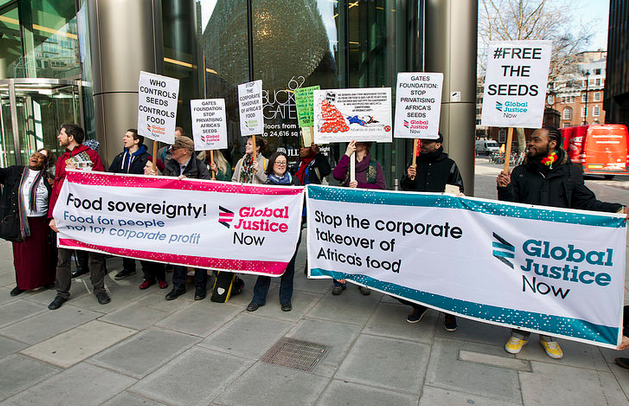
Gates Foundation’s Seed Agenda in Africa ‘Another Form of Colonialism,’ Warns Protesters

Screen-Shot-2015-03-24-at-8.27.09-AM

‘This neoliberal agenda of deregulation and privatization poses a serious threat to food sovereignty and the ability of food producers and consumers to define their own food systems and policies,’ says campaigners

By Lauren McCauley

Source: CommonDreams.org

Food sovereignty activists are shining a light on a closed-door meeting between the Bill and Melinda Gates Foundation (BMGF) and the United States Agency for International Development (USAID), which are meeting in London on Monday with representatives of the biotechnology industry to discuss how to privatize the seed and agricultural markets of Africa.

Early Monday, protesters picketed outside the Gates Foundation’s London offices holding signs that called on the foundation to “free the seeds.” Some demonstrators handed out packets of open-pollinated seeds, which served as symbol of the “alternative to the corporate model promoted by USAID and BMGF.” Others smashed a piñata, which they said represented the “commercial control of seed systems;” thousands of the seeds which filled the pinata spilled across the office steps. A similar protest is expected later Monday in Seattle, Washington, where BMGF is headquartered.

The meeting was convened to discuss a report put forth by Monitor-Deloitte, which was commissioned by BMGF and USAID to develop models for the commercialization of seed production in Africa, especially “early generation seed,” and to identify ways in which the African governmental sectors could facilitate private involvement in African seed systems. The study was conducted in Ethiopia, Ghana, Nigeria, Tanzania and Zambia on maize, rice, sorghum, cowpea, common beans, cassava and sweet potato.

However, food sovereignty activists are sounding the alarm over the secret meeting. Heidi Chow, food sovereignty campaigner with Global Justice Now, which organized Monday’s protest, warned that the agenda being promoted by these stakeholders will only increase corporate control over seeds.

“This is not ‘aid’ – it’s another form of colonialism,” said Chow. “We need to ensure that the control of seeds and other agricultural resources stay firmly in the hands of small farmers who feed the majority of the population in Africa, rather than allowing big agribusiness to dominate even more aspects of the food system.”

In a blog post, Chow further explained:

For generations, small farmers have been able to save and swap seeds. This vital practice enables farmers to keep a wide range of seeds which helps maintain biodiversity and helps them to adapt to climate change and protect from plant disease. However, this system of seed saving is under threat by corporations who want to take more control over seeds. Big seed companies are keen to grow their market share of commercial seeds in Africa and alongside philanthropic organizations like the Gates Foundation and aid donors, they are discussing new ways to increase their market penetration of commercial seeds and displacing farmers own seed systems.

Corporate-produced hybrid seeds often produce higher yields when first planted, but the second generation seeds will produce low yields and unpredictable crop traits, making them unsuitable for saving and storing. This means that instead of saving seeds from their own crops, farmers who use hybrid seeds become completely dependent on the seed companies that sell them.

Further, many of the seeds produced by these biotechnology giants are sold alongside chemical fertilizer and pesticides, manufactured by the very same companies, the use of which often leads to widespread environmental destruction and other health problems.

As others noted, while the meeting attendees included representatives from the World Bank and Syngenta, the world’s third biggest seed and biotechnology company, no farmers or farming organizations were represented at the talks.

“Seeds are vital for our food system and our small farmers have always been able to save and swap seeds freely,” Ali-Masmadi Jehu-Appiah, chair of Food Sovereignty Ghana, said in a press statement. “Now our seed systems are increasingly under threat by corporations who are looking to take more control over seeds in their pursuit of profit. This meeting will push this corporate agenda to hand more control away from our small farmers and into the hands of big seed companies.”

Reporting on the Monitor-Deloitte study, Ian Fitzpatrick, a food sovereignty researcher for Global Justice Now, said that documents circulated ahead of the meeting revealed a neo-liberal agenda “laid bare.”

Fitzpatrick writes:

The report recommends that in countries where demand for patented seeds is weaker (i.e. where farmers are using their own seed saving networks), public-private partnerships should be developed so that private companies are protected from ‘investment risk’. It also recommends that that NGOs and aid donors should encourage governments to introduce intellectual property rights for seed breeders and help to persuade farmers to buy commercial, patented seeds rather than relying on their own traditional varieties.

Finally, in line with the broader neoliberal agenda of agribusiness companies across the world, the report suggests that governments should remove regulations (like export restrictions) so that the seed sector is opened up to the global market.

“This neoliberal agenda of deregulation and privatization, currently promoted in almost every sphere of human activity—from food production to health and education—poses a serious threat to food sovereignty and the ability of food producers and consumers to define their own food systems and policies,” Fitzpatrick adds.

AGRA Watch, a program of the grassroots group Community Alliance for Global Justice, notes that the BMGF-USAID commercial seed agenda further “extends U.S. foreign policy into Africa on behalf of corporate interests.”

Phil Bereano, food sovereignty campaigner with AGRA Watch and an Emeritus Professor at the University of Washington added: “This is an extension of what the Gates Foundation has been doing for several years—working with the US government and agribusiness giants like Monsanto to corporatize Africa’s genetic riches for the benefit of outsiders. Don’t Bill and Melinda realize that such colonialism is no longer in fashion? It’s time to support African farmers’ self-determination.”

The ISIS Truth We Hide From

Isis fighters, pictured on a militant website verified by AP.

By Bob Hennelly

Source: WhoWhatWhy

Identifying Terrorist Enemy No. 1—the Islamic State militants—is easy now, after a spate of horrific videos of beheadings and burnings.

But what’s hard for Western governments and the mainstream media is figuring out the popularity of this terror group among young western Muslims. Why do these people choose to leave the relative comforts of home and take up arms with IS militants? It’s as if these young people are from another planet.

Even after President Obama’s three-day White House Summit on Violent Extremism, few establishment “experts” and commentators seem ready to consider one possible answer: that it is the extreme militarism of the U.S. and its allies that helped spawn IS, and al Qaeda before that.

On the PBS NewsHour segment covering the White house confab, panelists were asked “why people are drawn to the kind of extremism we are seeing today?” The assembled pundits identified “local grievances” like “access to education and job opportunities” and faulted recruiting for “extreme ideology through books and social media.”

Yet there was no mention of U.S. drone strikes, prisoner rendition, torture, and the thousands of dead and wounded Muslim civilians. All of those factors have been exploited by ISIS and other violent groups to make their case that the U.S. is waging a war on Islam.

After several decades of self-proclaimed “nation building” and “exporting democracy” in the Middle East and its environs, the results are all too clear. There are shattered nations in Iraq and Afghanistan, failed states in Yemen, Libya and Syria, and more than a dozen African nations that the U.S. State Department concedes are under constant threat of attack by well-armed and organized terrorists.

Is it possible that what the U.S. has actually been doing in these hot spots is “terrorism building” and “exporting chaos”? Is this the awful truth the United States cannot bring itself to admit?

Massaging History

It would seem so, since instead of changing course, the U.S. is in the process of doubling down on its mistakes. How else to explain that the new GOP presidential hopeful, Jeb Bush, nonchalantly told the Chicago Council on Global Affairs that “mistakes were made” in Iraq. He then proceeded to lay out his own plan for becoming the new global sheriff in town.

Here’s a jaw-dropping statement from that speech:

There were mistakes made in Iraq, for sure. Using the intelligence capability that everybody embraced about weapons of mass destruction was not—turns out not to be accurate.

Watching his brother’s back, Jeb wove out of thin air a phony consensus that “everybody” signed on for the rationale for the Iraq war. That’s despite a vote in Congress in which 23 U.S. Senators and 133 House members opposed it.

You see, if “everybody” was wrong, then nobody was right. It should come as no surprise that Jeb’s team of policy wise men includes many Bush II veterans, among them the unrepentant Iraq war architect Paul Wolfowitz.

His Own Man, With an Old Plan

As much as Jeb Bush insists he is his own man, the audience in Chicago could hear echoes of his brother George’s cowboy-like approach. When Jeb was asked about how he would handle IS, he said he would develop a “global strategy” that would “tighten the noose” so he and the posse could “take them out.”

During Bush’s remarks, he took aim at the Obama administration for being too quick to disengage from the world and Iraq. He blamed Obama for creating a power vacuum that set the stage for the rise of IS and Iranian influence.

Yet an examination of President Obama’s new National Security Strategy, his proposed military budget and his request for his own War Powers re-authorization all indicate an administration that is prosecuting a global war on terror with unfettered latitude as to where and whom it targets.

Could it be that this “global war on terror,” whether it be the Bush 1.0 or Obama 2.0 version, may actually be what is proliferating the very thing it was aimed to eradicate?

One policy expert who dares to look deeper is Graham Fuller, a career CIA agent and analyst who was vice-chairman of the CIA’s National Intelligence Council. Fuller says it was the U.S. invasion of Iraq in 2003 that set the stage for IS. By creating an endemically corrupt central government in Baghdad, notes Fuller, the American occupation provided a focal point to unite disparate opposition groups. As for the high-profile effort to train a new Iraqi army, that “security” force collapsed the moment its U.S. handlers left. (In an odd twist to an already bizarre security meta-narrative, Fuller’s former son-in-law is the uncle of accused Boston Marathon Bombers Tamerlan and Dzhokhar Tsarnaev.)

***

In linking Washington’s Middle Eastern policies to the rise of terrorist groups in the region, MIT professor Noam Chomsky takes it even further back. He says the roots start with the U.S. support of Iraq in its brutal war with Iran in the 1980s, and include the draconian economic sanctions that followed Saddam Hussein’s 1990 invasion of Kuwait. In Chomsky’s view, these sanctions punished Iraqi civilians while reinforcing Saddam’s dictatorial control.

In his 2006 book Devil’s Game: How the U.S. Helped Unleash Fundamentalist Islam, longtime Nation correspondent Robert Dreyfuss documents how the U.S., as early as the 1950s, backed the Muslim Brotherhood in exchange for help fighting communism.

Peace’s Deadliest Year

One way to justify failed policies is to pretend that they have worked as advertised. Nowhere was this disconnect between rhetoric and reality more on display than in President Obama’s updating this month of his National Security Strategy.

In presenting this new security game-plan, the president exhibited excessive confidence in declaring that the United States was heading “home” and “moving beyond” ground wars in Iraq and Afghanistan. In his mini-version of Bush’s infamous ‘Mission Accomplished’ statement, he asserted that “the threat of catastrophic attacks” against the U.S. had “diminished.”

But even as the president describes a winding-down of combat operations, anything but peace is taking hold in those places.

The sectarian violence has resulted in record numbers of civilian deaths and injuries. The UN reported last month that more than 12,000 civilians were killed in Iraq in 2014, the deadliest year for noncombatants since 2008. In Afghanistan, the UN Assistance Mission counted close to 3,200 civilians killed and more than 6,400 wounded, the deadliest year since America’s longest war started.

Providing a sharp contrast to the president’s own assertion that peace is almost at hand, he has sent troops back into Iraq. And just a few days ago, his new Secretary of Defense, Ashton Carter, said the U.S. might end up sticking around in Afghanistan after all.

What the Administration and a cheerleading media refuse to acknowledge is that the two U.S. wars in Afghanistan and Iraq, aimed at ending terrorist threats in the region, have done the exact opposite. They not only caused tens of thousands of civilian casualties but hardened the resolve of yet another generation to seek revenge against their perceived Western oppressors.

Bottom Line

While details of how the president plans to use his refreshed war powers are still vague, the price tag is not.

In the name of defending the country and fighting terrorism, the president’s proposed 2016 budget calls for adding $38 billion in regular defense spending and another $58 billion for so-called “Overseas Contingency Operations.” These expanded outlays would come on top of the more than half a trillion dollars the U.S. is already spending on the military.

Even under the sequester restrictions, says one specialist, U.S. military spending was already quite robust and shamefully under-scrutinized.

“If you can’t protect the nation with $500 billion dollars,” then something is amiss, according to Veronique deRugy of George Mason University’s Mercatus Center. She notes that even under the sequester restrictions, U.S. military spending was already quite robust and shamefully under-scrutinized.

The failures are especially pronounced, says deRugy, when one takes into account that in the years since 9/11, Washington’s extra expenditures, labeled “emergency” war funding, have topped Pentagon budgets by tens of billions annually.

And so under presidents from both parties, who were supposedly ‘conservative’  and ‘liberal’,  the “emergency” continues to spread.

5 Things Busy People Can Do to Fight the Rising Control System

maxresdefault

By Bernie Suarez

Source: Truth and Art TV

Want to implement small-scale, realistic tasks in your own life to strike back at the control system? Have you been seeing the daily headlines, the lies, the deceit and the global enslavement agenda in full swing and feeling that you aren’t doing enough to fight back because of your busy schedule? Feeling helpless and overwhelmed by the idea that a small group of psychopaths at the very top would push for a global order that involves their full enjoyment of life while you and the rest of humanity live as miserable slaves forever? Don’t have time to be a full-time activist, be involved in marches, or downright challenge the court system? Wondering what small things you can do to fight back as you deal with the hustle and bustle of your own life working to pay bills, obtain an education, or raising children?

Here are five subtle actions you can incorporate into your busy schedule to start pushing back and start making a difference. If you think any of these simple steps is too difficult then give yourself time to adapt. Work on weaning yourself off of your usual habits and slowly changing the hard-to-break habits keeping you from maximally fighting back while continuing your busy life.

1- Turn off your TV and shut off mindless entertainment

This is for some people a difficult thing to do so for those people it may be more realistic to wean down how much entertainment and TV you absorb. A key to this commitment is realizing that TV watching is a medical-physiological issue. Realize that when you watch TV there is a real physical reaction going on in your brain and that addiction to TV and entertainment (like gambling and alcohol) is one problem among many others associated with TV watching.

When someone is an addict they are taught that overcoming denial is a big part of the recovery process and you can’t recover if you deny that you have a problem to begin with. Likewise being addicted to TV and entertainment must not be underestimated as just another incidental habit. It is a real addiction and TV flicker rates have a lot to do with it. I recall for year I watched TV and during that time of my life whenever I was in a room without TV it felt very uncomfortable. I couldn’t understand why it felt so uncomfortable but I knew it was. I now realize that was because there is a physiological addiction involved in TV watching.

As you can imagine, successfully committing to watching less or no TV while living a busy life will free up a lot of time which can then be used for doing creative things, improving relationships, starting a group, picking up a book, doing research, and a lot of other pro-active things you thought you didn’t have time for.

2- Optimize your online privacy

Another subtle thing you can do to strike back at the control system while managing a busy schedule is to learn a few things about online privacy. Start cleaning up your computer and unplugging some of the links put in place for private corporations and even government to potentially spy on you. Learn about what an IP address is. Realize that an IP address can be used to track where you are. Go to your browser and type in the address ‘myipaddress.com’ and this website will read back to you your own IP address.

Become familiar with this concept then become familiar with the concept of ‘Proxy Servers’ and Tor browsers. Do some basic research on the issue and decide for yourself if you want to occasionally (or always) go online using a privacy optimized server. This may not be for everyone but at least be familiar with what it is in case you want or feel you need to use one some day. A proxy server or Tor browser will allow you to browse online without your IP address being traced or tracked.

Also, here’s something you should be doing every day. Depending on which browser you are using, become familiar on how to delete cookies from you computer. Cookies are like tiny robot programs installed on your computer by sites you visit. These robots are installed without your permission and are used to track you. For many browsers (Firefox, Google Chrome) it will be under ‘privacy’ options and/or ‘clear browsing data’. Then look for a link or option for deleting cookies. As I said, know that these cookies are installed on your private computer every single time you go a website. Get in the habit of clearing these cookies unless you want every site you visit to also know what other sites you are visiting. By using cookies many corporations are able to monitor your shopping habits and many other things about you. They rely on the fact that you don’t know how to clear your cookies or perhaps are too lazy to delete them every time you go online. Why not become familiar with cookies and what they do? Still not sure? Just do an online search for “how to clear cookies” then specify the browser you are using.

The point is to start doing little things that will make surveillance more difficult and to educate yourself about some small things that add up and can make a difference later on.

3- Use technology strategically

This topic in some ways is a continuation of the online privacy. Start doing small things to make the police surveillance state a bit more difficult for them to carry out. Be smart about how you use your smart phone. If possible, consider reverting back to a not-so-smart phone. If your phone company allows you to use an older phone it’s something you MAY want to consider.

Remember the time when we all bought small cameras to take pictures and we purchased video cameras to make videos? Why can’t we go back to using individual electronics again? Why do we need to use our phones for everything we do? Why have we become conditioned to living our entire lives using our phones? Have you considered this may have been planned to help enslave humanity? Studies now show smart phones are proven to have a negative impact on human relationships making people more selfish, more easily distracted and more stressed out among other things.

Furthermore, have you read the ‘Terms and Conditions‘ of the license agreements you agree to every time you download a cell phone (or any) app? Do you realize that for many of these redundant and often useless apps you sign away your privacy? Read the agreements very carefully, that is exactly what you are doing almost every time you download a cell phone app. Is this lifestyle really necessary? No it isn’t, and it’s one of the small things you can do to fight back. Take back your privacy and commit to a smart life instead of a smart phone.

Also, you can stop taking “selfies” and broadcasting your image all over your own cell phone. Realize the control system has mastered the facial recognition technology and these self produced images only help the opposition keep track of your facial features and what you look like recently, information that can be added to whatever information the system may already have about you. Remember every bit of content you pack your smart phone with can be legally stolen from your phone and given to anyone including law enforcement or even a fusion center that may have created a file for you without you knowing. Since the revelations of Edward Snowden we all know how NSA is violating the privacy of average Americans and although these measures may not entirely prevent NSA from doing what it does, at least you are doing something to fight back and you are making it more difficult for them to get your information. Imagine if everyone does their part to resist in some way how much harder it becomes for NSA.

Other things you can do is periodically change your contact information like your phone number(s), emails, and addresses. There is no law that says you can’t have multiple emails, addresses and phone numbers if for no other reason than to make yourself harder to track. Be creative instead of being predictable. It’s not about being paranoid it’s about smartly preparing for the worse case scenario, being a tiny bit smarter than the next person, being creative, and being vigilant about the world we now factually live in. Not all of these measures are for everyone but again, these are subtle things some of us can do while living a busy hectic life.

4- Be mindful where you spend your money

This is an issue that everyone can and should do something about. Each of us makes decisions every day about where we spend our money and who we give our money to. If you know a corporation is a part of the problem stop giving them your money. Is a decision like this not practical to implement immediately? Then decrease how much money you spend with that store. Here are a few other suggestions:

Buy only what you need. Resist mindless advertisements that try to get you to spend money on things you don’t need. Realize that like TV, shopping is another subtle addiction that you may need to break. Break away from the habit of going shopping as a form of entertainment and instead practice saving and smartly investing your money.

So where should you spend your money? Support alternative media with donations and online purchases. Support organizations and stores that share your values. Identify those entities that support the freedom and liberty we all wish to see come to fruition and then support those platforms. Invest in your own health and survival. Instead of spending money on things you don’t need buy things that empower you and your ability to survive free from government. Do your part to buy smartly, and if everyone does this we can greatly contribute to a shift in paradigm even as we live our busy lives.

5- Don’t give government a reason to arrest or fine you

Finally, regardless of what you do, know that government (City, State and Federal) needs your money badly and they pay a lot of people to look for reasons to take your money (or your freedom which is worth money to them) away from you. We’ve all seen the big city parking police scouring neighborhoods looking for any car parked in front of a meter that is one minute over the limit. We’ve seen throughout the U.S. how police often set up hidden speed traps so they can pull you over for a speeding ticket. Realize that police are rewarded for giving out tickets and the cities have quotas for tickets. The control system NEEDS your money or your freedom to fund its very own control over you. This is why they set up traffic light cameras, create stringent rules and DUI checkpoints throughout the city in hopes of catching violators. Realize this and stay focused every day being careful to not give the control system an excuse to transfer any of your hard earned money into their pockets. Do what you can to not be arrested, not get a ticket and not be harassed for money by the control system.

If none of this works, if you end up with tickets or arrested, or if you simply want to become a more effective change agent while living a busy life then educate yourself about the legal system and how it is rigged against you. Take time on your off days to learn some of the basics of how the system tricks each and every one of us from the time of birth into consenting to be ruled, robbed and controlled. Again, some may feel they don’t have time to learn about the legal system but, like learning about online privacy, learning how to legally take control of your own life is a priceless piece of knowledge to obtain in your spare time.

So there it is. All of these things can be done by someone caught up in a busy hectic lifestyle. All of us have spare time, some of us have more spare time than others. Ultimately, you choose your road and what kind of life you want to live. These ideas are for those you really care and really want to make a difference but realize that time is precious. Go ahead, start making your list and put some of things into action. Don’t worry about not being able to do all of this, just start somewhere. This is a guideline not a set of rules. Peace and love.

Against All Bosses: Government AND Corporate

bill-lumbergh-office-space-boss

By Kevin Carson

Source: Center for a Stateless Society

I keep resolving not to comment on any more of Alternet‘s by-the-numbers anti-libertarian puff pieces, but a recent one from David Masciotra (“You’re Not the Boss of Me: Why Libertarianism is a Childish Sham,” February 26) is in its own category of wretchedness.

Masciotra’s commentary includes two seemingly contradictory lines of argument. In the first, he dismisses anti-authoritarianism, as such, as the ethos of a spoiled toddler:

the protest of children who scream through tears, “You’re not the boss of me.” The rejection of all rules and regulations, and the belief that everyone should have the ability to do whatever they want, is not rebellion or dissent. It is infantile naïveté.

He associates this infantile rejection of all authority with selfishness and anti-sociality. In fact it “does not even rise to the most elementary level of politics,” which Aristotle defined as “the things concerning the polis,” or the community. Confucius associated politics with an ethics of “communal service with a moral system based on empathy.” This, in contrast to libertarianism, which “eliminates empathy, and denies the collective,” and opposes “any concept of the common good” or organizing communities “in the interest of solidarity.”

And of course because this is an Alternet attack on libertarianism, he can’t get through it without mentioning Ayn Rand — “the rebel queen of their icy kingdom.” Oddly enough, he didn’t manage to drag in the Koch brothers.

Just in passing, it’s a bit odd that none of Alternet‘s stable of center-left critics of libertarianism seem to have any idea that the movement might have ideological roots older than last Tuesday. American libertarianism as an organized political movement — the movement that later gave birth to the Libertarian Party — has its origins more or less in the radicals who dropped out of Young Americans for Freedom in 1968. But radical free market thought didn’t start with them, or with Ayn Rand, or even with Ludwig von Mises. It goes back to the classical liberalism of two hundred and more years ago.

And classical liberalism was a very diverse and varied movement, including some quite left-leaning strands, who considered themselves socialists as well as free market libertarians. This shouldn’t be surprising, given that the origins of classical liberalism, socialism and anarchism are so closely intertwined in the culture of the Enlightenment, and overlapped so heavily in their formative period of the 1820s through 1840s.

Two of my strongest ideological influences were the free market libertarians Thomas Hodgskin in England and Benjamin Tucker in the U.S., both of whom were socialists and saw the state’s primary role as intervening in the market on behalf of landlords and capitalists to enforce rents on the artificial scarcity of land and capital. And left-wing strands (like the thought of Henry George) persisted in American classical liberalism afterwards, and have continued to exist even in the modern libertarian movement.

Although contemporary American libertarianism is generally right-leaning and much of it is corporate-influenced, it still contains leftward-oriented strands — many of them quite anti-corporate, or (like me) even anti-capitalist. At his most left-friendly phase in the late ’60s, for example, prominent libertarian Murray Rothbard collaborated with New Left scholars like Ronald Radosh and the Studies on the Left group. During this period Rothbard described the main function of “our corporate state” as subsidizing the operating costs of big business and the accumulation of capital.

After all this, though, Masciotra dismisses libertarians as not being rebellious enough. Their rebellion disguises “their subservience to — for all their protests against the ‘political elite’ — the real elite.”

Who then are the libertarians rebelling against? The most powerful sector of the society is corporate America, and it profits and benefits most from the deregulatory and anti-tax measures libertarians champion. That sector of society also happens to own the federal government. Through large campaign donations and aggressive lobbying — the very corruption that libertarians help enable by defending Citizens United and opposing campaign finance reform — they have institutionalized bribery, transforming the legislative process into an auction. Libertarians proclaim an anti-government position, but they are only opposing the last measures of protection that remain in place to prevent the government from full mutation into an aristocracy.

Masciotra might be surprised to know I actually agree with most of this, and I’m a libertarian. My understanding of government as something that serves the interest of propertied classes, protects big business from competition, and funnels rents on artificial scarcity and artificial property upward from the producing classes to the plutocracy is one of the reasons I became a libertarian and an anarchist.

And one of the primary targets of my writing has been the right-leaning sort of libertarian who ignores the extent to which Corporate America owns the federal government. These people pass over the primary function of government — intervening in the market to facilitate rent extraction by the propertied ruling classes — and focus entirely on eliminating the secondary functions like partially restricting abuses of those ruling classes’ power and stabilizing the worst side-effects of corporate power.

My hatred of bosses is at the root of my identification, not only as a libertarian — but as a Leftist. My instinctive affinity for the “you’re not the boss of me” sentiment, which Masciotra dismisses contemptuously, is the reason I so strongly support labor struggle and radical unions like the I.W.W.

I believe that institutional hierarchies of all kinds are bad — corporate, government, university, etc. — because they suppress the free flow of information and feedback that those in authority don’t want to hear. They create conflicts of interest in which those at the top appropriate the gains from contributions to productivity from those below, and shift costs and blame downward — basically kind of stuff anyone who’s worked under a boss, or reads Dilbert, knows instinctively.

And my belief in free markets doesn’t mean that I lionize “rugged individualism,” or believe that the cash nexus should dominate most aspects of social life. It just means I don’t think the state should interfere with voluntary exchange where it exists. In fact I strongly support a solidaritarian society build on the kinds of self-organized working class institutions for mutual aid that Pyotr Kropotkin and E.P. Thompson described in their writing. I’m strongly influenced by Elinor Ostrom’s views on the governance of common pool resources. And I think that most economic activity in a free society would take place through forms of voluntary interaction other than money exchange — the social and gift economy and commons-based peer production, among them.

If Masciotra took a break from constructing his libertarian strawmen for a minute and checked out the diverse array of real people within our movement, he might find he actually has stuff in common with some of us.


The Lies End Now: “Most Transparent Administration Ever” Is No More: White House To Delete Its FOIA Regulations

corporate_obama32

By Tyler Durden

Source: Zero Hedge

Back on October 28, 2009, then White House press secretary Robert Gibbs said the following:

… understanding what this President has done is institute the very toughest ethics and transparency rules of any administration in history…  I think the President has returned to a stance of transparency and ethics that hasn’t been matched by any other White House.

… the President believes strongly in transparency… that transparency in that way in the best policy

… understand that what the President campaigned on – toughening our ethics rules, making more transparent our transparency policy – was something that he was passionate about and is proud of the progress that we’ve made in ensuring that.

And here is the president himself: “We have put in place the toughest ethics and transparency laws of any administration in history.”

Lies, lies, and nothing but lies. The lies end now.

As reported moments ago, the White House is voiding a federal regulation that subjects its Office of Administration to the Freedom of Information Act, or FOIA  (incidentally the same act that discovered none of Hillary Clinton’s “personal” government-business emails since they were not even stored on government property!) which as USA Today explains, makes “official a policy under Presidents Bush and Obama to reject requests for records to that office.”

And just like that the lie of Obama’s transparency is over, and it couldn’t come at a worse time for the democratic party, just as its top contender for the 2016 presidential race is struggling to emerge from a cover-up scandal which reeks of intentional hiding of classified documentation from the public (or worse). Going forward it will no longer be Hillary Clinton who will be mocked and ridiculed for her total impunity when it comes to public accountability and transparency, but the “most untransparent” president as well.

The White House said the cleanup of FOIA regulations is consistent with court rulings that hold that the office is not subject to the transparency law. The office handles, among other things, White House record-keeping duties like the archiving of e-mails.

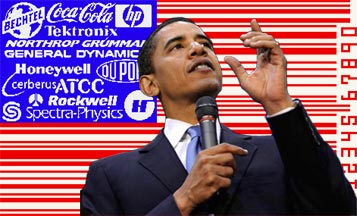
Actually, Obama really couldn’t have picked worse timing because not only does it come hot on the heels of clintonemail.com, but the announcement also is taking place on National Freedom of Information Day and during a national debate over the preservation of Obama administration records. It’s also Sunshine Week, an effort by news organizations and watchdog groups to highlight issues of government transparency. Almost as if the president of the US is openly mocking the public, making it clear he is accountable to no one (except of course for a few mega corporations: see: The Best “Democracy” Money Can Buy: For Every Dollar Spent Influencing US Politics, Corporations Get $760 Back)

“The irony of this being Sunshine Week is not lost on me,” said Anne Weismann of the liberal Citizens for Responsibility and Ethics in Washington, or CREW.

“It is completely out of step with the president’s supposed commitment to transparency,” she said. “That is a critical office, especially if you want to know, for example, how the White House is dealing with e-mail.”

But who wants to know that? Can’t the peasants just pay attention to the rigged all time high in the Apple Sachs Non-industrial Average and just leave the troubled leader of the free world alone?

The irony here is that with this act, Obama is now becoming even less transparent than the loathed by the left Bush dynasty:

Unlike other offices within the White House, which were always exempt from the Freedom of Information Act, the Office of Administration responded to FOIA requests for 30 years. Until the Obama administration, watchdog groups on the left and the right used records from the office to shed light on how the White House works.


“This is an office that operated under the FOIA for 30 years, and when it became politically inconvenient, they decided they weren’t subject to the Freedom of Information Act any more,” said Tom Fitton of the conservative Judicial Watch.


That happened late in the Bush administration, when CREW sued over e-mails deleted by the White House — as many as 22 million of them, by one accounting. The White House at first began to comply with that request, but then reversed course.


“The government made an argument in an effort to throw everything and the kitchen sink into the lawsuit in order to stop the archiving of White House e-mails,” said Tom Blanton, the director of the National Security Archive at George Washington University, which has used similar requests to shed light on foreign policy decisions.

As USA Today further explains, the rule change means that there will no longer be a formal process for the public to request that the White House voluntarily disclose records as part of what’s known as a “discretionary disclosure.” Records released by the Office of Administration voluntarily include White House visitor logs and the recipe for beer brewed at the White House.

“You have a president who comes in and says, I’m committed to transparency and agencies should make discretionary disclosures whenever possible, but he’s not applying that to his own White House,” Weismann said.

Why wait until now? The White House did not explain why it waited nearly six years to formally acknowledge the court ruling in its regulations.

Because accountability, that’s why. No really: “In the notice to be published Tuesday, the White House said it was not allowing a 30-day public comment period, and so the rule will be final.

Well, at least Obama has a sense of humor as he brings the country ever closer to the police state so well forecast by George Orwell: “It’s a little tone deaf to do this on Sunshine Week, even if it’s an administrative housecleaning,” said Rick Blum, coordinator of the Sunshine in Government initiative for the Reporters Committee for Freedom of the Press.”

And the punchline: the notice that will be published in Tuesday’s Federal Register, and in which the White House says it’s removing regulations on how the Office of Administration complies with Freedom of Information Act Requests based on “well-settled legal interpretations” is hosted on a cloud server run… by Amazon.