Baltimoreans Pushed to Their Limits

Suspect_Dies_Baltimore.JPEG-01b3c_c0-199-4709-2943_s561x327

By David S. D’Amato

Source: Center for a Stateless Society

We speak of the blowback that results from American foreign policy, the senseless, heinous acts of terror that represent an unfocused and irrational rebellion against American imperialism. We understand that calling it what it is, blowback — pointing out the causal relationship between American foreign policy and terrorism — is not an attempt to exculpate the people who commit these crimes. Looking for a motive that may aid in explaining these horrors is not looking for an excuse.

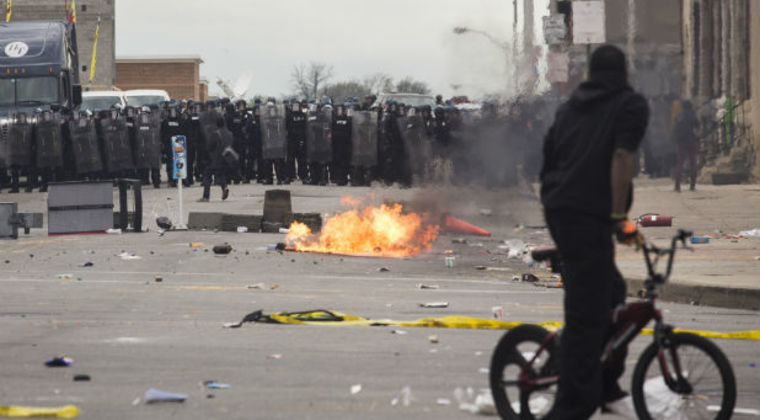
Similarly, the Baltimore rioters have found themselves on the losing end of a set of government policies that have consolidated wealth and foreclosed economic opportunities for independence and self-sufficiency. While so many Americans have been railing against welfare recipients, worried about the effects of food stamps on the federal budget, top American companies have worked closely with government for generations, guaranteeing the corporate welfare and special privileges that define the U.S. economic system.

The truth is that corporate capitalism has hung these rioting Baltimoreans out to dry, the American Dream being to them no more than a cruelly sarcastic joke, forever out of reach, mocking them. The prevailing story depicts the urban poor largely as the victims of “the free market,” dependent on a helping hand from government, be it education, job training, or just the bare necessities. In this story, government intervenes to file the sharp edges off of unbridled free market competition.

The problem with this story is that is recasts government in a role it has never actually played for poor and working class people — least of all black Americans. In real life, the state has intervened not to protect the economically powerless and penniless, but to serve to the needs of capital, to fence off resources and restrict opportunities in order to subject people to the control of a few giant employers. This coercive, state-driven process has nothing to do with a principled, libertarian free market today, and it never has in the past.

The result has been a permanent underclass, condemned to live in ghettos under quasi-military occupation, surrounded by violent crime that is the direct product of a failed war on drugs. And while the people who live in these communities are demonstrably no more likely to possess contraband than anyone else, they are far more likely to be stopped and frisked, arrested, and even murdered by increasingly militarized police officers.

The problems in Baltimore are historical and systemic. Everyone agrees that rioting, looting, and the wanton destruction of private property are senseless acts that ultimately can’t help anyone or create positive social change. We must nevertheless ask why these people in Baltimore feel so helpless, so abandoned and frustrated by the “proper channels,” that they find it is necessary to lash out and express themselves in this way.

Systematic state violence has left Baltimore communities barren, crying out for justice and opportunity. Anarchists believe that the dormant power of self-organization, cooperation and trade, once truly freed from aggression and meddling, is all the poor need to thrive. Through the anger and sadness coming out of Baltimore, it’s important not to lose sight of the larger, underlying issues.

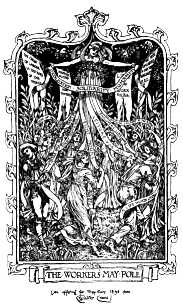
MAY DAY – The International Labor Day

crane13

Source: The Anarchist International

May 1st, International Workers’ Day, commemorates the historic struggle of working people throughout the world, and is recognized in most countries. The United States of America and Canada are among the exceptions. This despite the fact that the holiday began in the 1880s in the USA, linked to the battle for the eight-hour day, and the Chicago anarchists.

The struggle for the eight-hour day began in the 1860s. In 1884, the Federation of Organized Trades and Labor Unions of the United States and Canada, organized in 1881 (and changing its name in 1886 to American Federation of Labor ) passed a resolution which asserted that “eight hours shall constitute a legal day’s work from and after May 1, 1886, and that we recommend to labor organizations throughout this district that they so direct their laws as to conform to this resolution”. The following year the Federation repeated the declaration that an eight-hour system was to go into effect on May 1, 1886. With workers being forced to work ten, twelve, and fourteen hours a day, support for the eight-hour movement grew rapidly. In the months prior to May 1, 1886, thousands of workers, organized and unorganized, members of the organization Knights of Labor and of the federation, were drawn into the struggle. Chicago was the main center of the agitation for a shorter day. The anarchists were in the forefront of the Central Labor Union of Chicago, which consisted of 22 unions in 1886, among them the seven largest in the city.

During the Railroad strikes of 1877, the workers had been violently attacked by the police and the United States Army. A similar tactic of state terrorism was prepared by the bureaucracy to fight the eight-hour movement. The police and National Guard were increased in size and received new and powerful weapons financed by local business leaders. Chicago’s Commercial Club purchased a $2000 machine gun for the Illinois National Guard to be used against strikers. Nevertheless, by May 1st, the movement had already won gains for many Chicago workers. But on May 3, 1886, police fired into a crowd of strikers at the McCormick Harvester Machine Company, killing at least one striker, seriously wounding five or six others, and injuring an undetermined number. Anarchists called for a mass meeting the next day in Haymarket Square to protest the brutality.

The meeting proceeded without incident, and by the time the last speaker was on the platform, the rainy gathering was already breaking up, with only about two hundred people remaining. It was then a police column of 180 men marched into the square and ordered the meeting to disperse. At the end of the meeting a bomb was thrown at the police, killing one instantly, six others died later. About seventy police officers were wounded. Police responded by firing into the crowd. How many civilians were wounded or killed from police bullits never was ascertained exactly. Although it was never determined who threw the bomb, the incident was used as an excuse to attack anarchists and the labor movement in general. Police ransacked the homes and offices of suspected radicals, and hundreds were arrested without charge. A reign of police terror swept over Chicago. Staging “raids” in the working-class districts, the police rounded up all known anarchists and other socialists. “Make the raids first and look up the law afterward!” publicly counseled the state’s attorney.

Anarchists in particular were harassed, and eight of Chicago’s most active were charged with conspiracy to murder in connection with the Haymarket bombing. A kangaroo court found all eight guilty, despite a lack of evidence connecting any of them to the bomb-thrower, and they were sentenced to die. In October 9, 1886, the weekly journal Knights of Labor published in Chicago, carried on page 1 the following announcement: “Next week we begin the publication of the lives of the anarchists advertised in another column.”

The advertisement, carried on page 14, read: The story of the anarchists, told by themselves; Parsons, Spies, Fielden, Schwab, Fischer, Lingg, Engle, Neebe. The only true history of the men who claim that they are condemned to suffer death for exercising the right of Free Speech: Their association with Labor, Socialistic and Anarchistic Societies, their views as to the aims and objects of these organizations, and how they expect to accomplish them; also their connection with the Chicago Haymarket Affair. Each man is the author of his own story, which will appear only in the “Knights of Labor” during the next three months, – the great labor paper of the United States, a 16-page weekly paper, containing all the latest foreign and domestic labor news of the day, stories, household hints, etc. A co-operative paper owned and controlled by members of the Knights of Labor, and furnished for the small sum of $1.00 per annum. Adress all communications to Knights of Labor Publishing Company, 163 Washington St., Chicago, Ill. Later this journal and the paper Alarm published the autobiographies of the Haymarket men.

Albert Parsons, August Spies, Adolf Fischer and George Engel were hanged on November 11, 1887. Louis Lingg committed suicide in prison. The authorities turned over the bodies to friends for burial, and one of the largest funeral processions in Chicago history was held. It was estimated that between 150,000 to 500,000 persons lined the route taken by the funeral cortege of the Haymarket martyrs. A monument to the executed men was unveiled June 25, 1893 at Waldheim Cemetery in Chicago. The remaining three, Samuel Fielden, Oscar Neebe and Michael Schwab, were finally pardoned in 1893.

On June 26, 1893, the governor of Illinois, John Peter Altgeld, issued the pardon message in which he made it clear that he was not granting the pardon because he believed that the men had suffered enough, but because they were innocent of the crime for which they had been tried, and that they and the hanged men had been the victims of hysteria, packed juries and a biased judge. He noted that the defendants were not proven guilty because the state “has never discovered who it was that threw the bomb which killed the policeman, and the evidence does not show any connection whatsoever between the defendants and the man who threw it.”

International Workers’ Day is the commemoration of the Haymarket Event in Chicago in 1886. In 1889, the first congress of the Second International, meeting in Paris for the centennial of the French Revolution and the Exposition Universelle (1889), following an initiative from the American Federation of Labor, called for international demonstrations on the 1890 anniversary of the Chicago protests. These were so successful that May Day was formally recognized as an annual event at the International’s second congress in 1891.

It is not surprising that the state, business leaders, mainstream union officials, and the media would want to hide the true history of May Day. In its attempt to erase the history and significance of May Day, the United States government declared May 1st to be “Law Day”, and gave the workers instead Labor Day, the first Monday of September – a holiday devoid of any historical significance.

Nevertheless, rather than suppressing the labor and anarchist movements, the events of 1886 and the execution of the Chicago anarchists, spokesmen of the movement for the eight-hour day, mobilized many generations of radicals. Emma Goldman, a young immigrant at the time, later pointed to the Haymarket affair as her political birth. Instead of disappearing, the anarchist movement only grew in the wake of Haymarket.

As workers, we must recognize and commemorate May Day not only for it’s historical significance, but also as a time to organize around issues of vital importance of today for the working-class broadly defined, i.e. the grassroots – the people seen as a class in contrast to the superiors in income and/or rank – economically and/or political/administrative.

The May Day Manifestos of the International Workers of the World affiliated to the Anarchist International, from the latest years are published on its Webpage, click here!

Baltimore and the Human Right to Resistance: Rejecting the Framework of the Oppressor

Baltimore-Riots.jpg_23790e32da49a4d09d45db82b7634b69To hear President Obama and Baltimore mayor Rawlings tell it, politeness, nonviolence and respect for law and property are the fundamental obligations of those confronting the brazen and lawless violence of police in Baltimore and beyond. This is a truly upside-down reality.

By Ajamu Baraka

Source: Black Agenda Report

Anti-Black racism, always just beneath the surface of polite racial discourse in the U.S., has exploded in reaction to the resistance of black youth to another brutal murder by the agents of this racist, settler-colonialist state. With the resistance, the focus shifted from the brutal murder of Freddie Gray and the systematic state violence that historically has been deployed to control and contain the black population in the colonized urban zones of North America, to the forms of resistance by African Americans to the trauma of ongoing state violence.

The narrative being advanced by corporate media spokespeople gives the impression that the resistance has no rational basis. The impression being established is that this is just another manifestation of the irrationality of non-European people – in particular, Black people – and how they are prone to violence. This is the classic colonial projection employed by all white supremacist settler states, from the U.S., to South Africa and Israel.

The accompanying narrative is that any kind of resistance that does not fit the narrow definition of “non-violent” resistance is illegitimate violence and, therefore, counter-productive because – “violence doesn’t accomplish anything.”  Not only does this position falsely equate resistance to oppression as being morally equivalent to the violence of the oppressor, it also attempts to erase the role of violence as being fundamental to the U.S. colonial project.

The history of colonial conquest saw the U.S. settler state shoot and murdered its’ way across the land mass of what became the U.S. in the process of stealing indigenous land to expand the racist White republic from “sea to shining sea.”  And the marginalization of the role of violence certainly does not reflect the values of the Obama administration that dutifully implements the bi-partisan dictates of the U.S. strategy of full spectrum dominance that privileges military power and oppressive violence to protect and advance U.S. global supremacy. The destruction of Libya; the reinvasion of Iraq; the civil war in Syria; Obama’s continued war in Afghanistan; the pathological assault by Israel on Palestinians in Gaza and the U.S. supported attack on Yemen by the Saudi dictatorship, are just a few of the horrific consequences of this criminal doctrine.

Race and oppressive violence has always been at the center of the racist colonial project that is the U.S. It is only when the oppressed resist — when we decide, like Malcolm X said, that we must fight for our human rights — that we are counseled  to be like Dr. King, including by war mongers like Barack Obama. However, resistance to oppression is a right that the oppressed claim for themselves. It does not matter if it is sanctioned by the oppressor state, because that state has no legitimacy.

No rational person exalts violence and the loss of life. But violence is structured into the everyday institutional practices of all oppressive societies. It is the deliberate de-humanization of the person in order to turn them into a ‘thing’ — a process Dr. King called “thing-afication.” It is a necessary process for the oppressor in order to more effectively control and exploit. Resistance, informed by the conscious understanding of the equal humanity of all people, reverses this process of de-humanization. Struggle and resistance are the highest expressions of the collective demand for people-centered human rights – human rights defined and in the service of the people and not governments and middle-class lawyers.

That resistance may look chaotic at this point – spontaneous resistance almost always looks like that. But since the internal logic of neoliberal capital is incapable of resolving the contradiction that it created, expect more repression and more resistance that will eventually take a higher form of organization and permanence. In the meantime, we are watching to see who aligns with us or the racist state.

The contradictions of the colonial/capitalist system in its current expression of neoliberalism have obstructed the creation of decent, humane societies in which all people are valued and have democratic and human rights. What we are witnessing in the U.S. is a confirmation that neoliberal capitalism has created what Chris Hedges called “sacrificial zones” in which large numbers of black and Latino people have been confined and written off as disposable by the system. It is in those zones that we find the escalation of repressive violence by the militarized police forces. And it is in those zones where the people are deciding to fight back and take control of their communities and lives.

These are defining times for all those who give verbal support to anti-racist struggles and transformative politics. For many of our young white comrades, people of color and even some black ones who were too young to have lived through the last period of intensified struggle in the 1960s and ‘70s and have not understood the centrality of African American resistance to the historical social struggles in the U.S., it may be a little disconcerting to see the emergence of resistance that is not dependent on and validated by white folks or anyone else.

The repression will continue, and so will the resistance. The fact that the resistance emerged in a so-called black city provides some complications, but those are rich and welcoming because they provide an opportunity to highlight one of the defining elements that will serve as a line of demarcation in the African American community – the issue of class.  We are going to see a vicious ideological assault by the black middle class, probably led by their champion – Barack Obama – over the next few days. Yet the events over the last year are making it more difficult for these middle-class forces to distort and confuse the issue of their class collaboration with the white supremacist capitalist/colonialist patriarchy. The battle lines are being drawn; the only question that people must ask themselves is which side they’ll be on.

Ajamu Baraka is a human rights activist, organizer, geo-political analyst and editor and contributing columnist for the Black Agenda Report. Baraka serves as the Public Intervenor for Human Rights as a member of the Green Shadow Cabinet and coordinates the International Affairs Committee of the Black Left Unity Network. He is also an Associate Fellow at the Institute for Policy Studies (IPS) in Washington, D.C.

Why Mumia Must Live, and US imperialism Must Die: The Link Between Political Prisoners and the War on Terror

mumia

The so-called War on Terror and the national security state did not emerge full-blown from the rubble of 9/11. Both are products of previous waves of police repression, mainly targeting Black radicals. “The FBI’s counter insurgency war on the Black Panther Party chapters and leaders like Mumia established for local police departments a direct link to Washington’s war and surveillance arsenal.”

By Danny Haiphong

Source: Black Agenda Report

The fear of the Muslim/Arab terrorist rekindles the same fear in white America that the Black liberation movement ignited over four decades ago.”

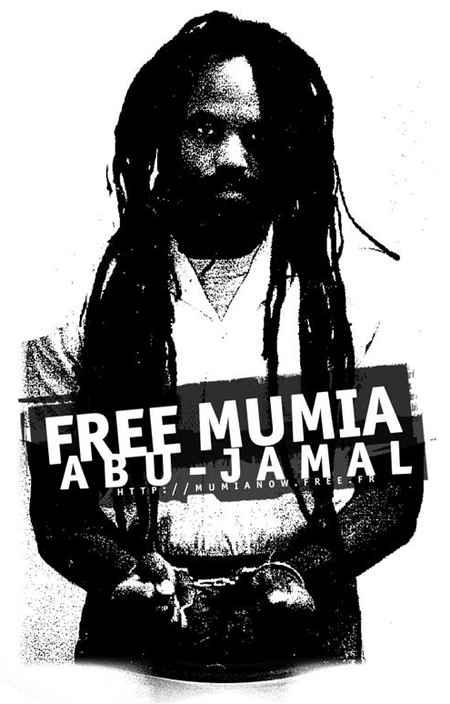
Political Prisoner and journalist Mumia Abu-Jamal has been subjected to over three decades of torture from the US prison gulag. His political imprisonment has placed his life in serious danger, this time not from state execution but instead from extra-legal medical neglect. The prison state has continuously failed in its efforts to murder Mumia through official means and has thus decided to refuse the former Black Panther adequate medical treatment for diabetes. Meanwhile, Boston residents of all classes await the verdict of whether the alleged “Boston bomber” Dzokhar Tsarnaev will receive the death penalty or life in prison. The event that faithful day remains shrouded in questions , but most of the city has accepted the dominant narrative put forth by the FBI and Boston Police Department. The War on Terror that produced the “Boston Bombing” and Mumia’s struggle against the prison state are intimately connected. For Mumia to live with freedom and dignity, the US imperial order behind the War on Terror must die.

Mumia Abu-Jamal’s existence as a political prisoner has been repressed by the establishment, while the War on Terror is a household name in the US. This is because the War on Terror serves the objectives of imperialism and Mumia does not. Mumia joined the Black Panther Party at fifteen and served as the Philadelphia Chapter’s Ministry of Information. He used his talents in journalism in service of Black people both in the BPP and after. This landed him on J. Edgar Hoover’s COINTEPRO list of Black liberation fighters to watch and suppress. In 1978, Mumia covered the Philadelphia police department’s siege on the MOVE Organization. His critical investigation of the Philly PD’s role in repressing MOVE led to his ouster from the journalism industry. In 1982, Mumia was framed for the murder of police officer Daniel Faulkner and sentenced to death.

He used his talents in journalism in service of Black people both in the BPP and after.”

The context of Mumia’s imprisonment is at the essence of US imperialism’s War on Terror, which could be better named its war of terror. In the film Manufacturing Guilt​ , Mumia’s frame-up is blatantly exposed through court documents and investigations. Yet, Mumia has lived much of his life in prison, mostly in solitary confinement. What explains this injustice and how does it relate to the current War on Terror? In Still Black, Still Strong, Dhoruba Bin-Wahad explains how the FBI’s counter insurgency war on the Black Panther Party chapters and leaders like Mumia established for local police departments a direct link to Washington’s war and surveillance arsenal. Washington’s war on Black liberation fighters precipitated the first SWAT team operation in 1969 and the FBI’s declaration that the Black Panther Party was the “greatest threat to the internal security” of the US. The war on Black freedom that jailed Mumia created the technical capacity for the War on Terror.

The recent bombing of the 2013 marathon, and 9/11 before that, created the conditions for a massive expansion of the surveillance state and police state throughout the US mainland. The hundreds of illegally detained prisoners at Guantanamo Bay, the increased surveillance of Muslims and Black people in the US, and the massive spy program instituted by the Patriot Act and similar legislation are daily reminders of US imperialism’s ever expanding repressive apparatus. Internationally, the US led War on Terror interventions have caused the loss of life of millions of people in the Middle East and Africa alongside the thousands more from US aerial drone strikes and proxy war. All of this has been justified as necessary to “counter” the so-called threat of “terrorism.”

The war on Black freedom that jailed Mumia created the technical capacity for the War on Terror.”

Mumia’s story, one shared by numerous US political prisoners sentenced to die in the cages of the prison state, contains in it the seeds that sprouted the rise of the massive War on Terror. Russell Maroon Shoatz, Oscar Lopez Rivera, Leonard Peltier and scores more faced trumped up charges from the state as part of US imperialism’s counter insurgency war on dissent generally and the Black liberation movement in particular. This war has been expanded to meet the needs of US imperialism, which in its current form has produced a potentially explosive situation domestically and globally. The sharpening contradictions of never-ending war and increasing poverty and privatization wouldn’t last long if the counter insurgency war on Mumia and the Panthers hadn’t provided the blueprints and technical support for the mass expansion of the War on Terror’s primary tools: war and surveillance state.

Mumia Abu-Jamal and the rest of the Empire’s political prisoners are caught in the cross hairs of US imperialism’s war of survival. Not only has the material basis of the counter insurgency war that murdered and imprisoned the Black liberation movement grown, but so too has the racist logic behind the repression. The War on Terror’s racist logic has permeated so deeply into the minds of the US public that the mere questioning of the agenda’s blatant deceit is subject to dismissal or defense by most people living in the US mainland. These conditions have left political prisoners with few fighters on the outside pressuring their release. The War on Terror has attempted to erase the memory of political prisoners by reframing the racist justifications for political imprisonment as common sense in what George Jackson called the “Amerikan mind.”

The War on Terror’s racist logic has permeated so deeply into the minds of the US public that the mere questioning of the agenda’s blatant deceit is subject to dismissal.”

So, even though the justification for each and every War on Terror intervention or policy since 2001 are dubious at best, the fear of the Muslim/Arab terrorist rekindles the same fear in white America that the Black liberation movement ignited over four decades ago. The Black Panther Party and their partners in struggle were deemed criminal in every way and many were falsely charged with the murder of police officers, the highest form of offense in the eyes of white America. The War on Terror built off this strategy by throwing the Muslim community into the racist war on the oppressed as a means to control the dissent of the entire population. That the US imperial machinery is complicit in, and a sponsor of, jihadist terror and proxy war matters as little as the innocence of political prisoners when it comes to preserving the Empire and criminalizing all resistance to its rule.

Mumia Abu-Jamal’s life needs to be saved by any means necessary, but fighting to free him based on his criminal case alone won’t develop the movement we need. One of the primary obstacles to building a concrete movement for the freedom of political prisoners is the privileging of innocence over a movement that links political prisoners to the repression of the imperial state. But Mumia’s innocence teaches us the real purpose of political imprisonment. The War on Terror is a consolidation of the forces that were built by imperialism to suppress the revolutionary ideas of Mumia Abu-Jamal. What we need is a reexamination of those ideas in the service of the freedom of all political prisoners. By studying the War on Terror and the repression of the Black Liberation movement from which it grew, it becomes increasingly clear that imperialism must die for Mumia to truly live.

Danny Haiphong is an organizer for Fight Imperialism Stand Together (FIST) in Boston. He is also a regular contributor to Black Agenda Report. Danny can be reached at wakeupriseup1990@gmail.com and FIST can be reached at bostonfist@gmail.com.

Infuriating Video Shows City Official Calling Vietnam Vet “The Enemy” for His Use of Medical Pot

images

By Matt Agorist

Source: The Free Thought Project

Maricopa County, AZ — A video was submitted to the Free Thought Project Sunday, which illustrates the brutal insanity of the state’s War on Drugs.

The video was taken during a heated debate on whether or not to legalize marijuana in Arizona. Maricopa County Attorney, Bill Montgomery, and Attorney Marc Victor went head to head on the topic of prohibition. Victor advocated to end prohibition and Montgomery held the position to continue locking people in cages for a plant.

At the end of the nearly 2 hour long debate, the two debaters took questions from the audience. That is when Vietnam veteran Don Ream stood up to explain to Montgomery how calling people who use marijuana for medicine, “Pot Heads,” was offensive.

Ream explained how he has been a patient for four years, and he is off all of his pharmaceutical medicine. All he uses for his symptoms is his medical marijuana. He then politely invited Mr. Montgomery to come and learn about the benefits of the substance and how safe marijuana actually is.

As Ream began to close his statement, Montgomery took to the podium ready to fire back.

“There is a difference between medical application of marijuana and recreational use of the substance,” said Montgomery, who is an attorney, not a doctor.

Ream then admitted that he uses his marijuana recreationally as well.

“Well, then you’re violating the law, and I have no respect for you,” Montgomery said. “I have no respect for someone who would try to claim that you served this country and took an oath to uphold the Constitution and protect against all enemies foreign and domestic – because you’re an enemy.”

Montgomery was then met with several “Boos” from the audience.

How exactly does ingesting a plant make you an enemy?

The person who wants to ingest a substance for medical or recreational reasons is not the criminal. However, the person that would kidnap, cage, or kill someone because they have a different lifestyle is a villain on many fronts.

The only “enemy” in the interchange below is the person who would deprive someone of their freedom by using government violence to enforce their personal preference. Shame on you Bill Montgomery.

Game Over

Political_Studies_3798278

The Jargon of Game Theory

By

Source: Soul of the East

While suffering under the information barrage wrought by mass media, a question arises in one’s mind: exactly how many words are there in the media vocabulary? For, when it comes to treatment of serious subjects like the economy and politics, the words in use are reduced to surprisingly few, so that even purported media analysis or commentary comes to resemble a mantra or nursery rhyme. Furthermore, it is notable that this “linguistic drain” occurs precisely at the moment when “serious” matters come into focus, and in spite of all the loftiness of the talking heads – our designated hierophants and media oracles – we are bombarded with rather frivolous terminology. One can only be perplexed at why, for instance, economic and political agents are called players? Why does the philosophy professor speak about the strategy of Nietzsche’s arguments? What exactly does it mean to have a cultural strategy? On what grounds does the literally critic assume that James Joyce employed a narrative strategy?

Why are all those serious things spoken about as if they were some kind of game?

On the face of it, the answer is surprisingly easy to deduce. Game or game-play jargon originates in global epistemic dominance of thought models derived from mathematical game theory. Its various abstract and complex forms (so called ‘models’ or ‘modules’), as well as their global application to all aspects of life, build the spiritual framework of our time to a significant extent, although they are rarely discussed outside of academia. However, game theory is not merely a mathematician’s plaything. If we bear in mind that the world stage – with all those global players – is also the home to all sorts of people who are well aware that they are being played, but have no idea of true nature of those playing them, then it is clear that the fundamentals of game theory should be subjected to critical scrutiny. The task is all the more urgent – and all the easier – if we bear in mind that the peculiarity of game theory, in contrast to other mathematical models, lies in the fact that it is founded on all-encompassing and simultaneously incredibly simple – one could say simple as in ‘dim witted’ – explanation of man and the world in general.

Game theory is a metaphysical doctrine, i.e. its ambition is to encompass everything, both the nature of man and the nature of universe. And there is a one special rule to every game of metaphysics, namely this: when the abstract and esoteric professional language of science is put aside, the game is potentially understandable to all parties – both those who are playing and those who are being played. It is an unspoken rule, an ancient assumption of all world-view con-games: in order for half-truth to hold sway over everybody, it must be spoken in common language. So let us examine, aided by some elementary concepts, what game theory is exactly and what it means for someone who is not a player, only played.

At its core, though, game theory is an explanatory model of decision making. It defines its subject as rational activity whose purpose is an increase in well-being of the deliberating individual or collective. Any behavior seemingly pursuing different purpose is only a roundabout way to achieve this goal more rationally, or it is simply “irrational.” Tertium non datur. Obviously, we are dealing with, broadly speaking, a “liberal” definition of man, although it is in fact the legacy of Ancient Greek Sophists. Bearing in mind that an individual is always in the midst of other individuals and that in order to achieve its goals it must collaborate or come into conflict with them, society must be rationally modelled in order to minimize conflict. That old bogeyman of political philosophy, Thomas Hobbes, conceived such a thing as possible only through the absolute sovereignty of the State, for was convinced that all those self-centered atoms were more prone to play at some iteration of Total War than that of Sims.

Proponents of game theory try to evade this fairly consistent inference of universal war or use it to prove something else: atomized individuals do not strive toward all-out conflict but towards equilibrium. The term denotes a state of conflict turned latent, in the sense of permanent threat or warning, but having ceased to be destructive; it is, in a word, a rational conflict, a war that grew cold. Namely, rational behavior is primarily strategic, i.e. it endeavors to accomplish its objective despite possible resistance by anticipating the strategies of that resistance. The healthy society is the one in which unavoidable conflicts are being channeled into relative harmony, regulated by the rules of the game, because the players realized that relative equality is more expedient than playing an ‘all or nothing’ game. Hence, game theory has a notably militaristic nature, affirmed by its history: it flourished inside military think tanks during the first years of the Cold war, only to be later unleashed on civil societies throughout the West.

The Prisoner’s Dilemma

At this level, some peculiarities are also notable. The term ‘game’ is made distinct but is not clearly defined, i.e. it is obviously artificially narrowed. For instance: since when does the game have to be competitive? Moreover, it is usually understood as a leisure activity, an escape from labor and conflict. Game by its nature doesn’t require winners and losers. It can be – and it usually is – a completely self-sufficient activity. In that sense, dances, visual and linguistic creative activities, fine or liberal arts, are all forms of playing a game. Those are all activities that, deprived of any calculated purpose outside themselves, remain autonomous and, therefore, free. However, game theory, without further clarification, presumes that games are always forms of competition implying conflict, binary division on winners and losers, elements of chance and power relations, domination and submission. So game theory is concerned with power plays. This is best illustrated in that most famous of game theory modules, the “Prisoner’s Dilemma.”

The Prisoner’s Dilemma is an imagined situation that game theoreticians apply to reality, and it has many variations with according levels of complexity. It can be described, using the so-called static model, in the following way:

Two criminals are brought to a police station for questioning. They committed the crime, but if the police fail to get the confession from one or either of them, they’ll walk. They are put in separate rooms and isolated from one another. A confession is demanded from each one. A situation develops in which the rules of the game provide them with a limited number of possible strategies: each one could or could not confess. If both confess, their pay-off is equally small, but if only one confesses, his pay-off is small, but bigger than the pay-off of his accomplice. If neither confesses, the pay-off is equally big for both of them, yet so is the risk of losing everything. Two key factors are in play: the prisoners are completely isolated from one another – they only know the game’s rules and the pay-offs by which they model their respective strategies, and each one only wants to maximize his own pay-off. The game-theory endeavor to use this module to explain real-life situations and foresee the decisions to be made by opponents (for instance, by Soviets in the Cold-War era) or to offer the best course of deliberation to its users. In the dynamic model of The Prisoner’s Dilemma, the main difference is in access to information, because players are allowed to confer before they are isolated.

A striking feature of such models must be noted. More often than not, the agents of decision-making in game theory modules are described as criminals. Sometimes they are jewel thieves, sometimes it’s a fugitive escaping the posse, and one encyclopedia’s game theory module is illustrated by the act of tossing the incapacitated opponent into precipice. It is interesting that the author uses the pronoun he for the victim while the criminal in the dilemma is denoted as she, in strict obeisance to the rules of political correctness. Bearing in mind that victimhood, imaginary or not, proves to gain a rather abundant pay-off, it seems that even the game theoretician is faced with a Prisoner’s Dilemma.

The Game Myth

This feature leads us to key weak point of game theory, i.e. its flimsy definition of rationality. Namely, the “big players”, of whose moving and shaking the media hierophants inform us unceasingly, are implicitly denounced as criminal organizations, and not by the frustrated and confused public – the notion appears incorporated into the very definition of their enterprises. Every player seeks exclusively his own maximal gain, and that which is considered to be “one’s own,” therefore rationally desirable, seemingly private, comes dangerously close to being privative. Bearing in mind that such exclusive economic players are prone to merge with their playmates in politics – which is, after all, the elementary definition of fascism – one must reach the conclusion that in the foundations of seemingly supra-private bodies, be it corporations or governments, not only private but also privative interests are embedded, and that the very process of democracy can be seen as a means of accomplishing this.

In that sense, it is no wonder that what is now called liberalism is a form of strange metaphysics. Namely, it appeals to ‘human nature’ and ‘natural rights’, but has in fact always been infected with an urge for escapism, clearly visible in so-called “state of nature” and “social contract” theories, mythical stories about a historical event that never happened in a historical age that never was, which man escaped by a decision he never made. Game theory metaphysics transforms this myth and enriches it, but it certainly doesn’t dispel it. The myth is sold, against all reason and the wealth of human imagination, as the veritable image of truth, i.e. a valid world-view, the prism through which the entire contemporary landscape is transmitted before our eyes. However, this picture, no matter how coherent and self-sufficient, is in fact rather fragile.

The persuasive power of the myth is proportional to the verity of its images of truth, while the persuasive power of the lie stems from its appellation to weaknesses of thought – to an inertia delighted with the ease of passing flippant judgment. The mythology of the rational playground falls precisely into this second category, because it assumes the pretense of a necessary and all-applicable system, thereby subverting the transcendental, robbing it of its very possibility while replacing it with a simulacrum. However, in moments of crisis – etymologically equal to moments of judgment – its frailty is all the more obvious, and its ability to maintain the illusion ever more inadequate to the task. The notion of man as a ‘selfish information processor’ is in fact a careless distortion of the classical understanding of elementary human solidarity, founded on love of one’s own transferred to another, best explained in Aristotle’s Book VIII of Nicomachean Ethics, where it is defined as ‘friendship’ (filia) in the broadest sense. The progressive concentration of power in the hands of players, at the expense of those who are played is more likely to push the losing side into the irrational decision of giving up on selfishness, of declaring: “I will not play anymore.”

Ghosts in the Machine 

We face the following eventuality: the choice of irrational decision sheds more light on a crucial system error in the definition of man and game that this pseudo-metaphysics imposes on us. The term ‘irrational’ is never really defined in the framework of game theory. And rationality fared only slightly better, though at least it can serve as a foothold for via negativa deduction of what is not irrationality. For the game theoretician, irrational behavior is not behavior at all; it is a pseudo-behavior deprived of deliberation. Bearing in mind that game theory yields a considerable pay-off in microbiology, where genes are conceived as rational players in the game of survival of the fittest, we can’t even say that irrational players are making monkeys of themselves. So how, using this sophisticated net, does one catch this elusive mutant who won’t play games, strategize, steal, or bow to political religion?

Let’s define him. This “ghost in the machine” could be someone whose moral sentiment forces him to irrationally decline profitable professions or profitable occasions, such as employing his talents in mass propaganda or advertising. Furthermore, in order to achieve his objective, perhaps writing a novel penetrating the depths of human condition, for example, he irrationally decides to always be close to death, because only then he can really reach the heart of his subject, while at the same time he knows that the pay-off will probably come after he is long gone. Is there any conceivable rational agent who can assume that he rationally planned all this? Or are all those “whistleblowers” really rational players; people who rationally decided to confront corruption, and now enjoy the pay-off by being unemployed or jailed, crucified between responsibility towards their conscience and their families?

After all, were the lines you now read calibrated for a payoff? “Irrationality” is what you were seeking the entire time.

Game theory views the irrational as its own confinement; the razor wire lining the playground fence or an unforeseen eventuality breaking the rules of game-play, its strict order. Bearing in mind that we are talking about world order – and world-encircling razor wire – the deprecation of the irrational is absolute inasmuch as the myth of the rational is absolute. Endemic, logically indescribable specimens are reduced to occasional noise in communication channels between players. Yet those endemic specimens are in fact the majority of our respectably populated planet, and so the noise grows to permeate our societies. It even begins to obstruct the tranquility of academic think tanks, and we know that devising complex and abstract logical, not to mention mathematical, models demands focus, a certain withdrawal from the world in the isolation of one’s paneled office – that parody of the monk’s cloister. Could it be that the hum of the irrational is evolving into an unpredictable, unbearable roar of chaos whose source is too powerful for even the valiant forces of campus security to subdue?

Is it only rational to predict that a creature of grand scale is much too big for nets weaved from a flimsy conceptual framework, unfit for catching even butterflies? What happens when the net breaks? Because the enemy is irrational, and therefore unthinkable. It is the great Unknown, something equal to an extraterrestrial invasion. Can the controllers’ sorcery of half-truth, half-philosophy, half-culture, and half-living keep our eyes wide shut for much longer? Among the faceless and unprepossessing shall awaken the beast of the irrational, its inner abyss suspending man between the angelic and the infernal. Game over.

See all of Branko Malic’s writings on philosophy, culture, and deep politics at Kali Tribune.

Saturday Matinee: Mini Doc Double Feature

earth-eyes-9447950-400-300

“Our False Reality” and “The Lie We Live”: two recent short videos with a thematic connection. The first was produced by Aaron Dykes and Melissa Melton of TruthstreamMedia.com and explores how those who seek power and control use technology to manipulate and engineer the masses right down to the perception of reality. The second film, produced by Spencer Cathcart, offers a brief but expansive overview of systems of control with a reminder of the positive potential of communications technology.

Twenty Years Later: Facts About the OKC Bombing That Go Unreported

mcveigh601

By Kevin Ryan

Source: Washington’s Blog

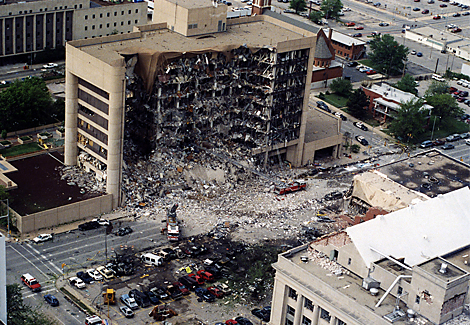
Next week will mark the 20th anniversary of the terrorist bombing of the Murrah Federal Building in Oklahoma City, which killed 168 people including 19 children. The mainstream media will undoubtedly focus its attention on Timothy McVeigh, who was put to death in June 2001 for his part in the crime. They might also mention Terry Nichols, who was convicted of helping McVeigh plan the bombing and is serving a life sentence without parole.

There will be less discussion about how the FBI spent years hunting for a man who witnesses say accompanied McVeigh on the day of the bombing. They called this accomplice John Doe #2 and theories about his identity range from an Iraqi named Hussain Al-Hussaini, to a German national described below, to a neo-nazi bank robber named Richard Guthrie. The Justice Department finally gave up its search and said it was all a mistake— that there was never any credible evidence of a John Doe #2 being involved.

That reversal demonstrates a pattern of cover-up by authorities and limited media coverage in the years since the crime. This week, accounts will not repeat early reports of secondary devices in the building, or reports of the involvement of unknown middle-eastern characters. There will also be little if any mention of the extensive independent investigation into the crime that was conducted by leading members of the OKC community. Here are seven more facts that will probably not see much coverage on the 20th anniversary.

  1. Attorney Jesse Trentadue began investigating the case after his brother Kenney was killed in prison, apparently having been tortured to death by the FBI in its search for John Doe #2. Trentadue’s investigation led to a federal judge nearly finding the FBI in contempt of court for tampering with a key witness. Trentadue now says, “There’s no doubt in my mind, and it’s proven beyond any doubt, that the FBI knew that the bombing was going to take place months before it happened, and they didn’t stop it.”
  1. Judge Clark Waddoups, who presided over the case brought by Jesse Trentadue, ruled in 2010 that CIA documents associated with the case must be held secret. These documents show that the CIA was involved in the OKC bombing investigation and the prosecution of McVeigh. This means that foreign parties were involved because the CIA is prohibited from interfering in purely domestic investigations.
  1. Andreas Strassmeir, a former German military officer, was suspected of being John Doe #2. Strassmeir became close friends with McVeigh and they were both associated with a neo-nazi organization located in Elohim City, OK. A retired U.S. intelligence official claimed that Strassmeir was “working for the German government and the FBI” while at Elohim City. Mainstream reports about the OKC bombing typically avoid reference to Strassmeir.
  1. Larry Potts was the FBI supervisor who was responsible for the tragedies at Ruby Ridge in 1992, and Waco in 1993. Potts was then given responsibility for investigating the OKC bombing. Terry Nichols claimed that McVeigh—who allegedly had been recruited as an undercover intelligence asset while in the Army—had been working under the supervision of Potts.
  1. Terry Yeakey, an officer of the OKC Police Department, was among the first to reach the scene and he was heralded as a hero for rescuing many victims. Yeakey was also an eyewitness to conversations and physical evidence that convinced him that there was a cover-up of the bombing by federal agents. Yeakey was committed to getting to the truth about what happened but a year after the bombing he was found dead off the side of a rural road. His death was ruled a suicide despite overwhelming evidence that he was murdered. Authorities reported that Yeakey, “slit his wrists and neck… then miraculously climbed over a barbed wire fence… walked over a mile’s distance, through a nearby field, and eventually shot himself in the side of the head at an unusual angle.” No weapon was found, no investigation was conducted, no fingerprints were taken, and no interviews were conducted. His family continues to fight for the truth about his death.
  1. Gene Corley, the engineer who was hired by the government to support its claims about the structural fire at the Branch Davidian complex in Waco, was brought in to investigate the destruction of the Murrah Building. Corley brought along three other engineers: Charles Thornton, Mete Sozen, and Paul Mlakar. Their investigation was conducted from half a block away—where they could not observe any of the damage directly—yet their conclusions supported the pre-existing official account. A few years later, within 72 hours of the 9/11 attacks, these same four men were on site leading the investigations at the Word Trade Center and the Pentagon.
  1. There are many other links between OKC and 9/11. For example, the alleged hijackers visited the OKC area many times and even stayed in the same motel that was frequented by McVeigh and Nichols. After both the OKC bombing and 9/11, building monitoring videos went missing, FBI harassment of witnesses was seen, and officials ignored evidence that did not support the political story. Additionally, numerous oddities link the OKC area to al Qaeda. In 2002, OKC resident Nick Berg was interrogated by the FBI for lending his laptop and internet password to alleged “20th hijacker” Zacarias Moussoui. Two years after this interrogation, Berg became world famous as a victim of beheading in Iraq. Investigators looking for clues about these connections will be particularly interested in two airports in OKC, the president of the University of Oklahoma, and the CIA leader who both monitored the alleged hijackers in Germany and was hired at the university just before 9/11.

On April 19, 2015, at the 20th anniversary of one of the worst terrorist attacks in history, citizens should be reminded that we don’t know what happened that day. We don’t know because officials have covered-up the crime for unknown reasons and most media sources will not challenge that cover-up.