
Pugnacious Parasites and the Provocation

insane_people

By Zen Gardner

Source: ZenGardner.com

Everyone knows the unscrupulously manipulative always accuse others of what they themselves are guilty of. It’s an age old trick to obfuscate the obvious and buy time to accomplish their purposes.

Lying is their pathological language.

Such behavior, especially in high profile public figures, is unthinkable, yet for some inexplicable reason it is not just tolerated, but ironically readily expected.

People still buy into it. And the reaction always remains the same. Complacency on the most part, and a rising sense of anger in others. No doubt a byproduct of cognitive dissonance and range of other deliberately triggered mechanisms, but surreal just the same.

A Bald Faced Lie is a Punch in the Face

This is essentially what transpires when someone knowingly lies to your face. It jars your mind and pushes you back on the defensive and you’re left to try and understand why your heart and head are not matching up with what you just heard.

Everyone, except these willingly possessed psychopaths, has a conscience. And it’s faithful to speak to us. This is why humanity has been conditioned to not respond to it, and also why fear is so essential to their game. When our signals are scrambled, our gut reaction belittled and intuition denied we’re left in a daze.

This is exactly what they want to happen. It gives them time to keep executing their programs, especially when a complicit media candies and bandies it about as if it’s true and nothing to question.

This is the whirled we’re in and up against. Again, another reason to stay fully conscious and circumspect and thoroughly educated as to their techniques and true nature. Not pretty stuff to look at, but understand it we must.

Abject bullies like Israel are relatively easy to spot – if we grasp their obvious odious nature and where they’re coming from. The bully in the playground works by pure intimidation and force and will resort to any form of expression they can – loud mouthed intimidation, brandishing weapons, and all bathed in swaggering bravado right up to and including physical force to get their point across.

Send a signal is their MO. And those who don’t cower, teach them a lesson. Again, just look at the abject genocidal insanity of the Israeli occupiers. Now that they’ve gained control of most of the world’s media, especially in the west, what they say goes. And if the media or governments don’t toe their line well enough they’ll hear from these vociferous, self serving elitist beasts.

The Provocation

Another aspect of bullying is provoking your supposed enemy. The US is at this big time, deliberately firing up the conservative right and constitutionalists. It’s full on deliberate. The opulent extravagance of the Obamas, the clearly deliberate crashing of the economy, the flagrant trashing of patriotism and removal of individual rights are all carefully planned. Threatening to disarm fiercely independent Americans is an essential part of this agenda.

The mass migration agenda is the same. While the US gets inundated with needy Central Americans with clear governmental manipulation, Europe is similarly being swept with an influx that threatens their economies and cultural identities.

What’s most amazing about this is anyone can read this agenda for themselves from UN statements and documents and the Agenda 21 or 2030 programs. That so many can’t be bothered to look into much of this is outright frightening.

Israel again is a master example of aggressive agendas designed to push back common sense and reason as well as true empathy for the plight of others. A clearly apartheid state while claiming they were the victims of such treatment is completely nonsensical. It flies in the face of simple reason and logic. Yet they get away with it. How? They’ve taken over the media and political structures through the same tactics of intimidation and potential consequence by their massive Mossad/CIA/MI6 black hand of control.

Strategy of Tension and Not Just Provoking, but Demonizing Your Subjects

What’s amazing is the thoroughness of psychopathic social engineers. This is where we need to wake up and get smart.

They operate according to something called the Strategy of Tension, keeping peoples and nations nervous and afraid and more inclined to rely on government and enforcement to protect them. It also homogenizes cultures in a form of group think and a state of malleability due to this state of fear.

The extension of their influence is far and wide. Mass shootings, weird mass “accidents” at certain interims, and most of all false flags, never mind assassinations and the like. This has been the weapon of choice for every totalitarian regime for eons and a real favorite of this latest push for world dominion by these psychopaths.

The end result, ironically, is not entirely to direct everyone’s attention to a foreign enemy. That’s just a ruse and excuse for genocide and expansion. The enemy to them is within – us. We must be contained like animals and malleable to their every whim.

So-called domestic terrorism has been a meme on the rise. The deliberate migration of “potential muslim extremists” is a key part of this, as any and every incident they stage can more and more be justified and conveniently blamed on outside influences. The end result is the same: clampdown on the populace.

Just look at this propaganda piece brought to you by the Rothschild/Rockefeller owned and CIA/Mossad/MI6 et all run Reuters news agency:

U.S. eyes ways to toughen fight against domestic extremists

The U.S. Justice Department is considering legal changes to combat what it sees as a rising threat from domestic anti-government extremists, senior officials told Reuters, even as it steps up efforts to stop Islamic State-inspired attacks at home.

Extremist groups motivated by a range of U.S.-born philosophies present a “clear and present danger,” John Carlin, the Justice Department’s chief of national security, told Reuters in an interview. “Based on recent reports and the cases we are seeing, it seems like we’re in a heightened environment.” (source)

The agenda is obvious. If we’re looking. The language as well is a giveaway, the smooth talking and use of buzz phrases like “clear and present danger”, “national security” and the like are rife.

The Subtler Techniques of Deceit

This may seem a bit tangential to the main point I’m making here but is nonetheless essential information if we’re to more fully understand how these tactics are carried out on subtler levels.

You’ll see the following logical fallacy tactics in use continually, but unfortunately most people fall for them for lack of discernment as well as awareness of just what deceitful people are capable of doing.

This is a big subject well worth researching on your own but here are a few to get you started:

1. The Strawman Argument – Misrepresenting someone’s argument to make it easier to attack.

Example: After Will said that we should put more money into health and education, Warren responded by saying that he was surprised that Will hates our country so much that he wants to leave it defenseless by cutting military spending.

You’ll see this in use continually especially in the political and government arenas. It’s very clever really, side-stepping the real issue and misdirecting the argument to a false issue having nothing to do with the original question or discussion.

2. The False Choice Dilemma – Giving an extremely narrow range of choice to an issue or situation that is much wider than is being portrayed with virtually unlimited possibilites.

Baby Bush’s carefully framed post 9/11 statement is the classic geopolitical example: “You’re either with us, or you’re with the terrorists.”

You have to admit that’s pretty damn galvanizing. But in what way? Now you can’t question what the “good guys” are doing or you might be with “axis of evil”? That’s what it’s since come down to. Again, cleverly staged propaganda by these very intelligent psychopaths. Keeping the public drugged and dumbed down would sure work in their favor, wouldn’t it?

3. Correlation versus Causation. You can apply this across the board. It’s so easy to assume what we’re told is true in this context. Beware.

The easiest example is when two events occur at the same time, or in close apparent relation with each other. One is then seen as the cause of the other. An increase in robberies occurs at the same time that jobs cuts are announced, for example. There is no evidence to support the claim that the expected job losses caused the increase in robberies.

This is best seen in false flag events when the enemy or culprit is named before any investigation whatsoever. If someone “claims” responsibility it’s case closed, as they go after their pre-selected patsy to confirm this or already executed this planted persona on the spot. Done deal.

4. Overgeneralization or Oversimplification.

This is another framework for logical fallacies. Generalizing from too small of a population, or reducing complex social issues to only one choice or the other, and leaving out the complex issues that do not support the claim are examples of fallacies that stem from overgeneralization and oversimplification. (source of last two citations)

These are just a few examples. It’s a field well worth exploring and getting a handle on. When you dissect and analyze these mechanisms it is extremely empowering.

All That To Say…

Be on the look out. Stay alert and awake and aware. What we see around us is not what we get, unless we fall for it and thereby make it our reality. Personal empowerment in such an environment as we’re living in is essential.

But you have to do the work.

Psychopaths are running the external world. It’s more evident by the day to more and more people. Those not fully on board even at higher and middle levels are being bullied into it within the power structure. They can see who the apparent heirs are to the coming positions of power so they’re buckling under the pressure in an effort to save their hides.

Others at many levels of society are waking up and looking for ways to expose this nefarious agenda and help humanity push back in whatever way it can. We need to keep our voices loud and clear and distinctly truthful and helpful.

There may be many vectors by which they’re coming at us, be they geoengineering, manipulated food, societal crackdowns, media programming and the like, but we’re clearly up to the challenge.

After all, we’re here! We’re thriving just fine in spite of all they do, and we’re growing stronger by the day.

Never forget that, let down your guard, nor grow weary in well doing.

This is our day – not theirs. Let’s fulfill our mission, and use the massive spiritual weapons at our disposal – love, truth, our connection to Source and essential eternal nature which can never be taken away.

Stay true.

Love always, Zen
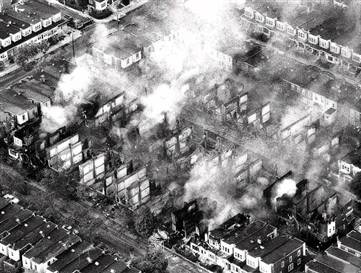
The MOVE Bombing – When Philly Police Plotted to Exterminate a Family

050412_move_hmed_3a-hmedium

(Source: Media Roots)

On May 13, 1985, one of the most shameful, horrific attacks by US police ever took place in West Philadelphia. 11 people, including five children, were killed in a deliberate massacre.

A racist and political attack on a radical community group known as the MOVE Organization, city and police officials were revealed to have intentionally set their home ablaze, let the fire rage, and violently kept escaping men, women and children trapped inside.

Featuring a harrowing first-hand account with the only adult survivor of the atrocity, Ramona Africa, Abby Martin documents an indispensable, but largely unheard of, moment in American history. From MOVE’s formation, to the arrest of the MOVE 9 political prisoners, to the build-up to the infamous bombing, The Empire Files chronicles an act that cannot be forgotten.

There Will Be No Lesser Evil

a1e0lul3thq1zmgdlw7q

By Jack Balkwill

Source: Dissident Voice

Damned by a corrupt system, it appears voters will be given a choice between Hillary Clinton and her friend Donald Trump this year, with no realistic alternative allowed by corporate media and their establishment patrons.

I say “friend” because the Clintons and Trumps have a relationship going back for years.

Seeing Trump as their enemy, many liberals are opining that Hillary is the lesser evil, saying they will vote for her.

I am not so sure Hilary’s the lesser evil.  I told friends years ago that I thought she would be the next president.  Long before she announced she would run again, corporate media repeatedly suggested her inevitability, tipping off that the establishment is firmly behind her by pushing her candidacy.

The establishment wants her badly, as she may be counted on to sell out the environment, enrich defense cheats and give the banksters direct access to the treasury among other corrupt things indicated by the Clinton past.  After her husband sold out the poor and working classes during his presidency, Bill and Hillary got rich from corporate speeches, the preferred delayed bribe for official corruption in The Land of the Free, in this case amounting to over a hundred million dollars for the pair.

Even Republicans are saying they will vote for her instead of Trump.  Because she is to the right of Richard Nixon, this will not be difficult for them (compare what Bill Clinton signed into law to Nixon’s bills, and there is no contest – all the while Hillary claiming the American people got two for the price of one).

As for The Donald, he’s often boasted that he rented Hillary’s vote when she was a New York senator, through several campaign donations (his son also contributed).  Trump also donated to her 2008 presidential campaign when she ran against Obama.  He calls her “Crooked Hillary,” and you can bet he will campaign hard against her with that slogan.

Not that they’ve been enemies.

On the Daily Show last year, Bill Clinton said of Trump, “He thought Hillary was a good senator for New York after 9/11 and he has actually, he’s one of the many Republicans who supported our foundation before they got the memo.”

A picture search shows Bill Clinton with his golf buddy Trump, Bill and Hillary posing beside Donald and his wife Melania, and even daughters Chelsea and Ivanka as close friends, although, like their parents, they are not socializing during the campaign, as part of the insider scam to convince voters that the Democrats and Republicans are somehow not connected.

National archives released last month show that when President, Bill Clinton posed with Trump at Trump Towers for a photo shoot, and Trump made several visits to the White House though we may never know what was on the table.  Trump would perform a magnificent public service if he disclosed what deals were made, but one wonders if he’d go to prison with the Clintons were such disclosures made.

One is reminded that, during the 2008 presidential campaign, Bill Clinton, thinking his wife was going to win the Democratic nomination, remarked that he didn’t know how she was going to run against her close friend John McCain.  It’s happening again, with corporate media playing their usual role of not noticing that both candidates are vying to see who gets to sell out the working class on behalf of a stifling plutocratic oligarchy.

Corporate media pretends like the Democrats and Republicans are at each other’s throats, but it should be obvious to anyone who digs a bit beyond the propaganda, that they are in bed with each other and represent the same interests – selling out the American people, primarily for money.

Rupert Murdoch’s New York Post has endorsed Trump, but the right wing billionaire gave a big fundraiser for Hillary Clinton when she ran in 2008, so it’s all one happy family.  The billionaires and transnational corporations make sure both sides are obligated in what corporate media play up as “free and fair elections.”

The polls reveal that Hillary and The Donald are two of the most unpopular candidates imaginable, with most Americans despising both. The two have appeared on television more than all other candidates combined, so they’ve been largely catapulted to the top by the corporate media, who pretend to be objective journalists.

Has anyone seen Jill Stein at all on television?  Polling shows she is for bringing the troops home and shutting down the wars, just like what the American people say they want in polling.  Corporate media is making certain she is hidden behind the curtain, as they whine that they just don’t understand how such unpopular candidates as Clinton and Trump have become finalists.

Will Trumps and Clintons go back to being friends after the election?  Probably not, as it looks like this battle will be the biggest mud fight in US presidential history, the only certainty that someone extremely unpopular will win the right to sell us out.


Jack Balkwill is an activist in Virginia. He can be reached at libertyuv@hotmail.com Read other articles by Jack.

No Man’s Land

fence

By Steven Stoll

Source: Orion Magazine

A chainlink fence topped with razor wire surrounds fourteen acres of thistle and grass at East Forty-First Street between Long Beach Avenue and South Alameda Street in Los Angeles. These two city blocks occupy a transitional environment of sorts. In one direction the sight of small houses stretches for miles toward the Pacific Ocean, but turn around and the neighborhood becomes industrial, consisting of a textile factory, a scrap metal recycling company, trucking terminals, and warehouses. The tracks of the Southern Pacific Railroad run parallel to Long Beach Avenue. There are few trees or anything green and growing but the drought-resistant thistle.

In 1986, the City of Los Angeles acquired the land from a group of owners through eminent domain, but then folded plans to build a waste incinerator when the community resisted. The land ended up in the holdings of the Harbor Department. It had been two years since the uprising that followed the acquittal of four Los Angeles police officers, tried for beating Rodney King. Perhaps looking to make a gesture and lacking its own use for the site, the Harbor Department invited members of a local food bank to plant a community garden.

They did. Between 1994 and 2006 hundreds of families grew a profusion of food plants on what had been a blighted lot just a few years before. One visitor identified a hundred species, most of them native to Mexico and South America— chayote, guava, tomatillo, sapodilla, and sugarcane, in addition to maize, beans, avocados, bananas, and squashes. The South Central Farm was not misnamed: photographs show the land in robust cultivation, producing a wealth of food.

But in 2001, one of the prior owners filed a lawsuit against the city. The property had never been used to build the incinerator, and so, he argued, Los Angeles had no reason to seize it. The city settled the case in 2003 by selling the fourteen acres back to the prior owner.

In the ensuing confrontation a single absentee negated the sustained labor and improvements of 350 families, representing around a thousand people, now accused of squatting. They refused to leave. Lawyers filed briefs. Gardeners swore resistance. (One said, “Just think if we assemble, two from every family, and you know we’ll each grab a hoe, and no one will get past us.”) Movie stars showed up with camera crews. A foundation offered millions of dollars as a purchase price, which the owner rejected. A date was set for the forced removal of the stalwarts. On June 13, 2006, Los Angeles County Sheriffs arrested forty people. Bulldozers destroyed the farm. A decade later, the land remains vacant.

In the case of the South Central Farm, ownership for profit triumphed over use for subsistence, which, of course, is the way of the world. Nothing could be more ordinary than a landowner asserting his rights. And yet, just five centuries ago, what happened on those fourteen acres in south Los Angeles wouldn’t have made sense to anyone.

In 1500, no one sold land because no one owned it. People in the past did, however, claim and control territory in a variety of ways. Groups of hunters and later villages of herders or farmers found means of taking what they needed while leaving the larger landscape for others to glean from. They certainly fought over the richest hunting grounds and most fertile valleys, but they justified their right by their active use. In other words, they asserted rights of appropriation. We appropriate all the time. We conquer parking spaces at the grocery store, for example, and hold them until we are ready to give them up. The parking spaces do not become ours to keep; the basis of our right to occupy them is that we occupy them. Only until very recently, humans inhabited the niches and environments of Earth somewhat like parking spaces.

Ownership is different from appropriation. It confers exclusive rights derived from and enforced by the state. These rights do not come from active use or occupancy. Property owners can neglect land for years, waiting for the best time to sell it, even if others would put it to better use. And in the absence of laws protecting landscapes, the holders of legal title can mow down a rainforest or drain a wetland without regard to social and ecological cost. Not all owners are destructive or irresponsible, but the imperative to seek maximum profit is built into the assumptions within private property. Land that costs money must make money.

Champions of capitalism don’t see private property as a social practice with a history but as a universal desire—a nearly physical law—that amounts to the very expression of freedom. The economist Friedrich Hayek called it “the most important guarantee of freedom, not only for those who own property, but scarcely less for those who do not.” But Hayek never explained how buyers and sellers of real estate spread a blanket of liberty over their tenants. And he never mentioned the fact that the concept, far from being natural law, was created by nation-states—the notion that someone could claim a bit of the planet all to himself is relatively new.

Every social system falls into contradictions, opposing or inconsistent aspects within its assumptions that have no clear resolution. These can be managed or put off, but some of them are serious enough to undermine the entire system. In the case of private property, there are at least two—and they may throw the very essence of capitalism into illegitimacy.

The first of the system’s contradictions points to its origins. Land in the English countryside during the sixteenth century was regulated by feudal obligations so obscure and so thick that few people today can make sense of them. An English peasant could use a run of soil for a term of years or for her entire life, but it did not belong to her. Village elders, representatives of the local lord, and even the deacon of the church might have claimed an interest in how this or that field was planted. Everyone from monarch to serf received a different slice of the realm. These use rights could be exchanged only in very limited ways: a lord occupied his ancestral house and manor for as long as he lived, but he could not sell them.

All sorts of events caused the demise of feudalism. The Black Death of the fourteenth century killed so many millions that the labor market tipped in favor of those who survived. The spread of money gave things exchange value and made buying and selling easier. Food production increased during the sixteenth century, creating more calories for work and more commodities for trade. And an international wool market inspired lords to change common fields into sheep walks.

The problem was that lords could not put sheep where they wanted. They lived within the feudal assemblage of obligations and rights attached to social orders and scraps of landscape. Faced with declining returns and proliferating opportunities, they began to curse the old rules—they wanted land for themselves.

Enclosure is just what it sounds like: the physical and legal bounding of an area. In practice it meant the seizure of villages, common fields, and outlying forests and marshes. It allowed lords to evict former residents so that they could do new things with land. Sometimes it happened by agreement, with peasants giving in to demands they feared to contest; other times there was violence. In 1607 at least one thousand peasants tore up hedges in Northamptonshire and filled in ditches that demarcated property lines. The rebels made a statement: “Wee, as members of the whole, doe feele the smarte of these incroaching Tirants, which would grind our flesh upon the whetstone of poverty.” King James didn’t flinch from the whetstone. His forces killed forty insurgents and hanged their leader.

The king’s involvement tells us that grasping lords did not do this dirty work by themselves. Parliament legalized their land grab by granting them something that had never before existed in human history: ownership. Lords could now act without regard to tradition or the needs of residents. Some demolished whole communities. The word pauper dates from the seventeenth century to describe poor people who wandered the roads homeless, eating anything they could scavenge and turning up cold and wet at church doors. Peasants became workers as their only option for survival. Some stooped for a wage on the very land they once tilled as members of villages.

Enclosure created two things at once: private property and wage labor, the essential preconditions for capitalism. Like all social practices, private property has a degree of flexibility. Some of its advantages can and should be diffused among as many people as possible. By eliminating messy titles to land and its embeddedness in tradition, enclosure made possible a new measure of innovation and abundance. But that’s also the first of its contradictions. It generates wealth and unprecedented social power for some by making others poor and dependent.

All of this matters because enclosure never came to an end. It jumped continents and kept on going. The colonial wars for North America, in which Britain and then the United States seized land from hundreds of tribes, can be understood as a rolling dispossession—by purchase, treaty, and ejectment. Enclosure also took place in Australia and South Africa. Wherever nation-states became landowners they turned the commons into private property. The epicenter of enclosure today is Africa. A resident of the village of Dialakoroba, in Mali, which has lost thousands of acres to foreign investors, recently said this: “I do not know, in ten to twenty years, how people will live in our villages because there will be no land to till. . . . Everything has been sold to rich people in very opaque conditions.”

Private property’s second contradiction comes from the odd notion that land is a commodity, which is anything produced by human labor and intended for exchange. Land violates the first category, but what about the second? As the historian Karl Polanyi wrote, land is just another name for nature. It’s the essence of human survival. To regard it as an item for exchange “means to subordinate the substance of society itself to the laws of the market.”

Clearly, though, we regard land as a commodity and this seems natural to us. Yet it represents an astonishing revolution in human perception. Real estate is a legal abstraction that we project over ecological space. It allows us to pretend that a thousand acres for sale off some freeway is not part of the breathing, slithering lattice of nonhuman stakeholders. Extending the surveyor’s grid over North America transformed mountain hollows and desert valleys into exchangeable units that became farms, factories, and suburbs. The grid has entered our brains, too: thinking, dealing, and making a living on real estate habituates us to seeing the biosphere as little more than a series of opportunities for moneymaking. Private property isn’t just a legal idea; it’s the basis of a social system that constructs environments and identities in its image.

Advocates of private property usually fail to point out all the ways it does not serve the greater good. Adam Smith famously believed that self-interested market exchange improves everything, but he really offered little more than that hope. He could not have imagined mountains bulldozed and dumped into creeks. He could not have imagined Camden, New Jersey, and other urban sacrifice zones, established by corporations and then abandoned by them. Maximum profit is the singular, monolithic interest at the heart of private property. Only the public can represent all the other human and nonhuman interests.

Unbelievably, perhaps, the United States Congress has done this. Consider one of its greatest achievements: the Endangered Species Act (ESA) of 1973. The act nails the abstraction of real estate to the ground. When a conglomerate of California developers proposed a phalanx of suburbs across part of the Central Valley, they came face to face with their nemesis: the vernal pool fairy shrimp. In 2002, the Supreme Court upheld the shrimp’s status as endangered and blocked construction. It was a case in which the ESA diminished the sacred rights to property for the sake of tiny invertebrates, leaving critics of the law dumbfounded. But those who would repeal the ESA (and all the other environmental legislation of the 1970s) don’t appreciate the contradiction it helps a little to contain: the compulsion to derive endless wealth from a muddy, mossy planet.

Of course, in the era of climate change, those invaluable laws and the agencies they created now seem too limited in their scope and powers to take on the spectacular collision between Economy and Ecology now in motion. But maybe the most radical way we can treat the ownership of Earth—the single most subversive notion we can have about private property—is that it’s merely a social relationship, an agreement between people to behave in certain ways. It can be challenged, changed, and contained. Much of what holds failing social systems together is that those in power succeed in eliminating the mere thought that things could be otherwise.

Should private property itself be extinguished? It’s a legitimate question, but there is no clear pathway to a system that would take its place, which could amount to some kind of global commons. Instead I suggest land reform, not the extinguishing of property rights but their radical diffusion. Imagine a space in which people own small homes and gardens but share a larger area of fields and woods. Let’s call such legislation the American Commons Communities Act or the Agrarian Economy Act. A policy of this sort might offer education in sustainable agriculture keyed to acquiring a workable farm in a rural or urban landscape. The United States would further invest in any infrastructure necessary to move crops to markets.

Let’s give abandoned buildings, storefronts, and warehouses to those who would establish communities for the homeless. According to one estimate, there are ten vacant homes for every homeless person. Squatting in unused buildings carries certain social benefits that should be recognized. It prevents the homeless from seeking out the suburban fringe, far from transportation and jobs (though it’s no substitute for dignified public housing). Plenty of people are now planting seeds in derelict city lots. In Los Angeles, an activist named Ron Finley looks for weedy ground anywhere he can find it for what he calls “gangsta gardening,” often challenging absentee owners. In 2013, the California legislature responded to sustained pressure from urban gardeners like Finley and passed the Urban Agriculture Incentive Zones Act, which gives tax breaks to any owner who allows vacant land to be used for “sustainable urban farm enterprise.”

Squatting raises another, much larger question. To what extent should improvements to land qualify one for property rights? The suppression of traditional privileges of appropriation amounts to one of the most revolutionary changes in the last five hundred years. All through the centuries people who worked land they did not own (like squatters and slaves) insisted that their toil granted them title. The United States once endorsed this view. The Homestead Act of 1862 granted 160 acres to any farmer who improved it for five years. Western squatters’ clubs and local preemption laws also endorsed the idea that labor in the earth conferred ownership.

It’s worth remembering that there is nothing about private property that says it must be for private use. Conservation land trusts own vast areas as nonprofit corporations and invite the public to hike and bike. It’s not an erosion of the institution of property but an ingenious reversal of its beneficiaries. But don’t wait for a land trust to be established before you enjoy the fenced up beaches or forests near where you live. Declare the absentee owners trustees of the public good and trespass at will. As long as the land in question is not someone’s home or place of business, signs that say KEEP OUT can, in my view, be morally and ethically ignored. Cross over these boundaries while humming “This Land Is Your Land.” Pick wildflowers, watch sand crabs in the surf, linger on your estate. Violating absentee ownership is a long-held and honorable tradition.

The arrest of the South Central Farmers was deeply disturbing in Los Angeles. So much so that citizens began to call for other farms, in other locations throughout the city and county. Ten years later community gardens abound. More than a hundred of them are thriving, including the Stanford Avalon Community Garden, which was established by some of the very families evicted from the South Central Farm. It runs one mile long and 80 feet wide underneath power lines, on city property. There is space for 180 plots, each about 1,300 square feet. The farmers compete with each other for the greatest yields. They pay a small fee for a plot and absorb all the food into their households, to be eaten and sold.

Building this garden movement has not extinguished any of the rights of private or public landowners. But only sustained resistance and protest could have forced these entities to accommodate thousands of household farmers. Yet nothing could be more ordinary or more radical than the desire for autonomy from the tyranny of wages, a dream that persists in billions of humans striving in slums and factories, ready for their moment to reclaim the commons.


Steven Stoll is Professor of History at Fordham University, where he teaches environmental history and the history of capitalism and agrarian societies. He is the author of Larding the Lean Earth: Soil and Society in Nineteenth-Century America (2002) and The Great Delusion (2008), about the origins of economic growth in utopian science. His writing has appeared in Harper’s Magazine, Lapham’s Quarterly, and the New Haven Review. He is finishing a book about losing land and livelihood in Appalachia.

Always Attack the Wrong Country

8lfjisz6

By Dmitry Orlov

Source: Club Orlov

There are numerous tactics available to those who aim to make problems worse while pretending to solve them, but misdirection is always a favorite. The reason to want to make problems worse is that problems are profitable—for someone. And the reason to pretend to be solving them is that causing problems, then making them worse, makes those who profit from them look bad.

In the international arena, this type of misdirection tends to take on a farcical aspect. The ones profiting from the world’s problems are the members of the US foreign policy and military establishments, the defense contractors and the politicians around the world, and especially in the EU, who have been bought off by them. Their tactic of misdirection is conditioned by a certain quirk of the American public, which is that it doesn’t concern itself too much with the rest of the world. The average member of the American public has no idea where various countries are, can’t tell Sweden from Switzerland, thinks that Iran is full of Arabs and can’t distinguish any of the countries that end in -stan. And so a handy trick has evolved, which amounts to the following dictum: “Always attack the wrong country.”

Need some examples? After 9/11, which, according to the official story (which is probably nonsense) was carried out by “suicide bombers” (some of them, amusingly, still alive today) who were mostly from Saudi Arabia, the US chose to retaliate by attacking Saudi ArabiaAfghanistan and Iraq.

When Arab Spring erupted (because a heat wave in Russia drove up wheat prices) the obvious place to concentrate efforts, to avoid a seriously bad outcome for the region, was Egypt—the most populous Arab country and an anchor for the entire region. And so the US and NATO decided to attack EgyptLibya.

When things went south in the Ukraine, whose vacillating government couldn’t make up its mind whether it wanted to remain within the Customs Union with Russia, its traditional trading partner, or to gamble on signing an agreement with the EU based on vague (and since then broken) promises of economic cooperation, the obvious place to go and try to fix things was the Ukraine. And so the US and the EU decided fix the UkraineRussia, even though Russia is not particularly broken. Russia was not amused; nor is it a country to be trifled with, and so in response the Russians inflicted some serious pain on the Washington establishmentfarmers within the EU.

Who was at fault exceedingly clear once the Ukrainians that managed to get into power (including some very nasty neo-Nazis) started to violate the rights of Ukraine’s Russian-speaking majority, including staging some massacres, in turn causing a large chunk of it to hold referendums and vote to secede. (Perhaps you didn’t know this, but the majority of the people in the Ukraine are Russian-speakers, and there is just one city of any size—Lvov—that is mostly Ukrainian-speaking. Mind you, I find Ukrainian to be very cute and it makes me smile whenever I hear it. I don’t bother speaking it, though, because any Ukrainian with an IQ above bathwater temperature understands Russian.) And so the US and the EU decided to fix things by continuing to put pressure on the UkraineRussia.

When Russia started insisting on a political rather than a military resolution to the crisis in the Ukraine, and helped negotiate the Minsk agreements together with the Ukraine, France and Germany, a similar thing happened. These agreements obligated the Ukrainian government to pass constitutional reforms to grant autonomy to its Russian regions in the east. The Ukrainian government refused to abide by these agreements. As a result, the US and the EU decided to put pressure on the UkrainianRussian government.

When a nasty terrorist group calling itself ISIS and composed of Islamic Salafi/Takfiri extremists started to seize power in large parts of Iraq, and then spread to Syria, something had to be done about it. These extremists were being financed by Turkey (which is still buying oil from them and sheltering them on its territory) and Saudi Arabia. And so the US and NATO decided to put some pressure on Turkey and Saudi ArabiaSyria.

In response to all this foolishness, Russia up and decided to actually go and fix something that was broken: Syria. And now Syria is on the mend, and members the misdirectorate in Washington are left scratching their heads.

So far so good. But this method of pretending to be solving problems by making them worse has some definite downsides.

For one thing, eventually even the dimmest, most geographically challenged bulbs in the general population start to get a clue, and then they start refusing to vote for the establishment candidates. Then it becomes hard to continue with the misdirecting because the people doing the misdirecting are voted out, and (horror of horrors!) somebody who might actually try to fix a problem or two might get voted in.

For another, continually making problems worse by attacking the wrong country tends to eventually make the sheer number problems get completely out of hand. Take the recent massive terror attack in Brussels, down the road from NATO headquarters, for which ISIS took credit. Recently, Europe has been experiencing a large-scale influx of people from the Middle East and North Africa, who have been forced to flee their native lands because of all the previous acts of misdirection, and a fair number of these people are ISIS terrorists. And so, to protect itself, NATO is planning to fight ISIS in EuropeSyria. Also, it is well known that the influx into Europe has been orchestrated by Turkey. In response, the EU has decided to put pressure ongive billions of euros to Turkey and tell Turkey that it is welcome to join the EU.

Lastly, this pattern has an overall momentum that, over time, becomes harder and harder to break. It starts out as just one group of plutocrats doing incredibly vile, underhanded but profitable things; later on, an even bigger group of plutocrats is doing equally vile but now completely idiotic, self-defeating, embarrassing things; and right near the end a really huge group of plutocrats is doing things that are absolutely suicidal—but they can’t stop themselves. You should be able to decide for yourselves when that point in time arrives, but I doubt that it is too far in the future.

Hillary Clinton’s Business of Corporate Shilling & War Making

download

Source: Media Roots

As the circus of the 2016 presidential election grinds on, Hillary Clinton has posited herself as the candidate of the people. But not many “candidates of the people” have vacation homes in the Hamptons that cost $200,000 per month, or hang out with the world’s billionaires.

It’s hard to know who she is really–while once being a proponent of Donald Trump type positions, like building a wall at the Mexican border, supporting torture, and opposing same-sex marriage until 2013, today she presents herself as the anti-Trump, anti-Republican candidate.

There’s been a lot of outrage about the impression that the establishment has already anointed her as the Democratic nominee, and has carved out her path to the presidency.

But like in 2008, her guaranteed seat on the throne is being derailed by the unpredictable moods of the masses, and millions of young progressive voters. She continues to play her shape shifting game, morphing her positions to try to capture the support for her opponent, but the real Hillary is still inside.

In fact, every layer of Hillary’s career shows why, far from being a candidate of the people, she’s the top pick by corporations to do the real job of any US president: CEO of the Empire.

Digging deep into Hillary’s connections to Wall Street, Abby Martin reveals how the Clinton’s multi-million-dollar political machine operates. This episode of The Empire Files chronicles the Clinton’s rise to power in the 90s on a right-wing agenda, the Clinton Foundation’s revolving door with Gulf state monarchies, corporations and the world’s biggest financial institutions, and the establishment of the hyper-aggressive “Hillary Doctrine” while Secretary of State.

Is the US Economy Heading for Recession?

How Do You Know When Your Society Is In The Midst Of Collapse?

boot

By Brandon Smith

Source: Activist Post

As economic turmoil worldwide becomes increasingly apparent, I have been receiving messages from readers expressing some concerns on the public “perception” of collapse. That is to say, there are questions on the average person’s concept of collapse versus the reality of collapse. This is a vital issue that I have discussed briefly in the past, but it deserves a more in-depth analysis.

What is collapse? How do we define it? And, are some of the notions of collapse in the public consciousness completely wrong?

It’s funny, because skeptics opposed to the idea of a U.S. collapse in particular will most often retort with a question they think I cannot or will not answer – “So, Mr. Smith, when specifically is this supposed collapse going to take place? What day and time?”

My response has always been – “We’re in the middle of a collapse right now; you really can’t see it right in front of your sneering face?”

The reason these people are incapable of grasping this kind of answer is in large part due to the popular mainstream conceptions of systemic collapse. These are conceptions that are for the most part delusional and not in line with the facts. The public idea of collapse comes predominantly from Hollywood, and not from personal experience. For the masses (and some preppers, unfortunately), a collapse is an “event” that happens visibly and usually swiftly. You wake up one morning and behold; the television and phones don’t work anymore and zombies are at your doorstep! Yes, it’s childish and cartoonish, but anything less than a Walking Dead/Mad Max scenario and many people act as if all other threats are benign.

This is the driving reason why many Americans are absolutely oblivious to the economic instability that is rampant and blatant within our system the past few months. They might see the same signals that alternative analysts see, but these signals do not register in their brains as dangers.

Look at it this way; say you told a person their whole life that a tiger is a 10-foot tall behemoth with four heads that breathes fire while urinating flesh-rending acid. Say you make movies and TV shows about it and they never have any experience to the contrary. When they finally come across a real tiger, they might try to pet the damn thing instead of running in terror or searching for a means of defense.

To use another vicious animal analogy, when I encounter skeptics with false assumptions of what a collapse actually is, I am often reminded of that woman in Anchorage, Alaska who jumped an enclosure fence at the zoo to get a closer picture of Binky the polar bear. These people have been made so inept when it comes to identifying threats that they will continue arguing with you as the animal takes a football-sized bite out of their meaty thigh.

So what is the root of the problem beyond Hollywood fantasies? Well, the problem is that social and economic collapse is not a singular event, it is a PROCESS. Collapse is a series of events that sometimes span years. Each event increases in volatility over the last event, but as time goes on these events tend to condition the masses. The public develops a normalcy bias towards crisis (like the old “frog in a boiling pot” analogy). They lose all sense of what a healthy system looks like.

It is not uncommon for a society to wade through almost a decade or more of violent decline before finally acknowledging the system is imploding on a fundamental level. It is also not uncommon for societies to endure years of abuse by corrupt governments before either organizing effectively to rebel, or caving in and submitting to totalitarianism.

But how does one recognize a failing system? How does a person know if they are in the middle of a collapse rather than on the “verge” of collapse? Here are some signals I have derived from research of various breakdowns in modern nations and why they indicate we are experiencing collapse right now…

The Criminals Openly Admit To Their Crimes

The surest way to know if your society is in the midst of disintegration is to see if the criminals who created the instability in the first place are openly discussing a collapse scenario or warning that one is imminent.

A year ago, central bankers presented little more than a chorus of recovery propaganda. Today, not so much. The Royal Bank of Scotland is now warning investors to “sell everything” ahead of a “cataclysmic” year in markets.

The Federal Reserve’s Richard Fisher has admitted that the Fed “frontloaded” (manipulated) stock markets into a bubble and that payment is about to come due in the form of severe economic volatility (up to 20% crash in equities).

The Bank for International Settlements, the central bank of central banks, has a track record of warning the public about collapse conditions – right before they happen, leaving little or no time for people to prepare. They have followed their habit by warning in September and December that a Fed rate hike would “shatter” the uneasy calm in markets.

The former Chief Economist of the BIS now says the economy is in worse shape than it was in 2008 and is headed for a larger fall.

What happened between last year and this year and why are these internationalists suddenly so forthcoming about our economic reality? The fact that central bankers are the cause of our current collapse leads me to believe that such admissions are designed to deflect guilt. If they put out a few warnings now, they can then later claim they are prognosticators rather than culprits, and that they were trying to “help us.” Beyond that, the reality is that our situation was just as dire in 2014/2015 as it is today; the difference is that now we are about to enter a new phase in the ongoing collapse, a much more detrimental phase, but still a phase of a breakdown that has been progressing since at least 2008.

The Fundamentals Break Through The Manipulation Barrier

Governments and central banks do not have the capacity to artificially create demand for goods or a supply of well-paying jobs in a crashing economy. What they can do, though, is hide the visible problems in supply and demand with false numbers.

I examined such false economic statistics in great detail last year in a six-part series titled “One Last Look At The Real Economy Before It Implodes.” I will not cover them all again here. I would only point out that recently the fundamentals of supply and demand have begun to break through the deceit of manipulated numbers, and this is a sign that the collapse is about to move from one stage to the next.

With global shipping and trucking freight in steep decline, with retail inventories in stasis and current oil consumption falling to levels not seen since 1997 despite a larger population, the mainstream can no longer deny that consumer demand is crumbling. If demand is falling dramatically, then the financial system is in the middle of falling dramatically; there is simply no way around this truth.

Stocks And Commodities Become Violently Erratic

Let’s be clear, if stock markets represent anything at all, they are merely lagging indicators of economic instability.  Stock markets are NOT predictive indicators of anything useful.  Therefore, any person who does nothing but track equities each day is going to be completely oblivious to the bigger picture behind the economy until it is too late.  They will be so mesmerized by the green numbers and red numbers and lines on minute-to-minute graphs that they will lose all sense of reality.

Violent swings in stocks are a sign of a financial system that is at the middle or end of the collapse process, not the beginning.

It is also important to note that extreme shifts in stocks and commodity values to the upside are just as much a signal of instability as shifts to the downside.  For instance, if you witnessed the recent 9% explosion in oil markets and thought to yourself “Ah, the markets are being stabilized again and nothing is different this time…”, then you are an idiot.

Of course, the next day oil markets lost almost all of the gains they made the day before.  And this is how markets behave when they are about to die; they expand and implode chaotically each day on nothing more that meaningless news headlines rather than hard data.  This heart attack in equities inevitably trends downwards as the weeks and months pass.  Keep in mind, equities are down nearly 10% from their recent highs, and oil is down approximately 50% in the past six months.  Every time there is a dead cat bounce in stocks skeptics come out of the woodwork to call alternative analysts “doomers”, yet they are nowhere to be found when markets come crashing back down.  They are not looking at the overall trend because their short attention spans hinder them.  Again, extreme swings in markets, whether up or down, are a sign of progressing collapse.

Deterioration Of Cultural Values, Heritage And Identity

I have written extensively over the years about the Cloward-Piven strategy; a strategy used by collectivists to destabilize social systems by dumping overt numbers of foreign immigrants into the population without demand for integration. This process has been obvious in the U.S. and Europe for quite some time, but only now is it peaking to the point that collapse is seen as an inevitable result by the public. Europe is worse off than the U.S. in this regard as millions upon millions of Muslim immigrants are injected into the EU’s already dying body; immigrants that intend to transplant their culture from their own failed societies rather than adopting the values and principles of the societies that have invited them in.

Natural-born Americans and legal immigrants with aspiration of integration appear to be fighting back against the Cloward-Piven strategy with some success by holding onto traditional American values despite being labeled “barbarians” and “racists.” Illegal immigration, though, is still completely unchecked.

In the EU, the long campaign of cultural Marxism has made natural-born Europeans perhaps the most self-hating people on the planet as well as the most passive and weak. Organized opposition to massive immigration programs in the EU should have taken place years ago. Now it is far too late, and the European system is finishing a social implosion which should have already been obvious to average citizens.

Open Discussion Of Totalitarian Measures

When corrupt leadership moves from quiet totalitarianism to more open totalitarianism, your society is in the FINAL stages of collapse, not the beginning of a collapse. The U.S. in particular has been slowly strangled with subversive legal directives and political policies ever since the so called “War on Terror” began. However, there are now multiple signals of a much deeper and open tyranny in the works.

A few recent examples stand out, including Barack Obama’s insistence that the office of the president has the legal authority to issues executive orders that affect constitutional protections such as the 2nd Amendment. As many liberty movement activists are aware, there is absolutely no constitutional precedent for the use of executive orders and such powers are not mentioned anywhere in the document. They were simply created out of thin air to be used by the federal government and sometimes state governments to supersede normal checks and balances.

While numerous presidents have issued executive orders, including some that were outright tyrannical, like Franklin Delano Roosevelt’s unconstitutional internment of Japanese Americans into concentration camps, George W. Bush and Barack Obama have been the most subversive in their bypassing of the Constitution. Obama, in particular, has tried to hide the number of executive actions he has taken by issuing hundreds of “presidential memorandums,” which are basically the same dirty play by another name.

These actions have been progressively setting the stage for the removal of checks and balances entirely in the name of crisis management. They are so broad in their nature and vague in their definitions and applications that they could be interpreted by federal authorities to mean just about anything in any given situation.

If executive actions are not scary enough, corrupt politicians are now becoming blunt in their demands for dominance. Two Republican Senators, Mitch McConnel and Lindsay Graham, are calling for unlimited AUMF-style (authorization of use of military force) war powers to be given to the president. Such powers would allow the president to project U.S. military forces anywhere in the world for any reason without review or time limits. This includes the use of military forces on U.S. soil.

The rationale for this is, of course, the threat of ISIS. The same group of terrorists the U.S. government helped to create.

And finally, if you want perhaps the most nonchalant admission of future tyranny in recent days, check out former General Wesley Clark’s call for “disloyal” Americans to be placed in internment camps through the duration of the war on terror, a war that could ostensibly go on forever.

One could argue that all of these measures are meant only to deter “Islamic extremism.” I would point out that government officials could have stemmed that tide at any time by enforcing existing immigration laws, or, by stopping all immigration for a period of years until the problem is handled. Instead, they have allowed open borders to remain, and have even imported potential terrorists while focusing Department of Homeland Security efforts more on evil white guys with guns.

If we accept the violation of the constitutional rights of any group of citizens, if we allow the concept of “thought crime” to become commonplace, then we leave the door open to the violation of our own rights someday. And that is how tyrants trick populations through incremental collapse; by applying despotism to a claimed dangerous minority, then expanding it to everyone else.

America is sitting near the end of the spectrum in terms of economic collapse and in the middle of the spectrum in terms of social collapse.  While more violent events are certainly gestating and are likely to be triggered in the near term, we should not overlook the reality that collapse is happening in stages all around us.  This process gives us at least some time.  All is not lost yet, and the steps we take to organize and prepare today will affect how the collapse process unfolds tomorrow. People who continue to ignore the outright evidence of collapse based on false assumptions of what collapse should look like are only preventing themselves from taking proper action until it is too late. Make no mistake, our system is dying. We cannot allow our false perceptions of this death to cloud the reality of it, or our response to it.


You can read more from Brandon Smith at his site Alt-Market.com. If you would like to support the publishing of articles like the one you have just read, visit our donations page here.  We greatly appreciate your patronage. You can contact Brandon Smith at: brandon@alt-market.com