The Democratic Surround

turner

On the latest Expanding Minds podcast host Erik Davis interviews Fred Turner, author of “The Democratic Surround: Multimedia and American Liberalism from World War II to the Psychedelic Sixties” (2013) and “From Counterculture to Cyberculture: Stewart Brand, the Whole Earth Network and the Rise of Digital Utopianism” (2006). Though I haven’t yet read either book, judging from the discussion and the introduction to “From Counterculture to Cyberculture”, some of the research seems to overlap with revelations in Lutz Dammbeck’s film “The Net” (2003).

This is a keynote presentation Turner gave on “From Counterculture to Cyberculture” as part of The Anthropocene Project 2013-2014 at Haus der Kulturen der Welt, Berlin:

Saturday Morning Matinee: The Net

netcover2

Notes by Other Cinema:

Ultimately stunning in its revelations, Lutz Dammbeck’s The Net explores the incredibly complex backstory of Ted Kaczynski, the infamous Unabomber. This exquisitely crafted inquiry into the rationale of this mythic figure situates him within a late 20th Century web of technology—a system that he grew to oppose. A marvelously subversive approach to the history of the Internet, this insightful documentary combines speculative travelogue and investigative journalism to trace contrasting countercultural responses to the cybernetic revolution.

For those who resist these intrusive systems of technological control, the Unabomber has come to symbolize an ultimate figure of Refusal. For those that embrace it, as did and do the early champions of media art like Marshall McLuhan, Nam June Paik, and Stewart Brand, the promises of worldwide networking and instantaneous communication outweighed the perils. Dammbeck’s conceptual quest links these multiple nodes of cultural and political thought like the Internet itself. Circling through themes of utopianism, anarchism, terrorism, CIA, LSD, Tim Leary, Ken Kesey and the Merry Pranksters, The Net exposes a hidden matrix of revolutionary advances, coincidences, and conspiracies.

Comedian Dieudonné Censored Throughout France

France Controversial Comic

Last week, French comedian, actor and activist Dieudonné M’Bala M’Bala gained international attention when, in a move backed by French President Francois Hollande and the country’s highest court, his comedy tour was banned in several French cities. The bannings followed a January 6 announcement from France’s interior minister Manuel Valls that he considered Dieudonné’s performances anti-semitic and a “a grave disturbance of public order”.

To be honest, I can’t say I’m familiar enough with Dieudonné to know whether he is anti-semitic or, as has happened to many others, he was given that label because he’s anti-Zionist or just critical of certain policies of the Israeli government. However, given his background it’s highly unlikely that he’s racist. He himself is of mixed race, his father being a white artist and his mother a black accountant originally from Cameroon. He was raised mostly by his mother since they divorced when he was one. His first comedy partner and childhood friend was Jewish, and in the 1997 and 2001 legislative elections in Dreux, he campaigned against racism and ran against the National Front.

Even if Dieudonné was a racist and anti-semite he should not have been censored (though it’s true if his performances weren’t banned I may not have heard of him). No matter how offensive one might find someone’s words and ideas, the best policy is open discussion and debate so people can decide for themselves what to believe and what to reject.

10 Most Awe-Inspiring Neuroscience Studies

By Jeremy Dean

Originally posted at PsyBlog

Post image for 10 Most Awe-Inspiring Neuroscience Studies

New studies demonstrate the deep power of human empathy, debunk right-brain and left-brain personalities, explore neural structures during sleep and way more…

It’s been an awe-inspiring few years for neuroscience.

By peering inside the living brain, neuroscientists have made all kinds of incredible discoveries.

Here are ten of my favourite–click the title to get the full story.

1Connectivity: The Difference Between Men’s and Women’s Brains 

A new study on the brains of 949 young people found striking gender differences in the brain’s connectivity between males and females. These may help explain some of the classic psychological differences between men and women.

2Hidden Caves in the Brain Open Up During Sleep to Wash Away Toxins

A new study published in the prestigious journal, Science, found that the brain may wash away toxins built up over the day during sleep.

The research discovered “hidden caves” inside the brain, which open up during sleep, allowing cerebrospinal fluid (CSF) to flush out potential neurotoxins, like β-amyloid, which has been associated with Alzheimer’s disease.

3Debunked: ‘Right-Brain’ and ‘Left-Brain’ Personalities

Evidence from over 1,000 fMRI brain scans finds no evidence people are ‘right-brained’ or ‘left-brained’.

4Like to Stay Up Late? Different Neural Structures Found in the Brains of Night Owls

Those who were confirmed night owls (preferring late to bed and late to rise) were found to have lower integrity of the white matter in various areas of the brain.

Lower integrity in these areas has been linked to depression and cognitive instability.

5Remote Control of the Mind – Over the Internet

Imagine if it were possible for one person to control another person’s movements over the internet, purely using their thoughts.

Well, researchers at the University of Washington have managed to set up the first ever noninvasive human-to-human brain interface.

6Brain Ultrasound: How Sound Waves Can Boost Mood

Pilot study finds mood of chronic pain patients is boosted by left-field use of ultrasound machine. Could it work for all of us?

7Social Rejection Triggers Release of Natural Painkillers in the Brain

Contrary to the old ‘sticks and stones’ saying, it seems words can and do hurt, and the brain responds accordingly.

A new study has found that the body produces natural painkillers in response to social rejection, just as if it had suffered a physical injury.

8The Brain “Sees” Objects That You Don’t Perceive

Every day, when you open your eyes in the morning, there is a huge flood of visual information from the external world into your mind.

Your brain edits this flood down to a trickle of things that are highly relevant: Where is the dressing-gown? Where is the curtain? Where is the door?

9Childhood Poverty and Stress Harms Adult Brain Function

Childhood stress and poverty linked to problems regulating the emotions in adulthood, according to a recent study.

10Neuroscience Reveals The Deep Power of Human Empathy

Without empathy, human beings are lonely, disconnected creatures.

And recent neuroscientific studies now demonstrate the enormous human capacity for empathy in the living mind.

Image credit: Saad Faruque

Jeremy Dean is a psychologist and the author of PsyBlog. His latest book is “Making Habits, Breaking Habits: How to Make Changes That Stick“. You can follow PsyBlog on Facebook, Twitter and Google+.

NASA: Incoming CME Will Cause a Geomagnetic Storm

jan7_2014_cme

By Chris Carrington
The Daily Sheeple
January 9th, 2014

NOAA is predicting a geomagnetic storm later today as the CME from the X1 flare hits the Earths magnetosphere. The speed of the solar wind will spike at around 1.6 million miles per hour (700km/s).

The NOAA Space Weather Prediction Center (SWPC) has the following information for the 9th, 10th and 11th January:

January 9th

50-90% chance of major-severe geomagnetic storm depending on where you live. The further north you are the higher the percentage of risk

January 10th

50-85% chance of major-severe geomagnetic storm depending on where you live. The further north you are the higher the percentage of risk.

January 11th

1-50% chance of major-severe geomagnetic storm depending on where you live. The further north you are the higher the percentage of risk.

The risk from flares today stands at 80% for an M-class and 50% for an X-class. Any eruption is most likely to come from somewhere within AR1944, though it has grown so massive it’s hard to see where AR1943 ends and AR1944 begins.

Todays sunspot number is 178.

A good explanation of how all these things fit together is provided by NASA:

Coronal mass ejections are more likely to have a significant effect on our activities than flares because they carry more material into a larger volume of interplanetary space, increasing the likelihood that they will interact with the Earth. While a flare alone produces high-energy particles near the Sun, some of which escape into interplanetary space, a CME drives a shock wave which can continuously produce energetic particles as it propagates through interplanetary space. When a CME reaches the Earth, its impact disturbs the Earth’s magnetosphere, setting off a geomagnetic storm. A CME typically takes 3 to 5 days to reach the Earth after it leaves the Sun. Observing the ejection of CMEs from the Sun provides an early warning of geomagnetic storms. Only recently, with SOHO, has it been possible to continuously observe the emission of CMEs from the Sun and determine if they are aimed at the Earth.

One serious problem that can occur during a geomagnetic storm is damage to Earth-orbiting satellites, especially those in high, geosynchronous orbits. Communications satellites are generally in these high orbits. Either the satellite becomes highly charged during the storm, and a component is damaged by the high current that discharges into the satellite, or a component is damaged by high-energy particles that penetrate the satellite. We are not able to predict when and where a satellite in a high orbit may be damaged during a geomagnetic storm.

Another major problem that has occurred during geomagnetic storms has been the temporary loss of electrical power over a large region. The best known case of this occurred in 1989 in Quebec. High currents in the magnetosphere induce high currents in power lines, blowing out electric transformers and power stations. This is most likely to happen at high latitudes, where the induced currents are greatest, and in regions having long power lines and where the ground is poorly conducting.

The damage to satellites and power grids can be very expensive and disruptive. Fortunately, this kind of damage is not frequent. Geomagnetic storms are more disruptive now than in the past because of our greater dependence on technical systems that can be affected by electric currents and energetic particles high in the Earth’s magnetosphere.

Chris Carrington is a writer, researcher and lecturer with a background in science, technology and environmental studies. Chris is an editor for The Daily Sheeple. Wake the flock up!

How Colorado Disrupted the Drug War

barack-obama-colorado-marijuana-majority

David Sirota reports on the successful political strategy used by activist Mason Tvert to help decriminalize recreational marijuana use in Colorado. It demonstrates how a slight shift in the public discourse can lead to large and rapid changes in attitudes towards an issue, and hopefully this strategy will be used in other states and countries currently prohibiting recreational cannabis use. Excerpts from Pando Daily:

“Marijuana has been illegal because of the perception of harm surrounding it — that’s how they made it illegal, that’s how it is illegal currently,” Tvert tells me in the shop’s bustling lobby. “Our opponents’ goal has been to maintain a perception of harm. So our idea has been to get people to understand that marijuana is not as harmful as they’ve been led to believe, and not as harmful as a product like alcohol that is already legal.”

Despite increasingly absurd attempts by the government’s drug-war apparatus to obscure the obvious truth, decades of medical and social science research on everything from physiological toxicity, to domestic violence to addiction has proven Tvert’s point that cannabis is less harmful than alcohol. But it was only a few years ago that Tvert’s colleague and future mentor at MPP, Steve Fox, happened upon a key political revelation in the reams of survey data about drug policy.

“He was looking at the polling and discovered that of those who think marijuana is safer than alcohol, 75 percent think it should be legal,” Tvert recounts as we wait behind a customer who is interrogating one of the shop’s staff members about THC and CBD content. “In other words, the number one indicator of whether or not you support marijuana being legal is whether you recognize it is safer than alcohol.”

From that revelation came the creation of the group headed by Tvert that was entirely focused on drawing the alcohol-marijuana comparison. Aptly named Safer Alternative For Enjoyable Recreation (aka SAFER), it was predicated on a two-step strategy.

“Rather than trying to increase the percentage of people who think marijuana should be legal, we simply tried to increase the percentage of people who understand marijuana is less harmful than alcohol, which would naturally produce an increase in the percentage of people who support legalization,” he says.

…In their view, this script-flipping tactic has worked better than any other strategy before it. Not only has it resulted in Colorado legalized weed, but national polls seem to support the larger theory. Indeed, as surveys show more Americans are now viewing marijuana as less harmful than alcohol, they are simultaneously showing a majority now support legalization across the country.

…But even beyond lessons about cannabis is an even larger lesson about how assumptions and frames of reference so often determine the difference between status quo and disruption.

In drug policy, the assumption had long been that prohibition is pro-safety and that legalization is a dangerous experiment. So instead of only amplifying old messages about legalization (it will raise tax revenue, it will end criminal justice iniquities, etc.) Tvert, SAFER and MPP creatively changed the fulcrum of the entire conversation. Rather than portray their fight as one for a brand new, wholly unknown and therefore frightening reality, they used alcohol – a product that most are already comfortable with – to recast their push as one designed to create a new version of current reality. And not just a new version, but a safer reality that doesn’t statutorily encourage people who want to use a mind-altering substance to only use one that is more harmful than cannabis.

…With the rise of social media and the slow-motion fall of a monopoly media that once had complete control over the public policy conversation, there is clearly more opportunity than ever to change the terms of the debate, even on issues that seem utterly intractable.

Read the full article here: http://pando.com/2014/01/07/how-colorado-disrupted-the-drug-war/

A must-see take down of cannabis legalization opponents/media pundits David Brooks and Ruth Marcus from The Colbert Report:

http://www.colbertnation.com/the-colbert-report-videos/431861/january-06-2014/recreational-pot-sales-in-colorado

The Existential Threat of Algorithmic Trading

flatline

Most of us are well aware of the problem of human labor being displaced by technology. The Thought Infection blog recently posted an informative overview of how even jobs we might not immediately think of as being at risk of obsolescence are steadily being encroached upon by technology. In this follow up article, he explains how automation has an especially destabilizing effect on the financial sector and economic system.

Excerpt:

The advent of algorithmic trading extends the game that has always existed in markets, but now the speed is faster, the stakes are higher and we can’t be sure who is in control. 

The manipulation abilities of trading algorithms may already (and if not, soon will) extend beyond this kind of inter-algorithmic effects. Given that trading algorithms can act on human informational sources, such as Twitter, as news is released, it is not outlandish to imagine that these algorithms could also be producing information in an effort to manipulate the market. Given that algorithms are becoming better at turning basic information into natural language, it seems possible that an algorithm could be designed to Tweet out false information about a company to try to depress the stock price.

If we take the ketchup manufacturer again and we imagine they are in a precarious position due to a new bill to remove subsidies for tomato growing. Imagine a bunch of tweet/comment/news bots aimed at pushing the public dialogue to make it seem that the subsidies are going to be removed. If massively parallelized, this kind of attack on public sentiment could have a significant effect on the ketchup manufacturer and provide an opportunity for major profits. I think it’s likely this kind of algorithmic sentiment manipulation is already happening on some level.

Even this kind of sentiment manipulation is only a drop in the bucket compared to what may become possible in the near future. The astounding profits which can be made in this kind of algorithmic trading is driving huge investment in artificial intelligence. In the near future, algorithmic traders will be capable of much more complex manipulations to try to move market prices.

…Perhaps by identifying those congressmen who are on the fence about subsidies, a targeted campaign to manipulate the opinions of those in said congressman’s district could have a real effect on the outcome for ketchup manufacturers. This may seem a bit ridiculous, but even a tiny effect on the perceptions and opinions of one individual can make a big difference if spread across a wide enough group.

Read the full article here: http://thoughtinfection.com/2014/01/05/the-deep-end-of-decoupling-the-existential-threat-of-algorithmic-trading/

What he speculates could be our greatest threat in the future is not Terminator-like cybernetic weapons but “an army of Gordon Gekko-bots capable of manipulating every aspect of our legal and political systems in an aim to maximize market profits.”

Sun’s Magnetic Field About to Complete Its Reversal

Solar-magnetic-field-forcetoknow.com_-548x390

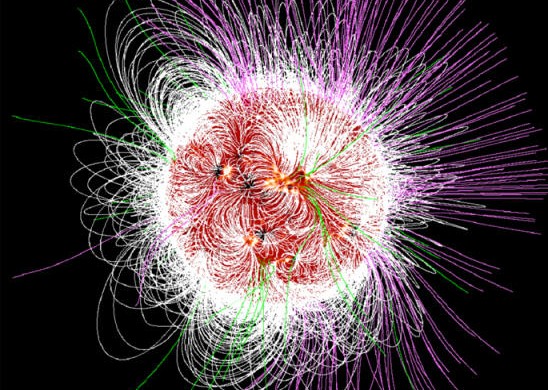
Approximately every 11 years, the magnetic field of the sun switches its polarity. This usually occurs during the part of the sun’s cycle known as the Solar Maximum. During the last solar magnetic field reversal in 2003, there were 17 major solar flare eruptions within three weeks including the record setting X-28 flare. In the current cycle the sun has so far had unusually low levels of activity, the weakest in at least 100 years. Since scientists have only been studying solar activity since the 1700s, we don’t know for sure how unusual the current pattern is relative to longer time spans, what it means, or what to expect next.

This video from NASA explains some of the cosmic effects expected to occur: