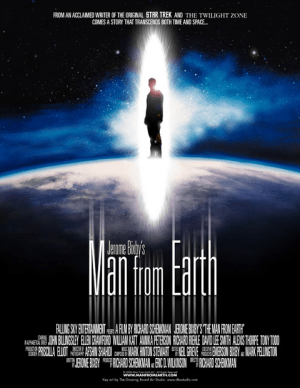
“The Man from Earth” (2007) is an indie drama (with sci-fi elements) written by Jerome Bixby and directed by Richard Schenkman. The screenplay was written by Bixby in the early 1960s and completed on his deathbed in April 1998. The film gained recognition in part for being widely distributed through peer-to-peer networks and was later adapted by Schenkman into a stage play of the same name.
A farewell party for departing university professor John Oldman (David Lee Smith) takes an unusual turn when he reveals his true identity. The group is split on their appraisal of John’s motives and mental stability. The plot advances through intellectual arguments between the professor and colleagues on the veracity of his claims regarding his history and reason for leaving.
“Seances” is an experimental film project from Guy Maddin which began as an art installation piece shot in public over 18 days at the Centre Pompidou in Paris and over another 13 days at the Phi Centre in Montreal. It’s intention is tomystically conjure long-forgotten stories of lost films from periods such as Hollywood’s silent era. Maddin invited the sad spirits of lost films to possess his assembled actors (including Mathieu Amalric, Charlotte Rampling, Udo Kier, and Geraldine Chaplin among others) and compel them to act out the old stories, while the spirit-photographer/director captured the precious narratives. The project’s website, which is currently the only way to view the project, randomly combines clips of the material in different combinations for every viewer creating a unique experimental short film that will never be seen again.
“True Legend” (2010) was directed by legendary director/fight choreographer Yuen Woo-Ping (best known for Drunken Master, Iron Monkey, Wing Chun, and his work on films such as The Matrix, Kung Fu Hustle, and Fist of Legend among other classics of the genre). The film’s plot is not unlike countless old school martial arts films, following the journey of former general Su Can (Vincent Zhao of The Blade) whose life is shattered by a jealous adopted brother (Andy On). With support from his wife (Xun Zhou), his doctor (Michelle Yeoh), the God of Wushu (Jay Chou) and an old sage (Gordon Liu), Su Can strives to overcome great odds to reunite his family. If you ever hoped to see a Shaw Brothers film with a larger budget and made using modern film techniques, True Legend won’t disappoint. The cast of martial arts veterans are great across the board as are David Carradine (in one of his last roles) and assorted lesser-known western actors as minions.
“La Haine” (1995) is the second feature film written and directed by Mathieu Kassovitz. The plot follows 19 hours in the lives of a multi-ethnic 20-something trio of friends from the housing projects of Paris where racism, police brutality and poverty have created a social pressure cooker. After finding a police pistol in the aftermath of a riot in which one of their friends was severely beaten by police, they navigate a series of perilous situations exemplifying simmering race and class hatred in French society (often escalated by the presence of the weapon). Though set in France, the basic storyline is all too relatable for disenfranchised people everywhere including the US. The film features great performances from the three leads (Hubert Koundé, Vincent Cassel and Saïd Taghmaoui), striking black and white cinematography by Pierre Aïm, and excellent writing/direction by Mathieu Kassovitz.
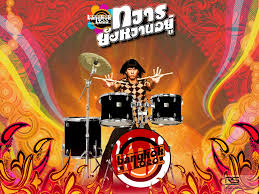
“Bangkok Loco” (2004) is a surreal Thai musical comedy (and feature film debut) from director Pornchai Hongrattanaporn. Actor/musician Krissada Terrence stars as Bay, a 70’s era drum prodigy with special skills taught to him by a monk. After getting framed for a murder, he becomes a fugitive but is aided by friend and fellow drummer Ton (Nountaka Warawanitchanoun). Together, they struggle to evade police, clear his name and win a climactic drum duel against “Devil’s Drums Master” Mr. David (Rang Sabian).
Watch the full film with English subtitles here. (May not stream on some portable devices.)
What is it that makes us human? And how best to ensure that we all get our fair say?
For director, photographer, and environmental activist Yann Arthus-Bertrand, the answers lay in framing all of his interview subjects using the same single image layout. The formal simplicity and unwavering gaze of his new documentary, Human, encourage viewers to perceive his 2,020 subjects as equals in the storytelling realm.
There’s a deep diversity of experiences on display here, arranged for maximum resonance.
The quietly content first wife of a polygamist marriage is followed by a polyamorous fellow, whose unconventional lifestyle is a source of both torment and joy.
There’s a death row inmate. A lady so confident she appears with her hair in curlers.
Where on earth did he find them?
His subjects hail from 60 countries. Arthus-Bertrand obviously went out of his way to be inclusive, resulting in a wide spectrum of gender and sexual orientations, and subjects with disabilities, one a Hiroshima survivor.
Tears, laughter, conflicting emotions… students of theater and psychiatry would do well to bookmark this page. There’s a lot one can glean from observing these subjects’ unguarded faces.
The project was inspired by an impromptu chat with a Malian farmer. The director was impressed by the frankness with which this stranger spoke of his life and dreams:
I dreamed of a film in which the power of words would resonate with the beauty of the world. Putting the ills of humanity at the heart of my work—poverty, war, immigration, homophobia—I made certain choices. Committed, political choices. But the men talked to me about everything: their difficulty in growing as well as their love and happiness. This richness of the human word lies at the heart of Human.
In Volume I, above, the interviewees consider love, women, work, and poverty. Volume II deals with war, forgiveness, homosexuality, family, and the afterlife. Happiness, education, disability, immigration, corruption, and the meaning of life are the concerns of the third volume .
The interview segments are broken up by aerial sequences, reminiscent of the images in Arthus-Bertrand’s book, The Earth from Above. It’s a good reminder of how small we all are in the grand scheme of things.
Appropriately, given the subject matter, and the director’s longtime interest in environmental issues, the filming and promotion were accomplished in the most sustainable way, with the support of the GoodPlanet Foundation and the United Carbon Action program. It would be lovely for all humanity if this is a feature of filmmaking going forward.
“Terror in Resonance” is an 11 episode anime series directed by Shinichirō Watanabe (director of a number of cult anime titles such as Cowboy Bebop, Space Dandy and Samurai Champloo). This latest series (known in Japan as Terror in Tokyo) centers on two teenage terrorist masterminds code-named Nine and Twelve who collectively go by the name Sphynx. They set off a number of targeted bombs around the city while releasing videos designed to communicate cryptic messages to authorities. What starts off as a conventional “cat & mouse” detective story gradually becomes an even more intriguing parapolitical parable. Terror in Resonance stands out for its mixture of elements from Akira,Dark Angel and V for Vendetta and references to familiar topics in the conspiracy milieu such as thermite bombs, remotely piloted planes, EMPs and human experimentation.
The earliest version of Reefer Madness was released in 1936. It was financed by a church group who intended it to be a morality tale warning parents of supposed dangers of cannabis use and helped prime the public for prohibitionist Harry Anslinger’s Marihuana Tax Act introduced a year later. In spring of 72, the founder of NORML, Keith Stroup, rediscovered the film and organized college campus screenings throughout California to raise funds for the California Marijuana Initiative which would potentially legalize cannabis in the 1972 fall elections. Though the initiative failed to pass, Reefer Madness was soon after elevated to the status of cult classic and became notorious for midnight movie screenings with spirited audience participation including mass pot smoking during key scenes.
Reefer Madness was “re-imagined” as a musical comedy by Kevin Murphy and premiered in Los Angeles in 1998 and in 2005 Showtime created the cable movie version directed by Andy Fickman and starring Kristen Bell, Christian Campbell, and John Kassir reprising their stage roles.





 After the Crash