Saturday Matinee: An Open Secret

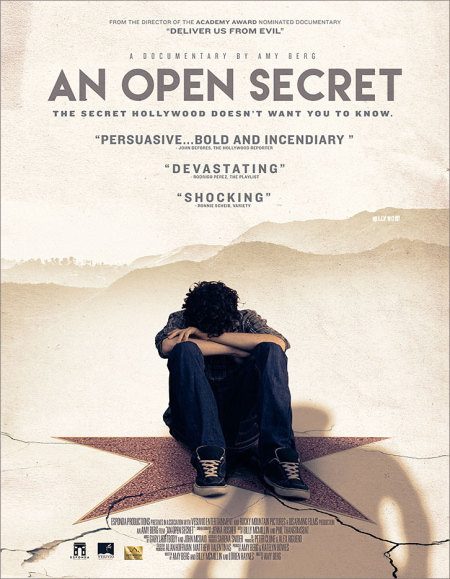
“An Open Secret” (2014) is a documentary film about Hollywood child sexual abuse directed by Amy Berg (Deliver Us From Evil). The film features interviews with victimized performers, who were targeted when they were young boys (including Corey Feldman and Todd Bridges), as well as industry figures, the predators themselves, and journalists. The documentary originally had a very limited theatrical run and has never had a home video release causing widespread suspicion that there was a campaign to bury the film. Regardless, according to Wikipedia a pirated version was viewed at least 900,000 times. Due to the exposure of Harvey Weinstein and other Hollywood sexual predators, on October 12 2017 the film was made available for free for nine days on Vimeo. Because it went viral, with over 3 million viewings on various social media platforms in two weeks, the free viewing period has been extended until early November.

Watch the full film for free for a limited time here: https://vimeo.com/142444429

Saturday Matinee: The People Under the Stairs

“The People Under the Stairs” (1991) is one of most overt and subversive social critiques in horror film format from the late great Wes Craven. The film’s plot, which also serves as a parable for America’s racial/class divide, focuses on Poindexter “Fool” Williams (Brandon Adams), whose family faces eviction by their landlords the Robesons (Everett McGill and Wendy Robie (who also played a quirky but far less menacing couple in Twin Peaks). Due to his desperate circumstances, Fool gets involved in a plot by his uncle Leroy and an associate to break into the Robesons’ house. The plan quickly spirals out of control and Fool escapes by hiding in the house with the help of children who were horrifically punished for breaking the Robesons’ “see/hear/speak no evil” rules.  Against the odds, Fool must escape to save his family and free the prisoners of the household.

Watch the full film here. (Streaming speed may be slowed by pop-up ads.)

Saturday Matinee: Night Tide

By Steve Johnson

Source: Bright Lights

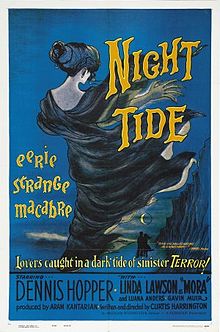
The first shot proper in Curtis Harrington’s 1961 feature film debut, Night Tide, situates main character Johnny Drake leaning over a pier in his sailor gear, slightly off-angle, so we understand that there’s something unresolved in his character, something at un-rest. The setting is Venice, California, a long way off from the Poe-like submerged city it’s named for, as are many of the film’s characters from their similar sources. A clairvoyant later calls Johnny innocent and searching, and everything about the moody composition reinforces this notion as he gazes into the reflective waters. There at the brink between land and sea, consciousness and dream, he’s Narcissus regarding himself in the pool, much like the protagonist of Harrington’s attention-getting 1946 short Fragment of Seeking.

In that earlier, experimental film, Harrington’s character — played by the director himself — pursues a robed figure after the fashion of Maya Deren’s “Meshes of the Afternoon,” only to discover that what he had taken to be a woman is instead himself, in drag. (The scenario is a gloss on such Poe tales as “William Wilson” and “The Assignation”; Harrington’s first short was an adaptation of “The Fall of the House of Usher,” a new version of which was also his final film work.) This motif of inquiring into gender and the self is revisited in film after film of Harrington’s no matter how personal or indifferent, from the exploration of the twin-gendered Venus and Mars of his next feature, Queen of Blood, through the various pursuits of his ’70s TV movies The Dead Don’t Die and How Awful About Allan, the latter climaxing in the reverse-unmasking of the lead’s veiled malefactor — whom he had assumed was a male boarder — as in fact his own sister.

This lunar pull toward some split-off aspect of the self is part allegorical, part autobiographical. In Night Tide, the division in Johnny’s object of fascination, the sideshow mermaid named Mora who believes she’s the real thing, represents our peculiarly human nature, being not entirely animal yet not entirely separate, either. In both evolutionary and individually developmental terms, she recalls the amniotic origins Johnny contemplates from his privileged perspective at the start of the picture, which viewpoint the film reiterates at other key points and in other key locations. That tension between our innocent beginnings and present “fallen” state reflects the director’s own attitude toward his ambitions and the course his career would take in the baroque and carnivalesque Hollywood where he found himself working for the next 25 years after this self-written and -financed calling card of a film.

Though Harrington’s character, and indeed the tone of his feature, is naïve, Harrington himself was not. True to the Hollywood Babylon of friend and early co-conspirator Kenneth Anger’s series of infamous industry exposés, the portrait of that town in such later Harringtons as What’s the Matter with Helen? maintains the grime on the city’s underbelly. For the novice filmmaker, Tinseltown was the Mora-like Lorelei whose song lured many a hapless romantic to his ruin. As his career lost its way from the wide-eyed optimism on display here, it bent itself to an increasing sordidness, the decadence that underlay his scenarios become less and less berobed with the illusion of glamor. By the time of his penultimate theatrical feature, the Exorcist knockoff Ruby, the putative Golden Age apostrophized throughout his work in the casting of mostly played-out Hollywood luminaries was at last seen as a nest of gangsters reduced to working for the title singer at her drive-in theater, her daughter the innocent supernatural woman of Night Tide become the actual agent of the violent deaths of which Mora, in her film, is falsely accused.

In conversation with David Del Valle on the latter’s cable interview program, The Sinister Image, Harrington described his first studio film, Games, as concerning the seeping of “European decadence” into innocent America. In that film, Night Tide‘s boardwalk attractions are literally internalized in the pinball-filled apartment and juvenile, prank-prone relationship of its socialite couple — based on Night Tide star Dennis Hopper and his Hollywood-royalty wife, Brooke Hayward — all of which turn malevolent under the influence of a French mystic played by Simone Signoret. In Night Tide this figure appears in the form of the Greek-speaking Mystery Woman (played by Marjorie Cameron, a consort of reputed Black Arts practitioner Aleister Crowley) and in Queen of Blood the vampiric cod-European extraterrestrial; in later tele-films The Dead Don’t Die it’s the zombie leader Varek, Killer Bees‘ queen-bee Madame von Bohlen, and the witchy Martine Beswick character of Devil Dog: Hound of Hell, as well as the soigné Nazi psychologist of theatrical career-closer Mata Hari.

Which is not to say that this influence need necessarily be European. The director just as easily gave it a domestic face in the form of Helen‘s radio evangelist played by Agnes Moorehead and her disturbed disciple Shelley Winters, and The Killing Kind‘s mother, Ann Sothern — symbols of Golden Age Hollywood, all, as was Bees‘ Gloria Swanson. The decadence, if any, is organic to its milieu; if it hails from any Old World to speak of, it’s a world within.

Harrington has said that all of his films are tragedies. Night Tide, at least, ends hopefully. When Ellen Sands, the land girl who vies for his affections, sees Johnny off, the implication is that she’ll be a soft place for him to land when he comes down from his guilty obsession over Mora; her offer of coffee on his way out is as Ariadne’s gift to Theseus of the thread of consciousness that would lead him out of the minotaur maze. With the more exotic love of Mora suggesting the primitive, deep and unfathomable artistic nature (she being first encountered in a subterranean jazz club and later doing an improvisational dance to a bongo beat) that Harrington would leave behind in the pursuit of bigger budgets, greater technical resources, and a wider audience, Ellen’s boardwalk merry-go-round suggests the simple, commercial (if mechanical) pleasures of an “innocent,” old-fashioned entertainment, and Night Tide the chronicle of a passage from avant-garde mother to the feature-length mainstream cinema Harrington would spend a quarter of a century courting with varying degrees of success.

We take solace in Johnny’s being escorted out by the Shore Patrol, suggesting that the questing sailor has found his feet and will one day return to the merry-go-round girl. It’s an odd early endorsement of heterosexual love and normality for a director the overwhelming bulk of whose later work describes such relations and their familial expression in grotesque terms — the undead marathon dancers of The Dead Don’t Die, the forced rape-participation of The Killing Kind, the suburban kennel that is Devil Dog‘s home and family (with its figurative “breeders”), as the ancestral-home hive of Bees. It’s no surprise, then, that the further Harrington came from the hopes of establishing the kind of career he may have envisioned, the harsher the satire became, until the disaster of the attempted Sylvia Kristel vehicle Mata Hari crumbled under the weight of its disinterest in the softcore couplings that were its generic reason for being. Afterward, it was series television for him, the likes of which — Dynasty, primarily — offered a more comfortable haven for his outright cynical — no longer conflicted — attitudes. It was as if Johnny had returned to find Ellen had given up the wait for him and gone. All that was left now was to join the amusements.

Saturday Matinee: Blade Runner Black Out 2022

In 2022, an EMP detonation has caused a global blackout that has massive, destructive implications all over the world. Directed by Cowboy Bebop and Samurai Champloo’s Shinichiro Watanabe, Blade Runner Black Out 2022 is a new animated short which serves as a prologue for the feature film Blade Runner 2049.

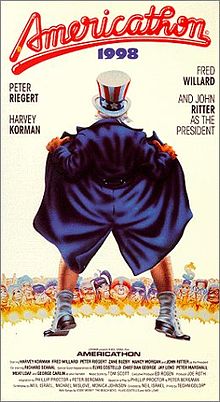
Saturday Matinee: Americathon

“Americathon” (1978) is, like Idiocracy, a dystopian comedy with prophetic predictions such as the fall of the USSR, privatization of public assets, smoking being banned, masses of homeless people living in cars, and the dominance of reality TV, but set in the then future year of 1998. It was directed by Neal Israel, based on a play by Firesign Theatre alumni Phil Proctor and Peter Bergman with narration by George Carlin. In Americathon’s vision of the future, the U.S. has passed peak oil and the government is on the brink of bankruptcy. In order to avoid having the country foreclosed and repossessed by the original owners, president Chet Roosevelt (John Ritter) organizes a national telethon with hilarious results. Features surprising appearances by Elvis Costello, Meat Loaf, Cybill Shepherd and Howard Hesseman.

Watch the full film here.

Saturday Matinee: A Short Vision

The Night Ed Sullivan Scared a Nation with the Apocalyptic Animated Short, A Short Vision (1956)

Source: Open Culture

On May 27, 1956, millions of Americans tuned in to The Ed Sullivan Show, expecting the usual variety of comedians, talents and musical guests. What they weren’t prepared for was a short animated film that Sullivan introduced thusly:

Just last week you read about the H-bomb being dropped. Now two great English writers, two very imaginative writers — I’m gonna tell you if you have youngsters in the living room tell them not to be alarmed at this ‘cause it’s a fantasy, the whole thing is animated — but two English writers, Joan and Peter Foldes, wrote a thing which they called “A Short Vision” in which they wondered what might happen to the animal population of the world if an H-bomb were dropped. It’s produced by George K. Arthur and I’d like you to see it. It is grim, but I think we can all stand it to realize that in war there is no winner.

And with that, he screened the horrific bit of animation you can watch above. At the height of the atomic age, this film was a short sharp shock. Its vision of a nuclear holocaust is told in the style of a fable or storybook, with both animals and humans witnessing their last moments on earth, and ending with the extinguishing of a tiny flame. The mostly static art work is all the more effective when faces melt into skulls.

Many children didn’t leave the room of course, and the website Conelrad has a wonderful in-depth history of that night and collected memories from people who were traumatized by the short as a child. One child’s hair–or rather a small section of his hair–turned white from fright.

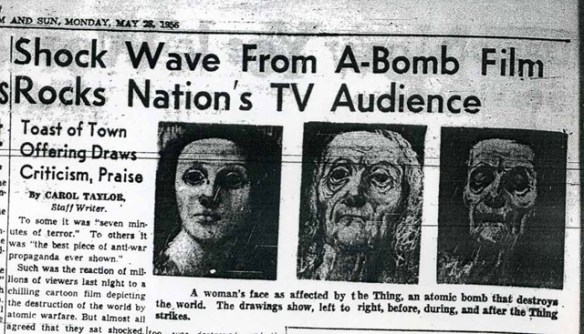
It was as formative a moment as The Day After would be to children of the ‘80s. The papers the next day reported on the short in salacious detail (“Shock Wave From A-Bomb Film Rocks Nation’s TV Audience”) and Sullivan not only defended his decision, but showed the film again on June 10.

The film was created by married couple Peter and Joan Foldes, and shot for little money in their kitchen on a makeshift animation table. Peter was a Hungarian immigrant who had studied at the Slade School of Art and the Courtlaud Institute and apprenticed with John Halas where he learned animation.

(Halas is best known for the animated feature version of Orwell’s Animal Farm.)

A Short Vision would go on in September of that year to win best experimental film at the 17th Venice Film Festival. (Peter Foldes would later make another disturbing and award-winning short called Hunger.)

Once so shocking, A Short Vision fell out of circulation. But a generation grew up remembering that they had seen something horrific on television that night (in black and white, not the color version above.) For a time, it was hard to find a mention of the film on IMDB and a damaged educational print was one of the few copies circulating around. Fortunately the British Film Institute has made a pristine copy available of this important Cold War document.

Saturday Matinee: Le Orme (aka Footprints on the Moon)

From Archive.org:

“Le Orme” (a/k/a “Footprints on the Moon” and “Primal
Impulse”) has been described variously as an Italian giallo, a sci-fi film, a
mystery, or a psychological thriller. Ultimately, it defies pigeonholing.

It stars Florinda Bolkan as Alice Cespi, a professional
translator, who is tormented by a recurring nightmare; in it, a lunar-landing
team deliberately abandons a colleague on the moon’s surface as part of a scientific
experiment.

Alice arrives for work one day and is summarily canned. The
reason? She’d walked out of an international astronomy conference and disappeared
for three days, incommunicado.

Those three days are a complete blank for her. Alice finds a
few vague clues — a torn postcard from Garma, a resort she’s never visited; an
earring, a unfamiliar bloody yellow dress that fits her perfectly — and sets out
to learn what has happened.

When she arrives in Garma, all of the strangers are
delighted to see her “again” — but claim that she’s another person entirely. And that’s
just the beginning…

Although the storytelling in “Le Orme” is fairly linear, it’s also disorienting — so you’ll
have to pay attention to it. There are blind alleys, red herrings and
(possibly) misleading implications throughout.

Cast includes Bolkan, Peter McEnery, Nicoletta Elmi, and a cameo by Klaus Kinski.

Titles and credits are in Italian, but all dialogue is in English.

Saturday Matinee: The President’s Analyst

“The President’s Analyst” (1967) is a political satire written and directed by Ted Flicker. James Coburn stars as Dr. Sidney Schaefer, a psychiatrist recruited by the U.S. government to serve as the president’s private psychoanalyst. Overwhelmed by stress and paranoia, he goes on the lam and is promptly hunted down by foreign and domestic intelligence agents as a pawn in a technocratic plot to control the world. The film’s comedic sensibility is at times dated but features themes which are even more relevant today such as the conflict between power and ethics, transhumanist aspirations of Big Data corporations, the ever-encroaching surveillance state and resultant loss of privacy.

Watch the full film here.