Saturday Matinee: Mayhem

By Brian Tallerico

Source: RogerEbert.com

Joe Lynch’s “Mayhem” feels like a timely film in a way it wouldn’t have a couple years ago. Whatever your political party may be, anger has been a palpable emotion in this country recently—it was anger that got Trump elected, and it’s anger that opposes his administration. But what do we do with that anger? How long can we keep it down before it overwhelms us? With his best film since “Wrong Turn 2,” Lynch channels that national anger into a stylish, smart, propulsive gore-fest set in a corporate America that takes no prisoners. But when did it?

Not only is “Mayhem” a brutal, visceral gut punch at a time of the year when we typically drown in awards bait, but it feels like a movie designed to tap into a vein of frustration and anger at a corrupt system. Hate your boss? Can’t control your road rage? Want to push your co-workers down a stairwell? Thinking mean things about the President and his cronies? “Mayhem” channels rage at an unfair society and the bullshit that trickles down from the Powers That Be into a paean to uncontrolled anger. Much more tonally consistent than the similar “The Belko Experiment,” “Mayhem” isn’t as much about id run rampant as it is two people finally loosed from moral and societal constraints in a way that allows them to enact bloody, vicious vengeance. There are times when the whole thing feels like an extended version of that scene from “Kingsman: The Secret Service,” or, worse, the movie that would be the favorite film of the lunatic followers of Tyler Durden in “Fight Club,” but this weird little genre exercise works way more often than it doesn’t, and actually has something to say in the process.

The premise of “Mayhem” is simple in a way that I think a lot of horror masters would admire. There’s an airborne disease, referred to as “Red Eye” for the single red-eye it gives those who suffer from it, that removes all societal and moral governance. So those infected with it don’t just get mad, they get bloody. And it happens to infect a firm (and not just any firm but the one that set the legal precedent for “Red-Eye Defense” by recently getting off a murderer who was infected with it at the time) filled with the kind of well-tailored monsters who barely control their impulse for cruelty anyway. These are the kind of people who gleefully step on the little man in the pursuit of the almighty dollar, and one of the most interesting aspects of “Mayhem” is the choice Lynch makes not to infect “average Joes” but people who seem to have practice unleashing their inner monsters. When John Towers (Steven Brand), the boss of this loathsome company, says to someone beneath him that “You must protect those above you,” it’s the kind of human shield mentality that CEOs and executives have been using for scapegoats for decades.

However, the protection in this case is literal, and the man that Towers needs it from is Derek Cho (Steven Yeun, going from fighting zombies on “The Walking Dead” to maniacal suits here), a rising star who is about to be fired on the day the infection hits the company. Rather than take his corporate execution the way so many do, he picks up a hammer and a nail gun and goes after the people above him, assisted by a client named Melanie Cross (Samara Weaving), who was in the office that day fighting an immoral foreclosure. Caroline Chikezie, Kerry Fox, and Dallas Roberts co-star as corporate monsters at Derek’s company, but the movie belongs to Yeun and Weaving, who both get exactly what Lynch is going for here. They are fearless and intense in ways that other performers would have missed. Yeun proves himself to be a more engaging leading man than I would have expected and Weaving has the energy of Margot Robbie—captivating and a little scary at the same time. They’re both really good, and it’s their commitment that keeps “Mayhem” humming.

“Mayhem” is at its best when it channels relatable stress into utter genre insanity. It’s like “Office Space” if Michael Bolton went on a murderous spree with a nail gun, playing on workplace stress instead of pure id, and it has a violent momentum that’s hard to deny, well-directed by Lynch (who might use a few too many quick cuts but also stages a brutal scene to Faith No More, so all is forgiven). It can be such a relentless experience that it surely won’t be for everyone, but it works best when considered as a film that’s essentially about people willing to kill, bribe and offer power to anyone to not only save their own skins but also excuse their own horrors. Whether you would levy such accusations at Trump or the candidate he beat a year ago, there’s something about watching a movie about unleashing repressed anger at injustice a year after Election Day 2016 that just feels right.


Watch the full film at Hoopla.

Saturday Matinee: The Sunshine Makers

A real-life Breaking Bad for the psychadellic set, The Sunshine Makers reveals the entertaining, untold story of Nicholas Sand and Tim Scully, the unlikely duo at the heart of 1960s American drug counterculture. United in a utopian mission to save the planet through the consciousness-raising power of LSD, Orange Sunshine, as they tried to stay one step ahead of the feds.

Watch the full film here.

Saturday Matinee: The Man Who Fell to Earth

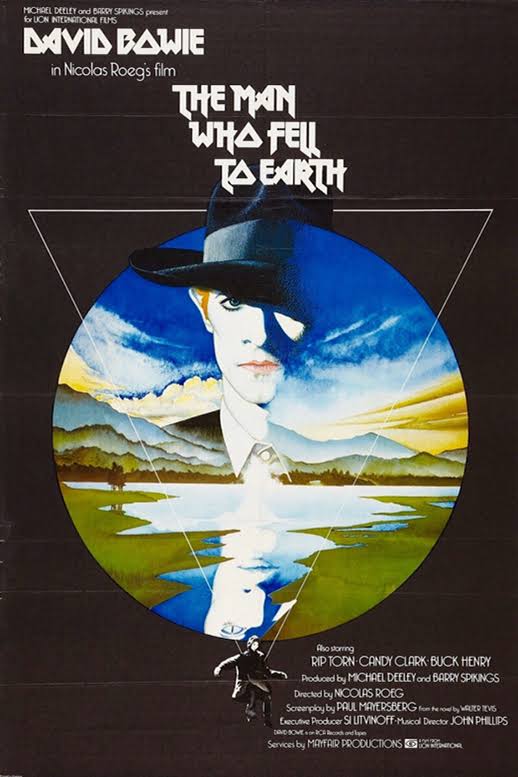
“The Man Who Fell to Earth” (1976) is a British science fiction film directed by Nicolas Roeg, written by Paul Mayersberg, and based on Walter Tevis’s 1963 novel of the same name. David Bowie (in his first feature film role) stars as an extraterrestrial who crash lands in New Mexico while on a mission to save his home planet. Going by the name of Thomas Newton, he soon meets Oliver Farnsworth (Buck Henry), Mary-Lou (Candy Clark) and Dr. Nathan Bryce (Rip Torn), who become his closest allies. Due to personal and professional betrayals, Newton’s secret is revealed and he’s captured by a government agency. While imprisoned he’s subject to tortuous medical tests which break his spirit, replacing his more “alien” personality traits with those of a modern American.

In Philip K. Dick’s novel VALIS, fictionalized versions of Dick and K. W. Jeter become obsessed with Valis, a film starring musician Eric Lampton. This plot element was based on Dick and Jeter’s real obsession with The Man Who Fell to Earth.

Watch the full film here: https://m2m.tv/watch/the-man-who-fell-to-earth/films


Saturday Matinee: Kaiba

A young man awakens without memories. There’s a hole in his chest, a symbol on his belly, and a blurry picture of a girl in a locket he has. Knowing nothing, he tries to escape a twisted city of stolen memories and exchangeable bodies in a world where minds are stored on chips when individuals die and the manipulation of other people’s memories has become the norm.

A surreal series of thirteen 26 minute episodes written and directed by Masaaki Yuasa (“Mind Game”).

Watch the full series here.

Saturday Matinee: Evidence

Evidence, Godfrey Reggio’s Short Film on What TV Does to Kids’ Brains

By DC

Source: Open Culture

Between 1982 and 2002, director Godfrey Reggio shot his well known Qatsi trilogy – Koyaanisqatsi, Powaqqatsi, and Naqoyqatsi. Somewhere between the 2nd and 3rd installment, Reggio took a little detour and directed a short eight minute film called Evidence. The main characters? Kids watching cartoons (Dumbo, actually) and looking “drugged,” “like the patients of a mental hospital,” he writes on his web site.

The villain? “Television technology,” which “is eating the subjects who sit before its gaze.” The weapon? Television again. That “radiation gun aimed at the viewer” “holds its subjects in total control.” A little house of horrors, to be sure. We have added Koyaanisqatsi (featuring the music of Philip Glass) and Evidence to our collection of Free Movies Online.

Saturday Matinee: The Case of the Grinning Cat

Synopsis from Icarus Films:

In his newest film, French documentarian and cinema-essayist Chris Marker reflects on French and international politics, art and culture at the start of the new millennium. In November 2001, the filmmaker became intrigued, as did many other Parisians, by the sudden appearance of alluring portraits of grinning yellow cats on buildings, Metro walls and other public surfaces. Marker’s cinematic efforts to document the mysterious materializations of this charming feline throughout Paris are a recurring theme of THE CASE OF THE GRINNING CAT.

This engaging record of Marker’s cinematic peregrinations throughout the city, visually energized by his free-association montage style, chronicles strikes, demonstrations, memorials, election campaigns, celebrity scandals, international political incidents, and a seemingly endless variety of political protests (against the Iraq War, against China’s occupation of Tibet, against the government’s ban on the wearing of Muslim headscarves). The personalized commentary running throughout THE CASE OF THE GRINNING CAT offers the simultaneously learned and witty reflections of the filmmaker, now in his early eighties, on both the contemporary and historical implications of these varied events and personalities.

The mysterious grinning yellow cats soon begin to appear amidst the banners and signs in some of the political demonstrations. Eventually, the creator of the grinning cats is revealed to be an art collective known as Mr. Cat, whose members are shown painting a massive representation of their mascot on the plaza before the Pompidou Center. The filmmaker’s own famous cat caricature soon allies with Mr. Cat, as Marker speculates on the political possibilities of such a feline association.

Chris Marker concludes THE CASE OF THE GRINNING CAT with thoughts on the vital importance of such expressions of imagination in our public lives, echoing the May ’68 slogan that “La poésie est dans la rue” (“Poetry is in the street”).

Saturday Matinee: Metamorphosis

(In memory of Terence McKenna, November 16, 1946 – April 3, 2000)

CHAOS AND THE WORLD SOUL

By Richard Kadrey

Source: Wired

METAMORPHOSIS – A video “trialogue” featuring Ralph Abraham, Terence McKenna, and Rupert Sheldrake – is part shamanic journey and part New Physics 101. It’s mostly talk, with touches of simple computer graphics and music adorning the presentation. But what talk it is. We’ve got Abraham, a mathematician and the godfather of chaos theory; McKenna, a shamanologist, ethnopharmacologist, and psychedelic philosopher; and Sheldrake, a radical biologist and originator of the idea of “morphic resonance,” a memory embedded in all natural systems. Their free-form discussion ranges from drug experiments to the anima mundi (world soul), chaos and complexity, and the effects of language and imagination on the shape of the universe – all in search of a new field theory that encompasses art, science, and philosophy.

In this particular chaotic system, McKenna is the strange attractor around which Abraham and Sheldrake orbit. The three unite in a quest for knowledge and an exchange about the sciences they’ve studied. Sheldrake talks passionately about trying to redefine biology in terms of living organisms, not the abstract dead things found in textbooks and labs. Abraham, not surprisingly, explains how protests over the Vietnam War lead him to leave his sheltered academic life, pursue meditation in the Himalayas, and study chaos theory.

With McKenna as the ringleader (and biggest talker), imagination and chaos are the principal themes. Chaos, as McKenna describes it, is a science to study, an opportunity to reshape the world by looking through the lens of nonlinear processes, and a metaphor to help us think about our place in the universe. In McKenna’s words, chaos “is telling us that the intimation of mysticism, the intimation of a possibility of transcendence, is all firmly grounded in science.”

This is heady stuff. Though you half expect the psychedelic proselytizing to drift off into some kind of Birkenstock-and-bean-sprout dead end, the rigor, intelligence, and wit of these three minds keep the ideas sharp and fast. For anyone interested in the edge of science, this video is both entertaining and inspiring.

Saturday Matinee: The Magic Christian

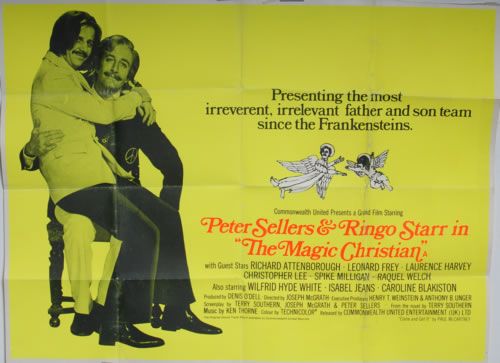
“The Magic Christian” (1969) is a British satire directed by Joseph McGrath and loosely adapted from the 1959 novel of the same name by Terry Southern, who co-wrote the screenplay with McGrath. Peter Sellers stars as billionaire Sir Guy Grand, who adopts a homeless man (Ringo Starr) and demonstrates to his new heir how virtually everyone in the world can be bought through an escalating series of pranks. Cameo appearances are made by John Cleese, Graham Chapman, Raquel Welch, Spike Milligan, Christopher Lee, Richard Attenborough and Yul Brynner among others.