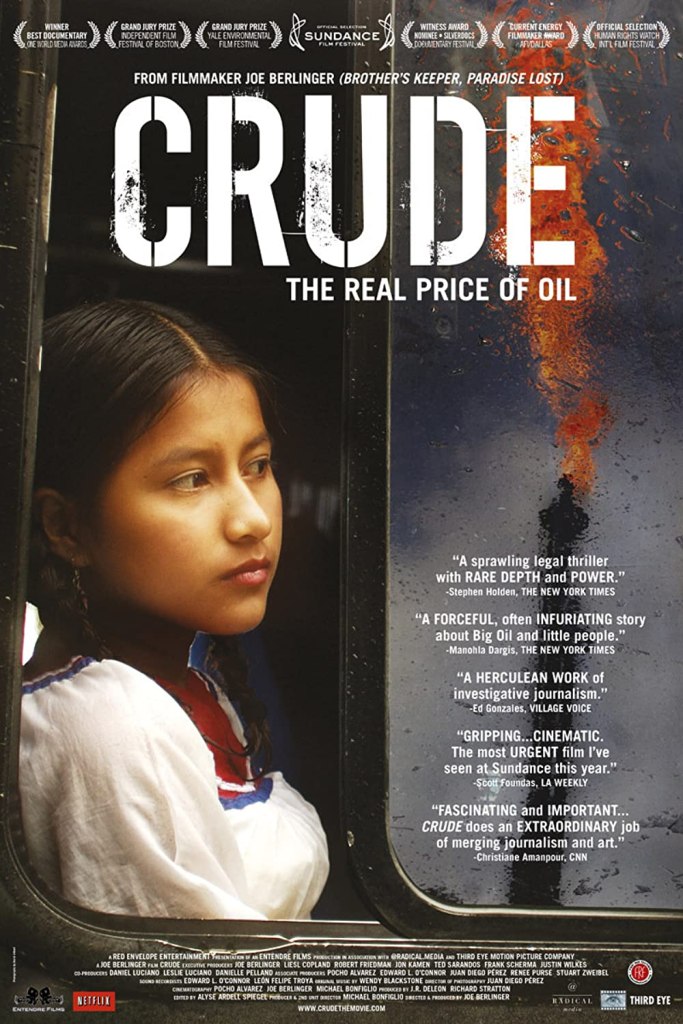
This attention-grabbing documentary directed by Joe Berlinger (Brother’s Keeper) centers on the dramatic story of a legal case that has dragged on for years: Aginda vs Chevron-Texaco. The plaintiffs are 30,000 individuals, including members of five indigenous tribes and colonial settlers in Ecuador who allege that over the course of its quest for oil, Texaco dumped over 18 billion gallons of toxic waste and formation water directly into streams, river, and jungle floor of the Amazon rainforest. In addition, the company is said to have spilled 18 million gallons of crude oil from pipelines, burned more than 235 billion cubic feet of natural gas into the atmosphere, and built nearly 1000 unlined toxic waste pits in the region — an area approximately the size of the state of Rhode Island. Berlinger manages to broaden the documentary out beyond what has been called the “Amazon Chernobyl case” to include material on global politics, celebrity causes, environmental activism, human rights advocacy, the role of the media in controversial trials, the power and wealth of multinational corporations, and the unconscionable treatment of rapidly-disappearing indigenous cultures.
At the center of this David vs Goliath struggle is Pablo Farjardo, the lead attorney for the Aguinda plaintiffs. He grew up in poverty in the Amazon region and attended college and law school under the sponsorship of the Catholic Church. In his first case, which has been running since November 1993, Farjardo is seen making his points during the judicial inspections of the affected regions, rallying support of indigenous tribes, and visiting with families who are suffering with cancer, skin conditions, and birth defects. In 2008, he received the Goldman Environmental Prize in San Francisco honoring his work along with Luis Yanza, President of the Amazon Defense Fund, who has been managing the day-by-day operations of the case. A large role has also been played by Steven Donziger, a New York-based attorney, who has provided invaluable strategy advice and seems to be very savvy about the importance of media coverage (the cover story about the case in Vanity Fair and the involvement of Trudie Styler, the co-founder of the Rainforest Foundation with her husband, the musician Sting).
The cause of Farjardo and associates is helped in 2007 when the new President of Ecuador, Rafael Correa, tours the toxic areas and lends his support. The case for Chevron in the documentary is presented by Ricardo Reis, the Managing Counsel for Chevron Latin America; Sara McMillan, Chevron’s Environmental Scientist who denies any connection between the company’s operations and the deaths and health issues of the indigenous tribes; and Adolfo Callejas and Diego Larrea, the two attorneys representing Chevron.
The proceedings reach a climactic point when the findings of Richard Cabrera, an independent expert, are released. He was appointed by the court to conduct a “global assessment” of the region, evaluating the plaintiffs’ claims and calculating the cost to repair any alleged damages. He found Chevron to be liable for up to $16 billion in damages (later amended to $27 billion) as compensation for health care, environmental remediation, reparations for loss of indigenous culture, cancer deaths, and the oil company’s “unjust enrichment” from its operations. Chevron has rejected the report calling it biased and unqualified. And so, the case continues and we recall that the Exxon Valdez judgment took nearly two decades to appeal.
Update:
Corporate Tyranny: How Chevron Conspired with US Courts to Destroy a Human Rights Lawyer
Human rights lawyer Steven Donziger has been thrust into an epic battle with one of the biggest oil companies in the world. He helped win a multi billion dollar lawsuit against the Oil Giant Chevron for polluting the Amazon in Ecuador and poisoning the indigenous community who lives there.
Ever since then Chevron has waged a relentless and global campaign to avoid accountability and to punish Doziger. In what reads like a Hollywood thriller, a US judge with ties to Chevron has conspired with the oil giant to destroy Donziger’s life. As a result of the case, he has been confined to his home on house arrest since 2019. And there’s a corporate media blackout!
Donziger spoke to Rania Khalek on Dispatches from house arrest in New York City, not too far from the New York Times, which has ignored the story.
Chapiteau-show may be the most untypically Russian film to come out in years. It neither resembles one of those spiritually drenched films about characters in the search for the meaning of life; nor is it close of becoming a naturalistic drama about crooked cops and suburban violence. Chapiteau-show is colorful, and chaotic; there are musical interludes, and dances; characters dress up, or go naked. Chapiteau-show is unorthodox. But despite its almost four-hour length, the film is remarkably straightforward. There are four stories entitled love, friendship, respect, and collaboration. Each of these stories is about a young man trying to find more of the category that gives his story a title, but they end up where they began. What they were looking for was an illusion. Each episode closes in the circus called Chapiteau-show, where the protagonists are invited to give a show, and meet again – in a sort of therapeutic ritual – to acknowledge that the world is made up of theatrical tricks, dreams, and fantasies.
In the first part – love – Aleksei (Aleksei Podolsky), a balded gamer, goes on vacation with the beautiful actress Vera (Vera Strokova). Having only met on the internet, they try to get to know each other, but it quickly turns out that they are too different to match. In the second episode – friendship – a deaf baker leaves his deaf friends behind to join a group of boy-scouts. He wants to prove to himself that he can also hang out with people that are not like him. But his new friends have a different idea of “friendship.” Some of them turn out to be lovers, so when his old friends swear true brotherhood he begs on his knees for them to accept him again. The third episode – respect – is about a son’s relationship with his father. The depressed son, Petr Nikolaevich, tries to impress his father by going on a venturous hiking trip with him. But he doesn’t make it all the way, breaking off the trip during a hunt in the woods. A producer is in the midst of the last episode – collaboration. Sergei wants to make money with so-called “ersatz-stars.” But his idea fails when he hires a carpenter to represent Victor Tsoy. In the end the carpenter is hired by the Chapiteau-show, and the producer left off without ideas, stars, or money.
Chapiteau-show shows how people are unable to significantly change the specific environment they live in. The irony of the film is that while in each of the four episode someone sets out to go on a road-trip to find a meaning in life, the only meaning presented to him at end of the trip is right where he left off. The film’s four variations have a clear message. It doesn’t matter who one wants to be. It is who you are that matters. The encounter with the young men’s desires and dreams shows them who they really are. The deaf baker is only forced to think about friendship when he sees how other people behave that also define themselves as friends. But instead of holding on to his dream or destroying the dream of others, he simply appreciates his own reality. It is this notion, that makes Loban’s film so unique. It may have parallel realities as a plot subject, but not as as moral suggestion.
I recently wrote an article on how birch trees, in Russian cinema, represents spiritual longing, the search for truth, peace and harmony. There is one scene that takes place in a birch tree forest in Loban’s film, too. It is when Petr, in the respect episode, decides to abandon his father and his wish to impress him. One could say that the choice of the birch tree forest for this particular scene is ironic. Whereas in most Russian films, like in Zvyagintsev’s The Return, or Federochenko’s Silent Souls, the trees underline the spiritual force of the characters dreams, Loban turns the signification around and makes his character’s dream die in the same setting. But the point is, in my opinion, not to provide an anti-metaphor, or to deconstruct the symbols of Loban’s cultural forefathers. Loban acknowledges the artistic meaning of the trees. He doesn’t deny that dreams for peace and harmony exist. Indeed, the motivation for Petr to impress his father is similar to the narrative of Zvygintsev’s The Return. This film is also about the relationship between two boys and their father, and a voyage the three make into wilderness. Even though Zvyagintsev’s film is far from reconciling, the film lacks Loban’s realism. It has a deep nostalgic feel to it. The distance between father and sons is like a lament, like a a betrayal. Unlike Chapiteau-show, The Return hangs onto the dreams of reconciliation. Even if it there is no space for real harmony in his film, there are the birch trees, and the equilibrium of nature to tell us that harmony is possible and that violence, hatred, and angst are opposed to it.
Dreams are part of reality, they may even shape reality, but the naked, commonplace, boring reality is different. Where one may think that Loban’s characters celebrate their dreams in the performances of the Chapiteau-show circus, they really celebrate their dream’s farewell. Loban follows this plea aesthetically. His film is full of pop-cultural and sophisticated references from Marylin Monroe to the Pirates of the Caribbean; from Levi-Strauss, and Goethe to Kubrik and Lynch. But these citations don’t have a chaotic postmodern feel. They simply show, on an artistic level, what the characters already told us. It is impossible to escape imitation; to be more beautiful, fancy, glorious, and glamorous is part of life. But there is no need to be nostalgic when life still turns out to be the boring, commonplace reality one tried to escape.
It’s not often that you find a movie that is completely batshit crazy, all the way extra, yet entirely wholesome all in one package. Yet, this is what we have in PG: PSYCHO GOREMAN. Coated with ounces of blood, campy humor, and adolescent sassafras, audiences will be taken through a wackadoo journey that will have their heads spinning. While not quite the type of family film one would put on family night, there is enough family-fun goodness to add this to the list once all members are grown and prepared to have their eyeballs explode. By film’s end, you’ll find yourself unexpectedly wanting the best for everyone, even if it means pure, utter destruction is the end result.
Siblings Mimi (Nita-Josee Hanna) and Luke (Owen Myre) accidentally awaken an ancient alien overlord with no name from a millennia-long prison sentence. Why was this overlord imprisoned you ask? Well, he attempted to destroy the universe after working under an oppressive system that exploited his labor. While the creature has no chill, Mimi is undaunted, especially when it’s discovered that she is in possession of a magical amulet that enables her to force the creature to obey every single command she makes. Every. Single. Command. If you know children well, you know this is an absolutely awful idea.
They decide to give the evil creature the name Psycho Goreman (Matthew Ninaber), which they shorten to PG to keep things easier. PG’s re-appearance, though, triggers attention across the galaxy. There are those who want to destroy him, remembering the destruction he caused eons ago. And there are others who wish to help him, for a price that is. As the galaxy’s creatures start to zero in on this small Earth town, the fate of the galaxy may be up to Mimi and Luke. But first, we get a heavy dose of sitcom-style shenanigans, which sow the seeds of heartwarming payoff that we experience at the film’s end.
Where should anyone really begin when discussing this film? First off, PG: PSYCHO GOREMAN is a practical effects wet-dream. From slowly crawling brain-boys to a suicidal melty zombie police officer to every alien character having their own specific costume that almost reminds of classic Power Rangers episodes mixed with Doctor Who flair, there is so much craft-based love in this film that it made this reviewer positively giddy to see what we’d see next. Knowing the amount of work that went into the effects onscreen, it’s an extraordinarily ambitious undertaking in this day and age. But, in all honesty, it is so worth it to see it come to life onscreen. Forever pro-practical all the way!
With the practical effects aiming to seduce our hearts, we have to keep in mind that this is not all that writer-director Steven Kostanski is bringing to the table for us to consume in PG: PSYCHO GOREMAN. The writing and the delivery of performances from the actors really help to sell the chaos that is taking place onscreen. Matthew Ninaber’s PG’s sinister, almost deadpan delivery contrasts nicely against Nita-Josee Hanna’s manic over-the-top energy she delivers for Mimi. While this reviewer would have loved more levels in Hanna’s performance, the direction and delivery of her character performance still worked well for the over-the-top nature of the film. Adam Brooks is also a notable standout, with his comedic timing and everyman performance providing a much-needed contrast to the adventures of the children onscreen.
The script itself is hilarious and heartwarming, with lines about hunky boys coming out of PG’s mouth that would seem out of place in any other film. Yet, this is a heartwarming, tongue-in-cheek type of film that lends itself to these subtleties, where each character undergoes their own spiritual journey. Just, with wallops of blood, gore, and viscera. These little moments are subtly interwoven in, which maximizes their impact upon arrival due to the black comedy that Kostanski leans into. And, if that isn’t enough for you, the various homages paid to family-style shows in the script really help remind the viewer of the lengths this film will go to remind of what PG: PSYCHO GOREMAN is really about – love and finding your own family. Even if that family consists of a psychotic girl, a mom-turned-administrator of misguided justice, or – even – a bloodthirsty alien warlord.
Overall, PG: PSYCHO GOREMAN is a film that would make an epic Midnighter event at any film festival. It would have been a crowd-pleaser pre-COVID and it certainly will after. This reviewer would argue that it’s the alien warlord version of the little girl paired with bodyguard/former military turned babysitter trope. It’s heartwarming, bloody, incredibly fucked up, and extra as all get out. And, while at times the performances can be more one-note than not, the film just really works. It’s a family film gone wrong, which seems perfectly fitting for the age we’re in now.
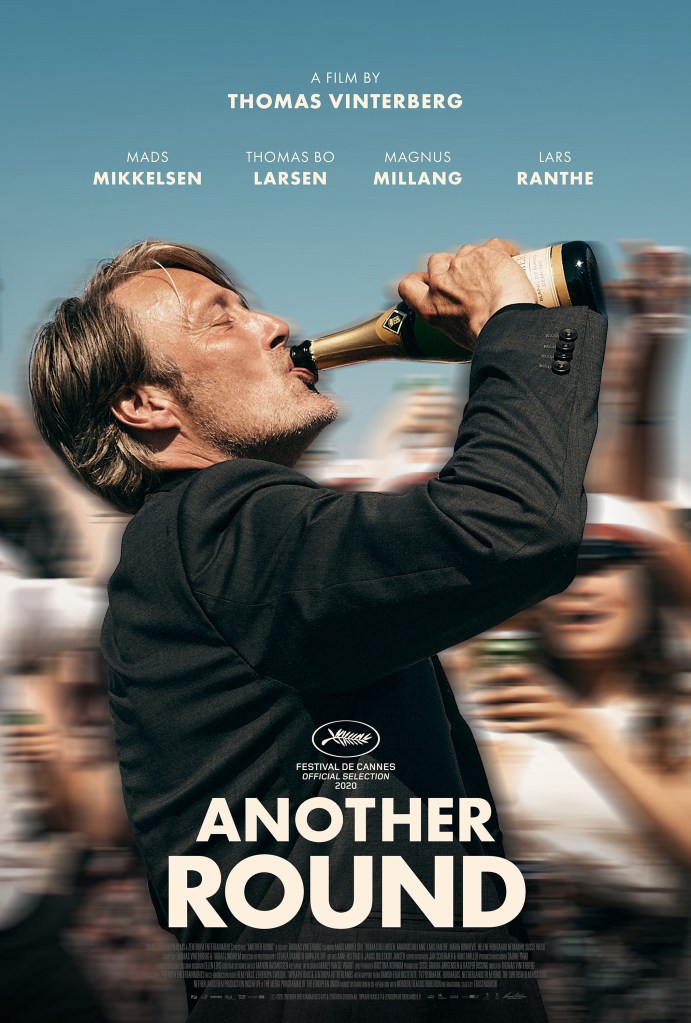
Four teacher friends start a social experiment in Thomas Vinterberg’s smart and ultimately moving “Another Round.” Based on a belief that the human body is born with too low an alcohol level, they strive to maintain a 0.05% BAC at all times—buzzed but far from drunk. They set rules. They can only drink during work hours (yes, as teachers). The idea is that a low-level buzz releases stress and tension in ways that nothing else can. To varying degrees, all four men are going through what could be called a midlife crisis, dissatisfied by the mundanity of daily life as teachers, but it’s Martin (Mads Mikkelsen) who is in the deepest funk. He has lost all passion for teaching his history class, feels distant from his family, and can’t find many reasons to get up. The social experiment breaks him out of his rut in a relatively predictable way, but Mikkelsen elevates what could have been another traditional message movie about living life to the fullest even after you think you’ve had your final drink.
Shortly after the experiment begins, Vinterberg stages a scene in Martin’s classroom, where he’s engaging with his students in a way he clearly hasn’t in years. He’s getting them involved with vibrant conversation and new ways to look at history. He’s smiling in that very Mads way. What’s brilliant about the scene is how Vinterberg and cinematographer Sturla Brandth Grøvlen replicate that slightly wobbly feeling that comes after just a strong drink or two. Martin is nowhere near blacking out or doing anything embarrassing, but the slightly unsteady camera swoops in for a close-up and then back out again in the inconsistent way that the world sometimes does after a couple glasses of wine—the filmmaking coming to life like how Martin is with his new buzz on life. It’s indicative of the high craft on display here as the visual language subtly matches the character’s journey.
Martin’s colleagues (Thomas Bo Larsen, Magnus Millang, & Lars Ranthe—all effective) find similar success, at least at first. A music teacher encourages his students to sing more with their hearts and souls; a philosophy teacher catches onto the anxiety of one of his students in a way he may not have given his previously detached approach. Then the quartet starts to change the terms of the experiment, which everyone knows is a bad idea. If 0.05% works so well for Martin that he feels better even when he’s sober, maybe he should go higher? They start pushing the envelope. Absinthe gets involved. As anyone who has tried it can tell you, Absinthe is almost always a bad idea. Trust me.
“Another Round” reaches beyond its set-up when it becomes a study in individuality. The experiment affects each of the four men differently, and everyone knows that a drunk night comes with a hungover morning. A student near the end gives an exam on the Kierkegaardian philosophies on anxiety and accepting fallibility and failure, which is what all midlife crisis films are about to a certain degree—coming to terms with mistakes after you realize you may be running out of time to correct them.
The midsection of “Another Round,” wherein the guys open up and alter their experiment based on results, has a tendency to drag, but Vinterberg avoids cliché in this bulk of the film, thanks largely to casting his favorite leading man (Mikkelsen starred in the director’s excellent “The Hunt”). The “Hannibal” star is such a genuinely captivating actor—one of those performers who holds the camera like a movie star while also feeling completely realistic and in the moment at the same time. He doesn’t hit a single false note in a film that really could have been all broad humor and wacky hijinks. Even as the final act starts to get a bit manipulative by stretching some previously established realism, Mikkelsen holds it together, and then he comes out literally swinging in one of the best final scenes of the year. It’s such a jubilant moment that you may walk out of the theater feeling a little buzzed.
Killing Gaza: Dan Cohen & Max Blumenthal’s documentary shows life under Israel’s bombs and siege
Filmed behind the walls of the Gaza Strip in the middle of Israel’s 2014 military assault, Killing Gaza presents a harrowing vision of siege and highlights a dispossessed people’s undying will to resist
In Killing Gaza, independent journalists Max Blumenthal and Dan Cohen documented Israel’s 2014 war on Gaza and its devastating aftermath.
Yet this film is much more than a documentary about Palestinian resilience and suffering. It is a chilling visual document of war crimes committed by the Israeli military, featuring direct testimony and evidence from the survivors.
James North of Mondoweiss wrote, “If documentary films like ‘Killing Gaza’ appeared regularly on American television, public opinion would start turning against Israel overnight. The film, just released by Dan Cohen and Max Blumenthal, is inspiring and sickening.”
This debut feature film by journalist Abby Martin began while reporting in Palestine, where she was denied entry into Gaza by the Israeli government on the accusation she was a “propagandist.” So Abby connected with a team of journalists in Gaza to produce the film through the blockaded border.
This collaboration shows you Gaza’s protest movement like you’ve never seen before. Filmed during the height of the Great March Of Return protests, it features riveting exclusive footage of demonstrations.
At its core, Gaza Fights For Freedom is a thorough indictment of the Israeli military for horrific war crimes, and a stunning cinematic portrayal of Palestinians’ heroic resistance.
Absurdity can take many different forms, particularly when it comes to artistic expression, with many individuals over the past century making their living from subverting the central tenets of reality. One such artist was Karen Shakhnazarov, whose ambition film Zerograd (Russian: Gorod Zero) holds the distinction of being one of the most bizarre works of cinema produced in the last few decades. A strange, hypnotic voyage into a darker version of the world, this film feels like the perverted offspring of David Lynch and Andrei Tarkovsky (especially if they collaborated on a twisted version of Alice in Wonderland), and I don’t think there is a single moment in this film that I was in complete awe of. Cinema is supposed to be challenging, and it doesn’t get more impenetrable than this, where Shakhnazarov takes us on a voyage that is somehow both hilarious and utterly terrifying, showing us a side of society that isn’t familiar to anything the best of us have experienced ourselves, but still manages to be as captivating as anything else. A deliriously work of experimental dark comedy, Zerograd is quite an achievement – and kudos has to go to Shakhnazarov for managing to construct something so bewildering, yet so deeply brilliant in both how it provokes certain ideas while remaining quite stable and consistent in its message (at least after we actually figure out what this film is attempting to convey), which creates a sensational piece of filmmaking that tests the boundaries of reality and presents the viewer with something so singularly unique, one would be forgiven for believing that Zerograd isn’t actually a film, but a fever-induced bout of delusions – and for all these reasons and more, we can easily proclaim this film as something of a hidden masterpiece, an outrageous, disconcerting surrealist odyssey that is as entertaining as it is wholly disruptive, both to the art form in which it was made and in terms of the broader socio-cultural implications embedded within it.
The film centres on Alexey Varakin (Leonid Filatov), a regular civil engineer who is sent to a small town in the middle of nowhere to meet with the owner of a factory to discuss some of the products they have been supplying. What was supposed to be a brief day-trip turns into what appears to be an eternity, especially when it becomes clear that everything isn’t what it seems in this mysterious countryside hamlet. His visit takes a horrifying turn when Alexey witnesses the suicide of a chef, which not only traumatizes him, but also places him at the centre of a conspiracy that points to him as the chief suspect, especially when the perspective of the event changes from suicide to a murder. What Alexey doesn’t realize is that he is stuck here – it is physically impossible for him to move beyond the borders of the town, since there are certain metaphysical forces keeping him there. This is made clear when he visits a museum, where the crotchety curator (Yevgeny Yevstigneyev) gives him a tour, taking him to subterranean levels and relaying the history of the town, which stretches all the way back to the formative years of the USSR and the rise of communism across the Soviet Union. Despite being a mild-mannered working-class man, Alexey is seen as something of an anomaly in this town, a stranger sent there by some celestial being to disrupt the lives of the residents – but it soon becomes clear that he’s not the one to fear, since a looming sense of foreboding lingers over the town, and causes the protagonist to reevaluate not only his own life, but the entire concept of reality in general, as everything around him is starting to point to the fact that everything Alexey knew to be true is quite possibly false information, and he himself is at risk of losing his identity as a whole if he doesn’t solve the problem before its too late.
Zerograd is a very different kind of film in every conceivable way. It positions itself as something of a mystery film, but one that dares to ask what happens when someone is investigating something and searching for the truth when every clue not only distances him further from the answer, but proves the incredulity of reality as a whole. This is a mystery film that struggles to even ask a coherent question – if anything, the answers are there, if only we knew where to start looking for them. Shakhnazarov masterfully constructs one of the most fascinating films of its era, a hauntingly dark comedy that eviscerates the very idea of plausibility, going beyond the confines of surrealism and becoming something else entirely, a kind of cold-blooded psychological horror that is more terrifying the more we realize how the sense of danger isn’t just constructed for dramatic purposes, but rather a fundamental aspect of the story. Modern audiences tend to equate the concept of surrealism with the idea of weird works that are artistically transgressive and show a lack of logic – and while this is often very true, its a baseline assessment that can’t apply particularly well to a work like Zerograd, which thrives on its ability to deconstruct nearly every sacrosanct truth while still retaining a coherent, concise narrative that goes to some bizarre narrative territory, but only for the sake of supporting its own ambitious ideas. There are many aspects of Zerograd that positively yearn to be discussed – and I’d expect some background knowledge of Soviet-era politics, while not essential in any way, would only enrich the experience, and help add context to a work of unhinged socio-cultural satire that masters the fine art of amusing the audience while gradually dismantling their deep-seated beliefs, to the point where we too get lost in this world, and begin to question our own individual realities.
We never quite know where this film is heading, and like any work of great surrealism, a clear sense of direction is entirely inconsequential. A brief roadmap of ideas is presented at the outset of Zerograd, but for the most part, it functions as a stream-of-consciousness odyssey that launches us into an uncanny world that feels familiar, but where the smallest inconsistencies prevent us from ever being at ease. The character of Alexey is our surrogate, an ordinary man thrown into these strange circumstances, and forced to navigate a side of the world he isn’t only unfamiliar with, but struggles to understand in any meaningful way. There is certainly some strange occurrences that take place throughout this film, with these events ranging from mildly amusing in how offbeat they are, to fully terrifying, especially when they hint at something far more sinister lurking beneath the surface. There’s quite a bit to digest when it comes to this film, where each individual idea can be unpacked – but as should be familiar to any devotee to the school of surrealism, the more you provoke a theme, the less effective it is. Zerograd works most effectively when each individual concept is taken as part of some larger whole, and while the details make for a fascinating film, the brilliance comes in the cumulative power, the gradually-compounding unearthliness that indicates that the eccentricities embedded within this story are not there merely for the sake of perplexing the audience, but rather to manipulate the entire concept of reality and everything it stands for, which is precisely what makes this such a remarkable film. It only makes the actual filmmaking more effective – Shakhnazarov constructs such a magnificent odyssey, where each frame is stunningly detailed, detached from reality in a way that doesn’t confuse us, but still points towards a more haunting alternative. There are some unforgettable images in this film, such as when the main character is served a cake that is modelled after his own head, or the striking final shot where he is finally able to makes his escape – and when taken alongside the brilliant story, we have a truly memorable work of speculative fiction.
Zerograd is a film in which the plot doesn’t revolve around the fact that nothing seems real – this is a film where we know for a fact that absolutely nothing we are seeing makes sense, but yet it is so grounded in some fundamentally realistic ideas, it never feels too far-fetched. There is an eerie sense of foreboding that intermingles with the darkly comic underpinnings to create quite a memorable piece that delves deeply into looking at the themes of identity and freedom, two concepts that are often explored in Soviet-era literature, albeit not in quite as bizarre a way as here. Shakhnazarov is a masterful filmmaker who produced something truly incredible with Zerograd, crafting a surreal odyssey that feels so compelling, even when it is clear that it is not afraid to venture beyond the confines of all known logic. This is the kind of film that people should be referring to when they’re describing the concept of a Kafka-esque story, since everything about Zerograd feels like something the esteemed but troubled author would write – a mysterious setting, a protagonist thrown into a world he doesn’t understand, eccentric characters that are so familiar yet so deeply unsettling, and a general sense of danger that never quite abates, constantly following the protagonist (and by extension, the audience) the further we journey through this strange world. This is a film that should be seen and discussed, even if the most insightful academics would have trouble coming to terms with the ideas Shakhnazarov uses throughout the film. In short, Zerograd is an astounding achievement, a bewildering but truly worthwhile absurdist masterpiece of Russian cinema that traverses reality and comes out of it stranger and more profoundly fascinating than ever before.
‘Underground Inc tells the story of the rise and fall of the alternative rock scene, in the wake of Nirvana’s success. Starting with it’s roots in the eighties underground punk scene – witness the meteoric rise to mainstream dominance and how it all came crashing down against a world of excess and greed. This is the story of the music business colliding with some of the most important and overlooked musicians of the period, finally telling this story in their own words!
Directed by Shaun Katz, ‘Underground inc’ explores the compelling history of the last physical rock scene in underground punk, and is a candid look into what it takes to survive as an artist in the music industry. Featuring interviews with a range of musicians and insiders from White Zombie, Queens of the Stone Age, Helmet, Clutch, Fishbone, Red Fang, Steve Albini and more. Underground inc is a must see for both musicians and music lovers.
“A film that captures a time in music that will forever be felt in sound, style, and inspiration…the ups and downs of the industry, and recognition to some talented bands and musicians who should have been heard”