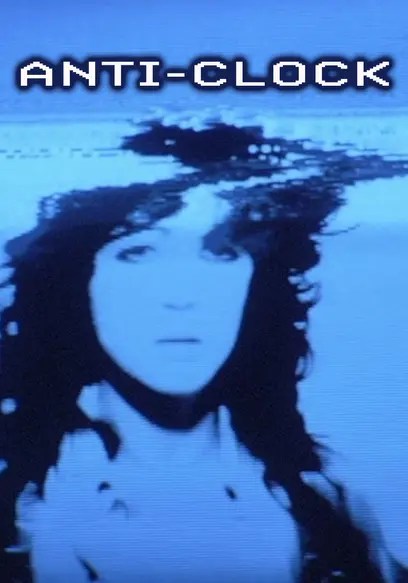
A complex and fascinating experimental exploration of time and identity, ANTI-CLOCK is a film of authentic, startling originality. Brilliantly mixing film and video techniques, Arden and Bond’s paranoid, psychological surveillance study of a career gambler turned clairvoyant unstuck in time captures onscreen the anxieties that have infiltrated the consciousness of so many in Western society.
Jane Arden was a leading figure in experimental British theatre and cinema, and an important radical feminist voice of the 1960s and ‘70s. With her work increasingly informed by her politics, the beginning of a personal and professional relationship with director Jack Bond facilitated the move to cinema, and the creation of a small but remarkable body of film work which is becoming increasingly celebrated. Following her tragic and sudden death in 1982, Bond withdrew these often strongly autobiographical films from circulation, only relenting decades later. Arden’s work is raw, perceptive, disturbing, vital, and beautiful.
I’ve mentioned on the blog before how I discovered David Lynch as an eight-year-old who was somehow allowed to watch Twin Peaks. For a long time, I knew him as “the guy who made Twin Peaks.” Even in college, as I began to explore his greater body of work, I was like most people; I just didn’t understand the abstractness of it all. What shifted my understanding was reading Lynch on Lynch, a book of interviews with the director focusing on his work in chronological order up to Mulholland Drive. Through this text, I came to understand the source of Lynch’s creativity – from deep inside his subconscious and expressed through images without any implied context – and how intuitive his work is. This happened around the same time I was taking Literary Theory & Criticism, which was probably the most influential academic experience I’ve ever had.
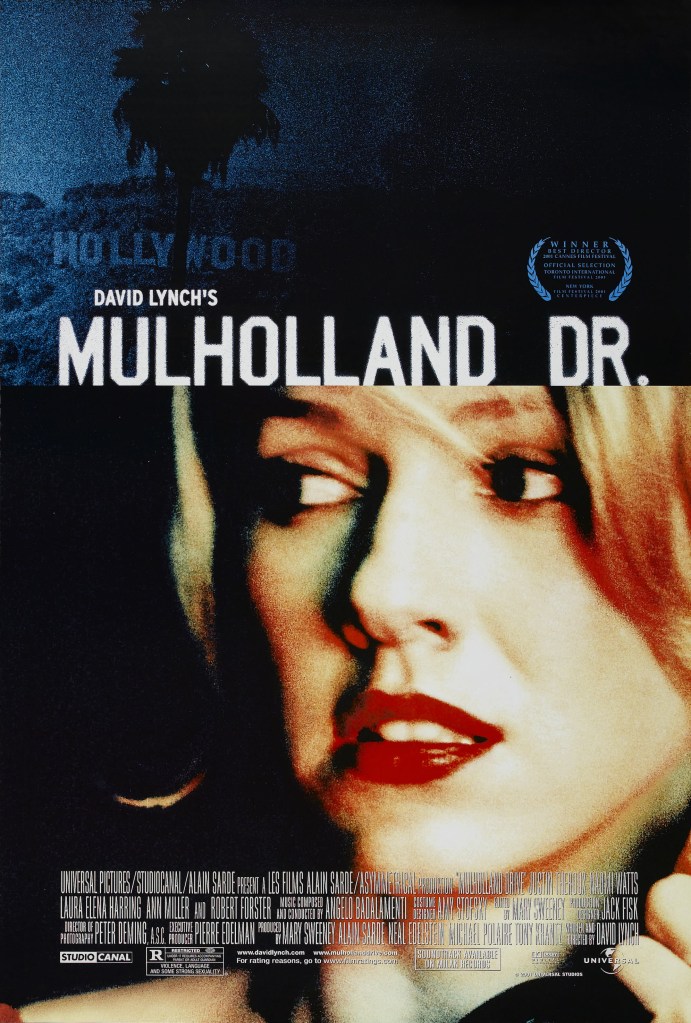
Mulholland Drive begins with a woman (Laura Harring) being driven to a party on the titular road. However, she was never going to arrive at the party. Her driver turns on her, and before they can assassinate the woman, the limousine is hit by a car of rowdy young people. The woman stumbles down a hillside and eventually hides in an apartment whose owner has a department for a long trip. This is the home of Betty’s (Naomi Watts) aunt, where the young woman has come to stay while she auditions in the hopes of becoming a movie star. She immediately feels empathy for the amnesiac woman and vows to help her. Her unexpected guest takes the name Rita after seeing a movie poster of Rita Hayworth in the apartment.
The two women begin investigating the few threads they have about Rita’s past. Meanwhile, a film production grinds to a halt as its lead actress has been let go. The director, Adam Kesher (Justin Theroux), is put through the gauntlet, having the worst day of his life as recasting her, and is placed in the hands of more powerful people. He arrives home to find his wife cheating on him with the pool boy. And then, while bedding down at a flea-bitten motel, Adam discovers his assets have been frozen. How does this relate to Betty and Rita? Well, they weave in and out of his story along with other elements that seem detached. By the end, the truth comes out in a strange place called Club Silencio, which holds the key to understanding it all.
I am going to talk about Mulholland Drive in more depth now, so if you haven’t seen the film I wouldn’t recommend reading any further.
The story of Betty & Rita is a dream. Lynch often has his character’s waking mind and dreaming subconscious collide, and it is very literal here. Betty is, in reality, Diane, a waitress at a coffee shop with aspirations of being an actress. She even has a small part in a production, which is where she met Camilla. Camilla is bisexual and did enjoy her time with Diane. However, the director of the picture, Adam, has taken a liking to his star. She’s more than happy to go along with it, but that leaves Diane reeling as she comes to understand her love was not reciprocated.
A plan is hatched. Diane pays a guy she knows to have Camilla killed, but the guilt of what she has done causes Diane’s mind to splinter. A dream forms, which is where the film begins, and it sees Camilla escaping her fate. And who does her hero end up being? Well, it’s Diane’s dream self of Betty. Diane imagines herself as far more innocent, caring, and talented than in real life. She also imagines that Camilla, as Rita, is wholly dependent on her. In her dream, Adam gets sent through the wringer, too. But the truth begins seeping in, little details here and there. It culminates at Club Silencio, where Diane’s conscious mind reminds her that what is playing out before her eyes is an illusion. This, in turn, forces her to wake up, and we finally see the horrifying truth of Diane’s life.
Lynch delivers a noir film that captures every element you would expect from such a story while still feeling wholly original and fitting into his body of work. It has the dream logic of a Lynch film, yet it is his most accessible picture. The pieces are all there on screen; he’s just not going to spoon-feed you. To engage with the work, consider what is said and the connections between images. Remember, Lynch is first a visual artist before a storyteller, so you can understand what is happening. This was the film that brought Roger Ebert around to finally appreciating Lynch after two decades of turning his nose up at the work.
But even more significant than Diane’s story is a reflection by Lynch on the nature of Hollywood as an American institution. He is an artist who didn’t start out interested in making movies. He wanted to paint. His experience on Eraserhead caused him to both love making movies and hate them at the same time. It would be Dune that helped calcify the idea of making the films he wanted to make without interest in whether they were going to be financially successful for his backers. He’s never made a movie he didn’t want to since then.
Twin Peaks is what made him famous on a whole other level, and once again, he was forced to walk amongst the Hollywood machine again. It should be noted that Mulholland Drive originated as a TV series about Audrey Horne going off to become a movie star and getting embroiled in noir storylines. It seems evident that this idea centered around how young women are especially forced to compromise and do things that give up their power to a man to make it. This makes sense and continues Lynch’s exploration of the abuse of women in the United States, which is the thematic centerpiece of Twin Peaks. He’s not a direct storyteller, so you’re expected to find these ideas; he trusts your intelligence to do that.
Club Silencio is a comment not just on Diane’s dream over her actions but on the dreams of so many to come to Hollywood and be “discovered.” Years ago, I read Hollywood Babylon, a collection of sordid industry gossip by former child star Kenneth Anger. It was quite a harrowing read. Things like the Fatty Arbuckle trial are relatively well-known, but there was so much more. There are hundreds of people you’ll probably never hear about who were murdered or committed murder or helped cover it up within the film industry. It didn’t necessarily involve big stars but people who worked in various capacities. There was a lot of money changing hands, and people were desperate to escape poverty. These circumstances often cause people to do terrible things.
Lynch’s work always seems focused on dismantling mythologies. Blue Velvet was about the myth of the friendly, quiet small town. Twin Peaks continued that but focused even more on the myth of the happy nuclear family with a mountain of abuse hidden just beneath the surface. It makes sense because the director is fascinated with the subconscious mind. He is a big proponent of transcendental meditation, which is all about engaging with those layers of our consciousness that we mostly avoid or ignore. Lynch doesn’t see dreams as a well of chaos but as a place where profound coherence can be discovered. The language of dreams is not the same as the waking world and it is in our inability to translate that our problems arise.
It should also be pointed out that Mulholland Drive’s construction acts as a Mobius strip. There is no beginning or end, just one continuous loop. Betty and Rita find Diane’s body rotting away in her apartment in the dream. The old couple that terrorizes Diane is the same couple that ushers Betty into the fantasy version of Hollywood. They have brought her there. What we are experiencing is a sort of Hell where Betty/Diane is forced to relive the torment of delusion & revelation over and over and over and over… In this way, I consider it one of Lynch’s most horrific films.
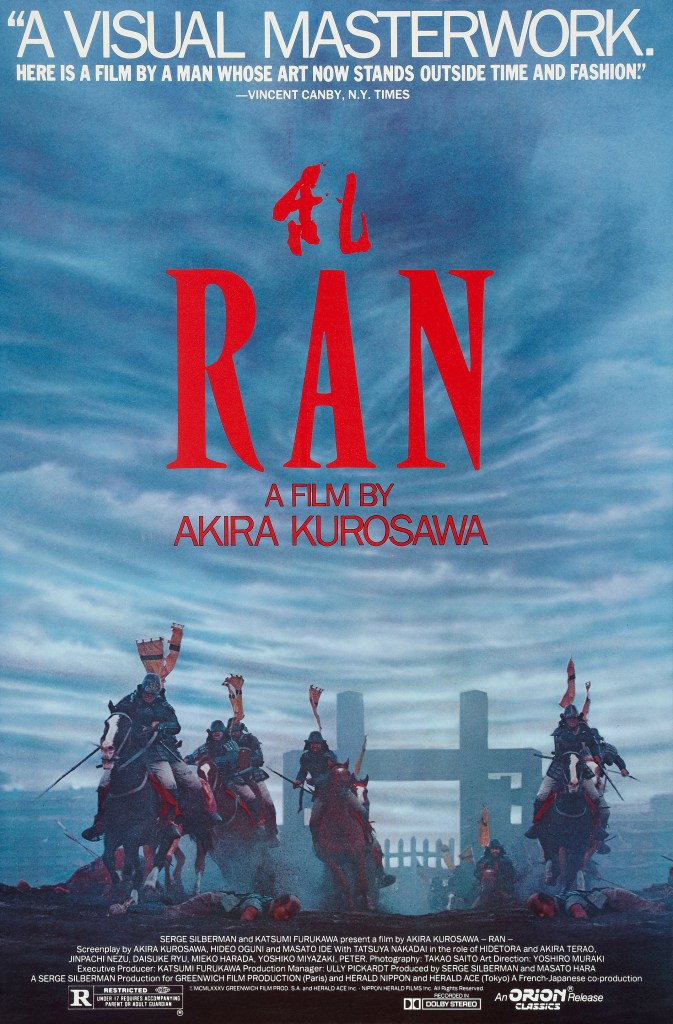
One of the early reviews of Akira Kurosawa’s “Ran” said that he could not possibly have directed it at an earlier age. My first impulse was to question that act of critical omnipotence. Who is to say Kurosawa couldn’t have made this film at 50 or 60, instead of at 75, as he has?
But then I thought longer about “Ran,” which is based on Shakespeare’s “King Lear” and on a similar medieval samurai legend. And I thought about Laurence Oliver’s “Lear” on TV last year, and about the “Lear” I saw starring Douglas Campbell a few weeks ago here in Chicago, and I realized that age probably is a prerequisite to fully understand this character. Dustin Hoffman might be able to play Willy Loman by aging himself with makeup, but he will have to wait another 20 years to play Lear.
The character contains great paradoxes, but they are not the paradoxes of youth; they spring from long habit. Lear has the arrogance of great power, long held. He has wide knowledge of the world. Yet he is curiously innocent when it comes to his own children; he thinks they can do no wrong, can be trusted to carry out his plans. At the end, when his dreams have been broken, the character has the touching quality of a childlike innocence that can see breath on lips that are forever sealed, and can dream of an existence beyond the cruelties of man. Playing Lear is not a technical exercise. I wonder if a man can do it who has not had great disappointments and long dark nights of the soul.
Kurosawa has lived through those bad times. Here is one of the greatest directors of all time, out of fashion in his own country, suffering from depression, nearly blind. He prepared this film for 10 years, drawing hundreds of sketches showing every shot, hardly expecting that the money ever would be found to allow him to make the film. But a deal was finally put together by Serge Silberman, the old French producer who backed the later films of Luis Bunuel (who also could have given us a distinctive Lear). Silberman risked his own money; this is the most expensive Japanese film ever made, and, yes, perhaps Kurosawa could not have made it until he was 75.
The story is familiar. An old lord decides to retire from daily control of his kingdom, yet still keep all the trappings of his power. He will divide his kingdom in three parts among his children. In “Ran” they are sons, not daughters. First, he requires a ritual statement of love. The youngest son cannot abide the hypocrisy, and stays silent. And so on. The Japanese legend Kurosawa draws upon contains a famous illustration in which the old lord takes three arrows and demonstrates that when they are bundled, they cannot be broken, but taken one at a time, they are weak. He wishes his sons to remain allies, so they will be strong, but of course they begin to fight, and civil war breaks out as the old lord begins his forlorn journey from one castle to another, gradually being stripped of his soldiers, his pride, his sanity. Nobody can film an epic battle scene like Kurosawa. He already has demonstrated that abundantly in “The Seven Samurai,” in “Yojimbo,” in “Kagemusha.” In “Ran,” the great bloody battles are counterpointed with scenes of a chamber quality, as deep hatreds and lusts are seen to grow behind the castle walls.
“King Lear” is a play that centers obsessively around words expressing negatives. “Nothing? Nothing will come to nothing!” “Never, never, never.” “No, no, no, no, no.” They express in deep anguish the king’s realization that what has been taken apart never will be put together again, that his beloved child is dead and will breathe no more, that his pride and folly have put an end to his happiness. Kurosawa’s film expresses that despair perhaps more deeply than a Western film might; the samurai costumes, the makeup inspired by Noh drama, give the story a freshness that removes it from all our earlier associations.
“Ran” is a great, glorious achievement. Kurosawa often must have associated himself with the old lord as he tried to put this film together, but in the end he has triumphed, and the image I have of him, at 75, is of three arrows bundled together.
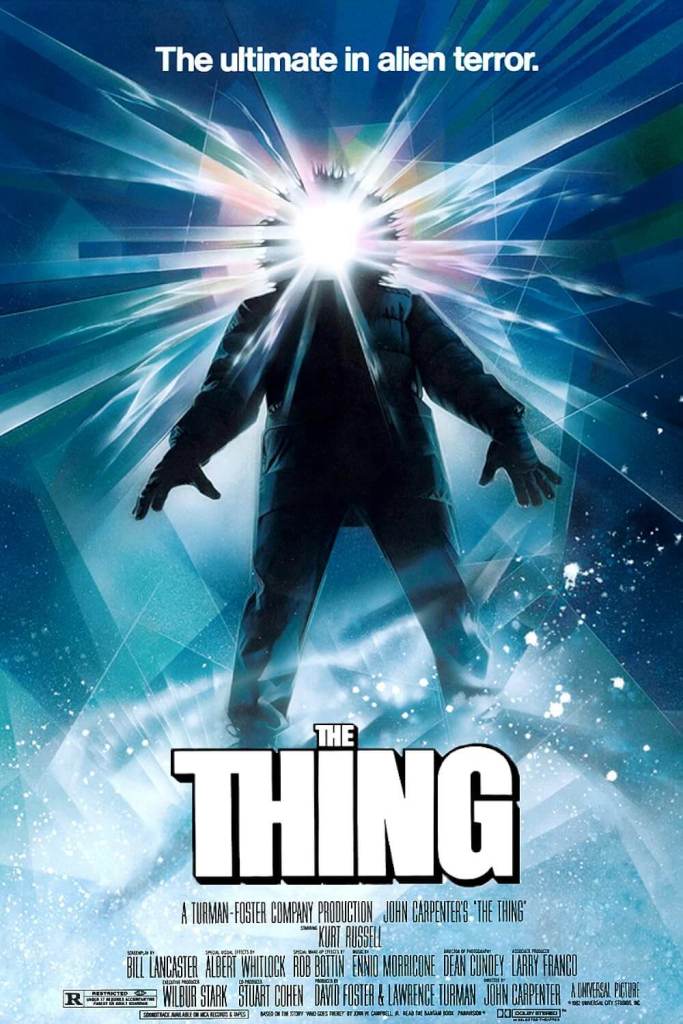
It’s the summer of 1982, and director John Carpenter is on the cusp of releasing his latest movie, The Thing. For the 34-year-old filmmaker, the release marks the end of a major undertaking: the culmination of months of shooting on freezing cold sets and snowy British Columbia locations, not to mention the execution of complex and time-consuming practical effects scenes.
Carpenter was understandably proud of the results: after such independent hits as Assault On Precinct 13, Halloween,andEscape From New York, this was his first studio movie (for Universal) and also his most expensive to date, with a budget of around $15m. And while The Thing had appeared in cinemas before (in the guise of Howard Hawks and Christian Nyby’s 1951 sci-fi shocker,The Thing From Another World) Carpenter’s movie was a fresh adaptation of John W. Campbell’s novella, Who Goes There?– a story Carpenter had long prized.
The Nyby-Hawks adaptation took the skeleton of Campbell’s story, about scientists discovering an alien life form in Antarctica, and made it into a monster movie chiller with James Arness as the hulking creature from outer space. Carpenter’sThe Thing, on the other hand, went back to the original story’s most compelling idea: that of a creature which can transform itself into perfect imitations of the people around it.
With the help of Rob Bottin’s groundbreaking effects work, Carpenter’s movie would bring this creature “out into the light” and he was understandably satisfied with the unholy amalgam of suspense and outright horror he’d brought to the screen.
THE ICY CRITICAL RECEPTION
Yet whenThe Thing opened in US cinemas on the 25th June 1982, the critical reception was almost as aggressive and seething as the movie’s title monster.
Writing for The New York Times, noted movie critic Vincent Canby described the movie as “foolish, depressing” with its actors “used merely as props to be hacked, slashed, disembowelled and decapitated, finally to be eaten and then regurgitated […] it is too phony to be disgusting. It qualifies only as instant junk.”
Timemagazine dismissed The Thing as “an exercise in abstract art,” while Roger Ebert, in a slightly less aggressive review, described it as “a great barf-bag movie”, but maintained that, “the men are just setups for an attack by The Thing.”
Even reviewers outside the mainstream were hostile towards The Thing. The magazine Cinefantastiqueran a cover which asked, “Is this the most hated movie of all time?”
In science fiction magazine Starlog, critic Alan Spencer wrote, “John Carpenter’s The Thing smells, and smells pretty bad. It has no pace, sloppy continuity, zero humor, bland characters on top of being totally devoid of either warmth or humanity […] It’s my contention that John Carpenter was never meant to direct a science-fiction horror movie. Here’s some things he’d be better suited to direct: traffic accidents, train wrecks and public floggings.”
Carpenter was left reeling from the critical reaction. “I was pretty stunned by it,” he later said. “I made a really gruelling, dark movie, but I [thought] audiences in 1982 wanted to see that.”
In terms of its theatrical performance, Carpenter’s dark vision didn’t exactly go down as either he or Universal had perhaps expected. A major summer release, The Thingscraped in at number eight at the US box office, and while it was by no means a flop – its lifetime gross amounted to just under $20 million according to Box Office Mojo – neither was it considered a hit.
THE CRUEL SUMMER
The issue of Starlog in which Alan Spencer’s review of The Thing appeared provides several clues as to why the critical reaction to the movie was so extreme. First, there’s the cover: published in November 1982, issue 64 of Starlog features the benevolent, childlike face of E.T.
Steven Spielberg’s family blockbuster E.T.: The Extra-Terrestrial had, unfortunately for Carpenter, appeared in American cinemas just two weeks before The Thing came out on the 25th June, and that movie’s warm, gentle view of extraterrestrial life was diametrically opposed to the nightmarish excess of Carpenter’s, and moviegoers were still eagerly lining up to see it 14 days later. The Thing, it seemed, simply ran counter to the mood of the times. Neither critics nor audiences were prepared for the intensity or chilly nihilism ofThe Thing, particularly in the heat of the summer season.
The actor Kenneth Tobey, who played Captain Hendry in The Thing From Another World, summed up the general consensus after a screening of Carpenter’s movie. “The effects were so explicit that they actually destroyed how you were supposed to feel about the characters,” Tobey said. “They became almost a movie in themselves, and were a little too horrifying.”
Its gory excess when compared to the sheer cuddliness of E.T. wasn’tThe Thing‘s only problem, either. As that November issue of Starlogproves, 1982 was a crowded year for science fiction, fantasy and horror.Star Trek II: The Wrath Of Khan, and Poltergeistopened on the same day – the 4th June. Disney’s hugely expensive sci-fi adventure Tron came out a little over a month later, on the 9th July.
Then there wasBlade Runner, 20th Century Fox’s expensive sci-fi gamble, which, likeThe Thing, opened on the 25th June and was initially regarded as a financial and critical disappointment.
The Thing was therefore unfortunate to appear in a bumper summer for genre films, and it was doubly hobbled by its R-rating; had its release date been moved to the winter and away from its more family-friendly competitors (even Poltergeistsomehow garnered a PG certificate), it’s possible that it could have found a wider audience in cinemas, despite all those savage reviews.
THE AFTERMATH
Bruised by the reaction to The Thing, Carpenter continued to make movies (he made Christinein 1983 and Starmanthe year after) but lost considerable confidence from the experience, and took some time before he’d talk openly about the earlier movie’s box office disappointment. Perhaps ironically, one of the outlets Carpenter first opened up to was Starlog.
“I was called ‘a pornographer of violence’,” Carpenter said in 1985. “I had no idea it would be received that way […] The Thing was just too strong for that time. I knew it was going to be strong, but I didn’t think it would be too strong […] I didn’t take the public’s taste into consideration.”
It was on video – and later television – that the perception ofThe Thing began to change. The initial shock and repulsion which greeted it in the summer of 1982 began to ebb, as the full extent of what Carpenter, and his filmmakers – among them writer Bill Lancaster, cinematographer Dean Cundey, composer Ennio Morricone and effects artist Rob Bottin (aided in certain scenes by Stan Winston) had managed to achieve.
With the growing passage of time, it becomes easier to see the criticisms aimed at The Thing as being among its most positive attributes. The characters aren’t “merely props” but distinct individuals whose traits are introduced subtly and cleverly – a brief line here, a quirky facial expression there.
That Kurt Russell’s MacReady is slow and even reluctant to emerge as the group’s leader adds to the movie’s unpredictability. The terse dialogue and frosty tone heightens the sense of paranoia and suspicion – this is a cold war horror about the very human emotions of fear and distrust, where the Thing could lurk anywhere, perhaps even within MacReady himself.
The Thing‘s apocalyptic tone was such that, when it came to filming the conclusion, even Carpenter wondered whether he’d gone a little too far. But editor Todd Ramsay coaxed him on, encouraging to remain true to his own bleak vision. “You have to embrace the darkness,” Ramsay told Carpenter. “That’s where this movie is. In the darkness.”
THE ENDURING CLASSIC
It has been more than 30 years since The Thing first appeared in that crowded summer of 1982, and it has long since shaken off its “instant junk” stigma. Repeat viewings have exposed the rich depths beneath Rob Bottin’s spectacular mutations: to this day, there are fan sites, such as Outpost 31, dedicated to detailing the minutiae of the movie’s production and story details.
Speculation still rages over exactly when Blair (played by Wilford Brimley) was first imitated by the shape-shifting monster, or whether the victims of the Thing know whether they’ve been replaced, or whether the two survivors at the end of the movie are even human anymore. It’s the ambiguity of Carpenter’s filmmaking, as well as its obvious technical brilliance, that has allowed The Thing to endure, despite the slings and arrows of its critics.
Back in 1982, Roger Ebert wrote, “there’s no need to see this version unless you are interested in what the Thing might look like while starting from anonymous greasy organs extruding giant crab legs and transmuting itself into a dog. Amazingly, I’ll bet that thousands, if not millions, of moviegoers are interested in seeing just that.”
On that latter point, Ebert was precisely right: thousands, even millions of movie fans are interested in The Thing. It’s just taken them a little while to realize that fact.
Directed by Joachim Trier — Screenplay by Eskil Vogt and Joachim Trier.
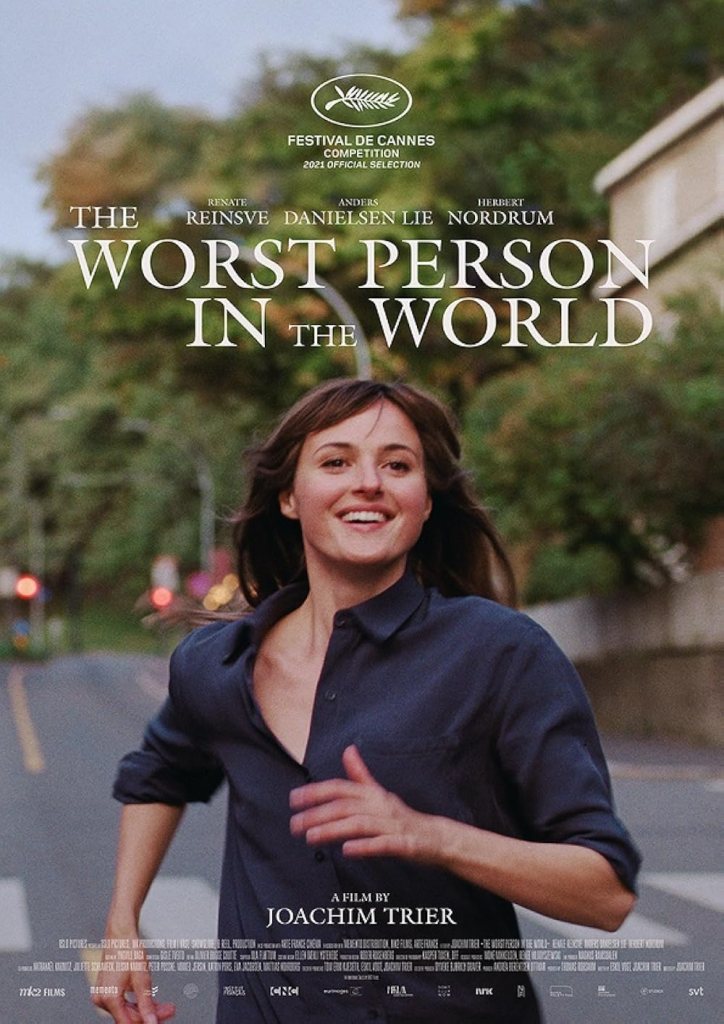
At the end of last month, I turned thirty years old. In the build-up to that turning of a corner, I must admit that I was feeling some kind of quarter-life crisis. Turning thirty reminded me that I should probably rewatch (and finally review) Joachim Trier’s The Worst Person in the World (Norwegian Title: Verdens Verste Menneske), for reasons that will be obvious to those who are familiar with it, but if you aren’t, then please read on and I’ll elaborate. In any case, The Worst Person In the World is the much-lauded third film in Joachim Trier’s acclaimed Oslo Trilogy, the first two films of which — Reprise and Oslo 31. August — I reviewed just last year. As I pressed play and rewatched the Danish-born Norwegian director’s Oscar-nominated hit, I’ll admit that it hit me harder than it had on my first viewing. It is yet another example of the kind of intelligent filmmaker that Trier is, and I suspect it will carve its own place as a true classic for how it speaks to the quarter-life crisis.
Joachim Trier’s The Worst Person in the World follows a soon-to-be-thirty-year-old medical student in Oslo named Julie (played by Renate Reinsve). Julie is facing feelings of self-doubt about the track she is on in life. It occurred to her that she originally only went to medical school because her grades were good enough for it, and so she now, on said whim, suddenly decides to pursue other careers like photography. At that same time, she also encounters a comic book artist fifteen years her senior named Aksel (played by Anders Danielsen Lie). Julie and Aksel hit it off, and he gives her something she thinks she desires — a feeling of life, or perhaps adulthood, having finally started for her. And yet, she has misgivings about the whole ordeal once she meets his friends. She’s not ready for children. She feels infantilized by his friends. Soon she, again on a whim, finds herself at a private wedding house party at which she knows no one. Here she encounters someone named Eivind (played by Herbert Nordrum) who, she feels, matches her energy more, and, even though they are both in a relationship, this encounter inspires her to once again question all that she knows to be safe and comfortable. Because what does she really want? Does she know?
The Worst Person in the World is a rich, deep text about someone who feels lost in early adulthood as the passage of time at study has sent them into something akin to being astray. Here we find a person who made a decision about her life out of esteem and practicality but not passion several years before we meet her. Now she feels like she’s ready for life to begin. She’s ready for a pattern of adulthood, comfortability, sense of belonging, forward momentum, and creative energy that people in their 20s and 30s crave at some point or another. But she wants it on her own terms (at her own pace), and she’s, frankly, not sure how to make that happen with everything that happens around her. There is something so innately timely and human about it that it is tough to put your finger on how exactly all of it has been so carefully baked into the film with such skill and insightfulness. Through it all, Trier’s leading lady Renate Reinsve delivers an energetic and modern performance with no false notes.
On the surface, it may sound like a fairly simple coming-of-age dramedy for someone in their late 20s, but, as it always is, ultimately what is important is how a film is about something. At one point, there is a truly glorious sequence in which our main character runs through the streets while time has stopped entirely so that she can imagine herself escaping her mundane relationship and instead rekindle her intimate romance with Eivind. This is such an effective way of showcasing desire and infatuation moments before dissolving everything safe that she knows. There is an inventive, odd, and explicit sequence showcasing Julie’s doubts about time, her body, and her relationship with her father, which pairs well with an earlier montage sequence in which we are guided through her family lineage at that age. Though significant portions of the film are shown through handheld camerawork, there is a moment with a noticeably shaky camera movement during an increasingly intense argument between Julie and Aksel (when she is seated and he calls her behavior pathetic) that effectively breaks the spell of the relationship, in a way that I thought was fascinating — it may have been a (happy) accident, but it works for the scene because of how real and messy a break up on-screen should be depicted. It’s also a film that is split neatly into 12 chapters, a prologue, and an epilogue, and which, on top of it all, also features sporadic narration from a female voice (an unspecified individual). It is jam-packed with the kind of light but evocative everyday wisdom through which the filmmakers cast a wide net with which its audience is properly enmeshed and affected. And, as a whole, I think it is an expressive rumination of what it means to be human and to become oneself under the pressure of modernity.
Vogt and Trier — both born in 1974 — were obviously in their forties when they made this film, and yet it feels so current and so much like these two individuals have their fingers on the pulse of generations that are younger than them. Obviously, they’ve been through a similar quarter-life crisis, and they also manage to include a character in the film that speaks to the kind of mid-life depression that they may feel hits them from time to time with Anders Danielsen Lie’s Aksel. Anders Danielsen Lie is fantastic as Aksel, and I think the scene in which he is negotiating the future of his doomed relationship with Julie shows the kind of elegant actor that he is. He is phenomenal at showing the pains of being at that point in your life and having to start over romantically, and he is soul-crushingly good in the scene in which Aksel reveals how he feels the world is leaving him behind
From top to bottom, Joachim Trier’s The Worst Person in the World is a work of art that possesses infectious feelings of excitement at the beginning of new love, but, at the same time, it is a complex film in that it is also so much more than just a romantic drama — it is thoughtful about turning thirty, i.e. turning a corner in life, and what that means in our time with unending options at our fingertips. Trier’s film has these playful visual techniques — and moments of magical realism — to give us key insight into the inner workings of his protagonist, but it is also more than just a mastery of visual artistry, he and co-writer Eskil Vogt once again showcase that they are perceptive filmmakers who can eloquently touch your heart. It is a deeply relatable film that I suspect speaks to so many of us in part because of how perfectly and accurately it captures generational feelings of ennui and aimlessness in a way that is in conversation with Trier’s previous films. Joachim Trier and Eskil Vogt’s 2021 film captures the zeitgeist in a way that isn’t merely superficial. It is keenly aware of the way we feel insufficient and unaccomplished because of both this unshakable yet unspecific feeling that the world is somehow constantly on the brink of something terrible, but also because of how we struggle to build on what past generations did for us and for themselves. One of the first masterpieces of the 2020s, it is heart-achingly sweet in its portrayal of newfound love before a crossroads, it is crushingly haunting in how it shows the effects of major life decisions, and it is made with the kind of penetrative precision that manages to speak to the human experience.
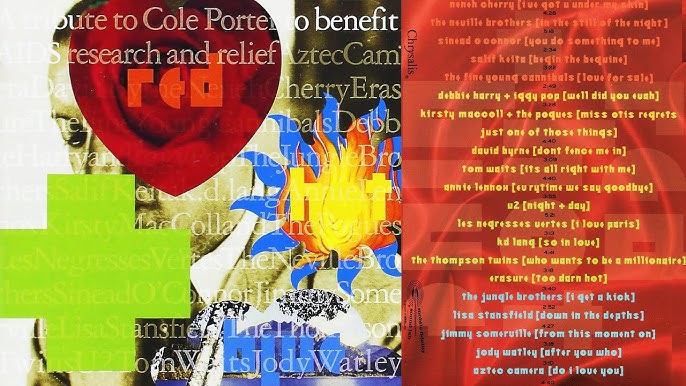
Red Hot + Blue is the first in the series of compilation albums from the Red Hot Organization. It features contemporary pop performers reinterpreting the music of Cole Porter, one of the great American songwriters of the early 20th century. It was one of the first successful tribute albums and a landmark multimedia project, with contributions from filmmakers, artists and designers in addition to musicians. The money raised went to several groundbreaking AIDS organizations, notably ACT UP and Treatment Action Group (TAG), which were responsible for forcing the government and pharmaceutical companies to release the drugs that now allow people to live with HIV.
FACTS / ORAL HISTORY
Filmmakers who made videos for the project included: Wim Wenders, Jim Jarmusch, Jonathan Demme, Alex Cox, Jean Baptiste Mondino, Percy Adlon and Neil Jordan
Artists and designers who contributed included: Jean Paul Gaultier, Keith Haring, David Wojnarowicz, Sue Coe, Barbara Kruger, Gran Fury and Jenny Holzer
The TV show was seen in over 30 countries around the world. ABC in the US demanded a different edit of the show with hosts who included Richard Gere, Whoopie Goldberg and several others. Gere’s introduction was one of the first mentions of the word ‘condom’ on network US television, outside of news programming
Pedro Almodovar wrote a treatment and was scheduled to make the video for “Don’t Fence Me In”, but couldn’t at the last minute and David Byrne directed a video himself
Most regrettable combination that didn’t, but almost happened: Lou Reed doing “I Get A Kick Out of You” directed by Martin Scorsese. The track was eventually done by The Jungle Brothers with a video by Mark Pellington
Neneh Cherry’s rap in “I’ve Got You Under My Skin” was one of the first times AIDS was described and talked about directly in popular culture
PRESS
Bella Online
The Red Hot + Blue movement was started in the early 90s’ by John Carlin. John had been working as an art critic and teacher and witnessed how AIDS was destroying his community. John got established music artists to come on board to record the songs of Cole Porter. Several Red, Hot & Blue compilation CD’s were released during the 90’s.
LONG ISLAND PRESS
One of the greatest CD compilations of all time, 1990’s RH + B was inspired, eclectic collection of songs by top artists of the time rendering Cole Porter songs– all to benefit AIDS research. As with the CD, the DVD collection of videos is sexy, provocative and most importantly, timeless. The music weathers the years well, and the videos add an extra intensity.
arkansas gazette
This astounding collection of contemporary pop performers reinterpreting the songs of Cole Porter came out in 1990, first as an album and then as a television special consisting of music videos, many by famous directors and openly portraying the effects of AIDS on society. The album sold more than a million copies worldwide and was one of the music industry’s first major AIDS benefits.
CREDITS
Produced and Directed By: Leigh Blake + John Carlin Created By: Leigh Blake, John Carlin + F. Richard Pappas Supervising Musical Producer: Steve Lillywhite
This review DOES NOT contain spoilers. In fact, I hope it helps you better understand the chaos that is Inherent Vice.
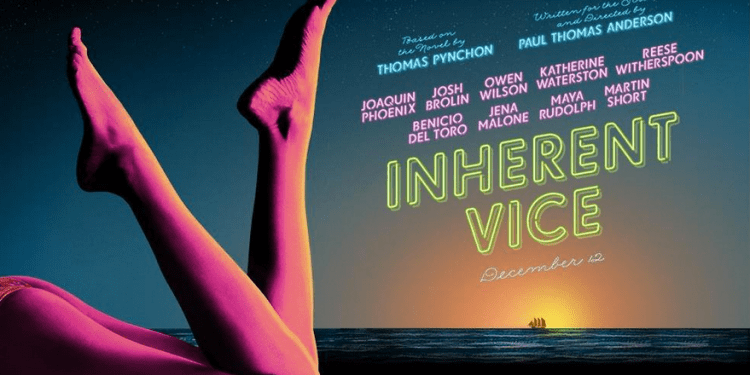
Have you ever felt like some piece of entertainment was made just for you? As someone who enjoys things that bore or confuse most other people (I am sure many of you can relate), I was shocked when I heard two of my niche obsessions were coming together to make something that would have a wide release: Thomas Pynchon, a master of postmodern literature, and Paul Thomas Anderson, a master of torturously beautiful filmmaking.
In general, adapting novels for the big screen is a huge risk when the author has such a dedicated following. I, for one, despise the “book is better than the movie” conversation. They are such different mediums I prefer not to compare the two. With movies based on books, I tend to disregard the story when I am judging the movie. The filmmaker neither loses or gains points in regards to how closely they follow the story, or even if the story is interesting. Instead, the film earns its merits by how well it is able to make that story visually interesting. For example, books can take the time to explain the minutia of the impossibility of certain resolutions, while a dialog-based scene in a movie doing the same thing would be as unnatural as the de-masked villain explaining his evil plan as he is dragged away by the police. The filmmaker has to be able to give the full story without an “explanation scene.”
Of course the book will explain everything better than the film can, but what can make a film adaptation great is its ability to chop the script, leaving only what is necessary for the story and what the story represents. As someone who has read Inherent Vice multiple times, I can confidently say that Paul Thomas Anderson absolutely perfected the adaptation. Not only is the core of the story intact, he also managed to extract the slightly hazy, challenging essence of the prose. At this point I want to talk about how he managed to represent challenging prose in a visual medium, but I still have no idea how he did it. Although Inherent Vice is easier to follow than Pynchon’s masterpiece, Gravity’s Rainbow, it is still a story that demands your attention, as does the film.
I can imagine seeing the film without any pretext will turn many off. Recent reviews tend to start with a confession of confusion, but all the details you need are there on the screen, you just need to focus on everything. Not only do you have to remember all the characters that appear on screen (there are many), but also characters and additional vocalized plotlines that never appear. There are plots and character paths leading in every direction, and every piece is needed to see the whole picture. Like the lead character, Larry “Doc” Sportello (Joaquin Phoenix), you have to become something of a Private Investigator, listening for clues and mapping the connections on a mental white board.
To talk about it in any detail, you need to have some concept of the major players in the story, but I promise there are no spoilers. Doc, a perfect representation of the hippy scene in 1970’s California, is a Private Investigator who is challenged by his ex-girl to check in on a plot against a wealthy real estate guru named Mickey Wolfmann, who she happens to be fucking. Doc tries to use his PI connections to get ahead of the game to stop the plot, primarily a homicide detective “Bigfoot” Bjornson (Josh Brolin).
Doc and Bigfoot have a long history of crossing paths while working on cases, and their love/hate relationship is one of the highlights of the novel and movie. Their history provides a platform for the duo to take cheap shots at the other’s lifestyle (Doc being on the pro-drug side of the debate, and Bigfoot being a straightedge cop who has a floundering side career in Hollywood). When Doc’s ex-old lady and Wolfmann both go missing (not a spoiler), the pair take different paths, fueled by dissimilar motives, to find out what exactly, like, happened, man.
When the movie begins, you might be slightly annoyed by the narration (especially the tone of the voice).
I can’t remember the last movie I watched that had so much narration throughout, but it serves as more than just a device to explain what is happening. In almost any other movie, I would see that as a cop-out, but the complexity of the story necessitates some omniscient input that can’t be provided through dialog. Like almost every word spoken in the movie, the narration is taken nearly word for word from the novel. Pynchon is known for his mastery of prose, and it seems that Anderson didn’t want that to go unseen in the film, so he brilliantly took a side character in the novel and gave her an extra part as the narrator. When the narrator isn’t assisting with the understanding of the plot, she is reading passages from the novel that help create the aura that Pynchon intended. It’s very lofty, scattered, and unsure of reality.
One of the keys to “getting” postmodern literature in general is understanding that what the story is about, isn’t truly what it’s about. However, at the same time, it isn’t the abstract symbolism that you would get with someone like Fitzgerald (seriously guys, what does the green light represent?). The story that Inherent Vice is telling is the story of a fading culture. How often do we hear the sigh of audible nostalgia by people who experienced the 60’s? Pynchon captures the zeitgeist of an era, when the good times are coming to an end. Bigfoot, a chronic hippy-lifestyle hater, is depicted as the force coming to erode Doc and his culture’s collective buzz. At the same time, we see a land developer destroying low-income neighborhoods for cookie-cutter homes, a president with no tolerance for lax lifestyles coming to power, and a shift from recreational and mind-opening drugs to a scene built on dependence. Behind this drug-hazed detective story lies a tragedy, the death of a perfect generation (or at least that is how people like Doc [and maybe Pynchon too, if we knew anything about him] saw it).
Compared to Anderson’s last two films (The Master and There Will Be Blood), Inherent Vice has a much different feel. The previous two were so cerebral and I am still trying to find the key that unlocks their true meanings, while Inherent Vice feels more forgiving to that end. It is also more forgiving in that the humor throughout the movie is palpable, over-the-top, and beautifully satirical. Like any of his films, Inherent Vice requires an extra viewing (or reading), but the second time around will prove that the key was never hidden, if there even was one to begin with.
(Side note: I got through a whole review about Pynchon without talking about Paranoia? I should turn in my Postmodern Member’s Club Card)
Stanley Kubrick spent most of his filmmaking career thinking about how to bring Arthur Schnitzler’s 1926 novella Traumnovelle (Dream Story) to the screen. He deliberated over its dreamlike structure and how to capture the Austrian writer’s text on film. While mulling over the project, he incorporated aspects of its themes and meanings into his other films. And after every completed project, he would consider whether the time was right to finally adapt Traumnovelle. When he eventually made Eyes Wide Shut in 1999, it confounded most moviegoers and critics. Yet, the film secured a place in the unconscious and fostered a lingering fascination for many, often followed by repeat viewings, new assessments, and reconsiderations in the years to come. This was often the pattern with the director’s work, but it was more pronounced with his final film, partly because of its lengthy road to completion. Kubrick had spent years developing a script and making characteristically scrupulous preproduction plans. The eventual shoot became the longest in filmmaking history, amounting to 18 months of exhausting effort, followed by an intense editing process, at the end of which the 70-year-old director died of heart failure. Eyes Wide Shut would amount to a culmination of his lifelong obsessions—his most psychologically complex, formally demanding, and enigmatic piece of filmmaking.
The seed of Eyes Wide Shut began, of course, when Kubrick read Schnitzler’s novella. The text follows Fridolin and Albertine, a Jewish couple in turn-of-the-century Vienna, whose sexual fantasies and jealousy nearly tear them apart. After a Carnival ball, Albertine confesses to having had a lurid fantasy about another man during their recent vacation. In a jealous response, Fridolin sets out on an increasingly dangerous nocturnal odyssey of sexually charged yet decidedly surreal encounters. They culminate with his intrusion into a masked orgy held by an elite secret society that issues a grave warning should he ever reveal what he saw. Whether Fridolin’s sexual adventures are real or merely dreamt remains unclear, but he returns home and confesses what happened to Albertine. The couple finds strength in their new appreciation for the difference between dreams and waking life—and their intersection in fantasies. Serialized in the magazine Die Dame before its publication in book form, Schnitzler’s text was translated into English by Otto P. Schinnerer, titled Rhapsody: A Dream Novel.
Accounts vary over when Kubrick first read the Schinnerer translation of Traumnovelle. One more frequently circulated story suggests that a shrink gave Kurbrick the book when he was shooting Spartacus (1960). However, the director’s early producing partner, James B. Harris, claims Kubrick had read Schnitzler before they first met in 1955. Whether his access to Traumnovelle came from his father’s extensive library, his time at New York’s City College and Columbia University, or his first wife, Ruth Sobotka, who was interested in Austrian literature, no one can confirm with certainty. Most recent scholarship, including the extensive work by authors Robert P. Kolker and Nathan Abrams in Eyes Wide Shut: Stanley Kubrick and the Making of His Final Film (2019) and Kubrick: An Odyssey (2024), resolve that the director had discovered Schnitzler in the 1950s or earlier. What’s not disputed is that Kubrick nursed lifelong neuroses around jealousy and sex, and Schnitzler’s considerable sex life and fixation on sexuality, introspection, adultery, and seduction emerged in his work. During Kubrick’s first marriage, for instance, he resented his wife’s advanced sexuality. He was jealous, and the notion that a spouse could look at their partner and conceal desire or even an affair horrified him. At the same time, he fantasized about other women yet felt helpless to act, much like Fridolin and the protagonist in Eyes Wide Shut.
Early in his career, Kubrick compiled ideas and started developing several inward-looking scripts about marriage, sex, and infidelity to confront his fixations, including screenplays called Jealousy, The Married Man, and A Perfect Marriage. None of them materialized, but given his preoccupations, it’s easy to understand what compelled him to adapt Vladimir Nabokov’s Lolita in 1962. Still, Schnitzler was always on his mind, but he could not ignore the challenges of adapting Traumnovelle. In a 1960 interview with The Observer, he made a vague allusion to making a film that sounds like Schnitzler’s work and conveys “the times, psychologically, sexually, politically, personally.” He added, “It’s probably going to be the hardest film to make.” His collaborator and second wife, Christiane Kubrick, also discouraged him from tackling Traumnovelle too early, realizing that the subject would undoubtedly strain their marriage, which was still in its early years after they wed in 1958. Christiane later told critic Richard Schickel that they had numerous arguments about him adapting the Schnitzler story over the years, and her husband took them “as evidence that material so stirring must be worth doing.”
By the mid-1990s, when the director finally started work on his Schnitzler film in earnest, Kubrick’s adaptation had undergone several false starts. Over the decades, Kubrick met with writers such as Anthony Burgess, John le Carré, Michael Herr, Diane Johnson, and Terry Southern to work out the screenplay. Warner Bros. even announced the project in 1971, when Kubrick had imagined his version of Traumnovelle as a black-and-white sex comedy starring Woody Allen, whose early, funny films the director loved. Then he shifted to Steve Martin, meeting with the comedian from one of his favorite films, The Jerk(1979), to discuss the project. Eventually, he changed his mind and started to explore a more mysterious experience bordering on a thriller, perhaps because Albert Brooks so effectively captured jealousy in his comedy Modern Romance (1981). Brooks plays a film editor who keeps breaking up with his girlfriend because of an irrational, paranoid jealousy, stemming from his own sense of inadequacy. Famously, Kubrick called Brooks to congratulate him on the film and ask him how he conveyed jealousy so well. Transitioning to a serious tone for his adaptation of Traumnovelle, Kubrick wanted the leads to be played by a real-life celebrity couple. He didn’t want the neuroses in the story to be attributed to ethnicity, making the main character’s preoccupations those of a neurotic or Jewish stereotype. By contrast, having an attractive couple—such as Alec Baldwin and Kim Basinger or Bruce Willis and Demi Moore—at the center suggested these problems had more to do with universal emotional concerns that no degree of good looks or success could prevent.
This long-tailed development process was nothing new for the filmmaker. Every Kubrick production from the mid-1960s onward found the director committing years to exhaustive research, sometimes only to have the project fall through. The period between his last two films, Full Metal Jacket (1987) and Eyes Wide Shut, represents his most extended break from actual production in his career. During that time, Kubrick vacillated between potential projects, accumulating vast libraries of research on a Holocaust film based on Louis Begley’s Wartime Lies, a Viking epic based on H. Rider Haggard’s Eric Brighteyes, what would eventually become A.I. Artificial Intelligence(2001), and others. But in 1997, Warner Bros. announced that production would finally get underway on a new Kubrick film, which he wrote alongside Frederic Raphael, the Oscar-winning screenwriter of Darling (1965) and Two for the Road (1967). Throughout the lengthy shoot, even the months immediately following his death, Kubrick’s usual reclusiveness and demand for secrecy during production escalated public curiosity. The facts remained scant. Besides announcing the project’s two leads, Tom Cruise and Nicole Kidman, outlets such as Entertainment Weekly peddled unconfirmed information about the plot, claiming the stars would play “married psychiatrists who become obsessed with two of their patients.”
Kubrick had been in contact with Cruise since the early 1990s about a collaboration. Since the couple’s marriage in 1990, Cruise and Kidman had been the subject of tabloid fodder, from baseless rumors about Cruise’s sexuality and the couple’s status as Scientologists. The former was in the prime of his career, having earned an Oscar nomination for Born on the Fourth of July (1989) and reigning as champion over the North American box office throughout the 1990s. After Kidman starred alongside Cruise in Days of Thunder (1990) and Far and Away (1992), the Aussie performer started to show her range in To Die For (1995) and several Hollywood blockbusters. However, neither of them had done anything like a Kubrick film before. Throughout the extended shoot, which kept the stars from making other projects for almost two years, the media fueled rumors that they were finding Kubrick impossible to work with after supporting actors Harvey Keitel and Jennifer Jason Leigh left the production, their roles filled by Sydney Pollack and Marie Richardson. Reshoots lengthened the actual filming to around 400 days, long for even Kubrick’s typically extended shoots, while post-production took another year.
All the while, reports of a protracted and troubled production failed to consider Kubrick’s usual painstaking methods, which had gone into overdrive from Kubrick’s decades-long interest in Schnitzler’s novella. His desire to get the story right, after it had consumed him for so many years, doubtlessly inflamed his already extreme meticulousness. In the years following Eye Wide Shut’s release, those involved in the production would tell stories about how Kubrick would demand countless takes, sometimes upward of 100, without offering clear direction. Perhaps he didn’t know what he was looking for until he saw it. Maybe the process broke down the pretenses of his actors, giving his signature detached quality to his performers. As usual, every detail had to be considered, labored over, and selected from thousands of options, evidenced in the endless boxes of photos in the Kubrick archive that informed his preproduction process. Kubrick encouraged Cruise and Kidman to go further than they ever had before to find their characters, from urging them to sleep in their apartment set to dominating their offscreen lives. For their part, the leads went along on the journey, receiving their director’s ideas with an open mind and trusting in his approach, no matter how unconventional or seemingly arbitrary.
This painstaking endeavor of making Eyes Wide Shut and the resultant expectations it fostered among moviegoers and critics led to another in a long line of Kubrick films that didn’t strike viewers with its full dimension until much later. Each of Kubrick’s projects, from Lolita to Full Metal Jacket, was misunderstood upon its initial release. Only after multiple viewings and a decade or so of consideration are his films declared masterful and placed among the most celebrated examples of cinematic art. Eyes Wide Shut is no exception; it might even be the most pronounced example of this phenomenon of latent appreciation. Upon its release, many of Kubrick’s devoted followers considered the film a disappointment or a dreary finale to a monumental career. It wasn’t until well into the twenty-first century that reassessments of what proves to be his most emotionally confronting picture became more widespread. Complex in structure, bold in subject matter, and, like most Kubrick films, subject to boundless readings and critical analyses, Eyes Wide Shut is one of Kubrick’s most obsessed-over pictures. And for good reason: The story is unusual and meandering; the presentation is among his most unorthodox. The experience might even be impenetrable, except when a viewer pierces its surface and looks deeper, the film supplies rich cinematic nourishment.
The film’s first image is brief and, at first, without context. Opening titles read Cruise, Kidman, and Kubrick’s names. Then, as if our eyes have opened for a momentary peep, the frame reveals a woman, Kidman, from behind. She loosens her dress and drops it to the floor, standing completely, unabashedly naked, as she lifts her feet out and kicks the dress aside. The screen turns black again and reveals the film’s title. In this single shot, the camera’s metaphorical lids open to the image and shut again, acting almost reflexively to expose us to temptation and then immediately take away its unapologetically voyeuristic male gaze. Holding on any longer would be self-indulgent and potentially dangerous. Such themes prevail throughout Eyes Wide Shut, whose very title indicates the waking dream state of a film lingering between reality and reverie. Kubrick may have derived the title from True Lies(1994), another film about jealousy and suspicion within a marriage. He even kept a copy of the screenplay in his office and invited James Cameron to his home to discuss how he made the Arnold Schwarzenegger and Jamie Lee Curtis actioner. As a title, Eyes Wide Shut has the same paradoxical structure as True Lies. Then again, as Kolker and Abrams observe, Kurbrick, who had approached John le Carré to write the script, may have borrowed the phrase from the author’s Tinker, Tailor, Soldier, Spy, where a character named Stanley enters a “honey pot” situation with “eyes wide shut.”
However the title formed—consciously or not—from other sources, Schnitzler’s novella remained a constant reference point and inspiration for the director. Kubrick takes us into the elegant Central Park West apartment of Dr. Bill Harford (Cruise) and his wife Alice Harford (Kidman), whose characters display marital intimacy, seemingly devoid of secrets—their openness apparent as Alice uses the toilet and Bill checks himself over in the bathroom mirror. Kubrick’s wide-angle lens portrays their impressive dwelling, decorated with paintings by Kubrick’s wife Christiane and her daughter Katharina Hobbs. The camera follows as these two well-dressed, attractive people leave their daughter with the babysitter so they may attend a high-class party on Fifth Avenue hosted by one of Bill’s patients. The millionaire Victor Ziegler (Sydney Pollack) has wealth that makes the Harfords look like middle-class pilot fish swimming with sharks. Production designers Les Tomkins and Roy Walker stage the ball shimmering with interior lights for the holidays, a surreal time of year when everything feels heightened. While the couple dances, Alice wonders if they know anyone at the party. Bill confirms they do not. They’re both out of their depth, and Bill will prove to be increasingly so throughout the ensuing 159 minutes.
During their dance, Bill notices an old medical school pal, Nick Nightingale (Todd Field), playing piano and leaves Alice to catch up with him. Alice claims she’s going to the restroom but instead heads to the bar, where she meets Sandor Szavost (Sky du Mont), an attractive Hungarian fatcat, who comes on to her during a flirtatious dance. Bill, too, flirts with two models who promise to take him “where the rainbow ends”—a decidedly unattainable place that he never visits, not during that encounter nor any other in the film. Instead, Ziegler needs Dr. Bill upstairs to save an overdosed sex worker (Julienne Davis). After the party, the Harfords return home and channel the evening’s sexual tensions into making love. But the next evening, during another escape from reality, Bill and Alice smoke pot and, clearly influenced, move from verbal foreplay into the film’s most pivotal scene: a dizzying discussion about their flirtations from the night before. All at once, Alice’s tone becomes accusatory—she wants to know why she shouldn’t be jealous of Bill’s flirtation and why Bill isn’t upset about hers. Bill responds that he knows Alice would never be unfaithful because women “just don’t think like that.” Alice reflects, “If you men only knew…” and then proceeds to shut down his claim by recalling, with devastating detail, a memory of a naval officer she once saw and fantasized about during their vacation to Cape Cod.
Before Bill can respond, a call interrupts; he must leave their argument and make a late-night appearance for the family of a deceased patient. Bereaved, Marion (Marie Richardson) welcomes Bill and, having apparently harbored a sexual obsession with him, kisses him and confesses her love mere feet away from the corpse of her deceased father. However comically awkward, the moment confirms Alice’s claim for Bill—women do think like that, a realization that twists the knife of Alice’s confession. When Bill leaves Marion’s apartment, a group of hypermasculine college goons body check him and lash out with homophobic slurs. Afterward, humiliated and emasculated, Bill wanders the city on a series of sexual misadventures. Kubrick’s dark humor emerges in these scenes, as almost everyone Bill encounters—male and female—makes a sexual advance toward him. But, out of his depth, none of his potential trysts work out. Bill, it seems, isn’t even sure how to be unfaithful. A sex worker named Domino (Vinessa Shaw) picks him up, brings him back to her apartment, and asks him what kind of “fun” he wants. Uncertain, he asks, “What would you recommend?” And then his conscience returns when his cell phone buzzes, and it’s Alice on the other end. Instead of following through with Domino, he imagines his wife and the naval officer together—a black-and-white film playing in his mind incessantly. Kubrick refused to allow Cruise on the set when Kidman shot the monochrome sequence and forbade her from telling her husband what was filmed, hoping Cruise’s uncertainty and jealousy might come through in his performance.
During Bill’s late-night walks, the artifice of Eyes Wide Shut becomes increasingly conspicuous. Bill walks down the same city streets, constructed via immaculately detailed but wholly unreal sets in England’s Pinewood Studios, all radiant with deep underlighting from the Christmastime setting and sometimes rear-projected behind Cruise. Re-creating New York, a necessity because Kubrick refused to leave his England home, enhances the dreamlike aura of his mise-en-scène. While filming Full Metal Jacket, a production that led to him recreating a wartorn Vietnam wasteland in England, Kubrick remarked, “Sometimes it is easier to build ‘reality’ than go to it.” He applied that philosophy to Eyes Wide Shut. Based on thousands of photographs, measurements, and actual props from New York, Kurbrick’s production designers and set dressers built four blocks of convincing Greenwich Village locations on the Pinewood backlot. The studio shoot gave Kubrick complete control over the unpredictable lighting conditions, shooting, and design. For Kubrick, the set also supplied him with a memoryscape, drawing on details from his time living in New York City—many of which no longer existed. Kolker and Abrams called the setting “an expatriate’s dream of the New York he once knew.” But the effect, surely intended, imbues the faux nocturnal world Bill explores with the unreal textures of a waking, psychosexual dream shaped by his jealousy.
While walking down one of these streets, reeling from his unfulfilled sexual temptations, Bill meets up with his old friend Nightingale after his set at a jazz club. Nightingale confesses that he has another late-night gig— a hush-hush event at an unknown location—where he plays blindfolded. Once, Nightingale laughs, he caught a glimpse of naked women everywhere. Intrigued, Bill insists on crashing the party and pries details from his friend. He sets out to rent the required cloak and mask costume and takes a cab to a Gothic mansion in upstate New York. Bill enters and gives the password Nightingale gave him—“Fidelio,” taken from Beethoven’s opera, meaning “faithful.” Standing on the margins, he bears witness to a ritualized orgy, where figures donning grotesque Venetian masks engage in impersonal sexual acts, the participants oddly pantomiming kisses and oral sex through their masks, even at the height of their undulations. One of the naked, masked women, who somehow recognizes Bill behind his disguise, warns him to leave. But Bill does not heed the warning and, soon identified as an interloper, he is captured by the ominous cloaked men behind this proceeding, exposed, and nearly punished. At the last moment, he is “redeemed” by the self-sacrificing woman concerned for his safety. Released and told never to inquire about the evening again, Bill returns home, feeling lucky to be alive.
Despite the presence of sexuality throughout the film, Eyes Wide Shut rarely attempts to be sexy. Instead, the film links Bill’s attempts at illicit sexuality with death: When Bill later returns to Domino’s apartment only to find her roommate, Sally (Fay Masterson), he learns that Domino has just discovered she’s HIV positive—tragic for her; a close call for Bill. When Bill returns his costume to Mr. Milich (Rade Šerbedžija), he finds the renter’s daughter (Leelee Sobieski) has become an exploited victim of her father, who attempts to sell her willing services to Bill. The orgy scene carries a stigma of nightmarish dread followed by a menacing threat. Regardless of the relative omnipresence of nudity and sex in the film, these moments are more about linking unfaithful sexuality with death and apprehension than arousal. Moreover, the film’s sexual scenes away from Alice are not meant to be erotic or real but rather distanced and ethereal, their intimacy and eroticism removed by their participants’ lack of real human connectivity. Cruise’s one brief onscreen sexual encounter with Kidman feels all the more realistic and meaningful by comparison.
When Bill returns to the sanctuary of their marital bed, Alice appears to be having a laughing nightmare. He asks her to tell him about the dream. She weeps as she confesses to a devastating, post-apocalyptic, orgiastic encounter that begins with the dreaded naval officer and escalates into countless men. At the sight of her husband’s presence in the dream, she laughs mockingly. Alice weeps at the cruelty of her unconscious thoughts, and Bill’s wounded ego isn’t helped. The next morning, Bill attempts to follow up with Nightingale but discovers, thanks to a flirtatious hotel clerk (Alan Cumming), that Nightingale was taken away by men early in the morning. Bill returns to the scene of the orgy and stands outside the estate’s front gate, where he’s issued a written warning to stop his inquiries—a moment given a chilling undercurrent from the film’s maddening, repetitive piano score by Jocelyn Pook. Bill soon learns of a reported beauty queen who overdosed and, in the morgue, sees that she was the same woman who saved him at the orgy and whose overdose he treated at Ziegler’s party. As his imagination runs wild, he notices a mysterious man following him.
Most commonly associated with confident, heroic, save-the-day roles, Cruise plays the weakest and most emotionally vulnerable character of his career in Eyes Wide Shut. Kubrick presents him as an outsider, unable to penetrate the sexual world of the elite class. Despite being a well-paid doctor, he does not know anyone at Ziegler’s party, nor does he qualify for an invite to the orgy. When Bill arrives in a cab at the orgy instead of a limo, he’s instantly outed as someone who doesn’t belong. And so, feeling thoroughly inadequate both sexually and as a member of New York’s high-end social circle, Bill clings to the little authority he has: his medical license and his money. While he attempts to learn about the orgy and what happened to Nightingale, he comically flashes his doctor’s license like a detective’s badge to several thoroughly unimpressed New Yorkers: the costume shop owner, Domino’s roommate, a server in a diner, and the hotel clerk. If that doesn’t work, he dishes out cash to buy their favor, treating everyone as though they have a price. One can guess he imagines himself as an Important Man, yet Alice’s confession and his ejection from the orgy have bruised his ego. In an amusingly cruel streak, Kubrick casts Cruise against type. On the surface, he has all the hallmarks of a successful, good-looking family man. Yet, even as he tries to restore his ego through a meaningless sexual encounter, whether by circumstance or fear, he cannot manage to go through with it, nor can he earn anyone’s respect with his doctor’s badge or wallet full of cash.
Later, Ziegler requests to see Bill at his obscenely lavish home. Bill’s host awkwardly offers a drink and a game of billiards before revealing he, too, was at the orgy. Ziegler attempts to convince Bill that the night’s theatrics were just that: a show designed to frighten him. He assures Bill that the sex worker’s death was an accidental overdose and that Nightingale is on a plane to his Seattle home. He encourages Bill to leave it alone, explaining that he’s meddling with the lives of influential people. “If I told you some of their names […] I don’t think you’d sleep so well,” he says. Once again, Bill returns home, shaken but also relieved, only to see that Alice has found his missing Venetian mask from the orgy and placed it on his pillow. With this, Bill weeps in a scene mirroring Alice’s earlier dream confession and says he’ll tell her everything. After talking it through, and after Bill apologizes, they come to an understanding: both may have fantasies, but some dreams can be just as dangerous as reality. Hopefully, they can know the difference in the future. And as for their shared cravings for emotionally detached sexuality, Alice offers her four-letter-word solution to reinvigorate their marriage: “Fuck.”
Eyes Wide Shut recognizes the reality of desires and fantasies, conscious and unconscious, while encouraging an open dialogue about them. Themes of masks that conceal true identities, eyes (open and shut), and states of consciousness and dreaming have a symbolic place within the film. Perhaps Kubrick, long happily married to his wife Christiane, sought to complete a sort of testimony to how a strong enough bond can accept the need for detached fantasy but also acknowledge and work through how “No dream is just a dream” within their marriage. Certainly, the coda of the film engrains the filmmaker’s intentions. These intentions may have influenced Kubrick’s choice to cast a real-life couple in the film, and his choice couldn’t have been more correct. Wearing down their superstar gloss with his repeated takes, Kubrick draws profound performances out of his stars, particularly Kidman and her staggering delivery of several long, upsetting monologues in Kubrick’s extended shots. With the pairing of these stars, there’s an undeniable onscreen-offscreen intrigue for the viewer, as we suspect, in some way, the filming has penetrated their married lives to give us some voyeuristic insight (even more so now, after their divorce). Kidman’s peak moment comes the night after Bill’s confession, where she’s shown smoking, her makeup gone, and her eyes bloodshot from crying all night. An unprecedented transformation has taken place: Kidman appears not like a movie star, nor even like her Central Park West elite character, but like a human being stripped of all her veneers to reveal the bare, crushed humanity underneath.
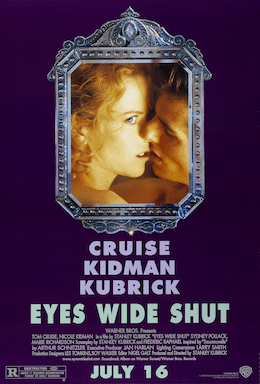
Warner Bros. marketed the film mainly as a showcase for Cruise and Kidman. Despite rumors to the contrary, these actors gave everything to their director, and their uncanny performances, unique within their respective careers, attest to this. They sacrificed much over two years for what ultimately became an art film, something with which neither performer was familiar. Of course, defining (or not) Schnitzler’s story and Kubrick’s film through advertisements was another matter altogether. The studio’s promotional team loaded the movie trailer with all the signs of an “erotic thriller,” dwelling on dramatic images without dialogue, confident that the “Cruise Kidman Kubrick” names on the screen would be enough to sell the picture. Never mind if it led to audiences having misaligned expectations. To be sure, although it’s intended for mature adults, Eyes Wide Shut does not belong in the thriller genre. With a thriller, Bill’s would-be sexual adventures might amount to something beyond his jealous point of view; the thriller elements would instead be vindicated when Bill uncovers that the orgy was just as dangerous as he suspected, a revelation he never makes. If he uncovers a secret society of rich orgy-goers who rough up a piano player who can’t keep a secret and let a drug-addicted prostitute die, he also falls victim to their ruse. The advertising also ignores the dark humor found in the nightmarish surreality of Bill’s misadventures. But then, the unique tone of Kubrick’s film is difficult to pin down in its entirety, much less so in promotional material.
When Eyes Wide Shut opened in July of 1999, many critics and viewers were baffled or altogether shocked by its displays of sexuality and confronting ruminations on infidelity. Critics wrote positive to lukewarm reviews, but few declared it a landmark. Many cited their aversion to Warner Bros.’s release of an R-rated version into theaters that digitally blocked sexually graphic material cited as problematic by the MPAA—an artistic violation of Kubrick’s final film. Rather than accept box-office death with an NC-17 rating, the studio made the controversial decision for these digital alterations (an alternative considered by Kubrick to earn his contractually obligated R-rating) that placed digital figures in front of sex acts during the film’s orgy sequence. The studio later acknowledged their error and released Kubrick’s uncut version on various home video formats. As always, there were a number of complete dissenters, including Andrew Sarris’ assessment for the New York Observer, which described the film as “control-freak unreality.” Entertainment Weekly’s review thought the film’s revelations were unaffecting. Other critics complained about Kubrick’s intentionally slow pace or deliberately unnatural dialogue delivery by his actors, citing the director’s long-standing detached quality as an encumbrance to enjoying the picture.
Such responses failed to recognize the potential that little of Eyes Wide Shut takes place in what one could call “reality.” Few critics at the time considered this possibility. Kubrick and Frederic Raphael’s screenplay never intended realism, only to closely follow Schnitzler’s “dream novel” and show a world informed by Bill’s jealousy. As a result, Eyes Wide Shut cannot be pigeonholed into a single genre or sole interpretation, just like Kubrick’s pictures from 2001: A Space Odyssey (1968) to Barry Lyndon(1975) to The Shining(1980). Viewers must dissect, interpret, and consider minor behavioral quirks and visual touches, questioning seemingly self-contained scenes and encounters against the larger whole—just as a psychoanalyst would interpret a dream. Kubrick’s faith in his audience’s willingness to investigate themselves for meaning in film is also his most significant characteristic as an artist. He refuses to give answers, inviting viewer participation that often leads to rampant theories and speculation, ensuring his films’ longevity. In Eyes Wide Shut, the viewer must discover where the characters cross the line between dream and reality. That journey of breaking through can be confronting, repulsive, shocking, hilarious, unsettling, and emotionally eviscerating, but never short of engaging. With his posthumous release, accusations of Kubrick’s emotional coldness as a filmmaker have never had a more potent counterargument.
Given the timing of Kubrick’s death and the film’s release a few months later, Eyes Wide Shut would undergo another kind of scrutiny. Kubrick was famous for tinkering with his films immediately after their release and making edits based on initial audience reactions. Some have speculated whether the version released in July of 1999 was what Kubrick would have wanted. Before his death, Kubrick had screened the film for its superstar leads, along with several executives from Warner Bros.—the studio that had honored a long-held deal for the director to work in England, far away from Hollywood, in an unprecedented arrangement that allowed him to have final cut on whatever project he desired. Those in attendance attest to Kubrick’s satisfaction with the film. Kubrick told Jan Harlan, the production’s executive producer and his brother-in-law, that he felt it was his best film to date. Even so, Kubrick’s fervent followers have questioned whether the director would have changed anything about Eyes Wide Shut. Was the movie unfinished, or did Kubrick have more tinkering to do? What would Kubrick have changed? Does it matter? Such theorizing may be indicative of the Kubrick viewer, accustomed to conspiracy theories and mining his work for hidden meaning. But the speculation achieves little beyond indulging the imagination of enthusiasts, some of whom have taken it upon themselves to create fan edits or discredit the film as it exists.
Whether deemed his final masterpiece, a late-career misfire, or an incomplete film, Eyes Wide Shut is perhaps Stanley Kubrick’s most divisive film. Whereas many of the director’s masterpieces have been canonized in their respective genres—comedy (Dr. Strangelove, 1964), science fiction (2001: A Space Odyssey), war (Full Metal Jacket), horror (The Shining), historical epic (Spartacus)—his final film continues to defy classification and resist the almost universal acclaim given to his other output. Its formal daring, confronting themes, and challenging presentation remain more interpretive and inaccessible than any other film to his name. Given that it preoccupied Kubrick for much of his life and, as argued by many scholars and commentators, supplies a summa to his career-long preoccupations, the film continues to be examined and debated for its portrait of a masculine crisis in the face of female desire, surreal cinemascape, and unconventional filmmaking. Many Kubrick films invite interpretation, particularly those in the second half of his career. But the dreamlike nature of Eyes Wide Shut only amplifies that quality, leaving a rich wellspring that, like Kubrick’s best films, offers a bottomless resource to explore.
Bibliography:
Chion, Michel. Kubrick’s Cinema Odyssey. British Film Institute, 2001.
 After the Crash