These are not good times for Joe Biden. When the U.S. economy is performing well whoever is in the White House is going to get most of the credit. Likewise, when the U.S. economy is performing poorly whoever is in the White House is going to get most of the blame. That is just the way that it is, and that is one of the primary reasons why most Americans are quite displeased with Joe Biden right now. Things are not going well at all, and the outlook for the months ahead is even worse. The American people are becoming increasingly frustrated, and a new Gallup poll that was just released discovered that “confidence” in the presidency has fallen to the lowest level ever recorded…
President Joe Biden has pushed the presidency to a place it hasn’t been in nearly 50 years.
In the latest Gallup poll, less than a quarter of those surveyed have “confidence” in the presidency, worse than during the Trump presidency and nearly as bad as the end of the George W. Bush presidency.
Going back to 1975, Gallup has never recorded a confidence reading as low as Biden’s 23%.
Other polls have come up with similarly stunning results. For example, a different survey that was just released discovered that a whopping 88 percent of all Americans believe that the nation is heading in the wrong direction…
The White House was faced with another dire poll Tuesday that found that 54 percent of Americans believe the middle class hasn’t benefited ‘at all’ from President Joe Biden’s policies.
On top of that, the new Monmouth University Poll found that 88 percent of Americans surveyed said the country was headed in the wrong direction – with just 10 percent saying it’s headed the right way – a record low.
Just think about that.
88 percent.
In this day and age, it is difficult to get 88 percent of Americans to agree on anything.
But almost all of us seem to agree that the country is going downhill, and according to that same survey Americans are currently more concerned about economic matters than anything else…
Nearly half those surveyed said inflation and gas were the biggest concerns currently facing their families, with 33 percent saying inflation and 15 percent pointing to fuel costs.
A lot of people out there don’t really care much about what is going on in the world until it starts affecting their personal finances.
And these days the American people are feeling a tremendous amount of pain.
In fact, the consumer confidence index that is put out by the University of Michigan just fell to an all-time record low…
The University of Michigan’s gauge of consumer sentiment fell sharply to a record-low reading of 50.2, down from a May reading of 58.4. Economists polled by the Wall Street Journal had expected an June reading of 59.
The level is comparable to the low point reached in the middle of the 1980 recession, the university said.
The American people have never been more pessimistic about the economy.
Ever.
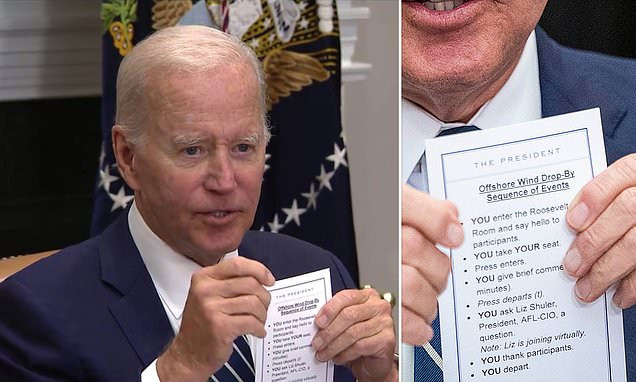
And we have a guy in the White House that has a really difficult time even putting a coherent sentence together at this point.
As you celebrate the 4th tomorrow, remember our President's inspiring words about this great nation. pic.twitter.com/EcNoXNuY8l
Of course the team around Biden is not exactly competent either.
Time after time, the Biden administration has made colossal blunders. This week, we learned that someone in the Biden administration apparently thought that it would be a good idea to send oil from our strategic petroleum reserve to China…
Because he hates Americans, President Joe Biden is shipping much-needed American oil to foreign countries, including… China.
The whole idea of the Strategic Petroleum Reserve (SPR), which is owned by the U.S. government, specifically the U.S. Department of Energy, is to hold on to about 700 million barrels of oil in the event of an emergency or disruption.
I was floored when I first read that.
Who would be stupid enough to do such a thing?
Someday we are going to need the oil in the strategic petroleum reserve, and hopefully there will be some left when that moment finally arrives.
This week we have also been getting more numbers that indicate that the economic slowdown in the United States appears to be picking up speed.
LinkedIn, a unit of Microsoft, saw its hiring rate fall 5.4% month over month in June on a seasonally adjusted basis, the lowest level since December 2021, according to new data released on Friday. On an annual basis, the employment platform’s hiring rate tumbled 11.9% in June.
LinkedIn’s hiring rate is calculated based on the percentage of the platform’s members who added a new employer to their profile in the same month the new job began divided by the total number of LinkedIn members in the United States.
And we just learned that new vehicle sales during the month of June were depressingly low…
Automakers have now reported their June new vehicle sales, or their Q2 new vehicle sales, for the US, except Tesla, which doesn’t report US sales but only global sales. All automakers, even Toyota, and now even Tesla, are struggling with the ongoing semiconductor shortages, and they started the month of June with desperately low inventories on dealer lots and in transit.
And so new vehicle sales in June plunged by 13.5% from the already horribly beaten-down June 2021, to 1.127 million vehicles, and collapsed by 25% from June 2019, the last decent year in the industry, according to data released by the Bureau of Economic Analysis today
It appears that a recession is already here, and the months ahead are going to be really tough.
So I would encourage you to get out of debt.
And I would also encourage you to build up your emergency fund.
This is not a time to fritter away your money on unnecessary things. You want to put yourself in the best position possible to weather the “perfect storm” that is ahead, because things certainly aren’t going to be getting easier from here.
As the economy deteriorates, the frustration of the American people is going to get deeper and deeper.
Needless to say, that isn’t good news for Joe Biden.
It’s very difficult to find common ground that supports cooperation in the disintegrative stage of scarcities, rising prices, catastrophically centralized power and social discord.
Today’s topic echoes Peter Turchin’s 2016 book, Ages of Discord, which I have often referenced in blog posts.
Turchin proposes repeating cycles of history of social integration (people finding reasons to cooperate) and disintegration (people finding reasons to not cooperate).
Clearly, we’re in a disintegrative stage.
Fischer proposed a repeating cycle of history in which humans expand their numbers and economy to consume all available resources.
Once all the low-hanging fruit has been consumed, scarcities arise, pushing prices above what commoners can afford, and the result is economic stagnation and social/political revolution.
Either humans exploit a new energy source at scale to provide for the larger population and higher consumption per person, or the population and consumption decline to fit available resources.
Parker covers the mutually reinforcing climate, political, social and economic crises of the 17th century. A long cycle of cold, wet summers reduced crop yields, leading to hunger and strife.
Parker also identifies another cause of the tumultuous, war-plagued 1600s: political leaders had consolidated too much power, enabling them to pursue disastrous wars without any restraint from competing domestic social-political interests.
Clearly, we’re in Fischer’s stage of overshoot and resource scarcity and Parker’s extremes of centralized power free to pursue catastrophic wars of choice.
In the 1600s, those launching wars reckoned a clean, decisive victory was within easy reach. In every case, the wars dragged on inconclusively or generated even wider conflicts.
In the end, all the wars were settled diplomatically, not by military victory. The military gains were nil while the destruction was widespread and devastating.
Fischer details how poorly humans respond to scarcity and higher prices, also known as inflation or more. accurately, as the decline in purchasing power of money and labor. As scarcities and higher prices take their toll, society unravels: crime and social disorder accelerate.
What we’re seeing in real time is a “circle the wagons” mentality of weeding out everyone but the True Believers in every movement. Litmus tests are handy for this test: answer wrong on any question and you’re cast out: heretic!
It’s not enough to tick one “progressive” or “conservative” box; you have to tick them all or you’re a heretic who cannot be trusted. If you leave one box unticked, you might untick a few more in the days ahead.
This puts pressure on everyone to declare their loyalty to the “party” even if the loyalty is just for show. This dishonesty pleases those demanding every box be ticked but this forced loyalty creates an illusion of solidarity that unravels under pressure.
Exacerbating this is social media, which rewards those promoting the most extreme and divisive positions and deranges the populace by substituting recognition online, which encourages disintegration, for real-world engagement, which encourages moderation and cooperation.
Online, it’s easy to be all-or-nothing: there should be no restrictions on social media, or we should just pull the plug and shut the whole mess down.
In the real world, these are knotty, nuanced problems. The Founding Fathers would not have tolerated sedition under the guise of free speech. The social order can only be maintained if every participant adheres to standards of civility and the common good.
When put under stress, humans harden their positions as a defensive measure. They become more argumentative and less tolerant, more strident in insisting that the One True Thing is the answer to our problems.
This leads to magical thinking, for example, that we can replace hydrocarbons with fusion or wind and solar. When the physical and cost limits of minerals are presented as impassable obstacles, people respond with denial: there must be a way to keep everything the same.
Humans have an easy time expanding their population and consumption per person and a hard time consuming less.
It’s very difficult to find common ground that supports cooperation in the disintegrative stage of scarcities, rising prices, catastrophically centralized power and social discord.
This requires accepting that we can cooperate with people on one issue even though all the other boxes of our group/party/movement are left unticked.
History suggests the disintegrative stage will run its course and consumption will realign with available resources one way or another, and the best we can do is preserve our own sanity, community and willingness to nurture small patches of common ground that support productive cooperation.
In my 16 years as an alternative economist and political writer I have spent around half that time warning that the ultimate outcome of the Federal Reserve’s stimulus model would be a stagflationary collapse. Not a deflationary collapse, or an inflationary collapse, but a stagflationary collapse. The reasons for this were very specific – Mass debt creation was being countered with MORE debt creation while many central banks have been simultaneously devaluing their currencies through QE measures. On top of that, the US is in the unique position of relying on the world reserve status of the dollar and that status is diminishing.
“Production of fiat money is not the same as real production within the economy… Trillions of dollars in public works programs might create more jobs, but it will also inflate prices as the dollar goes into decline. So, unless wages are adjusted constantly according to price increases, people will have jobs, but still won’t be able to afford a comfortable standard of living. This leads to stagflation, in which prices continue to rise while wages and consumption stagnate.
Another Catch-22 to consider is that if inflation becomes rampant, the Federal Reserve may be compelled (or claim they are compelled) to raise interest rates significantly in a short span of time. This means an immediate slowdown in the flow of overnight loans to major banks, an immediate slowdown in loans to large and small businesses, an immediate crash in credit options for consumers, and an overall crash in consumer spending. You might recognize this as the recipe that created the 1981-1982 recession, the third-worst in the 20th century.
In other words, the choice is stagflation, or deflationary depression.”
It’s clear today what the Fed has chosen. It’s important to remember that throughout 2020 and 2021 the mainstream media, the central bank and most government officials were telling the public that inflation was “transitory.” Suddenly in the past few months this has changed and now even Janet Yellen has admitted that she was “wrong” on inflation. This is a misdirection, however, because the Fed knows exactly what it is doing and always has. Yellen denied reality, but she knew she was denying reality. In other words, she was not mistaken about the economic crisis, she lied about it.
‘First and foremost, no, the Fed is not motivated by profits, at least not primarily. The Fed is able to print wealth at will, they don’t care about profits – They care about power and centralization. Would they sacrifice “the golden goose” of US markets in order to gain more power and full bore globalism? Absolutely. Would central bankers sacrifice the dollar and blow up the Fed as an institution in order to force a global currency system on the masses? There is no doubt; they’ve put the US economy at risk in the past in order to get more centralization.’
The Fed has known for years that the current path would lead to inflation and then market destruction, and here’s the proof – Fed Chairman Jerome Powell actually warned about this exact outcome in October of 2012:
“I have concerns about more purchases. As others have pointed out, the dealer community is now assuming close to a $4 trillion balance sheet and purchases through the first quarter of 2014. I admit that is a much stronger reaction than I anticipated, and I am uncomfortable with it for a couple of reasons.First, the question, why stop at $4 trillion? The market in most cases will cheer us for doing more. It will never be enough for the market. Our models will always tell us that we are helping the economy, and I will probably always feel that those benefits are overestimated. And we will be able to tell ourselves that market function is not impaired and that inflation expectations are under control. What is to stop us, other than much faster economic growth, which it is probably not in our power to produce?
When it is time for us to sell, or even to stop buying, the response could be quite strong; there is every reason to expect a strong response. So there are a couple of ways to look at it. It is about $1.2 trillion in sales; you take 60 months, you get about $20 billion a month. That is a very doable thing, it sounds like, in a market where the norm by the middle of next year is $80 billion a month. Another way to look at it, though, is that it’s not so much the sale, the duration; it’s also unloading our short volatility position.”
As we all now know, the Fed waited until their balance sheet was far larger and until the economy was MUCH weaker than it was in 2012 to unleash tightening measures. They KNEW the whole time exactly what was going to happen.
It is no coincidence that the culmination of the Fed’s stimulus bonanza has arrived right after the incredible damage done to the economy and the global supply chain by the covid lockdowns. It is no coincidence that these two events work together to create the perfect stagflationary scenario. And, it’s no coincidence that the only people who benefit from these conditions are proponents of the “Great Reset” ideology at the World Economic Forum and other globalist institutions. This is an engineered collapse that has been in the works for many years.
The goal is to “reset” the world, to erase what’s left of free market systems, and to establish what they call the “Shared Economy” system. This system is one in which the people who survive the crash will be made utterly dependent on government through Universal Basic Income and one that will restrict all resource usage in the name of “carbon reduction.” According to the WEF, you will own nothing and you will like it.
The collapse is engineered to create crisis conditions so frightening that they expect the majority of the public to submit to a collectivist hive mind lifestyle with greatly reduced standards. This would be accomplished through UBI, digital currency models, carbon taxation, population reduction, rationing of all commodities and a social credit system. The goal, in other words, is complete control through technocratic authoritarianism.
All of this is dependent on the exploitation of crisis events to create fear in the population. Now that economic destabilization has arrived, what happens next? Here are my predictions…
The Fed Will Hike Interest Rates More Than Expected, But Not Enough To Stop Inflation
Today, we are witnessing the poisonous fruits of a decade-plus of massive fiat money creation and we are now at the stage where the Fed will reveal its true plan. Hiking interest rates fast, or hiking them slow. Fast hikes will mean an almost immediate crash in markets (beyond what we have already seen), slow hikes will mean a drawn out process of price inflation and general uncertainty.
I believe the Fed will hike more than expected, but not enough to actually slow inflation in necessities. There will be an overall decline in luxury items, recreation commerce and non-essentials, but most other goods will continue to climb in cost. It is to the advantage of globalists to keep the inflation train running for another year or longer.
In the end, though, the central bank WILL declare that the pace of interest rates is not enough to stop inflation and they will revert to a Volcker-like strategy, pushing rates up so high that the economy simply stops functioning altogether.
Markets Will Crash And Unemployment Will Abruptly Spike
Stock markets are utterly dependent on Fed stimulus and easy money through low interest rate loans – This is a fact. Without low rates and QE, corporations cannot engage in stock buybacks. Meaning, the tools for artificially inflating equities are disappearing. We are already seeing the effects of this now with markets dropping 20% or more.
The Fed will not capitulate. They will continue to hike regardless of the market reaction.
As far as jobs are concerned, Biden and many mainstream economists constantly applaud the low unemployment rate as proof that the American economy is “strong,” but this is an illusion. Covid stimulus measures temporarily created a dynamic in which businesses needed increased staff to deal with excess retail spending. Now, the covid checks have stopped and Americans have maxed out their credit cards. There is nothing left to keep the system afloat.
Businesses will start making large job cuts throughout the last half of 2022.
Price Controls
I have no doubt that Joe Biden and Democrats will seek to enforce price controls on many goods as inflation continues, and there will be a handful of Republicans that will support the tactic. Price controls actually lead to a reduction in supply because they remove all profits and thus all incentive for manufacturers to keep producing goods. What usually happens at that point is government steps in to nationalize manufacturing, but this will be substandard production and at a much lower yield.
In the end, supplies are reduced even further and prices go even higher on the black market because no one can get their hands on most goods anyway.
Rationing
Yes, rationing at the manufacturing and distribution level is going to happen, so be sure to buy what you need now before it does. Rationing occurs in the wake of price controls or supply chain disruptions, and usually this coincides with a government propaganda campaign against “hoarders.”
They will hold up a few exaggerated examples of people who buy truckloads of merchandise to scalp prices on the black market. Then, not long after, they will accuse preppers and anyone who bought goods BEFORE the crisis of “hoarding” simply because they planned ahead.
Rationing is not only about controlling the supply of necessities and thus controlling the population by proxy; it is also about creating an atmosphere of blame and suspicion within the public and getting them to snitch on or attack anyone that is prepared. Prepared people represent a threat to the establishment, so expect to be demonized in the media and organize with other prepared people to protect yourself.
Be Ready, It Only Gets Worse From Here On
It might sound like I am predicting success of the Great Reset program, but I actually believe the globalists will fail in the end. That’s not going to stop them from making the attempt. Also, the above scenarios are only predictions for the near term (within the next couple of years). There will be many other problems that stem from these situations.
Naturally, food riots and other mob actions will become more commonplace, perhaps not this year, but by the end of 2023 they will definitely be a problem. This will coincide with the return of political unrest in the US as leftist factions, encouraged by globalist foundations, demand more government intervention in poverty. At the same time, conservatives will demand less government interference and less tyranny.
At bottom, the people who are prepared might be called a lot of mean names, but as long as we organize and work together, we will survive. Many unprepared people will NOT survive. Understand that the economic conditions ahead of us are historically destructive; there is no way that serious consequences can be avoided for a large part of the population, if only because they refuse to listen and to take proper steps to protect themselves.
The denial is over. The crash is here. Time to take action if you have not done so already.
What I am about to share with you is a developing situation, and I hope to share more once the facts become clearer. It appears that a very serious diesel crisis is coming in the months ahead, and that will have a dramatic impact on our economy. As you will see below, we are being warned that there will be shortages of diesel fuel, diesel exhaust fluid and diesel engine oil. Most diesel vehicles require all three in order to run, and so a serious shortage of any of them would be a major disaster. Needless to say, simultaneous shortages of all three could potentially be catastrophic. Most Americans don’t spend much time thinking about diesel, but without it our supply chains collapse and we don’t have a functioning economy. In a recent Time Magazine article discussing the coming diesel fuel shortage, we are told that “the U.S. economy runs on diesel”…
Though most consumers shake their heads at the cost of gasoline and complain about the cost of filling up their car tanks, what they really should be worried about is the price of diesel. The U.S. economy runs on diesel. It’s what powers the container ships that bring goods from Asia and the trucks that collect goods from the ports and bring them to warehouses and then to your home. The farmers who grow the food you eat put diesel in their tractors to plow the fields, and the workers that bring construction equipment to build your home put diesel in their trucks.
Since January, supplies of diesel fuel have been steadily getting tighter.
As supplies have gotten tighter, prices have skyrocketed. The average price of a gallon of diesel fuel hit $5.50 a gallon in early May, and it has remained above that level ever since.
One of the biggest reasons for the supply crunch is a serious lack of refining capacity. Back in 1980, the U.S. had twice as many refineries…
There are also fewer refineries, which process crude oil into diesel and other products, in the U.S. than were just a few years ago. There are just 124 now operating, down from twice as many in 1980, and down from 139 in 2016, according to the U.S. Energy Information Association. The northeast region is particularly spare, with just seven refineries today, down from 27 in 1982.
There have already been some temporary outages of diesel fuel at a few locations around the country, and we are being warned that disruptions are likely to intensify during the summer months.
But the good news is that we aren’t going to run out of diesel fuel. It may become a lot more expensive, and there may be painful temporary shortages, but we won’t run out of it.
Unfortunately, the crisis that we are facing with diesel exhaust fluid is potentially much more serious.
If you have just been skimming this article, this is the part where you need to start really paying attention.
Newsweek is telling us that the United States “could soon experience a severe shortage of diesel exhaust fluid”…
The U.S. could soon experience a severe shortage of diesel exhaust fluid (DEF), impacting U.S. drivers already hit with soaring fuel prices.
DEF is a solution made up of urea and de-ionized water that is needed for almost everything that runs on diesel. It reduces harmful gases being released into the atmosphere and works by converting nitrogen oxide produced by diesel engines into nitrogen and steam.
If you have a diesel vehicle that was sold in the United States after 2010, your vehicle could technically run without DEF, but in most cases your vehicle will simply not let you start it if the DEF tank is dry…
Can we call it a DEF jam? Everything is in short supply as supply chains continue to unlink. The latest commodity reportedly hit is DEF, or the blue diesel exhaust fluid that every diesel sold in the U.S. after 2010 needs to cut emissions. This means that every diesel truck, diesel RV, SUV, and car owner will likely have to look harder, and pay more for, DEF. A diesel engine can technically run without DEF, but your diesel vehicle likely won’t let you start it if the DEF tank is empty.
A lack of urea is the biggest reason for the growing shortage of DEF.
The United States is one of the largest importers of urea in the world, and Russia and China are two of the largest exporters. In previous years that wasn’t a problem, but now the war in Ukraine has dramatically changed things…
A major portion of our urea comes from Europe, and because of the war in Ukraine we’re seeing a shortage of it, according to Newsweek. Russia is one of the world’s major exporters of it. China, too, is a major exporter of it, and it has suspended exports. Weather, too, has caused supply chain disruptions. Since it’s also a major component in fertilizers, there’s intense competition for urea.
Without enough DEF, our economy is going to be in for a world of hurt.
Meanwhile, Mike Adams is reporting on the growing shortages of diesel engine oil that are starting to happen all over the nation…
Retailers, customers and distributors are all reporting shortages in diesel engine oil. This is not an imaginary problem, it is a real problem that is so far entirely ignored by the corporate media.
Apparently there are some diesel engine oil additives that are in extremely short supply, and one industry insider is telling us that this problem isn’t going to be resolved any time soon.
So what this means is that people are going to start running out of diesel engine oil.
In fact, it is already being reported that the trains in Sri Lanka will soon have to completely shut down because of a lack of diesel engine oil…
Sri Lanka Railways said that it will NOT be possible to operate trains in the future due to the lack of engine oil. A senior official at Sri Lanka Railways said that the current level of engine oil would only last for another two months.
That’s in line with the warning we’re hearing in the states: About 8 weeks of diesel engine oil remaining in the pipeline.
Just solving one of the shortages that I have described in this article will not be enough.
As I noted in the opening paragraph, a diesel vehicle requires diesel fuel, diesel exhaust fluid and diesel engine oil in order to operate.
You need all three.
This is a story that I will be following very closely. Needless to say, there are enormous implications for our supply chains and for our economy as a whole if solutions cannot be found.
The created food crisis, whether real or a smoke-and-mirrors psy-op, is all about tearing down the global food system and “building back better” – a new dystopian food system built by corporate monoliths and rigidly controlled in the name of the greater good.
The press has been predicting this for years, but up until now it always appeared to be nothing more than fearmongering, designed to worry or distract people, but the signs are there that this time, to quote Joe Biden, it “is going to be real”.
Nobody knows how bad it could get, except the people who are creating it.
Because the evidence is pretty clear, it is being deliberately & cold-bloodedly created. We’ve been documenting it for months.
We have Russia’s “special operation” in Ukraine driving up the price of staple foods, wheat and sunflower oil, as well as fertiliser.
We have the sudden “bird flu outbreak” driving up the price of poultry and eggs.
The soaring price of oil is driving up the cost of food distribution.
The inflation caused by huge influxes of fiat currency means families are spending more money on less food.
And as all this is happening, the US and UK (and maybe others, we don’t know) are literally paying farmers not to farm.
It’s pretty clear this is The Great Reset: Food Edition. The lockdown melody with slightly different lyrics. A process of breaking down the structures already in place so we can “build back better” with a more controlled and more corporatised food system
Just as the Covid “pandemic” was said to highlight “weaknesses in the multilateral system”, so this food crisis will show that our “unstable food systems are in need of reform” and we need to ensure our “food security”…or a thousand variations on that theme.
That’s not supposition. They already started, over a year ago.
The Journal of Agriculture, Food Systems & Community Developments published a paper in February 2021 titled:
Dismantling and rebuilding the food system after COVID-19: Ten principles for redistribution and regeneration
In an interview from July last year, Ruth Richardson the Executive Director of the NGO Global Alliance for the Future of Food literally said:
Our Dominant Food System Needs to Be Dismantled and Rebuilt”
Later, in September 2021, the UN convened the first-ever “Food Systems Summit”, whose mission statement included the line:
Rebuilding the food systems of the world will also enable us to answer the UN Secretary-General’s call to “build back better” from COVID-19.
Writing in the Guardian two weeks ago, George Monbiot, weathervane for every deep state agenda, states with his trademark lack of subtlety:
The banks collapsed in 2008 – and our food system is about to do the same…The system has to change.
But what does “change” and “rebuilt” actually mean in this context?
Well, that’s no mystery, they’ve been talking it up for years.
Almost all of these are stories from just the past month or so, many of them talking points at the World Economic Forum’s Davos Conference.
As is almost always the case, the problem to which they’re currently “reacting” already has a series of pre-ordained solutions.
Just as we saw lockdowns break the economy to pieces whilst the billionaire class land record profits whilst corporate megaliths expanded their monopolies, so too will any proposed food security policies end up benefiting the already mega-rich or installing infrastructure for corporate control.
They just announced the building of the largest “cultured meat factory” in the world. Fake meat, of course, can’t be raised at home and is subject to patented processes of creation. Genetically edited or modified plants and animals are likewise subject to patents.
Supranational companies, with profits larger than the budget of some nations, are developing carbon footprint tracker apps which reward people for making the “right decisions”. That could easily be applied to food.
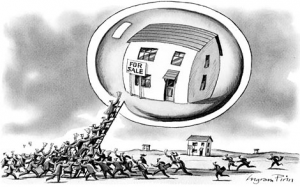
Are we heading into another real estate bubble / crash? Those who say “no” see the housing shortage as real, while those who say “yes” see the demand as a reflection of the Federal Reserve’s artificial goosing of the housing market via its unprecedented purchases of mortgage-backed securities and “easy money” financial conditions.
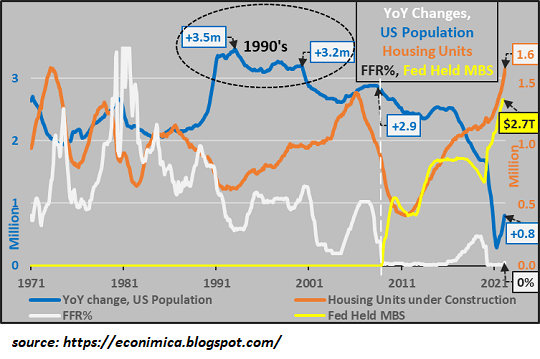
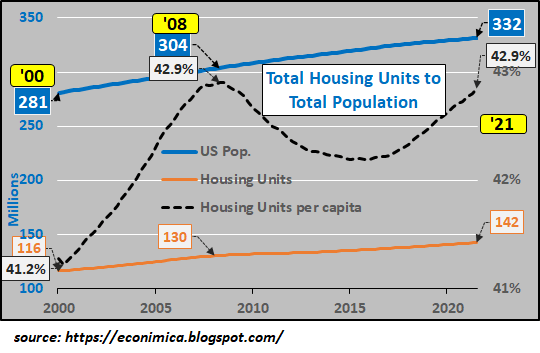
My colleague CH at econimica.blogspot.com recently posted charts calling this assumption into question. The first chart (below) shows the U.S. population growth rate plummeting as housing starts soar, and the second chart shows housing unit per capita, which has just reached the same extreme as the 2008 housing bubble.
Demographics and housing do not reflect a housing shortage nationally, though there could be scarcities locally, of course, and other factors such as thousands of units being held off the market as short-term rentals or investments by overseas buyers who have no interest in renting their investment dwellings.
On a per capita basis, housing has reached previous bubble levels. That suggests housing shortages are artificial or local, not structural.
Next, let’s consider how the current housing bubble differs from previous bubbles in the late 1970s and 2000s. In my view, the previous bubbles were driven by demographics, inflation and monetary policy: in the late 70s, the 65 million-strong Baby Boom generation began buying their first homes, pushing demand higher while inflation soared, making real-world assets such as housing more desirable.
Once the Federal Reserve pushed interest rates to 18%, mortgage rates rose in lockstep and housing crashed as few could afford sky-high housing prices at sky-high mortgage rates.
The housing bubble of 2007-08 was largely driven by declines in mortgage rates (as the Fed pursued an “easy money” policy to escape the negative effects of the Dot-Com stock market bubble crash) and a loosening of credit/mortgage standards. These fueled a bubble that morphed into a speculative free-for-all of no-down payment and no-document loans.
This decline in the cost of borrowing money (mortgage rates) enabled a sharp rise in the price of housing, a speculative boom that was greatly accelerated by “innovations” in the mortgage market such as zero down payments loans, interest-only loans, home equity loans, and no-document “liar loans”–mortgages underwritten without the usual documentation of income and net worth.
These forces generated a speculative frenzy of house-flipping, leveraging the equity in the family home to buy two or three homes under construction and selling them before they were even completed for fat profits, and so on.
Needless to say, the pool of potential buyers expanded tremendously when people earning $25,000 a year could buy $500,000 houses on speculation.
Once the bubble popped, the pool of buyers shrank along with the home equity.
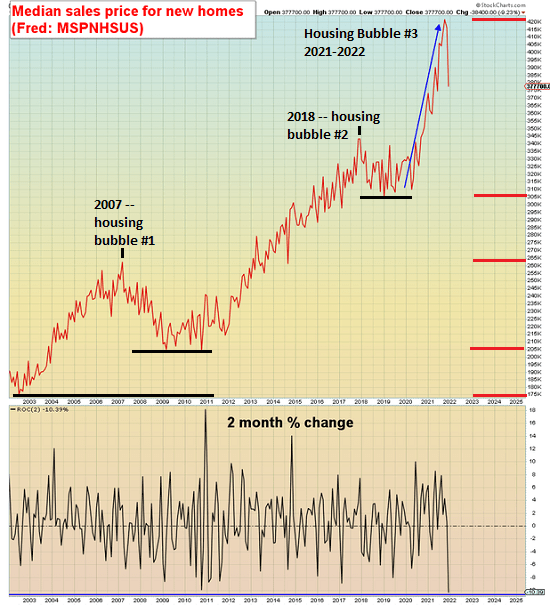
If we study this chart below of new home prices (courtesy of Mac10), we can see that the 21st century’s Bubble #2 rose as the Federal Reserve pushed mortgage rates far below historic norms. Once rates reached a bottom, the 7-year inflation of home prices (from 2011 to 2018) began rolling over.
This deflation of home prices was reversed by the pandemic recession, as the Fed’s vast expansion of credit and mortgage-buying, which pushed mortgage rates to new lows. Trillions of dollars in new credit and cash stimulus ignited a speculative frenzy in stocks, bonds and real estate, a frenzy which drove bubble #3 to extraordinary heights.
All this unprecedented fiscal and monetary stimulus also ignited inflation, and so rates are rising in response. Bubble #3 is already deflating, at least by the measure of new home prices.
But the current bubble has a number of dynamics that weren’t big factors in previous bubbles.
One is the rise of remote work. Many people have been working remotely since the late 1990s enabled Internet-based work, but the pandemic greatly increased the pool of employers willing to accept remote work as a permanent feature of employment.
This trend has been well documented, but the consequences are still unfolding: remote workers are no longer trapped in unaffordable, congested cities and suburbs.
Several other trends have attracted much less attention, but I see them as equally consequential.
1. Housing in many urban zones are out of reach of all but the top 10% without extraordinary sacrifice, and now that employment isn’t necessarily tied to urban zones, the bottom 90% of young people without family wealth or high incomes are coming to realize the benefits of urban living are not worth the extreme sacrifices needed to buy an overvalued house.
A middle-class life–home ownership, financial security, leisure and surplus income to invest in one’s family and well-being–is no longer affordable for the majority of young Americans.
Few are willing to concede this because it reveals the neofeudal nature of American life. Those who bought homes in coastal urban zones 20+ years ago are wealthy due to soaring housing valuations while young people can’t even afford the rent, much less buying a house.
If you’re not making $250,000 or more a year as a couple, the only hope for a middle-class life that includes leisure and some surplus income to invest is top move to some place with much lower housing and other costs. That place is rural America.
2. The benefits of urban living are deteriorating while the sacrifices and downsides are increasing. Urban living is fun if you’re wealthy, not so fun if you don’t have plenty of surplus income to spend.
Urban problems such as homelessness, traffic congestion and crime are endemic and unresolvable, though few are willing to state the obvious. Americans are expected to be optimistic and to count on some new whiz-bang technology to solve all problems.
Unfortunately, problems generated by dysfunctional, overly complex institutions, corruption and unaffordable costs can’t be solved by some new technology, and so the decay of cities will only gather momentum.
The hope that billions of federal stimulus funding would solve these problems is about to encounter reality as the funds dry up and all the problems remain or have actually expanded despite massive “investments” in solutions.
Few analysts have looked at the finances of high-cost cities. The decline in bricks-and-mortar retail, rising crime, soaring junk fees, rents and property taxes have all made urban small business insanely costly and therefore risky.
Small businesses are the core sources of employment and taxes. As high costs, crime, etc. choke small businesses, employment and tax revenues drop and commercial real estate sits empty, generating decay and defaults.
Once office and retail space is no longer affordable or necessary, commercial real estate crashes in value as owners who bought at the top default and go bankrupt.
People need shelter but they don’t need office space or to start a bricks-and-mortar retail business.
As urban finances unravel, cities won’t have the funding to run their bloated, inefficient, overly complex and unaccountable bureaucracies.
3. In geopolitics, we speak of the core and the periphery. Empires have a core (Rome and central Italy in the Roman Empire) and a periphery (Britain, North Africa, Egypt, the Levant).
As finances and trade decay and costs soar, the periphery is surrendered to maintain the core.
In urban zones, the same dynamic will become increasingly visible: the peripheral neighborhoods will be underfunded to continue protecting the wealthy enclaves.
Crime will skyrocket in the periphery even as residents of the wealthy enclaves see little decay in their neighborhoods.
This asymmetry–already extreme–will drive social unrest and disorder. This is a self-reinforcing feedback: as the periphery neighborhoods deteriorate, the remaining businesses flee and the smart money sells and moves away.
Tax revenues plummet and city services decay even further, persuading hangers-on to move before it gets even worse. Cities compensate for the lower revenues by increasing taxes on the remaining residents and cutting services.
Each turn of the screw triggers more closures and selling and fewer tax revenues.
4. Dependency chains will become increasingly consequential: the greater a city’s dependency on essentials trucked/shipped from hundreds or thousands of of kilometers/miles away, the more prone that city will be to disruptions of essentials: food, energy, materials and infrastructure.
Though few are willing to dwell on such vulnerabilities, most cities are totally dependent on diesel fueled fleets of trucks, rail and jet fuel for luxuries flown in from afar for virtually all goods. Cities produce very little in the way of essentials such as food and energy.
The past reliability of long supply chains has instilled a confidence that these supply chains stretching thousands of kilometers and miles are unbreakable and forever. They aren’t, and the initial disruptions will be a great shock to Americans who believe full gas tanks and fully stocked store shelves are their birthright.
5. As I’ve explained in my new book Global Crisis, National Renewal, the era of cheap, reliable abundance has drawn to a close and now we are entering an era of scarcity in essentials.
Another reality few discuss is the relative stability of global weather over the past 40 years. As weather becomes less reliable, so too do crop yields and food supplies.
Globalization has poured capital into expanding acreage under cultivation to the point that the planet’s forests are being decimated to grow more soy to feed animals to be slaughtered for human consumption.
On the margins, land that was once productive has been lost to desertification. Fresh water aquifers have been drained and glaciers feeding rivers are melting away. Soil fertility has declined even as fertilizer use has expanded.
The low-hanging fruit of GMO seeds, fertilizers, insecticides, herbicides and Green Revolution hybrids have all been plucked. The gains have been reaped but now the downsides of these dependencies are becoming increasingly consequential: fertilizer costs are rising fast, insects and diseases are evading chemicals and vaccines, and the vulnerabilities of mono-crop, industrialized agriculture and animal husbandry threaten to cascade into crop failures, soaring prices and shortages.
6. This will have two consequences: rural incomes which have been falling for decades due to globalization (i.e. bringing in cheap food from places with no environmental standards, cheap labor and few taxes / social costs) will start rising sharply, fueling a reversal in the long decline of rural communities based on agricultural income.
The soaring costs of essentials will reduce the disposable income of the bottom 90%, reducing the money they’ll have to spend on eating out, retail shopping, etc.–all the surplus spending that drives cities’ economies and tax revenues.
Few (if any) commentators forecast a cyclical reversal of the demographic trend of people moving from rural locales to cities. I think this trend has already reversed and will gather momentum as cities become increasingly unlivable, disposable incomes decline as scarcities push prices higher and people flee for lower cost, more secure environs.
7. As I often note, following what the super-wealthy are doing is a pretty sound investment strategy because the super-wealthy spend freely to buy the best advice and are highly motivated to protect their wealth.
People who live in well-known, highly desirable rural towns (Telluride, Jackson Hole, Lake Tahoe, etc.) are describing a feeding frenzy of wealthy urbanites buying multi-million dollar homes. Small cities such as Bozeman, MT and Ashville, NC are experiencing a flood of new residents that is straining infrastructure and pushing housing prices out of reach for local residents with average wages.
8. Rural towns in the U.S., Italy, Japan and even Switzerland are trying to attract new residents with offers of free land, subsidized rent, low cost homes, etc. This shows that the trends are global and not limited to any one nation. Would you take free land in rural America?
The decay of urban life isn’t yet consequential enough to push people into making a major move, but once someone has been robbed, repeatedly found human feces on their doorstep or experienced scarcities that trigger the madness of crowds, the decision to leave becomes much, much easier.
Some cities will manage the decline of employment and tax revenues more gracefully than others. Most will suffer from the dynamic I’ve often described on the blog: the Ratchet Effect. Costs move effortlessly higher as tax revenues have increased in one speculative bubble after another, but once revenues drop, cities have no mechanisms or political constituency to manage a sharp, long-term decline in revenues.
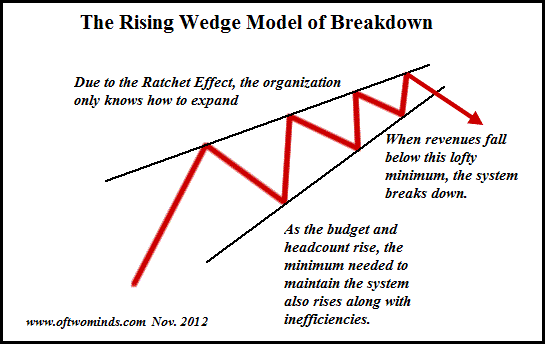
They then become prone to the other dynamic I’ve described, the Rising Wedge Breakdown (see chart below): as agencies and institutions become sclerotic, unaccountable and self-serving, even a relatively modest cut in revenues triggers institutional collapse, as the system requires 100% funding to function. A 10% reduction doesn’t cause a 10% decline in service, it causes an 50% decline in service, on the way to complete dysfunction.
Few believe cities can unravel, but remote work, geographic arbitrage (discussed below), tightening credit, rising crime, the decline of commercial real estate, end of massive stimulus, scarcities, the madness of crowds, the decline of civic services and amenities and an insanely high cost of living all have consequences and second-order effects.
What were beneficial synergies become fatal synergies as dynamics reverse and begin reinforcing each other.
So let’s put all this together.
A. The cycle of declining interest rates and inflation has ended and a cycle of much higher interest and mortgage rates and inflation is beginning. Higher mortgages rates will depress housing prices as only the highest income households will be able to afford today’s prices once mortgage rates rise.
B. The decay of urban finances and quality of life will accelerate as stimulus ends, credit dries up and inflation decimates disposable income.
C. The stress of trying to make enough money to afford the high costs of city/suburban living as the real estate bubble pops and the benefits of city living decline will burn out increasing numbers of people who will have no choice but to find more affordable, more secure and more livable places.
D. While the wealthy have already secured second or third homes in the toniest desirable towns, there are still opportunities for lower cost, more secure residences in rural areas.
E. This migration, even at the margins, will further depress urban housing prices and push prices in desirable rural locales higher.
F. This migration will have regional, ethnic and cultural variations. For example, some African-Americans leaving the upper Midwest are finding favor with communities in the South where family, church and cultural ties beckon.
G. Correspondent John F. used the phrase geographic arbitrage which means earning money remotely in high-wage sectors while living some place that’s low cost and secure.
I wrote about this many years ago in my post about young Japanese maintaining a part-time remote-work gig while pursuing farming in rural communities: Degrowth Solutions: Half-Farmer, Half-X (July 19, 2014).
H. Though monetary / inflationary forces will pop housing prices based solely on low mortgage rates, this doesn’t mean housing everywhere will decline: as burned out urbanites seek lower cost, more secure and livable places in rural locales, homes in desirable towns and small cities could rise sharply because they’re starting from such low levels.
I. If urban areas decay rapidly, housing prices could plummet much faster than most people think possible.
When cities lose employment, tax revenues and desirability, they can go down fast. Property values can fall in half and then by 90%.
How is this possible? Supply and demand: if demand falls off a cliff, there won’t be buyers for thousands of homes that come on the market all at once. This is just like a stock market in which buyers disappear, as no one wants to buy an asset that’s rapidly losing value.
As I’ve noted many times, prices for assets are set on the margins: the last sale of a house resets the price for the entire neighborhood.
The stock market is easily manipulated by the big players, who can stop a slide in prices by buying huge chunks of stocks and call options. There are no equivalent forces which can stop a decline in housing prices.
And since rates will rise regardless of what the Federal Reserve does because global capital is demanding a real return above inflation, then the hope for lower mortgage rates to support bubble-level housing prices will be in vain.
How low could housing go? As explained above, there will likely be very asymmetric declines and increases in housing valuations going forward. But on a technical-analysis level, we can anticipate a general decline to previous lows, first to the 2019 lows and then to the 2011 lows.
Some analysts believe inflation will funnel capital into housing as investors seek assets that will go up with inflation, but this is a murky forecast: the bottom 90% of American households are already priced out of coastal housing, so inflation only robs their wages of purchasing power. They don’t have any hope of buying a house anywhere near current prices.
Corporations are buying thousands of houses for the rental income, but once all the stimulus runs out and the excesses of speculation reverse, they’ll find few renters can afford their sky-high rents. At that point corporate buyers become corporate sellers, but they won’t find buyers willing or able to pay their asking prices, which are based on bubble pricing, not reality.
All these swirling currents will affect housing valuations in different places differently. Some areas could see 50% declines while others see 50% increases, regardless of mortgage rates or Fed policy.
What will become most desirable is a low cost of living, security and livability, which includes community, reduced dependency on long supply chains and local production of essentials.
We are all prone to believing the recent past is a reliable guide to the future. But in times of dynamic reversals, the past is an anchor thwarting our progress, not a forecast.
Most Americans don’t realize this, but we truly have entered historic territory. As you will see below, the inflation crisis of 2022 has now escalated to a level that is beyond anything that we experienced during the horrible Jimmy Carter era of the 1970s. If you are old enough to have been alive back then, you probably remember the constant headlines about inflation. And you also probably remember that it seemed like the impotent administration in power in Washington was powerless to do anything about it. In other words, it was a lot like what we are going through today. Unfortunately for us, this new economic crisis is still only in the very early chapters.
Of course the mainstream media would like us to believe that what we are experiencing today is not even close to what Americans went through in the late 1970s and early 1980s. According to CNN, the U.S. inflation rate hit a peak of 14.6 percent in the first half of 1980…
The inflation rate hit a record high of 14.6% in March and April of 1980. It helped to lead to Carter’s defeat in that fall’s election. It also led to some significant changes in the US economy.
Compared to that, the numbers we have been given in early 2022 seem rather tame. On Tuesday, we learned that the official rate of inflation in the U.S. hit 8.5 percent in the month of March…
Prices that consumers pay for everyday items surged in March to their highest levels since the early days of the Reagan administration, according to Labor Department data released Tuesday.
The consumer price index, which measures a wide-ranging basket of goods and services, jumped 8.5% from a year ago on an unadjusted basis, above even the already elevated Dow Jones estimate for 8.4%.
8.5 percent is much lower than 14.6 percent, and so to most people it would seem logical to conclude that we are still a long way from the kind of nightmarish crisis that our nation endured during the waning days of the Carter administration.
But is that the truth?
In reality, we can’t make a straight comparison between the official rate of inflation in 2022 and the official rate of inflation in 1980. The way that the inflation rate is calculated has been changed more than 20 times since 1980, and every time it was changed the goal was to make the official rate of inflation appear to be lower.
What we really need is an apples-to-apples comparison; fortunately, John Williams over at shadowstats.com has done the math for us.
According to Williams, if the inflation rate was still calculated the way that it was back in 1980, the official rate of inflation would be somewhere around 17 percent right now.
17 percent!
That means that the inflation that we are seeing now is even worse than anything that Americans went through during the Jimmy Carter era.
And government figures for individual categories seem to confirm that inflation is now wildly out of control. For example, the price of gasoline has risen by 48 percent over the past year…
The price of gasoline rose by 48.0 percent from March 2021 to March 2022, according to numbers released today by the Bureau of Labor Statistics.
In just one month—from February to March—the seasonally adjusted price of gasoline went up 18.3 percent.
Vehicle prices have escalated to absurd levels as well. If you can believe it, the average retail selling price of a used vehicle at CarMax has risen by 39.7 percent in just 12 months…
CarMax experienced a slowdown in fourth-quarter used car sales volume as its average retail selling price jumped 39.7% year-over-year to $29,312, an increase of approximately $8,300 per unit.
And I discussed yesterday, home prices in the United States have jumped 32.6 percent over the past two years.
We have entered a full-blown inflationary nightmare, and the Biden administration is trying to blame Vladimir Putin for it.
Needless to say, that is extremely disingenuous of Biden, because prices were already skyrocketing even before the war in Ukraine started.
But it is true that the war is making economic problems even worse all over the globe, and that isn’t going to end any time soon.
A couple of weeks ago there was a bit of optimism that some sort of a ceasefire agreement could be reached, but now there appears to be no hope that there will be one any time soon.
On Tuesday, Putin told the press that peace talks have reached “a dead end”…
Talks with Ukraine have reached “a dead end,” Russian President Vladimir Putin said in fresh Tuesday remarks. “We will not stop military operations in Ukraine until they succeed.” He explained that Ukraine has “deviated” from agreements and any possible prior progress reached during the Istanbul meetings, according to state-run RIA.
The strong remarks aimed at both Kiev and the West were given during a joint presser with his Belarusian counterpart Alexander Lukashenko. He further hailed that the military operations is still going “according to plan,” Bloomberg reports, however while admitting to the domestic population that “Russian logistics and payment systems remain a weakness and the long-term impact of western measures could be more painful.” But he also said the county has withstood the economic “blitzkrieg” from the West.
Ukrainian President Volodymyr Zelensky named recognition of the annexation of the Crimea region as one of his red lines for Moscow in any potential peace talks with Russian President Vladimir Putin to end war between the two countries.
Russia annexed the southern region of Crimea in 2014. Russian-backed separatists and forces, as well Ukrainian soldiers, have since been fighting in the eastern region of Ukraine.
Russia will never, ever willingly give Crimea back to Ukraine.
Anyone who thinks otherwise is simply being delusional.
So unless someone changes their tune, this war between Russia and Ukraine is going to keep going until someone achieves total victory.
And that could take a really long time.
Meanwhile, global food supplies will get tighter and tighter, and global economic conditions will continue to rapidly deteriorate.
And so what happens if another “black swan event” or two hits us later in 2022?
We are so vulnerable right now, and it wouldn’t take much at all to push us over the edge and into an unprecedented worldwide crisis of epic proportions.
“We are now speeding down the road of wasteful spending and debt, and unless we can escape we will be smashed in inflation.”—Herbert Hoover
This is financial tyranny.
The U.S. government—and that includes the current administration—is spending money it doesn’t have on programs it can’t afford, and “we the taxpayers” are the ones who must foot the bill for the government’s fiscal insanity.
We’ve been sold a bill of goods by politicians promising to pay down the national debt, jumpstart the economy, rebuild our infrastructure, secure our borders, ensure our security, and make us all healthy, wealthy and happy.
None of that has come to pass, and yet we’re still being loaded down with debt not of our own making.
Now the Biden administration is proposing a $5.8 trillion spending budget that notably includes $813 billion for national defense, $30 billion to “fund the police,” and a plan to reduce the national deficit by roughly $1 trillion over 10 years through additional tax hikes.
The U.S. ranks as the 12th most indebted nation in the world, with much of that debt owed to the Federal Reserve, large investment funds and foreign governments, namely, Japan and China.
Essentially, the U.S. government is funding its very existence with a credit card.
In 2021, we paid more than $562 billion in interest on that public debt, which according to journalist Rob Garver, “is more than the annual budget of every individual federal agency except for the Treasury, the Department of Health and Human Services (which manages the Medicare and Medicaid government health insurance programs), and the Department of Defense.”
According to the Committee for a Reasonable Federal Budget, the interest we’ve paid on this borrowed money is “nearly twice what the federal government will spend on transportation infrastructure, over four times as much as it will spend on K-12 education, almost four times what it will spend on housing, and over eight times what it will spend on science, space, and technology.”
Clearly, the national debt isn’t going away anytime soon, especially not with government spending on the rise and interest payments making up such a large chunk of the budget.
Still, the government remains unrepentant, unfazed and undeterred in its wanton spending.
Indeed, the national deficit (the difference between what the government spends and the revenue it takes in) remains at more than $1.5 trillion.
If Americans managed their personal finances the way the government mismanages the nation’s finances, we’d all be in debtors’ prison by now.
Despite the government propaganda being peddled by the politicians and news media, however, the government isn’t spending our tax dollars to make our lives better.
We’re being robbed blind so the governmental elite can get richer.
We’re not living the American dream. We’re living a financial nightmare.
In the eyes of the government, “we the people, the voters, the consumers, and the taxpayers” are little more than pocketbooks waiting to be picked.
“We the people” have become the new, permanent underclass in America.
Consider: The government can seize your home and your car (which you’ve bought and paid for) over nonpayment of taxes. Government agents can freeze and seize your bank accounts and other valuables if they merely “suspect” wrongdoing. And the IRS insists on getting the first cut of your salary to pay for government programs over which you have no say.
We have no real say in how the government runs, or how our taxpayer funds are used, but we’re being forced to pay through the nose, anyhow.
We have no real say, but that doesn’t prevent the government from fleecing us at every turn and forcing us to pay for endless wars that do more to fund the military industrial complex than protect us, pork barrel projects that produce little to nothing, and a police state that serves only to imprison us within its walls.
If you have no choice, no voice, and no real options when it comes to the government’s claims on your property and your money, you’re not free.
It didn’t take long, however—a hundred years, in fact—before the American government was laying claim to the citizenry’s property by levying taxes to pay for the Civil War. As the New York Times reports, “Widespread resistance led to its repeal in 1872.”
Determined to claim some of the citizenry’s wealth for its own uses, the government reinstituted the income tax in 1894. Charles Pollock challenged the tax as unconstitutional, and the U.S. Supreme Court ruled in his favor. Pollock’s victory was relatively short-lived. Members of Congress—united in their determination to tax the American people’s income—worked together to adopt a constitutional amendment to overrule the Pollock decision.
On the eve of World War I, in 1913, Congress instituted a permanent income tax by way of the 16th Amendment to the Constitution and the Revenue Act of 1913. Under the Revenue Act, individuals with income exceeding $3,000 could be taxed starting at 1% up to 7% for incomes exceeding $500,000.
It’s all gone downhill from there.
Unsurprisingly, the government has used its tax powers to advance its own imperialistic agendas and the courts have repeatedly upheld the government’s power to penalize or jail those who refused to pay their taxes.
While we’re struggling to get by, and making tough decisions about how to spend what little money actually makes it into our pockets after the federal, state and local governments take their share (this doesn’t include the stealth taxes imposed through tolls, fines and other fiscal penalties), the government continues to do whatever it likes—levy taxes, rack up debt, spend outrageously and irresponsibly—with little thought for the plight of its citizens.
To top it all off, all of those wars the U.S. is so eager to fight abroad are being waged with borrowed funds. As The Atlantic reports, “U.S. leaders are essentially bankrolling the wars with debt, in the form of purchases of U.S. Treasury bonds by U.S.-based entities like pension funds and state and local governments, and by countries like China and Japan.”
Of course, we’re the ones who will have to repay that borrowed debt.
For instance, American taxpayers have been forced to shell out more than $5.6 trillion since 9/11 for the military industrial complex’s costly, endless so-called “war on terrorism.” That translates to roughly $23,000 per taxpayer to wage wars abroad, occupy foreign countries, provide financial aid to foreign allies, and fill the pockets of defense contractors and grease the hands of corrupt foreign dignitaries.
Mind you, that staggering $6 trillion is only a portion of what the Pentagon spends on America’s military empire.
Most recently, in response to Russia’s military aggression against Ukraine, the Biden Administration approved $13.6 billion in military and humanitarian aid for Ukraine, with an additional $200 million for immediate military assistance.
As Dwight D. Eisenhower warned in a 1953 speech, this is how the military industrial complex will continue to get richer, while the American taxpayer will be forced to pay for programs that do little to enhance our lives, ensure our happiness and well-being, or secure our freedoms.
This is no way of life.
Yet it’s not just the government’s endless wars that are bleeding us dry.
We’re also being forced to shell out money for surveillance systems to track our movements, money to further militarize our already militarized police, money to allow the government to raid our homes and bank accounts, money to fund schools where our kids learn nothing about freedom and everything about how to comply, and on and on.
It’s tempting to say that there’s little we can do about it, except that’s not quite accurate.
There are a few things we can do (demand transparency, reject cronyism and graft, insist on fair pricing and honest accounting methods, call a halt to incentive-driven government programs that prioritize profits over people), but it will require that “we the people” stop playing politics and stand united against the politicians and corporate interests who have turned our government and economy into a pay-to-play exercise in fascism.
Unfortunately, we’ve become so invested in identity politics that pit us against one another and keep us powerless and divided that we’ve lost sight of the one label that unites us: we’re all Americans.
Trust me, we’re all in the same boat, folks, and there’s only one real life preserver: that’s the Constitution and the Bill of Rights.
The Constitution starts with those three powerful words: “We the people.”
There is power in our numbers.
As I make clear in my book Battlefield America: The War on the American People and in its fictional counterpart The Erik Blair Diaries, that remains our greatest strength in the face of a governmental elite that continues to ride roughshod over the populace. It remains our greatest defense against a government that has claimed for itself unlimited power over the purse (taxpayer funds) and the sword (military might).
Where we lose out is when we fall for the big-talking politicians who spend big at our expense.






 After the Crash