From Chi-Town bagman to ECOWAS chairman: meet the former money launderer leading the push to invade Niger

By Alexander Rubinsteain and Kit Klarenberg

Source: The Grayzone

Since the overthrow of Niger’s US-friendly government, West African nations of the ECOWAS bloc have threatened an invasion of their neighbor.

Before leading the charge for intervention, ECOWAS chair Bola Tinubu spent years laundering millions for heroin dealers in Chicago, and has since been ensnared in numerous corruption scandals.

Hours after Niger’s Western-backed leader was detained by the country’s presidential guard on July 28, Nigerian President and chair of the Economic Community of West African States (ECOWAS) Bola Tinubu leapt into action, warning that the group of nations “will not tolerate any situation that incapacitates the democratically-elected government.”

“As the Chairperson of ECOWAS…I state without equivocation that Nigeria stands firmly with the elected government in Niger.”

Two days later, ECOWAS imposed severe sanctions on Niger, and the bloc issued a stark ultimatum: if the newly-inaugurated junta won’t reinstall the ousted president in a week’s time, the group’s pro-Western African governments will — by military means, if necessary. 

On Saturday, July 6 — one day before the deadline — ECOWAS leaders approved a plan to invade the country, with the ominous caveat that they are “not going to tell the coup plotters when and where we are going to strike.”

If ECOWAS gets its way, member states Benin, Cabo Verde, Côte d’Ivoire, The Gambia, Ghana, Guinea Bissau, Liberia, Nigeria, Sierra Leone, Sénégal and Togo will be pressured to send their soldiers to invade Niger.

These developments have thrust the typically-overlooked West African country of Niger into the Western media spotlight. But if hostilities break out, it wouldn’t just be one single impoverished African state in the crosshairs.

Neighboring Burkina Faso, Mali and Guinea, which are also governed by military administrations that recently seized power by force, have all warned that any attack on Niger will be viewed as an attack on them too. If their ECOWAS rivals make the first move, the nations which mainstream media have dubbed Africa’s “coup belt” have pledged to unleash their military forces as well — an announcement which should end any illusions that restoring the country’s previous president would be a painless process.

Leading the pro-Western coalition is the president of its most powerful country, Nigeria: Bola Tinubu. One of Nigeria’s wealthiest men, the source of the scandal-plagued president’s fortune remains unclear.

Documents reviewed by The Grayzone reveal Tinubu as a longtime US asset who was named as an accomplice in a massive drug running operation that saw him launder millions on behalf of a heroin-dealing relative. 

Bola Tinubu’s career marred by drug-trafficking, corruption allegations

For over 30 years, Bola Tinubu has been a major force in Nigeria’s political scene and the country’s economy, with local nicknames ranging from “the Mother of the Market” to “the Godfather of Lagos” and “the Lion of Bourdillon.” But his power inside Nigeria went largely unnoticed by international audiences until 2023, when he became ECOWAS chair after winning the presidency in an election closely tracked by the US government.

As president, Tinubu quickly instituted a regime of economic reforms backed by the US-controlled International Monetary Fund and the World Bank. Over the course of Tinubu’s political career in Nigeria, the African operator has cultivated a close relationship with the US embassy. According to a slew of classified State Department cables released by WikiLeaks, American officials relied heavily on Tinubu’s assessments of the domestic political landscape.

The ECOWAS chair’s early life is shrouded in mystery, and even his exact age is unknown. Nearly every detail of Tinubu’s personal history — prior to his appearance in Chicago on a student visa — is in dispute, including his legal birth name.

Records from Chicago State University show that Tinubu received a degree in Business Administration in 1979. In the following years, media reports indicate that Tinubu was employed in some capacity at a number of major US-based multinationals, including Mobil Oil Nigeria, consulting firm Deloitte, and GTE, which was the largest communication and utilities company in the US at the time.

Of the few details about the Nigerian President’s early exploits which can be confirmed, many are derived from a 1993 court docket naming Tinubu as an accomplice in a massive midwestern drug smuggling operation. 

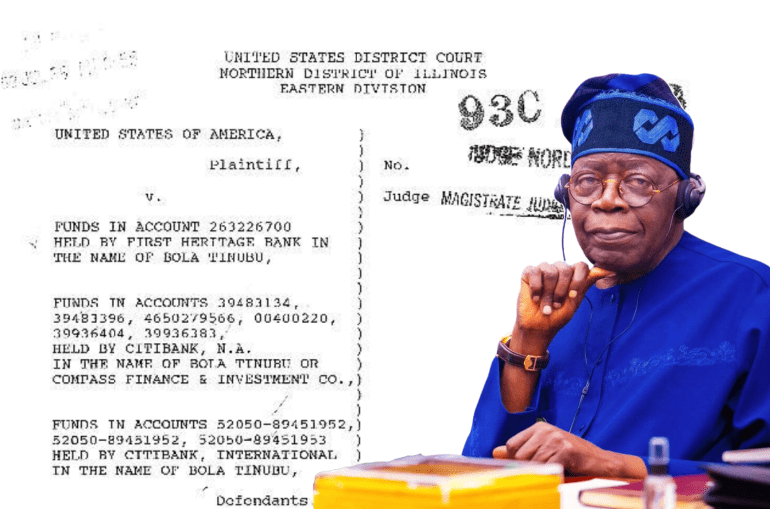
As journalist David Hundeyin has detailed, court documents from the US District Court’s Northern District of Illinois make it clear that Tinubu amassed a small fortune laundering money for a heroin-trafficking relative in Chicago, and that US government officials ultimately seized well over a million dollars from various bank accounts registered under the current Nigerian president’s name.

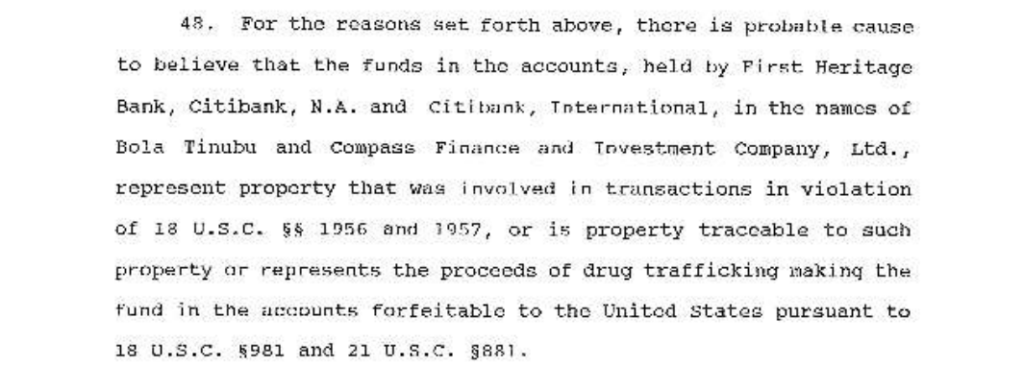
A 1993 report by IRS Special Agent Kevin Moss explained that “there is probable cause to believe that funds in certain bank accounts controlled by Bola Tinubu… represent proceeds of drug trafficking; therefore these funds are forfeitable to the United States.”

In the documents, Moss describes an extremely close working relationship between the future Nigerian president and two Nigerian heroin dealers named Abiodun Olasuyi Agbele and Adegboyega Mueez Akande, the latter of whom was listed as Tinubu’s cousin on an application for a vehicle loan.

“According to bank employees, when Bola Tinubu came to First Heritage Bank in December 1989 to open the accounts, he was introduced to them by Adegboyega Mueez Akande, who at that time maintained an account at the bank.” What’s more, bank records indicate that “Bola Tinubu also opened a joint checking account in his name and the name of his wife, Oluremi Tinubu,” who had “previously opened a joint bank account also at this bank with Audrey Akande, the wife of Adegboyega Mueez Akande,” Moss explained. In several of the applications, the addresses used by Tinubu exactly matched those previously used by Akande.
“According to bank records… Tinubu opened an individual money market account and a NOW account” at First Heritage Bank in December 1989, the special agent noted. “In the application, Tinubu stated that his address was 7504 South Stewart, Chicago, Illinois” — “the same address used previously by Akande.”
“Bank records disclosed that five days after the account was opened, on January 4, 1990, $80,000 was deposited into the NOW account at First Heritage Bank by wire transfer through First Chicago from Banc One Houston,” the report continues. According to the IRS, the money was sent by Akande.

But the Nigerian president’s financial dealings with the heroin traffickers went even further, according to the IRS special agent. He wrote that Citibank records documented “two additional corporate accounts held in the name of Compass Finance and Investment Company, Ltd. which were controlled by Bola Tinubu.”

“When Bola Tinubu opened these accounts,” he provided “a memorandum of association and articles of association” which “identified Mueez Adegboyega Akande and Abiodun Olasuyi Agbele as directors of Compass Finance and Investment Company, Ltd.,” Moss wrote.

In the end, Tinubu somehow managed to deposit over $660,000 in his First Heritage Bank account in 1990, and more than $1.2 million the next year — all while claiming to take home just $2,400 a month from his position at Mobil Oil Nigeria.

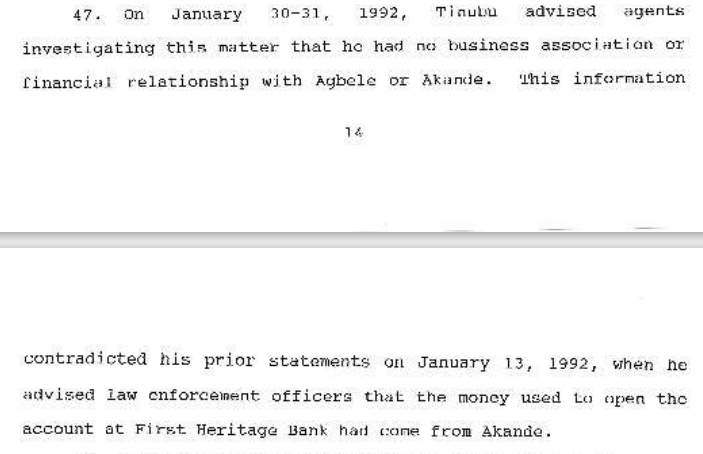
As the investigation into the money laundering scheme began to gain traction, Tinubu left the US and returned to Nigeria. Ultimately, Moss was able to speak to Tinubu by telephone on a number of occasions, and the special agent reported that the future president initially acknowledged his personal and financial dealings with the pair of drug traffickers. 

But in late January of 1992, “Tinubu advised agents investigating this matter that he had no business association or financial relationship with Abele or Akande,” Moss wrote. “This information contradicted his prior statements on January 13, 1992, when he advised law enforcement officers that the money used to open the account at First Heritage Bank had come from Akande.”

Back in Nigeria, Tinubu had already begun to transition into the political arena. By 1992, he’d been elected to the Senate, and in 1999 he became the Governor of Lagos State, a position he retained until 2007. At some point in his tenure, Tinubu established a relationship with the US Embassy which would last for years to come, according to a trove of diplomatic cables released by Wikileaks.

But even his State Department allies couldn’t help noticing Tinubu’s penchant for dishonesty. One particularly noteworthy cable pointed out that the politician was “known to play fast and loose with the facts” and “has been caught in the past embellishing his educational achievements.”

In the end, however, Tinubu’s usefulness seemed to outweigh his casual relationship with the truth, and the future Nigerian president went on to provide American officials with a near-continuous assessment of the political situation in his country. One typically intimate meeting with Tinubu ended with the US ambassador to Nigeria commenting: “as always, we found his take on the national political scene to be insightful.”

When the cables came to light in 2011, many Nigerians were shocked at the candor with which their elected officials spoke to Washington’s envoys. “The willingness of our elites to divulge unsolicited information about the nation to U.S. officials betrays an infantile thirst for a paternal dictatorship,” Nigerian-American professor and columnist Farooq Kperogi wrote.

Though Tinubu appeared to have escaped justice for his alleged role in a heroin trafficking conspiracy, accusations of corruption would continue to dog the ECOWAS chair throughout his political career in Nigeria. Since leaving office as governor of Lagos in 2007, Tinubu “picked every subsequent winning candidate,” according to German broadcaster DW, which noted earlier this year that the tycoon “is believed to be one of Nigeria’s richest politicians but the source of his wealth is unknown.”

In recent years, clues about the origins of the fortune amassed by one of Africa’s leading political players have begun to come to light.

In 2009, Tinubu came under investigation by the Metropolitan Police of London, who were probing allegations that the politician had pooled money with two other Nigerian governors to create a front company known as the “African Development Fund Incorporation.”

Investigators alleged the unusual business arrangement was actually a joint effort to illegally acquire shares of ECONET, a telecommunications firm founded by US intelligence asset and Gates Foundation trustee Strive Masiyiwa. But attempts to probe the legitimacy of the transactions in question were sidelined when the Nigerian federal government stonewalled the British investigation, which ultimately concluded without a single arrest. To this day, Nigerian authorities have yet to release the evidence requested by UK authorities.

In 2011, Tinubu was tried before the Code of Conduct Tribunal in Nigeria for illegally operating 16 foreign bank accounts. Eager to avoid the embarrassment he’d previously suffered when being photographed in court, the ECOWAS chair reportedly refused to take his place at the dock in a judicial hearing.

But the unwelcome attention appears to have done little to rein in the politician’s extravagant taste, and Tinubu once again found himself embroiled in a corruption scandal following an investigation into the luxurious 7,000-square foot mansion where the Nigerian president stays when receiving medical care in London.

According to Nigerian outlet Premium Times, the massive villa in London’s exclusive Westminster borough was picked up for a song by Tinubu’s son, who somehow managed to purchase the property at a discount of approximately $10 million from a wealthy fugitive – even though the seller’s assets, including the mansion in question, had been frozen by a Nigerian court. Photos published on social media in 2017 show Tinubu posing inside the villa alongside Nigeria’s president at the time, Muhammadu Buhari.

The current and previous president worked closely for decades, and Tinubu has publicly claimed sole credit for Buhari’s presidency while campaigning. “If it were not for me standing before you leading the army, saying ‘Buhari, go ahead, we’re behind you,’ he could never have become the president,” he told supporters at a rally last year.

But the suspicious confluence of money and influence didn’t end with the mysterious mansion in London. During Nigeria’s 2019 general election, footage of armored trucks entering Tinubu’s residence went viral on social media, and the incident was widely seen as proof that the politician was engaged in a fraudulent vote-buying scheme. But Tinubu remained defiant, telling reporters, “I keep money wherever I want.”

“Excuse me, is it my money or government money?” he asked. “If I don’t represent any agency of government and I have money to spend, if I have money, if I like, I give it to the people free of charge,” he insisted.

This January, the official explanation for the episode evolved again when one of his party’s representatives told a Nigerian TV station that the armored trucks in question had simply “missed [their] way” and arrived at the wrong address. Asked why Tinubu had seemingly admitted to dispensing cash to the public, the party’s organizing secretary in Lagos offered the bemused presenters an equally improbable explanation: “he said that jokingly.”

ECOWAS as a neocolonial weapon

While ECOWAS was officially founded via the Treaty of Lagos in 1975, its official history notes the bloc’s origins date back to the creation of the CFA Franc in 1945, which consolidated France’s West African empire into a single-currency union. Publicly, the move was described as a benevolent attempt to shield these colonies from the consequences of the French franc’s sharp devaluation in 1945, following the creation of the US-dominated Bretton Woods system. As the French finance minister said at the time:

“In a show of her generosity and selflessness, metropolitan France, wishing not to impose on her faraway daughters the consequences of her own poverty, is setting different exchange rates for their currency.”

In reality, the introduction of the CFA Franc meant that Paris was able to maintain highly unequal trading relationships with its African colonies, at a time when its economy was ravaged by World War II and its overseas empire was rapidly disintegrating. The currency made it cheap for member states to import from France and vice versa, but prohibitively expensive for them to export anything anywhere else.

This forced dependency in Francophone West Africa created a captive market for the French, and by extension the rest of Europe. That dynamic, which has stunted regional economic development for decades, persists to this day. The CFA Franc’s continued dominance ensures West African states remain under the economic and political control of France. Those African nations are powerless to enact meaningful policy changes, as they lack control over their own monetary policy.

That the currency features so prominently in the authorized history of ECOWAS is instructive, because the bloc has long-been criticized as an extension of French imperialism. It was not for nothing that in 1960, then-French President Charles de Gaulle made membership of the CFA Franc a precondition for decolonization in Africa.

Though ECOWAS is theoretically meant to maximize member states’ collective bargaining power by fostering “interstate economic and political cooperation,” such harmonization makes it easier for former imperial powers like France to exploit and enfeeble their constituent countries. The bloc imposes a strict, Western-approved legal and financial framework upon its members, and any state deviating from these rules is harshly punished.

In January 2022, ECOWAS imposed strict sanctions on Mali, prompting thousands to take to the streets in support of the military government that seized power in January the previous year. The new government’s efforts to purge the country of malign foreign influence saw a complete ban on French media imposed, a decision which was slammed by the UN but cheered by average Malians.

ECOWAS applied similar measures to Burkina Faso in response to a September 2022 military coup, which saw Paul-Henri Sandaogo Damiba removed after just eight months in power. Though Damiba himself seized via military coup, there was little condemnation from Western officials and few suggestions that ECOWAS impose sanctions — perhaps due to the ousted leader’s pro-Western orientation and status as a graduate of multiple elite US military and State Department training courses.

Since 1990, ECOWAS has waged seven separate conflicts in West Africa, in order to protect the West’s preferred despots across the region. Meanwhile, between 1960 and 2020, Paris launched 50 separate overt interventions in Africa. Figures for clandestine activities conducted during this time are unavailable, but the country’s fingerprints are plastered all over multiple rigged elections, coups, and assassinations that have sustained compliant, corrupt governments in power throughout the continent.

As President Jacques Chirac remarked in 2008, “without Africa, France will slide down into the rank of a third [world] power.” This perspective was reaffirmed in a 2013 French Senate report, Africa is Our Future. Indeed, the mere existence of anti-imperialist governments anywhere in the region is intolerable to Paris. 

Luckily for the French elite, compromised figures like Bola Tinubu are still on hand to do their dirty work for them.
America’s Constitutional Government Is Gone

By Eric Zuesse

Source: The Duran

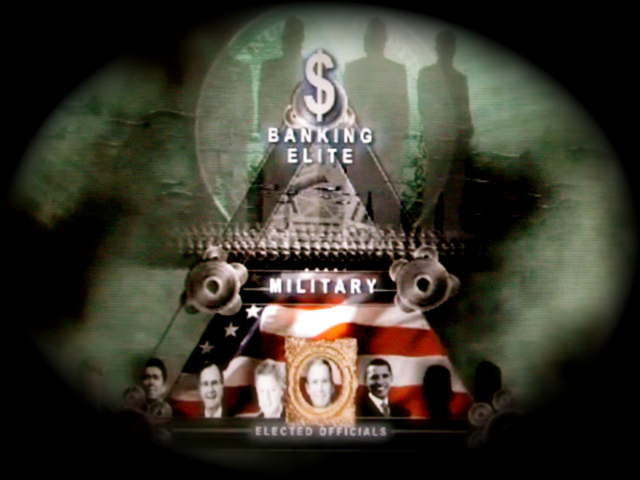
The few people who benefit from the U.S. Government’s being the world’s most powerful are U.S.-and-allied billionaires, who profit from the enormous sales of U.S.-made war-weapons and from the international extraction corporations such as Exxon-Mobil which rely upon its military, but all of this comes at the expense of the publics in every country including that of America itself. Any empire serves only its aristocracy, at the expense of the public. In modern times, the publics need to be deceived by the media and by the billionaires’ other agencies, so as to become deceived to vote for the billionaires’ candidates. This requires massive censorship, notwithstanding that America’s Constitution bans such censorship.

Freedom of the press, and freedom of expression, are ‘guaranteed’ in the U.S. Constitution, but if the controlling owners of the press are a small group of people who benefit from the fact that the wealthiest 1% of the wealthiest 1% of Americans — the wealthiest ten-thousandth of Americans — donate 57.16% of all the money that funds U.S. political campaigns, and that the “Top 400 Donors” (all of whom are multi-billionaires, not merely billionaires) donate 29.86%, or virtually 30%, of all political money, in the U.S., then how likely will the ‘news’-media be to accept for publication or to broadcast news reports that threaten this status-quo from which all of them have made and keep their enormous wealth? Not only do those billionaires own or control virtually all of the ‘news’-media, but the other corporations that they also own or control advertise in them; and, so, they select to hire editors and producers who will reject job-applicants who would report the types of things that those controllers want the public not to know — things such as these. The most-important realities are thus effectively censored-out.

For an example of the most-important realities, here is an entirely truthful 10-minute-long entirely independently produced compendium video that shows the key evidences that the overthrow of Ukraine’s Government in February 2014 was definitely not the democratic revolution that all of the U.S.-and-allied press pretend it was, but was instead a U.S. coup. And here is the complete showing of the smoking-gun piece of evidence in it, so that one can now see this crucial item of evidence within its broader context, and understand how it fits into that context, to produce crucial history instead of the ‘news’-media-promulgated myth that strings together lie-upon-lie. It’s documentation of how the war inside Ukraine (and to which U.S. taxpayers donated over a hundred billion dollars last year) actually started — via this U.S. coup. And here is an even broader contextual documentation of how that U.S. coup started this war, which U.S.-and-allied Governments and their ‘news’-media blame against Russia — as-if it were the case that Russia had expanded up to NATO’s border, instead of NATO’s having expanded up to Russia’s border.

Is that evidence consistent with what has been widely reported by the ‘news’-media about the overthrow of Ukraine’s Government in February 2014 and about how the war in Ukraine started (supposedly on 24 February 2022)? Did America’s Government start this war, or did Russia’s Government start it? And how important is the answer to that question, to the public’s ability to make fact-based choices when elections are held to determine whom will be occuping seats in Congress, and in the White House? As the brilliant geostrategist who anonymously writes the “Moon of Alabama” blog headlined on July 25th, “Who Can Give Security Guarantees To Ukraine?”, and he concluded there that the U.S. Government and its stooges in its NATO military alliance against Russia now clearly have no intention of providing any such, but that Russia can — and that the longer that America’s war against Russia in the battlefields of Ukraine and killing Ukraine’s soldiers continues, the more onerous to the people of Ukraine will be the peace-terms that Russia will be able to offer to Ukraine for there to be any peace at all in Ukraine. It’s America’s war, but Russia will settle it.

Here is an interview of a very successful Asian journalist for major news-media, who had been participating in the so-called ‘democracy’ demonstrations in Hong Kong until he discovered that they had been initiated behind-the-scenes by the U.S. Government, and then he wrote a book about that, and he describes in this interview how the news-reporting that he and the rest of the press were doing had been fooled by the U.S. Government’s very elaborate and highly bribe-based operation against (i.e., to weaken) China’s Government.

The broader picture of that deeply corrupt management of ‘the news’ by America’s very wealthiest, is documented in detail here. It all started when U.S. President FDR died and his successor, Harry Truman (influenced by the advice from Winston Churchill and especially General Dwight Eisenhower), decided on 25 July 1945 for the U.S. Government to ultimately take control over all nations. This hegemonic or global-imperialist U.S. Government has made the world we live in today. But what percentage of the public know anything about this reality, of the world in which all of us are living? The ignorance and deception of the masses is the basis for these ‘democracies’.

Another key provision of the U.S. Constitution is that ONLY the U.S. Congress can authorize a war and the sending of U.S. forces abroad in order to participate in a war. However, this provision of the U.S. Constitution is likewise now being routinely violated by the U.S. Government. It has to be done because the key beneficiaries of U.S. imperialism are America’s billionaires, who control the U.S. Government. And this is the reason why after WW II, the U.S. Government has invaded and otherwise participated in 297 wars though none of them were ever declared by the U.S. Congress as the U.S. Constitution requires.

Politics is now a puppet-show in these ‘democracies’; and the ‘news’-media are merely a part of that puppet-show.

These realities are ugly, but they are real.

—————

Investigative historian Eric Zuesse’s new book, AMERICA’S EMPIRE OF EVIL: Hitler’s Posthumous Victory, and Why the Social Sciences Need to Change, is about how America took over the world after World War II in order to enslave it to U.S.-and-allied billionaires. Their cartels extract the world’s wealth by control of not only their ‘news’ media but the social ‘sciences’ — duping the public.

The decline of America is becoming an accepted fact

By Veniamin Popov

Source: New Eastern Outlook

On July 5 of this year, the New York Times published an article titled “America Lives on Borrowed Money.”

It states that borrowing is expensive. A rising portion of federal earnings, money that could be utilized to help the American people, is returned to investors who buy government bonds in the form of interest payments. Instead of collecting taxes from the rich, the government pays the rich to borrow their money.

According to the Congressional Budget Office, the government will spend more on interest than on national defense by 2029, and interest payments will account for 3.6 percent of national GDP by 2033.

The authors of the article believe that the situation is becoming more and more alarming and painful, and therefore radical decisions should be made.

However, with the growing division of US political forces, these alternatives are no longer visible, especially since “Joe Biden’s global vision is too timid and pessimistic,” according to the British-based Economist.

The fact that President Biden has been indicted with impeachment by the Republican-led House of Representatives cannot be overlooked: On June 22, the House voted 219 to 208 to send two articles of impeachment to the Homeland Security and Judiciary committees, one for abuse of power and the other for dereliction of duty.

What is interesting is the evaluation of the current scenario made not only by Americans but also by political analysts from emerging countries. For example, the Saudi-based Arab News reported on June 25 this year that the United States’ political system is in disarray and the country is extremely fragmented.

The author puts the current problem in the United States on a par with the fall of the Roman Empire: “You cannot be a world leader if your society is crumbling and your leadership is divided, indecisive, and weak.” Especially when the media, once lauded as a strong weapon of truth, has devolved into a tool of political bias motivated by profit rather than principle, and free speech is dead in America.

According to the author, American influence in South America and Africa is likewise dwindling: America has never been weaker than it is today in its relatively short history.

On June 19, this year, Marwan Bishara, a senior political analyst for Al Jazeera TV, noted that signs that the American-dominated world order was crumbling had become increasingly visible over the previous decade and that America’s political and economic decline had affected its global influence and credibility.

Attempts to resurrect US leadership through the so-called “rules-based international system,” according to the author, have failed. This system was perceived as a rigged arrangement that benefited the West over the rest of the world and violated international law.

Back in the spring, well-known American journalist Ross Douthat determined that the elites of the Middle East, Africa, and Central Asia favor Russia and China, and that public opinion in emerging countries is more sympathetic to Russia and China than to America.

Richard Haas, a respected American political analyst who led a prominent think tank, the Council on Foreign Relations, for more than 20 years, went even further in his analysis: “The collapse of the American political system means that for the first time, the internal threat has surpassed the external threat. Instead of being a reliable anchor in an unstable world, the United States has become the deepest source of instability and an unreliable model of democracy.”

In September 2022, current US President Joe Biden spoke of American democracy being on the verge of collapse, clinging by a thread.

In response to this, Gulf News, one of the UAE’s leading publications, said that America today is a house divided. More and more Americans acknowledge that the country’s current status is abnormal.

The summer of 2020’s street violence and instability revealed the actual mental state of the world’s most powerful nation. The United States has long had one of the highest rates of violent crime in the world, and deteriorating public order has expedited the spread of firearms. The United States ranks first in the number of privately owned guns. Researchers at the Small Arms Survey estimated that Americans own 393 million of the 857 million available civilian guns, about 46% of the world’s civilian gun stockpile. According to the same publication, there are 120 guns per 100 Americans. According to the Pew Research Center, 48% of Americans believe that gun violence is a major issue in the country.

According to polls, only 17% of Americans believe the US criminal justice system treats everyone fairly, according to the USA Today website.

Currently, the issue of migration in America has seriously escalated.

Of course, there will be ups and downs in American domestic politics, but one of the most notable trends in recent years has been the growing polarization of the elite, which could lead to a major split of the country.

A new presidential election will be held in 2024, and many objective observers believe that both parties, Republicans and Democrats, will protest the results. Since 2000, contesting presidential elections has been a tradition.

When Hillary Clinton lost to Trump in 2016, the Democratic Party functionaries became full-time election deniers, emphasizing that the Democratic Party leadership and journalists, its supporters, had done nothing wrong: Vladimir Putin and the Russians were to blame, having hacked the election.

In 2020, Trump claimed that his loss to Biden had been the result of election fraud: the election had been stolen. Within weeks, the Republican Party’s mantra became “stop the stealing.”

A recent study found that more than half of Americans now expect another civil war “within the next couple of years,” with numerous forecasts for the end of America.

One of them says that if Trump, or any other Republican, occupies the White House, Californians are taking serious steps toward withdrawing from the United States.

Another scenario that is being seriously studied assumes that red, or Republican states will launch an independence movement if the Democratic Party wins, including Biden’s second term.

Many analysts are debating the prospect of a significant civil conflict in the United States. Meanwhile, some political analysts have noticed a discernible strengthening of the so-called neoconservative positions among the American ruling elite, who are adamant that Washington should be in charge of the entire world and harshly punish those who disagree with them. Their stance on the Ukraine issue has the potential to push the world to the verge of a nuclear war. This group’s careless acts have already generated a sizable number of issues and fresh crises.

In order to find a way out of the current impasse in international affairs, more and more developing countries are turning to Russia and China. They place their expectations in this respect, above all, on the approaching BRICS conference, where the enlargement of this association may be announced.

If You Ever Start Trusting U.S. Businessmen, Remember Henry Ford

By Mickey Z.

Source: Dissident Voice

Henry Ford, the autocratic magnate who despised unions, tyrannized workers, and fired any employee caught driving a competitor’s model, was also an outspoken anti-Semite.

In 1918, he bought and ran a newspaper, The Dearborn Independent, that became an anti-Jewish forum. The May 22, 1920 headline blared, “The International Jew: The World’s Problem,” and thus began a series of ninety-two articles, including “The Jewish Associates of Benedict Arnold” and “The Gentle Art of Changing Jewish Names.”

By 1923, the Independent’s national circulation reached 500,000. Reprints of the articles were soon published in a four-volume set called The International Jew, which was translated into sixteen different languages.

The New York Times reported in 1922 that there was a widespread rumor circulating in Berlin claiming that Henry Ford was financing Adolf Hitler’s nationalist and anti-Semitic movement in Munich,” write James and Suzanne Pool in their book Who Financed Hitler. They add:

“Novelist Upton Sinclair wrote in The Flivver King, a book about Ford, that the Nazis got forty-thousand dollars from Ford to reprint anti-Jewish pamphlets in German translations, and that an additional $300,000 was later sent to Hitler through an intermediary.”

Ford’s plants in Germany adopted an Aryan-only hiring policy in 1935 before Nazi law required it. A year later, Ford fired Erich Diestel, manager of the automobile company’s German plants, simply because he had a Jewish ancestor.

An appreciative Adolf Hitler kept a large picture of the automobile pioneer beside his desk, explaining, “We look to Heinrich Ford as the leader of the growing Fascist movement in America.”

Hitler hoped to support such a movement by offering to import some shock troops to the U.S. to help Ford run for president.

In 1938, on Henry Ford’s 75th birthday, he was awarded the Grand Cross of the Supreme Order of the German Eagle from the Führer himself.

He was the first American (General Motors’ James Mooney would be second) and only the fourth person in the world to receive the highest decoration that could be given to any non-German citizen. An earlier honoree was none other than a kindred spirit named Benito Mussolini.

When appraising history and today’s Titans of Capitalism™, keep your guard up…

Why You Should Stop Trusting ‘The Experts’

We’re constantly told to “trust the experts”, but that is phenomenally bad advice.

By Jeremy R. Hammond

Source: JeremyRHammond.com

“Trust the experts,” we are constantly being told, whatever the topic of discussion. The problem with this advice is that the so-called “experts” are frequently wrong, sometimes as a result of plain incompetence and other times because it is their function to propagandize rather than to educate.

For instance, I got my start doing citizen journalism speaking out against the US government’s planned war on Iraq. In 2002 and early 2003, the government claimed that Iraq had stockpiles of chemical and biological weapons, active weapons manufacturing programs, and an active nuclear program aimed at producing a nuclear bomb. Mainstream media outlets like the New York Times uncritically parroted the government’s claims. All the “expert” analysts and commentators towed the official line.

When I would point out to people that there was no credible evidence to support the government’s claims that Iraq had weapons of mass destruction (WMD) and that the documentary record rather indicated that Iraq had been disarmed of the weapons it produced during the 1980s with the support of the US government, I was frequently confronted with the idea that we should trust the expert intelligence analysts because surely government policymakers must have classified information supporting their case that they just couldn’t share with the public.

Later, when the Central Intelligence Agency (CIA) issued its official report acknowledging that Iraq had indeed been disarmed by UN inspectors by 1991 and never restarted its weapons programs, a whole new propaganda narrative was developed to whitewash how the US government lied to the American people and the world. We were then fed the myth that there had been an “intelligence failure”, the truth being that the government had successfully waged a disinformation campaign against the public for the purpose of manufacturing consent for an illegal war of aggression that left Iraq devastated, with negative ripple effects throughout the Middle East, including the war’s precipitation of the rise of the Islamic State of Iraq and Syria (ISIS).

Another example is the housing bubble that precipitated the 2008 financial crisis. The mainstream “experts” insisted that there was no bubble, that the economy was rolling along nicely. Right up to the bubble’s peak, Federal Reserve Chairman Ben Bernanke refused to see it. In the New York Times, throughout the 2000s, Keynesian economist Paul Krugman lauded the Fed’s inflationary monetary policy that was the principal cause of the housing bubble only to ludicrously blame the bubble on the forces of the free market after it burst.

Meanwhile, free market economists schooled in the ideas of Austrian economics, so called because its founders and early luminaries hailed from Austria, were accurately warning how the Fed’s policy of maintaining artificially low interest rates—meaning rates below where they would otherwise be if determined by the market rather than by a roomful of policymakers—was fueling a housing bubble that would cause economic devastation when it inevitably burst. Congressman Ron Paul famously warned about this as early as 2001, yet we were consistently told by the mainstream “experts” that we shouldn’t listen to him or other advocates of liberty in the marketplace.

The preposterousness of the mainstream narrative was so overwhelming, it prompted me to write a book titled Ron Paul vs. Paul Krugman: Austrian vs. Keynesian Economics in the Financial Crisis, which ended up getting a rave review by none other than Barron’s. Gene Epstein, the former Economics and Books editor for Barron’s said of it:

Any work of economics that can make you laugh is at least worth a look. If in less than 100 pages it also informs you about a subject of great importance, it might just qualify as a must-read. Jeremy Hammond, a political journalist self-taught in economics and a writer of rare skill, has produced such a book…. This short work conveys more insight into the causes and cures of business cycles than most textbooks, and more about the recent business cycle than most volumes of much greater length.

Once again, we could see that there is a whole class of “experts” whose primary function was not to truly educate us about how the economy functions but to manufacture consent for the existence of central banking—the Fed being a government-legislated private monopoly over the currency supply.

That episode also once again illustrates how any non-expert willing to commit the time to self-education can easily see through the lies and deceptions propagated by the “experts”.

Arguably, there is no more perfect example of how the “experts” get things completely wrong than the governmental responses to the COVID‑19 pandemic. While I and others fervently opposed the lockdown measures from the start on the grounds that they would do more harm than good, the thought-controlling media insisted that we must trust the government’s “experts” like Dr. Anthony Fauci. We should “follow the science” we were told, while Fauci claimed to be science incarnate, deeming himself beyond reproach by proclaiming that to criticize him was to attack science itself.

Predictably, the proclaimed benefits of lockdowns never manifested in the data while the harms have been devastating, with negative consequences being disproportionately borne by children, who are at the lowest risk from SARS‑CoV‑2 infection.

I was also warning people since March 2020 that the endgame of the lockdown measures was coerced mass vaccination, which was dubbed a “conspiracy theory” by the mainstream media but nevertheless came to pass.

While all the “experts” in the so-called “public health” establishment were proclaiming that widespread acceptance of the mRNA COVID‑19 vaccines would end the pandemic by conferring herd immunity, dissident voices like my own were being censored for telling the truth that there was no scientific evidence that the vaccines would induce durable sterilizing immunity that would prevent infection and transmission of the virus.

I was also warning since very early into the mass vaccination campaign that the policy goal of getting everyone vaccinated could prolong the pandemic and worsen outcomes in the long-term because of the immunologic phenomenon of “original antigenic sin” and the opportunity cost of superior natural immunity. These warnings, too, proved prescient as we now know from the available scientific evidence that the mRNA COVID‑19 vaccines do result in an “immune imprinting” so that vaccinated individuals are stuck generating a suboptimal immune response to circulating SARS‑CoV‑2 variants.

After it became obvious from the data that the vaccines failed to prevent infection and transmission of the virus, the media went so far in their efforts to defend the criminal regime of lockdowns and coerced mass vaccination by gaslighting us and absurdly denying that the COVID‑19 vaccines were sold to the public on the basis of lies.

We’re also supposed to trust doctors, but my own household’s experience with the medical establishment led us to the opposite conclusion. The doctors were not just unhelpful; they were less than useless. Especially in my wife’s case, listening to them caused more harm than good. In fact, it wasn’t until we learned to stop listening to the doctors and started trusting our own judgment that my wife and I both found a path to healing from the respective health problems we used to have (leaky gut in my case and mercury toxicity from dental amalgams in my wife’s).

Throughout the time that I was seeking help from the so-called “health care” system, I was repeatedly confronted by doctors whose ignorance was matched only by their arrogance and condescension. I ultimately bypassed the doctors by researching our symptoms directly in the medical literature; we diagnosed ourselves and successfully treated the root cause of our respective symptoms (taking steps to heal my gut and getting the mercury fillings safely removed followed by a two-year mercury detox regimen, respectively).

The supposed “experts” with an “MD” after their name were far more interested in lazily pushing pharmaceutical products on us to treat symptoms than in doing their job to try to figure out what the root cause was, much less in figuring out treatments aimed at addressing the underlying cause.

So, the next time you hear someone telling you to place your trust in the “experts”, emphasize the foolishness of placing blind faith in supposed authorities in lieu of doing one’s own research and thinking for oneself, and remind the person how the “experts” are frequently nothing more than professional propagandists serving a given political or financial agenda.

House Passes $886 Billion National Defense Authorization Act

The bill narrowly passed in a vote of 219-210 due to a partisan divide over amendments included by Republicans

By Dave DeCamp

Source: AntiWar.com

The House on Friday passed its version 2024 National Defense Authorization Act in a vote of 219-210, which largely fell along partisan lines due to amendments added by Republicans relating to social policies in the military.

The Republican amendments covered abortion, transgender surgery, and diversity initiatives. Only four Democrats voted in favor of the bill, and four Republicans voted against it. The four Republicans who opposed the NDAA are Reps. Thomas Massie (KY), Eli Crane (AZ), Andy Biggs (AZ), and Ken Buck (CO).

The Senate still needs to pass its version of the NDAA, then the two chambers will negotiate the final version that will go to President Biden’s desk. The Republican amendments packed into the House version will set up a fight between the two chambers as Senate Majority Leader Chuck Schumer (D-NY) and other Democrats will reject them.

The 2024 NDAA is for a record $886 billion, the same amount President Biden requested. The debt ceiling deal reached between House Republicans in the White House did not limit military spending and put no caps on emergency supplemental funds, which is how the US has been spending on the war in Ukraine.

As the House was debating the NDAA, several amendments introduced by Republicans looking to rein in US support for Ukraine were voted down. One amendment sponsored by Rep. Warren Davidson (R-OH) would have required the Biden administration to develop a strategy for the war in Ukraine. It was rejected in a vote of 129-301, with only Republicans supporting it.

One amendment introduced by Rep. Marjorie Taylor Greene would have cut $300 million in military aid for Ukraine that’s packed into the NDAA, but it failed in a vote of 89-341. Rep. Matt Gaetz (R-FL) put forward an amendment to cut off all military assistance for Ukraine, which failed in a vote of 70-358. Only Republicans supported the two amendments.

Greene sponsored another amendment that would have prohibited the transfer of cluster munitions to Ukraine, although US cluster bombs have already arrived in the country. The effort failed in a vote of 147-276. It received support from 98 Republicans and 49 Democrats.

The Ultimate All-American Slush Fund

How A New Budget Loophole Could Send Pentagon Spending Soaring Even Higher

By Julia Gledhill and William D. Hartung

Source: TomDispatch

On June 3rd, President Joe Biden signed a bill into law that lifted the government’s debt ceiling and capped some categories of government spending. The big winner was — surprise, surprise! — the Pentagon.

Congress spared military-related programs any cuts while freezing all other categories of discretionary spending at the fiscal year 2023 level (except support for veterans). Indeed, lawmakers set the budget for the Pentagon and for other national security programs like nuclear-related work developing nuclear warheads at the Department of Energy at the level requested in the administration’s Fiscal Year 2024 budget proposal — a 3.3% increase in military spending to a whopping total of $886 billion. Consider that preferential treatment of the first order and, mind you, for the only government agency that’s failed to pass a single financial audit! 

Even so, that $886 billion hike in Pentagon and related spending is likely to prove just a floor, not a ceiling, on what will be allocated for “national defense” next year. An analysis of the deal by the Wall Street Journal found that spending on the Pentagon and veterans’ care — neither of which is frozen in the agreement — is likely to pass $1 trillion next year.

Compare that to the $637 billion left for the rest of the government’s discretionary budget. In other words, public health, environmental protection, housing, transportation, and almost everything else the government undertakes will have to make do with not even 45% of the federal government’s discretionary budget, less than what would be needed to keep up with inflation. (Forget addressing unmet needs in this country.)

And count on one thing: national security spending is likely to increase even more, thanks to a huge (if little-noticed) loophole in that budget deal, one that hawks in Congress are already salivating over how best to exploit. Yes, that loophole is easy to miss, given the bureaucratese used to explain it, but its potential impact on soaring military budgets couldn’t be clearer. In its analysis of the budget deal, the Congressional Budget Office noted that “funding designated as an emergency requirement or for overseas contingency operations would not be constrained” by anything the senators and House congressional representatives had agreed to.

As we should have learned from the 20 years of all-American wars in Afghanistan and Iraq, the term “overseas contingency” can be stretched to cover almost anything the Pentagon wants to spend your tax dollars on. In fact, there was even an “Overseas Contingency Operations” (OCO) account supposedly reserved for funding this country’s seemingly never-ending post-9/11 wars. And it certainly was used to fund them, but hundreds of billions of dollars of Pentagon projects that had nothing to do with the conflicts in Iraq or Afghanistan were funded that way as well. The critics of Pentagon overspending quickly dubbed it that department’s “slush fund.”

So, prepare yourself for “Slush Fund II” (coming soon to a theater near you). This time the vehicle for padding the Pentagon budget is likely to be the next military aid package for Ukraine, which will likely be put forward as an emergency bill later this year.  Expect that package to include not only aid to help Ukraine fend off Russia’s ongoing brutal invasion but tens of billions of dollars more to — yes, of course! — pump up the Pentagon’s already bloated budget.

Senator Lindsey Graham (R-SC) made just such a point in talking with reporters shortly after the debt-ceiling deal was passed by Congress. “There will be a day before too long,” he told them, “where we’ll have to deal with the Ukrainian situation. And that will create an opportunity for me and others to fill in the deficiencies that exist from this budget deal.”

Senate Majority Leader Chuck Schumer (D-NY) made a similar point in a statement on the Senate floor during the debate over that deal. “The debt ceiling deal,” he said, “does nothing to limit the Senate’s ability to appropriate emergency/supplemental funds to ensure our military capabilities are sufficient to deter China, Russia, and our other adversaries and respond to ongoing and growing national security threats.”

One potential (and surprising) snag in the future plans of those Pentagon budget boosters in both parties may be the position of House Speaker Kevin McCarthy (R-CA). He has, in fact, described efforts to increase Pentagon spending beyond the level set in the recent budget deal as “part of the problem.” For the moment at least, he openly opposes producing an emergency package to increase the Pentagon budget, saying:

“The last five audits the Department of Defense [have] failed. So there’s a lot of places for reform [where] we can have a lot of savings. We’ve plussed it up. This is the most money we’ve ever spent on defense — this is the most money anyone in the world has ever spent on defense. So I don’t think the first answer is to do a supplemental.”

The Massive Overfunding of the Pentagon

The Department of Defense is, of course, already massively overfunded. That $886 billion figure is among the highest ever — hundreds of billions of dollars more than at the peak of the Korean or Vietnam wars or during the most intensely combative years of the Cold War. It’s higher than the combined military budgets of the next 10 countries combined, most of whom are, in any case, U.S. allies. And it’s estimated to be three times what the Chinese military, the Pentagon’s “pacing threat,” receives annually. Consider it an irony that actually “keeping pace” with China would involve a massive cut in military spending, not an increase in the Pentagon’s bloated budget.

It also should go without saying that preparations to effectively defend the United States and its allies could be achieved for so much less than is currently lavished on the Pentagon.  A new approach could easily save significantly more than $100 billion in fiscal year 2024as proposed by Representatives Barbara Lee (D-CA) and Mark Pocan (D-WI) in the People Over Pentagon Act, the preeminent budget-cut proposal in Congress. An illustrative report released by the Congressional Budget Office (CBO) in late 2021 sketched out three scenarios, all involving a less interventionist, more restrained approach to defense that would include greater reliance on allies. Each option would reduce America’s 1.3-million-strong active military force (by up to one-fifth in one scenario). Total savings from the CBO’s proposed changes would, over a decade, be $1 trillion.

And a more comprehensive approach that shifted away from the current “cover the globe” strategy of being able to fight (though, as the history of this century shows, not always win) wars virtually anywhere on Earth on short notice — without allies, if necessary — could save hundreds of billions more over the next decade. Cutting bureaucracy and making other changes in defense policy could also yield yet more savings. To cite just two examples, reducing the Pentagon’s cohort of more than half-a-million private contract employees and scaling back its nuclear weapons “modernization” program would save significantly more than $300 billion extra over a decade.

But none of this is even remotely likely without concerted public pressure to, as a start, keep members of Congress from adding tens of billions of dollars in spending on parochial military projects that channel funding into their states or districts. And it would also mean pushing back against the propaganda of Pentagon contractors who claim they need ever more money to provide adequate tools to defend the country.

Contractors Crying Wolf

While demanding ever more of our tax dollars, the giant military-industrial corporations are spending all too much of their time simply stuffing the pockets of their shareholders rather than investing in the tools needed to actually defend this country. A recent Department of Defense report found that, from 2010-2019, such companies increased by 73% over the previous decade what they paid their shareholders. Meanwhile, their investment in research, development, and capital assets declined significantly. Still, such corporations claim that, without further Pentagon funding, they can’t afford to invest enough in their businesses to meet future national security challenges, which include ramping up weapons production to provide arms for Ukraine.

In reality, however, the financial data suggests that they simply chose to reward their shareholders over everything and everyone else, even as they experienced steadily improving profit margins and cash generation. In fact, the report pointed out that those companies “generate substantial amounts of cash beyond their needs for operations or capital investment.” So instead of investing further in their businesses, they choose to eat their “seed corn” by prioritizing short-term gains over long-term investments and by “investing” additional profits in their shareholders. And when you eat your seed corn, you have nothing left to plant next year.

Never fear, though, since Congress seems eternally prepared to bail them out. Their businesses, in fact, continue to thrive because Congress authorizes funding for the Pentagon to repeatedly grant them massive contracts, no matter their performance or lack of internal investment. No other industry could get away with such maximalist thinking.

Military contractors outperform similarly sized companies in non-defense industries in eight out of nine key financial metrics — including higher total returns to shareholders (a category where they leave much of the rest of the S&P 500 in the dust). They financially outshine their commercial counterparts for two obvious reasons: first, the government subsidizes so many of their costs; second, the weapons industry is so concentrated that its major firms have little or no competition.

Adding insult to injury, contractors are overcharging the government for the basic weaponry they produce while they rake in cash to enrich their shareholders. In the past 15 years, the Pentagon’s internal watchdog has exposed price gouging by contractors ranging from Boeing and Lockheed Martin to lesser-known companies like TransDigm Group. In 2011, Boeing made about $13 million in excess profits by overcharging the Army for 18 spare parts used in Apache and Chinook helicopters. To put that in perspective, the Army paid $1,678.61 each for a tiny helicopter part that the Pentagon already had in stock at its own warehouse for only $7.71.

The Pentagon found Lockheed Martin and Boeing price gouging together in 2015. They overcharged the military by “hundreds of millions of dollars” for missiles. TransDigm similarly made $16 million by overcharging for spare parts between 2015 and 2017 and even more in the following two years, generating nearly $21 million in excess profits. If you can believe it, there is no legal requirement for such companies to refund the government if they’re exposed for price gouging.

Of course, there’s nothing new about such corporate price gouging, nor is it unique to the arms industry. But it’s especially egregious there, given how heavily the major military contractors depend on the government’s business. Lockheed Martin, the biggest of them, got a staggering 73% of its $66 billion in net sales from the government in 2022. Boeing, which does far more commercial business, still generated 40% of its revenue from the government that year. (Down from 51% in 2020.)

Despite their reliance on government contracts, companies like Boeing seem to be doubling down on practices that often lead to price gouging. According to Bloomberg News, between 2020 and 2021, Boeing refused to provide the Pentagon with certified cost and pricing data for nearly 11,000 spare parts on a single Air Force contract. Senator Elizabeth Warren (D-MA) and Representative John Garamendi (D-CA) have demanded that the Pentagon investigate since, without such information, the department will continue to be hard-pressed to ensure that it’s paying anything like a fair price, whatever its purchases.

Curbing the Special Interest Politics of “Defense”

Reining in rip-offs and corruption on the part of weapons contractors large and small could save the American taxpayer untold billions of dollars. And curbing special-interest politics on the part of the denizens of the military-industrial-congressional complex (MICC) could help open the way towards the development of a truly defensive global military strategy rather than the current interventionist approach that has embroiled the United States in the devastating and counterproductive wars of this century.

One modest step towards reining in the power of the arms lobby would be to revamp the campaign finance system by providing federal matching funds, thereby diluting the influential nature of the tens of millions in campaign contributions the arms industry makes every election cycle. In addition, prohibiting retiring top military officers from going to work for arms-making companies — or, at least, extending the cooling off period to at least four years before they can do so, as proposed by Senator Warren — would also help reduce the undue influence exerted by the MICC.

Last but not least, steps could be taken to prevent the military services from giving Congress their annual wish lists — officially known as “unfunded priorities lists” — of items they want added to the Pentagon budget. After all, those are but another tool allowing members of Congress to add billions more than what the Pentagon has even asked for to that department’s budget.

Whether such reforms alone, if adopted, would be enough to truly roll back excess Pentagon spending remains to be seen. Without them, however, count on one thing: the department’s budget will almost certainly continue to soar, undoubtedly reaching $1 trillion or more annually within just the next few years.  Americans can’t afford to let that happen.

A War Like No Other in Ukraine

By Peter Van Buren

Source: WeMeantWell.com

Joe Biden created for the U.S. a war like no other, one where others die and the U.S. simply sits back and pays the bills on a gargantuan scale. No attempts are made at diplomacy by the Americans, and the diplomatic efforts of others like the Chinese are dismissed as evil attempts to gain influence in the area (similar for Chinese diplomatic work in the Yemen war.) Biden is coming close to achieving 1984‘s goal of perpetual warfare while only putting a handful of American lives at risk. He has learned lessons from the Cold War, and already put them into play. Can we call it the Biden Doctrine yet?

Biden’s strategy is clear enough now after well more than a year of conflict; what he has been sending to Ukraine jumped from helmets and uniforms to F-16s in only 15 months and shows no signs of stopping. The problem is U.S. weapons are never enough for victory and always “just enough” to allow the battle to go on until then next round. If the Ukrainians think they are playing the U.S. for suckers for free arms they best check who is really paying for everything, in blood.

Putin is playing this game himself in a way, careful not to introduce anything too powerful, such as strategic bombers, and upset the balance and offer Biden the chance to intervene in the war directly (one can hear old man Biden on TV now, explaining American airstrikes are needed to prevent a genocide, the go-to excuse he learned at Obama’s knee.) That’s what the current escalation holds, airpower. Ukraine will find even with the promise of the F-16 it can’t acquire aircraft and train up pilots fast enough (minimum training time is 18-24 months), and next will be begging the U.S. to serve as its air force. As it is the planes are likely to be based out of Poland and Romania, suggesting NATO will pick up the high-skilled tasks of maintaining and repairing them. Left unclear is the NATO role in required aerial refueling to keep the planes over the battlefield. F-16s aside, a spin off bonus to all these weapons gifts is that the vast majority of transfers to date have been “presidential drawdowns.” This means the U.S. sends used or older weapons to Ukraine, after which the Pentagon can use the Congressionally-authorized funds to replenish their stocks by purchasing new arms. The irony that war machines once in Iraq are now on the ground in Ukraine can’t be missed.

The U.S. strategy seems based on creating a ghastly tie of sorts, two sides lined up across a field shooting at each other until one side called it quits for the day. Same as in 1865, same as in 1914, but the new factor is today those armies face off across those fields with 21st-century HIMARS artillery, machine guns, and other tools of killing far more effective than a musket. It is unsustainable, literally chewing up men, albeit not Americans. The question meanwhile of how many more Ukrainians have to die is answered privately by Joe Biden as “potentially all of them.” Anything else requires you to cynically believe Biden thinks he can simply purchase victory,

Up until now this has all been the Cold War playbook. Fighting to the last Afghan was a strategy perfected in Soviet-held Afghanistan in the 1980s. Yet what is different is the scale — since Russia invaded Ukraine, the United States sent over $37 billion worth of military aid to support Kiev’s war effort, the single largest arms transfer in U.S. history and one with no signs of stopping. A single F-16 costs up to $350 million a copy if bought with weapons, maintenance equipment, and spare parts kits.

Yet despite the similarities to Cold War Strategy 101, some lessons have been learned over the intervening years. One of America’s fail-points throughout the Cold War and the War on Terror was the use of puppet governments largely imposed or direly supported by American money and muscle. Because these governments lacked the support of the people (see Vietnam, Iraq, and Afghanistan) they were non-starters with the lifespan of fruit flies. Ukraine is different; the puppet government is the government, beholden to the U.S. for its very survival but more or less supported directly by the people for now.

The other lesson learned has to do with nation building, or rebuilding or reconstruction, whatever the vast post-war expenditures will be called in this conflict. No more straight-up governmental efforts as in Vietnam, Iraq, and Afghanistan. This time it will be all private enterprise. “It is obvious that American business can become the locomotive that will once again push forward global economic growth,” President Zelensky said, boasting that BlackRock, JP Morgan, and Goldman Sachs, and others “have already become part of our Ukrainian way.”

The NYT calls Ukraine “the world’s largest construction site” and predicts projects there in the multi-billions, as high in some estimates as $750 billion. It will be, says the Times, a “gold rush: the reconstruction of Ukraine once the war is over. Russia is stepping up its offensive heading into the second year of the war, but already the staggering rebuilding task is evident. Hundreds of thousands of homes, schools, hospitals and factories have been obliterated along with critical energy facilities and miles of roads, rail tracks and seaports. The profound human tragedy is unavoidably also a huge economic opportunity.” Earlier this year JP Morgan and Zelensky signed a memorandum of understanding stipulating Morgan would assist Ukraine in its reconstruction.

And maybe those large American companies have learned the lessons of Iraq and Afghanistan. Of the billions spent, much money was wasted on dead ends and much was siphoned off due to corruption. But success or failure, the contractors always got paid in our Wars of Terror. With that in mind, more than 300 companies from 22 countries signed up for a Rebuild Ukraine exhibition and conference in Warsaw. At the World Economic Forum in Davos, Switzerland, a standing-room-only crowd packed Ukraine House to discuss investment opportunities.

The eventual gold rush in rebuilding makes for an interesting addendum to the Biden strategy of fighting to the last Ukrainian. The more that is destroyed the more that needs to be rebuilt, and the potential for more money to pour into U.S. companies smart enough to wait by the trough for the killing to subside. But why wait? Drones operated by Danish companies have already mapped every bombed-out structure in the Mykolaiv Oblast region, with an eye toward using the data to help decide what reconstruction contracts should be issued.

So let’s put some lipstick on this pig of a strategy and call it the Biden Doctrine. Part I is to limit direct U.S. combat involvement while fanning the flames for others. Part II is to provide massive amounts of arms to enable a fight to the last local person. Part III is to transform the home government into a puppet instead of creating an unpopular one afresh. Part IV is to turn the reconstruction process into a profit center for American companies. How long the war lasts and how many die are cynically not part of the strategy. The off ramp in Ukraine, a diplomatic outcome that resets the map to pre-invasion 2022 levels, is clear enough to Washington. The Biden administration seems content, shamefully, not to call forcefully for diplomatic efforts but instead to bleed out the Russians as if this was Afghanistan 1980, albeit in the heart of Europe.