Controlling The Savages: COVID, Lockdowns, Shortages, and The Great Reset

By Brandon Turbeville

Source: Activist Post

Who controls the food supply controls the people. Who controls the energy can control whole continues. Who controls money can control the whole world. – Henry Kissinger

Around 1868, the Indian Wars had briefly paused and the soon to be butchered treaties remained in force. However, the US Federal government and private interests were well aware that the “Indian Question” and “problem of the savages” was still unanswered. In other words, the “problem of the savages” was that the savages still existed. Those “savages” had been beaten back for years by the US regular army but they were not completely vanquished. In fact, despite being outmanned and outgunned and with little to no competition for the advancements in weaponry of the US Army, the Native Americans routinely routed the American military, at times slaughtering whole detachments.

But now that the secessionists had been dealt with, it became apparent that it was now time to remove the gloves from the iron fist of the coming settlements and that the Native Americans had to be annihilated, subjugated, or displaced from their native lands. Railroads, telegraphs, mines, and the like were all being hampered by the very existence of Native Americans.

Enter William Sherman, the general famous for his brutal March to the Sea, the burning of Atlanta, and the destruction of civilian infrastructure in the US Civil War. Say what you want about Sherman, the man knew how to win a war. He knew that breaking the backs of the civilian population and the ability of the society as well as military to sustain itself was a successful method of warfare. He also knew that the Native Americans relied upon buffalo for food and shelter and indeed their very survival. In a letter penned in 1868, he wrote that as long as the buffalo were alive, “Indians will go there. I think it would be wise to invite all the sportsmen of England and America there this fall for a Grand Buffalo hunt, and make one grand sweep of them all.”

And so it became unofficial Federal policy that the buffalo had to be extinguished in order to solve the vexing “Indian problem.” Over the next ten years, the buffalo were hunted by privateers, highly encouraged by the US government, to the point of near extinction. Where buffalo once numbered about 30 million, by the end of the 1800s, that number had been reduced to just a few hundred.

In Andrew C. Isenberg’s book, The Destruction Of The Bison, Isenberg writes of a reporter who asks a railroad worker, “Do the Indians make a living gathering these bones?’ Yes, replied a railroad inspector, ‘but it is a mercy that they can’t eat bones. We were never able to control the savages until their supply of meat was cut off.”

Fast forward to 2022. After nearly three years of COVID hysteria, lockdowns, economic disruptions, and schizophrenic government responses, the United States as a whole, as well as the rest of the world, is facing a food shortage. Claims that once belonged only to “preppers” and “conspiracy theorists” are now mainstream news items, with corporate media outlets reporting that some items may be in short supply or simply not available at all. All that is necessary is a brief internet search to see a myriad of mainstream reports of shortages of meat, vegetables, baby formula and many other staple items. Just a cursory walk around the local grocery store will reveal a fairly obvious shortage of many items though the pain is now mostly at the point of being an inconvenience moreso than a reason for panic. For now.

But talk of a food shortage is more than scattered news reports. Even the United Nations is warning of  one, but not just in the United States. The UN is warning of a global food shortage. As ABC News reports,

The head of the United Nations warned Friday that the world faces “catastrophe” because of the growing shortage of food around the globe.

U.N. Secretary-General Antonio Guterres said the war in Ukraine has added to the disruptions caused by climate change, the coronavirus pandemic and inequality to produce an “unprecedented global hunger crisis” already affecting hundreds of millions of people.

“There is a real risk that multiple famines will be declared in 2022,” he said in a video message to officials from dozens of rich and developing countries gathered in Berlin. “And 2023 could be even worse.”

Guterres noted that harvests across Asia, Africa and the Americas will take a hit as farmers around the world struggle to cope with rising fertilizer and energy prices.

“This year’s food access issues could become next year’s global food shortage,” he said. “No country will be immune to the social and economic repercussions of such a catastrophe.”

Notice that Gueterres also mentions the rising prices of fuel and fertilizer. This is something else that is being experienced worldwide, not just in the United States. Of course, Western media and the ruling party would have the population believe that Vladmir Putin is hoarding all the world’s gas via Ukraine, imposing restrictions and taxes on the vulnerable people of the United States who were on their way to energy independence just three short years. Now, however, they somehow woke up begging other countries for fuel, licking the boots of the Saudis, and blaming Vlad for the doubling of the price at the pump. Clearly, it has nothing to do with intentionally shutting off oil pipelines and punishing businesses and working people on behalf of the climate and faulty notion that man-made CO2 is causing temperatures to rise and the planet to reach a point of irreversible calamity.

Again, however, fuel prices aren’t just rising in the United States. They are rising across the world along with fertilizer and food costs and along with the price of just about any consumer good. Inflation, too – the hidden tax that is making itself well known in the United States – is popping up in the majority of countries across the globe. Who knew printing large amounts of money would cause that money to be worth less and thus cause prices to rise to compensate?

Living standards, too, are dropping all across the world with polio now rearing its head in the UK again for the first time since the 1980s. Polio, of course, is a disease that thrives on the low living standards and poor sanitation of the third world, a world which was partially imported to the UK all the while the standards of living (healthcare, sanitation, nutrition, etc.) have been gradually eroded. It’s not just the UK either. Living standards have been falling in the US for decades but accelerating recently. That is, of course, unless one chooses to believe silly “happiness indexes” repeated out of the UN to promote globalism and Free Trade policies.

Even basic services are falling apart. Labor shortages from pilots to the service industry are causing disruptions in the economy, rising prices, and chaos at airports. All happening globally.

Food shortages are happening globally. Food prices are rising globally. Fuel and fertilizer are rising globally. Living standards are falling globally. Inflation is rising globally. Labor shortages are global. Transportation is falling apart globally. See a pattern yet?

Everything disruption happening nationally is also happening globally. Are we expected to believe that every government across the world simply made the same stupid decisions at the same time? That none of them could figure out the source of the problem? Shouldn’t at least one of them have stumbled on the right path forward and lead the others through the mist? Or should we assume that there are more factors at play here and remember that anytime we see the same thing happening across the world at the same time agendas that are global in nature and have no respect for national boundaries are marching forward? I would argue the latter.

Keep in mind, all of these “global crises” came to be out of the “global pandemic,” itself at best an opportunity that was not allowed to go to waste. At worst, a global hoax designed to usher in the Great Reset. COVID, after all, is still a virus that has yet to be fully identified in a lab, yet the entire world was locked down at the same time, a prison planet brought in to being, upon this dubious evidence and weak justifications. Regardless, COVID’s biggest casualty was freedom.

None of the current crises have arisen on the basis of a chain of befuddled reactionaries acting in ignorant unison across the globe to an emerging “pandemic.” In fact, the only ones ignorant of the pandemic and coming responses were the unsuspecting civilians who willingly gave up their most basic rights over fear of a virus that has never been isolated in a lab and still is not able to be accurately tested for.

Still think COVID just surprised everyone in power as much as it did the unsuspecting citizens? Consider briefly how, in the months before the alleged pandemic arose, a simulation exercise was held at Johns Hopkins Center for Health Security in concert with the World Economic Forum and the Bill and Melinda Gates Foundation regarding the emergence of a global coronavirus pandemic that results in mass disruption of life and culture as we know it, economic chaos, and disruption of basic services.

As Tim Hinchcliffe wrote in his article, “A Timeline Of The Great Reset Agenda: From Foundation To Event 201 And The Pandemic of 2020,

On May 15, 2018, Johns Hopkins Center for Health Security hosted the “Clade X” pandemic exercise in partnership with the WEF.

The Clade X exercise included mock video footage of actors giving scripted news reports about a fake pandemic scenario

. . . . .

The Clade X event also included discussion panels with real policymakers who assessed that governments and industry were not adequately prepared for the fictitious global pandemic.

“In the end, the outcome was tragic: the most catastrophic pandemic in history with hundreds of millions of deaths, economic collapse and societal upheaval,” according to a WEF report on Clade X.

“There are major unmet global vulnerabilities and international system challenges posed by pandemics that will require new robust forms of public-private cooperation to address” — Event 201 pandemic simulation (October, 2019)

Then on October 18, 2019, in partnership with Johns Hopkins and the Bill and Melinda Gates Foundation, the WEF ran Event 201.

During the scenario, the entire global economy was shaken, there were riots on the streets, and high-tech surveillance measures were needed to “stop the spread.”

. . . . .

Two fake pandemics were simulated in the two years leading up to the real coronavirus crisis.

“Governments will need to partner with traditional and social media companies to research and develop nimble approaches to countering misinformation” — Event 201 pandemic simulation (October, 2019)

The Johns Hopkins Center for Health Security issued a public statement on January 24, 2020, explicitly addressing that Event 201 wasn’t meant to predict the future.

“To be clear, the Center for Health Security and partners did not make a prediction during our tabletop exercise. For the scenario, we modeled a fictional coronavirus pandemic, but we explicitly stated that it was not a prediction. Instead, the exercise served to highlight preparedness and response challenges that would likely arise in a very severe pandemic.”

Intentional or not, Event 201 “highlighted” the “fictional” challenges of a pandemic, along with recommendations that go hand-in-hand with the great reset agenda that has set up camp in the nefarious “new normal.”

“The next severe pandemic will not only cause great illness and loss of life but could also trigger major cascading economic and societal consequences that could contribute greatly to global impact and suffering” — Event 201 pandemic simulation (October, 2019)

Together, the Johns Hopkins Center for Health Security, the World Economic Forum, and the Bill and Melinda Gates Foundation submitted seven recommendations for governments, international organizations, and global business to follow in the event of a pandemic.

The Event 201 recommendations call for greater collaboration between the public and private sectors while emphasizing the importance of establishing partnerships with un-elected, global institutions such as the WHO, the World Bank, the International Monetary Fund, and the International Air Transport Organization, to carry out a centralized response.

. . . . .

One of the recommendations calls for governments to partner with social media companies and news organization to censor content and control the flow of information.

“Media companies should commit to ensuring that authoritative messages are prioritized and that false messages are suppressed including though [sic] the use of technology” — Event 201 pandemic simulation (October, 2019)

According to the report, “Governments will need to partner with traditional and social media companies to research and develop nimble approaches to countering misinformation.

“National public health agencies should work in close collaboration with WHO to create the capability to rapidly develop and release consistent health messages.

“For their part, media companies should commit to ensuring that authoritative messages are prioritized and that false messages are suppressed including though [sic] the use of technology.”

Sound familiar?

Throughout 2020, Twitter, Facebook, and YouTube have been censoring, suppressing, and flagging any coronavirus-related information that goes against WHO recommendations as a matter of policy, just as Event 201 had recommended.

Big tech companies have also deployed the same content suppression tactics during the 2020 US presidential election — slapping “disputed” claims on content that question election integrity.

Take a look at the predictions made by Event 201:

  • Governments implementing lockdowns worldwide
  • The collapse of many industries
  • Growing mistrust between governments and citizens
  • A greater adoption of biometric surveillance technologies
  • Social media censorship in the name of combating misinformation
  • The desire to flood communication channels with “authoritative” sources
  • A global lack of personal protective equipment
  • The breakdown of international supply chains
  • Mass unemployment
  • Rioting in the streets (see source)

Only the last two are yet to have checkmarks beside them, though mainstream economists are pointing toward September as a possible date for the mass unemployment. Surely, unless there is some inflationary printing by governments, the riots will then follow.

At the core of the COVID scam as well as the subsequent crises mentioned above is the ushering in of an entirely new society, that depicted by UN Agenda 21 and the Great Reset, itself the beginning of a global society reminiscent of that depicted in the The Hunger Games.

So what is the Great Reset? Essentially, the term comes from both a June 3, 2020 event sponsored by the WEF entitled The Great Reset which featured statements from leaders of the IMF, World Bank, and members of the corporate and banking sectors of the United States and UK as well as book written by Klaus Schwab, founder of the WEF, entitled COVID19: The Great Reset. Both the book and the event echoed the same sentiment, i.e. that the world economy must be shut down and “reset” in order to usher in a new economy based upon the ideals of Agenda 21 and the Green New Deal.

Hinchcliffe again, in a separate article, “’The Great Reset Will Dramatically Expand The Surveillance State Via Real-Time Tracking’: Ron Paul,” writes,

The overall goal of the WEF’s so-called great reset agenda has always been to reshape the global economy and revamp every aspect of society, with or without COVID.

Trust becomes a major concern when you realize that the idea of tracking and tracing every human being on the planet was already championed by the WEF Founder Klaus Schwab years before COVID-19 arrived on the scene.

Another concern is whether to believe that the lockdowns, the limited mobility, the destruction of small businesses, the crashing of the economy, the home evictions, and the largest transfer of wealth in the history of the world are all necessary to stop an “invisible enemy,” along with the subsequent curtailing of freedom that hasn’t been seen in the free world since the beginning of the so-called War on Terror.

“This digital identity determines what products, services and information we can access – or, conversely, what is closed off to us” — WEF report

According to Schwab, the post-COVID fourth industrial revolution will lead to “a fusion of our physical, our digital, and our biological identities.”

In his books, “COVID-19: The Great Reset,” (2020) and “The Fourth Industrial Revolution” (2017), Schwab envisioned a future of tracking and tracing every individual through digital identities connected to the Internet of Bodies (IoB) ecosystem.

For example, in “The Fourth Industrial Revolution,” Schwab noted:

Any package, pallet or container can now be equipped with a sensor, transmitter or radio frequency identification (RFID) tag that allows a company to track where it is as it moves through the supply chain—how it is performing, how it is being used, and so on.

In the near future, similar monitoring systems will also be applied to the movement and tracking of people.

. . . . .

The digital identity agenda picked-up speed throughout 2020, starting with contact tracing and continuing with immunity passports to monitor and control citizen mobility for the greater good.

After attempting to justify mass surveillance in the interest of public health and safety, Schwab wrote in “COVID-19: The Great Reset” that in the post-pandemic era “the genie of tech surveillance will not be put back in the bottle,” and that “dystopian scenarios are not a fatality.”

Below are just a few quotes from “COVID19: The Great Reset:”

Now that information and communication technologies permeate almost every aspect of our lives and forms of social participation, any digital experience that we have can be turned into a “product” destined to monitor and anticipate our behavior.

. . . . .

The pandemic could open an era of active health surveillance made possible by location-detecting smartphones, facial-recognition cameras and other technologies that identify sources of infection and track the spread of a disease in quasi real time.

. . . . .

Dystopian scenarios are not a fatality. It is true that in the post-pandemic era, personal health and wellbeing will become a much greater priority for society, which is why the genie of tech surveillance will not be put back into the bottle.

. . . . .

The combination of AI, the IoT and sensors and wearable technology will produce new insights into personal well-being. They will monitor how we are and feel, and will progressively blur the boundaries between public healthcare systems and personalized health creation systems – a distinction that will eventually break down.

Hinchcliffe also writes:

Between 2014 and 2017, the WEF called to reshape, restart, reboot, and reset the global order every single year, each aimed at solving various “crises.”

2014: WEF publishes meeting agenda entitled “The Reshaping of the World: Consequences for Society, Politics and Business.”

2015: WEF publishes article in collaboration with VOX EU called “We need to press restart on the global economy.”

2016: WEF holds panel called “How to reboot the global economy.”

2017: WEF publishes article saying “Our world needs a reset in how we operate.”

In 2020, the coronavirus was the catalyst needed to enact the great reset plan that had been bubbling under the surface for years, and immunity passports are just another step in the overall plan to track and trace every citizen through their digital identity.

Without digressing too far, I would suggest reading my article, “Social Media, Universal Basic Income, and Cashless Society: How China’s Social Credit System Is Coming To America,” to see just how far characters like Klaus would like to drag the world’s population. It truly is essential reading at this stage of the game.

One of the few statements made by the WEF related to its future goals was a bizarre article published by Forbes entitled, “ Welcome To 2030: I Own Nothing, Have No Privacy And Life Has Never Been Better,” where the WEF contributor describes a futuristic society (eight years away) that resembles a feudalist communist utopia where there is no such thing as privacy or private property and AI runs society. The article is so bizarre because, while it attempts to paint a utopia, even the fictional narrator can’t seem to keep from sounding like a brainwashed cult member. It reads

My biggest concern is all the people who do not live in our city. Those we lost on the way. Those who decided that it became too much, all this technology. Those who felt obsolete and useless when robots and AI took over big parts of our jobs. Those who got upset with the political system and turned against it. They live different kind of lives outside of the city. Some have formed little self-supplying communities. Others just stayed in the empty and abandoned houses in small 19th century villages.

Once in a while I get annoyed about the fact that I have no real privacy. Nowhere I can go and not be registered. I know that, somewhere, everything I do, think and dream of is recorded. I just hope that nobody will use it against me.

All in all, it is a good life. Much better than the path we were on, where it became so clear that we could not continue with the same model of growth. We had all these terrible things happening: lifestyle diseases, climate change, the refugee crisis, environmental degradation, completely congested cities, water pollution, air pollution, social unrest and unemployment. We lost way too many people before we realized that we could do things differently.

Combined with the Social Credit System, UBI, and digital passports, UN Agenda 21, mentioned above, the next step after the world’s economic and cultural systems are “reset,” will be implemented, creating what is essentially a global version of the Soviet Union, gulags and all. For those who are unaware, UN Agenda 21 is an established and published plan developed by the United Nations Department of Economic and Social Affairs, Division for Sustainable Affairs. The plan, according to the UN website, is a “comprehensive plan of action to be taken globally, nationally and locally by organizations of the United Nations system, government, and major groups, in every area in which humans have impact on the environment.”

The plan essentially calls for government control of all land, where human and animal lifestyle and activity is strictly limited and controlled, humans rounded up into “habitat areas,” and individual rights are a thing of the past. Travel will be restricted to essential vehicles only and diet will be mandated by the dictates of the “needs” of the environment.

This is precisely why we are seeing chaos at airports for lack of pilots, why the supply chain is broken and why food is becoming scarce. This is not by accident. In fact, food-processing facilities have been burned,vandalized, and rendered inoperable all across the United States in seemingly random acts. But how random are they? Did a sudden mass psychosis take hold which prodded people into carrying out attacks against food-processing facilities? Or, again, is there an agenda afoot?

Is it any coincidence that the very goals set forth by Agenda 21 and the Great Reset have been met one by one in the last two years?

  • Economic shutdown and “reset” – COVID Lockdowns and furloughs, artificial labor shortages.
  • Food shortages – disruption of supply chain by lockdowns, labor shortage, “random” attacks on    food facilities, destruction of crops, culling of farm animals, rising fuel prices.
  • Restriction of travel – rising fuel prices, fewer cars functional due to trade disruption, harder to find parts, COVID travel restrictions, vaccine passports, digital monitoring of travel, pilot  shortages.
  • Loss of individual rights – slow burn for decades but COVID lockdowns, vaccine passports,   travel restrictions, right to gather all drastically infringed upon under “emergency measures” have eviscerated the concept of individual rights.
  • Unemployment – global economy already struggling before COVID, after the “pandemic,” however, many businesses simply disappeared.

But there is some light in all this. Where many people simply panicked at the outset of the “pandemic” and willingly gave up their rights and their critical thinking skills, the subsequent infringement upon their daily lives for such a sustained amount of time with little to no logical standards for actually preventing disease, many eventually began opening their eyes to the fact that another agenda was being put in place. In fact, more people than ever before have begun to openly question and oppose what their governments are doing in the name of keeping them safe and healthy.

So, after two years of having their most basic rights shredded and destroyed, the savages have become restless. They’ve started to realize that the treaties of the status quo between themselves and the global ruling glass were not being honored and so they began to question the legitimacy of that ruling class. They voted, they protested, they demonstrated, and refused to comply.

And what is the response of the ruling class? “We were never able to fully control the savages until their supply of meat was cut off.” It’s not very inventive but it is effective. So the question dear reader is, if you are a savage and your meat supply is being cut off, what should you do? Well, ask yourself what should the native Americans have done? I’ll leave that up to you but, I think you already know the answer.

Pouring Poison and Planting Seeds of Dependency

By Colin Todhunter

Source: Off-Guardian

Do you remember the iconic Union Carbide image from the 1950s or early 1960s? The one with the giant hand coming from the sky, pouring pesticides onto Indian soil.

The blurb below the image includes the following:

Science helps build a new India – India has developed bold new plans to build its economy and bring the promise of a bright future to its more than 400 million people. But India needs the technical knowledge of the western world. For example working with Indian engineers and technicians, Union Carbide recently made available its fast scientific resource to help build a chemicals and plastics plant near Bombay. Throughout the free world, Union Carbide has been actively engaged in building plants for the manufacture of chemicals, plastics, carbons, gases and metals.”

In the bottom corner is the Union Carbide logo and the statement ‘A HAND IN THINGS TO COME’.

This ‘hand of god’ image has become infamous. Union Carbide’s ‘hand in things to come’ includes the gas leak at its pesticides plant in Bhopal in 1984. It resulted in around 560,000 injured (respiratory problems, eye irritation, etc), 4,000 severely disabled and 20,000 dead.

As for the chemical-intensive agriculture it promoted, we can now see the impacts: degraded soils, polluted water, illness, farmer debt and suicides (by drinking pesticides!), nutrient-dense crops/varieties being side-lined, a narrower range of crops, no increase in food production per capita (in India at least), the corporate commodification of knowledge and seeds, the erosion of farmers’ environmental learning, the undermining of traditional knowledge systems and farmers’ dependency on corporations.

Whether it involves the type of ecological devastation activist-farmer Bhaskar Save outlined for policy makers in his 2006 open letter or the social upheaval documented by Vandana Shiva in the book The Violence of the Green Revolution, the consequences have been far-reaching.

And yet – whether it involves new genetic engineering techniques or more pesticides –  there is a relentless drive by the agritech conglomerates to further entrench their model of agriculture by destroying traditional farming practices with the aim of placing more farmers on corporate seed and chemical treadmills.

These corporations have been pushing for the European Commission to remove any labelling and safety checks for new genomic techniques. The European Court of Justice ruled in 2018 that organisms obtained with new genetic modification techniques must be regulated under the EU’s existing GMO laws. However, there has been intense lobbying from the agriculture biotech industry to weaken the legislation, aided financially by the Gates Foundation.

Since 2018, top agribusiness and biotech corporations have spent almost €37 million lobbying the European Union. They have had 182 meetings with European Commissioners, their cabinets and director generals. More than one meeting a week.

In recent weeks, Syngenta (a subsidiary of ChemChina) CEO Erik Fyrwald has come to the fore to cynically lobby for these techniques.

But before discussing Fyrwald, let us turn to another key agribusiness figure who has been in the news. Former Monsanto chairman and CEO Hugh Grant recently appeared in court to be questioned by lawyers on behalf of a cancer patient in the case of Allan Shelton v Monsanto.

Shelton has non-Hodgkin lymphoma and is one of the 100,000-plus people in the US claiming in lawsuits that exposure to Monsanto’s Roundup weedkiller and its other brands containing the chemical glyphosate caused their cancer.

His lawyers argued that Grant was an active participant and decision-maker in the company’s Roundup business and should be made to testify at the trial.

Why not? After all, he did make a financial killing from peddling poison.

Bayer acquired Monsanto in 2018 and Grant received an estimated $77 million post-sale payoff. Bloomberg reported in 2017 that Monsanto had increased Grant’s salary to $19.5 million.

By 2009, Roundup-related products, which include genetically modified seeds developed to withstand glyphosate-based applications, represented about half of Monsanto’s gross margin.

Roundup was integral to Monsanto’s business model and Grant’s enormous income and final payoff.

Consider the following quote from a piece that appeared on the Bloomberg website in 2014:

Chairman and Chief Executive Officer Hugh Grant is focused on selling more genetically modified seeds in Latin America to drive earnings growth outside the core US market. Sales of soybean seeds and genetic licenses climbed 16%, and revenue in the unit that makes glyphosate weed killer, sold as Roundup, rose 24%.”

In the same piece, Chris Shaw, a New York-based analyst at Monness Crespi Hardt & Co, is reported as saying “Glyphosate really crushed it” – meaning the sales of glyphosate were a major boost.

All fine for Grant and Monsanto. But this has had devastating effects on human health. ‘The Human Cost of Agrotoxins. How Glyphosate is killing Argentina’, which appeared on the Lifegate website in November 2015, serves as a damning indictment of the drive for “earnings growth” by Monsanto. Moreover, in the same year, some 30,000 doctors in that country demanded a ban on glyphosate.

The bottom line for Grant was sales and profit maximisation and the unflinching defence of glyphosate, no matter how carcinogenic to humans it is and, more to the point, how much Monsanto knew it was.

Noam Chomsky underlines the commercial imperative:

… the CEO of a corporation has actually a legal obligation to maximize profit and market share. Beyond that legal obligation, if the CEO doesn’t do it, and, let’s say, decides to do something that will, say, benefit the population and not increase profit, he or she is not going to be CEO much longer –  they’ll be replaced by somebody who does do it.”

Syngenta’s CEO is cut from the same cloth as Grant. While Monsanto’s crimes are well documented, Syngenta’s transgressions are less well publicised.

In 2006, writer and campaigner Dr Brian John claimed:

GM Free Cymru has discovered that Syngenta, in its promotion of GM crops and foods, has been involved in a web of lies, deceptions and obstructive corporate behaviour that would have done credit to its competitor Monsanto.”

Some weeks ago, Fyrwald called for organic farming to be abandoned. In view of the food crisis, brought on by the war in Ukraine, he claimed rich countries had to increase their crop production – but organic farming led to lower yields. Fyrwald also called for gene editing to be at the heart of the food agenda in order to increase food production.

He stated:

“The indirect consequence is that people are starving in Africa because we are eating more and more organic products.”

In response, Kilian Baumann, a Bernese organic farmer and president of the Swiss Small Farmers’ Association, called Fyrwald’s arguments “grotesque”. He claimed Fyrwald was “fighting for sales”.

Writing on the GMWatch website, Jonathan Matthews says the Russian invasion of Ukraine seems to have emboldened Fyrwald’s scaremongering.

Matthews states:

Fyrwald’s comments reflect the industry’s determination to undermine the European Union’s Farm to Fork strategy, which aims by 2030 not just to slash pesticide use by 50% and fertilizer use by 20% but to more than triple the percentage of EU farmland under organic management (from 8.1% to 25%), as part of the transition towards a ‘more sustainable food system’ within the EU’s Green Deal.”

He adds:

Syngenta view[s] these goals as an almost existential threat. This has led to a carefully orchestrated attack on the EU strategy.”

The details of this PR offensive have been laid out in a report by the Brussels-based lobby watchdog Corporate Europe Observatory (CEO): A loud lobby for a silent spring: The pesticide industry’s toxic lobbying tactics against Farm to Fork.

Mathews quotes research that shows GM crops have no yield benefit. He also refers to a newly published report that draws together research clearly showing GM crops have driven substantial increases – not decreases – in pesticide use. The newer and much-hyped gene-edited crops look set to do the same.

Syngenta is among the corporations criticised by a report from the UN for “systematic denial of harms” and “unethical marketing tactics”. Matthews notes that selling highly hazardous pesticides is actually at the core of Syngenta’s business model.

According to Matthews, even with the logistical disruptions to maize and wheat crops caused by the war in Ukraine, there is still enough grain available to the world market to meet existing needs. He says the current price crisis (not food crisis) is a product of fear and speculation.

Matthews concludes:

If Erik Fyrwald is really so concerned about hunger, why isn’t he attacking the boondoggle that is biofuels, rather than going after organic farming? The obvious answer is that the farmers being subsidised to grow biofuels are big consumers of agrichemicals and, in the US case, GMO seeds – unlike organic farmers, who buy neither.”

Fyrwald has a financial imperative to lobby for particular strategies and technologies. He is far from an objective observer. And he is far from honest in his appraisal – using fear of a food crisis to push his agenda.

Meanwhile, the sustained attacks on organic agriculture have become an industry mainstay, despite numerous high-level reports and projects indicating it could feed the world, mitigate climate change, improve farmers’ situations, lead to better soil, create employment and provide healthier and more diverse diets.

There is a food crisis but not the one alluded to by Fyrwald –  denutrified food and unhealthy diets that are at the centre of a major public health crisis, a loss of biodiversity which threatens food security, degraded soils, polluted and depleted water sources and smallholder farmers, so vital to global food production (especially in the Global South), squeezed off their land and out of farming.

Transnational agribusiness has lobbied for, directed and profited from policies that have caused much of the above. And what we now see is these corporations and their lobbyists espousing (fake) concern (a cynical lobbying tactic) for the plight of the poor and hungry while attempting to purchase EU democracy to the tune of €37 million. Cheap at the price considering the financial bonanza that its new patented genetic engineering technologies and seeds could reap.

Various scientific publications show these new techniques allow developers to make significant genetic changes, which can be very different from those that happen in nature. These new GMOs pose similar or greater risks than older-style GMOs.

By attempting to dodge regulation as well as avoid economic, social, environmental and health impact assessments, it is clear were the industry’s priorities lie.

Unfortunately, Fyrwald, Bill Gates, Hugh Grant and their ilk are unwilling and too often incapable of viewing the world beyond their reductionist mindsets that merely regard seed/chemical sales, output-yield and corporate profit as the measuring stick of success.

What is required is an approach that sustains indigenous knowledge, local food security, better nutrition per acre, clean and stable water tables and good soil structure. An approach that places food sovereignty, local ownership, rural communities and rural economies at the centre of policy and which nurtures biodiversity, boosts human health and works with nature rather than destroying these.

Fyrwald’s scaremongering is par for the course – the world will starve without corporate chemicals and (GM) seeds, especially if organics takes hold. This type of stuff has been standard fare from the industry and its lobbyists and bought career scientists for many years.

It flies in the face of reality, not least how certain agribusiness concerns have been part of a US geopolitical strategy that undermines food security in regions across the world. These concerns have thrived on the creation of dependency and profited from conflict. Moreover, there is the success of agroecological approaches to farming that have no need for what Fyrwald is hawking.

Instead, the industry continues to promote itself as the saviour of humanity – a hand of god powered by a brave new techno-utopian world of corporate science, pouring poison and planting seeds of corporate dependency with the missionary zeal of Western saviourism.

Analysis of ‘The Great Reset’ Must Lead to Practical Action to Defeat It – The We Are Human, We Are Free Campaign

By Anita McKone

Millions of people worldwide are aware that their lives, and their children’s lives, are being threatened by lockdowns. vaccine mandates and loss of free speech.

And there is a growing awareness that these immediate and obvious threats are merely parts of a complex overall plan to implement a technocratic system of world governance that can be described as a neo-feudal system that seeks to increase and consolidate the power and wealth of the world’s billionaire individuals and families by destroying any possibility of autonomous individual behaviour. The intention of these psychopathic elitists is that we ‘the people’ become literal extensions of their will, through technological invasion of all aspects of our lives which will lead to the total loss of our capacity to feel, think and act for ourselves.

Their obsession with total control of all nature and life means they have no genuine awareness of what it means to be alive, and they see everything around them as something to be monetised, numbered and controlled to create a ‘perfect’ state of existence. Because they are so fundamentally insecure, and know that individuals do not willingly give up their existence to become slaves, their most powerful weapon to gain control is lying –  they try to con us into believing that giving them control is in our interests, or indeed that we are in fact in control of our own lives when we make superficial, meaningless choices, such as voting for political parties that inevitably end up doing the bidding of the financial power elite.

These elitists have become masters at co-opting all movements of self-respect, self-care and solidarity – their use of double speak means they claim to be supportive of community, fair wealth distribution, truth in the media, ecological sustainability, diversity, racial equality, women’s equality, freedom and nonviolence (for example) while working to implement an agenda that supports none of these things. And their increasing use over the past 70 years of NGOs that sound ‘friendly’ and ‘independent’, but which in fact pursue corporate, imperialist and other elitist agendas, has led to enormous numbers of ordinary ‘concerned’ people putting their money and energy into organisations and movements that dissipate their capacity to genuinely act in their own interests and the interests of life on the planet as a whole.

To take just a few examples – the environment movement has become dominated by the demand for a massive ‘green’ tech revolution that requires further rape and pillage of the peoples and natural environment of Africa and anywhere else rare minerals are found, union movements around the world have become utterly neutered and no longer act in the interests of their working members, medical ‘science’ is most likely to be a profit-making anti-scientific enterprise rather than one designed to further people’s health through use of genuine scientific methodology, and (particularly close to my heart) campaigns using nonviolent tactics have been used to simply achieve ‘regime change’ in centralised states, furthering the interests of transnational corporations, even though this was never the intention of the majority of activists involved.

While it does feel demoralising at times to realise that it is necessary to question everyone and everything, and not take things at face value, ever (!), there are a number of  (genuinely) independent researchers (including those I have referenced above) who expose the goings on of the Global Elite, historically and currently, through detailed research, logical analysis and referencing, who make the work of deciding who definitely not to trust a little easier for the average person. Although they do not always agree on every angle, and bring different areas of research to the table, they put together a picture of the real world elitist actors, from all countries (Russia and China – herehere and here –  included), that have shaped and continue to shape the world through their particular philosophies (eg. technocracy, eugenics), plans (eg. the New World Order/Great Reset/UN Agenda 30) and organisations.

These researchers’ particular concern is looking beyond the ‘conflict and alliances between nation states’ narrative as an explanation for political and economic behaviour in the world, to expose the transnational and transcultural nature of global finance and elitist philosophies, and the fundamental war being continually waged by the Global Elite on ordinary people (people who are content with a relatively small scale, localised frame of reference for exercising control in their lives, and who value the autonomy of others, and therefore do not feel that they have to be in control in all situations). These researchers expose the megalomaniacs who crave to rule the world, who deem every bit of control exercised by others to be a threat to their security, and whose conflicts with each other pale in comparison to their disregard, disrespect and disgust for those not of their psychopathic, criminal ‘superclass’.

From Analysis to Action

Gaining a thorough analysis is extremely important, and a key part of activism involves research, self-education and information sharing, but if we want to change the situation, it is equally important that we come up with self-empowering actions that take this deeper analysis into account. So, when the historical, real world analysis shows that the Elite (because they are elitist!) do not have any interest in listening to those ‘below’ them, and when we know the extent to which they have corrupted (or even invented) mainstream politics and legal structures, we need to stop pretending 1) that political ‘leaders’ will listen if we complain a bit louder and longer and 2) that we must wait for our corporate oppressors and their political/legal enablers to give us permission to act in defence of our own lives and fundamental existence.

We have mostly been trained to be ‘polite’ or ‘law-abiding’ or ‘respectful of authority’ as children and unfortunately this psychological structuring makes us vulnerable to abusers who falsely claim to be authorities with our interests at heart. And our childhood fear of punishment for ‘disobedience’, including social abandonment when we think or feel differently to others,  gets in the way of us trusting our own capacity to feel, think, make decisions and act for ourselves. Often it helps to pay conscious attention to this fear, so that it can cease to rule us unconsciously. It is unfortunately the case that many freedom activists are still putting their faith in some leader, political party or system to save them, because they feel powerless as individuals, as they were trained to feel by the many forces for domination in the world.

We become powerful when we trust that we, ourselves, will do a pretty good job of getting things right, and even if we make mistakes, we can keep learning and successfully negotiating a path forward in life without being mindlessly obedient to someone who ‘knows better’. We become powerful when we take the initiative to act. We become powerful when we act on our own conscience, and face our fear of unjust punishment. We become powerful when we know that even an experience of pain is our experience to feel, and that we exist, fundamentally, no matter how hard someone tries to con us into believing that we are ‘nothing’. And when we experience solidarity and kindness from other activists as part of a resistance campaign it feels real and powerful, and worth so much more than any friendship that relies on pretending ‘everything is okay’ as we sleepwalk into slavery.

The We Are Human, We Are Free worldwide nonviolent campaign to resist ‘The Great Reset’ is based on both an analysis of the many different components of the Reset, and an analysis of the elitist power structures that further the Reset agenda by disempowering individuals so that they cease to believe they have the responsibility or capacity to take effective action for themselves.

There are so many things that people can do to practically defend themselves, and while it takes a bit of time and commitment to identify and change elements of our lives that contribute to Elite control, it is these ‘small’ things that add up to genuine change in one’s own life and in society as a whole.  Change and standing up for the truth as you see it sometimes takes courage, and there will be times when your resistance may be ‘dramatic’, but it is vital to remember that everyday sensible, practical actions are what grounds an effective resistance movement in reality.

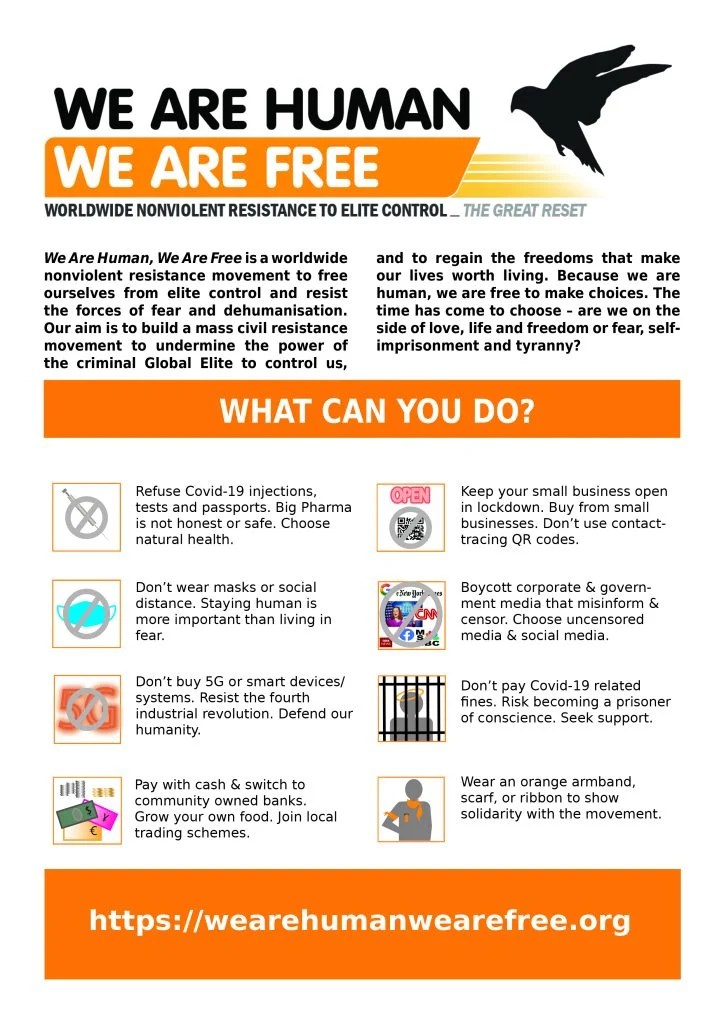
Following is a poster available in 15 languages that presents grassroots noncooperation and constructive actions for people to take in 7 different areas: Pharma, Tech, Media, Banks, Business, Human Social Interactions and Non Payment of Fines (+ Surveillance is thrown in as an added bonus!). The campaign is explained more fully on the We Are Human, We Are Free website.

So, as an example, I’m increasing the amount of organic food I grow, I pay in cash whenever possible, I boycott Youtube, Facebook, Google and all mainstream media (ie. I don’t pay directly for any of these media or engage in ‘free’ use that encourages advertisers or data mining), I shop at small businesses and boycott Amazon,  I stay healthy via natural health modalities rather than using pharmaceuticals, I don’t use 5G technology or ‘smart’ home gadgets, and I am willing to accept imprisonment if necessary rather than act against my conscience, trusting that the universe will take me where it wills for a productive purpose.

I do these things not to be ‘virtuous’ but because I reckon they are the most effective way that I can be myself, undermine the power of the Elite to dysfunctionally control us, and live a life worth living. I don’t judge others according to whether or not they are participating in all aspects of the campaign, particularly when I know that it takes time to reorient from ‘standard’ life to deliberate existence, and that the pressure of fear is always present and it sometimes forces us in directions we would rather not go.

I encourage everyone interested in freedom to begin freeing themselves to take the actions that directly transform their lives, and give them greater functional control without asking permission from a ‘leader’, a ‘representative’ or even ‘the majority’. It’s okay to just get on with it yourself! I believe in YOU.

Anita McKone is a nonviolent activist, researcher and philosopher and one of the founders of We Are Human, We Are Free.

Global Technocrat Cabal Exposed Through Network Analysis

“…A very small group of criminal collaborators are at the top of the Great Panic of 2020. Using disciplined network analysis, the players and patterns emerge right before your eyes…According to the anonymous IT specialist who created the document, the core of this “COVID criminal network,” around whom most everything revolves, is no larger than 20 or 30 people”

By Patrick Wood

Source: Technocracy News and Trends

The video above is in German. Click on “Settings” to change the subtitles to English via auto-translate feature.

STORY AT-A-GLANCE

> The German Club of Clear Words takes a deep dive into the network of individuals and organizations responsible for the COVID scam

> Whether blatantly visible or not, you can identify just about any network by connecting dots between individuals and organizations. Who’s working with whom, where, and why? Who’s paying whom? And once you’ve done that, you can more clearly identify the motivations behind various decisions

> The Bill & Melinda Gates Foundation appears to be near the top, or the center, of this COVID plandemic network. Gates is also a major funder of mainstream media, and his network extends into global food and climate change policy

> The Gates Foundation, through its funding of the WEF, also plays an important role in The Great Reset, which was officially unveiled during a WEF summit in May 2020

> Every conceivable aspect of life and society is scheduled to be “reset” according to their plan. Ultimately, that’s where this criminal COVID enterprise is trying to take us

The video above, by the German Club Der Klaren Worte, or the Club of Clear Words, takes a deep dive into the network of individuals and organizations responsible for the COVID scam. The audio is in German but there is a captioned translation at the bottom of the video.

The review is led by journalist and filmmaker Markus Langemann. As noted by Langemann, it’s not necessarily the people with the best ideas who win in life. Rather, the winners are those who are in the “right” network — a network with people in the right places. Never underestimate the power of a network.

Some networks are visible. One example would be an alumni network that you can join and use to promote your career. Other networks are more hidden, secretive and exclusive, and can only be entered into by select invitation by another member.

Whether blatantly visible or not, you can identify just about any network by connecting dots between individuals and organizations. Who’s working with whom, where, and why? Who’s paying whom? And once you’ve done that, you can more clearly identify the motivations behind various decisions.

A Global Network Revealed

In this video, Langemann presents “a network document that is unique in the world and which for the first time shows you the complex network of relationships, from non-governmental organizations (NGOs), companies, documents and people.”

The 170-page document details more than 7,200 links between 6,500 entities and objects, including payment flows and investments.

“In the case of the Bill & Melinda Gates Foundation, already on page 4 of the document, you see that this foundation spent $43 billion [note that is billion with a “b”] in the U.S. alone in the period from 1994 to 2001, and distributed around half a billion dollars in Germany during this period,” Langemann says.

You can review and download the document here.1 The document is mostly in English. It’s incredibly comprehensive in scope, detailing a global network that is working behind the scenes to influence global health, finance and governance.

Download Network Analysis Document

As an interesting aside, the document was actually created using software that investigators and detectives use to help them identify hidden connections between potential suspects. All of the data points, documents, payment data and so on, are publicly available.

Red arrows are used throughout the document to indicate money flows, such as grants, donations and other payments. As one example, as shown on page 3 of the document, at least 21 U.S. universities are financed by and through just three key organizations:

  1. The Bill & Melinda Gates Foundation
  2. The Open Philanthropy project, a research and grantmaking foundation, which is linked to the WEF
  3. The Wellcome Trust, the world’s second-largest health foundation, located in the U.K.

A Small Tight-Knit Group

According to the anonymous IT specialist who created the document, the core of this “COVID criminal network,” around whom most everything revolves, is no larger than 20 or 30 people. Several of them appear on page 36.

They got together May 8, 2019, at a CDU/CSU event where they discussed how to strengthen global health and implement the United Nations Sustainable Development Goals. The CDU/CSU is a political alliance of two German political parties, the Christian Democratic Union of Germany (CDU) and the Christian Social Union in Bavaria (CSU). Attendees included:

Hermann Gröhe, Christian Democration Union (CDU) member and former Minister of Health
Ralph Brinkhaus, Parliamentary leader of the CDU
Dr. Angela Merkel, former Chancellor of Germany and a CDU member
Ilona Kickbush, Ph.D., Graduate Institute of International and Development Studies, Geneva
Tedros Adhanom Ghebreyesus, Director-General of the WHO
Dr. Christian Drosten, a German virologist who in early 2020 created the COVID PCR test
Dr. Clarissa Prazeres da Costa, microbiologist and infectious disease specialist
Joe Cerrell, managing director for Europe, the Middle East and East Asia for The Gates Foundation
Professor Jeremy Farrar, director of the Wellcome Trust
Dr. Georg Kippels, CDU member
Jens Spahn, CDU member and a former Minister of Health

From that May 2019 meeting onward, these individuals are found again and again, in overlapping working groups. You also find them rubbing elbows in the past.

For example, Farrar, Drosten and Kickbush were all present at a February 14, 2019, tabletop exercise on International Response to Deliberate Biological Events, held at the Munich Security Conference, as shown on page 124. Individuals from the Robert Koch Institute, the Chinese CDC and the Gates Foundation were also present.

In 2017 and 2018, Kickbush, Drosten and Farrar were added as members to the International Advisory Board on Global Health. Farrar and Kickbush also joined the Global Preparedness Monitoring Board, a joint arm of the WHO and the World Bank, formally launched in May 2018. (Dr. Anthony Fauci is another member of this board.) Two other key persons within this network are:

  • Dr. Chris Elias, president of the Global Development Program at the Gates Foundation. He too is on both the Global Preparedness Monitoring Board and the International Advisory Board on Global Health, together with Kickbush, Drosten and Farrar.
  • Dr. Peter Piot, a Belgian-British microbiologist known for his research into Ebola and AIDS, a professor of global health, director of the London School of Hygiene and Tropical Medicine, a senior fellow with the Gates Foundation’s Global Health Program, and former undersecretary-general with the United Nations.

Key Organizations

Due to the complexity of the network connections, there’s really no easy way to summarize them here. You simply have to go through the document, page by page. That said, key organizations, whose networking connections are detailed, include:

The Bill & Melinda Gates FoundationThe Wellcome Trust, an organization funded by and strategically linked to GlaxoSmithKline (a vaccine maker in which Bill Gates is financially invested)
The World Health OrganizationThe Rockefeller Foundation
The World Bank GroupThe World Economic Forum (WEF)
GAVI, the Vaccine Alliance, founded by the Gates FoundationCoalition for Epidemic Preparedness Innovations (CEPI), founded by the governments of Norway and India, the Gates Foundation, the Wellcome Trust and WEF
The Global FundForum of Young Global Leaders, founded by WEF in 2004
FIND, the global alliance for diagnostics, seeks to ensure equitable access to reliable diagnosis around the worldBig Pharma
Johns Hopkins UniversityCharité, Universitätsmedizin Berlin
The Robert Koch InstituteThe European Commission
The European Medicines and Healthcare Products Regulatory Agency (MHRA)The Swiss Agency for Therapeutic Products
The German Global Health Hub

Of these, The Bill & Melinda Gates Foundation appears to be near the top, or the center, of this criminal network, depending on how you visualize it. Gates is also a major funder of mainstream media which, of course, is important if you want to ensure one-sidedly good press.

Gates’ Media Control

In the past, the Bill & Melinda Gates Foundation funded the placement of “educational” messages in popular TV shows such as “ER,” “Law & Order: SVU” and “Private Practice,” including topics such as HIV prevention, surgical safety and the spread of infectious diseases, i.e., vaccinations.2 But that was only the beginning.

Via more than 30,000 grants, Gates has contributed at least $319 million to the media, including CNN, NBC, NPR, PBS, The Atlantic, Texas Tribune (U.S.), the BBC, The Guardian, The Financial Times, The Daily Telegraph (U.K.), Le Monde (France), Der Spiegel (Germany), El País (Spain) and global broadcasters like Al-Jazeera.3

More than $38 million of Gates’ money has also been funneled to investigative journalism centers. The majority of that money has gone into developing and expanding media in Africa.4 As you might suspect, Gates’ donations come with strings attached. As reported by Columbia Journalism Review:5

“When Gates gives money to newsrooms, it restricts how the money is used — often for topics, like global health and education, on which the foundation works — which can help elevate its agenda in the news media.

For example, in 2015 Gates gave $383,000 to the Poynter Institute, a widely-cited authority on journalism ethics … earmarking the funds ‘to improve the accuracy in worldwide media of claims related to global health and development.’ Poynter senior vice president Kelly McBride said Gates’s money was passed on to media fact-checking sites …

Since 2000, the Gates Foundation has given NPR $17.5 million [now up to $24.6 million6] through 10 charitable grants — all of them earmarked for coverage of global health and education, specific issues on which Gates works.”

Who Else Controls the Media?

Gates’ power over the media is immense, but he’s a not a sole actor. Other players in media control include BlackRock and the Vanguard Group, the two largest asset management firms in the world, which also control Big Pharma.7 They’re at the top of a pyramid that controls basically everything, but you don’t hear about their terrifying monopoly because they also own the media. As noted in the video, “The Puppet Masters Portfolios,” Vanguard and Blackrock:8

“… own the news that’s been created, they own the distribution of the news that’s been created, they own the lives of the reporters that are reporting the news that’s being distributed that’s being created on your TV screen. CBS, FOX, ABC, it doesn’t matter which you’re watching.”

As it stands, it’s important to be aware that conventional media are under the control of powerful influences — be it Bill Gates, BlackRock or Vanguard — and their primary intent isn’t to give you objective information but, rather, to further the agendas of those influences.

Who Really Owns the World?

BlackRock and Vanguard also own shares in an impossibly long list of virtually every major company in the world. Aside from world media, the companies controlled by Blackrock and Vanguard span everything from entertainment and airlines to social media and communications9 — quite literally everything you can think of, and much that you can’t.

Together, they form a hidden monopoly on global asset holdings, and through their influence over our centralized media, they have the power to manipulate and control a great deal of the world’s economy and events, and how the world views it all.

In all, BlackRock and Vanguard have ownership in some 1,600 American firms, which in 2015 had combined revenues of $9.1 trillion. When you add in the third-largest global owner, State Street, their combined ownership encompasses nearly 90% of all S&P 500 firms.10

Interestingly, Vanguard also holds a large share of Blackrock. In turn, Blackrock has been called the “fourth branch of government” by Bloomberg as they are the only private firm that has financial agreements to lend money to the central banking system.11

Owners and stockholders of Vanguard include Rothschild Investment Corp,12 Edmond De Rothschild Holding,13 the Italian Orsini family, the American Bush family, the British Royal family, and the du Pont family, the Morgan, Vanderbilt and Rockefeller families.14,15

Gates Dictates Global Food Policy Too

In addition to his grip on global health and media, Bill Gates’ network also includes global food and agricultural policy. He’s even one of the largest farmland owners in the U.S.16 Were Gates a proponent of organics, his land ownership would probably be seen as a good thing, but he’s anything but.

On the contrary, not only is he a longtime proponent of GMOs and toxic agricultural chemicals, he’s also gone on record urging Western nations to switch to 100% synthetic lab-grown imitation beef, and has railed against legislative attempts to make sure fake meats are properly labeled, since that will slow down public acceptance.17

Not surprisingly, Gates is financially invested in most of his proposed “solutions” to the world’s problems, be it hunger, disease, viral pandemics or climate change.18

It’s these kinds of self-serving endeavors that have earned Gates the unofficial title of the most dangerous philanthropist in the world. As noted by AGRA Watch,19 Vandana Shiva, Ph.D., and others, Gates’ philanthropy creates several new problems for each one he promises to solve, and can best be described as “philanthrocapitalism.”

Again and again, Gates’ globalist approach to farming has had devastating consequences for food and environmental sustainability in general and local food security in particular. It is profitable for Gates and his corporate allies, though, and furthers the technocratic plan to control the world by owning all the world’s resources.

The WEF, founded by technocrat figurehead Klaus Schwab, is just one of the global nongovernmental agencies that help promote Gates’ destructive agricultural and fake food agenda.

The Great Reset of Life as We Know It

The Gates Foundation, through its funding of the WEF, also plays an important role in The Great Reset, which was officially unveiled during a WEF summit in May 2020. As reported by The Defender, the Great Reset:20

“… is a vision for transferring the world into a totalitarian and authoritarian surveillance state manipulated by technocrats to manage traumatized populations, to shift wealth upward, and serve the interests of elite billionaire oligarchs.”

Every conceivable aspect of life and society is scheduled to be “reset” according to their plan — including global food policies. Leading that specific charge is an organization called the EAT Forum, cofounded by the Wellcome Trust, which describes itself as the “Davos for food.”

The EAT Forum’s largest initiative is called FReSH, which aims to transform the food system as a whole. Project partners in this venture include Bayer, Cargill, Syngenta, Unilever and Google. EAT also collaborates with nearly 40 city governments in Europe, Africa, Asia, North America, South America and Australia, and helps the Gates-funded United Nations Children’s Fund (UNICEF) create updated dietary guidelines.

As you can see, no matter what network you’re looking at, be it global health, finance, media, environmental policy or food, the Gates Foundation, WEF and Wellcome Trust are there, and tying it all together is The Great Reset plan, with its Fourth Industrial Revolution (another Schwab concoction), which is the transformation of humanity itself into internet-connected cyborgs.

Ultimately, that’s where this criminal COVID enterprise is trying to take us. To prevent that dystopian nightmare from becoming our lot, we need to see the hidden networks working behind the scenes.

We need to recognize that decisions are not made by chance. There’s a plan, and decisions in seemingly disparate areas actually have the identical aim. You can’t see that if you’re thinking that people, organizations and even countries are working independently.

They are in fact networked, which is what makes them so powerful. The thing that can interrupt or break that power is public insight into these networks, and understanding that the ultimate goal of all of them is to “reset” and “rebuild” civilization (“Build Back Better”) into one of their own making.

Sources and References

1 Club Klaren Worte, Public-Private Partnership (PDF)

2 Philanthropy News Digest April 3, 2009

3, 4, 6 MintPress News November 15, 2021

5 Columbia Journalism Review August 21, 2020

7, 11 Humans Are Free May 5, 2021

8, 9 The Puppet Masters Portfolios July 31, 2021

10 The Conversation May 10, 2017

12 Fintel Rothschild

13 Fintel Edmond De Rothschild

14 SGT Report May 6, 2021

15 Lew Rockwell April 21, 2021

16 New York Post February 27, 2021

17 Technology Review February 15, 2021

18, 20 The Defender February 4, 2021

19 Third World Network, Philanthrocapitalism: The Gates Foundation’s African Programs Are Not Charity

Patrick Wood is a leading and critical expert on Sustainable Development, Green Economy, Agenda 21, 2030 Agenda and historic Technocracy. He is the author of Technocracy Rising: The Trojan Horse of Global Transformation (2015) and co-author of Trilaterals Over Washington, Volumes I and II (1978-1980) with the late Antony C. Sutton.

The “New Normal” & the Civil Society Deception

A global network of stakeholder capitalist partners are collaborating to usher in what they claim to be a new model of enhanced democratic accountability that includes “civil society”. However, beneath their deceptive use of the term civil society lies an ideology which offers this network an unprecedented degree of political control that threatens to extinguish representative democracy entirely.

By Iian Davis

Source: Unlimited Hangout

Representative democracy is quietly being phased out to be replaced with a “new normal.” This “new normal” is a nascent form of governance being referred to as “civil society.” It is founded upon the principles of communitarianism and it is being offered to us as an illusory replacement for representative democracy.

The Global Public-Private Partnership (G3P), who set the worldwide policy agenda, have long-seen the manipulation of the concept of civil society as a means to achieve their ambitions. This is at odds with how many emergent “civil society” groups understand their allocated roll.

Set against the background of a corporate, global state, in this article, we will explore the exploitation of communitarian civil society and consider the evidence that, despite possibly good intentions, civil society is very far from the system of increased democratic accountability that communitarians had hoped for. In the hands of the G3P, what they refer to as “civil society” is a tyranny.

Shaping the Global Public-Private Partnership

Speaking at the World Economic Forum (WEF) annual Davos meeting in 1998, then United Nations (UN) Secretary General Kofi Annan, described the transformation of the United Nations. He signalled the transition to the G3P model of global governance:

“The United Nations has been transformed since we last met here in Davos. The Organization has undergone a complete overhaul that I have described as a ‘quiet revolution’ […] A fundamental shift has occurred. The United Nations once dealt only with governments. By now we know that peace and prosperity cannot be achieved without partnerships involving governments, international organizations, the business community and civil society […] The business of the United Nations involves the businesses of the world.”

The WEF describes itself as the “International Organization for Public-Private Cooperation.” It represents the interests of more than 1000 global corporations and, in June 2019, it signed a Strategic Partnership Framework agreement with the United Nations. The WEF and the UN agreed to work together to “accelerate implementation of the 2030 Agenda for Sustainable Development.”

Agenda 2030 establishes the initial waypoints along the path to completion of the plan for the 21st century, also known as Agenda 21. The policies required to achieve these goals will be developed by the multi-stakeholder partnership. The UN explain how this is envisaged to operate:

“Cross sectorial and innovative multi-stakeholder partnerships will play a crucial role for getting us to where we need by the year 2030. Partnerships for sustainable development are multi-stakeholder initiatives voluntarily undertaken by Governments, intergovernmental organizations, major groups and others stakeholders, which efforts are contributing to the implementation of inter-governmentally agreed development goals and commitments, as included in Agenda 21.”

For its part, the UN describes itself as the “place where the world’s nations can gather together, discuss common problems and find shared solutions.” Currently 193 sovereign states are signed up to the UN Charter

National governments commit to abide by the principles of the Charter and the ruling arbitration of the International Court of Justice. While UN General Assembly recommendations are non-binding on member states, the UN provides a mechanism by which governments can take collective action.

With the Strategic Partnership in place, the WEF and the corporations they represent are now engaged in “effective collaboration” with the 193 national governments represented at the UN. They are directly partnering with government in the development of global policy agendas.

The partnership will guide the formation of policies and regulations related to international finance and the global financial system; the transition to a new, low carbon global economy; international public health policy, disaster preparedness and global health security; the technological development deemed necessary to bring about the Fourth Industrial Revolution; policies on diversity, inclusion and equality; oversight of the global education systems and more.

In an attempt to add a veneer of democratic accountability to this Strategic Partnership Framework, as the world uniformly moves towards Agenda 2030 Sustainable Development Goals (SDGs), the UN strongly advocates collaboration with “civil society.” Indeed, SDG 17 specifically refers to this arrangement: “Goal 17 further seek to encourage and promote effective public, public-private and civil society partnerships”

Civil society will be engaged by utilising the WEF concept of the “multistakeholder platform.” This is a core element of the WEF’s definition of stakeholder capitalism. 

The communitarian model of civil society is based upon a triumvirate power sharing structure between state (public sector), market (private sector) and community (social or third sector.) However, the WEF’s interpretation of stakeholder capitalism assumes that the public-private partnership stakeholders (state-market) select the civil society communities (social or third sector) they wish to engage with. 

Selection bias is a concern, as it obviously excludes the communities the public-private partnership does not wish to engage with. In part, this contradicts the communitarian view of civil society. 

The WEF’s multistakeholder platform appears to exploit, rather than embrace, communitarian civil society. Understandably, the WEF’s partnership with the UN drew strong criticism from many civil society groups. The Transnational Institute (TNI) encapsulated their concerns as follows: 

“This public-private partnership will permanently associate the UN with transnational corporations […] This is a form of corporate capture […] The provisions of the strategic partnership effectively provide that corporate leaders will become ‘whisper advisors’ to the heads of UN system departments, using their private access to advocate market-based profit-making ‘solutions’ to global problems while undermining real solutions […] The UN’s acceptance of this partnership agreement moves the world toward WEF’s aspirations for multistakeholderism becoming the effective replacement of multilateralism […] The goal was to weaken the role of states in global decision-making and to elevate the role of a new set of ‘stakeholders’, turning our multilateral system into a multistakeholder system, in which companies are part of the governing mechanisms. This would bring transnational corporations, selected civil society representatives, states and other non-state actors together to make global decisions, discarding or ignoring critical concerns around conflicts of interest, accountability and democracy.”

Less than six months after the Strategic Partnership Framework was signed the pseudopandemic allegedly began in Wuhan, China. Resulting world events have somewhat obscured the corporate capture of global governance from public attention, but it remains in place. 

The Civil Society Tradition

Representative democracies have a long tradition of civil society. Between 1835 and 1840 the French aristocrat, Alexis de Tocqueville, wrote and published two volumes of “Democracy in America.” He noted that, for the representative democracy of the “new world,” the voluntary institutions of civil society promoted active engagement in decision making and acted as a bulwark against the excesses of centralised, governmental authority:

“Americans of all ages, all conditions, and all dispositions, constantly form associations. They have not only commercial and manufacturing companies, in which all take part, but associations of a thousand other kinds -religious, moral, serious, futile, extensive, or restricted, enormous or diminutive. The Americans make associations to give entertainments, to found establishments for education, to build inns, to construct churches, to diffuse books […] and in this manner they found hospitals, prisons, and schools […] they form a society.”

While he found that American civil society empowered the citizenry, de Tocqueville also identified some of the apparent risks:

“When several members of an aristocracy agree to combine, they easily succeed in doing so; as each of them brings great strength to the partnership, the number of its members may be very limited; and when the members of an association are limited in number, they may easily become mutually acquainted, understand each other, and establish fixed regulations. The same opportunities do not occur amongst democratic nations, where the associated members must always be very numerous for their association to have any power.”

There is nothing intrinsically wrong with concept of civil society, but even in the 19th century the potential for it to be exploited by powerful interest groups was apparent.

Today, civil society is sold to us as a way to fix what many people see as the “democratic deficit”. First coined in the late 70’s by the Congress of Young European Federalists (JEF), the “deficit” was conceived to explain the observed failings in representative democracy.

The JEF held that the ponderous, centralised bureaucracy of national government was unable to adapt to rapidly changing economic and social conditions. Further, that the interdependent, international nature of modern, technologically advanced industrial societies created conditions that no single nation could address in isolation.

This left the electorate unable to affect the policy changes they needed, as government became unresponsive to social and economic realities. Civil society was suggested as a way to bridge the gap between governance, government and community. Unfortunately, the inherent credulity of the communitarian theory driving it rendered civil society vulnerable to manipulation by more Machiavellian global forces.

Communitarian Civil Society Model

In 1848, Karl Marx and Frederick Engels published the first edition of the Communist Manifesto. In it they criticised their intellectual forebears, Henri de Saint-Simon, Charles Fourier and others, for their utopian naivety. In particular they decried the “utopian socialist” rejection of the class struggle, pointing out that, in their opinion, the proletariat needed an independent political movement in order to overturn the rule of the bourgeoisie.

In 1841, John Goodwyn Barmby coined the term “communitarian.” He was among those who Marx would subsequently label as utopian socialists. Communitarianism elucidated their theory that individual identity was a product of familial, social and community interactions. Communitarianism wasn’t widely referenced until, in 1996, the Canadian philosopher Charles Taylor highlighted that a new form of political communitarianism was building in the US:

“The term has been taken up by a group under the leadership of Amitai Etzioni in the US. This group has a political agenda. One might say that they are concerned social democrats who are worried about the way that various forms of individualism are undermining the welfare state. They see the need for solidarity, and hence for ‘community’ on a number of levels, from the family to the state.”

Amitai Etzioni, an Israeli-American dual citizen, is the director of the Center for Communitarian Policy Studies at George Washington University. A former advisor to the Carter administration, he formed an association of like minded sociologists and other scholars called the Communitarian Network.

In 1991, the Network produced its manifesto in the form of the Responsive Communitarian Platform. Etzioni et al. defined civil society as the moral and political space between community and state. They suggested that global problems could only be tackled with the participation of civil society:

“A communitarian perspective must be brought to bear on the great moral, legal and social issues of our time […] Moral voices achieve their effect mainly through education and persuasion, rather than through coercion […] they exhort, admonish, and appeal to what Lincoln called the better angels of our nature […] this important moral realm, which is neither one of random individual choice nor of government control, has been much neglected […] we see an urgent need for a communitarian social movement to accord these voices their essential place […] civil society is a constant, ongoing enterprise.”

Communitarianism is opposed to authoritarian control. It specifies “community” as representative of the people. Accordingly, in order for government to be genuinely responsive to the changing needs of the electorate, it must engage with communities:

“We seek to find ways to accord citizens more information, and more say, more often. We seek to curb the role of private money, special interests, and corruption in government. Similarly, we ask how ‘private governments,’ whether corporations, labor unions, or voluntary associations, can become more responsive to their members and to the needs of the community.”

Etzioni and other communitarians, like the utopian socialists before them, believe that the community represents the individual. Therefore, the community can speak for the individual. Further, they believe that governments and “private governments” can engage with the people via consultation with the communities. In combination, these communities form civil society.

Communitarian Assumptions

In his 2000 commissioned treatise for the UK-based, privately funded think tank DEMOS, titled The Third Way To A Good Society, Etzioni argued that civil society could remedy public disillusionment in democratic institutions. He noted the dwindling public trust in government and increasing sense of disenfranchisement. The remedy he proposed for this democratic deficit has since proven disastrous:

“We aspire to a society that is not merely civil but is good […] When we bond with family, friends or community members we live up to the basic principle of the good society […] The good society is one that balances three often partially incompatible elements: the state, the market and the community. […] Communities, in my understanding, are based on two foundations […] First, communities provide bonds of affection that turn groups of people into social entities resembling extended families. Second, they transmit a shared moral culture (a set of shared social meanings and values that characterise what the community considers virtuous verses unacceptable behaviour) […] These traits differentiate communities from other social groups […] Contemporary communities evolve among members of one profession working for the same institution […] members of an ethnic or racial group even if dispersed among others; people who share a sexual orientation; or intellectuals of the same political or cultural feather […]Groups that merely share specific interests – to prevent the Internet from being taxed or to reduce the costs of postage – are solely an interest group or lobby. They lack the affective bonds and shared culture that make communities.”

For communitarians shared morality defines the “good society” which manifests in the exercise of power sharing between “the state, the market and the community.” Communities, as defined, stand apart from mere “interest groups” because they have “affective bonds” whereas interest groups don’t, in the communitarian’s view.

Community is, according to the communitarians, held together because people have affection for each other. They suggest that interest groups lack cohesion by comparison.

Community is “good” and therefore the power-sharing triangle is “good” for society. Certainly the vast majority of us want to live in a peaceful society, where families of every shape and size can thrive, where children have the opportunity to reach their full potential and conflict is resolved without resorting to violence. Nonetheless, communitarianism poses some questions.

Absent a shared “specific interest,” it is not easy to define community. Which “communities” will be chosen to form civil society, how is this decision made and who makes it? Who represents the local community? Is it the church, if so which church? Is it a local charity or an environmentalist group? Does the local cyclist community represent the interests of the local road hauliers community? What “good” values do these selected communities promote, who among us agree with them and how many of us share their aims and objectives?

Who is selected from each alleged community to represent the opinions of all of its constituent members? Do the community members share the views of their representatives? Are they happy for these community leaders to speak for them?

In the multistakeholder platform-based model of civil society it appears that these judgments fall to the public-private partnership. How confident can the rest of us be in their rationale? Even the notion of the local community is a nebulous concept. Where are the boundaries of local? Is it our street, our town, city or nation state? Does everyone who lives in whatever is prescribed as the local community agree? Do we all share the same opinions, do we even want to be part of a community?

Communitarians offer few, if any, answers to these questions. It is an implicit assumption of communitarianism that this thing they call community is capable of acting as a voice for the individual. This is not evident.

Communitarian “New Normal” Intolerance

An oft quoted sound-bite during the 2020 iteration of the pseudopandemic was the phrase the “new normal.” Many of us probably believed that the prospect of a new normal referred to little more than the introduction of stringent public health measures following an unprecedented global pandemic. However, this is not what “new normal” means.

While he was far from the first to use it, the “new normal” was a phrase offered by Amitai Etzioni in his 2011 book of the same name. He accompanied his book with an essay, titled The New Normal, also written in 2011. In both the book and the essay, Etzioni explored the communitarian view on the new, post global economic collapse world. The “new normal” was the name Etzioni gave to a society of “diminished economic condition.”

He suggested that people must accept that continual growth was unlikely and should, in any case, eschew consumerism as a measure of success. He welcomed this envisaged change to a society that valued relationships as well as emotional, intellectual and spiritual growth beyond material acquisition. He claimed that a reduction in consumption was required to save the planet. We all needed to reduce our carbon footprints, he asserted.

As people have come to question the often dispiriting pursuit of modern materialism, Etzioni’s perspective was welcome perhaps. However, it is in Etzioni’s exploration of the balance between individual rights and the “common good” where doubts arise. Etzioni, alongside most communitarians, considers that balance to be fluid. Neither individual rights nor the common good take precedent in a sociological concept Etzioni called “libertarian communitarianism.” 

As new situations arise and technologies emerge, what is good for the community today may not be good for the community tomorrow. Therefore, the point at which the common good does override individual rights—as it must—is constantly shifting, according to libertarian communitarianism.

However, one value which communitarianism does not espouse is diversity of opinion. In the communitarian model, the power to define the common good is absolute. The traditional democratic values of freedom of speech and expression are distinctly unwelcome in communitarian philosophy. This is not admitted, but it is implicit to their theory. For communitarians, dissent from the community or disagreement with the stated “common good” is not tolerated.

For example, the Responsive Communitarian Platform states:

“We should not hesitate to speak up and express our moral concerns to others when it comes to issues we care about deeply […] Those who neglect these duties, should be explicitly considered poor members of the community […] A good citizen is involved in a community or communities. We know that enduring responsive communities cannot be created through fiat or coercion, but only through genuine public conviction […] Although it may seem utopian, we believe that in the multiplication of strongly democratic communities around the world lies our best hope for the emergence of a global community that can deal concertedly with matters of general concern to our species as a whole.”

Communitarians are ambitious. They see their civil society as a global project where everyone involved has a “genuine public conviction” to communitarian principles. This ambition is shared by the G3P, but for very different reasons.

What if we are not convinced? What if we believe individual sovereignty is sacrosanct and that freedom of speech and expression, of organic public protest and freedom of choice are more important than a commitment to any prescribed community or the community’s authorised version of the common good?

According to communitarians, like Etzioni, this makes us poor members of the community. We are not “good citizens” and they suggest how we should be dealt with:

“Responsibilities are anchored in community […] communities define what is expected of people; they educate their members to accept these values; and they praise them when they do and frown upon them when they do not […] Whenever individuals or members of a group are harassed, many non-legal measures are appropriate to express disapproval of hateful expressions and to promote tolerance among the members of the polity.”

This is community as a control mechanism, not as an extension of any egalitarian meritocracy where individuals can flourish. The community will define our responsibilities and spell out what is expected of us. The community will instill its values and we must agree with them. If we don’t, we will be “educated” to accept them.

If we strongly express disagreement with community values this could constitute “hate” and “harassment” of community members. Those of us outside of the community, for any reason, will be receive its disapproval and efforts will be made to make us more tolerant of the community’s beliefs. Whatever they may be.

Therefore, uniformity of opinion within these communities is enforced. Debate will be welcome as long as it doesn’t challenge the community’s precepts. These are off limits. Members will probably have to leave independent thought at the door before entering the community and certainly before being accepted by it.

There is a significant risk that groupthink will develop. The roots of communitarianism are in the utopian socialist view that identity is formed by the community. In turn, this also suggests that community identity becomes individual identity.

An individual suffering from groupthink possesses unquestioned certainty, intolerance for any opposing views and an inability to engage in logical discourse. Their critical thinking skills are impaired, because to question the community is to question their own identity. 

Those who do not share the ordained group ethos, or those who question the evidence base underpinning the group’s certainty, are not part of the community. They are “other.”

Etzioni describes anyone who doesn’t embrace vaccine passports as Individual Rights Luddites. Having thought about vaccine passports, he concluded:

“These passports could enable scores of millions of people to leave their depressing quarantines, to go to work, to attend school, and to be socially active again, all of which would help revive the economy and reduce social tensions.”

He accepts that lockdowns and the closure of the global economy was an unavoidable response to a global pandemic and not a policy choice. He believes that school closures make sense and that the economy will be revived once the vaccine passport system is established. He believes that the mRNA and viral vector injections are vaccines and that they work as described by the manufacturers.

In other words Etzioni accepts a whole raft of assumptions. Based upon them, he insists that denying access to society to those who don’t want to be injected is not “discrimination” but rather “differentiation.” Applying his communitarian principles he wrote:

“Differentiation will exert some pressure on those who refuse to be vaccinated, as they will be unable to reap the benefits of the passports unless they reconsider their position.”

Etzioni has defined the common good. Or rather, he accepts the common good as defined for him. Freedom of choice or principles such as bodily autonomy are overridden by the “common good.” 

Etzioni disagrees with the philosopher Giorgio Agamben who pointed out the horrific ramifications of a biosecurity state. This is fine, disagreement and debate are welcome in any free society.

Unfortunately, unlike Agamben, Etzioni doesn’t advocate a free society. He suggests a communitarian civil society based upon the consensus view of what does or does not constitute the common good. As did Hitler’s National Socialists in 1930s Germany, a society from which Etzioni fled as a child to what is now the state of Israel.

Communitarians oppose the abuse of power and it is unfair to describe them as fascists. Nonetheless, it is entirely reasonable to point out the parallels. Both political ideologies accept authoritarian diktat. That is what enforcement of the “common good” is. 

However, this is not the most worrying aspect of the communitarianism. It is communitarians’ naive grasp of the global realpolitik, which renders communitarian civil society the perfect policy vehicle for the G3P. This is what should concern us most. Unlike communitarians, the G3P definitely wants to enforce dictatorial control.

The Political Class Embraces Communitarian Civil Society

In one sense, the global political class’ apparent enthusiasm for communitarian civil society seems surprising. It is unusual for them to seek ways to increase public scrutiny of state and corporate power or public involvement in their policy development. 

While public consultation is nothing new, policy is typically designed via internal party political processes, set at party conferences and so-forth. The parties then produce manifestos that the people are invited to select in elections, once every 4 or 5 years.

Civil society, as envisioned by communitarians, suggests a permanent power sharing structure that affords individual voters “more say, more often” in an effort to “curb the role of private money, special interests, and corruption in government.” It is rare that governments, and the political parties that form them, willingly diminish their own power and authority. 

That this seeming diminution of party political power should be embraced both simultaneously and globally is unprecedented. Yet, that is what we have seen, as Western representative democracies have advocated, what appears to be, increasing political power for civil society groups.

The recent COP26 summit, which established the basis for action for the new global economy, invited representatives from “governments, businesses, NGOs, and civil society groups.” The US State Department brought together “leaders from government, civil society, and the private sector” for their Summit For Democracy to deliberate on US foreign policy.

The German government has appointed a National Civil Society Body to monitor the site selection for potential nuclear waste storage facilities. The UK government has created the Office for Civil Society within the Department for Digital, Culture, Media & Sport. On the surface, it seems democracy is exploding everywhere.

Communitarian Civil Society Is A G3P Project

The Communitarian Network’s ideas certainly enthralled the western political class. During the 1990s, US president Clinton and then UK Prime Minister Tony Blair, with German Chancellor Gerhard Schröder leading the mainland European charge, embraced what they called “the Third Way.”

In New Labour’s Third Way: pragmatism and governance, Dr. Michael Temple outlined how this new form of communitarianism was interpreted in the polity of the 1990s:

“Elements of both stakeholding and communitarianism can be found in the Third Way […] communitarian ideas have undoubtedly influenced New Labour [..] Outputs and not ideology are driving the new agenda of governance under New Labour. This is seen to have its roots in the new ways of working the party has embraced in local governance, where public–private partnerships have become the norm and a new ethos of public service has emerged.”

This transformation in governance was not solely a political shift of the “progressive left.” Following the demise of the UK Labour government, the Conservative-led coalition, under David Cameron, advocated the “Big Society.” Today, under another Conservative government, virtually no UK policy initiative or announcement is complete unless it speaks of engagement with “civil society.”

“Public-private partnerships” became prevalent in UK local government decision-making during the 1980s & 90s. This was an aspect of the forerunner of the Third Way, named by the UK Labour party as the “stakeholder society.”

The idea of the stakeholder society owed much to the reforms introduced by former UK Conservative Prime Minster, Margaret Thatcher. Under her leadership in the 1980s the pursuit of “Reagonomics” led the introduction of compulsory competitive tendering (CCT) for all local authority contracts.

Hitherto, standard local government practice had been to allocate infrastructure projects to private contractors while the regional government provided many local services. With CCT, all contracts were opened up to the private sector. This meant that multinational corporations had access to new taxpayer-funded markets.

Prof. Andrew Gamble and Gavin Kelly, who formed the Resolution Foundation policy think tank, welcomed Tony Blair’s 1996 speech in Singapore. They emphasised the stakeholder society as a crucial element of Blair’s vision of “one nation socialism”:

“The key idea behind one nation socialism is the stakeholder society, a society in which all individuals and interests have a stake through democratic representation, and through the adoption by political parties like the Labour Party of a conception of the public interest.”

However, the stakeholder society redefined who would determine the public interest? Traditionally, this had primarily been an undertaking for elected governments. They could be kicked out of office if the public disagreed with their policies. However, the stakeholder society gave a formal policymaking role to both the third (social) and the private sector. No one voted for them, nor could they be removed through any electoral process.

Nor was the Third Way simply a European project. In the US, the Third Way policy think tank was formed in Washington in 2005. Supposedly a think tank of the “progressive left”, the Third Way was heavily backed by global corporations and lobbied Congress intensively to adopt multinational trade deals, such as the Trans-Pacific Partnership (TPP). 

Initially, it seems difficult to understand why global corporations and governments would be eager to promote an idea like the Third Way or civil society. For global corporations, the ability to focus their lobbying efforts on a handful of elected officials would appear preferable, and easier, than trying to influence the communities forming civil society. Centralised authority benefits them, so why would they seek to to dilute it?

The “key idea” of the stakeholder society did not originate in centre-left think tanks like the Resolution Foundation or the Third Way. It sprang from the heart of the global capitalist network forming the Global Public Private Partnership (G3P).

Stakeholder capitalism is supposedly a new model of so-called responsible capitalism which the founder and current executive chairman of the World Economic Forum (WEF), Klaus Schwab, pioneered in the 1970s. The G3P he represents claims the right to act as trustees of society. In December 2019, Schwab wrote “What Kind of Capitalism Do We Want”, where he outlined the stakeholder capitalism concept:

“Stakeholder capitalism, a model I first proposed a half-century ago, positions private corporations as trustees of society, and is clearly the best response to today’s social and environmental challenges.”

“Trustee” has a specific legal definition:

“The person appointed, or required by law, to execute a trust; one in whom an estate, interest, or power is vested, under an express or implied agreement to administer or exercise it for the benefit or to the use of another.”

The referenced “other” is us, the population. We all apparently agree that private corporations should be invested with the power to administer the global estate. Or at least that is the assumption at the heart of stakeholder capitalism.

Communitarianism and stakeholder capitalism merge to form what is now being referred to as “civil society.” This then is the proposed model of representative democracy that will ostensibly enable us to have a say in the policy formation process. If we examine this claim, however, it is resoundingly hollow.

In the hands of the global stakeholder capitalists, with the connivance of a power hungry “progressive” left, Etzioni’s dream of a communitarian civil society has metastasised into a global control mechanism for the G3P. Civil society, as the term is now being used, is a threat to every democratic principle we value.

The Tyranny of the New Normal Communitarian Civil Society

Etzioni, Michael Sandel, Charles Taylor and other proponents of communitarianism, who advocate local and national governance via civil society, offer a model ripe for exploitation. Governments across the world have enthusiastically seized the opportunity presented by this rendering of civil society, typically in the form of people’s or citizen’s assemblies.

Many assemblies have formed their consultative community through the drawing of lots. So-called sortition is a governance model that invites members of the local community to deliberate on important policy issues. For example, the UK Government commissioned the Climate Assembly to look at policy enabling the UK to achieve “net zero” carbon emissions by 2050.

Selected delegates were able to debate what the net zero policy priorities should be. They considered how fast net zero policies should be implemented and looked at how net zero policies could impact their communities, considering what mitigation measures may be required. What they could not do is question net zero policy nor the underlying assumptions it is based upon.

The World Economic Forum (WEF) succinctly explains how they interpret the communitarian civil society:

“Civil society actors from a wide range of fields come together to collaborate with government and business leaders on finding and advocating solutions to global challenges. They also focus on how to best leverage the transformation brought by the Fourth Industrial Revolution and partner with industry, philanthropy, government and academia to take action and engage in the development, deployment, use and governance of technology. Non-governmental organizations (NGOs), labour and religious leaders, faith-based organizations and other civil society stakeholders are key members of the World Economic Forum’s multistakeholder platform.”

There is no questioning of either government or business. No opportunity is provided for the people, the subjects of the policy agenda under debate, to explore alternatives.

The necessity for the WEF model of the Fourth Industrial Revolution is assumed, as is the partnership with industry to achieve it. The problems are predetermined and the “solutions” have already been decided before civil society has the opportunity to “collaborate with government and business.”

The civil society stakeholders are chosen. Representatives from NGOs, religious communities, unions and philanthropic foundations are the selected stakeholders whose only role is to agree with the policies placed on the table by the public-private partnership. Their consent is deemed to be public consent.

As previously stated, the communitarian civil society creates a power sharing structure between state (public sector), market (private sector) and community (social or third sector.) It assumes that all three sectors are independent of each other and therefore governance, the setting of policy agendas, is achieved through equal compromise of all three parties.

This fatal naivety effectively extinguishes, rather than enhances, democratic accountability. In truth, the public and private sector are not independent of each other. They are working as equals in partnership. 

Between them, they have all the money, all the legal authority, all the resources. Via the public sector (government), they also possess a monopoly on the use of force to compel communities to comply.

On the other side of the civil society equation sits some abstract form of “community” that is invited by the public-private partnership to collaborate. The public-private partnership selects the community or communities they want to rubber stamp their policies. The community has neither power, nor access to resources. Unlike their civil society “partners”, the community can’t force anyone to do anything.

The parameters of the alleged debate are set before the community joins and it will only be allowed to select from whatever “solutions” are put in front of it. All of this fulfills the immediate objectives of the G3P.

At the same time, this allows the G3P to address an issue that has plagued it for years: the democratic deficit or the public’s loss of trust in the institutions of government.

Within the G3P, governments don’t necessarily devise policy. Instead, their primary role is to market the policy and then enforce it. 

Governments also provide the enabling environment for G3P policy agendas. They provide this environment both in terms of investment, via the taxpayer, and perhaps more importantly because the population is more likely to accept the rule of an allegedly democratic government rather than a dictatorship composed of a network of global corporations, NGOs and philanthropic foundations.  

Consequently, a democratic deficit that erodes that trust is a problem. If you want to convert your policy agenda into legislation and regulation that impacts people’s lives, then you need to make them believe they still have some way of holding decision makers to account. Otherwise, they might resist your undemocratic rule. 

The communitarian model of civil society is a gift for the G3P. Not only can they use it to continue maintaining the illusion of democracy, they can exploit claimed engagement with the community and build trust. Building trust is a current, major goal fo the G3P. For example, a “Crucial Year to Rebuild Trust” was the central theme of the 2021 Davos summit, hosted largely virtually by the WEF, and their planned theme for 2022 is “Working Together, Restoring Trust.”

Our continued “trust” in their institutions is vital for the G3P and the stability of their rule. The constant reference to civil society is intended to convince us that we too are stakeholders in the G3P’s multistakeholder platform. In reality, we aren’t. This is a deceit. 

Instead, we are the subjects of the predetermined policy agendas that civil society will be invited to approve on our behalf. If we question the selected representative civil society groups, their communitarian beliefs or their assumed right to speak for us, we will be castigated as “bad citizens.” 

Being in a community of like-minded souls, with whom we feel a bond, is nice but such a community has no chance against against a committed “interest group.” Such groups have a shared goal and often the will and the resources to attain it. Throughout history, communities have been ruthlessly oppressed by such “interest groups.”

Interest groups’ big advantage is that their members don’t have to feel any affection for each other or even agree on anything other than their objective. Its constituent members simply need to settle their purpose and they do so because each recognises how it benefits them. They are committed to the cause, not to each other.

In the case of the G3P, their cause is the creation and control of new markets and, in doing so, the establishment of a new global economic model. Civil society has helped to set this process in motion.

One of the G3P objectives is the global roll-out of Central Bank Digital Currencies (CBDCs). This offers the G3P the ability to individually monitor and control every financial transaction on Earth. We have every reason to fiercely oppose its introduction. It represents nothing less than absolute economic enslavement.  

Yet, the civil society deception is being used to convince us that we are somehow stakeholders in its development. This will undoubtedly be exploited to persuade us to accept its imminent introduction.

The Bank of England (BoE), who claim they have yet to make a decisions on CBDC, has committed its CBDC Taskforce to “engage widely with stakeholders on the benefits, risks and practicalities.”

To this end, they have set up the CBDC Engagement Forum (EF). The BoE states that the EF will:

“Provide a forum to engage senior stakeholders and gather strategic input on all non-technology aspects of CBDC from a diverse cross-section of expertise and perspectives […] The EF will inform the Bank’s further exploration of the challenges and opportunities of potentially implementing CBDC […] Participation in the EF is at the invitation of the Bank and HMT (Her Majesty’s Treasury.) Members will be drawn from the relevant range of CBDC stakeholders: from financial institutions, to civil society groups, to merchants, business users and consumers.”

Given that the introduction of CBDC will radically transform all our lives, it would be good to know who the civil society groups are that will supposedly be representing the public interest. The BoE explains that representatives will be invited to join, following their application, from any of the following organisations:

“Organisation active in retail or the digital economy, a university, a trade or consumer representative body, a think-tank, a registered charity or non-government organisation.”

It is not clear how any of these hand-picked delegates will actually advocate in the public’s interest. However, the BoE assures us that they will:

“On an individual level, the EF will be representative of the gender and ethnic diversity of the UK population, and seek to incorporate members of different backgrounds to support diversity of thought.”

This is what the BoE call engaging widely with stakeholders. In many respects, it is the epitome of communitarian ideology. 

The community (in this case, the British public) will be represented because the EF will reflect the right gender and ethnic balance. This is appropriate, but it is missing one vital aspect of diversity: Class.

Just like the utopian socialists who inspired Etzioni and other communitarian thinkers, the BoE does not think that economic power matters when it comes to defining civil society. As long as they tick the right diversity boxes, class is not an issue. However, when they decide to introduce CBDC, it is the working and middle class who will suffer most as a result.

This may not be the model of civil society that the communitarians intended, but it is the model that the rest of us are going to get. A powerful interest group, the G3P, has seized upon the opportunity of communitarianism to construct a form of fake democratic accountability that consolidates their power and authority.

In one sense, it does fix the democratic deficit. By cutting out the electorate, the “new normal” communitarian civil society effectively ends representative democracy.

Citizens and Experts Call for a Halt to COVID-19 Vaccine Rollout in India

“The Truth of COVID-19 – The India Statement”

By Colin Todhunter

Source: Off-Guardian

The mass rollout of COVID-19 vaccines should be halted immediately. These experimental vaccines pose serious dangers. That is the message contained in a statement from concerned citizens soon to be forwarded to India’s Prime Minister Narendra Modi.

The statement’s signatories include medical scientists, doctors, epidemiologists, civil servants, civil society organisations and “deeply concerned mothers, fathers, husbands and wives”.

Concerned citizens of India can sign on to the ‘The Truth of COVID-19 — The India Statement’ prior to its dispatch to the PM in the link provided at the end of this article.

Internationally renowned professionals in the field of medical science have also joined this effort by offering their expertise, including Dr Mike Yeadon, Dr Peter McCullough, Dr Pierre Kory, Dr Roger Hodkinson, Professor Sucharit Bhakdi and Dr Tess Lawrie.

The statement comprises two parts. Part one is a five-page summary of the main points and recommendations. This is supported by part two, a 62-page document which quotes the relevant literature and has dozens of references to back up the assertions made about the vaccines, COVID-19 and the vaccination programme.

Some of the key points and recommendations contained in part one are summarised below.

The statement begins by saying that a coronavirus vaccine has never before been used successfully. One problem has been the development of antibody disease enhancement (ADE). The vaccine produces antibodies, but sometimes this does not prevent disease – it instead makes the disease more serious and ADE can extend into the future (this has been seen before, for example regarding the rollout of a Dengue vaccine in Manila).

All the vaccines use the spike protein and this was thought to be a good idea at first because the virus uses its spike protein to attach to the host cells. But the statement notes this is a blunder and a major catastrophe. The spike protein is the toxic part of the virus that causes major (vascular) disease.

It is now confirmed that the synthetic spike protein of the vaccines is also toxic and is similarly causing the likes of clotting and bleeding disorders.

Many thousands of people taking the vaccine have died. The vaccine leaves the injection site in the arm and, contrary to what was assumed, and unexpectedly, travels into the bloodstream, spreading all over the body including with concentrations in the ovaries, bone marrow and lymph nodes.

Moreover, the mass rollout of the vaccines is putting selection pressure on the virus to evolve into strains that are resistant to the vaccine, like Delta and Omicron. This is well-known science that follows the same pattern as, for example, in anti-biotic resistance.

Dr Luc Montagnier, the Nobel Prize winner who discovered the AIDs virus, has raised an urgent warning about this phenomenon. The statement notes that this process of new variants will not stop as more and more people get vaccinated.

Data from Israel (where the vast majority are vaccinated) show an increase in hospitalisations and deaths among the vaccinated. This is a repeated pattern occurring in other countries and was predicted by Dr Montagnier and other leading virologists.

The protective effect of the vaccines is also waning and is now below the required regulatory efficacy of at least 50%. The US health agencies are already advising a booster third dose. However, leading vaccine experts and immunologists and the vaccine manufacturers knew this all along. It was hidden though from the public.

It is clear that people who recover from Covid-19 develop natural immunity, which is long-lasting with antibodies that are effective against several viruses or variants. A large percentage of the Indian population, around 70% or more, already have this natural immunity. The statement concludes that vaccines are therefore not required.

As the vaccines can produce antibodies to a protein, syncytin, which, in the future, may cause abortions in women, the assertion is that women of child-bearing age (50 and below) should not be given the vaccines.

The statement notes that children have not had much problem with Covid, but some doctors are suggesting that a third wave will affect them. This is based on speculation, not science. Moreover, the long-term impacts of these vaccines and in particular the toxic spike protein are unknown. It would thus be quite unconscionable to risk the future of children. Given the data, it is clear that the risks of Covid-19 vaccines far outweigh the benefits for children.

India has a major disease burden in terms of communicable diseases, (TB, diarrhoeal, etc) and children are seriously impacted (more than 2,000 children die every day). On the other hand, the incidence and deaths due to COVID-19 are negligible. Children are not impacted by this disease.

In India, levels of serious malnutrition are worrying (and the COVID-related lockdown of the country can only have exacerbated this).

According to the statement, stopping unneeded vaccinations would release the huge sum of Rs 35,000 crores (almost 4.1 billion euros) for a public health system in dire need of resources to deal with killer childhood diseases and for improving the health of the population.

The statement notes that at the very heart of the problem of unsafe vaccines is the endemic conflict of interest that engulfs the institutions of health worldwide, not least in the US (NIA/FDA/CDC) the UK (MHRA) and the WHO.

It is for all the reasons mentioned above that vaccine manufacturers demand to be indemnified from any harm their vaccines may cause. Pfizer and Israel have made an agreement to hide Covid-19 vaccine adverse reactions for 10 years. Yet, these adverse effects are key to understanding vaccine science.

The statement also says that routine RT-PCR testing as presently conducted, including on asymptomatic cases, should be discontinued. PCR-driven ‘cases’ mislead the public on Covid infections. Furthermore, it is clear that the vaccines have failed to provide immunity and also fail to stop transmission from those vaccinated. India has acquired ‘herd immunity’ and does not need these vaccines. Medical science therefore does not support their continued rollout.

The statement concludes:

India must stop the vaccines with immediate effect… Preventive measures, early treatment and treatment protocols through all the stages of the diseases with Ivermectin and other off-label drugs are proven… very early on, India took exemplary action with regard to the ICMR [Indian Council of Medical Research] guideline on HDQ (hydroxychloroquine) and UP state with its public health measure of dispensing Ivermectin, which was an acknowledged success. We need to widen these measures across India. Both are ‘repurposed’ drugs, are medically proven and safe solutions, and there are others in our toolkit of medical products, along with vitamins (D, C and zinc).”

The PM will be urged to implement the recommendations set out in the statement and these will be at a fraction of the cost of vaccines. The funds released will allow the government to invest in overall health infrastructure (children’s health in particular), the economy, farmers and agriculture and the environment.

Concerned citizens of India can sign on to the statement here, where links to both parts of the statement are provided.

Gates, Fauci, and Daszak charged with Genocide in Court Filing

International Criminal Court

By Justus R. Hope, MD

Source: The Desert Review

In a stunning 46-page legal filing to the International Criminal Court on December 6, an intrepid attorney and seven applicants accused Anthony Fauci, Peter Daszak, Melinda Gates, William Gates III, and twelve others of numerous violations of the Nuremberg Code. These included various crimes against humanity and war crimes as defined by the Rome Statutes, Articles 6, 7, 8, 15, 21, and 53.

Besides the four kingpins, twelve others were named, including the CEOs of the leading vaccine corporations and the health leaders held accountable for the United Kingdom.

  • Albert Bourla, CEO of Pfizer
  • Stephane Bancel, CEO of AstraZeneca
  • Pascal Soriot, CEO of Moderna
  • Alex Gorsky, CEO of Johnson and Johnson 
  • Tedros Adhanhom Ghebreyesus, Director-General of the WHO
  • Boris Johnson, UK Prime Minister
  • Christopher Whitty, UK Chief Medical Adviser 
  • Matthew Hancock, former UK Secretary of State for Health and Social Care
  • Sajid Javid, current UK Secretary of State for Health and Social Care 
  • June Raine, UK Chief Executive of Medicines and Healthcare products 
  • Dr. Ravid Shah, President of the Rockefeller Foundation
  • Klaus Schwab, President of the World Economic Forum

Dr. Ravid Shah, having worked for the Gates Foundation since 2001, was named a World Economic Forum “Young Global Leader” in 2007. He now presides over the Rockefeller Foundation, a group funding ID2020 along with the Gates Foundation.

Klaus Schwab, a wickedly intelligent, perhaps diabolical German with double doctorate degrees in Economics and Engineering, is the founder of the World Economic Forum, a club for the wealthiest percentile of the world’s corporate and political elite. He is a power broker who has groomed many presidents, prime ministers, and tech CEOs who now view him with reverence and unswerving loyalty.

Schwab, an economist, and technocrat has befriended many nations, most significantly China’s Xi Jinping, who delivered a key speech at Davos. He praised his vision of a New World Order. On January 25, 2021, Klaus Schwab vowed his support for Xi Jinping with these words, “Mr. President (Xi Jinping) I believe this is the best time to reset our policies and to work, jointly, for a peaceful and prosperous world. We all welcome now, his excellency, Xi Jinping, President of the People’s Republic of China.” See mark 2:26.

Many consider Schwab the mastermind behind the current movement towards cryptocurrency, universal identification, and a one-world (fascist) government to be run jointly, in totalitarian fashion, with China.

https://conservapedia.com/Klaus_Schwab

Attorney Hannah Rose and seven applicants brought the Nuremberg action on behalf of the victims, the entire population of the United Kingdom. She filed the legal proceeding with the International Criminal Court located at The Hague. The Hague is notable for its long history in helping victims seek redress for war crimes and defining appropriate ethical guidelines for conduct during war.

Following the Nazi atrocities committed during World War II, the war crime trials were held in Nuremberg, Germany. Following these, a set of principles was developed, which ultimately led to the development of the Nuremberg Code.

These principles essentially meant that anyone, no matter how wealthy or powerful, even a head of state, was not above the law. The fact that the law of their home nation would permit their action would not relieve the person from justice under international law.

In particular, the medical experiments conducted by the Nazi doctors led to strict rules and ethical principles regarding future human scientific trials, including the doctrine of necessary informed consent and freedom from coercion or threat in submitting to experimental drugs.

As we all know, before receiving a surgical procedure, there is a legal and ethical requirement that the patient be apprised of any significant potential risks, including infection, bleeding, nerve damage, or even death. The patient usually signs the consent form following this explanation. And as we all know, whenever we receive prescription medication, we are notified of the potential risks on a package insert and usually a discussion with the Pharmacist.

The vaccines should be no different, yet they are. A person about to receive the jab is rarely told that there are risks of blood clots, bleeding, cerebral thrombosis, myocarditis, and death, yet those risks exist. See mark 12:58 to 17:40.

https://www.thedesertreview.com/opinion/columnists/beyond-ivermectin-censoring-medical-journals/article_b1089af2-4279-11ec-b491-5bcaf600d33c.html

https://www.totalhealth.co.uk/blog/are-people-getting-full-facts-covid-vaccine-risks

Attorney Hannah Rose notes in Point 40 of her brief that the ethical standards of the Nuremberg Code amount to an obligation on physicians and pharmaceutical manufacturers to abide by its principles. Accordingly, any physician or research scientist found to have breached any of the ten principles of the Nuremberg Code would face criminal liability.

She notes in Point 42, “The first principle of the Nuremberg Code is a willingness and informed consent by the person to receive treatment and participate in an experiment. The person is supposed to activate freedom of choice without the intervention, either through force, deceit, fraud, threat, solicitation, or any other type of binding or coercion.” 

In Point 43 she argues, “When the heads of the Ministry of Health as well as the Prime Minister presented the vaccine in the United Kingdom and began the vaccination of United Kingdom residents, the vaccinated  were not advised, that in practice, they would be taking part in a medical experiment and that their consent is required under the Nuremberg Code. This as a matter of fact is a genetic medical experiment on human beings performed without informed consent under a severe and blatant offense of the Nuremberg Code.”

In addition, Rose argues under Point 44 that there is an obligation for alternative treatments to be discussed, including the risks and benefits of such alternatives.  She notes that these were never discussed despite the fact alternative treatments have been proven to be safe and effective “with up to a 100% success rate.” 

https://www.zerohedge.com/covid-19/indias-ivermectin-blackout-secret-revealed

A key principle of the Nuremberg Code requires that a scientist must be prepared to terminate the experiment at any stage, if he has probable cause to believe, in the exercise of the good faith, superior skill, and careful judgment required of him that a continuation of the experiment is likely to result in injury, disability, or death to the experimental subject.

https://encyclopedia.ushmm.org/content/en/article/the-nuremberg-code#permissible-medical-experiments-1

In Point 46, she argues, “It is known that the mRNA ‘vaccination’ treatments have caused the death of many as well as injury and severe damage (including disablement and paralysis) after the ‘vaccine’ was administered. Despite this fact, the government did not instruct the initiation of an investigation into the matter. It is also questionable that given the experimental nature of these vaccinations, that there are not any full reports available of the numbers of dead or injured, as may be expected in such a medical process for the benefit of the public participating in the experiment.”

The reader is reminded that Nazi physicians conducted experiments on human beings in concentration camps without informed consent, leading to horrific suffering and death. 

https://encyclopedia.ushmm.org/content/en/article/nazi-medical-experiments

https://www.pbs.org/wgbh/nova/holocaust/experiside.html

To dramatically underscore the relevance of Nuremberg to the horrific deaths we now see related to the experimental mRNA ‘vaccination’ program, Rose, in Point 34a, included a statement from a group of Holocaust survivors, those who experienced first-hand both the Nazi experiments and today the vaccine experiment. This is an excerpt from their unique perspective: 

We, the survivors of the atrocities committed against humanity during the Second World War, feel bound to follow our conscience…Another holocaust of greater magnitude is taking place before our eyes. We call upon you to stop this ungodly medical experiment on humankind immediately. It is a medical experiment to which the Nuremberg Code must be applied.

Holocaust survivor Vera Sharav issued a statement in Points 34b and 34c:

The stark lesson of the Holocaust is that whenever doctors join forces with government and deviate from their personal, professional, clinical commitment to do no harm to the individual, medicine can then be perverted from a healing, humanitarian profession to a murderous apparatus…What sets the Holocaust apart from all other mass genocides is the pivotal role played by the medical establishment, the entire medical establishment. Every step of the murderous process was endorsed by the academic, professional medical establishment.

As a direct result of the Nuremberg World War II experience, the United Nations asked the International Law Commission to develop the Nuremberg Principles, the key standards  to avoid the Nazi doctors’ atrocities. Unfortunately, as Hannah Rose pointed out, many of these ten principles of the Nuremberg Code were systematically violated by the United Kingdom and many other countries during the COVID-19 pandemic.

https://encyclopedia.ushmm.org/content/en/article/the-nuremberg-code#permissible-medical-experiments-1

In addition, a permanent international criminal court was established for investigation and enforcement – known as The International Criminal Court. The ICC began full-time operations in 2002 and currently has 123 member nations that have explicitly agreed to be bound by the Rome Statutes. 

The United Kingdom is a member while the United States is not. However, under article 12(3) of the Rome Statute of the International Criminal Court, even a state that is NOT a member may exercise jurisdiction “by declaration lodged with the Registrar,” meaning that any nation may be subject to the ICC depending upon the circumstances, member nation or not. Keep in mind that Nazi Germany had not consented to jurisdiction.

The ICC bills itself as a “court of last resort” meaning that claims should be decided in the perpetrator’s home nation whenever possible. However, the core principle of impunity drives the ICC, the belief that no one who commits war crimes should enjoy freedom from criminal responsibility. Therefore, the ICC operates as an impartial and omnipotent arbiter of world human rights and will aggressively step in when it sees flagrant Nuremberg-type atrocities without consequence.

That is precisely what Hannah Rose has identified in her legal brief in Point 2,

“We have tried to raise this case through the English police and the English Court system without success, we have been unable even to get the case registered either with the police or with the court after several attempts…This is such a case which is why we are addressing the ICC directly.”

Attorney Rose relied partly upon the expertise of Dr. Michael Yeadon, a research-based PhD in respiratory pharmacology and former Vice President and Chief Scientist at Pfizer.

In the background section of the brief, she writes in Point 5:

“The Covid-19 ‘vaccines’ do not meet the requirement to be categorized as vaccines and are in fact gene therapy (Appendix 8)…Dr. Mike Yeadon, a joint applicant on this request, asserts that claims calling the Covid-19 injections a ‘vaccine’ is public manipulation and misrepresentation of clinical treatment.

It’s not a vaccination. It’s not prohibiting infection. It’s not a prohibiting transmission device. It’s a means by which your body is conscripted to make the toxin that then allegedly your body somehow gets used to dealing with it, but unlike a vaccine, which is to trigger the immune response, this is to trigger the creation of the toxin.’ 

MRNA uses the cell’s machinery to synthesize proteins that are supposed to resemble the SPIKE protein of the virus, which is what it uses to enter cells via the ACE2 receptor. These proteins are then identified by the immune system, which builds antibodies against them. The real concern is that these proteins could accumulate in the body, especially in regions of high concentration of ACE2 receptors, such as the gonads. If the immune system then attacks the location where they accumulate, then you could be dealing with an auto-immune condition.”

Dr. Yeadon mentions, in an interview, that our governments have grossly exaggerated the entire threat of COVID-19. He notes that COVID-19 represents a slightly greater risk than influenza if you are older than age 70 but a much lower risk than the seasonal flu if you are younger. See mark 31:00.

“So it’s just absurd that you should be happy or willing to let your economy and civil society be smashed for something which represents for almost everyone working a lower risk than influenza – but that’s true. 

Given this virus represents at worst a slightly bigger risk to the old and ill than does influenza, and a less risk than for almost everyone else who’s younger and fit, it was NEVER NECESSARY for us to have done anything.

We didn’t need to do anything, lockdowns, masks, mass testing, vaccines – there are multiple therapeutic drugs that are at least as effective as vaccines are…an off-patent drug called Ivermectin, one of the most widely used drugs in the world, is also able to reduce symptoms at any stage of the disease including lethality by about 90%. 

So you don’t need vaccines and you don’t need any of the measures that have been introduced at all.” See mark 31:15. 

For any reader still under the illusion that these mRNA covid vaccines have helped, please read the following article comparing the countries without vaccination to those with it. The most vaccinated nations have deaths per million up to 100 x greater than the least. Always question what the government tells you.

https://www.thedesertreview.com/opinion/columnists/vaccines-work—for-smallpox-and-measles/article_978543f2-56c2-11ec-af20-5ff179ad7b93.html

Yeadon goes on to explain that people need not worry about variants. He explains that our immune system is easily able to deal with ALL mutations of SARS-CoV-2 and explains that 18 years after the first SARS, those people are still protected by their immunity – and this immunity even extends to immunity against SARS-CoV-2, a virus 80% similar but 20% different than the original SARS.

Yeadon’s major point is that if survivors of SARS some 18 years later have immunity against the new virus, which is 20% different, why would we believe that a current viral mutant only 0.3% different would be a threat? See mark 35:40.

“So when your government scientists say that a variant that’s 0.3% different from SARS could masquerade as a new virus and be a threat to your health, you should know, and I’m telling you, THEY ARE LYING. If they’re lying and they are, why is the pharmaceutical industry making top-up vaccines? They are making them.” See mark 35:55 

“You should be terrified at this point. I am, because there is absolutely no possible justification for their manufacture. But they’re being made, and the world’s medicine regulators have said…we won’t be asking them to do any clinical safety studies. Let me just say again, the variants are not different enough to represent a threat to you so you do not need top-up vaccines…

The regulators have waved them through. I’m very frightened of that – there’s no possible benign interpretation of this. I believe they are going to be used to damage your health and possibly kill you. Seriously. I can see no sensible interpretation other than a serious attempt at mass depopulation.

This will provide the tools to do it and plausible deniability – because they will create another story about some sort of biological threat, you’ll line up and get your top-up vaccines, and a few months or a year or so later, you’ll die of some peculiar, inexplicable syndrome, and they won’t be able to associate it with the top-up vaccines.” See mark 36:05 to 37:15.

Yeadon follows this up with his conclusion, “This system (mandatory vaccine passports) is being put in place using lies, and it’s being put in place for some purpose, and I believe that purpose is complete totalitarian control, and I think the purpose of that is going to be mass depopulation.” See mark 45:40.

“Do not allow it to be an interoperable global fixed-format database because that will be the end of human freedom, and I see no way of recovering from that once the system’s up and running.” See mark 46:30

Yeadon explained that few people will hear his words and that this fraud was perpetrated on the world’s population through censorship, fear and propaganda. Dr. Yeadon, an insightful man, notes that the perpetrators have exhaustively planned this all, and they have considered how people might respond. Yeadon notes that if we all respond as expected, we will lose.

“Collectively, we need to do something unexpected.” See mark 48:43.

However, it is likely they didn’t plan on the International Criminal Court coming after them. They also didn’t plan on Dr. Reiner Fuellmich, an experienced trial lawyer licensed in Germany and California who founded the Berlin Corona Committee, which heads a group of attorneys with global reach dedicated to dragging this deadly conspiracy into the open and suing it into oblivion.

https://odysee.com/$/download/Reiner-Fuellmich-Introduction-English_BestCut/ef71f74bed4c1a9e26d47e5aeb4478ec1519a1f3

Fuellmich does an excellent job in this interview of exposing the actions of Klaus Schwab and the World Economic Forum, WEF, also known as Davos. The WEF has as its goal the establishment of a New World Order, with the globe to be run by self-selected technocrats like Bill Gates, himself, and other members of Davos.

In 1971 Schwab founded what was to become the WEF in 1987. It has 1,000 members. In general, qualification requires a business to have more than 5 billion dollars per year in revenue. The theme of WEF and Klaus Schwab has recently been “The Great Reset,” which essentially means a new world order. In the following video, Klaus Schwab can be heard discussing this with Henry Kissinger. We hear Dr. Kissinger praising China’s Xi Jinping’s speech and the formation of a new international order. See mark 2:50 to 4:00.

Schwab himself sums up the 2017 Davos Meeting with the following statement, “What  a wonderful opportunity to conclude our week here with such concrete proposals and ideas of how we can really create a New World Order.” See mark 26:40.

Professor Andreas Oehler aptly describes the agenda of Schwab and the WEF, “The World Economic Forum seems to be the driver behind and organizer of the global population control operations, be it pandemics, biometric IDs, Great Reset, or public-private partnerships in name of the “common good” (fascist corporatism).” See the following article,  “The Four Horseman of the Apocalypse identified, along with the Apocalypse itself.”

https://live2fightanotherday.substack.com/

Professor Oehler of the University of Bamberg is widely published in credit, banking, finance, and investor protection. He believes that Klaus Schwab and his WEF members, including Bill Gates, planned the COVID-19 pandemic by sponsoring Event 201, a coronavirus pandemic simulation exercise held in New York City on October 18, 2019. WEF has been a proponent of digital biometric identity systems to make societies “more efficient and productive” (and easier to control).

https://www.centerforhealthsecurity.org/event201/

Oehler wrote, “WEF collaborates with the ID2020 alliance, funded by the Gates and Rockefeller foundations to run a program to ‘provide digital ID with vaccines.’ In particular, ID2020 sees the vaccination of children as ‘an entry point for digital identity.’ In reality, this means that anything a person does or is allowed to do (employment, travel, commerce, health care…) will be linked to the person’s digital ID. This will remove any privacy and take total control over each and every activity of any individual on earth.”

https://live2fightanotherday.substack.com/

For readers who may doubt this, read Klaus Schwab’s book, The Great Reset. One of his chief goals is to have perfect monitoring ability of every human being and to be able to regulate all behavior, even to the point of complete totalitarian control.

The WEF sees times of great turmoil or catastrophes as ideal opportunities to implement this reset, such as during the financial crisis of 2008, and now the COVID-19 pandemic, which Dr. Reiner Fuellmich feels created a perfect opportunity for the WEF to execute its plan. Fuellmich, a world-renowned trial attorney, refers to Schwab and his henchmen collectively as “Mr. Global.”

“Klaus Schwab spells this out in his book, The Great Reset, and demands… a World Government under the UN, which has been brought under control by the WEF. This is to be achieved by creating as much worldwide chaos as possible in the form of pandemics, wars including civil wars and natural disasters so that the world population becomes convinced that the national governments are overwhelmed, and only a world government can help. 

At the same time, Schwab calls for the shifting of all wealth to Mr. Global so that in 2030, no one, except Mr. Global, will still own anything, and we will supposedly be happy with that. Cash is to be abolished and replaced by a digital currency.  This will be allocated to or taken away from every person in the world who can then also be found anywhere and at any time by various tracking systems. This is to be done by a single central world bank.” See mark 32:45 to 33:56.

https://odysee.com/$/download/Reiner-Fuellmich-Introduction-English_BestCut/ef71f74bed4c1a9e26d47e5aeb4478ec1519a1f3

Fuellmich and Oehler both describe a series of puppets that the WEF has trained to help carry out these missions under the WEF “Young Global Leader” program, which started in 1993. Such people have gone on to become Presidents, Prime Ministers, and CEOs. These include some of the key players in this pandemic and vaccination effort: 

  • Microsoft founder Bill Gates (1993)
  • California Governor Gavin Newsom (selected in 2005)
  • Pete Buttigieg (selected in 2019, candidate for US President in 2020, US secretary of transportation since 2021)
  • Stéphane Bancel (Moderna CEO; selected in 2009)
  • Facebook founder and CEO Mark Zuckerberg (2009)
  • Facebook COO Sheryl Sandberg (2007)
  • Google co-founders Sergey Brin and Larry Page (2002/2005)
  • Covid Twitter personality Eric Feigl-Ding (a ‘WEF Global Shaper‘ since 2013)
  • New Zealand Prime Minister Jacinda Ardern (since 2017, selected in 2014)
  • Australian Health Minister Greg Hunt (selected in 2003; former WEF strategy director)
  • Canadian Deputy Prime Minister Chrystia Freeland (selected in 2001; former managing director of Reuters)
  • Canadian Prime Minister Justin Trudeau is a WEF participant but is not a confirmed Young Global Leader 
  • German Chancellor Angela Merkel (selected in 1993, 12 years before becoming Chancellor)
  • Current German Health Minister Jens Spahn and former Health Ministers Philipp Roesler and Daniel Bahr
  • EU Commission Presidents Jose Manuel Barroso (2004-2014, selected in 1993) and Jean-Claude Juncker (2014-2019, selected in 1995)
  • French President Emanuel Macron (since 2017, selected in 2016), 
  • Former French President Nicolas Sarkozy (2007-2012, selected in 1993), 
  • Austrian Chancellor Sebastian Kurz
  • Former Italian Prime Minister Matteo Renzi (2014-2016, selected in 2012), 
  • Former Spanish Prime Minister Jose Maria Aznar (1996-2004, selected in 1993)
  • Dr. Ravid Shah, President of the Rockefeller Foundation

https://live2fightanotherday.substack.com/

When we notice the harsh authoritarian and mandatory lockdowns of Australia, Austria, and Canada, perhaps it begins to make better sense when we factor in the names of those in the WEF Young Global Leadership program. See mark 34:25 to 34:58.

https://odysee.com/$/download/Reiner-Fuellmich-Introduction-English_BestCut/ef71f74bed4c1a9e26d47e5aeb4478ec1519a1f3

Now, against our seemingly hopeless situation, Reiner Fuellmich gives us all every reason to be optimistic:

“Against this background, which increasingly more people are recognizing, very large legal disputes have been set in motion in India, South Africa, the US, Canada, and France. Their goal is to hold those responsible accountable under both civil and criminal law. This also includes that the assets that have been taken away by Mr. Global from the world’s population…are returned…In particular, Anglo-American Law with its powerful tools of class action, pre-trial discovery, punitive damages…provides the tools for very effective justice.” See mark 35:00.

https://odysee.com/$/download/Reiner-Fuellmich-Introduction-English_BestCut/ef71f74bed4c1a9e26d47e5aeb4478ec1519a1f3

Reiner mentions that he has developed very good evidence that the PCR test was fraudulently used to grossly exaggerate the number of true COVID cases and the courts in Portugal, Austria and Germany, have set excellent precedents in their rulings to that effect.

Fuellmich concludes, “The Berlin Corona Committee already now has extremely incriminating  evidence proving that this Corona ‘plandemic’ NEVER had anything to do with health; rather Mr. Global’s actions are aimed solely at these goals:

#1. Destruction of regional economies to make the population dependent on Mr. Global’s global supply chains.

#2. Shifting the wealth of the world’s populations from the bottom to the top – to the super-rich – to Mr. Global.

#3. Population reduction – you can call it genocide.

#4. The installation of a World Government under the UN which is now under the control of the WEF.” See mark 36:13 to 36:56.

https://odysee.com/$/download/Reiner-Fuellmich-Introduction-English_BestCut/ef71f74bed4c1a9e26d47e5aeb4478ec1519a1f3

He reminds us that we are dealing with megalomaniacs and sociopaths, those who lack a conscience. Fuellmich reminds us that while the mainstream media may censor, hundreds of thousands of people hear the message anyway; they are taking to the streets in protest in England, Germany, Australia, Brazil, etc. Civil servants, medical doctors, lawyers, politicians, nurses, and police officers are refusing the jab. 

Key elements include those of compassion and spirituality, as this has indeed become an epic struggle between right versus wrong. Reiner tells the story of a doctor who walked into a bank and was accosted by a person afraid because he was not wearing a mask. He hugged the individual who began to weep because they had not been held in more than a year. Fuellmich reminds us that we can all laugh, cry, and feel while they (the sociopaths) cannot.

Attorney Rose, now a heroic icon, asked the ICC to take immediate action by way of legal injunction in Points 128 and 153: 

It is of the utmost urgency, that ICC take immediate action, taking all of this into account, to stop the rollout of covid vaccinations, introduction of unlawful vaccination passports and all other types of illegal warfare mentioned herein currently being waged against the people of the United Kingdom by way of a court injunction.

In closing, Reiner Fuellmich asked us to remember spirituality. We must celebrate our humanity. Like those in the Nazi concentration camps, who remembered to sing and praise God in the face of the most extreme adversity, we too must cling to our roots in religion and love for one another. 

Fuellmich is confident that we will prevail. See mark 38:40.

https://odysee.com/$/download/Reiner-Fuellmich-Introduction-English_BestCut/ef71f74bed4c1a9e26d47e5aeb4478ec1519a1f3

That’s what this is all about, humanity versus inhumanity. We are human. We can laugh, cry, sing, dance and hug. The other side, Mr. Global and his puppets can’t do that. They can only fake feelings and have no empathy at all. This is because the other side has no access to the spiritual side. The US Constitution starts with the words, ‘We the People.’ And when the wall came down between East and West Berlin, 33 years ago, it was the East German people chanting – We the people – that brought it down. Mr. Global’s house of cards will come crashing down the very same way. Without a doubt in my mind, Mr. Global and his puppets will lose this war of good against evil – they will lose their insane war against life and creation itselfThere is no other way.

After hearing him speak, I am confident as well. Dr. Pierre Kory once told me, “This situation seems backward. The doctors were the corrupt people who caused this mess, but the lawyers are those with ethics who will save us.”

Pierre Kory, as usual, is correct. Someday, today’s youth will become senior citizens. They will remind their society of today’s Nuremberg II trials, and how they helped stop the largest con job ever perpetrated on the world. It is time to end the lockdowns, the vaccination mandates, the censorship, and the propaganda.

The media will resume reporting real news and cease fear-mongering. Then, journalists will return to what they do best – proper investigative reporting. And the International Criminal Court will most assuredly continue what it does best – bringing cold-blooded mass murderers to justice.

https://famous-trials.com/nuremberg/1903-doctortrial

Dr. Justus R. Hope, writer’s pseudonym, graduated summa cum laude from Wabash College where he was named a Lilly Scholar. He attended Baylor College of Medicine where he was awarded the M.D. degree. He completed a residency in Physical Medicine & Rehabilitation at The University of California Irvine Medical Center. He is board-certified and has taught at The University of California Davis Medical Center in the departments of Family Practice and Physical Medicine & Rehabilitation. He has practiced medicine for over 35 years and maintains a private practice in Northern California.

Saturday Matinee: Monopoly – Follow the Money

By Stuart Bramhall

Source: The Most Revolutionary Act

Monopoly – Follow the Money

Directed by Tim Gielen (2021)

Translated by Vrouwen voor Vrijeid (Women for Freedom)

This Dutch documentary attempts to pinpoint the main corporations and individuals responsible for the Covid plandemic.

It begins by examining the key institutional investors that own the vast majority of the global share market. Going company by company, filmmakers reveal that approximately 8-10 institutional investors own 80% of the stock of nearly all global corporations. Some of the smaller institutional investors include mutual and pension funds. However the top three of every corporation they examine include BlackRock* and the Vanguard Group.**

The film looks at the institutional shareholdings of company after company, including Google, Twitter, Apple, Microsoft, Sony, Phillips, Boeing, Airbus, Coca Cola, Pepsi, all the mining companies, all the oil companies, Cargill, ADM, Bayer (the largest seed producer in the world since their acquisition of Monsanto), all the textile and fashion brands, Amazon, Ebay, Master Card, Visa, Paypal, and all the banks, tobacco companies, defense contractors, insurance companies, processed food companies, cosmetic brands and publishers and media outlets.***

In every case, both Vanguard Group and BlackRock are both within the top three institutional investors.

They also own stock in each other’s companies. In fact, Vanguard is  the biggest shareholder in BlackRock, which Bloomberg refers to as the “fourth branch of government” because it both advises central banks and lends them money.

We don’t know exactly who owns shares in Vanguard as it’s not a publicly traded company. However we do know that it’s a safe place for many of the most powerful families in the world to hide their wealth (eg the Rockefellers, Rothschilds and British royal family).

The film also explores how wealthy families use nonprofit foundations to shape global politics in their own interest without attracting public attention. The big three featured in the film are George Soros’s Open Society Foundation, the Clinton Foundation and the Bill and Melinda Gates Foundation.

All these rich and powerful elites meet at the World Economic Forum in Davos Switzerland every January and mingle with world leaders and significant non-profit groups, such as Greenpeace and UNESCO.

Chairman and founder of the WEF is Klaus Schwab, a Swiss professor and businessman. In his book, The Great Reset, he states that the coronavirus is a great “opportunity” to reset our societies. According, to Schwab, our old society must switch to a new one because the consumption society the elite has forced on us is no longer sustainable. Under the new society he proposes, people will own nothing and rely primarily on the state to get their needs met.


*BlackRock, Inc. is an American multinational investment management corporation based in New York City. Founded in 1988, initially as a risk management and fixed income institutional asset manager, BlackRock is the world’s largest asset manager, with $8.67 trillion in assets under management as of January 2021.

**The Vanguard Group, Inc. is an American registered investment advisor based in Malvern, Pennsylvania with about $7 trillion in global assets under management, as of January 13, 2021. It is the largest provider of mutual funds and the second-largest provider of exchange-traded funds in the world after BlackRock’s iShares.

***What this means, In essence, is that a handful of individuals control all public information.