Boston Marathon Bombings’ Guilty Verdict Exposed as a Gross Travesty of Justice

b_w0h3guiaatqhk

By Joachim Hagopian

With the official government narrative of the 9/11 attack filled with a plethora of lies that have since been subsequently exposed, the next biggest “war on terror” event on US soil that the feds failed to stop was the April 2013 Boston Marathon bombings. And now the lone living suspect from that horrific crime that killed three people, left 17 limbless and injured 264 victims (though that number’s been accused of being purposely inflated) has now been found guilty of all 30 counts after the jury’s 11 hour deliberation earlier this week. As we mark the second anniversary of this tragic event and the second and final phase of the trial beginning on Monday that will decide the fate of Dzhokhar Tsarnaev – whether he’ll live out the rest of his life in prison or be put to death, a critical review of preceding events and developments surrounding his high profile, extremely significant case seems both timely and much needed.

Despite Dzhokhar Tsarnaev pleading not guilty to the 30 counts (17 carrying the death penalty) he was charged within a week after the April 15th bombings last year, his lead defense attorney Judy Clark several days ago conceded to the jury that her client was guilty in her closing argument. Apparently blaming the dead brother whose due process was denied became Dzhokhar’s only defense strategy. The defense team insisted that he was coerced and bullied by his older brother into committing alleged acts of terrorism. Considering no real solid proof other than photos placing Dzhokhar and older brother Tamerlan both wearing backpacks at the scene of the crime where the two bombs exploded was even presented at the trial, no justice for either the Tsarnaevs nor the many victims can possibly come from this guilty verdict.

If the purpose of the US judicial system in criminal trials is to ensure that all factual evidence surrounding an alleged crime or crimes be accurately and fairly presented so that the jurors can properly assess the best semblance of the truth as presented by both prosecution and defense in order for the jury to adjudicate and decide a defendant’s true guilt or innocence, this trial was a complete travesty of justice. And if a basic tenet of the justice system in the United States holds that a defendant is considered innocent until proven guilty, then again this verdict outcome is an obscene farce and a shameful joke exposing America’s justice system for its gross injustice. Just as the 9/11 commission failed to adequately address and answer dozens of questions that its official narrative failed to deliver, and years earlier the Warren Commission failed JFK and America, so does the prosecution’s case of evidence of Tsarnaev’s guilt fail to be convincing, much less provide definitive and unequivocal proof that the 21-year old Chechen American with his brother committed the Boston Marathon crimes.

And the prime reason why is that so much of the testimony and so called evidence was based on the FBI and local law enforcement’s dishonest versions of events that were based near exclusively on the government’s one star witness’s faulty, changeable, non-credible accounting of events. The identity of this sole witness that even through the trial was never revealed, testified in court by his fake name “Danny.” Later it was learned that Danny’s real name was Dun Meng. A Chinese national finishing his masters at Northeastern University in engineering, during his alleged carjacking, Meng claimed that the deceased brother Tamerlan confessed that he and his younger brother were responsible for both the Marathon bombings as well as the murder of the MIT campus policeman.

Throughout his trial testimony, the key witness maintained constant eye contact with what seemed almost like his handler, Northeastern University criminology professor James Fox. Fox clearly acted as Meng’s coach and gatekeeper ensuring that Fox would be present in a tentative interview with WhoWhatWhy journalist Russ Baker though it turned out Fox made sure it never happened. In a television interview with the immigrant gas station attendant that Meng ran to when he escaped, it was Fox once again guarding his henhouse, making sure the attendant stayed on script, an odd role for a criminology professor. But in a case where the entire story was badly scripted by the feds, necessitating absolute control over all outgoing information to the public, Professor Fox was merely playing his part. And that part also included state propagandist. Samplings from articles he wrote for the Boston Globe, starting with his response to the difficulty of finding a cemetery that would accept Tamerlan Tsarnaev’s body, he wrote:

I truly understand and appreciate why many folks want nothing to do with the corpse of a man who apparently hated America and our way of life… If and when Dzhokhar Tsarnaev were scheduled to die, his name and image would be plastered all over the news, further increasing his undeserved celebrity in the minds of those on the political fringe who view our government as evil and corrupt… The bombing seems to have been an attack against American life, not specifically American lives. Those killed and injured were unfortunate surrogates of the intended target: America and the freedoms we enjoy.”

When the strength of the state’s evidence to convict and execute a man relies solely on one incognito witness whose tightly controlled testimony repeatedly kept changing depending on whom he talked to, how can a guilty verdict be considered legitimate or fair? Virtually the entire guilt or innocence of Dzhokhar Tsarnaev rested on what this one alleged witness claimed, yet he kept changing his story on numerous occasions despite his gatekeeper’s best intentions.

The other so called incriminating evidence used against Dzhokhar was a bogus, totally unbelievable written confession that he is purported to have written in the dark on the inside wall of the boat he was hiding out in. Dzhokhar was supposedly laying there nearly bleeding to death from the alleged gunshot exchange with police a few hours earlier. Yet on video footage the young man is seen emerging unassisted from the boat appearing bloodless and uninjured only to be admitted minutes later to the emergency hospital room in critical condition suffering from a deeply sliced neck wound that prevented him from speaking for weeks. How did that happen while in police custody? And that came after a swarm of police shot a slew of bullet holes into the boat while Tsarnaev supposedly lay there gravely injured.

Just as the French authorities made sure that no prisoners were allowed to be taken alive in the alleged Hebdo Paris crime spree in January, nor in Osama bin Laden’s alleged execution in Pakistan in 2011, nor in the JFK assassination, that barrage of gunfire into that boat by FBI and/or local police was also intended to kill the only suspect. That way the government’s complicity, criminal involvement and subsequent cover-up would have conveniently been eliminated – wiped clean of any messy complications in the form of a suspect trial and the truth inadvertently leaking out. So the US government proceeds with a pseudo-trial that kept the defendant silent and unable to ever present his side of the story. In effect, he may as well have been silenced by the bullets intended to kill him.

Another of the dozens of discrepancies in this case is over how and when older brother Tamerlan actually died. A series of photos of a naked and handcuffed Tamerlan were taken as the police placed him into custody and inside a patrol car. Both CNN and the Boston Globe reported that Tamerlan was alive in police custody. Yet the feds’ official line was that after the brothers robbed a 7-Eleven, Tamerlan was killed in the Watertown shootout with the police while Dzhokhar backed the car over him as he made his temporary getaway. It can only be one or the other. The photos don’t lie. Cops do.

For so many incredulous inconsistencies to actually be accepted as convincing “evidence” while so many discrepant facts directly contradict state evidence, and then the “no questions asked” defense and mainstream media throughout the trial passively swallowing it hook, line and sinker in its rush to convict Dzhokhar Tsarnaev (trial being over in less than a month with 95 witnesses) is utterly preposterous and again, a complete and total miscarriage of justice. For nearly two years all the potential defense witnesses were constantly harassed, deported, jailed, and even killed, thus, virtually silencing any chance of a fair defense for Dzhokhar.

But then the propaganda lies built into this case from the start were designed to convict the brothers as the patsy fall guys all along. Going back to the JFK assassination and Lee Harvey Oswald, every false flag operation has its unwitting stooges who are used by the feds as props to take the sole blame. From President Obama to the FBI to their propagandist presstitutes, they were all publicly weighing in their guilty verdicts no sooner than the release of the photos that within days of the bombings identified the two brothers as the only prime suspects, thus prejudicing the entire case, effectively swaying Americans into believing that the one suspect still alive was guilty long before his trial ever began. And we know based on both Obama and the FBI’s track records that they both are constantly lying through their teeth and obviously cannot be trusted.  The overwhelming majority of American citizens per last August’s CNN poll, an all-time high of 87%, of Americans simply do not trust their own government, knowing that they are constantly being lied to every day. And with so many blatant holes in the state’s case, anyone half aware and informed of what’s been allowed to go down in the Boston Marathon bombings case would be near 100% certain that the government is once again producing an over-the-top false narrative designed to hide its own criminality. But then the US federal government’s become a militarized dictatorship, part of an international crime cabal that uses state propaganda as effectively as the Nazis ever did.

All kinds of unexplained anomalies are rampant throughout this case. A number of paid mercenaries from Craft International, a paramilitary private security contractor out of Texas (not unlike notorious Blackwater/aka Xe/aka Academi) were also spotted in photos wearing those same black colored government-issued-like backpacks. The question of whether any of them laid their backpack and its contents on the ground never quite came up in the trial. Apparently these guys were part of a Homeland Security training exercise that just happened to be training at the exact same time and place as the so called terrorists on that Boston Marathon day. Think about those odds, kind of like America’s entire national air defense on 9/11 conveniently being absent, purposely diverted to training exercises in the Atlantic just so the 9/11 false flag could be executed as planned. In Boston the unmistakable heavy presence of the military and special ops personnel assembled en-masse instantly on the scene after the marathon explosions is yet another giveaway indicating that the feds had something if not everything to do with this tragedy.

Clearly it was a training exercise alright, Bostonians was used as a guinea pig litmus test for assessing how a large US urban population of over a million people would react to a first practice, simulation dry-run of martial law in America, conveniently prepping us for what’s to come. The 2012 National Defense Authorization Act upheld by the US Supreme Court a year ago now permits the US military to invade our homes without warrant, arrest us without charges, and imprison us indefinitely without trial, legal representation or due process. After the marathon bombings the feds’ stand down order issued over an expansive, densely populated metropolitan area to remain in their homes while a massive police state-army dressed and armed for war against its own people without warrants entered thousands of homes with automatic weapons drawn in the largest, monster-scale manhunt in US history searching for one teenager from a family with whom the feds were already very familiar.

Perhaps the most respected independent news team that’s been diligently investigating the Boston Marathon bombings the last two years – WhoWhatWhy – has asserted that older brother Tamerlan was most likely an FBI informant. Through court motions last year Dzhokhar’s defense team submitted evidence that the FBI had approached the older Tsarnaev brother in an effort to recruit him to spy on his fellow Boston Chechen and Muslim community. The US intel community has a verifiably long history both here and around the globe of seeking out troubled youth and young people like the Tsarnaevs as informants in its worldwide clandestine operations.

The FBI and CIA’s common misuse of paying informants to entrap others globally into joining plots of terrorism was well documented in researcher-author Trevor Aaronson’s book The Terror Factory: Inside the FBI’s Manufactured War on Terrorism. Between 9/11 and 2011 he confirmed that 508 defendants were recruited by informants paid up to $100,000 in multiple sting operations. In fact, in all but only three high profile cases were the FBI and their informants not involved. Again, this demonstrates that the US government’s calling card around the world reads “Terrorism-R-US,” just another M.O. for squandering hard earned taxpayer dollars to keep its invented “war on terror” very much ongoing and alive forever.

What seems most probable are efforts by the FBI to recruit Tamerlan to become a snitch in the neocons’ self-serving war on terror. Yet this piece of crucial evidence has been purposely withheld from all court proceedings and MSM’s dubious, half-ass coverage. 26-year old Tamerlin was a down on his luck, unemployed boxer whose dream of Olympic gold had been shattered, married to a nurse’s aide working 60 hours a week to make ends meet. Yet WhoWhatWhy states that just two days prior to the bombings, Tamerlan could afford sending his mother in Russia $900 cash along with paying for the backpacks (or were they government issued?), ammunition and bomb-making materials. Yet this critical piece of information was also prohibited from further inquiry during the trial.

Of course the FBI predictably denied any Tsarnaev solicitation to become an informant. Prior to last month’s trial, the US Circuit Court judge presiding over the case explicitly ordered that the brother’s involvement with FBI not be allowed to enter his courtroom during the trial. It remains to be seen if Judge George A. O’Toole will permit the defense to present this critical information during the upcoming sentencing phase. Because the government has so much to hide and has failed to address so many discrepancies in the case for obvious high stakes reasons, it probably won’t be included, which of course only reinforces what many of us already know, that this trial is but a sham for police state propaganda and truth suppression.

Of all the receipts for typical everyday items purchased, the only receipts found in Tamerlan’s pockets were receipts for his self-incriminating bomb-making materials. That’s almost like finding the unblemished passport belonging to the lead 9/11 box-cutter a couple blocks from the towers’ ashes the day after, or the Hebdo gunman’s wallet with ID left carelessly on purpose in the cab so those terrorists could instantly be identified. This calling card pattern smacks of yet another inside job rendition with the same shabby, grubby fed fingerprints carelessly smudged all over it.

Another inconsistent weakness in the prosecution’s case was the sophistication required for making the “pressure-cooker” bombs used at the marathon. Supposedly Tamerlan learned off an al Qaeda internet website where the article’s authors mention the directions being beyond the scope of a novice. Throughout the trial, the prosecution team would go back and forth promoting the notion of the bombs’ complexity whenever it served their purpose. For example, as the reason used to justify the FBI interrogating Dzhokhar for two days straight without reading him his Miranda rights, the FBI suspected that others were also involved, partially based on the bombs seeming more than homemade-like. Yet whenever it would come up as a reason to mitigate seeking the death penalty, the notion of lone wolves would get drummed home every time.

The traces of bomb materials in Tamerlan’s apartment underwent the same flip floppy logic as a transparent prosecution ploy used to convict the younger brother. Three times the feds changed their tune on traces of the bomb material being found in the apartment and whether the brothers had outside help or not. These discrepancies consistently went unchallenged by the defense during the trial as if pre-scripted to let the shady government off the hook in its back and forth rendition of “truth,” protecting the feds’ cover-up lies of discrepancy in order to allow the US government to get away with its incriminating part.

The one thread of unfailing consistency throughout this entire two year story is the constant inconsistencies and the countless conspicuously avoided bottom line questions that smack of inside cover-up. Initially the Tsarnaevs were not the suspects. Apparently once the photos of the Tsarnaev brothers at the Boston Marathon were made public asking for help in identifying their names, overheard on a Boston police scanner and then scooped up immediately by social media network sources, the names Mike Mulugeta and Sunil Trapathi were erroneously identified as the suspects. The fact that the FBI knew who the two men in those photos were because they had previous dealings with them enough to place them on a no fly list, the FBI willfully lied to America pretending it needed the public’s assistance to identify them. And then the police put out false names of innocent people as suspects. Mike Mulugeta reportedly was shot dead though any actual accounts confirming his death are completely absent. However, East Indian American and Brown University student Sunil Trapathi who had been reported missing since mid-March was found floating face down in pond water in Providence, Rhode Island about a week after the Marathon explosions. What little information about his suspicious death was released through his family and the question of whether the death resulted from foul play is still largely unknown.

More bogus, planted propaganda against the brothers shortly after they were identified as the prime suspects was the FBI claim linking them to the triple murder case in Waltham, Massachusetts that took place on September 11th, 2011. Only during the trial did it come out that there existed absolutely no evidence that Tamerlan was involved. Yet the systematic damage of misinformation supporting the brothers’ guilt was already done, ensuring that in the court of public opinion the Tsarnaevs were guilty as charged right from the get-go.

Here the Tsarnaev brothers were supposedly on a no fly list acting as more evidence supporting prior contact with intelligence agencies, yet Tamerlan was permitted to fly to known terrorist hotbed Chechnya and neighboring Dagestan from January 21, 2012 to July 17, 2012. His family members insist he spent his entire time with family, among them a distant cousin who heads a non-violent organization critical of Western policies toward Islam. Yet his visit was used by prosecution as so called evidence that the older brother was “radicalized” there and came home an inspired terrorist seeking revenge on America.

New York Times article dated April 20, 2013 suggests that Tamerlan was first approached by the FBI in January 2011 after a return trip from Russia. Russian intelligence services that monitored phone calls in Chechnya warned the FBI in March 2011 that Tamerlan was becoming a potential threat. Thus two plus years well in advance of the bombings, the FBI was already cognizant of Tamerlan’s extremist leaning activities. Yet the FBI allowed him to travel yet again to Russia despite being on a no fly list and less than nine months after his return from that final trip abroad, the Boston Marathon bombings occurred. This damning piece of government evidence makes the feds minimally guilty of criminal gross negligence if not actually a criminal accomplice.

Yet another despicable chapter to this tragic saga is the FBI’s murder of Tamerlan Tsarnaev’s friend in Florida. Within weeks after the Boston bombings, an unarmed Ibragim Todashev was shot by an FBI agent previously reprimanded for excessive force as an Oakland police officer. Initially the FBI lied about the circumstances, falsely claiming Todashev wielded a knife. The victim’s family is suing the FBI for $30 million. Even after admitting the lie about the victim brandishing a weapon, the Justice Department (overseeing the FBI) and a Florida prosecutor cleared the murdering FBI agent of any wrongdoing. The official government’s response that in effect supports such egregious acts of violence toward innocent civilians strongly indicates that the victim knew too much and the crime syndicate’s answer for people aware of the feds’ evildoing is to systematically assassinate those who might incriminate the federal government. Neutralizing perceived threats is standard operating procedure.

As an aside, the Tsarnaev brothers’ uncle who went public shortly after the bombings blasting his nephews as “losers” was married for several years in the 1990’s to the daughter of well-known CIA career officer Graham Fuller. Fuller is the CIA architect for creating the Mujahedeen movement that fought the Soviets in Afghanistan in the 1980’s, the same outfit whose leader Osama bin Laden emerged as the so called 9/11  al Qaeda mastermind.  Fuller was a committed advocate for using Islamic fundamentalists as US proxy war mercenaries. Another coincidence that the CIA VIP’s son-in-law and his nephews came from Chechnya, a hotspot for separatist Muslim terrorist activity?

Once again the United States government appears to be at least complicit in another state crime against its own citizens… and then applying a media blackout to any real investigative reporting that would ask the dozens of questions to get to the truth. Even the defendant’s legal representation abandoned Tsarnaev’s right to a fair trial, and by co-opting to act in accordance with the government’s “no questions asked” implicitly applied gag-rule, it too is complicit in this heinous crime for neither seeking the truth nor any real justice for either the defendants or the scores of victims. The US crime cabal and its fabricated “war on terror” is perpetuated globally, both on US soil and around the world as an ongoing crime against humanity. The truth behind 9/11 is in-our-face, and so is the truth behind these Boston bombings. The criminals in Washington must pay for their crimes.

Joachim Hagopian is a West Point graduate and former US Army officer. He has written a manuscript based on his unique military experience entitled “Don’t Let The Bastards Getcha Down.” It examines and focuses on US international relations, leadership and national security issues. After the military, Joachim earned a master’s degree in Clinical Psychology and worked as a licensed therapist in the mental health field for more than a quarter century. He now concentrates on his writing and has a blog site at http://empireexposed. blogspot. com/He is also a regular contributor to Global Research and a syndicated columnist at Veterans Today.

Monsanto Shill Patrick Moore Fails “Glyphosate Challenge”

safe_image.php

France is not without it’s share of free speech issues, but much credit should be given to the Canal+ network and a recent documentary they aired, “Bientôt dans vos assiettes” (Soon on your plate), produced by investigative journalist Paul Moreira. During an interview for the show, corporate green-washer Patrick Moore claims that glyphosate, the key ingredient in Monsanto’s Roundup herbicide, is safe enough to drink (an oft-repeated claim for Monsanto chemicals). Moreira’s response is brilliant: offering Moore an opportunity to drink glyphosate in front of the cameras. This is a transcript of the PR nightmare moment:

Moore: Do not believe that glyphosate in Argentina is causing increases in cancer. You can drink a whole quart of it and it won’t hurt you.

Moreira: You want to drink some? We have some here.

Moore: I’d be happy to actually… Not, not really, but…

Moreira: Not really?

Moore: I know it wouldn’t hurt me.

Moreira: If you say so, I have some glyphosate.

Moore: No, I’m not stupid.

Moreira: OK. So you… So it’s dangerous, right?

Moore: No. People try to commit suicide with it and fail, fairly regularly.

Moreira: Tell the truth. It’s dangerous.

Moore: It’s not dangerous to humans. No, it’s not.

Moreira: So you are ready to drink one glass of glyphosate?

Moore: No, I’m not an idiot.

Moore then abruptly ends the interview losing what little dignity he had left by calling the interviewer “a complete jerk.” This is the man Monsanto and the Biotech industry would have us believe is a suitable science Ambassador for EXPO 2015 whose theme will be “Feeding the planet, energy for life”. Moore has also been vocal on social media in response to the decision of the World Health Organization’s panel of scientists to list glyphosate as a probable carcinogen.

Enjoy the schadenfreude with James Corbett through the following Corbett Report video:

It could only be better had Moore actually drank it.


Useful Idiots: The Clueless Gooberism of First Look’s Fallen Heroes

Quote

First-Look-Media2-600x400

By Chris Floyd

Source: Empire Burlesque

I don’t really want to go too far down the road on this when there are far more important things happening in the world, but really, take just a moment to look at the language in the Ken Silverstein piece on the world-historical tragedy of him finding out that it was less than ideal to work for a rapacious, dodgy billionaire:

“[Matt Taibbi] hired some incredible writers, including Alex Pareene, Edith Zimmerman and other insanely talented people [for the oligarch-funded vehicle called Racket] …. During my short time at Racket, we talked about how we should have the courage to write whatever we wanted—and not to worry about whether First Look management liked what we did or whether we offended potential future employers. At bottom, that is the true formula to produce fearless, independent journalism. You will never produce fearless, independent journalism if you live in fear of angering your media boss or to please your sources or even your friends.”

I mean, just look at that phrasing. All of Silverstein’s pals at racket were not just good journalists, they weren’t just talented people; no, they had to be INSANELY talented. They were all (him included) people endowed with talent beyond all normal measuring.

And then, in those deep, soulful conversations he reports having with Taibbi and the other god-like creatures assembled at Racket, Silverstein talks of the “fearless, independent journalism” (a phrase repeated in two successive sentences) they were all courageously pledged to create, no matter what the oligarch who was giving them tens of millions of dollars might think.

But really: who on god’s green earth talks about themselves in this way? Who beats their chests and shouts about how FEARLESS and INDEPENDENT they are, how INSANELY TALENTED all their colleagues are? Who, who actually was fearless and independent, would sign up with a bloated billionaire techno-oligarch in the first place? And what genuinely talented person needs to proclaim anxiously to all the world how talented — sorry, not just talented but INSANELY talented — they and their friends are?

And again, really: Alex Parene, INSANELY talented? You might, at a stretch, say that Tolstoy or Shakespeare were INSANELY talented; that is, that their talents seem to exceed those of most other writers. But some guy who used to write pieces for Salon? He’s incomprehensibly talented, is he? Couldn’t he be, like, just talented, or even less hyperbolically, just a good writer? Is that not good enough?

And again, as with Glenn Greenwald, who famously declared that he took no interest at all in Omidyar’s background or politics before he took his multimillion dollar checks, Silverstein too declares that he “knew little” about Omidyar when he took the oligarch’s money, and that the oligarch — whatever he did or stood for — “wasn’t a big part of my decision-making.”

Not to belabor the point, but again we are talking about self-proclaimed FEARLESS INDEPENDENT journalists — Greenwald and Silverstein — who freely admit that they did virtually no due diligence, no FEARLESS investigation, of the oligarch who was waving fat wads of money at them. They just took the money. And now we are supposed to feel sorry for Silverstein and Taibbi and the other INSANELY TALENTED FEARLESS INDEPENDENT JOURNALISTS who discovered that working on Petey’s Farm was not the utopia they thought it would be. I suppose being INSANELY TALENTED and FEARLESSLY INDEPENDENT doesn’t preclude you from being MONUMENTALLY STUPID and WILFULLY IGNORANT. But such glaring evidence of the latter does tend to tarnish somewhat one’s savvy, dissident cred, does it not?

So what is the upshot of the whole Omidyar FUBAR? The end result has been 1) to shut down for months on end some of the few ‘dissident’ writers able to publish in the mainstream media; and 2) undermine their credibility and make them all look like stupid, self-aggrandizing, money-grubbing goobers. If you had deliberately designed a scheme to cripple the already minuscule portion of mildly oppositional stances toward our militarist empire allowed to surface on the margins of the national discourse, you could not have been more effective than the long slow-motion train wreck of First Look Media.

Is the Web Destroying the Cultural Economy?

Internet-devices-globe-world-connected

By Charles Hugh Smith

Source: Of Two Minds

Are we entering a cultural Dark Age, where the talented cannot earn a living creating culture?

Longtime correspondent G.F.B. recently sent me this 13-minute Interview with Andrew Keen. This is my first exposure to Keen, and his view that the democratization of the Web is great for politics but a disaster for what he calls the Cultural Economy— the relatively small but important slice of the economy that pays creators and artists to make culture: music, literature, art and serious journalism.

The title of Keen’s 2007 book encapsulates his dire perspective: The Cult of the Amateur: How blogs, MySpace, YouTube, and the rest of today’s user-generated media are destroying our economy, our culture, and our values.

(His 2012 book had a similar theme: Digital Vertigo: How Today’s Online Social Revolution Is Dividing, Diminishing, and Disorienting Us)

(Author Scott Timberg makes some of the same points in his new book Culture Crash: The Killing of the Creative Class (via Cheryl A.)

Keen touches on a great many ideas and themes in this brief interview, but his core point is this: by enabling everyone to express themselves on an essentially equal footing, the Web has undermined legitimate journalism and buried the talented few in an avalanche of mediocrity–in his words, talent is “lost in a sea of garbage.”

By eliminating the middleman who added value by sorting the wheat from the chaff–the film studio, the music labels, the publishers–the Web has created a cultural landscape where “soft, ordinary” content such as cute cat videos garner the most “likes” and clicks–the digital world’s metric for popularity and thus value in the marketplace.

Keen tossed off one of his most interesting ideas as an aside: that the break-up of community and the resulting loss of identity has generated a universal drive to establish an identity via self-expression: everybody feels they can compose a song, write a novel or make a movie.

Keen is at his most provocative (to the democratized ideal of the amateur making it big) when he declares the vast majority of people are talentless: talent is by definition scarce. We can’t all be equally talented, nor can anyone generate culturally valuable content without mastering their craft over thousands of hours of practice.

Keen unapologetically calls the previous arrangement an “industrial meritocracy.” He feels this hierarchical meritocracy is being destroyed and there is nothing to replace it.  This will result in a cultural Dark Age where the talented cannot earn a living creating culture. The only avenue left for creators of content that can be copied and distributed digitally (music, digital art, writing) is to find wealthy patrons to support their work.

One of G.F.B.’s points in our conversation was the Web’s “level playing field” is an artificial construct, much like the playing field in a stadium. But outside the stadium, the geography is anything but level.  Put other way, global corporations have great advantages in the supposedly “level playing field” of the Web.

Keen mentions that what will remain scarce in this tsunami of digital content is access to the artist, live performances and art that cannot be digitized, such as sculpture and paintings. As I have discussed in previous Musings, musicians who perform constantly can make a living in this environment, because their free music on the web builds an audience for their live performances.  But not every band performs enough to make a go of this model.

In Keen’s  view, it is now essentially impossible for bands, artists and writers to create a “brand” that will generate an income. Only those creators who entered the digital age with an established brand can leverage their recognition into an income.

As a completely marginal creator of content who never rose within the industrial meritocracy lauded by Keen, I  think Keen makes some excellent points but overstates his case for a cultural Dark Age.

As G.F.B. pointed out in our conversation on this topic, a new class of curators is arising within the Web, people who sift through the vast outpouring of content and select the best or most interesting (in their view). Those curators who succeed are adding value just as the industrial middlemen did in the pre-digital model. In some small way, I think Of Two Minds performs a bit of this curation.

It seems to me that the digital age requires every creator of content to not only be perseverant but to focus a great deal of time and energy on marketing their content–precisely what the industrial media and cultural industrial-model companies once did for their talent.

There is no longer enough money in creating content to pay an office full of people to issue press releases and arrange book tours.  In the publishing world, promotion is increasingly up to the authors; as Keen noted, only those authors with brands that were established in the pre-digital age can sell enough content to support industrial-type promotion.

We can bemoan this, or we can grasp the nettle and realize that  it is no longer enough to practice one’s craft for the fabled 10,000 hours–one must also invest another 10,000 hours in promoting and marketing one’s content/cultural creations.  That dual process (creation and marketing) is so arduous, so impoverishing, so demanding, only the driven few can sustain it long enough to claw their way through the mountains of mediocrity.

Making a living at cultural content was always brutally Darwinian; perhaps all that’s changed is the nature of the Darwinian selection process.

The Cowardly and Despicable American Presstitutes

aa-media-monkeys

By Paul Craig Roberts

Source: Paul Craig Roberts Institute for Political Economy

There is a brouhaha underway about an American journalist who told a story about being in a helicopter in a war zone. The helicopter was hit and had to land. Which war zone and when I don’t know. The US has created so many war zones that it is difficult to keep up with them all, and as you will see, I am not interested in the story for its own sake.

It turns out that the journalist has remembered incorrectly. He was in a helicopter in a war zone, but it wasn’t hit and didn’t have to land. The journalist has been accused of lying in order to make himself seem to be “a more seasoned war correspondent than he is.”

The journalist’s presstitute colleagues are all over him with accusations. He has even had to apologize to the troops. Which troops and why is unclear. The American requirement that everyone apologize for every word reminds me of the old Soviet practice, real or alleged by anti-communists, that required Soviet citizens to self-criticize.

National Public Radio (2-5-15) thought this story of the American journalist was so important that the program played a recording of the journalist telling his story. It sounded like a good story to me. The audience enjoyed it and was laughing. The journalist telling the story did not claim any heroism on his part or any failure on the part of the helicopter crew. It is normal for helicopters to take hits in war zones.

Having established that the journalist had actually stated that the helicopter was hit when in fact it wasn’t, NPR brought on the program a psychologist at the University of California, Irvine, an expert on “false memory.” The psychologist explained various reasons a person might have false memories, making the point that it is far from uncommon and that the journalist is most likely just another example. But the NPR presstitute still wanted to know if the journalist had intentionally lied in order to make himself look good. It was never explained why it made a journalist look good to be in a helicopter forced to land. But few presstitutes get to this depth of questioning.

Now to get to the real point. I was listening to this while driving as it was less depressing to listen to NPR’s propaganda than to listen to the Christian-Zionist preachers. In the previous hour NPR had presented listeners with three reports about civilian deaths in the break-away provinces in eastern and southern Ukraine. The first time I heard the report, the NPR presstitute recounted how explosives had hit a hospital killing 5 people in the break-away Donetsk Republic. The presstitute did not report that this was done by Ukrainian forces, instead suggesting that it could have been done by the “Russian-supported rebels.” He didn’t offer any explanation why the rebels would attack their own hospital. The impression left for that small percentage of informed Americans capable of thought is that presstitutes are not allowed to say that the Washington-backed Ukrainians attacked a hospital.

In all three reports, Secretary of State John Kerry was broadcast saying that the US wanted a diplomatic, peaceful solution, but that the Russians were blocking a peaceful solution by sending tank columns and troops into Ukraine. On my return trip, I heard over NPR Kerry twice more repeating the unsupported claim that Russian tanks and troops are pouring into Ukraine. Obviously, NPR was serving as a propaganda voice that Russia was invading Ukraine.

Think about this for a minute. We have been hearing from high US government officials, including the president himself, for months and months about Russian tank columns and troops entering Ukraine. The Russian government denies this steadfastly, but, of course, we cannot trust the now-demonized Russians. We are not allowed to believe them, because they are positioned as the Enemy, and good patriotic Americans never believe the Enemy.

But how can we help but believe the Russians? If all these Russian tank columns and troops that have allegedly been pouring into Ukraine were real, Washington’s puppet government in Kiev would have fallen sometime last year, and the conflict would be over. Anyone with a brain knows this.

So, we arrive at my point. A journalist told a harmless story and has been roasted alive and forced to apologize to the troops for lying. In the middle of this brouhaha, the US Secretary of State, the President of the United States, innumerable senators, executive branch officials, and presstitutes have repeatedly reported month after month Russian tank columns and troops entering Ukraine. Yet, despite all these Russian forces, the civilians in the break-away provinces of eastern and southern Ukraine are still being slaughtered by Washington’s puppet state in Kiev.

If Russian tanks and troops are this ineffective, why are NATO commanders and neoconservative warmongers warning of the dire danger that Russia poses to the Baltics, Poland, and Eastern Europe?

It doesn’t make any sense, does it?

So the question is: Why are the presstitutes all over some hapless journalist rather than holding accountable the Great Liars, John Kerry and Barak Obama?

The answer is: It is costless to the presstitutes to try to destroy, for totally insignificant reasons–perhaps just for the pleasure of it, like “American Sniper” killing people for fun–one of their own, but they would be fired if they hold Kerry and Obama accountable, and they know it. But they have to get someone, so they eat their own.

A democracy without an honest media cannot exist. In America democracy is a facade behind which operates every evil inclination of mankind. During the past 14 years the American people have supported governments that have invaded, bombed, or droned seven countries, killing, maiming, and displacing millions of people for no reason other than profit and hegemonic power. There is scant sign that this has caused very many Americans sleepless nights or a bad conscience.

When Washington is not bombing and killing, it is plotting to overthrow reformist governments, such as the Honduran government Obama overthrew, and the Venezuelan, Bolivian, Ecuadoran, and Argentine governments that the Obama regime is current trying to overthrow. And, also, of course the democratically elected government in Ukraine that has been supplanted by Washington’s coup.

The new Greek government is in the crosshairs, and so is Putin himself.

Washington and its fawning presstitutes branded the elected Ukrainian government that was a victim of Washington’s coup, “a corrupt dictatorship.” The replacement government consists of a combination of Washington puppets and neo-nazis with their own military forces sporting Nazi insignias. The American presstitutes have been careful not to notice the Nazi insignias.

Ask yourself why a journalist’s false memory episode of an insignificant event is so important to the American presstitutes, while John Kerry’s and Barak Obama’s extraordinary, blatant, blockbuster, and dangerous lies are ignored.

In the event you have forgotten the efficiency of the Russian military, remember the fate of the American and Israeli trained and equipped Georgian Army that Washington sicced on South Ossetia. The Georgian invasion of South Ossetia resulted in the deaths of Russian peace-keeping soldiers and Russian citizens. The Russian military intervened, and the American and Israeli trained and equipped Georgian Army collapsed in five hours. All of Georgia was back in Russian hands, but the Russians withdrew and left the former province of Russia independent, despite the lies from Washington that Putin intends to restore the Soviet Empire.

The only correct conclusion that any American can make is that every statement of the US government and its presstitute media is a blatant lie designed to serve a secret agenda that the American people would not support if they knew of its existence.

Whenever Washington and its whore media speak, they lie.

Dr. Paul Craig Roberts was Assistant Secretary of the Treasury for Economic Policy and associate editor of the Wall Street Journal. He was columnist for Business Week, Scripps Howard News Service, and Creators Syndicate. He has had many university appointments. His internet columns have attracted a worldwide following. Roberts’ latest books are The Failure of Laissez Faire Capitalism and Economic Dissolution of the West and How America Was Lost.

Former CIA Official Lied in Boston Bombing Cover-Up

index

By Daniel Hopsicker

Source: MadCowNews

Former top CIA official Graham Fuller lied in a press interview about his former son-in-law, Ruslan Tsarni, the uncle of “The Brothers Tsarnaev,” Tamerlan, now dead, and Dzhokhar, soon to go on trial in Boston for allegedly planting a homemade pressure-cooker bomb packed with shrapnel near the finish line of the Boston Marathon. 

“A story on the Internet implying possible connections between Ruslan (Tsarni) and the Agency through me is absurd,” Fuller said in an Apr 27 2013 story headlined “Former CIA officer: ‘Absurd’ to link uncle of Boston suspects, Agency,” in Washington-D.C.-based Al-Monitor, which bills itself as the “Pulse of the Middle East.”

Fuller was responding to an exclusive report published here headlined “Was Boston Bombers ‘Uncle Ruslan’ with the CIA?”,which he and reporter Laura Rosen churlishly refused to credit, calling it merely a “story on the Internet” even as they labored to debunk it. Yet it was reported and re-published so widely in the aftermath of the Boston Marathon terror attack that Fuller felt compelled to respond.

Well,  compelled to respond may be a little strong. Still, respond he did, in an interview which marshalled arguments to indicate questioning whether Ruslan Tsarni’s connection with the CIA had been through his famous former father-in-law were not just an exercise in futility. They were absurd

Just to be clear, there is zero evidence to indicate either Uncle Ruslan Tsarni or the CIA hired the Tsarnaev Brothers to blow up Boston.  There is, however, abundant evidence that elements of the U.S. Government have been playing footsie with Chechen terrorists, presumably to divert Russia from committing the kind of rash Neo-Communist Gangster stuff they’d be doing already unless we’re very very  careful.

Here’s a troubling question: If it was blow-back from that campaign which blew up in Boston—throwing covert U.S. support at Chechen terrorists—do you think anyone in the U.S. Government is eager to let the American people in on that no-doubt classified-for-reasons-of-national-security secret?

Why, the very idea seems—to use Mr. Fuller’s word—absurd.

Uncle Ruslan meets ‘the boys’

In his interview, Graham Fuller admitted that a second bombshell disclosure in an exclusive Apr 26, 2013, report headlined Boston bombers’ uncle married daughter of top CIA official, also was true: The Tsarnaev Brothers’ uncle, Ruslan Tsarni, was his former son-in-law.

Tsarni was married to Graham Fuller’s daughter Samantha between 1994 and sometime near the dawn of the millenium, Fuller grudgingly admitted.  Still, he insisted,without explanation, that suggestions that law enforcement should be checking to see if Ruslan Tsarni had “hooked up” with the CIA through Fuller were “absurd.”

It was an odd assertion. At the very moment he was making it, investigators with the FBI—who remained convinced the Tsarnaev Brothers had outside help and support—were in an intensive manhunt to find foreign connections to the case.  Asking questions about links between Ruslan, the CIA, and the bombers would not be seen as out of bounds. Or would they?

Of course, statements by former top CIA officials should be taken with a large grain of salt. Double the salt allowance if the “former” official is still engaged in intrigue in Central Asia.

Hannibal crosses the Alps; Fuller fords his Rubicon

And that’s before discounting fstill further for being widely and infamously known as the man who convinced the Reagan Administration that it would be a neat idea to send a callow Marine Lt. Col. named Oliver North with a cake under one arm and some TOW missiles under the other to a meet-and-greet in Tehran with the Ayatollah.

But back to the body blows being thrown against the credibility of anyone with the temerity of reporting the obvious…

“Fuller retired from the agency almost a decade before the brief marriage,” sniffed Laura Rosen, the reporter  selected to give him a sympathetic hearing.

“I, of course, retired from CIA in 1987,” Fuller offered helpfully, suggesting his Agency past had receded into the far reaches of recorded history, a dimly-remembered time located somewhere just this side of Hannibal crossing the Alps.

If Fuller retired, moved to Florida, and taken up golf while decked out in the vibrant hues of lime-green and canary-yellow sweater-slack combinations favored in the Florida golfing fraternity, he might have a point.

That was not, alas, how Fuller chose to spend his dwindling years. Even today he keeps stirring the pot in Central Asia, a long-time player in what previous generations called the Great Game.

He’s a consultant at Rand Corp; and he’s written a prodigious number of books with Great-Game-y titles: “Turkey & the Arab Spring;” “The Arab Shia’a;” “The Future of Political Islam;” “Turkey’s Kurdish Question;” “The Geopolitics of Islam & the West. “

Kazakh-style crony capitalism, illustrated

Ruslan Tsarni’s former father-in-law isn’t his only link to the CIA. There’s also his decades-long work history, discovered in a press release from a dodgy oil-related company with no assets and a ridiculous name whose President had been somehow lured away from a life-long career with Halliburton.

It reveals that Tsarni had worked in Central Asia for the Agency for International Development (USAID)—a U.S. Government Agency often used for cover by the CIA, including a two-year stint in the former Soviet Republic of Kazakhstan during the “Wild West” days of the early 1990’s, when anything that wasn’t nailed down in that country was up for grabs.

At a time when vast natural resources and enormous fortunes were ‘in play’ during the economic free-for-all in the “Stans” after the collapse of the Soviet Union, 24-year old Ruslan Tsarni was already a ‘player.’

Ruslan Tsarni is once again working (since 2010) working for USAID. Oddly enough, Russia, the country competing with the US for influence in the region, unceremoniously kicked USAID out of the country just months before the Boston Bombing terror attack, for, according to a Putin spokesmen, encouraging his political opposition.

Ruslan Tsarni & the Congress of Chechen International Organizations

In his interview with Laura Rosen, Fuller uncorked a whopper. Said Fuller,“Like all Chechens, Ruslan was very concerned about his native land, but I saw no particular involvement in politics [although] he did try to contact other Chechens around.”

Perhaps Fuller felt that no one would notice. Perhaps he felt immune to fact-checking, a sentiment common among Reagan-era CIA officials. But whatever his motivation, he has been caught in a provable lie.  Ruslan Tsarni, as Fuller well knows, has been up to his neck in Central Asian political intrigue for decades. 

On August 17,1995, while Ruslan Tsarni and Graham Fuller’s daughter Samantha were still virtual newlyweds, Tsarni incorporated a company in Maryland called the “Congress of Chechen International Organizations.” 

Ruslan Tsarni was listed as the company’s resident agent. The group sent aid to Islamic terrorists in Chechnya, including thousands of pairs of combat boots, coordinating its efforts with another so-called “charity,” Benevolence International, designated “financiers of terrorism” by the Treasury Department before being shut down by US Attorney Patrick Fitzgerald.

The company’s listed address, 11114 Whisperwood Ln. Rockville MD., was the home address of former top CIA official s Graham Fuller.

Today, the home remains listed in his wife’s name.

“An impromptu press conference aired live on network television”

With worldwide attention on the upcoming trial of Boston Marathon bombing suspect Dzhokhar Tsarnaev, what facts could possibly be being deliberately de-selected and hidden from view?

In “Long Mile Home” a book about the Boston Marathon Bombing by two Boston Globe reporters,  everything they have to say about Ruslan Tsarni isn’t much:

“On the Friday morning after Tamerlan was  killed, with police still hunting for Dzhokhar, investigators and reporters found their uncle, Ruslan Tsarni, a corporate attorney living outside Washington D.C.

When he emerged after speaking to FBI agents inside his home, he walked up to television cameras and reporters gathered outside looking for the latest in what had become the biggest story in the world. In an impromptu press conference aired live on network television, Tsarni offered condolences to the bombing victims, denounced his nephews, and ordered Dzhokhar to turn himself in.

Asked to explain what provoked the brothers to attack, Tsarni said, “Being losers. Hatred for those who were able to settles themselves. These are the only reasons I can imagine. Anything else—anything to do with religion, with Islam –that’s a fraud. It’s a fake.”

Asked how he felt about the United States, Tsarni said, “I respect this country. I love this country.”

An opinion writer for the Washington Post called his words “inspiring,” and said his press conference was “a moment we all needed.”

The New Yorker said he “looked like he might hunt his nephew down himself.”

That’s it. That’s everything they wrote about Ruslan Tsarni. Nothing about his work overseas for USAID. Nothing about being the former son-in-law of a top CIA official, or about running an organization out of his house that was sending aid to Chechen terrorists. Most of all nothing about his being—at the same time he was calling his nephews “losers”— a guy involved, according to the London Telegraph, in the biggest bank fraud in history.

By anyone’s standards, that’s a lot not to report. The authors must be proud.

“Uncle” Ruslan Tsarni is the elephant in the living room

“News,” someone once wrote, “is selection.”

And selection is always  based on an ideology and an agenda. Just something to remember the next time you’re reading, or watching, the ‘news.’

As jury selection proceeds in Boston in the upcoming trial of Dzhokhar Tsarnaev, the most pressing question about the attack remains one which is so obvious even Time Magazine is asking it: Did They Really Act On Their Own? 

The logical place to start would be with Uncle Ruslan, who’s been married to the daughter of a former top CIA official who remains a”player” in Central Asia’s Great Game.  But, of course, it ain’t gonna happen.

Whether by accident or design, Ruslan Tsarni played the same role in the aftermath of the Boston terror attack played after the 9/11 terror attack by Rudi Dekkers,  manager of Mohamed Atta’s flight school in Venice. And just like Rudi Dekkers before him, his pronouncements were received uncritically.

The mainstream media fawned all over him. He was soon being called “Uncle Ruslan. He  became the primary go-to source on the suspects, peddling his brief about the perfidy and all-around loser nature of his two nephews, one of whom, who he’d helped raise and bring to America, had just been killed in a hail of gunfire with police.

There were no tears for Uncle Ruslan. He was “protected,” and no doubt glad for it.

When Graham Fuller fibbed about Ruslan’s political activities, was it out of personal loyalty, or in support of a larger operation which had Ruslan Tsarni leading every 24-hour news cycle for more than a week during the biggest story of the year? Is there anyone in America who still thinks this happens by accident?

What does this say about the CIA’s ability to mold news coverage of a major event?

Already a valuable asset, Uncle Ruslan hadn’t even executed his most valuable task yet. Tsarni would soon be single-handedly responsible for leading the entire mainstream media of the Western World on a two-week long wild goose chase. Like a Pied Piper for the electronic age, he led the world away from whoever had actually punched the Tsarnaev Brothers ticket to jihad, towards something that didn’t even exist, “a chubby red-haired Armenian Muslim exorcist named Misha.”

More on this in our next story.

Uncle Ruslan’s  network for “international corruption”

When he was pontificating daily on live network television, why had no one thought to ask him about his contemporaneous  involvement in what London newspapers had begun calling “the biggest bank fraud in history?”

That’s the other side, the well-connected oil executive-side, of Ruslan Tsarni, that remains hidden. When one reporter had the bad manners to ask him what he did, Tsarni got touchy, and would say only, “I work for a living.”

End-of-story,CIA-style.

Tsarni is implicated in an international criminal investigation that oddly enough also involves another name currently in the news: Britain’s Prince Andrew, who sold his run-down estate to a Kazakh billionaire banker-turned-fugitive looking for asylum in London who paid Andrew $10 million more than it was worth.

Before he left Almaty for a more exciting life in London, the banker, with Tsarni’s help, had made off with a cool six billion dollars. Six billion. With a “B.”

More on this in our next story too.

When Graham Fuller was caught lying, it confirmed growing suspicions that huge chunks of the truth about the Boston Marathon Bombing—the biggest act of terrorism in America since the 9/11 attack— are deliberately being hidden from view.

In truth, news that another cover-up is underway comes as no great surprise. What is surprising is how much of cover-up, both in the 9/11 and the Boston Marathon terror attacks, was first identified here, in The MadCow Morning News, whose very name points out the surrealistic absurdity of contemporary American journalism.

Novelist Thomas Pynchon put it best: “If they can get you to ask the wrong questions, they don’t have to worry about the answers.”

The Victory of ‘Perception Management’

wpid-facebook_-1640825551

By Robert Parry

Source: Consortium News

To understand how the American people find themselves trapped in today’s Orwellian dystopia of endless warfare against an ever-shifting collection of “evil” enemies, you have to think back to the Vietnam War and the shock to the ruling elite caused by an unprecedented popular uprising against that war.

While on the surface Official Washington pretended that the mass protests didn’t change policy, a panicky reality existed behind the scenes, a recognition that a major investment in domestic propaganda would be needed to ensure that future imperial adventures would have the public’s eager support or at least its confused acquiescence.

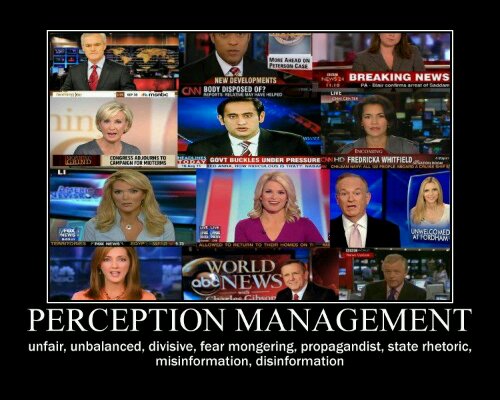
This commitment to what the insiders called “perception management” began in earnest with the Reagan administration in the 1980s but it would come to be the accepted practice of all subsequent administrations, including the present one of President Barack Obama.

In that sense, propaganda in pursuit of foreign policy goals would trump the democratic ideal of an informed electorate. The point would be not to honestly inform the American people about events around the world but to manage their perceptions by ramping up fear in some cases and defusing outrage in others – depending on the U.S. government’s needs.

Thus, you have the current hysteria over Russia’s supposed “aggression” in Ukraine when the crisis was actually provoked by the West, including by U.S. neocons who helped create today’s humanitarian crisis in eastern Ukraine that they now cynically blame on Russian President Vladimir Putin.

Yet, many of these same U.S. foreign policy operatives – outraged over Russia’s limited intervention to protect ethic Russians in eastern Ukraine – are demanding that President Obama launch an air war against the Syrian military as a “humanitarian” intervention there.

In other words, if the Russians act to shield ethnic Russians on their border who are being bombarded by a coup regime in Kiev that was installed with U.S. support, the Russians are the villains blamed for the thousands of civilian deaths, even though the vast majority of the casualties have been inflicted by the Kiev regime from indiscriminate bombing and from dispatching neo-Nazi militias to do the street fighting.

In Ukraine, the exigent circumstances don’t matter, including the violent overthrow of the constitutionally elected president last February. It’s all about white hats for the current Kiev regime and black hats for the ethnic Russians and especially for Putin.

But an entirely different set of standards has applied to Syria where a U.S.-backed rebellion, which included violent Sunni jihadists from the start, wore the white hats and the relatively secular Syrian government, which has responded with excessive violence of its own, wears the black hats. But a problem to that neat dichotomy arose when one of the major Sunni rebel forces, the Islamic State, started seizing Iraqi territory and beheading Westerners.

Faced with those grisly scenes, President Obama authorized bombing the Islamic State forces in both Iraq and Syria, but neocons and other U.S. hardliners have been hectoring Obama to go after their preferred target, Syria’s President Bashar al-Assad, despite the risk that destroying the Syrian military could open the gates of Damascus to the Islamic State or al-Qaeda’s Nusra Front.

Lost on the Dark Side

You might think that the American public would begin to rebel against these messy entangling alliances with the 1984-like demonizing of one new “enemy” after another. Not only have these endless wars drained trillions of dollars from the U.S. taxpayers, they have led to the deaths of thousands of U.S. troops and to the tarnishing of America’s image from the attendant evils of war, including a lengthy detour into the “dark side” of torture, assassinations and “collateral” killings of children and other innocents.

But that is where the history of “perception management” comes in, the need to keep the American people compliant and confused. In the 1980s, the Reagan administration was determined to “kick the Vietnam Syndrome,” the revulsion that many Americans felt for warfare after all those years in the blood-soaked jungles of Vietnam and all the lies that clumsily justified the war.

So, the challenge for the U.S. government became: how to present the actions of “enemies” always in the darkest light while bathing the behavior of the U.S. “side” in a rosy glow. You also had to stage this propaganda theater in an ostensibly “free country” with a supposedly “independent press.”

From documents declassified or leaked over the past several decades, including an unpublished draft chapter of the congressional Iran-Contra investigation, we now know a great deal about how this remarkable project was undertaken and who the key players were.

Perhaps not surprisingly much of the initiative came from the Central Intelligence Agency, which housed the expertise for manipulating target populations through propaganda and disinformation. The only difference this time would be that the American people would be the target population.

For this project, Ronald Reagan’s CIA Director William J. Casey sent his top propaganda specialist Walter Raymond Jr. to the National Security Council staff to manage the inter-agency task forces that would brainstorm and coordinate this “public diplomacy” strategy.

Many of the old intelligence operatives, including Casey and Raymond, are now dead, but other influential Washington figures who were deeply involved by these strategies remain, such as neocon stalwart Robert Kagan, whose first major job in Washington was as chief of Reagan’s State Department Office of Public Diplomacy for Latin America.

Now a fellow at the Brookings Institution and a columnist at the Washington Post, Kagan remains an expert in presenting foreign policy initiatives within the “good guy/bad guy” frames that he learned in the 1980s. He is also the husband of Assistant Secretary of State for European Affairs Victoria Nuland, who oversaw the overthrow of Ukraine’s elected President Viktor Yanukovych last February amid a very effective U.S. propaganda strategy.

During the Reagan years, Kagan worked closely on propaganda schemes with Elliott Abrams, then the Assistant Secretary of State for Latin America. After getting convicted and then pardoned in the Iran-Contra scandal, Abrams reemerged on President George W. Bush’s National Security Council handling Middle East issues, including the Iraq War, and later “global democracy strategy.” Abrams is now a senior fellow at the Council on Foreign Relations.

These and other neocons were among the most diligent students learning the art of “perception management” from the likes of Raymond and Casey, but those propaganda skills have spread much more widely as “public diplomacy” and “information warfare” have now become an integral part of every U.S. foreign policy initiative.

A Propaganda Bureaucracy

Declassified documents now reveal how extensive Reagan’s propaganda project became with inter-agency task forces assigned to develop “themes” that would push American “hot buttons.” Scores of documents came out during the Iran-Contra scandal in 1987 and hundreds more are now available at the Reagan presidential library in Simi Valley, California.

What the documents reveal is that at the start of the Reagan administration, CIA Director Casey faced a daunting challenge in trying to rally public opinion behind aggressive U.S. interventions, especially in Central America. Bitter memories of the Vietnam War were still fresh and many Americans were horrified at the brutality of right-wing regimes in Guatemala and El Salvador, where Salvadoran soldiers raped and murdered four American churchwomen in December 1980.

The new leftist Sandinista government in Nicaragua also was not viewed with much alarm. After all, Nicaragua was an impoverished country of only about three million people who had just cast off the brutal dictatorship of Anastasio Somoza.

So, Reagan’s initial strategy of bolstering the Salvadoran and Guatemalan armies required defusing the negative publicity about them and somehow rallying the American people into supporting a covert CIA intervention inside Nicaragua via a counterrevolutionary force known as the Contras led by Somoza’s ex-National Guard officers.

Reagan’s task was made tougher by the fact that the Cold War’s anti-communist arguments had so recently been discredited in Vietnam. As deputy assistant secretary to the Air Force, J. Michael Kelly, put it, “the most critical special operations mission we have … is to persuade the American people that the communists are out to get us.”

At the same time, the White House worked to weed out American reporters who uncovered facts that undercut the desired public images. As part of that effort, the administration attacked New York Times correspondent Raymond Bonner for disclosing the Salvadoran regime’s massacre of about 800 men, women and children in the village of El Mozote in northeast El Salvador in December 1981. Accuracy in Media and conservative news organizations, such as The Wall Street Journal’s editorial page, joined in pummeling Bonner, who was soon ousted from his job.

But these were largely ad hoc efforts. A more comprehensive “public diplomacy” operation took shape beginning in 1982 when Raymond, a 30-year veteran of CIA clandestine services, was transferred to the NSC.

A slight, soft-spoken New Yorker who reminded some of a character from a John le Carré spy novel, Raymond was an intelligence officer who “easily fades into the woodwork,” according to one acquaintance. But Raymond would become the sparkplug for this high-powered propaganda network, according to a draft chapter of the Iran-Contra report.

Though the draft chapter didn’t use Raymond’s name in its opening pages, apparently because some of the information came from classified depositions, Raymond’s name was used later in the chapter and the earlier citations matched Raymond’s known role. According to the draft report, the CIA officer who was recruited for the NSC job had served as Director of the Covert Action Staff at the CIA from 1978 to 1982 and was a “specialist in propaganda and disinformation.”

“The CIA official [Raymond] discussed the transfer with [CIA Director] Casey and NSC Advisor William Clark that he be assigned to the NSC as [Donald] Gregg’s successor [as coordinator of intelligence operations in June 1982] and received approval for his involvement in setting up the public diplomacy program along with his intelligence responsibilities,” the chapter said.

“In the early part of 1983, documents obtained by the Select [Iran-Contra] Committees indicate that the Director of the Intelligence Staff of the NSC [Raymond] successfully recommended the establishment of an inter-governmental network to promote and manage a public diplomacy plan designed to create support for Reagan Administration policies at home and abroad.”

During his Iran-Contra deposition, Raymond explained the need for this propaganda structure, saying: “We were not configured effectively to deal with the war of ideas.”

One reason for this shortcoming was that federal law forbade taxpayers’ money from being spent on domestic propaganda or grassroots lobbying to pressure congressional representatives. Of course, every president and his team had vast resources to make their case in public, but by tradition and law, they were restricted to speeches, testimony and one-on-one persuasion of lawmakers.

But things were about to change. In a Jan. 13, 1983, memo, NSC Advisor Clark foresaw the need for non-governmental money to advance this cause. “We will develop a scenario for obtaining private funding,” Clark wrote. (Just five days later, President Reagan personally welcomed media magnate Rupert Murdoch into the Oval Office for a private meeting, according to records on file at the Reagan library.)

As administration officials reached out to wealthy supporters, lines against domestic propaganda soon were crossed as the operation took aim not only at foreign audiences but at U.S. public opinion, the press and congressional Democrats who opposed funding the Nicaraguan Contras.

At the time, the Contras were earning a gruesome reputation as human rights violators and terrorists. To change this negative perception of the Contras as well as of the U.S.-backed regimes in El Salvador and Guatemala, the Reagan administration created a full-blown, clandestine propaganda network.

In January 1983, President Reagan took the first formal step to create this unprecedented peacetime propaganda bureaucracy by signing National Security Decision Directive 77, entitled “Management of Public Diplomacy Relative to National Security.” Reagan deemed it “necessary to strengthen the organization, planning and coordination of the various aspects of public diplomacy of the United States Government.”

Reagan ordered the creation of a special planning group within the National Security Council to direct these “public diplomacy” campaigns. The planning group would be headed by the CIA’s Walter Raymond Jr. and one of its principal arms would be a new Office of Public Diplomacy for Latin America, housed at the State Department but under the control of the NSC.

CIA Taint

Worried about the legal prohibition barring the CIA from engaging in domestic propaganda, Raymond formally resigned from the CIA in April 1983, so, he said, “there would be no question whatsoever of any contamination of this.” But Raymond continued to act toward the U.S. public much like a CIA officer would in directing a propaganda operation in a hostile foreign country.

Raymond fretted, too, about the legality of Casey’s ongoing involvement. Raymond confided in one memo that it was important “to get [Casey] out of the loop,” but Casey never backed off and Raymond continued to send progress reports to his old boss well into 1986. It was “the kind of thing which [Casey] had a broad catholic interest in,” Raymond shrugged during his Iran-Contra deposition. He then offered the excuse that Casey undertook this apparently illegal interference in domestic politics “not so much in his CIA hat, but in his adviser to the president hat.”

As a result of Reagan’s decision directive, “an elaborate system of inter-agency committees was eventually formed and charged with the task of working closely with private groups and individuals involved in fundraising, lobbying campaigns and propagandistic activities aimed at influencing public opinion and governmental action,” the draft Iran-Contra chapter said. “This effort resulted in the creation of the Office of Public Diplomacy for Latin America and the Caribbean in the Department of State (S/LPD), headed by Otto Reich,” a right-wing Cuban exile from Miami.

Though Secretary of State George Shultz wanted the office under his control, President Reagan insisted that Reich “report directly to the NSC,” where Raymond oversaw the operations as a special assistant to the President and the NSC’s director of international communications, the chapter said.

“Reich relied heavily on Raymond to secure personnel transfers from other government agencies to beef up the limited resources made available to S/LPD by the Department of State,” the chapter said. “Personnel made available to the new office included intelligence specialists from the U.S. Air Force and the U.S. Army. On one occasion, five intelligence experts from the Army’s 4th Psychological Operations Group at Fort Bragg, North Carolina, were assigned to work with Reich’s fast-growing operation.”

A “public diplomacy strategy paper,” dated May 5, 1983, summed up the administration’s problem. “As far as our Central American policy is concerned, the press perceives that: the USG [U.S. government] is placing too much emphasis on a military solution, as well as being allied with inept, right-wing governments and groups. …The focus on Nicaragua [is] on the alleged U.S.-backed ‘covert’ war against the Sandinistas. Moreover, the opposition … is widely perceived as being led by former Somozistas.”

The administration’s difficulty with most of these press perceptions was that they were correct. But the strategy paper recommended ways to influence various groups of Americans to “correct” the impressions anyway, removing what another planning document called “perceptional obstacles.”

“Themes will obviously have to be tailored to the target audience,” the strategy paper said.

Casey’s Hand

As the Reagan administration struggled to manage public perceptions, CIA Director Casey kept his personal hand in the effort. On one muggy day in August 1983, Casey convened a meeting of Reagan administration officials and five leading ad executives at the Old Executive Office Building next to the White House to come up with ideas for selling Reagan’s Central American policies to the American people.

Earlier that day, a national security aide had warmed the P.R. men to their task with dire predictions that leftist governments would send waves of refugees into the United States and cynically flood America with drugs. The P.R. executives jotted down some thoughts over lunch and then pitched their ideas to the CIA director in the afternoon as he sat hunched behind a desk taking notes.

“Casey was kind of spearheading a recommendation” for better public relations for Reagan’s Central America policies, recalled William I. Greener Jr., one of the ad men. Two top proposals arising from the meeting were for a high-powered communications operation inside the White House and private money for an outreach program to build support for U.S. intervention.

The results from the discussions were summed up in an Aug. 9, 1983, memo written by Raymond who described Casey’s participation in the meeting to brainstorm how “to sell a ‘new product’ – Central America – by generating interest across-the-spectrum.”

In the memo to then-U.S. Information Agency director Charles Wick, Raymond also noted that “via Murdock [sic] may be able to draw down added funds” to support pro-Reagan initiatives. Raymond’s reference to Rupert Murdoch possibly drawing down “added funds” suggests that the right-wing media mogul had been recruited to be part of the covert propaganda operation. During this period, Wick arranged at least two face-to-face meetings between Murdoch and Reagan.

In line with the clandestine nature of the operation, Raymond also suggested routing the “funding via Freedom House or some other structure that has credibility in the political center.” (Freedom House would later emerge as a principal beneficiary of funding from the National Endowment for Democracy, which was also created under the umbrella of Raymond’s operation.)

As the Reagan administration pushed the envelope on domestic propaganda, Raymond continued to worry about Casey’s involvement. In an Aug. 29, 1983, memo, Raymond recounted a call from Casey pushing his P.R. ideas. Alarmed at a CIA director participating so brazenly in domestic propaganda, Raymond wrote that “I philosophized a bit with Bill Casey (in an effort to get him out of the loop)” but with little success.

Meanwhile, Reich’s Office of Public Diplomacy for Latin America (S/LPD) proved extremely effective in selecting “hot buttons” that would anger Americans about the Sandinistas. He also browbeat news correspondents who produced stories that conflicted with the administration’s “themes.” Reich’s basic M.O. was to dispatch his propaganda teams to lobby news executives to remove or punish out-of-step reporters – with a disturbing degree of success. Reich once bragged that his office “did not give the critics of the policy any quarter in the debate.”

Another part of the office’s job was to plant “white propaganda” in the news media through op-eds secretly financed by the government. In one memo, Jonathan Miller, a senior public diplomacy official, informed White House aide Patrick Buchanan about success placing an anti-Sandinista piece in The Wall Street Journal’s friendly pages. “Officially, this office had no role in its preparation,” Miller wrote.

Other times, the administration put out “black propaganda,” outright falsehoods. In 1983, one such theme was designed to anger American Jews by portraying the Sandinistas as anti-Semitic because much of Nicaragua’s small Jewish community fled after the revolution in 1979.

However, the U.S. embassy in Managua investigated the charges and “found no verifiable ground on which to accuse the GRN [the Sandinista government] of anti-Semitism,” according to a July 28, 1983, cable. But the administration kept the cable secret and pushed the “hot button” anyway.

Black Hats/White Hats

Repeatedly, Raymond lectured his subordinates on the chief goal of the operation: “in the specific case of Nica[ragua], concentrate on gluing black hats on the Sandinistas and white hats on UNO [the Contras’ United Nicaraguan Opposition].” So Reagan’s speechwriters dutifully penned descriptions of Sandinista-ruled Nicaragua as a “totalitarian dungeon” and the Contras as the “moral equivalent of the Founding Fathers.”

As one NSC official told me, the campaign was modeled after CIA covert operations abroad where a political goal is more important than the truth. “They were trying to manipulate [U.S.] public opinion … using the tools of Walt Raymond’s trade craft which he learned from his career in the CIA covert operation shop,” the official admitted.

Another administration official gave a similar description to The Miami Herald’s Alfonso Chardy. “If you look at it as a whole, the Office of Public Diplomacy was carrying out a huge psychological operation, the kind the military conduct to influence the population in denied or enemy territory,” that official explained. [For more details, see Parry’s Lost History.]

Another important figure in the pro-Contra propaganda was NSC staffer Oliver North, who spent a great deal of his time on the Nicaraguan public diplomacy operation even though he is better known for arranging secret arms shipments to the Contras and to Iran’s radical Islamic government, leading to the Iran-Contra scandal.

The draft Iran-Contra chapter depicted a Byzantine network of contract and private operatives who handled details of the domestic propaganda while concealing the hand of the White House and the CIA. “Richard R. Miller, former head of public affairs at AID, and Francis D. Gomez, former public affairs specialist at the State Department and USIA, were hired by S/LPD through sole-source, no-bid contracts to carry out a variety of activities on behalf of the Reagan administration policies in Central America,” the chapter said.

“Supported by the State Department and White House, Miller and Gomez became the outside managers of [North operative] Spitz Channel’s fundraising and lobbying activities. They also served as the managers of Central American political figures, defectors, Nicaraguan opposition leaders and Sandinista atrocity victims who were made available to the press, the Congress and private groups, to tell the story of the Contra cause.”

Miller and Gomez facilitated transfers of money to Swiss and offshore banks at North’s direction, as they “became the key link between the State Department and the Reagan White House with the private groups and individuals engaged in a myriad of endeavors aimed at influencing the Congress, the media and public opinion,” the chapter said.

The Iran-Contra draft chapter also cited a March 10, 1985, memo from North describing his assistance to CIA Director Casey in timing disclosures of pro-Contra news “aimed at securing Congressional approval for renewed support to the Nicaraguan Resistance Forces.”

The chapter added: “Casey’s involvement in the public diplomacy effort apparently continued throughout the period under investigation by the Committees,” including a 1985 role in pressuring Congress to renew Contra aid and a 1986 hand in further shielding the Office of Public Diplomacy for Latin America from the oversight of Secretary Shultz.

A Raymond-authored memo to Casey in August 1986 described the shift of the S/LPD office – where Robert Kagan had replaced Reich – to the control of the Bureau of Inter-American Affairs, which was headed by Assistant Secretary of State Elliott Abrams, who had tapped Kagan for the public diplomacy job.

Even after the Iran-Contra scandal unraveled in 1986-87 and Casey died of brain cancer on May 6, 1987, the Republicans fought to keep secret the remarkable story of the public diplomacy apparatus. As part of a deal to get three moderate Republican senators to join Democrats in signing the Iran-Contra majority report, Democratic leaders agreed to drop the draft chapter detailing the CIA’s domestic propaganda role (although a few references were included in the executive summary). But other Republicans, including Rep. Dick Cheney, still issued a minority report defending broad presidential powers in foreign affairs.

Thus, the American people were spared the chapter’s troubling conclusion: that a secret propaganda apparatus had existed, run by “one of the CIA’s most senior specialists, sent to the NSC by Bill Casey, to create and coordinate an inter-agency public-diplomacy mechanism [which] did what a covert CIA operation in a foreign country might do. [It] attempted to manipulate the media, the Congress and public opinion to support the Reagan administration’s policies.”

Kicking the Vietnam Syndrome

The ultimate success of Reagan’s propaganda strategy was affirmed during the tenure of his successor, George H.W. Bush, when Bush ordered a 100-hour ground war on Feb. 23, 1991, to oust Iraqi troops from Kuwait, which had been invaded the previous August.

Though Iraqi dictator Saddam Hussein had long been signaling a readiness to withdraw – and Soviet President Mikhail Gorbachev had negotiated a withdrawal arrangement that even had the blessings of top U.S. commanders in the field – President Bush insisted on pressing ahead with the ground attack.

Bush’s chief reason was that he – and his Defense Secretary Dick Cheney – saw the assault against Iraq’s already decimated forces as an easy victory, one that would demonstrate America’s new military capacity for high-tech warfare and would cap the process begun a decade earlier to erase the Vietnam Syndrome from the minds of average Americans.

Those strategic aspects of Bush’s grand plan for a “new world order” began to emerge after the U.S.-led coalition started pummeling Iraq with air strikes in mid-January 1991. The bombings inflicted severe damage on Iraq’s military and civilian infrastructure and slaughtered a large number of non-combatants, including the incineration of some 400 women and children in a Baghdad bomb shelter on Feb. 13. [For details, see Consortiumnews.com’s “Recalling the Slaughter of Innocents.”]

The air war’s damage was so severe that some world leaders looked for a way to end the carnage and arrange Iraq’s departure from Kuwait. Even senior U.S. military field commanders, such as Gen. Norman Schwarzkopf, looked favorably on proposals for sparing lives.

But Bush was fixated on a ground war. Though secret from the American people at that time, Bush had long determined that a peaceful Iraqi withdrawal from Kuwait would not be allowed. Indeed, Bush was privately fearful that the Iraqis might capitulate before the United States could attack.

At the time, conservative columnists Rowland Evans and Robert Novak were among the few outsiders who described Bush’s obsession with exorcising the Vietnam Syndrome. On Feb. 25, 1991, they wrote that the Gorbachev initiative brokering Iraq’s surrender of Kuwait “stirred fears” among Bush’s advisers that the Vietnam Syndrome might survive the Gulf War.

“There was considerable relief, therefore, when the President … made clear he was having nothing to do with the deal that would enable Saddam Hussein to bring his troops out of Kuwait with flags flying,” Evans and Novak wrote. “Fear of a peace deal at the Bush White House had less to do with oil, Israel or Iraqi expansionism than with the bitter legacy of a lost war. ‘This is the chance to get rid of the Vietnam Syndrome,’ one senior aide told us.”

In the 1999 book, Shadow, author Bob Woodward confirmed that Bush was adamant about fighting a war, even as the White House pretended it would be satisfied with an unconditional Iraqi withdrawal. “We have to have a war,” Bush told his inner circle of Secretary of State James Baker, national security adviser Brent Scowcroft and Gen. Colin Powell, according to Woodward.

“Scowcroft was aware that this understanding could never be stated publicly or be permitted to leak out. An American president who declared the necessity of war would probably be thrown out of office. Americans were peacemakers, not warmongers,” Woodward wrote.

The Ground War

However, the “fear of a peace deal” resurfaced in the wake of the U.S.-led bombing campaign. Soviet diplomats met with Iraqi leaders who let it be known that they were prepared to withdraw their troops from Kuwait unconditionally.

Learning of Gorbachev’s proposed settlement, Schwarzkopf also saw little reason for U.S. soldiers to die if the Iraqis were prepared to withdraw and leave their heavy weapons behind. There was also the prospect of chemical warfare that the Iraqis might use against advancing American troops. Schwarzkopf saw the possibility of heavy U.S. casualties.

But Gorbachev’s plan was running into trouble with President Bush and his political subordinates who wanted a ground war to crown the U.S. victory. Schwarzkopf reached out to Gen. Powell, chairman of the Joint Chiefs of Staff, to make the case for peace with the President.

On Feb. 21, 1991, the two generals hammered out a cease-fire proposal for presentation to the NSC. The peace deal would give Iraqi forces one week to march out of Kuwait while leaving their armor and heavy equipment behind. Schwarzkopf thought he had Powell’s commitment to pitch the plan at the White House.

But Powell found himself caught in the middle. He wanted to please Bush while still representing the concerns of the field commanders. When Powell arrived at the White House late on the evening of Feb. 21, he found Bush angry about the Soviet peace initiative. Still, according to Woodward’s Shadow, Powell reiterated that he and Schwarzkopf “would rather see the Iraqis walk out than be driven out.”

In My American Journey, Powell expressed sympathy for Bush’s predicament. “The President’s problem was how to say no to Gorbachev without appearing to throw away a chance for peace,” Powell wrote. “I could hear the President’s growing distress in his voice. ‘I don’t want to take this deal,’ he said. ‘But I don’t want to stiff Gorbachev, not after he’s come this far with us. We’ve got to find a way out’.”

Powell sought Bush’s attention. “I raised a finger,” Powell wrote. “The President turned to me. ‘Got something, Colin?’,” Bush asked. But Powell did not outline Schwarzkopf’s one-week cease-fire plan. Instead, Powell offered a different idea intended to make the ground offensive inevitable.

“We don’t stiff Gorbachev,” Powell explained. “Let’s put a deadline on Gorby’s proposal. We say, great idea, as long as they’re completely on their way out by, say, noon Saturday,” Feb. 23, less than two days away.

Powell understood that the two-day deadline would not give the Iraqis enough time to act, especially with their command-and-control systems severely damaged by the air war. The plan was a public-relations strategy to guarantee that the White House got its ground war. “If, as I suspect, they don’t move, then the flogging begins,” Powell told a gratified president.

The next day, at 10:30 a.m., a Friday, Bush announced his ultimatum. There would be a Saturday noon deadline for the Iraqi withdrawal, as Powell had recommended. Schwarzkopf and his field commanders in Saudi Arabia watched Bush on television and immediately grasped its meaning.

“We all knew by then which it would be,” Schwarzkopf wrote. “We were marching toward a Sunday morning attack.”

When the Iraqis predictably missed the deadline, American and allied forces launched the ground offensive at 0400 on Feb. 24, Persian Gulf time.

Though Iraqi forces were soon in full retreat, the allies pursued and slaughtered tens of thousands of Iraqi soldiers in the 100-hour war. U.S. casualties were light, 147 killed in combat and another 236 killed in accidents or from other causes. “Small losses as military statistics go,” wrote Powell, “but a tragedy for each family.”

On Feb. 28, the day the war ended, Bush celebrated the victory. “By God, we’ve kicked the Vietnam Syndrome once and for all,” the President exulted, speaking to a group at the White House. [For more details, see Robert Parry’s Secrecy & Privilege.]

So as not to put a damper on the post-war happy feelings, the U.S. news media decided not to show many of the grisliest photos, such as charred Iraqi soldiers ghoulishly still seated in their burned-out trucks where they had been incinerated while trying to flee. By that point, U.S. journalists knew it wasn’t smart for their careers to present a reality that didn’t make the war look good.

Enduring Legacy

Though Reagan’s creation of a domestic propaganda bureaucracy began more than three decades ago – and Bush’s vanquishing of the Vietnam Syndrome was more than two decades ago – the legacy of those actions continue to reverberate today in how the perceptions of the American people are now routinely managed. That was true during last decade’s Iraq War and this decade’s conflicts in Libya, Syria and Ukraine as well as the economic sanctions against Iran and Russia.

Indeed, while the older generation that pioneered these domestic propaganda techniques has passed from the scene, many of their protégés are still around along with some of the same organizations. The National Endowment for Democracy, which was formed in 1983 under the supervision of Walter Raymond’s NSC operation, is still run by the same neocon, Carl Gershman, and has an even bigger budget, now exceeding $100 million a year.

Gershman and his NED played important behind-the-scenes roles in instigating the Ukraine crisis by financing activists, journalists and other operatives who supported the coup against elected President Yanukovych. The NED-backed Freedom House also beat the propaganda drums. [See Consortiumnews.com’s “A Shadow Foreign Policy.”]

Two other Reagan-era veterans, Elliott Abrams and Robert Kagan, have both provided important intellectual support for continuing U.S. interventionism around the world. Earlier this year, Kagan’s article for The New Republic, entitled “Superpowers Don’t Get to Retire,” touched such a raw nerve with President Obama that he hosted Kagan at a White House lunch and crafted the presidential commencement speech at West Point to deflect some of Kagan’s criticism of Obama’s hesitancy to use military force.

A New York Times article about Kagan’s influence over Obama reported that Kagan’s wife, Assistant Secretary of State Victoria Nuland, apparently had a hand in crafting the attack on her ostensible boss, President Obama.

According to the Times article, the husband-and-wife team share both a common world view and professional ambitions, Nuland editing Kagan’s articles and Kagan “not permitted to use any official information he overhears or picks up around the house” – a suggestion that Kagan’s thinking at least may be informed by foreign policy secrets passed on by his wife.

Though Nuland wouldn’t comment specifically on Kagan’s attack on President Obama, she indicated that she holds similar views. “But suffice to say,” Nuland said, “that nothing goes out of the house that I don’t think is worthy of his talents. Let’s put it that way.”

Misguided Media

In the three decades since Reagan’s propaganda machine was launched, the American press corps also has fallen more and more into line with an aggressive U.S. government’s foreign policy strategies. Those of us in the mainstream media who resisted the propaganda pressures mostly saw our careers suffer while those who played along moved steadily up the ranks into positions of more money and more status.

Even after the Iraq War debacle when nearly the entire mainstream media went with the pro-invasion flow, there was almost no accountability for that historic journalistic failure. Indeed, the neocon influence at major newspapers, such as the Washington Post and the New York Times, only has solidified since.

Today’s coverage of the Syrian civil war or the Ukraine crisis is so firmly in line with the State Department’s propaganda “themes” that it would put smiles on the faces of William Casey and Walter Raymond if they were around today to see how seamlessly the “perception management” now works. There’s no need any more to send out “public diplomacy” teams to bully editors and news executives. Everyone is already onboard.

Rupert Murdoch’s media empire is bigger than ever, but his neocon messaging barely stands out as distinctive, given how the neocons also have gained control of the editorial and foreign-reporting sections of the Washington Post, the New York Times and virtually every other major news outlet. For instance, the demonizing of Russian President Putin is now so total that no honest person could look at those articles and see anything approaching objective or evenhanded journalism. Yet, no one loses a job over this lack of professionalism.

The Reagan administration’s dreams of harnessing private foundations and non-governmental organizations have also come true. The Orwellian circle has been completed with many American “anti-war” groups advocating for “humanitarian” wars in Syria and other countries targeted by U.S. propaganda. [See Consortiumnews.com’s “Selling ‘Peace Groups’ on US-Led Wars.”]

Much as Reagan’s “public diplomacy” apparatus once sent around “defectors” to lambaste Nicaragua’s Sandinistas by citing hyped-up human rights violations now the work is done by NGOs with barely perceptible threads back to the U.S. government. Just as Freedom House had “credibility” in the 1980s because of its earlier reputation as a human rights group, now other groups carrying the “human rights” tag, such as Human Rights Watch, are in the forefront of urging U.S. military interventions based on murky or propagandistic claims. [See Consortiumnews.com’s “The Collapsing Syria-Sarin Case.”]

At this advanced stage of America’s quiet surrender to “perception management,” it is even hard to envision how one could retrace the many steps that would lead back to the concept of a democratic Republic based on an informed electorate. Many on the American Right remain entranced by the old propaganda theme about the “liberal media” and still embrace Reagan as their beloved icon. Meanwhile, many liberals can’t break away from their own wistful trust in the New York Times and their empty hope that the media really is “liberal.”

To confront the hard truth is not easy. Indeed, in this case, it can cause despair because there are so few voices to trust and they are easily drowned out by floods of disinformation that can come from any angle – right, left or center. Yet, for the American democratic Republic to reset its goal toward an informed electorate, there is no option other than to build institutions that are determinedly committed to the truth.

Investigative reporter Robert Parry broke many of the Iran-Contra stories for The Associated Press and Newsweek in the 1980s. You can buy his latest book, America’s Stolen Narrative, either in print here or as an e-book (from Amazon and barnesandnoble.com). You also can order Robert Parry’s trilogy on the Bush Family and its connections to various right-wing operatives for only $34. The trilogy includes America’s Stolen Narrative. For details on this offer, click here.

What the Charlie Hebdo Execution Video Really Shows

 1420643226f4e8b.-big

By Jonathan Cook

Source: Global Research

I am well aware that I’m stepping into a hornet’s nest by posting this video, which is going viral. Those who wish to silence all debate have an easy card to play here, accusing me of buying into a conspiracy theory. There’s only one problem: unlike the video-maker, I have few conclusions to draw about what the significance of this video is in relation to the official story. That is not why I am posting it.

But it does, at least to my mind and obviously a lot of other people’s, judging by how quickly it’s spreading, suggest that Ahmed Merabet, the policeman outside the Charlie Hebdo office, was not shot in the head, as all the media have been stating.

That said, it does not prove much more. It doesn’t prove that Merabet did not die at the scene. Maybe he bled to death there on the pavement from his earlier wound. It certainly doesn’t prove that the Kouachi brothers were not the gunmen or that the one who fired missed on purpose. Maybe he just missed.

Nor does the video’s removal from most websites prove that there is some sort of massive cover-up going on. Ideas of good taste, especially in the immediate aftermath of a massacre close to home (ie here in the West), can lead to a media consensus that a video is too upsetting. That can occur even if it does not show blood and gore, simply because of what it implies. Herd instinct in these instances is very strong.

But the unedited video clip does leave a sour taste: because unless someone has a good rebuttal, it does indeed seem impossible that an AK-47 bullet fired from close range would not have done something pretty dramatic to that policeman’s head. And if the video is real – and there doesn’t seem much doubt that it is – it clearly shows nothing significant happened to his head either as or after the bullet was fired.

So what points am I making?

The first one is more tentative. It seems – though I suppose there could be an explanation I have overlooked – that the authorities have lied about the cause of the policeman’s death. That could be for several probably unknowable reasons, including that his being executed was a simpler, neater story than that he bled to death on the pavement because of official incompetence (there already seems to have been plenty of that in this case).

The second point is even more troubling. Most of the senior editors of our mainstream media have watched the unedited video just as you now have. And either not one of them saw the problem raised here – that the video does not show what it is supposed to show – or some of them did see it but did not care. Either way, they simply regurgitated an official story that does not seem to fit the available evidence.

That is a cause for deep concern. Because if the media are acting as a collective mouth-piece for a dubious official narrative on this occasion, on a story of huge significance that one assumes is being carefully scrutinised for news angles, what are they doing the rest of the time?

The lesson is that we as news consumers must create our own critical distance from the “news” because we cannot trust our corporate media to do that work for us. They are far too close to power. In fact, they are power.

Official narratives are inherently suspect because power always looks out for itself. This appears to be a good example – whether what it shows is relatively harmless or sinister – to remind us of that fact.

UPDATE:

I’m still trying to imagine a plausible explanation for the video. I’m no ballistics expert, so I’m firmly in the land of conjecture. But I wonder whether, if the bullet hit the pavement close to Merabet’s head, it might have been possible for bullet fragments to hit him, possibly killing him.

This possibility (assuming it is one) does not invalidate the point of my post. If it was indeed the case, certainly no media outlet has suggested that the gunman missed Merabet and that he died from the exploding fragments.

This isn’t meant to raise technical, or gruesome, details of the case. It is to suggest that western journalists do not report fearlessly and independently when they examine events being narrated by official sources. They mostly regurgitate information on trust, because they trust the authorities to be telling the truth. They do the same when the acts of official enemies are being examined – they again turn to official sources on their side. In short, most journalists have no critical distance from the events they are reporting on our behalf.

That leaves us, ordinary news consumers, in a position of either blindly trusting our own officials too or trying to work things out for ourselves. You would hope that the issues raised by this video get aired by journalists as part of establishing greater trust in our profession and proof of our independence. Instead, I expect it will simply be consigned the “conspiracy theory” bin.