Amazon, “Economic Terrorism” and the Destruction of Competition and Livelihoods

By Colin Todhunter

Source: Off-Guardian

Global corporations are colonising India’s retail space through e-commerce and destroying small-scale physical retail and millions of livelihoods.

Walmart entered into India in 2016 with a US$3.3 billion take-over of the online retail start-up Jet.com. This was followed in 2018 with a US$16 billion take-over of India’s largest online retail platform, Flipkart. Today, Walmart and Amazon control almost two thirds of India’s digital retail sector.

Amazon and Walmart have a record of using predatory pricing, deep discounts and other unfair business practices to attract customers to their online platforms. A couple of years ago, those two companies generated sales of over US$3 billion in just six days during Diwali. India’s small retailers reacted by calling for a boycott of online shopping.

If you want to know the eventual fate of India’s local markets and small retailers, look no further than what US Treasury Secretary Steven Mnuchin said in 2019. He stated that Amazon had “destroyed the retail industry across the United States.”

AMAZON’S CORPORATE PRACTICES

In the US, an investigation by the House Judiciary Committee concluded that Amazon exerts monopoly power over many small- and medium-size businesses. It called for breaking up the company and regulating its online marketplace to ensure that sellers are treated fairly.

Amazon has spied on sellers and appropriated data about their sales, costs and suppliers. It has then used this information to create its own competing versions of their products, often giving its versions superior placement in the search results on its platform.

The Institute for Local Self-Reliance (ILSR) published a revealing document on Amazon in June 2021 that discussed these issues. It also notes that Amazon has been caught using its venture capital fund to invest in start-ups only to steal their ideas and create rival products and services.

Moreover, Amazon’s dominance allows it to function as a gatekeeper: retailers and brands must sell on its site to reach much of the online market and changes to Amazon’s search algorithms or selling terms can cause their sales to evaporate overnight.

Amazon also makes it hard for sellers to reduce their dependence on its platform by making their brand identity almost invisible to shoppers and preventing them from building relationships with their customers. The company strictly limits contact between sellers and customers.

According to the ILSR, Amazon compels sellers to buy its warehousing and shipping services, even though many would get a better deal from other providers, and it blocks independent businesses from offering lower prices on other sites. The company also routinely suspends sellers’ accounts and seizes inventories and cash balances.

The Joint Action Committee against Foreign Retail and E-commerce (JACAFRE) was formed to resist the entry of foreign corporations like Walmart and Amazon into India’s e-commerce market. Its members represent more than 100 national groups, including major trade, workers’ and farmers’ organisations.

JACAFRE issued a statement in 2018 on Walmart’s acquisition of Flipkart, arguing that it undermines India’s economic and digital sovereignty and the livelihoods of millions in India. The committee said the deal would lead to Walmart and Amazon dominating India’s e-retail sector. It would also allow them to own India’s key consumer and other economic data, making them the country’s digital overlords, joining the ranks of Google and Facebook.

In January 2021, JACAFRE published an open letter saying that the three new farm laws, passed by parliament in September 2020, centre on enabling and facilitating the unregulated corporatisation of agriculture value chains. This will effectively make farmers and small traders of agricultural produce become subservient to the interests of a few agrifood and e-commerce giants or will eradicate them completely.

Although there was strong resistance to Walmart entering India with its physical stores, online and offline worlds are now merged: e-commerce companies not only control data about consumption but also control data on production and logistics. Through this control, e-commerce platforms can shape much of the physical economy.

What we are witnessing is the deliberate eradication of markets in favour of monopolistic platforms.

BEZOS NOT WELCOME

Amazon’s move into India encapsulates the unfair fight for space between local and global markets. There is a relative handful of multi-billionaires who own the corporations and platforms. And there are the interests of hundreds of millions of vendors and various small-scale enterprises who are regarded by these rich individuals as mere collateral damage to be displaced in their quest for ever-greater profit.

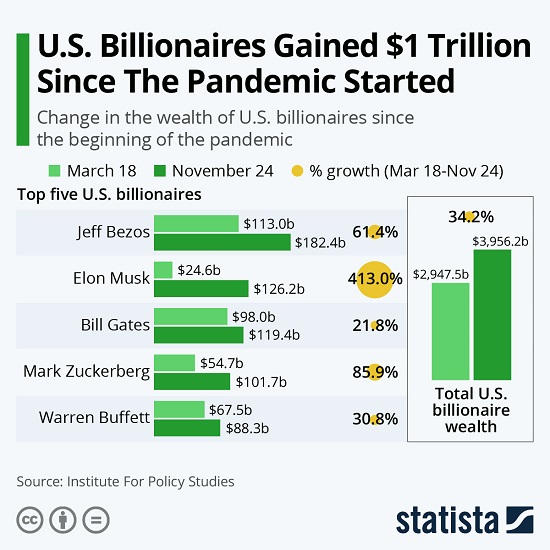
Thanks to the helping hand of various COVID-related lockdowns, which devastated small businesses, the wealth of the world’s billionaires increased by $3.9tn (trillion) between 18 March and 31 December 2020.

In September 2020, Jeff Bezos, Amazon’s executive chairman, could have paid all 876,000 Amazon employees a $105,000 bonus and still be as wealthy as he was before COVID. Jeff Bezos – his fortune constructed on unprincipled methods that have been well documented in recent years – increased his net wealth by $78.2bn during this period.

Bezos’s plan is clear: the plunder of India and the eradication of millions of small traders and retailers and neighbourhood mom and pop shops.

This is a man with few scruples. After returning from a brief flight to space in July, in a rocket built by his private space company, Bezos said during a news conference:

I also want to thank every Amazon employee and every Amazon customer because you guys paid for all of this.”

In response, US congresswoman Nydia Velazquez wrote on Twitter:

While Jeff Bezos is all over the news for paying to go to space, let’s not forget the reality he has created here on Earth.”

She added the hashtag #WealthTaxNow in reference to Amazon’s tax dodging, revealed in numerous reports, not least the May 2021 study ‘The Amazon Method: How to take advantage of the international state system to avoid paying tax’ by Richard Phillips, Senior Research Fellow, Jenaline Pyle, PhD Candidate, and Ronen Palan, Professor of International Political Economy, all based at the University of London.

Little wonder that when Bezos visited India in January 2020, he was hardly welcomed with open arms.

Bezos praised India on Twitter by posting:

Dynamism. Energy. Democracy. #IndianCentury.”

The ruling party’s top man in the BJP foreign affairs department hit back with:

Please tell this to your employees in Washington DC. Otherwise, your charm offensive is likely to be waste of time and money.”

A fitting response, albeit perplexing given the current administration’s proposed sanctioning of the foreign takeover of the economy, not least by the unscrupulous interests that will benefit from the recent farm legislation.

Bezos landed in India on the back of the country’s antitrust regulator initiating a formal investigation of Amazon and with small store owners demonstrating in the streets. The Confederation of All India Traders (CAIT) announced that members of its affiliate bodies across the country would stage sit-ins and public rallies in 300 cities in protest.

In a letter to PM Modi, prior to the visit of Bezos, the secretary of the CAIT, General Praveen Khandelwal, claimed that Amazon, like Walmart-owned Flipkart, was an “economic terrorist” due to its predatory pricing that “compelled the closure of thousands of small traders.”

In 2020, Delhi Vyapar Mahasangh (DVM) filed a complaint against Amazon and Flipkart alleging that they favoured certain sellers over others on their platforms by offering them discounted fees and preferential listing. The DVM lobbies to promote the interests of small traders. It also raised concerns about Amazon and Flipkart entering into tie-ups with mobile phone manufacturers to sell phones exclusively on their platforms.

It was argued by DVM that this was anti-competitive behaviour as smaller traders could not purchase and sell these devices. Concerns were also raised over the flash sales and deep discounts offered by e-commerce companies, which could not be matched by small traders.

The CAIT estimates that in 2019 upwards of 50,000 mobile phone retailers were forced out of business by large e-commerce firms.

Amazon’s internal documents, as revealed by Reuters, indicated that Amazon had an indirect ownership stake in a handful of sellers who made up most of the sales on its Indian platform. This is an issue because in India Amazon and Flipkart are legally allowed to function only as neutral platforms that facilitate transactions between third-party sellers and buyers for a fee.

UNDER INVESTIGATION

The upshot is that India’s Supreme Court recently ruled that Amazon must face investigation by the Competition Commission of India (CCI) for alleged anti-competitive business practices. The CCI said it would probe the deep discounts, preferential listings and exclusionary tactics that Amazon and Flipkart are alleged to have used to destroy competition.

However, there are powerful forces that have been sitting on their hands as these companies have been running amok.

In August 2021, the CAIT attacked the NITI Aayog (the influential policy commission think tank of the Government of India) for interfering in e-commerce rules proposed by the Consumer Affairs Ministry.

The CAIT said that the think tank clearly seems to be under the pressure and influence of the foreign e-commerce giants.

The president of CAIT, BC Bhartia, stated that it is deeply shocking to see such a callous and indifferent attitude of the NITI Aayog whch have remained a silent spectator for so many years when:

…the foreign e-commerce giants have circumvented every rule of the FDI policy and blatantly violated and destroyed the retail and e-commerce landscape of the country but have suddenly decided to open their mouth at a time when the proposed e-commerce rules will potentially end the malpractices of the e-commerce companies.”

Of course, money talks and buys influence. In addition to tens of billions of US dollars invested in India by Walmart and Amazon, Facebook invested US$5.5 billion last year in Mukesh Ambani’s Jio Platforms (e-commerce retail). Google has also invested US$4.5 billion.

Since the early 1990s, when India opened up to neoliberal economics, the country has become increasingly dependent on inflows of foreign capital. Policies are being governed by the drive to attract and retain foreign investment and maintain ‘market confidence’ by ceding to the demands of international capital which ride roughshod over democratic principles and the needs of hundreds of millions of ordinary people. ‘Foreign direct investment’ has thus become the holy grail of the Modi-led administration and the NITI Aayog.

The CAIT has urged the Consumer Affairs Ministry to implement the draft consumer protection e-commerce rules at the earliest as they are in the best interest of the consumers as well as the traders of the country.

Meanwhile, the CCI probably will complete its investigation within two months.
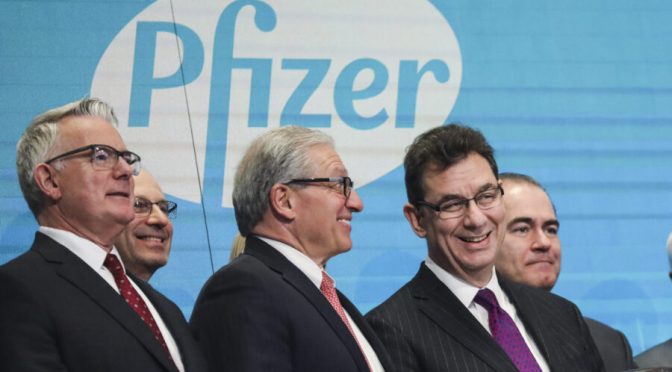
Leaked Document Reveals ‘Shocking’ Terms of Pfizer’s International Vaccine Agreements

Dr. Joseph Mercola

Source: Covert Geopolitics

Vaccine purchasers must “indemnify, defend and hold harmless Pfizer … from and against any and all suits, claims, actions, demands, losses, damages, liabilities, settlements, penalties, fines, costs and expenses … arising out of, relating to, or resulting from the vaccine.”

  • A leaked document broken down by Twitter user Ehden reveals the shocking terms of Pfizer’s international COVID-19 vaccine agreements.
  • Countries that purchase Pfizer’s COVID-19 shot must acknowledge that “Pfizer’s efforts to develop and manufacture the product” are “subject to significant risks and uncertainties.”
  • In the event that a drug or other treatment comes out that can prevent, treat or cure COVID-19, the agreement stands, and the country must follow through with their vaccine order.
  • While COVID-19 vaccines are “free” to receive in the U.S., they’re being paid for by taxpayer dollars at a rate of $19.50 per dose — Albania, the leaked contract revealed, paid $12 per dose.
  • The purchaser of Pfizer’s COVID-19 vaccine must also acknowledge two facts that have largely been brushed under the rug: both their efficacy and risks are unknown.
  • Purchasers must also “indemnify, defend and hold harmless Pfizer … from and against any and all suits, claims, actions, demands, losses, damages, liabilities, settlements, penalties, fines, costs and expenses … arising out of, relating to, or resulting from the Vaccine.”

Vaccine makers have nothing to lose by marketing their experimental COVID-19 shots, even if they cause serious injury and death, as they enjoy full indemnity against injuries occurring from COVID-19 vaccines or any other pandemic vaccine under the Public Readiness and Emergency Preparedness (PREP) Act, passed in the U.S. in 2005.

The full extent of their COVID-19 vaccine indemnification agreements with countries, however, is a closely guarded secret, one that has remained highly confidential — until now. A leaked document broken down by Twitter user Ehden reveals the shocking terms of Pfizer’s international COVID-19 vaccine agreements.

“These agreements are confidential, but luckily one country did not protect the contract document well enough, so I managed to get a hold of a copy,” he wrote. “As you are about to see, there is a good reason why Pfizer was fighting to hide the details of these contracts.”

An ironclad agreement, all on Pfizer’s terms

The alleged indemnification agreement, reportedly between Pfizer and Albania, was originally posted in snippets on Twitter, but Twitter now has them marked as “unavailable.” Copies of the tweets are available on Treadreader, however.

The Albania agreement appears very similar to another contract, published online, between Pfizer and the Dominican Republic. It covers not only COVID-19 vaccines, but any product that enhances the use or effects of such vaccines.

Countries that purchase Pfizer’s COVID-19 shot must acknowledge that “Pfizer’s efforts to develop and manufacture the Product” are “subject to significant risks and uncertainties.”

And in the event that a drug or other treatment comes out that can prevent, treat or cure COVID-19, the agreement stands, and the country must follow through with their order. Ivermectin, for instance, is not only safe, inexpensive and widely available but has been found to reduce COVID-19 mortality by 81%. Yet, it continues to be ignored in favor of more expensive, and less effective, treatments and mass experimental vaccination.

“If you were wondering why #Ivermectin was suppressed,” Ehden wrote, “well, it is because the agreement that countries had with Pfizer does not allow them to escape their contract, which states that even if a drug will be found to treat COVID19 the contract cannot be voided.”

Even if Pfizer fails to deliver vaccine doses within their estimated delivery period, the purchaser may not cancel the order. Further, Pfizer can make adjustments to the number of contracted doses and their delivery schedule, “based on principles to be determined by Pfizer,” and the country buying the vaccines must “agree to any revision.”

It doesn’t matter if the vaccines are delivered severely late, even at a point when they’re no longer needed, as it’s made clear that “Under no circumstances will Pfizer be subject to or liable for any late delivery penalties.” As you might suspect, the contract also forbids returns “under any circumstances.”

The big secret: Pfizer charged U.S. More Than Other Countries

While COVID-19 vaccines are “free” to receive in the U.S., they’re being paid for by taxpayer dollars at a rate of $19.5011 per dose. Albania, the leaked contract revealed, paid $12 per dose, while the EU paid $14.70 per shot. While charging different prices to different purchases is common in the drug industry, it’s often frowned upon.

In the case of the price disparity between the U.S. and the EU, Pfizer is said to have given a price break to the EU because it financially supported the development of their COVID-19 vaccine. Still, Ehden noted, “U.S. taxpayers got screwed by Pfizer, probably also Israel.” Also, Pfizer makes a point to note that countries have no right to withhold payment to the company for any reason.

Apparently, this includes in the case of receiving damaged goods. Purchasers of Pfizer’s COVID-19 vaccines are not entitled to reject them “based on service complaints,” unless they do not conform to specifications or the FDA’s Current Good Manufacturing Practice regulations. And, Ehden adds, “This agreement is above any local law of the state.”

While the purchaser has virtually no way of canceling the contract, Pfizer can terminate the agreement in the event of a “material breach” of any term in their contract.

Safety and efficacy ‘not currently known’

The purchaser of Pfizer’s COVID-19 vaccine must also acknowledge two facts that have largely been brushed under the rug: Both their efficacy and risks are unknown. According to section 5.5 of the contract:

“Purchaser acknowledges that the Vaccine and materials related to the Vaccine, and their components and constituent materials are being rapidly developed due to the emergency circumstances of the COVID-19 pandemic and will continue to be studied after provision of the Vaccine to Purchaser under this Agreement.

“Purchaser further acknowledges that the long-term effects and efficacy of the Vaccine are not currently known and that there may be adverse effects of the Vaccine that are not currently known.”

Indemnification by the purchaser is also explicitly required by the contract, which states, under section 8.1:

“Purchaser hereby agrees to indemnify, defend and hold harmless Pfizer, BioNTech, each of their Affiliates, contractors, sub-contractors, licensors, licensees, sub-licensees, distributors, contract manufacturers, services providers, clinical trial researchers, third parties to whom Pfizer or BioNTech or any of their respective Affiliates may directly or indirectly owe an indemnity based on the research …

“from and against any and all suits, claims, actions, demands, losses, damages, liabilities, settlements, penalties, fines, costs and expenses (including, without limitation, reasonable attorneys’ fees and other expenses of an investigation or litigation … arising out of, relating to, or resulting from the Vaccine …”

Meanwhile, the purchaser must also keep the terms of the contract confidential for a period of 10 years.

Purchasers must protect and defend Pfizer

Not only does Pfizer have total indemnification, but there’s also a section in the contract titled, “Assumption of Defense by Purchaser,” which states that in the event Pfizer suffers losses for which it is seeking indemnification, the purchaser “shall promptly assume conduct and control of the defense of such Indemnified Claims on behalf of the Indemnitee with counsel acceptable to Indemnitee(s), whether or not the Indemnified Claim is rightfully brought.” Ehden notes:

“Pfizer is making sure the country will pay for everything: ‘Costs and expenses, including … fees and disbursements of counsel, incurred by the Indemnitee(s) in connection with any Indemnified Claim shall be reimbursed on a quarterly basis by Purchaser.’”

Buried in the March 17, 2020, Federal Register — the daily journal of the U.S. government — in a document titled, “Declaration Under the Public Readiness and Emergency Preparedness Act for Medical Countermeasures Against COVID-19,” is language that establishes a new COVID-19 vaccine court — similar to the federal vaccine court that already exists.

In the U.S., vaccine makers already enjoy full indemnity against injuries occurring from this or any other pandemic vaccine under the PREP Act. If you’re injured by a COVID vaccine (or a select group of other vaccines designated under the act), you’d have to file a compensation claim with the Countermeasures Injury Compensation Program (CICP), which is funded by U.S. taxpayers via Congressional appropriation to the Department of Health and Human Services (DHHS).

While similar to the National Vaccine Injury Compensation Program (NVICP), which applies to nonpandemic vaccines, the CICP is even less generous when it comes to compensation. As reported by Dr. Meryl Nass,25 the maximum payout you can receive — even in cases of permanent disability or death — is $250,000 per person; however, you’d have to exhaust your private insurance policy before the CICP gives you a dime.

The CICP also has a one-year statute of limitations, so you have to act quickly, which is also difficult since it’s unknown if long-term effects could occur more than a year later.

Pfizer accused of abuse of power

As is apparent in Pfizer’s confidential contract with Albania, the drug giant wants governments to guarantee the company will be compensated for any expenses resulting from injury lawsuits against it. Pfizer has also demanded that countries put up sovereign assets, including bank reserves, military bases and embassy buildings, as collateral for expected vaccine injury lawsuits resulting from its COVID-19 inoculation.

New Delhi-based World Is One News (WION) reported in February 2021 that Brazil rejected Pfizer’s demands, calling them “abusive.” The demands included that Brazil:

  1. “Waives sovereignty of its assets abroad in favor of Pfizer.”
  2. Not apply its domestic laws to the company.
  3. Not penalize Pfizer for vaccine delivery delays.
  4. Exempt Pfizer from all civil liability for side effects.

STAT News also referred to concerns by legal experts, who also suggested Pfizer’s demands were an abuse of power. Mark Eccleston-Turner, a lecturer in global health law at Keele University in England, told STAT:

“[Pfizer] is trying to eke out as much profit and minimize its risk at every juncture with this vaccine development then this vaccine rollout. Now, the vaccine development has been heavily subsidized already. So there’s very minimal risk for the manufacturer involved there.”

Signs of COVID vaccine failure, adverse effects rise

Pfizer continues to sign lucrative secret vaccine deals across the globe. In June 2021, they signed one of their biggest contracts to date — with the Philippine government for 40 million doses.

Meanwhile, COVID-19 “breakthrough cases,” which used to be called vaccine failures, are on the rise. According to the U.S. Centers for Disease Control and Prevention (CDC), as of July 19, 5,914 people who had been fully vaccinated for COVID-19 were hospitalized or died from COVID-19.

In the U.K., as of July 15, 87.5% of the adult population had received one dose of COVID-19 vaccine and 67.1% had received two. Yet, symptomatic cases among partially and fully vaccinated are on the rise, with an average of 15,537 new infections a day being detected, a 40% increase from the week before.

In a July 19 report from the CDC, the agency also reported that the Vaccine Adverse Event Reporting System (VAERS) had received 12,313 reports of death among people who received a COVID-19 vaccine — more than doubling from the 6,079 reports of death from the week before.

Soon after the report, however, they reverted the number to the 6,079 from the week before, indicating by default that no deaths from the vaccine had occurred that week,34 raising serious questions about transparency and vaccine safety.

Many other adverse events are also appearing, ranging from risks from the biologically active SARS-CoV-2 spike protein used in the vaccine to blood clots, reproductive toxicity and myocarditis(heart inflammation). As you can see in the confidential indemnification agreements, however, even if the vaccine turns out to be a dismal failure — and a risk to short- and long-term health — countries have no recourse, nor does anyone who received the experimental shots.

One question that we should all be asking is this: If the COVID-19 vaccines are, in fact, as safe and effective as the manufacturers claim, why do they require this level of indemnification?

France Neoliberal Macron: Vanguard of a Covid Global Corporate Dictatorship?

By Gilbert Mercier

Source: News Junkie Post

Liberte-Egalite-Fraternite: under Macron’s pass sanitaire guillotine?

For the few of us who are students of history, and its aficionado travelers, meaning those who muse and wonder, at times, about how significant figures of the past would view our often dire predicament, it is rather obvious that, for example, the founding fathers of the French Revolution such as Danton, Mirabeau, St Just, and Robespierre would be shocked and angry by what has recently happened to their Republic. Even France’s last great statesman General de Gaulle, if alive today, would have likely been deeply enraged by the state of affairs in a country he loved and fought for with his heart and soul.

In the era of President Emmanuel Macron, who is merely a cynical actor, figurehead, and France’s public relation person in chief passing for a statesman, but who truly is a loyal servant of global corporatism, our revolution’s founders, as well as the subsequent republics’ principles, like the one of the Fifth Republic of de Gaulle, have been insulted, slapped in the face, and assaulted by some sort of insidious and limp dictatorship, under the cover of a health crisis. A complex authoritarian strategy using the pretense of shielding French citizens, often against their will, in this new lucrative conceptual war.

This war on a virus is even more advantageous than the previous conceptual one: the war on terror. In General Macron’s war, syringes are the weapons delivery system of choice, needles like billions of little worker bees at the ready to jab you for an invitation to control freedom, and a moderate slice of happiness: the joy once you have obtained the French COVID pass Sanitaire to go to museums, movie theaters, inside restaurants, and avoid wearing masks outdoor.

French citizens should be aware that the very motto of our dear Republic, Liberte-Egalite-Fraternite is under the assault of king Ubu Macron and could, without a strong popular resistance, be decapitated by the cold blade of Macron’s virtual guillotine. In a form of dictatorial grab of power for the benefit of big biotech and big pharmaceutical companies. Macron’s pernicious pass sanitaire, just approved by France Assemblee Nationale, is a power grab by global corporate imperialism. Of course, all of it done with a wink, a tan and a smile! All of it done for the greater good of ungrateful “Gaullois refractaire” French citizens, in the continuity of the pesky Gilets Jaunes. Science lover poseur Macron, an enlightened modern day Julius Cesar, is bent on defeating obscurantism armed only with syringes to deliver his brand of salvation thru vaccines. Those who have been in the forefront of the street protest in France to resist this hybrid neoliberal dictatorship personified by Macron are the still active Gilets Jaunes.

From war on terror to war on virus: maximum profit for big tech & pharma

Forget about the good old so-called war-on-terror, fading slightly since its start in September 2001 but still a nice little threat in the background, big enough to keep the military-industrial complex flush with cash. A new conceptual global war was needed: the global war on COVID virus came at the right time. This one is even more promising, as it potentially concern the entire world population or 7.5 billion people. The COVID war has also been an easy sell for the general population, as it can be viewed as a war of necessity with humans “all in it together.” It can also provide an astronomical stream of revenue by making vaccination mandatory. In terms of profit from pandemics, vaccine companies have not been the only beneficiaries of this COVID gold rush.

Big tech companies have racked up billions of dollars at a furious pace since March 2020 and the various restrictive measures of lock-downs and curfews. The likes of Amazon, Zoom and streaming media have handsomely benefited from the imposed partial move to a virtual world. As matter of fact, worldwide stock markets have become junkies to this trend: addicted to the war on COVID benefits.

Needless to say, this vast stream of income is also potentially endless because of the virus mutation into different variants. One loses track of this Greek alphabet catalogue. It was Alpha first or the English variant, then Beta or the Brazilian one, more contagious than the rhythm of Samba, and now it is the Delta variant originally called Indian mutation. As the virus mutates, as they all do, it could potentially take us all the way to Omega, the last letter of the Greek alphabet. The side effect of the Delta variant’s rapid spread has been to allow Macron, and soon many others, head-of-states or figureheads, to tighten back the screw on fundamental liberties.

Rule by decree, states of emergency, arbitrary measures, absurd,or not, are a form of abuse of power that neoliberals like Macron are really enjoying. It is an insidious form of dictatorship under a benevolent disguise of the enlightened rulers forcing their citizenry’s behavior. In France a law is about to pass, in parliament, to make vaccine for healthcare workers across board mandatory. If they do not comply by September 15, 2021, they will be fired. In the case of France, this should be viewed as a prelude to mandatory vaccination for the entire population.

Killing personal freedom and liberties

In France, government controlled mainstream media, critiques rightly calling the Macron administration’s sweeping COVID policies a “dictature sanitaire” or healthcare dictatorship have been labeled conspiracy theorists. This is pure disinformation, as what defines a dictatorship, semantically speaking, is a government, elected or not, forcing policies on its citizens. It is done under the premise that it is an action for the benefit of the common good, but nonetheless it is the exercise of authoritarian power on a population.

Through the COVID-19 pandemics, governments have learned that, if fear and paranoia were prevalent enough, and they run a lot of polls in their respective population, any dictatorial measures could be implemented without risking much social turmoil. A great majority of people did, and would likely comply again to other lock-downs, wearing masks outdoors, curfews, but without much protest. Now the final frontier is mandatory vaccination from 12 years-old on, which will give you some sort of health passport. If approved. this pass would give people the right to live almost free. This new type of passport, given to you as a reward to your obedience, will give you access to a mythical promised land often called by Macron “the return of the happy days!”

COVID fear mongering: subterfuge to hide climate collapse threat

There is no doubt, for any rational minds, that contesting the reality of the COVID pandemic is pure conspiracy theory. More than that, it is full blown lunacy! There are two radical anti-vaxers thought processes here: firstly, deny the existence of the pandemic entirely; secondly, which might be even more disturbing, an unshakable belief that the virus was man made, and released on purpose by the like of Fauci, Bill Gates, and a hand full of mad scientists. And, of course, here’s the icing on the cake: they’re all acting on behalf of a cabal of globalist pedophiles. These are the kinds of conspiracy theories that currently get you banned on social media.

As much as they are colorfully insane, this type of COVID-19 conspiracy theory denials are not, in essence, any worse than climate change crisis denial. The difference being that your average run of the mill climate change denier won’t get banned on social media. The nature of the capitalist global corporatism system, where neoliberals like Macron are leading figures, is not to create a crisis from scratch, which is either an impossible or very challenging task, but instead to take advantage of crisis either to further general policy goals, or in most cases benefit punctually from them like an opportunistic predator. This predatory aspect is after all the very nature of capitalism.

Besides the numerous advantages that Macron, his political colleagues and their patrons from the billionaire class have found in the COVID crisis, as explained above, not only huge financial gains for pharmaceutical companies, but also for tech companies involved in this sort of forced quantum leap to the virtual world. In brief, this has been a chance to brutally shock the global economy. Not to make it more equal or sustainable, but quite exactly the opposite: COVID has been an opportunity to concentrate wealth even more in fewer hands with a net result of more social inequality.

Because in today’s press one story is always used to hide another, the pandemic has been also a blessed opportunity to hide, not the proverbial 800-pound gorilla in the room, but instead the 10,000-ton Godzilla wrecking the planet: Godzilla, in this case, being the growing certainty of an upcoming global climate collapse.

Of the “Liberte-Egalite-Fraternite” motto of the French revolution, all the great values have been trampled and gutted. With lock-downs, curfews, mandatory masks and vaccine, Liberte is now gone. In the era of Macron, a former investment banker, nobody can talk about Egalite in a country which is on its way to become almost as unequal as the United States; and last but not least, how could anyone see any Fraternite left? The community sense of brotherhood died quite sometime ago in France. There is no brotherhood left, no deep sense of connection within the nation, we are not “all in this together”.

In reality, there is only all of us, common men and women worldwide, against the billionaire class that controls the levers of the global corporate imperialist machines, with their political servant facilitators acting as heads of state. The specific names within the political class are of little significance, since they represent the identical interests. It’s a bit like the names given to the COVID variants. The Delta variant, portrayed as the top threat right now, started more modestly as India’s mutation. Who knows, perhaps in some billionaire class circles, Emmanuel Macron is just called factor X, LV or MANU.

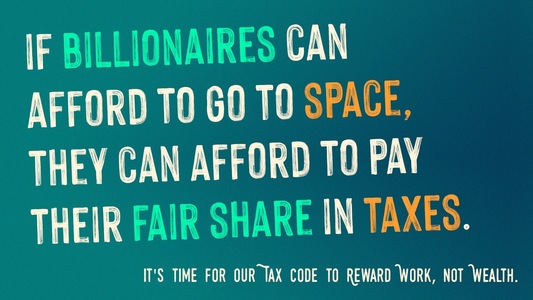
Why Don’t Billionaires Pay the Same High Tax Rates the Rest of Us Pay?

By Charles Hugh Smith

Source: Of Two Minds

The truth is America has lost its way if commoners pay a rate of 40% but its billionaires pay next to nothing.

As with everything else in polarized America, billionaires proclaiming space tourism is the next big thing for humanity neatly divides opinion into two camps: those who laud the initiative, hard work and innovations of the billionaires as examples of the American Can-Do Dream, and those who wished the billionaire space tourists had taken a one-way flight to a distant orbit of blissful silence.

Setting aside that bitter divide, let’s explore another divide: how our two-tier tax system enables billionaires to become billionaires while the rest of us get poorer. Whenever I discuss the taxes of the non-billionaire self-employed, armies of apologists leap to the defense of the status quo with various quibbles: the 0.9% Medicare surcharge only kicks in above $200,000, the cap on Social Security taxes is $142,800, and so on.

Setting aside the quibbles–and recall the tax code with regulatory notes is thousands of pages–let’s deal with the real issue, which is that billionaires and their corporations pay a thin slice of taxes as a percentage of total income/gains if they pay any at all, while self-employed and small business pay extraordinarily high tax rates.

To all the quibblers: please add the 15.3% Social Security/Medicare tax rate (self-employed / sole proprietors pay both the employee and employer share of this tax) to the federal tax rate of 24% for income above $85,520. It’s 39.3%.

Just how hard would it be to conclude that everyone earning more than $142,000 should pay at least the same rate the rest of us pay? Aren’t we demonstrating all those same laudable traits of the billionaires, just on a smaller scale? Why should we pay 40% and the billionaires pay essentially zero?

Gee, do you reckon paying no taxes might help folks become richer? Garsh, nobody ever asked that question before. And do you reckon paying 40% of your income might make you poorer over time? Golly gee, how come the talking heads worshiping the billionaires never ask these questions?

Since Social Security and Medicare/Medicaid are the bedrock of America’s social safety net, why shouldn’t billionaires pay to support these programs? Well, why not? Just how lame do the excuses have to be to be recognized as laughably self-serving?

Here’s the trick billionaires use to evade taxes. There are countless ways for the super-wealthy to evade taxes–funnel earnings through an Irish post office box, buy a tax break in Washington DC, slide the money into one of dozens of global tax havens, and so on.

But a simple one is to report no income and live large off borrowed money. As the billions of dollars in capital gains pile up as the billionaire’s stock holdings soar (thanks, Federal Reserve, for the free trillions; awful swell of you to give us all that free money), there’s no income generated until the billionaire sells some shares. No sale, no income. Just pay yourself $1 a year in salary, borrow against your billions at super-low rates of interest, and voila, you’re tax-free while you build your super-yacht, buy your private island, and so on.

Just as a thought experiment, suppose the first $50,000 in earnings for everyone were tax-free, and a 40% tax rate was collected on all income above $1 million, both earned and unearned (capital gains), not when the gains were realized in a sale but at the end of every tax year, whether the shares that rose in value were sold or not.

So Billionaire Space Tourist reaped $10 billion in capital gains from the appreciation of stocks held, then the Billionaire pays 40% of those gains: $4 billion. There is a way to not pay any taxes on capital gains–have your portfolio lose value. No gains, no taxes. And to close all the loopholes, the tax rate is on all assets and income connected in any way, shape or form with the U.S. First they pay the U.S. taxes, then if they want to pay other nations’ taxes as well, be my guest. But the 40% is due and payable regardless of any other conditions.

You don’t like it, then stop selling any products in the U.S. or holding any assets in the U.S. Why should billionaires get to set up immensely profitable monopolies, quasi-monopolies, cartels and corporations in the U.S. but pay near-zero in taxes? Why should billionaires be free to profit from America’s economy but pay nothing to support its citizenry?

What precisely is the logic of reducing taxes on the wealthiest few to near-zero? If there is no logic, then we’re left with corruption: America is a moral cesspool.

The truth is America has lost its way if commoners pay a rate of 40% but its billionaires pay next to nothing. Please note Karma and Divine Retribution are not controlled by the billionaire’s lackeys and apparatchiks in the Federal Reserve. The pendulum of exploitation has reached its extreme, and the reversal to the opposite extreme is underway.

What’s REALLY behind the war on home ownership?

Becoming a “Nation of Renters” is clearly a big part of the New Normal.

By Kit Knightly

Source: Off-Guardian

The incipient “Great Reset” is a multi-faceted beast. We talk a lot about vaccine passports and lockdowns and the Covid-realated aspects – and we should – but there’s more to it than that.

Remember, they want you to “own nothing and be happy”. And right at the top of the list of things you definitely shouldn’t own, is your own home.

The headlines about this have been steady for the last few years, but it has picked up pace in the wake of the “pandemic” (as has so much else). An agenda hidden on back pages, behind by Covid’s meaningless big red numbers, but perhaps no less sinister.

You can find articles all over the net talking up renting over owning.

Last month, for example, Bloomberg ran an article headlined:

America Should Become a Nation of Renters”

Which praises what they call “the liquefaction of the housing market” and gleefully expounds on the idea that “The very features that made home buying an affordable and stable investment are coming to an end.”

The Atlantic published “Why Its Better To Rent Than Own” in March.

Financial pages from Business Insider to Forbes to Yahoo and Bloomberg again are filled with lists titled “9 Ways Renting is Better Than Buying”or similar.

Other publications go more personal with it, with anecdotal columns about ignoring financial advice and refusing to buy your home. Vox, never one to sell their agenda with any kind of subtlety, have a piece titled:

Homeownership can bring out the worst in you

Which literally argues that buying a house can make you a bad person:

It’s the biggest thing you might ever buy. And it could be turning you into a bad person.

So what exactly is the narrative here? What’s the story behind the story?

The short answer is fairly simple: It’s about greed, and it’s about control.

It almost always is, in the end.

The longer answer is rather more complicated. Major investment firms such as Vanguard and Blackrock, along with rental companies such as American Homes 4 Rent, are buying up single-family homes in record numbers – sometimes entire neighbourhoods at a time.

They pay well over market value, pricing families who want to own those homes out of the market, which forces the housing market up whilst the Lockdown-created recession is lowering wages and creating millions of newly unemployed.

Of course, this is motivating people to sell the houses they already own.

People all across America have been saddled with houses worth less than they bought them for since the 2008 economic crash, and are eager to take the cash from private investment firms paying 10-20% over market value. Combine an economic recession with a created housing boom and you have a huge population of motivated sellers.

Of course, many of these sellers don’t realise, until it’s too late, that even if they attempt to downsize or move to a cheaper area, they may be priced out of the market completely, and forced to rent.

As such, in the last year, the private investment share of single-family home purchases is estimated to have increased ten-fold, going from 2% in 2018 to over 20% this year.

As more and more people are forced to rent, of course, rental properties will be in higher and higher demand. This in turn will drive the cost of renting up.

Market Watch has already reported that, in the last year, rent has increased over 3x faster than the government predicted.

This problem is likely to get worse in the near future.

Last night [7/30/21], Congress “accidentally failed” to extend the Covid-related eviction ban.

Which means, this weekend, while Senators adjourn to the summer homes they probably don’t rent, the ban will officially end and a lot of people are likely to have their houses foreclosed or their landlords kick them out.

The newly empty buildings will be a feeding frenzy for the massive corporate landlords. Who will descend on the banks like starving hyenas to snap up the foreclosed properties for pennies on the dollar. Just like they did in 2008.

None of this is any secret, it’s been covered in the mainstream. Tucker Carlson even did a segment on it in early June.

The Wall Street Journal headlined, back in April, “If You Sell a House These Days, the Buyer Might Be a Pension Fund”, and reported:

Yield-chasing investors are snapping up single-family homes, competing with ordinary Americans and driving up prices

However, since then, something has clearly changed. The propaganda machine has kicked into gear to defend Wall Street from any backlash.

No better example of this shift can be found than The Atlantic, which ran this story in 2019:

WHEN WALL STREET IS YOUR LANDLORD
With help from the federal government, institutional investors became major players in the rental market. They promised to return profits to their investors and convenience to their tenants. Investors are happy. Tenants are not.

…and this story last month:

BLACKROCK IS NOT RUINING THE US HOUSING MARKET
The real villain isn’t a faceless Wall Street Goliath; it’s your neighbors and local governments stopping the construction of new units.

Going back to the Vox well we have:

Wall Street isn’t to blame for the chaotic housing market

Which ran just a few days after the Atlantic article, and is practically identical.

Both these (oddly similar) articles argue that Wall Street and private equity firms can’t be blamed for buying up houses, and that the real problem is the lack of supply to meet demand.

You see, all the “selfish” people who already own homes (they did say it makes you a bad person) are blocking the construction of new houses, and thus driving up the cost of property through scarcity.

This has been a logically flawed argument around the housing market for decades.

That there aren’t enough houses for people to buy is patently absurd when the US census data says that there are over 15 million houses currently standing empty. That’s enough to house all of America’s roughly 500,000 homeless people 30x over.

There’s plenty of houses, there’s just not enough money to buy them.

The reason for that is the same reason the California has massive “homeless camps” in its major cities, and that so many people are having to become renters instead of owners: wage stagnation.

For decades now, wage increases have lagged behind increases in the cost of living. In the 1960s one full-time job could afford a decent standard of living for a family of four or more. These days both parents work, sometimes multiple jobs each.

It was huge amounts of financial de-regulation which created this situation. So, whether you believe Vox’s BlackRock apologia or not, one way or another Wall Street very definitely is to blame.

But this isn’t just about money. It never is. Just as the war on cash isn’t just about efficiency, and the environmental push isn’t just about climate change. Ditto veganism. It’s about control. Just like vaccines, lockdowns and masks.

It always comes down to control.

It’s an oft-used cliche, but no less true for that, that homeowning “gives people a stake in society”. A family-owned house is a source of security for the future and something to leave your children. It is also sovereignty and privacy. Your own space that no one else can control or take away.

In short: A homeowner is independent. A renter is not. A renter can be controlled. A homeowner can not.

It’s the same reasoning behind the way working people were encouraged to take out loans and become debt slaves. If you limit people’s options, if you make them rely on you for a roof over their heads, you have control over them.

There’s a great article about this situation called “Your New Feudal Overlords”.

Under Feudalism, land wasn’t owned by the working class, but provided to them by landed barons, hence the term “Land Lord”. If you disrespected your Lord, or broke his rules, or he perceived another peasant/farm animal/crop would be a better use of the land, he could take it back.

Essentially, the behaviour of serfs was kept in check by their reliance on the nobility for a place to live. That’s very much the dynamic they’re going for here.

Rental agreements can be full of any terms and conditions the landlord wants, and the more desperate people get the more of their consumer rights they will sign over.

Maybe you’ll agree to smart meters which monitor your internet or power-usage habits, and then sell the data to behavioural modellers and viral marketers.

Maybe you’ll have to agree to certain power limitations or water shortages in order to “fight climate change”.

Maybe it will get worse than that.

Maybe they’ll go full Black Mirror style corporate dystopia. Maybe, through affiliation programs, the mega-equity firm which owns your rental house has ties to McDonald’s, and as such will require you to not eat at any competing fast-food franchises, or demand you observe at least ninety seconds of Disney advertisements per day.

Maybe it will be as simple as including vaccine status in the tenancy agreement, making it impossible for the unvaxxed to find a home.

Maybe they just want to make poor people miserable.

After all, the super-wealthy have got all the money they could ever need, and all the luxury they could ever use. Their living standards are as high as physically possible. So maybe the only way they can keep “winning”, is to start driving the living standards of us proles down.

No air travel. No vacations. No going out at all. Live in a tiny house, or a pod. Eat bugs. Get rid of your car. Rent your clothes. Or your furniture. Pay taxes on sugar. And alcohol. And red meat.

They’ve been very clear about this. They’ve told you about the Great Reset and the Internet of Things. That’s the plan.

You won’t own a house. And you’ll be happy…or else the mega-corporation you’re forced to rent from will kick you out.

How Breakdown Cascades Into Collapse

By Charles Hugh Smith

Source: Of Two Minds

Maintaining the illusion of confidence, permanence and stability serves the interests of those benefiting from the bubbles and those who prefer the safety of the herd, even as the herd thunders toward the precipice.

The misconception that collapse is an all or nothing phenomenon is common: Either the system rights itself with a bit of money-printing and rah-rah or it collapses into post-industrial ruin and gangs are battling over the last stash of canned beans.

Neither scenario considers the fragility and resilience of the socio-economic system as a whole. It is both far more fragile than the believers in the permanence of the waste is growth model grasp and more resilient than the complete collapse prognosticators grasp.

The recent relatively mild logjams in global supply chains of essentials are mere glimpses of precariously fragile delivery-supply systems. These can be understood as bottlenecks that only insiders see, or as unstable nodes through which all the economy’s connections run. Put another way, the economy’s as a network appears decentralized and robust, but this illusion vanishes when we consider how the entire economy rests on a few unstable nodes.

One such node is the delivery of gasoline and fuels. It’s such an efficient and reliable system that 99.9% of us take it for granted: there will always be plenty of gasoline at every station, the tanks of jet fuel will always be topped off, and so on.

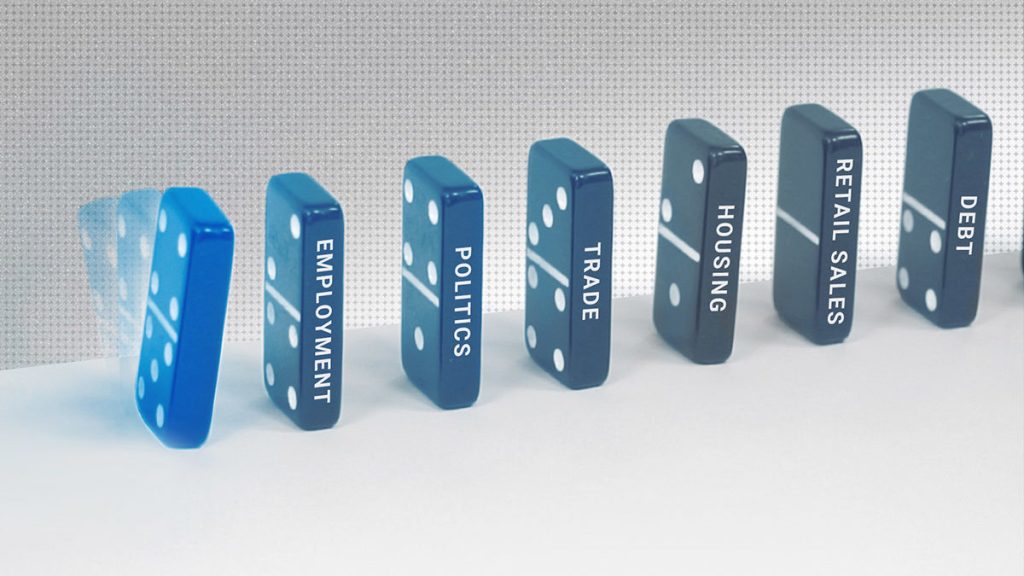
The 0.1% know that this system, once disrupted, would knock over dominoes all through the economy.

Hyper-efficiency and hyper-globalization has reduced the number of producers of essentials to the point that disruptions cannot be overcome with redundant sources. We see this everywhere in the global economy: a handful of plants and companies (sometimes a single source of essential components) process or manufacture essential components in much larger systems.

This is how you end up with thousands of newly manufactured vehicles parked in lots awaiting one critical part that is in short supply.

Another key weakness is the entire system’s reliance on debt, leverage and speculation. Few seem to understand that physical production and delivery systems can grind to a halt for financial reasons–for example, lines of credit being pulled, a counterparty to some arcane commodity swap goes under, taking the presumably solvent corporation down with it, and so on.

The more debt that’s been piled up, the greater the instability of the entire system. Risk always appears low until the system destabilizes, and then all the hedges fail and risk breaks out, flooding through the entire financial system.

Leverage is great fun on the way up, as it magnifies gains. Since the Federal Reserve implicitly guarantees that “buy the dip” will generate massive gains, why not ramp up leverage ten-fold to maximize those Fed-guaranteed gains?

Leverage is less fun on the way down. When the underlying collateral has shrunk to 20% of the leveraged bets being made, a 21% decline in the asset wipes out all the collateral holding up the palace of leveraged debt.

The Fed can print money but it can’t create collateral, nor can it make insolvent entities solvent. All the Fed can do is increase the debt and leverage, which is not the solution, it’s the problem.

Speculation is also inherently unstable, as the euphoric herd, once startled, turns in panic and stampeded in fear. Markets which appeared liquid–i.e., sellers could count on someone buying as many millions of shares as they desired to sell–become illiquid, as buyers vanish like mist in Death Valley. With buyers gone, prices plummet to levels the herd reckoned “impossible” just days before.

The Fed’s entire strategy in the 21st century has been to inflate asset bubbles that generate the illusion of wealth–the so-called wealth effect which is presumed to inspire voracious borrowing and spending.

Unfortunately for the Fed, most of the gains flowed to the top 0.1%, and an economy based on a handful of billionaires buying super-yachts and spaceships is a line of dominoes awaiting the inevitable “accident.” So there are two systemic problems with relying on asset bubbles to generate “wealth”: 1) since 90% of the assets are owned by a thin slice of the populace, bubbles increase destabilizing inequality, and 2) bubbles are intrinsically unstable. So the U.S. economy, dependent on the Fed for the “juice” of monetary stimulus, is now dependent on incredibly unstable bubbles in assets, debt and leverage, bubbles which have generated extremes of wealth/income inequality that are destabilizing the social and political orders.

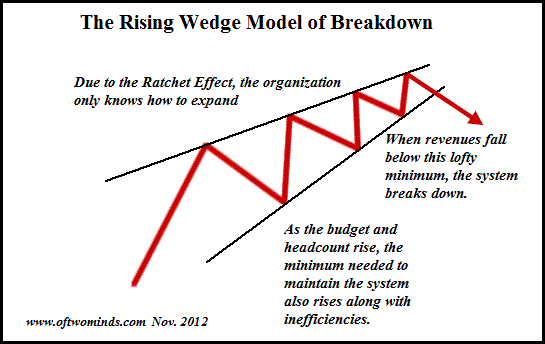
As the three charts below illustrate, the fragility and instability are well hidden until it’s too late: bubbles, debt, leverage, budgets and revenues can only click higher because the system breaks down if there is any sustained decline (the rising wedge model of breakdown). Once the subsystems fail, there’s no putting the eggshell back together.

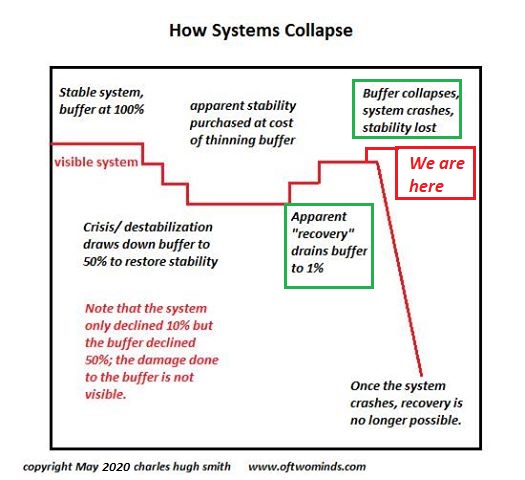
The second chart depicts how buffers thin beneath the surface, masking the systemic fragility. The loss of redundancy, the decay of maintenance, the loss of experienced workers–all of these are hidden from public view until the system breaks down.

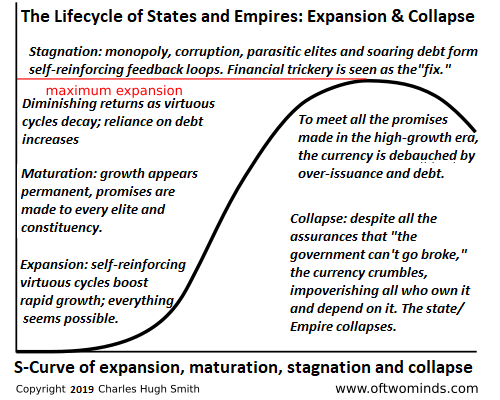
The third chart tracks the S-curve of expansion, confidence, complacency, delusion and collapse followed by human systems, from nations to empires to corporations: as the buffers thin and the rising wedge reaches an apex of vulnerability, the leadership evinces a delusional confidence in the permanence and stability of increasingly fragile, unstable systems.

Maintaining the illusion of confidence, permanence and stability serves the interests of those benefiting from the bubbles and those who prefer the safety of the herd, even as the herd thunders toward the precipice.

This is how breakdowns in apparently stable subsystems triggers the fall of dominoes throughout the larger system, leading to a collapse that was widely viewed as “impossible.” Such is the power of complacency and delusion.

Is Inflation “Transitory”? Here’s Your Simple Test

By Charles Hugh Smith

Source: Of Two Minds

Is inflation “transitory” in your household budget? Really? Where?

The Federal Reserve has been bleating that inflation is “transitory”–but what about the real world that we live in, as opposed to the abstract funhouse of rigged statistics? Here’s a simple test to help you decide if inflation is “transitory” in the real world.

Let’s start with some simple stipulations: price is price, there are no tricks like hedonics or substitution. Nobody cares if the truck stereo is better than it was 40 years ago, the price of the truck is the price we pay today, and that’s all that matters.

(Funny, the funhouse statistical adjustments never consider that appliances that used to last 30 years now break down and are junked after 3 years–if we adjusted for that, the $500 washer would be tagged at $5,000 today because it has lost 90% of its durability over the past 30 years.)

Second, inflation must be weighted to “big ticket” nondiscretionary items. The funhouse statistical trickery counts a $10 drop in the price of a TV (which you buy every few years at best) as equal to a $100 rise in childcare, which you pay monthly. No, no, no: a 10% rise in rent, healthcare insurance and childcare is $400 a month or roughly $5,000 a year. A 10% decline in a TV you buy every three years is $50. Even a 50% drop in the price of a TV ($250) is $83 per year–absolutely trivial, absolutely meaningless compared to $5,000 in higher big-ticket expenses.

You can forego the new TV but not the rent, childcare or healthcare. That’s the difference between “big ticket” nondiscretionary and discretionary (meals out, 3rd TV, etc.).

Third, we jettison the painfully obvious manipulation of “owners equivalent rent” for housing costs. Housing costs are the prices we pay for rent, owning a home and paying property taxes, insurance and maintenance costs to own the home. (Have you priced having a new roof put on your house by a licensed, reputable contractor? No? Well, it’s become a lot more expensive than it was a few years ago. Where is that enormous price leap in “owners equivalent rent”? Just how stupid does the Fed reckon we are?)

OK, here’s the test: let’s say markets finally take a deflationary dive from overvalued heights. Housing, stocks and other risk assets fall 30%. Trillions of dollars in “wealth” (that didn’t exist prior to the Everything Bubble inflating) has vanished, generating a reverse wealth effect as all the owners of these assets feel poorer and less inclined to borrow and spend. This is classically considered highly deflationary: demand drops, prices drop.

The three billionaires who own more assets than the bottom 50% of Americans (165 million Americans) will be crying, but how does life change for the 165 million Americans who own a vanishingly thin slice of these assets? Does their rent drop? No, for the reasons I explained in The Fed Is Wrong: Inflation Is Sticky: the big corporate landlords have to keep rents high to placate their lenders. (And let’s not forget greed: the greedy never want to lower prices, preferring to cling to the Fed’s fantasy of “transitory” trouble.)

Now let’s ask about the higher-income 150 million Americans who own homes and pay property taxes, who pay healthcare insurance, college tuition and fees, childcare and elderly care. Even if there is a deflationary crash in stocks and housing, what are the odds the overall costs of owning and maintaining your home will drop significantly?

What are the odds that local government will let property taxes drop with valuations? Shall we be honest and say zero? If real estate valuations plummet, then property tax rates will rise to compensate. Or other “creative” fees will be imposed to make up the shortfall in tax revenues.

What about childcare? What are the odds that childcare costs will drop 30%? Shall we be honest and say zero? The costs paid by childcare providers only go up, and so those who don’t charge enough (marginal providers) will close down, generating a shortage of supply that elevates prices.

What about elderly care? Will assisted living facilities suddenly drop 30% just because asset bubbles pop? No. The costs of assisted living march higher regardless of what asset valuations and interest rates do.

What about healthcare? Will all those costs drop 30% because assets declined? No. Everyone exposed to real-world pricing of healthcare will be paying more.

But what about the roofing contractor? Won’t they charge 30% less? The biggest expenses for the contractor are workers compensation insurance, liability insurance, disability insurance, FICA (Social Security and Medicare) and healthcare insurance, and none of those will drop a single dollar even if stocks drop 30%.

Just as 85% of local government expenses are labor-related, most of the expenses of the roofing contractor are labor-related. The roofing materials dropping a few bucks might lower the cost by a few percentage points, but the material costs are based on the costs of the manufacturers, distributors, truckers, etc., and these are also based on labor-related expenses, taxes, insurance and healthcare–none of which will drop a dime, regardless of what asset prices do.

Economist Michael Spence elucidated the difference between tradable and untradable goods and services. If you want your washer repaired, that service in untradable, as shipping your broken washer to China for repair is not financially viable. As labor costs rise in China and other offshore economies, that raises costs even for tradable goods.

The majority of essential services are untradable and the costs are dependent on “big ticket” expenses which cannot go down without imploding the economy and government: taxes, insurance, healthcare, childcare, elderly care, etc. cannot drop 30% because they’re based on labor costs, highly profitable systemic friction (Big Pharma, the Higher Education Cartel, Big Ag, healthcare and other quasi-monopolies) and the need for ever-higher tax revenues to provide services which the public demands.

Let’s also ponder the consequences of the extreme concentration of wealth and income in the top 5% of U.S. households. The top 10% own roughly 85% of all wealth, and the top 1% own more than half the financial wealth.

Any significant drop in financial assets will have almost no effect on the bottom 90% because they don’t own enough of these assets to be consequential. So the deflationary effect of the reverse wealth effect will be concentrated in the discretionary spending of the top 10%: the luxury imported vehicles, the $100 per plate dinners (those $60 bottles of wine add up), the $500/day resort vacation, the $2,500/week AirBnB rental, etc.

The declines in the cost of these discretionary luxuries may well be noteworthy, but there are thresholds below which prices cannot drop. The high-end restaurant has equally high-end expenses, and so marginal providers will close, leaving only those few who can maintain profitability as demand for luxury dining craters.

The resort has high expenses as well, and once profitability has been lost, resorts will close just like other marginal providers. Supply shrinks along with demand, and the survivors keep prices high enough or they too will close.

So the essential “big ticket” costs will keep rising and the discretionary luxuries only the top 10% can afford will drop–but not by much as all those luxury providers have the same high fixed costs.

So to recap the test: what are the odds of these “big ticket” expenses dropping 30% if asset prices drop 30%?

Taxes: zero.

Healthcare: zero.

Childcare: zero.

Elderly care: zero.

Costs of doing business: zero.

As for housing: the mortgage doesn’t drop if the market value of the house drops 30%, and any declines in insurance will be modest. The costs of maintenance won’t drop much, either, and might actually increase as the supply of skilled workers declines. (Nothing is more expensive than the “cheap” repair that has to be redone correctly.)

Rents may drop in areas nobody wants to live anymore, but rents will rise in places people do want to live.

The larger point here is the long economic cycles have turned. The 40-year decline in interest rates has turned, whether we admit it or not. The 40-year decline in the prices of goods due to financialization (lower interest rates, higher speculative assets) and globalization has turned. The 40-year expansion of the workforce has turned. The 40-year decline of oil/fuel/resources prices has turned. The 40-year fantasy that we can depend on other nations for our essential resources and components is drawing to a close.

Untradable goods and services, cost thresholds, resource security, the end of financialization / globalization and declining interest rates matter. The fantasy that the top 10% can prop up the economy by borrowing and spending the phantom wealth of insanely overvalued asset bubbles is drawing to a close.

Is inflation “transitory” in your household budget? Really? Where?

There is More to BlackRock Than You Might Imagine

By F. William Engdahl

Source: New Eastern Outlook

A virtually unregulated investment firm today exercises more political and financial influence than the Federal Reserve and most governments on this planet. The firm, BlackRock Inc., the world’s largest asset manager, invests a staggering $9 trillion in client funds worldwide, a sum more than double the annual GDP of the Federal Republic of Germany. This colossus sits atop the pyramid of world corporate ownership, including in China most recently. Since 1988 the company has put itself in a position to de facto control the Federal Reserve, most Wall Street mega-banks, including Goldman Sachs, the Davos World Economic Forum Great Reset, the Biden Administration and, if left unchecked, the economic future of our world. BlackRock is the epitome of what Mussolini called Corporatism, where an unelected corporate elite dictates top down to the population.

How the world’s largest “shadow bank” exercises this enormous power over the world ought to concern us. BlackRock since Larry Fink founded it in 1988 has managed to assemble unique financial software and assets that no other entity has. BlackRock’s Aladdin risk-management system, a software tool that can track and analyze trading, monitors more than $18 trillion in assets for 200 financial firms including the Federal Reserve and European central banks. He who “monitors” also knows, we can imagine. BlackRock has been called a financial “Swiss Army Knife — institutional investor, money manager, private equity firm, and global government partner rolled into one.” Yet mainstream media treats the company as just another Wall Street financial firm.

There is a seamless interface that ties the UN Agenda 2030 with the Davos World Economic Forum Great Reset and the nascent economic policies of the Biden Administration. That interface is BlackRock.

Team Biden and BlackRock

By now it should be clear to anyone who bothers to look, that the person who claims to be US President, 78-year old Joe Biden, is not making any decisions. He even has difficulty reading a teleprompter or answering prepared questions from friendly media without confusing Syria and Libya or even whether he is President. He is being micromanaged by a group of handlers to maintain a scripted “image” of a President while policy is made behind the scenes by others. It eerily reminds of the 1979 Peter Sellers film character, Chauncey Gardiner, in Being There.

What is less public are the key policy persons running economic policy for Biden Inc. They are simply said, BlackRock. Much as Goldman Sachs ran economic policy under Obama and also Trump, today BlackRock is filling that key role. The deal apparently was sealed in January, 2019 when Joe Biden, then-candidate and long-shot chance to defeat Trump, went to meet with Larry Fink in New York, who reportedly told “working class Joe,” that, “I’m here to help.”

Now as President in one of his first appointees, Biden named Brian Deese to be the Director of the National Economic Council, the President’s main adviser for economic policy. One of the early Presidential Executive Orders dealt with economics and climate policy. That’s not surprising, as Deese came from Fink’s BlackRock where he was Global Head of Sustainable Investing. Before joining BlackRock, Deese held senior economic posts under Obama, including replacing John Podesta as Senior Adviser to the President where he worked alongside Valerie Jarrett. Under Obama, Deese played a key role in negotiating the Global Warming Paris Accords.

In the key policy post as Deputy Treasury Secretary under Secretary Janet Yellen, we find Nigerian-born Adewale “Wally” Adeyemo. Adeyemo also comes from BlackRock where from 2017 to 2019 he was a senior adviser and Chief of Staff to BlackRock CEO Larry Fink, after leaving the Obama Administration. His personal ties to Obama are strong, as Obama named him the first President of the Obama Foundation in 2019.

And a third senior BlackRock person running economic policy in the Administration now is also unusual in several respects. Michael Pyle is the Senior Economic Adviser to Vice President Kamala Harris. He came to Washington from the position as the Global Chief Investment Strategist at BlackRock where he oversaw the strategy for investing some $9 trillion of funds. Before joining BlackRock at the highest level, he had also been in the Obama Administration as a senior adviser to the Undersecretary of the Treasury for International Affairs, and in 2015 became an adviser to the Hillary Clinton presidential bid.

The fact that three of the most influential economic appointees of the Biden Administration come from BlackRock, and before that all from the Obama Administration, is noteworthy. There is a definite pattern and suggests that the role of BlackRock in Washington is far larger than we are being told.

What is BlackRock?

Never before has a financial company with so much influence over world markets been so hidden from public scrutiny. That’s no accident. As it is technically not a bank making bank loans or taking deposits, it evades the regulation oversight from the Federal Reserve even though it does what most mega banks like HSBC or JP MorganChase do—buy, sell securities for profit. When there was a Congressional push to include asset managers such as BlackRock and Vanguard Funds under the post-2008 Dodd-Frank law as “systemically important financial institutions” or SIFIs, a huge lobbying push from BlackRock ended the threat. BlackRock is essentially a law onto itself. And indeed it is “systemically important” as no other, with possible exception of Vanguard, which is said to also be a major shareholder in BlackRock.

BlackRock founder and CEO Larry Fink is clearly interested in buying influence globally. He made former German CDU MP Friederich Merz head of BlackRock Germany when it looked as if he might succeed Chancellor Merkel, and former British Chancellor of Exchequer George Osborne as “political consultant.” Fink named former Hillary Clinton Chief of Staff Cheryl Mills to the BlackRock board when it seemed certain Hillary would soon be in the White House.

He has named former central bankers to his board and gone on to secure lucrative contracts with their former institutions. Stanley Fisher, former head of the Bank of Israel and also later Vice Chairman of the Federal Reserve is now Senior Adviser at BlackRock. Philipp Hildebrand, former Swiss National Bank president, is vice chairman at BlackRock, where he oversees the BlackRock Investment Institute. Jean Boivin, the former deputy governor of the Bank of Canada, is the global head of research at BlackRock’s investment institute.

BlackRock and the Fed

It was this ex-central bank team at BlackRock that developed an “emergency” bailout plan for Fed chairman Powell in March 2019 as financial markets appeared on the brink of another 2008 “Lehman crisis” meltdown. As “thank you,” the Fed chairman Jerome Powell named BlackRock in a no-bid role to manage all of the Fed’s corporate bond purchase programs, including bonds where BlackRock itself invests. Conflict of interest? A group of some 30 NGOs wrote to Fed Chairman Powell, “By giving BlackRock full control of this debt buyout program, the Fed… makes BlackRock even more systemically important to the financial system. Yet BlackRock is not subject to the regulatory scrutiny of even smaller systemically important financial institutions.”

In a detailed report in 2019, a Washington non-profit research group, Campaign for Accountability, noted that, “BlackRock, the world’s largest asset manager, implemented a strategy of lobbying, campaign contributions, and revolving door hires to fight off government regulation and establish itself as one of the most powerful financial companies in the world.”

The New York Fed hired BlackRock in March 2019 to manage its commercial mortgage-backed securities program and its $750 billion primary and secondary purchases of corporate bonds and ETFs in no-bid contracts. US financial journalists Pam and Russ Martens in critiquing that murky 2019 Fed bailout of Wall Street remarked, “for the first time in history, the Fed has hired BlackRock to “go direct” and buy up $750 billion in both primary and secondary corporate bonds and bond ETFs (Exchange Traded Funds), a product of which BlackRock is one of the largest purveyors in the world.” They went on, “Adding further outrage, the BlackRock-run program will get $75 billion of the $454 billion in taxpayers’ money to eat the losses on its corporate bond purchases, which will include its own ETFs, which the Fed is allowing it to buy…”

Fed head Jerome Powell and Larry Fink know each other well, apparently. Even after Powell gave BlackRock the hugely lucrative no-bid “go direct” deal, Powell continued to have the same BlackRock manage an estimated $25 million of Powell’s private securities investments. Public records show that in this time Powell held direct confidential phone calls with BlackRock CEO Fink. According to required financial disclosure, BlackRock managed to double the value of Powell’s investments from the year before! No conflict of interest, or?

A Very BlackRock in Mexico

BlackRock’s murky history in Mexico shows that conflicts of interest and influence-building with leading government agencies is not restricted to just the USA. PRI Presidential candidate Peña Nieto went to Wall Street during his campaign in November 2011. There he met Larry Fink. What followed the Nieto victory in 2012 was a tight relationship between Fink and Nieto that was riddled with conflict of interest, cronyism and corruption.

Most likely to be certain BlackRock was on the winning side in the corrupt new Nieto regime, Fink named 52-year-old Marcos Antonio Slim Domit, billionaire son of Mexico’s wealthiest and arguably most corrupt man, Carlos Slim, to BlackRock’s Board. Marcos Antonio, along with his brother Carlos Slim Domit, run the father’s huge business empire today. Carlos Slim Domit, the eldest son, was Co-Chair of the World Economic Forum Latin America in 2015, and currently serves as chairman of the board of America Movil where BlackRock is a major investor. Small cozy world.

The father, Carlos Slim, at the time named by Forbes as World’s Richest Person, built an empire based around his sweetheart acquisition of Telemex (later America Movil). Then President, Carlos Salinas de Gortari, in effect gifted the telecom empire to Slim in 1989. Salinas later fled Mexico on charges of stealing more than $10 billion from state coffers.

As with much in Mexico since the 1980s drug money apparently played a huge role with the elder Carlos Slim, father of BlackRock director Marcos Slim. In 2015 WikiLeaks released company internal emails from the private intelligence corporation, Stratfor. Stratfor writes in an April 2011 email, the time BlackRock is establishing its Mexico plans, that a US DEA Special Agent, William F. Dionne confirmed Carlos Slim’s ties to the Mexican drug cartels. Stratfor asks Dionne, “Billy, is the MX (Mexican) billionaire Carlos Slim linked to the narcos?” Dionne replies, “Regarding your question, the MX telecommunication billionaire is.” In a country where 44% of the population lives in poverty you don’t become the world’s richest man in just two decades selling Girl Scout cookies.

Fink and Mexican PPP

With Marcos Slim on his BlackRock board and new president Enrique Peña Nieto, Larry Fink’s Mexican partner in Nieto Peña’s $590 billion PublicPrivatePartnership (PPP) alliance, BlackRock, was ready to reap the harvest. To fine-tune his new Mexican operations, Fink named former Mexican Undersecretary of Finance Gerardo Rodriguez Regordosa to direct BlackRock Emerging Market Strategy in 2013. Then in 2016 Peña Nieto appointed Isaac Volin, then head of BlackRock Mexico to be No. 2 at PEMEX where he presided over corruption, scandals and the largest loss in PEMEX history, $38 billion.

Peña Nieto had opened the huge oil state monopoly, PEMEX, to private investors for the first time since nationalization in the 1930s. The first to benefit was Fink’s BlackRock. Within seven months, BlackRock had secured $1 billion in PEMEX energy projects, many as the only bidder. During the tenure of Peña Nieto, one of the most controversial and least popular presidents, BlackRock prospered by the cozy ties. It soon was engaged in highly profitable (and corrupt) infrastructure projects under Peña Nieto including not only oil and gas pipelines and wells but also including toll roads, hospitals, gas pipelines and even prisons.

Notably, BlackRock’s Mexican “friend” Peña Nieto was also “friends” not only with Carlos Slim but with the head of the notorious Sinaloa Cartel, “El Chapo” Guzman. In court testimony in 2019 in New York Alex Cifuentes, a Colombian drug lord who has described himself as El Chapo’s “right-hand man,” testified that just after his election in 2012, Peña Nieto had requested $250 million from the Sinaloa Cartel before settling on $100 million. We can only guess what for.

Larry Fink and WEF Great Reset

In 2019 Larry Fink joined the Board of the Davos World Economic Forum, the Swiss-based organization that for some 40 years has advanced economic globalization. Fink, who is close to the WEF’s technocrat head, Klaus Schwab, of Great Reset notoriety, now stands positioned to use the huge weight of BlackRock to create what is potentially, if it doesn’t collapse before, the world’s largest Ponzi scam, ESG corporate investing. Fink with $9 trillion to leverage is pushing the greatest shift of capital in history into a scam known as ESG Investing. The UN “sustainable economy” agenda is being realized quietly by the very same global banks which have created the financial crises in 2008. This time they are preparing the Klaus Schwab WEF Great Reset by steering hundreds of billions and soon trillions in investment to their hand-picked “woke” companies, and away from the “not woke” such as oil and gas companies or coal. BlackRock since 2018 has been in the forefront to create a new investment infrastructure that picks “winners” or “losers” for investment according to how serious that company is about ESG—Environment, Social values and Governance.

For example a company gets positive ratings for the seriousness of its hiring gender diverse management and employees, or takes measures to eliminate their carbon “footprint” by making their energy sources green or sustainable to use the UN term. How corporations contribute to a global sustainable governance is the most vague of the ESG, and could include anything from corporate donations to Black Lives Matter to supporting UN agencies such as WHO. Oil companies like ExxonMobil or coal companies no matter how clear are doomed as Fink and friends now promote their financial Great Reset or Green New Deal. This is why he cut a deal with the Biden presidency in 2019.

Follow the money. And we can expect that the New York Times will cheer BlackRock on as it destroys the world financial structures. Since 2017 BlackRock has been the paper’s largest shareholder. Carlos Slim was second largest. Even Carl Icahn, a ruthless Wall Street asset stripper, once called BlackRock, “an extremely dangerous company… I used to say, you know, the mafia has a better code of ethics than you guys.”