Era of US Domination of Latin America Coming to an End

Marcha en Venezuela contra las sanciones de Trump (Reuters)

By Kevin Zeese and Margaret Flowers

Source: Dissident Voice

Despite its failings at home, the United States intervenes in countries across multiple continents seeking to control their governments and resources.

This week, we look at the US’ latest efforts in Nicaragua, Venezuela, and Bolivia to undermine their independence and force them to serve the interests of the US government and transnational corporations.

In all three countries, the US has displayed a lack of understanding of the people and their support for their revolutionary processes, and as a result, is failing. As US empire fades, so might the Monroe Doctrine come to an end.

Sandanista- FSLN rally in Nicaragua

Nicaragua: USAID Multi-Year Destabilization Plan Exposed

A US Agency for International Development (USAID) document revealed by reporter William Grigsby describes covert plans to overthrow the democratically-elected Nicaraguan government in the next two years. USAID seeks to hire mercenaries “to take charge of the plan . . . to disrupt public order and carry out other [violent] actions before, during, and/or after the 2021 elections.”

USAID is creating Responsive Assistance In Nicaragua (RAIN), allotting $540,000 in grants to remove the Sandinista government in what it calls “Nicaragua’s transition to democracy.” Daniel Ortega won the 2016 election with 72 percent of the vote in what election observers from the Organization of American States (OAS), a US tool, described as taking “place in a calm, smooth and pacific manner, with no large incidents.”

Brian Willson, who has opposed US efforts to dominate Nicaragua since the 1980s Contra war, concludes the US realizes Ortega will win the 2021 election. In fact, this week, a poll showed support for Ortega’s party, FSLN, at 50% and for the opposition at 10%. One of USAID plans, as they tried in Venezuela in 2018, is for the opposition to boycott the election since they know they will lose, then call it illegitimate and create a political and economic crisis.

The real goal is not a democracy but domination so US transnational corporations can profit from the second poorest country in the hemisphere by putting in place a neoliberal economy to privatize public services, cut social services, and purge all traces of the Sandinistas. USAID also plans to “reestablish” the police and military to enforce their rule. Another goal is to stop Nicaragua from being the “threat of a good example” for its economic growth, reduction of inequality, poverty, illiteracy and crime.

Ben Norton points out in the Grayzone that “the 14-page USAID document employed the word ‘transition’ 102 times” making clear the intent is regime change.  A “sudden transition without elections,” a euphemism for a coup, is one of three possible regime change scenarios.

John Perry writes about “US interference in Nicaragua, going back at least as far as William Walker’s assault on its capital and usurpation of the presidency in 1856.” Since the 1979 Sandinista Revolution, the US has sought to take back control of Nicaragua.

USAID and its National Endowment for Democracy (NED) have been funding the opposition. NED financed 54 projects from 2014-17 to lay the groundwork for a 2018 coup attempt, which  also involved USAIDWiston Lopez writes the US has provided “more than 31 million dollars between the end of 2017 and May 1, 2020.” When the attempted coup in 2018 failed, the US also put in place illegal unilateral coercive measures, known as economic sanctions, supported by both Democrats and Republicans, to try to weaken the country.

The USAID’s RAIN program outlines the usual regime change steps; e.g., remake the police and military as enforcers of the new neoliberal order, move “quickly to dismantle parallel institutions”; i.e., the Sandinista Front, the Sandinista Youth, and other grassroots institutions, and implement “transitional justice measures”; i.e., the prosecution of current government officials and movement leaders.

A new area of attack is a disinformation campaign against Nicaragua’s handling of COVID-19. The opposition misrepresents the government’s response and puts forward false death statistics in an attempt to create chaos. As Wiston López points out, “Since March the US-directed opposition has focused 95% of their actions on attempting to discredit Nicaragua’s prevention, contention, and Covid treatment. However, this only had some success in the international media and is now backfiring since Nicaragua is the country with one of the lowest mortality rates in the continent.”

The US media fails to report on the success of Nicaragua in combating the virus using a community-based health system. Nicaragua has been building its health system for the last 12 years and took rapid action to prepare for the virus. Nicaragua did not impose a lock down because it is a poor country where 80 percent of people are in the informal economy and 40 percent live in rural areas. People must work in order to eat.

Stephen Sefton puts the failure of the United States so far in context. At its root, the US does not understand the people of Nicaragua, their history of fighting US domination, and their ability to overcome right-wing puppets. It also misunderstands what the Sandinista government is doing to better the lives of the people in every sector of the economy. Sefton concludes, “The US government has failed notoriously to meet the needs of its own people during the current pandemic but can still find money to try and destroy a small country whose success makes US social, economic and environmental policy look arbitrary, negligent and criminal.”

Nicolas Maduro kicks out Donald Trump (Photo by Ben Norton

Venezuela: Bipartisan Failed Regime Change

Ever since the 1998 election of Hugo Chavez, successive US administrations have tried and failed to dominate Venezuela. The bipartisan nature of this policy was on display on August 4, when Elliot Abrams, the notorious coup-monger for multiple presidents, testified in Congress. Not a single Senator criticized the attempt to illegally overthrow a democratically-elected government.

Abrams was criticized by both Democrats and Republicans for his inability to remove President Maduro from power. Senator Chris Murphy (D-CT) was most open about the coup attempt describing it as “a case study in diplomatic malpractice” and claiming Trump botched a winning play in a comedy of errors that strengthened Maduro. After the hearing, Murphy posted a series of Tweets admitting the coup and how it could have been done better.

clip from Murphy’s embarrassing comments was shared widely including by the Venezuelan Vice President Delcy Rodríguez and Foreign Minister Jorge Arreaza. When Vijay Prashad asked Arreaza his reaction, he described the US openly admitting crimes and said the “confessions” of Murphy, Gen. John Kelly, John Bolton, and Elliot Abrams “are priceless evidence for the complaint we raised at the International Criminal Court.”

Elliot Abrams testified that he would continue to work very hard to remove Maduro hopefully by the end of the year.  This echoed a statement by President Trump at SouthCom headquarters in Florida. Sen. Murphy’s comments are consistent with those made by Joe Biden who says he would be more effective at removing Maduro than Trump. Biden described Trump as soft on Maduro because he considered talking to him.

Elliot Abrams announced the US will be starting a media war against Venezuela. The reality is the US has been conducting a media war against Venezuela for more than 20 years.

Venezuela is moving ahead with elections for the National Assembly on December 6, 2020. Unlike 2018, more parties are agreeing to participate including the larger Democratic Action and Justice First parties, as well as a new Communist Party alliance and the hard-right Popular Will party, which was US puppet Juan Guaidó’s former party. There will be 105 political parties contesting for 277 National Assembly seats, 110 more than the current term. Venezuela uses a combination of majority winners and proportional representation. Venezuela also requires half the candidates to be female, and they use electronic voting confirmed by paper ballots with a public citizen audit on Election Day.

Juan Guaidó and others allied with the United States said they would boycott the election. Guaidó cannot risk running because he is likely to be defeated. The US is encouraging a boycott and then will claim the election was not legitimate as it did in the last presidential election. After December, Guaidó will not hold any elected office making his fraudulent claim to the presidency even weaker.

These events come after two major embarrassments for the US in Venezuela. Operation Gideonan attempt by mercenaries to invade Venezuela was foiled on May 4, leading to their arrests and the arrests of their co-conspirators. The State Department abandoned the mercenaries, and this week two former Green Berets were sentenced to 20 years in prison after admitting their guilt. It was evident that Guaidó was heavily involved in this failure adding to his failed presidential takeover and tainting him beyond repair.

The second defeat was Iran and Venezuela working together to deliver oil and equipment for Venezuelan refineries. Five Iranian oil tankers passed by the largest US armada in the Caribbean since the invasion of Panama. Southcom has been repeatedly sending warships into Venezuelan waters. The solidarity of Iran and Venezuela overcame the naval blockade, undermined US sanctions, and sent a shudder through the US by showing other nations they can defy the United States.

Venezuela has a strong history of struggle against imperialism but the US’ economic war is costing their economy hundreds of billions of dollars and leading to the premature death of Venezuelans. In addition, the United Kingdom is refusing to release more than a billion dollars of Venezuelan gold held in the Bank of England that was to be used for food and medicine. The UK court ruled against Venezuela but they are appealing the decision.

Bolivians protest the postponement of the election

Bolivia: US Dictator Fears Democratic Vote

On November 12 2019, a US-backed coup in Bolivia removed President Evo Morales who had just won re-election. The self-proclaimed President Jeanine Añez, a right-wing Christian, leads a de facto government involved in massacres, persecution and imprisonment of political leaders. It is destroying the social and economic model and achievements of the Movement Towards Socialism (MAS Party) led by Morales.

The OAS played a crucial role in the coup with their false analysis of Morales’ re-election. The western media reported the false OAS analysis without criticism. Now, studies by MIT and the Center for Economic and Policy Analysis have shown that Morales clearly won the election and should have remained in power. For months the Washington Post claimed Morales’ re-election was a fraud, but finally, in March, it acknowledged the election was legitimate. Similarly, the New York Times admitted in July that Morales won the election.

Many have called this a lithium coup because the element is plentiful in Bolivia and critical for batteries. This was made evident when Elon Musk, the head of Tesla, said on Twitter “We will coup whoever we want! Deal with it.” Tesla would benefit from cheap and plentiful lithium for electric car batteries.

The people of Bolivia are struggling to restore democracy. The fraudulent report by the OAS led to a three-week conflict between right-wing Bolivians protesting alleged fraud and pro-government, mostly indigenous, demonstrators defending Morales. The military and police sided with the right-wing coup. The coup government threatened legislators and their families while repressing the people. There were racist attacks against the majority Indigenous population and the Wiphala, the indigenous flag, was burned in the streets. When she took power, Áñez, surrounded by right-wing legislators, held up a large leather bible and declared, “The Bible has returned to the palace.”

The US recognized the coup government, similar to its recognition of the failed coup leader, Juan Guaidó in Venezuela. Añez claimed she’d be transitory until the next election, but at the direction of the US, she is putting in place deep roots and has delayed elections.

The repression has galvanized the MAS party, as well as peasant unions and grassroots organizations who continue their struggle to restore Bolivian democracy. The pressure led to elections being scheduled. Initially, Áñez said she would not run but reversed herself and is now a candidate while she is trying to outlaw the MAS party and its candidates.

Elections were scheduled for May 3, but have been postponed twice allegedly due to the pandemic, but really because this is an ongoing coup.

It is true that the COVID-19 pandemic is hitting Bolivia hard with horror stories about people unable to get medical treatment. Immediately after the coup, the Añez government expelled the Cuban doctors. The coup-government is unable to manage the health system. Corruption is rampant in the purchase of medical equipment. The health ministry has had three ministers during the crisis. The situation is dire with overcrowded hospitals, lack of basic supplies, and corpses in the streets and in their homes with nowhere to be buried.

The coup-government is using the virus to try to delay elections because polls show the MAS candidate, Luis Arce, is far ahead and likely to win in the first round of elections with Áñez coming in a distant third. Áñez has sought to prosecute Arce to keep him from running, so far unsuccessfully.  On July 6, the Attorney General of Bolivia charged Evo Morales with terrorism and financing of terrorism from exile and is seeking preventive detention.

Since mid-July, thousands of Bolivians have been protesting the postponement of elections. They are holding sustained protests throughout the country and blocking many roads. Indigenous and peasant groups, agricultural groups, along with women and unions are joining together calling for elections.  Morales, Arce, and the MAS Party have denounced the delay.

Domination Will Not Reverse Decline

Evo Morales said in a recent interview:

The United States is trying to make Latin America its backyard forever. We know about the hard resistance of the peoples of Cuba, Venezuela, Nicaragua. The struggle of our peoples is very important. The United States wants to divide us in order to plunder our natural resources. The peoples no longer accept domination and plunder. The United States is in decline, and yet it lashes out.

The US is weakening as a global power and its failures in Latin America are both a symptom of this and are causing further decline. The US’ violations of international law are obvious and are being challenged. But the US is an empire and it will not give up the Monroe Doctrine easily.

As citizens of Empire, we have a particular responsibility to demand the US stop its sanctions and illegal interference in Latin America and elsewhere around the world. In this time of multiple global crises, we must demand the US become a cooperative member of the world community and work peacefully to address the pandemic, recession and climate crisis.

Structures to do this exist to help with this such as the global ceasefire and the Paris Climate agreement. And on the anniversary of the US bombing of Hiroshima and Nagasaki, Japan, we must add the Nuclear Ban Treaty as another effort the US must join.

The Free Market Is A Failure

By TheHipcrimeVocab

Sorry for the deliberately click-bait-y headline, but I think this message is important to get out there.

In my discussions few months back on What is Neoliberalism, I noted that a core element of neoliberal philosophy is that markets are the only efficient, effective and rational way to distribute goods and services.

Neoliberals profess the idea that only competitive markets can allocate “scarce” resources efficiently, and that it is only such “free” markets that can lift people out of poverty and deliver broad prosperity. They pound it into our heads constantly.

Yet the Covid-19 crisis has illustrated spectacular and pervasive failures of such “free” markets all over the globe, and especially in the U.S. Instead of fairness or efficiency, we see systemic failure in every market we look: the food industry, the medical industry, the retail industry, the employment market. Resources are being destroyed and misallocated on a massive scale

Let’s start with the food industry, because food is the most important thing (nine means from anarchy, and all that). Thousands and thousands of pigs are being slaughtered, their meat left to rot, eaten by no-one, regardless of the forces of supply and demand:

The United States faces a major meat shortage due to virus infections at processing plants. It means millions of pigs could be put down without ever making it to table…

Boerboom, a third-generation hog farmer, is just one of the tens of thousands of US pork producers who are facing a stark reality: although demand for their products is high in the nation’s grocery stores, they may have to euthanise and dispose of millions of pigs due to a breakdown in the American food supply chain.

Meat shortage leaves US farmers with ‘mind-blowing’ choice (BBC)

Potatoes are sitting in Belgian warehouses and left to rot, only two short years after a drought threatened to produce a severe shortage:

Belgium: Lighthearted campaign to ‘eat more fries’ aims to lift heavy load (DW)

Meanwhile, dairy farmers in the U.S. heartland are dumping milk into the ground, to be drunk by no one.

Cows don’t shut off: Why this farmer had to dump 30,000 gallons of milk (USA Today)

In fact, the whole food situation is rather ugly, as this piece from The Guardian summarizes:

This March and April, even as an astounding 30 million Americans plunged into unemployment and food bank needs soared, farmers across the US destroyed heartbreaking amounts of food to stem mounting financial losses.

In scenes reminiscent of the Great Depression, dairy farmers dumped lakes of fresh cow’s milk (3.7m gallons a day in early April, now about 1.5 million per day), hog and chicken farmers aborted piglets and euthanized hens by the thousands, and crop growers plowed acres of vegetables into the ground as the nation’s brittle and anarchic food supply chain began to snap and crumble.

After delays and reports of concealing worker complaints, meatpacking plants that slaughter and process hundreds of thousands of animals a day ground to a halt as coronavirus cases spread like wildfire among workers packed tightly together on dizzyingly fast assembly lines.

Meanwhile, immigrant farmworkers toiled in the eye of the coronavirus storm, working and living in crowded dangerous conditions at poverty wages; at one Washington state orchard, half the workers tested positive for Covid-19. Yet many of these hardest working of Americans were deprived of economic relief, as they are undocumented. Advocates report more farmworkers showing up at food banks – and some unable to access food aid because they can’t afford the gas to get there.

None of this is acceptable or necessary and it’s not just about Covid-19, it’s also illustrative of a deeply deregulated corporate capitalism. America’s food system meltdown amid the pandemic has been long-developing, and a primary cause is decades of corporate centralization and a chaotic array of policies designed to prop up agribusiness profits at any cost.

Farmers are destroying mountains of food. Here’s what to do about it (Guardian)

That doesn’t sound very “efficient” to me, does it? How about you? Free market fundamentalists, care to weigh in?

Meanwhile, hospitals in the United States, which one would think are the most important thing to keep open during a pandemic, are actually closing across the country. These are the very things you want most to be open! Why is this happening? Because health care in the U.S. is a profit-driven enterprise that “competes” in the free market. Because elective procedures—their cash cow—have either been suspended or postponed. U.S. hospitals are closing because they are dependent upon these elective procedures to shore up their profits, and markets rely on profits.

As the deadly virus has spread beyond urban hotspots, many more small hospitals across the country are on the verge of financial ruin as they’ve been forced to cancel elective procedures, one of the few dependable sources of revenue. Williamson Memorial and similar facilities have been struggling since long before the pandemic — at least 170 rural hospitals have shut down since 2005, according to University of North Carolina research on rural hospital closures.

But even as hospitals in cities like New York City and Detroit have been deluged with coronavirus patients, many rural facilities now have the opposite problem: their beds are near-empty, their operating rooms are silent, and they’re bleeding cash.

More than 100 hospitals and hospital systems around the country have already furloughed tens of thousands of employees, according to a tally by industry news outlet Becker’s Hospital Review. They’ve sent home nurses and support staffers who would be deemed essential under state stay-home orders.

Rural hospitals are facing financial ruin and furloughing staff during the coronavirus pandemic (CNN)

And how about allocating labor via impersonal markets? How’s that going? Well, not so well. The workers with the skills most desperately needed on the front lines during the crisis are taking pay cuts and getting laid off left and right. Instead of contributing, they are sitting at home, unable to work even if they wanted to:

At a time when medical professionals are putting their lives at risk, tens of thousands of doctors in the United States are taking large pay cuts. And even as some parts of the US are talking of desperate shortages in nursing staff, elsewhere in the country many nurses are being told to stay at home without pay.

That is because American healthcare companies are looking to cut costs as they struggle to generate revenue during the coronavirus crisis.

“Nurses are being called heroes,” Mariya Buxton says, clearly upset. “But I just really don’t feel like a hero right now because I’m not doing my part.”

Ms Buxton is a paediatric nurse in St Paul, Minnesota, but has been asked to stay at home.

At the unit at which Ms Buxton worked, and at hospitals across most of the country, medical procedures that are not deemed to be urgent have been stopped. That has meant a massive loss of income.

Coronavirus: Why so many US nurses are out of work (BBC)

It’s an ironic twist as the coronavirus pandemic sweeps the nation: The very workers tasked with treating those afflicted with the virus are losing work in droves.

Emergency room visits are down. Non-urgent surgical procedures have largely been put on hold. Health care spending fell 18% in the first three months of the year. And 1.4 million health care workers lost their jobs in April, a sharp increase from the 42,000 reported in March, according to the Labor Department. Nearly 135,000 of the April losses were in hospitals.

As Hospitals Lose Revenue, More Than A Million Health Care Workers Lose Jobs (NPR)

So it doesn’t seem like “free and open” markets are doing so well with either health care or labor.

Meanwhile, U.S. states are competing against each other for desperately needed PPE equipment, bidding up the price and preventing scarce resources from going to where they are most badly needed, which would naturally be where Covid-19 has struck the hardest:

As coronavirus testing expands and more cases of infection are being identified, doctors, nurses and other healthcare workers are scrambling to find enough medical supplies to replenish their dwindling supply.

But state and local governments across the United States are vying to purchase the same equipment, creating a competitive market for those materials that drives up prices for everyone.

“A system that’s based on state and local governments looking out for themselves and competing with other state and local governments across the nation isn’t sustainable,” said John Cohen, an ABC News contributor and former acting Undersecretary of the Department of Homeland Security, “and if left to continue, we’ll certainly exacerbate the public health crisis we’re facing.”

“There’s a very real possibility,” he added, “that those state and local governments that have the most critical need won’t get the equipment they need.”

Competition among state, local governments creates bidding war for medical equipment (ABC News)

Yet neoliberals always tell us how important “competition” is in every arena of life.

Failure, failure, failure! Everywhere we look, we see failure. Pervasive, systematic failure. Resources going unused. Surpluses of food being dumped even while people go hungry and line up at food banks. Workers with necessary skills sitting at home, twiddling their thumbs. Other workers unable to even earn a living to support themselves and their families, no matter how badly they want to work. Masks and protective equipment NOT going to where they are most needed, their costs inflating, befitting no one except profiteers even as people die.

Tell me again about how the market is “efficient” at distributing resources. Tell me again about how central planning inevitably results in wasted resources, surfeits and shortages.

And here is the big, bold, underscored point:

The free-marketeers want to trumpet the market’s successes, but they don’t want to own its failures.

Free-market boosters always want to talk about the wonderful benefits of markets. How they allow multiple people to coordinate their activities across wide variations of space and time. How they allow knowledge to be distributed among many different actors. How they favor tacit knowledge that a single entity could not possess. Libraries of encomiums have been written celebrating the virtues of the “free” market. You know their names: The Provisioning of ParisEconomics in One LessonFree to ChooseI Pencil, and all of that. Much of what passes for economic “science” is simply cheerleading for markets– the bigger, freer and less-regulated the better.

Okay, fair enough.

But how about market failures? Why don’t they ever talk about that? Because if you read the economics books I cited above, you would come away with the idea that there are no market failures! That, in fact, there is no such thing. That markets, in effect, cannot fail!

If you want to own the successes, you need to own the failures.

Oh, they love, love, love to talk about central planning’s “failures”. They can’t get enough of that. They love to talk about empty shelves in the Soviet Union, long lines at supermarkets, the lack of toilet paper in Venezuela (amusingly, now a problem throughout the capitalist world), and the allegedly long waiting times in “socialized medicine” countries. We are constantly subjected to that drumbeat day after day after day. It’s part of every economics 101 course. Central planning doesn’t work. Central planning is inefficient. Central planning is “tyranny.”

But what about all that stuff I cited above?

Where are all the free-market fundamentalists now?

What is their excuse?

They’ll use special pleading. They’ll argue that it’s exceptional circumstances. That no one could have foreseen a “black swan” event like the global Covid-19 pandemic (despite numerous experts warning about it for years). They’ll tell us that markets work just fine under “normal” circumstances. They’ll say we cannot pass any kind of judgement on the failings of markets during such an unusual event.

Here’s why that argument is bullshit:

Pandemics are a real, and recurring phenomenon in human history. We’ve been incredibly fortunate that we’ve been in rare and atypical hundred-year period from 1918-1919 to today without a global pandemic or novel disease we couldn’t quickly contain and/or eradicate.

But pandemics are always—and always have always been—a societal threat, even if we’ve forgotten that fact. And the experts tell us that there will be a lot more of them in our future, with population overshoot, environmental destruction, encroachment on formerly unoccupied lands and climate change proceeding apace. What that means is this:

If your economic system can’t function properly during a pandemic, then your economic system is shit.

If your economic system only works when conditions are ideal, in fact depends upon conditions being ideal, then, your economic system doesn’t really work at all. If something like a pandemic causes it to seize up and fail, then your economic system is poorly designed and doesn’t work very well. Not only do the free markets graphed on economists’ chalkboards not exist in anywhere the real world, they apparently rely on a blissful Eden-like Arcadia to function as intended—a situation any causal glance at human history tells us is highly unusual. Any disruption and they fall like dominoes. They are about as resilient as tissue paper.

And the stresses are only going to get worse in the years ahead, with climate change making some areas uninhabitably hot, while other places are submerged under rising sea levels. And that’s before we get to the typical natural disasters like volcanic eruptions, tsunamis and earthquakes. And there will be new novel plant diseases as well, unfolding against the increasing resistance of germs to antibiotics.

Will the free market fundamentalists and libertarian market cheerleaders acknowledge this???

Don’t hold your breath.

No, they will continue to lionize “private initiative” at every opportunity, while completely ignoring the stuff I opened this post with. They’ll sweep it under the rug or, more likely, simply handwave it away. They’ll continue to say that we need to scale back government regulation and interference and let the invisible hand sort it all out.

Because discipline of modern economics as practiced today is not a science. It may not even rise to the level of a pseudoscience. It’s PR for laissez-faire capitalism.

Of course, we’ve had market failures before. They occurred all throughout the nineteenth century and during Great Depression, for example. These are well-documented. But many of the things that came out of those bygone market failures to prevent or mitigate them have been systematically and deliberately dismantled over the past generation due to rise of neoliberalism.

And now we’re paying the price.

Karl Polanyi made an important distinction between markets and Market Society. Markets are where people come together to buy, sell, and exchange surplus goods. These have existed throughout history. They are tangential to society; embedded in something larger than it. Such markets can be shut down without causing an existential threat to civilization.

But Market Society is dependent upon impersonal forces of supply and demand and functioning markets for absolutely everything in the society, from jobs to food to health care. Everything is oriented around maximizing private profits, and not human needs. Markets failing to function adequately lead to unemployment, sickness, starvation and death. Shutting them down is an existential threat to civilization.

As Dmitry Orlov wrote in his best-known work, the Russians survived the collapse of the Soviet Union precisely because they didn’t rely on the Market.

Naturalizing markets in this way is an abdication of both causal and moral responsibility for famines, a way to avoid reality and the ethical consequences for people in a position to change things. Markets are not given; they are predicated on a host of laws and social conventions that can, if the need arises, be changed. It makes no sense for American farmers to destroy produce they can’t sell while food banks are struggling to keep up with demand. This kind of thinking is a way for powerful people to outsource ethical choices to the market, but the market has no conscience.

Famine Is a Choice (Slate)

Now, to be clear I’m not necessarily making an argument for or against central planning as opposed to markets. That’s a different discussion.

But my core point is simply this: you cannot discuss market successes without discussing market failures. To do so is intellectually dishonest, disingenuous, and not to mention incredibly dangerous and irresponsible. If economics were a real science, instead of just PR for capitalism, it would take a look at the things I described above, and figure out ways they could have been avoided, regardless of any preconceived ideology or assumptions about the “right” way to arrange a society, or assumptions about how things “should” work. It would seek out ways for society to become, in Nassim Taleb’s terminology, “antifragile.”

But don’t hold your breath for that, either.

Western Liberal Media Attacks Tanzania’s President John Magufuli For Exposing Covid-19 Tests and Population Control in Africa

By Timothy Alexander Guzman

Source: Silent Crow News

From the start of the Covid-19 pandemic, Tanzania’s President John ‘The Bulldozer’ Magufuli exposed the fraud behind the Covid-19 testing kits and criticized the mass hysteria in regards to the virus. Several mainstream media networks including Bloomberg News led an attack against Magufuli’s actions regarding how his government has responded to the pandemic. Bloomberg News reporter Antony Sguazzin published ‘Africa’s ‘Bulldozer’ Runs Into Covid-19, Claims God on His Side’, the title itself already mocks Magufuli for mentioning God when it comes to Covid-19, but Sguazzin conveniently bypasses what Magufuli actually said in his article and criticizes him to the point of hostility:

Tanzania’s maverick President John Magufuli has used his strong personality to cow corrupt civil servants and force foreign mining companies to pay millions of dollars in outstanding tax. The coronavirus may be less responsive

What a way for Antony Sguazzin to begin his propaganda piece by calling him the “maverick President”:

Last week, he became the first African leader to declare victory over the virus, even though health data haven’t been released for more than a month. He’s criticized the national laboratory for exaggerating the number of infections, dismissed health experts and discouraged the wearing of masks, all the while saying God will protect Tanzania. Restrictions on social gatherings such as weddings will be lifted from June 29, when schools can reopen

As Squazzin continued his attack by claiming that there were deaths and nighttime burials by health officials in a video published by Al Jazeera that neither confirms or denies the accusations. The video could have been filmed anywhere in the African continent where outbreaks like Ebola and other health crisis have emerged in the past. The US embassy had warned that contracting Covid-19 was “extremely high” in the main city of Dar es Salaam and that hospitals were overwhelmed despite the number of cases being reported by the Tanzanian government at 509 cases and with more than 21 deaths:

But the president’s optimism is belied by reports of deaths and nighttime burials by health officials wearing personal protective equipment. Dozens of Tanzanian truck drivers who had to undergo screening at border posts have tested positive. The U.S. Embassy warned last month that the risk of contracting the virus in the main city, Dar es Salaam, male was “extremely high” and that hospitals were overwhelmed

Sguazzin said that Magufuli’s response to activists who were detained because of their criticism towards his government of how he was handling Covid-19 pandemic was by intimidating the public:

Nicknamed “the bulldozer” for his no-nonsense approach when he was minister of works, Magufuli has made intimidation and bravado a feature of his presidency since assuming office in 2015. His campaign to fight graft — he often fired people while cameras were rolling — earned him widespread praise and elevated his authority within the ruling Chama Cha Mapinduzi party.

Crackdowns on the media and those who poke fun at the government mean that criticism of how Magufuli is handling the outbreak is mostly restricted to social media. Official information is limited and tightly controlled. At least 13 journalists, students and politicians have been detained since March 23 for distributing information about the virus, Tanzania’s Legal and Human Rights Centre said

The 13 journalists, students and politicians who are being held for distributing information about Covid-19 is a human rights issue and extreme to go that far if all allegations are true. Magufuli’s government’s stance on the LGBTQ community is also extreme since they jail people up to 30 years in prison if you are convicted, but unfortunately that’s happens all over Africa and many countries around the world including in the most brutal dictatorship on the planet who is also a friend to the US is Saudi Arabia, where they execute people from the LGBTQ community but that is rarely mentioned in the mainstream media.  Since Magufuli was elected, he has slashed his own salary from $15,000 a month to $4,000 and reduced his government from 30 to 11 ministries. He also cut excessive government spending in various areas including foreign travel by government officials and canceling the World’s AIDs Day in Tanzania and decided to use the funds for AIDS medications. Magufuli also suspended Independence Day in 2015 to declare a national cleanup day to reduce the spread of cholera and to improve the health system in the country. To increase domestic production, it was reported in 2017 that Tanzania banned exporting unprocessed ores for domestic smelting purposes.  Magufuli also amended laws to renegotiate mining contracts or even terminate them if fraud is suspected. It’s apparent that Magufuli is a nationalist. Magufuli has done some bad, but he also has done some good, especially when he exposed Covid-19 testing kits as a fraud. Now the Mainstream media is attacking his policies and what he says concerning the Covid-19 consensus. What angered the West and the mainstream media is not what Magufuli  is claiming about God, it is what he did to prove that the Covid-19 test kits were inaccurate and that’s what Sguazzin forgot to mention.  Magufuli has proved to the world that the covid-19 test kits are a fraud and what the World Health Organization (WHO) and the Centers for Disease Control (CDC) claims are on the dangers of the virus is basically false.  Magufuli explains how he tested the test takers by instructing his country’s security services to send various samples to the Covid-19 testing labs that were not human:

We took samples from goats, we took samples from sheeps, we took samples from Pawpaws, we even took samples from car oil and we took samples from other different things and we took samples to the laboratory without them knowing and we even named all the samples, like the sample from the car oil, we named it Jabil Hamza, 30 years old, male, the results came back negative. When we took the sample from a jackfruit (durian), we named it Sara Samuel, 45 years old, female. the results came back unconclusive. When we took the samples from a Pawpaw, we named it

Elizabeth Ane, 26 years, female, the results from the Pawpaw came back positive, that it has corona. That means the liquid from the pawpaw is positive.” We took samples from (a bird type) called Kware, the results came back positive. We took samples from a rabbit, the results came back undeterminent. We took samples from a goat and the results came back positive. We took samples from a sheep and it came back negative and so on and so on

This is where Magufuli made his point:

So now when you see this, you have taken the samples and say they are humans and the results come back positive that they have corona, that means all the pawpaws should be in isolation also and when you take goat samples and they are also positive, that means all the goats that we have here by assumption or maybe the goat with the sample which was taken should also should also be in isolation. and when you take jackfruit (durian) and it’s also positive that liquid from the jackfruit (durian) which we named it Elizabeth, meaning Elizabeth the Jackfruit (Durian) that means all the Jackfruits (Durian) should be in isolation also so when you notice something like this, you must know there is a dirty game played in these tests

Magufuli also said that the people who work in the laboratories are most likely bought and paid for by special interests:

That there unbelievable things happening in this country, either the laboratory workers in there are bought by people with money, either they are not well educated which isn’t true because this laboratory is used for other diseases, either the samples which are brought in because even the reagents are imported, because even the swambs are also imported, so it’s a must that something is actually going on

Magufuli earned instant criticism from US and European media networks on his leadership with allegations of corruption and human rights abuses considering the imprisonment of journalists, students and politicians who criticized his government. Whether corruption in the Tanzanian government is true or not, many countries in Africa are corrupt with dictatorships. There was also regime change operations backed by Western powers including the US when they gave the CIA the green light to set up the assassination of Zaire’s President Patrice Lamumba in 1961 and in 1966, the CIA overthrew Ghana’s first president under its new independence, Kwame Nkrumah, a pan-Africanist and an anti-imperialist who authored a book titled ‘Neo-Colonialism: The Last Stage of Imperialism’. We must also take into account the centuries old European colonialism since the Portuguese built its trading posts in the late 15th century, followed up by US interventions in Africa during the Cold War leading up to the United States Africa Command (AFRICOM) which was created under the George W. Bush regime in 2007.  The US military and intelligence apparatus currently have numerous military bases all over Africa in efforts to stop Chinese and Russian influence and to control the natural resources which has basically put the African continent at a disadvantage in comparison to the rest of the world.  In this case, Magufuli has actually stood up to the powers that be and took a stand for his people.

Western Imperialism Did Not End: Population Control, Birth Control to Experimenting with Dangerous Vaccines

In 2018, liberal media network, CNN headlined with ‘Don’t Use Birth Control, ‘Tanzania’s President Tells Women In The Country’ said that “Tanzania’s President John Magufuli has told women in the East African nation to stop taking birth control pills because the country needs more people, according to local media reports.” Magufuli was quoted in a local newspaper called The Citizen in a public rally saying that “those going for family planning are lazy … they are afraid they will not be able to feed their children. They do not want to work hard to feed a large family and that is why they opt for birth controls and end up with one or two children only.” According to CNN, “he was quoted in a local newspaper, The Citizen, as saying that those advocating for birth control were foreign and had sinister motives.” Which by all means is true.

Magufuli’s understands how the depopulation agenda works. CNN mentions Jacqueline Mahon the representative for Tanzania for the United Nations Population Fund (UNFPA) who was present at the time at least according to The Citizen quoted Magufuli saying that “I have traveled to Europe and I have seen the effects of birth control. In some countries they are now struggling with declining population. They have no labor force.” Then of course, in an old propaganda tactic which CNN loves to use, they criticized the President on other various issues including his stance on how women lawmakers should dress:

In another development, the speaker of the Tanzanian parliament banned female lawmakers from wearing fake nails and eyelashes in parliament.  “With the powers vested in me by the Constitution of the United Republic of Tanzania, I now ban all MPs with false eyelashes and false finger nails from stepping into Parliament,” Job Ndugai said, a day after Magufuli’s comments.  The new rules also ban women MPs from wearing short dresses and jeans. Female visitors to parliament are also expected to adhere to the dress code

In September 2018, the World Economic Forum (WEF) website headlined with ‘Bill Gates has a warning about population growth’ it began with “rapid population growth in some of Africa’s poorest countries could put at risk future progress towards reducing global poverty and improving health, according to a report by the philanthropic foundation of Bill Gates.” The site quoted what Gates had told reporters  “population growth in Africa is a challenge.” WEF article mentioned what the Bill and Melinda Gates foundation’s own report had discovered in their research and it “found that poverty in Africa is increasingly concentrated in a few countries, which also have among the fastest-growing populations in the world.” The report claimed that “by 2050, it projected, more than 40 percent of world’s extremely poor people will live in just two countries: Democratic Republic of the Congo and Nigeria.” Gates was asked about growing populations and an increase of poverty in Africa and he said that access to birth control combined with investments in health and education for the younger generation was necessary. Gates said that “the biggest things are the modern tools of contraception” and “If you have those things available then people have more control over being able to space their children.”

Forbes magazine recently published ‘Bill And Melinda Gates Have Sharp Words For U.S.’ Lack Of Leadership Role In Fighting Pandemic’ on a virtual Forbes philanthropy summit with the genocidal power couple, Melinda Gates spoke on who should get the vaccines first, and they are black and the indigenous people:

There are 60 million healthcare workers [around the world]. They deserve to get the vaccine first, they’re the ones dealing with this on the front lines, trying to keep us all safe. And then you have to start to tier from there, based on the countries and the populations. Here in the United States, it’s going to be Black people who really should get it first and many indigenous people, as well as people with underlying symptoms, and then elderly people 

In other words, black and the indigenous people will be guinea pigs once again. Forbes also reported that “The couple, whose Bill and Melinda Gates Foundation has committed more than $350 million to fight the coronavirus, plans to utilize two nonprofits—The Global Fund To Fight AIDS, Tuberculosis and Malaria, and Gavi, the Vaccine Alliance—to help equitably distribute therapeutics and vaccines to developing countries.”  There is good news in regards to Africa as Fox news reported about the Covid-19 vaccine trials in South Africa ‘Protest versus Africa’s 1st COVID-19 vaccine test shows fear’ said that “Protesters against Africa’s first COVID-19 vaccine trial burned their face masks Wednesday as experts note a worrying level of resistance and misinformation around testing on the continent” and that the “Anti-vaccine sentiment in Africa is “the worst I’ve ever seen,” the CEO of the GAVI vaccine alliance, Seth Berkley, told an African Union vaccine conference last week.” The Fox news report explains why the African people is concerned:

But the small band of demonstrators who gathered Wednesday at the University of the Witwatersrand, where the trial is based, reflect long-running fears among some in Africa over testing drugs on people who don’t understand the risks.

“The people chosen as volunteers for the vaccination, they look as if they’re from poor backgrounds, not qualified enough to understand” protest organizer Phapano Phasha told The Associated Press ahead of the event. “We believe they are manipulating the vulnerable”

The report also mentioned the controversial French doctor, Jean-Paul Mira, head of intensive care at Cochin hospital in Paris said “If I can be provocative, shouldn’t we be doing this study in Africa, where there are no masks, no treatments, no resuscitation?” comparing the corona virus to previous AIDS studies: “In prostitutes, we try things because we know that they are highly exposed and that they do not protect themselves.” The imperial mentality by the west to control Africa’s population growth and to test Africans with vaccines has been proven time and time again to be dangerous and problematic for the African people.  Tanzania’s president John Magufuli has helped expose Western intentions in Africa especially when it comes to the Covid-19 testing kits giving false positive results.  The mainstream media quickly criticizes those who do not follow Western instituted depopulation programs from the US and Europe such as Magufuli who actually did something right in the face of Covid-19 hysteria. Magufuli is now the subject of Western media criticism and mockery not because he mentioned God, it’s because he is not following the program, it’s pretty obvious at this point.

Having Sucked America Dry, Tech Giants Seek New Markets Beyond Reach of US Antitrust Laws

Sept. 27, 2015 Facebook CEO Mark Zuckerberg hugs Prime Minister of India Narendra Modi at Facebook in Menlo Park, Calif. (AP Photo/Jeff Chiu, File)

An aggressive push to consolidate companies in the tech sector, coupled with the world’s ever-increasing dependence on digital platforms and tools, is quickly leading to a crisis of sovereignty.

By Raul Diego

Source: MintPress News

The American consumer market for big tech gadgets appears to have reached the point of saturation as the novelty of mobile devices and laptops plateau and the persistent lockdown sees savings dwindle and discretionary spending disappear. Apple, which has enjoyed reigning over the smartphone market for more than a decade, has been forced to drop its prices over the last year as a result of a market at full capacity.

Nevertheless, one of the world’s most liquid companies, along with other tech giants like Facebook and Google – whose parent company, Alphabet, Inc. recently overtook Apple as the most cash-rich company in the world – are taking full advantage of their position to gobble up startups in emerging sectors in the Artificial Intelligence (AI) space like Natural Language Processing (NLP), Machine Learning (ML) and Deep Learning (DL), in order to solidify their place in other, mostly untapped markets in developing nations.

Big tech’s insatiable appetite, as manifested in this current sprint to further consolidate their assets, is bound to give them even more control over their already substantial access to our data and other digital activities of the population at large.  Earlier this year, then Presidential candidate Elizabeth Warren led the call to “Break Them Up,” in reference to the big tech companies, declaring that they had “bulldozed competition, used our private information for profit, and tilted the playing field against everyone else. And in the process, they have hurt small businesses and stifled innovation.” Her plan to “level the playing field,” however, seems to have gone away with her fleeting candidacy.

Nonetheless, they are all gearing up to face an election-year challenge to their growing power as a year-long House Judiciary subcommittee investigation is set to conclude and will more than likely provide plenty of fodder for the antitrust battles looming on the horizon. Some analysts have speculated that the U.S. government could impose fines on companies like Google in the tens of billions for past violations. But, whether or not this Congress implements measures with any real teeth remains to be seen.

Captive market shares

American tech giants are turning their focus to south-east Asia as their original markets in the U.S. can no longer support most of their quarterly profit projections. Apple’s recent acquisition of Seattle-based Xnor.ai, which specializes in “low-power, edge-based artificial intelligence tools” that will help them develop low-cost hardware for things like security cameras using artificial visual intelligence.

The Xnor.ai acquisition is just one of several made by Apple this year. Others include an Irish AI platform called Voysis that enables voice interactions with digital retailers; NextVR, a virtual reality headset company that holds over 40 patents in that space and will help Apple carve out a niche in the burgeoning world of streaming music and sporting events.

Google, which already has a virtual monopoly over Internet search capabilities and related tools, is aggressively pursuing startups in the cloud computing space, healthcare, and advertising market. A salient example is the ongoing $2.1 Billion-dollar acquisition of Fitbit, which has reportedly entered its final stages but has raised calls in some quarters for U.S. antitrust regulators to take a closer look.

The bank of Zuckerberg

Meanwhile, Facebook is continuing its incursion into the virtual entertainment arena with the purchase of Sanzaru Games in February as the social media giant solidifies its VR stake by taking over both hardware and software sides of that emerging market. Zuckerberg has also added to his social media empire with plans to acquire animated gif search engine Giphy for $400 Million, extending his consolidation over two of the most popular social media and communication platforms in its portfolio: Instagram and WhatsApp.

Facebook’s recent $5.7 Billion-dollar investment in India’s Jio Platforms also reveals how the tech giant is betting on Asia for its future growth. Facebook claims that Jio has “brought more than 388 million people online” and is poised to leverage its ubiquitous presence in the country through WhatsApp, boasting that the chat/call app has become a “commonly used verb across many Indian languages and dialects.”

The Indian telecom, led by that nation’s richest man, also includes a recently launched e-commerce site called JioMart, that further opens the door for Facebook’s digital payments platform and has the very real potential to put the social media company in a new class as a payment processing giant, shaking up the status quo in a space largely controlled by the banking sector.

Breaking out of the virtual gold cage

Having sucked the American market dry, these colossal corporations continue their unfettered growth and are increasingly beyond the reach of national anti-monopoly laws. Their aggressive push to consolidate across sectors in the technology space, coupled with the world’s ever-increasing dependence on digital platforms and tools is quickly leading us into a crisis of sovereignty.

If three companies own or have a stake in virtually all of the apps, gadgets and software that are ultimately responsible for collecting out data, performing our transactions and providing the content we consume, we will effectively become prisoners of these same corporations.

Even if Google were to re-instate the infamous “don’t be evil” motto in its code of conduct, such a state of affairs would render that promise moot. The slew of acquisitions by the world’s top tech companies in the midst of an economic depression for the rest of us does not bode well for a future of greater self-determination as the wealth and knowledge gaps grow larger.

Efforts to bridge these gaps are being undertaken by people like Dion Devow in Australia, an entrepreneur who is on a mission to close the gap between Indigenous Australians and IT. But, how effective can such efforts really be in the long run if the technological infrastructure continues to accumulate in the hands of so very few?

The financialization of the end of the world

By Kurt Cobb

Source: resilience

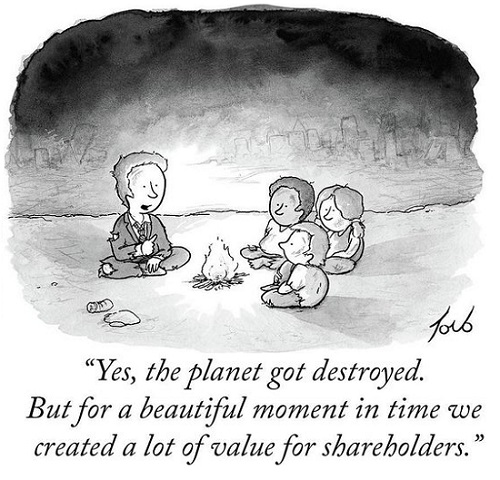
For those who are fans of cartoons from The New Yorker magazine and consistent readers of this blog, you might be able to guess my two favorite cartoons. In the first one, a man in a coat and tie stands at a podium and tells his unseen audience the following: “And so, while the end-of-the-world scenario will be rife with unimaginable horrors, we believe that the pre-end period will be filled with unprecedented opportunities for profit.”

In the second, a man in a tattered suit sits cross-legged near a campfire with three children listening to him intently as he says this: “Yes, the planet got destroyed. But for a beautiful moment in time we created a lot of value for shareholders.”

Now, in the you-can’t-make-this-stuff-up category, financial writer Paul Farrell used the caption from the first cartoon in a 2015 piece for MarketWatch entitled: “Your No. 1 end-of-the-world investing strategy.” The subheading is: “How to pick stocks for the near term when long-term trends say collapse is near.” The subhead actually seems like it might be another caption from a New Yorker cartoon (or possibly one from The Onion). Why exactly would you invest in stocks—as opposed to seeds of food crops and sturdy garden implements—”when long-term trends say collapse is near”? But I’ll put that down to bad headline writing.

In Farrell’s defense, he frequently used his column in MarketWatch to warn his readers of the coming collapse of modern civilization if we don’t change our ways. He was obliged to give investment advice, of course, because that’s what the column was for.

Few other investment gurus are as intellectually honest as Farrell. Among prominent investment managers, only Jeremy Grantham comes close to understanding the scope of the challenges we face. Grantham wrote a piece in 2013 called “The Race of Our Lives” that outlines the myriad challenges humans face. He starts with a discussion of the fall of civilizations. (He updated his views in 2018.)

One would think that the coronavirus pandemic would allow for some sober reflection among those in the financial community as the pandemic-induced crash of the economy and the markets has called into question the stability of practically all the arrangements of modern civilization. Instead, the focus is on how stock markets could be back at or near all-times highs at the beginning of what is arguably the next Great Depression.

The New Yorker cartoons linked above appropriately characterize the madness that grips late-stage civilizations as their pillars begin to fall. Instead of attempting to adapt to new realities, every attempt is made to maintain the current fragile system. The trillions of dollars pumped into the world financial system by central banks and governments in the wake of the pandemic have done little except stoke renewed financial bubbles in practically all financial markets (and thereby bailed out the mostly wealthy owners of financial assets).

The disconnect is hard to miss. The latest reading of the U.S. Federal Reserve Bank of Atlanta’s GDPNow indicator, which is frequently updated as new data becomes available, now predicts that U.S. GDP will contract by 45.5 percent in the current quarter. (The number is annualized and seasonally adjusted.)

Even so the NASDAQ Composite Index hit a new all-time high earlier this month just three months after the recent trough reached during the crash. The S&P 500 is now very close to a new all-time high. Neither development makes sense in the middle of the worst economic downturn since the Great Depression. For comparison, it took more than two years for the NASDAQ Composite from the bottom in 2009 during the Great Financial Crisis to regain its 2007 highs. It took the S&P 500 more than four years.

Of course, the financialization of everything continues. Vaccine makers are in line for government funds. Naturally, it takes money to develop a vaccine. But drug makers aren’t in the business of keeping people healthy. They are in the business of making money. In the United States at least they are helped by the fact that they aren’t liable if their vaccine kills or injuries someone. And, executives in one money-losing pharmaceutical firm cashed in stock right after their company goosed the shares significantly higher with a very preliminary announcement about the company’s coronavirus vaccine research.

When it comes to real estate, it used to be that people bought it for income and as a store of value. Now firms buy real estate mostly with borrowed money and try to make gains mostly through property price appreciation. Often the real estate loans are packaged into securities that are sold and resold as part of the giant Wall Street and worldwide financial casino.

One of the surest signs of the financialization of everything and the growing disconnect of finance from reality is the credit default swap (CDS). The CDS is essentially insurance for loans and bonds. The buyer pays the seller a premium every month. If the instrument insured defaults, the seller provides a predetermined payment to reimburse the CDS buyer. Now here’s the weird thing: An investor doesn’t even have to own the loan or bond to insure it. It’s like me taking out an insurance policy on your home against fire when I have no ownership or interest in the home. In fact, I have every incentive to make sure your house burns down. Do you see any problem with that?

For normal insurance, the buyer must have an insurable interest. Typically, this means the buyer must actually own the thing he or she is insuring. The CDS, on the other hand, is an ideal instrument for those who want to bring on a financial end-of-the-world scenario. The buyers have every reason to want the economy to go down the drain as their payments may be 10 or even 20 times their initial investment.

Many wealthy people fear and even believe an end-of-the-world scenario is possible or probable. Some think they can hold up in luxury bunkers until the dust clears. But what if, when the dust clears, their wealth is gone and the financial world they used to inhabit has vanished.

Perhaps they will sit around campfires telling their grandchildren about the old days when finance was king and the real economy of goods and services was just a place where rubes got their daily bread—while, of course, simultaneously providing an outsized portion to the rich.

Another Bank Bailout Under Cover of a Virus

By Ellen Brown

Source: Web of Debt

Insolvent Wall Street banks have been quietly bailed out again. Banks made risk-free by the government should be public utilities.  

When the Dodd Frank Act was passed in 2010, President Obama triumphantly declared, “No more bailouts!” But what the Act actually said was that the next time the banks failed, they would be subject to “bail ins” – the funds of their creditors, including their large depositors, would be tapped to cover their bad loans.

Then bail-ins were tried in Europe. The results were disastrous.

Many economists in the US and Europe argued that the next time the banks failed, they should be nationalized – taken over by the government as public utilities. But that opportunity was lost when, in September 2019 and again in March 2020, Wall Street banks were quietly bailed out from a liquidity crisis in the repo market that could otherwise have bankrupted them. There was no bail-in of private funds, no heated congressional debate, and no public vote. It was all done unilaterally by unelected bureaucrats at the Federal Reserve.

“The justification of private profit,” said President Franklin Roosevelt in a 1938 address, “is private risk.” Banking has now been made virtually risk-free, backed by the full faith and credit of the United States and its people. The American people are therefore entitled to share in the benefits and the profits. Banking needs to be made a public utility.

The Risky Business of Borrowing Short to Lend Long

Individual banks can go bankrupt from too many bad loans, but the crises that can trigger system-wide collapse are “liquidity crises.” Banks “borrow short to lend long.” They borrow from their depositors to make long-term loans or investments while promising the depositors that they can come for their money “on demand.” To pull off this sleight of hand, when the depositors and the borrowers want the money at the same time, the banks have to borrow from somewhere else. If they can’t find lenders on short notice, or if the price of borrowing suddenly becomes prohibitive, the result is a “liquidity crisis.”

Before 1933, when the government stepped in with FDIC deposit insurance, bank panics and bank runs were common. When people suspected a bank was in trouble, they would all rush to withdraw their funds at once, exposing the fact that the banks did not have the money they purported to have. During the Great Depression, more than one-third of all private US banks were closed due to bank runs.

But President Franklin D. Roosevelt, who took office in 1933, was skeptical about insuring bank deposits. He warned, “We do not wish to make the United States Government liable for the mistakes and errors of individual banks, and put a premium on unsound banking in the future.” The government had a viable public alternative, a US postal banking system established in 1911. Postal banks became especially popular during the Depression, because they were backed by the US government. But Roosevelt was pressured into signing the 1933 Banking Act, creating the Federal Deposit Insurance Corporation that insured private banks with public funds.

Congress, however, was unwilling to insure more than $5,000 per depositor (about $100,000 today), a sum raised temporarily in 2008 and permanently in 2010 to $250,000. That meant large institutional investors (pension funds, mutual funds, hedge funds, sovereign wealth funds) had nowhere to park the millions of dollars they held between investments. They wanted a place to put their funds that was secure, provided them with some interest, and was liquid like a traditional deposit account, allowing quick withdrawal. They wanted the same “ironclad moneyback guarantee” provided by FDIC deposit insurance, with the ability to get their money back on demand.

It was largely in response to that need that the private repo market evolved. Repo trades, although technically “sales and repurchases” of collateral, are in effect secured short-term loans, usually repayable the next day or in two weeks. Repo replaces the security of deposit insurance with the security of highly liquid collateral, typically Treasury debt or mortgage-backed securities. Although the repo market evolved chiefly to satisfy the needs of the large institutional investors that were its chief lenders, it also served the interests of the banks, since it allowed them to get around the capital requirements imposed by regulators on the conventional banking system. Borrowing from the repo market became so popular that by 2008, it provided half the credit in the country. By 2020, this massive market had a turnover of $1 trillion a day.

Before 2008, banks also borrowed from each other in the fed funds market, allowing the Fed to manipulate interest rates by controlling the fed funds rate. But after 2008, banks were afraid to lend to each other for fear the borrowing banks might be insolvent and might not pay the loans back. Instead the lenders turned to the repo market, where loans were supposedly secured with collateral. The problem was that the collateral could be “rehypothecated,” or used for several loans at once; and by September 2019, the borrower side of the repo market had been taken over by hedge funds, which were notorious for risky rehypothecation. Many large institutional lenders therefore pulled out, driving the cost of borrowing at one point from 2% to 10%.

Rather than letting the banks fail and forcing a bail-in of private creditors’ funds, the Fed quietly stepped in and saved the banks by becoming the “repo lender of last resort.” But the liquidity crunch did not abate, and by March the Fed was making $1 trillion per day available in overnight loans. The central bank was backstopping the whole repo market, including the hedge funds, an untenable situation.

In March 2020, under cover of a national crisis, the Fed therefore flung the doors open to its discount window, where only banks could borrow. Previously, banks were reluctant to apply there because the interest was at a penalty rate and carried a stigma, signaling that the bank must be in distress. But that concern was eliminated when the Fed announced in a March 15 press release that the interest rate had been dropped to 0.25% (virtually zero). The reserve requirement was also eliminated, the capital requirement was relaxed, and all banks in good standing were offered loans of up to 90 days, “renewable on a daily basis.” The loans could be continually rolled over. And while the alleged intent was “to help meet demands for credit from households and businesses at this time,” no strings were attached to this interest-free money. There was no obligation to lend to small businesses, reduce credit card rates, or write down underwater mortgages.

The Fed’s scheme worked, and demand for repo loans plummeted. Even J.P. Morgan Chase, the largest bank in the country, has acknowledged borrowing at the Fed’s discount window for super cheap loans. But the windfall to Wall Street has not been shared with the public. In Canada, some of the biggest banks slashed their credit card interest rates in half, from 21 percent to 11 percent, to help relieve borrowers during the COVID-19 crisis. But US banks have felt no such compunction. US credit card rates dropped in April only by half a percentage point, to 20.15%. The giant Wall Street banks continue to favor their largest clients, doling out CARES Act benefits to them first, emptying the trough before many smaller businesses could drink there.

In 1969, Prime Minister Indira Gandhi nationalized 14 of India’s largest banks, not because they were bankrupt (the usual justification today) but to ensure that credit would be allocated according to planned priorities, including getting banks into rural areas and making cheap financing available to Indian farmers.  Congress could do the same today, but the odds are it won’t. As Sen. Dick Durbin said in 2009, “the banks … are still the most powerful lobby on Capitol Hill. And they frankly own the place.”

Time for the States to Step In

State and local governments could make cheap credit available to their communities, but today they too are second class citizens when it comes to borrowing. Unlike the banks, which can borrow virtually interest-free with no strings attached, states can sell their bonds to the Fed only at market rates of 3% or 4% or more plus a penalty. Why are elected local governments, which are required to serve the public, penalized for shortfalls in their budgets caused by a mandatory shutdown, when private banks that serve private stockholders are not?

States can borrow from the federal unemployment trust fund, as California just did for $348 million, but these loans too must be paid back with interest, and they must be used to cover soaring claims for state unemployment benefits. States remain desperately short of funds to repair holes in their budgets from lost revenues and increased costs due to the shutdown.

States are excellent credit risks – far better than banks would be without the life-support of the federal government. States have a tax base, they aren’t going anywhere, they are legally required to pay their bills, and they are forbidden to file for bankruptcy. Banks are considered better credit risks than states only because their deposits are insured by the federal government and they are gifted with routine bailouts from the Fed, without which they would have collapsed decades ago.

State and local governments with a mandate to serve the public interest deserve to be treated as well as private Wall Street banks that have repeatedly been found guilty of frauds on the public. How can states get parity with the banks? If Congress won’t address that need, states can borrow interest-free at the Fed’s discount window by forming their own publicly-owned banks. For more on that possibility, see my earlier article here.

As Buckminster Fuller said, “You never change things by fighting the existing reality. To change something, create a new model that makes the old model obsolete.” Post-COVID-19, the world will need to explore new models; and publicly-owned banks should be high on the list.

From Soft to Hard Fascism: “Get In Your House Right Now!”

By Kurt Nimmo

Source: Another Day in the Empire

There can no longer be any doubt—America is now a full-blown fascist state. In the past, authoritarian fascism was kept reserved in the shadows, largely out of the public eye, but in a remarkably short period of time it has emerged from the darkness to show its fangs and snarl menacingly at the people, many of them cowed and dutifully following irrational orders from on high.

As the following video demonstrates, state violence is not directed exclusively at rioters and Antifa goons pretending to be anarchists (most would be unable to define the term) as they loot, burn, and attack the media and innocent bystanders. Violence is used to frighten and intimidate the real enemies of the state—the American people, or those who casually and defy the COVID lockdown and others peacefully protesting murder at the hand of a psychopathic cop.

Fortunately, the woman in the video was not seriously injured. She wasn’t looting Target or burning down Walmart. The woman made the mistake of venturing out on the porch of her home, her private property, and for this crime, she was shot with a paintball by a member of a “state militia” (now federalized).

The social fabric is coming apart at the seams. First mandatory lockdowns, state-imposed impoverishment, followed by an unfolding Greatest Depression as a result of a shutdown economy, and now social unrest, violence, theft, and arson in two dozen large cities across the country.

If this degree of violence and destruction is possible centered around the death of a single man, imagine what will happen when millions of people are in desperate straits, unemployed, many evicted, and homeless. It will not be simply police stations that go up in flames. It will be statehouses.   

However, the American people have demonstrated repeatedly they are gullible and easily steered into dead-end diversions pumped up and hyped 24/7 by a corporate propaganda media. The Trump hatefest and political polarization—worse than any in recent memory—will no doubt go by the wayside as millions of Americans face the “new normal” envisioned by their masters—a standard of living in rapid freefall, soon to crash on the rocks. None of this is happenstance or coincidental.

Most Americans may not have protested the endless wars and criminal economic scams of the ruling elite (mostly due to decades of incessant propaganda), but they will raise their voices and fists when they are unemployed for months on end, evicted from homes and apartments, have their cars repossessed, and are confronted with hunger, want, and homelessness.

In order to enforce the latest manifestation of psychopathic neoliberalism and predatory crony capitalism, the state will depend on steroid-headed soldiers and cops to frighten and intimidate the people.

It may be paintballs today, but tomorrow it might be live ammo.

America’s Super-Rich See Their Wealth Rise by $282 Billion in Three Weeks of Pandemic

America’s billionaires have accrued more wealth in the past three weeks alone than they made in total prior to 1980.

Source: Mint Press News

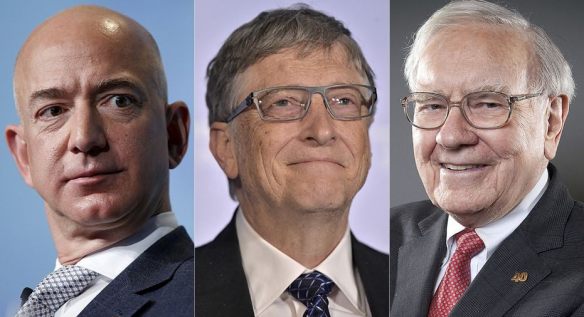
A new report from the Institute for Policy Studies found that, while tens of millions of Americans have lost their jobs during the coronavirus pandemic, America’s ultra-wealthy elite have seen their net worth surge by $282 billion in just 23 days. This is despite the fact that the economy is expected to contract by 40 percent this quarter. The report also noted that between 1980 and 2020 the tax obligations of America’s billionaires, measured as a percentage of their wealth, decreased by 79 percent. In the last 30 years, U.S. billionaire wealth soared by over 1100 percent while median household wealth increased by barely five percent. In 1990, the total wealth held by America’s billionaire class was $240 billion; today that number stands at $2.95 trillion. Thus, America’s billionaires accrued more wealth in just the past three weeks than they made in total prior to 1980. As a result, just three people ­– Amazon CEO Jeff Bezos, Microsoft co-founder Bill Gates and Berkshire Hathaway’s Warren Buffet – own as much wealth as the bottom half of all U.S. households combined.

The Institute for Policy Studies’ report paints a picture of a modern day oligarchy, where the super-rich have captured legislative and executive power, controlling what laws are passed. The report discusses what it labels a new “wealth defense industry” – where “billionaires are paying millions to dodge billions in taxes,” with teams of accountants, lawyers, lobbyists and asset managers helping them conceal their vast fortunes in tax havens and so-called charitable trusts. The result has been crippled social programs and a decrease in living standards and even a sustained drop in life expectancy – something rarely seen in history outside of major wars or famines. Few Americans believe their children will be better off than they were. Statistics suggest they are right.

Billionaires very theatrically donate a fraction of what they used to give back in taxes, making sure to generate maximum publicity for their actions. And they secure positive coverage of themselves by stepping in to keep influential news organizations afloat. A December investigation by MintPress found that Gates had donated over $9 million to The Guardian, over $3 million to NBC Universal, over $4.5 million to NPR, $1 million to Al-Jazeera, and a staggering $49 million to the BBC’s Media Action program. Some, like Bezos, prefer to simply outright purchase news organizations themselves, changing the editorial stance to unquestioning loyalty to their new owners.

The spike in billionaire wealth comes amid an unprecedented economic crash; 26.5 million Americans have filed for unemployment over the last five weeks, and that number is expected to continue to rise dramatically. While the super-rich are holed up in their mansions and yachts, the 49-62 million Americans designated as “essential workers” must continue to risk their lives to keep society functioning, even as many of them do not even earn as much as the $600 weekly increase in unemployment benefits the CARES act stipulates. Many low paid workers, such as grocery store employees, have already fallen sick and died. The mother of one 27-year-old Maryland worker who contracted COVID-19 and died received her daughter’s last paycheck. It amounted to $20.64.

Amazon staff, directly employed by Bezos, also risk their lives for measly pay. One third of all Amazon workers in Arizona, for example, are enrolled in the food stamps program, their wages so low that they cannot afford to pay for food. The vast contrast in the effect that COVID-19 has had on the super wealthy versus the rest of us has many concluding that billionaires’ wealth and the poverty of the rest of the world are two sides of the same coin: that the reason people working full-time still cannot afford a house or even to eat is the same reason people like Bezos control more wealth than many countries. Bezos’ solution to his employees’ hunger has been to set up a charity and ask for public donations to help his desperate workers.

The majority of millennials, most of them shut out from attaining the American dream, already prefer socialism to capitalism, taking a dim view of the latter. The latest news that the billionaire class is laughing all the way to the bank during a period of intense economic suffering is unlikely to improve their disposition.


Alan MacLeod is a Staff Writer for MintPress News. After completing his PhD in 2017 he published two books: Bad News From Venezuela: Twenty Years of Fake News and Misreporting and Propaganda in the Information Age: Still Manufacturing Consent. He has also contributed to Fairness and Accuracy in Reporting, The Guardian, Salon, The Grayzone, Jacobin Magazine, Common Dreams the American Herald Tribune and The Canary.