A War Like No Other in Ukraine

By Peter Van Buren

Source: WeMeantWell.com

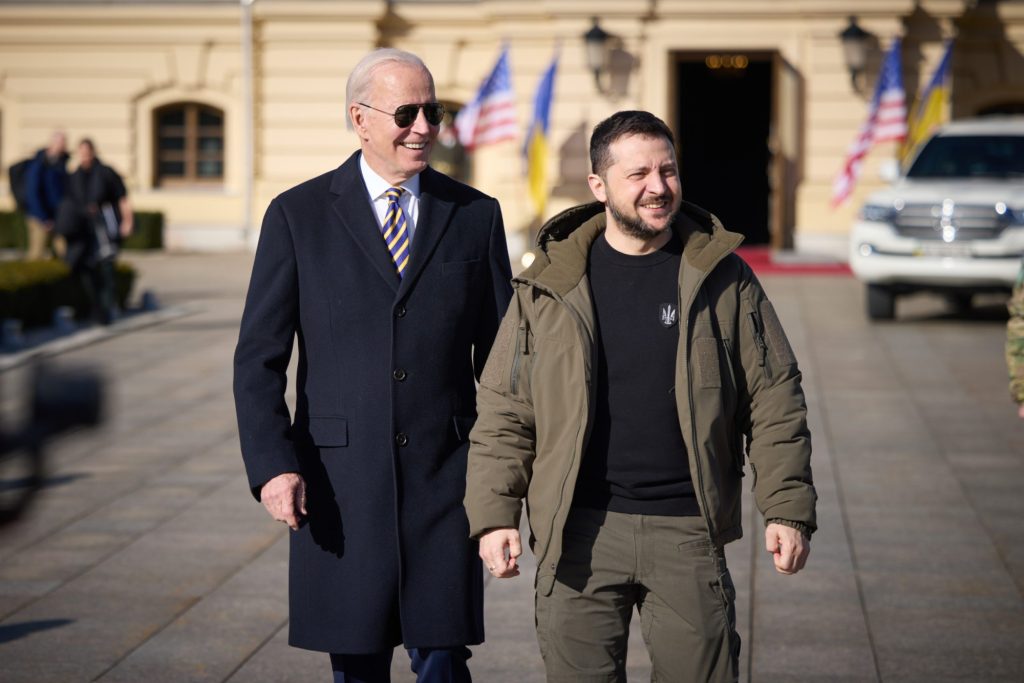
Joe Biden created for the U.S. a war like no other, one where others die and the U.S. simply sits back and pays the bills on a gargantuan scale. No attempts are made at diplomacy by the Americans, and the diplomatic efforts of others like the Chinese are dismissed as evil attempts to gain influence in the area (similar for Chinese diplomatic work in the Yemen war.) Biden is coming close to achieving 1984‘s goal of perpetual warfare while only putting a handful of American lives at risk. He has learned lessons from the Cold War, and already put them into play. Can we call it the Biden Doctrine yet?

Biden’s strategy is clear enough now after well more than a year of conflict; what he has been sending to Ukraine jumped from helmets and uniforms to F-16s in only 15 months and shows no signs of stopping. The problem is U.S. weapons are never enough for victory and always “just enough” to allow the battle to go on until then next round. If the Ukrainians think they are playing the U.S. for suckers for free arms they best check who is really paying for everything, in blood.

Putin is playing this game himself in a way, careful not to introduce anything too powerful, such as strategic bombers, and upset the balance and offer Biden the chance to intervene in the war directly (one can hear old man Biden on TV now, explaining American airstrikes are needed to prevent a genocide, the go-to excuse he learned at Obama’s knee.) That’s what the current escalation holds, airpower. Ukraine will find even with the promise of the F-16 it can’t acquire aircraft and train up pilots fast enough (minimum training time is 18-24 months), and next will be begging the U.S. to serve as its air force. As it is the planes are likely to be based out of Poland and Romania, suggesting NATO will pick up the high-skilled tasks of maintaining and repairing them. Left unclear is the NATO role in required aerial refueling to keep the planes over the battlefield. F-16s aside, a spin off bonus to all these weapons gifts is that the vast majority of transfers to date have been “presidential drawdowns.” This means the U.S. sends used or older weapons to Ukraine, after which the Pentagon can use the Congressionally-authorized funds to replenish their stocks by purchasing new arms. The irony that war machines once in Iraq are now on the ground in Ukraine can’t be missed.

The U.S. strategy seems based on creating a ghastly tie of sorts, two sides lined up across a field shooting at each other until one side called it quits for the day. Same as in 1865, same as in 1914, but the new factor is today those armies face off across those fields with 21st-century HIMARS artillery, machine guns, and other tools of killing far more effective than a musket. It is unsustainable, literally chewing up men, albeit not Americans. The question meanwhile of how many more Ukrainians have to die is answered privately by Joe Biden as “potentially all of them.” Anything else requires you to cynically believe Biden thinks he can simply purchase victory,

Up until now this has all been the Cold War playbook. Fighting to the last Afghan was a strategy perfected in Soviet-held Afghanistan in the 1980s. Yet what is different is the scale — since Russia invaded Ukraine, the United States sent over $37 billion worth of military aid to support Kiev’s war effort, the single largest arms transfer in U.S. history and one with no signs of stopping. A single F-16 costs up to $350 million a copy if bought with weapons, maintenance equipment, and spare parts kits.

Yet despite the similarities to Cold War Strategy 101, some lessons have been learned over the intervening years. One of America’s fail-points throughout the Cold War and the War on Terror was the use of puppet governments largely imposed or direly supported by American money and muscle. Because these governments lacked the support of the people (see Vietnam, Iraq, and Afghanistan) they were non-starters with the lifespan of fruit flies. Ukraine is different; the puppet government is the government, beholden to the U.S. for its very survival but more or less supported directly by the people for now.

The other lesson learned has to do with nation building, or rebuilding or reconstruction, whatever the vast post-war expenditures will be called in this conflict. No more straight-up governmental efforts as in Vietnam, Iraq, and Afghanistan. This time it will be all private enterprise. “It is obvious that American business can become the locomotive that will once again push forward global economic growth,” President Zelensky said, boasting that BlackRock, JP Morgan, and Goldman Sachs, and others “have already become part of our Ukrainian way.”

The NYT calls Ukraine “the world’s largest construction site” and predicts projects there in the multi-billions, as high in some estimates as $750 billion. It will be, says the Times, a “gold rush: the reconstruction of Ukraine once the war is over. Russia is stepping up its offensive heading into the second year of the war, but already the staggering rebuilding task is evident. Hundreds of thousands of homes, schools, hospitals and factories have been obliterated along with critical energy facilities and miles of roads, rail tracks and seaports. The profound human tragedy is unavoidably also a huge economic opportunity.” Earlier this year JP Morgan and Zelensky signed a memorandum of understanding stipulating Morgan would assist Ukraine in its reconstruction.

And maybe those large American companies have learned the lessons of Iraq and Afghanistan. Of the billions spent, much money was wasted on dead ends and much was siphoned off due to corruption. But success or failure, the contractors always got paid in our Wars of Terror. With that in mind, more than 300 companies from 22 countries signed up for a Rebuild Ukraine exhibition and conference in Warsaw. At the World Economic Forum in Davos, Switzerland, a standing-room-only crowd packed Ukraine House to discuss investment opportunities.

The eventual gold rush in rebuilding makes for an interesting addendum to the Biden strategy of fighting to the last Ukrainian. The more that is destroyed the more that needs to be rebuilt, and the potential for more money to pour into U.S. companies smart enough to wait by the trough for the killing to subside. But why wait? Drones operated by Danish companies have already mapped every bombed-out structure in the Mykolaiv Oblast region, with an eye toward using the data to help decide what reconstruction contracts should be issued.

So let’s put some lipstick on this pig of a strategy and call it the Biden Doctrine. Part I is to limit direct U.S. combat involvement while fanning the flames for others. Part II is to provide massive amounts of arms to enable a fight to the last local person. Part III is to transform the home government into a puppet instead of creating an unpopular one afresh. Part IV is to turn the reconstruction process into a profit center for American companies. How long the war lasts and how many die are cynically not part of the strategy. The off ramp in Ukraine, a diplomatic outcome that resets the map to pre-invasion 2022 levels, is clear enough to Washington. The Biden administration seems content, shamefully, not to call forcefully for diplomatic efforts but instead to bleed out the Russians as if this was Afghanistan 1980, albeit in the heart of Europe.
The patriotism of killing and being killed

Why are patriotism and war so intertwined in U.S. media and politics?

By Norman Solomon

Source: Nation of Change

The Fourth of July—the ultimate patriotic holiday—is approaching again. Politicians orate, American Flags proliferate and, even more than usual, many windows on the world are tinted red, white and blue. But an important question remains unasked: Why are patriotism and war so intertwined in U.S. media and politics?

The highest accolades often go to those who died for their country. But when a war is based on deception with horrific results, as became clear during the massive bloodshed in Vietnam, realism and cynicism are apt to undermine credulity. “War’s good business so give your son,” said a Jefferson Airplane song in 1967. “And I’d rather have my country die for me.”

Government leaders often assert that participating in war is the most laudable of patriotic services rendered. And even if the fighters don’t know what they’re fighting for, the pretense from leadership is that they do. When President Lyndon Johnson delivered a speech to U.S. troops at Cam Ranh Bay in South Vietnam, he proclaimed that “you know what you are doing, and you know why you are doing it—and you are doing it.”

Five decades later, long after sending U.S. troops to invade Panama in 1989 and fight the 1991 Gulf War, former President George H.W. Bush tweeted that he was “forever grateful not only to those patriots who made the ultimate sacrifice for our Nation—but also the Gold Star families whose heritage is imbued with their honor and heroism.” Such lofty rhetoric is routine.

Official flattery elevates the warriors and the war, no matter how terrible the consequences. In March 2010, making his first presidential visit to Afghanistan, Barack Obama told the assembled troops at Bagram Air Base that they “represent the virtues and the values that America so desperately needs right now: sacrifice and selflessness, honor and decency.”

From there, Obama went on to a theme of patriotic glory in death: “I’ve been humbled by your sacrifice in the solemn homecoming of flag-draped coffins at Dover, to the headstones in section 60 at Arlington, where the fallen from this war rest in peace alongside the fellow heroes of America’s story.” Implicit in such oratory is the assumption that “America’s story” is most heroic and patriotic on military battlefields.

A notable lack of civic imagination seems to assume that there is no higher calling for patriotism than to kill and be killed. It would be an extremely dubious notion even if U.S. wars from Vietnam to Afghanistan and Iraq had not been based on deception—underscoring just how destructive the conflation of patriotism and war can be.

From Vietnam to Iraq and beyond, the patriotism of U.S. troops—and their loved ones as well as the general public back home—has been exploited and manipulated by what outgoing President Dwight Eisenhower called the “military-industrial complex.” Whether illuminated by the Pentagon Papers in 1971 or the absence of the proclaimed Iraqi weapons of mass destruction three decades later, the falsehoods provided by the White House, State Department and Pentagon have been lethal forms of bait-and-switch.

Often lured by genuine love of country and eagerness to defend the United States of America, many young people have been drawn into oiling the gears of a war machine—vastly profitable for Pentagon contractors and vastly harmful to human beings trapped in warfare.

Yet, according to top officials in Washington and compliant media, fighting and dying in U.S. wars are the utmost proof of great patriotism.

We’re encouraged to closely associate America’s wars with American patriotism in large part because of elite interest in glorifying militarism as central to U.S. foreign policy. Given the destructiveness of that militarism, a strong argument can be made that true patriotism involves preventing and stopping wars instead of starting and continuing them.

If such patriotism can ever prevail, the Fourth of July will truly be a holiday to celebrate.

PRIGOZHIN’S FOLLY

By Seymour Hersh

Source: Mint Press News

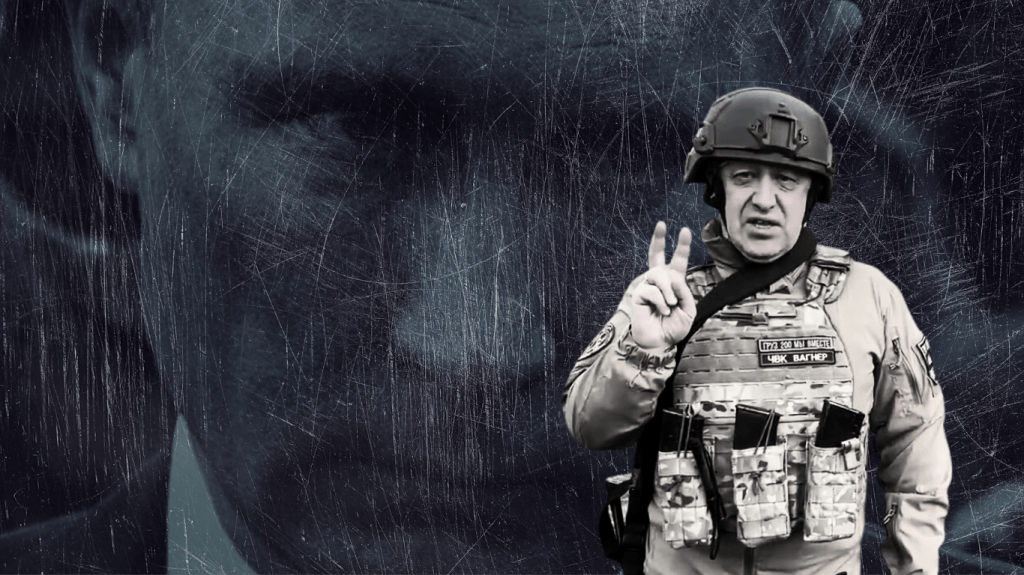
The Biden administration had a glorious few days last weekend. The ongoing disaster in Ukraine slipped from the headlines to be replaced by the “revolt,” as a New York Times headline put it, of Yevgeny Prigozhin, chief of the mercenary Wagner Group.
The focus slipped from Ukraine’s failing counter-offensive to Prigozhin’s threat to Putin’s control. As one headline in the Times put it, “Revolt Raises Searing Question: Could Putin Lose Power?” Washington Post columnist David Ignatius posed this assessment: “Putin looked into the abyss Saturday—and blinked.”

Secretary of State Antony Blinken—the administration’s go-to wartime flack, who weeks ago spoke proudly of his commitment not to seek a ceasefire in Ukraine—appeared on CBS’s Face the Nation with his own version of reality: “Sixteen months ago, Russian forces were . . . thinking they would erase Ukraine from the map as an independent country,” Blinken said. “Now, over the weekend they’ve had to defend Moscow, Russia’s capital, against mercenaries of Putin’s own making. . . . It was a direct challenge to Putin’s authority. . . . It shows real cracks.”

Blinken, unchallenged by his interviewer, Margaret Brennan, as he knew he would not be—why else would he appear on the show?—went on to suggest that the defection of the crazed Wagner leader would be a boon for Ukraine’s forces, whose slaughter by Russian troops was ongoing as he spoke. “To the extent that it presents a real distraction for Putin, and for Russian authorities, that they have to look at—sort of mind their rear as they’re trying to deal with the counter offensive in Ukraine, I think that creates even greater openings for the Ukrainians to do well on the ground.”

At this point was Blinken speaking for Joe Biden? Are we to understand that this is what the man in charge believes?

We now know that the chronically unstable Prigozhin’s revolt fizzled out within a day, as he fled to Belarus, with a no-prosecution guarantee, and his mercenary army was mingled into the Russian army. There was no march on Moscow, nor was there a significant threat to Putin’s rule.

Pity the Washington columnists and national security correspondents who seem to rely heavily on official backgrounders with White House and State Department officials. Given the published results of such briefings, those officials seem unable to look at the reality of the past few weeks, or the total disaster that has befallen the Ukraine military’s counter-offensive.

So, below is a look at what is really going that was provided to me by a knowledgeable source in the American intelligence community:

“I thought I might clear some of the smoke. First and most importantly, Putin is now in a much stronger position. We realized as early as January of 2023 that a showdown between the generals, backed by Putin, and Prigo, backed by anti-Russian extremists, was inevitable. The age-old conflict between the ‘special’ war fighters and a large, slow, clumsy, unimaginative regular army. The army always wins because they own the peripheral assets that make victory, either offensive or defensive, possible. Most importantly, they control logistics. special forces see themselves as the premier offensive asset. When the overall strategy is offensive, big army tolerates their hubris and public chest thumping because SF are willing to take high risk and pay a high price. Successful offense requires a large expenditure of men and equipment. Successful defense, on the other hand, requires husbanding these assets.

“Wagner members were the spearhead of the original Russian Ukraine offensive. They were the ‘little green men’. When the offensive grew into an all-out attack by the regular army, Wagner continued to assist but reluctantly had to take a back seat in the period of instability and readjustment that followed. Prigo, no shy violet, took the initiative to grow his forces and stabilize his sector.

“The regular army welcomed the help. Prigo and Wagner, as is the wont of special forces, took the limelight and took the credit for stopping the hated Ukrainians. The press gobbled it up. Meanwhile, the big army and Putin slowly changed their strategy from offensive conquest of greater Ukraine to defense of what they already had. Prigo refused to accept the change and continued on the offensive against Bakhmut. Therein lies the rub. Rather than create a public crisis and court-martial the asshole [Prigozhin], Moscow simply withheld the resources and let Prigo use up his manpower and firepower reserves, dooming him to a stand-down. He is, after all, no matter how cunning financially, an ex-hot dog cart owner with no political or military accomplishments.

“What we never heard is three months ago Wagner was cycled out of the Bakhmut front and sent to an abandoned barracks north of Rostov-on-Don [in southern Russia] for demobilization. The heavy equipment was mostly redistributed, and the force was reduced to about 8,000, 2,000 of which left for Rostov escorted by local police.

“Putin fully backed the army who let Prigo make a fool of himself and now disappear into ignominy. All without raising a sweat militarily or causing Putin to face a political standoff with the fundamentalists, who were ardent Prigo admirers. Pretty shrewd.”

There is an enormous gap between the way the professionals in the American intelligence community assess the situation and what the White House and the supine Washington press project to the public by uncritically reproducing the statements of Blinken and his hawkish cohorts.

The current battlefield statistics that were shared with me suggest that the Biden administration’s overall foreign policy may be at risk in Ukraine. They also raise questions about the involvement of the NATO alliance, which has been providing the Ukrainian forces with training and weapons for the current lagging counter-offensive. I learned that in the first two weeks of the operation, the Ukraine military seized only 44 square miles of territory previously held by the Russian army, much of it open land. In contrast, Russia is now in control of 40,000 square miles of Ukrainian territory. I have been told that in the past ten days Ukrainian forces have not fought their way through the Russian defenses in any significant way. They have recovered only two more square miles of Russian-seized territory. At that pace, one informed official said, waggishly, it would take Zelensky’s military 117 years to rid the country. of Russian occupation.

The Washington press in recent days seems to be slowly coming to grips with the enormity of the disaster, but there is no public evidence that President Biden and his senior aides in the White House and State Department aides understand the situation.

Putin now has within his grasp total control, or close to it, of the four Ukrainian oblasts—Donetsk, Kherson, Lubansk, Zaporizhzhia—that he publicly annexed on September 30, 2022, seven months after he began the war. The next step, assuming there is no miracle on the battlefield, will be up to Putin. He could simply stop where he is, and see if the military reality will be accepted by the White House and whether a ceasefire will be sought, with formal end-of-war talks initiated. There will be a presidential election next April in Ukraine, and the Russian leader may stay put and wait for that—if it takes place. President Volodymyr Zelensky of Ukraine has said there will be no elections while the country is under martial law.

Biden’s political problems, in terms of next year’s presidential election, are acute—and obvious. On June 20 the Washington Post published an article based on a Gallup poll under the headline “Biden Shouldn’t Be as Unpopular as Trump—but He Is.” The article accompanying the poll by Perry Bacon, Jr., said that Biden has “almost universal support within his own party, virtually none from the opposition party and terrible numbers among independents.” Biden, like previous Democratic presidents, Bacon wrote, struggles “to connect with younger and less engaged voters.” Bacon had nothing to say about Biden’s support for the Ukraine war because the poll apparently asked no questions about the administration’s foreign policy.

The looming disaster in Ukraine, and its political implications, should be a wake-up call for those Democratic members of Congress who support the president but disagree with his willingness to throw many billions of good money after bad in Ukraine in the hope of a miracle that will not arrive. Democratic support for the war is another example of the party’s growing disengagement from the working class. It’s their children who have been fighting the wars of the recent past and may be fighting in any future war. These voters have turned away in increasing numbers as the Democrats move closer to the intellectual and moneyed classes.

If there is any doubt about the continuing seismic shift in current politics, I recommend a good dose of Thomas Frank, the acclaimed author of the 2004 best-seller What’s the Matter with Kansas? How Conservatives Won the Heart of America, a book that explained why the voters of that state turned away from the Democratic party and voted against their economic interests. Frank did it again in 2016 in his book Listen, Liberal: Or, Whatever Happened to the Party of the People? In an afterword to the paperback edition he depicted how Hillary Clinton and the Democratic Party repeated—make that amplified—the mistakes made in Kansas en route to losing a sure-thing election to Donald Trump.

It may be prudent for Joe Biden to talk straight about the war, and its various problems for America—and to explain why the estimated more than $150 billion that his administration has put up thus far turned out to be a very bad investment.

America At War-Provoking The Consequences

By Christopher Black

Source: New Eastern Outlook

The United States of America is at war with Russia. There is not much point in using terms such as “proxy war” to describe the situation. If a belligerent in a war is acting as a proxy for another power and that power is not engaged directly in the war, the term can be useful. But when the power, for which the “proxy” engages in the war, is directly involved in the war itself, then it is a co-belligerent, a party to the war directly, not simply by proxy.

The issue is whether each state is pursuing its own interests and has its own independent means of doing so, or whether the interests and forces of the allied powers are subordinate to the interests and forces of a leader.  In such a case, the enemy being attacked can regard all its opponents as a single entity.

In this regard, Clausewitz said that, “if you can vanquish all your enemies by defeating one of them, that defeat must be the main objective of the war. In this one enemy, we strike at the centre of gravity of the entire conflict.”

If we analyse the war in the Ukraine theatre of operations in these terms, it becomes clear that the Ukrainian military forces are in fact forces of the United States of America. They have been created, armed, trained, supplied, financed, and are directed and commanded by the Americans, for American interests. The government for whom they nominally fight is a puppet state, installed in power by the United States and its NATO allies in a coup d’etat in 2014. It has no independent interests outside of American ones, and no control over the war or the forces nominally under its command.

The United States of America is the leader of a hostile military alliance, the purpose of which, since its inception, has been to isolate, threaten, attack and destroy Russia, has conspired with its alliance for years to achieve this end, has spent vast resources to prepare the attack, and has, with malice and determination, sabotaged any proposals for peace.  It insists on war.  It is the centre of gravity of the entire conflict.

The American government claims that it is not engaged even in a proxy war with Russia, that they are merely assisting an independent nation suffering aggression from another, that this does not put them at war with Russia, a war which, they claim, they are trying to avoid despite their actions and daily propaganda.

But, like the British, and the rest, the truth is the United States of America is a party to the war directly, according to all accepted criteria under international law. It supplies money to conduct the war, tanks, armoured vehicles, aircraft, arms, ammunition, military provisions and other war materials, engages its own military forces-military advisors and combatants, provides military intelligence, obtained on a real-time basis from its spy networks, satellite observations and electronic data collection, engages in an intense propaganda war against Russia, has attempted, through “sanctions,” to impose a blockade on Russia and its economy and people, blew up the Nord Stream gas pipeline, sends, on a regular basis, senior government and military officials, including the American President, Congressional bigwigs and the leaders of other members of the military alliance, to meet with and direct the actions of their lieutenant Zelensky, and conducts constant military exercises further threatening attacks against Russia. The NATO Air Defender military exercises begin in Europe on June 12, the day I write this, involving hundreds of NATO aircraft.

Make no mistake. The United States of America is at war with Russia. No amount of rhetoric can hide that fact and what the consequences for the United States will be. To quote Clausewitz again,

 “Danger is part of the friction of war. Without an accurate conception of danger, we cannot understand war.”

The problem is that the neither the Americans nor the other members of its unholy alliance, seem to realise the danger they are in, neither their leaders nor their citizens. Like the British, they suffer from the delusion that they are insulated from the consequences of their war, that they are invulnerable, that Russia will not dare to respond to the attacks upon its territory and people by attacking their territories. This shared delusion makes them ever more dangerous, since they think, they can keep escalating their actions in the war without any limits.  They cannot-not without consequences.

On June 8th Tass reported, following the statement by the former head of NATO, Fogh Rasmussen, that NATO countries may send their forces into the conflict directly, that Dmitry Medvedev stated,

“Fogh Rasmussen wasn’t a very smart man before. And now he has sunk into a doctrinaire’s dementia. In an interview with The Guardian, he stated that even if Banderavite Ukraine doesn’t receive an invitation to join NATO in Vilnius, the countries of the alliance will be able to send their troops there. Sort of on their own.”

“Well, have the people of these countries been asked? Who among them wants war with Russia? Do they really want hypersonic strikes on Europe? And what does Uncle Sam think about this? It would affect him too, wouldn’t it?”

Again, on June 1, TASS reported that Dmitry Medvedev stated, in connection with the attack on Russians in the Belgorod region by NATO-Ukrainian forces,

“The aim was simple – to cause damage, to harm to the civilian population somehow, And the fact that our enemy is already behaving as a terrorist characterizes in a very specific way both the Ukrainian regime and those who are behind it – first of all the Americans and the Europeans, who, in fact, have got on the warpath with us. Terrorist acts must entail the harshest retaliation possible.”

Medvedev’s views have been stated by other members of the government, by members of the Duma and by President Putin when he referred to Russian strikes on command and decision centres wherever they may be.

The Americans can whistle in the dark, lie to their people, try to fool the world, but what matters is what the Russian government thinks and knows, and it thinks, because it knows, that the United States of America is at war with Russia and seeks Russia’s complete defeat and subjugation. The campaign in Ukraine is just a phase of this war, is the current geographical space for this war, so for the United States and its allies to assume that they can carry out attacks on Russia and not suffer being dealt with in kind or worse, that war cannot be waged on their territories, is a serious mistake.

Indeed, on May 31, Dmitry Medvedev stated with respect to Britain,

“London is, in fact, waging an undeclared war on Moscow, which means that any British official can be viewed as a legitimate military target.

“Today, Great Britain is acting as an ally of Ukraine, by providing it with equipment and personnel as military assistance, that is de facto waging an undeclared war against Russia. Therefore, any of its officials, both military and civilian ones, who are making a contribution to the war effort, can be viewed as a legitimate military target,”

Medvedev was commenting on a remark by British Foreign Secretary James Cleverly who had justified the drone attacks on Moscow, saying that Ukraine had the right to attack targets on Russian territory for self-defense.

He added,

“Foolish officials in the UK, our eternal enemy, should remember that under universally recognized international law governing the conduct of war in modern conditions, including the Hague and Geneva Conventions with their additional protocols, their situation can also be qualified as being at war.”

The same analysis applies in spades to the United States of America.

An interesting comment in this regard was made by the Kremlin spokesman Dmitry Peskov on June 3rd when, according to Tass, he stated in an interview on the Rossiya-1 TV channel, that,

“Ukraine has simply become a tool of the West’s ‘hybrid war’ against Russia, and therefore it is futile to deal with it in resolving the conflict. Now, Ukraine is actually a tool of conflict. The conflict has indeed become broader, as the collective West is waging a hybrid war against our country. It is futile to deal with this tool in order to resolve the conflict, and this must be understood too.”

All the rhetoric from NATO about whether or not Ukraine can become a member of NATO is just a smokescreen to hide from their people the fact that Ukraine is already de facto part of NATO.  Whether or not the formalities of signing pieces of paper, of getting the approval of NATO states is followed through, is irrelevant.

Remember that on March 26, 2022, in Warsaw, President Biden stated,

“We have a sacred obligation under Article 5 to defend each and every inch of NATO territory with the full force of our collective power.”

He was referring not only to Poland but to Ukraine as well. What Russia feared is now the reality. Ukraine is de facto a NATO state.  And all the rhetoric from the West and commentators about whether or not NATO will invoke Article 5 is another smokescreen designed to mask what is really happening, for NATO has already activated Article 5 of the NATO Treaty.

The talk about invoking it in the future is an attempt to hide NATO’s weakness, its defeats on the military, economic and political fronts, even as they throw one weapon system after another at Russia, and inject NATO forces into the fighting only to have their equipment and forces destroyed.

 They have nothing left to throw at Russia that can defeat it.  So, they pretend NATO is not yet really engaged. But these facts make the USA even more dangerous as it becomes clear that the combined West cannot defeat Russia, a nuclear power, using conventional means.

Remember also that the United States has a first strike nuclear arms policy, and they have already placed, in Romania and Poland, land-based versions of the Aegis Air Defence System, which can be used to launch nuclear-armed missiles at Russia. These systems have been tested.  The one in Poland is reported to be fully operational as of June 30.  The danger to Russia is immediate and existential. Those systems are one of the reasons Russia activated its military operations.  Russia has further responded to this, and to the attacks on Russia, clearly planned and ordered by the US and UK, by placing tactical nuclear weapons in Belarus which are to be made operational after July 7, when the facilities to store and use them will be completed.

Those tactical nuclear weapons are designed for battlefield use. We hope it never comes to that, but Russia faces a direct threat from people bent on its destruction that think they are untouchable. So, Russia faces very difficult choices on what to do and how to prevent an escalation to all our nuclear war while ensuring its own security.

On May 23, during his visit to Laos, Deputy Head of the Russian Security Council Dmitry Medvedev issued a warning on the day Russian security forces destroyed the Ukrainian raiding force that attacked civilians in the Belgorod region.

“The North Atlantic alliance does not take the threat of nuclear war seriously enough, thus making a big mistake. NATO is not serious about this scenario. Otherwise, NATO would not have supplied such dangerous weapons to the Ukrainian regime. Apparently, they think that a nuclear conflict, or a nuclear apocalypse, is never ever possible. NATO is wrong, and at some point, events may take a completely unpredictable turn. The responsibility will be placed squarely on the North Atlantic Alliance,”

Medvedev pointed out that no one knows whether the point of no return has been passed,

“No one knows this. This is the main danger. Because as soon as they provide something, they say: let’s supply this, too. Long-range missiles or planes. Everything will be all right. But nothing will be fine. We will be able to cope with it. But only more and more serious types of weapons will be used. That’s what the current trend is.”

So, we come back to Clausewitz. The American government and people cannot understand the war they are engaged in unless they understand the danger, they are in.  They have to understand their country is the centre of gravity in this war, whose defeat will mean the defeat of all its minions in NATO. The Russian people know the danger they are in. The Americans, through NATO, through their NATO puppets in Ukraine, have attacked Russians in Russia. It is logical to expect that Russia will decide to bring home to the Americans what war means, what danger they are in, and they do not need to use nuclear weapons to achieve this.

Russia can strike using its conventional hypersonic weapons as well, against which the USA has no defence whatsoever, as has been established with the destruction of the Patriot Air defence complexes in Ukraine which could not stop Russian missiles. They have no other air defence systems operational in the United States territory or on its naval forces that can stop them either.  Russia has not decided to take this step yet. But it can and the Americans can do nothing about it except bluster about using nuclear weapons against Russia, But Russia took that possibility into account when the special military operation began.

The American people have not directly experienced war in their own territory for a long time. They have no idea what it is. They have no idea of the danger they are in so long as their government continues its aggressive policies, not only against Russia, but China as well.  The American people, misled and misinformed, have no conception of the dangers of this war anymore than the British people and the peoples of the other NATO countries do. The American people must be warned.  The United States of America is at war, and no amount of bluffing and lying can protect them from the consequences their government is provoking. To repeat what I said in my warning to the people of Britain, the consequences are predictable and they will be catastrophic.

Ukraine Stays with the West But Russia Is Winning and Has the Receipts

By Margaret Kimberley

Source: Black Agenda Report

A delegation of African leaders travelled to Ukraine and Russia to help broker peace. But the collective west insists on prolonging the conflict.

The war in Ukraine grinds on and the Ukrainian army is being destroyed by Russia with great loss of life. One would think that Ukraine would be grateful for any and all peace efforts, but it is being used as a proxy by the United States and its NATO allies, the collective west. The seeds of this catastrophe began long before Russia’s special military operation. The European Union and NATO nations brought anti-Russian right-wing forces to power in 2014 in a coup against the elected Ukrainian president. If not for them there would be no war at all.

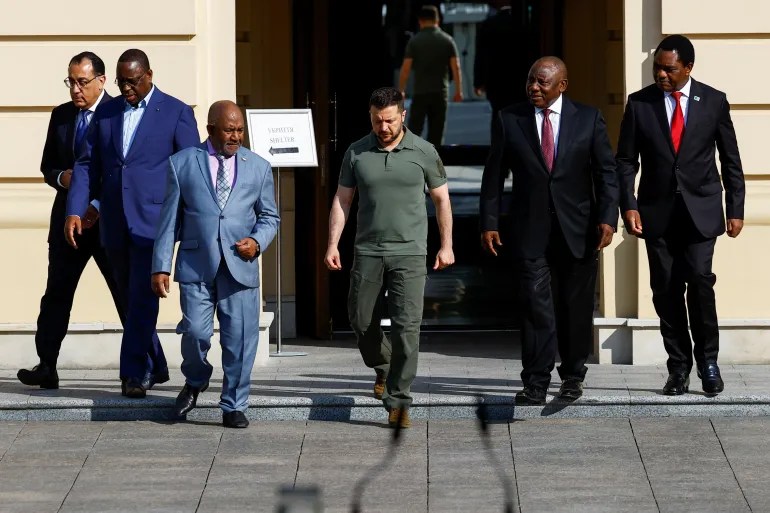
Their degree of culpability became clear recently when a delegation of African leaders traveled to Ukraine and Russia as part of a peacemaking initiative. The party included heads of state of Senegal, Egypt, Zambia, Comoros, Uganda, Republic of Congo, and South Africa. Comoros President Azali Assoumani is the current chair of the African Union. The group was greeted in Kiev by air raid sirens used to create the appearance that a Russian missile attack was underway. President Zelensky was barely polite, thanking South African president Cyril Ramaphosa and others for coming but letting them know that everything was Russia’s fault and that he had no interest whatsoever in peace talks. 

Not only is Ukraine a de facto U.S. colony which lives and dies by Washington’s whims, but it is also a deeply racist country. Much of its population is still attached to Nazi ideology and the politics of World War II collaborator Stephan Bandera. 

Nazi salutes, swastikas and other insignias are common there. So much so that the New York Times recently felt obliged to wonder in feigned innocence why these symbols are worn openly. The simple and obvious answer is that Ukraine is full of Nazis. Any likelihood that the same people would listen to Africans were indeed slim. 

Ukraine was joined in racial superiority theater by Poland. Media and security staff accompanying the presidents were delayed there and the delegation had to travel without them. When the manufactured drama was no longer needed the delegation arrived in St. Petersburg, Russia and met with president Vladimir Putin who had a surprise of his own. 

Putin listened politely to the 10-point plan and then interrupted with a surprise of his own. He not only reminded them the conflict began in 2014 but pointed out that Russia has been ready for peace ever since Turkey brokered negotiations with Ukraine in April 2022. Ukraine was on the verge of signing an agreement until its collective west friends, the US and UK in particular, scuttled the plan. 

The Treaty on Permanent Neutrality and Guarantees of Security of Ukraine offered security guarantees for Ukraine in exchange for a commitment to remain neutral, meaning that NATO membership would be off the table. Putin pointed out that as soon as Russian forces left Kiev the agreement was thrown into “the dustbin.” Just as in the case of the Minsk Agreements, the collective west offered treachery instead of peace.

The African leaders have their own self-interest which sent them to Russia. Their nations’ supplies of grain and fertilizer have been disrupted by the western sanctions and restrictions on trade with Russia. Earlier agreements on this trade have worked against Africans, as Putin pointed out, “These European neo-colonial powers, technically the US, have once again deceived the international community and the Africa countries in need: 31.7 million tonnes were exported and only three percent reached Africa’s needy countries. Is this not deception?”

It is all to the good that the international community works together to end this war, but the west is only interested in escalating and Ukraine pays the price. The collective west excels in creating propaganda and bullying its allies. The rest of the world is working to escape U.S. and NATO domination as Ukrainians die in large numbers.

Ukraine’s love of Nazi symbolism reveals why that country is content to turn its population into cannon fodder. Meanwhile western insistence on escalation brings the entire world to the brink. Yet there is still no honest discussion about how the war began, or how the Nordstream pipeline exploded. Russia is still painted as the villain and the people of this country go into another presidential election year in the dark.

Russia is not just winning on the battlefield. Nation after nation has declared an intention to use currencies other than the dollar for trade or to join the BRICS. But the collective west cannot accept defeat. The threat they represent to the world cannot be underestimated.

Schrödinger’s War – And Orwell’s

By Raúl Ilargi Meijer

Source: The Automatic Earth

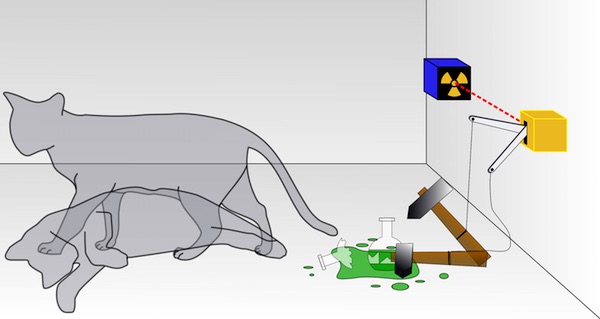
Physicist Erwin Schrödinger in 1935 tried to explain the (consequences of the) uncertainty principle, defined by Werner Heisenberg as a core theme of Albert Einstein’s view of quantum mechanics, to … Albert Einstein. The latter must have been thrilled. Even though he did not like the uncertainty principle (God does not play dice). The thought experiment became known as “Schrödinger’s cat”. Since you cannot know both a particle’s position and its speed -and that’s just one example-, you have to assume all possible outcomes are valid (superposition). Only when you “look” does one particular outcome become the “reality”. It’s all part of the subatomic “world”

Wikipedia: “In Schrödinger’s original formulation, a cat, a flask of poison, and a radioactive source are placed in a sealed box. If an internal monitor (e.g. a Geiger counter) detects radioactivity (i.e. a single atom decaying), the flask is shattered, releasing the poison, which kills the cat. The Copenhagen interpretation implies that, after a while, the cat is simultaneously alive and dead. Yet, when one looks in the box, one sees the cat either alive or dead, not both alive and dead. This poses the question of when exactly quantum superposition ends and reality resolves into one possibility or the other.”

As I’m trying to explain this, I very much have to wonder if I get it right. And I always thought that follows the uncertainty principle too: I can understand it and not understand it both at the same time. A physicist might fare a bit better, but it won’t come easy.

This is what I was thinking of with regards to the war in Ukraine. Before the fighting started, all possible outcomes seemed equally possible. If you did not look too closely at numbers of soldiers and weaponry, that is. But once it did start (when Schrödinger’s box was opened), it became clear very rapidly that Ukraine had no chance of winning. So why are we still acting as if the box remains closed? Because that way we get to spend billions more on armory, and we get western people to support Zelensky and his neo-nazis as those same people suffer from high prices for everything. Any outcome is still possible!

Take the Kakhovka dam narrative, or Nord Stream or any of the numerous other examples. When both sides accuse each other of perpetrating a certain event, Schrödinger’s box remains closed. Which is exactly what our politicians and arms makers desire. They don’t want us to know that they’ve been beaten by Russia, because you would no longer support their policies and their arms purchases. They want “superposition”. They can’t very well declare victory -though they try-, but they don’t need to either. They need uncertainty. Politicians, arms makers and media. They all profit from keeping you in the dark.

The best comment on Kakhovka I’ve seen perhaps comes from @CheburekiMan on Twitter: “Restoring water flow to the North Crimean Canal was top priority for Russia, the very first act of the SMO. Before Kiev shut off the flow in 2014, the canal was supplying 85% of Crimea’s water. So much depended on it, from crops to industry to drinking water, that’s how important it is. Now the pro-Ukraine bleating sheep want people to believe that Russia would wreck the dam, empty the reservoir and cause serious harm to its own people by running the canal dry. It’s so bonkers that one has to seriously consider such ideas are the result of brain damage, or perhaps fetal alcohol syndrome.”

Where Orwell comes in is in the terminology. Where “War equals Peace”. The EU pays its member states for the second hand weapons they “donate” to Kiev, through something called the European Peace Fund (aka Facility). Mass weapons deliveries that get huge numbers of people killed, are labeled “Peace”. Zelensky touts a plan labeled a Peace Plan, which demands Russia give back all territories, pay war reparations, deliver Putin et al to some international criminal court etc. The chance of that happening is of course zero, but as long as Schrödinger’s box remains closed, anything is possible. Still, it is a War Plan, not a Peace Plan.

Similarly, Zelensky and his international backers are organizing a Peace Summit, where everybody is invited except Russia. That makes it a War Summit. The suggestion made to westerners is that this is a globally supported initiative, but it is only a small part of the world population (10%?) that supports it. NATO+Japan+Australia. Did I leave anyone out? New Zealand? Ha ha ha, I read that Jacinda Ardern was made a dame. If you know a better illustration of how deep we’ve sunk, I’m game.

All the rest of the world is much more interested in the economic developments that involve BRICS+. 31 and counting nations have expressed interest in joining. And they’re not going to risk their potential role in that over a local fight far away that they know is long decided. US/NATO, in provoking this war, have lost not only the fight, but much more importantly, their economic power. Recently, the G7 were talking about what they were going to do in Central Asia. Which is basically all the “-Stans” left over after the Soviet Union dissolved. But the G7 is not going to do anything, it has no power there anymore. All these countries want to join the BRICS+. Why would you join a waning power if you have a shot at joining a power in its ascendancy, that all your neighbors are also joining?

The same attitude is prevalent in Africa, South America, East Asia, etc. Full of countries that remember how they were treated through the years by first Europe and then the US. The world has changed beyond recognition since the start of Russia’s SMO, and the “globalist west” is the only “region” that doesn’t recognize this. The USD won’t be replaced tomorrow as the reserve currency, but it doesn’t have to be. The process goes step by step, and is unstoppable. Hemingway’s famous words about how you go bankrupt (first gradually, then suddenly) have us on the wrong foot here. We only look at the “suddenly” part when it comes to the reserve currency, and ignore all the “gradually” steps. And then one day we will wake up and everything’s changed.

The rest of the world sees Schrödinger’s box as open. Only the west thinks that it’s still closed, and all possible outcomes are still viable.

Clinging Bitterly to Guns and Religion

The End Stage of American Empire

By William J. Astore

Source: TomDispatch.com

All around us things are falling apart. Collectively, Americans are experiencing national and imperial decline. Can America save itself? Is this country, as presently constituted, even worth saving?

For me, that last question is radical indeed. From my early years, I believed deeply in the idea of America. I knew this country wasn’t perfect, of course, not even close. Long before the 1619 Project, I was aware of the “original sin” of slavery and how central it was to our history. I also knew about the genocide of Native Americans. (As a teenager, my favorite movie — and so it remains — was Little Big Man, which pulled no punches when it came to the white man and his insatiably murderous greed.)

Nevertheless, America still promised much, or so I believed in the 1970s and 1980s. Life here was simply better, hands down, than in places like the Soviet Union and Mao Zedong’s China. That’s why we had to “contain” communism — to keep them over there, so they could never invade our country and extinguish our lamp of liberty. And that’s why I joined America’s Cold War military, serving in the Air Force from the presidency of Ronald Reagan to that of George W. Bush and Dick Cheney. And believe me, it proved quite a ride. It taught this retired lieutenant colonel that the sky’s anything but the limit.

In the end, 20 years in the Air Force led me to turn away from empire, militarism, and nationalism. I found myself seeking instead some antidote to the mainstream media’s celebrations of American exceptionalism and the exaggerated version of victory culture that went with it (long after victory itself was in short supply). I started writing against the empire and its disastrous wars and found likeminded people at TomDispatch — former imperial operatives turned incisive critics like Chalmers Johnson and Andrew Bacevich, along with sharp-eyed journalist Nick Turse and, of course, the irreplaceable Tom Engelhardt, the founder of those “tomgrams” meant to alert America and the world to the dangerous folly of repeated U.S. global military interventions.

But this isn’t a plug for TomDispatch. It’s a plug for freeing your mind as much as possible from the thoroughly militarized matrix that pervades America. That matrix drives imperialism, waste, war, and global instability to the point where, in the context of the conflict in Ukraine, the risk of nuclear Armageddon could imaginably approach that of the 1962 Cuban Missile Crisis. As wars — proxy or otherwise — continue, America’s global network of 750-odd military bases never seems to decline. Despite upcoming cuts to domestic spending, just about no one in Washington imagines Pentagon budgets doing anything but growing, even soaring toward the trillion-dollar level, with militarized programs accounting for 62% of federal discretionary spending in 2023.

Indeed, an engorged Pentagon — its budget for 2024 is expected to rise to $886 billion in the bipartisan debt-ceiling deal reached by President Joe Biden and House Speaker Kevin McCarthy — guarantees one thing: a speedier fall for the American empire. Chalmers Johnson predicted it; Andrew Bacevich analyzed it. The biggest reason is simple enough: incessant, repetitive, disastrous wars and costly preparations for more of the same have been sapping America’s physical and mental reserves, as past wars did the reserves of previous empires throughout history. (Think of the short-lived Napoleonic empire, for example.)

Known as “the arsenal of democracy” during World War II, America has now simply become an arsenal, with a military-industrial-congressional complex intent on forging and feeding wars rather than seeking to starve and stop them. The result: a precipitous decline in the country’s standing globally, while at home Americans pay a steep price of accelerating violence (2023 will easily set a record for mass shootings) and “carnage” (Donald Trump’s word) in a once proud but now much-bloodied “homeland.”

Lessons from History on Imperial Decline

I’m a historian, so please allow me to share a few basic lessons I’ve learned. When I taught World War I to cadets at the Air Force Academy, I would explain how the horrific costs of that war contributed to the collapse of four empires: Czarist Russia, the German Second Reich, the Ottoman empire, and the Austro-Hungarian empire of the Habsburgs. Yet even the “winners,” like the French and British empires, were also weakened by the enormity of what was, above all, a brutal European civil war, even if it spilled over into Africa, Asia, and indeed the Americas.

And yet after that war ended in 1918, peace proved elusive indeed, despite the Treaty of Versailles, among other abortive agreements. There was too much unfinished business, too much belief in the power of militarism, especially in an emergent Third Reich in Germany and in Japan, which had embraced ruthless European military methods to create its own Asiatic sphere of dominance. Scores needed to be settled, so the Germans and Japanese believed, and military offensives were the way to do it.

As a result, civil war in Europe continued with World War II, even as Japan showed that Asiatic powers could similarly embrace and deploy the unwisdom of unchecked militarism and war. The result: 75 million dead and more empires shattered, including Mussolini’s “New Rome,” a “thousand-year” German Reich that barely lasted 12 of them before being utterly destroyed, and an Imperial Japan that was starved, burnt out, and finally nuked. China, devastated by war with Japan, also found itself ripped apart by internal struggles between nationalists and communists.

As with its prequel, even most of the “winners” of World War II emerged in a weakened state. In defeating Nazi Germany, the Soviet Union had lost 25 to 30 million people. Its response was to erect, in Winston Churchill’s phrase, an “Iron Curtain” behind which it could exploit the peoples of Eastern Europe in a militarized empire that ultimately collapsed due to its wars and its own internal divisions. Yet the USSR lasted longer than the post-war French and British empires. France, humiliated by its rapid capitulation to the Germans in 1940, fought to reclaim wealth and glory in “French” Indochina, only to be severely humbled at Dien Bien Phu. Great Britain, exhausted from its victory, quickly lost India, that “jewel” in its imperial crown, and then Egypt in the Suez debacle.

There was, in fact, only one country, one empire, that truly “won” World War II: the United States, which had been the least touched (Pearl Harbor aside) by war and all its horrors. That seemingly never-ending European civil war from 1914 to 1945, along with Japan’s immolation and China’s implosion, left the U.S. virtually unchallenged globally. America emerged from those wars as a superpower precisely because its government had astutely backed the winning side twice, tipping the scales in the process, while paying a relatively low price in blood and treasure compared to allies like the Soviet Union, France, and Britain.

History’s lesson for America’s leaders should have been all too clear: when you wage war long, especially when you devote significant parts of your resources — financial, material, and especially personal — to it, you wage it wrong. Not for nothing is war depicted in the Bible as one of the four horsemen of the apocalypse. France had lost its empire in World War II; it just took later military catastrophes in Algeria and Indochina to make it obvious. That was similarly true of Britain’s humiliations in India, Egypt, and elsewhere, while the Soviet Union, which had lost much of its imperial vigor in that war, would take decades of slow rot and overstretch in places like Afghanistan to implode.

Meanwhile, the United States hummed along, denying it was an empire at all, even as it adopted so many of the trappings of one. In fact, in the wake of the implosion of the Soviet Union in 1991, Washington’s leaders would declare America the exceptional “superpower,” a new and far more enlightened Rome and “the indispensable nation” on planet Earth. In the wake of the 9/11 attacks, its leaders would confidently launch what they termed a Global War on Terror and begin waging wars in Afghanistan, Iraq, and elsewhere, as in the previous century they had in Vietnam. (No learning curve there, it seems.) In the process, its leaders imagined a country that would remain untouched by war’s ravages, which was we now know — or do we? — the height of imperial hubris and folly.

For whether you call it fascism, as with Nazi Germany, communism, as with Stalin’s Soviet Union, or democracy, as with the United States, empires built on dominance achieved through a powerful, expansionist military necessarily become ever more authoritarian, corrupt, and dysfunctional. Ultimately, they are fated to fail. No surprise there, since whatever else such empires may serve, they don’t serve their own people. Their operatives protect themselves at any cost, while attacking efforts at retrenchment or demilitarization as dangerously misguided, if not seditiously disloyal.

That’s why those like Chelsea ManningEdward Snowden, and Daniel Hale, who shined a light on the empire’s militarized crimes and corruption, found themselves imprisoned, forced into exile, or otherwise silenced. Even foreign journalists like Julian Assange can be caught up in the empire’s dragnet and imprisoned if they dare expose its war crimes. The empire knows how to strike back and will readily betray its own justice system (most notably in the case of Assange), including the hallowed principles of free speech and the press, to do so.

Perhaps he will eventually be freed, likely as not when the empire judges he’s approaching death’s door. His jailing and torture have already served their purpose. Journalists know that to expose America’s bloodied tools of empire brings only harsh punishment, not plush rewards. Best to look away or mince one’s words rather than risk prison — or worse.

Yet you can’t fully hide the reality that this country’s failed wars have added trillions of dollars to its national debt, even as military spending continues to explode in the most wasteful ways imaginable, while the social infrastructure crumbles.

Clinging Bitterly to Guns and Religion

Today, America clings ever more bitterly to guns and religion. If that phrase sounds familiar, it might be because Barack Obama used it in the 2008 presidential campaign to describe the reactionary conservatism of mostly rural voters in Pennsylvania. Disillusioned by politics, betrayed by their putative betters, those voters, claimed the then-presidential candidate, clung to their guns and religion for solace. I lived in rural Pennsylvania at the time and recall a response from a fellow resident who basically agreed with Obama, for what else was there left to cling to in an empire that had abandoned its own rural working-class citizens?

Something similar is true of America writ large today. As an imperial power, we cling bitterly to guns and religion. By “guns,” I mean all the weaponry America’s merchants of death sell to the Pentagon and across the world. Indeed, weaponry is perhaps this country’s most influential global export, devastatingly so. From 2018 to 2022, the U.S. alone accounted for 40% of global arms exports, a figure that’s only risen dramatically with military aid to Ukraine. And by “religion,” I mean a persistent belief in American exceptionalism (despite all evidence to the contrary), which increasingly draws sustenance from a militant Christianity that denies the very spirit of Christ and His teachings.

Yet history appears to confirm that empires, in their dying stages, do exactly that: they exalt violence, continue to pursue war, and insist on their own greatness until their fall can neither be denied nor reversed. It’s a tragic reality that the journalist Chris Hedges has written about with considerable urgency.

The problem suggests its own solution (not that any powerful figure in Washington is likely to pursue it). America must stop clinging bitterly to its guns — and here I don’t even mean the nearly 400 million weapons in private hands in this country, including all those AR-15 semi-automatic rifles. By “guns,” I mean all the militarized trappings of empire, including America’s vast structure of overseas military bases and its staggering commitments to weaponry of all sorts, including world-ending nuclear ones. As for clinging bitterly to religion — and by “religion” I mean the belief in America’s own righteousness, regardless of the millions of people it’s killed globally from the Vietnam era to the present moment — that, too, would have to stop.

History’s lessons can be brutal. Empires rarely die well. After it became an empire, Rome never returned to being a republic and eventually fell to barbarian invasions. The collapse of Germany’s Second Reich bred a third one of greater virulence, even if it was of shorter duration. Only its utter defeat in 1945 finally convinced Germans that God didn’t march with their soldiers into battle.

What will it take to convince Americans to turn their backs on empire and war before it’s too late? When will we conclude that Christ wasn’t joking when He blessed the peacemakers rather than the warmongers?

As an iron curtain descends on a failing American imperial state, one thing we won’t be able to say is that we weren’t warned.

America’s Addiction to War Comes with a 15 Trillion Dollar Price Tag

To surmount the debt crisis, America needs to stop feeding the Military-Industrial Complex, the most powerful lobby in Washington.

By Jeffrey D. Sachs

Source: Information Clearing House

In the year 2000, the U.S. government debt was $3.5 trillion, equal to 35% of the Gross Domestic Product (GDP). By 2022, the debt was $24 trillion, equal to 95% of GDP. The U.S. debt is soaring, hence America’s current debt crisis. Yet both Republicans and Democrats are missing the solution: stopping America’s wars of choice and slashing military outlays.

Suppose the government’s debt had remained at a modest 35% of GDP, as in 2000. Today’s debt would be $9 billion, as opposed to $24 trillion. Why did the U.S. government incur the excess $15 trillion in debt?

The single biggest answer is the U.S. government’s addiction to war and military spending. According to the Watson Institute at Brown University, the cost of U.S. wars from fiscal year 2001 to fiscal year 2022 amounted to a whopping $8 trillion, more than half of the extra $15 trillion in debt. The other $7 trillion arose roughly equally from budget deficits caused by the 2008 financial crisis and the Covid-19 pandemic.

Facing down the military-industrial lobby is the vital first step to putting America’s fiscal house in order.

To surmount the debt crisis, America needs to stop feeding the Military-Industrial Complex (MIC), the most powerful lobby in Washington. As President Dwight D. Eisenhower famously warned on January 17, 1961, “In the councils of government, we must guard against the acquisition of unwarranted influence, whether sought or unsought, by the military-industrial complex. The potential for the disastrous rise of misplaced power exists and will persist.” Since 2000, the MIC led the U.S. into disastrous wars of choice in Afghanistan, Iraq, Syria, Libya, and now Ukraine.

The Military-Industrial Complex long ago adopted a winning political strategy by ensuring that the military budget reaches into every Congressional district. The Congressional Research Service recently reminded Congress that, “Defense spending touches every Member of Congress’s district through pay and benefits for military servicemembers and retirees, economic and environmental impact of installations, and procurement of weapons systems and parts from local industry, among other activities.” Only a brave member of Congress would vote against the military-industry lobby, yet bravery is certainly no hallmark of Congress.

America’s annual military spending is now around $900 billion, roughly 40% of the world’s total, and greater than the next 10 countries combined. U.S. military spending in 2022 was triple that of China. According to Congressional Budget Office, the military outlays for 2024-2033 will be a staggering $10.3 trillion on current baseline. A quarter or more of that could be avoided by ending America’s wars of choice, closing down many of America’s 800 or so military bases around the world, and negotiating new arms control agreements with China and Russia.

Yet instead of peace through diplomacy, and fiscal responsibility, the MIC regularly scares the American people with a comic-book style depictions of villains whom the U.S. must stop at all costs. The post-2000 list has included Afghanistan’s Taliban, Iraq’s Saddam Hussein, Syria’s Bashar al-Assad, Libya’s Moammar Qaddafi, Russia’s Vladimir Putin, and recently, China’s Xi Jinping. War, we are repeatedly told, is necessary for America’s survival.
 

A peace-oriented foreign policy would be opposed strenuously by the military-industrial lobby but not by the public. Significant public pluralities already want less, not more, U.S. involvement in other countries’ affairs, and less, not more, US troop deployments overseas. Regarding Ukraine, Americans overwhelmingly want a “minor role” (52%) rather than a “major role” (26%) in the conflict between Russia and Ukraine. This is why neither Biden nor any recent president has dared to ask Congress for any tax increase to pay for America’s wars. The public’s response would be a resounding “No!”

While America’s wars of choice have been awful for America, they have been far greater disasters for countries that America purports to be saving. As Henry Kissinger famously quipped, “To be an enemy of the United States can be dangerous, but to be a friend is fatal.” Afghanistan was America’s cause from 2001 to 2021, until the U.S. left it broken, bankrupt, and hungry. Ukraine is now in America’s embrace, with the same likely results: ongoing war, death, and destruction.

The military budget could be cut prudently and deeply if the U.S. replaced its wars of choice and arms races with real diplomacy and arms agreements. If presidents and members of congress had only heeded the warnings of top American diplomats such as William Burns, the U.S. Ambassador to Russia in 2008, and now CIA Director, the U.S. would have protected Ukraine’s security through diplomacy, agreeing with Russia that the U.S. would not expand NATO into Ukraine if Russia also kept its military out of Ukraine. Yet relentless NATO expansion is a favorite cause of the MIC; new NATO members are major customers of U.S. armaments.

The U.S. has also unilaterally abandoned key arms control agreements. In 2002, the U.S. unilaterally walked out of the Anti-Ballistic Missile Treaty. And rather than promote nuclear disarmament—as the U.S. and other nuclear powers are required to do under Article VI the Nuclear Non-Proliferation Treaty—the Military-Industrial Complex has sold Congress on plans to spend more than $600 billion by 2030 to “modernize” the U.S. nuclear arsenal.

Now the MIC is talking up the prospect of war with China over Taiwan. The drumbeats of war with China are stoking the military budget, yet war with China is easily avoidable if the U.S. adheres to the One-China policy that properly underpins U.S.-China relations. Such a war should be unthinkable. More than bankrupting the U.S., it could end the world.

Military spending is not the only budget challenge. Aging and rising healthcare costs add to the fiscal woes. According to the Congressional Budget Office, debt will reach 185 percent of GDP by 2052 if current policies remain unchanged. Healthcare costs should be capped while taxes on the rich should be raised. Yet facing down the military-industrial lobby is the vital first step to putting America’s fiscal house in order, needed to save the U.S., and possibly the world, from America’s perverse lobby-driven politics.