
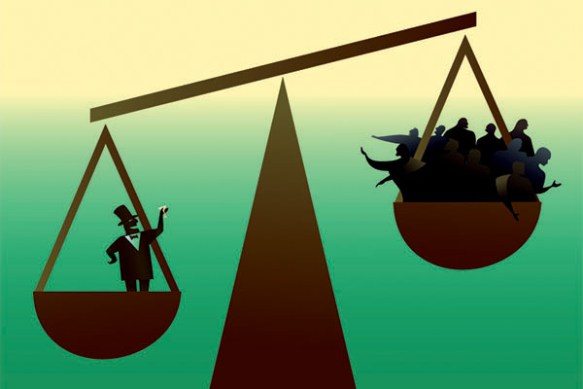
National (In)Security In the United States of Inequality

By Rajan Menon

Source: Unz Review

So effectively has the Beltway establishment captured the concept of national security that, for most of us, it automatically conjures up images of terrorist groups, cyber warriors, or “rogue states.” To ward off such foes, the United States maintains a historically unprecedented constellation of military bases abroad and, since 9/11, has waged wars in Afghanistan, Iraq, Syria, Libya, and elsewhere that have gobbled up nearly $4.8 trillion. The 2018 Pentagon budget already totals $647 billion — four times what China, second in global military spending, shells out and more than the next 12 countries combined, seven of them American allies. For good measure, Donald Trump has added an additional $200 billion to projected defense expenditures through 2019.

Yet to hear the hawks tell it, the United States has never been less secure. So much for bang for the buck.

For millions of Americans, however, the greatest threat to their day-to-day security isn’t terrorism or North Korea, Iran, Russia, or China. It’s internal — and economic. That’s particularly true for the 12.7% of Americans (43.1 million of them) classified as poor by the government’s criteria: an income below $12,140 for a one-person household, $16,460 for a family of two, and so on… until you get to the princely sum of $42,380 for a family of eight.

Savings aren’t much help either: a third of Americans have no savings at all and another third have less than $1,000 in the bank. Little wonder that families struggling to cover the cost of food alone increased from 11% (36 million) in 2007 to 14% (48 million) in 2014.

The Working Poor

Unemployment can certainly contribute to being poor, but millions of Americans endure poverty when they have full-time jobs or even hold down more than one job. The latest figures from the Bureau of Labor Statistics show that there are 8.6 million“working poor,” defined by the government as people who live below the poverty line despite being employed at least 27 weeks a year. Their economic insecurity doesn’t register in our society, partly because working and being poor don’t seem to go together in the minds of many Americans — and unemployment has fallen reasonably steadily. After approaching 10% in 2009, it’s now at only 4%.

Help from the government? Bill Clinton’s 1996 welfare “reform” program concocted in partnership with congressional Republicans, imposed time limits on government assistance, while tightening eligibility criteria for it. So, as Kathryn Edin and Luke Shaefer show in their disturbing book, $2.00 a Day: Living on Almost Nothing in America, many who desperately need help don’t even bother to apply. And things will only get worse in the age of Trump. His 2019 budget includes deep cuts in a raftof anti-poverty programs.

Anyone seeking a visceral sense of the hardships such Americans endure should read Barbara Ehrenreich’s 2001 book Nickel and Dimed: On (Not) Getting By in America. It’s a gripping account of what she learned when, posing as a “homemaker” with no special skills, she worked for two years in various low-wage jobs, relying solely on her earnings to support herself. The book brims with stories about people who had jobs but, out of necessity, slept in rent-by-the-week fleabag motels, flophouses, or even in their cars, subsisting on vending machine snacks for lunch, hot dogs and instant noodles for dinner , and forgoing basic dental care or health checkups. Those who managed to get permanent housing would choose poor, low-rent neighborhoods close to work because they often couldn’t afford a car. To maintain even such a barebones lifestyle, many worked more than one job.

Though politicians prattle on about how times have changed for the better, Ehrenreich’s book still provides a remarkably accurate picture of America’s working poor. Over the past decade the proportion of people who exhausted their monthly paychecks just to pay for life’s essentials actually increased from 31% to 38%. In 2013, 71% of the families that had children and used food pantries run by Feeding America, the largest private organization helping the hungry, included at least one person who had worked during the previous year. And in America’s big cities, chiefly because of a widening gap between rent and wages, thousands of working poor remain homeless, sleeping in shelters, on the streets, or in their vehicles, sometimes along with their families. In New York City, no outlier when it comes to homelessness among the working poor, in a third of the families with children that use homeless shelters at least one adult held a job.

The Wages of Poverty

The working poor cluster in certain occupations. They are salespeople in retail stores, servers or preparers of fast food, custodial staff, hotel workers, and caregivers for children or the elderly. Many make less than $10 an hour and lack any leverage, union or otherwise, to press for raises. In fact, the percentage of unionized workers in such jobs remains in the single digits — and in retail and food preparation, it’s under 4.5%. That’s hardly surprising, given that private sector union membership has fallen by 50% since 1983 to only 6.7% of the workforce.

Low-wage employers like it that way and — Walmart being the poster child for this — work diligently to make it ever harder for employees to join unions. As a result, they rarely find themselves under any real pressure to increase wages, which, adjusted for inflation, have stood still or even decreased since the late 1970s. When employment is “at-will,” workers may be fired or the terms of their work amended on the whim of a company and without the slightest explanation. Walmart announced this year that it would hike its hourly wage to $11 and that’s welcome news. But this had nothing to do with collective bargaining; it was a response to the drop in the unemployment rate, cash flows from the Trump tax cut for corporations (which saved Walmart as much as $2 billion), an increase in minimum wages in a number of states, and pay increases by an arch competitor, Target. It was also accompanied by the shutdown of 63 of Walmart’s Sam’s Club stores, which meant layoffs for 10,000 workers. In short, the balance of power almost always favors the employer, seldom the employee.

As a result, though the United States has a per-capita income of $59,500 and is among the wealthiest countries in the world, 12.7% of Americans (that’s 43.1 million people), officially are impoverished. And that’s generally considered a significant undercount. The Census Bureau establishes the poverty rate by figuring out an annual no-frills family food budget, multiplying it by three, adjusting it for household size, and pegging it to the Consumer Price Index. That, many economists believe, is a woefully inadequate way of estimating poverty. Food prices haven’t risen dramatically over the past 20 years, but the cost of other necessities like medical care (especially if you lack insurance) and housing have: 10.5% and 11.8% respectively between 2013 and 2017 compared to an only 5.5% increase for food.

Include housing and medical expenses in the equation and you get the Supplementary Poverty Measure (SPM), published by the Census Bureau since 2011. It reveals that a larger number of Americans are poor: 14% or 45 million in 2016.

Dismal Data

For a fuller picture of American (in)security, however, it’s necessary to delve deeper into the relevant data, starting with hourly wages, which are the way more than 58%of adult workers are paid. The good news: only 1.8 million, or 2.3% of them, subsist at or below minimum wage. The not-so-good news: one-third of all workers earn less than $12 an hour and 42% earn less than $15. That’s $24,960 and $31,200 a year. Imagine raising a family on such incomes, figuring in the cost of food, rent, childcare, car payments (since a car is often a necessity simply to get to a job in a country with inadequate public transportation), and medical costs.

The problem facing the working poor isn’t just low wages, but the widening gap between wages and rising prices. The government has increased the hourly federal minimum wage more than 20 times since it was set at 25 cents under the 1938 Fair Labor Standards Act. Between 2007 and 2009 it rose to $7.25, but over the past decade that sum lost nearly 10% of its purchasing power to inflation, which means that, in 2018, someone would have to work 41 additional days to make the equivalent of the 2009 minimum wage.

Workers in the lowest 20% have lost the most ground, their inflation-adjusted wages falling by nearly 1% between 1979 and 2016, compared to a 24.7% increase for the top 20%. This can’t be explained by lackluster productivity since, between 1985 and 2015, it outstripped pay raises, often substantially, in every economic sector except mining.

Yes, states can mandate higher minimum wages and 29 have, but 21 have not, leaving many low-wage workers struggling to cover the costs of two essentials in particular: health care and housing.

Even when it comes to jobs that offer health insurance, employers have been shifting ever more of its cost onto their workers through higher deductibles and out-of-pocket expenses, as well as by requiring them to cover more of the premiums. The percentage of workers who paid at least 10% of their earnings to cover such costs — not counting premiums — doubled between 2003 and 2014.

This helps explain why, according to the Bureau of Labor Statistics, only 11% of workers in the bottom 10% of wage earners even enrolled in workplace healthcare plans in 2016 (compared to 72% in the top 10%). As a restaurant server who makes $2.13 an hour before tips — and whose husband earns $9 an hour at Walmart — put it, after paying the rent, “it’s either put food in the house or buy insurance.”

The Affordable Care Act, or ACA (aka Obamacare), provided subsidies to help people with low incomes cover the cost of insurance premiums, but workers with employer-supplied healthcare, no matter how low their wages, weren’t covered by it. Now, of course, President Trump, congressional Republicans, and a Supreme Court in which right-wing justices are going to be even more influential will be intent on poleaxing the ACA.

It’s housing, though, that takes the biggest bite out of the paychecks of low-wage workers. The majority of them are renters. Ownership remains for many a pipe dream. According to a Harvard study, between 2001 and 2016, renters who made $30,000-$50,000 a year and paid more than a third of their earnings to landlords (the threshold for qualifying as “rent burdened”) increased from 37% to 50%. For those making only $15,000, that figure rose to 83%.

In other words, in an ever more unequal America, the number of low-income workers struggling to pay their rent has surged. As the Harvard analysis shows, this is, in part, because the number of affluent renters (with incomes of $100,000 or more) has leapt and, in city after city, they’re driving the demand for, and building of, new rental units. As a result, the high-end share of new rental construction soared from a third to nearly two-thirds of all units between 2001 and 2016. Not surprisingly, new low-income rental units dropped from two-fifths to one-fifth of the total and, as the pressure on renters rose, so did rents for even those modest dwellings. On top of that, in places like New York City, where demand from the wealthy shapes the housing market, landlords have found ways — some within the law, others not — to get rid of low-income tenants.

Public housing and housing vouchers are supposed to make housing affordable to low-income households, but the supply of public housing hasn’t remotely matched demand. Consequently, waiting lists are long and people in need languish for years before getting a shot — if they ever do. Only a quarter of those who qualify for such assistance receive it. As for those vouchers, getting them is hard to begin with because of the massive mismatch between available funding for the program and the demand for the help it provides. And then come the other challenges: finding landlords willing to accept vouchers or rentals that are reasonably close to work and not in neighborhoods euphemistically labelled “distressed.”

The bottom line: more than 75% of “at-risk” renters (those for whom the cost of rent exceeds 30% or more of their earnings) do not receive assistance from the government. The real “risk” for them is becoming homeless, which means relying on shelters or family and friends willing to take them in.

President Trump’s proposed budget cuts will make life even harder for low-income workers seeking affordable housing. His 2019 budget proposal slashes $6.8 billion(14.2%) from the resources of the Department of Housing and Urban Development’s (HUD) by, among other things, scrapping housing vouchers and assistance to low-income families struggling to pay heating bills. The president also seeks to slash funds for the upkeep of public housing by nearly 50%. In addition, the deficits that his rich-come-first tax “reform” bill is virtually guaranteed to produce will undoubtedly set the stage for yet more cuts in the future. In other words, in what’s becoming the United States of Inequality, the very phrases “low-income workers” and “affordable housing” have ceased to go together.

None of this seems to have troubled HUD Secretary Ben Carson who happily ordered a $31,000 dining room set for his office suite at the taxpayers’ expense, even as he visited new public housing units to make sure that they weren’t too comfortable (lest the poor settle in for long stays). Carson has declared that it’s time to stop believing the problems of this society can be fixed merely by having the government throw extra money at them — unless, apparently, the dining room accoutrements of superbureaucrats aren’t up to snuff.

Money Talks

The levels of poverty and economic inequality that prevail in America are not intrinsic to either capitalism or globalization. Most other wealthy market economies in the 36-nation Organization for Economic Cooperation and Development (OECD) have done far better than the United States in reducing them without sacrificing innovation or creating government-run economies.

Take the poverty gap, which the OECD defines as the difference between a country’s official poverty line and the average income of those who fall below it. The United States has the second largest poverty gap among wealthy countries; only Italy does worse.

Child poverty? In the World Economic Forum’s ranking of 41 countries — from best to worst — the U.S. placed 35th. Child poverty has declined in the United States since 2010, but a Columbia University report estimates that 19% of American kids (13.7 million) nevertheless lived in families with incomes below the official poverty line in 2016. If you add in the number of kids in low-income households, that number increases to 41%.

As for infant mortality, according to the government’s own Centers for Disease Control, the U.S., with 6.1 deaths per 1,000 live births, has the absolute worst record among wealthy countries. (Finland and Japan do best with 2.3.)

And when it comes to the distribution of wealth, among the OECD countries only Turkey, Chile, and Mexico do worse than the U.S.

It’s time to rethink the American national security state with its annual trillion-dollar budget. For tens of millions of Americans, the source of deep workaday insecurity isn’t the standard roster of foreign enemies, but an ever-more entrenched system of inequality, still growing, that stacks the political deck against the least well-off Americans. They lack the bucks to hire big-time lobbyists. They can’t write lavish checks to candidates running for public office or fund PACs. They have no way of manipulating the myriad influence-generating networks that the elite uses to shape taxation and spending policies. They are up against a system in which money truly does talk — and that’s the voice they don’t have. Welcome to the United States of Inequality.


Rajan Menon, a TomDispatch regular, is the Anne and Bernard Spitzer Professor of International Relations at the Powell School, City College of New York, and Senior Research Fellow at Columbia University’s Saltzman Institute of War and Peace Studies. He is the author, most recently, of The Conceit of Humanitarian Intervention 

Exposing the Giants: The Global Power Elite

Diego Rivera, Man at the Crossroads/Man, Controller of the Universe, 1933

By Robert J. Burrowes

Developing the tradition charted by C. Wright Mills in his 1956 classic The Power Elite, in his latest book, Professor Peter Phillips starts by reviewing the transition from the nation state power elites described by authors such as Mills to a transnational power elite centralized on the control of global capital.

Thus, in his just-released study Giants: The Global Power Elite, Phillips, a professor of political sociology at Sonoma State University in the USA, identifies the world’s top seventeen asset management firms, such as BlackRock and J.P Morgan Chase, each with more than one trillion dollars of investment capital under management, as the ‘Giants’ of world capitalism. The seventeen firms collectively manage more than $US41.1 trillion in a self-invested network of interlocking capital that spans the globe.

This $41 trillion represents the wealth invested for profit by thousands of millionaires, billionaires and corporations. The seventeen Giants operate in nearly every country in the world and are ‘the central institutions of the financial capital that powers the global economic system’. They invest in anything considered profitable, ranging from ‘agricultural lands on which indigenous farmers are replaced by power elite investors’ to public assets (such as energy and water utilities) to war.

In addition, Phillips identifies the most important networks of the Global Power Elite and the individuals therein. He names 389 individuals (a small number of whom are women and a token number of whom are from countries other than the United States and the wealthier countries of Western Europe) at the core of the policy planning nongovernmental networks that manage, facilitate and defend the continued concentration of global capital. The Global Power Elite perform two key uniting functions, he argues: they provide ideological justifications for their shared interests (promulgated through their corporate media), and define the parameters of action for transnational governmental organizations and capitalist nation-states.

More precisely, Phillips identifies the 199 directors of the seventeen global financial Giants and offers short biographies and public information on their individual net wealth. These individuals are closely interconnected through numerous networks of association including the World Economic Forum, the International Monetary Conference, university affiliations, various policy councils, social clubs, and cultural enterprises. For a taste of one of these clubs, see this account of The Links in New York. As Phillips observes: ‘It is certainly safe to conclude they all know each other personally or know of each other in the shared context of their positions of power.’

The Giants, Phillips documents, invest in each other but also in many hundreds of investment management firms, many of which are near-Giants. This results in tens of trillions of dollars coordinated in a single vast network of global capital controlled by a very small number of people. ‘Their constant objective is to find enough safe investment opportunities for a return on capital that allows for continued growth. Inadequate capital-placement opportunities lead to dangerous speculative investments, buying up of public assets, and permanent war spending.’

Because the directors of these seventeen asset management firms represent the central core of international capital, ‘Individuals can retire or pass away, and other similar people will move into their place, making the overall structure a self-perpetuating network of global capital control. As such, these 199 people share a common goal of maximum return on investments for themselves and their clients, and they may seek to achieve returns by any means necessary – legal or not…. the institutional and structural arrangements within the money management systems of global capital relentlessly seek ways to achieve maximum return on investment, and … the conditions for manipulations – legal or not – are always present.’

Like some researchers before him, Phillips identifies the importance of those transnational institutions that serve a unifying function. The World Bank, International Monetary Fund, G20, G7, World Trade Organization (WTO), World Economic Forum (WEF), Trilateral Commission, Bilderberg Group, Bank for International Settlements, Group of 30 (G30), the Council on Foreign Relations and the International Monetary Conference serve as institutional mechanisms for consensus building within the transnational capitalist class, and power elite policy formulation and implementation. ‘These international institutions serve the interests of the global financial Giants by supporting policies and regulations that seek to protect the free, unrestricted flow of capital and debt collection worldwide.’

But within this network of transnational institutions, Phillips identifies two very important global elite policy-planning organizations: the Group of Thirty (which has 32 members) and the extended executive committee of the Trilateral Commission (which has 55 members). These nonprofit corporations, which each have a research and support staff, formulate elite policy and issue instructions for their implementation by the transnational governmental institutions like the G7, G20, IMF, WTO, and World Bank. Elite policies are also implemented following instruction of the relevant agent, including governments, in the context. These agents then do as they are instructed. Thus, these 85 members (because two overlap) of the Group of Thirty and the Trilateral Commission comprise a central group of facilitators of global capitalism, ensuring that ‘global capital remains safe, secure, and growing’.

So, while many of the major international institutions are controlled by nation-state representatives and central bankers (with proportional power exercised by dominant financial supporters such as the United States and European Union countries), Phillips is more concerned with the transnational policy groups that are nongovernmental because these organizations ‘help to unite TCC power elites as a class’ and the individuals involved in these organizations facilitate world capitalism. ‘They serve as policy elites who seek the continued growth of capital in the world.’

Developing this list of 199 directors of the largest money management firms in the world, Phillips argues, is an important step toward understanding how capitalism works globally today. These global power elite directors make the decisions regarding the investment of trillions of dollars. Supposedly in competition, the concentrated wealth they share requires them to cooperate for their greater good by identifying investment opportunities and shared risk agreements, and working collectively for political arrangements that create advantages for their profit-generating system as a whole.

Their fundamental priority is to secure an average return on investment of 3 to 10 percent, or even more. The nature of any investment is less important than what it yields: continuous returns that support growth in the overall market. Hence, capital investment in tobacco products, weapons of war, toxic chemicals, pollution, and other socially destructive goods and services are judged purely by their profitability. Concern for the social and environmental costs of the investment are non-existent. In other words, inflicting death and destruction are fine because they are profitable.

So what is the global elite’s purpose? In a few sentences Phillips characterizes it thus: The elite is largely united in support of the US/NATO military empire that prosecutes a repressive war against resisting groups – typically labeled ‘terrorists’ – around the world. The real purpose of ‘the war on terror’ is defense of transnational globalization, the unimpeded flow of financial capital around the world, dollar hegemony and access to oil; it has nothing to do with repressing terrorism which it generates, perpetuates and finances to provide cover for its real agenda. This is why the United States has a long history of CIA and military interventions around the world ostensibly in defense of ‘national interests’.


Wealth and Power

An interesting point that emerges for me from reading Phillips thoughtful analysis is that there is a clear distinction between those individuals and families who have wealth and those individuals who have (sometimes significantly) less wealth (which, nevertheless, is still considerable) but, through their positions and connections, wield a great deal of power. As Phillips explains this distinction, ‘the sociology of elites is more important than particular elite individuals and their families’. Just 199 individuals decide how more than $40 trillion will be invested. And this is his central point. Let me briefly elaborate.

There are some really wealthy families in the world, notably including the families Rothschild (France and the United Kingdom), Rockefeller (USA), Goldman-Sachs (USA), Warburgs (Germany), Lehmann (USA), Lazards (France), Kuhn Loebs (USA), Israel Moses Seifs (Italy), Al-Saud (Saudi Arabia), Walton (USA), Koch (USA), Mars (USA), Cargill-MacMillan (USA) and Cox (USA). However, not all of these families overtly seek power to shape the world as they wish.

Similarly, the world’s extremely wealthy individuals such as Jeff Bezos (USA), Bill Gates (USA), Warren Buffett (USA), Bernard Arnault (France), Carlos Slim Helu (Mexico) and Francoise Bettencourt Meyers (France) are not necessarily connected in such a way that they exercise enormous power. In fact, they may have little interest in power as such, despite their obvious interest in wealth.

In essence, some individuals and families are content to simply take advantage of how capitalism and its ancilliary governmental and transnational instruments function while others are more politically engaged in seeking to manipulate major institutions to achieve outcomes that not only maximize their own profit and hence wealth but also shape the world itself.

So if you look at the list of 199 individuals that Phillips identifies at the centre of global capital, it does not include names such as Bezos, Gates, Buffett, Koch, Walton or even Rothschild, Rockefeller or Windsor (the Queen of England) despite their well-known and extraordinary wealth. As an aside, many of these names are also missing from the lists compiled by groups such as Forbes and Bloomberg, but their absence from these lists is for a very different reason given the penchant for many really wealthy individuals and families to avoid certain types of publicity and their power to ensure that they do.

In contrast to the names just listed, in Phillips’ analysis names like Laurence (Larry) Fink (Chairman and CEO of BlackRock), James (Jamie) Dimon (Chairman and CEO of JPMorgan Chase) and John McFarlane (Chairman of Barclays Bank), while not as wealthy as those listed immediately above, wield far more power because of their positions and connections within the global elite network of 199 individuals.

Predictably then, Phillips observes, these three individuals have similar lifestyles and ideological orientations. They believe capitalism is beneficial for the world and while inequality and poverty are important issues, they believe that capital growth will eventually solve these problems. They are relatively non-expressive about environmental issues, but recognize that investment opportunities may change in response to climate ‘modifications’. As millionaires they own multiple homes. They attended elite universities and rose quickly in international finance to reach their current status as giants of the global power elite. ‘The institutions they manage have been shown to engage in illegal collusions with others, but the regulatory fines by governments are essentially seen as just part of doing business.’

In short, as I would characterize this description: They are devoid of a legal or moral framework to guide their actions, whether in relation to business, fellow human beings, war or the environment and climate. They are obviously typical of the elite.

Any apparent concern for people, such as that expressed by Fink and Dimon in response to the racist violence in Charlottesville, USA in August 2017, is simply designed to promote ‘stability’ or more precisely, a stable (that is, profitable) investment and consumer climate.

The lack of concern for people and issues that might concern many of us is also evident from a consideration of the agenda at elite gatherings. Consider the International Monetary Conference. Founded in 1956, it is a private yearly meeting of the top few hundred bankers in the world. The American Bankers Association (ABA) serves as the secretariat for the conference. But, as Phillips notes: ‘Nothing on the agenda seems to address the socioeconomic consequences of investments to determine the impacts on people and the environment.’ A casual perusal of the agenda at any elite gathering reveals that this comment applies equally to any elite forum. See, for example, the agenda of the recent WEF meeting in Davos. Any talk of ‘concern’ is misleading rhetoric.

Hence, in the words of Phillips: The 199 directors of the global Giants are ‘a very select set of people. They all know each other personally or know of each other. At least 69 have attended the annual World Economic Forum, where they often serve on panels or give public presentations. They mostly attended the same elite universities, and interact in upperclass social setting[s] in the major cities of the world. They all are wealthy and have significant stock holdings in one or more of the financial Giants. They are all deeply invested in the importance of maintaining capital growth in the world. Some are sensitive to environmental and social justice issues, but they seem to be unable to link these issues to global capital concentration.’

Of course, the global elite cannot manage the world system alone: the elite requires agents to perform many of the functions necessary to control national societies and the individuals within them. ‘The interests of the Global Power Elite and the TCC are fully recognized by major institutions in society. Governments, intelligence services, policymakers, universities, police forces, military, and corporate media all work in support of their vital interests.’

In other words, to elaborate Phillips’ point and extend it a little, through their economic power, the Giants control all of the instruments through which their policies are implemented. Whether it be governments, national military forces, ‘military contractors’ or mercenaries (with at least $200 billion spent on private security globally, the industry currently employs some fifteen million people worldwide) used both in ‘foreign’ wars but also likely deployed in future for domestic control, key ‘intelligence’ agencies, legal systems and police forces, major nongovernment organizations, or the academic, educational, ‘public relations propaganda’, corporate media, medical, psychiatric and pharmaceutical industries, all instruments are fully responsive to elite control and are designed to misinform, deceive, disempower, intimidate, repress, imprison (in a jail or psychiatric ward), exploit and/or kill (depending on the constituency) the rest of us, as is readily evident.


Defending Elite Power

Phillips observes that the power elite continually worries about rebellion by the ‘unruly exploited masses’ against their structure of concentrated wealth. This is why the US military empire has long played the role of defender of global capitalism. As a result, the United States has more than 800 military bases (with some scholars suggesting 1,000) in 70 countries and territories. In comparison, the United Kingdom, France, and Russia have about 30 foreign bases. In addition, US military forces are now deployed in 70 percent of the world’s nations with US Special Operations Command (SOCOM) having troops in 147 countries, an increase of 80 percent since 2010. These forces conduct counterterrorism strikes regularly, including drone assassinations and kill/capture raids.

‘The US military empire stands on hundreds of years of colonial exploitation and continues to support repressive, exploitative governments that cooperate with global capital’s imperial agenda. Governments that accept external capital investment, whereby a small segment of a country’s elite benefits, do so knowing that capital inevitably requires a return on investment that entails using up resources and people for economic gain. The whole system continues wealth concentration for elites and expanded wretched inequality for the masses….

‘Understanding permanent war as an economic relief valve for surplus capital is a vital part of comprehending capitalism in the world today. War provides investment opportunity for the Giants and TCC elites and a guaranteed return on capital. War also serves a repressive function of keeping the suffering masses of humanity afraid and compliant.’

As Phillips elaborates: This is why defense of global capital is the prime reason that NATO countries now account for 85 percent of the world’s military spending; the United States spends more on the military than the rest of the world combined.

In essence, ‘the Global Power Elite uses NATO and the US military empire for its worldwide security. This is part of an expanding strategy of US military domination around the world, whereby the US/ NATO military empire, advised by the power elite’s Atlantic Council, operates in service to the Transnational Corporate Class for the protection of international capital everywhere in the world’.

This entails ‘further pauperization of the bottom half of the world’s population and an unrelenting downward spiral of wages for 80 percent of the world. The world is facing economic crisis, and the neoliberal solution is to spend less on human needs and more on security. It is a world of financial institutions run amok, where the answer to economic collapse is to print more money through quantitative easing, flooding the population with trillions of new inflation-producing dollars. It is a world of permanent war, whereby spending for destruction requires further spending to rebuild, a cycle that profits the Giants and global networks of economic power. It is a world of drone killings, extrajudicial assassinations, death, and destruction, at home and abroad.’


Where is this all heading?

So what are the implications of this state of affairs? Phillips responds unequivocally: ‘This concentration of protected wealth leads to a crisis of humanity, whereby poverty, war, starvation, mass alienation, media propaganda, and environmental devastation are reaching a species-level threat. We realize that humankind is in danger of possible extinction’.

He goes on to state that the Global Power Elite is probably the only entity ‘capable of correcting this condition without major civil unrest, war, and chaos’ and elaborates an important aim of his book: to raise awareness of the importance of systemic change and the redistribution of wealth among both the book’s general readers but also the elite, ‘in the hope that they can begin the process of saving humanity.’ The book’s postscript is a ‘A Letter to the Global Power Elite’, co-signed by Phillips and 90 others, beseeching the elite to act accordingly.

‘It is no longer acceptable for you to believe that you can manage capitalism to grow its way out of the gross inequalities we all now face. The environment cannot accept more pollution and waste, and civil unrest is everywhere inevitable at some point. Humanity needs you to step up and insure that trickle-down becomes a river of resources that reaches every child, every family, and all human beings. We urge you to use your power and make the needed changes for humanity’s survival.’

But he also emphasizes that nonviolent social movements, using the Universal Declaration of Human Rights as a moral code, can accelerate the process of redistributing wealth by pressuring the elite into action.


Conclusion

Peter Phillips has written an important book. For those of us interested in understanding elite control of the world, this book is a vital addition to the bookshelf. And like any good book, as you will see from my comments both above and below, it raised more questions for me even while it answered many.

As I read Phillips’ insightful and candid account of elite behavior in this regard, I am reminded, yet again, that the global power elite is extraordinarily violent and utterly insane: content to kill people in vast numbers (whether through starvation or military violence) and destroy the biosphere for profit, with zero sense of humanity’s now limited future. See ‘The Global Elite is Insane Revisited’ and ‘Human Extinction by 2026? A Last Ditch Strategy to Fight for Human Survival’ with more detailed explanations for the violence and insanity here: Why Violence? and Fearless Psychology and Fearful Psychology: Principles and Practice.

For this reason I do not share his faith in moral appeals to the elite, as articulated in the letter in his postscript. It is fine to make the appeal but history offers no evidence to suggest that there will be any significant response. The death and destruction inflicted by elites is highly profitable, centuries-old and ongoing. It will take powerful, strategically-focused nonviolent campaigns (or societal collapse) to compel the necessary changes in elite behavior. Hence, I fully endorse his call for nonviolent social movements to compel elite action where we cannot make the necessary changes without their involvement. See ‘A Nonviolent Strategy to End Violence and Avert Human Extinction’ and Nonviolent Campaign Strategy.

I would also encourage independent action, in one or more of several ways, by those individuals and communities powerful enough to do so. This includes nurturing more powerful individuals by making ‘My Promise to Children’, participating in ‘The Flame Tree Project to Save Life on Earth’ and signing the online pledge of ‘The People’s Charter to Create a Nonviolent World’.

Fundamentally, Giants: The Global Power Elite is a call to action. Professor Peter Phillips is highly aware of our predicament – politically, socially, economically, environmentally and climatically – and the critical role played by the global power elite in generating that predicament.

If we cannot persuade the global power elite to respond sensibly to that predicament, or nonviolently compel it to do so, humanity’s time on Earth is indeed limited.


Biodata: Robert J. Burrowes has a lifetime commitment to understanding and ending human violence. He has done extensive research since 1966 in an effort to understand why human beings are violent and has been a nonviolent activist since 1981. He is the author of ‘Why Violence?’ http://tinyurl.com/whyviolence His email address is flametree@riseup.net and his website is here. http://robertjburrowes.wordpress.com

Robert J. Burrowes
P.O. Box 68
Daylesford, Victoria 3460
Australia

Email: flametree@riseup.net

Websites:
Nonviolence Charter
Flame Tree Project to Save Life on Earth
‘Why Violence?’
Feelings First
Nonviolent Campaign Strategy
Nonviolent Defense/Liberation Strategy
Anita: Songs of Nonviolence
Robert Burrowes
Global Nonviolence Network

The Suicidal Empire

By Dmitry Orlov

Source: Club Orlov

There are a lot of behaviors being exhibited by those in positions of power in the US that seem disparate and odd. We watch Trump who is imposing sanctions on country after country, dreaming of eradicating his country’s structural trade deficit with the rest of the world. We watch pretty much all of US Congress falling over each other in their attempt to impose the harshest possible sanctions on Russia. People in Turkey, a key NATO country, are literally burning US dollars and smashing iPhones in a fit of pique. Confronted with a new suite of Russian and Chinese weapons systems that largely neutralize the ability of the US to dominate the world militarily, the US is setting new records in the size of its already outrageously bloated yet manifestly ineffectual defense spending. As a backdrop to this military contractor feeding frenzy, the Taliban are making steady gains in Afghanistan, now control over half the territory, and are getting ready to stamp “null and void,” in a repeat of Vietnam, on America’s longest war. A lengthening list of countries are set to ignore or compensate for US sanctions, especially sanctions against Iranian oil exports. In a signal moment, Russia’s finance minister has recently pronounced the US dollar “unreliable.” Meanwhile, US debt keeps galloping upwards, with its largest buyer being reported as a mysterious, possibly entirely nonexistent “Other.”

Although these may seem like manifestations of many different trends in the world, I believe that a case can be made that these are all one thing: the US—the world’s imperial overlord—standing on a ledge and threatening to jump, while its imperial vassals—too many to mention—are standing down below and shouting “Please, don’t jump!” To be sure, most of them would be perfectly happy to watch the overlord plummet and jelly up the sidewalk. But here is the key point: if this were to happen today, it would cause unacceptable levels of political and economic collateral damage around the world. Does this mean that the US is indispensable? No, of course not, nobody is. But dispensing with it will take time and energy, and while that process runs its course the rest of the world is forced to keep it on life support no matter how counterproductive, stupid and demeaning that feels.

What the world needs to do, as quickly as possible, is to dismantle the imperial center, which is in Washington politically and militarily and in New York and London financially, while somehow salvaging the principle of empire. “What?!” you might exclaim, “Isn’t imperialism evil.” Well, sure it is, whatever, but empires make possible efficient, specialized production and efficient, unhindered trade over large distances. Empires do all sorts of evil things—up to and including genocide—but they also provide a level playing field and a method for preventing petty grievances from escalating into tribal conflicts.

The Roman Empire, then Byzantium, then the Tatar/Mongol Golden Horde, then the Ottoman Sublime Porte all provided these two essential services—unhindered trade and security—in exchange for some amount of constant rapine and plunder and a few memorable incidents of genocide. The Tatar/Mongol Empire was by far the most streamlined: it simply demanded “yarlyk”—tribute—and smashed anyone who attempted to rise above a level at which they were easy to smash. The American empire is a bit more nuanced: it uses the US dollar as a weapon for periodically expropriating savings from around the world by exporting inflation while annihilating anyone who tries to wiggle out from under the US dollar system.

All empires follow a certain trajectory. Over time they become corrupt, decadent and enfeebled, and then they collapse. When they collapse, there are two ways to go. One is to slog through a millennium-long dark age—as Western Europe did after the Western Roman Empire collapsed. Another is for a different empire, or a cooperating set of empires, to take over, as happened after the Ottoman Empire collapsed. You may think that a third way exists: of small nations cooperating sweetly and collaborating successfully on international infrastructure projects that serve the common good. Such a scheme may be possible, but I tend to take a jaundiced view of our simian natures.

We come equipped with MonkeyBrain 2.0, which has some very useful built-in functions for imperialism, along with some ancillary support for nationalism and organized religion. These we can rely on; everything else would be either a repeat of a failed experiment or an untested innovation. Sure, let’s innovate, but innovation takes time and resources, and those are the exact two things that are currently lacking. What we have in permanent surplus is revolutionaries: if they have their way, look out for a Reign of Terror, followed by the rise of a Bonaparte. That’s what happens every time.

Lest you think that the US isn’t an empire—a collapsing one—consider the following. The US defense budget is larger than that of the next ten countries combined, yet the US can’t prevail even in militarily puny Afghanistan. (That’s because much of its defense budget is trivially stolen.) The US has something like a thousand military bases, essentially garrisoning the entire planet, but to unknown effect. It claims the entire planet as its dominion: no matter where you go, you still have to pay US income taxes and are still subject to US laws. It controls and manipulates governments in numerous countries around the world, always aiming to turn them into satrapies governed from the US embassy compound, but with results that range from unprofitable to embarrassing to lethal. It is now failing at virtually all of these things, threatening the entire planet with its untimely demise.

What we are observing, at every level, is a sort of blackmail: “Do as we say, or no more empire for you!” The US dollar will vanish, international trade will stop and a dark age will descend, forcing everyone to toil in the dirt for a millennium while mired in futile, interminable conflicts with neighboring tribes. None of the old methods of maintaining imperial dominance are working; all that remains is the threat of falling down and leaving a huge mess for the rest of the world to deal with. The rest of the world is now tasked with rapidly creating a situation where the US empire can be dealt a coup de grâce safely, without causing any collateral damage—and that’s a huge task, so everyone is forced to play for time.

There is a lot of military posturing and there are political provocations happening all the time, but these are sideshows that are becoming an unaffordable luxury: there is nothing to be won through these methods and plenty to be lost. Essentially, all the arguments are over money. There is a lot of money to be lost. The total trade surplus of the BRICS countries with the West (US+EU, essentially) is over a trillion dollars a year. SCO—another grouping of non-Western countries—comes up with almost the same numbers. That’s the amount of products these countries produce for which they currently have no internal market. Should the West evaporate overnight, nobody will buy these products. Russia alone had a 2017 trade surplus of $116 billion, and in 2018 so far it grew by 28.5%. China alone, in its trade just with the US, generated $275 billion in surplus. Throw in another $16 billion for its trade with the EU.

Those are big numbers, but they are nowhere near enough if the project is to build a turnkey global empire to replace US+EU in a timely manner. Also, there are no takers. Russia is rather happy to have shed its former Soviet dependents and is currently invested in building a multilateral, international system of governance based on international institutions such as SCO, BRICS and EAEU. Numerous other countries are very interested in joining together in such organizations: most recently, Turkey has expressed interest in turning BRICS into BRICTS. Essentially, all of the post-colonial nations around the world are now forced to trade away some measure of their recently won independence, essentially snatching defeat from the jaws of victory. The job vacancy of Supreme Global Overlord is unlikely to attract any qualified candidates.

What everyone seems to want is a humble, low-budget, cooperative global empire, without all of the corruption and with a lot less life-threatening militarism. It will take time to build, and the resources to build it can only come from one place: from gradually bleeding US+EU dry. In order to do this, the wheels of international commerce must continue to spin. But this is exactly what all of the new tariffs and sanctions, the saber-rattling and the political provocations, are attempting to prevent: a ship laden with soya is now doing circles in the Pacific off the coast of China; steel I-beams are rusting at the dock in Turkey…

But it is doubtful that these attempts will work. The EU has been too slow in recognizing just how pernicious its dependence on Washington has become, and will take even more time to find ways to free itself, but the process has clearly started. For its part, Washington runs on money, and since its current antics will tend to make money grow scarce even faster than it otherwise would, those who stand to lose the most will make the Washingtonians feel their pain and will force a change of course. As a result, everyone will be pushing in the same direction: toward a slow, steady, controllable imperial collapse. All we can hope for is that the rest of the world manages to come together and build at least the scaffolding of a functional imperial replacement in time to avoid collapsing into a new post-imperial dark age.

US Intelligence Community as a Collapse Driver

By Dmitry Orlov

Source: Club Orlov

In today’s United States, the term “espionage” doesn’t get too much use outside of some specific contexts. There is still sporadic talk of industrial espionage, but with regard to Americans’ own efforts to understand the world beyond their borders, they prefer the term “intelligence.” This may be an intelligent choice, or not, depending on how you look at things.

First of all, US “intelligence” is only vaguely related to the game of espionage as it has been traditionally played, and as it is still being played by countries such as Russia and China. Espionage involves collecting and validating strategically vital information and conveying it to just the pertinent decision-makers on your side while keeping the fact that you are collecting and validating it hidden from everyone else.

In eras past, a spy, if discovered, would try to bite down on a cyanide capsule; these days torture is considered ungentlemanly, and spies that get caught patiently wait to be exchanged in a spy swap. An unwritten, commonsense rule about spy swaps is that they are done quietly and that those released are never interfered with again because doing so would complicate negotiating future spy swaps. In recent years, the US intelligence agencies have decided that torturing prisoners is a good idea, but they have mostly been torturing innocent bystanders, not professional spies, sometimes forcing them to invent things, such as “Al Qaeda.” There was no such thing before US intelligence popularized it as a brand among Islamic terrorists.

Most recently, British “special services,” which are a sort of Mini-Me to the to the Dr. Evil that is the US intelligence apparatus, saw it fit to interfere with one of their own spies, Sergei Skripal, a double agent whom they sprung from a Russian jail in a spy swap. They poisoned him using an exotic chemical and then tried to pin the blame on Russia based on no evidence. There are unlikely to be any more British spy swaps with Russia, and British spies working in Russia should probably be issued good old-fashioned cyanide capsules (since that supposedly super-powerful Novichok stuff the British keep at their “secret” lab in Porton Down doesn’t work right and is only fatal 20% of the time).

There is another unwritten, commonsense rule about spying in general: whatever happens, it needs to be kept out of the courts, because the discovery process of any trial would force the prosecution to divulge sources and methods, making them part of the public record. An alternative is to hold secret tribunals, but since these cannot be independently verified to be following due process and rules of evidence, they don’t add much value.

A different standard applies to traitors; here, sending them through the courts is acceptable and serves a high moral purpose, since here the source is the person on trial and the method—treason—can be divulged without harm. But this logic does not apply to proper, professional spies who are simply doing their jobs, even if they turn out to be double agents. In fact, when counterintelligence discovers a spy, the professional thing to do is to try to recruit him as a double agent or, failing that, to try to use the spy as a channel for injecting disinformation.

Americans have been doing their best to break this rule. Recently, special counsel Robert Mueller indicted a dozen Russian operatives working in Russia for hacking into the DNC mail server and sending the emails to Wikileaks. Meanwhile, said server is nowhere to be found (it’s been misplaced) while the time stamps on the files that were published on Wikileaks show that they were obtained by copying to a thumb drive rather than sending them over the internet. Thus, this was a leak, not a hack, and couldn’t have been done by anyone working remotely from Russia.

Furthermore, it is an exercise in futility for a US official to indict Russian citizens in Russia. They will never stand trial in a US court because of the following clause in the Russian Constitution: “61.1 A citizen of the Russian Federation may not be deported out of Russia or extradited to another state.” Mueller may summon a panel of constitutional scholars to interpret this sentence, or he can just read it and weep. Yes, the Americans are doing their best to break the unwritten rule against dragging spies through the courts, but their best is nowhere near good enough.

That said, there is no reason to believe that the Russian spies couldn’t have hacked into the DNC mail server. It was probably running Microsoft Windows, and that operating system has more holes in it than a building in downtown Raqqa, Syria after the Americans got done bombing that city to rubble, lots of civilians included. When questioned about this alleged hacking by Fox News, Putin (who had worked as a spy in his previous career) had trouble keeping a straight face and clearly enjoyed the moment. He pointed out that the hacked/leaked emails showed a clear pattern of wrongdoing: DNC officials conspired to steal the electoral victory in the Democratic Primary from Bernie Sanders, and after this information had been leaked they were forced to resign. If the Russian hack did happen, then it was the Russians working to save American democracy from itself. So, where’s the gratitude? Where’s the love? Oh, and why are the DNC perps not in jail?

Since there exists an agreement between the US and Russia to cooperate on criminal investigations, Putin offered to question the spies indicted by Mueller. He even offered to have Mueller sit in on the proceedings. But in return he wanted to question US officials who may have aided and abetted a convicted felon by the name of William Browder, who is due to begin serving a nine-year sentence in Russia any time now and who, by the way, donated copious amounts of his ill-gotten money to the Hillary Clinton election campaign. In response, the US Senate passed a resolution to forbid Russians from questioning US officials. And instead of issuing a valid request to have the twelve Russian spies interviewed, at least one US official made the startlingly inane request to have them come to the US instead. Again, which part of 61.1 don’t they understand?

The logic of US officials may be hard to follow, but only if we adhere to the traditional definitions of espionage and counterespionage—“intelligence” in US parlance—which is to provide validated information for the purpose of making informed decisions on best ways of defending the country. But it all makes perfect sense if we disabuse ourselves of such quaint notions and accept the reality of what we can actually observe: the purpose of US “intelligence” is not to come up with or to work with facts but to simply “make shit up.”

The “intelligence” the US intelligence agencies provide can be anything but; in fact, the stupider it is the better, because its purpose is allow unintelligent people to make unintelligent decisions. In fact, they consider facts harmful—be they about Syrian chemical weapons, or conspiring to steal the primary from Bernie Sanders, or Iraqi weapons of mass destruction, or the whereabouts of Osama Bin Laden—because facts require accuracy and rigor while they prefer to dwell in the realm of pure fantasy and whimsy. In this, their actual objective is easily discernible.

The objective of US intelligence is to suck all remaining wealth out of the US and its allies and pocket as much of it as possible while pretending to defend it from phantom aggressors by squandering nonexistent (borrowed) financial resources on ineffective and overpriced military operations and weapons systems. Where the aggressors are not phantom, they are specially organized for the purpose of having someone to fight: “moderate” terrorists and so on. One major advancement in their state of the art has been in moving from real false flag operations, à la 9/11, to fake false flag operations, à la fake East Gouta chemical attack in Syria (since fully discredited). The Russian election meddling story is perhaps the final step in this evolution: no New York skyscrapers or Syrian children were harmed in the process of concocting this fake narrative, and it can be kept alive seemingly forever purely through the furious effort of numerous flapping lips. It is now a pure confidence scam. If you are less then impressed with their invented narratives, then you are a conspiracy theorist or, in the latest revision, a traitor.

Trump was recently questioned as to whether he trusted US intelligence. He waffled. A light-hearted answer would have been:

“What sort of idiot are you to ask me such a stupid question? Of course they are lying! They were caught lying more than once, and therefore they can never be trusted again. In order to claim that they are not currently lying, you have to determine when it was that they stopped lying, and that they haven’t lied since. And that, based on the information that is available, is an impossible task.”

A more serious, matter-of-fact answer would have been:

“The US intelligence agencies made an outrageous claim: that I colluded with Russia to rig the outcome of the 2016 presidential election. The burden of proof is on them. They are yet to prove their case in a court of law, which is the only place where the matter can legitimately be settled, if it can be settled at all. Until that happens, we must treat their claim as conspiracy theory, not as fact.”

And a hardcore, deadpan answer would have been:

“The US intelligence services swore an oath to uphold the US Constitution, according to which I am their Commander in Chief. They report to me, not I to them. They must be loyal to me, not I to them. If they are disloyal to me, then that is sufficient reason for their dismissal.”

But no such reality-based, down-to-earth dialogue seems possible. All that we hear are fake answers to fake questions, and the outcome is a series of faulty decisions. Based on fake intelligence, the US has spent almost all of this century embroiled in very expensive and ultimately futile conflicts. Thanks to their efforts, Iran, Iraq and Syria have now formed a continuous crescent of religiously and geopolitically aligned states friendly toward Russia while in Afghanistan the Taliban is resurgent and battling ISIS—an organization that came together thanks to American efforts in Iraq and Syria.

The total cost of wars so far this century for the US is reported to be $4,575,610,429,593. Divided by the 138,313,155 Americans who file tax returns (whether they actually pay any tax is too subtle a question), it works out to just over $33,000 per taxpayer. If you pay taxes in the US, that’s your bill so far for the various US intelligence “oopsies.”

The 16 US intelligence agencies have a combined budget of $66.8 billion, and that seems like a lot until you realize how supremely efficient they are: their “mistakes” have cost the country close to 70 times their budget. At a staffing level of over 200,000 employees, each of them has cost the US taxpayer close to $23 million, on average. That number is totally out of the ballpark! The energy sector has the highest earnings per employee, at around $1.8 million per. Valero Energy stands out at $7.6 million per. At $23 million per, the US intelligence community has been doing three times better than Valero. Hats off! This makes the US intelligence community by far the best, most efficient collapse driver imaginable.

There are two possible hypotheses for why this is so.

First, we might venture to guess that these 200,000 people are grossly incompetent and that the fiascos they precipitate are accidental. But it is hard to imagine a situation where grossly incompetent people nevertheless manage to funnel $23 million apiece, on average, toward an assortment of futile undertakings of their choosing. It is even harder to imagine that such incompetents would be allowed to blunder along decade after decade without being called out for their mistakes.

Another hypothesis, and a far more plausible one, is that the US intelligence community has been doing a wonderful job of bankrupting the country and driving it toward financial, economic and political collapse by forcing it to engage in an endless series of expensive and futile conflicts—the largest single continuous act of grand larceny the world has ever known. How that can possibly be an intelligent thing to do to your own country, for any conceivable definition of “intelligence,” I will leave for you to work out for yourself. While you are at it, you might also want to come up with an improved definition of “treason”: something better than “a skeptical attitude toward preposterous, unproven claims made by those known to be perpetual liars.”

How $21 Trillion in U.S. Tax Money Disappeared. “Full Scope Audit” of the Pentagon

Dismantling A Society: How Empires Feed Off the Republic

By RS Anthion

Source: CounterPunch

“It is patently ridiculous for the United Nations to examine poverty in America.”

-Nikki Haley (1)

Nikki Haley released a ferocious rebuke of a UN report detailing poverty in the United States. As if she could will away or dismiss its findings simply by how angry she denounced it. The life expectancy in the United States sits at 78.6 years (2) whilst Cubans can expect to live to 79.5 according to the World Health Organisation(3). Cuba is of course a country that has been economically embargoed by the United States for over half a century. Nikki Haleys ferocious retort comes amid a United Nations report examining poverty in the United States. 40 million Americans live in poverty, 18.5 million americans live in extreme poverty and 5.3million live in “third world conditions of absolute poverty” (4).

“The Special Rapporteur wasted the UN’s time and resources, deflecting attention from the world’s worst human rights abusers and focusing instead on the wealthiest and freestcountry in the world.”

-Nikki Haley.

It probably needs repeating that the United States imprisons more people (both total and as a percentage of their population) than anywhere else on the planet. Americans are 5 percent of the population whilst having 25 percent of the worlds prisoners. This doublespeak has become the norm. The US ambassador can say straight faced the US is the “freest country in the world” whilst having the highest percentage of its population in prison. Significantly higher than Russia, China or Iran.(7)

This is a myth of American empire, that freedom only exists in the United States. And if freedom exists elsewhere then the US is the “freest”.

The UN report does indeed paint a bleak picture for the average man or woman in the US and it’s no surprise that Nikki Haley has reacted with such venom at this UN report.

Because this strikes at the heart of one of the other ‘myths of American empire’. That each successive generation will live better than the previous one which fuelled the idea of ‘American exceptionalism’. That their form of government and ideology was something to be celebrated and even lifted up as the ‘messianic nation’ (ie. exported across the globe). But the precise definition of a nation in decline is when the generation after you lives worse than the previous generation. So the US ruling elite, a ruling class that has been doing victory laps since Reagan in removing workers rights/protections and labour laws, is caught in a dichotomy. A contradiction where they still try to propagandise their population into the messianic nation worthy of justifying imperialism (“bringing democracy” or “humanitarian intervention”) whilst the working class of the United States slips further into poverty.

“The United States is a land of stark contrasts. It is one of the world’s wealthiest societies, a global leader in many areas, and a land of unsurpassed technological and other forms of innovation. Its corporations are global trendsetters, its civil society is vibrant and sophisticated and its higher education system leads the world. But its immense wealth and expertise stand in shocking contrast with the conditions in which vast numbers of its citizens live. About 40 million live in poverty, 18.5 million in extreme poverty, and 5.3 million live in Third World conditions of absolute poverty.4 It has the highest youth poverty rate in the Organization for Economic Cooperation and Development (OECD), and the highest infant mortality rates among comparable OECD States. Its citizens live shorter and sicker lives compared to those living in all other rich democracies, eradicable tropical diseases are increasingly prevalent, and it has the world’s highest incarceration rate, one of the lowest levels of voter registrations in among OECD countries and

the highest obesity levels in the developed world. 5. The United States has the highest rate of income inequality among Western countries.5 The $1.5 trillion in tax cuts in December 2017 overwhelmingly benefited the wealthy and worsened inequality. The consequences of neglecting poverty and promoting inequality are clear. The United States has one of the highest poverty and inequality levels among the OECD countries, and the Stanford Center on Inequality and Poverty ranks it 18th out of 21 wealthy countries in terms of labour markets, poverty rates, safety nets, wealth inequality and economic mobility. But in 2018 the United States had over 25 per cent of the world’s 2,208 billionaires. 6 There is thus a dramatic contrast between the immense wealth of the few and the squalor and deprivation in which vast numbers of Americans exist. For almost five decades the overall policy response has been neglectful at best, but the policies pursued over the past year seem deliberately designed to remove basic protections from the poorest, punish those who are not in employment and make even basic health care into a privilege to be earned rather than a right of citizenship. 6. The visit of the Special Rapporteur coincided with the dramatic change of direction in relevant United States policies. The new policies: (a) provide unprecedentedly high tax breaks and financial windfalls to the very wealthy and the largest corporations; (b) pay for these partly by reducing welfare benefits for the poor; © undertake a radical programme of financial, environmental, health and safety deregulation that eliminates protections mainly benefiting the middle classes and the poor; (d) seek to add over 20 million poor and middle class persons to the ranks of those without health insurance; (e) restrict eligibility for many welfare benefits while increasing the obstacles required to be overcome by those eligible; (f) dramatically increase spending on defence, while rejecting requested improvements in key veterans’ benefits; (g) do not provide adequate additional funding to address an opioid crisis that is decimating parts of the country; and (h) make no effort to tackle the structural racism that keeps a large percentage of non-Whites 7 in poverty and near poverty”

Ultimately the empire “feeds off the republic” (to quote Michael Parenti). So when the US has spent an estimated either $3.6 trillion (based on a Brown University study) or $5.6 trillion (according to the associated press) on war in Afghanistan, Iraq, Pakistan and Syria(5). This money isn’t plucked from thin air. US tax payers have to pay that back and is the source of Americans increased poverty. The $2 trillion discrepancy between the associated press and the Brown university study is testament to the open corruption in military contracts. The money has been funnelled through so many private contractors looking to milk the tax payers for all their worth there’s a 2 trillion margin of error when estimating what has actually been spent.

Eisenhowers A Chance For Peace speech in 1953 seems more relevant than ever.

“Every gun that is made, every warship launched, every rocket fired signifies, in the final sense, a theft from those who hunger and are not fed, those who are cold and are not clothed.
This world in arms is not spending money alone. It is spending the sweat of its laborers, the genius of its scientists, the hopes of its children. The cost of one modern heavy bomber is this: a modern brick school in more than 30 cities. It is two electric power plants, each serving a town of 60,000 population. It is two fine, fully equipped hospitals. It is some fifty miles of concrete pavement. We pay for a single fighter with a half-million bushels of wheat. We pay for a single destroyer with new homes that could have housed more than 8,000 people. . . . This is not a way of life at all, in any true sense. Under the cloud of threatening war, it is humanity hanging from a cross of iron.”

The United States is currently at war with 7 different nations (Iraq, Syria, Afghanistan, Pakistan, Yemen, Somalia and Libya) all the while leaving it’s citizens to the ravages of the free market: whether that’s the burgeoning opiod crisis, the children drinking lead contaminated water or the 40 million Americans in poverty.

Alexander Zinoviev berating Gorbachev and Yeltsin on TV in 1990. His errily prophetic vision of Russia came true. When capitalism was restored to Russia under Yeltsin in the 90s Russia experienced what economists would later call the “Russian Cross” whereby the death rate shot up and the birth rate slowed to a crawl (creating a cross on a graph). The return of capitalism meant a death spiral of every social ill; alcoholism, domestic abuse, drug abuse and homelessness. The return of orthodox Christianity to fill the power void. The wholesale sell off of public services that had once been owned by the collective people to the fortune 500.

The brilliant thinker and Soviet dissident who later came to regret being a tool for western interest spoke in a brilliantly prophetic interview in 1999 in which he asserted the end of communism in the east meant the end of democracy in the west. That the glue for any kind of pluralism in media/politics etc. came from the united front against communism to the east. Since the fall of communism he asserts a kind of democratic totalitarianism has arisen. And who can argue it hasn’t? Voter turnout is worse each year as people realise no party in a First Past the Post system will represent their interests. Princeton University long released a peer review paper that the United States is an oligarchy. That the average person in the US has little to no effect on the policies and laws that are ratified by the courts. That’s perhaps why 54 percent of citizens in democracies believe their voice doesn’t have an impact on political decisions, and 64 percent think their government doesn’t act in their interest.

“Q: Don’t you think that people can have their own opinions, and that they can vote and thus express themselves?

ANSWER. First of all, even now people don’t vote that often, and they will vote even less in the future. With regard to public opinion in the West it is shaped by the media. Suffice it to recall the universal approval of the war in Kosovo. Remember the Spanish war! Volunteers from all over the world traveled to that country to fight on one side or the other. Remember the war in Vietnam. But these days, people are so well shepherded that they react only the way that the purveyors of propaganda want them to.

Q: So, the role of Gorbachev was not positive?

A: I look at things from a slightly different angle. Contrary to common belief, Soviet communism did not collapse because of internal reasons. Its collapse is certainly the greatest victory in the history of the West. An unheard of victory which, let me say it again, can establish a unitary power monopoly on a planetary scale. The end of communism also signalized the end of democracy. The modern epoch is not only post-communist, it is also post-democratic! Today we are witnessing the establishment of democratic totalitarianism, or, if you will, totalitarian democracy.

Q: Does not it all sound a little absurd?

A: Not at all. Democracy requires pluralism and pluralism implies an existence of at least two more or less equal forces which oppose each other and at the same time influence each other. During the Cold War there was world democracy, global pluralism, with two opposing systems: capitalist and communist, plus other countries with an amorphous system which belonged to neither. Soviet totalitarianism was sensitive to Western criticism. In turn, the Soviet Union influenced the West, in particular through the latter’s own communist parties. Today we live in a world dominated by one single force, one ideology and one pro-globalization party. All of this together began to take shape during the Cold War, when superstructures gradually appeared in various forms: commercial, banking, political and media organizations. Despite their different fields of activity, what they had in common was essentially their transnational scope. With the collapse of communism they began to rule the world. Thus, Western countries ended up in the dominant position, but at the same time they are now in a subordinate position as they gradually lose their sovereignty to what I call the supra-society. The planet-wide supra-society consists of commercial and non-commercial organizations whose influence extends far beyond individual states. Like other countries, the Western countries are subordinated to these supranational structures. This is despite the fact that the sovereignty of states was also an integral part of pluralism and hence of democracy on a global scale. Today’s ruling supra-power suppresses sovereign states. The European integration unfolding in front of our very eyes is also leading to the disappearance of pluralism within this new conglomerate in favor of supranational power.

Q: But do not you think that France and Germany remain democracies?

A: Western countries got to know true democracy during the Cold War. Political parties had genuine ideological differences and different political programs. The media also differed from each other. All this had an impact on the lives of ordinary people contributing to the growth of their wealth. Now this has come to an end. A democratic and prosperous capitalism with socially oriented laws and job security was in many ways thanks to a fear of communism. After the fall of communism in Eastern Europe, a massive attack on the social rights of citizens was launched in the West. Today the socialists who are in power in most European countries are pursuing policies of dismantling the social security system, destroying everything that was socialist in the capitalist countries. There is no longer a political force in the West capable of protecting ordinary citizens. The existence of political parties is a mere formality. They will differ less and less as time goes on. The war in the Balkans was anything but democratic. Nevertheless, the war was perpetrated by the socialists who historically have been against these kinds of ventures. Environmentalists, who are in power in some countries, welcomed the environmental catastrophe caused by the NATO bombings. They even dared to claim that bombs containing depleted uranium are not dangerous for the environment, even though soldiers loading them wear special protective overalls. Thus, democracy is gradually disappearing from the social structure of the West. Totalitarianism is spreading everywhere because the supranational structure imposes its laws on individual states. This undemocratic superstructure gives orders, imposes sanctions, organizes embargos, drops bombs, causes hunger. Even Clinton obeys it. Financial totalitarianism has subjugated political power. Emotions and compassion are alien to cold financial totalitarianism. Compared with financial dictatorship, political dictatorship is humane. Resistance was possible inside the most brutal dictatorships. Rebellion against banks is impossible.

Q: What about a revolution?

A: Democratic totalitarianism and financial dictatorship rule out the possibility of social revolution.

Q: Why?

A: Because they combine omnipotent military power with a financial stranglehold. All revolutions received support from outside. From now on this is impossible because there are no sovereign states, nor will there be. Moreover, at the lowest level the working class has been replaced with the unemployed class. What do the unemployed want? Jobs. Therefore, they are in a less advantageous position than the working class of the past.

Q: Would it be correct to say that the intensifying radicalization in the West will leads to its own destruction?

A: Nazism was destroyed during total war. The Soviet system was young and strong. It would have continued to thrive, had it not been destroyed by outside forces. Social systems do not destroy themselves. They can only be destroyed by an external force. It’s like a ball rolling on a surface: only the presence of an external obstacle could break its movement. I can prove it like a theorem. Today, we are dominated by a country with enormous economic and military superiority. The new emerging world order is drawn to unipolarity. If the supranational government manages to achieve this by eliminating all external enemies, then a unified social system can survive until the end of time. Only a person can die from their illness. But a group of people, even a small group, would try to survive through reproduction. Now imagine a social system comprising billions of people! Its capacity to anticipate and prevent self-destructive phenomena will be limitless. In the foreseeable future, the process of erasing differences across the world cannot be stopped, since democratic totalitarianism is the last phase of the development of Western society, which began with the Renaissance.” (6)

In a world where capitalist-liberalism is disintegrating right before our eyes; where ‘human rights’ are justified in bombing the poorest people on earth, that “humanitarian intervention” is used straight faced by world leaders and their sycophantic media cheerleaders in the mainstream media and a world where most of humanity only has debt peonage and decreased living standards to look forward to.

It certainly does look like humanity has been nailed to an iron cross.

The world is in desperate need of a liberating ideology, in which true media and political pluralism can thrive instead of the circus currently on offer. One where we’re not in thrall to capital or beholden to the fortune 500 who rule every aspect of our lives.

Notes.

(1) http://thehill.com/policy/international/un-treaties/393659-nikki-haley-ridiculous-for-un-to-analyze-poverty-in-america

(2) https://edition.cnn.com/2017/12/21/health/us-life-expectancy-study/index.html?no-st=1529923969

(3) http://www.who.int/countries/cub/en/

(4) United Nations Generaly Assembly, 4 May 2018 http://undocs.org/A/HRC/38/33/ADD.1

(5) http://www.newsweek.com/trump-says-us-spent-7-trillion-middle-east-mistake-iraq-cost-88-billion-804215

(6) https://russia-insider.com/en/history/russian-thinker-1999the-end-communism-russai-signalized-end-democracy-west-alexander

(7)https://www.washingtonpost.com/news/fact-checker/wp/2015/07/07/yes-u-s-locks-people-up-at-a-higher-rate-than-any-other-country/?utm_term=.ab39c81fabff

Amazon, Microsoft and Google compete for Pentagon Cloud warfighter project

By Will Morrow

Source: WSWS.org

Amazon, Microsoft and Google are competing to secure a multi-billion-dollar Department of Defense contract to build and oversee the US military’s Cloud computing infrastructure, which will be used to control every aspect of the Pentagon’s global operations.

The Joint Enterprise Defense Infrastructure (JEDI) project will transfer the large number of separate data control centers currently being run by the Pentagon into a centralized Cloud network that will be administered by one of the technology giants. The contract is reported to be worth up to $10 billion over the next decade, potentially making it the Department of Defense’s single largest acquisition ever. The winning bidder is expected to be announced in September.

The company that secures the contract will be completely integrated into all of the US military’s fighting operations. According to Nextgov, Brigadier General David Krumm, the deputy director for requirements for the Joint Chiefs of Staff, described JEDI as a “global fabric” that will connect the headquarters with active combat forces, from an F-35 fighter jet pilot to a Pacific submarine captain to an Army platoon leader. “This is going to make a difference like few things have to get information to our warfighters,” Krumm said.

The Department of Defense hosted an industry conference on the project on March 7 in Arlington, Virginia, attended by technology companies, including representatives from Amazon and Microsoft. Krumm told the audience that JEDI would “change the way that this nation, its soldiers, its sailors, its Marines and its airmen fight and win our nation’s wars.”

The Cloud network will be required to hold data at all security classification levels, meaning security officials with top secret security clearances will be working at the facilities.

On May 16, Bloomberg Government published images of the advertisements produced by Amazon and Microsoft on electronic billboards in the Pentagon railway station about how their companies’ technology could support the military in battle.

Microsoft’s ad featured an image of a special operations soldier and the caption, “The cloud gets actionable insight while the action is still unfolding.” An Amazon Web Services ad included the statement, “Time to launch: months minutes,” to underscore that the cloud infrastructure will help coordinate missile launches.

The JEDI program was first announced in September 2017, a month after Trump’s Defence Secretary James Mattis carried out a tour of Silicon Valley boardrooms. Mattis met with Google’s Founder Sergey Brin and CEO Sundar Pichai, as well as executives at Facebook and Amazon, to discuss further integrating their technologies into the US armed forces.

The Defense One website reported on April 12 that “Brin in particular was eager to showcase how much Google was learning every day about AI and cloud implementation,” citing an anonymous senior Defense Department official. Mattis “returned to Washington, D.C., convinced that the US military had to move much of its data to a commercial cloud provider—not just to manage files, email, and paperwork but to push mission-critical information to front-line operators,” the article noted.

Significantly, the article notes that while Amazon and Microsoft have publicly expressed their desire to secure the contract, Google has “kept its own interest … out of the press. Company leaders have even hidden the pursuit from its own workers, according to Google employees Defense One reached.”

Google’s integration into the military’s operations has triggered widespread opposition among its employees. A letter published in April written to Google’s CEO Pichai and signed by more than 3,000 Google workers, demanded that the company cease its collaboration with the Pentagon.

The letter was a response to Google admitting in March that it is providing the military with artificial intelligence software that can be used to detect objects in video surveillance footage, under what is called Project Maven. This technology can be directly used to develop automatic targeting for the US drone murder operations in the Middle East and North Africa.

The Defense One article stated that “Maven is more than either Google or the Defense Department has admitted publicly, according to the senior defense official who called it a ‘pathfinder’ project, a starting point for future collaboration between the Pentagon and Google.”

Media reports indicate that the company most likely to secure the JEDI contract is Amazon. The company is considered to have an edge because it is already operating a Cloud network for the US intelligence agencies, under a $600 million contract reached in 2013.

Since September 2016, Amazon has been providing facial recognition technology called Rekognition to police forces and private intelligence contractors. Rekognition is able to process video footage from police body cameras, surveillance cameras and CCTV to “identify persons of interest against a collection of millions of faces in real-time, enabling timely and accurate crime prevention” (see: “Amazon providing facial recognition technology to police agencies for mass surveillance”).

The distinction between the technology corporations and the state has become almost entirely blurred as they become ever-more integrated into the military-intelligence apparatus. This takes place as Washington is working to outpace its major geostrategic rivals, above all China and Russia, in the arena of advanced warfare technology and artificial intelligence, in preparation for a catastrophic war that would inevitably involve the use of nuclear weapons.

As they integrate themselves into the American military build-up, the technology giants are collaborating in mass political censorship of left-wing and anti-war websites, above all the World Socialist Web Site, in order to suppress mass opposition to war. Since April 2017, Google has altered its search result algorithms in order to censor the WSWS and other left-wing and anti-war websites.


The author also recommends:

Google, drone murder and the military-intelligence-censorship complex
[19 May 2018]

The Pentagon Budget as Corporate Welfare for Weapons Makers

By William Hartung (with introduction by TomDispatch)

Source: TomDispatch.com

What company gets the most money from the U.S. government? The answer: the weapons maker Lockheed Martin. As the Washington Post recently reported, of its $51 billion in sales in 2017, Lockheed took in $35.2 billion from the government, or close to what the Trump administration is proposing for the 2019 State Department budget. And which company is in second place when it comes to raking in the taxpayer dollars? The answer: Boeing with a mere $26.5 billion. And mind you, that’s before the good times even truly begin to roll, as TomDispatch regular and weapons industry expert William Hartung makes clear today in a deep dive into the (ir)realities of the Pentagon budget.  When it comes to the Department of Defense, though, perhaps we should retire the term “budget” altogether, given its connotation of restraint. Can’t we find another word entirely? Like the Pentagon cornucopia?

Sometimes, it’s hard to believe that perfectly sober reportage about Pentagon funding issues isn’t satire in the style of the New Yorker’s Andy Borowitz.  Take, for instance, a recent report in the Washington Examiner that Army Secretary Mark Esper and other Pentagon officials are now urging Congress to release them from a September 30th deadline for fully dispersing their operation and maintenance funds (about 40% of the department’s budget).  In translation, they’re telling Congress that they have more money than even they can spend in the time allotted.

It’s hard to be forced to spend vast sums in a rush when, for instance, you’re launching a nuclear arms “race” of one by “modernizing” what’s already the most advanced arsenal on the planet over the next 30 years for a mere trillion-plus dollars (a sum that, given the history of Pentagon budgeting, is sure to rise precipitously).  In that context, let Hartung usher you into the wondrous world of what, in the age of The Donald, might be thought of (with alliteration in mind) as the Plutocratic Pentagon. Tom

How the Pentagon Devours the Budget
Normalizing Budgetary Bloat
By William D. Hartung

Imagine for a moment a scheme in which American taxpayers were taken to the cleaners to the tune of hundreds of billions of dollars and there was barely a hint of criticism or outrage.  Imagine as well that the White House and a majority of the politicians in Washington, no matter the party, acquiesced in the arrangement.  In fact, the annual quest to boost Pentagon spending into the stratosphere regularly follows that very scenario, assisted by predictions of imminent doom from industry-funded hawks with a vested interest in increased military outlays.

Most Americans are probably aware that the Pentagon spends a lot of money, but it’s unlikely they grasp just how huge those sums really are.  All too often, astonishingly lavish military budgets are treated as if they were part of the natural order, like death or taxes.

The figures contained in the recent budget deal that kept Congress open, as well as in President Trump’s budget proposal for 2019, are a case in point: $700 billion for the Pentagon and related programs in 2018 and $716 billion the following year.  Remarkably, such numbers far exceeded even the Pentagon’s own expansive expectations.  According to Donald Trump, admittedly not the most reliable source in all cases, Secretary of Defense Jim Mattis reportedly said, “Wow, I can’t believe we got everything we wanted” — a rare admission from the head of an organization whose only response to virtually any budget proposal is to ask for more.

The public reaction to such staggering Pentagon budget hikes was muted, to put it mildly. Unlike last year’s tax giveaway to the rich, throwing near-record amounts of tax dollars at the Department of Defense generated no visible public outrage.  Yet those tax cuts and Pentagon increases are closely related.  The Trump administration’s pairing of the two mimics the failed approach of President Ronald Reagan in the 1980s — only more so.  It’s a phenomenon I’ve termed “Reaganomics on steroids.”  Reagan’s approach yielded oceans of red ink and a severe weakening of the social safety net.  It also provoked such a strong pushback that he later backtracked by raising taxes and set the stage for sharp reductions in nuclear weapons.

Donald Trump’s retrograde policies on immigration, women’s rights, racial justice, LGBT rights, and economic inequality have spawned an impressive and growing resistance.  It remains to be seen whether his generous treatment of the Pentagon at the expense of basic human needs will spur a similar backlash.

Of course, it’s hard to even get a bead on what’s being lavished on the Pentagon when much of the media coverage failed to drive home just how enormous these sums actually are. A rare exception was an Associated Press story headlined “Congress, Trump Give the Pentagon a Budget the Likes of Which It Has Never Seen.” This was certainly far closer to the truth than claims like that of Mackenzie Eaglen of the conservative American Enterprise Institute, which over the years has housed such uber-hawks as Dick Cheney and John Bolton.  She described the new budget as a “modest year-on-year increase.” If that’s the case, one shudders to think what an immodest increase might look like.

The Pentagon Wins Big

So let’s look at the money.

Though the Pentagon’s budget was already through the roof, it will get an extra $165 billion over the next two years, thanks to the congressional budget deal reached earlier this month.  To put that figure in context, it was tens of billions of dollars more than Donald Trump had asked for last spring to  “rebuild” the U.S. military (as he put it).  It even exceeded the figures, already higher than Trump’s, Congress had agreed to last December.  It brings total spending on the Pentagon and related programs for nuclear weapons to levels higher than those reached during the Korean and Vietnam wars in the 1950s and 1960s, or even at the height of Ronald Reagan’s vaunted military buildup of the 1980s. Only in two years of Barack Obama’s presidency, when there were roughly 150,000 U.S. troops in Iraq and Afghanistan, or about seven times current levels of personnel deployed there, was spending higher.

Ben Freeman of the Center for International Policy put the new Pentagon budget numbers in perspective when he pointed out that just the approximately $80 billion annual increase in the department’s top line between 2017 and 2019 will be double the current budget of the State Department; higher than the gross domestic products of more than 100 countries; and larger than the entire military budget of any country in the world, except China’s.

Democrats signed on to that congressional budget as part of a deal to blunt some of the most egregious Trump administration cuts proposed last spring.  The administration, for example, kept the State Department’s budget from being radically slashed and it reauthorized the imperiled Children’s Health Insurance Program (CHIP) for another 10 years.  In the process, however, the Democrats also threw millions of young immigrants under the bus by dropping an insistence that any new budget protect the Deferred Action for Childhood Arrivals, or “Dreamers,” program.  Meanwhile, the majority of Republican fiscal conservatives were thrilled to sign off on a Pentagon increase that, combined with the Trump tax cut for the rich, funds ballooning deficits as far as the eye can see — a total of $7.7 trillion worth of them over the next decade.

While domestic spending fared better in the recent congressional budget deal than it would have if Trump’s draconian plan for 2018 had been enacted, it still lags far behind what Congress is investing in the Pentagon.  And calculations by the National Priorities Project indicate that the Department of Defense is slated to be an even bigger winner in Trump’s 2019 budget blueprint. Its share of the discretionary budget, which includes virtually everything the government does other than programs like Medicare and Social Security, will mushroom to a once-unimaginable 61 cents on the dollar, a hefty boost from the already startling 54 cents on the dollar in the final year of the Obama administration.

The skewed priorities in Trump’s latest budget proposal are fueled in part by the administration’s decision to embrace the Pentagon increases Congress agreed to last month, while tossing that body’s latest decisions on non-military spending out the window.  Although Congress is likely to rein in the administration’s most extreme proposals, the figures are stark indeed — a proposed cut of $120 billion in the domestic spending levels both parties agreed to. The biggest reductions include a 41% cut in funding for diplomacy and foreign aid; a 36% cut in funding for energy and the environment; and a 35% cut in housing and community development.  And that’s just the beginning.  The Trump administration is also preparing to launch full-scale assaults on food stamps, Medicaid, and Medicare.  It’s war on everything except the U.S. military.

Corporate Welfare

The recent budget plans have brought joy to the hearts of one group of needy Americans: the top executives of major weapons contractors like Lockheed Martin, Boeing, Northrop Grumman, Raytheon, and General Dynamics. They expect a bonanza from the skyrocketing Pentagon expenditures. Don’t be surprised if the CEOs of these five firms give themselves nice salary boosts, something to truly justify their work, rather than the paltry $96 million they drew as a group in 2016 (the most recent year for which full statistics are available).

And keep in mind that, like all other U.S.-based corporations, those military-industrial behemoths will benefit richly from the Trump administration’s slashing of the corporate tax rate.  According to one respected industry analyst, a good portion of this windfall will go towards bonuses and increased dividends for company shareholders rather than investments in new and better ways to defend the United States.  In short, in the Trump era, Lockheed Martin and its cohorts are guaranteed to make money coming and going.

Items that snagged billions in new funding in Trump’s proposed 2019 budget included Lockheed Martin’s overpriced, underperforming F-35 aircraft, at $10.6 billion; Boeing’s F-18 “Super Hornet,” which was in the process of being phased out by the Obama administration but is now written in for $2.4 billion; Northrop Grumman’s B-21 nuclear bomber at $2.3 billion; General Dynamics’ Ohio-class ballistic missile submarine at $3.9 billion; and $12 billion for an array of missile-defense programs that will redound to the benefit of… you guessed it: Lockheed Martin, Raytheon, and Boeing, among other companies.  These are just a few of the dozens of weapons programs that will be feeding the bottom lines of such companies in the next two years and beyond.  For programs still in their early stages, like that new bomber and the new ballistic missile submarine, their banner budgetary years are yet to come.

In explaining the flood of funding that enables a company like Lockheed Martin to reap $35 billion per year in government dollars, defense analyst Richard Aboulafia of the Teal Group noted that “diplomacy is out; air strikes are in… In this sort of environment, it’s tough to keep a lid on costs. If demand goes up, prices don’t generally come down. And, of course, it’s virtually impossible to kill stuff. You don’t have to make any kind of tough choices when there’s such a rising tide.”

Pentagon Pork Versus Human Security

Loren Thompson is a consultant to many of those weapons contractors.  His think tank, the Lexington Institute, also gets contributions from the arms industry.  He caught the spirit of the moment when he praised the administration’s puffed-up Pentagon proposal for using the Defense Department budget as a jobs creator in key states, including the crucial swing state of Ohio, which helped propel Donald Trump to victory in 2016.  Thompson was particularly pleased with a plan to ramp up General Dynamics’s production of M-1 tanks in Lima, Ohio, in a factory whose production line the Army had tried to put on hold just a few years ago because it was already drowning in tanks and had no conceivable use for more of them.

Thompson argues that the new tanks are needed to keep up with Russia’s production of armored vehicles, a dubious assertion with a decidedly Cold War flavor to it.  His claim is backed up, of course, by the administration’s new National Security Strategy, which targets Russia and China as the most formidable threats to the United States.  Never mind that the likely challenges posed by these two powers — cyberattacks in the Russian case and economic expansion in the Chinese one — have nothing to do with how many tanks the U.S. Army possesses.

Trump wants to create jobs, jobs, jobs he can point to, and pumping up the military-industrial complex must seem like the path of least resistance to that end in present-day Washington.  Under the circumstances, what does it matter that virtually any other form of spending would create more jobs and not saddle Americans with weaponry we don’t need?

If past performance offers any indication, none of the new money slated to pour into the Pentagon will make anyone safer.  As Todd Harrison of the Center for Strategic and International Studies has noted, there is a danger that the Pentagon will just get “fatter not stronger” as its worst spending habits are reinforced by a new gusher of dollars that relieves its planners of making any reasonably hard choices at all.

The list of wasteful expenditures is already staggeringly long and early projections are that bureaucratic waste at the Pentagon will amount to $125 billion over the next five years.  Among other things, the Defense Department already employs a shadow work force of more than 600,000 private contractors whose responsibilities overlap significantly with work already being done by government employees.  Meanwhile, sloppy buying practices regularly result in stories like the recent ones on the Pentagon’s Defense Logistics Agency losing track of how it spent $800 million and how two American commands were unable to account for $500 million meant for the war on drugs in the Greater Middle East and Africa.

Add to this the $1.5 trillion slated to be spent on F-35s that the nonpartisan Project on Government Oversight has noted may never be ready for combat and the unnecessary “modernization” of the U.S. nuclear arsenal, including a new generation of nuclear-armed bombers, submarines, and missiles at a minimum cost of $1.2 trillion over the next three decades.  In other words, a large part of the Pentagon’s new funding will do much to fuel good times in the military-industrial complex but little to help the troops or defend the country.

Most important of all, this flood of new funding, which could crush a generation of Americans under a mountain of debt, will make it easier to sustain the seemingly endless seven wars that the United States is fighting in Afghanistan, Pakistan, Syria, Iraq, Libya, Somalia, and Yemen.  So call this one of the worst investments in history, ensuring as it does failed wars to the horizon.

It would be a welcome change in twenty-first-century America if the reckless decision to throw yet more unbelievable sums of money at a Pentagon already vastly overfunded sparked a serious discussion about America’s hyper-militarized foreign policy.  A national debate about such matters in the run-up to the 2018 and 2020 elections could determine whether it continues to be business-as-usual at the Pentagon or whether the largest agency in the federal government is finally reined in and relegated to an appropriately defensive posture.


William D. Hartung, a TomDispatch regular, is the director of the Arms and Security Project at the Center for International Policy and the author of Prophets of War: Lockheed Martin and the Making of the Military-Industrial Complex.