Commerical Militarism is Pricey: Uncle Sam Paying Millions to NFL to Promote Warfare State

8155265791_319c7c1a6a_b

“I’ll Pay You To Salute Me”: Government Takes Hard Line On NFL

By Josie Wales

Source: The Free Thought Project

For those unaware, the National Football League operates as a type of legal monopoly thanks to a political situation so cozy it makes the cable companies and Big Pharma look like rogue enemies of the state.

The NFL pays no taxes. Billionaires own all but one of these teams (the Green Bay Packers are owned by shareholders), and unlike with other sports, every NFL team makes a profit. The NFL itself is classified as a 501(c)6, much like your local Chamber of Commerce. Therefore, they don’t have to give the Capitol Hill mafia a cut of their income.

You may expect, given the preferential treatment the NFL receives from Congress and their very close relationship with legislators, that a typical NFL game would include multiple appeals to emotion designed to make citizens love Big Brother.

And you’d be right.

The national anthem is a long, drawn-out, pregame event. There’ll be a flyover by the Blue Angels at the perfect, climactic moment. During a break in the action, some soldier returning from Afghanistan or any other foreign war-zone will be reunited with his family while the stadium erupts in deafening applause and heart wrenching sobs.

Well, hold off on purchasing those tickets just yet, because the Washington Post found something interesting this week. All this patriotic propaganda- the troop-salutes, the banner ads, even the community service events where troops and NFL teams “build or re-build” a playground together, come with a price tag.

Fourteen NFL teams were paid a total of $5.4 million by the Department of Defense to cover the nationalistic propaganda filling downtime during the games.

No word yet on whether the Patriots were one of the fourteen teams.

The Post reports:

U.S. Sen. Jeff Flake (R-Ariz.) called the spending wasteful and disingenuous, Baxter and Salant report:

“Those of us go to sporting events and see them honoring the heroes,” Flake said in an interview. “You get a good feeling in your heart. Then to find out they’re doing it because they’re compensated for it, it leaves you underwhelmed. It seems a little unseemly.” …

“They realize the public believes they’re doing it as a public service or a sense of patriotism,” Flake said. “It leaves a bad taste in your mouth.”

According to the Post, this is what the National Guard (who coughed up all but $100,000 of the millions) receives in return for its spending:

A Hometown Heroes Salute segment, online advertising and meeting space for a meeting or events, digital advertising on stadium screens, and advertising and marketing services including a kickoff video message from the Guard. Furthermore, according to the Post,

“…soldiers attended the annual kickoff lunch in New York City to meet and take pictures with the players for promotional use, and the Jets allowed soldiers to participate in a charity event in which coaches and players build or rebuild a playground or park. The Jets also provided game access passes.”

Just remember, the next time you purchase a ticket to a football game, you may very well be funding the promotion of armed forces invading foreign countries with no regard for collateral murder.

Go Jets. Literally.

Why Are So-Called Progressives Defending Special Ops Training?

jadehelm1

By Carol Miller

Source: Counterpunch

Anti-militarism activists are shaking their heads in amazement. We have been working for years to push back against the massive military expansion underway both in the US and around the world, fighting back one threatened community at a time. The national media has barely mentioned these efforts and local media chooses to mostly ignore the work.

Militarized violence has become the new normal in the USA. It barely matters whether these militarized forces are controlled by the Pentagon, or state governors, each in control of a national guard (state-based militia), state or local police chief, or even a county sheriff with their own militarized departments.

Yet, the largest war “game” ever undertaken by the Pentagon is now getting huge amounts of superficial media attention. The media is not focusing on the tremendous financial cost, the potential environmental consequences, or the unconstitutionality of the plan. The media of both the left and the right are using the plan as yet another convenient tool in enabling the divide and conquer strategy of the Pentagon.

Jade Helm 15 and Texas have become the convenient punch lines of jokes and mocking by so-called progressives and the mainstream media without a single serious look at what the actual activity will do on the ground. Think about this; Viet Nam is the size of New Mexico. Iraq is smaller than Texas. Afghanistan is also smaller than Texas.

What war is being practiced for in an area comprised of seven of the largest states in the US including New Mexico and Texas – Russia? China? Africa? Europe? These are the questions the media should be asking. The public needs to know the endgame of all the proposed and ongoing war games.

The majority of people taking the Jade Helm 15 seriously are not conspiracy theorists, they are community volunteers and environmental attorneys that have been working for years to stop military expansion. Among the volunteers are retired people, school children, veterans, ranchers, peace activists, business people, and environmentalists. They are people who know and oppose intrusive, polluting, environmentally destructive, economically damaging military operations whether overhead, on the ground or in waterways.

Communities Organized Against Military Expansion

Across the US, communities are kept busy responding to endless Pentagon NEPA actions. NEPA is the National Environmental Policy Act, which supposedly protects or limits the environmental impacts of government activities. People are most familiar with the Environmental Impact Statement (EIS), which is the final stage of the lengthy NEPA process.

The group I work with is the Peaceful Skies Coalition, organized in 2010 to stop air force special ops from flying and practicing war at very low altitudes over most of northern New Mexico and southern Colorado. Over the past five years, the coalition has intervened in numerous Pentagon NEPA actions from Vermont to Alaska. We also stand in solidarity with the people around the world fighting US militarism; Okinawa, Guam, Jeju Island Korea and Sicily to name just a few.

A meeting of anti-militarization community leaders was held both online and in person in Taos, New Mexico in April. As community after community told their story we realized that the situation was identical no matter where in the US the military was expanding. Communities are organized to fight current Pentagon expansion plans. The Pentagon wants to expand the bootprint not only of its bases, but also to expand military activities across public lands; national forests, national parks and Bureau of Land Management (BLM). As a result of agreeing to shared values in April, the organizations are in the process of creating a national organization to strengthen the reach and voice of the anti-militarization movement.

Pentagon’s Planned Gulf of Alaska Ecocide is Also Not a Joke

While attention is focused Jade Helm 15 in the southwest US, barely a speck of attention is being paid to the real navy plan to begin live ammunition bombing and sonar war “games” in the Gulf of Alaska (GOA) in June. Without a miracle that intervenes to stop this project, the navy bombing will begin next month and be repeated every year for at least the next five years.

Public outcry, especially to the secretary of the navy and members of Congress, might help stop the planned bombings. (http://www.eyakpreservationcouncil.org/navy-training-facts/write-letter-navy-2/) The sample letter prepared by the Eyak Preservation Council states that “The coastline around the GOA is home to many coastal communities and Alaska Native people who rely on marine and freshwater resources… These exercises are planned during the most prolific breeding and migratory periods of the marine supported life in the region (salmon, whales, birds and more)… Commercial fishing is the largest private sector employer in Alaska, providing some 80,000 jobs as well as a healthy food source.”

The Eyak Preservation Council, which is fighting a lonely battle to stop the navy, describes the importance of salmon to their lives; “The life blood of our region – the basis for a culture, economy and community. The Copper River and Prince William Sound are spectacular watersheds that host a rich, plentiful, unique and roadless pristine ecosystem that supports one of the most sought after wild salmon runs in the world, known as the Copper River wild salmon. One of the last truly wild places on earth.”

The Gulf of Alaska fight is just one of the fights against the navy currently taking place all along the Pacific Rim including the West Coast of the US and Hawai’i. Community volunteers and a handful of attorneys versus the Pentagon, is a scenario repeated in one community after another.

Jade Helm 15 is Not a Joke

Jade Helm 15 is not a joke and must be taken seriously. Mock invasions, mock terrorist manhunts, shootouts, and roundups are not jokes. They are reminders that in the Global War On Terror (GWOT) being a US citizen doesn’t matter. Because in the eyes of the State, everyone is a suspect, everyone must stand up against war and war practice. The last shreds of democracy are at stake.

Carol Miller is a community organizer from Ojo Sarco, New Mexico (population 300) and an advocate for “geographic democracy,” the belief that the United States must guarantee equal rights and opportunities to participate in the national life, no matter where someone lives. She is an officer of the Peaceful Skies Coalition.


Game Over

Political_Studies_3798278

The Jargon of Game Theory

By

Source: Soul of the East

While suffering under the information barrage wrought by mass media, a question arises in one’s mind: exactly how many words are there in the media vocabulary? For, when it comes to treatment of serious subjects like the economy and politics, the words in use are reduced to surprisingly few, so that even purported media analysis or commentary comes to resemble a mantra or nursery rhyme. Furthermore, it is notable that this “linguistic drain” occurs precisely at the moment when “serious” matters come into focus, and in spite of all the loftiness of the talking heads – our designated hierophants and media oracles – we are bombarded with rather frivolous terminology. One can only be perplexed at why, for instance, economic and political agents are called players? Why does the philosophy professor speak about the strategy of Nietzsche’s arguments? What exactly does it mean to have a cultural strategy? On what grounds does the literally critic assume that James Joyce employed a narrative strategy?

Why are all those serious things spoken about as if they were some kind of game?

On the face of it, the answer is surprisingly easy to deduce. Game or game-play jargon originates in global epistemic dominance of thought models derived from mathematical game theory. Its various abstract and complex forms (so called ‘models’ or ‘modules’), as well as their global application to all aspects of life, build the spiritual framework of our time to a significant extent, although they are rarely discussed outside of academia. However, game theory is not merely a mathematician’s plaything. If we bear in mind that the world stage – with all those global players – is also the home to all sorts of people who are well aware that they are being played, but have no idea of true nature of those playing them, then it is clear that the fundamentals of game theory should be subjected to critical scrutiny. The task is all the more urgent – and all the easier – if we bear in mind that the peculiarity of game theory, in contrast to other mathematical models, lies in the fact that it is founded on all-encompassing and simultaneously incredibly simple – one could say simple as in ‘dim witted’ – explanation of man and the world in general.

Game theory is a metaphysical doctrine, i.e. its ambition is to encompass everything, both the nature of man and the nature of universe. And there is a one special rule to every game of metaphysics, namely this: when the abstract and esoteric professional language of science is put aside, the game is potentially understandable to all parties – both those who are playing and those who are being played. It is an unspoken rule, an ancient assumption of all world-view con-games: in order for half-truth to hold sway over everybody, it must be spoken in common language. So let us examine, aided by some elementary concepts, what game theory is exactly and what it means for someone who is not a player, only played.

At its core, though, game theory is an explanatory model of decision making. It defines its subject as rational activity whose purpose is an increase in well-being of the deliberating individual or collective. Any behavior seemingly pursuing different purpose is only a roundabout way to achieve this goal more rationally, or it is simply “irrational.” Tertium non datur. Obviously, we are dealing with, broadly speaking, a “liberal” definition of man, although it is in fact the legacy of Ancient Greek Sophists. Bearing in mind that an individual is always in the midst of other individuals and that in order to achieve its goals it must collaborate or come into conflict with them, society must be rationally modelled in order to minimize conflict. That old bogeyman of political philosophy, Thomas Hobbes, conceived such a thing as possible only through the absolute sovereignty of the State, for was convinced that all those self-centered atoms were more prone to play at some iteration of Total War than that of Sims.

Proponents of game theory try to evade this fairly consistent inference of universal war or use it to prove something else: atomized individuals do not strive toward all-out conflict but towards equilibrium. The term denotes a state of conflict turned latent, in the sense of permanent threat or warning, but having ceased to be destructive; it is, in a word, a rational conflict, a war that grew cold. Namely, rational behavior is primarily strategic, i.e. it endeavors to accomplish its objective despite possible resistance by anticipating the strategies of that resistance. The healthy society is the one in which unavoidable conflicts are being channeled into relative harmony, regulated by the rules of the game, because the players realized that relative equality is more expedient than playing an ‘all or nothing’ game. Hence, game theory has a notably militaristic nature, affirmed by its history: it flourished inside military think tanks during the first years of the Cold war, only to be later unleashed on civil societies throughout the West.

The Prisoner’s Dilemma

At this level, some peculiarities are also notable. The term ‘game’ is made distinct but is not clearly defined, i.e. it is obviously artificially narrowed. For instance: since when does the game have to be competitive? Moreover, it is usually understood as a leisure activity, an escape from labor and conflict. Game by its nature doesn’t require winners and losers. It can be – and it usually is – a completely self-sufficient activity. In that sense, dances, visual and linguistic creative activities, fine or liberal arts, are all forms of playing a game. Those are all activities that, deprived of any calculated purpose outside themselves, remain autonomous and, therefore, free. However, game theory, without further clarification, presumes that games are always forms of competition implying conflict, binary division on winners and losers, elements of chance and power relations, domination and submission. So game theory is concerned with power plays. This is best illustrated in that most famous of game theory modules, the “Prisoner’s Dilemma.”

The Prisoner’s Dilemma is an imagined situation that game theoreticians apply to reality, and it has many variations with according levels of complexity. It can be described, using the so-called static model, in the following way:

Two criminals are brought to a police station for questioning. They committed the crime, but if the police fail to get the confession from one or either of them, they’ll walk. They are put in separate rooms and isolated from one another. A confession is demanded from each one. A situation develops in which the rules of the game provide them with a limited number of possible strategies: each one could or could not confess. If both confess, their pay-off is equally small, but if only one confesses, his pay-off is small, but bigger than the pay-off of his accomplice. If neither confesses, the pay-off is equally big for both of them, yet so is the risk of losing everything. Two key factors are in play: the prisoners are completely isolated from one another – they only know the game’s rules and the pay-offs by which they model their respective strategies, and each one only wants to maximize his own pay-off. The game-theory endeavor to use this module to explain real-life situations and foresee the decisions to be made by opponents (for instance, by Soviets in the Cold-War era) or to offer the best course of deliberation to its users. In the dynamic model of The Prisoner’s Dilemma, the main difference is in access to information, because players are allowed to confer before they are isolated.

A striking feature of such models must be noted. More often than not, the agents of decision-making in game theory modules are described as criminals. Sometimes they are jewel thieves, sometimes it’s a fugitive escaping the posse, and one encyclopedia’s game theory module is illustrated by the act of tossing the incapacitated opponent into precipice. It is interesting that the author uses the pronoun he for the victim while the criminal in the dilemma is denoted as she, in strict obeisance to the rules of political correctness. Bearing in mind that victimhood, imaginary or not, proves to gain a rather abundant pay-off, it seems that even the game theoretician is faced with a Prisoner’s Dilemma.

The Game Myth

This feature leads us to key weak point of game theory, i.e. its flimsy definition of rationality. Namely, the “big players”, of whose moving and shaking the media hierophants inform us unceasingly, are implicitly denounced as criminal organizations, and not by the frustrated and confused public – the notion appears incorporated into the very definition of their enterprises. Every player seeks exclusively his own maximal gain, and that which is considered to be “one’s own,” therefore rationally desirable, seemingly private, comes dangerously close to being privative. Bearing in mind that such exclusive economic players are prone to merge with their playmates in politics – which is, after all, the elementary definition of fascism – one must reach the conclusion that in the foundations of seemingly supra-private bodies, be it corporations or governments, not only private but also privative interests are embedded, and that the very process of democracy can be seen as a means of accomplishing this.

In that sense, it is no wonder that what is now called liberalism is a form of strange metaphysics. Namely, it appeals to ‘human nature’ and ‘natural rights’, but has in fact always been infected with an urge for escapism, clearly visible in so-called “state of nature” and “social contract” theories, mythical stories about a historical event that never happened in a historical age that never was, which man escaped by a decision he never made. Game theory metaphysics transforms this myth and enriches it, but it certainly doesn’t dispel it. The myth is sold, against all reason and the wealth of human imagination, as the veritable image of truth, i.e. a valid world-view, the prism through which the entire contemporary landscape is transmitted before our eyes. However, this picture, no matter how coherent and self-sufficient, is in fact rather fragile.

The persuasive power of the myth is proportional to the verity of its images of truth, while the persuasive power of the lie stems from its appellation to weaknesses of thought – to an inertia delighted with the ease of passing flippant judgment. The mythology of the rational playground falls precisely into this second category, because it assumes the pretense of a necessary and all-applicable system, thereby subverting the transcendental, robbing it of its very possibility while replacing it with a simulacrum. However, in moments of crisis – etymologically equal to moments of judgment – its frailty is all the more obvious, and its ability to maintain the illusion ever more inadequate to the task. The notion of man as a ‘selfish information processor’ is in fact a careless distortion of the classical understanding of elementary human solidarity, founded on love of one’s own transferred to another, best explained in Aristotle’s Book VIII of Nicomachean Ethics, where it is defined as ‘friendship’ (filia) in the broadest sense. The progressive concentration of power in the hands of players, at the expense of those who are played is more likely to push the losing side into the irrational decision of giving up on selfishness, of declaring: “I will not play anymore.”

Ghosts in the Machine 

We face the following eventuality: the choice of irrational decision sheds more light on a crucial system error in the definition of man and game that this pseudo-metaphysics imposes on us. The term ‘irrational’ is never really defined in the framework of game theory. And rationality fared only slightly better, though at least it can serve as a foothold for via negativa deduction of what is not irrationality. For the game theoretician, irrational behavior is not behavior at all; it is a pseudo-behavior deprived of deliberation. Bearing in mind that game theory yields a considerable pay-off in microbiology, where genes are conceived as rational players in the game of survival of the fittest, we can’t even say that irrational players are making monkeys of themselves. So how, using this sophisticated net, does one catch this elusive mutant who won’t play games, strategize, steal, or bow to political religion?

Let’s define him. This “ghost in the machine” could be someone whose moral sentiment forces him to irrationally decline profitable professions or profitable occasions, such as employing his talents in mass propaganda or advertising. Furthermore, in order to achieve his objective, perhaps writing a novel penetrating the depths of human condition, for example, he irrationally decides to always be close to death, because only then he can really reach the heart of his subject, while at the same time he knows that the pay-off will probably come after he is long gone. Is there any conceivable rational agent who can assume that he rationally planned all this? Or are all those “whistleblowers” really rational players; people who rationally decided to confront corruption, and now enjoy the pay-off by being unemployed or jailed, crucified between responsibility towards their conscience and their families?

After all, were the lines you now read calibrated for a payoff? “Irrationality” is what you were seeking the entire time.

Game theory views the irrational as its own confinement; the razor wire lining the playground fence or an unforeseen eventuality breaking the rules of game-play, its strict order. Bearing in mind that we are talking about world order – and world-encircling razor wire – the deprecation of the irrational is absolute inasmuch as the myth of the rational is absolute. Endemic, logically indescribable specimens are reduced to occasional noise in communication channels between players. Yet those endemic specimens are in fact the majority of our respectably populated planet, and so the noise grows to permeate our societies. It even begins to obstruct the tranquility of academic think tanks, and we know that devising complex and abstract logical, not to mention mathematical, models demands focus, a certain withdrawal from the world in the isolation of one’s paneled office – that parody of the monk’s cloister. Could it be that the hum of the irrational is evolving into an unpredictable, unbearable roar of chaos whose source is too powerful for even the valiant forces of campus security to subdue?

Is it only rational to predict that a creature of grand scale is much too big for nets weaved from a flimsy conceptual framework, unfit for catching even butterflies? What happens when the net breaks? Because the enemy is irrational, and therefore unthinkable. It is the great Unknown, something equal to an extraterrestrial invasion. Can the controllers’ sorcery of half-truth, half-philosophy, half-culture, and half-living keep our eyes wide shut for much longer? Among the faceless and unprepossessing shall awaken the beast of the irrational, its inner abyss suspending man between the angelic and the infernal. Game over.

See all of Branko Malic’s writings on philosophy, culture, and deep politics at Kali Tribune.

Hillary Clinton: The International Neocon Warmonger

06

By Webster G. Tarpley

Source: Voltaire.net

Hillary Clinton has announced her candidacy for President of the United States. While the European press showers her with praise without thinking, Webster G. Tarpley recalls her balance sheet: in all circumstances, she supported war and corporate interests.

As the National Journal reported in 2014, even the pathetically weak anti-war left is not ready to reconcile with Hillary given her warmongering as Secretary of State. And with good reason. Scratching just lightly beneath the surface of Hillary Clinton’s career reveals the empirical evidence of her historic support for aggressive interventions around the globe.

Beginning with Africa, Hillary defended the 1998 cruise missile strike on the El Shifa pharmaceutical plant in the Sudanese capital of Khartoum, destroying the largest producer of cheap medications for treating malaria and tuberculosis and provided over 60% of available medicine in Sudan. In 2006 she supported sending United Nations troops to Darfur with logistical and technical support provided by NATO forces. Libyan leader Moammar Qaddafi was outspoken in his condemnation of this intervention, claiming it was not committed out of concern for Sudanese people but “…for oil and for the return of colonialism to the African continent.”

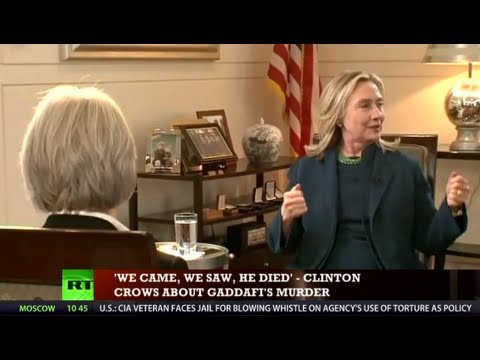
This is the same leader who was murdered in the aftermath of the 2011 NATO bombing of Libya; an attack promoted and facilitated with the eager support of Mrs. Clinton. In an infamous CBS news interview, said regarding this international crime: “We came, we saw, he died.” As Time magazine pointed out in 2011, the administration understood removing Qaddafi from power would allow the terrorist cells active in Libya to run rampant in the vacuum left behind. Just last month the New York Times reported that Libya has indeed become a terrorist safe haven and failed state— conducive for exporting radicals through “ratlines” to the conflict against Assad in Syria.

Hillary made prompt use of the ratlines for conflicts in the Middle East. In the summer of 2012, Clinton privately worked with then CIA director and subversive bonapartist David Petraeus on a proposal for providing arms and training to death squads to be used to topple Syria just as in Libya. This proposal was ultimately struck down by Obama, reported the New York Times in 2013, but constituted one of the earliest attempts at open military support for the Syrian death squads.

Her voting record on intervening in Afghanistan and Iraq is well known and she also has consistently called for attacking Iran. She even told Fareed Zakaria the State Department was involved “behind the scenes” in Iran’s failed 2009 Green Revolution. More recently in Foreign Policy magazine David Rothkopf wrote on the subject of the Lausanne nuclear accord, predicting a “snap-back” in policy by the winner of the 2016 election to the foreign policy in place since the 1980s. The title of this article? “Hillary Clinton is the Real Iran Snap-Back.” This makes Hillary the prime suspect for a return to the madcap Iranian policies that routinely threaten the world with a World War 3 scenario.

Hillary Clinton is not only actively aggressing against Africa and the Middle East. She was one of the loudest proponents against her husband’s hesitancy over the bombing of Kosovo, telling Lucina Frank: “I urged him to bomb,” even if it was a unilateral action.

While no Clinton spokesperson responded to a request by the Washington Free Beacon regarding her stance on Ukraine, in paid speeches she mentioned “putting more financial support into the Ukrainian government”. When Crimea decided to choose the Russian Federation over Poroshenko’s proto-fascist rump state, Hillary anachronistically called President Putin’s actions like “what Hitler did in the ‘30s.” As a leader of the bumbled ”reset” policy towards Russia, Hillary undoubtedly harbors some animus against Putin and will continue the destabilization project ongoing in Ukraine.

Not content with engaging in debacles in Eastern Europe, she has vocally argued for a more aggressive response to what she called the “rollback of democratic development and economic openness in parts of Latin America.” This indicates her willingness to allow the continuation of CIA sponsored efforts at South American destabilization in the countries of Venezuela, Bolivia, Ecuador, Argentina and Brazil.

It is one of the proud prerogatives of the Tax Wall Street Party to push out into the light the Wall Street and foundation-funded Democrats. The final blow to Hillary’s clumsy façade comes directly from arch-neocon Robert Kagan. Kagan worked as a foreign policy advisor to Hillary along with his wife, Ukraine madwoman Victoria Nuland, during Hillary’s term as Secretary of State. He claimed in the New York Times that his view of American foreign policy is best represented in the “mainstream” by the foreign policy of Hillary Clinton; a foreign policy he obviously manipulated or outright crafted. Kagan stated: “If she pursues a policy which we think she will pursue…it’s something that might have been called neocon, but clearly her supporters are not going to call it that; they are going to call it something else.” What further reason could any sane person need to refute Hillary? A vote for Hillary is a vote for the irrational return to war.

The “Giant Sucking Sound”: Clinton Gave US NAFTA and Other Free Trade Sellouts

“There is no success story for workers to be found in North America 20 years after NAFTA,” states AFL-CIO president Richard Trumka. Unlike other failures of his Presidency, Bill Clinton can not run from NAFTA. It was Vice President Al Gore, not a veto-proof Republican congress, who lobbied to remove trade barriers with low-wage Mexico.

The record of free trade is clear. Multinational corporations and Wall Street speculators realize incredible profits, wages remain stagnant in the US, poverty persists in the developing world, and the remaining industrial corporations in America and Canada are increasingly owned by Chinese, Indian and other foreign interests.

America’s free trade policy is upside down. Besides Canada, Australia and Korea, most of our “free” trade partners are low-wage sweatshop paradises like Mexico, Chile, Panama, Guatemala, Bahrain and Oman. The US does in fact apply tariffs on most goods and on most nations of origin – rates are set by the US International Trade Commission (USTIC), a quasi-public federal agency.

Since a German- or Japanese-made automobile would under USITC’s schedule be taxed 10% upon importation, Volkswagen and Toyota can circumvent taxation by simply building their auto assembly plants for the US market in Mexico. In Detroit, an auto assembly worker is paid between $14 and $28/hour, ($29,120-$58,240/yr); hard work for modest pay. In Mexico, the rate varies from $2-5/hour.

In China, all automobile imports regardless of origin are tariffed as high as 25%. This allows the Chinese to attract joint ventures with Volkswagen and Toyota, and to paraphrase Abraham Lincoln, “keep the jobs, the cars and the money.”

NAFTA-related job loss is not a question of productivity, currency manipulation, “fair trade,” environmental standards, etc. While these issues are not trivial, free trade – as Lincoln’s advisor Henry C. Carey proved – is a matter of simple accounting. Can an American family survive on $4,160/year ($2/hr)? If not, cars and their components will be built in Mexico. If we want cars built in the United States, the only solution is a general tariff (import tax) reflecting the difference between those wage standards, like the very tariffs repealed by Bill Clinton.

In the United States the “runaway shop” under NAFTA and CAFTA has sent trade deficits and unemployment soaring while wages drop relative to the cost of living. Yet Mexico and other “partners” receive no benefit either. Many manufacturing sectors in Mexico pay wages lower than the equivalent sector in China. Mexico is now the world leader in illegal narcotics exportation and weapons importation. The poverty level between 1994 and 2009 remained virtually identical. (52.4% – 52.3%). The shipping of raw materials to Mexico comprise the majority of so called American “exports”. The finished products from these exports are assembled and sold back to the United States at slave labor prices.

Don’t expect Hillary to behave differently with the coming “Trans-Pacific Partnership,” which seeks to replace an ascendant China with less-developed Vietnam and Malaysia. Vietnam would overtake India-allied Bangladesh in the global apparel trade, and Malaysia has a high-tech manufacturing sector poised to rival China’s. With America’s manufacturing economy in shambles, the Clinton machine can now be redirected to geopolitical maneuvers.


Saturday Matinee: Mini Doc Double Feature

earth-eyes-9447950-400-300

“Our False Reality” and “The Lie We Live”: two recent short videos with a thematic connection. The first was produced by Aaron Dykes and Melissa Melton of TruthstreamMedia.com and explores how those who seek power and control use technology to manipulate and engineer the masses right down to the perception of reality. The second film, produced by Spencer Cathcart, offers a brief but expansive overview of systems of control with a reminder of the positive potential of communications technology.

FAA investigating Florida mailman’s landing of gyrocopter on U.S. Capitol lawn

1dfb9_1956

By Ben Montgomery

Source: Tampa Bay Times

Doug Hughes, a 61-year-old mailman from Ruskin, told his friends he was going to do it. He was going to fly a gyrocopter through protected airspace and put it down on the lawn of the U.S. Capitol, then try to deliver 535 letters of protest to 535 members of Congress.

The stunt seemed so outlandish that not even his closest friend thought he would pull it off.

“My biggest fear was he was going to get killed,” said Mike Shanahan, 65, of Apollo Beach, who works with Hughes for the Postal Service.

After 21/2 years of planning, Hughes came hovering low over the buildings of northeast D.C. about 1:20 p.m., like a distant bird. He rounded the Washington Monument a few minutes later, flew straight up the expanse of the National Mall and brought his small craft down right in front of the Capitol, where he was quickly surrounded by police and surrendered without incident.

The flight stunned police, Secret Service and witnesses. Authorities briefly shut down the Capitol as a security measure. The incident brought out dozens of reporters and cameras from national media outlets — exactly what Hughes had hoped for. Hughes, who sees himself as a sort of showman patriot, a mix of Paul Revere and P.T. Barnum, wanted to do something so big and brazen that it would hijack the news cycle and turn America’s attention toward his pet issue: campaign finance reform.

“No sane person would do what I’m doing,” Hughes told the Tampa Bay Times in the weeks before he took flight. He was doing it, he said, because the United States is “heading full-throttle toward a breakdown.”

“There’s no question that we need government, but we don’t have to accept that it’s a corrupt government that sells out to the highest bidder,” Hughes said.

It’s hard to say whether the message got through.

“I don’t think anyone noticed it,” said Sophia Brown, visiting Washington from England. “We noticed it, but nobody made a big deal about it.”

Richard Burns, 27, a worker at a marijuana lobby group in Washington, stood by the Capitol in wonder and solidarity.

“I don’t know whatever it was he was doing, but I support him,” Burns said.

Gil Wheeler, 53, a pilot from Las Vegas, said the biggest problem was how the letter carrier reached restricted airspace in the first place.

“This is just another question for Homeland Security,” Wheeler said. “We still have a lot of questions to ask.”

Late Wednesday, U.S. Capitol Police said Hughes had been arrested, charged under Title 49 of U.S. Code and processed at their headquarters. He was then transferred to the central cellblock in Washington. The FAA was investigating.

News reports said Secret Service agents were investigating at Gettysburg Airport, a small airport in Pennsylvania, where they believe Hughes took off.

Hughes didn’t know whether he would even make it. He imagined being shot down, blown down. Almost every scenario he could imagine involved some type of resistance. Barring that, he said: “They will put the cuffs on me. And they will try to establish who is behind this. . . . The authorities are going to be out to get me.”

His wife could not be reached for comment.

Hughes contacted a Tampa Bay Times reporter last year, saying he wanted to tell someone about his plan and motivation. He said he had no intention of hurting anybody and that he didn’t want to be hurt. By that time, he had already been visited twice by the Secret Service, he said.

The first visit, Hughes told the Times, came one night last spring at about 1 a.m. The agent was accompanied by a Hillsborough County sheriff’s deputy. In a statement issued to media outlets Wednesday, the Secret Service said it interviewed Hughes on Oct. 5, 2013, and that a “complete and thorough investigation was conducted.”

The Secret Service agent asked him questions about his plan, Hughes said, and he said he was honest in his replies, if not totally forthcoming with details. Yes, he did own a gyrocopter. Yes, he kept it in a hangar at the small airport in Wauchula. Yes, he had talked of doing something big to bring attention to the issue of campaign finance reform. No, he was not planning to crash into any buildings or monuments in Washington, D.C.

I’m not a violent person, Hughes remembers saying. All I want to do is draw attention.

Someone inside his circle of secrecy had reported him, telling the Secret Service that Hughes was talking about committing a daring act of civil disobedience that also happened to be a federal crime.

Two days later, Hughes said, the same agent showed up at the post office where Hughes works and asked more questions. One of Hughes’ colleagues told the Tampa Bay Times that he, too, answered questions from the Secret Service.

And then, for months, nothing. That was it, Hughes said. No other questions. No other contact. Hughes put his plan into action.

He bought a burner cell phone and a videocamera and tested a livestream video feed from his gyrocopter. He built a website offline that explained why he was doing this. He bought $250 worth of stamps and stuffed envelopes with his letter:

“I’m demanding reform and declaring a voter’s rebellion in a manner consistent with Jefferson’s description of rights in the Declaration of Independence,” he wrote in his letters. “As a member of Congress, you have three options. 1. You may pretend corruption does not exist. 2. You may pretend to oppose corruption while you sabotage reform. 3. You may actively participate in real reform.”

Late last week, he loaded the gyrocopter onto a trailer and headed for an undisclosed location outside the nation’s capital.

His livestream showed that he took off about 12:10 p.m. Wednesday. He intended to fly about 300 feet high, at 45 mph and wound up landing on the west lawn of the Capitol shortly before 1:30 p.m.

Hughes knew there was a risk he could be shot out of the sky, though he hoped it wouldn’t come to that.

“I don’t believe that the authorities are going to shoot down a 61-year-old mailman in a flying bicycle,” he said. “I don’t have any defense, okay, but I don’t believe that anybody wants to personally take responsibility for the fallout.”

In the end, his flight occurred without incident or escorts. The Times published a story about Hughes’ plans on its website, tampabay.com, shortly after noon when it was clear he had actually taken off and was attempting his flight. His livestream cut in and out but showed his progress. A Times reporter called the Secret Service in Washington, D.C., shortly before 1 p.m. to see if officials were aware of a man in a gyrocopter flying toward the capital. Public information officers there who did not give their names said they had not heard of the protest. They referred a reporter to Capitol Police. A public information officer did not immediately answer.

Sgt. Trina Hamilton in the watch commander’s office said: “He hasn’t notified anybody. We have no information.”

Hughes’ friend, Mike Shanahan, after receiving a call from Hughes early Wednesday, said he contacted a Secret Service agent and left a message but never heard back. Hughes had told his friend he was in Washington, Shanahan recalled. But when Shanahan tried to access the live-streaming website, he could not find it and was unsure if Hughes was really going to take flight.

Before his flight, Hughes said he knew what was at stake. He figured he’ll lose his job of 11 years. And he could lose his tidy little house across from a pond with a fountain. He knew he would lose his freedom. That means losing, at least temporarily, his Russian-born wife and his polite 12-year-old daughter who plays the piano and wins awards at the science fair. He kept them in the dark, he said, for fear they’d be implicated.

Hughes is a slender, soft-spoken, pedantic man, with thinning gray hair and hearing aids. He has no criminal record and it’s rare to hear him curse. But he said he needed the show, the very dramatic public act of civil disobedience, to focus the nation’s attention on campaign finance reform, a topic that in most quarters makes eyes glaze over. Money, he says, has corrupted the democracy.

At the root of Hughes’ disdain is the Supreme Court’s 2010 decision in Citizens United vs. Federal Election Commission, in which the court decided campaign contributions were a form of “political speech” and struck down limits on how much corporations and unions could give to political contenders. The decision changed the game. Campaign spending went through the roof. In Hughes’ mind, there was a parallel spike in favor-dealing and the government is now practically owned by the rich. Hughes likes to point out that nearly half the retiring members of Congress from 1998 to 2004 got jobs as lobbyists earning some 14 times their congressional salaries.

But nobody seems to care.

Hughes thinks the answers are out there, and they’re nonpartisan. He points to reform thinkers like political activist Cenk Uygar and Harvard legal theorist Lawrence Lessig, who launched a political action committee to end political action committees. The motto: “Embrace the irony.”

“I’m not promoting myself,” Hughes said a few weeks ago. “I’m trying to direct millions of people to information, to a menu of organizations that are working together to fix Congress.”

His idea began to blossom 2½ years ago, after his son, John Joseph Hughes, 24, committed suicide by driving his car head-on into another man, killing them both. “Police: Suicidal driver caused deadly crash,” read the headline in the Leesburg newspaper. He was crushed by grief, and disappointed that his son had killed himself — and someone else — to make a stupid, worthless point.

“Something changed in me,” Hughes said. With mourning came a realization. The years Hughes spent thinking about and writing about mundane political issues were for naught if he didn’t have a way to make a point. His political frustrations and grief merged. He doesn’t condone what his son did, but it offered a lesson.

“He paid far too high a price for an unimportant issue,” Hughes said. “But if you’re willing to take a risk, the ultimate risk, to draw attention to something that does have significance, it’s worth doing.”

He has always wanted to fly. Growing up in Santa Cruz, Calif., he used to ride his bike to Sky Park and watch the planes come and go, and read books about the Wright brothers and Kitty Hawk.

At first he thought about using an ultralight fixed-wing plane, but that felt too threatening. He finally found the gyrocopter, which has unpowered helicopter blades on top for lift but gets its thrust from a propeller on the back. The cockpit, if you can call it that, is wide open. “This is as transparent a vehicle that I could come up with,” Hughes said. “You can literally see through it.” He can land the craft in a space the size of half a basketball court.

Hughes told the Times he planned to set up a delayed email blast to alert as many TV and newspaper breaking news desks as he could find, as well as the Secret Service.

The Secret Service statement said it did not receive notification of the flight. Several reporters told the Times they received the email. The Times reported about Hughes’ flight on Twitter and Facebook as it was happening, but most media attention came after his landing at the Capitol. His website went up as scheduled, which broadcast a choppy livestream of his trip.

His biggest fear all along, he said, was losing his nerve.

“I have thought about walking away from this whole thing because it’s crazy,” he said. “But I have also thought about being 80 years old and watching the collapse of this country and thinking that I had an idea once that might have arrested the fall and I didn’t do it.

“And I will tell you completely honestly: I’d rather die in the flight than live to be 80 years old and see this country fall.”

Times staff writers Zachary T. Sampson and Lauren Carroll and researcher Caryn Baird contributed to this report.


This is the text of the letter that Doug Hughes wants to deliver to members of Congress:

Dear ___________,

Consider the following statement by John Kerry in his farewell speech to the Senate —

“The unending chase for money I believe threatens to steal our democracy itself. They know it. They know we know it. And yet, Nothing Happens!” — John Kerry, 2-13

In a July 2012 Gallup poll, 87% tagged corruption in the federal government as extremely important or very important, placing this issue just barely behind job creation. According to Gallup, public faith in Congress is at a 41-year record low, 7%. (June 2014) Kerry is correct. The popular perception outside the DC beltway is that the federal government is corrupt and the US Congress is the major problem. As a voter, I’m a member of the only political body with authority over Congress. I’m demanding reform and declaring a voter’s rebellion in a manner consistent with Jefferson’s description of rights in the Declaration of Independence. As a member of Congress, you have three options.

1. You may pretend corruption does not exist.

2. You may pretend to oppose corruption while you sabotage reform.

3. You may actively participate in real reform.

If you’re considering option 1, you may wonder if voters really know what the ‘chase for money’ is. Your dismal and declining popularity documented by Gallup suggests we know, but allow a few examples, by no means a complete list. That these practices are legal does not make them right! Obviously, it is Congress who writes the laws that make corruption legal.

1. Dozens of major and very profitable corporations pay nothing in taxes. Voters know how this is done. Corporations pay millions to lobbyists for special legislation. Many companies on the list of freeloaders are household names — GE, Boeing, Exxon Mobil, Verizon, Citigroup, Dow …

2. Almost half of the retiring members of Congress from 1998 to 2004 got jobs as lobbyists earning on average fourteen times their Congressional salary. (50% of the Senate, 42% of the House)

3. The new democratic freshmen to the US House in 2012 were ‘advised’ by the party to schedule 4 hours per day on the phones fund raising at party headquarters (because fund raising is illegal from gov’t offices.) It is the donors with deep pockets who get the calls, but seldom do the priorities of the rich donor help the average citizen.

4. The relevant (rich) donors who command the attention of Congress are only .05% of the public (5 people in a thousand) but these aristocrats of both parties are who Congress really works for. As a member of the US Congress, you should work only for The People.

1. Not yourself.

2. Not your political party.

3. Not the richest donors to your campaign.

4. Not the lobbyist company who will hire you after your leave Congress.

There are several credible groups working to reform Congress. Their evaluations of the problem are remarkably in agreement though the leadership (and membership) may lean conservative or liberal. They see the corrupting effect of money — how the current rules empower special interests through lobbyists and PACs — robbing the average American of any representation on any issue where the connected have a stake. This is not democracy even if the ritual of elections is maintained.

The various mechanisms which funnel money to candidates and congress-persons are complex. It happens before they are elected, while they are in office and after they leave Congress. Fortunately, a solution to corruption is not complicated. All the proposals are built around either reform legislation or a Constitutional Amendment. Actually, we need both — a constitutional amendment and legislation.

There will be discussion about the structure and details of reform. As I see it, campaign finance reform is the cornerstone of building an honest Congress. Erect a wall of separation between our elected officials and big money. This you must do — or your replacement will do. A corporation is not ‘people’ and no individual should be allowed to spend hundreds of millions to ‘influence’ an election. That much money is a megaphone which drowns out the voices of ‘We the People.’ Next, a retired member of Congress has a lifelong obligation to avoid the appearance of impropriety. That almost half the retired members of Congress work as lobbyists and make millions of dollars per year smells like bribery, however legal. It must end. Pass real campaign finance reform and prohibit even the appearance of payola after retirement and you will be part of a Congress I can respect.

The states have the power to pass a Constitutional Amendment without Congress — and we will. You in Congress will likely embrace the change just to survive, because liberals and conservatives won’t settle for less than democracy. The leadership and organization to coordinate a voters revolution exist now! New groups will add their voices because the vast majority of Americans believe in the real democracy we once had, which Congress over time has eroded to the corrupt, dysfunctional plutocracy we have.

The question is where YOU individually stand. You have three options and you must choose.

Sincerely,

Douglas M. Hughes

http://www.TheDemocracyClub.org

Judith Miller’s Blame-Shifting Memoir

Judy Miller 409By Veteran Intelligence Professionals for Sanity

Source: Consortium News

U.S. intelligence veterans recall the real story of how New York Times reporter Judith Miller disgraced herself and her profession by helping to mislead Americans into the disastrous war in Iraq. They challenge the slick, self-aggrandizing rewrite of history in her new memoir.

MEMORANDUM FOR: Americans Malnourished on the Truth About Iraq

FROM: Veteran Intelligence Professionals for Sanity (VIPS)

SUBJECT: A New “Miller’s Tale” (with apologies to Geoffrey Chaucer)

On April 3, former New York Times journalist Judith Miller published an article in the Wall Street Journal entitled “The Iraq War and Stubborn Myths: Officials Didn’t Lie, and I Wasn’t Fed a Line.” If this sounds a bit defensive, Miller has tons to be defensive about.

In the article, Miller claims, “false narratives [about what she did as a New York Times reporter] deserve, at last, to be retired.” The article appears to be the initial salvo in a major attempt at self-rehabilitation and, coincidentally, comes just as her new book, The Story: A Reporter’s Journey, is to be published today.

In reviewing Miller’s book, her “mainstream media” friends are not likely to mention the stunning conclusion reached recently by the Nobel Prize-winning International Physicians for the Prevention of Nuclear War and other respected groups that the Iraq War, for which she was lead drum majorette, killed one million people. One might think that, in such circumstances – and with bedlam reigning in Iraq and the wider neighborhood – a decent respect for the opinions of mankind, so to speak, might prompt Miller to keep her head down for a while more.

In all candor, after more than a dozen years, we are tired of exposing the lies spread by Judith Miller and had thought we were finished. We have not seen her new book, but we cannot in good conscience leave her WSJ article without comment from those of us who have closely followed U.S. policy and actions in Iraq.

Miller’s Tale in the WSJ begins with a vintage Miller-style reductio ad absurdum: “I took America to war in Iraq. It was all me.” Since one of us, former UN inspector Scott Ritter, has historical experience and technical expertise that just won’t quit, we asked him to draft a few paragraphs keyed to Miller’s latest tale. He shared the following critique:

Miller’s Revisionist History

“Judith Miller did not take America to war in Iraq. Even a journalist with an ego the size of Ms. Miller’s cannot presume to usurp the war power authorities of the President of the United States, or even the now-dormant Constitutional prerogatives of Congress. What she is guilty of, however, is being a bad journalist.

“She can try to hide this fact by wrapping herself in a collective Pulitzer Prize, or citing past achievements like authoring best-selling books. But this is like former Secretary of State Colin Powell trying to remind people about his past as the National Security Advisor for President Reagan or Chairman of the Joint Chiefs of Staff under Presidents George H. W. Bush and Bill Clinton.

“At the end of the day Mr. Powell will be judged not on his previous achievements, but rather on his biggest failure – his appearance before the United Nations Security Council touting an illusory Iraqi weapons-of-mass-destruction threat as being worthy of war. In this same vein, Judith Miller will be judged by her authoring stories for the ‘newspaper of record’ that were questionably sourced and very often misleading. One needs only to examine Ms. Miller’s role while embedded in U.S. Army Mobile Exploitation Team Alpha, hunting for weapons of mass destruction during the 2003 invasion, for this point to be illustrated.

“Miller may not have singlehandedly taken America and the world to war, but she certainly played a pivotal role in building the public case for the attack on Iraq based upon shoddy reporting that even her editor at the New York Times has since discredited – including over reliance on a single-source of easy virtue and questionable credibility – Ahmed Chalabi of the Iraqi National Congress. The fact that she chose to keep this ‘source’ anonymous underscores the journalistic malfeasance at play in her reporting.

“Chalabi had been discredited by the State Department and CIA as a reliable source of information on Iraq long before Judith Miller started using him to underpin her front-page ‘scoops’ for the New York Times. She knew this, and yet chose to use him nonetheless, knowing that then Secretary of Defense Donald Rumsfeld was fully as eager to don the swindlers’ magic suit of clothes, as was the king in Hans Christian Anderson’s fairy tale. In Ms. Miller’s tale, the fairy-tale clothes came with a WMD label and no washing instructions.

“Ms. Miller’s self-described ‘newsworthy claims’ of pre-war weapons of mass destruction stories often were – as we now know (and many of us knew at the time) – handouts from the hawks in the Bush administration and fundamentally wrong.

“Like her early reporting on Iraq, Ms. Miller’s re-working of history to disguise her malfeasance/misfeasance as a reporter does not bear close scrutiny. Her errors of integrity are hers and hers alone, and will forever mar her reputation as a journalist, no matter how hard she tries to spin the facts and revise a history that is highly inconvenient to her. Of course, worst of all, her flaws were consequential – almost 4,500 U.S. troops and 1,000,000 Iraqis dead.”

Relying on the Mistakes of Others

In her WSJ article, Miller protests that “relying on the mistakes of others and errors of judgment are not the same as lying.” It is almost as though she is saying that if Ahmed Chalabi told her that, in Iraq, the sun rises in the west, and she duly reported it, that would not be “the same as lying.”

Miller appears to have worked out some kind of an accommodation with George W. Bush and others who planned and conducted what the post-World War II Nuremburg Tribunal called the “supreme international crime,” a war of aggression. She takes strong issue with what she calls “the enduring, pernicious accusation that the Bush administration fabricated WMD intelligence to take the country to war.”

Does she not know, even now, that there is abundant proof that this is exactly what took place? Has she not read the Downing Street Memorandum based on what CIA Director George Tenet told the head of British Intelligence at CIA headquarters on July 20, 2002; i. e., that “the intelligence and facts were being fixed around the policy” of making war for “regime change” in Iraq?

Does she not know, even at this late date, that the “intelligence” served up to “justify” attacking Iraq was NOT “mistaken,” but outright fraud, in which Bush had the full cooperation of Tenet and his deputy John McLaughlin? Is she unaware that the Assistant Secretary of State for Intelligence at the time, Carl Ford, has said, on the record, that Tenet and McLaughlin were “not just wrong, they lied … they should have been shot” for their lies about WMD? (See Hubris: The Inside Story of Spin, Scandal, and the Selling of the Iraq War by Michael Isikoff and David Corn.)

Blame Blix

Miller’s tale about Hans Blix in her WSJ article shows she has lost none of her edge for disingenuousness: “One could argue … that Hans Blix, the former chief of the international inspectors, bears some responsibility,” writes Miller. She cherry-picks what Blix said in January 2003 about “many proscribed weapons and items,” including 1,000 tons of chemical agent, were still “not accounted for.”

Yes, Blix said that on Jan. 27, 2003. But Blix also included this that same day in his written report to his UN superiors, something the New York Times, for some reason, did not include in its report:

“Iraq has on the whole cooperated rather well so far with UNMOVIC in this field. The most important point to make is that access has been provided to all sites we have wanted to inspect and with one exception it has been prompt. We have further had great help in building up the infrastructure of our office in Baghdad and the field office in Mosul. Arrangements and services for our plane and our helicopters have been good. The environment has been workable.

“Our inspections have included universities, military bases, presidential sites and private residences. Inspections have also taken place on Fridays, the Muslim day of rest, on Christmas day and New Years day. These inspections have been conducted in the same manner as all other inspections.” [See “Steve M.” writing (appropriately) for “Crooks and Liars” as he corrected the record.]

Yes, there was some resistance by Iraq up to that point. Blix said so. However, on Jan. 30, 2003, Blix made it abundantly clear, in an interview published in The New York Times, that nothing he’d seen at the time justified war. (The byline was Judith Miller and Julia Preston.)

The Miller-Preston report said: “Mr. Blix said he continued to endorse disarmament through peaceful means. ‘I think it would be terrible if this comes to an end by armed force, and I wish for this process of disarmament through the peaceful avenue of inspections,’ he said. …

“Mr. Blix took issue with what he said were Secretary of State Colin L. Powell’s claims that the inspectors had found that Iraqi officials were hiding and moving illicit materials within and outside of Iraq to prevent their discovery. He said that the inspectors had reported no such incidents. …

“He further disputed the Bush administration’s allegations that his inspection agency might have been penetrated by Iraqi agents, and that sensitive information might have been leaked to Baghdad, compromising the inspections. Finally, he said, he had seen no persuasive indications of Iraqi ties to Al Qaeda, which Mr. Bush also mentioned in his speech. ‘There are other states where there appear to be stronger links,’ such as Afghanistan, Mr. Blix said, noting that he had no intelligence reports on this issue.”

Although she co-authored that New York Times report of Jan. 30, 2003, Judith Miller remembers what seems convenient to remember. Her acumen at cherry picking may be an occupational hazard occasioned by spending too much time with Chalabi, Rumsfeld and other professional Pentagon pickers.

Moreover, Blix’s February 2003 report showed that, for the most part, Iraq was cooperating and the process was working well:

“Since we arrived in Iraq, we have conducted more than 400 inspections covering more than 300 sites. All inspections were performed without notice, and access was almost always provided promptly. In no case have we seen convincing evidence that the Iraqi side knew in advance that the inspectors were coming. …

“The inspections have taken place throughout Iraq at industrial sites, ammunition depots, research centres, universities, presidential sites, mobile laboratories, private houses, missile production facilities, military camps and agricultural sites. …

“In my 27 January update to the Council, I said that it seemed from our experience that Iraq had decided in principle to provide cooperation on process, most importantly prompt access to all sites and assistance to UNMOVIC in the establishment of the necessary infrastructure. This impression remains, and we note that access to sites has so far been without problems, including those that had never been declared or inspected, as well as to Presidential sites and private residences. …

“The presentation of intelligence information by the US Secretary of State suggested that Iraq had prepared for inspections by cleaning up sites and removing evidence of proscribed weapons programmes.

“I would like to comment only on one case, which we are familiar with, namely, the trucks identified by analysts as being for chemical decontamination at a munitions depot. This was a declared site, and it was certainly one of the sites Iraq would have expected us to inspect.

“We have noted that the two satellite images of the site were taken several weeks apart. The reported movement of munitions at the site could just as easily have been a routine activity as a movement of proscribed munitions in anticipation of imminent inspection.”

Blix made it clear that he needed more time, but the Bush administration had other plans. In other words, the war wasn’t Blix’s fault, as Judy Miller suggests. The fault lay elsewhere.

When Blix retired at the end of June 2004, he politely suggested to the “prestigious” Council on Foreign Relations in New York the possibility that Baghdad had actually destroyed its weapons of mass destruction after the first Gulf War in 1991 (as Saddam Hussein’s son-in-law, Hussein Kamel, who had been in charge of the WMD and rocket programs assured his debriefers when he defected in 1995). Blix then allowed himself an undiplomatic jibe:

“It is sort of fascinating that you can have 100 per cent certainty about weapons of mass destruction and zero certainty of about where they are.”

For the Steering Group, Veteran Intelligence Professionals for Sanity (VIPS)

William Binney, former Technical Director, National Security Agency (ret.)

Thomas Drake, former Senior Executive, NSA

Daniel Ellsberg, former State and Defense Department official, associate VIPS

Frank Grevil, former Maj., Army Intelligence, Denmark, associate VIPS

Katharine Gun, former analyst, GCHQ (the NSA equivalent in the UK), associate VIPS

Matthew Hoh, former Capt., USMC, Iraq & Foreign Service Officer, Afghanistan, associate VIPS

Brady Kiesling, former Political Counseler, U.S. Embassy, Athens, resigned in protest before the attack on Iraq, associate VIPS.

Karen Kwiatkowski, former Lt. Col., US Air Force (ret.), at Office of Secretary of Defense watching the manufacture of lies on Iraq, 2001-2003.

Annie Machon, former officer, MI5 (the CIA equivalent in the UK), associate VIPS

David MacMichael, former Capt., USMC & senior analyst, National Intelligence Council (ret.)

Ray McGovern, former Capt., Army Infantry/Intelligence & CIA presidential briefer (ret.)

Elizabeth Murray, former Deputy National Intelligence Officer for the Near East, National Intelligence Council (ret.)

Todd E. Pierce, Maj., former U.S. Army Judge Advocate (ret.)

Scott Ritter, former Maj., USMC, former UN Weapon Inspector, Iraq

Coleen Rowley, Division Council & Special Agent, FBI (ret.)

Greg Thielmann, former Office Director for Strategic, Proliferation, and Military Affairs in the State Department’s Bureau of Intelligence and Research

Peter Van Buren, former diplomat, Department of State, associate VIPS

Ann Wright, Col., US Army (ret.) & US diplomat (resigned in March, 2003 in opposition to the war on Iraq)

Pink-haired ‘nerd’ scores win, thanks to 9/11 Truth websites

22587_001_5108_r

Video game blogger beats NASA engineer in TV physics contest

By Craig McKee

Source: Architects and Engineers for 9/11 Truth

Sometimes the truth about 9/11 shows up in the oddest places.

On a recent episode of the TBS reality show King of the Nerds, a bubbly, pink-haired video game blogger named Danielle was the unlikely winner of one phase of a science-related competition that pitted her against a NASA engineer and three other contenders. The most intriguing aspect of her upset win was that Danielle used “9/11 conspiracy” websites to outsmart her rivals.

Hosted by the stars of the Revenge of the Nerds movies, Robert Carradine and Curtis Armstrong, King of the Nerds features a group of contestants who compete in a series of challenges called “nerd wars” in a location called “Nerdvana.” The challenge on this episode involved predicting how many panes of glass — spaced apart vertically in much the same way floors in a high-rise office building are — would be broken when balls of various weights were dropped from a tower.

At the start, the hosts did a demonstration to acquaint the five competitors with the problem they would have to solve. When they dropped a twelve-pound ball suspended fourteen feet above more than two dozen sheets of glass that were one-quarter-inch thick and spaced three inches apart, the top four panes broke.

Carradine and Armstrong then issued the assignment: The contestants had to calculate how many panes would shatter in each of three different tests. In the first and third tests, the only variable that changed was the density of the dropped object — a six-pound nerd ball in the former, a fifteen-pound stuffed pig in the latter. (The audience is left to wonder what the heck the pig was stuffed with!) In the second test, besides the different density (an eight-pound nerd ball), the thickness of the glass and the space between the panes were also altered.

One by one, the young competitors revealed their academic backgrounds, familiarity with physics, and current vocations. There was Ivan, the smug-but-confused, role-playing game designer; Moogega, the cocky NASA engineering whiz; Genevieve, the stressed-out fantasy writer; Celeste, the pro-gamer; and Genevieve, the AP physics guide writer. The latter two collaborated “to improve our mutual chances of winning . . .” and “. . . to have a better chance of knocking Danielle out of this competition.” Then there was Danielle, who, having taken zero courses in physics, initially declared the challenge to be “bull&@^*” because all her adversaries were more qualified than she was. (She majored in a pre-vet program, where “we didn’t care how fast the cat moved . . . .”)

Lack of expertise, however, didn’t deter Danielle. Unlike her opponents, who got some sleep, she stayed up all night in search of answers. And while they appeared to rely only partially on the Internet (we see them referring to the available calculus books as well as scribbling lots of notes and equations — a few from memory), Danielle depended exclusively on the World Wide Web.

“I might be the only one in the house who is looking at My Little Pony to try to solve a physics problem,” she admitted at one point.

But the main sources of Danielle’s research were 9/11 Truth websites. “The only thing I’ve found that’s even similar to what we’re doing are people who are trying to disprove 9/11 being a terrorist attack,” she observed. “I have literally found probably ten websites using an example of dropping a bowling ball through panes of glass to explain why the Twin Towers is a conspiracy.”

When the three tests were over, Danielle came out on top, having bested her two closest competitors by one point. Ivan was miffed that someone with no prior knowledge of physics had beaten them all. Meanwhile, embarrassed engineer Moogega saw her worst fear come true when she finished dead last.

“I just beat a NASA scientist in physics,” a bemused Danielle beamed, then added, “What the f%^k?” She went on to thank “all the conspiracy theorists of America.”

Curiously, in one night of research, the “queen” of King of the Nerds did more to forward the truth about the Twin Towers’ destruction — albeit indirectly and unwittingly — than the mainstream media has done in thirteen years of pretending to prove the unprovable official account of 9/11.

Craig McKee is a journalist and creator of the blog Truth and Shadows.