Berlin Conference of 1884-1885 was undeniably one of the biggest evil summits in modern history. Greedy and racist European colonialists sat down in the German city and divided Africans as if they were sharing bread on a breakfast table.
The conference was organized by Otto von Bismarck, the first chancellor of Germany at the request of King Leopold II of Belgium, the Western genocidal barbarian that murdered more than 10 million innocent Africans in Congo.
Most Africans are not even aware of this genocide in Congo perpetrated by the Belgium colonialists because it is not in our history books written by the white colonialists.
European colonialism in Africa lasted more than a century with only the ancient Kingdom of Ethiopia spared because they defeated the Italian colonialists on the battlefield.
Trillions and trillions of dollars were stolen from Africa, millions of Africans were murdered by the European colonialists and Africans were massively brainwashed that they had no history before European colonialism.
The wave of ‘independence’ in Africa from the 1950s and 1960s did not represent true independence. What actually happened was that colonialism was cleverly replaced with neocolonialism by the genocidal imperialist barbarians of the West.
The massive looting of rich resources in Africa continued under Western puppet leadership. The courageous African leaders who refused to dance to the tune of the European colonialists were eliminated.
This was what happened to African heroes, Patrick Lumumba of Congo and Thomas Sankara of Burkina Faso. Congo has all mineral resources except for crude oil.
The uranium used by the US regime to make the atomic bombs unleashed on Hiroshima and Nagasaki was mined in Congo.
French greed in Africa
Among the European colonialists, French colonialism was more brutal and exploitative.
France killed more than 1.5 million civilians in Algeria alone. They murdered tens of thousands of civilians in other African countries.
One of the Modus Operandi of the French colonialists was to assemble Islamic scholars in a hall and exterminate all of them. They did this in Algeria, Chad, Mali and Senegal.
And the greed of their neocolonialism is extreme. Even after independence, France is still controlling the wealth of its former colonies in Africa.
The rich resources of French nations are still controlled by France and they continue to pay colonial tax to France.
French goods and services dominate their markets. The domineering presence of France in these countries has been excruciating and devastating for local populations.
Niger Republic does not know the quantity of uranium France was taking from there, which is worst than slavery.
No evil lasts forever
There is a popular saying that “No evil lasts forever”.
France’s neocolonialism in Africa will not last forever. Popular military coups against puppets of France imperialism have started and are gathering momentum.
The recent military coup in the West African state of Niger Republic does not stand in isolation but follows similar upheavals in the neighboring countries of Mali, Burkina Faso, and Guinea in recent years.
Mali is facing insurgency that is backed by Western hegemony. Mali expelled French troops because they were actively aiding the insurgents to justify its military presence in the African country.
Now, on Wednesday, we woke up with the news of another puppet of the Western hegemonic barbarians in Gabon overthrown by the military. Ali Bango inherited the Gabon presidency from his corrupt Father, Omar Bongo.
Early on Wednesday, some military personnel appeared on state TV and announced that they were seizing power and dislodging a family that has ruled the country for 56 years.
The military officers introduced themselves as members of the Committee of Transition and the Restoration of Institutions.
“Today the country is undergoing a severe institutional, political, economic, and social crisis,” the officers said in a statement, dubbing the recent election illegitimate.
“In the name of the Gabonese people … we have decided to defend the peace by putting an end to the current regime.”
Pertinently, Gabon’s former president had 70 bank accounts, 39 apartments, 2 Ferraris, 6 Mercedes Benz cars, 3 Porsches and a Bugatti in France. He ruled for 42 years (from 1967 to 2009). French leaders loved Bongo because he was loyal to them.
His son, Ali Bongo has been the president for 14 years (2009 – 2023). He has just been overthrown in a coup.
The fact is that the Western liberal democracy has not only failed in Africa but has failed woefully.
Democracy in Africa has become a tool for the corrupt ruling elites to steal the wealth of their respective countries and transfer it to Western financial institutions while the populations remain in abject poverty and hunger.
Democracy is just another system of government hijacked by the Western hegemonic barbarians, the biggest enemies of the human race. Democracy is now an imperialist tool of Western hegemony in Africa. This is a bitter and undeniable fact.
The people of Gabon will definitely celebrate this military coup as it marks the end of French interference and looting in their country. Another setback for the French leaders.
Africa must rise again
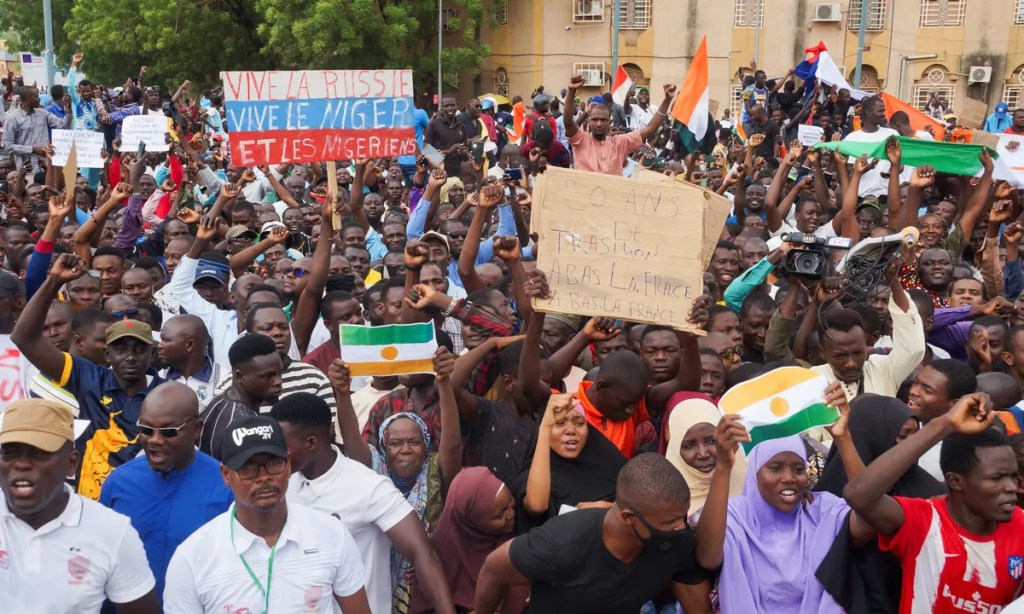
The most noticeable current in Mali, Burkina Faso, Guinea, Niger Republic and Gabon is that the change of governments all have popular support as the people of those countries are tired of France’s imperialism, arrogance and terrorism.
Today France has the 4th largest gold reserves in the world and there is no single gold mine in France.
These gold mines are all in Mali, Niger Republic and other African countries. The France neocolonialism in Africa must end. Its time has come.
“I believe that all government is evil, and that trying to improve it is largely a waste of time.”
H.L. Mencken
Throughout our history, and today, little, if any defense of this country or its people, has been necessary or warranted. The true enemy of the people of America is, and has always been, its own government. The real enemies are most all the politicians, regardless of party, the courts, the CIA, the NSA, the FBI, the IRS, the entire military industrial complex, and in general, the federal and state police forces. In other words, all the ruling class and it pawns in government, its enforcers, and all their institutions and bureaucracies, are the real threat to this populace and its natural freedoms. The ludicrous notion of national defense, and that government forces actually “defend the country,” is an outright lie; propagandized by the State and its mouthpieces in media, simply as a way to gain great power in order to own and control society.
Many will take offence to these statements, mostly due to the fact that since birth, they have been inundated and indoctrinated by false ‘authority’ figures, to believe that they cannot survive and prosper without restrictive laws and rule, and worthless government schooling, all kept in check by severe coercive State prosecution. They are taught (schooled) to abandon their individuality in favor of the so-called ‘greater good’ of a collective society, to depend on and trust others in power to protect and sustain them and their families throughout their lives. This breeds only ignorance and passivity in the face of State terror. Independence, a supposed hallmark of this nation-state and its residents, is literally vilified, and even prohibited in many instances, causing personal sovereignty to be discarded in the name of unified slavery.
We live in a country that has warred aggressively against fictitious enemies, meaning without cause or necessity, more than any other country on earth. It is stated, and supported, that the United States has been at war for at least 93% of its entire existence. I firmly believe this number to be much higher, and with proper consideration, it is likely closer to 100%. If one is to determine the actual damage done, the actual harm due to direct war, proxy war, what is insanely considered ‘collateral damage,’ what is the horrid long term cost to human life in the aftermath of this terror, the total number of causalities, including the dead, would be tens if not hundreds of millions of innocent people. But what is sold to the wrongly named ‘public, is that this country is and has been the savior of ‘democracy,’ a completely evil and failed ideology, which is a gross lie beyond the imagination of any sane and thinking human being.
Yes, the truth hurts, but without acceptance of truth, what is left is a deceitful lie; a manufactured myth so atrocious as to have caused an entire nation’s abhorrent and hostile policies to be supported by the masses to such an extent, as to have caused the most broad-based, aggressive, and egregious destruction of humanity in history. This should be the epitaph upon the death of this empire.
At this time in our lives, aggressive war by this government and all who support its heinous deeds, has graduated from its main objective of slaughtering innocent men, women, and children, in addition to the other devastation, in other countries most everywhere on earth, to include the entirety of this country’s population as well. The major war currently is against all of us who live and work in the U.S. by those who continue to claim to be our protectors. This contradiction is absurd, but is still little understood by the average American, as can be evidenced by the terroristic treatment inflicted, and with little if any resistance, on this society these past few years.
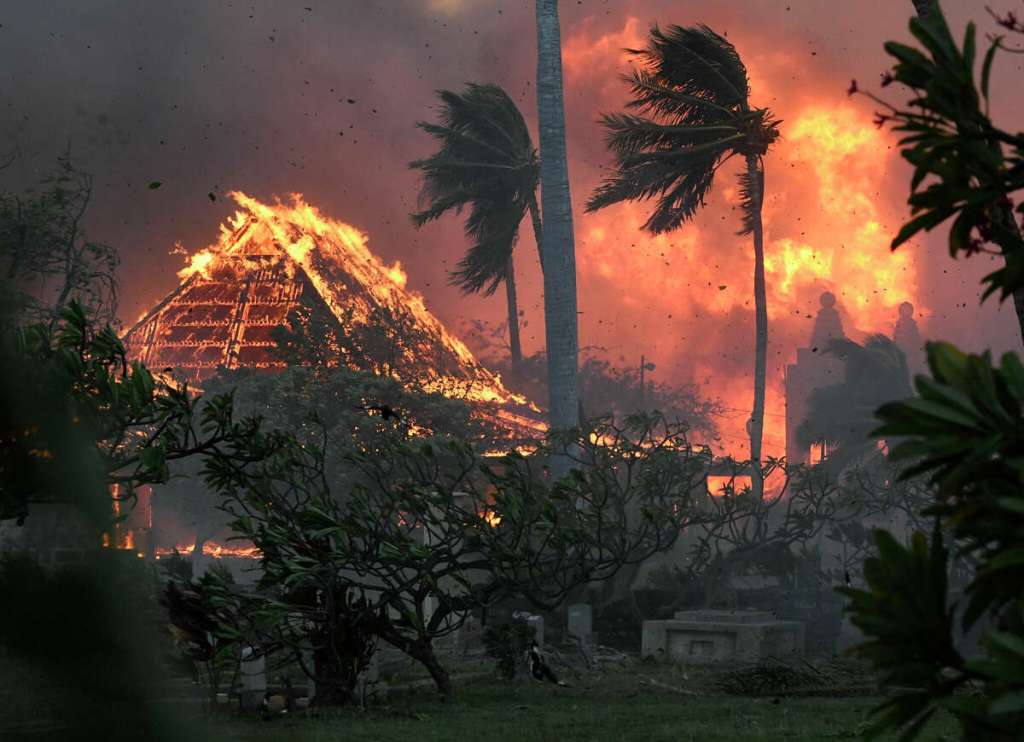
At a time when this country and the world are steeped in madness and hate, more and more atrocities continue to take place, with almost zero empathy evident by the political class. The last evil ‘ruler,’ just one among all, ‘chosen’ by the ‘people,’ was Biden, and this was his response to the State’s complicit murder of those in Lahaina just recently, after a very suspicious and devastating fire had destroyed an entire town and its residents. He had the audacity to offer these poor people who lost everything, including many family members, a one-time $700 payment per household. This was in the midst of giving over $200 million more to Ukraine’s political criminals recently, with plans to give many more billions; this after more than $113 billion has already been paid to enrich the newly rich politicians in Ukraine. (Apparently, blackmail garners payment more than actual need of Americans) This alone should be enough for everyone in this country to grasp how little this government cares about its own, and how worthless all in the governing system have become. To depend on, or trust this scum to defend you from harm, is asinine beyond explanation.
Who will defend you from harm? Who will defend you from foreign invasion, although that has never once happened in this country’s history, not even including the pre-planned setup called the Pearl Harbor attack? Who will defend you from hyper-inflation and the resulting extreme prices for goods? Who will defend you from mass censorship and constant surveillance? Who will defend you from food shortages, energy shutdowns, and extensive restrictions on all transactions and travel? Who will defend your children from the consuming perversion being forced on them at every opportunity with this government’s blessing? Who will defend you from aggression and tyranny? Who will defend you from yourself?
It will never be the evil State that defends you, nor will it be its ‘national defense systems,’ its enforcers in the military and police, the politicians, the banking cartels, the large corporate monsters, or any government at any level. There is only one legitimate defense, and that is self-defense. Only you, each of you, has the ability and desire to defend himself. No other and no State entity can or will ever be your savior. Until that is accepted, expect total serfdom to become your voluntarily accepted way of life.
Much more tyranny is coming. Lockdowns, fake ‘viruses,’ bioweapons, threats and totalitarian measures based on bogus ‘climate change, central bank digital currency, social credit restrictions, more inflation, destruction of money, health mandates, curfews, travel shutdowns, food shortages, transhuman promotion, among many other atrocities, including perpetual war.
National defense is an outright lie, and can never protect you, it can only harm you. There is but one enemy, and that enemy is the State! There is but one defense against this demon called government, and that is when individuals, or individuals working together en masse, abolish all rule. The responsibility for you is you, and any dependence on government whatsoever can only lead to despair, hopelessness, disaster, and enslavement. Defend yourself from this evil State, and break the chains that bind you.
“Every government is run by liars. Nothing they say should be believed.”
As developments in West Africa demonstrate, the francophone countries are no longer willing to accept French neo-colonialism. With the fear factor finally removed, Africa’s quest for genuine independence is steadily coming to fruition.
The 26 July coup in the West African nation of Niger, which threatens to undermine French and US military presence in the region, has shed light on the historical exploitation and continued practices of Francafrique – the term used to describe the persistent exploitation by the former French Empire in Africa.
France heavily relies on nuclear energy, with 68 percent of its power coming from nuclear plants. It obtains 19 percent of the uranium required to run these plants from Niger. Despite this significant contribution toward France’s energy needs, only 14.3 percent of Nigeriens have access to a power grid, and even that is often unreliable. This stark contrast highlights the disparities and ongoing exploitation by rapine foreign powers throughout the African continent.
The Legacy of Francafrique
Francafrique has been known for its exploitative systems designed to profit from African resources, using pressure, capital, and frequently outright force to maintain control over its former empire. As a result, many African states, including Niger, continue to face poverty and underdevelopment.
Burkina Faso’s young, charismatic leader Ibrahim Traore recently spoke at the Russia-Africa summit in St. Petersburg and decried the fact that Africa is resource-rich, but its people are poor, and criticized African leaders seeking hand-outs from the west, as they perpetuate dependency and poverty. He also described what is being imposed on Africa as a form of slavery, stating:
“As far as what concerns Burkina Faso today, for more than eight years we’ve been confronted with the most barbaric, the most violent form of imperialist neo-colonialism. Slavery continues to impose itself on us. Our predecessors taught us one thing: a slave who cannot assume his own revolt does not deserve to be pitied. We do not feel sorry for ourselves, we do not ask anyone to feel sorry for us.”
France’s inability to justify its presence in Africa with a coherent narrative further complicates the situation. Paris cannot openly confess its greed, feign a “civilizing mission,” or admit to any responsibility due to its past crimes. This lack of purpose weakens French power on the continent, leading to violence and poverty in its wake.
West Africa’s drive for further independence has left Atlanticists concerned about the opening this leaves for Eurasian powers like Russia and China to increase their influence in Africa. The west’s reaction reflects a lack of respect for the sovereignty of African countries, viewing the continent merely as a theater to maintain global dominance.
Since the Ukraine war’s onset in early 2022, Atlanticists have expressed alarm over the unwillingness of Global South states to support the west’s anti-Russia policies, a trend further amplified by the shift to multipolarism everywhere. This weakening of western hegemony has opened a path for many nations to avidly explore their geopolitical options and diversify their economies.
A report from the Munich Security Conference held in February highlighted this very real schism with the west:
“Many countries in Africa, Asia, and Latin America have steadily lost faith in the legitimacy and fairness of an international system which has neither granted them an appropriate voice in global affairs, nor sufficiently addressed their core concerns. To many states, these failures are deeply tied to the west. They find that the western-led order has been characterized by post-colonial domination, double standards, and neglect for developing countries’ concerns.”
Fleeced by the CFA Franc
The aftermath of the Second World War marked a significant shift in global power dynamics, and the victorious powers sought to establish a new world order that would maintain peace and promote economic balance.
In the context of African colonies, where colonial troops played a major role in the allied victory, the victorious powers, including France, aimed to retain economic control and benefit from their former colonies even as the world moved towards decolonization.
As the push for political independence grew stronger in the late 1950s, France organized referendums in its African colonies to vote on accepting a constitution drafted by the French.
Guinea, led by former trade unionist Sekou Toure, opposed accepting the French constitution and voted overwhelmingly against it. In a furious response, De Gaulle’s government withdrew all French administrators from Guinea and took action to sabotage the country’s infrastructure and resources. The harsh measures by Paris aimed to serve as an example of what would happen to any former French colony that resisted France’s agenda.
During the Cold War, the Communist states exploited such actions by presenting themselves as liberators and allies of African countries that sought independence from European influence. This stance has led to some Africans viewing countries like Russia as more equitable partners compared to France.
Over the years, France has demonstrated a pattern of intervening militarily – over 50 times since 1960 – in African countries to secure governments that remain compliant with French economic interests, particularly related to the continued use of the CFA Franc.
The system by which the CFA Franc operates has historically been one of a fixed exchange rate where the currency has unlimited convertibility but is permanently pegged to the French currency, previously the Franc and then the Euro.
Worse yet, France had requirements to store, and thus profit from, the foreign reserves owned by its former colonies, though the requirement of holding 50 percent of their foreign exchange reserves in a French-ran bank was dropped for the western zone in 2019.
Under this scheme, African states received a nominal amount of interest, but the bank benefited from lending that capital out at higher rates and attaining massive profits off of African resources and labor. This is despite the fact that many countries in Francophone Africa are major gold exporters and thus have a multitude of options for storing wealth to back a currency in alternative central banks.
While the CFA Franc system has provided some benefits in terms of stability and preventing Zimbabwean-style hyperinflation, it has also come under scrutiny for imposing requirements on African countries that are not placed on more powerful nations. The lack of control over their own currency has hindered economic growth and made these countries vulnerable to global economic shocks.
Northern African states such as Tunisia, Algeria, and Morocco chose to leave the CFA Franc upon gaining independence and have experienced relatively higher prosperity. Similarly, Botswana’s success with its own national currency demonstrates that proper management can lead to stable democracy and economic growth, even for less developed nations.
Exclusive rights and privileges
The CFA Franc system has been the geopolitical equivalent of one’s father insisting he manages their savings while leaving them out of his will. There are benefits to having a trade and currency zone, such as the current ECOWAS union that covers the Western part of the continent, but by design under the CFA Franc system, independence has been an illusion by which France has fleeced these countries.
France has been dependent on Africa for its status as a world power for more than a century. Among other privileges it has carved out for itself in post-colonial treaties, France has had the exclusive right to sell military equipment to former colonies, and enjoys the first right to any natural resources discovered. Paris makes great use of these privileges: as just one example, 36.4 percent of France’s gas is sourced from the African continent.
Moreover, a vast network of French business interests, which include major multinational companies, dominate industries such as energy, communications, and transportation in many African countries. France’s government also supports French businesses in Africa in several ways, including through an enormous public company called COFACE which guarantees French exports into these underdeveloped markets.
Towards independence and self-reliance
This economic dependence has contributed to the perpetuation of a system where African states remain weak, pliant, and reliant on resource exports, primarily benefiting French companies and interests. Additionally, African states are obligated to ally with France in any major conflict, further eroding their national sovereignty.
The African continent suffers from many ailments, but perhaps the most persistent and nefarious are a lack of sovereignty and access to capital. Meanwhile, much of Europe’s prosperity has been derived from looting the Global South for centuries.
The case of Brussels, built on the wealth derived from the brutal exploitation of the Congo under Belgian King Leopold II, is a stark reminder of the deep-rooted impact of colonialism. When the monarch’s crimes against humanity were discovered, he was ultimately forced to bequeath the majority of his fortune to the Belgian state upon his death.
Not wanting to do so, he embarked on an enormous series of public works to spend his ill-gotten gains, creating modern Brussels. Now the EU and NATO meet there and audaciously give disingenuous lectures about universal human rights while surrounded by the profits of some of the most brutal cases of oppression in human history.
While military governments often face challenges in achieving their stated goals, it is evident that western-backed “civil democracies” have also struggled to significantly improve the security and well-being of the African public.
The path to solving Africa’s problems lies in transformative leaders who can shrug off the legacy and remaining shackles of colonialism and enable the continent to carve out a genuine, homegrown path to independence and self-reliance.
I am not a big fan of Federal Government disaster relief. Too much of the time the money never gets to those who need it most, and too often Washington’s armies of disaster “experts” are more interested in pushing people around than helping them.
Nevertheless, it’s hard to look at recent footage of the devastation in Maui and then hear President Biden tell Congress that he needs another $24 billion for Ukraine. How can this Administration continue to justify tens of billions of dollars for this losing war that is not in our interest while the rest of the United States disintegrates?
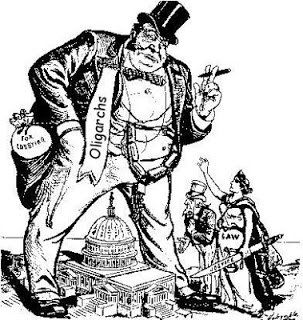
Biden’s new $24 billion request comes on top of well over $120 billion already spent to fight the US proxy war on Russia in Ukraine. Heritage Foundation budget expert Richard Stern has done the math and determined that Biden’s spending on the Ukraine war thus far will cost each and every American household $900. How many Americans would rather have those $900 dollars back in their pocket rather than in the pockets of Lockheed-Martin, Raytheon, and Ukraine’s oligarchs?
Recent surveys have shown that a majority of Americans could not afford to cover a sudden $1,000 emergency. Will Americans connect the dots and realize that the reason they can’t find that $1,000 for an emergency is because the neocons have already sent it to Ukraine?
Ukraine has long been known as among the most corrupt countries on earth and not long ago investigative journalist Seymore Hersh wrote that Ukrainian president Vladimir Zelensky has embezzled at least $400 million in aid from the American people. Corruption scandals continue to break in Ukraine. Just last week Zelensky fired the heads of all local draft boards for corruption. Some press reports suggest that sales of luxury cars in Ukraine have broken all previous records. I wonder why.
No wonder the tide of US public opinion is turning against further involvement in the war. Recently CNN found that among all Americans, more than 55 percent are opposed to continued aid to Ukraine. Among Republicans the number opposing more aid to Ukraine rises to three-out-of-four. That is why we are finally starting to see more Republican Members raising concerns. I’d like to think they have seen the light that an aggressive and interventionist foreign policy is not in America’s interest, but most likely they are worried about losing elections. Whatever their motivation, this turning tide should be welcomed.
Yet the Biden Administration persists in backing Ukraine even as the US mainstream media is increasingly pointing out the obvious: Ukraine is not winning and cannot win, and continuing to pour money into a losing cause will just result in bankruptcy at home and more dead Ukrainians overseas.
Last week Newsweek published an article asking, “Does Ukraine Have Kompromat on Joe Biden?” In the article, Northeastern University Professor Max Abrahms wonders out loud whether Biden’s continued support for Ukraine might be related to compromising information held in Kiev about the many Biden family shady business ventures in Ukraine and the region. It is certainly worth considering.
Meanwhile, the residents of Maui that survived the recent horrific fire will take little comfort knowing that the Biden Administration is more interested in sending their money to Ukraine than in helping them recover.
Economic issues are some of the most politically abused issues often because the data politicians exploit is easy to present out of context. The vast majority of the public doesn’t spend their time immersed in the intricacies of monetary policy, unemployment stats and the processes of inflation vs deflation. They hear a soundbite on the news or social media once in a while, assume it must be true and then go on with their day.
This is how economic crisis events always seem to take the population by surprise – The establishment tells people all is well and no one questions the narrative in the face of numerous warning signs. Sometimes, the populace continues to believe that everything is fine despite the financial framework burning down around them, all because the “experts” continue to convince them that recovery is “right around the corner.”
There are numerous incentives for government officials and mainstream economists to mislead the citizenry with tales of imminent prosperity in the midst of instability. Primarily, the goal is to keep the middle-class population as docile as possible so that they don’t revolt until it’s too late (the middle class being predominantly conservative, and the greatest threat to any corrupt regime). Understand that economics is the root of power, and economic perception is the key to influencing the masses.
Hidden Indicators And Rampant Money Printing
The reality is that the US was hurtling towards stagflationary disaster ever since the crash of 2008, when Barack Obama and Joe Biden (with the help of the Federal Reserve) oversaw the near doubling of the national debt from $10 trillion to almost $20 trillion – The most egregious abuse of monetary policy that the US had ever seen.
And, keep in mind this was only the officially reported cash. Because of pressure brought by people like Ron Paul in 2011, the government was forced to pursue a limited audit of the Federal Reserve bailouts at that time. This revealed at least $16 trillion created from nothing by the Fed to prop up the failing system.
In 2006, right before the derivatives collapse, the Federal Reserve conveniently and abruptly ended their M3 money supply report. They now only report the M2 money supply, which does not include the vast assets held in corporate coffers, large time deposits in banks, institutional money market funds, short-term repurchase agreements (repo), and larger liquid assets. It was as if they knew an inflationary event was about to take place and they needed to obscure the evidence.
In other words, in economics there is the “official government data” and then there is the REAL data, which is sometimes so hidden it is impossible to quantify.
Even if we only go by the M2 report, the money supply skyrocketed starting in 2020, and rose exponentially through 2021 and 2022 – It jumped by 40% in only two years. This is why the cost of most necessities has risen 25% or more.
I’m sure most readers have noticed that inflation is not going away despite Joe Biden’s claims that he has “cut inflation in half” under his “Bidenomics” plan. This is because inflation is cumulative. The CPI might fluctuate, but the effects of inflation remain as prices tend to increase and stay high perpetually.
There Is No Such Thing As “Bidenomics”
The supposed financial progress that Biden is trying to take credit for has nothing to do with Biden’s policies. Not a thing. Unless, of course, you count market manipulation as a positive.
For example, the reduction in CPI is directly related to the continuous interest rate hikes of the Federal Reserve, which Biden has zero control over. The Fed is autonomous and makes its decisions independent of the White House or government. This is a fact openly admitted by former chairman Alan Greenspan. When the fed raises rates, debt becomes more expensive, lending slows down and thus the economy slows down.
One of the only ways that Biden can influence CPI is through artificial deflation of energy prices. The Biden Administration has been dumping US strategic oil reserves on the market for the past year as a means to suppress oil prices, thereby directly and indirectly keeping the CPI numbers down. This is not progress, it’s economic fraud.
The misuse of stats extends to other sectors, such as Biden’s attempt to take credit for the recent reduction in the US deficit. Again, this has nothing to do with Biden; the Fed’s interest rate hikes make it more expensive for the government to take on debt, therefore, debt spending drops.
It’s also not a situation that signals a recovery in the economy – The Fed continues to hike rates supposedly to stall inflation, but higher rates in a debt heavy environment lead to inevitable deflationary upheaval. As I predicted a year ago, the Fed is continuing to increase interest rates until this happens.
Employment Miracle Or Employment Scam?
This issue has been brought up by many analysts but I’ll touch on it again here because Biden is relentless in his falsehoods when it comes to employment data. FACT: 72% of all “new jobs” Biden takes credit for were originally lost during the pandemic lockdowns. The very lockdowns which Democrats avidly enforced and tried to keep in place perpetually. You can’t take credit for “creating” jobs that you are responsible for destroying.
In terms of higher labor demand, the pressure is in low wage service sector jobs and these are the majority of jobs added since Biden took office. And, this rush into retail/service was purchased with $8 trillion+ in covid stimulus cash along with a moratorium on rent and student loan payments. That much extra money in circulation buys at least a few years of consumer spending, propping up jobs numbers.
Throughout history, such gains from inflationary actions and government interventions are always short term, and they always end with a dramatic plunge in employment once the effects subside.
Biden’s Fake Manufacturing Boom
Biden has recently touted a jump in US manufacturing as the latest achievement of Bidenomics, but like every other claim he makes, you have to look at the context. These are not free market manufacturing facilities built according to market demand. Rather, Biden is pumping billions of taxpayer dollars into green tech, once again artificially engineering a “manufacturing boom” through government subsidies for products that have limited demand.
Biden wants to rig the demand, too, by enforcing climate laws which make gas, oil and coal sources too expensive and solar panels and wind turbines cheaper by comparison. For example, Biden is increasing costs for oil and gas exploration on federal lands, while greatly lowering the prices for building solar farms on federal lands. In other words, the government uses your money to create factories for green tech and then creates laws which force people to use that green tech.
In the meantime, Joe’s manufacturing “boom” paid for with tax dollars also comes at the cost of America’s oil, gas and coal industries, not to mention less energy freedom for the general public. It’s socialism, not a revolution in domestic manufacturing.
For Biden, The Key Is To Create As Many Government Cash Injections As Possible Until 2025
You want to know why Democrats are so angry that the Supreme Court blocked Biden’s plan to make taxpayers cover student loan debts? It’s not because they care about naive college kids who paid too much money for garbage degrees – It’s because student debt relief would immediately add trillions more in spending in the short term to the US economy.
An interesting side effect of the college loan moratorium is the surprising credit boost – As soon as college loan payments were put on hold, millions of former students had their credit ratings increase by default. Meaning, they could now hike their credit limits and spend MORE money they don’t have. It’s an incredibly sneaky way to artificially prop up the system WITHOUT using direct stimulus measures that rely on the central bank. This false boost will disappear by October of this year.
Biden’s constant attempts to introduce infrastructure programs are another way the government can create the illusion of recovery by using debt spending as a means to mitigate the signals of greater fiscal decline. Without Fed stimulus it’s the only option Biden has, and as rates rise it becomes costly.
The bottom line is this – The US economy is on a short timetable as long as the Fed continues to raise interest rates into weakness as a means to suppress inflation. As we witnessed in the spring, higher rates are already breaking the back of mid-tier banks across the western world and the Fed’s backstop funds are only enough to stall the debt crisis for a time. I continue to predict that once the Fed Funds Rate is raised to 6% or more, we will once again see a banking calamity similar to the 2008 crash, but this time if the Fed steps in with a bailout hyperinflation will be the immediate result.
Bidenomics is a sham in every respect. Anything that could be considered an economic improvement is due to the Federal Reserve playing the odds with interest rates. A massive 40% increase in the money supply sure helps in obscuring fiscal weakness as well. Luckily, nearly 60% of Americans in recent polls say they aren’t buying the Bidenomics fairytale – They see the dangers around them every day.
The covid event was a catalyst that revealed all the weaknesses of the US system that many of us in alternative economics have been warning about for years. And now it seems as if the establishment is trying to drag things along for just a little while longer. The reason why is up for speculation, but the fact remains that a broken structure cannot be propped up with stop gaps. I’m doubtful that Biden will be able to ride the wave created by covid stimulus until the end of 2024. Something has to give.
On July 5 of this year, the New York Times published an article titled “America Lives on Borrowed Money.”
It states that borrowing is expensive. A rising portion of federal earnings, money that could be utilized to help the American people, is returned to investors who buy government bonds in the form of interest payments. Instead of collecting taxes from the rich, the government pays the rich to borrow their money.
According to the Congressional Budget Office, the government will spend more on interest than on national defense by 2029, and interest payments will account for 3.6 percent of national GDP by 2033.
The authors of the article believe that the situation is becoming more and more alarming and painful, and therefore radical decisions should be made.
However, with the growing division of US political forces, these alternatives are no longer visible, especially since “Joe Biden’s global vision is too timid and pessimistic,” according to the British-based Economist.
The fact that President Biden has been indicted with impeachment by the Republican-led House of Representatives cannot be overlooked: On June 22, the House voted 219 to 208 to send two articles of impeachment to the Homeland Security and Judiciary committees, one for abuse of power and the other for dereliction of duty.
What is interesting is the evaluation of the current scenario made not only by Americans but also by political analysts from emerging countries. For example, the Saudi-based Arab News reported on June 25 this year that the United States’ political system is in disarray and the country is extremely fragmented.
The author puts the current problem in the United States on a par with the fall of the Roman Empire: “You cannot be a world leader if your society is crumbling and your leadership is divided, indecisive, and weak.” Especially when the media, once lauded as a strong weapon of truth, has devolved into a tool of political bias motivated by profit rather than principle, and free speech is dead in America.
According to the author, American influence in South America and Africa is likewise dwindling: America has never been weaker than it is today in its relatively short history.
On June 19, this year, Marwan Bishara, a senior political analyst for Al Jazeera TV, noted that signs that the American-dominated world order was crumbling had become increasingly visible over the previous decade and that America’s political and economic decline had affected its global influence and credibility.
Attempts to resurrect US leadership through the so-called “rules-based international system,” according to the author, have failed. This system was perceived as a rigged arrangement that benefited the West over the rest of the world and violated international law.
Back in the spring, well-known American journalist Ross Douthat determined that the elites of the Middle East, Africa, and Central Asia favor Russia and China, and that public opinion in emerging countries is more sympathetic to Russia and China than to America.
Richard Haas, a respected American political analyst who led a prominent think tank, the Council on Foreign Relations, for more than 20 years, went even further in his analysis: “The collapse of the American political system means that for the first time, the internal threat has surpassed the external threat. Instead of being a reliable anchor in an unstable world, the United States has become the deepest source of instability and an unreliable model of democracy.”
In September 2022, current US President Joe Biden spoke of American democracy being on the verge of collapse, clinging by a thread.
In response to this, Gulf News, one of the UAE’s leading publications, said that America today is a house divided. More and more Americans acknowledge that the country’s current status is abnormal.
The summer of 2020’s street violence and instability revealed the actual mental state of the world’s most powerful nation. The United States has long had one of the highest rates of violent crime in the world, and deteriorating public order has expedited the spread of firearms. The United States ranks first in the number of privately owned guns. Researchers at the Small Arms Survey estimated that Americans own 393 million of the 857 million available civilian guns, about 46% of the world’s civilian gun stockpile. According to the same publication, there are 120 guns per 100 Americans. According to the Pew Research Center, 48% of Americans believe that gun violence is a major issue in the country.
According to polls, only 17% of Americans believe the US criminal justice system treats everyone fairly, according to the USA Today website.
Currently, the issue of migration in America has seriously escalated.
Of course, there will be ups and downs in American domestic politics, but one of the most notable trends in recent years has been the growing polarization of the elite, which could lead to a major split of the country.
A new presidential election will be held in 2024, and many objective observers believe that both parties, Republicans and Democrats, will protest the results. Since 2000, contesting presidential elections has been a tradition.
When Hillary Clinton lost to Trump in 2016, the Democratic Party functionaries became full-time election deniers, emphasizing that the Democratic Party leadership and journalists, its supporters, had done nothing wrong: Vladimir Putin and the Russians were to blame, having hacked the election.
In 2020, Trump claimed that his loss to Biden had been the result of election fraud: the election had been stolen. Within weeks, the Republican Party’s mantra became “stop the stealing.”
A recent study found that more than half of Americans now expect another civil war “within the next couple of years,” with numerous forecasts for the end of America.
One of them says that if Trump, or any other Republican, occupies the White House, Californians are taking serious steps toward withdrawing from the United States.
Another scenario that is being seriously studied assumes that red, or Republican states will launch an independence movement if the Democratic Party wins, including Biden’s second term.
Many analysts are debating the prospect of a significant civil conflict in the United States. Meanwhile, some political analysts have noticed a discernible strengthening of the so-called neoconservative positions among the American ruling elite, who are adamant that Washington should be in charge of the entire world and harshly punish those who disagree with them. Their stance on the Ukraine issue has the potential to push the world to the verge of a nuclear war. This group’s careless acts have already generated a sizable number of issues and fresh crises.
In order to find a way out of the current impasse in international affairs, more and more developing countries are turning to Russia and China. They place their expectations in this respect, above all, on the approaching BRICS conference, where the enlargement of this association may be announced.
Since Bitcoin (BTC) was introduced to the world as an alternative to the current central bank system with a dying US dollar that is backed by nothing as its reserve currency, but now there is a plan by several governments to move ahead with implementing their own central bank digital currencies (CBDCs), which is a digital form of currency that is still backed by, you guessed it, nothing. The Nigerian government had made the decision to be the financial guinea pig for the globalist CBDC scheme, and so far, it has failed and that’s the good news. The bad news is that certain governments are still moving forward with the idea of using government-issued digital currencies. In the case of Nigeria, its citizens rejected their government’s plan to issue CBDCs by restricting cash in efforts to create a cashless society and so far, it seems that it has failed in epic fashion according to an opinion piece by author Nicholas Anthony that was published by coindesk.com ‘Nigerians’ Rejection of Their CBDC Is a Cautionary Tale for Other Countries’ is a warning to governments who are willing to take the same step:
In Nigeria, citizens have taken to the streets to protest the nation’s cash shortage, further objecting to their government’s implementation of a central bank digital currency (CBDC). The shortage came about due to cash restrictions aimed at pushing the country into a 100% cashless economy. Yet, instead of adopting the CBDC, Nigerian protesters are demanding paper money be restored.
The country’s experience strongly suggests the average citizen understands that CBDCs present a substantial risk to financial freedom while providing no unique benefit
Not only did the Nigerian people reject CBDCs, but they also demanded a return to paper currencies because they quickly found out that financial freedoms would be severely limited.
The concerns ranged from risking financial privacy to the possibility of financial oppression by government institutions. Anthony mentioned how “the Nigerian government has unleashed a flurry of tricks to spur adoption, but none has proven effective.” He even gave credit to the Nigerian government in terms of using modest approaches to influence its citizens to use CBDCs and it still failed:
To its credit, the Nigerian government initially tried to encourage use through modest measures. In August 2022, it removed access restrictions so that bank accounts were no longer required to use the CBDC. Then, in October, it offered discounts if people used the CBDC to pay for cabs. Yet, neither effort proved to be fruitful. Put simply, Nigerians prefer cash
However, the Nigerian government continued its assault on cash:
Unfortunately, the Nigerian government doubled down and moved to more drastic measures by restricting cash itself. In December the Central Bank of Nigeria began restricting cash withdrawals to 100,000 naira (US$225) per week for individuals and 500,000 naira ($1,123) for businesses.
To make matters worse, the Nigerian government also chose to redesign the currency during this time in a “move aimed at restoring the control of the Central Bank of Nigeria (CBN) over currency in circulation” and to “further deepen the push to [a] cashless economy,” according to a CBN press release
The Nigerians had a hard time adapting to the government’s restrictions on their hard earned cash, so they posted their concerns on Twitter, Tik Tok and other social media platforms to let the world know what went wrong. Soon after, major protests erupted on the streets because of the cash shortages imposed by the Central Bank of Nigeria:
NAIRA SCARCITY: Viral video shows the moment Benin protesters attempted to invade CBN office.
Protesters attempted to invade the Central Bank of Nigeria at Ring road in Benin, Edo State on Wednesday. pic.twitter.com/5sQcLfFeDo
The government decided to redesign the currency to restore control over the Central Bank of Nigeria as its governor, Godwin Emefiele claimed that “the destination, as far as I am concerned, is to achieve a 100% cashless economy in Nigeria.” To add insult to injury, “the company that designed the Nigerian CBDC called the cash restrictions a creative use of marketing and said other countries could be expected to take similar steps.” A top manager from a financial institutional ratings firm called Agusto and Co., Ayokunle Olumbunmi said that the central bank “doesn’t want us to be spending cash. They want us to be doing transactions electronically, but you can’t legislate a change in behavior.” Anthony concluded that the idea of CBDCs will not go very far, “CBDCs may be popular among central bankers, but money is ultimately a tool for the people. So long as the risks outweigh the benefits, it’s unlikely any CBDC will gain traction in Africa or elsewhere.”
Nicholas Anthony was correct to point out that CBDCs will not become mainstream as several countries have already demonstrated their unwillingness to move forward with the new form of digitized currencies.
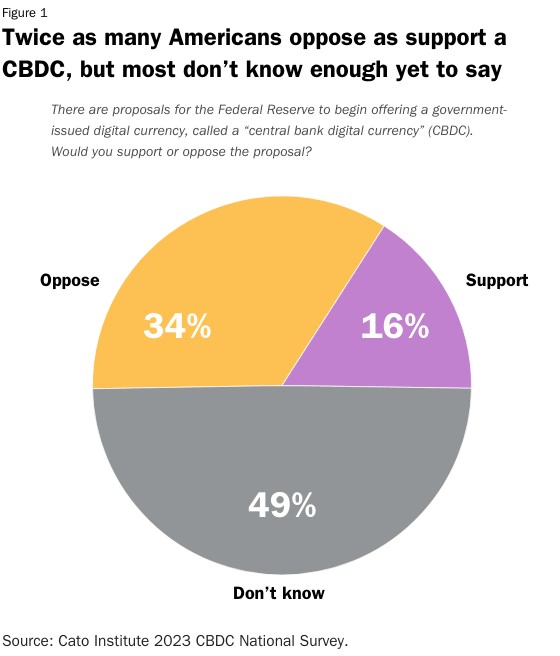
The average human being on earth understands that CBDCs is a bad idea, even in the United States where two-thirds of the population believes almost anything that their government tells them to believe are skeptical of CBDCs according to the Cato Institute, a think tank who also published an article by Nicholas Anthony on the findings of a survey that was conducted by the US federal Reserve Bank on how people view CBDCs. Here is what they found, “Specifically, more than 66 percent of the 2,052 commenters were concerned or outright opposed to the idea of a CBDC in the United States (Figure 1).”
Bitcoin.com published an article on the GOP’s 2024 presidential candidate, Florida’s governor, Ron DeSantis who is opposed to CBDCs,‘Ron DeSantis Vows to Prohibit CBDC, ‘Woke Politics,’ and ‘Financial Surveillance’ in Florida,’ he said “I think what the danger of the digital currency is that, one, they want to make that the sole currency, they want to get rid of crypto,” DeSantis continued, “They don’t like crypto because they can’t control crypto. So, they want to put everything in a central bank digital currency.” There were other politicians who also have similar views on CBDCs:
DeSantis shares the view of several Republican officials who have criticized the idea of a central bank digital currency (CBDC). Minnesota congressman Tom Emmer introduced the Central Bank Digital Currency (CBDC) Anti-Surveillance State Act, while Texas senator Ted Cruz has created legislation against the government developing a CBDC. Georgia representative Marjorie Taylor Greene has also spoken out against CBDCs, and 2024 Democratic presidential candidate Robert Kennedy Jr. has warned that a central bank digital currency could lead to financial slavery
Cash is King! How the CBDC Failed in Japan and Ecuador
Cointelegraph.com, an independent digital news platform that focuses on crypto assets, blockchain technology and emerging fintech trends published an article last year written by Helen Partz based on which countries have rejected CBDCs for one reason or another titled ‘Some central banks have dropped out of the digital currency race’ mentions Japan, who is a major player in the global economy, ultimately rejected developing a CBDC scheme. The Bank of Japan (BOJ) started testing their digital currency proof-of-concept in 2021 and had planned to finish the first phase by 2022 but in January “former BOJ official Hiromi Yamaoka advised against using the digital yen as part of the country’s monetary policy, citing risks to financial stability.”
The BOJ issued a report in July 2022 and stated that it had no plan to establish a CBDC system since there is a “strong preference for cash and high ratio of bank account holding in Japan” and that the regulator suggested for a CBDC to be used as a “public good” and it “must complement and coexist” with “private payment services in order for Japan to achieve secure and efficient payment and settlement systems.” However, it also said that “the fact that CBDC is being seriously considered as a realistic future option in many countries must be taken seriously,” in other words, the CBDC scheme in Japan will not move forward although several countries are still in the early stages of developing a plan for the use of CBDCs, but for Japan, cash is still and will be king well into the foreseeable future.
Ecuador is another example as its central bank, Banco Central del Ecuador (BCE) who launched its own electronic currency known as dinero electrónico (DE) in 2014 to increase some sort of financial inclusion for the public as well as to control the flow of fiat currencies. According to Partz “As of February 2015, Ecuador managed to adopt DE as a functional means of payment, allowing qualified users to transfer money via a mobile app. The application specifically allowed citizens to open an account using a national identity number and then deposit or withdraw money via designated transaction centers.” But industry observers were not so sure that the DE can take the form of a CBDC since Ecuador’s currency is the US dollar, and since Ecuador does not currently have its own sovereign currency, many were not so sure that they can call the DE, a form of CBDC. “The Ecuadorian government cited the support of its dollar-based monetary system as one of the goals behind its DE platform after it started to accept U.S. dollars as legal tender in September 2000.” It seems that Ecuador remains skeptical on any possibility that issuing CBDCs will be a success:
According to online reports, Ecuador’s DE operated from 2014 to 2018, amassing a total of 500,000 users at its peak out of a population of roughly 17 million people. The project was eventually deactivated in March 2018, with the BCE reportedly citing legislation abolishing the central bank’s electronic money system. Passed in December 2021, the law stated that e-payment systems should be outsourced to private banks.
Years after dropping its central bank digital money initiative, Ecuador has apparently remained skeptical about the whole CBDC phenomenon. In August 2022, Andrés Arauz, the former general director at Ecuador’s central bank, warned eurozone policymakers that a digital euro could potentially disrupt not only privacy but also democracy
Bottom line, the CBDC will not be a standard for financial transactions for the few countries who already tried launching their versions of digital currencies.
However, in the US, the Federal Reserve’s ‘FedNow’ was supposed to be launched sometime in July 2023. Here is the Federal Reserve’s Press Release:
The Federal Reserve announced that the FedNow Service will start operating in July and provided details on preparations for launch. The first week of April, the Federal Reserve will begin the formal certification of participants for launch of the service. Early adopters will complete a customer testing and certification program, informed by feedback from the FedNow Pilot Program, to prepare for sending live transactions through the system.
Certification encompasses a comprehensive testing curriculum with defined expectations for operational readiness and network experience. In June, the Federal Reserve and certified participants will conduct production validation activities to confirm readiness for the July launch.
“We couldn’t be more excited about the forthcoming FedNow launch, which will enable every participating financial institution, the smallest to the largest and from all corners of the country, to offer a modern instant payment solution,” said Ken Montgomery, first vice president of the Federal Reserve Bank of Boston and FedNow program executive. “With the launch drawing near, we urge financial institutions and their industry partners to move full steam ahead with preparations to join the FedNow Service”
For the US population, FedNow is a test that will eventually fail. People will be skeptical about a central bank digital currency once it proves that it is used to surveil people’s spending habits and control what they spend their money on, and God forbid they are anti-war, anti-vaccine activists, homeschoolers, pro-gun supporters or conspiracy theorists, the bankers can cut them off from using CBDCs and then what happens? Will there be riots in the streets?
Since Bitcoin was introduced as an alternative to central bank control, the creation of the CBDC is their answer in hopes of retaining their power, but that idea is not likely to happen, it will in some way, backfire.
When it comes to Bitcoin, it’s a different story. In an interesting article written by Jay Speakman of beincrypto.com ‘When You Buy Bitcoin You Gain Freedom’ says that “in a world where economic and political uncertainties abound, owning Bitcoin (BTC) could provide the path toward financial freedom and autonomy. It’s no longer just about investing in a digital asset. It’s about making a revolutionary move to gain control over your finances and future.” Speakman makes several main points on why people should own Bitcoins and one of those points is that owning sovereign cryptos such as Bitcoins, Ethereum’s and others is a step towards financial freedom:
It provides the opportunity to participate in the global economy without the limitations of traditional banking systems. Bitcoin is not subject to government regulations. At least not yet, and it is free from the inflationary policies which can erode fiat currency values. This means Bitcoin provides an alternative and potentially more secure, store of value
Another reason for owning Bitcoins is for future investment purposes:
Investing in Bitcoin is no longer simply making money. It is about investing in your future and securing your financial freedom. Bitcoin’s decentralized financial system operates independently of central authorities or governments. This means it is resistant to censorship and regulation. Bitcoin holders can make transactions without the need for banks, which are subject to government intervention
“Investment Diversification” is another reason to own Bitcoins since putting all your eggs in one basket, especially in a globalist banking system, is a bit risky:
Investing in Bitcoin can provide portfolio diversification as it is not correlated to traditional assets such as stocks and bonds. This means it may provide a hedge against inflation and market volatility, mitigating the risks associated with traditional investment portfolios
However, owning Bitcoins does have risks like everything else since the “market is notoriously volatile. Prices often fluctuate wildly based on a range of factors, from government regulations to media coverage.” Speakman also mentions that “BTC transactions can result in a permanent loss of funds. There is also the risk of hacking and theft, as these transactions are irreversible and untraceable.”
In conclusion, the article lays out what owning Bitcoins could mean for individuals and investors alike especially for those who do not trust the traditional banking system:
The decision to buy BTC is more than just a financial investment. It’s a move towards financial freedom, control, and security. Bitcoin’s feature of allowing individuals to act as their own banks. Providing a secure alternative to traditional banking systems which have exhibited instability and vulnerability to failures. Furthermore, the appeal goes beyond just financial security and autonomy. The digital currency resonates with libertarians who value individual freedom and limited government intervention. Despite a torrent of dissenting voices Bitcoin continues to gain mainstream adoption. As the technology continues to mature, it may address some of the concerns raised by the dissenting voices.
Investing in digital assets may involve risks such as volatility and the potential for hacking and theft. Yet, the benefits of financial freedom outweigh the downsides. As the world becomes increasingly uncertain, owning Bitcoin could be the first step toward financial security and autonomy
When you look at the difference between CBDCs along with the system imposed by international banking cartels who still maintain some form of financial dominance versus the Bitcoin revolution, there is a difference. CBDCs means no financial freedoms and owning Bitcoins means the exact opposite. Even though Bitcoins are still in the early stages, there is hope in the new crypto technology. But like everything else, you should be cautious, do not invest 100% of your net worth in just one asset, in other words, invest maybe 5% in bitcoins, and the rest? 15% in emergency preparedness (food, water filters, guns, flashlights, etc.) 20% in real estate or invest in a second passport, 20% in hard assets like gold, silver and copper, 20% in high-end watches, antiques, aged wines and liquor, collectibles etc. and the last 20% in foreign stocks especially those that are in politically stabilized environments or in gold and silver mining companies, but that’s just my opinion.
Government-backed CBDCs will be a failure because the people already do not trust international banking cartels to totally control their finances. So, for these banks to have total control over your financial wellbeing under their CBDC scheme would be an extremely difficult task for them to manage.
The banking cartel or the financial bureaucrats are about to discover that they will be in over their heads with an angry population. Just imagine if the banking cartels, certain governments and their corporate conglomerates are in control over the people’s finances, they will get to determine who eats and who will starve. This is the ultimate power grab the globalist bankers have been dreaming about for a very long time, but will the people stop this from happening? I’m an optimist, so I believe that they will demand their financial freedoms and that is something of value that they can hold and control in their own hands. The case for CBDCs will be a hard sell, so central banks who are proposing this idea should think twice about what they are trying to impose on the public, if not, they will face some form of resistance just like they did in Nigeria.
There are two approaches to analyzing a situation:
1. Choose the desired outcome–generally the one that doesn’t require any major changes, sacrifices or downward mobility 2. Identify the initial conditions and systemic dynamics and then follow these to a conclusion back-tested by comparisons with historical outcomes.
Our default setting as humans is 1: select the outcome we want and then find whatever bits and pieces supports that conclusion. Cherry-pick data, draw false analogies–the field is wide open.
This is why we get so upset when our “analysis” is challenged: we’re forced to ask what happens to us if our desired outcome doesn’t transpire, and since the answer might be something less than optimal, we violently reject any data or analogies that conflict with our carefully curated “analysis.”
A great deal of what passes for analysis today is cherry-picked bits and pieces that support a happy story of endlessly expanding prosperity–AI, fusion, etc.–with no mention of limits, constraints, costs or worst-case outcomes rather than best-case outcomes.
Let’s start with an historical analogy most reject: the Great Depression of 1929 to 1942. The conventional account claims that the Depression was the result of a “Federal Reserve policy error”: the Fed tightened credit when it should have loosened it.
This is nonsense. What actually happened was credit expanded rapidly in the Roaring 1920s, which is why they were Roaring. Farmers could borrow money to buy prairie land to put under the plow, speculators could borrow $9 on margin to play the stock market with $1 in cash, and so on.
In other words, what happened was a gigantic credit bubble inflated that pushed stocks and other assets to unsustainable heights of over-valuation, valuations based on the Roaring 20s expansion of credit and consumption continuing forever.
But all bubbles pop, and so the weather changed for the worse and newly plowed prairie turned into a Dust Bowl, wiping out heavily leveraged farmers. Since there was no federal bank deposit guarantee (no FDIC), the bankruptcies of overleveraged borrowers wiped out thousands of small banks, wiping out the savings of prudent depositors.
So even prudent savers got wiped out in the crash of the credit bubble.
Stock speculators gambling on margin (i.e. borrowed money) were quickly wiped out, and the selling became self-reinforcing, accelerating the cascading crash.
The real policy error was protecting the wealthy who owned the debt from a debt-clearing write-down. The wealthy own debt, the non-wealthy owe debt. When the debt is defaulted on, the lender / owner of the debt has to absorb the loss. The debtor is freed of the burden. In a debt-clearing event driven by defaults, insolvencies and bankruptcies, the wealthy are the losers and the debtors are freed of the burden of debt.
Various programs were implemented to stave off the consequences of default, as if pushing losses into the future would somehow enable the credit bubble to reinflate. That’s not how it works: the financial system is like a forest, and if the dead wood of bad debt piles up and isn’t allowed to burn, then the forest cannot foster new growth.
Economies that refuse to accept the wealth destruction that results from credit bubbles popping stagnate. This is the story of Japan from 1990 to the present: the status quo in Japan refused to accept the losses, hiding bad debt (i.e. non-performing loans) behind artifices such as new loans that covered the interest due, listing the non-performing loans in “zombie” categories, i.e. as assets that were still on the books at full value even though they were essentially worthless, and so on.
The net result was 33 years of stagnation and social decay as young people gave up on owning homes and having families.
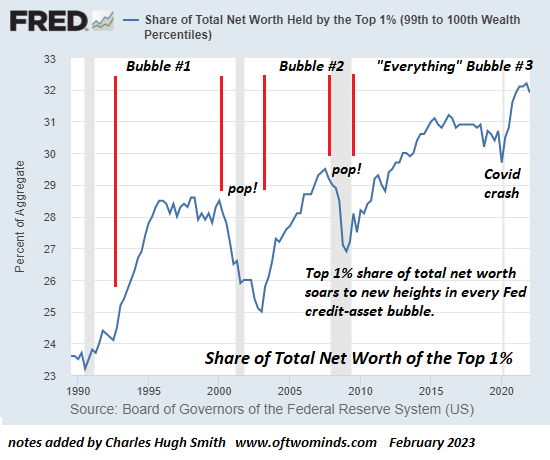
Now the US has inflated another “debt super-cycle” credit bubble that has pushed assets into over-valuation. Once again the goal is to avoid handing the wealthy owners of all this debt the enormous losses that must be accepted to clear the dead wood of bad debt, money lent to borrowers and projects that were not creditworthy except in a bubble.
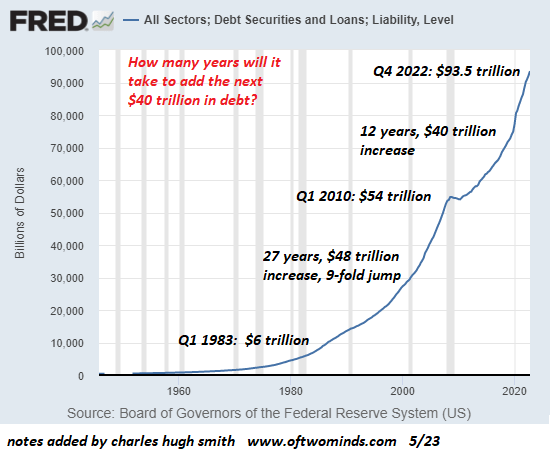
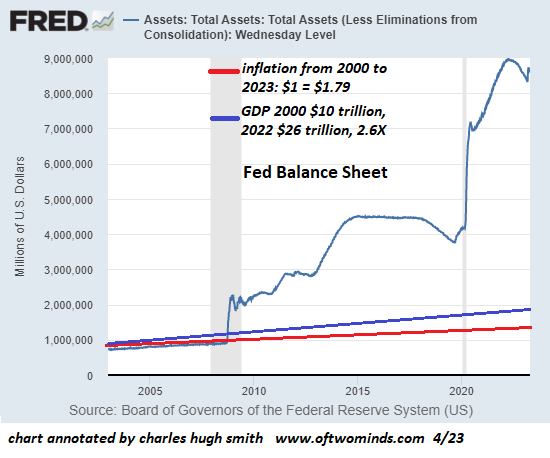
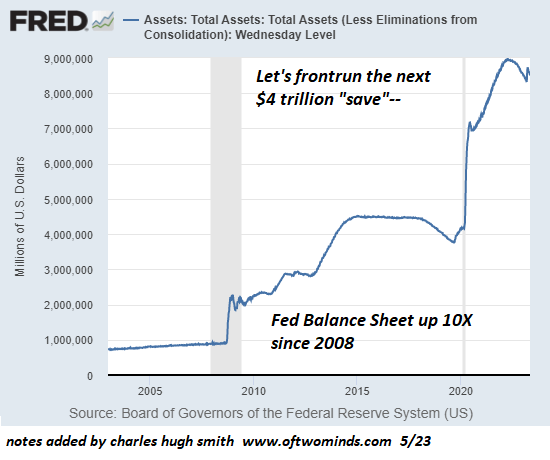
The lesson the status quo took from the Great Depression is to cover up private-sector over-valuations and bad debts with vast expansions of credit via the Federal Reserve and the federal government. Please look at these four charts below: 1. total credit (TCMDO) 2. the Federal Reserve balance sheet (2 charts) 3. federal debt
All are in visibly unsustainable parabolic ascents.
Predictably, the status quo will refuse to accept the necessity of clearing the dead wood and accepting the trillions of dollars in losses that will accrue to those who own the unpayable debts.
Consider CRE, commercial real estate. Office towers are now worth one-third of their pre-pandemic valuations, the valuations on which their mortgages were based. There is no way these properties can be magically restored to their previous over-valuation. Massive losses must be accepted by the owners of the debt. If those losses make them insolvent, so be it. That is unacceptable in a system geared to protect the wealthy at all costs.
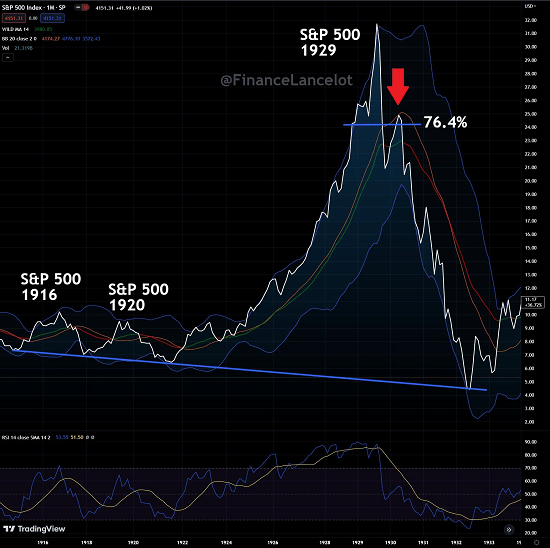
But bubbles pop anyway, regardless of policy tweaks. Consider these stock market charts of the Roaring 20s and the Great Depression and the present (below). The similarity is remarkable–possibly even eerie.
The big difference between the Great Depression of the 1930s and the Depression we’re entering is the world still had enormous reserves of resources to tap and a (by today’s standards) modest population in the resource-consuming developed nations.
Recall that a developed-world consumer uses up to 100 times more energy and resources than a poor person in a rural undeveloped nation. Recycling a few bottles doesn’t change this.
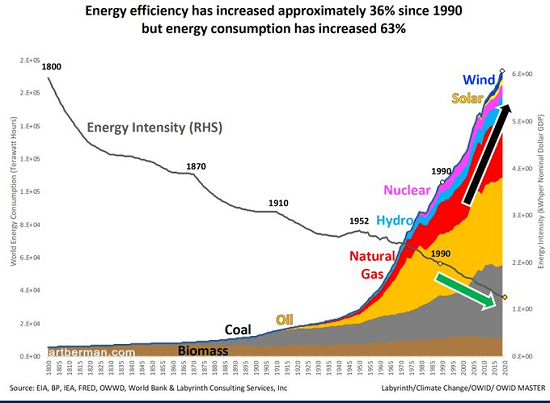
This means the planet’s “savings account” of abundant, cheap-to-access resources has been depleted. Yes, there is still oil and copper, etc., but it’s of far lower quality and much harder to get now. The rich ores have been mined and the shallow super-giant oil fields have all been tapped long ago. Now the Saudis must pump stupendous quantities of seawater into their oil wells to maintain production. All these technologies consume vast quantities of energy.
The inevitable result is the energy efficiency–how much energy is required to access, process and transport the energy–has plummeted even as consumption has soared.
The outcome many hope for is some new miraculously cheap and abundant sources of energy such as fusion. But fusion is far more complicated and tricky than pumping oil, and oil is a high-energy-density fuel that can be stored rather easily. All the electricity generated by various technologies can’t be stored easily or cheaply, and so the happy story is that a new miraculous battery technology is just around the corner.
But batteries are also complicated and resource-dense, so they’ll always be as expensive as the materials needed to fabricate them. There will never be “low-cost” batteries if the materials needed to make them are scarce and expensive to dig out of the ground, process and transport.
So the policy choices are simple: either protect the wealthy from write-downs of bad debt and the collapse of asset bubbles and usher in decades of stagnation, or force the wealthy to take the losses and clear away the dead wood.
But either choice will be constrained by the reality that humanity has already drained the easy-to-get “savings account” of global resources.
I get emails from readers who say things like “mining techniques are far more efficient now.” That’s fine, but most of these new mines are often thousands of kilometers away from railways or seaports, and thousands of kilometers away from the processing plants that turn the ore into useful metals.
Recall the enormity of the cost and effort required to build a single two-lane highway thousands of kilometers to a new mine, and the oceans of diesel fuel needed to power the mining equipment and trucks hauling the ore to railways or seaports. Recall the immense amounts of energy required to smelt / process these ores, and the near-zero percentage of lithium-ion batteries that are currently being recycled.
Batteries are difficult to recycle because they’re not manufactured to be recycled, and they’re not manufactured to be recycled because that would raise costs considerably, reducing profits.
So on the present course, the idea is to manufacture billions of batteries, throw them all in the landfill in 10 years, and then mine enough minerals to build another couple billion batteries and then repeat the cycle of throwing them away in 10 years forever.
That isn’t realistic, so the status quo will have to adjust to this unwelcome reality.
This is why I keep writing books about relocalizing, degrowth, using less rather than more to yield a higher level of well-being. The resource “savings account” won’t support fantasies of endlessly expanding consumption of hard-to-get resources.
But the status quo has much to unlearn, and it seems the only pathway to a new understanding is a Great Depression that won’t end with a new expansion of credit because the resources required for that new expansion simply won’t be available or affordable.
Reducing our exposure to avoidable risks is a key strategy of Self-Reliance.







 After the Crash