Two for Tuesday
Reply

By Peter Sobczynski
Source: RogerEbert.com
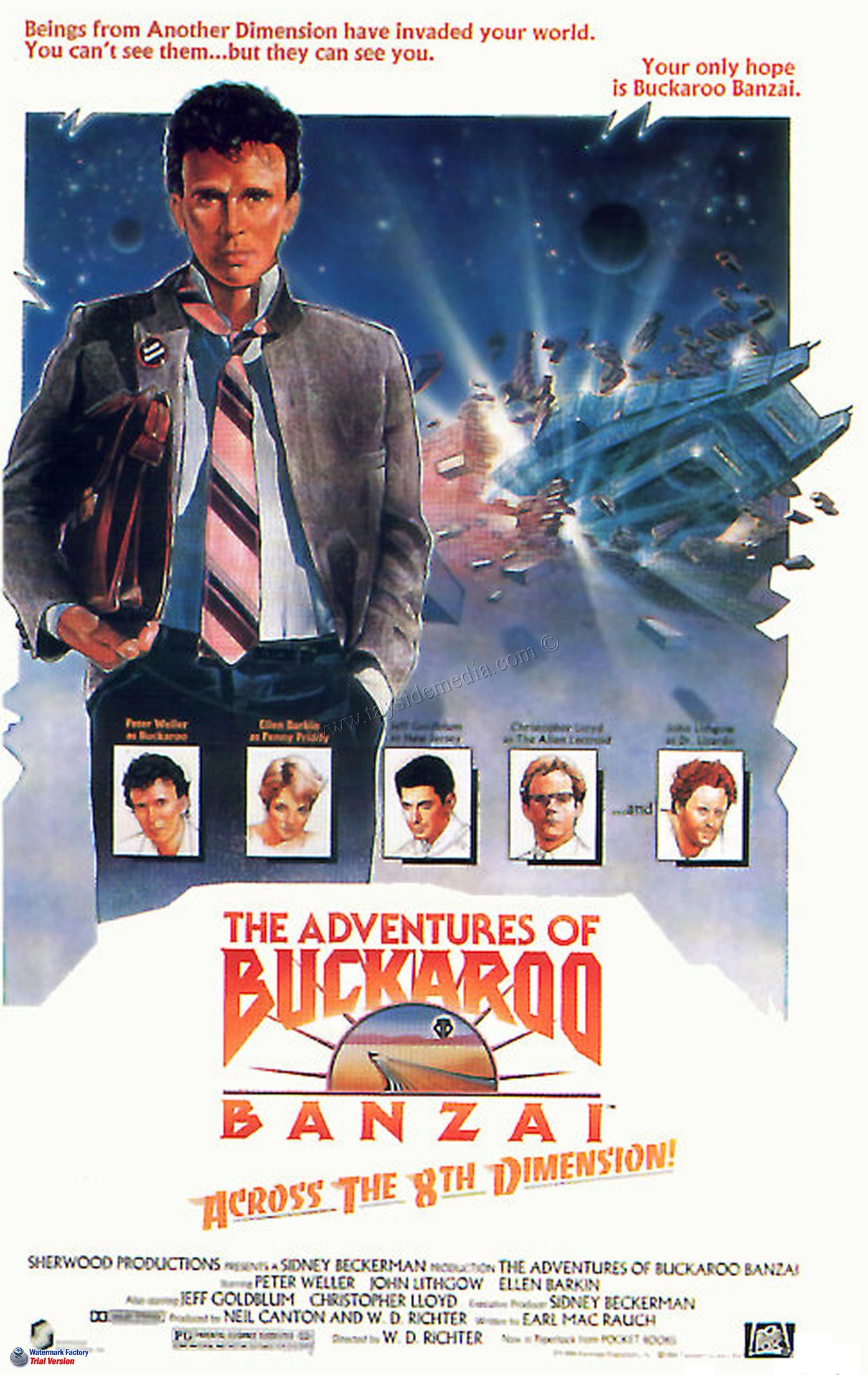
Practically from the moment that I first saw it at the age of 13 during its very brief run at the long-defunct Golf Mill Theaters (thanks for the ride, Mom) in the fall of 1984, “The Adventures of Buckaroo Banzai: Across the Eighth Dimension” has been my all-time favorite movie. And yet, it occurs to me that while I’ve been lucky enough to write at length about any number of favorites over the years, I’ve never had the occasion to do so for that particular film. Oh sure, I’ve proclaimed it as a favorite many times and have made reference to it every now and then—I even gave “Sharknado 4: The 4th Awakens” an extra half-star for nodding to it—but I haven’t had the opportunity to properly explain my love of the film. Happily, it is now making its long-awaited Blu-ray debut in a package from Shout! Factory that includes all the bells and whistles that members of its ever-widening cult could possibly ask for. Even more happily, it gives me a chance to sit down and once and for all explain why I love this film so much.
Of course, that is easier said than done because, as anyone who has seen it can attest, it’s not exactly the kind of movie that can be summed up in a sentence or two. Even the most basic, no-frills explanation of it will send many heads reeling, either out of excitement or confusion. Perhaps the best place to start is to look at its hero, the one and only Buckaroo Banzai himself. The Japanese-American son of a pair of brilliant scientists, he first studied medicine and became a brilliant neurosurgeon. However, he chose to become a modern-day Renaissance man and soon branched out into particle physics, designing high-powered automobiles, occasionally saving the world with the aid of his band of Blue Blaze Irregulars and performing with his other band, the hard-rocking Hong Kong Cavaliers, a group made up of geniuses from other scientific endeavors. (All of this is summed up for viewers in an opening roll of text not dissimilar from the ones that kick off the “Star Wars” films).
As the film proper opens, Buckaroo (Peter Weller), along with his men and mentor Dr. Hikita (Robert Ito), are ostensibly preparing to test a new Jet Car with the capacity to drive at the speed of sound. The real experiment, however, involves the Oscillation Overthruster, a secret device that they hope will let them drive through solid matter. This is not the first attempt to make a go of the Overthruster. In 1938, Dr. Hikita was working for the eminent physicist Dr. Emilio Lizardo (John Lithgow) when he tried to pass through—the experiment was a botch that lodged him partway through a wall, and landed him in the Trenton Home for the Criminally Insane. In 1955, an attempt by Hikita and Buckaroo’s parents was sabotaged by crime lord Hanoi Xan via a bombing that killed his parents. (A flashback to this scene was cut from the original release but can be seen in the deleted scenes, where we discover that Buckaroo’s mother was played by Jamie Lee Curtis.) Buckaroo, however, succeeds and not only manages to drive through a mountain with nary a scratch, he has returned with some kind of alien organism attached to the Jet Car. Upon hearing this news, Lizardo breaks out of the asylum, claiming that he is going home. (Get ready because now things are about to get a little confusing.)
As it turns out, when Lizardo was trapped in the eighth dimension all those decades ago, he had his mind taken over by Lord John Whorfin, a fearsome Red Lectroid who was banished there alongside many of his followers after an unsuccessful attempt to take over their home world of Planet 10 from the more peaceable Black Lectroids. Before being locked up, he managed to bring many fellow Red Lectroids to Earth, where they have been living in plain sight and are now running a defense contracting company based in Grover’s Mills, New Jersey that is currently in charge of building a new bomber for the US Air Force. What they have really been doing with the government’s money is building a spaceship that will allow them to rescue their comrades still trapped in the 8th Dimension and return to take over Planet 10 once and for all. Now that Buckaroo has perfected the necessary Overthruster, all they need to do is steal it and they are home free.
After receiving a mysterious electric shock that allows him to see Lectroids as they really are and prevent the attempted theft of the Overthruster during a press conference, Buckaroo learns of the existence of Yoyodyne. But when the Hong Kong Cavaliers hack into their computer database, they discover that every single employee has the first name of John, a bizarre surname and an application for a Social Security card dated November 1, 1938. Around this time, a Black Lectroid emissary arrives with a message from their leader stating that if Buckaroo is unable to stop Whorfin/Lizardo from using the Overthruster to return to the eighth dimension, they will protect themselves by faking a nuclear attack that will start World War III. With the fate of the world now in his hands, Buckaroo and his team, including new Hong Kong Cavalier recruit Sidney Zweibel (Jeff Goldblum), a neurosurgeon and piano player who dresses up in full cowboy gear (including chaps) and calls himself New Jersey, and Penny Priddy (Ellen Barkin), a mysterious woman who meets Buckaroo after being accused of trying to shoot him during a concert (she was actually trying to kill herself but was accidentally bumped by a waitress at the key moment), set off to do battle with the Lectroids, recover the Overthruster, save humanity and if time permits, explain exactly what that watermelon is doing there.
In other words, “The Adventures of Buckaroo Banzai” is your typical sci-fi/action/comedy/rock&roll/kung-fu/political satire/neo-western/guys-on-a-mission extravaganza. The film was the brainchild of writer Earl Mac Rauch, who had written a couple of novels and co-wrote the screenplay to the Martin Scorsese musical “New York, New York,” and W.D. Richter, who had already established himself as a writer of quirky screenplays through such films as the goofy action comedy “Slither” and the masterful 1978 remake of “Invasion of the Body Snatchers.” One day, Mac Rauch dreamed up this character that would eventually be called Buckaroo Banzai and Richter encouraged him to write a screenplay involving his adventures. Supposedly, Mac Rauch would start one, get about fifty pages into it and then abandon it to try again with a new story. Eventually, Richter and producer Neil Canton formed a company to make “Buckaroo Banzai” and got Rauch to write a new treatment, using material from his previous attempts, that was then called “Lepers from Saturn.” Although it was rejected by many, it got noticed at MGM and studio chief David Begelmen agreed to finance it. Unfortunately, the project was then delayed for nearly a year because of a writers strike and Begelmen left MGM after a number of his expensive projects died at the box-office. However, Begelmen formed his own production company, bought the script back from MGM and made a deal with 20th Century Fox to produce it.
This would prove to be good news and bad news for the project. On the one hand, it was Begelmen’s enthusiasm that eventually got the film up and running. On the other hand, he apparently saw it as a straightforward action film in the mold of “Raiders of the Lost Ark” and either overlooked the weirdo humor in the screenplay or just assumed that Richter and Mac Rauch would dump all of that nonsense somewhere along the way in order to ensure that it would be a hit. Once it became evident that the weird stuff was not going by the wayside, Begelmen began battling with Richter, Mac Rauch and Canton over the most inexplicable things in a misguided attempt to exert authority and make the film that he wanted. For example, Richter has hired the great cinematographer Jordan Cronenweth, whose credits included such titles as “Brewster McCloud,” “Altered States” and, perhaps his most famous work, “Blade Runner.” The story goes that Begelmen agreed to his hiring as long as he didn’t make the film look in any way like “Blade Runner” but after several weeks of shooting, he decided that it was indeed looking like “Blade Runner” and had Cronenweth replaced with Fred J. Koenekamp, who had shot such epics as “Patton” and “The Towering Inferno.” At another point, he threatened to shut down the production over a pair of red-rimmed glasses that Buckaroo wore in a couple of scenes on the theory that heroes don’t wear red glasses.
The struggles to make the film were equaled only by the struggles to get it released and find an audience. Perhaps realizing early on that trying to sell the film to a mainstream audience at first might not be a wise idea, Fox decided to promote it at sci-fi conventions in the months leading up to its release by stressing that it was a cult movie in the making. Unfortunately, this approach wound up backfiring as the sci-fi audience was understandably wary of anything announcing itself as a cult movie before anyone had actually seen it—in their eyes, a cult movie is one that is discovered and nurtured by a loyal audience, not one that arrives in theaters proclaiming itself as such right from the get-go. “Buckaroo Banzai” was originally scheduled for a wide release on June 8, 1984 (which would have pitted it against the opening weekends of “Ghostbusters” and “Gremlins”) but was bumped at the last minute to a much-reduced opening in a few cities in mid-August that barely made any impact, though it did receive good reviews from the likes of Pauline Kael and Vincent Canby. Over the next couple of months, it opened in a few more cities before finally disappearing from theaters altogether.
And this is the point where the film and I finally crossed paths. Back in the prehistoric days before the Internet, a kid obsessed with the world of film would have to get himself down to the local bookstore or newsstand to purchase magazines that contained articles about upcoming releases. One such magazine was Starlog, which was dedicated to new and classic films in the sci-fi/fantasy genres and even though they were not necessarily favorites of mine, there were usually enough items of interest in each issue to make it worth the purchase. Now, 1984 provided a bumper crop of titles for genre fans—this was the year of “Indiana Jones and the Temple of Doom,” “Ghostbusters,” “Streets of Fire,” “Star Trek III: The Search for Spock,” “Gremlins,” “2010,” “The Last Starfighter,” “Dune” and the proverbial many more—and while not all of them may have lived up to the hype, they sure looked tantalizing at the time. As good as most of those looked, it was this “Buckaroo Banzai” thing that looked most intriguing to me. Even at the borderline precocious age of 13, I had already fancied myself as someone who knew more than a thing or two about movies but I had never seen or heard of anything like this before. Needless to say, that June release date couldn’t come quickly enough and even though the August delay was frustrating, my enthusiasm did not wane. However, it was devastating to discover that Chicago was not a part of that August release and that when it did finally open locally a month or so later, it was only in a couple of theaters with the nearest one located about 40 miles away. Thanks to a supremely indulgent mother, I made it to that theater during its opening weekend and sat down in what was, aside from myself, my mother and maybe five other people, an almost totally empty house to finally bear witness to the film that I had been obsessing over for months. I must admit that as the lights went down, the pessimist in me was thinking “What if this isn’t that good after all?”
Fat chance of that happening. Not only did “The Adventures of Buckaroo Banzai” live up to all of my insanely inflated expectations, it somehow managed to exceed them. I loved that it took any number of film genres and slammed them all together into one crazy-quilt narrative. I loved the idea of a hero who was valued more for his brains than for his ability to beat the bad guys into a pulp. I loved the funky New Wave aesthetic. I loved the decidedly offbeat humor, especially since one of my problems with science-fiction has always been its tendency to occasionally take itself a little too seriously at times. I loved the idea that all of the spaceships on display looked more like seashells or rotting fruit than the gleaming craft that whizzed through space on “Star Trek.” I loved the jaw-dropping performance by John Lithgow as Emilio Lizardo, a hilariously audacious turn that saw him using “frothing mad” as a mere stepping-off point to a level of pure craziness that at times seems more like a possession than a performance. I loved the sight of Ellen Barkin in that slinky pink dress. (Hey, I was a 13-year-old boy.) I even loved the end credits sequence that found Buckaroo and the Hong Kong Cavaliers traipsing through an empty L.A. aqueduct to the tune of the film’s jaunty theme music while the titles breathlessly promised that they would return in “Buckaroo Banzai vs. the World Crime League,” despite sensing (correctly, as it turned out) that the lack of people in the theaters meant such a prospect was unlikely at best. Watching this film, it was almost as if someone was tapping directly into my mind’s idea of a great movie and projecting it before my eyes. (For those of you who are curious, venerable Mom wound up enjoying it as well, though the few other patrons seemed more than a little bewildered when the lights went up afterwards.)
However, unlike a lot of things that seemed cool back in the day and eventually look fairly silly with the wisdom of age, my admiration for “The Adventures of Buckaroo Banzai” has only grown over the years as I have been able to appreciate just how innovative and groundbreaking it was. For example, while genre mash-ups are a relatively common occurrence these days, they were fairly non-existent back then—the fear being that such things would be impossible to market to people who preferred a undiluted take on their preferred genre over one that mixed up with with several others—and it is amazing to see how well Richter and Mac Rauch juggle the various generic tropes in ways that clearly have fun with them without crossing the line into overtly making fun of them. Additionally, I love the way it dropped this bizarre and complicated mythology in the laps of viewers without any elongated explanations and assumed that they would have the intelligence to figure things out as it went along. Now this wasn’t a completely unheard-of approach—“Star Wars” began in much the same way—but it was taken to such a level here that it almost felt like you were watching chapter five of a serial where you had already missed chapters one through four. Admittedly, this approach may have alienated as many viewers as it enchanted—some reviewers complained that they felt as if they were watching someone else’s private in-joke that made no effort to let them in on the fun—but to these eyes, the notion of creating this oddly detailed world (with stuff practically bursting out of every jam-packed frame) and then immersing viewers in it was an audacious approach that paid off beautifully. If you ever wondered what might have resulted if Robert Altman had ever been given the reins of a large-scale science-fiction project (not counting “Quintet”), this film may be the closest that we ever come to answering that question.
Another aspect of the film that may have bewildered viewers but now seems startlingly prescient is how it depicts a world in which popular culture has extended its tendrils into all areas of life in unexpectedly goofy ways. No matter where one goes in the film, there is an odd cultural reference there to comment upon it. During the Jet Car experiment, we see a scientific gauge labeled “Sine” that is eventually followed by ones marked “Seeled” and “Delivered.” When it is announced that Dr. Lizardo has escaped from the asylum, he is mistaken by one person for Mr. Wizard. During Whorfin’s manic speech rallying his men as they prepare to leave for Planet 10, he sort-of quotes the Beach Boys cover “Sloop John B” by exhorting “I feel so broke-up, I want to go home!” Orson Welles (“The guy from the old wine commercials?”) is the basis of a couple of gags, one fleeting (when we get a glimpse of the President of the United States, played by Ronald Lacey, he is made up to look exactly like Charles Foster Kane) and one that inspires one of its funniest conceits. As it turns out, the infamous “War of the Worlds” broadcast was not fiction at all—it was Lectroids landing in New Jersey, not Martians, and they hypnotized Orson Welles into broadcasting that it was all made up. Even Buckaroo himself is often depicted as a pop culture hero just as much as he is a regular hero—we see his face plastered upon comic books and video games and he is, to be sure, the rare hero who tops off a day of derring-do by playing a sold-out concert with his band that finds him belting out an especially soulful cover of the classic “Since I Don’t Have You.”
And yet, the oddest and perhaps most arcane cultural reference is the odd connection the film shares with the works of legendary author Thomas Pynchon. Not only does it share a certain thematic similarity with the dense narratives and weirdo humor prevalent in Pynchon’s work, his cheerfully surreal novel The Crying of Lot 49 was largely centered around an shadowy aerospace manufacturer known as Yoyodyne Systems. In fact, one could argue the case that long before the arrival of “Inherent Vice,” “The Adventures of Buckaroo Banzai,” at least in a metaphorical sense, was the first real stab at bringing the Pynchon perspective from the page to the screen. (The plot thickened when Pynchon published his 1990 novel Vineland, which itself contained a couple of not-so-subtle references to “The Adventures of Buckaroo Banzai,” leading to speculation that either Richter or Mac Rauch actually were the reclusive novelist.)
As for the performances, all of the actors clearly found just the right way to connect with the admittedly quirky tone of the material. Some have slagged Peter Weller for being a little stiff at times but they are missing the point—this is a character who is so cool and above the fray that he doesn’t have to be constantly calling attention to himself. More importantly, he serves the necessary duty of being the anchor of the film that keeps it from flying off amidst all of the other oddball characters—it is a smart piece of underplaying from an actor who has never quite gotten his due despite starring in two all-time genre classics (the other, of course, being “Robocop”). Jeff Goldblum had already proven himself to be a more-than-reliable supporting player by the time he did this film and his ability to put a unique and often hilarious spin on even the most seemingly mundane bit of dialogue never shone brighter than it did here. (He also deserves credit not only for donning one of the goofiest Western outfits ever seen but somehow making it work against all odds.) As Penny Priddy, the one female character of note (perhaps the one aspect of the film that does not date very well today), Ellen Barkin more than holds her own with the guys. Christopher Lloyd turns up as John Bigboote, who has been in charge of the goings-on at Yoyodyne over the past few decades and whose name inspires a great running joke involving Whorfin repeatedly mispronouncing it as “big booty,” and he is a blast throughout. However, the scene-stealer of the bunch—indeed, one of the scene-stealing performances of all time—is unquestionably John Lithgow as Emilio Lizardo. Given the rare opportunity to play a character where going too far over the top is simply impossible, Lithgow pulls out all the stops with his astoundingly flamboyant turns in which everything from his accent (which genuinely sounds like an alien trying to approximately an Italian dialect) to his wardrobe (which finds him wearing two of everything) is cranked up to maximum effect. And yet, even though he is playing a character who is clearly out of control, the performance never is—Lithgow knows exactly when to go for laughs or menace and hits those beats perfectly every time. He also gets many of the film’s best lines as well and I guarantee that after you see it, you too will be quoting (no doubt in your best approximation of the accent) such classic lines as, “Laugh while you can, monkey boy!” and “Sealed with a curse as sharp as a knife/Doomed is-a your soul and damned is your life!”
Although the film tanked in theaters, it eventually began to develop a genuine cult following once it hit cable and home video and brave viewers were given the chance to experience it for themselves. The promised sequel never emerged (due in part to a tangled situation involving the rights and the bankruptcy of the original production company), but “Buckaroo Banzai” has continued to live on in the pop culture firmament in odd and unusual ways. A couple of installments of the “Dick Tracy” comic strip made arcane references to the film and the finale of Wes Anderson’s “The Life Aquatic with Steve Zissou” paid homage to the end credits sequence (and, of course, included Jeff Goldblum in the mix). After a long delay, the film came out on DVD in 2001 in an edition that deepened the meta-textual joke, positing that Buckaroo Banzai was indeed a real person and that the film was actually a docudrama depicting real-life events. Strangely enough, in 1998, Fox attempted to develop a TV adaptation that was to be titled “Buckaroo Banzai: Ancient Secrets and New Mysteries” that never got off the ground save for a brief bit of test computer animation that can be found as an extra on the new Blu-ray. Even more strangely, it was announced earlier this year that another attempt to bring it to television was being attempted by none other than Kevin Smith and that Amazon Studios might be producing it.
Whether or not this particular endeavor pans out remains to be seen. However, until it happens, the new Blu-ray should more than tide over fans of the film. The two-disc package contains all the material from the original DVD release—the original commentary with Richter and Mac Rauch maintaining the illusion that what they are presenting is fact, deleted scenes, the alternate opening with Buckaroo’s parents, a short featurette and the trailer—along with a new commentary from sci-fi experts Michael and Dennis Okuda. More importantly, there is “Into the 8th Dimension,” a full-length documentary that chronicles every possible aspect of the film from its strange beginnings to its occasionally tortured production to its long and fruitful afterlife that is packed with fascinating tidbits of information. For example, we learn that when Richter first found the actor he wanted to play Buckaroo, Begelmen refused to cast him on the belief that he would never become a movie star—so long, Tom Hanks.
Of course, the best feature of all is the film itself in all its crazy, one-of-a-kind glory. For decades, I have loved this movie beyond all others. Watching it again, I realized that love had not been misplaced in the slightest. Now, those of you who have never seen it before may not react in quite the same way as I did, but I can pretty much guarantee that you have never seen a film quite like it—maybe the one that came closest to approximating its wild mixup of genres and strange humor was “Big Trouble in Little China,” on which Richter served as a co-writer—and that if you are able to accept its offbeat nature, you are in for the cinematic ride of your life. And when it is all over and you begin to delve into the special features, you will even finally learn exactly what that watermelon was doing there.
Watch the full film on Hoopla.
Mike Upchurch is a comedy writer who got his start working on Mr. Show and The Chris Rock Show in the late nineties. In recent years he has written, directed and edited a series of short films, the best of which are presented here. They share in common an acerbic wit skewering various genres of pop culture detritus using brilliant editing and low-tech CGI techniques to insert whimsical performances, dialogue and plotlines into found footage.

From Wikipedia:
The Quiz Broadcast: a post-apocalyptic television quiz show hosted by Mitchell (who constantly reminds viewers to “remain indoors”) and transmitted by the British Emergency Broadcasting System. The show is being aired in the immediate years after “The Event”, an unexplained disaster that left most of the human race dead, including all of the children. The sickly contestants on the show are survivors “trying to enjoy themselves” whilst avoiding any traumatic memories of “the Event”–Peter (a blind man played by Webb), Sheila, and Unknown Male 282. Prizes in the game consist of the sparse food and fuel supplies they have in their bunker. The questions asked often revolve around “pre-Event” subject matter, which the contestants have little to no knowledge of, while later sketches demonstrate the increasing deterioration of society, morale and health, and suggest that a cannibalistic race referred to as “Them” had overrun the area. The sketch ends on a somber note with Peter and the host being the last survivors of the bunker and possibly even the human race; Peter remains hopeful that help will come, but the host knows that it won’t. In March 2020, 13 years after the original broadcast, these sketches and the ‘Remain Indoors’ banner in particular, began trending heavily on social media in light of the Coronavirus pandemic and the associated national lockdowns.
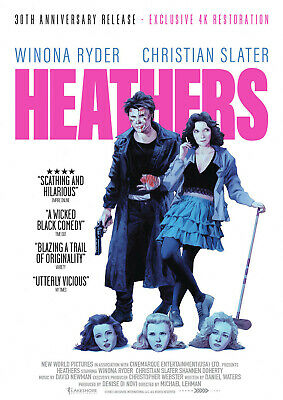
“Heathers” (1988) is a dark high school comedy written by Daniel Waters and directed by Michael Lehmann. “The Heathers” of the title refers to Westerburg High School’s elite clique of popular girls, whose newest member is Veronica Sawyer (Winona Ryder). Fed up with the Heathers’ constant peer pressure and obnoxious social circle she becomes increasingly attracted to J.D. (Christian Slater), a mysterious, rebellious – and possibly psychotic – new student. This 80’s cult film was most likely inspired by a thematically similar (but tonally different) 70’s high school film called “Massacre at Central High“.
Watch Heathers on Hoopla here: https://www.hoopladigital.com/title/11896270
From the film’s official website:
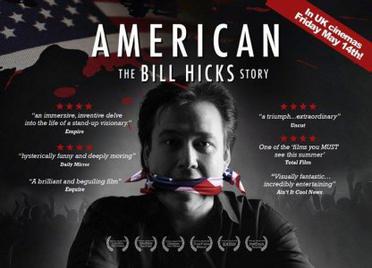
Three years in the making, AMERICAN: The Bill Hicks Story brings the tale of one of modern culture’s most iconic heroes to the big screen.
Like many who have a strong sense of their place in history, Hicks left a large unseen legacy; his collection of video recordings and hundreds of photographs and these became the starting point for this feature-length animated documentary.
But why animation? Bill Hicks’ complex story had never been adequately told and this demanded pushing documentary storytelling in a new direction to boldly recreate the key unseen scenes of Bill’s life and, for the first time fully reveal the worlds that shaped his character and his comedy.
Real locations, such as the bedroom window he snuck out of to perform with comedy partner Dwight Slade, the dark alleys of Houston where he nearly met his end, and the spellbinding theatre auditoriums where he played his most famous concerts; are all meticulously recreated in stunning three dimensional photorealism to provide a fresh new sense of the challenges the lone comedian faces and a real sense of what his journey was like.
Bill’s story is told by the 10 people who knew him best; his family and closest friends who recount the twists & turns of his life with a freshness that hadn’t faded in 15 years. They had never all spoken at one time before, and never at such length. A diverse group of individuals, but with one thing in common – Bill’s personality, humanity and humour shone from every one of them…
From Kevin Booth, Bill’s talented lifelong friend to the Outlaw Comics who introduced Bill into their heady world of drugs & alcohol, to photographer David Johndrow who perceptively captures some of the most revelatory moments of Bill’s life, each speaker is a compelling narrator who still carries a piece of Bill with them and, woven together, they bring a palpable sense of Bill’s presence to the screen.
Their story provides the platform for Bill’s own voice and for the first time, his 17 years of material are combined in a powerful chronology with his offstage journey. With each of his routines now bedded in the context of his life, a fascinating insight into the growth and development of an artist is revealed, as Bill’s early character work found first a comedic aim and then a truly powerful voice when he beat addiction to enthrall and challenge audiences, often touring 300 nights a year.Recreating Bill’s story has been a journey all of it’s own; traveling all across America to record extensive new interviews, watching hundreds of performances and developing the animation technique over thousands of hours to fully realize the cinematic vision required.
With a little help and a few orbits of the sun, these raw materials – video clips, photographs & personal recollections – have now been put together to recreate a full sense of Bill’s life, ambitions and achievements and a lasting testament as to why he will remain one of the enduring cultural cornerstones of our age.
Watch the full film on Kanopy here.

By CJ Hopkins
Source: Consent Factory, Inc.
Break out the pussyhats and vuvuzelas, folks, because the neoliberal Resistance is back, and this time they’re not playing around. No more impeachments and investigations. It’s time to go mano-a-mano with Trump, and they’ve finally got just the bad hombre to do it. No, not Bernie Sanders, you commies. A battle-hardened Resistance fighter. El Caballo Pequeño! El Jefe Mínimo! Subcomandante Michael Bloomberg!
Yes, that’s right, Michael Bloomberg, multi-billionaire Republicrat oligarch, has mobilized a guerilla army of overpaid PR professionals, Wall Street sociopaths, liberal racists, and anti-outdoor-smoking fanatics, and is steamrolling toward the Democratic convention to buy a brokered nomination and save America from “Putinism.” He’s had it with you sugary-soft-drink-drinking, chain-smoking, gun-toting, Oxy-gobbling, Hitler-loving, Putinist peasants and your infatuation with Donald Trump. So he’s decided to transform the entire country into a sterile, upscale, fascist themepark where you can rent a studio for $3,000 a month and the cops keep “the darkies” in their place, like he successfully did to New York City.
Although his campaign seemed to come out of nowhere (and sort of resembles a desperate attempt to prevent a Bernie Sanders nomination), the Resistance have been planning this corporatist Tet Offensive for quite some time. Apparently, Subcomandante Bloomberg and his inner circle of sub-subcomandantes have been hiding out deep in the mountainous jungles of Manhattan’s affluent Upper East Side (or in the Hamptons, or London, or in one of El Jefe’s other multi-million-dollar homes) since Trump and the Russians invaded the country, waiting for the perfect moment to start inundating the American people with television commercials and social media posts informing them of his “electability.”
Clearly, that moment has now arrived.
Bloomberg has spent over $400 million on TV, radio, and digital ads, and it isn’t even Super Tuesday yet. He bought the Democratic National Committee and had them change the rules so he could join the debates (which, based on his poor performance in Las Vegas, might not have been the most brilliant strategy). He has been buying politicians, community organizers, journalists, pundits, his opponents’ campaign staff, Instagram and Facebook influencers, and everyone else he can possibly buy to support his campaign to buy the presidency … which is totally legal, and the American way, and is our only hope of overthrowing the Putin-Nazi Occupation Government and regaining our God-given capitalist freedom!
Sure, to some folks, it looks … well, unseemly (not to mention decidedly undemocratic), this Wall Street oligarch attempting to bribe and bully his way into the White House, but, given the stakes, what choice do we have? As the corporate media and intelligence agencies have been telling us for the last three years, the country is under occupation by an evil conspiracy of Russian-backed Nazis personally controlled by Vladimir Putin! More or less any moment now, Putin is going to order Trump to nullify the U.S. Constitution, declare martial law, appoint himself Führer, and start rounding up and murdering the Jews … or investigating Hunter Biden, or the spooks who have been trying to force him out of office.
This Putin-Nazism cannot continue! Trump must be deposed, no matter the cost. As Robert Reich put it in this piece in The Guardian:
“If the only way we can get rid of the sociopathic tyrant named Trump is with an oligarch named Bloomberg, we will have to choose the oligarch.”
There you have it, folks. We’ll have to choose Bloomberg, or else his golf buddy, Literal Hitler, will destroy the fabric of democracy, or whatever.
Another op-ed in The Washington Post, It Might Be Time to Take Bloomberg Seriously, wondered, if it comes down to Bloomberg versus Bernie:
“Do you choose socialism or capitalism? An ideologue or an executive? Are you really going to ask Americans to trade one extreme for the other, or do you want to offer them a certified, electable moderate?”
Vox, in its “Case for Michael Bloomberg — Mike Bloomberg and His Billions Are What Democrats Need to Beat Trump,” observes that, sure, Bloomberg has drawbacks, like his history of racist remarks and policies, abusing women, oppressing the poor, and just generally being an arrogant little authoritarian corporatist creep, but hey, he’s apologized for all that stuff, and he’ll probably never do it again.
Plus, according to this piece in …uh, Bloomberg Opinion (which “does not necessarily reflect the views and opinions of Bloomberg LP and its owners”), The 2020 Election Is a Choice Between Democracy and Putinism! At the end of the day, once the dust has settled:
“It will come down to rule of law. In November, Americans will decide whether they will fight for the foundation of liberal democracy and democratic capitalism or whether they will accede to Putinism.”
You’ll be hearing variations of this message over and over, and over again, as we approach election day in November … that is, assuming Bloomberg and the rest of the Resistance can buy, bribe, badger, and bamboozle enough Democratic voters into nominating him. First, they need to deal with Bernie Sanders and his swarm of kill-crazy commie terrorists (who rumor has it are also being remotely controlled by Vladimir Putin). To do this, all they will need to do is deny Sanders a first ballot win in Milwaukee, which shouldn’t be too hard to accomplish. Sure, a brokered convention will be ugly, but, as Robert Reich said, they’ll have to do it, or else … well, you know, end of democracy.
Yes, I’m aware that Subcomandante Bloomberg blew his first debate (prompting Twitter pundits to pronounce him DOA) and that millions of “progressive” Democrats hate him, and that the corporate media are running a lot of “Bloomberg’s Nasty Past” pieces now (in order to maintain the appearance of journalism), but, make no mistake, if he secures the nomination, they’ll be lining up to “reluctantly” endorse him, because the alternative will be Russian Hitler!
Look, it’s easy to get distracted by the day-to-day ups and downs of the horse race (which is the primary purpose of the horse race, after all) and forget that we are in the middle of a global capitalist War on Populism … a war that GloboCap intends to win. Sure, they will survive another four years of Trump (or even four years of Sanders if they have to), but, at some point, in order to restore “normality,” or “democratic capitalism,” or whatever, they are probably going to need to stop dicking around and install a bona fide global capitalist oligarch in the Oval Office. They are going to need to do this in order to crush the hopes of the populist insurgency that erupted in the Spring of 2016, and led to the rise of Donald Trump, Bernie Sanders, Jeremy Corbyn, the Brexit, the ongoing protests in France, the downfall of Angela Merkel, etc.
Another Obama is not going to cut it … people aren’t buying that con anymore. No, if the empire is going to reestablish control, it is going to need to take its liberal mask off, and shove a blatant corporatist oligarch like Bloomberg down the public’s throat in order to remind everyone who’s boss. It may not be Michael Bloomberg this time, but it is going to be someone like Bloomberg eventually. Someone powerful, and extremely unpleasant, who will be sold to us as the only one who can save the world from the “Nazis” and the “Russians” … which will necessitate taking some very extreme measures, like the ones we took during the War on Terror. You remember the measures we took back then, don’t you?
Or what, you think that GloboCap has been manufacturing all this mass hysteria over “Russian election interference” and “Nazi terrorism” for their own amusement? Yeah, that’s probably all it is. It’s probably not a prelude to anything.
INDIAN COUNTRY NEWS
"It is the duty of every man, as far as his ability extends, to detect and expose delusion and error"..Thomas Paine
Human in Algorithms
From the Roof Top
I See This
blog of the post capitalist transition.. Read or download the novel here + latest relevant posts
अध्ययन-अनुसन्धानको सार
 After the Crash