
There’s not many humor sites that skewer American culture as adeptly and consistently as The Onion. I recently delved deep into their video archives where I found a few gems (marginally more absurd than reality):
Whoops. That last clip was actually from MSNBC. Maybe they’re trying to compete with The Onion?

On November 6, 2013 Infowars.com sponsored a “We Will Resist TSA & NSA Tyranny” video contest. One of the participants, Telly “Leatherface” Blackwood, received a call regarding his entry from a man claiming to be from the TSA on Monday afternoon. According to a statement posted with a recording of a follow-up call on YouTube:
I received a call from a man named John on January 19 claiming to be from the TSA and had some questions for me. I asked him to call me back next day that I couldn’t hear him well. He agreed and within an hour or two I download an app so I can record phone calls. Today January 20th around 5:42pm while sitting outside he called back and I was able to record the whole thing. It was a strange call but very laughable. Sounds like one irritated TSA agent had enough of my video.
The contentious video from Blackwood’s comedy group “Off the Hook Television”:
In 2012, a TSA video from Natural News was suppressed by YouTube’s age restrictions (though this reposting got around it):
This is Joy Camp’s submission to the Infowars contest:
Bonus Clip: A new Joy Camp video mocking the contemporary pop music scene:
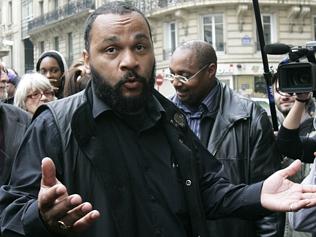
Last week, French comedian, actor and activist Dieudonné M’Bala M’Bala gained international attention when, in a move backed by French President Francois Hollande and the country’s highest court, his comedy tour was banned in several French cities. The bannings followed a January 6 announcement from France’s interior minister Manuel Valls that he considered Dieudonné’s performances anti-semitic and a “a grave disturbance of public order”.
To be honest, I can’t say I’m familiar enough with Dieudonné to know whether he is anti-semitic or, as has happened to many others, he was given that label because he’s anti-Zionist or just critical of certain policies of the Israeli government. However, given his background it’s highly unlikely that he’s racist. He himself is of mixed race, his father being a white artist and his mother a black accountant originally from Cameroon. He was raised mostly by his mother since they divorced when he was one. His first comedy partner and childhood friend was Jewish, and in the 1997 and 2001 legislative elections in Dreux, he campaigned against racism and ran against the National Front.
Even if Dieudonné was a racist and anti-semite he should not have been censored (though it’s true if his performances weren’t banned I may not have heard of him). No matter how offensive one might find someone’s words and ideas, the best policy is open discussion and debate so people can decide for themselves what to believe and what to reject.

In “Bad Boy Bubby” (1993), an Australian film by writer/director Rolf de Heer, Nicholas Hope gives a brilliant performance as Bubby, a man who’s been kept confined and abused physically and emotionally by his mother for 35 years. He eventually escapes and has a number of chance encounters which reveal different aspects of himself and society. The first portion of the film is the most brutal, but as Bubby ventures out into the world the film’s tone lightens a bit and becomes more of a traditional (yet still twisted) dark comedy. Bad Boy Bubby is definitely not for all tastes and is initially difficult to watch, but is ultimately rewarding for its uniformly great performances, writing and direction.

David Sirota reports on the successful political strategy used by activist Mason Tvert to help decriminalize recreational marijuana use in Colorado. It demonstrates how a slight shift in the public discourse can lead to large and rapid changes in attitudes towards an issue, and hopefully this strategy will be used in other states and countries currently prohibiting recreational cannabis use. Excerpts from Pando Daily:
“Marijuana has been illegal because of the perception of harm surrounding it — that’s how they made it illegal, that’s how it is illegal currently,” Tvert tells me in the shop’s bustling lobby. “Our opponents’ goal has been to maintain a perception of harm. So our idea has been to get people to understand that marijuana is not as harmful as they’ve been led to believe, and not as harmful as a product like alcohol that is already legal.”
Despite increasingly absurd attempts by the government’s drug-war apparatus to obscure the obvious truth, decades of medical and social science research on everything from physiological toxicity, to domestic violence to addiction has proven Tvert’s point that cannabis is less harmful than alcohol. But it was only a few years ago that Tvert’s colleague and future mentor at MPP, Steve Fox, happened upon a key political revelation in the reams of survey data about drug policy.
“He was looking at the polling and discovered that of those who think marijuana is safer than alcohol, 75 percent think it should be legal,” Tvert recounts as we wait behind a customer who is interrogating one of the shop’s staff members about THC and CBD content. “In other words, the number one indicator of whether or not you support marijuana being legal is whether you recognize it is safer than alcohol.”
From that revelation came the creation of the group headed by Tvert that was entirely focused on drawing the alcohol-marijuana comparison. Aptly named Safer Alternative For Enjoyable Recreation (aka SAFER), it was predicated on a two-step strategy.
“Rather than trying to increase the percentage of people who think marijuana should be legal, we simply tried to increase the percentage of people who understand marijuana is less harmful than alcohol, which would naturally produce an increase in the percentage of people who support legalization,” he says.
…In their view, this script-flipping tactic has worked better than any other strategy before it. Not only has it resulted in Colorado legalized weed, but national polls seem to support the larger theory. Indeed, as surveys show more Americans are now viewing marijuana as less harmful than alcohol, they are simultaneously showing a majority now support legalization across the country.
…But even beyond lessons about cannabis is an even larger lesson about how assumptions and frames of reference so often determine the difference between status quo and disruption.
In drug policy, the assumption had long been that prohibition is pro-safety and that legalization is a dangerous experiment. So instead of only amplifying old messages about legalization (it will raise tax revenue, it will end criminal justice iniquities, etc.) Tvert, SAFER and MPP creatively changed the fulcrum of the entire conversation. Rather than portray their fight as one for a brand new, wholly unknown and therefore frightening reality, they used alcohol – a product that most are already comfortable with – to recast their push as one designed to create a new version of current reality. And not just a new version, but a safer reality that doesn’t statutorily encourage people who want to use a mind-altering substance to only use one that is more harmful than cannabis.
…With the rise of social media and the slow-motion fall of a monopoly media that once had complete control over the public policy conversation, there is clearly more opportunity than ever to change the terms of the debate, even on issues that seem utterly intractable.
Read the full article here: http://pando.com/2014/01/07/how-colorado-disrupted-the-drug-war/
A must-see take down of cannabis legalization opponents/media pundits David Brooks and Ruth Marcus from The Colbert Report:

Being without cable, I occasionally miss out on television’s rare quality offerings. Comedy Central’s Key and Peele seem to be one example, but I’ve been able to catch up through YouTube. These are a few of my favorite skits out of the many I’ve seen so far:

Alison Nastasi reports on some of the more interesting ways Christmas is observed in cultures around the world at Flavorwire.com: http://flavorwire.com/428646/strange-christmas-traditions-around-the-world/view-all/
At Truth Jihad, host Kevin Barrett interviews Ethan Indigo Smith about the Christmas Conspiracy:
A sampling of Smith’s provocative thoughts on Christmas can be found here: http://news-beacon-ireland.info/?p=15247

Daily Kos recently did a post on the background of one of my favorite Christmas songs, “Christmas in the Trenches“, while a Fanpop.com article from last year delivered a devastating take-down of one of my least favorite Christmas songs, “Do They Know It’s Christmas?“.
Consolidation of media ownership + corporate propaganda = (rather unsettling) comedy gold:
The Onion looks back at It’s a Wonderful Life:
A hilarious but deeply cynical Rankin/Bass-style musical number (NSFW):
Hope you all have a happy Wednesday!
INDIAN COUNTRY NEWS
"It is the duty of every man, as far as his ability extends, to detect and expose delusion and error"..Thomas Paine
Human in Algorithms
From the Roof Top
I See This
blog of the post capitalist transition.. Read or download the novel here + latest relevant posts
अध्ययन-अनुसन्धानको सार
 After the Crash