An Unprecedented 1,640 CEOs Departed in 2019; Now Execs Are Dumping Stock at Highest Pace Since 2006

By Pam Martens and Russ Martens

Source: Wall Street on Parade

A rather fascinating picture is emerging that suggests that things were not as rosy in the U.S. economic landscape prior to the pandemic as President Donald Trump and his Director of the National Economic Council, Larry Kudlow, would have the public believe.

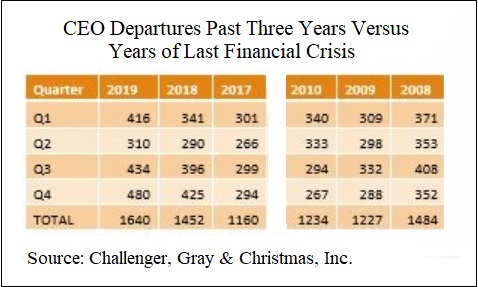
Challenger, Gray & Christmas, Inc. has been tracking CEO departures for the past 12 years. Its Vice President, Andrew Challenger, called the numbers for 2019 “staggering.” It was the highest number since their surveys began in 2002. A total of 1,640 CEOs headed for the exits last year. That was 156 more CEOs than those who left their post in 2008 – the year that Wall Street blazed a scorched earth trail through the U.S. economy.

The number of CEOs that did not leave on their own accord last year was 101 out of the 1,640. According to the study, 15 CEOs left over allegations of professional misconduct; 20 left amid a scandal, “typically under investigations for financial wrongdoing or other legal issues”; 24 saw their positions terminated; 39 left due to a merger or acquisition; 3 left due to bankruptcy.

CEOs of old, established companies have the clearest view of what is happening in the overall economy. They can compare sales growth to prior years and prior decades. They can spot negative or positive trends in the economy far ahead of the economic reports that the federal government releases to the public.

When an outsized number of CEOs decide to cash out their stock options, grab their golden parachutes, and flee their corner offices – something smells.

On top of that fishy smell comes a report from TrimTabs Investment Research that corporate insiders have reaped more than $50 billion in stock sales since May, putting insider selling on a pace not seen since 2006 – two years before the stock market and economic crash of 2008.

The above two reports on corporate executive behavior are compatible with Wall Street On Parade’s reports that show that the current financial crisis began in the fall of 2019 – months before the first case of COVID-19 had emerged anywhere in the world. What triggered the financial crisis? The same kind of liquidity crisis on Wall Street that ushered in the crisis of 2008. (See Wall Street’s Financial Crisis Preceded COVID-19: Chart and Timeline and our archive of more than 100 articles on the financial crisis of 2019/2020 here.)

Why does it matter when the financial crisis began? It’s critically important for the following reasons.

First, the U.S. national debt has exploded to $26.69 trillion. To wrap your mind around this explosion of the national debt, you need some historical perspective. At the beginning of the Bill Clinton Presidency in January 1993, the U.S. national debt stood at $4 trillion. At that point, the United States was more than 200 years old. During that 200 years, the U.S. had financed the Revolutionary War, the Civil War, World Wars I and II and the Vietnam War. The country had also been through the greatest economic collapse in its history, the Great Depression, which required a multitude of fiscal spending programs.

It took more than two centuries for the U.S. national debt to reach $4 trillion but in just the past 27 years the national debt has grown by more than $22 trillion – more than a five-fold increase in less than three decades.

This staggering amount of debt puts the nation at risk of a future credit downgrade and cripples its ability to adequately deal with the financial struggles of its citizens during the worst health and financial crisis in a century.

One of the key reasons for this mushrooming debt was the Wall Street financial crisis of 2008 which required massive fiscal spending to keep the economy from sinking into a depression.

But no serious steps were taken by Congress to reform Wall Street. Derivatives remain largely unregulatedDark Pools are still trading in darkness. Wall Street continues to pay credit rating agencies to rate their toxic debt piles. Off balance sheet casinos run rampant at the largest Wall Street banks. Obscene pay for performance via stock options continues to incentive CEOs and CFOs to massage earnings.

The biggest unaddressed problem is the critical need to restore the Glass-Steagall Act. All of the dangers cited above can, and do, bring down an entire financial institution as we learned in 2008. But with the restoration of the Glass-Steagall Act, the giant, federally-insured, deposit-taking banks would be completely separated from the Wall Street casino investment banks.

This handful of mega banks that hold the majority of deposits in this country are too critical to keeping credit flowing to businesses and consumers to be run by the Wall Street bet-the-ranch mentality. These banks are simply too big to be bailed out again.

When Citigroup was disintegrating from all of the evils mentioned above from 2007 to 2010, this is what it took to resuscitate its sinking hull: $45 billion in capital infusions from the U.S. Treasury; over $300 billion in asset guarantees from the federal government; the Federal Deposit Insurance Corporation (FDIC) guaranteed $5.75 billion of its senior unsecured debt and $26 billion of its commercial paper and interbank deposits; and the Federal Reserve secretly, with no authorization or even awareness of Congress, made a cumulative $2.5 trillion in below-market rate loans to Citigroup from 2007 through at least the middle of 2010, according to an audit by the Government Accountability Office (GAO).

And, finally, acknowledging that this latest financial crisis began prior to the pandemic shines a bright light on the incompetency of the Federal Reserve to manage these Wall Street behemoth banks. It’s simply an insane regulatory model to have a bank regulator with the ability to create money out of thin air that can secretly create and spend $29 trillion bailing out the banks to cover up its own incompetency. That’s what happened from 2007 to 2010 and is in the process of happening again. (See The Fed Has Pumped $9 Trillion into Wall Street Over the Past Six Months, But Mnuchin Says “This Isn’t Like the Financial Crisis”.)


From Terrorists to Viruses: Dystopian Progress

By Edward Curtin

Source: Behind the Curtain

For anyone old enough to have been alive and aware of the attacks of September 11, 2001 and of so-called COVID-19 in 2020, memory may serve to remind one of an eerie parallel between the two operations.  However, if memory has been expunged by the work of one’s forgettery or deleted by the corporate media flushing it down the memory hole, or if knowledge is lacking, or maybe fear or cognitive dissonance is blocking awareness, I would like to point out some similarities that might perk one up to consider some parallels and connections between these two operations.

The fundamental tie that binds them is that both events aroused the human fear of death. Underlying all fears is the fear of death.  A  fear that has both biological and cultural roots. On the biological level, we all react to death threats in a fight or flight manner. Culturally, there are multiple ways that fear can be allayed or exacerbated, purposely or not. Usually, culture serves to ease the fear of death, which can traumatize people, through its symbols and myths. Religion has for a long time served that purpose, but when religion loses its hold on people’s imaginations, especially in regard to the belief in immortality, as Orwell pointed out in the mid-1940s, a huge void is left.  Without that consolation, fear is usually tranquilized by trivial pursuits.

In the cases of the attacks of September 11, 2001 and the current corona virus operation, the fear of death has been used by the power elites in order to control populations and institute long-planned agendas.  There is a red thread that connects the two events.

Both events were clearly anticipated and planned.

In the case of September 11, 2001, as I have argued before, linguistic mind-control was carefully crafted in advance to conjure fear at the deepest levels with the use of such repeated terms as Pearl Harbor, Homeland, Ground Zero, the Unthinkable, and 9/11.  Each in its turns served to raise the fear level dramatically. Each drew on past meetings, documents, events, speeches, and deep associations of dread. This language was conjured from the chief sorcerer’s playbook, not from that of an apprentice out of control.

And as David Ray Griffin, the seminal 9/11 researcher (and others), has pointed out in a dozen meticulously argued and documented books, the events of that day had to be carefully planned in advance, and the post hoc official explanations can only be described as scientific miracles, not scientific explanations. These miracles include: massive steel-framed high-rise buildings for the first time in history coming down without explosives or incendiaries in free fall speed; one of them being WTC-7 that was not even hit by a plane; an alleged hijacker pilot, Hani Hanjour, who could barely fly a Piper Cub, flying a massive Boeing 757 in a most difficult maneuver into the Pentagon; airport security at four airports failing at the same moment on the same day; all sixteen U.S. intelligence agencies failing; air traffic control failing, etc.  The list goes on and on.  And all this controlled by Osama bin Laden. It’s a fairy tale.

Then we had the crucially important anthrax attacks that are linked to 9/11. Graeme MacQueen, in The 2001 Anthrax Deception, brilliantly shows that these too were a domestic conspiracy.

These planned events led to the invasion of Afghanistan, the Patriot Act, the U.S. withdrawal from the ABM Treaty, the invasion of Iraq , the ongoing war on terror, etc.

Let us not forget years of those fraudulent color-coded warnings of the terrorist levels and the government admonition to use duct tape around your windows to protect against a massive chemical and biological attack.

Jump to 2020.  Let me start in reverse while color-coded designs are fresh in our minds. As the COVID-19 lockdowns were under way, a funny thing happened as people were wishing that life could return to normal and they could be let out of their cages. Similar color-coded designs popped up everywhere at the same time.  They showed the step-by-step schedule of possible loosening of government controls if things went according to plan. Red to yellow to green. Eye catching. Red orange yellow blue green.  As with the terrorist warnings following September 11, 2001.  In Massachusetts, a so-called blue state where I live, it’s color chart ends in blue, not green, with Phase 4 blue termed “the new normal: Development of vaccines and/or treatments enable the resumption of ‘the new normal.’” Interesting wording.  A resumption that takes us back to the future.

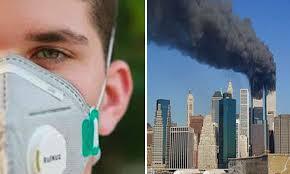
As with the duct tape admonitions after 9/11, now everyone is advised to wear a mask. It’s interesting to note that the 3 M Company, a major seller of duct tape, is also one of the world’s major sellers of face masks.  The company was expected to be producing 50 million N95 respirator masks per month by June 2020 and 2 billion globally within the coming year.  Then there is 3 M’s masking tape…but this is a sticky topic.

After the attacks of September 11, 2001, we were told repeatedly that the world was changed forever. Now we are told that after COVID 19, life will never be the same.  This is the “new normal,” while the post-9/11-pre-Covid-19 world must have been the old new normal. So everything is different but normal also.  So as the Massachusetts government website puts it, in the days to come we may be enabled to enact “the resumption of ‘the new normal.’”  This new old normal will no doubt be a form of techno-fascist transhumanism enacted for our own good.

As with 9/11, there is ample evidence that the corona virus outbreak was expected and planned; that people have been the victims of a propaganda campaign to use an invisible virus to scare us into submission and shut down the world’s economy for the global elites.  It is a clear case, as Peter Koenig tells Michel Chossudovsky in this must-see interview, that is not a conspiracy theory but a blatant factual plan spelled out in the 2010 Rockefeller Report, the October 18, 2019 Event 201, and Agenda 21, among other places.

Like amorphous terrorists and a war against “terrorism,” which is a tactic and therefore not something you can fight, a virus is invisible except when the media presents it as a pale, orange-spiked bunch of floating weird balls that are everywhere and nowhere.  Watch your back, watch your face, mask up, wash your hands, keep your distance – you never know when those orange spiked balls may get you.

As with 9/11, whenever anyone questions the official narrative of Covid-19, the official statistics, the validity of the tests, the effectiveness of masks, the powers behind the heralded vaccine to come, and the horrible consequences of the lockdowns that are destroying economies, killing people, forcing people to despair and to commit suicide, creating traumatized children, bankrupting small and middle-sized businesses for the sake of enriching the richest, etc., the corporate media mock the dissidents as conspiracy nuts, aiding the viral enemy.  This is so even when the dissenters are highly respected doctors, scientists, intellectuals, et al., who are regularly disappeared from the internet. With September 11, there were initially far fewer dissenters than now, and so the censorship of opposing viewpoints didn’t need the blatant censorship that is now growing daily. This censorship happens all across the internet now, quickly and stealthily, the same internet that is being forced on everyone as the new normal as presented in the Great Global Reset, the digital lie, where, as Anthony Fauci put it, no one should  ever shake hands again. A world of abstract images and beings in which, as Arthur Jensen tells Howard Beal in the film, Network, “All necessities [will be] provided, all anxieties tranquilized, all boredom amused.”  A digital dystopia that is fast approaching as perhaps the end of that red thread that runs from 9/11 to today.

Heidi Evens and Thomas Hackett write in the New York Daily News:

With the nation’s illusion of safety and security in ruins, Americans begin the slow and fitful process of healing from a trauma that feels deeply, cruelly personal…leaving citizens throughout the country with the frightening knowledge of their vulnerability.

That was written on September 12, 2001.

How Corporate Tyranny Works

By Chris Hedges

Source: OpEdNews.com

Those, like environmental lawyer Steven Donziger, who fight the corporate control of our society on behalf of the vulnerable find the institutions of power unite to crucify them.

The persecution of the attorney Steven Donziger is a grim illustration of what happens when we confront the real centers of power, masked and unacknowledged by the divisive cant from the Trump White House or the sentimental drivel of the Democratic Party. Those, like Donziger, who name and fight the corporate control of our society on behalf of the vulnerable see the judiciary, the press and the institutions of government unite to crucify them.

“It’s been a long battle, 27 years,” Donziger said when I reached him by phone in his apartment in Manhattan.

Donziger, who has been fighting polluting American oil companies for nearly three decades on behalf of indigenous communities and peasant farmers in Ecuador, has been under house arrest in Manhattan for a year. He will go to trial in federal court in New York on September 9 on contempt of court charges, which could see him jailed for six months. Ever since he won a multibillion-dollar judgment in 2011 against the oil giant Chevron, the multinational has come after him personally through litigation that threatens to destroy him economically, professionally and personally.

“Our L-T [long-term] strategy is to demonize Donziger,” Chevron wrote in an internal memo in 2009, as reviewed by Courthouse News.

It started when Texaco went into Ecuador in the Amazon in the 1960s and cut a sweetheart deal with the military government then ruling Ecuador,” Donziger told me. “Over the next 25 years, Texaco was the exclusive operator of a very large area of the Amazon that had several oil fields within this area, 1500 square miles. They drilled hundreds of wells. They created thousands of open-air, unlined toxic waste pits where they dumped the heavy metals and toxins that came up from the ground when they drilled. They ran pipes from the pits into rivers and streams that local people relied on for their drinking water, their fishing and their sustenance. They poisoned this pristine ecosystem, in which lived five indigenous peoples, as well as a lot of other non-indigenous rural communities. There was a mass industrial poisoning.”

“By the time I went down there in the early 1990s, many people had died, cancer rates were skyrocketing according to several independent health evaluations, people were really hurting. There was zero regard for the lives of the local people by Texaco. I was a very young lawyer back in 1993 when I first went to Ecuador. It was like looking at an apocalyptic scene. There was oil on the roads. People were living in abject poverty. They had no shoes. They would get oil on their feet when they walked along the roads. The oil pollution had permeated every aspect of daily life. It was in the food supply. It was in the water supply. It was in the air. The average person there would get exposed multiple times a day to very harmful, cancer-causing toxins, with foreseeable results.”

“I, with other lawyers, filed a lawsuit in New York against Texaco. The reason we filed in New York was because Texaco’s headquarters were in New York in 1993. The decisions to pollute in Ecuador, to play God to the people of Ecuador, were made in New York. We sued in New York. Texaco tried to get the case back to Ecuador where they had never been held accountable, where they knew the indigenous peoples had no money or resources to find lawyers.”

“They thought it would just go away,” said Donziger. “Over a 10-year period, we battled to get a jury trial in the United States. Ultimately, they won that part of the battle. It went down to Ecuador.”

“We started working with a team of Ecuadoran lawyers in the early 2000s. We went forward with the lawsuit. We produced voluminous scientific and testimonial evidence, showing that they caused probably the world’s worst oil pollution. It was called the ‘Amazon Chernobyl’ by locals and experts. They dumped 16 billion gallons of toxic waste. They did it deliberately to save money. This was unlike the BP spill in the Gulf of Mexico, which was a terrible accident, even though it was a product of horrendous negligence by BP. This was done by design to pollute, knowing that people would die, and that indigenous groups would be decimated, and that this beautiful part of the Amazon would be destroyed.”

The refusal to abide by even minimal environmental regulations saved Texaco an estimated $3 on every barrel of oil produced over 26 years (1964-1992), according to Amazon Watch, or an estimated extra $5 billion in revenue. The hundreds of waste pits the company eventually abandoned in Ecuador, on average, contain 200 times the contamination allowed by typical global standards.

“They tried to grind us down using classic corporate defense tactics,” Donziger said of the legal war. “They filed thousands of motions. We stood strong. We had a great legal team of Ecuadorian lawyers.”

In the end, they won a stunning victory, a rare moment of accountability for first-world conglomerates who rape the environment of developing nations by exploiting weak, corrupt governments.

“The verdict came down, about $18 billion in favor of the affected communities, which is what it would take at a minimum to clean up the actual damage and compensate the people for some of their injuries. That eventually got reduced on appeal in Ecuador to $9.5 billion, but it was affirmed by three appellate courts, including the highest court of Ecuador. It was affirmed by the Canadian Supreme Court, where the Ecuadorians went to enforce their judgment in a unanimous opinion in 2015.”

Chevron, as the evidence mounted against it, sold their assets in Ecuador and left the country. The corporation threatened the plaintiffs with a “lifetime of litigation” if they attempted to collect, and, according to internal Chevron memos, launched a legal and media campaign that has cost an estimated $2 billion to prevent payment of the settlement and to demonize and destroy Donziger.

Donziger came to his epic battle against Chevron through journalism. “I was a journalist on my college newspaper,” he said of his time as a history major at American University. “My first job out of college was as a journalist with [United Press International]. I worked for UPI in Washington. They were strong in Latin America. I traveled to Managua in 1983 or 1984, I don’t remember exactly, and found work in the UPI bureau. I was 23 years old. I worked in the UPI bureau in Managua during the Sandinista era.”

He left UPI after a year in Managua but stayed on in Nicaragua to work as a freelance journalist for newspapers such as The Fort Lauderdale News, The Toronto Star and The Atlanta Constitution. He spent about three years as a reporter before going to Harvard Law School. When he graduated from Harvard Law School in 1991, he worked as a public defender in Washington, D.C. He documented Iraqi civilian casualties in Iraq following the first Gulf War that became a report adopted by the United Nations.

A classmate at law school was from Ecuador. His classmate’s father organized a trip in April 1993 for lawyers and medical professionals to look at the contamination caused by the oil extraction in the Amazon. That trip, which Donziger joined, spawned the suit against Texaco. He would make more than 250 trips to Ecuador over the next two decades.

“Journalism significantly shaped my views and skill set,” he said. “It was vital to allowing my work to be successful. From the beginning this was a unique litigation, for many reasons, but one of the reasons was we, as a team, decided to work across multiple platforms. If we only saw this case as a lawsuit we would never win.”

“Chevron controlled the legal system in Ecuador with their influence. We needed to operate across different platforms, including engaging with the media and carrying out significant public education. Most Ecuadorians, other than those who lived in the region, knew nothing about the pollution that had been happening in their country. We carried out zealous advocacy in the public arena. We realized that the indigenous people would never get a fair trial in Ecuador if they did not illuminate what had happened to them and get public support.”

“The fact that I am detained shows how far we’ve come and how much risk Chevron feels. It’s not a sign we lost. It’s the opposite.”

Steven Donziger

Both the judge who oversaw its lawsuit against Donziger for “racketeering” and Chevron itself “claim that this type of activity is wrong,” he said. “The irony is that what we were doing is what the big oil companies have always done. They always operate in the public relations domain, lobbying Congress to pass legislation to extinguish various legal claims, meeting political leaders behind the scenes. They operate across every platform they can find to exercise their power. We were smart enough to meet them toe-to-toe wherever they were operating and neutralize their ability to undermine the fairness of the trial. That’s how they operate. They try to control court systems.”

“My journalism [experience] sensitized me to injustice. It allowed me to understand the media. I knew how to write press releases, which matters when you do a public case like this. I knew how to work across different platforms to mobilize positive energy around the case. Human rights work involves, first and foremost, justice for victims. But equally important is accountability for the perpetrators. The fact that I am detained shows how far we’ve come and how much risk Chevron feels. It’s not a sign we lost. It’s the opposite.”

Chevron, which had left Ecuador, went back to the New York court, where Donziger had originally filed the lawsuit before Chevron got a change of venue to Ecuador, and sued him, using a civil courts portion of the federal law famous for breaking the New York Mafia in the 1970s, the Racketeer Influenced and Corrupt Organizations Act.

In effect, “They sued me as a civil racketeer, under a civil RICO statute for $60 billion,” he said. “That was the largest amount of money an American individual ever had been sued for. This began a 10-year campaign to demonize me by Chevron and by its judicial allies.”

Chevron, which has more than $260 billion in assets, has hired an estimated 2,000 lawyers from 60 law firms to carry out its campaign, according to court documents. The oil giant dropped its demand for financial damages weeks before the RICO trial, which would have necessitated a jury trial. Judge Lewis A. Kaplan, a former lawyer for the tobacco industry who had undisclosed investments in funds with Chevron holdings, according to his public financial disclosure statement, decided the RICO case alone. He found credible a witness named Alberto Guerra, relocated to the US by Chevron at a cost of some $2 million, who claimed the verdict in Ecuador was the product of a bribe. Kaplan used Guerra’s testimony as primary evidence for the racketeering charge, although Guerra, a former judge, later admitted to an international tribunal that he had falsified his testimony.

“[Kaplan] wouldn’t allow me to bring in any environmental evidence that the Ecuadorian courts had used to find Chevron liable,” Donziger said. “He wouldn’t let me testify on my own behalf on direct. He allowed Chevron to use secret witnesses whose identities he wouldn’t reveal to me. He tried to treat it like a national-security kind of case to try to demonize me. Because Chevron’s whole strategy is to demonize [me] as a way to distract attention from its environmental crimes in Ecuador. And Judge Kaplan, who knows all the tricks in the books because he used to work for [tobacco company] Brown & Williamson, when he was [an attorney with the law firm of] Paul, Weiss. He knows the tobacco industry playbook that they used for years and years and continue to use. And he worked with the Chevron lawyers at Gibson, Dunn & Crutcher to implement them against me without a jury. And there was nothing I could do about it.”

(Paul, Weiss is a large law firm that currently advises Chevron on its $13 billion purchase of another energy company.)

John Keker, one of Donziger’s lawyers on that case, said he was up against 160 lawyers for Chevron and during the trial he felt “like a goat tethered to a stake.” He called the court proceedings under Kaplan “a Dickensian farce” and a “show trial.” In the end, Kaplan ruled that the judgment in the Ecuadorean court against Chevron was the result of fraud.

He also ordered Donziger to turn over decades of all client communication to Chevron, in effect eradicating attorney-client privilege, a backbone of the Anglo-American legal system with roots dating to ancient Rome. Donziger appealed what was, according to legal experts following the case, an unprecedented and illegal order. While Donziger’s appeal was pending, Kaplan charged him with criminal contempt for this principled stance, as well as his refusal to turn over his passport, his personal electronics and to refrain from seeking the collection of the original award against Chevron.

When his criminal contempt charges against the environmental lawyer were ignored by the U.S. attorney’s office for over five years, Judge Kaplan, using an exceedingly rare judicial maneuver, appointed the private law firm of Seward & Kissel, to act in the name of the government to prosecute Donziger. Neither the judge nor the law firm disclosed that Chevron has been a client of Seward & Kissel.

Kaplan also violated the established random case assignment protocol to personally assign Loretta Preska, a member of the right-wing Federalist Society, to hear the case. Chevron is a major donor to the Federalist Society. Preska, in a show of bias, already has said the charges against Donziger appear to be “very strong,” according to Courthouse News. In May, she disallowed him from having his charges heard by a jury.

“The last thing any of them wants is for a group of ordinary citizens to see what has happened to Steven Donziger,” Rick Friedman, one of Donziger’s attorneys, said of Chevron.

“The last thing any of them wants is for a group of ordinary citizens to see what has happened to Steven Donziger.”

Rick Friedman, attorney

Preska’s fealty to corporate power was previously on public display in 2013 when she imposed a 10-year sentence, the maximum allowed under a plea deal, on Jeremy Hammond, the activist who hacked into Stratfor, a private security firm. Hammond made public a barrage of damning internal emails and exposed the email address and password of an account used for business by Preska’s husband, Thomas Kavaler, a partner at the law firm Cahill Gordon & Reindel. Preska, despite the conflict of interest, refused to recuse herself. The 10-year sentence was one of the longest in U.S. history for hacking.

Kaplan had Preska demand Donziger post an $800,000 bond on a misdemeanor charge. Preska placed him under house arrest and confiscated his passport which he has used to meet with attorneys around the world attempting to enforce the judgment against Chevron. Kaplan managed to have Donziger disbarred. He allowed Chevron to freeze Donziger’s bank accounts, slapped Donziger with millions in fines without allowing him a jury, forced him to wear an ankle monitor 24 hours a day and effectively shut down his ability to earn a living. Kaplan allowed Chevron to impose a lien on Donziger’s apartment in Manhattan where he lives with his wife and teenage son.

Donziger is scheduled to go to trial without a jury on September 9 in New York City for contempt. Preska will preside over the trial. There has not been a criminal trial in Manhattan federal court since March because of the pandemic. Donziger’s trial would be the first, although hundreds of other defendants facing far more serious felony charges are waiting in jails, infested with COVID-19, for a trial date. Donziger’s four pro bono lawyers said they do not want to risk their lives by traveling to New York during the pandemic for what is a misdemeanor offense.

“The judgment against Chevron Corporation in Ecuador was the product of fraud, bribery and corruption,” Sean Comey, Senior Advisor – External Affairs Chevron Corporation said when I asked the corporation to comment on the case. “Steven Donziger is a proven liar and an adjudicated racketeer. He committed criminal acts in the U.S. and abroad in pursuit of his extortion scheme in the Ecuadorian courts. Donziger’s continuing lawlessness is now a matter for prosecutors and the U.S. courts to decide. Chevron is not involved in Donziger’s criminal prosecution.”

The flagrant corruption and misuse of the legal system to abjectly serve corporate interests in the Donziger case illustrates the deep decay within our judiciary and democratic institutions, one that was abetted by Democratic administrations that stacked the courts with corporate lawyers — Kaplan was appointed by Bill Clinton — and Donald Trump, who has elevated ideologues selected by the Federalist Society to the federal bench. Ruling after ruling in Donziger’s case has ignored or grossly distorted the law on behalf of Chevron to ensure that Donziger will be prosecuted, sent to prison and remain in debt for life — all while the $9.5 billion settlement is never paid to aid the people harmed in Ecuador.

The International Association of Democratic Lawyers and the international committee of the National Lawyers Guild issued a letter signed by more than 70 organizations calling the persecution of Donziger an “attack on the rule of law.” The letter said his house arrest was “unprecedented” and charged that he was being targeted for what it called “one of the most important corporate accountability and human rights cases of our time.” The letter accused Kaplan of “violating basic notions of fairness in the judicial process that lie at the core of the rule of law.”

“We cannot allow the rule of law to be upended by corporate interests and a highly biased federal judge seeking to destroy the willpower of one lawyer who has already withstood decades of brutal litigation and scathing personal and professional attacks,” the letter read.

Chevron has also used its clout and advertising dollars to keep the story from being reported in numerous media outlets.

“Based on where this story is trending, we have launched a full offensive to kill it or redirect it,” an August 10, 2010 internal memo from Chevron reads concerning a potential report — on the case being done by the Fox News bureau in Miami.

“In addition to working through the Miami bureau, we have reached out to more senior news folks at Fox News, both in NY (through Dana) and in WDC (through Greg Mueller). So, we are trying to attack this story on multiple fronts. To this end, Kent is set to talk to John Stack and Sean Smith who both reside at Fox News in NY at 1:30 today. Finally, if need be, I think we may need to pull the JSW card with Roger Ailes. We have checked John’s availability to place a call to Roger, but his first availability is tomorrow afternoon.”

From 2010 to 2018, John S. Watson was the CEO and chairman of the Chevron Corporation.

The story was killed.

Another internal memo lays out the steps, also ultimately successful, to prevent a similar story from appearing in GQ magazine. The memo suggests that Chevron work …with the Columbia Journalism Review (that ran the rebuke of 60 minutes) and the Media Research Center to expose any degree of bias by GQ and raise alerts about the reporting techniques prior to the story’s publication.”

The memo recommends letting the magazine know that it will face legal action if the story runs and calls on Chevron investigators to “conduct further due diligence on reporter.” Chevron has also hired reporters to produce fake pieces of journalism that peddle the corporation’s propaganda on fake news sites it runs.

The New York Times magazine earlier this year considered a story about Donziger and then dropped it. The newspaper runs its own ad agency called T Brand Studio. Chevron is a major client, meaning The New York Times, through T Brand Studio, produces ads for Chevron.

Jake Silverstein, editor of the magazine, when asked to comment said by email: “It was one of several stories William [Langewiesche] considered writing for us in the past year, one that ultimately we decided not to assign. Many factors go into our decisions about what to assign, and none of them ever include who is or is not a client of T Brand Studio or any other part of the paper’s advertising business.”

Dean Baquet, the newspaper’s executive editor, said, when I reached him by email, that the idea that the magazine piece on Donziger was killed because Chevron is a major advertiser is “a ridiculous claim.” He added, “I didn’t even know Chevron worked with T Brand [Studio].”

But that Chevron has invested tremendous resources to kill stories about this case is indisputable given the detailed campaigns to block coverage outlined in its own internal memos.

“I’ve experienced this multiple times with media over the past 10 to 15 years,” Donziger said. “An entity will start writing the story, spend a lot of time on it, then the reporter disappears. The story doesn’t run.”

While The NationThe Intercept and Courthouse News Service have reported on Donziger’s current legal battle, no major mainstream publication has touched it.

“Corporate influence over our federal judiciary has increased dramatically in recent years,” Donziger said. “This firm [Chevron] has captured an element of power from the government and deployed it against a human rights activist.”

Front Line Defenders issued a report in 2019 that found that 300 human rights activists had been murdered in 31 countries, more than two-thirds in Latin America. Of those killed, 40 percent fought for land rights, indigenous peoples and environmental justice.

“What’s shocking to a lot of people is that this is now happening in the United States,” Donziger said. “I don’t mean murder, but death by a thousand cuts. Chevron does not want me to be a lawyer anymore, at a minimum. They don’t want me advocating even as a non-lawyer. They want to silence me. They want to kill every story they can. They’d rather have no story about this case than even a positive story about their side. They don’t want people to know about it. They want to erase it from people’s thought process.

“I cannot get a fair trial with a judge appointed by Judge Kaplan rather than through the random assignment process,” he lamented. “I cannot get a fair trial with a prosecutor whose law firm [has worked] for Chevron. These are egregious conflicts of interest. Its misconduct on a grand scale. I’ve been locked up four times as long as the longest sentence ever imposed on a lawyer for criminal contempt in New York. Anyone who cares about the rule of law should be appalled.”

Era of US Domination of Latin America Coming to an End

Marcha en Venezuela contra las sanciones de Trump (Reuters)

By Kevin Zeese and Margaret Flowers

Source: Dissident Voice

Despite its failings at home, the United States intervenes in countries across multiple continents seeking to control their governments and resources.

This week, we look at the US’ latest efforts in Nicaragua, Venezuela, and Bolivia to undermine their independence and force them to serve the interests of the US government and transnational corporations.

In all three countries, the US has displayed a lack of understanding of the people and their support for their revolutionary processes, and as a result, is failing. As US empire fades, so might the Monroe Doctrine come to an end.

Sandanista- FSLN rally in Nicaragua

Nicaragua: USAID Multi-Year Destabilization Plan Exposed

A US Agency for International Development (USAID) document revealed by reporter William Grigsby describes covert plans to overthrow the democratically-elected Nicaraguan government in the next two years. USAID seeks to hire mercenaries “to take charge of the plan . . . to disrupt public order and carry out other [violent] actions before, during, and/or after the 2021 elections.”

USAID is creating Responsive Assistance In Nicaragua (RAIN), allotting $540,000 in grants to remove the Sandinista government in what it calls “Nicaragua’s transition to democracy.” Daniel Ortega won the 2016 election with 72 percent of the vote in what election observers from the Organization of American States (OAS), a US tool, described as taking “place in a calm, smooth and pacific manner, with no large incidents.”

Brian Willson, who has opposed US efforts to dominate Nicaragua since the 1980s Contra war, concludes the US realizes Ortega will win the 2021 election. In fact, this week, a poll showed support for Ortega’s party, FSLN, at 50% and for the opposition at 10%. One of USAID plans, as they tried in Venezuela in 2018, is for the opposition to boycott the election since they know they will lose, then call it illegitimate and create a political and economic crisis.

The real goal is not a democracy but domination so US transnational corporations can profit from the second poorest country in the hemisphere by putting in place a neoliberal economy to privatize public services, cut social services, and purge all traces of the Sandinistas. USAID also plans to “reestablish” the police and military to enforce their rule. Another goal is to stop Nicaragua from being the “threat of a good example” for its economic growth, reduction of inequality, poverty, illiteracy and crime.

Ben Norton points out in the Grayzone that “the 14-page USAID document employed the word ‘transition’ 102 times” making clear the intent is regime change.  A “sudden transition without elections,” a euphemism for a coup, is one of three possible regime change scenarios.

John Perry writes about “US interference in Nicaragua, going back at least as far as William Walker’s assault on its capital and usurpation of the presidency in 1856.” Since the 1979 Sandinista Revolution, the US has sought to take back control of Nicaragua.

USAID and its National Endowment for Democracy (NED) have been funding the opposition. NED financed 54 projects from 2014-17 to lay the groundwork for a 2018 coup attempt, which  also involved USAIDWiston Lopez writes the US has provided “more than 31 million dollars between the end of 2017 and May 1, 2020.” When the attempted coup in 2018 failed, the US also put in place illegal unilateral coercive measures, known as economic sanctions, supported by both Democrats and Republicans, to try to weaken the country.

The USAID’s RAIN program outlines the usual regime change steps; e.g., remake the police and military as enforcers of the new neoliberal order, move “quickly to dismantle parallel institutions”; i.e., the Sandinista Front, the Sandinista Youth, and other grassroots institutions, and implement “transitional justice measures”; i.e., the prosecution of current government officials and movement leaders.

A new area of attack is a disinformation campaign against Nicaragua’s handling of COVID-19. The opposition misrepresents the government’s response and puts forward false death statistics in an attempt to create chaos. As Wiston López points out, “Since March the US-directed opposition has focused 95% of their actions on attempting to discredit Nicaragua’s prevention, contention, and Covid treatment. However, this only had some success in the international media and is now backfiring since Nicaragua is the country with one of the lowest mortality rates in the continent.”

The US media fails to report on the success of Nicaragua in combating the virus using a community-based health system. Nicaragua has been building its health system for the last 12 years and took rapid action to prepare for the virus. Nicaragua did not impose a lock down because it is a poor country where 80 percent of people are in the informal economy and 40 percent live in rural areas. People must work in order to eat.

Stephen Sefton puts the failure of the United States so far in context. At its root, the US does not understand the people of Nicaragua, their history of fighting US domination, and their ability to overcome right-wing puppets. It also misunderstands what the Sandinista government is doing to better the lives of the people in every sector of the economy. Sefton concludes, “The US government has failed notoriously to meet the needs of its own people during the current pandemic but can still find money to try and destroy a small country whose success makes US social, economic and environmental policy look arbitrary, negligent and criminal.”

Nicolas Maduro kicks out Donald Trump (Photo by Ben Norton

Venezuela: Bipartisan Failed Regime Change

Ever since the 1998 election of Hugo Chavez, successive US administrations have tried and failed to dominate Venezuela. The bipartisan nature of this policy was on display on August 4, when Elliot Abrams, the notorious coup-monger for multiple presidents, testified in Congress. Not a single Senator criticized the attempt to illegally overthrow a democratically-elected government.

Abrams was criticized by both Democrats and Republicans for his inability to remove President Maduro from power. Senator Chris Murphy (D-CT) was most open about the coup attempt describing it as “a case study in diplomatic malpractice” and claiming Trump botched a winning play in a comedy of errors that strengthened Maduro. After the hearing, Murphy posted a series of Tweets admitting the coup and how it could have been done better.

clip from Murphy’s embarrassing comments was shared widely including by the Venezuelan Vice President Delcy Rodríguez and Foreign Minister Jorge Arreaza. When Vijay Prashad asked Arreaza his reaction, he described the US openly admitting crimes and said the “confessions” of Murphy, Gen. John Kelly, John Bolton, and Elliot Abrams “are priceless evidence for the complaint we raised at the International Criminal Court.”

Elliot Abrams testified that he would continue to work very hard to remove Maduro hopefully by the end of the year.  This echoed a statement by President Trump at SouthCom headquarters in Florida. Sen. Murphy’s comments are consistent with those made by Joe Biden who says he would be more effective at removing Maduro than Trump. Biden described Trump as soft on Maduro because he considered talking to him.

Elliot Abrams announced the US will be starting a media war against Venezuela. The reality is the US has been conducting a media war against Venezuela for more than 20 years.

Venezuela is moving ahead with elections for the National Assembly on December 6, 2020. Unlike 2018, more parties are agreeing to participate including the larger Democratic Action and Justice First parties, as well as a new Communist Party alliance and the hard-right Popular Will party, which was US puppet Juan Guaidó’s former party. There will be 105 political parties contesting for 277 National Assembly seats, 110 more than the current term. Venezuela uses a combination of majority winners and proportional representation. Venezuela also requires half the candidates to be female, and they use electronic voting confirmed by paper ballots with a public citizen audit on Election Day.

Juan Guaidó and others allied with the United States said they would boycott the election. Guaidó cannot risk running because he is likely to be defeated. The US is encouraging a boycott and then will claim the election was not legitimate as it did in the last presidential election. After December, Guaidó will not hold any elected office making his fraudulent claim to the presidency even weaker.

These events come after two major embarrassments for the US in Venezuela. Operation Gideonan attempt by mercenaries to invade Venezuela was foiled on May 4, leading to their arrests and the arrests of their co-conspirators. The State Department abandoned the mercenaries, and this week two former Green Berets were sentenced to 20 years in prison after admitting their guilt. It was evident that Guaidó was heavily involved in this failure adding to his failed presidential takeover and tainting him beyond repair.

The second defeat was Iran and Venezuela working together to deliver oil and equipment for Venezuelan refineries. Five Iranian oil tankers passed by the largest US armada in the Caribbean since the invasion of Panama. Southcom has been repeatedly sending warships into Venezuelan waters. The solidarity of Iran and Venezuela overcame the naval blockade, undermined US sanctions, and sent a shudder through the US by showing other nations they can defy the United States.

Venezuela has a strong history of struggle against imperialism but the US’ economic war is costing their economy hundreds of billions of dollars and leading to the premature death of Venezuelans. In addition, the United Kingdom is refusing to release more than a billion dollars of Venezuelan gold held in the Bank of England that was to be used for food and medicine. The UK court ruled against Venezuela but they are appealing the decision.

Bolivians protest the postponement of the election

Bolivia: US Dictator Fears Democratic Vote

On November 12 2019, a US-backed coup in Bolivia removed President Evo Morales who had just won re-election. The self-proclaimed President Jeanine Añez, a right-wing Christian, leads a de facto government involved in massacres, persecution and imprisonment of political leaders. It is destroying the social and economic model and achievements of the Movement Towards Socialism (MAS Party) led by Morales.

The OAS played a crucial role in the coup with their false analysis of Morales’ re-election. The western media reported the false OAS analysis without criticism. Now, studies by MIT and the Center for Economic and Policy Analysis have shown that Morales clearly won the election and should have remained in power. For months the Washington Post claimed Morales’ re-election was a fraud, but finally, in March, it acknowledged the election was legitimate. Similarly, the New York Times admitted in July that Morales won the election.

Many have called this a lithium coup because the element is plentiful in Bolivia and critical for batteries. This was made evident when Elon Musk, the head of Tesla, said on Twitter “We will coup whoever we want! Deal with it.” Tesla would benefit from cheap and plentiful lithium for electric car batteries.

The people of Bolivia are struggling to restore democracy. The fraudulent report by the OAS led to a three-week conflict between right-wing Bolivians protesting alleged fraud and pro-government, mostly indigenous, demonstrators defending Morales. The military and police sided with the right-wing coup. The coup government threatened legislators and their families while repressing the people. There were racist attacks against the majority Indigenous population and the Wiphala, the indigenous flag, was burned in the streets. When she took power, Áñez, surrounded by right-wing legislators, held up a large leather bible and declared, “The Bible has returned to the palace.”

The US recognized the coup government, similar to its recognition of the failed coup leader, Juan Guaidó in Venezuela. Añez claimed she’d be transitory until the next election, but at the direction of the US, she is putting in place deep roots and has delayed elections.

The repression has galvanized the MAS party, as well as peasant unions and grassroots organizations who continue their struggle to restore Bolivian democracy. The pressure led to elections being scheduled. Initially, Áñez said she would not run but reversed herself and is now a candidate while she is trying to outlaw the MAS party and its candidates.

Elections were scheduled for May 3, but have been postponed twice allegedly due to the pandemic, but really because this is an ongoing coup.

It is true that the COVID-19 pandemic is hitting Bolivia hard with horror stories about people unable to get medical treatment. Immediately after the coup, the Añez government expelled the Cuban doctors. The coup-government is unable to manage the health system. Corruption is rampant in the purchase of medical equipment. The health ministry has had three ministers during the crisis. The situation is dire with overcrowded hospitals, lack of basic supplies, and corpses in the streets and in their homes with nowhere to be buried.

The coup-government is using the virus to try to delay elections because polls show the MAS candidate, Luis Arce, is far ahead and likely to win in the first round of elections with Áñez coming in a distant third. Áñez has sought to prosecute Arce to keep him from running, so far unsuccessfully.  On July 6, the Attorney General of Bolivia charged Evo Morales with terrorism and financing of terrorism from exile and is seeking preventive detention.

Since mid-July, thousands of Bolivians have been protesting the postponement of elections. They are holding sustained protests throughout the country and blocking many roads. Indigenous and peasant groups, agricultural groups, along with women and unions are joining together calling for elections.  Morales, Arce, and the MAS Party have denounced the delay.

Domination Will Not Reverse Decline

Evo Morales said in a recent interview:

The United States is trying to make Latin America its backyard forever. We know about the hard resistance of the peoples of Cuba, Venezuela, Nicaragua. The struggle of our peoples is very important. The United States wants to divide us in order to plunder our natural resources. The peoples no longer accept domination and plunder. The United States is in decline, and yet it lashes out.

The US is weakening as a global power and its failures in Latin America are both a symptom of this and are causing further decline. The US’ violations of international law are obvious and are being challenged. But the US is an empire and it will not give up the Monroe Doctrine easily.

As citizens of Empire, we have a particular responsibility to demand the US stop its sanctions and illegal interference in Latin America and elsewhere around the world. In this time of multiple global crises, we must demand the US become a cooperative member of the world community and work peacefully to address the pandemic, recession and climate crisis.

Structures to do this exist to help with this such as the global ceasefire and the Paris Climate agreement. And on the anniversary of the US bombing of Hiroshima and Nagasaki, Japan, we must add the Nuclear Ban Treaty as another effort the US must join.

Killing Democracy in America

By William J. Astore

Source: Strategic Culture Foundation

The phrase “thinking about the unthinkable” has always been associated with the unthinkable cataclysm of a nuclear war, and rightly so. Lately, though, I’ve been pondering another kind of unthinkable scenario, nearly as nightmarish (at least for a democracy) as a thermonuclear Armageddon, but one that’s been rolling out in far slower motion: that America’s war on terror never ends because it’s far more convenient for America’s leaders to keep it going — until, that is, it tears apart anything we ever imagined as democracy.

I fear that it either can’t or won’t end because, as Martin Luther King, Jr., pointed out in 1967 during the Vietnam War, the United States remains the world’s greatest purveyor of violence — and nothing in this century, the one he didn’t live to see, has faintly proved him wrong. Considered another way, Washington should be classified as the planet’s most committed arsonist, regularly setting or fanning the flames of fires globally from Libya to Iraq, Somalia to Afghanistan, Syria to — dare I say it — in some quite imaginable future Iran, even as our leaders invariably boast of having the world’s greatest firefighters (also known as the U.S. military).

Scenarios of perpetual war haunt my thoughts. For a healthy democracy, there should be few things more unthinkable than never-ending conflict, that steady drip-drip of death and destruction that drives militarism, reinforces authoritarianism, and facilitates disaster capitalism. In 1795, James Madison warned Americans that war of that sort would presage the slow death of freedom and representative government. His prediction seems all too relevant in a world in which, year after year, this country continues to engage in needless wars that have nothing to do with national defense.

You Wage War Long, You Wage It Wrong

To cite one example of needless war from the last century, consider America’s horrendous years of fighting in Vietnam and a critical lesson drawn firsthand from that conflict by reporter Jonathan Schell. “In Vietnam,” he noted, “I learned about the capacity of the human mind to build a model of experience that screens out even very dramatic and obvious realities.” As a young journalist covering the war, Schell saw that the U.S. was losing, even as its military was destroying startlingly large areas of South Vietnam in the name of saving it from communism. Yet America’s leaders, the “best and brightest” of the era, almost to a man refused to see that all of what passed for realism in their world, when it came to that war, was nothing short of a first-class lie.

Why? Because believing is seeing and they desperately wanted to believe that they were the good guys, as well as the most powerful guys on the planet. America was winning, it practically went without saying, because it had to be. They were infected by their own version of an all-American victory culture, blinded by a sense of this country’s obvious destiny: to be the most exceptional and exceptionally triumphant nation on this planet.

As it happened, it was far more difficult for grunts on the ground to deny the reality of what was happening — that they were fighting and dying in a senseless war. As a result, especially after the shock of the enemy’s Tet Offensive early in 1968, escalating protests within the military (and among veterans at home) together with massive antiwar demonstrations finally helped put the brakes on that war. Not before, however, more than 58,000 American troops died, along with millions of Vietnamese, Cambodians, and Laotians.

In the end, the war in Indochina was arguably too costly, messy, and futile to continue. But never underestimate the military-industrial complex, especially when it comes to editing or denying reality, while being eternally over-funded for that very reality. It’s a trait the complex has shared with politicians of both parties. Don’t forget, for instance, the way President Ronald Reagan reedited that disastrous conflict into a “noble cause” in the 1980s. And give him credit! That was no small thing to sell to an American public that had already lived through such a war. By the way, tell me something about that Reaganesque moment doesn’t sound vaguely familiar almost four decades later when our very own “wartime president” long ago declared victory in the “war” on Covid-19, even as the death toll from that virus approaches 150,000 in the homeland.

In the meantime, the military-industrial complex has mastered the long con of the no-win forever war in a genuinely impressive fashion. Consider the war in Afghanistan. In 2021 it will enter its third decade without an end in sight. Even when President Trump makes noises about withdrawing troops from that country, Congress approves an amendment to another massive, record-setting military budget with broad bipartisan support that effectively obstructs any efforts to do so (while the Pentagon continues to bargain Trump down on the subject).

The Vietnam War, which was destroying the U.S. military, finally ended in an ignominious withdrawal. Almost two decades later, after the 2001 invasion, the war in Afghanistan can now be — the dream of the Vietnam era — fought in a “limited” fashion, at least from the point of view of Congress, the Pentagon, and most Americans (who ignore it), even if not the Afghans. The number of American troops being killed is, at this point, acceptably low, almost imperceptible in fact (even if not to Americans who have lost loved ones over there).

More and more, the U.S. military is relying on air power, unmanned drones, mercenaries, local militias, paramilitaries, and private contractors. Minimizing American casualties is an effective way of minimizing negative media coverage here; so, too, are efforts by the Trump administration to classify nearly everything related to that war while denying or downplaying “collateral damage” — that is, dead civilians — from it.

Their efforts boil down to a harsh truth: America just plain lies about its forever wars, so that it can keep on killing in lands far from home.

When we as Americans refuse to take in the destruction we cause, we come to passively accept the belief system of the ruling class that what’s still bizarrely called “defense” is a “must have” and that we collectively must spend significantly more than a trillion dollars a year on the Pentagon, the Department of Homeland Security, and a sprawling network of intelligence agencies, all justified as necessary defenders of America’s freedom. Rarely does the public put much thought into the dangers inherent in a sprawling “defense” network that increasingly invades and dominates our lives.

Meanwhile, it’s clear that low-cost wars, at least in terms of U.S. troops killed and wounded in action, can essentially be prolonged indefinitely, even when they never result in anything faintly like victory or fulfill any faintly useful American goal. The Afghan War remains the case in point. “Progress” is a concept that only ever fits the enemy — the Taliban continues to gain ground — yet, in these years, figures like retired general and former CIA director David Petraeus have continued to call for a “generational” commitment of troops and resources there, akin to U.S. support for South Korea.

Who says the Pentagon leadership learned nothing from Vietnam? They learned how to wage open-ended wars basically forever, which has proved useful indeed when it comes to justifying and sustaining epic military budgets and the political authority that goes with them. But here’s the thing: in a democracy, if you wage war long, you wage it wrong. Athens and the historian Thucydides learned this the hard way in the struggle against Sparta more than two millennia ago. Why do we insist on forgetting such an obvious lesson?

“We Have Met the Enemy and He Is Us”

World War II was arguably the last war Americans truly had to fight. My Uncle Freddie was in the Army and stationed at Pearl Harbor when it was attacked on December 7, 1941. The country then came together and won a global conflict (with lots of help) in 44 months, emerging as the planetary superpower to boot. Now, that superpower is very much on the wane, as Donald Trump recognized in running successfully as a declinist candidate for president in 2016. (Make America Great Again!) And yet, though he ran against this country’s forever wars and is now president, we’re approaching the third decade of a war on terror that has yielded little, spread radical Islamic terror outfits across an expanse of the planet, and still seemingly has no end.

“Great nations do not fight endless wars,” Trump himself claimed only last year. Yet that’s exactly what this country has been doing, regardless of which party ruled the roost in Washington. And here’s where, to give him credit, Trump actually had a certain insight. America is no longer great precisely because of the endless wars we wage and all the largely hidden but associated costs that go with them, including the recently much publicized militarization of the police here at home. Yet, in promising to make America great again, President Trump has failed to end those wars, even as he’s fed the military-industrial complex with even greater piles of cash.

There’s a twisted logic to all this. As the leading purveyor of violence and terror, with its leaders committed to fighting Islamic terrorism across the planet until the phenomenon is vanquished, the U.S. inevitably becomes its own opponent, conducting a perpetual war on itself. Of course, in the process, Afghans, Iraqis, Libyans, Syrians, Somalis, and Yemenis, among other peoples on this embattled planet of ours, pay big time, but Americans pay, too. (Have you even noticed that high-speed railroad that’s unbuilt, that dam in increasing disrepair, those bridges that need fixing, while money continues to pour into the national security state?) As the cartoon possum Pogo once so classically said, “We have met the enemy and he is us.”

Early in the Iraq War, General Petraeus asked a question that was relevant indeed: “Tell me how this [war] ends.” The answer, obvious to so many who had protested in the global streets over the invasion to come in 2003, was “not well.” Today, another answer should be obvious: never, if the Pentagon and America’s political and national security elite have anything to do with it. In thermodynamics class, I learned that a perpetual motion machine is impossible to create due to entropy. The Pentagon never took that in and has instead been hard at work proving that a perpetual military machine is possible… until, that is, the empire it feeds off of collapses and takes us with it.

America’s Military Complex as a Cytokine Storm

In the era of Covid-19, as cases and deaths from the pandemic continue to soar in America, it’s astonishing that military spending is also soaring to record levels despite a medical emergency and a major recession.

The reality is that, in the summer of 2020, America faces two deadly viruses. The first is Covid-19. With hard work and some luck, scientists may be able to mass-produce an effective vaccine for it, perhaps by as early as next spring. In the meantime, scientists do have a sense of how to control it, contain it, even neutralize it, as countries from South Korea and New Zealand to Denmark have shown, even if some Americans, encouraged by our president, insist on throwing all caution to the winds in the name of living free. The second virus, however, could prove even more difficult to control, contain, and neutralize: forever war, a pandemic that U.S. military forces, with their global strike missions, continue to spread across the globe.

Sadly, it’s a reasonable bet that in the long run, even with Donald Trump as president, America has a better chance of defeating Covid-19 than the virus of forever war. At least, the first is generally seen as a serious threat (even if not by a president blind to anything but his chances for reelection); the second is, however, still largely seen as evidence of our strength and exceptionalism. Indeed, Americans tend to imagine “our” military not as a dangerous virus but as a set of benevolent antibodies, defending us from global evildoers.

When it comes to America’s many wars, perhaps there’s something to be learned from the way certain people’s immune systems respond to Covid-19. In some cases, the virus sparks an exaggerated immune response that drives the body into a severe inflammatory state known as a cytokine storm. That “storm” can lead to multiple organ failure followed by death, yet it occurs in the cause of defending the body from a viral attack.

In a similar fashion, America’s exaggerated response to 19 hijackers on 9/11 and then to perceived threats around the globe, especially the nebulous threat of terror, has led to an analogous (if little noticed) cytokine storm in the American system. Military (and militarized police) antibodies have been sapping our resources, inflaming our body politic, and slowly strangling the vital organs of democracy. Left unchecked, this “storm” of inflammatory militarism will be the death of democracy in America.

To put this country right, what’s needed is not only an effective vaccine for Covid-19 but a way to control the “antibodies” produced by America’s forever wars abroad and, as the years have gone by, at home — and the ways they’ve attacked and inflamed the collective U.S. political, social, and economic body. Only when we find ways to vaccinate ourselves against the destructive violence of those wars, whether on foreign streets or our own, can we begin to heal as a democratic society.

To survive, the human body needs a healthy immune system, so when it goes haywire, becomes wildly inflamed, and ends up attacking and degrading our vital organs, we’re in trouble deep. It’s a reasonable guess that, in analogous terms, American democracy is already on a ventilator and beginning to feel the effects of multiple organ failure.

Unlike a human patient, doctors can’t put our democracy into a medically induced coma. But collectively we should be working to suppress our overactive immune system before it kills us. In other words, it’s truly time to defund that military machine of ours, as well as the militarized version of the police, and rethink how actual threats can be neutralized without turning every response into an endless war.

So many years later, it’s time to think the unthinkable. For the U.S. government that means — gasp! — peace. Such a peace would start with imperial retrenchment (bring our troops home!), much reduced military (and police) budgets, and complete withdrawal from Afghanistan and any other place associated with that “generational” war on terror. The alternative is a cytokine storm that will, in the end, tear us apart from within.


Hiroshima Denial is Terror

By Finian Cunningham

Source: Information Clearing House

Those who deny history, or who are oblivious, are apt to repeat it. That is the frightening, perhaps most disturbing aspect of the 75th anniversary this week of the American atomic bombing of Hiroshima and Nagasaki.

The indiscriminate mass murder of 200,000 people on August 6 and 9, 1945, is beyond words in its horror and moral depravity. But what is equally condemning is the ostensible lack of remorse and the obfuscation to conceal the scale of such evil.

For if there were any remorse or realization about the crime there would surely be a commitment to never repeat it. The most solemn manifestation of commitment would be the pursuance of nuclear disarmament.

Seventy-five years on, yes, American news media run so-called commemorative articles on the historic events. However, there is a sense of glibness about the calamity, a sort of dull duty to mark the occasion as if it is a yearly chore of “regret”. There is also a sneaking awe at the destructive power unleashed on those Japanese cities, as well as the usual inclusion of official justification about how US leaders at the time were allegedly motivated by ending the Pacific War quickly. There are even in some media coverage brief mentions of acknowledgement that the dropping of the A-bombs was “unnecessary”.

But it’s all delivered in an insidious way to obscure the shocking, barbaric truth that the United States dropped weapons of mass destruction on civilians. How about going further and acknowledging it was a deliberate act of mass terror for political purpose to establish American hegemony in the postwar order?

No proper humane or moral lessons, it seems, have been drawn about the genocide that took place at Hiroshima and Nagasaki. Neither by the people in US government and media establishments nor, lamentably, by the wider American population. If lessons were truly learned then there would be a sense of revulsion and outrage demanding immediate nuclear disarmament and the end to all war machinery.

Just last month, the US Congress passed an annual military budget of $740 billion, including for the development of weapons of mass destruction. This is while 30 million American workers and their families are suffering from unemployment and deprivation due to the coronavirus pandemic and the government shutting off pittance welfare payments.

The anniversary of Hiroshima and Nagasaki comes as the Trump administration issues ever-more provocative slander against China over the pandemic and other matters that are really not Washington’s business nor remit, especially the subjects of alleged human rights violations or government espionage against citizens.

Washington continues to provoke both Russia and China with ever-expanding plans to deploy intermediate-range missiles near their territories. This only one year after Washington scrapped the Intermediate-range Nuclear Forces (INF) treaty with Moscow.

It is the US side which is threatening to collapse the New START accord, the last-remaining nuclear arms-control treaty with Moscow.

It is the US side which is pushing recklessly ahead with weaponizing outer space while falsely, cynically, accusing Russia and China of doing so, even though the latter have both repeatedly called for a United Nations-backed moratorium on militarizing this domain.

It is the US side which reserves the unilateral “right to first nuclear strike” while Russia and China have declared to only use such weapons as defensive response to attack.

The militarization by Washington and its bellicose policies towards Moscow and Beijing are proof that the criminality of Hiroshima and Nagasaki has never been accounted for.

The criminality of that genocide remains unacknowledged and ignored by the US ruling system because, evidently, it wants to use that horror as a psychological weapon against others. The psychological weapon being: “We did it before, and we can do it again”. The ultimate “terror card” was played and continues to be played, albeit tacitly.

Contemporary developments and indicators of geopolitical tensions with China and Russia show that Washington is not willing or indeed capable of engaging for mutual peace. It is hellbent on stoking cold war confrontation, even if that confrontation results in hot war. A war with Russia or China would inevitably escalate into a catastrophic nuclear end.

On August 6 and 9, 1945, 75 years ago, the world witnessed two cities despatched to the hell of nuclear annihilation. It is utterly shameful that the nation that perpetrated such an absolute crime remains unapologetic and in denial. But more than that, it is utterly nefarious because the unapologetic logic means it could happen again.

ATOMIC BOMBINGS AT 75: Scholars Speak Out Against ‘Unnecessary’ Attacks


The bombing of Nagasaki as seen from the town of Koyagi, about 13 km south, taken 15 minutes after the bomb exploded. In the foreground, life seemingly went on unaffected. (Wikipedia)

Japan was ready to surrender, making the atomic bombings of Hiroshima on Aug. 6, 1945, and Nagasaki two days later, totally unnecessary and morally indefensible, say a panel of scholars in two video discussions.

By Consortium News

The debate over the atomic bombings—a controversy that forced the Smithsonian Institution to abandon its Enola Gay exhibit 25 years ago—continues unabated in America today as we approach the 75th anniversary of the incineration of Hiroshima and Nagasaki.

Four historians, each of whom has written extensively on the topic, discussed the documentary evidence and explored the current state of knowledge about the bombings in two sessions with TV, print, radio, and internet journalists from around the world.

Among other points, they argue that the bombings were unnecessary as Japan was ready to surrender as long as they could keep the emperor (which the U.S. eventually allowed them to do); that U.S. generals, including Dwight Eisenhower and Douglas MacArthur, were opposed to the bombings; and that a real aim of the attacks was to send a message to the Soviet Union and not to avert a U.S. invasion, which was still months away.

The historians taking part are:

Gar Alperovitz, formerly a Fellow of Kings College Cambridge, the Institute of Politics at Harvard, and Lionel Bauman Professor of Political Economy at the University of Maryland, is the author of Atomic Diplomacy: Hiroshima and Potsdam and The Decision to Use the Atomic Bomb. He is currently a Principal of The Democracy Collaborative, an independent research institution in Washington, D.C.

Martin Sherwin, University Professor of History, George Mason University, is author of A World DestroyedHiroshima and Its Legacies winner of the Society of Historians of American Foreign Relation’s Bernath Book Prize, co-author with Kai Bird of American Prometheus: The Triumph and Tragedy of J. Robert Oppenheimer winner of the 2006 Pulitzer Prize for biography, and Gambling with Armageddon: Nuclear Roulette from Hiroshima to the Cuban Missile Crisis, forthcoming in September 2020.

Kai Bird, Executive Director, CUNY Graduate Center’s Leon Levy Center for Biography, co-author (with Martin Sherwin) of Pulitzer Prize-winning American Prometheus: The Triumph and Tragedy of J. Robert Oppenheimer, co-editor (with Lawrence Lifschultz) Hiroshima’s Shadow, and author The Chairman: John J. McCloy and the Making of the American Establishment.

Peter Kuznick, Professor of History, Director, Nuclear Studies Institute, American University, co-author (with Akira Kimura), Rethinking the Atomic Bombings of Hiroshima and Nagasaki: Japanese and American Perspectives, co-author (with Oliver Stone) of The New York Times best-selling The Untold History of the United States (books and documentary film series), and author “The Decision to Risk the Future: Harry Truman, the Atomic Bomb and the Apocalyptic Narrative.”

Former news executive at NPR, NBC, and CBS and professor emeritus at the University of Missouri Barbara Cochran moderated both sessions. The questioning in the first press briefing began with Owen Ullmann, former world news editor at USA Today, and current executive editor of International Economy Magazine, followed by former Washington Post columnist and current John S. and James L. Knight Chair in Public Affairs Journalism at the University of Maryland Dana Priest, Walter Pincus, former reporter/columnist at The Washington Post and contributing senior national security columnist at the Cipher Brief, Pablo Pardo of El Mundo, and Yuliya Olhovskaya of Channel One Russia. The second briefing was kicked off by New York Times Tokyo station chief Motoko Rich, Masato Tainaka of Asahi Shimbun, and Miya Tanaka of Kyodo News.

The two press briefings, one for the Western press, and the other for journalists in Asia, can be seen here:

America, You’ve Been Blacklisted: McCarthyism Refashioned for a New Age

By John W. Whitehead

Source: The Rutherford Institute

“If we confuse dissent with disloyalty—if we deny the right of the individual to be wrong, unpopular, eccentric or unorthodox—if we deny the essence of racial equality then hundreds of millions in Asia and Africa who are shopping about for a new allegiance will conclude that we are concerned to defend a myth and our present privileged status. Every act that denies or limits the freedom of the individual in this country costs us the confidence of men and women who aspire to that freedom and independence of which we speak and for which our ancestors fought.”—Edward R. Murrow

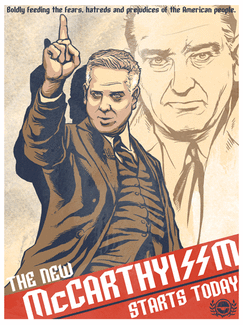
For those old enough to have lived through the McCarthy era, there is a whiff of something in the air that reeks of the heightened paranoia, finger-pointing, fear-mongering, totalitarian tactics that were hallmarks of the 1950s.

Back then, it was the government—spearheaded by Senator Joseph McCarthy and the House Un-American Activities Committee—working in tandem with private corporations and individuals to blacklist Americans suspected of being communist sympathizers.

By the time the witch hunts carried out by federal and state investigative agencies drew to a close, thousands of individuals (the vast majority of them innocent any crime whatsoever) had been accused of communist ties, investigated, subpoenaed and blacklisted. Regarded as bad risks, the accused were blacklisted, and struggled to secure employment. The witch hunt ruined careers, resulting in suicides, and tightened immigration to exclude alleged subversives.

Seventy years later, the vitriol, fear-mongering and knee-jerk intolerance associated with McCarthy’s tactics are once again being deployed in a free-for-all attack by those on both the political Left and Right against anyone who, in daring to think for themselves, subscribes to ideas or beliefs that run counter to the government’s or mainstream thought.

It doesn’t even seem to matter what the issue is anymore (racism, Confederate monuments, Donald Trump, COVID-19, etc.): modern-day activists are busily tearing down monuments, demonizing historic figures, boycotting corporations for perceived political transgressions, and using their bully pulpit to terrorize the rest of the country into kowtowing to their demands.

All the while, the American police state continues to march inexorably forward.

This is how fascism, which silences all dissenting views, prevails.

The silence is becoming deafening.

After years of fighting in and out of the courts to keep their 87-year-old name, the NFL’s Washington Redskins have bowed to public pressure and will change their name and team logo to avoid causing offense. The new name, not yet announced, aims to honor both the military and Native Americans.

Eleanor Holmes Norton, a delegate to the House of Representatives who supports the name change, believes the team’s move “reflects the present climate of intolerance to names, statues, figments of our past that are racist in nature or otherwise imply racism [and] are no longer tolerated.”

Present climate of intolerance, indeed.

Yet it wasn’t a heightened racial conscience that caused the Redskins to change their brand. It was the money. The team caved after its corporate sponsors including FedEx, PepsiCo, Nike and Bank of America threatened to pull their funding.

So much for that U.S. Supreme Court victory preventing the government from censoring trademarked names it considers distasteful or scandalous.

Who needs a government censor when the American people are already doing such a great job at censoring themselves and each other, right?

Now there’s a push underway to boycott Goya Foods after its CEO, Robert Unanue, praised President Trump during a press conference to announce Goya’s donation of a million cans of Goya chickpeas and a million other food products to American food banks as part of the president’s Hispanic Prosperity Initiative.

Mind you, Unanue—whose grandfather emigrated to the U.S. from Spain—also praised the Obamas when they were in office, but that kind of equanimity doesn’t carry much weight in this climate of intolerance.

Not to be outdone, the censors are also taking aim at To Kill a Mockingbird, Harper Lee’s Pulitzer Prize-winning novel about Atticus Finch, a white lawyer in the Jim Crow South who defends a black man falsely accused of rape. Sixty years after its debut, the book remains a powerful testament to moral courage in the face of racial bigotry and systemic injustice, told from the point of view of a child growing up in the South, but that’s not enough for the censors. They want to axe the book—along with The Adventures of Huckleberry Finn—from school reading curriculums because of the presence of racial slurs that could make students feel “humiliated or marginalized.”

Never mind that the N-word makes a regular appearance in hip-hop songs. The prevailing attitude seems to be that it’s okay to use the N-word as long as the person saying the word is not white. Rapper Kendrick Lamar “would like white America to let black people exclusively have the word.”

Talk about a double standard.

This is also the overlooked part of how oppression becomes systemic: it comes about as a result of a combined effort between the populace, the corporations and the government.

McCarthyism worked the same way.

What started with Joseph McCarthy’s headline-grabbing scare tactics in the 1950s about Communist infiltrators of American society snowballed into a devastating witch hunt once corporations and the American people caught the fever.

McCarthyism was a contagion, like the plague, spreading like wildfire among people too fearful or weak or gullible or paranoid or greedy or ambitious to denounce it for what it was: an opportunistic scare tactic engineered to make the government more powerful.

McCarthy, a young Republican senator, grasped the opportunity to make a name for himself by capitalizing on the Cold War paranoia of the time. In a speech in February 1950, McCarthy claimed to have a list of over 200 members of the Communist Party “working and shaping the policy of the U.S. State Department.” The speech was picked up by the Associated Press, without substantiating the facts, and within a few days the hysteria began.

McCarthy specialized in sensational and unsubstantiated accusations about Communist infiltration of the American government, particularly the State Department. He also targeted well-known Hollywood actors and directors, trade unionists and teachers. Many others were brought before the inquisitional House Committee on Un-American Activities for questioning.

“McCarthyism” eventually smeared all the accused with the same broad brush, whether the evidence was good, bad or nonexistent.

The parallels to the present movement cannot be understated.

Even now, with modern-day McCarthyism sweeping the nation and America’s own history being blacklisted, I have to wonder what this sudden outrage and crisis of conscience is really all about.

Certainly, anyone who believes that the injustices, cruelties and vicious callousness of the U.S. government are unique to the Trump Administration has not been paying attention.

No matter what the team colors might be at any given moment, the playbook remains the same. The leopard has not changed its spots.

Scrape off the surface layers and you will find that the American police state that is continuing to wreak havoc on the rights of the people under the Trump Administration is the same police state that wreaked havoc on the rights of the people under every previous administration.

So please spare me the media hysterics and the outrage and the hypocritical double standards of those whose moral conscience appears to be largely dictated by their political loyalties.

While we squabble over which side is winning this losing battle, a tsunami approaches.

While the populace wages war over past injustices, injustice in the here and now continues to trample innocent lives underfoot. Certainly, little of significance is being done to stem the tide of institutional racism that has resulted in disproportionate numbers of black Americans who continue to be stopped, frisked, shot at, arrested and jailed.

I’ve had enough of the short- and long-term amnesia that allows political sycophants to conveniently forget the duplicity, complicity and mendacity of their own party while casting blame on everyone else.

When you drill right down to the core of things, the policies of a Trump Administration have been no different from an Obama Administration or a Bush Administration, at least not where it really counts.

In other words, Democrats by any other name have been Republicans, and vice versa.

War has continued. Surveillance has continued. Drone killings have continued. Police shootings have continued. Highway robbery meted out by government officials has continued. Corrupt government has continued. Profit-driven prisons have continued. Censorship and persecution of anyone who criticizes the government have continued. The militarization of the police has continued. The devastating SWAT team raids have continued. The government’s efforts to label dissidents as extremists and terrorists has continued.

The more things change, the more they have stayed the same.

We’ve been stuck in this political Groundhog’s Day for so long that minor deviations appear to be major developments while obscuring the fact that we’re stuck on repeat, unable to see the forest for the trees.

This is what is referred to as creeping normality, or a death by a thousand cuts.

It’s a concept invoked by Pulitzer Prize-winning scientist Jared Diamond to describe how major changes, if implemented slowly in small stages over time, can be accepted as normal without the shock and resistance that might greet a sudden upheaval.

Diamond’s concerns related to Easter Island’s now-vanished civilization and the societal decline and environmental degradation that contributed to it, but it’s a powerful analogy for the steady erosion of our freedoms and decline of our country right under our noses.

As Diamond explains, “In just a few centuries, the people of Easter Island wiped out their forest, drove their plants and animals to extinction, and saw their complex society spiral into chaos and cannibalism… Why didn’t they look around, realize what they were doing, and stop before it was too late? What were they thinking when they cut down the last palm tree?”

His answer: “I suspect that the disaster happened not with a bang but with a whimper.”

Much like America’s own colonists, Easter Island’s early colonists discovered a new world—“a pristine paradise”—teeming with life. Yet almost 2000 years after its first settlers arrived, Easter Island was reduced to a barren graveyard by a populace so focused on their immediate needs that they failed to preserve paradise for future generations.

The same could be said of the America today: it, too, is being reduced to a barren graveyard by a populace so focused on their immediate needs that they are failing to preserve freedom for future generations.

In Easter Island’s case, as Diamond speculates:

The forest…vanished slowly, over decades. Perhaps war interrupted the moving teams; perhaps by the time the carvers had finished their work, the last rope snapped. In the meantime, any islander who tried to warn about the dangers of progressive deforestation would have been overridden by vested interests of carvers, bureaucrats, and chiefs, whose jobs depended on continued deforestation… The changes in forest cover from year to year would have been hard to detect… Only older people, recollecting their childhoods decades earlier, could have recognized a difference. Gradually trees became fewer, smaller, and less important. By the time the last fruit-bearing adult palm tree was cut, palms had long since ceased to be of economic significance. That left only smaller and smaller palm saplings to clear each year, along with other bushes and treelets. No one would have noticed the felling of the last small palm.

Sound painfully familiar yet?

We’ve already torn down the rich forest of liberties established by our founders. It has vanished slowly, over the decades. Those who warned against the dangers posed by too many laws, invasive surveillance, militarized police, SWAT team raids and the like have been silenced and ignored. They stopped teaching about freedom in the schools. Few Americans know their history. And even fewer seem to care that their fellow Americans are being jailed, muzzled, shot, tasered, and treated as if they have no rights at all.

The erosion of our freedoms happened so incrementally, no one seemed to notice. Only the older generations, remembering what true freedom was like, recognized the difference. Gradually, the freedoms enjoyed by the citizenry became fewer, smaller and less important. By the time the last freedom falls, no one will know the difference.

This is how tyranny rises and freedom falls: with a thousand cuts, each one justified or ignored or shrugged over as inconsequential enough by itself to bother, but they add up.

Each cut, each attempt to undermine our freedoms, each loss of some critical right—to think freely, to assemble, to speak without fear of being shamed or censored, to raise our children as we see fit, to worship or not worship as our conscience dictates, to eat what we want and love who we want, to live as we want—they add up to an immeasurable failure on the part of each and every one of us to stop the descent down that slippery slope.

We are on that downward slope now.

The contagion of fear that McCarthy helped spread with the help of government agencies, corporations and the power elite is still poisoning the well, whitewashing our history, turning citizen against citizen, and stripping us of our rights.

What we desperately need is the kind of resolve embodied by Edward R. Murrow, the most-respected newsman of his day.

On March 9, 1954, Murrow dared to speak truth to power about the damage McCarthy was inflicting on the American people. His message remains a timely warning for our age.

We will not walk in fear, one of another. We will not be driven by fear into an age of unreason, if we dig deep in our history and our doctrine; and remember that we are not descended from fearful men. Not from men who feared to write, to speak, to associate, and to defend causes that were for the moment unpopular. This is no time for men who oppose Senator McCarthy’s methods to keep silent, or for those who approve. We can deny our heritage and our history, but we cannot escape responsibility for the result. There is no way for a citizen of a republic to abdicate his responsibilities. As a nation we have come into our full inheritance at a tender age. We proclaim ourselves, as indeed we are, the defenders of freedom, wherever it continues to exist in the world, but we cannot defend freedom abroad by deserting it at home. The actions of the junior Senator from Wisconsin have caused alarm and dismay amongst our allies abroad, and given considerable comfort to our enemies. And whose fault is that? Not really his. He didn’t create this situation of fear; he merely exploited it—and rather successfully. Cassius was right. ”The fault, dear Brutus, is not in our stars, but in ourselves.”

America is approaching another reckoning right now, one that will pit our commitment to freedom principles against a level of fear-mongering that is being used to wreak havoc on everything in its path.

The outcome rests, as always, with “we the people.” As Murrow said to his staff before the historic March 9 broadcast: “No one can terrorize a whole nation, unless we are all his accomplices.”

Take heed, America.

As I make clear in my book Battlefield America: The War on the American People, this may be your last warning.