Gates Foundation’s Seed Agenda in Africa ‘Another Form of Colonialism,’ Warns Protesters

Screen-Shot-2015-03-24-at-8.27.09-AM

‘This neoliberal agenda of deregulation and privatization poses a serious threat to food sovereignty and the ability of food producers and consumers to define their own food systems and policies,’ says campaigners

By Lauren McCauley

Source: CommonDreams.org

Food sovereignty activists are shining a light on a closed-door meeting between the Bill and Melinda Gates Foundation (BMGF) and the United States Agency for International Development (USAID), which are meeting in London on Monday with representatives of the biotechnology industry to discuss how to privatize the seed and agricultural markets of Africa.

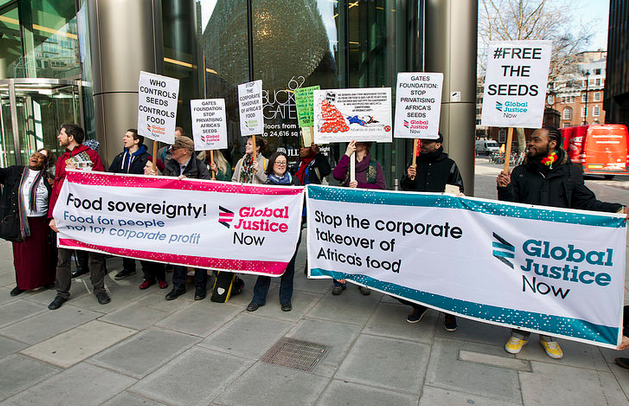
Early Monday, protesters picketed outside the Gates Foundation’s London offices holding signs that called on the foundation to “free the seeds.” Some demonstrators handed out packets of open-pollinated seeds, which served as symbol of the “alternative to the corporate model promoted by USAID and BMGF.” Others smashed a piñata, which they said represented the “commercial control of seed systems;” thousands of the seeds which filled the pinata spilled across the office steps. A similar protest is expected later Monday in Seattle, Washington, where BMGF is headquartered.

The meeting was convened to discuss a report put forth by Monitor-Deloitte, which was commissioned by BMGF and USAID to develop models for the commercialization of seed production in Africa, especially “early generation seed,” and to identify ways in which the African governmental sectors could facilitate private involvement in African seed systems. The study was conducted in Ethiopia, Ghana, Nigeria, Tanzania and Zambia on maize, rice, sorghum, cowpea, common beans, cassava and sweet potato.

However, food sovereignty activists are sounding the alarm over the secret meeting. Heidi Chow, food sovereignty campaigner with Global Justice Now, which organized Monday’s protest, warned that the agenda being promoted by these stakeholders will only increase corporate control over seeds.

“This is not ‘aid’ – it’s another form of colonialism,” said Chow. “We need to ensure that the control of seeds and other agricultural resources stay firmly in the hands of small farmers who feed the majority of the population in Africa, rather than allowing big agribusiness to dominate even more aspects of the food system.”

In a blog post, Chow further explained:

For generations, small farmers have been able to save and swap seeds. This vital practice enables farmers to keep a wide range of seeds which helps maintain biodiversity and helps them to adapt to climate change and protect from plant disease. However, this system of seed saving is under threat by corporations who want to take more control over seeds. Big seed companies are keen to grow their market share of commercial seeds in Africa and alongside philanthropic organizations like the Gates Foundation and aid donors, they are discussing new ways to increase their market penetration of commercial seeds and displacing farmers own seed systems.

Corporate-produced hybrid seeds often produce higher yields when first planted, but the second generation seeds will produce low yields and unpredictable crop traits, making them unsuitable for saving and storing. This means that instead of saving seeds from their own crops, farmers who use hybrid seeds become completely dependent on the seed companies that sell them.

Further, many of the seeds produced by these biotechnology giants are sold alongside chemical fertilizer and pesticides, manufactured by the very same companies, the use of which often leads to widespread environmental destruction and other health problems.

As others noted, while the meeting attendees included representatives from the World Bank and Syngenta, the world’s third biggest seed and biotechnology company, no farmers or farming organizations were represented at the talks.

“Seeds are vital for our food system and our small farmers have always been able to save and swap seeds freely,” Ali-Masmadi Jehu-Appiah, chair of Food Sovereignty Ghana, said in a press statement. “Now our seed systems are increasingly under threat by corporations who are looking to take more control over seeds in their pursuit of profit. This meeting will push this corporate agenda to hand more control away from our small farmers and into the hands of big seed companies.”

Reporting on the Monitor-Deloitte study, Ian Fitzpatrick, a food sovereignty researcher for Global Justice Now, said that documents circulated ahead of the meeting revealed a neo-liberal agenda “laid bare.”

Fitzpatrick writes:

The report recommends that in countries where demand for patented seeds is weaker (i.e. where farmers are using their own seed saving networks), public-private partnerships should be developed so that private companies are protected from ‘investment risk’. It also recommends that that NGOs and aid donors should encourage governments to introduce intellectual property rights for seed breeders and help to persuade farmers to buy commercial, patented seeds rather than relying on their own traditional varieties.

Finally, in line with the broader neoliberal agenda of agribusiness companies across the world, the report suggests that governments should remove regulations (like export restrictions) so that the seed sector is opened up to the global market.

“This neoliberal agenda of deregulation and privatization, currently promoted in almost every sphere of human activity—from food production to health and education—poses a serious threat to food sovereignty and the ability of food producers and consumers to define their own food systems and policies,” Fitzpatrick adds.

AGRA Watch, a program of the grassroots group Community Alliance for Global Justice, notes that the BMGF-USAID commercial seed agenda further “extends U.S. foreign policy into Africa on behalf of corporate interests.”

Phil Bereano, food sovereignty campaigner with AGRA Watch and an Emeritus Professor at the University of Washington added: “This is an extension of what the Gates Foundation has been doing for several years—working with the US government and agribusiness giants like Monsanto to corporatize Africa’s genetic riches for the benefit of outsiders. Don’t Bill and Melinda realize that such colonialism is no longer in fashion? It’s time to support African farmers’ self-determination.”

5 Things Busy People Can Do to Fight the Rising Control System

maxresdefault

By Bernie Suarez

Source: Truth and Art TV

Want to implement small-scale, realistic tasks in your own life to strike back at the control system? Have you been seeing the daily headlines, the lies, the deceit and the global enslavement agenda in full swing and feeling that you aren’t doing enough to fight back because of your busy schedule? Feeling helpless and overwhelmed by the idea that a small group of psychopaths at the very top would push for a global order that involves their full enjoyment of life while you and the rest of humanity live as miserable slaves forever? Don’t have time to be a full-time activist, be involved in marches, or downright challenge the court system? Wondering what small things you can do to fight back as you deal with the hustle and bustle of your own life working to pay bills, obtain an education, or raising children?

Here are five subtle actions you can incorporate into your busy schedule to start pushing back and start making a difference. If you think any of these simple steps is too difficult then give yourself time to adapt. Work on weaning yourself off of your usual habits and slowly changing the hard-to-break habits keeping you from maximally fighting back while continuing your busy life.

1- Turn off your TV and shut off mindless entertainment

This is for some people a difficult thing to do so for those people it may be more realistic to wean down how much entertainment and TV you absorb. A key to this commitment is realizing that TV watching is a medical-physiological issue. Realize that when you watch TV there is a real physical reaction going on in your brain and that addiction to TV and entertainment (like gambling and alcohol) is one problem among many others associated with TV watching.

When someone is an addict they are taught that overcoming denial is a big part of the recovery process and you can’t recover if you deny that you have a problem to begin with. Likewise being addicted to TV and entertainment must not be underestimated as just another incidental habit. It is a real addiction and TV flicker rates have a lot to do with it. I recall for year I watched TV and during that time of my life whenever I was in a room without TV it felt very uncomfortable. I couldn’t understand why it felt so uncomfortable but I knew it was. I now realize that was because there is a physiological addiction involved in TV watching.

As you can imagine, successfully committing to watching less or no TV while living a busy life will free up a lot of time which can then be used for doing creative things, improving relationships, starting a group, picking up a book, doing research, and a lot of other pro-active things you thought you didn’t have time for.

2- Optimize your online privacy

Another subtle thing you can do to strike back at the control system while managing a busy schedule is to learn a few things about online privacy. Start cleaning up your computer and unplugging some of the links put in place for private corporations and even government to potentially spy on you. Learn about what an IP address is. Realize that an IP address can be used to track where you are. Go to your browser and type in the address ‘myipaddress.com’ and this website will read back to you your own IP address.

Become familiar with this concept then become familiar with the concept of ‘Proxy Servers’ and Tor browsers. Do some basic research on the issue and decide for yourself if you want to occasionally (or always) go online using a privacy optimized server. This may not be for everyone but at least be familiar with what it is in case you want or feel you need to use one some day. A proxy server or Tor browser will allow you to browse online without your IP address being traced or tracked.

Also, here’s something you should be doing every day. Depending on which browser you are using, become familiar on how to delete cookies from you computer. Cookies are like tiny robot programs installed on your computer by sites you visit. These robots are installed without your permission and are used to track you. For many browsers (Firefox, Google Chrome) it will be under ‘privacy’ options and/or ‘clear browsing data’. Then look for a link or option for deleting cookies. As I said, know that these cookies are installed on your private computer every single time you go a website. Get in the habit of clearing these cookies unless you want every site you visit to also know what other sites you are visiting. By using cookies many corporations are able to monitor your shopping habits and many other things about you. They rely on the fact that you don’t know how to clear your cookies or perhaps are too lazy to delete them every time you go online. Why not become familiar with cookies and what they do? Still not sure? Just do an online search for “how to clear cookies” then specify the browser you are using.

The point is to start doing little things that will make surveillance more difficult and to educate yourself about some small things that add up and can make a difference later on.

3- Use technology strategically

This topic in some ways is a continuation of the online privacy. Start doing small things to make the police surveillance state a bit more difficult for them to carry out. Be smart about how you use your smart phone. If possible, consider reverting back to a not-so-smart phone. If your phone company allows you to use an older phone it’s something you MAY want to consider.

Remember the time when we all bought small cameras to take pictures and we purchased video cameras to make videos? Why can’t we go back to using individual electronics again? Why do we need to use our phones for everything we do? Why have we become conditioned to living our entire lives using our phones? Have you considered this may have been planned to help enslave humanity? Studies now show smart phones are proven to have a negative impact on human relationships making people more selfish, more easily distracted and more stressed out among other things.

Furthermore, have you read the ‘Terms and Conditions‘ of the license agreements you agree to every time you download a cell phone (or any) app? Do you realize that for many of these redundant and often useless apps you sign away your privacy? Read the agreements very carefully, that is exactly what you are doing almost every time you download a cell phone app. Is this lifestyle really necessary? No it isn’t, and it’s one of the small things you can do to fight back. Take back your privacy and commit to a smart life instead of a smart phone.

Also, you can stop taking “selfies” and broadcasting your image all over your own cell phone. Realize the control system has mastered the facial recognition technology and these self produced images only help the opposition keep track of your facial features and what you look like recently, information that can be added to whatever information the system may already have about you. Remember every bit of content you pack your smart phone with can be legally stolen from your phone and given to anyone including law enforcement or even a fusion center that may have created a file for you without you knowing. Since the revelations of Edward Snowden we all know how NSA is violating the privacy of average Americans and although these measures may not entirely prevent NSA from doing what it does, at least you are doing something to fight back and you are making it more difficult for them to get your information. Imagine if everyone does their part to resist in some way how much harder it becomes for NSA.

Other things you can do is periodically change your contact information like your phone number(s), emails, and addresses. There is no law that says you can’t have multiple emails, addresses and phone numbers if for no other reason than to make yourself harder to track. Be creative instead of being predictable. It’s not about being paranoid it’s about smartly preparing for the worse case scenario, being a tiny bit smarter than the next person, being creative, and being vigilant about the world we now factually live in. Not all of these measures are for everyone but again, these are subtle things some of us can do while living a busy hectic life.

4- Be mindful where you spend your money

This is an issue that everyone can and should do something about. Each of us makes decisions every day about where we spend our money and who we give our money to. If you know a corporation is a part of the problem stop giving them your money. Is a decision like this not practical to implement immediately? Then decrease how much money you spend with that store. Here are a few other suggestions:

Buy only what you need. Resist mindless advertisements that try to get you to spend money on things you don’t need. Realize that like TV, shopping is another subtle addiction that you may need to break. Break away from the habit of going shopping as a form of entertainment and instead practice saving and smartly investing your money.

So where should you spend your money? Support alternative media with donations and online purchases. Support organizations and stores that share your values. Identify those entities that support the freedom and liberty we all wish to see come to fruition and then support those platforms. Invest in your own health and survival. Instead of spending money on things you don’t need buy things that empower you and your ability to survive free from government. Do your part to buy smartly, and if everyone does this we can greatly contribute to a shift in paradigm even as we live our busy lives.

5- Don’t give government a reason to arrest or fine you

Finally, regardless of what you do, know that government (City, State and Federal) needs your money badly and they pay a lot of people to look for reasons to take your money (or your freedom which is worth money to them) away from you. We’ve all seen the big city parking police scouring neighborhoods looking for any car parked in front of a meter that is one minute over the limit. We’ve seen throughout the U.S. how police often set up hidden speed traps so they can pull you over for a speeding ticket. Realize that police are rewarded for giving out tickets and the cities have quotas for tickets. The control system NEEDS your money or your freedom to fund its very own control over you. This is why they set up traffic light cameras, create stringent rules and DUI checkpoints throughout the city in hopes of catching violators. Realize this and stay focused every day being careful to not give the control system an excuse to transfer any of your hard earned money into their pockets. Do what you can to not be arrested, not get a ticket and not be harassed for money by the control system.

If none of this works, if you end up with tickets or arrested, or if you simply want to become a more effective change agent while living a busy life then educate yourself about the legal system and how it is rigged against you. Take time on your off days to learn some of the basics of how the system tricks each and every one of us from the time of birth into consenting to be ruled, robbed and controlled. Again, some may feel they don’t have time to learn about the legal system but, like learning about online privacy, learning how to legally take control of your own life is a priceless piece of knowledge to obtain in your spare time.

So there it is. All of these things can be done by someone caught up in a busy hectic lifestyle. All of us have spare time, some of us have more spare time than others. Ultimately, you choose your road and what kind of life you want to live. These ideas are for those you really care and really want to make a difference but realize that time is precious. Go ahead, start making your list and put some of things into action. Don’t worry about not being able to do all of this, just start somewhere. This is a guideline not a set of rules. Peace and love.

Colluders in Crude: The Oily Politics of How the Obama Administration Sided with BP Over the American People

gulf-oil-spill17

By Stuart H. Smith

Source: WhoWhatWhy

The explosion and sinking of the Deepwater Horizon oil rig on April 21, 2010,  was the largest accidental marine oil spill in the history of the petroleum industry. The resulting devastation to human health and the environment continues to this day. A new Florida State University study, published on Jan. 20 in the journal Environmental Science & Technology, reports that up to 10 million gallons of crude oil “missing” from the spill settled at the bottom of the Gulf of Mexico, imperiling wildlife and marine ecosystems.

Stuart H. Smith, an environmental plaintiff attorney who served as lead counsel on more than 100 oil pollution cases and has won major litigation against oil giants Chevron and ExxonMobil, came to represent thousands of claimants against BP. He saw from the inside how BP and the American government really responded to the crisis. This article is adapted from his book, Crude Justice: How I Fought Big Oil and Won, and What You Should Know about the New Environmental Attack on America (BenBella Books, 2015). 

I am a first-hand witness to the Obama administration’s complicity in putting the interests of a foreign company above and beyond the health and safety of American workers.

The tragedy began on April 21, 2010, with the explosion and fire on British Petroleum’s Deepwater Horizon oil rig in the Gulf of Mexico off the Louisiana coast. It killed 11 workers and caused a leak that would ultimately spew nearly five million barrels of oil into the Gulf.

Denying Workers Protective Gear

BP hired workers to clean up the spill, but no one was publicly addressing what the prolonged exposure to oil—which is laden with carcinogens such as benzene—might do to them. There was little talk about the threat of volatile organic compounds (VOCs) in the air along the Gulf Coast, even for workers traveling to the edge of the spill in boats and removing oil from the beaches. Cleanup crews were attaching oil-catching booms to their shrimp boats and driving their boats directly through the oil slicks to corral and collect the oil spilling from BP’s broken well—and largely tackling their jobs without serious protective gear, because BP had not supplied it.

“BP knew that providing protective equipment would be an admission that the oil exposure was dangerous and sought to avoid that at all costs,” says Marylee Orr, the founder and longtime executive director of the Louisiana Environmental Action Network (LEAN), a leading environmental group in the state.

It wasn’t long before the fishermen began reporting headaches, vomiting, nausea, dizziness, and chest pains.

In early June, two key Democratic members of Congress—Minnesota Representative James Oberstar, then-chairman of the House Transportation and Infrastructure Committee, and New York Representative Jerrold Nadler, a senior committee member—sent a letter to the EPA and the Department of Labor demanding that Gulf workers be provided with “proper protective equipment, including respirators.”

Incredibly, the Obama administration said “no.”

David Michaels, assistant secretary in the Labor Department, who oversaw the Occupational Safety and Health Administration, told the Wall Street Journal that their tests showed “minimal” risk from exposure to airborne toxins—despite the fact that EPA’s air monitors along the Gulf Coast were picking up substantial airborne VOC readings from the spill, and despite scores of alarming medical reports from cleanup workers.

Protecting BP Stockholders

Around the same time, President Barack Obama was on the phone to the British prime minister. David Cameron was in a tizzy because so many English pensioners had their retirement money tied up in BP stock.

“The president made clear that he had no interest in undermining BP’s value,” Cameron’s office announced after the phone call.

Indeed, on June 16, 2010—one month before the leaking well had been capped and the full extent of the damage could be investigated—the White House announced an unprecedented deal with BP in which the oil company would finance a relief fund of up to $20 billion.

This escrow fund was good politics—$20 billion sounded impressive to the average voter—but would prove to be music to the ears of BP’s board. Historically, such escrow funds had been effective means for companies to limit their liability. They were tools for persuading vulnerable people in desperate need to sign away their legal rights to recover full compensation for the damages they’d suffered.

Sure enough, just before Christmas 2010, Kenneth Feinberg, who’d been appointed to oversee the fund, made a blatant attempt to boost the number of cases the fund could say were “settled” by offering the spill’s victims one-time bonus payments of $5,000 for individuals and $25,000 for businesses, contingent upon his settlement terms.

In fact, the $20 billion fund had set a preliminary target for damage claims that would turn out to be tens of billions of dollars less than the actual damages. Moreover, the agreement allowed BP to secure the fund using future productions from its leases in the Gulf of Mexico as collateral, exempting all of BP’s holdings elsewhere.  This locked the federal government into a partnership with BP, forcing it to continue to allow its offshore drilling in the Gulf to pay back the claims.

Hiding the Oil, Spreading the Toxins

In the early days of the spill, BP began unleashing gallons of a toxic chemical called Corexit.  Corexit was able to get rid of the thick black oily plumes on the water’s surface that had been visible for miles across the Gulf and were becoming such a public relations disaster on the nightly TV news.

But Corexit wasn’t solving the oil problem, only the PR problem.  Corexit was merely hiding the oil and spreading toxins over a larger area. This created even greater risks for the cleanup workers—risks they had not been trained to deal with.

Weeks after the spill, LEAN’s Marylee Orr pressed for admission to the main command centers, to which her NGO was supposed to have access. Eventually she and other Gulf environmental activists got a private meeting with a top federal official—EPA administrator and Louisiana native Lisa Jackson. They argued that the feds needed to force BP to stop spraying Corexit in the Gulf and produced evidence that Corexit was merely masking the oil and dispersing toxins over a bigger area.

(Hugh Kaufman, longtime EPA employee and whistleblower, said government officials were well aware of the hazards of Corexit, telling an interviewer that “in the Exxon Valdez case, people who worked with dispersants, most of them are dead now.  The average death age is around 50.”)

At first it seemed like Jackson was listening to their plea. A short time later, in late May, the EPA and the Coast Guard issued a joint order to BP telling the company to “eliminate” surface spraying of Corexit—unless the firm got a waiver from the Coast Guard because of exceptional circumstances.

You can guess how that all played out. BP asked for and routinely got a waiver from the Coast Guard to spray Corexit—day after day, including nine days in a row immediately after Lisa Jackson’s “order,” and ultimately 74 times over 54 days. An estimated million gallons of the toxic dispersant were deployed in the Gulf after the government’s supposed command to eliminate much of its use.

Later, independent laboratory tests performed for me confirmed what the experts had feared about the Corexit spraying: dispersing the oil actually meant taking the toxic elements of the oil from the surface, where they were highly concentrated but weren’t harming marine life below, and spreading them deep into Gulf waters.  Our lab tests showed toxic pollution of water at levels 35 times higher than before the oil was dispersed.

Claiming “Gulf Seafood Is Safe”

Early on, the federal government’s public relations initiative was in full gear. On June 14—54 days into the crisis of the oil spill—President Obama came down to the Florida Panhandle and decreed that he was launching “a comprehensive, coordinated, and multiagency initiative” to make sure the catch from the Gulf waters was safe to eat.  “Now,” he said into the bank of cameras, “I had some of that seafood for lunch, and it was delicious….So let me be clear. Seafood from the Gulf today is safe to eat.  But we need to make sure that it stays that way.”

In essence, Obama was telling Americans to eat first and ask questions later.  But how could the president assure the public that seafood was safe to eat when, as he acknowledged, in-depth testing hadn’t yet even been carried out?”

At the Pentagon, a massive order for shrimp, crab cakes, and pre-packaged jambalaya was placed and sold at base commissaries around the world.  The executive chef at the White House bought and served more than 2,000 pounds of shrimp and other Gulf goodies at an array of holiday parties for Barack and Michelle Obama and their guests, commenting: “We at the White House are so happy to play our part in reminding Americans that Gulf seafood is not only safe but delicious.”

Around the Gulf, news accounts quoted fishermen who were reeling in red snapper with sores and lesions—some the size of a 50 cent piece—the likes of which they had never seen before.  Crab fishermen were reporting that their hauls had dropped by 70% and that the few crabs they did pull up suffered similar lesions and disease.  It made sense. Red snapper were bottom feeders—eating the shrimp and crabs that live on the sea floor—and independent scientists had already shown that oil from the leaking BP rig was coating the bottom of the Gulf.

Practicing Faulty and Deceptive Testing

In late 2010, the government stated that it had tested more than 10,000 seafood samples from the Gulf and found no evidence of problems. But the vast majority of those tests were what the National Oceanic and Atmospheric Administration called “sensory testing,” and what you and I might call a smell test. This test was hardly adequate for finding traces of hydrocarbons that are odorless, yet highly toxic.

Moreover, in conducting the smell tests, specimens that were clearly oiled in the spill or possibly diseased were tossed aside, skewing the lab results. When the seafood that would have produced the worst numbers was transferred to trash buckets, the polynuclear aromatic hydrocarbon numbers looked a lot better.

In addition, according to the government testing structure, the “safe” consumption level for a grown man is four shrimp a week.  Who the hell living on the Gulf of Mexico eats only four shrimp per week?

Conducting his own test analysis, Paul Orr, Marylee’s son and the unofficial river keeper for the lower Mississippi, gathered samples of shrimp, crab, and finfish from 20 different locations in the Gulf off the Louisiana and Mississippi coastlines. His results showed high levels of total petroleum hydrocarbons, including in seafood from areas that had been declared safe for fishing. Testing by other independent environmentalists showed high levels of cadmium, a long-lasting carcinogen.

Alleging “Swimming Is Safe”

The seafood shilling was just the beginning.

The government also issued reports that beaches were safe for swimming. President Obama dramatized this, allowing a photo of him swimming with his daughter—in an unimpacted bay, of course—along the Florida Panhandle coast.

The passage of time did not diminish the assault on the beaches.  Tropical Storm Lee washed tar balls and patches of asphalt-like gunk up and down the Gulf in 2011, as did Hurricane Isaac in the summer of 2012.  In 2013, more than three years after the BP catastrophe, a blob of oil from the Macondo field that was roughly half the size of a football field came ashore in Grand Terre Island off the coast of Louisiana.

Attempting to Bar Independent Testing

The U.S. government seemed to have two agendas—both of them bad.  One was siding with large commercial fishing operations in the Gulf, whose livelihood depended on public confidence in the safety of their catch, and not with the broader U.S. public of seafood consumers.  The other was to get the PR nightmare of BP out of the headlines.

Almost immediately after the spill, the FAA implemented a temporary flight restriction across the entire eastern Gulf of Mexico that continued for months.  They refused to let the media get anywhere close to the offshore slicks. The Coast Guard turned the entire zone over to private security goons hired by BP who would not let anyone near the spill to photograph and take samples. BP’s guards blocked many of the roads leading to oil-gunked beaches. Never before had America ceded its sovereign police power to a corporation, and a foreign one at that.

Key governmental agencies involved in the Gulf Coast recovery seemed to be working harder to prevent independent scientists from doing their own testing than they were in conducting their own rigorous studies.

As a Big Oil litigator, I knew that the fastest way to lose an environmental law case was to rely on industry or government data, which rarely painted the full picture. It was critical to perform your own testing using your own experts.  I’d never had an environmental case where the government was on the side of the victim.

***

To prove toxic exposure and resulting damages in the BP disaster, I hired Dr. William Sawyer, a top Florida-based research toxicologist with 30 years of experience, and Worcester Polytechnic civil engineer Marco Kaltofen, considered one of the top engineers in the field, who described himself as “specializing in when things go really bad.”

Marco and William decided that the best approach to overcoming the restricted access was simply to look and act like they belonged.  “We dressed the way the BP guys dressed,” Marco told me later.   “We had the story, we had the business cards and lab notebook and all the equipment.  And you just go out there and you mix it up.”

Soon the BP cleanup contractors were giving Marco and his coworker access to their refreshment tent.

“I got a Louisiana oysterman’s license,” Marco said. “I would get out to these sites and they would say, ‘I’m sorry—you can’t be collecting specimens out here.’  I’d say, ‘I got a Louisiana scientific collection permit,’ and I would get BP escorts when I produced this document.  It looked really official—it said I could collect oysters around this area….It had dates, stamps….”

From that, Marco collected a treasure trove of shellfish and marine life, as well as water, sand, and spilled oil.

Marco and William’s initial data showed alarming levels of toxic hydrocarbons, first in the Gulf water columns, and then in seafood. Even before they issued a formal report, they posted some of their raw data on the Internet.

That’s when they started receiving phone calls from staffers on the president’s commission investigating the oil spill.

“There was a grave concern as to why we were finding contamination,” William recalled, “and then the questions were geared toward whether we had sampling permits.”

Instead of expressing concern about the danger that might be posed to American consumers from eating oil-contaminated seafood, federal investigators were questioning whether Marco and William had permits to collect the samples.

It was only after a TV news crew investigated the calls and a New Orleans-area congressman called for a full-blown investigation that the Oil Spill Commission pulled a 180-degree turn.  One staffer even tried to explain that the calls to Marco and his associate had gone out because the commission had been impressed with their work.

Much later, our team learned about some of the intense pressure that was taking place behind the scenes.  At the same time that we were pressing for a more open investigation of environmental impact, in-fighting was ensuing between other independent scientists, who were finding equally troubling data, and government officials, who were finding ways to cover up the discoveries. The Reuters news agency learned that wildlife biologists who’d been hired by the National Marine Fisheries Service to document an “unusual marine event”—the dramatic rise in dolphin deaths—were told they couldn’t make their findings known because it was part of a law enforcement probe into the BP spill.

Denying Evidence

Mounting evidence revealed that oil-spill cleanup workers and other Gulf residents were suffering respiratory illnesses, skin rashes, and other more serious maladies.  But federal authorities insisted that the rise in such ailments was merely a coincidence. Donald Boesch, a member of Obama’s Oil Spill Commission, summed up their response: “We were charged with being evidence-driven, and the fact is, we’ve asked for and sought out evidence that the oil spill is the proximate cause of these health problems, and we just haven’t found it.”

But all Boesch had to do was walk into any of the doctors’ crowded waiting rooms and health clinics scattered across the Gulf region.

Dr. Michael Robichaux of Mathews, Louisiana, on the Gulf Coast, was among those examining the ailing cleanup workers and other coastal residents. At first the doctor was dubious that the ailments were linked to the workers’ and residents’ exposure to BP’s oil and Corexit. But after he began treating them, he converted and became an evangelist for their cause.  Of the 113 patients he treated who had been exposed to toxic pollution, he wrote that about 100 of them had severe chronic health effects, to the point that many were unable to work. “It appears that the interests of a large, foreign corporation have superseded the needs of thousands of Americans who reside along the coast of the Gulf of Mexico,” Dr. Robichaux told U.S. District Judge Carl Barbier.

Settlement Deals

In May 2012, BP announced that it had reached a settlement deal—estimated at the time to be worth $7.8 billion—with a circle of well-connected tort lawyers called the Plaintiffs Steering Committee on behalf of the Gulf Coast residents and small businesses.  Joining a handful of other lawyers, I appeared before Judge Barbier that September to object to the proposed deal.  How, we asked, could a proper price be fixed on the damage caused by BP when new oil kept coming ashore, as had happened when Hurricane Isaac hit the Gulf Coast just days before the courtroom arguments?  We also argued that the deal was woefully inadequate, both for those who had been made ill and for many coastal businesses.

We didn’t win that skirmish, but other penalties for the British oil giant are finally adding up. In early 2015, a federal judge was nearing a final ruling on civil penalties against BP under the federal Clean Water Act, which could reach some $13.7 billion.

To date, my firm has successfully handled claims against BP for about three quarters of our thousands of clients.  Hundreds of them remain, fighting for their fair share.

The extreme efforts of a Big Oil giant to avoid liability for its actions have been sadly familiar to me.  But the actions of the U.S. government to side with a huge multinational corporation against the health and safety of American workers are unconscionable.

Adapted from CRUDE JUSTICE:  How I Fought Big Oil and Won, And What You Should Know About the New Environmental Attack on America by Stuart H. Smith (BenBella Books, 2015). 

Never Before Has Our Approach to Drugs Improved So Much, So Fast

Hemp_for_victory_1942

We’re winning: More progress has been made toward enlightened drug policies and treatment in the past five years than in the previous 25. Here’s an advocacy agenda to take us even closer to the future we need.

By Maia Szalavitz

Source: Substance.com

There has never been a more exciting time to be writing and thinking about drugs and addiction. For most of the ‘80s through the ‘00s, policy and treatment debates were stagnant, with all sides taking hardened positions and often repeating the same tired talking points. But now change is in the air and those who would like to see reform have a chance to make a real difference. By looking at where we’ve come from, we can see where we need to go.

Until 2011 or 2012, the war on drugs, while much bemoaned, was simply a fact of life, with pretty much everyone agreeing both about its failure and, simultaneously, about the impossibility of doing anything significantly different because of the “tough on crime” arms race between the Republicans and Democrats.

The science didn’t matter: No one seemed to care that marijuana was objectively less harmful than alcohol or tobacco or that our drug laws originated both in the time of Jim Crow and, quite explicitly, as a way of oppressing people of color by other means. In fact, merely stating these facts, as I did many times, would often get me in trouble with editors who wanted to “balance” them with a prohibitionist claim to prove that the publication was “objective”! No one ever seemed to consider balance when a drug warrior made a demonstrably untrue statement.

It didn’t matter that the data on needle exchange was overwhelmingly in favor—and that no study had ever found that it encouraged drug use or prolonged addiction. A quote by someone who was ideologically opposed had to be obtained, even though they had no data to back their concerns about these programs to prevent infection with HIV and hepatitis C “sending the wrong message.”

The failure of drug enforcement either to prevent or to reduce “drug epidemics” and the ineffectiveness of incarceration at fighting addiction was irrelevant, too, even as the necessity of such punitive efforts was simply accepted without question.

Nor did it matter that harsh, confrontational treatment was known both to backfire and to be incredibly common—Dr. Drew, Intervention, Beyond Scared Straight and similar shows even portrayed it as exemplary.

At the same time, 12-step supporters were adamant that their way was the only way—or at least the best way. Drug warriors were convinced that criminalization of both possession and sales was the only way to avoid addiction Armageddon—and even many people in recovery bought into the idea that law enforcement must always play a role in policies related to illegal drugs.

In 2000, for instance, during the fight over California’s Proposition 36, which gives drug users three chances at treatment before jail becomes a sentencing option, the Betty Ford Center was among the opponents. Speaking for a coalition that included the rehab, actor and sobriety advocate Martin Sheen wrote in an op-ed, “Without accountability and consequences, drug abusers have little incentive to change their behavior or take treatment seriously.” (He didn’t explain how Betty Ford gets alcoholics, whose drug is legal, to comply with care.) But Prop 36 passed anyway, an early sign of the drug war’s waning hold.

And so, even when reforms would actually send patients to rehabs, treatment providers remained firmly aligned with drug warriors on the necessity of harsh criminalization, while they begged for crumbs of financing from the abundant table of law enforcement and argued that treatment is better than jail.

Now, though, the winds have shifted. Four states and Washington, DC, have legalized recreational use of marijuana. President Obama has directed the justice department not to interfere with these experiments and said last week, “My suspicion is that you are going to see other states start looking at this.” California, which rejected recreational legalization as recently as 2010, may pass it in an expected 2016 ballot initiative. National polls show majority support for legalization.

Neither Colorado nor Washington—the first two states to legalize—has seen anything near the predicted disaster in the first year after the passage of the law. In fact, in Colorado, crime is down, auto fatalities are down and teen use is stable or declining. (Because Washington took longer to implement its regime, good statistics aren’t yet available).

All of this is excellent news for reformers. So what should be next on the agenda? Here are a few things I’d like to see, which I think could build on the increased openness to more effective policy:

1. Over-the-counter naloxone

Naloxone, an opioid antagonist that can reverse opioid overdose, is now widely available to first responders and, through many harm reduction agencies, to friends and families of people at risk. No adverse effects have been reported; just more and more lives saved. The FDA should make naloxone available over the counter, and sales should be subsidized or prices capped to make it affordable. This safe, effective lifesaver should be in every first-aid kit.

2. Expand access to medication-assisted treatment

As I noted recently, it’s outrageous that any doctor who discovers that a patient has an opioid problem can’t simply prescribe the most effective treatment: maintenance with Suboxone or methadone. Federal limits on the number of patients a doctor can have on maintenance and laws that literally ghettoize methadone treatment should be repealed. Insurance limits on prescribing also should be challenged: These exist for no other medical condition.

3. Decriminalize personal possession of all drugs

Now that even once-staunch prohibitionists like Kevin Sabet no longer argue strongly for arrest and incarceration of those who possess marijuana, why does it still make sense for heroin, cocaine or other illegal drugs?

82% of all drug arrests are for possession, and half of these are for marijuana. According to the ACLU, the US spends $3.1 billion annually arresting and adjudicating marijuana possession cases, and at least as much is likely to be spent on the other half of possession arrests for all other drugs. And yet no data suggests that arresting drug users for possession fights addiction or reduces crime: In fact, addicted people often get worse due to incarceration, with very little treatment available in jail.

Moreover, Portugal’s 10-plus-year experience of complete decriminalization has found it to be associated with less crime, more treatment and less disease. What’s not to like? The World Health Organization recently came out in favor of decriminalization. Drug reformers should not make marijuana arrests the only focus of their abolition campaign. Arrests for use are expensive, harmful and ineffective: They need to stop.

5. Reform treatment

People with addiction and their loved ones are often shocked at what occurs in treatment: Evidence-based care is so hard to find that even leading addiction researcher and former deputy drug czar Tom McLellan didn’t know where to turn when his son needed help in 2009. Anne Fletcher’s Inside Rehab, David Sheff’s Clean and this 2012 report from the Center on Addiction and Substance Abuse all demonstrate the need for better accountability from treatment providers.

To start, private and public insurers should simply refuse to pay for treatment that is little more than indoctrination into 12-step groups, which can be had for free at many church basements. Instead, treatment time should be devoted to evidence-based therapies like motivational interviewing and cognitive behavioral therapy, which aren’t free—and provider reimbursement should be based on results, respectful and empathetic care and genuine fidelity to evidence-based therapies.

And this isn’t a change that only opponents of 12-step programs should favor. Even those who are helped by the steps know that such treatment clearly violates the Eighth Tradition, which states that AA should be “forever nonprofessional” and that the 12th-step work of trying to bring others into the program should be unpaid. Both 12-step groups and treatment will ultimately be better off disentangled.

5. Reframe addiction

As I’ve argued here before, addiction is better characterized as a learning or developmental disorder than as a brain disease. While those who support the brain disease concept see it as a way of reducing stigma, in actual fact, this idea can increase fear and hatred of addicts because the notion of “brain damage” suggests permanence and poor odds for recovery.

What addiction actually does in the brain is similar to what love does—it strongly wires in new memories and pushes us to seek certain experiences. This is not “damage” or “destruction.” When we understand addiction as one more type of neurodiversity—not always a disability, sometimes even a source of strength—we’ll really cut stigma.

Also, it’s impossible to fight stigma while the legal system enforces it: The whole point of criminalizing drug possession is to stigmatize it. Without changing both criminalization and the view of addiction as the only disease treated by prayer and repentance, stigma reduction won’t get very far.

There’s much more, of course, but these are areas where real progress can be made. Never before have I seen more openness in this area: Now people who used to blanch at the words “harm reduction” are singing its praises and those who were once horrified by needle exchange are calling for naloxone. We still have a long way to go—and there’s always the chance of backlash—but as Martin Luther King, Jr., put it, “The arc of the moral universe is long, but it bends towards justice.”

Maia Szalavitz is the nation’s leading neuroscience and addiction journalist, and a columnist at Substance.com. She has contributed to Time, The New York Times, Scientific American Mind, the Washington Post and many other publications. She has also published five books, including Help at Any Cost: How the Troubled-Teen Industry Cons Parents and Hurts Kids (Riverhead, 2006), and is currently finishing her sixth, Unbroken Brain, which examines why seeing addiction as a developmental or learning disorder can help us better understand, prevent and treat it. Her previous column for Substance.com was about how to treat people who need, but misuse, opiate painkillers in a more helpful and enlightened way.

6 Things You Should Know When Buying and Consuming Legal Marijuana

IMG_5168

Whether you haven’t toked since the 70’s, or you’re entirely new to the experience — here’s the starting place.

By Jeremy Daw

Source: Alternet

I distinctly remember the first time I bought weed. Nervous out of my mind, I dialed the beeper (this was 2003 in New York City – every step required discretion). Two minutes later, someone called me back. I gave them my address, then waited two hours (I didn’t yet have the experience necessary to appreciate how fast that was). Then I answered the knock on the door and opened up my home to a complete stranger who never gave his name. He opened up a briefcase full of five different strains, ranging, he explained, from $50 to $80 per eighth. “What’s an eighth?” I asked. He rolled his eyes. Noob.

Determined that the God-knows-how-many curious tourists flocking to Colorado to purchase legal cannabis today should never suffer the same indignities as I did over a decade ago, I present here the sum total of my experience as a pot smoker, distilled into 6 easy maxims. You can thank me later.

1. Stay on the grass.

New tokers, or anyone who hasn’t lit up since the 70’s, will likely find the dizzying array of pot products for sale at the package store a little confusing. BHO (butane hash oil), ice water, something called ‘shatter’ – the wide selection of products on offer stand testament to just how far the industry has come in 40 years. If you have no tolerance built up already, take my advice and steer well clear of all of these. Just the grass – dried flowers – by itself will be plenty potent enough to get you high, believe me. The main exceptions to this principle, however, are the edibles. Today’s edible products have evolved far beyond mere brownies; many chocolate infusers mold their products to break off easily into precisely measured ‘doses’, so the newbie who doesn’t want to irritate her throat can break off a small square and feel a moderate effect. Just be careful – sugar can trick your brain into thinking it needs more sugar, so you must stalwartly resist the urge to take that extra bite until you’ve given the first dose time to work – up to 1.5 hours for most people.

2. Vaping is healthier.

Another development which has taken the cannabis industry by storm lately is the proliferation of portable vaporizers. While the reliable Volcano still remains the equipment of choice for the home-bound aficionado, new portable models have opened up possibilities to take one’s vape on the go. These handy devices can drastically reduce any potentially harmful chemicals in marijuana smoke and can avoid irritating the throat (they still will make you cough, however, because of the expectorant properties of cannabinoids). But make sure you pair the right vape with the right product. Some are designed to handle ‘shake’ (dried flowers, ground up), some only work with hashish and some only work with the highest-grade extracts. Perhaps the best choice for the new marijuana user is the O.pen or similar model, because they come with pre-mixed extracts in glycerin, providing an experience familiar to anyone who has tried an e-cigarette. In any case, remember to take just 1-2 puffs at first, then wait at least five minutes to measure the effects before vaping again. It’s easy to get too high on this stuff.

3. Train your brain.

As strange as this may sound, everyone has to learn how to get high before they can experience it; this is why many marijuana newbies report feeling no effects the first time they smoke pot. Marijuana intoxication is unlike any other feeling in the world, and until your brain knows what to expect it can be difficult to get there. If, after taking a couple hits, you don’t feel any different, try this meditation to deepen the experience. First, relax; close your eyes. Listen to the sounds to your left. Listen to the sounds to your right. Pay attention to how your body feels – is there tightness anywhere? If so, don’t judge – just breathe into the parts of your body which hold the tension, and allow your breath to exhale out. Let go of all judgmental thoughts, all questions of “am I doing it right?” Just float downstream instead.

After a few minutes of mindful breathing, don’t be surprised to suddenly feel noticeably different. Your body may feel lighter; colors may appear more fascinating. Music will open up with more depth than you have ever felt before. And pretty soon, you may start to feel pretty hungry.

4. Come down with CBD.

There are many wonderful reasons why marijuana intoxication is more pleasant than, say, alcohol (no hangover, for one). Even so, the experience isn’t enjoyable for everyone. If you find yourself feeling paranoid, anxious or nauseous – first of all, relax. Remind yourself that no one in history has ever had a fatal overdose of marijuana, and that everything will pass. Breathe deeply.

Just in case that isn’t enough, make sure to keep some special marijuana handy, called “high-CBD.” Such bud is so called because it contains unusually high levels of cannabidiol, or CBD for short, a non-psychoactive cannabinoid which has been shown to mitigate the effects of THC. Many first-time users who found they accidentally took too much have found relief by smoking (or vaping) a few hits of high-CBD bud; within minutes, the CBD will “bring them back down.” If you’re new to cannabis, or you haven’t ever had anything truly high-grade, asking your vendor for a gram of high-CBD bud can be a good idea, just in case.

5. Savor the flavors.

For everyone who has never tried it, or anyone who has relied on the same bud from the same dealer for years, the myriad diversity of scents and flavors on selection in Denver will be a revelation. Some taste like pine; others, mango; still others, lavender. Take the time to sample the scents on offer before making your selection.

When you’re ready to consume, use practices which preserve the flavor. Vape, if possible; the low-temp sublimation process preserves the maximum amount of terpenes – the organic chemicals which provide the pot’s flavors. If you’re smoking instead, use a hemp wick. These beeswax-coated twines are wound with hemp fiber, so they neither add to nor take away from the bud’s exotic flavors. Lighters cover up too much with the taste of butane.

6. Get a grinder.

Regardless of whether you’re rolling joints, packing bowls or loading vapes, a good grinder makes everything easier. Even many experienced tokers often forget to grind up their cannabis before consuming; stuffing whole nugs in pipes can lead to a frustrating experience. But when the bud is ground up ahead of time, it allows smooth airflow which in turn leads to smoother, more flavorful hits.

This is not an exhaustive list, but it will get you started. Apply these principles, and the new year will bring more than just new laws – it will also deliver a healthier way to recreationally relax.


Jeremy Daw is the editor of TheLeafOnline.com and Cannabis Now Magazine, and the author of Weed the People: From Founding Fiber to Forbidden Fruit (2012).

5 Myths About Marijuana–Debunked

ReeferMadnessPoster

The more research is released, the more legalization makes sense.

By Owen Poindexter

Source: Alternet

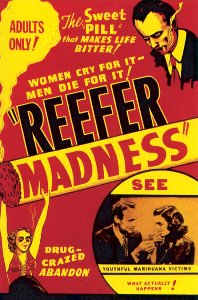
Back in the 1930s, the arguments to criminalize cannabis were bizarre and openly racist. The anti-pot crusader Harry Anslinger made all sorts of over-the-top claims, such as, “Marihuana is a short cut to the insane asylum. Smoke marihuana cigarettes for a month and what was once your brain will be nothing but a storehouse of horrid specters.”

Nowadays more than 100 million Americans say they’ve smoke pot, millions use cannabis regularly to treat illnesses and it is as legal as alcohol in two U.S. states. However, it remains illegal under federal law largely due to scare tactics ingrained in our society, which date back even prior to Anslinger.

Today, pot legalization opponents try a little harder to sound reasonable, but their claims don’t do much better than Anslinger’s under scrutiny. Recent studies have picked apart the justifications for criminalizing marijuana. Here are five of the most popular arguments against cannabis legalization that are easily undermined by objective data.

1. Pot leads to crime. If alcohol prohibition taught us anything it’s that prohibition itself leads to crime, not what is prohibited. While cannabis has shaken the psychotic Reefer Madness reputation over the years, the association between weed and crime is still alive and well in certain realms of the media, which are happy to present data without appropriate statistical caveats.

As for the studies that carefully and objectively examine their data, they find no association between cannabis and crime. A recent study in the journal PLOS One found that in states that legalized medical marijuana between 1990 and 2006 the crime rate either remained the same or decreased.

Another study looked at the Lambeth borough of London, which depenalized cannabis for 13 months in 2001-2002. The study found that this actually reduced other types of crime, because Lambeth police could focus their energy elsewhere.

These results fit with common sense. Cannabis has a range of effects on mood and behavior, but they don’t include violence, impulsivity or other traits that would turn otherwise law-abiding citizens into criminals.

2. The gateway theory. The gateway theory has long been the stock response of marijuana opponents to the notion that cannabis itself isn’t that bad for you. They falsely claim it leads to harder stuff, and insist that what starts with a joint ends with a heroin needle.

While it’s true that most users of hard drugs used marijuana and alcohol first, that doesn’t prove that cannabis use leads to harder drugs. Correlation does not equal causality—most heroin users have worn jeans at some point in their lives, but it’s unlikely that one leads to another.

But is it at least plausible that cannabis use creates a bridge to experimenting with more dangerous chemicals? The research says no.

A RAND Institute study using data collected from 1982-1994 found that drug use patterns in American youths can be explained without resorting to a gateway effect. People who are interested in mind-altering substances are likely to have tried pot, as it is the most popular and available illicit drug. This and other circumstantial factors related to drug availability and how old someone was when they first used cannabis were sufficient to explain drug use patterns. Since then, numerous peer-reviewed studies have been published, supporting RAND’s basic conclusions.

Holland provides a good natural experiment in the effects of cannabis use, as marijuana has been legal there for citizens since 1976. A RAND Corporation study from 2011, titled What Can We Learn From The Dutch Coffee Shop Experience? found no causal relationship between using cannabis and harder drugs. In fact, because legalization meant that people went to a coffee shop, not a dealer, to get high, RAND found that legal cannabis likely reduced rates of harder drug use.

3. Cannabis has no medicinal purpose. Even though it has been slain many times over at this point, this idea is worth mentioning because cannabis is still listed as a Schedule I substance by the U.S. government, which implies that the official federal stance is that it has no medical use and is “dangerous.” However, just the opposite is true according to the actual facts. Almost half the states in the U.S. already have some kind of medical marijuana law (20 plus Washington D.C.) and many more are likely to legalize medical marijuana in this year’s elections.

Cannabis has been shown to effectively treat a slew of conditions including seizure disorders ( often quite dramatically), glaucoma, and symptoms related to chemotherapy. There is even evidence it can reduce certain types of cancerous tumors.

This is all well known and well documented, and yet cannabis remains a Schedule I drug. While it’s hard to find anyone who will still defend this policy, it remains the law of the land, and a major stumbling block on the path to reform.

4. Marijuana is addictive. The addiction claim has been contained over time, but never fully eradicated. Cannabis faces some guilt by association. How could alcohol, tobacco, heroin and cocaine all be clearly addictive and yet weed somehow isn’t?

Furthermore, with words like stoner and pothead in the lexicon, our culture has a firm grasp of the weed-dependent stereotype. When we think of marijuana addiction, an image comes to mind. He (usually a he), smokes pot and eats all day, is smelly and unshaven, watches too much TV and/or plays too many video games, and has a crappy job if he has a job at all. And sure, a lot of people actually do know someone like that, but the research show that, that someone is probably choosing their lifestyle rather than trapped in it by an actual addiction.

Regardless of how the addiction myth has stuck around, it is just that: a myth. The most commonly cited study on cannabis dependence declared that 4% of Americans 15-54 are dependent on cannabis. That’s compared to 24% who are dependent on tobacco and 14% on alcohol. Among users, they found that 9% of cannabis users who try it get hooked, as compared to 32% for tobacco and 15% for alcohol.

So cannabis seems to show some propensity for dependence, but for every dependent user, there are 10 who don’t develop that sort of issue, and this rate is better than that of popular legal drugs.

Furthermore, even the 9% figure is likely inflated. A subject in the oft-cited study was deemed “dependent” if they answered yes to at least three of seven questions. The survey included questions that would take a very different meaning with legal drugs than illegal, such as if “a great deal of time was spent in activities necessary to get the substance, taking the substance, or recovering from its effects.”

This study was conducted in the 1990s, before any state had recognized the medical use of cannabis, and acquiring it regularly involved considerable effort. Because of this, it’s not hard to imagine that users would experience “important social, occupational, or recreational activities given up or reduced because of use,” which was another criterion for dependence. It is quite possible the survey mistook habitual use for dependence in some cases.

We can be sure that cannabis is significantly less habit-forming than alcohol, and especially tobacco, and the degree to which people become dependent is probably overstated.

5. Pot makes users lazy. This idea is the most persistent: we rarely question the cultural belief that getting high saps one’s motivation. If there is any truth to that, it has been difficult to find in studies. What seems to be going on instead is that about 5-6% of the population has “amotivational syndrome,” and there is no significant difference in this between cannabis users and everyone else. One study looked at daily pot smokers and compared them to people who never touch pot. This found no significant difference between the two groups. There was a small difference in “subjective well-being” (how happy the subject says he or she is) favoring non-smokers, but the study authors ascribed much of this to medical conditions some of the subjects were taking cannabis to mitigate.

More than anything, the idea that stoners are lazy seems to be confirmation bias. We shrug off the examples that contradict that notion as special cases and nod sagely when our suspicions are confirmed. Furthermore, we fail to group unmotivated non-users with unmotivated users.

***

As the stigma against cannabis research has disappeared and more good data has been made available, the arguments against legalization have fallen. If cannabis is a plant with legitimate medical uses, does not lead to crime or harder drugs, is not addictive and doesn’t make you lazy, what argument for prohibition remains?

If there are still legitimate reasons to keep cannabis criminalized, let’s talk about them, but if not, let’s cut out a major revenue stream of Mexico’s vicious drug cartels, grant easy access to medicine for people who need it, provide a major boost to our economy, and legalize already.


Owen Poindexter is a freelance writer. See his work at owenpoindexter.com and follow him @owenpoindexter.

The Soft Drink That Conquered the World

coca_cola_coke_india

Environmental historian Bartow J. Elmore discusses the global consequences of ‘Coca-Cola capitalism.’

By Elaina Koros

Source: USnews.com

From its origins as a patent medicine formulated in a small southern pharmacy, Coca-Cola has grown into a multibillion-dollar company. Headquartered in Atlanta, it possesses one of the world’s most valuable brands. Yet despite its exponential growth over the decades, Coca-Cola has kept its operations streamlined by relying on partnerships with commercial titans like Monsanto and integrating its manufacturing plants with public water and recycling infrastructures, explains Bartow J. Elmore, an environmental historian at the University of Alabama. In his new book, “Citizen Coke: The Making of Coca-Cola Capitalism,” he argues that this business model, though widespread and successful, has global environmental consequences in the modern age. Elmore recently spoke with U.S. News about the sustainability and applicability of what he calls “Coca-Cola capitalism.” Excerpts:

What inspired you to write this book?

I grew up in Atlanta, born and raised on the syrupy Coke soft drink. Seeing this product that was from my hometown end up everywhere, I wondered how [something] that had started in the Jim Crow South in 1886 ended up all over the world. As someone who was interested in environmental history, I was particularly interested in answering that question from a materials standpoint. Beyond the advertising and marketing, how did the company acquire the natural resources it needed to put its product on retail shelves around the globe?

What is Coca-Cola’s business model?

I call the model Coca-Cola capitalism. I’d say what makes Coke great is not so much what Coke does, but what it doesn’t do. Coca-Cola embeds itself in systems of production and distribution that it doesn’t own. Coke didn’t own sugar plantations. It didn’t own caffeine processing plants. It didn’t own bottling businesses for most of its history. [Instead, it] relied on a host of independent businesses to supply its needs and to distribute its products.

How are Coke operations impacting the environment globally?

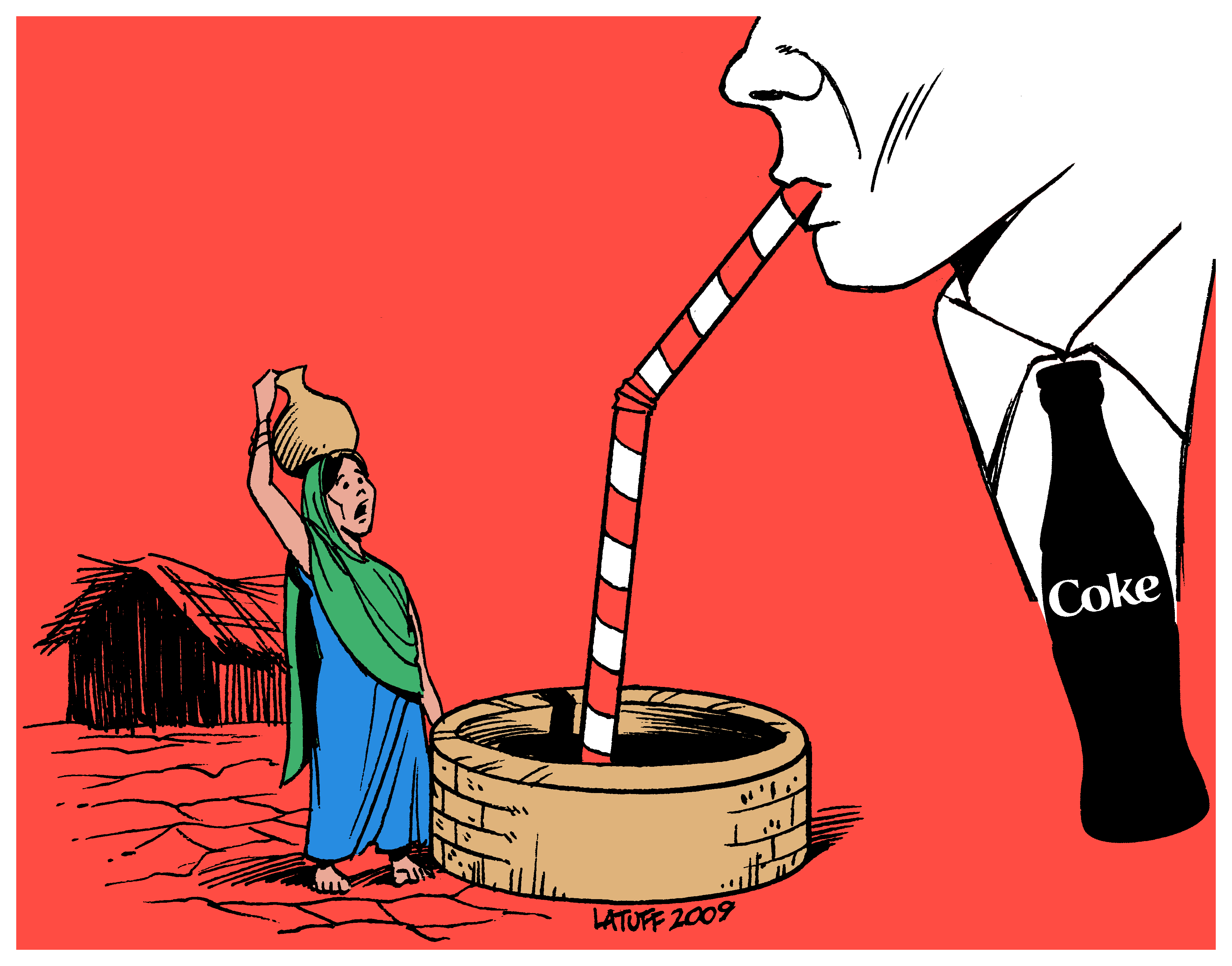
Coke is expanding into increasingly arid regions of the developing world, and that’s in part because Coke is going to places where there aren’t the same kinds of health concerns that there are in the United States. Unfortunately, that means they’re extracting water from places that don’t have a great deal of water to spare.

I think of the human body as part of the environment, and I end the book by explaining how the stomach has become a kind of silo, a storage unit for Coke’s excess. In a nation where more than 30 percent of people are obese today, this is a hot issue for Coca-Cola.

How has Coke’s expansion impacted other companies and the public?

One great example is Monsanto. You wouldn’t have a chemical company like Monsanto without Coke, because Coke in the early 20th century bought all of Monsanto’s main product, which was saccharin, an artificial sweetener. If you go to the Monsanto website, they say that in 1903 and 1905, without Coca-Cola’s massive purchases of their saccharin, they would not exist. I think that’s true of a lot of companies. It’s amazing how many businesses Coke has kept alive through its huge purchasing contracts.

When I say that Coca-Cola capitalism involves partnering with people, that often means the government. I think two good examples of this are public water supplies and recycling. Coke, throughout its history, depended on bottlers who tapped into the public water supply to access 80 percent of what they sold to consumers, which was water, 80 percent of the finished product. In the early 20th century, cities and even the federal government participated in building this infrastructure, spending billions of dollars to bring fresh, clean water to cities and increasingly to rural areas of the country. So, what made Coke expand so rapidly was that it was able to tap into that government infrastructure.

The other example would be recycling. If you look at the history, you see that Coca-Cola and its industry partners lobbied heavily in Congress to try and get curbside recycling to be the solution to the nation’s litter problem. Why not have you and I, the regular taxpayer, pay for that infrastructure and, in a way, conveniently bring the company’s packaging back to the company?

How would you curb some of the negative effects of Coke’s operations and products?

One thing is to make companies pay for the pollution they generate. If we don’t like litter, then we should force corporations to realize that by putting a price tag on it. I would say the same thing goes for obesity. If we think that these products contribute to really expensive health costs like obesity, then let’s make these corporations change. They’ll find ways to respond to the pressures that people put on them.