How America Became an Oligarchy

OLIGARCHY

By Ellen Brown

Source: Counterpunch

“The politicians are put there to give you the idea that you have freedom of choice. You don’t. . . . You have owners.”

— George Carlin, The American Dream

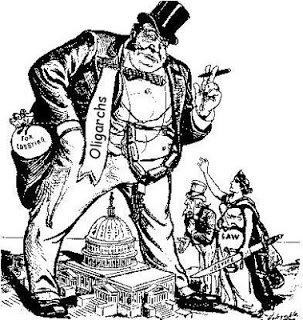
According to a new study from Princeton University, American democracy no longer exists. Using data from over 1,800 policy initiatives from 1981 to 2002, researchers Martin Gilens and Benjamin Page concluded that rich, well-connected individuals on the political scene now steer the direction of the country, regardless of – or even against – the will of the majority of voters. America’s political system has transformed from a democracy into an oligarchy, where power is wielded by wealthy elites.

“Making the world safe for democracy” was President Woodrow Wilson’s rationale for World War I, and it has been used to justify American military intervention ever since. Can we justify sending troops into other countries to spread a political system we cannot maintain at home?

The Magna Carta, considered the first Bill of Rights in the Western world, established the rights of nobles as against the king. But the doctrine that “all men are created equal” – that all people have “certain inalienable rights,” including “life, liberty and the pursuit of happiness” – is an American original. And those rights, supposedly insured by the Bill of Rights, have the right to vote at their core. We have the right to vote but the voters’ collective will no longer prevails.

In Greece, the left-wing populist Syriza Party came out of nowhere to take the presidential election by storm; and in Spain, the populist Podemos Party appears poised to do the same. But for over a century, no third-party candidate has had any chance of winning a US presidential election. We have a two-party winner-take-all system, in which our choice is between two candidates, both of whom necessarily cater to big money. It takes big money just to put on the mass media campaigns required to win an election involving 240 million people of voting age.

In state and local elections, third party candidates have sometimes won. In a modest-sized city, candidates can actually influence the vote by going door to door, passing out flyers and bumper stickers, giving local presentations, and getting on local radio and TV. But in a national election, those efforts are easily trumped by the mass media. And local governments too are beholden to big money.

When governments of any size need to borrow money, the megabanks in a position to supply it can generally dictate the terms. Even in Greece, where the populist Syriza Party managed to prevail in January, the anti-austerity platform of the new government is being throttled by the moneylenders who have the government in a chokehold.

How did we lose our democracy? Were the Founding Fathers remiss in leaving something out of the Constitution? Or have we simply gotten too big to be governed by majority vote?

Democracy’s Rise and Fall

The stages of the capture of democracy by big money are traced in a paper called “The Collapse of Democratic Nation States” by theologian and environmentalist Dr. John Cobb. Going back several centuries, he points to the rise of private banking, which usurped the power to create money from governments:

The influence of money was greatly enhanced by the emergence of private banking. The banks are able to create money and so to lend amounts far in excess of their actual wealth. This control of money-creation . . . has given banks overwhelming control over human affairs. In the United States, Wall Street makes most of the truly important decisions that are directly attributed to Washington.

Today the vast majority of the money supply in Western countries is created by private bankers. That tradition goes back to the 17th century, when the privately-owned Bank of England, the mother of all central banks, negotiated the right to print England’s money after Parliament stripped that power from the Crown. When King William needed money to fight a war, he had to borrow. The government as borrower then became servant of the lender.

In America, however, the colonists defied the Bank of England and issued their own paper scrip; and they thrived. When King George forbade that practice, the colonists rebelled.

They won the Revolution but lost the power to create their own money supply, when they opted for gold rather than paper money as their official means of exchange. Gold was in limited supply and was controlled by the bankers, who surreptitiously expanded the money supply by issuing multiple banknotes against a limited supply of gold.

This was the system euphemistically called “fractional reserve” banking, meaning only a fraction of the gold necessary to back the banks’ privately-issued notes was actually held in their vaults. These notes were lent at interest, putting citizens and the government in debt to bankers who created the notes with a printing press. It was something the government could have done itself debt-free, and the American colonies had done with great success until England went to war to stop them.

President Abraham Lincoln revived the colonists’ paper money system when he issued the Treasury notes called “Greenbacks” that helped the Union win the Civil War. But Lincoln was assassinated, and the Greenback issues were discontinued.

In every presidential election between 1872 and 1896, there was a third national party running on a platform of financial reform. Typically organized under the auspices of labor or farmer organizations, these were parties of the people rather than the banks. They included the Populist Party, the Greenback and Greenback Labor Parties, the Labor Reform Party, the Antimonopolist Party, and the Union Labor Party. They advocated expanding the national currency to meet the needs of trade, reform of the banking system, and democratic control of the financial system.

The Populist movement of the 1890s represented the last serious challenge to the bankers’ monopoly over the right to create the nation’s money. According to monetary historian Murray Rothbard, politics after the turn of the century became a struggle between two competing banking giants, the Morgans and the Rockefellers. The parties sometimes changed hands, but the puppeteers pulling the strings were always one of these two big-money players.

In All the Presidents’ Bankers, Nomi Prins names six banking giants and associated banking families that have dominated politics for over a century. No popular third party candidates have a real chance of prevailing, because they have to compete with two entrenched parties funded by these massively powerful Wall Street banks.

Democracy Succumbs to Globalization

In an earlier era, notes Dr. Cobb, wealthy landowners were able to control democracies by restricting government participation to the propertied class. When those restrictions were removed, big money controlled elections by other means:

First, running for office became expensive, so that those who seek office require wealthy sponsors to whom they are then beholden. Second, the great majority of voters have little independent knowledge of those for whom they vote or of the issues to be dealt with. Their judgments are, accordingly, dependent on what they learn from the mass media. These media, in turn, are controlled by moneyed interests.

Control of the media and financial leverage over elected officials then enabled those other curbs on democracy we know today, including high barriers to ballot placement for third parties and their elimination from presidential debates, vote suppression, registration restrictions, identification laws, voter roll purges, gerrymandering, computer voting, and secrecy in government.

The final blow to democracy, says Dr. Cobb, was “globalization” – an expanding global market that overrides national interests:

[T]oday’s global economy is fully transnational. The money power is not much interested in boundaries between states and generally works to reduce their influence on markets and investments. . . . Thus transnational corporations inherently work to undermine nation states, whether they are democratic or not.

The most glaring example today is the secret twelve-country trade agreement called the Trans-Pacific Partnership. If it goes through, the TPP will dramatically expand the power of multinational corporations to use closed-door tribunals to challenge and supersede domestic laws, including environmental, labor, health and other protections.

Looking at Alternatives

Some critics ask whether our system of making decisions by a mass popular vote easily manipulated by the paid-for media is the most effective way of governing on behalf of the people. In an interesting Ted Talk, political scientist Eric Li makes a compelling case for the system of “meritocracy” that has been quite successful in China.

In America Beyond Capitalism, Prof. Gar Alperovitz argues that the US is simply too big to operate as a democracy at the national level. Excluding Canada and Australia, which have large empty landmasses, the United States is larger geographically than all the other advanced industrial countries of the OECD (Organization for Economic Cooperation and Development) combined. He proposes what he calls “The Pluralist Commonwealth”: a system anchored in the reconstruction of communities and the democratization of wealth. It involves plural forms of cooperative and common ownership beginning with decentralization and moving to higher levels of regional and national coordination when necessary.

Dr. Alperovitz is co-founder of an initiative called The Next System Project, aimed at defining the issues in a national political debate as a first step to realizing the possible. He quotes Prof. Donald Livingston, who asked in 2002:

What value is there in continuing to prop up a union of this monstrous size? . . . [T]here are ample resources in the American federal tradition to justify states’ and local communities’ recalling, out of their own sovereignty, powers they have allowed the central government to usurp.

Taking Back Our Power

If governments are recalling their sovereign powers, they might start with the power to create money, which was usurped by private interests while the people were asleep at the wheel. State and local governments are not allowed to print their own currencies; but they can own banks, and all depository banks create money when they make loans, as the Bank of England recently acknowledged.

The federal government could take back the power to create the national money supply by issuing its own Treasury notes as Abraham Lincoln did. Alternatively, it could issue some very large denomination coins as authorized in the Constitution; or it could nationalize the central bank and use quantitative easing to fund infrastructure, education, job creation, and social services, responding to the needs of the people rather than the banks.

The freedom to vote carries little weight without economic freedom – the freedom to work and to have food, shelter, education, medical care and a decent retirement. President Franklin Roosevelt maintained that we need an Economic Bill of Rights. If our elected representatives were not beholden to the moneylenders, they might be able both to pass such a bill and to come up with the money to fund it.

Ellen Brown is an attorney, founder of the Public Banking Institute, and author of twelve books including the best-selling Web of Debt. Her latest book, The Public Bank Solution, explores successful public banking models historically and globally. Her 300+ blog articles are at EllenBrown.com. Listen to “It’s Our Money with Ellen Brown” on PRN.fm.


Baltimoreans Pushed to Their Limits

Suspect_Dies_Baltimore.JPEG-01b3c_c0-199-4709-2943_s561x327

By David S. D’Amato

Source: Center for a Stateless Society

We speak of the blowback that results from American foreign policy, the senseless, heinous acts of terror that represent an unfocused and irrational rebellion against American imperialism. We understand that calling it what it is, blowback — pointing out the causal relationship between American foreign policy and terrorism — is not an attempt to exculpate the people who commit these crimes. Looking for a motive that may aid in explaining these horrors is not looking for an excuse.

Similarly, the Baltimore rioters have found themselves on the losing end of a set of government policies that have consolidated wealth and foreclosed economic opportunities for independence and self-sufficiency. While so many Americans have been railing against welfare recipients, worried about the effects of food stamps on the federal budget, top American companies have worked closely with government for generations, guaranteeing the corporate welfare and special privileges that define the U.S. economic system.

The truth is that corporate capitalism has hung these rioting Baltimoreans out to dry, the American Dream being to them no more than a cruelly sarcastic joke, forever out of reach, mocking them. The prevailing story depicts the urban poor largely as the victims of “the free market,” dependent on a helping hand from government, be it education, job training, or just the bare necessities. In this story, government intervenes to file the sharp edges off of unbridled free market competition.

The problem with this story is that is recasts government in a role it has never actually played for poor and working class people — least of all black Americans. In real life, the state has intervened not to protect the economically powerless and penniless, but to serve to the needs of capital, to fence off resources and restrict opportunities in order to subject people to the control of a few giant employers. This coercive, state-driven process has nothing to do with a principled, libertarian free market today, and it never has in the past.

The result has been a permanent underclass, condemned to live in ghettos under quasi-military occupation, surrounded by violent crime that is the direct product of a failed war on drugs. And while the people who live in these communities are demonstrably no more likely to possess contraband than anyone else, they are far more likely to be stopped and frisked, arrested, and even murdered by increasingly militarized police officers.

The problems in Baltimore are historical and systemic. Everyone agrees that rioting, looting, and the wanton destruction of private property are senseless acts that ultimately can’t help anyone or create positive social change. We must nevertheless ask why these people in Baltimore feel so helpless, so abandoned and frustrated by the “proper channels,” that they find it is necessary to lash out and express themselves in this way.

Systematic state violence has left Baltimore communities barren, crying out for justice and opportunity. Anarchists believe that the dormant power of self-organization, cooperation and trade, once truly freed from aggression and meddling, is all the poor need to thrive. Through the anger and sadness coming out of Baltimore, it’s important not to lose sight of the larger, underlying issues.

When It Becomes Serious, First They Lie–When That Fails, They Arrest You

ost2

By Charles Hugh Smith

Source: Of Two Minds

When lying is no longer enough to gain compliance, then the organs of security are unleashed on dissent and resistance.

“When it becomes serious, you have to lie.” Jean-Claude Juncker simply gave voice to what the world’s leaders practice on a daily basis, because now it’s always serious.


And why is it now serious? Persuading tax donkeys and debt serfs that everything is going their way is now impossible without lies. Persuading the populace that the leadership is working on their behalf was jettisoned in the wake of the 2008 bailout of bankers and parasites.

Stripped of the artifice that they care about anything other than preserving the wealth of their cronies, global political leaders now rely on propaganda: narratives designed to manage expectations and perceptions, bolstered by carefully tailored official statistics.

Reliance on lies erodes legitimacy. As the rich get richer and the burdens on tax donkeys and debt serfs increase, the gulf between the official happy-story narrative and reality widens to the breaking point, and faith in the narrative and the leadership espousing it declines.

When 20% of the populace no longer believe the lies and begins questioning the state’s enforcement of the status quo, the government devotes its resources to punishing dissenters and resisters. Whistleblowers are charged with trumped-up crimes; those publicly refuting the status quo’s narrative of lies are harassed and discredited, and those who resist state enforcement of parasitic cronyism are set up, beaten, entrapped, investigated, interrogated and arrested once suitably Kafkaesque charges can be conjured up by the apparatchiks of enforcement.

Why 20%? It’s the Pareto Distribution (the 80/20 rule): the 20% of any populace that accepts a new trend, technology or narrative has an outsized influence over the other 80%.

Governments operate on the premise that propaganda and threats will always be enough to cow their populaces into compliance and bribes will induce complicity. When lies, bribes and threats no long work, the state unleashes its full pathological powers on dissent.

The last mass campaign of political suppression in the U.S. occurred in the late 1960s and early 1970s, when resistance to the war of choice in Vietnam reached mainstream proportions.

The U.S. government was accustomed to manipulating and managing the populace with very simple propaganda: Communism is our deadly enemy, we must fight it everywhere on the planet, etc. But when thousands of American service personnel started coming home in body bags from the latest “we must fight Communism everywhere because it’s dangerous to us” war in East Asia, this simplistic justification made no sense: what existential threat to the U.S. did a Communist Vietnam pose?

The U.S. has faced only two existential threats to its sovereignty since 1860: World War II (1941-45) and the potential for a nation-destroying nuclear war with the Soviet Union. The idea that the U.S. was existentially threatened by falling dominoes in East Asia was always ludicrous, and the U.S. status quo (the political leadership, the Deep State, private industry profiting from war, etc.) soon abandoned the absurd justification.

Vietnam was always more of a domestic-politics issue than a geopolitical one: the Democrats feared being perceived as being “weak on Communism” because that impacted the results of elections. Throwing treasure and American lives away in Vietnam was pure domestic politics from 1961-68 (once mired, Democrats feared being tagged as the party that “lost Vietnam”), and thereafter the treasure and lives were sacrificed on the equally contrived Nixon-Kissinger policy of avoiding losing geopolitical face with a withdrawal that amounted to surrender.

Though it is not well known, the Federal Bureau of Investigation (FBI) was ordered to devote essentially all its resources to suppressing dissent in these years. Teams assigned to organized crime were reassigned to track down draft resisters and other political malcontents. COINTELPRO was a vast program devoted to illegally entrapping, beating up and undermining any and all political resistance to the war and the government’s increasingly heavy-handed oppression of dissent.

For more on COINTELPRO, please read War at Home: Covert action against U.S. activists and what we can do about it.

Simply put: when lies no longer work, governments freak out and devote their resources not to eliminating wars of choice, cronyism and corruption but to suppressing dissent and resistance to those policies.

The U.S. government has always been free to pursue wars of choice with its professional military, with little risk of widespread political blowback. A variety of “splendid little wars” have been waged, generally for conquest or enforcement of hemispheric hegemony. The government’s success in rallying the nation during World War II instilled a false confidence that merely raising the flag of existential threat would be enough to eliminate dissent and elicit compliance in the masses.

Vietnam was the first time the American public went through the process of buying the usual “threat” justification for war, questioning the threat and eventually rejecting the state’s narrative. The government responded by lashing out at its own citizenry, engaging in a full spectrum of illegal and blatantly immoral actions designed not to right wrongs or fix broken policies, but to suppress dissent and resistance to destructive policies and broken systems.

The U.S. government is not unique in this; on the contrary, all governments, by their very nature as concentrations of coercive power, will pursue the same path. Rather than confess the government is operated by cronies, for cronies, the machinery of the state will increasingly be turned on its citizenry.

Rendering unto Caesar that which is Caesar’s is no longer enough; abiding by the laws of the land are no longer enough. What the state demands is not just compliance with its countless laws and regulations, but absolute obedience to its narratives and policies.


Anyone who withholds obedience is quickly deemed a traitor–not to the nation or its Constitution, but to the state itself, which is ultimately a collection of cronies and self-serving vested interests protecting their fiefdoms at the expense of the citizenry.

When lying is no longer enough to gain compliance, then the organs of security are unleashed on dissent and resistance. This process is well under way in nation-states around the world.

If I had to pick the two key operative dynamics of the next 20 years, I would choose:

1. The over-expansion and implosion of credit/debt bubbles.

2. The over-reach of the central state as it seeks to win the hearts and minds of its people by ruthlessly suppressing dissent.

The two dynamics are of course causally connected. Central states depend entirely on credit bubbles for their financial survival, and on enforcing increasingly untenable official narratives for their legitimacy.

Both are unraveling, and will continue to unravel, no matter how many state resources are thrown at the symptoms of political illegitimacy, rather than at the root causes of that illegitimacy.


The Matrix Is Real and How It Will Change All Of Our Lives

M3_Hugo_Weaving_003

By Paul Craig Roberts

Source: King World News

Americans are the most manipulated people in history. Since 2008, the economy has been manipulated for the benefit of a few oversized banks “too big to fail.” US foreign policy has been manipulated to serve the hegemonic agenda of a handful of neoconservatives. These manipulations have undercut the consumer basis of the US economy and have pushed the American people into a conflict situation with Russia and China.

Lies, US Economic Collapse And Nuclear War

US economic collapse and nuclear war are the two most likely outcomes of Washington’s manipulations of the American people. Time and again, the American public has fallen for transparent lies and orchestrated events. 2015 is a decisive year. Will a credulous people cast off their gullibility, or will they be swept away by economic collapse and war?

There are reasons to believe that the government’s manipulations have overreached and are crossing the point of believability, even on the part of credulous Americans. Let’s review some of these manipulations — first, economic, and then foreign policy.

Unemployment Number Is Meaningless

On January 9, the US government told Americans that the unemployment rate had fallen to a comforting 5.6 percent, an indication that the Federal Reserve’s policy of Quantitative Easing was successful in restoring the US economy. A 5.6 percent rate of unemployment suggests that Americans have a reasonable chance of finding a job. Yet we know there are millions of discouraged workers who have given up looking for a job.

The explanation of this paradox is that the 5.6 percent unemployment rate (U.3) does not include unemployed people who have not looked for a job in the previous four weeks. These unemployed are called “discouraged workers.” If they have been discouraged for less than one year, they are counted in a seldom-reported measure of unemployment (U.6). This rate stands at 11.2 percent, twice as high as the unemployment rate stressed by government and financial media.

The 11.2 percent rate is an official measure, but it is not publicized because it indicates a dismal employment outlook 5.5 years after the 2008 recession was declared over, in June 2009. What kind of recovery is it when the unemployment rate remains at 11.2 percent years after the recession has officially ended?

The Great Lie Exposed

The story worsens. The 11.2 percent rate does not include the millions of unemployed long-term discouraged workers (those discouraged for more than one year). Prior to 1994, the US Bureau of Labor Statistics counted the long-term discouraged as unemployed, and the government of Canada still does. John Williams (shadowstats.com) continues to include the long-term discouraged. When the long- term discouraged are added to the U.6 measure, the rate of unemployment again doubles, to 23 percent.

In other words, the actual unemployment rate is actually four times higher than the comforting figure released January 9.

Inflation Rate Also Falls Victim

The government engages in similar deception with the inflation rate. If the price of an item in the index rises, a lower-priced item is substituted, thus eliminating inflation by substitution. Inflation also is eliminated by redefining a price rise as a quality improvement.

By undercounting inflation, the government reports price increases as real economic growth, denies cost-of-living increases to Social Security recipients, and justifies paying savers negative real interest rates. These manipulations provide banks with free money, thus boosting bank profits while encouraging the stock market with “good news.”

Americans who search for jobs without success know other Americans in the same situation. As time passes, they learn from experience that the unemployment rate cannot be low and falling when jobs are harder to find. People who shop for food and pay utility bills know inflation is far higher than the government reports. Experience and the passage of time make the government’s numbers less and less believable.

Global Financial Markets Manipulated

The financial markets also are manipulated. To protect the dollar from declining in value due to its overproduction, the Federal Reserve’s bullion bank agents drive down the price of gold and silver by dumping uncovered shorts in the futures market. Since 2011, we have had the extraordinary situation in which the prices of gold and silver have been driven down despite strong demand and constraints on supply — a result that can be achieved only by manipulation in the futures market.

The dollar’s value also is manipulated by foreign central banks in cooperation with Washington. The Japanese and European central banks print yen and euros to protect the dollar’s exchange value. If all major currencies also are being printed, the dollar cannot decline.

The government’s Plunge Protection Team can prevent major stock-market corrections by stepping in and purchasing S&P futures, thus preventing the market’s overvaluation from bursting the bubble.

These manipulations are apparent to experienced investors. Sooner or later, attentive Americans will realize that the government’s deceit is not limited to the marketplace, but extends into foreign policy.

Fooled Over And Over Into War

Ever since the Clinton regime’s demonizations of Yugoslavia and Serbia, Americans have been deceived into supporting expensive wars and foreign-policy positions that are not in their interest. Washington’s demonizations of the Taliban, Osama bin Laden, Saddam Hussein, Gaddafi, Assad, Iran and of Muslims generally have resulted in 14 years of wars in which seven or eight countries have been invaded, bombed and attacked with drones. Increasingly, people at home and abroad understand these wars and bombings are based on lies and deceptions.

The destruction of countries and the massive human hurt happened because the US government lied and deceived.

There were no weapons of mass destruction in Iraq. Assad did not use chemical weapons in Syria. Gaddafi did not issue Viagra to his troops to assist in the rape of Libyan women. Iran does not have a nuclear- weapons program.

Millions of Muslims have been killed, maimed and dislocated by these wars, and tens of thousands of American soldiers have been killed and physically or psychologically maimed. The destruction of countries and the massive human hurt happened because the US government lied and deceived.

The most extraordinary aspect of the Charlie Hebdo event is that the French cartoonists are being championed in the name of free speech. Yet the Anglo-American world does not have free speech. Free speech, if it involves criticism or exposure of the government, is being redefined as “domestic extremism.” Criticism of Washington now implies that the critic is hostile to the public, a possible extremist who must be deterred before he inflicts harm on innocents. As Glenn Greenwald noted, try satirizing Israelis in the manner that Charlie Hebdo satirized Muslims, and you will find out how little free speech there is. http://bit.ly/1xYF93V Free speech is used to demonize Washington’s hand-picked enemies. That’s about as far as it goes.

Washington Demonizing Russia

As 2014 drew to a close, Washington was at work demonizing Russia and its president. Russia no more invaded Ukraine than Saddam Hussein had weapons of mass destruction. But despite years of experience with the government’s foreign-policy lies, polls show that more than 60 percent of the US population has fallen for Washington’s demonization of Russia.

We now have two decades of evidence that Washington uses demonization as a prelude to war. Russia and China, recognizing Washington’s intent to destabilize, have formed a strategic alliance. War with Russia and China would not be like war with Iraq and Libya, or drone attacks on Yemen and Pakistan. Unlike Saddam Hussein and Iran, Russia and China do have weapons of mass destruction — plenty of them.

Whereas Americans are not subject to any meaningful retaliation from Washington’s wars against Muslims, Washington’s aggressive warlike policy toward Russia and China, ringing both countries with military bases while demonizing both with false charges, threatens the life of every American and every person on earth. A threat of this magnitude could pull Americans out of their insouciance and force them to confront the government over its dangerous manipulations of public opinion.

Governments successful with their deceptions end up overreaching. The Charlie Hebdo affair possibly is an overreach. The Paris shootings have many characteristics of a false-flag operation. The attack on the cartoonists’ office was a disciplined professional attack associated with special forces; yet the suspects later corralled and killed seemed bumbling and unprofessional. It is like they were two different sets of people.

Is This Really The Official Story?

Muslim terrorists are usually prepared to die in the attack; yet the two professionals who hit Charlie Hebdo so hard escaped. Their identities were established by the unprofessional and unlikely act of leaving their identification in the getaway car. This reminds me of the undamaged passport miraculously found among the ruins of the two World Trade Center towers. The incriminating passport was the only undamaged item in the entire ruins and was the basis for identifying the 9/11 alleged hijackers.

It is a plausible inference that the ID left in the getaway car was the ID of one of the two brothers later killed by police, from whom we will never hear anything, and not the ID of the professionals who attacked Charlie Hebdo. An important fact that supports this inference is the report that the third suspect in the attack, Hamyd Mourad, the alleged driver of the getaway car, when seeing his name circulating on social media as a suspect, realized the danger he was in and quickly turned himself in to police for protection against being murdered by security forces as a terrorist.

Hamyd Mourad says he has an ironclad alibi. If so, this makes him the despoiler of a false-flag attack. If that is the case, he is likely to be coerced or tortured into some sort of confession to support the official story. http://bit.ly/1Aai8pJ

Mainstream Media Clueless

The American and European media have ignored this important story. I googled Hamyd Mourad and all I found (January 12) was the main US and European media reporting that the third suspect had turned himself in. The news was reported in a fashion that gave credence to the accusation that the suspect who turned himself in was part of the attack. Not a single US mainstream media source reported that the alleged suspect turned himself in because he had an ironclad alibi. The list of sources that reported Mourad’s turning himself in to police report in a way that can be read as confirmation of his guilt.

Some merely reported it in a headline with no coverage in the report. The list of those I googled includes:

• The Washington Post (January 7, by Griff Witte and Anthony Faiola)

• Die Welt (Germany), “One suspect has turned himself in to police in connection with Wednesday’s massacre at the offices of Parisian satirical magazine, Charlie Hebdo”

• ABC News (January 7), “Youngest suspect in Charlie Hebdo Attack turns himself in”

• CNN (January 8), “Citing sources, the Agence France Presse news agency reported that an 18-year- old suspect in the attack had surrendered to police.”

High-Ranking Police Official Suddenly Commits Suicide?

Another puzzle in the official story that remains unreported, according to my 6 p.m. Google search on January 12, is the alleged suicide of a high-ranking member of the French Judicial Police who had a lead role in the Charlie Hebdo investigation. For unknown reasons, a police official involved in the most important investigation of a lifetime decided to kill himself in his police office in the middle of the night while writing his report on his investigation. The alternative media reports it: http://bit.ly/1xc8W1W So did the UK Telegraph. But no suspicion is seen in the police official’s death, and as far as the US “presstitute” media is concerned, it did not happen. There are no reports, domestic or foreign, at the time of writing, about his death and whether his report has disappeared.

Media Cloaks The Lies And Crimes Of Government

As Gerald Celente has pointed out for years and as Patrick L. Smith writes in CounterPunch (Vol. 21, No. 10, 2014), the media serve as presstitutes. The media justify withholding information from the public on the basis of patriotism. Patriotism requires the media to support the government, not the truth. Patrick Smith quotes former New York Times editor Jill Abramson, who says in defense of the New York Times misleading the American people: “Journalists are Americans, too. I consider myself to be a patriot.” Of course, journalists lie to us because their careers are controlled by government and corporations dependent on government. Patriotism has little to do with it, but it serves as a cover. Patriotism is like “national security,” a cloak for the lies and crimes of government.

Life In The Matrix

Here we have it. The media lie to us because they are patriots. We believe the lies because we are patriots. More likely, the fact of the matter might be that both the media and the people are morally and spiritually corrupt.

In other words, we willfully live in The Matrix and are our own worst enemy.

Life in the Algorithm

images

By Douglas Haddow

Source: Adbusters

The searches we make, the news we read, the dates we go on, the advertisements we see, the products we buy and the music we listen to. The stock market. The surveillance society. The police state, and the drones. All guided by a force we never see and few understand.

A series of calculation procedures that come together to constitute capitalism’s secret ingredient — the all holy algorithm, that which binds and optimizes. Those strange numerical gods who decide whether or not you’re a terrorist and what kids’ toy is going to set the market on fire this Christmas. But what are they, where did they come from and how did they get so powerful?

Algorithms are not new. You can trace their origin all the way back to a 9th century Persian mathematician by the name of Muhammad ibn Musa al–Khwarizmi (Algoritmi in Latin) from whom the word derives its name. Then there was Abu Yusaf Ya’qub ibn Ishaq al–Kindi, a contemporary of al–Khwarizmi’s at Baghdad’s House of Wisdom. He discovered and developed the science of frequency analysis, or code–breaking, providing a basis for code breaker Alan Turing to develop his Turing Machine, the theoretical prototype for the 9 billion devices currently sending and receiving signals through the Internet.

When we talk about algorithms, when they come up in conversation, often tied to latent and emerging fears, we’re not talking about the mathematical models behind them, we’re talking about the models that the models were modeled on. Most people have never heard of a polytope, Boolean Logic or the Hirsch Conjecture. But everyone has a credit score, whether they like it or not.

If we want to interrogate the true nature of these numbers, the wizard behind the ghost in the machine, we need to look no further than Adam Smith, that dour Scot who lived with his mum and accidentally created the modern world.

Smith was neither a modernist nor a cosmopolitan. He was an absent’minded hermit who never married, had few friends, suffered from alternating fits of depression and hypochondria, travelled outside Britain on just one occasion and demanded that all his personal writing be burned upon his death. He was the supreme king of unintended consequences, a humble and misunderstood moral philosopher who became the patron saint of greed.

Most famously, and most tragically, Smith was an ambitious writer who got a bit flowery with his language on occasion, and, as a result, his entire legacy was reduced to two words: invisible and hand. As in, the Invisible Hand — that mysterious market force that secretly and surreptitiously guides all our actions and decisions. Or so we’ve been told.

In The Wealth of Nations, the blueprint for what became known as capitalism, Smith drops the phrase but once. It’s situated in a rather dry discussion on trade policy and is used as a metaphor in a straightforward critique of mercantilism’s excessive restrictions.

And that’s it. Just a cursory metaphor used for poetic flourish in an otherwise obscure and forgettable passage. And for the 150 years that followed the book’s publication, that’s exactly what it was — obscure and forgotten. Smith didn’t mention it, his contemporaries didn’t mention it, nor did his critics. Nary a soul on Earth repeated those two words or paid them any heed.

That is, until 1948, when everything changes.

If you look at a Google NGRAM chart of “invisible hand,” you’ll see that there was little to no interest in the phrase up until the 1930s and ’40s, at which point it begins to bubble up a bit, gaining traction in a few peripheral spheres here and there. Then in ’48, Chicago School economist Paul Samuelson writes a book called Economics: An Introductory Analysis, which would go on to become the best–selling economics book of all time.

In his book, Samuelson grabs hold of Smith’s wordplay and freebases meaning from it until a mere metaphor mutates into the economic doctrine that would define the shape and form of global finance for the remainder of the century, and beyond.

“Every individual, in pursuing only his own selfish good, was led, as if by an invisible hand, to achieve the best good for all, so that any interference with free competition by government was almost certain to be injurious,” writes Samuelson. And with that, not only is it justifiable to be callous in the pursuit of wealth, your callousness will somehow, vis–à–vis the invisible hand, uplift those you trample on your way to the top.

Picture Gordon Gekko, hair trickling with high–end product, walking with the gait of limitless sprezzatura, saying, “Greed is right, greed works. Greed clarifies, cuts through and captures the essence of the evolutionary spirit. Greed, in all of its forms; greed for life, for money, for love, knowledge has marked the upward surge of mankind.”

Samuelson would later go on to regret the liberties he took with Smith’s words, but the meme had already been injected into the passive hive mind of economics. What followed was a long and tangled game of economic telephone wherein Smith’s fatalistic conceit gradually took on mythical qualities. From turn of phrase to doctrine, from doctrine to dogma, from dogma to metaphysical law. The invisible hand became the celestial justification of the free market and the economic rationalist’s negation of anything that stood in its way.

Austrian economist Friedrich Hayek even went so far as to develop an entire theory of human interaction based on the myth. It was called Catallactics, and proposed that we did not live within an economy, but rather, a Catallaxy — a complex and self–organizing system in which every individual sent out a constant stream of complex signals that mixed to create overall market behavior.

Knowledge, Hayek argued, was distributed on an individual level, each person containing their own fraction of the whole.

The vast repository of human knowledge was inherently decentralized. Because of this, no central body or government agency could ever hope to contain enough of it to know what was really going on. But if allowed to move freely without meddling, these messages would come together to create order and equilibrium in the market.

This, he argued, is why the government should never meddle in the market. And why order could never be “planned,” and was instead “brought about by the mutual adjustment of many individual economies in a market.” As long as the signals, our private info–snowflakes, could float freely, the market would reach equilibrium.

Through Hayek, dogma became revelation — the invisible hand was not merely a magical presence promising equilibrium, it was also pointing us toward a not–too–distant utopia. And if we didn’t follow the hand? Oppression and despair would follow mankind into a dark hole of tyranny.

Hayek’s ideas spread swiftly through a series of think tanks connected to his economic clique, The Mont Pelerin Society, which counted Karl Popper, Ludwig von Mises and, of course, who else but Milton Friedman among its members. Together they successfully launched what we now call “neoliberalism” into the political consciousness.

Neoliberalism found its champions in Margaret Thatcher and Ronald Reagan. Thatcher regularly corresponded with Hayek and used the slogan There Is No Alternative (TINA) to explain her affection for its concepts. Reagan hired Friedman to be his economic advisor. And together they carried out an economic revolution that smashed trade unions and deregulated and privatized anything and everything that could be guillotined. From this axis of Anglos, it spread to other parts of the Commonwealth, then to Europe, Asia, South America and beyond.

But no matter how much they stripped away government meddling, somehow the “abstract signals” still weren’t getting through. The hand remained clenched and crises endemic. Asia, Argentina, the Eurozone, the 2008 meltdown, the flash crash. The market continually failing to magically self–correct and achieve equilibrium.

The faithful kept their faith and stuck to the program. The crisis, both economic and existential, were met with a recommitment to the faith in the form of austerity and technology and the dream persisted.

The problem was obvious to anyone outside the neoliberal thought–bubble: the invisible hand wasn’t real and it didn’t exist. It never had existed. It wasn’t just invisible, but immaterial, made from the twisted fantasies of economists obsessed with achieving an impossible “equilibrium.” You couldn’t touch it, and it couldn’t touch you.
Until now.

In 2010, when the Dow Jones Industrial dropped 1000 points in under a minute, the biggest one–day point decline in history, it received far less attention then it deserved, because everything returned to normal a few seconds later. Now, miniature flash crashes occur constantly throughout the day. But this crash was a turning point, demonstrating that something had changed. That something was that the neoliberals had achieved what communists, socialists and Christians never could: they made their god real, and in doing so, achieved their utopia. They just didn’t let the rest of us in on it.

The critical flaw in Hayek’s vision of the hand was that a “central body” could never gather enough information. We know this to be untrue, and with big data and the analysis and manipulation of that data through algorithmic equation, the missing link between money and the machine was discovered.

The searches we make, the news we read, the dates we go on, the advertisements we see, the products we buy and the music we listen to. The stock market … All informed by this marriage between mathematics and capital, all working together in perfect harmony to achieve a singular goal — equilibrium. But it’s a curious sort of equilibrium. Less to do with the relationship between supply and demand, and more about the man and the market.

All these algorithms we encounter throughout the day, they’re working toward a greater goal: solving problems and learning how to think. Like the advent and rise of high–frequency trading, they’re part of an optimization trend that leads to a strange brand of perfection: automated profit.

And their current day use, no matter how impressive the specs, is still rooted in 7th century code–breaking. Only now it’s about breaking our individual codes. Throughout the day we send out thousands of our own individual abstract signals and the algorithms figure out how best to streamline our existence into the market’s needs. We’re all just cyphers waiting to get cracked.

This is not the stuff of Orwell and Huxley, but Amazon and the NSA.

There is an overwhelming feeling of inevitability surrounding all of this. With computational capacity still threatening to double every two years, the algorithmic estate will continue to expand and become more sophisticated. All of this development, testing and research is leading to a predictable outcome. Given that they are leading investment and research in the sector, Wall Street financiers will develop the world’s first fully functioning Artificial Intelligence.

If any of this feels inevitable, it’s because it was designed to make us feel that way. If the algorithms that organize the world of money were turned on their head and used to analyze the defects in their guiding philosophy, they would shred it all on one razor sharp fact: the world beyond the market is still a real one. And no matter how sophisticated the math, how brilliant the AI, we will always be living in it.

Outside of The Wealth of Nations, Smith employed the Invisible Hand concept on only two other occasions. Once in his Theory of Moral Sentiments, where he slags off the rich, and the other in the History of Astronomy, where he says:

For it may be observed, that in all Polytheistic religions, among savages, as well as in the early ages of Heathen antiquity, it is the irregular events of nature only that are ascribed to the agency and power of their gods. Fire burns, and water refreshes; heavy bodies descend, and lighter substances fly upwards, by the necessity of their own nature; the invisible hand of Jupiter was never apprehended to be employed in those matters.

These days, the “savages” kick back, polish their yachts and let the machines do their thinking for them. Their god is a primitive and cruel one. Worse yet, it lacks imagination. The future it sees is just an optimized version of the present. Everything that falls within its gaze is predictable, because mathematical sequences are predictable. What remains to be seen is whether or not human beings are as predictable as the machines think we are.

The Global De-dollarization and the US Policies

index

By Vladimir Odintsov

Source: New Eastern Outlook

In its quest for world domination, which the White House has been pursuing for more than a century, it relied on two primary tools: the US dollar and military might. In order to prevent Washington from establishing complete global hegemony, certain countries have recently been revising their positions towards these two elements by developing alternative military alliances and by breaking with their dependence on the US dollar.

Until the mid-twentieth century, the gold standard was the dominant monetary system, based on a fixed quantity of gold reserves stocked in national banks, which limited lending. At that time, the United States managed to become the owner of 70% of world’s gold reserves (excluding the USSR), therefore it pushed its weakened competitor, the UK, aside resulting to the creation of the Bretton Woods financial system in 1944. That’s how the US dollar became the predominant currency for international payments.

But a quarter century later this system had proven ineffective due to its inability to contain the economic growth of Germany and Japan, along with the reluctance of the US to adjust its economic policies to maintain the dollar-gold balance. At that time, the dollar experienced a dramatic decline but it was saved by the support of rich oil exporters, especially once Saudi Arabia began to exchange its black gold for US weapons and support in talks with Richard Nixon. As a result, President Richard Nixon in 1971 unilaterally ordered the cancellation of the direct convertibility of the United States dollar to gold, and instead he established the Jamaican currency system in which oil has become the foundation of the US dollar system. Therefore, it’s no coincidence that from that moment on the control over oil trade has become the number one priority of Washington’s foreign policy. In the aftermath of the so-called Nixon Shock the number of US military engagements in the Middle East and other oil producing regions saw a sharp increase. Once this system was supported by OPEC members, the global demand for US petrodollars hit an all time high. Petrodollars became the basis for America domination over the global financial system which resulted in countries being forced to buy dollars in order to get oil on the international market.

Analysts believe that the share of the United States in today’s world gross domestic product shouldn’t exceed 22%. However, 80% of international payments are made with US dollars. As a result, the value of the US dollar is exceedingly high in comparison with other currencies, that’s why consumers in the United States receive imported goods at extremely low prices. It provides the United States with significant financial profit, while high demand for dollars in the world allows the US government to refinance its debt at very low interest rates.

Under these circumstances, those hedging against the dollar are considered a direct threat to US economic hegemony and the high living standards of its citizens, and therefore political and business circles in Washington attempt by all means to resist this process. This resistance manifested itself in the overthrow and the brutal murder of Libyan leader Muammar Gaddafi, who decided to switch to Euros for oil payments, before introducing a gold dinar to replace the European currency.

However, in recent years, despite Washington’s desire to use whatever means to sustain its position within the international arena, US policies are increasingly faced with opposition. As a result, a growing number of countries are trying to move from the US dollar along with its dependence on the United States, by pursuing a policy of de-dollarization. Three states that are particularly active in this domain are China, Russia and Iran. These countries are trying to achieve de-dollarization at a record pace, along with some European banks and energy companies that are operating within their borders.

The Russian government held a meeting on de-dollarization in spring of 2014, where the Ministry of Finance announced the plan to increase the share of ruble-denominated contracts and the consequent abandonment of dollar exchange. Last May at the Shanghai summit, the Russian delegation manged to sign the so-called “deal of the century” which implies that over the next 30 years China will buy $ 400 billion worth of Russia’s natural gas, while paying in rubles and yuans. In addition, in August 2014 a subsidiary company of Gazprom announced its readiness to accept payment for 80,000 tons of oil from Arctic deposits in rubles that were to be shipped to Europe, while the payment for the supply of oil through the “Eastern Siberia – Pacific Ocean” pipeline can be transferred in yuans. Last August while visiting the Crimea, Russia’s President Vladimir Putin announced that “the petrodollar system should become history” while “Russia is discussing the use of national currencies in mutual settlements with a number of countries.” These steps recently taken by Russia are the real reasons behind the West’s sanction policy.

In recent months, China has also become an active member of this “anti-dollar” campaign, since it has signed agreements with Canada and Qatar on national currencies exchange, which resulted in Canada becoming the first offshore hub for the yuan in North America. This fact alone can potentially double or even triple the volume of trade between the two countries since the volume of the swap agreement signed between China and Canada is estimated to be a total of 200 billion yuans.

China’s agreement with Qatar on direct currency swaps between the two countries are the equivalent of $ 5.7 billion and has cast a heavy blow to the petrodollar becoming the basis for the usage of the yuan in Middle East markets. It is no secret that the oil-producing countries of the Middle Eastern region have little trust in the US dollar due to the export of inflation, so one should expect other OPEC countries to sign agreements with China.

As for the Southeast Asia region, the establishment of a clearing center in Kuala Lumpur, which will promote greater use of the yuan locally, has become yet another major step that was made by China in the region. This event occurred in less than a month after the leading financial center of Asia – Singapore – became a center of the yuan exchange in Southeast Asia after establishing direct dialogue regarding the Singapore dollar and the yuan.

The Islamic Republic of Iran has recently announced its reluctance to use US dollars in its foreign trade. Additionally, the President of Kazakhstan Nursultan Nazarbayev has recently tasked the National Bank with the de-dollarization of the national economy.

All across the world, the calls for the creation of a new international monetary system are getting louder with each passing day. In this context it should be noted that the UK government plans to release debts denominated in yuans while the European Central Bank is discussing the possibility of including the yuan in its official reserves.

Those trends are to be seen everywhere, but in the midst of anti-Russian propaganda, Western newsmakers prefer to keep quiet about these facts, in particular, when inflation is skyrocketing in the United States. In recent months, the proportion of US Treasury bonds in the Russian foreign exchange reserves has been shrinking rapidly, being sold at a record pace, while this same tactic has been used by a number of different states.

To make matters worse for the US, many countries seek to export their gold reserves from the United States, which are deposited in vaults at the Federal Reserve Bank. After a scandal of 2013, when the US Federal Reserve refused to return German gold reserves to its respective owner, the Netherlands have joined the list of countries that are trying to retrieve their gold from the US. Should it be successful the list of countries seeking the return of gold reserves will double which may result in a major crisis for Washington.

The above stated facts indicate that the world does not want to rely on US dollars anymore. In these circumstances, Washington relies on the policy of deepening regional destabilization, which, according to the White House strategy, must lead to a considerable weakening of any potential US rivals. But there’s little to no hope for the United States to survive its own wave of chaos it has unleashed across the world.

Vladimir Odintsov, political commentator, exclusively for the online magazine “New Eastern Outlook”

11 Predictions Of Economic Disaster In 2015 From Top Experts All Over The Globe

economic-collapse

By Michael Snyder

Source: Economic Collapse Blog

Will 2015 be a year of financial crashes, economic chaos and the start of the next great worldwide depression?  Over the past couple of years, we have all watched as global financial bubbles have gotten larger and larger.  Despite predictions that they could burst at any time, they have just continued to expand.  But just like we witnessed in 2001 and 2008, all financial bubbles come to an end at some point, and when they do implode the pain can be extreme.  Personally, I am entirely convinced that the financial markets are more primed for a financial collapse now than they have been at any other time since the last crisis happened nearly seven years ago.  And I am certainly not alone.  At this point, the warning cries have become a deafening roar as a whole host of prominent voices have stepped forward to sound the alarm.  The following are 11 predictions of economic disaster in 2015 from top experts all over the globe…

#1 Bill Fleckenstein: “They are trying to make the stock market go up and drag the economy along with it. It’s not going to work. There’s going to be a big accident. When people realize that it’s all a charade, the dollar will tank, the stock market will tank, and hopefully bond markets will tank. Gold will rally in that period of time because it’s done what it’s done because people have assumed complete infallibility on the part of the central bankers.”

#2 John Ficenec: “In the US, Professor Robert Shiller’s cyclically adjusted price earnings ratio – or Shiller CAPE – for the S&P 500 is currently at 27.2, some 64pc above the historic average of 16.6. On only three occasions since 1882 has it been higher – in 1929, 2000 and 2007.”

#3 Ambrose Evans-Pritchard, one of the most respected economic journalists on the entire planet: “The eurozone will be in deflation by February, forlornly trying to ignite its damp wood by rubbing stones. Real interest rates will ratchet higher. The debt load will continue to rise at a faster pace than nominal GDP across Club Med. The region will sink deeper into a compound interest trap.”

#4 The Jerome Levy Forecasting Center, which correctly predicted the bursting of the subprime mortgage bubble in 2007: “Clearly the direction of most of the recent global economic news suggests movement toward a 2015 downturn.”

#5 Paul Craig Roberts: “At any time the Western house of cards could collapse. It (the financial system) is a house of cards. There are no economic fundamentals that support stock prices — the Dow Jones. There are no economic fundamentals that support the strong dollar…”

#6 David Tice: “I have the same kind of feel in ’98 and ’99; also ’05 and ’06.  This is going to end badly. I have every confidence in the world.”

#7 Liz Capo McCormick and Susanne Walker: “Get ready for a disastrous year for U.S. government bonds. That’s the message forecasters on Wall Street are sending.”

#8 Phoenix Capital Research: “Just about everything will be hit as well. Most of the ‘recovery’ of the last five years has been fueled by cheap borrowed Dollars. Now that the US Dollar has broken out of a multi-year range, you’re going to see more and more ‘risk assets’ (read: projects or investments fueled by borrowed Dollars) blow up. Oil is just the beginning, not a standalone story.

If things really pick up steam, there’s over $9 TRILLION worth of potential explosions waiting in the wings. Imagine if the entire economies of both Germany and Japan exploded and you’ve got a decent idea of the size of the potential impact on the financial system.”

#9 Rob Kirby: “What this breakdown in the crude oil price is going to spawn another financial crisis.  It will be tied to the junk debt that has been issued to finance the shale oil plays in North America.  It is reported to be in the area of half a trillion dollars worth of junk debt that is held largely on the books of large financial institutions in the western world.  When these bonds start to fail, they will jeopardize the future of these financial institutions.  I do believe that will be the signal for the Fed to come riding to the rescue with QE4.  I also think QE4 is likely going to be accompanied by bank bail-ins because we all know all western world countries have adopted bail-in legislation in their most recent budgets.  The financial elites are engineering the excuse for their next round of money printing . . .  and they will be confiscating money out of savings accounts and pension accounts.  That’s what I think is coming in the very near future.”

#10 John Ing: “The 2008 collapse was just a dress rehearsal compared to what the world is going to face this time around. This time we have governments which are even more highly leveraged than the private sector was.

So this time the collapse will be on a scale that is many magnitudes greater than what the world witnessed in 2008.”

#11 Gerald Celente: “What does the word confidence mean? Break it down. In this case confidence = con men and con game. That’s all it is. So people will lose confidence in the con men because they have already shown their cards. It’s a Ponzi scheme. So the con game is running out and they don’t have any more cards to play.

What are they going to do? They can’t raise interest rates. We saw what happened in the beginning of December when the equity markets started to unravel. So it will be a loss of confidence in the con game and the con game is soon coming to an end. That is when you are going to see panic on Wall Street and around the world.”

If you have been following my website, you know that I have been pointing to 2015 for quite some time now.

For example, in my article entitled “The Seven Year Cycle Of Economic Crashes That Everyone Is Talking About“, I discussed the pattern of financial crashes that we have witnessed every seven years that goes all the way back to the Great Depression.  The last two major stock market crashes began in 2001 and 2008, and now here we are seven years later.

Will the same pattern hold up once again?

In addition, there are many other economic cycles that seem to indicate that we are due for a major economic downturn.  I discussed quite a few of these theories in my article entitled “If Economic Cycle Theorists Are Correct, 2015 To 2020 Will Be Pure Hell For The United States“.

But just like in 2000 and 2007, there are a whole host of doubters that are fully convinced that the party can continue indefinitely.  Even though our economic fundamentals continue to get worse, our debt levels continue to grow and every objective measurement shows that Wall Street is more reckless and more vulnerable to collapse than ever before, they mock the idea that a financial collapse is imminent.

So let’s see what happens in 2015.

I have a feeling that it is going to be an extremely “interesting” year.

The CIA-engineered oil glut to bring down Putin and Maduro

Russian President Vladimir Putin shakes hands with his Venezuelan counterpart Nicolas Maduro during a signing ceremony at the Kremlin in Moscow

By Wayne Madsen

Source: Intrepid Report

John Brennan’s long familiarity with Saudi Arabia, owing to the time he spent there as the CIA station chief in Riyadh in the 1990s and his knowledge of Saudi oil operations, has paid off. WMR has learned that Brennan’s agents inside Saudi Aramco convinced the firm’s management and the Saudi Oil Ministry to begin fracking operations to stimulate production in Saudi Arabia’s oldest oil fields.

By pumping salt water into older wells, some at a depth of 3 to 6 thousand feet, an inordinate amount of pressure was built up. The CIA’s oil industry implants knew what would occur when the fracking operations began. Due to the dangerously high water pressure, the Saudis were forced continuously pump oil until the pressure became equalized. That process is continuing. If the Saudis ceased pumping oil, they would permanently lose the wells to salt water contamination. In the current “pump it or lose it” situation, the Saudis are forced to pump at a rate that may take up to 5 years before they can slow down production rates.

The net result of the CIA-inspired fracking operations, which the Saudis were warned not to pursue by petroleum engineers working for some foreign-based firms like Schlumberger, is that there will be an oil supply glut for the next 5 years. The glut will be followed by a reduction in Saudi oil production unless new oil fields are brought on line. There is now a major push by U.S. and Canadian oil companies to bring the Keystone XL pipeline from Canada to the United States to offset the expected sharp rise in oil prices in five years.

The CIA operation to frack Middle Eastern oil fields was not only limited to Saudi Arabia. WMR has learned from oil industry sources that similar fracking caused overproduction problems in Kuwait and Iraq.

The result of the sudden decline in oil prices has resulted in heavy damage to the economies of the CIA-targeted countries of Russia, Iran, and Venezuela. Brennan and his economic warfare operatives banked on the Saudi overproduction to harm the economies of all three countries and the CIA has not been disappointed. The CIA figures that the governments of Vladimir Putin in Russia, Ayatollah Ali Khamenei in Iran, and Nicolas Maduro in Venezuela will have long since collapsed and been replaced by pro-Western regimes within 5 years.

Already, from his base in Switzerland, exiled Russian tax evader billionaire Mikhail Khodorkovsky has called for Putin’s overthrow and even his assassination. Meanwhile, the U.S. Congress and the Obama administration have taken cues from the CIA to impose devastating economic sanctions on both Russia and Venezuela. Similar congressional legislation to increase sanctions on Iran is pending.

Russia has been harmed the most by the CIA’s Saudi oil production scheme. The Russian ruble fell 56 percent in value against the U.S. dollar while Russian interest rates climbed to 17 percent. The price of shares of Russia’s largest lending bank, Sberbank, fell 18 percent. Although the Russian economic collapse has resulted in financial ripples around the world, with Austrian and French banks losing their stock values and the value of the Polish zloty and Hungarian forint falling against the dollar, the Obama administration says that there will be no easing on economic sanctions imposed on Russia over Ukraine. Obama has put the investments of American holders of Russian bonds in dire jeopardy.

The Pacific Investment Management Company’s (PEBIX) Emerging Markets Bond Fund, which holds over $800 million in Russian bonds, has lost almost 8 percent in value in the past few weeks.

Russian Central Bank Vice Chairman Sergei Shvetsov said, “What is happening is a nightmare that we could not even have imagined a year ago.”

Meanwhile, basic staples in Venezuela, including cooking oil, rice, and corn flour, are becoming hard to obtain. The U.S. dollar has jumped 1,700 percent in value against the Venezuelan bolivar on the black market. The CIA is using the financial collapse to push for an undemocratic overthrow of the Venezuelan government.

Iran, which has been under punitive Western economic sanctions for a number of years over its nuclear power program, is probably best able to weather the storm. Iran has built up a rather impressive domestic food production, telecommunications, and oil industry infrastructure to survive the sanctions. However, Iranian President Hassan Rouhani appears very aware of the Saudi role in the conspiracy to drive down oil prices.

Rouhani recently said, “The main reason for [the oil price plunge] is [a] political conspiracy by certain countries against the interest of the region and the Islamic world and it is only in the interest of some other countries . . . Iran and people of the region will not forget such conspiracies, or in other words, treachery against the interests of the Muslim world.”

Brennan’s and the CIA’s industrial sabotage of the Saudi and other Middle East oil industries will continue to have far-reaching effects on the world economy. Oil industry insiders fear that the CIA has unleashed something that may deal a devastating blow to the global economy.