The Unraveling Quickens

By Charles Hugh Smith

Source: Of Two Minds

Even if we don’t measure the erosion of intangible capital, the social and political consequences of this impoverishment are manifesting in all sorts of ways.

The central thesis of my new book Will You Be Richer or Poorer? is the financial “wealth” we’ve supposedly gained (or at least a few of us have gained) in the past 20 years has masked the unraveling of our intangible capital: the resilience of our economy, our social capital, i.e. our ability to find common ground and solve real-world problems, our sense that the playing field, while not entirely level, is not two-tiered, and our sense of economic security–have all been shredded.

The unraveling of everything that actually matters is quickening. While every “news” outlet cheerleads the stock market (“The Dow soared today as investor optimism rose… blah blah blah”), our “leadership” and our media don’t even attempt to measure what’s unraveling, much less address the underlying causes.

The hope is that if we ignore what’s unraveling, it will magically go away. But that’s not how reality works.

The unraveling is gathering momentum because prices have been pushing higher while wages lag, feeding the rising precariousness and inequality of our economy. The connection between people losing ground and social disorder/disunity has been well established by historians such as Peter Turchin Ages of Discord and David Hackett Fischer The Great Wave: Price Revolutions and the Rhythm of History.

In our era, trust in the legitimacy of our institutions is unraveling because the statistics presented as “facts” are so clearly designed to support the status quo narrative that everything’s getting better every day in every way rather than the politically unwelcome reality that the bottom 95% are losing ground and whatever they do earn and own is increasingly at risk from forces outside their control.

Economic decay leads to social and political disorder / disunity. The sudden rise of vast homeless encampments is one manifestation of the social fabric unraveling. In the political realm, the insanity of accusing Democratic candidates of being “Russian agents” matches the hysterical destructiveness of the McCarthy era in the 1950s.

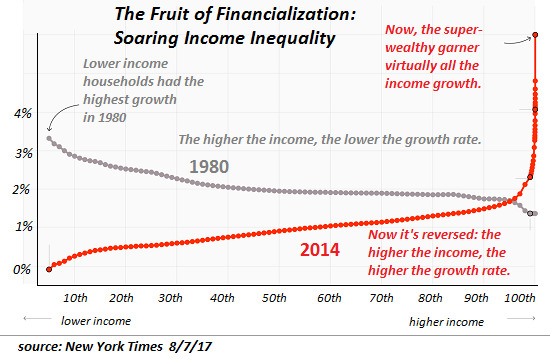
It all starts with economic decay, so let’s look at some charts. Here’s a chart of income inequality which helps drive wealth inequality.

Note that the only group that benefited from the past 20 years of speculative bubbles is the top 1%. The whole idea that inflating bubbles creates a “wealth effect” that “trickles down” is preposterous, as evidenced by the decline of the middle 60% of households while the speculators and owners of bubble-assets skimmed the vast majority of income gains.

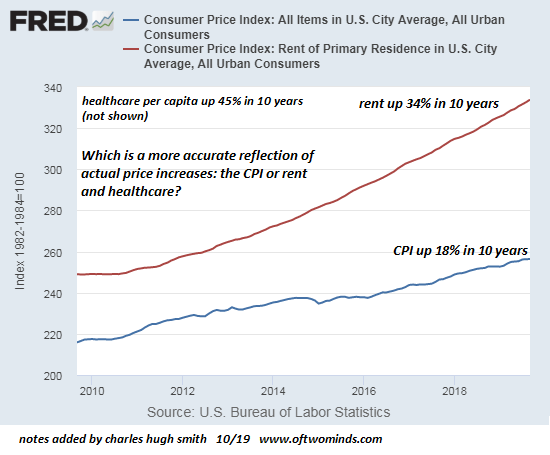
Meanwhile, we’re told inflation is less than 2% annually while rising costs have outpaced meager wage increases. What’s a more realistic measure of real-world inflation–the official Consumer Price Index (CPI) at 18% over ten years or rent and healthcare at 34% and 45%?

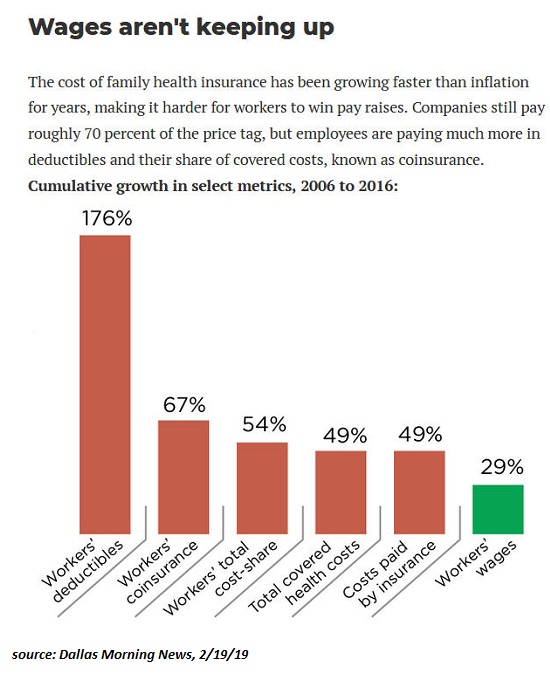
According to the Chapwood Index, real-world inflation in urban America is running 9% to 13% annually. This is more in line with reality than the bogus CPI, as evidenced by this chart of wages and healthcare costs:

Even if we don’t measure the erosion of intangible capital, the social and political consequences of this impoverishment are manifesting in all sorts of ways: large-scale social disorder is breaking out around the globe, and the political middle ground has completely vanished: no matter which way an issue is decided, one camp will refuse to accept the outcome.

The only way forward with any chance of success is to start by acknowledging the decay of our economy due to rampant financialization, legalized looting, the pathologies of “winner take most” speculation and the realities of a two-tiered system in which entrenched elites are “more equal” than the rest of us, economically, socially and politically. We have to accept the limits of technology to reverse the unraveling and assess the damage that’s already been done to our shared capital.

Acting as if the system is working just fine and the problem is perception/optics is accelerating the unraveling.

The Key to a Sustainable Economy Is 5,000 Years Old

By Ellen Brown

Source: Truthdig

We are again reaching the point in the business cycle known as “peak debt,” when debts have compounded to the point that their cumulative total cannot be paid. Student debt, credit card debt, auto loans, business debt and sovereign debt are all higher than they have ever been. As economist Michael Hudson writes in his provocative 2018 book, “…and forgive them their debts,” debts that can’t be paid won’t be paid. The question, he says, is how they won’t be paid.

Mainstream economic models leave this problem to “the invisible hand of the market,” assuming trends will self-correct over time. But while the market may indeed correct, it does so at the expense of the debtors, who become progressively poorer as the rich become richer. Borrowers go bankrupt and banks foreclose on the collateral, dispossessing the debtors of their homes and their livelihoods. The houses are bought by the rich at distress prices and are rented back at inflated prices to the debtors, who are then forced into wage peonage to survive. When the banks themselves go bankrupt, the government bails them out. Thus the market corrects, but not without government intervention. That intervention just comes at the end of the cycle to rescue the creditors, whose ability to buy politicians gives them the upper hand. According to free-market apologists, this is a natural cycle akin to the weather, which dates all the way back to the birth of modern economics in ancient Greece and Rome.

Hudson counters that those classical societies are not actually where our financial system began, and that capitalism did not evolve from bartering, as its ideologues assert. Rather, it devolved from a more functional, sophisticated, egalitarian credit system that was sustained for two millennia in ancient Mesopotamia (now parts of Iraq, Turkey, Kuwait and Iran). Money, banking, accounting and modern business enterprise originated not with gold and private trade, but in the public sector of Sumer’s palaces and temples in the third century B.C. Because it involved credit issued by the local government rather than private loans of gold, bad debts could be periodically forgiven rather than compounding until they took the whole system down, a critical feature that allowed for its remarkable longevity.

The True Roots of Money and Banking

Sumer was the first civilization for which we have written records. Its notable achievements included the wheel, the lunar calendar, our numerical system, law codes, an organized hierarchy of priest-kings, copper tools and weapons, irrigation, accounting and money. It also produced the first written language, which took the form of cuneiform figures impressed on clay. These tablets were largely just accounting tools, recording the flow of food and raw materials in the temple and palace workshops, as well as IOUs (mainly to these large public institutions) that had to be preserved in writing to be enforced. This temple accounting system allowed for the coordinated flow of credit to peasant farmers from planting to harvesting, and for advances to merchants to engage in foreign trade.

In fact, it was the need to manage accounts for a large labor force under bureaucratic control that is thought to have led to the development of writing. The people willingly accepted this bureaucratic control because they viewed the gods as having decreed it. According to their cuneiform writings, humans were genetically engineered to work the fields and the mines after certain lower gods tasked with that hard labor rebelled.

Usury, or the charging of interest on loans, was an accepted part of the Mesopotamian credit system. Interest rates were high and remained unchanged for two millennia. But Mesopotamian scholars were well aware of the problem of “debts that can’t be paid.” Unlike in today’s academic economic curriculum, Hudson writes:

Babylonian scribal students were trained already c. 2000 BC in the mathematics of compound interest. Their school exercises asked them to calculate how long it took a debt at interest of 1/60th per month to double. The answer is 60 months: five years. How long to quadruple? 10 years. How long to multiply 64 times? 30 years. It must’ve been obvious that no economy can grow in keeping with this rate of increase.

Sumerian kings solved the problem of “peak debt” by periodically declaring “clean slates,” in which agrarian debts were forgiven and debtors were released from servitude to work as tenants on their own plots of land. The land belonged to the gods under the stewardship of the temple and the palace and could not be sold, but farmers and their families maintained leaseholds to it in perpetuity by providing a share of their crops, service in the military and labor in building communal infrastructure. In this way, their homes and livelihoods were preserved, an arrangement that was mutually beneficial, since the kings needed their service.

Jewish scribes, who spent time in captivity in Babylon in the sixth century B.C, adapted these laws in the year or jubilee, which Hudson argues was added to Leviticus after the Babylonian captivity. According to Leviticus 25:8-13, a Jubilee Year was to be declared every 49 years, during which debts would be forgiven, slaves and prisoners freed and their property leaseholds restored. As in ancient Mesopotamia, property ownership remained with Yahweh and his earthly proxies. The Jubilee law effectively banned the outright sale of land, which could only be leased for up to 50 years (Leviticus 25:14-17). The Levitican Jubilee represented an advance over the Mesopotamian “clean slates,” Hudson says, in that it was codified into law rather than relying on the whim of the king. But its proclaimers lacked political power, and whether the law was ever enforced is unclear. It served as a moral rather than a legal prescription.

Ancient Greece and Rome adopted the Mesopotamian system of lending at interest, but without the safety valve of periodic “clean slates,” since the creditors were no longer the king or the temple, but private lenders. Unfettered usury resulted in debt bondage and forfeiture of properties, consolidation into large landholdings, a growing wedge between rich and poor, and the ultimate destruction of the Roman Empire.

As for the celebrated development of property rights and democracy in ancient Greece and Rome, Hudson argues that they did not actually serve the poor. They served the rich, who controlled elections, just as rich donors do today. Taking power away from local governments by privatizing once-communal lands allowed private creditors to pass laws by which they could legally confiscate property when their debtors could not pay. “Free markets” meant the freedom to accumulate massive wealth at the expense of the poor and the state.

Hudson maintains that when Jesus Christ preached “forgiveness of debts,” he was also talking about economic debt, not just moral transgressions. When he overturned the tables of the money changers, it was because they had turned a house of prayer into “a den of thieves.” But creditors’ rights had by then gained legal dominance, and Christian theologians lacked the power to override them. Rather than being a promise of economic redemption in this life, forgiveness of debts thus became a promise of spiritual redemption in the next.

How to Pull Off a Modern Debt Jubilee

Such has been the fate of debtors in modern Western economies. But in some modern non-Western economies, vestiges of the debt write-off solution remain. In China, for instance, nonperforming loans are often carried on the books of state-owned banks or canceled rather than putting insolvent debtors and banks into bankruptcy. As Dinny McMahon wrote in June in an article titled “China’s Bad Data Can Be a Good Thing”:

In China, the state stands behind the country’s banks. As long as authorities ensure those banks have sufficient liquidity to meet their obligations, they can trundle along with higher delinquency levels than would be regarded safe in a market economy.

China’s banking system, like that of ancient Mesopotamia, is largely in the public sector, so the state can back its banks with liquidity as needed. Interestingly, the Chinese state also preserves the ancient Near Eastern practice of retaining ownership of the land, which citizens can only lease for a period of time.

In Western economies, most banks are privately owned and heavily regulated, with high reserve and capital requirements. Bad loans mean debtors are put into foreclosure, jobs and capital infrastructure are lost, and austerity prevails. The Trump administration is now aggressively pursuing a trade war with China in an effort to level the playing field by forcing it into the same austerity regime, but a more productive and sustainable approach might be for the U.S. to engage in periodic debt jubilees itself.

The problem with that solution today is that most debts in Western economies are owed not to the government but to private creditors, who will insist on their contractual rights to payment. We need to find a way to pay the creditors while relieving the borrowers of their debt burden.

One possibility is to nationalize insolvent banks and sell their bad loans to the central bank, which can buy them with money created on its books. The loans can then be written down or voided out. Precedent for this policy was established with “QE1,” the Fed’s first round of quantitative easing, in which it bought unmarketable mortgage-backed securities from banks with liquidity problems.

Another possibility would be to use money generated by the central bank to bail out debtors directly. This could be done selectively, by buying up student debt or credit card debt or car loans bundled as “asset-backed securities,” then writing the debts down or off, for example. Alternatively, debts could be relieved collectively with a periodic national dividend or universal basic income paid to everyone, again drawn from the deep pocket of the central bank.

Critics will object that this would dangerously inflate the money supply and consumer prices, but that need not be the case. Today, virtually all money is created as bank debt, and it is extinguished when the debt is repaid. That means dividends used to pay this debt down would be extinguished, along with the debt itself, without adding to the money supply. For the 80% of the U.S. population now carrying debt, loan repayments from their national dividends could be made mandatory and automatic. The remaining 20% would be likely to save or invest the funds, so this money too would contribute little to consumer price inflation; and to the extent that it did go into the consumer market, it could help generate the demand needed to stimulate productivity and employment. (For a fuller explanation, see Ellen Brown, “Banking on the People,” 2019).

In ancient Mesopotamia, writing off debts worked brilliantly well for two millennia. As Hudson concludes:

To insist that all debts must be paid ignores the contrast between the thousands of years of successful Near Eastern clean slates and the debt bondage into which [Greco-Roman] antiquity sank. … If this policy in many cases was more successful than today’s, it is because they recognized that insisting that all debts must be paid meant foreclosures, economic polarization and impoverishment of the economy at large.

Is the U.S. Becoming a Third World Nation?

By Charles Hugh Smith

Source: Of Two Minds

This is a chart of an informal kleptocracy which cloaks itself in the faux finery of democracy and a (rigged) “market” economy.

Back in the day, nations that didn’t qualify as either developed (First World) or developing (Second World) were by default Third World, impoverished, corrupt and what we now refer to as failed states–governments that were incapable of improving the lives of their people and the machinery of governance, generally as a result of corruption and self-serving elites, i.e. kleptocracies.

Is the U.S. slipping into Third World status? While many scoff at the very question, others citing the rise of homelessness, entrenched pockets of abject poverty and the decaying state of infrastructure might nod “yes.”

These are not uniquely Third World problems, they’re symptoms of a status quo that’s fast losing First World capabilities. What characterizes Third World/Failing States isn’t just poverty, crumbling infrastructure and endemic corruption; at a systems level these are the key dynamics in Third World/Failing States:

1. The status quo protects insiders at the expense of everyone else.

2. There is no real accountability; failure has no consequences, bureaucrats are never fired for incompetence, reforms are watered down or neutered by institutional sclerosis.

3. Pay-to-play is the most cost-effective way to influence policy or evade consequences.

4. The status quo is incapable of differentiating between complexity that serves the legitimate purposes of transparency and accountability and complexity that serves no purpose beyond guaranteeing insiders’ paper-shuffling jobs. As a consequence, complexity that adds no value chokes the economy and the government.

5. There are two sets of laws: one for insiders and the super-wealthy, and another harsher set for everyone else.

6. The super-wealthy fear nothing because the system functions to serve their interests.

7. The super-wealthy and state insiders control the media’s narratives and the machinery of governance to serve their interests. Reforms are in name only; the faces of elected officials change but nothing changes structurally.

8. Insiders, well-paid pundits and the technocrats serving the corporate and state elites believe the status quo is just fine because they’re doing fine; they are blind to the soaring inequality, systemic corruption, stupendous waste and the impossibility of real reform.

Does America’s status quo protect insiders at the expense of everyone else? Yes. As for the other seven characteristics: yes, yes, yes, yes, yes, yes and yes.

And lets’ not forget #9: the vast majority of the economic gains flow to the elite at the very top of the wealth-power pyramid: is this true in the U.S.? Definitively yes. Just look at this chart: this is a chart of an informal kleptocracy which cloaks itself in the faux finery of democracy and a (rigged) “market” economy.

That’s the very definition of a Third World failed state.

Related Video:

Billionaires are a Sign of Economic Failure

Inherited wealth and crony capitalism have created an aristocratic class that undermines social mobility and democracy

By Max Lawson

Source: Inequality.org

The New York Times published an editorial comment on its front page in January 2019, provocatively entitled “abolish billionaires.” The editorial raised a serious question: what if instead of being a sign of economic success, billionaires are a sign of economic failure?  In what ways can the boom in billionaires, and the dramatic increase in extreme wealth generally, be harmful?

To answer this question, we need to understand the origins of billionaire wealth, and to understand how that wealth is used once it is gained.  The answer to both these questions I think rightly casts doubt on the value of the super-rich in our society.

Approximately one third of billionaire wealth comes from inheritance. It is very hard to make the case for the economic utility of inherited wealth, and instead there is a strong case for the fact that it undermines social mobility and economic progress. It creates instead a new aristocracy who are rich simply because their parents were rich which is hard to see as a good thing.

Whether inherited or secured in other ways, extreme wealth takes on a momentum of its own.  The super-rich have the money to spend on the best investment advice, and billionaire wealth has increased since 2009 by an average of 11 percent a year, far higher than rates ordinary savers can obtain.

Bill Gates is worth nearly $100 billion dollars in 2019, almost twice what he was worth when he stepped down as head of Microsoft.  This is despite his admirable commitment to giving his money away.  As Thomas Piketty said in his book Capital in the 21st Century, “No matter how justified inequalities of wealth may be initially, fortunes can grow beyond any rational justification in terms of social utility.”

My Oxfam colleague Didier Jacobs calculated a few years ago that another third of billionaire wealth comes from crony connections to government and monopoly.  This could be for example when billionaires secure concessions to provide services exclusively from government, using crony connections and corruption.  The Economist has developed a similar measure of crony capitalism with similar findings. What is clear it seems to me is that corruption and crony connections to governments are behind a significant proportion of billionaire wealth.

Almost all sectors of our global economy are also now characterized by monopoly power, as is detailed by Nick Shaxson in his great new book, the Finance Curse. Whether food, pharmaceuticals, media, finance, or technology, each sector is characterized by a handful of huge corporations.

Decades of largely unquestioned mergers and acquisitions, where corporations have bought up competitors, have led to this.  Historically, and especially in the United States in the early part of the 20th century, monopoly power was rightly viewed as a serious threat to the economy and to society, and steps were taken to break up monopolies.  It was President Franklin Roosevelt who famously said that “government by organized money is just as dangerous as government by organized mob.” However, in recent decades, neoliberal economics has led a much more benign view of monopoly power, and very little action is now taken to dismantle them. I think this is a key distinction between neoliberalism and classical liberal economics.  These monopolies impose hidden monopoly taxes on every consumer, as it enables these companies, and their wealthy shareholders, to extract excessive profits from the market, directly fueling the growth in extreme wealth at the expense of ordinary citizens.

The actions of corporations, including the move towards monopoly, are driven by a relentless focus on ever-increasing returns to shareholders — shareholders who are primarily the very same extremely wealthy people.  Our new Oxfam paper on the “Seven Deadly Sins” of the G7, released this week, shows how returns to shareholders have increased dramatically whilst real wages have barely increased.

Behind corporate power and corporate actions is increasingly the power of super-rich shareholders.

Once billionaire wealth is accumulated, the way it is used also casts doubt on how useful it is to have billionaires.  The super-rich use their wealth to pay as little tax as possible, making active use of a secretive global network of tax havens, as revealed by the Panama Papers and other exposes.

One ground-breaking study that made use of this leaked information showed that the super-rich are paying as much as 30 percent less tax than they should, denying governments billions in lost tax revenue, that could have been spent on schools or on hospitals.  The super-rich are supported in this by the Society of Trust and Estate Practitioners (STEP), a secretive organization of over 20,000 wealth managers that actively pressures governments to reduce taxes on the richest.

Billions are not just used to ensure lower taxes. They can also be used to buy impunity from justice, to buy politicians, or to buy a pliant media.  The use of “dark” money to influence elections and public policy is a growing problem all over the world. The Koch brothers — Charles and the recently deceased David — two of the richest men in the world, have had a huge influence over conservative politics in the United States.

Another recent Oxfam study  showed the many ways in which politics has been captured by the very rich in Latin America.  Many of today’s new breed of nationalist, racist leaders have substantial financial backing.

This active political influencing by the super-rich directly drives greater inequality, by constructing reinforcing feedback loops, in which the winners of the game get even more resources to win even bigger next time.

For all these reasons, I think there is a strong case to be made that rather than being celebrated, as one U.S. commentator recently said, “every billionaire is a policy failure,” and that in particular if we are to end poverty and build fairer societies, we need to bring an end to extreme wealth.

The 5-Step CEO pay scam

Grossly widening inequalities of income and wealth cannot be separated from grossly widening inequalities of political power in America. This corruption must end.

By Robert Reich

Source: Nation of Change

Average CEO pay at big corporations topped 14.5 million dollars in 2018. That’s after an increase of 5.2 million dollars per CEO over the past decade, while the average worker’s pay has increased just 7,858 dollars over the decade. 

Just to catch up to what their CEO made in 2018 alone, it would take the typical worker 158 years.

This explosion in CEO pay relative to the pay of average workers isn’t because CEOs have become so much more valuable than before. It’s not due to the so-called “free market.”

It’s due to CEOs gaming the stock market and playing politics.

How did CEOs pull this off? They followed these five steps:

First: They made sure their companies began paying their executives in shares of stock.

Second: They directed their companies to lobby Congress for giant corporate tax cuts and regulatory rollbacks.

Third: They used most of the savings from these tax cuts and rollbacks not to raise worker pay or to invest in the future, but to buy back the corporation’s outstanding shares of stock.

Fourth: This automatically drove up the price of the remaining shares of stock.

Fifth and finally: Since CEOs are paid mainly in shares of stock, CEO pay soared while typical workers were left in the dust.

How to stop this scandal? Five ways:

1. Ban stock buybacks. They were banned before 1982 when the Securities and Exchange Commission viewed them as vehicles for stock manipulation and fraudThen Ronald Reagan’s SEC removed the restrictions. We should ban buybacks again.

2. Stop corporations from deducting executive pay in excess of 1 million dollars from their taxable income – even if the pay is tied to so-called company performance. There’s no reason other taxpayers ought to be subsidizing humongous CEO pay.

3. Stop corporations from receiving any tax deduction for executive pay unless the percent raise received by top executives matches the percent raise received by average employees.

4. Increase taxes on corporations whose CEOs make more than 100 times their average employees.

5. Finally, and most basically: Stop CEOs from corrupting American politics with big money. Get big money out of our democracy. Fight for campaign finance reform.

Grossly widening inequalities of income and wealth cannot be separated from grossly widening inequalities of political power in America. This corruption must end.

What globalism did was to transfer the US economy to China

By Paul Craig Roberts

Source: Intrepid Report

The main problem with the US economy is that globalism has been deconstructing it. The offshoring of US jobs has reduced US manufacturing and industrial capability and associated innovation, research, development, supply chains, consumer purchasing power, and tax base of state and local governments. Corporations have increased short-term profits at the expense of these long-term costs. In effect, the US economy is being moved out of the First World into the Third World.

Tariffs are not a solution. The Trump administration says that the tariffs are paid by China, but unless Apple, Nike, Levi, and all of the offshoring companies got an exemption from the tariffs, the tariffs fall on the offshored production of US firms that are sold to US consumers. The tariffs will either reduce the profits of the US firms or be paid by US purchasers of the products in higher prices. The tariffs will hurt China only by reducing Chinese employment in the production of US goods for US markets.

The financial media is full of dire predictions of the consequences of a US/China “trade war.” There is no trade war. A trade war is when countries try to protect their industries by placing tariff barriers on the import of cheaper products from foreign countries. But half or more of the imports from China are imports from US companies. Trump’s tariffs, or a large part of them, fall on US corporations or US consumers.

One has to wonder that there is not a single economist anywhere in the Trump administration, the Federal Reserve, or anywhere else in Washington capable of comprehending the situation and conveying an understanding to President Trump.

One consequence of Washington’s universal economic ignorance is that the financial media has concocted the story that “Trump’s tariffs” are not only driving Americans into recession but also the entire world. Somehow tariffs on Apple computers and iPhones, Nike footwear, and Levi jeans are sending the world into recession or worse. This is an extraordinary economic conclusion, but the capacity for thought has pretty much disappeared in the United States.

In the financial media the question is: Will the Trump tariffs cause a US/world recession that costs Trump his reelection? This is a very stupid question. The US has been in a recession for two or more decades as its manufacturing/industrial/engineering capability has been transferred abroad. The US recession has been very good for the Asian part of the world. Indeed, China owes its faster than expected rise as a world power to the transfer of American jobs, capital, technology, and business know-how to China simply in order that US shareholders could receive capital gains and US executives could receive bonus pay for producing them by lowering labor costs.

Apparently, neoliberal economists, an oxymoron, cannot comprehend that if US corporations produce the goods and services offshore that they market to Americans, it is the offshore locations that benefit from the economic activity.

Offshore production started in earnest with the Soviet collapse as India and China opened their economies to the West. Globalism means that US corporations can make more money by abandoning their American work force. But what is true for the individual company is not true for the aggregate. Why? The answer is that when many corporations move their production for US markets offshore, Americans, unemployed or employed in lower paying jobs, lose the power to purchase the offshored goods.

I have reported for years that US jobs are no longer middle-class jobs. The jobs have been declining for years in terms of value-added and pay. With this decline, aggregate demand declines. We have proof of this in the fact that for years US corporations have been using their profits not for investment in new plant and equipment, but to buy back their own shares. Any economist worthy of the name should instantly recognize that when corporations repurchase their shares rather than invest, they see no demand for increased output. Therefore, they loot their corporations for bonuses, decapitalizing the companies in the process. There is perfect knowledge that this is what is going on, and it is totally inconsistent with a growing economy.

As is the labor force participation rate. Normally, economic growth results in a rising labor force participation rate as people enter the work force to take advantage of the jobs. But throughout the alleged economic boom, the participation rate has been falling, because there are no jobs to be had.

In the 21st century, the US has been decapitalized and living standards have declined. For a while the process was kept going by the expansion of debt, but consumer income has not kept place and consumer debt expansion has reached its limits.

The Fed/Treasury “plunge protection team” can keep the stock market up by purchasing S&P futures. The Fed can pump out more money to drive up financial asset prices. But the money doesn’t drive up production, because the jobs and the economic activity that jobs represent have been sent abroad. What globalism did was to transfer the US economy to China.

Real statistical analysis, as contrasted with the official propaganda, shows that the happy picture of a booming economy is an illusion created by statistical deception. Inflation is undermeasured, so when nominal GDP is deflated, the result is to count higher prices as an increase in real output, that is, inflation becomes real economic growth. Unemployment is not counted. If you have not searched for a job in the past 4 weeks, you are officially not a part of the work force and your unemployment is not counted. The way the government counts unemployment is so extraordinary that I am surpised the US does not have a zero rate of unemployment.

How does a country recover when it has given its economy away to a foreign country that it now demonizes as an enemy? What better example is there of a ruling class that is totally incompetent than one that gives its economy bound and gagged to an enemy so that its corporate friends can pocket short-term riches?

We can’t blame this on Trump. He inherited the problem, and he has no advisers who can help him understand the problem and find a solution. No such advisers exist among neoliberal economists. I can only think of four economists who could help Trump, and one of them is a Russian.

The conclusion is that the United States is locked on a path that leads directly to the Third World of 60 years ago. President Trump is helpless to do anything about it.

American Apocalypse: The Government’s Plot to Destabilize the Nation Is Working


By John W. Whitehead

Source: The Rutherford Institute

“The most dangerous man to any government is the man who is able to think things out … without regard to the prevailing superstitions and taboos. Almost inevitably he comes to the conclusion that the government he lives under is dishonest, insane, intolerable.” — H. L. Mencken

The U.S. government is working hard to destabilize the nation.

No, this is not another conspiracy theory.

Although it is certainly not far-fetched to suggest that the government might be engaged in nefarious activities that run counter to the best interests of the American people, doing so will likely brand me a domestic terrorist under the FBI’s new classification system.

Observe for yourself what is happening right before our eyes.

Domestic terrorism fueled by government entrapment schemes. Civil unrest stoked to dangerous levels by polarizing political rhetoric. A growing intolerance for dissent that challenges the government’s power grabs. Police brutality tacitly encouraged by the executive branch, conveniently overlooked by the legislatures, and granted qualified immunity by the courts. A weakening economy exacerbated by government schemes that favor none but a select few. An overt embrace of domestic surveillance tactics if Congress goes along with the Trump Administration’s request to permanently re-authorize the NSA’s de-activated call records program. Heightened foreign tensions and blowback due to the military industrial complex’s profit-driven quest to police and occupy the globe.

The seeds of chaos are being sown, and it’s the U.S. government that will reap the harvest.

Mark my words, there’s trouble brewing.

Better yet, take a look at “Megacities: Urban Future, the Emerging Complexity,” a Pentagon training video created by the Army for U.S. Special Operations Command.

The training video is only five minutes long, but it says a lot about the government’s mindset, the way its views the citizenry, and the so-called “problems” that the government must be prepared to address in the near future through the use of martial law.

Even more troubling, however, is what this military video doesn’t say about the Constitution, about the rights of the citizenry, and about the dangers of locking down the nation and using the military to address political and social problems.

The training video anticipates that all hell will break loose by 2030—that’s barely ten short years away—but the future is here ahead of schedule.

We’re already witnessing a breakdown of society on virtually every front.

By waging endless wars abroad, by bringing the instruments of war home, by transforming police into extensions of the military, by turning a free society into a suspect society, by treating American citizens like enemy combatants, by discouraging and criminalizing a free exchange of ideas, by making violence its calling card through SWAT team raids and militarized police, by fomenting division and strife among the citizenry, by acclimating the citizenry to the sights and sounds of war, and by generally making peaceful revolution all but impossible, the government has engineered an environment in which domestic violence is becoming almost inevitable.

The danger signs are screaming out a message

The government is anticipating trouble (read: civil unrest), which is code for anything that challenges the government’s authority, wealth and power.

According to the Pentagon training video created by the Army for U.S. Special Operations Command, the U.S. government is grooming its armed forces to solve future domestic political and social problems.

What they’re really talking about is martial law, packaged as a well-meaning and overriding concern for the nation’s security.

The chilling five-minute training video, obtained by The Intercept through a FOIA request and made available online, paints an ominous picture of the future—a future the military is preparing for—bedeviled by “criminal networks,” “substandard infrastructure,” “religious and ethnic tensions,” “impoverishment, slums,” “open landfills, over-burdened sewers,” a “growing mass of unemployed,” and an urban landscape in which the prosperous economic elite must be protected from the impoverishment of the have nots.

And then comes the kicker.

Three-and-a-half minutes into the Pentagon’s dystopian vision of “a world of Robert Kaplan-esque urban hellscapes — brutal and anarchic supercities filled with gangs of youth-gone-wild, a restive underclass, criminal syndicates, and bands of malicious hackers,” the ominous voice of the narrator speaks of a need to “drain the swamps.”

Drain the swamps.

Surely, we’ve heard that phrase before?

Ah yes.

Emblazoned on t-shirts and signs, shouted at rallies, and used as a rallying cry among Trump supporters, “drain the swamp” became one of Donald Trump’s most-used campaign slogans.

Far from draining the politically corrupt swamps of Washington DC of lobbyists and special interest groups, however, the Trump Administration has further mired us in a sweltering bog of corruption and self-serving tactics.

Funny how the more things change, the more they stay the same.

Now the government has adopted its own plans for swamp-draining, only it wants to use the military to drain the swamps of futuristic urban American cities of “noncombatants and engage the remaining adversaries in high intensity conflict within.”

And who are these noncombatants, a military term that refers to civilians who are not engaged in fighting?

They are, according to the Pentagon, “adversaries.”

They are “threats.”

They are the “enemy.”

They are people who don’t support the government, people who live in fast-growing urban communities, people who may be less well-off economically than the government and corporate elite, people who engage in protests, people who are unemployed, people who engage in crime (in keeping with the government’s fast-growing, overly broad definition of what constitutes a crime).

In other words, in the eyes of the U.S. military, noncombatants are American citizens a.k.a. domestic extremists a.k.a. enemy combatants who must be identified, targeted, detained, contained and, if necessary, eliminated.

In the future imagined by the Pentagon, any walls and prisons that are built will be used to protect the societal elite—the haves—from the have-nots.

If you haven’t figured it out already, we the people are the have-nots.

Suddenly it all begins to make sense.

The events of recent years: the invasive surveillance, the extremism reports, the civil unrest, the protests, the shootings, the bombings, the military exercises and active shooter drills, the color-coded alerts and threat assessments, the fusion centers, the transformation of local police into extensions of the military, the distribution of military equipment and weapons to local police forces, the government databases containing the names of dissidents and potential troublemakers.

The government is systematically locking down the nation and shifting us into martial law.

This is how you prepare a populace to accept a police state willingly, even gratefully.

You don’t scare them by making dramatic changes. Rather, you acclimate them slowly to their prison walls.

Persuade the citizenry that their prison walls are merely intended to keep them safe and danger out. Desensitize them to violence, acclimate them to a military presence in their communities, and persuade them that there is nothing they can do to alter the seemingly hopeless trajectory of the nation.

Before long, no one will even notice the floundering economy, the blowback arising from military occupations abroad, the police shootings, the nation’s deteriorating infrastructure and all of the other mounting concerns.

It’s happening already.

The sight of police clad in body armor and gas masks, wielding semiautomatic rifles and escorting an armored vehicle through a crowded street, a scene likened to “a military patrol through a hostile city,” no longer causes alarm among the general populace.

Few seem to care about the government’s endless wars abroad that leave communities shattered, families devastated and our national security at greater risk of blowback.

The Deep State’s tactics are working.

We’ve allowed ourselves to be acclimated to the occasional lockdown of government buildings, Jade Helm military drills in small towns so that special operations forces can get “realistic military training” in “hostile” territory, and  Live Active Shooter Drill training exercises, carried out at schools, in shopping malls, and on public transit, which can and do fool law enforcement officials, students, teachers and bystanders into thinking it’s a real crisis.

Still, you can’t say we weren’t warned about the government’s nefarious schemes to lock down the nation.

Back in 2008, an Army War College report revealed that “widespread civil violence inside the United States would force the defense establishment to reorient priorities in extremis to defend basic domestic order and human security.” The 44-page report went on to warn that potential causes for such civil unrest could include another terrorist attack, “unforeseen economic collapse, loss of functioning political and legal order, purposeful domestic resistance or insurgency, pervasive public health emergencies, and catastrophic natural and human disasters.”

In 2009, reports by the Department of Homeland Security surfaced that labelled right-wing and left-wing activists and military veterans as extremists (a.k.a. terrorists) and called on the government to subject such targeted individuals to full-fledged pre-crime surveillance. Almost a decade later, after spending billions to fight terrorism, the DHS concluded that the greater threat is not ISIS but domestic right-wing extremism.

Meanwhile, the government has been amassing an arsenal of military weapons for use domestically and equipping and training their “troops” for war. Even government agencies with largely administrative functions such as the Food and Drug Administration, Department of Veterans Affairs, and the Smithsonian have been acquiring body armor, riot helmets and shields, cannon launchers and police firearms and ammunition. In fact, there are now at least 120,000 armed federal agents carrying such weapons who possess the power to arrest.

Rounding out this profit-driven campaign to turn American citizens into enemy combatants (and America into a battlefield) is a technology sector that has been colluding with the government to create a Big Brother that is all-knowing, all-seeing and inescapable. It’s not just the drones, fusion centers, license plate readers, stingray devices and the NSA that you have to worry about. You’re also being tracked by the black boxes in your cars, your cell phone, smart devices in your home, grocery loyalty cards, social media accounts, credit cards, streaming services such as Netflix, Amazon, and e-book reader accounts.

All of this has taken place right under our noses, funded with our taxpayer dollars and carried out in broad daylight without so much as a general outcry from the citizenry.

And then you have the government’s Machiavellian schemes for unleashing all manner of dangers on an unsuspecting populace, then demanding additional powers in order to protect “we the people” from the threats.

Seriously, think about it.

The government claims to be protecting us from cyberterrorism, but who is the biggest black market buyer and stockpiler of cyberweapons (weaponized malware that can be used to hack into computer systems, spy on citizens, and destabilize vast computer networks)? The U.S. government.

The government claims to be protecting us from weapons of mass destruction, but what country has one the deadliest arsenals of weapons of mass destruction and has a history of using them on the rest of the world? The U.S. government. Indeed, which country has a history of secretly testing out dangerous weapons and technologies on its own citizens? The U.S. government.

The government claims to be protecting us from foreign armed threats, but who is the largest weapons manufacturer and exporter in the world, such that they are literally arming the world? The U.S. government. For that matter, where did ISIS get many of their deadliest weapons, including assault rifles and tanks to anti-missile defenses? From the U.S. government.

The government claims to be protecting the world from the menace of foreign strongmen, but how did Saddam Hussein build Iraq’s massive arsenal of tanks, planes, missiles, and chemical weapons during the 1980s? With help from the U.S. government. And who gave Osama bin Laden and al-Qaida “access to a fortune in covert funding and top-level combat weaponry”? The U.S. government.

The government claims to be protecting us from terrorist plots, but what country has a pattern and practice of entrapment that involves targeting vulnerable individuals, feeding them with the propaganda, know-how and weapons intended to turn them into terrorists, and then arresting them as part of an elaborately orchestrated counterterrorism sting? The U.S. government.

For that matter, the government claims to be protecting us from nuclear threats, but which is the only country to ever use a nuclear weapon in wartime? The United States.

Are you getting the picture yet?

The U.S. government isn’t protecting us from terrorism.

The U.S. government is creating the terror. It is, in fact, the source of the terror.

Just think about it for a minute: Cyberwarfare. Terrorism. Bio-chemical attacks. The nuclear arms race. Surveillance. The drug wars.

Almost every national security threat that the government has claimed greater powers in order to fight—all the while undermining the liberties of the American citizenry—has been manufactured in one way or another by the government.

Did I say Machiavellian? This is downright evil.

We’re not dealing with a government that exists to serve its people, protect their liberties and ensure their happiness. Rather, these are the diabolical machinations of a make-works program carried out on an epic scale whose only purpose is to keep the powers-that-be permanently (and profitably) employed.

It’s time to wake up and stop being deceived by government propaganda.

Mind you, by “government,” I’m not referring to the highly partisan, two-party bureaucracy of the Republicans and Democrats.

I’m referring to “government” with a capital “G,” the entrenched Deep State that is unaffected by elections, unaltered by populist movements, and has set itself beyond the reach of the law.

I’m referring to the corporatized, militarized, entrenched bureaucracy that is fully operational and staffed by unelected officials who are, in essence, running the country and calling the shots in Washington DC, no matter who sits in the White House.

Be warned: in the future envisioned by the government, we will not be viewed as Republicans or Democrats. Rather, “we the people” will be enemies of the state.

For years, the government has been warning against the dangers of domestic terrorism, erecting surveillance systems to monitor its own citizens, creating classification systems to label any viewpoints that challenge the status quo as extremist, and training law enforcement agencies to equate anyone possessing anti-government views as a domestic terrorist.

What the government failed to explain was that the domestic terrorists would be of the government’s own making, and that “we the people” would become enemy #1.

As I make clear in my book, Battlefield America: The War on the American People, we’re already enemies of the state.

You want to change things? Start by rejecting the political labels and the polarizing rhetoric and the “us vs. them” tactics that reduce the mass power of the populace to puny, powerless factions.

Find common ground with your fellow citizens and push back against the government’s brutality, inhumanity, greed, corruption and power grabs.

Be dangerous in the best way possible: by thinking for yourself, by refusing to be silenced, by choosing sensible solutions over political expediency and bureaucracy.

When all is said and done, the solution to what ails this country is really not that complicated: decency, compassion, common sense, generosity balanced by fiscal responsibility, fairness, a commitment to freedom principles, and a firm rejection of the craven, partisan politics of the Beltway elites who have laid the groundwork for the government’s authoritarian coup d’etat.

Let the revolution begin.

 

The Real Big Brother

By Eric Zuesse

Source: Consortium News

Jeff Bezos is the owner of The Washington Post, which leads America’s news-media in their almost 100 percent support and promotion of neoconservatism, American imperialism and wars. This includes sanctions, coups, and military invasions against countries that America’s billionaires want to control but don’t yet control — such as Venezuela, Syria, Iran, Russia, Libya, and China.

These are aggressive wars against countries which have never aggressed against the United States. They are not, at all, defensive, but the exact opposite. It’s not necessarily endless war (even Hitler hadn’t planned that), but war until the entire planet has come under the control of the U.S. Government, a government that is itself controlled by America’s billionaires, the funders of neoconservatism and imperialism — in both major American political parties, think tanks, newspapers, TV networks, etcetera.

Bezos has been a crucial part of neoconservatism, ever since, at the June 6-9 2013 Bilderberg meeting, he arranged with Donald Graham, the Washington Post’s owner, to buy that newspaper, for $250 million. Bezos had already negotiated, in March of that same year, with the neoconservative CIA Director, John Brennan, for a  $600 million ten-year cloud computing contract that transformed Amazon corporation, from being a reliable money-loser, into a reliably profitable firm.

That caused Bezos’s net worth to soar even more (and at a sharper rate of rising) than it had been doing while it had been losing money. He became the most influential salesman not only for books, but for the CIA, and for such mega-corporations as Lockheed Martin. Imperialism has supercharged his wealth, but it didn’t alone cause it. Bezos might be the most ferociously gifted business-person on the planet.

Some of America’s billionaires don’t care about international conquest as much as he does, but all of them at least accept neoconservatism; none of them, for example, establishes and donates large sums to, anti-imperialistic organizations; none of America’s billionaires is determined to end the reign of neoconservatism, nor even to help the fight to end it, or at least to end its grip over the U.S. government. None. Not even a single one of them does.

Plutocrat Bezos at the Pentagon with then Defense Secretary Ash Carter, May 2016. (Wikimedia Commons)

But many of them establish and donate large sums to neoconservative organizations, or run neocon organs such as The Washington Post.  That’s the way billionaires are, at least in the United States. All of them are imperialists. They sponsor it; they promote it and hire people who do, and demote or get rid of people who don’t. Expanding an empire is extremely profitable for its aristocrats, and always has been, even before the Roman Empire.

Bezos wants to privatize everything around the world that can become privatized, such as education, highways, health care, and pensions. The more that billionaires control those things, the less that everyone else does; and preventing control by the public helps to protect billionaires against democracy that would increase their taxes and government regulations that would reduce their profits by increasing their corporations’ expenses. So, billionaires control the government in order to increase their takings from the public.

With the help of the war promotion of  The Washington Post, Bezos is one of the world’s top personal sellers to the U.S. military-industrial complex. He controls and is the biggest investor in Amazon corporation, whose Web Services division supplies all cloud-computing services to the Pentagon, CIA and NSA. (He’s leading the charge in the most advanced facial recognition technology too.)

In April there was a headline, “CIA Considering Cloud Contract Worth ‘Tens of Billions’,” which contract could soar Bezos’s personal wealth even higher into the stratosphere, especially if he wins all of it (as he previously did).

He also globally dominates, and is constantly increasing his control over the promotion and sale of books and films, because his Amazon is the world’s largest retailer (and now also one of the largest publishers, producers and distributors.) That, too, can have a huge impact upon politics and government, indirectly, by promoting the most neocon works helping to shape intellectual discourse (and voters’ votes) in the country.

Bezos is crushing millions of retailers by his unmatched brilliance at controlling one market after another as Amazon or as an essential middleman for — and often even a controller of — Amazon’s retail competitors.

He is a strong believer in “the free market”, which he has mastered perhaps better than anyone. This means that Bezos supports the unencumbered ability of billionaires, by means of their money, to control and eventually absorb all who are less powerful than they.

Because he is so enormously gifted himself at amassing wealth, he has thus-far been able to rise to the global top, as being one of the world’s most powerful individuals. The wealthiest of all is King Salman— the owner of Saudi Arabia, whose Aramco (the world’s largest oil company) is, alone, worth over a trillion dollars. (Forbes and Bloomberg exclude monarchs from their wealth-rankings.)

In fact, Bloomberg is even so fraudulent about it as to have headlined on Aug. 10, “The 25 wealthiest dynasties on the planet control $1.4 trillion” and violated their tradition by including on their list one monarch, King Salman, whom they ranked at #4 as owning only $100 million, a ludicrously low ‘estimate’, which brazenly excluded not just Aramco but any of the net worth of Saudi Arabia.

Bloomberg didn’t even try to justify their wacky methodology, but merely presumed the gullibility of their readers for its acceptance. That King, therefore, is at least seven times as rich as Bezos is. He might possibly be as powerful as Bezos is. The supreme heir is lots wealthier even than the supreme self-made billionaire or “entrepreneur” is.

Certainly, both men are among the giants who bestride the world in our era. And both men are libertarians — champions of the belief that property rights (of which, billionaires have so much) are the basis of all rights, and so they believe that the wealthiest people possess the most rights of all, and that the poorest people have the least, and that all persons whose net worths are negative (having more debts than assets) possess no rights except what richer people might donate to or otherwise grant to them, out of kindness or otherwise (such as familial connections).

This — privatization of everything — is what libertarianism is: a person’s worth is his or her “net worth” — nothing else. That belief is pure libertarianism. It’s a belief that many if not most billionaires hold. Billionaires are imperialistic because they seek to maximize the freedom of the super-rich, regardless of whether this means increasing their takings from, or ultimately impoverishing, everyone who isn’t super-rich. They have a coherent ideology. It’s based on wealth. The public instead believes in myths that billionaires enable to be promulgated.

Like any billionaire, Bezos hires and retains employees and other agents who do what he/she wants them to do. This is their direct power. But billionaires also possess enormous indirect power by means of their interdependencies upon one-another, as each large corporation is contractually involved with other corporations, especially with large ones such as they; and, so, whatever power any particular billionaire possesses is actually a shared power, along with the others. (An example was the deal Bezos made with Graham.)

Collectively, they network together, even with ones they might never even have met personally, but only through their representatives, and even with their own major economic competitors. This is collective power which billionaires possess in addition to their individual power as hirers of employees and other agents.

Whereas Winston Smith, in the prophetic allegorical novel 1984, asked his superior and torturer O’Brien, “Does Big Brother exist?”

“‘Of course he exists. The Party exists. Big Brother is the embodiment of the Party.’

‘Does he exist in the same way as I exist?’

‘You do not exist,’ said O’Brien.”

This collective power is embodied by Bezos as well as any billionaire does.  A few of the others may embody it too, such as Bill Gates, Warren Buffett, Larry Ellison, Mark Zuckerberg, Charles Koch, Sergey Brin, Michael Bloomberg, George Soros,  and Jack Dorsey.  They compete against each other, and therefore have different priorities for the U.S. government; but, all of them agree much more than they disagree in regards to what the Government “should” do (especially that the U.S. military should be expanded — at taxpayer’s expense, of course, not their own).

Basically, Big Brother, in the real world is remarkably coherent and unified — far more so than the public is — and this is one of the reasons why they control Government, bypassing the public.

Here is how all of this plays out, in terms of what Bezos’s agents have been doing:

His Amazon pays low to no federal taxes because the Federal Government has written the tax-laws to encourage companies to do the types of things that Bezos has always wanted Amazon to do.

The U.S. government consequently encourages mega-corporations through taxes and regulations to crush small firms by making it harder for them to grow. That somewhat locks-in the existing aristocracy to be less self-made (as Bezos himself was, but his children won’t be).

Elected politicians overwhelmingly support this because most of their campaign funds were donated by super-rich individuals and their employees and other agents. It’s a self-reinforcing system. Super-wealth controls the government, which (along with the super-wealthy and their corporations) controls the public, which reduces economic opportunity for them. The end-result is institutionally reinforced extreme wealth-inequality, becoming more extreme all the time.

The billionaires are the real Big Brothers. And Bezos is the biggest of them all.