Saturday Matinee: Enter the Void

Enter the Void and the Inhuman Condition

By Matt Cipolla

Source: RogerEbert.com

“I know it is coming, and I do not fear it, because I believe there is nothing on the other side of death to fear … I was perfectly content before I was born, and I think of death as the same state.” — Roger Ebert

Inaccessible as mortality itself and as jolting as a bullet to the back, Gaspar Noé’s “Enter the Void,” which made its Cannes debut ten years ago this month, is a science fiction movie, but it isn’t worried about what exists outside our world. It isn’t concerned with aliens or spaceships. It’s about what we’re all obsessed with—pretending to live, refusing to die, and latching onto any ersatz empathy just for the sake of hope. It isn’t an optimistic film in its depiction of the afterlife, but that’s entirely the point—and that’s what makes it sort of beautiful.

Writer/director Gaspar Noé has been a staple of the New French Extremity movement since the turn of the millennium. His debut feature, “I Stand Alone” (1998), was a cauldron of rage centered on a man so seething the audience had to strain to see his humanity. “Irreversible” (2002) existed in the same narrative universe but was thematically adjacent more than anything else. They were neck-deep in social nihilism, drowning in the worst of human nature. But while they were each an hour-and-a-half of vitriol, “Enter the Void” acts as the answer to that: a nearly three-hour dissociation of living, dying, and repeating, all from an atheistic view.

Noé has regularly disagreed with the concept of a higher power and life after death. This isn’t too surprising given how antitheist his films are, and while “Enter the Void” is much more spiritual than his other films, it’s also much more accepting of death. That may sound depressing in theory, but Noé is so comfortable in his beliefs that there’s little room for depression. Here, death is not sad. It’s nothing to fear, or hate, or cry about. It simply is.

“Death is an extraordinary experience,” Noé told the Irish Times. “I believe that. No one can really tell you what it is like because once you’ve experienced death, you are done. But it only happens just once in your life. By its nature it is extraordinary. If you are suffering or in pain, death is the best thing that can happen. I’m annoyed by a culture in which death is always considered something bad.”

“Enter the Void” revels in death right away by treating it like a breath of fresh air in a world hogtied by plastic. First, the film dives into its opening credits, an assault of flashing words and staccato techno music. It’s hypnotic, sure, but it also feels like a game of chicken between the viewer and a case of epilepsy. Just as we adjust to the anarchy, it dies. Cut to black.

Now we’re in a first-person point of view. We are Oscar (Nathaniel Brown), an American drug dealer and addict living in Tokyo. We talk with our sister Linda (Paz de la Huerta) on a balcony overlooking a world of neon and, after she leaves, smoke some DMT. Then a phone call interrupts the trip: it’s Victor (Olly Alexander), an acquaintance asking for some more drugs. But he can’t pick them up, so we need to bring them to him.

We oblige just as there’s a knock on the door—is it the police? No, it’s just Alex (Cyril Roy), a friend who’s lent us his copy of The Tibetan Book of the Dead. We head over to Victor and discuss the afterlife and reincarnation, and despite being in one of the most populous cities in the world, it never feels like we’re in more than a bubble. We’re itching to pop out of it.

We part ways with Alex and eventually find Victor in a bar. He’s crying. “I’m so sorry,” he says—and then the police swarm in. We run into the bathroom, try to flush the drugs, and pop!—the police shoot us through the door. We keel over. We die. Slowly, oh so slowly. And as we finally leave our body, we take the perspective of our spirit as it floats around the city, reliving our past memories and seeing our death’s aftermath. The first-person perspective becomes third person when replaying memories, and an over-the-shoulder framing motif carries an uncanny degree of separation from our own body. It’s a piggyback ride with our eyes on our back, right by the angel wings that never come to be.

Over the course of the journey, we remember that Linda’s and our parents died in a car crash while we were small kids. Foster care put her in a different home and, in accordance with a childhood pact we made to never leave each other, we started selling drugs to help Linda to move to Tokyo. But we got more and more into drugs. We needed more and more until more was never enough. Just maybe if we can find a second life, we can get just that: more.

Noé may find death to be happy if anything, but that’s something Oscar can’t bring himself to believe. His fatal flaw is what keeps him from passing on.

Truthfully, “Enter the Void”’s climax is Oscar’s death, only 25 minutes into the 161-minute film. It would be the inciting incident in most films, but here it caps off the part that’s grounded to reality. The film then dives into science fiction and becomes unstuck in time for its remaining 136 minutes, and as our protagonist searches for reincarnation, Noé approaches his arc with the detachment often seen in the sci-fi work of Tarkovsky and Kubrick. The idea of living, dying, and repeating until breaking the cycle is fundamentally spiritual (and specifically Buddhist), but it’s also a genre staple. From “2001: A Space Odyssey” to “Solaris” to “Under the Skin,” the concept is divorced from theism. It’s a form of atheistic spiritualism that Noé treats as sci-fi, like a drug-fueled melodrama as told by “2001”’s star child. 

In a September 2010 interview with Den of Geek, Noé said that he partly based the film’s premise on a theory that our brains contain limited amounts of DMT, which are unleashed during death. This was later echoed in a September 2018 article from the BBC that documented the reported similarities between DMT trips and near-death experiences. Combined with the languid pacing and psychedelic aesthetics, “Enter the Void”’s internalized sense of humanity feels just as elusive as the unknown encounters of “2001” or the personified dreams of “Solaris.”

As we do stumble out of the film, it ends with a rebirth. Could it be Oscar’s eventual reincarnation or could it just be a stoner’s dream that he had while dying? Was he trying to assign some sort of meaning to his life or was it actually there? If there was no latent purpose, is it better or worse for his life to reset? What if there is a latent purpose? Would the real damnation be an end to all emotions and the end of all life?

Whether Oscar’s life had meaning doesn’t matter because he couldn’t give himself to the possibility of it not. In the world of “Enter the Void,” it’s as good to cease to exist than it is to live and suffer.

____________________

Watch Enter the Void on tubi here: https://tubitv.com/movies/100000089/enter-the-void?start=true&tracking=google-feed&utm_source=google-feed

Saturday Matinee: 88

A sinister Big Conspiracy backs a presidential candidate in 2024 –“88”

By Roger Moore

Source: Movie Nation

In Oliver Stone’s 1991 film “JFK,” Donald Sutherland played a character only identified as “X,” the “explainer” who downloads most of the suspect government and government officials’ actions in the days surrounding the Kennedy Assassination in 1963.

It’s a strange and in retrospect amusing way of throwing everything behind Stone’s thesis in the film at the wall at once in a single mesmerizing third action monologue.

Imagine a whole movie of such monologues, with more than one version of such a connect-the-dots character.

“88” is a political thriller by the one-named Nigerian/British/American filmmaker Eromose (“Legacy”), a two hour sermon on white supremacy and dark money and how America got to where it is today. It’s never less than interesting, even as its dramatic urgency wanes due to the monotony of its message and the over-the-top “thrills” this thriller never bothers to provide.

Brandon Victor Jackson plays Femi, a numbers guy who works in accounting in the fundraising office of candidate Harold Roundtree, a pre-Iowa (oopsie) “front-runner” for the 2024 presidential nomination, mainly thanks to huge infusions of cash from assorted non-profit political action committees.

Femi spots an odd thing about these donations, their bizarre numeric amounts that add up to some incarnation of the number “88.”

As he passes this info on to his senior campaign staff bosses (Amy Sloan, Michael Harney), he continues to dig and brings in a Jewish pal (Thomas Sadoski) whose “investigative” skills he can tap into. And Ira sees something straight away. Those numbers, “88?” That’s white supremacist code for the eighth letter of the alphabet, repeated.

“HH…’Heil Hitler.’”

“88” takes these two, and Femi’s pregnant activist/wife Maria (Naturi Naughton) and that campaign through a round of digging and soul-searching over the latest “chosen one” candidate, a great communicator with all the right education and background and a sketchy tie to one big non-profit PAC, the one he ran right up to the day he announced, “One USA.”

We meet the candidate who inspires Femi and convinces the veteran political operatives on the staff that he’s a winner via a long interview Roundtree has with a tough-minded, challenging journalist.

Our writer-director lets us know how to write “names” into your low-budget film’s cast, by putting the movie’s two most famous actors onto basically a single TV interview set (no background, just darkness behind them) for a series of scenes intercut into the action, scenes that might have taken just a couple of days to shoot.

Orlando Jones (“Drumline”) is surprisingly affecting and Obama-esque as Roundtree, and William Fichtner (TV’s “Mom,” “The Perfect Storm”) gets to ask the uncomfortable questions as a bulldog TV interrogator who brings up “race,” a topic our candidate dodges, Big Money in politics and white supremacy, including Abraham Lincoln’s thoughts on the matter.

Femi’s quest takes on “Marathon Man” intrigues (without violence), “follow the money” “All the President’s Men” plotting and “JFK” warning phone calls and “visits” from those who either want to expose the truth, or want to ensure Femi doesn’t reveal it.

“There’s a storm coming, Mister Jackson! Stay out of the way!”

Eromose gives us primers on lynching and global racist politics and even an animated “Schoolhouse Rock” style explainer on how “rich people buy elections” thanks to the infamous Citizen’s United case.

“88” is informatively watchable, thanks to all these in-story tutorials. What it lacks is high drama and a sense of the stakes, which never feel as murderous as you might expect. All this backstory about Femi’s AA membership and wife Maria’s boycott-armed activism against her own bank’s lending policies and the “plantation owners” of the National Football League and debating Black Lives Matter vs. Stop Asian Hate clutters up the film and ignores the very basic lessons of “All the President’s Men.”

“Follow the money,” and “What did the (candidate for) President know, and when did he know it?”

It’s possible to be a bit awed by the “JFK” ambition of “88,” even if the execution waters down Eromose’s message to the point where we wonder if he’s simply lost his nerve.

____________________

Watch 88 on Hoopla here: https://www.hoopladigital.com/title/15769261

Saturday Matinee: Sadness and Joy in the Life of Giraffes

By Teresa Viera

Source: Cineuropa

Sadness and Joy in the Life of Giraffes [+], Tiago Guedes’ fourth feature, premiered in Portuguese cinemas on 21 November. A cinematic adaptation of Tiago Rodrigues’ play of the same name, it portrays the transition from childhood to adulthood.

Giraffe (Maria Abreu) is at the centre of this story: a quirky 12-year-old girl who is addicted to dictionaries, she seems to be much older (and more mature) than she actually is, and her endearing nickname was given to her by her mother, who passed away. Giraffe lives with “the man who is her father” (Miguel Borges), an unemployed forty-something actor who has no future prospects but still tries not to give up hope for his daughter. Her father is not the only man in her life, though, as she has an imaginary friend named Judy Garland. A big, fat teddy bear who curses all the time – not in a Tourette’s kind of way, but that doesn’t stop him from being plain rude and inappropriate – he is a reflection of Giraffe’s emotional anguish at a moment when she is trying to push her grief aside, as well as a symbol of her actual age, and he will be her companion on a journey that will change her entire life. As “the man who is her father” couldn’t pay the bill for her to watch the Discovery Channel, in order for her to complete a school paper about giraffes, her mind is made up: she will run away to gather enough money not only to pay for that month’s bill, but those for the rest of her life.

Wandering through the city, with the sounds composed by Manel Cruz (creating a compelling, bittersweet 2000s indie vibe) accompanying her, she has several encounters with different characters (including Chekhov). These are, in fact, moments of duality and contrast (a child and an angry old man, an innocent girl and a punk, and so on) that enable the character to continuously gather insights for her journey and, most importantly, to gain knowledge about life itself. This narrative style is also reflected in the film’s visual approach, which is based on a continuous line combined with illustrations, as well as short glimpses of Giraffe’s perspective (through videos shot with her mobile phone). These visual and narrative contrasts are what create the film’s tragicomic tone: a tone most of us can relate to, as that’s just how life is. As light, beautiful, cheerful and safe as this film can sometimes feel or seem, it is also – in a beautiful but subtle way – highly charged, as it is, in fact, about one of the most important (and dramatic) chapters in one’s life. Growing up isn’t easy, our innocence is lost somewhere along the way, and something inside of us slowly perishes. And this film shows us exactly that: using fiction and a child’s imaginary world (and the destruction of that same world), it demonstrates how sad and joyful life really is – or can be.

Sadness and Joy in the Life of Giraffes was produced by Portugal’s Take It Easy and is distributed by NOS AudiovisuaisPortugal Film is overseeing its international sales.

____________________

Watch Sadness and Joy in the Life of Giraffes on Hoopla here: https://www.hoopladigital.com/title/15667286

Saturday Matinee: Mother Night

Helps us see that there is no escaping the burdens of living in a political world.

Film Review by Frederic and Mary Ann Brussat

Source: Spirituality and Practice

There is no escaping the burdens of living in a political world nor is it possible to duck our obligation to take responsibility for what we do. These two moral points are at the hub of Keith Gordon’s riveting screen adaptation of Kurt Vonnegut’s 1961 novel Mother Night.

In 1961, Howard Campbell (Nick Nolte), an American, finds himself in an Israeli prison where he is ordered to write his memoirs before standing trial as a war criminal.

He recalls his life in Germany and his success as a playwright. During the rise of Hitler, Campbell and his wife try to ignore what is happening and live in their own “nation of two.”

Then Col. Frank Wirtanen (John Goodman) plays upon Campbell’s ego and convinces him to become a secret agent while posing as a Nazi sympathizer. Campbell’s virulent radio broadcasts against the Jews and the Allies win him fame in Germany and hatred abroad.

After the war is over, he moves to Greenwich Village alone; his wife has died during the war. Campbell doesn’t know whether to view himself as a hero or a villain. Meanwhile, he is pursued by two Russian spies (Alan Arkin and Sheryl Lee) and some neo-Nazis.

The screenplay by Robert B. Weide draws out the moral conundrums in Vonnegut’s thought-provoking novel about good and evil, role-playing, and conscience.

____________________

Watch Mother Night on Hoopla here: https://www.hoopladigital.com/title/11749338

Saturday Matinee: Valley of the Gods

By Peter Sobczynski

Source: RogerEbert.com

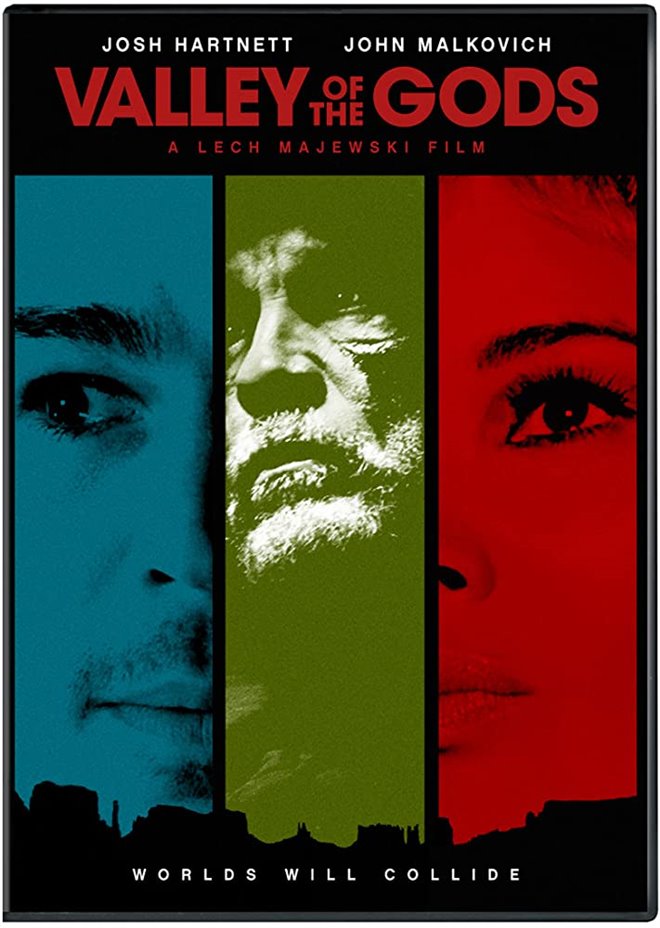
Of all the films this year that have been forced by circumstances to make their debuts via home video and streaming services, I can’t think of one that I would’ve rather seen in a theater than “Valley of the Gods.” This is partly because it is indeed a large-scale drama with a grand visual sweep that presumably needs a big screen to be properly appreciated. However, the real reason I wish that I could have seen it in a theater is to be able to see the faces of the other audience members once the end credits started rolling. My guess is that their facial expressions would greatly resemble those of the first night crowd for “Springtime for Hitler” at the end of the opening number. This is a movie so strange, bizarre and so unclassifiable that as soon as I was done watching it, I contacted my editor to see if deploying the phrase “batshit crazy” would be acceptable. It was approved but I have decided not to employ it on the basis that even that description undersells the experience.

As the film opens, a man (Josh Hartnett) arrives at the Valley of the Gods, an area of southeastern Utah near Monument Valley where the spirits of Navajo Indian deities are said to reside within the enormous stones on display. The man pulls a desk out of the back of his car and begins writing, in longhand, of course. In due time, we learn that he is John Ecas, an advertising copywriter whose life has collapsed since his wife (Jaime Ray Newman) left him, evidently for her hang gliding instructor. His therapist (John Rhys-Davies) suggests that the best way for John to cut through all the absurdity that he sees in the world is to beat it at its own game by doing things that are even crazier—climbing up a mountain face while dragging all of his pots and pans with him or walking the streets both backwards and blindfolded. Having accomplished those feats, John has now decided to write the novel that he has always dreamed of penning and while I cannot be 100% sure, it is implied that most of the rest of the film is a visualization of what he is creating.

This eventually introduces us to Wes Tauros, the richest man in the world, and rumored to have gone mute following a personal tragedy. He is played by John Malkovich, who is not exactly the first person one might think of to play a mute. Anyway, he’s in the midst of closing a deal to acquire the mineral rights to the Valley of the Gods in order to mine for uranium, a move that divides the Navajos still living there between those who want the money that they will receive as part of the deal and those upset that the development of the land will desecrate what they consider to be holy ground. Eventually, John turns up at Tauros’ super-lavish estate in order to write the man’s biography but discovers things that are peculiar, even by the standards of a character played by John Malkovich.

By most critical standards, “Valley of the Gods” is a film that starts off as being fairly berserk and quickly becomes frothing mad. It feels as though writer/director Lech Majewski had a marathon of the films of Terrence Malick and the recent works of Wim Wenders and decided to try to make something that would combine the two, minus the lucid plotting. The narrative, which unfolds via a prologue and ten separate chapter headings, is, to put it charitably, a mess. The various plot threads involving the rich man, the tormented writer, and the Navajos are largely inscrutable and they do not so much weave together towards the end as much as they clumsily crash into each other. Too often, Majewski abandons them entirely to go off onto strange tangents that range from Tauros catapulting a luxury car over a cliff vis some dubious effects work, to the scenes in which Keir Dullea turns up as the rich man’s spectral butler. (This may indeed be the most bewildering film that Dullea has ever appeared in and you know what his most famous credit is.) Then there is Bérénice Marlohe, who turns up in the world’s stretchiest limousine but otherwise does nothing but get a makeover and appear in what is only the film’s third most ridiculous sex scene. (The winner, FYI, is the bewildering sequence where one of the Navajos climbs up a giant rock formation and, uh, has sex with it.)

So yeah, the movie doesn’t “work,” as they say. And yet, even though it pretty much goes off the rails right from the start, never to return, I never quite minded. The film may be nuts but it certainly isn’t boring and there is never a moment where you feel the plot gears grinding away—this is definitely a movie that moves to the beat of a different drummer, even when it seems as if the drummer in question is Keith Moon. Additionally, it has a formal beauty to it that can’t be denied and which is frequently ravishing to behold—there are times when you just want to sit back and let the whole thing just wash one you. I also admired the willingness of actors like Hartnett and Malkovich to go way out on an artistic limb by taking part in it.

“Valley of the Gods” is a film that most people may find to be, at best, wildly uneven and frequently ridiculous and I cannot disagree with those assertions. However, I am still kind of happy that I saw it and I know that there are things in it that I will remember long after most of the more conventional movies of late have faded away. If you are someone who has in the past embraced such wonderfully unrestrained and seemingly foolhardy cinematic visions as Emir Kusturica’s “Arizona Dream” (1994), Richard Kelly’s “Southland Tales” (2006) or the Werner Herzog title of your choice, you might want to check this one out for yourself. If you do, be sure to stick it out for the jaw-dropping finale in which … well, you wouldn’t believe me even if I told you. 

____________________

Watch Valley of the Gods on Hoopla here: https://www.hoopladigital.com/title/13724818

Saturday Matinee: Stranger at the Gate

How Many Strangers Are At the Gate?

By David Swanson

Source: Let’s Try Democracy

Spolier Alert: if you want to watch an excellent 30-minute film without knowing what happens, scroll down and watch it before reading any of these words.

We’ve long known that U.S. mass-shooters are disproportionately trained in shooting by the U.S. military. I don’t know whether the same applies to those who kill in the U.S. with bombs. I wouldn’t be surprised if the connection were even greater.

The Oscar-nominated short film Stranger at the Gate tells the story of a man who went from a difficult childhood straight into the U.S. military at 18.

When learning to shoot at paper targets, he had concerns about killing actual people. He recounts being given the advice that if he could look at those he would kill as anything other than human he would have no problems. So, that, he says, is what he did.

But, of course, conditioning people to thoughtlessly kill doesn’t provide them with any way of being unconditioned again, of comfortably ceasing to be self-deceptive murderers.

This guy went off to U.S. wars where he killed people he thought of as Muslims. The characterization of the people killed as belonging to an evil religion, was largely a game of military propaganda. The actual motivations of those picking the wars tended to have more to do with power, global domination, profits, and politics. But bigotry has always been used to sucker the rank and file into doing what’s desired.

Well, this good soldier did his job and returned to the United States believing that he had done his job, and that that job had been to kill Muslims because of the evil of Muslims. There was no Off switch.

He was troubled. He was drunk. The lies didn’t rest easily. But the lies had a tighter grip than the truth. When he saw that there were Muslims in his hometown, he believed he needed to kill them. Yet he grasped that he would no longer be praised for it, that he would now be condemned for it. Even so, he still believed in the cause. He decided that he would go to the Islamic Center and find proof of the evil of the Muslims that he could show everyone, and then he would blow the place up. He hoped to kill at least 200 people (or non-people).

The men and women at the Islamic Center welcomed him and transformed him.

In the United States today one may want to rewrite this line:

“Do not neglect to show hospitality to strangers, for by so doing some people have entertained angels without knowing it.”

in this way:

“Do not neglect to show hospitality to strangers, for by so doing some people have entertained would-be mass-murderers without knowing it.”

How many?

Nobody knows.

Saturday Matinee: The Warriors

By Dante James

Source: Film Threat

Warriors… come out to play! Warriors… come out to play!

One of the most well-known movie chants in cinematic history has passed the 30-year mark.

When The Warriors, starring a bunch unknown actors at the time, made its debut in ‘79, No one could have predicted it would be considered one of the greatest “cult classics” in film history… but here we are.

And if you were to ask any fan of The Warriors why this film has stood the test of time in cult fandom, most will never be able to give you a solid reason other than: “It’s just f*****g cool, man!” But that’s the magic of this movie!

The concept was simple enough. Street gangs from all over New York would come to a truce and unite under the highly respected urban messiah, Cyrus (Roger Hill), Leader of the Grammercy Riffs. A meeting was called in Central Park where they would all hear his message of strength in numbers against the cops. Except, everything goes wrong when Luthor (David Patrick Kelly), leader of Rogues, for no apparent reason other than he was bored, pulls his gun and kills Cyrus from the crowd.

But instead of getting caught, he immediately blamed one of The Warriors, the gang from Coney Island, for the assassination. After violently beating their leader, Cleon (Dorsey Wright), the gangs turned their attention to rest of The Warriors: Swan (Michael Beck), Ajax (James Remar), Rembrandt (Marcelino Sanchez), Vermin (Terry Michos), Cochise (David Harris), Snow (Bryan Tyler), and Cowboy (Tom McKitterick). And from here on out, they have every gang in New York after their a*s as they try to make it back home to Coney.

During this time in cinema (the mid to late 70s), there was an influx of genre movies that were becoming more and more popular. Blaxploitation, gritty cop dramas, and of course, kung fu.

What set The Warriors apart from most films (at the time) was how stylized it was. Starting with how very eccentric and themed all the different gangs were:

The Grammercy Riffs: The biggest and most feared gang made up of Black Kung Fu artist.

The Lizzies: The punk, all-girl gang.

The Boppers: The Harlem crew who looked like 1920s gangsters.

The Turnball AC’s: The skinhead, rabid, “Mad-Max” psychopaths.

The Baseball Furies: The gang dressed like the New York Yankees with facepaint and big bats!

This is just a few of the 20 or more gangs featured in this film. But it was enough to have every 10-year-old boy’s imagination working overtime!

Though there wasn’t a ton of dialogue in the film, the performances were strong all the way through. Especially that of Lynne Thigpen, who plays “The Voice,” a radio DJ who gave the other gangs sightings of The Warriors so they could continue their hunt. And though you never see her entire face in the whole film except for her lips, she brings the much-needed weight that makes the film feel legit.

Deborah Van Valkenburgh, who played the mouthy, tough-girl Mercy who helps The Warriors navigate through the dangerous city, was a stand-out! You go from wanting her to get pushed into ongoing traffic, to loving her by the end. Valkenburgh, though not a household name, has been consistently working in Hollywood even to this day. But her role as Mercy is still the one she gets the most recognition for!

James Remar, who is noted bad-a*s in every movie he’s in, makes Ajax the one Warrior that we all gravitate towards. Even to the point of stealing scenes away from Michael Beck who at this point in the movie, is the actual lead. Ajax’s rumble with The Baseball Furies is still the most memorable fight in the movie!

Another performance that should not go unnoticed is that of Hollywood’s favorite bad guy, David Patrick Kelly who plays Luthor, Leader of The Rogues. From the moment he kills Cyrus, until the end of the film, he delivers on being the scumbag we love to hate. And of course, he’ll always be remembered for his legendary scene in the car as The Rogues have The Warriors cornered at the beach and taunts them by clinking three bottles together on his fingers over and over chanting: “Warriors… Come out to play!” And rumor has it, this scene was completely improvised by Kelly, which makes it even more classic.

The Warriors saw a resurgence in the early 2000s. With not only a video game from developer Rockstar Studios but also with an updated re-release of the film with added footage. People at comic conventions were now cosplaying as The Warriors and all of the different gangs from the film. There have been several reunions with the cast (that are still living), and talks of a reboot.

For many guys in my generation (Gen X), The Warriors has been a constant on most “Best of” list. And for me personally, It’s one film that can’t be redone for the simple fact, there isn’t a living director that can capture what made this movie work!

If you’ve never seen this film, I can’t recommend it highly enough. It’s definitely in my TOP 5 of “All time greatest movies.”  

*Pro-Tip: It’s best watched late at night, completely in the dark, with some beer and popcorn*

____________________

Watch The Warriors on Hoopla here: https://www.hoopladigital.com/title/15742134

Saturday Matinee: In the Mouth of Madness

That Time John Carpenter Went Meta With ‘In the Mouth of Madness’

As always, Carpenter was light years ahead of his time.

By Nick L.

Source: Collider

One of John Carpenter’s more endearing traits is his aversion to self-effacing clowning. This is not at all to suggest that Carpenter’s films aren’t funny — rather, it’s that the living genre legend often opts to play familiar B-movie scenarios completely straight, whether it be a terse gangland standoff rendered as a modern-day Western showdown (Assault On Precinct 13, one of the most influential films of the 20th century) or a masked killer, bereft of any overwrought psychological motive, terrorizing the inhabitants of a sleepy all-American suburb (Halloween, of course). While Carpenter has dabbled in satire (They Live) and high-concept fantasy (Big Trouble In Little China) over the course of his now decades-spanning career, the grounded nature of his approach is often its own reward. The Escape From New York director has all but perfected an economical, tough-minded creative ethos that has gone on to influence an entire generation of filmmakers dabbling in sci-fi, horror, and beyond.

Going Meta Before It Was Cool

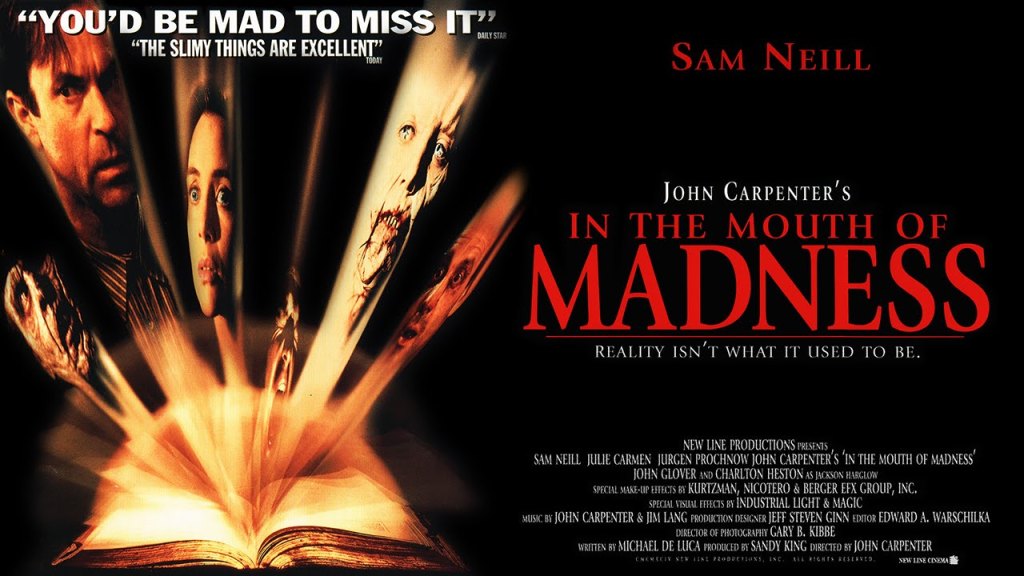
In the Mouth of Madness, Carpenter’s glorious 1994 cult masterpiece, might be the most conspicuous exception to this rule. The story of an insurance investigator who begins losing his grip on reality while probing the mysterious disappearance of a lucratively popular horror author named Sutter Cane, In the Mouth of Madness is an unabashedly meta exploration of the creative act as a form of hypnosis. It is not only a film whose central plot conceit is unique to the moral panic that defined so much of the decade in which it was released (the idea that exposure to certain “corrupt” media could warp one’s brain and possibly even compel one to commit violent acts, etc.), it’s also a cutting cautionary tale about surrendering to artifice and fantasy, and a clever-but-never-obnoxious social lampoon about what it means to be considered the master of a low trade.

Of course, John Carpenter knows a thing or two about being unfairly labeled as the master of a low trade. Carpenter, who is known for his tell-it-like-it-is demeanor, once quipped: “In England, I’m a horror director. In Germany, I’m a filmmaker. In the U.S., I’m a bum.” Films like the Jeff Bridges-starring Starman and the memorably nasty high school bloodbath Christine might be considered totemic cult items today, but many of Carpenter’s more beloved works were initially decried as trash in their time. As such, Carpenter and screenwriter Michael De Luca (yes, that Michael De Luca) turn In the Mouth of Madness’ most important character, Sutter Cane, into the Ernest Hemingway of airport novels. Clearly, the obvious allusion with Cane is Stephen King (or perhaps, to a lesser extent, Clive Barker), right down to the fact that Mouth of Madness eventually makes a narrative detour to Hobb’s End: a kind of bastardized stand-in for King’s own sleepy, creepy fictional borough, Castle Rock.

Third Film of the Apocalypse Trilogy

In The Mouth Of Madness opens with Sam Neil’s John Trent being admitted to a psychiatric hospital. He appears to have gone stark-raving mad, as evidenced by the demented look in his eyes, and the vaguely occult-looking marks he’s scrawled onto his face. In a gesture that feels borrowed from a tale by H.P. Lovecraft (Carpenter’s reverence for Lovecraft is well-documented at this point), Trent begins to recall the tale of how exactly he went mad. We learn that when Trent worked in insurance, his employer (Charlton Heston) tasked him with looking into the matter of Sutter Cane. For all intents and purposes, Cane appears to have vanished off the face of the earth. After its ghoulish prologue, Mouth of Madness settles into a more deliberately routine rhythm, only to disappear further and further down the proverbial rabbit hole as Trent and a colleague, Cane’s editor (memorably played by Julie Carmen), find themselves lost among the otherworldly horrors of Hobb’s End.

In The Mouth Of Madness is the third and final film in John Carpenter’s “Apocalypse Trilogy,” which also includes The Thing and the criminally underappreciated Prince of Darkness. In all three films, evil manifests as a primarily unseen, invisible force, often contorting familiar things like dogs, books, and human bodies into horrifying and hitherto-unseen new shapes. In The ThingKurt Russell and his motley crew of researchers hole up in icy Arctic seclusion, fending off the malevolent energy of a shapeshifting, violently hostile alien parasite. In Prince Of Darkness, a group of college students occupy an incredibly menacing old church, where they proceed to unearth a tube of neon-green liquid that, if mishandled, could unleash the very literal fury of the devil. Both movies are steeped in Lovecraftian imagery and primordial terror, and both amplify the built-in claustrophobia of their settings to phantasmagoric degrees.

In The Mouth Of Madness is a funnier, sillier, more stylistically gonzo effort than its two predecessors in the trilogy, mostly because it purports to stand outside the nuts and bolts of its superficial narrative, to some degree, and actually comment on the art of what it means to scare people for a living. There is something wickedly ingenious about the idea of a popular novel whose contents are so unholy that reading it would cause one to spiral into a kind of monstrous abyss. If that idea alone were all the movie were interested in, In the Mouth of Madness would still rank as one of Carpenter’s more enjoyable late-career works. And yet, as always, the director is keen to dig deeper into the subtextual resonance of his story, turning what might otherwise be a spooky ’90s chiller — the type of thing you might have caught a rerun of on TBS sometime back in the 2000s — into a cheeky, compelling commentary on the horror pantheon itself, and Carpenter’s place in it.

We live in an era where people willingly and enthusiastically sign themselves over to fictional “universes.” Whether it’s MarvelStar Wars, Game of Thrones, or perhaps something more obscure, we now inhabit an epoch in which individuals willingly give themselves up to elaborate forms of corporate mythology. In some cases, this sort of fanboy devotion can swallow you whole. In the Mouth of Madness is concerned with this very subject. It is no wonder the film was greeted with such indifferent critical notices upon its release: as always, Carpenter was light years ahead of his time. The scariest thing about In the Mouth of Madness is that, in the world Carpenter hath created, Sutter Cane himself isn’t even seen as a mere writer of trash books — when he’s finally revealed, he is tellingly and literally depicted as a prophet.