NATO prolongs the Ukraine proxy war, and global havoc

With diplomacy thwarted, the US and its allies plan for “open-ended” military and economic warfare against Russia, no matter the costs at home and abroad.
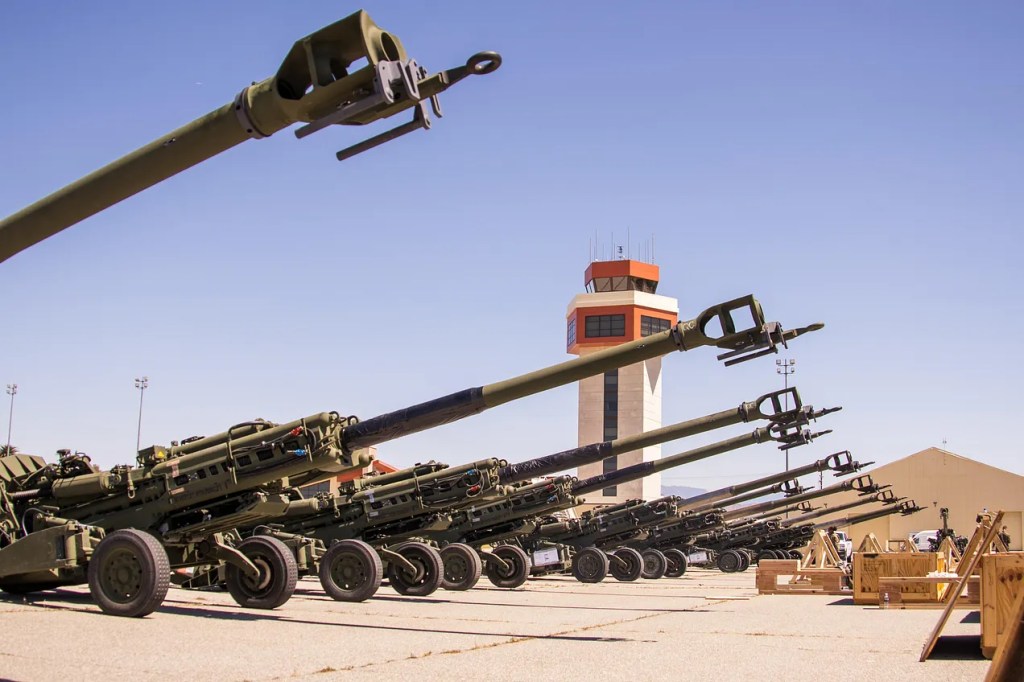
(US Dept. of Defense)

By Aaron Maté

Source: Aaron Mate Substack

Russia has announced plans to mobilize an additional 300,000 troops for the war in Ukraine. In his speech unveiling the expanded war effort, Vladimir Putin vowed to achieve his main goal of the “liberation of Donbas,” and issued a thinly veiled nuclear threat in the process. The move comes days ahead of planned referendums in breakaway Ukrainian areas to formalize Russian annexation.

Russia’s escalation ensures that the fighting is entering an even more dangerous phase. While Russia bears legal and moral responsibility for its invasion, recent developments underscore that NATO leaders have shunned opportunities to prevent further catastrophe and chosen instead to fuel it.

Putin’s announcement comes just after the Ukrainian military’s routing of Russian forces from Kharkiv, which relied extensively on US planning, weaponry and intelligence, sparked triumphant declarations that the tide has turned.

According to The Atlantic’s Anne Applebaum, “Americans and Europeans need to prepare for a Ukrainian victory,” one so overwhelming that it may well bring “about the end of Putin’s regime.”

Beyond the chorus of emboldened neoconservatives, Western officials are less sanguine.

“Certainly it’s a military setback” for Russia, a US official said of the Kharkiv retreat to the Washington Post. “I don’t know if I could call it a major strategic loss at this point.” Germany’s defense chief, General Eberhard Zorn, said that while Ukraine “can win back places or individual areas of the frontlines,” overall, its forces can “not push Russia back over a broad front.”

Whether or not it marked a major strategic loss for Russia, the battle in Kharkiv is already a major victory for NATO leaders seeking to prolong their proxy war in Ukraine and economic warfare next door.

Ukraine’s expulsion of Russian forces in the northeast, the New York Times reports, has “amplified voices in the West demanding that more weapons be sent to Ukraine so that it could win.”

“Despite Ukrainian forces’ startling gains in the war against Russia,” the Washington Post adds, “the Biden administration anticipates months of intense fighting with wins and losses for each side, spurring U.S. plans for an open-ended campaign with no prospect for a negotiated end in sight.”

As has been apparent since the Ukraine crisis erupted, US planning for open-ended proxy warfare against Russia has led it to sabotage any prospect of a negotiated end.

The US rejection of diplomacy around Ukraine has been newly substantiated by former White House Russia expert Fiona Hill. Citing “multiple former senior U.S. officials,” Hill reports that in April of this year “Russian and Ukrainian negotiators appeared to have tentatively agreed on the outlines of a negotiated interim settlement.” Under this framework, Russia would withdraw to its pre-invasion position, while Ukraine would pledge not to join NATO “and instead receive security guarantees from a number of countries.”

In confirming that US officials were aware of this tentative agreement, Hill bolsters previous news that Washington’s junior partner in London was enlisted to thwart it. As Ukrainian media reported, citing sources close to Ukrainian President Volodymyr Zelensky, UK Prime Minister Boris Johnson traveled to Kiev in April and relayed the message that Russia “should be pressured, not negotiated with.” Johnson also informed Zelensky that “even if Ukraine is ready to sign some agreements on [security] guarantees with Putin,” his Western patrons “are not.” The talks promptly collapsed.

In his speech announcing the expanded war effort, Putin invoked this episode. After the invasion began, he said, Ukrainian officials “reacted very positively to our proposals… After certain compromises were reached, Kyiv was actually given a direct order to disrupt all agreements.”

Having undermined the prospect of a negotiated peace in the war’s early weeks, proxy warriors in Washington are openly celebrating their success.

“I like the structural path we’re on here,” Republican Senator Lindsey Graham recently declared. “As long as we help Ukraine with the weapons they need and the economic support, they will fight to the last person.”

Graham’s avowed willingness to expend every “last person” in Ukraine to fight Russia is in line with a broader US strategy that views the entire world as subordinate to its war aims. As the Washington Post reported in June, the White House is willing to “countenance even a global recession and mounting hunger” in order to hand Russia a costly defeat. In Ukraine, this now means also countenancing the threat of nuclear disaster, as the crisis surrounding the Zaporizhzhia nuclear power plant has laid bare.

The prevailing willingness to sacrifice civilian well-being extends to the US public, as National Security Advisor Jake Sullivan has newly made clear. Appearing at the Aspen Security Conference, Sullivan was asked if he is worried about the “American people’s staying power” on the Ukraine proxy war, amid “criticism that we’re spending billions and billions to support Ukraine, and not spending it here.”

 “Fundamentally not,” Sullivan responded. “It’s very important for Putin to understand what exactly he’s up against from the point of view of the United States’ staying power.” That staying power, Sullivan explained, was cemented in the $40 billion war funding measure overwhelmingly approved by Congress (including every self-identified progressive Democrat) in May.

“That can go on, just on the basis of what we have already had allocated to us and resources for a considerable period of time,” Sullivan vowed. “And then, I strongly believe that there will be bipartisan support in the Congress to re-up those resources should it become necessary.”

To policymakers like Sullivan, there is not only an endless pool of money to “re-up” the war, but a “fundamentally” indifferent posture toward the taxpayers footing the bill.

Despite Biden’s reported scolding of Defense Secretary Lloyd Austin for admitting that the US goal in Ukraine is to leave Russia “weakened,” Sullivan – speaking before a friendly Beltway crowd — also forgot to stick to the script.

The US “strategic objective” in Ukraine, Sullivan explained, is to “ensure that Russia’s invasion of Ukraine… is a strategic failure for Putin,” and that “Russia pay a longer-term price in terms of the elements of its national power.” This would teach a “lesson,” he added, “to would-be aggressors elsewhere.”

By “would-be aggressors elsewhere”, Sullivan naturally precludes the US and its allies, whose aggression is not only permitted but promoted under the US-led “rules-based international order.”

President Biden has made that clear by abandoning his pledge to make Saudi Arabia a “pariah” state, notwithstanding its murderous (US-backed) aggression in Yemen. The regular aggression by US ally Israel against Gaza and Syria also continues unabated. The United Nations just reported that an Israeli strike on the Damascus international airport in June – one of hundreds of Israeli bombings on Syria that go largely ignored — “led to considerable damage to infrastructure” and “meant the suspension of U.N. deliveries of humanitarian assistance” to Syrians in need for nearly two weeks. As of this writing, the latest Israeli strike killed five Syrian soldiers, eliciting no Western media and political protest. It is more accurate to describe Israeli aggression on Syria as a joint Israeli-US effort, given that the US reviews and approves the strikes.

Allied NATO leaders are also vocally countenancing the Ukraine proxy war’s costs on their domestic populations. In response to the European sanctions, Russia has now halted gas deliveries to the EU via the key Nord Stream 1 pipeline. Having previously relied on Russia for close to 40 percent of its gas needs, European industries are facing layoffs, factory closures, and higher energy bills that “are pushing consumers to near poverty,” the Financial Times reports.

“People want to end the war because they cannot bear the consequences, the costs,” the EU’s Josep Borell observed this month. While ending the war might appeal to some, it does not interest the EU’s top diplomat. “This mentality must be overcome,” Borell declared. “The offensive on the northeastern front helps with that.”

Europe, NATO chief Jens Stoltenberg recently wrote, may even face “civil unrest,” as economies contract and temperatures drop, but “for Ukraine’s future and for ours, we must prepare for the winter war and stay the course.”

“No matter what my German voters think, I want to deliver to the people of Ukraine,” Germany’s Foreign Minister Annalena Baerbock told a conference in Prague last month. During the upcoming winter, Baerbock acknowledged, “we will be challenged as democratic politicians. People will go in the street and say ‘We cannot pay our energy prices’.” While pledging to help people “with social measures,” Baerbock insisted that the European Union’s sanctions on Russia will remain. “The sanctions will stay also in wintertime, even if it gets really tough for politicians,” she said.

Whereas Western leaders appear confident they can manage civil unrest at home, they face additional resistance abroad. In Africa, a leaked report from the European Union’s envoy to the continent warns that African nations are blaming the EU’s Russia sanctions for food shortages. The report also cautions that “the EU is seen as fueling the conflict,” in Ukraine, “not as a peace facilitator.”

Rather than address these African concerns, the envoy’s office proposes a “more transactional… approach” in which the EU makes “clear” that its “willingness” to “maintain higher levels” of foreign aid “will depend on working based on common values and a joint vision,” – in short, on Africa falling in line.

That is undoubtedly the US policy, as UN Ambassador Linda Thomas-Greenfield made clear last month. After promising a “listening tour,” Thomas-Greenfield instead came to Africa with a dictate and an outright threat. “Countries can buy Russian agricultural products, including fertilizer and wheat,” she decreed. But “if a country decides to engage with Russia” and break US sanctions, “they stand the chance of having actions taken against them.” That Africa faces a food security crisis, with hundreds of millions going hungry, is apparently of lower importance.

While Western sanctions on Russia wreak havoc worldwide, the architects in Washington seem only perturbed by their failure, so far, to inflict the intended levels of suffering on Russian civilians. “We were expecting” that US sanctions “would totally crater the Russian economy” by now, a disappointed senior US official told CNN.

Other US officials are leaving room for hope. “There’s going to be long-term damage done to the Russian economy and to generations of Russians as a result of this,” CIA Director William Burns told a cybersecurity conference this month. Burns’ long-term forecast of harming “generations of Russians” is based on extensive planning. As one US official explained it to CNN, when the sanctions were designed, Biden officials not only “wanted to keep pressure on Russia over the long term as it waged war on Ukraine,” but also “wanted to degrade Russia’s economic and industrial capabilities.” Accordingly, “we’ve always seen this as a long-term game.”

The “long-term game” of trying to destroy Russia’s economy and immiserate “generations” of its citizens is accompanied by increasing plans for a long-term fight. The Biden administration plans to formally name the US military mission in Ukraine – such as in prior campaigns like Operation Desert Storm — while also appointing a general to oversee the effort. The naming, the Wall Street Journal observes, is “significant bureaucratically, as it typically entails long-term, dedicated funding.”

The US plan for a long-term military and economic campaign against Russia is being implemented despite the awareness that Ukraine could face far worse.

“Some American officials express concern that the most dangerous moments are yet to come,” the New York Times reports. To date, “Putin has avoided escalating the war in ways that have, at times, baffled Western officials.” Unlike US military campaigns in Iraq, Russia “has made only limited attempts to destroy critical infrastructure or to target Ukrainian government buildings.”

“The current moment draws attention to a tension that underlies America’s strategy for the war,” the Washington Post observes, “as officials channel massive military support to Ukraine, fueling a war with global consequences, while attempting to remain agnostic about when and how Kyiv might strike a deal to end it.”

These rare admissions not only contradict the typical portrayal of a genocidal Russia that is used to justify the proxy war, but capture the underlying policy driving it. More than six months in, US officials are aware that Russia has “avoided escalating the war” and targeting “critical infrastructure,” – to the point where these same officials are “baffled” by Russian restraint. Despite this, their policy centers on “fueling” this same war, while remaining “agnostic” about ending it.

War being fluid – and US-led military support for Ukraine ever-expanding – it is of course possible that Ukraine will continue to defy expectations and drive out the invading Russian forces.

What the latest developments on and off the battlefield make undoubtedly clear is that NATO states are willing to use Ukraine for as long as it takes to achieve the stated aim of leaving Russia “weakened” or even achieving regime change, no matter the damage knowingly inflicted on Ukrainians, Russians, the Global South, and their own citizens.
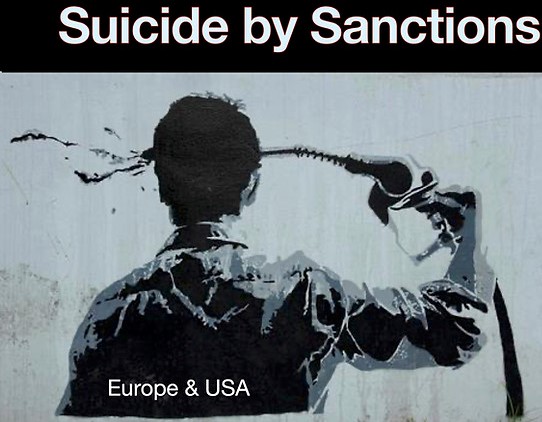
Europe Commits Suicide-By-Sanctions

Relentless Ukraine reporting helps conceal other conflicts

By Ron Paul

Source: Eurasia Review

A Swiss billboard is making the rounds on social media depicting a young woman on the telephone. The caption reads, “Does the neighbor heat the apartment to over 19 degrees (66F)? Please inform us.” While the Swiss government has dismissed the poster as a fake, the penalties Swiss citizens face for daring to warm their homes are very real. According to the Swiss newspaper Blick, those who violate the 66 degree heating limit could face as many as three years in prison!

Prison time for heating your home? In the “free” world? How is it possible in 2022, when Switzerland and the rest of the political west have achieved the greatest economic success in history, that the European continent faces a winter like something out of the dark ages?

Sanctions.

While long promoted – often by those opposed to war – as a less destructive alternative to war, sanctions are in reality acts of war. And as we know with interventionism and war, the result is often unintended consequences and even blowback.

European sanctions against Russia over its invasion of Ukraine earlier this year will likely go down in history as a prime example of how sanctions can result in unintended consequences. While seeking to punish Russia by cutting off gas and oil imports, European Union politicians forgot that Europe is completely dependent on Russian energy supplies and that the only people to suffer if those imports are shut down are the Europeans themselves.

The Russians simply pivoted to the south and east and found plenty of new buyers in China, India, and elsewhere. In fact, Russia’s state-run Gazprom energy company has reported that its profits have increased by 100 percent in the first half of this year.

Russia is getting rich while Europeans are facing a freezing winter and economic collapse. All because of the false belief that sanctions are a cost-free way to force other countries to do what you want them to do.

What happens when the people see dumb government policies making energy bills skyrocket as the economy grounds to a halt? They become desperate and take to the streets in protest.

This weekend thousands of Austrians took to the streets in a “Freedom Rally” to demand an end to sanctions and the opening of Nord Stream II, the gas pipeline on the verge of opening earlier this year. Last week an estimated 100,000 Czechs took to the streets of Prague to protest NATO and EU policy. In France, the “Yellow Vests” are back in the streets protesting the destruction of their economy in the name of “defeating” Russia in Ukraine. In Germany, Serbia, and elsewhere, protests are gearing up.

Even the Washington Post was forced to admit that sanctions on Russia are not having the intended effect. In an article yesterday, the paper worries that sanctions are inflicting “collateral damage in Russia and beyond, potentially even hurting the very countries that impose them. Some even worried that the sanctions intended to deter and weaken Putin could end up emboldening and strengthening him.”

This is all predictable. Sanctions kill. Sometimes they kill innocents in the country targeted for destruction and sometimes they kill innocents in the country imposing them. The solution, as always, is non-intervention. No sanctions, no “color revolutions,” no meddling. It’s really that simple.

Global Planned Financial Tsunami Has Just Begun

By F. William Engdahl

Source: Global Research

Since the creation of the US Federal Reserve over a century ago, every major financial market collapse has been deliberately triggered for political motives by the central bank. The situation is no different today, as clearly the US Fed is acting with its interest rate weapon to crash what is the greatest speculative financial bubble in human history, a bubble it created. Global crash events always begin on the periphery, such as with the 1931 Austrian Creditanstalt or the Lehman Bros. failure in September 2008. The June 15 decision by the Fed to impose the largest single rate hike in almost 30 years as financial markets are already in a meltdown, now guarantees a global depression and worse.

The extent of the “cheap credit” bubble that the Fed, the ECB and Bank of Japan have engineered with buying up of bonds and maintaining unprecedented near-zero or even negative interest rates for now 14 years, is beyond imagination. Financial media cover it over with daily nonsense reporting , while the world economy is being readied, not for so-called “stagflation” or recession. What is coming now in the coming months, barring a dramatic policy reversal, is the worst economic depression in history to date. Thank you, globalization and Davos.

Globalization

The political pressures behind globalization and the creation of the World Trade Organization out of the Bretton Woods GATT trade rules with the 1994 Marrakesh Agreement, ensured that the advanced industrial manufacturing of the West, most especially the USA, could flee offshore, “outsource” to create production in extreme low wage countries. No country offered more benefit in the late 1990s than China. China joined WHO in 2001 and from then on the capital flows into China manufacture from the West have been staggering. So too has been the buildup of China dollar debt. Now that global world financial structure based on record debt is all beginning to come apart.

When Washington deliberately allowed the September 2008 Lehman Bros financial collapse, the Chinese leadership responded with panic and commissioned unprecedented credit to local governments to build infrastructure. Some of it was partly useful, such as a network of high-speed railways. Some of it was plainly wasteful, such as construction of empty “ghost cities.” For the rest of the world, the unprecedented China demand for construction steel, coal, oil, copper and such was welcome, as fears of a global depression receded. But the actions by the US Fed and ECB after 2008, and of their respective governments, did nothing to address the systemic financial abuse of the world’s major private banks on Wall Street and Europe , as well as Hong Kong.

The August 1971 Nixon decision to decouple the US dollar, the world reserve currency, from gold, opened the floodgates to global money flows. Ever more permissive laws favoring uncontrolled financial speculation in the US and abroad were imposed at every turn, from Clinton’s repeal of Glass-Steagall at the behest of Wall Street in November 1999. That allowed creation of mega-banks so large that the government declared them “too big to fail.” That was a hoax, but the population believed it and bailed them out with hundreds of billions in taxpayer money.

Since the crisis of 2008 the Fed and other major global central banks have created unprecedented credit, so-called “helicopter money,” to bailout the major financial institutions. The health of the real economy was not a goal. In the case of the Fed, Bank of Japan, ECB and Bank of England, a combined $25 trillion was injected into the banking system via “quantitative easing” purchase of bonds, as well as dodgy assets like mortgage-backed securities over the past 14 years.

Quantitative madness

Here is where it began to go really bad. The largest Wall Street banks such as JP MorganChase, Wells Fargo, Citigroup or in London HSBC or Barclays, lent billions to their major corporate clients. The borrowers in turn used the liquidity, not to invest in new manufacturing or mining technology, but rather to inflate the value of their company stocks, so-called stock buy-backs, termed “maximizing shareholder value.”

BlackRock, Fidelity, banks and other investors loved the free ride. From the onset of Fed easing in 2008 to July 2020, some $5 trillions had been invested in such stock buybacks, creating the greatest stock market rally in history. Everything became financialized in the process. Corporations paid out $3.8 trillion in dividends in the period from 2010 to 2019. Companies like Tesla which had never earned a profit, became more valuable than Ford and GM combined. Cryptocurrencies such as Bitcoin reached market cap valuation over $1 trillion by late 2021. With Fed money flowing freely, banks and investment funds invested in high-risk, high profit areas like junk bonds or emerging market debt in places like Turkey, Indonesia or, yes, China.

The post-2008 era of Quantitative Easing and zero Fed interest rates led to absurd US Government debt expansion. Since January 2020 the Fed, Bank of England, European Central Bank and Bank of Japan have injected a combined $9 trillion in near zero rate credit into the world banking system. Since a Fed policy change in September 2019, it enabled Washington to increase public debt by a staggering $10 trillion in less than 3 years. Then the Fed again covertly bailed out Wall Street by buying $120 billion per month of US Treasury bonds and Mortgage-Backed Securities creating a huge bond bubble.

A reckless Biden Administration began doling out trillions in so-called stimulus money to combat needless lockdowns of the economy. US Federal debt went from a manageable 35% of GDP in 1980 to more than 129% of GDP today. Only the Fed Quantitative Easing, buying of trillions of US government and mortgage debt and the near zero rates made that possible. Now the Fed has begun to unwind that and withdraw liquidity from the economy with QT or tightening, plus rate hikes. This is deliberate. It is not about a stumbling Fed mis-judging inflation.

Energy drives the collapse

Sadly, the Fed and other central bankers lie. Raising interest rates is not to cure inflation. It is to force a global reset in control over the world’s assets, it’s wealth, whether real estate, farmland, commodity production, industry, even water. The Fed knows very well that Inflation is only beginning to rip across the global economy. What is unique is that now Green Energy mandates across the industrial world are driving this inflation crisis for the first time, something deliberately ignored by Washington or Brussels or Berlin.

The global shortages of fertilizers, soaring prices of natural gas, and grain supply losses from global draught or exploding costs of fertilizers and fuel or the war in Ukraine, guarantee that, at latest this September-October harvest time, we will undergo a global additional food and energy price explosion. Those shortages all are a result of deliberate policies.

Moreover, far worse inflation is certain, due to the pathological insistence of the world’s leading industrial economies led by the Biden Administration’s anti-hydrocarbon agenda. That agenda is typified by the astonishing nonsense of the US Energy Secretary stating, “buy E-autos instead” as the answer to exploding gasoline prices.

Similarly, the European Union has decided to phase out Russian oil and gas with no viable substitute as its leading economy, Germany, moves to shut its last nuclear reactor and close more coal plants. Germany and other EU economies as a result will see power blackouts this winter and natural gas prices will continue to soar. In the second week of June in Germany gas prices rose another 60% alone. Both the Green-controlled German government and the Green Agenda “Fit for 55” by the EU Commission continue to push unreliable and costly wind and solar at the expense of far cheaper and reliable hydrocarbons, insuring an unprecedented energy-led inflation.

Fed has pulled the plug

With the 0.75% Fed rate hike, largest in almost 30 years, and promise of more to come, the US central bank has now guaranteed a collapse of not merely the US debt bubble, but also much of the post-2008 global debt of $303 trillion. Rising interest rates after almost 15 years mean collapsing bond values. Bonds, not stocks, are the heart of the global financial system.

US mortgage rates have now doubled in just 5 months to above 6%and home sales were already plunging before the latest rate hike. US corporations took on record debt owing to the years of ultra-low rates. Some 70% of that debt is rated just above “junk” status. That corporate non-financial debt totaled $9 trillion in 2006. Today it exceeds $18 trillion. Now a large number of those marginal companies will not be able to rollover the old debt with new, and bankruptcies will follow in coming months. The cosmetics giant Revlon just declared bankruptcy.

The highly-speculative, unregulated Crypto market, led by Bitcoin, is collapsing as investors realize there is no bailout there. Last November the Crypto world had a $3 trillion valuation. Today it is less than half, and with more collapse underway. Even before the latest Fed rate hike the stock value of the US megabanks had lost some $300 billion. Now with stock market further panic selling guaranteed as a global economic collapse grows, those banks are pre-programmed for a new severe bank crisis over the coming months.

As US economist Doug Noland recently noted, “Today, there’s a massive “periphery” loaded with “subprime” junk bonds, leveraged loans, buy-now-pay-later, auto, credit card, housing, and solar securitizations, franchise loans, private Credit, crypto Credit, DeFi, and on and on. A massive infrastructure has evolved over this long cycle to spur consumption for tens of millions, while financing thousands of uneconomic enterprises. The “periphery” has become systemic like never before. And things have started to Break.”

The Federal Government will now find its interest cost of carrying a record $30 trillion in Federal debt far more costly. Unlike the 1930s Great Depression when Federal debt was near nothing, today the Government, especially since the Biden budget measures, is at the limits. The US is becoming a Third World economy. If the Fed no longer buys trillions of US debt, who will? China? Japan? Not likely.

Deleveraging the bubble

With the Fed now imposing a Quantitative Tightening, withdrawing tens of billions in bonds and other assets monthly, as well as raising key interest rates, financial markets have begun a deleveraging. It will likely be jerky, as key players like BlackRock and Fidelity seek to control the meltdown for their purposes. But the direction is clear.

By late last year investors had borrowed almost $1 trillion in margin debt to buy stocks. That was in a rising market. Now the opposite holds, and margin borrowers are forced to give more collateral or sell their stocks to avoid default. That feeds the coming meltdown. With collapse of both stocks and bonds in coming months, go the private retirement savings of tens of millions of Americans in programs like 401-k. Credit card auto loans and other consumer debt in the USA has ballooned in the past decade to a record $4.3 trillion at end of 2021. Now interest rates on that debt, especially credit card, will jump from an already high 16%. Defaults on those credit loans will skyrocket.

Outside the US what we will see now, as the Swiss National Bank, Bank of England and even ECB are forced to follow the Fed raising rates, is the global snowballing of defaults, bankruptcies, amid a soaring inflation which the central bank interest rates have no power to control. About 27% of global nonfinancial corporate debt is held by Chinese companies, estimated at $23 trillion. Another $32 trillion corporate debt is held by US and EU companies. Now China is in the midst of its worst economic crisis since 30 years and little sign of recovery. With the USA, China’s largest customer, going into an economic depression, China’s crisis can only worsen. That will not be good for the world economy.

Italy, with a national debt of $3.2 trillion, has a debt-to-GDP of 150%. Only ECB negative interest rates have kept that from exploding in a new banking crisis. Now that explosion is pre-programmed despite soothing words from Lagarde of the ECB. Japan, with a 260% debt level is the worst of all industrial nations, and is in a trap of zero rates with more than $7.5 trillion public debt. The yen is now falling seriously, and destabilizing all of Asia.

The heart of the world financial system, contrary to popular belief, is not stock markets. It is bond markets—government, corporate and agency bonds. This bond market has been losing value as inflation has soared and interest rates have risen since 2021 in the USA and EU. Globally this comprises some $250 trillion in asset value a sum that, with every fed interest rise , loses more value. The last time we had such a major reverse in bond values was forty years ago in the Paul Volcker era with 20% interest rates to “squeeze out inflation.”

As bond prices fall, the value of bank capital falls. The most exposed to such a loss of value are major French banks along with Deutsche Bank in the EU, along with the largest Japanese banks. US banks like JP MorganChase are believed to be only slightly less exposed to a major bond crash. Much of their risk is hidden in off-balance sheet derivatives and such. However, unlike in 2008, today central banks can’t rerun another decade of zero interest rates and QE. This time, as insiders like ex-Bank of England head Mark Carney noted three years ago, the crisis will be used to force the world to accept a new Central Bank Digital Currency, a world where all money will be centrally issued and controlled. This is also what Davos WEF people mean by their Great Reset. It will not be good. A Global Planned Financial Tsunami Has Just Begun.

Thanks To The Rapidly Imploding U.S. Economy, Joe Biden’s Poll Numbers Have Plunged To Unprecedented Levels

By Michael Snyder

Source: Economic Collapse Blog

These are not good times for Joe Biden.  When the U.S. economy is performing well whoever is in the White House is going to get most of the credit.  Likewise, when the U.S. economy is performing poorly whoever is in the White House is going to get most of the blame.  That is just the way that it is, and that is one of the primary reasons why most Americans are quite displeased with Joe Biden right now.  Things are not going well at all, and the outlook for the months ahead is even worse.  The American people are becoming increasingly frustrated, and a new Gallup poll that was just released discovered that “confidence” in the presidency has fallen to the lowest level ever recorded

President Joe Biden has pushed the presidency to a place it hasn’t been in nearly 50 years.

In the latest Gallup poll, less than a quarter of those surveyed have “confidence” in the presidency, worse than during the Trump presidency and nearly as bad as the end of the George W. Bush presidency.

Going back to 1975, Gallup has never recorded a confidence reading as low as Biden’s 23%.

Other polls have come up with similarly stunning results.  For example, a different survey that was just released discovered that a whopping 88 percent of all Americans believe that the nation is heading in the wrong direction…

The White House was faced with another dire poll Tuesday that found that 54 percent of Americans believe the middle class hasn’t benefited ‘at all’ from President Joe Biden’s policies.

On top of that, the new Monmouth University Poll found that 88 percent of Americans surveyed said the country was headed in the wrong direction – with just 10 percent saying it’s headed the right way – a record low.

Just think about that.

88 percent.

In this day and age, it is difficult to get 88 percent of Americans to agree on anything.

But almost all of us seem to agree that the country is going downhill, and according to that same survey Americans are currently more concerned about economic matters than anything else

Nearly half those surveyed said inflation and gas were the biggest concerns currently facing their families, with 33 percent saying inflation and 15 percent pointing to fuel costs.

A lot of people out there don’t really care much about what is going on in the world until it starts affecting their personal finances.

And these days the American people are feeling a tremendous amount of pain.

In fact, the consumer confidence index that is put out by the University of Michigan just fell to an all-time record low

The University of Michigan’s gauge of consumer sentiment fell sharply to a record-low reading of 50.2, down from a May reading of 58.4. Economists polled by the Wall Street Journal had expected an June reading of 59.

The level is comparable to the low point reached in the middle of the 1980 recession, the university said.

The American people have never been more pessimistic about the economy.

Ever.

And we have a guy in the White House that has a really difficult time even putting a coherent sentence together at this point.

Of course the team around Biden is not exactly competent either.

Time after time, the Biden administration has made colossal blunders.  This week, we learned that someone in the Biden administration apparently thought that it would be a good idea to send oil from our strategic petroleum reserve to China

Because he hates Americans, President Joe Biden is shipping much-needed American oil to foreign countries, including… China.

The whole idea of the Strategic Petroleum Reserve (SPR), which is owned by the U.S. government, specifically the U.S. Department of Energy, is to hold on to about 700 million barrels of oil in the event of an emergency or disruption.

I was floored when I first read that.

Who would be stupid enough to do such a thing?

Someday we are going to need the oil in the strategic petroleum reserve, and hopefully there will be some left when that moment finally arrives.

This week we have also been getting more numbers that indicate that the economic slowdown in the United States appears to be picking up speed.

According to LinkedIn, hiring in the U.S. is really starting to fall off

LinkedIn, a unit of Microsoft, saw its hiring rate fall 5.4% month over month in June on a seasonally adjusted basis, the lowest level since December 2021, according to new data released on Friday. On an annual basis, the employment platform’s hiring rate tumbled 11.9% in June.

LinkedIn’s hiring rate is calculated based on the percentage of the platform’s members who added a new employer to their profile in the same month the new job began divided by the total number of LinkedIn members in the United States.

And we just learned that new vehicle sales during the month of June were depressingly low

Automakers have now reported their June new vehicle sales, or their Q2 new vehicle sales, for the US, except Tesla, which doesn’t report US sales but only global sales. All automakers, even Toyota, and now even Tesla, are struggling with the ongoing semiconductor shortages, and they started the month of June with desperately low inventories on dealer lots and in transit.

And so new vehicle sales in June plunged by 13.5% from the already horribly beaten-down June 2021, to 1.127 million vehicles, and collapsed by 25% from June 2019, the last decent year in the industry, according to data released by the Bureau of Economic Analysis today

It appears that a recession is already here, and the months ahead are going to be really tough.

So I would encourage you to get out of debt.

And I would also encourage you to build up your emergency fund.

This is not a time to fritter away your money on unnecessary things.  You want to put yourself in the best position possible to weather the “perfect storm” that is ahead, because things certainly aren’t going to be getting easier from here.

As the economy deteriorates, the frustration of the American people is going to get deeper and deeper.

Needless to say, that isn’t good news for Joe Biden.

U.S. Effort to Hurt Russia Undermines Itself and the World

African Union Chairman and Senegal president Macky Sall meeting President Vladimir Putin, June 3, 2022 (Photo:Sputnik/Mikhail Klimentyev/Kremlin via REUTERS)

By Margaret Kimberley

Source: Black Agenda Report

The U.S. drive to dominate creates self-inflicted wounds and self-imposed crises. It also creates suffering around the world with only the most servile vassal states willing to do what Washington wants. 

The United States continues to shoot itself in the foot in its futile effort to damage the Russian economy. It is also asking other nations to do likewise and live with inflation, food scarcity, and rising energy prices. European countries have gone along with the sanctions which cut off their natural gas supplies from Russia when there is no logical alternative source for them. However, the rest of the world has refused to join in U.S. and EU condemnations or accept that they must live with privations caused by the reckless actions of other nations.

Of course, the ongoing state of delusion just continues the fantasy foreign policy decision making in Washington. The Countering Malign Russian Influences in Africa Act, HR 7311 , is just one example. But while the U.S. makes up nonsense as it goes along, the real problems that African nations have with the U.S. and their desire to have good relations with Russia go unaddressed.

Russian president Vladimir Putin recently welcomed Macky Sall, president of Senegal and Chairman of the African Union (AU) to a summit meeting. African countries are particularly hard hit by sanctions against Russia. They depend on Russia and Ukraine for supplies of wheat and other grains. When the sanctions regime removed Russia from the Society for Worldwide Interbank Financial Telecommunication (SWIFT) system, it impeded Africans ability to pay for commodities, including food and fertilizer. In a virtual meeting with the EU, Sall said, “When the SWIFT system is disrupted, it means that even if the products exist, payment becomes complicated, if not impossible.” In other words, Africa has to go hungry because of the U.S. obsession with an impossible mission of breaking up Russia or turning back the clock to the 1990s when compromised Russian leadership allowed their country to be open to international thievery.

African nations are not the only ones who face serious crises because of anti-Russian sanctions. The U.S. expects India and China to give up supplies of Russian oil and cause hardships in those countries. Biden will soon visit Saudi Arabia and ask for an increase in oil production, which of course means that OPEC nations will make less money. Of course, Sall’s visit to Russia could have been a wakeup call to Washington that policy changes were needed, instead they fell back on old strategies, warning African countries not to buy grain from Russia, calling it “stolen ” from Ukraine. At a moment of opportunity, the Biden administration just added insult to injury.

The United States is still the country with the world reserve currency and 800 military bases around the world. This power is never used for the benefit of humanity. The drive to dominate never ends, and people throughout the planet are expected to go along and suffer due to American whims.

That is what the U.S. told the people of Venezuela, who had the gall to elect and re-elect left wing governments. The Trump administration demanded “maximum pressure” against Venezuela, enacting harsh sanctions that killed 50,000 people, cutting off access to foreign markets and even choosing to recognize a phony president.

But a funny thing happened on the way to destroying Russia. The Europeans who go along like good little vassals still need oil, and according to reports the U.S. has decided to allow Venezuela to sell some of its resources to their puppets in their time of need. The U.S. whiplashes from trying to punish one country, to lifting their punishments on another, while telling others they have to starve and just be quiet about it.

While the Congressional Black Caucuses (CBC) takes part in fairy tales about “malign Russian influence,” Africans are taking matters into their own hands and talking directly with Putin. They know they must ignore U.S. dictates if they are to survive. Of course Russia will ultimately create its own payment system with African countries, just as it did with China.

Meanwhile Russian victories in Ukraine continue. The Ukrainian counter attacks that have become a staple of corporate media are mostly imaginary, more grist for the war propaganda mill. Joe Biden undermines himself by blurting out that Ukraine may have to negotiate a settlement, while also announcing that the U.S. will keep sending money and military equipment.

The U.S. is once again undermining itself. An empire in crisis will inevitably behave irrationally. It demands control but creates the circumstances which undo the very systems, such as SWIFT, that it depends upon. But there will be more meetings with Putin, and more countries saying that they will not undermine themselves because Washington asks them to.

The Worst Economic Gloom In 50 Years

By Michael Snyder

Source: Activist Post

We haven’t seen anything like this in decades.  Energy prices are soaring to unprecedented heights.  Food shortages in some parts of the world are starting to become quite severe.  Rampant inflation is out of control all over the globe.  Meanwhile, economic activity is slowing down everywhere that you look.  Some are comparing this current crisis to the “stagflation” of the 1970s, but I believe that is a far too optimistic assessment.  Just about everyone can see that economic conditions are rapidly deteriorating, and there is a tremendous amount of alarm about what the months ahead will bring.

According to a brand new Wall Street Journal-NORC survey that was just released, the percentage of Americans that believe that the state of the U.S. economy is “poor or not so good” is 83 times larger than the percentage of Americans who believe that the state of the U.S. economy is “excellent”…

A severe pessimism grips the U.S. economy and Americans report the highest level of dissatisfaction with their financial situation in at least half a century, poll results released Monday show.

Eighty-three percent of Americans describe the state of the economy as poor or not so good, according to a Wall Street Journal-NORC Poll. Only one percent describe the economy as “excellent.”

I would like to talk to someone from the one percent of Americans who still believe that the U.S. economy is in “excellent shape”.

To me, it is always fascinating to find someone who can completely deny reality even when all of the evidence points in the other direction.

The same survey found that the percentage of Americans who are “not at all satisfied with their financial condition” is the highest in at least 50 years

Thirty-five percent said they are not at all satisfied with their financial condition, the highest level of dissatisfaction since NORC began asking the question every few years starting in 1972.

Sixty-three percent of Americans say they are extremely or very concerned about the price of gas. Fifty-four percent say they are extremely or very concerned about the impact of high grocery prices on their household’s financial situation. Just 13 percent say they not very or not at all concerned about gas prices and 19 percent about grocery prices.

In other words, this is the gloomiest that Americans have been about their own personal finances in at least five decades.

Wow.

One of the big reasons why people feel this way is because the price of just about everything is going up.

In particular, the price of gasoline has been making national headlines just about every day.  On Tuesday, it set another brand new record

The national average price of gas is now $4.955, reflecting an over three-cent jump overnight, 28-cent rise in the last week, and nearly 64-cent rise in the last month. Diesel also hit another record on Tuesday, reaching $5.719.

Currently, 16 states are experiencing an average price of gas of $5.00 or more. That includes Maine ($5.023), Massachusetts ($5.21), New Jersey ($5.032), Pennsylvania ($5.031), Michigan ($5.214), Ohio ($5.061), Indiana ($5.234), Illinois ($5.532), Idaho ($5.025), Alaska ($5.469), Hawaii ($5.493), Washington ($5.489), Oregon ($5.485), Nevada ($5.564), Arizona ($5.181), and California ($6.390). California’s Mono County appears to be reporting the highest gas price average in the Golden State — $7.213.

Unfortunately, there is a growing consensus among the experts that this is just the beginning.  Here is one example

With the summer travel season just getting underway, demand for gasoline, coupled with the cut-off of Russian oil shipments due to the war in Ukraine, is sending oil prices higher on global markets.

The national average for gasoline could be close to $6 by later this summer according to Tom Kloza, global head of energy analysis for the OPIS, which tracks gas prices for AAA.

And here is another example

GasBuddy head of petroleum analysis Patrick De Haan provided insight into record-high gas prices, warning on Wednesday that “we’re going to be swimming in these high prices for a while.”

Speaking on “Varney & Co.” on Wednesday, De Haan also revealed his forecasts for how high prices at the pump will climb, arguing that they could reach a national average of $6 a gallon in the coming months, but “what seems like more of a guarantee is that $5 mark.”

Others are even more pessimistic.  In fact, the head of commodity trading giant Trafigura just warned that the price of oil could actually make a “parabolic ” move in the months ahead.

Needless to say, energy prices have a domino effect throughout the entire economy.  When commentator Anthony B. Sanders contacted moving companies about his coming move out of state, he could hardly believe the quotes that he was given

As I line up my move from Fairfax VA to Columbus OH, I am getting a variety of quotes from moving companies. And wow! The cost of moving using a national moving company for a 4 bedroom house is $15,000 to $20,500. That includes International, North American and Bekins.

One of the reasons for the high cost of moving is the massive increase in diesel fuel used for trucking. Diesel fuel under Biden has risen 117%. And since it was revealed that natural gas often is used for electric charging stations, and NATGAS is up 281% under Biden (but there aren’t many electric moving trucks yet).

Could you imagine paying $20,000 to move from Virginia to Ohio?

In the old days, you could purchase your own new vehicle for that much money.

In this crazy environment, some companies are attempting to hide inflation by shrinking their package sizes

“Joining the parade of downsized products is cereal stalwart Honey Bunches of Oats, which has seen the weight of its standard box, previously 14.5 ounces, lessen to 12 ounces — a reduction of roughly 17 percent,” the U.K. paper said.

Angel Soft toilet paper has also reduced its size from 425 sheets per roll to 320, while Bounty paper towels have cut their rolls from 165 sheets per roll to 147 late last year. Gatorade also cut its bottle size from 32 ounces to 28 ounces.

Do they actually believe that we will not notice that the packages have changed?

And this isn’t just happening here in the United States.  At this point, this is taking place all over the globe

In the U.S., a small box of Kleenex now has 60 tissues; a few months ago, it had 65. Chobani Flips yogurts have shrunk from 5.3 ounces to 4.5 ounces. In the U.K., Nestle slimmed down its Nescafe Azera Americano coffee tins from 100 grams to 90 grams. In India, a bar of Vim dish soap has shrunk from 155 grams to 135 grams.

Our standard of living is falling with each passing day, and that process is only going to accelerate during the second half of this year.

In a desperate attempt to keep living the way that they always have, many Americans are turning to their credit cards at an alarming rate.

Needless to say, that is only a short-term solution.

And at the same time, overall economic activity continues to slow down

A closely followed measurement from the Atlanta Federal Reserve Bank suggests the economy could be headed for a second-quarter decline in gross domestic product, the broadest measure of goods and services produced in a country. The GDPNow tracker shows the economy grew at an annualized pace of just 0.9% in the spring, a steep decline from its previous estimate of 1.3% on June 1.

If U.S. GDP is actually negative for the second quarter, that will be two quarters in a row, and that will mean that we are officially in a recession right now.

But what we are heading into in 2023 and beyond is not going to be just a “recession”.

Ultimately, we are heading into the sort of “nightmare scenario” that I have warned about for years.

It took decades of very foolish decisions for us to reach this point, and our leaders in Washington continue to make very foolish decisions.

So the truth is that there are no long-term solutions in sight.

Only pain.

So if the American people are this upset about the economy now, how will they be feeling six months down the road?

5 signs they are CREATING a food crisis

By Kit Knightly

Source: Off-Guardian

It’s no secret that, according to politicians and the corporate press, “food shortages” and a “food supply crises” have been on the way for a while now. They have been regularly predicted for several years.

What’s really strange is that despite its near-constant incipience, the food shortage never seems to actually arrive and is always blamed on something new.

As long ago as 2012, “scientists” were predicting that climate change and a lack of clean water would create “food shortages” that would “turn the world vegetarian by 2050”.

In 2019, UN “experts” warned that “climate change was threatening the world’s food supply”.

Later the same year, the UK was warned that they could expect a food shortage as a result of “post-Brexit chaos”.

By early March 2020 supermarkets were already “warning” that the government had been too slow to act on the coronavirus outbreak, and they might run out of food. (They never actually did).

A month later, in April 2020 when the “pandemic” was less than three months old, “officials” warned Covid was going to create a global food crisis. Three months later it had ballooned into “the worst food crisis for 50 years”.

In the Summer of 2021 the British press was predicting the “worst food shortages since world war 2” and “rolling power cuts”, allegedly due to a lack of truck drivers blamed equally on Covid and Brexit (neither the shortages nor power cuts ever really materialised).

By September 2021, the UK was told the gas price spike would create a shortage of frozen food, and just a month later, that we may have to ration meat ahead of Christmas, due to the gas crisis. (There never was any rationing)

In January 2022, Australia saw “empty supermarket shelves” blamed on the Omicron variant crippling the supply chain, while the US had the same empty shelves blamed on bad winter weather.

Moving into the spring of 2022, the food crisis is still on its way…only now it’s because of the war in Ukraine, or China’s “Zero Covid” policies, or the bird flu outbreak.

You’d be forgiven for thinking that – since the food crisis is always expected but never arrives, and is always blamed on the current thing – that it doesn’t really exist. That it’s nothing but a psy-op designed to spread panic and give suppliers an excuse to jack up their prices in response to fake “scarcity” created by the press.

However, there are indications that this may be about to change.

In a Brussels press conference on March 25th of this year, Joe Biden said…

Regarding food shortages – yes, we did talk about shortages, and they’re going to be real.”

…which is a decidedly odd thing to say.

Most of the time the only reason to strongly affirm something is “going to be real” from now on, is that up to that point it was not.

Indeed, there are a few signs that the food supply is about to genuinely come under attack.

1. UKRAINE WAR & WESTERN SANCTIONS

It’s well documented that Russia’s “special operation” in Ukraine has driven up the prices of oil, gas and wheat. Partly due to disruption on the ground, but mostly due to Western sanctions.

Russia is the largest exporter of wheat and other grains in the world, and these products are used not just for making food for humans, but also as animal feed. Western nations boycotting Russian wheat will therefore potentially drive up the price of a huge variety of foodstuffs.

We have already seen rationing of sunflower oil (a major Ukrainian export), with reports that this could extend to all kinds of other products including sausages, chicken, pasta and beer.

This war did not need to happen, it could have been prevented (and could still be stopped) by a simple agreement on Ukrainian neutrality. Combine that with the sweeping nature of the anti-Russian sanctions – unmatched in recent history – and you can reason that the chaos on the ground and concomitant increase in food prices is part of a deliberate policy serving the Great Reset agenda.

2. INCREASING THE PRICE OF OIL

The increased price of oil has natural and obvious knock-on effects for every industrial sector – most especially transport, logistics and agriculture. Despite fears of a cost of living crisis, warnings of food shortages and Russia’s status as the largest exporter of oil and gas in the world, Western nations and their allies have made virtually zero effort to lower the cost of oil.

The high oil price has already seen the Russian ruble bounce back to pre-war strength, and yet Saudi Arabia has been increasing their prices, not flooding the market to tank the price as they did in 2014/15.

Keeping the cost of petroleum high is a deliberate policy decision, and one that shows the cost of living crisis – and any resultant food shortages – are being engineered on purpose.

3. BIRD FLU

The press is claiming there is a major bird flu outbreak going on. As we published last week, the dynamics of “bird flu” seem to be identical to Covid. Birds are tested for the virus using PCR tests, culled if they are “positive”, and these culls are then labelled “bird flu deaths”.

This process has already seen at least 27 million poultry birds destroyed in the US alone, the world’s largest exporter of both chicken and eggs. France, Canada and the UK have also culled millions of birds.

Bird flu has already (allegedly) caused the price of chicken and eggs to skyrocket.

(As a potentially important aside, a new report has also warned that pigs can pass “superbugs” to humans, so pigs may be for the chop sometime soon, too)

4. UK & US PAYING FARMERS TO STOP FARMING

Going back to last May, the Biden administration began pushing farmers to add agricultural land to the “conservation reserve program”, a federally funded program allegedly aimed at preserving the environment. The program is essentially paying farmers not to farm. A very odd policy decision, given the widely predicted food shortages.

A state-level plan in California is going to pay farmers to grow less, this time in the name of saving water.

Interestingly, the UK has a similar program going on for (again, allegedly) totally different reasons. Starting this past February, the British government is paying lump sums of up £100,000 to any farmers who want to retire from farming. Again, a strange policy during a period of geopolitical unrest impacting the food supply.

5. MANUFACTURED FERTILISER SHORTAGES

Russia and Belarus are two of the biggest exporters of fertiliser and fertiliser-related products in the world, accounting for around 10 billion dollars worth of trade manually. So, the war in Ukraine (and the sanctions) are already hitting the fertiliser market hard, with prices hitting new all-time highs in March.

China, the third biggest exporter of fertiliser in the world, has had a self-imposed export ban on the product since last summer, allegedly in an effort to keep domestic food prices low.

Given that, it is very strange that America’s Union Pacific Railway has suddenly placed a limit on the number of fertiliser deliveries it will make, informing fertiliser giant CF Industries they will need to cut their train car use by as much as 20%.

In their public response, CF Industries stated:

The timing of this action by Union Pacific could not come at a worse time for farmers…Not only will fertilizer be delayed by these shipping restrictions, but additional fertilizer needed to complete spring applications may be unable to reach farmers at all. By placing this arbitrary restriction on just a handful of shippers, Union Pacific is jeopardizing farmers’ harvests and increasing the cost of food for consumers.”

BONUS: FIRES AT FOOD PROCESSING PLANTS

This get’s a bonus slot, not an official spot, because of the multiple unknowns in this case.

In the strangest and most ephemeral story on the list, it seems there has been a rash of fires at food processing plants all over the United States in the last six months. Since August 2021 at least 16 major fires have broken out at food processing plants all across the country.

In September last year a meat processor in Nebraska burned down, impacting 5% of the country’s beef supply. In March of this year fire shut down a Nestle frozen food plant in Arkansas and a major potato processing site in Belfast, Maine was almost levelled by a huge fire.

The examples just keep on coming.

In just the last week two different single-engine planes have crashed into two different food plants, causing major fires. One at a potato processing plant in Idaho, another at a General Mills plant in Georgia.

Right now we can’t prove this is a deliberate campaign, or even statistically unusual, but it certainly warrants some further investigation.

There’s a good write-up on this story on Tim Pool’s website, and an in-depth twitter thread covering all the recent events from Dr Ben Braddock here.

*

In summary…

  1. A war which did not need to happen is driving up food and oil prices.
  2. Sanctions which did not need to be put in place are also driving up food and oil prices.
  3. Western allies are intentionally raising their oil prices.
  4. Despite warning of a food crisis, US and UK are paying farmers not to farm.
  5. A “bird flu epidemic” very much like the fake Covid “pandemic” is driving up the price of poultry and eggs.
  6. Western companies are actively making the fertiliser shortages worse.
  7. Bizarre fires are crippling large sections of the US food industry.

Taken individually maybe these points could all be seen as mistakes or coincidences, but when you put them all together it’s not hard to spot the pattern. The press may claim we are “sleepwalking” into a food crisis, but it looks more like they’re running head-first into it.

After years of saying there’s a food shortage on the way, it looks like they might be about to finally actually create one.

‘Rublegas:’ the world’s new resource-based reserve currency

The Russian ruble is sitting pretty right now, having regained its pre-sanctions value and set to become a major commodity currency.Photo Credit: The Cradle

Rublegas is the commodity currency du jour and it isn’t nearly as complicated as NATO pretends. If Europe wants gas, all it needs to do is send its Euros to a Russian account inside Russia.

By Pepe Escobar

Source: The Cradle

Saddam, Gaddafi, Iran, Venezuela – they all tried but couldn’t do it. But Russia is on a different level altogether.

The beauty of the game-changing, gas-for-rubles, geoeconomic jujitsu applied by Moscow is its stark simplicity.

Russian President Vladimir Putin’s presidential decree on new payment terms for energy products, predictably, was misunderstood by the collective west. The Russian government is not exactly demanding straightforward payment for gas in rubles. What Moscow wants is to be paid at Gazprombank in Russia, in its currency of choice, and not at a Gazprom account in any banking institution in western capitals.

That’s the essence of less-is-more sophistication. Gazprombank will sell the foreign currency – dollars or euros – deposited by their customers on the Moscow Stock Exchange and credit it to different accounts in rubles within Gazprombank.

What this means in practice is that foreign currency should be sent directly to Russia, and not accumulated in a foreign bank – where it can easily be held hostage, or frozen, for that matter.

All these transactions from now on should be transferred to a Russian jurisdiction – thus eliminating the risk of payments being interrupted or outright blocked.

It’s no wonder the subservient European Union (EU) apparatus – actively engaged in destroying their own national economies on behalf of Washington’s interests – is intellectually unequipped to understand the complex matter of exchanging euros into rubles.

Gazprom made things easier this Friday, sending official notifications to its counterparts in the west and Japan.

Putin himself was forced to explain in writing to German Chancellor Olaf Scholz how it all works.

Once again, very simple: Customers open an account with Gazprombank in Russia. Payments are made in foreign currency – dollars or euros – converted into rubles according to the current exchange rate, and transferred to different Gazprom accounts.

Thus it is 100 percent guaranteed that Gazprom will be paid.

That’s in stark contrast to what the United States was forcing the Europeans to do: pay for Russian gas in Gazprom accounts in Europe, which would then be instantly frozen. These accounts would only be unblocked with the end of Operation Z, Russia’s military ops in Ukraine.

Yet the Americans want the war to go on indefinitely, to “bog down” Moscow as if this was Afghanistan in the 1980s, and have strictly forbidden the Ukrainian Comedian in front of a green screen somewhere – certainly not Kiev – to accept any ceasefire or peace deal.

So Gazprom accounts in Europe would continue to be frozen.

As Scholz was still trying to understand the obvious, his economic minions went berserk, floating the idea of nationalizing Gazprom’s subsidiaries – Gazprom Germania and Wingas – in case Russia decides to halt the gas flow.

This is ridiculous. It’s as if Berlin functionaries believe that Gazprom subsidiaries produce natural gas in centrally heated offices across Germany.

The new rubles-for-gas mechanism does not in any way violate existing contracts. Yet, as Putin warned, existing contracts may indeed be stopped: “If such [ruble] payments are not made, we will consider this to be the buyers’ failure to perform commitments with all ensuing implications.”

Kremlin spokesman Dmitri Peskov was adamant that the mechanism will not be reversed under the current, dire circumstances. Still that does not mean that the gas flow would be instantly cut off. Payment in rubles will be expected from ‘The Unfriendlies’ – a list of hostile states that includes mostly the US, Canada, Japan and the EU – in the second half of April and early May.

For the overwhelming majority of the Global South, the overarching Big Picture is crystal clear: an Atlanticist oligarchy is refusing to buy the Russian gas essential to the wellbeing of the population of Europe, while fully engaged in the weaponization of toxic inflation rates against the same population.

Beyond Rublegas

This gas-for-rubles mechanism – call it Rublegas – is just the first concrete building block in the construction of an alternative financial/monetary system, in tandem with many other mechanisms: ruble-rupee trade; the Saudi petroyuan; the Iran-Russia SWIFT- bypassing mechanism; and the most important of all, the China-Eurasia Economic Union (EAEU) design of a comprehensive financial/monetary system, with the first draft to be presented in the next few days.

And all of the above is directly linked to the stunning emergence of the ruble as a new, resource-based reserve currency.

After the predictable initial stages of denial, the EU – actually, Germany – must face reality. The EU depends on steady supplies of Russian gas (40 percent) and oil (25 percent). The sanction hysteria has already engineered certified blowback.

Natural gas accounts for 50 percent of the needs of Germany’s chemical and pharmaceutical industries. There’s no feasible replacement, be it from Algeria, Norway, Qatar or Turkmenistan. Germany is the EU’s industrial powerhouse. Only Russian gas is capable of keeping the German – and European – industrial base humming and at very affordable prices in case of long-term contracts.

Disrupt this set up and you have horrifying turbulence across the EU and beyond.

The inimitable Andrei Martyanov has summed it up this way: “Only two things define the world: the actual physical economy, and military power, which is its first derivative. Everything else are derivatives but you cannot live on derivatives.”

The American turbo-capitalist casino believes its own derivative “narrative” – which has nothing to do with the real economy. The EU will eventually be forced by reality to move from denial to acceptance. Meanwhile, the Global South will be fast adapting to the new paradigm: the Davos Great Reset has been shattered by the Russian Reset.