Congress Approves Greater Corporate Predation

2013-08_cartoon

By Stephen Lendman

Source: Steve Lendman Blog

On June 18, House members narrowly approved fast track Trade Promotion Authority (TPA) – using procedural gimmicks, bribes and heavy pressure, the usual way corrupt politicians operate.

On June 23, Senate members followed suit. A cloture motion to end debate passed – clearing the way for a Wednesday vote expected to support TPA.

Public Citizen President Robert Weissman commented saying:

The usual “legislative contortions an gimmicks…hand(ed) (corporate predators) their top priority” – the right to ram through Congress with minimal debate and no amendments anti-consumer rapacious trade deals no responsible societies would tolerate.

Overwhelming public opposition doesn’t matter. So-called “free” trade deals are hugely unfair.

People know “these deals will means more export of jobs, more downward pressure on wages,” said Weissman – plus more environmental destruction and loss of consumer protections.

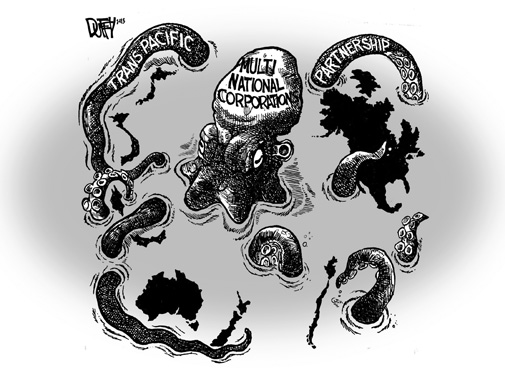
Proposed TPP and TTIP trade bills are corporate scams – designed to rip off populations for maximum profits, no matter the cost to human lives and welfare.

They’ll wreck public healthcare. They’ll make it unaffordable for growing millions. They’ll undermine food safety. They’ll advance environmental destruction. Their secret provisions if made public would cause mass outrage.

Weissman struck a positive note saying when “the American people see what (are) actually in (these) agreements, they are going to force their representatives in Washington to vote (them) down.”

Environmental organization 350.org executive director May Boeve expressed “outrage that Congress…voted to fast track pollution, rather than the job-creating clean energy we need to address climate change.”

“It’s clear this deal would extend the world’s dependence on fracked gas, forbid our negotiators from ever using trade agreements in the fight against global warming, and make it easier for big polluters to burn carbon while suing anyone who gets in the way.”

“That’s why we’re so disappointed President Obama has taken up the banner for ramming this legislative pollution through the halls of Congress, in a way he never pushed for a climate bill.”

Food and Water Watch executive director Wenonah Hauter said “(s)enators who who provided the margin of Fast Track victory will face angry voters in their next elections.”

“Constituents will hold them accountable for putting the interests of transnational corporations ahead of the public.”

Monied interests run things. Whatever they want, they get. Congressional support for fast track and nightmarish trade deals to follow alone show why America is unfit to live in.


Stephen Lendman lives in Chicago. He can be reached at lendmanstephen@sbcglobal.net.

His new book as editor and contributor is titled “Flashpoint in Ukraine: US Drive for Hegemony Risks WW III.”

http://www.claritypress.com/LendmanIII.html

Visit his blog site at sjlendman.blogspot.com.

Listen to cutting-edge discussions with distinguished guests on the Progressive Radio News Hour on the Progressive Radio Network.

Deepwater Capitalism

gulf-oil-spill17

Reflections on the Fifth Anniversary of One of the Biggest Oil Spills in History

By Quincy Saul

Source: Counterpunch

In memory of Gabriel García Márquez, March 6, 1927-April 17, 2014.

In September of 2009, the BP corporation dug the deepest oil well in history. The 35,055-foot deep Tiber prospect, 300 miles off the Texas coast, promised six billion barrels: one of the largest oil fields ever discovered in the country. So of course, they kept looking for more: They moved their massive drilling rig named Deepwater Horizon fifty miles south of the Louisiana coastline, to a prospect called Macondo, named after the setting of the famous book 100 Years of Solitude, by Gabriel García Márquez.

On April 20, 2010, as they began to seal the well, something went wrong: a mix of oil and gas escaped, rushing up through earth and water, blowing up the Deepwater Horizon, and killing eleven workers, whose bodies were never recovered. Over the next eighty seven days, the whole world watched as over 200 million gallons of oil erupted from the ocean floor into the Gulf of Mexico.

It was the largest oil spill in history – more than ten times the size of the Exxon Valdez disaster in Alaska. The images of animals covered in oil began to haunt our screens again, and the scale of death was so great it still seems impossible to quantify – estimates of the number of birds killed within the first hundred days ranges between 100,000 and one million. But the real nightmare was offshore, as riptides and hired hands collected thousands of animal carcasses into “death gyres”. Riki Ott explains:

“Hurricane Creekkeeper John Wathen managed to get the only footage of what I came to call the ‘death gyres.’ the rip currents that collected dead animals offshore. The Incident Command – BP and the US Coast Guard – kept the media 1,500 feet up in the air so the press couldn’t really capture the situation there. The animal carcasses were corralled, taken out to sea, and dumped at night, according to fishermen who were involved with so-called ‘Night-time Operations.’ Offshore workers reported ‘thousands of dolphins, birds too numerous to count, sea turtles too numerous to count,’ and even whales in the death gyres.” (Earth at Risk, Building a Resistance Movement to Save the Planetedited by Derrick Jensen and Lierre Keith, p. 49)

Five years later, what can we say? If hindsight is 20-20 then presumably we can learn from our mistakes. How did it happen? Was it BP’s fault? Or is there a bigger picture to blame? Five years later, the common sense of this tragedy has yet to dawn, as if the oil has clogged our hearts and minds along with our oceans and beaches. Like the pioneers of Márquez’s Macondo, searching for a way through the swamp, we seem lost, desperately hacking our way through nature and through our own nature. And the past, like the path, seems to always be disappearing behind us.

“…and the cries of the birds and the uproar of the monkeys became more and more remote, and the world became eternally sad. The men on the expedition felt overwhelmed by their most ancient memories in that paradise of dampness and silence, going back to before original sin, as their boots sank into pools of steaming oil and their machetes destroyed bloody lilies and golden salamanders. . . . They could not return because the strip that they were opening as they went along would soon close up with a new vegetation that almost seemed to grow before their eyes.” (Márquez, p. 11-12)

How did it Happen?

“The main thing is not to lose our bearings.” (Márquez, p. 12)

Whodunit? What was the crime scene, and who are the criminals? What murder weapon spawned gyres of death? Five years later, we must look through the tangled jungle of events which have grown up behind us, and remember how we got here. Michael Klare’s insightful blow-by-blow of the events leading up to the accident is worth revisiting. 

“When BP first deployed the rig at the Macondo prospect in January 2010, it set a target date of March 7 for completion of that well. However, due to a series of geological obstacles and technical mishaps, drilling was not completed until April 19, producing a cost overrun on the project of approximately $58 million. It is not surprising, then, that BP’s site managers felt particular pressure to seal the well and move the Deepwater Horizon, to its next scheduled location. In their rush, the site managers made several last-minute decisions. . . . When preparing for the final cementing that would prevent natural gas from leaking into the wellbore, for instance, they decided to use only six “centralizers” to position the well’s steel casing, whereas the original design had called for twenty-one centralizers. They also went ahead with the sealing of the well even though several ‘negative-pressure’ tests suggested a dangerous buildup of gas in the wellbore. . . . the desire to complete the job swiftly and move the expensive drillship to its next assignment certainly contributed to the disaster.” (The Race for What’s Left, The global scramble for the world’s last resourcesKlare, p. 47-8)

One way to solve this crime is to blame the workers – the crime scene is the workplace, and the murder weapon is the botched job. They failed to follow industry regulations; using less than half of the recommended number of centralizers, and ignoring the test results indicating a dangerous buildup of gas. But this explanation is not sufficient, and hides another suspect. If the workers pulled the trigger, who gave the order?

As Klare explains, the workers were in a rush. It was the BP site managers – their cost overrun, their “pressure to seal the well and move,” and the “desire to complete the job swiftly,” which created the conditions in which the oil workers made their fateful decisions. So is BP the murderer? Is the crime scene the BP board room?


Inside BP

At the dawn of the 21st century, BP had a tabloid affair with alternative energy. John Browne, its CEO from 1995 to 2007 re-branded the company, from “British Petroleum” to “Beyond Petroleum”, and urged its shareholders and broader public “to look beyond oil and gas to fuels which can be produced locally and which do not threaten the sustainability of the world’s climate.” In 2008, Browne was replaced by Tony Hayward, whose more sober vision re-branded the company simply “BP”, and clarified that “the energy of the future will be more than oil, but oil will still be a major part of it.” In 2010 he closed BP’s “alternative energy office.” (Klare, p. 41)

Perhaps the public relations team from that office had all been moved to the Gulf Coast, where it has been working overtime since 2010. This has included classroom visits with “hands-on” experiments, substituting cocoa for oil and dish soap for chemical dispersant, to win young hearts and minds to the efficacy of BP’s cleanup efforts.[1] According to the company, the case is closed. A recently released report from BP concluded: “BP has seen no data to suggest a significant long-term population-level impact to any species.” In fact, “BP is claiming that wildlife in the Gulf is thriving and more abundant since the disaster.” (Jensen and Keith, p. 61) In a recent press conference, BP’s executive vice president for response and environmental restoration in the region Laura Folse said “I personally have no concern about oil washing in from the offshore to the shoreline.”

BP is preparing for the punchline, because currently pending in court is the case which will decide how much money BP has to pay in damages for the disaster. While BP is a giant – listed by Fortune magazine as the fourth largest publicly held company in the world – some on Wall Street have expressed fear that the court’s decision could kill the company. This panic began almost immediately after the spill, and BP began to sell off assets all over the world, in Colombia, Egypt, the US, Canada and Argentina. (Klare, p. 215, 216)

But according to forensic accounting expert Ian Ratner who testified recently on the case, BP “actually, has a better balance sheet today than it had before the spill.” Despite around $40 billion in oil spill liabilities, the company is financially better off than before the disaster. What’s more, they are back at the scene of the crime: “We expect to be back and actively drilling during the second half of the year,” said BP Chief Financial Offcer Byron Grote in April 2011. And he kept his promise: like Colonel Buendía in Márquez’s novel, BP gives orders for execution but is isolated and naive about to the results: “Lost in the solitude of his immense power, he began to lose direction.” (Márquez, p. 171) BP seems both all-powerful and powerless, returning to the scene of the crime like a dog unto its vomit, at the mercy of some god or godlessness which demands more drilling.

There is more than meets the eye in this case. Is BP the only culprit on trial? If the workers pulled the trigger, and BP gave the order, who put the gun in its hand? And who made the gun? There is an African saying that “if you want to get at the root of the murder, you have to look for the blacksmith who made the machete.” (Anthills of the SavannahChinua Achebe, p. 159)

The World System

“That was perhaps the only mystery that was never cleared up in Macondo. . . . A trickle of blood came out under the door, crossed the living room, went out into the street, continued on in a straight line across the uneven terraces, went down steps and climbed over curbs, passed along the Street of the Turks, turned a corner to the right and another to the left, made a right angle at the Buendía house, went in under the closed door, crossed through the parlor, hugging the walls so as not to stain the rugs, went on to the other living room, made a wide curve to avoid the dining-room table, went along the porch with the begonias, and passed without being seen under Amaranta’s chair as she gave an arithmetic lesson to Aureliano José, and went through the pantry and came out in the kitchen, where Úrsula was getting ready to crack thirty-six eggs to make bread.” (Márquez, p. 135)

What was the blacksmith that built and blew the Deepwater Horizon? Like the mystery of Macondo in Márquez’s story, the trail of blood climbs and descends, turns corners and crosses paths, taking us from the work place, to the board room, to the stock exchange, and from there it seems to flow into the ocean of normal every-day modern life. As Lamar McKay, chairman and president of BP America said, “the deepwater is indispensable to the world’s energy future.” (Klare, p. 69) The trail doesn’t go cold, it goes everywhere. Like the war of Colonel Buendía, our search for justice in the death gyres seems to get stuck in a stalemate of business as usual: “’Everything normal, Colonel.’ And normality was precisely the most fearful part of that infinite war.” (Márquez, p. 171)

In the early 2000s, the deep sea drilling industry boomed. All the big oil corporations competed to dig the deepest wells, at depths and conditions that boggle the imagination – deeper than Mt. Everest is tall, under thousands of feet of water (and pressure). These projects out-compete space exploration in the audacity of their engineering and in their cost: Shell built a rig called Mars that was three times more expensive than the Mars Pathfinder mission, with arguably more complex technology. (Klare, p. 44) While their locations are industry secrets – no one knows how many or where they all are – they are everywhere, from the Falkland Islands to the Arctic Circle, from South America to West Africa.

A 2010 report by energy expert Michael Smith estimated that big oil would spend $387 billion on offshore drilling between 2010 and 2014 – 33% more than over the previous five years – building 20,000 offshore wells in ever deeper waters. (Klare, p. 44-45) The Deepwater Horizon explosion, which came nineteen days after President Obama announced plans for more offshore drilling, did little or nothing to change the plan. Three days after the explosion, with Macondo still gushing, a White House spokesperson assured that increase in offshore drilling would continue, promising that it would be done “safely, securely, and without harm to the environment.” (Klare, p. 51)

Before Deepwater Horizon, regulations on the industry had been lax. In the United States, the Interior Department’s Mineral Management Service (MMS) took a hands-off approach to the industry, never, for instance, setting any criteria for minimum-pressure tests, which had such fateful consequences in the Gulf. (Klare, p. 50) After a six month moratorium on drilling in the Gulf after the disaster, oil companies began to lobby the courts to being reissuing permits. A new set of safety rules was established, and by April 2011, one year after the disaster, deep drilling in the Gulf, by BP and others, was back online. (Klare, p. 52) Everything normal, Colonel.

This is the normalcy of the infinite war on mother earth: While the fallout of the disaster continues to inflict irreparable damage to the Gulf, the industry which created the crisis is allowed to resume the activity which created it. And the same agencies that failed to regulate the industry before are being trusted to do it right this time. How can this be?

The answer can be found by following the money, like the trickle of blood in Macondo, from the scene of the crime, and out into the world-system. In an energy analysis report from several years ago, it was predicted that due to declining reserves of conventional oil, offshore oil output would contribute 35 percent of global supplies by 2020. By 2015, the report continued, deep-offshore fields would be “the only source of growth to power the world’s expanding economy. . . . Any energy firm that intends to continue being involved in the production of hydrocarbons must, therefore, establish a significant presence in the major deepwater drilling zones.” (Klare, p. 45)

In other words, the industry is too big to fail – even if does fail. Big oil cannot be too strictly regulated or restricted – or punished. Their alibi is the world-system; the modern way of life. This logic was recently re-asserted by Justice Department attorney Steve O’Rourke in the buildup to the court case that will decide BP’s punishment, who said that the penalty “has to be high enough that companies of this size won’t let a spill like this ever happen again. But, again, not so high as to be ruinous to their operation.” In the great state of Louisiana, individuals who murder get capital punishment, but corporations who murder get rehabilitation. Questioned about whether the company would attempt to drill at Macondo again, BP senior vice president Kent Wells responded that “there is a good reservoir there,” and there was no reason to rule it out, because if BP didn’t, someone else would. (Klare, p. 52)

And so BP and the Gulf and all of us have come full circle, back to the scene of the crime. As death approaches for Márquez’s Ursula Buendía, so does the realization for all of us: “time was not passing. . . . it was turning in a circle.” (Márquez, p409) As big oil races ever faster and ever deeper, time somehow seems to stand still. The rush put on the workers is the rush put on the managers, is the rush put on the CEOs, is the rush put on the shareholders, is the same rush put again upon the workers. And in this “race for what’s left,” as Michael Klare calls it, we are left standing still, watching death approaching, as the drilling rigs, like monster space-age vultures, circle Macondo once again.

We must ask again, and answer again, to keep our bearings, and to clear a path to the truth: Is the crime scene the workplace, or is it the board room? The stock exchange, or the gas station down the street? Like the trickle of blood weaving through the town of Macondo, the evidence leads everywhere; back to normal modern life. The crime scene is everywhere. The murder weapon is the world-system. The criminal and the culprit is deepwater capitalism.

Deepwater capitalism is a terminal stage in the global metastasis of a social cancer we call the economy. Capitalism has gone to deep water, as it has gone to the hearts of mountains and into the depths of the earth. Offshore oil drilling is but one horseman, in a world-wide apocalypse of extreme resource extraction. The others are fracking, tar sands, and mountaintop removal. If imperialism is the highest stage of capitalism, then today’s resource extraction apocalypse reveals the highest stage of imperialism – genocide and extinction.

Captain Ahab from Moby Dick, the insane captain of a whaling ship – distant ancestors of today’s offshore oil rigs – speaks for the system: “all my means are sane, my object and my motive mad.” (Melville, p. 177) With sane means and mad motives, Captain Ahab is both a model and a metaphor for today’s economy, whose command will sink civilization. It is the immense power without direction, the normal infinite war, the gravity at the center of a world-wide death gyre.


Conclusions

At the beginning of the road into the swamp they put up a sign that said ‘Macondo’ and another larger one on the main street that said ‘God exists’.” (Márquez, p. 49)

Five years later we owe it to ourselves and to the world to come to some conclusions. It may take millions of years for the ecosystems of the Gulf to recover, but in the meantime we must recover our hearts and our minds from a modernity in which such disasters are normal aspects of every-day life. We must come to some conclusions about this world-system, and about the generations of people who will live and die on the front lines of an infinite struggle against an infinite war.

Regardless of the severity of the punishment BP receives, the fact that it is back at the scene of the crime, drilling, gives us an indication of the real scale of the problem. If BP is a psychopathic recidivist criminal, it is not alone. The global economy which depends on this kind of extreme resource extraction, which gives corporations like BP orders and alibis, and which bends executive, legislative and judicial power to its needs, is on the move, and it will strike again. Bhopal, Macondo, Fukushima – the beat will go on until we pull the emergency break. Michael Klare writes in conclusion to his comprehensive global survey of our doomsday terrain: “As the race for what’s left gains momentum, this sort of predatory behavior will become more frequent and more brutal. . . . Only if we abandon the race altogether . . . . can we hope to avoid calamity on a global scale.” (Klare, p. 218 and 210)

To abandon the race: This is the conclusion to which we must come. It will, however, require much more of us than the reformist measures Klare proposes – increasing efficiency, developing alternative energies, and supporting “green” versus “brown” capital. These will only buy Captain Ahab more time. It’s time for mutiny. It’s time for the emergency break. It’s time for revolution.

Conclusions on the local level in the Gulf are more difficult. Big picture political conclusions will not bring back the fish and the birds, will not restore livelihoods and dreams swept away by poisoned waters. In a region that the federal government has all but abandoned, the future is wholly in the hands of the common people of the Gulf coast.[2] It is an immense burden for any people, let alone those who are still recovering, ten years later, from Hurricane Katrina, and who live trapped between “cancer alley” and rising ocean levels, with the ground literally sinking under their feet. Thus the struggles of the people of the Gulf symbolize for the entire world a last stand for meaning, in a civilization on the brink of oblivion: “It was the last that remained of a past whose annihilation had not taken place because it was still in a process of annihilation, consuming itself from within, ending at every moment but never ending its ending.” (Márquez, p409) After them, the flood.

Like children, many of us are afraid of the dark. We hide from the creeping annihilation even as it seeps ever closer to home. We close off our hearts to the horror, and mute our minds before the madness, even as it consumes us and enlists our complicity. As John W. Tunnell, witness for BP, recently testified, “The images of those dead birds that were oiled, like pelicans, stick in people’s minds more, and so it’s easy to get emotionally involved in those things. . . . you have to step back and critically and unemotionally, objectively to look at what’s going on.”

While BP’s witnesses, as personifications of capital, would have us immerse ourselves in the infamous “icy waters of egotistical calculation,” some people in the Gulf prefigure a different path to the truth. A documentary titled My Louisiana Love chronicles the story of Monique Verdin, a young Native American woman in search of love and life amidst death and indifference: “I want to keep living on our land, but I’m inheriting a dying delta.” She sets out fearlessly into a landscape of annihilation with an open heart, an open mind, and open hands, and in her story there is a universal story.

It is a story of salvation blossoming next to damnation, a story which promises like Holderin that “where danger threatens, that which saves from it also grows.” Like jewelweed growing next to poison ivy, like women’s liberation in Rojava alongside to the patriarchal crusade of ISIS, like God next to Macondo: There is hope here, perhaps the only kind of hope that is real in a world where everything is at least partly toxic, where dioxin swirls in breast milk, and death gyres spiral in the oceanic cradle of life. It is a story that slumbers in a world consumed with cynicism, a world awash in the icy waters of ego. But like the people of Macondo, we await only the right magnet to re-ignite our wonder. As the gypsy proclaimed, “things have a life of their own. . . . It’s simply a matter of waking up their souls.” (Márquez, p. 2)

Quincy Saul is the author of Truth and Dare: A Comic Book Curriculum for the End and the Beginning of the World, and the co-editor of Maroon the Implacable: The Collected Writings of Russell Maroon Shoatz. He is a musician and a co-founder of Ecosocialist Horizons.

REFERENCES

100 Years of Solitude, by Gabriel García Márquez, Harper Perennial Modern Classics, 2006

The Race for What’s Left, The global scramble for the world’s last resources, by Michael T. Klare, Metopolitan Books, Henry Holt and Company, NY, 2012

Earth at Risk, Building a Resistance Movement to Save the Planet, edited by Derrick Jensen and Lierre Keith, Flashpoint Press, 2012

Anthills of the Savannah, by Chinua Achebe, Anchor Book, 1998

Moby Dick, by Herman Melville, St. Botolph Society, 1892

“Suffering a Sea Change,” by Joel Kovel, Capitalism Nature Socialism, Volume 21, Issue 3, September 2010

Notes.

[1]  “NOAA and BP teamed up to visit eighth-grade classrooms in the Gulf to show children how to safely clean up an oil spill. They spilled cocoa powder in a little aquarium to mimic an oil spill – cocoa powder, right? Yummy. They sprinkled in Dawn dish soap to ‘disperse’ the oil. ‘See children? Dispersant works to clean up the oil, and we’re going to save the world. It’s OK.’ (Riki Ott, in Jensen and Keith, p52) Chemical dispersants can best be described with the poem by Gerard Manley Hopkins, “where we, even where we mean to mend her, we end her”: the toxicity of chemical dispersants – arguably more dangerous than the oil they purport to clean up – has been analyzed and documented by many organizations.

[2]  “It really is all up to us. In the Gulf, it didn’t take people twenty years like with the Exxon Valdez spill to realize the federal government was not in control of the situation; it took them two months.” -Riki Ott (Jensen and Keith, p52)


Hillary Clinton: The International Neocon Warmonger

06

By Webster G. Tarpley

Source: Voltaire.net

Hillary Clinton has announced her candidacy for President of the United States. While the European press showers her with praise without thinking, Webster G. Tarpley recalls her balance sheet: in all circumstances, she supported war and corporate interests.

As the National Journal reported in 2014, even the pathetically weak anti-war left is not ready to reconcile with Hillary given her warmongering as Secretary of State. And with good reason. Scratching just lightly beneath the surface of Hillary Clinton’s career reveals the empirical evidence of her historic support for aggressive interventions around the globe.

Beginning with Africa, Hillary defended the 1998 cruise missile strike on the El Shifa pharmaceutical plant in the Sudanese capital of Khartoum, destroying the largest producer of cheap medications for treating malaria and tuberculosis and provided over 60% of available medicine in Sudan. In 2006 she supported sending United Nations troops to Darfur with logistical and technical support provided by NATO forces. Libyan leader Moammar Qaddafi was outspoken in his condemnation of this intervention, claiming it was not committed out of concern for Sudanese people but “…for oil and for the return of colonialism to the African continent.”

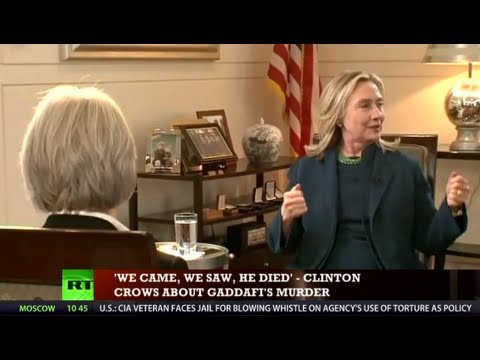
This is the same leader who was murdered in the aftermath of the 2011 NATO bombing of Libya; an attack promoted and facilitated with the eager support of Mrs. Clinton. In an infamous CBS news interview, said regarding this international crime: “We came, we saw, he died.” As Time magazine pointed out in 2011, the administration understood removing Qaddafi from power would allow the terrorist cells active in Libya to run rampant in the vacuum left behind. Just last month the New York Times reported that Libya has indeed become a terrorist safe haven and failed state— conducive for exporting radicals through “ratlines” to the conflict against Assad in Syria.

Hillary made prompt use of the ratlines for conflicts in the Middle East. In the summer of 2012, Clinton privately worked with then CIA director and subversive bonapartist David Petraeus on a proposal for providing arms and training to death squads to be used to topple Syria just as in Libya. This proposal was ultimately struck down by Obama, reported the New York Times in 2013, but constituted one of the earliest attempts at open military support for the Syrian death squads.

Her voting record on intervening in Afghanistan and Iraq is well known and she also has consistently called for attacking Iran. She even told Fareed Zakaria the State Department was involved “behind the scenes” in Iran’s failed 2009 Green Revolution. More recently in Foreign Policy magazine David Rothkopf wrote on the subject of the Lausanne nuclear accord, predicting a “snap-back” in policy by the winner of the 2016 election to the foreign policy in place since the 1980s. The title of this article? “Hillary Clinton is the Real Iran Snap-Back.” This makes Hillary the prime suspect for a return to the madcap Iranian policies that routinely threaten the world with a World War 3 scenario.

Hillary Clinton is not only actively aggressing against Africa and the Middle East. She was one of the loudest proponents against her husband’s hesitancy over the bombing of Kosovo, telling Lucina Frank: “I urged him to bomb,” even if it was a unilateral action.

While no Clinton spokesperson responded to a request by the Washington Free Beacon regarding her stance on Ukraine, in paid speeches she mentioned “putting more financial support into the Ukrainian government”. When Crimea decided to choose the Russian Federation over Poroshenko’s proto-fascist rump state, Hillary anachronistically called President Putin’s actions like “what Hitler did in the ‘30s.” As a leader of the bumbled ”reset” policy towards Russia, Hillary undoubtedly harbors some animus against Putin and will continue the destabilization project ongoing in Ukraine.

Not content with engaging in debacles in Eastern Europe, she has vocally argued for a more aggressive response to what she called the “rollback of democratic development and economic openness in parts of Latin America.” This indicates her willingness to allow the continuation of CIA sponsored efforts at South American destabilization in the countries of Venezuela, Bolivia, Ecuador, Argentina and Brazil.

It is one of the proud prerogatives of the Tax Wall Street Party to push out into the light the Wall Street and foundation-funded Democrats. The final blow to Hillary’s clumsy façade comes directly from arch-neocon Robert Kagan. Kagan worked as a foreign policy advisor to Hillary along with his wife, Ukraine madwoman Victoria Nuland, during Hillary’s term as Secretary of State. He claimed in the New York Times that his view of American foreign policy is best represented in the “mainstream” by the foreign policy of Hillary Clinton; a foreign policy he obviously manipulated or outright crafted. Kagan stated: “If she pursues a policy which we think she will pursue…it’s something that might have been called neocon, but clearly her supporters are not going to call it that; they are going to call it something else.” What further reason could any sane person need to refute Hillary? A vote for Hillary is a vote for the irrational return to war.

The “Giant Sucking Sound”: Clinton Gave US NAFTA and Other Free Trade Sellouts

“There is no success story for workers to be found in North America 20 years after NAFTA,” states AFL-CIO president Richard Trumka. Unlike other failures of his Presidency, Bill Clinton can not run from NAFTA. It was Vice President Al Gore, not a veto-proof Republican congress, who lobbied to remove trade barriers with low-wage Mexico.

The record of free trade is clear. Multinational corporations and Wall Street speculators realize incredible profits, wages remain stagnant in the US, poverty persists in the developing world, and the remaining industrial corporations in America and Canada are increasingly owned by Chinese, Indian and other foreign interests.

America’s free trade policy is upside down. Besides Canada, Australia and Korea, most of our “free” trade partners are low-wage sweatshop paradises like Mexico, Chile, Panama, Guatemala, Bahrain and Oman. The US does in fact apply tariffs on most goods and on most nations of origin – rates are set by the US International Trade Commission (USTIC), a quasi-public federal agency.

Since a German- or Japanese-made automobile would under USITC’s schedule be taxed 10% upon importation, Volkswagen and Toyota can circumvent taxation by simply building their auto assembly plants for the US market in Mexico. In Detroit, an auto assembly worker is paid between $14 and $28/hour, ($29,120-$58,240/yr); hard work for modest pay. In Mexico, the rate varies from $2-5/hour.

In China, all automobile imports regardless of origin are tariffed as high as 25%. This allows the Chinese to attract joint ventures with Volkswagen and Toyota, and to paraphrase Abraham Lincoln, “keep the jobs, the cars and the money.”

NAFTA-related job loss is not a question of productivity, currency manipulation, “fair trade,” environmental standards, etc. While these issues are not trivial, free trade – as Lincoln’s advisor Henry C. Carey proved – is a matter of simple accounting. Can an American family survive on $4,160/year ($2/hr)? If not, cars and their components will be built in Mexico. If we want cars built in the United States, the only solution is a general tariff (import tax) reflecting the difference between those wage standards, like the very tariffs repealed by Bill Clinton.

In the United States the “runaway shop” under NAFTA and CAFTA has sent trade deficits and unemployment soaring while wages drop relative to the cost of living. Yet Mexico and other “partners” receive no benefit either. Many manufacturing sectors in Mexico pay wages lower than the equivalent sector in China. Mexico is now the world leader in illegal narcotics exportation and weapons importation. The poverty level between 1994 and 2009 remained virtually identical. (52.4% – 52.3%). The shipping of raw materials to Mexico comprise the majority of so called American “exports”. The finished products from these exports are assembled and sold back to the United States at slave labor prices.

Don’t expect Hillary to behave differently with the coming “Trans-Pacific Partnership,” which seeks to replace an ascendant China with less-developed Vietnam and Malaysia. Vietnam would overtake India-allied Bangladesh in the global apparel trade, and Malaysia has a high-tech manufacturing sector poised to rival China’s. With America’s manufacturing economy in shambles, the Clinton machine can now be redirected to geopolitical maneuvers.


Confronting Industrialism

cost-of-coal_detail

By Derrick Jensen

Source: Counterpunch.org

Some of the most important questions confronting us are: what should we do about this culture’s industrial wastes, from greenhouse gases to pesticides to ocean microplastics?

Can the capitalists clean up the messes they create? Or is the whole industrial system beyond reform? The answers become clear with a little context.

Let’s start the discussion of context with two riddles that aren’t very funny.

Q: What do you get when a cross a long drug habit, a quick temper, and a gun?

A: Two life terms for murder, with earliest release date 2026.

And,

Q: What do you get when you cross a large corporation, two nation states, 40 tons of poison, and at least 8,000 dead human beings?

A: Retirement with full pay and benefits. Warren Anderson, CEO of Union Carbide. Bhopal.

The point of these riddles is not merely that when it comes to murder and many other atrocities, different rules apply to the poor than to the rich. And it’s not merely that ‘economic production’ is a get-out-of-jail free card for whatever atrocities the ‘producers’ commit, whether it’s genocide, gynocide, ecocide, slaving, mass murder, mass poisoning, and so on.

Do we even care? We already know they don’t …

The point here is that this culture is clearly not particularly interested in cleaning up its toxic messes. Obviously, or it wouldn’t keep making them. It wouldn’t allow those who make these messes to do so with impunity. It certainly wouldn’t socially reward those who make them.

This may or may not be the appropriate time to mention that this culture has created, for example, 14 quadrillion (yes, quadrillion) lethal doses of Plutonium 239, which has a half-life of over 24,000 years, which means that in a mere 100,000 years that number will be all the way down to only about 3.5 quadrillion lethal doses: Yay!

And socially reward them it does. I could have used a whole host of examples other than Warren Anderson, who was playing on the back nine long after he should have been hanging by the neck (he was sentenced to death in absentia, but the US refused to extradite him).

There’s Tony Hayward, who oversaw BP’s devastation of the Gulf of Mexico and who was ‘punished’ for this with a severance package worth well over $30 million. Or we could throw another couple of riddles at you, which are really the same riddles:

Q: What do you call someone who puts poison in the subways of Tokyo?

A: A terrorist.

Q: What do you call someone who puts poison (cyanide) into groundwater?

A: A capitalist: CEO of a gold mining corporation.

We could talk about frackers, who make money as they poison groundwater. We could talk about anyone associated with Monsanto. You can add your own examples. I’d say you can ‘choose your poison’ but of course you can’t. Those are chosen for you by those doing the poisoning.

Civilization’s ability to overcome our native common sense

I keep thinking about one of the most fundamentally sound (and fundamentally disregarded) statements I’ve ever read. After Bhopal, one of the doctors trying to help survivors stated that corporations (and by extension, all organizations and individuals) “shouldn’t be permitted to make poison for which there is no antidote.”

Please note, by the way, that far from having antidotes, nine out of ten chemicals used in pesticides in the US haven’t even been thoroughly tested for (human) toxicity.

Isn’t that something we were all supposed to learn by the time we were three? Isn’t it one of the first lessons our parents are supposed to teach us? Don’t make a mess you can’t clean up!

Yet that is precisely the foundational motivator of this culture. Sure, we can use fancy phrases to describe the processes of creating messes we have no intention of cleaning up, and in many cases cannot clean up.

And so we get phrases like ‘developing natural resources’, or ‘sustainable development’, or ‘technological progress’ (like the invention and production of plastics, the bathing of the world in endocrine disruptors, and so on), or ‘mining’, or ‘agriculture’, or ‘the Green Revolution’, or ‘fueling growth’, or ‘creating jobs’, or ‘building empire’, or ‘global trade’.

But physical reality is always more important than what we call it or how we rationalize it. And the truth is that this culture has been based from the beginning to the present on privatizing benefits and externalizing costs. In other words, on exploiting others and leaving messes behind.

Hell, they call them ‘limited liability corporations’ because a primary purpose is to limit the legal and financial liability of those who benefit from the actions of corporations for the harm these actions cause.

Internalizing insanity

This is no way to run a childhood, and it’s an even worse way to run a culture. It’s killing the planet. Part of the problem is that most of us are insane, having been made so by this culture. We should never forget what RD Laing wrote about this insanity:

“In order to rationalize our industrial-military complex [and I would say this entire way of life, including the creation of messes we have neither the interest nor capacity to clean up], we have to destroy our capacity to see clearly any more what is in front of, and to imagine what is beyond, our noses. Long before a thermonuclear war can come about, we have had to lay waste to our own sanity.

“We begin with the children. It is imperative to catch them in time. Without the most thorough and rapid brainwashing their dirty minds would see through our dirty tricks. Children are not yet fools, but we shall turn them into imbeciles like ourselves, with high IQs, if possible.”

We’ve all seen this too many times. If you ask any reasonably intelligent seven-year-old how to stop global warming caused in great measure by the burning of oil and gas and by the destruction of forests and prairies and wetlands, this child might well say, “Stop burning oil and gas, and stop destroying forests and prairies and wetlands!”

If you ask a reasonably intelligent thirty-year-old who works for a ‘green’ high tech industry, you’ll probably get an answer that primarily helps the industry that pays his or her salary.

Part of the brainwashing process of turning us into imbeciles consists of getting us to identify more closely with-and care more about the fate of-this culture rather than the real physical world. We are taught that the economy is the ‘real world’, and the real world is merely a place from which to steal and on which to dump externalities.

Does nature have to adapt to us? Or us to nature?

Most of us internalize this lesson so completely that it becomes entirely transparent to us. Even most environmentalists internalize this. What do most mainstream solutions to global warming have in common? They all take industrialism as a given, and the natural world as having to conform to industrialism.

They all take empire as a given. They all take overshoot as a given. All of this is literally insane, in terms of being out of touch with physical reality. The real world must always be more important than our social system, in part because without a real world you can’t have any social system whatsoever. It’s embarrassing to have to write this.

Upton Sinclair famously said that it’s hard to make a man understand something, when his job depends on him not understanding it.

I would add that it’s hard to make people understand something when the benefits they accrue through their exploitative and destructive way of life depend on it. So we suddenly get really stupid about the waste products produced by this culture.

When people ask how we can stop polluting the oceans with plastic, they don’t really mean, “How can we stop polluting the oceans with plastic?” They mean, “How can we stop polluting the oceans with plastic and still have this way of life?”

And when they ask how we can stop global warming, they really mean, “How can we stop global warming without stopping this level of energy usage?”. When they ask how we can have clean groundwater, they really mean, “How can we have clean groundwater while we continue to use and spread all over the environment thousands of useful but toxic chemicals that end up in groundwater?”

The answer to all of these is: you can’t.

First we must recover our sanity. Then we must act

As I’ve been writing this essay about the messes caused by this culture, there’s an allegorical image I can’t get out of my mind. It’s of a half-dozen Emergency Medical Technicians putting bandages on a person who has been assaulted by a knife-wielding psychopath.

The EMTs are trying desperately to stop this person from bleeding out. It’s all very tense and suspenseful as to whether they’ll be able to staunch the flow of blood before the person dies.

But here’s the problem: as these EMTs are applying bandages as fast as they can, the psychopath is continuing to stab the victim. Worse, the psychopath is making wounds faster than the EMTs are able to bandage them. And the psychopath is paid very well for stabbing the victim, while most of the EMTs are bandaging in their spare time.

And in fact the health of the economy is based on how much blood the victim loses – as in this culture, where economic production is measured by the conversion of living landbase into raw materials, e.g., living forests into two-by-fours, living mountains into coal.

How do we stop the victim from bleeding out? Any child can tell you. And any sane person who cares more about the health of the victim than the health of the economy that is based on dismembering the victim can tell you. The first thing you need to do is stop the stabbing. No amount of bandages will make up for an assault that is ongoing, indeed, one that is accelerating.

What do we do about this culture’s fabrication of industrial wastes? The first step is stop their production. Actually the first step is that we regain our sanity, that is, we transfer our loyalty away from the psychopaths, and toward the victim, toward, in this case, the planet that is our only home.

Once we do that, everything else is technical. How do we stop them? We stop them.

Derrick Jensen is Member of the Steering Committee of Deep Green Resistance. See more details. Read Derrick Jensen’s blog.


Colluders in Crude: The Oily Politics of How the Obama Administration Sided with BP Over the American People

gulf-oil-spill17

By Stuart H. Smith

Source: WhoWhatWhy

The explosion and sinking of the Deepwater Horizon oil rig on April 21, 2010,  was the largest accidental marine oil spill in the history of the petroleum industry. The resulting devastation to human health and the environment continues to this day. A new Florida State University study, published on Jan. 20 in the journal Environmental Science & Technology, reports that up to 10 million gallons of crude oil “missing” from the spill settled at the bottom of the Gulf of Mexico, imperiling wildlife and marine ecosystems.

Stuart H. Smith, an environmental plaintiff attorney who served as lead counsel on more than 100 oil pollution cases and has won major litigation against oil giants Chevron and ExxonMobil, came to represent thousands of claimants against BP. He saw from the inside how BP and the American government really responded to the crisis. This article is adapted from his book, Crude Justice: How I Fought Big Oil and Won, and What You Should Know about the New Environmental Attack on America (BenBella Books, 2015). 

I am a first-hand witness to the Obama administration’s complicity in putting the interests of a foreign company above and beyond the health and safety of American workers.

The tragedy began on April 21, 2010, with the explosion and fire on British Petroleum’s Deepwater Horizon oil rig in the Gulf of Mexico off the Louisiana coast. It killed 11 workers and caused a leak that would ultimately spew nearly five million barrels of oil into the Gulf.

Denying Workers Protective Gear

BP hired workers to clean up the spill, but no one was publicly addressing what the prolonged exposure to oil—which is laden with carcinogens such as benzene—might do to them. There was little talk about the threat of volatile organic compounds (VOCs) in the air along the Gulf Coast, even for workers traveling to the edge of the spill in boats and removing oil from the beaches. Cleanup crews were attaching oil-catching booms to their shrimp boats and driving their boats directly through the oil slicks to corral and collect the oil spilling from BP’s broken well—and largely tackling their jobs without serious protective gear, because BP had not supplied it.

“BP knew that providing protective equipment would be an admission that the oil exposure was dangerous and sought to avoid that at all costs,” says Marylee Orr, the founder and longtime executive director of the Louisiana Environmental Action Network (LEAN), a leading environmental group in the state.

It wasn’t long before the fishermen began reporting headaches, vomiting, nausea, dizziness, and chest pains.

In early June, two key Democratic members of Congress—Minnesota Representative James Oberstar, then-chairman of the House Transportation and Infrastructure Committee, and New York Representative Jerrold Nadler, a senior committee member—sent a letter to the EPA and the Department of Labor demanding that Gulf workers be provided with “proper protective equipment, including respirators.”

Incredibly, the Obama administration said “no.”

David Michaels, assistant secretary in the Labor Department, who oversaw the Occupational Safety and Health Administration, told the Wall Street Journal that their tests showed “minimal” risk from exposure to airborne toxins—despite the fact that EPA’s air monitors along the Gulf Coast were picking up substantial airborne VOC readings from the spill, and despite scores of alarming medical reports from cleanup workers.

Protecting BP Stockholders

Around the same time, President Barack Obama was on the phone to the British prime minister. David Cameron was in a tizzy because so many English pensioners had their retirement money tied up in BP stock.

“The president made clear that he had no interest in undermining BP’s value,” Cameron’s office announced after the phone call.

Indeed, on June 16, 2010—one month before the leaking well had been capped and the full extent of the damage could be investigated—the White House announced an unprecedented deal with BP in which the oil company would finance a relief fund of up to $20 billion.

This escrow fund was good politics—$20 billion sounded impressive to the average voter—but would prove to be music to the ears of BP’s board. Historically, such escrow funds had been effective means for companies to limit their liability. They were tools for persuading vulnerable people in desperate need to sign away their legal rights to recover full compensation for the damages they’d suffered.

Sure enough, just before Christmas 2010, Kenneth Feinberg, who’d been appointed to oversee the fund, made a blatant attempt to boost the number of cases the fund could say were “settled” by offering the spill’s victims one-time bonus payments of $5,000 for individuals and $25,000 for businesses, contingent upon his settlement terms.

In fact, the $20 billion fund had set a preliminary target for damage claims that would turn out to be tens of billions of dollars less than the actual damages. Moreover, the agreement allowed BP to secure the fund using future productions from its leases in the Gulf of Mexico as collateral, exempting all of BP’s holdings elsewhere.  This locked the federal government into a partnership with BP, forcing it to continue to allow its offshore drilling in the Gulf to pay back the claims.

Hiding the Oil, Spreading the Toxins

In the early days of the spill, BP began unleashing gallons of a toxic chemical called Corexit.  Corexit was able to get rid of the thick black oily plumes on the water’s surface that had been visible for miles across the Gulf and were becoming such a public relations disaster on the nightly TV news.

But Corexit wasn’t solving the oil problem, only the PR problem.  Corexit was merely hiding the oil and spreading toxins over a larger area. This created even greater risks for the cleanup workers—risks they had not been trained to deal with.

Weeks after the spill, LEAN’s Marylee Orr pressed for admission to the main command centers, to which her NGO was supposed to have access. Eventually she and other Gulf environmental activists got a private meeting with a top federal official—EPA administrator and Louisiana native Lisa Jackson. They argued that the feds needed to force BP to stop spraying Corexit in the Gulf and produced evidence that Corexit was merely masking the oil and dispersing toxins over a bigger area.

(Hugh Kaufman, longtime EPA employee and whistleblower, said government officials were well aware of the hazards of Corexit, telling an interviewer that “in the Exxon Valdez case, people who worked with dispersants, most of them are dead now.  The average death age is around 50.”)

At first it seemed like Jackson was listening to their plea. A short time later, in late May, the EPA and the Coast Guard issued a joint order to BP telling the company to “eliminate” surface spraying of Corexit—unless the firm got a waiver from the Coast Guard because of exceptional circumstances.

You can guess how that all played out. BP asked for and routinely got a waiver from the Coast Guard to spray Corexit—day after day, including nine days in a row immediately after Lisa Jackson’s “order,” and ultimately 74 times over 54 days. An estimated million gallons of the toxic dispersant were deployed in the Gulf after the government’s supposed command to eliminate much of its use.

Later, independent laboratory tests performed for me confirmed what the experts had feared about the Corexit spraying: dispersing the oil actually meant taking the toxic elements of the oil from the surface, where they were highly concentrated but weren’t harming marine life below, and spreading them deep into Gulf waters.  Our lab tests showed toxic pollution of water at levels 35 times higher than before the oil was dispersed.

Claiming “Gulf Seafood Is Safe”

Early on, the federal government’s public relations initiative was in full gear. On June 14—54 days into the crisis of the oil spill—President Obama came down to the Florida Panhandle and decreed that he was launching “a comprehensive, coordinated, and multiagency initiative” to make sure the catch from the Gulf waters was safe to eat.  “Now,” he said into the bank of cameras, “I had some of that seafood for lunch, and it was delicious….So let me be clear. Seafood from the Gulf today is safe to eat.  But we need to make sure that it stays that way.”

In essence, Obama was telling Americans to eat first and ask questions later.  But how could the president assure the public that seafood was safe to eat when, as he acknowledged, in-depth testing hadn’t yet even been carried out?”

At the Pentagon, a massive order for shrimp, crab cakes, and pre-packaged jambalaya was placed and sold at base commissaries around the world.  The executive chef at the White House bought and served more than 2,000 pounds of shrimp and other Gulf goodies at an array of holiday parties for Barack and Michelle Obama and their guests, commenting: “We at the White House are so happy to play our part in reminding Americans that Gulf seafood is not only safe but delicious.”

Around the Gulf, news accounts quoted fishermen who were reeling in red snapper with sores and lesions—some the size of a 50 cent piece—the likes of which they had never seen before.  Crab fishermen were reporting that their hauls had dropped by 70% and that the few crabs they did pull up suffered similar lesions and disease.  It made sense. Red snapper were bottom feeders—eating the shrimp and crabs that live on the sea floor—and independent scientists had already shown that oil from the leaking BP rig was coating the bottom of the Gulf.

Practicing Faulty and Deceptive Testing

In late 2010, the government stated that it had tested more than 10,000 seafood samples from the Gulf and found no evidence of problems. But the vast majority of those tests were what the National Oceanic and Atmospheric Administration called “sensory testing,” and what you and I might call a smell test. This test was hardly adequate for finding traces of hydrocarbons that are odorless, yet highly toxic.

Moreover, in conducting the smell tests, specimens that were clearly oiled in the spill or possibly diseased were tossed aside, skewing the lab results. When the seafood that would have produced the worst numbers was transferred to trash buckets, the polynuclear aromatic hydrocarbon numbers looked a lot better.

In addition, according to the government testing structure, the “safe” consumption level for a grown man is four shrimp a week.  Who the hell living on the Gulf of Mexico eats only four shrimp per week?

Conducting his own test analysis, Paul Orr, Marylee’s son and the unofficial river keeper for the lower Mississippi, gathered samples of shrimp, crab, and finfish from 20 different locations in the Gulf off the Louisiana and Mississippi coastlines. His results showed high levels of total petroleum hydrocarbons, including in seafood from areas that had been declared safe for fishing. Testing by other independent environmentalists showed high levels of cadmium, a long-lasting carcinogen.

Alleging “Swimming Is Safe”

The seafood shilling was just the beginning.

The government also issued reports that beaches were safe for swimming. President Obama dramatized this, allowing a photo of him swimming with his daughter—in an unimpacted bay, of course—along the Florida Panhandle coast.

The passage of time did not diminish the assault on the beaches.  Tropical Storm Lee washed tar balls and patches of asphalt-like gunk up and down the Gulf in 2011, as did Hurricane Isaac in the summer of 2012.  In 2013, more than three years after the BP catastrophe, a blob of oil from the Macondo field that was roughly half the size of a football field came ashore in Grand Terre Island off the coast of Louisiana.

Attempting to Bar Independent Testing

The U.S. government seemed to have two agendas—both of them bad.  One was siding with large commercial fishing operations in the Gulf, whose livelihood depended on public confidence in the safety of their catch, and not with the broader U.S. public of seafood consumers.  The other was to get the PR nightmare of BP out of the headlines.

Almost immediately after the spill, the FAA implemented a temporary flight restriction across the entire eastern Gulf of Mexico that continued for months.  They refused to let the media get anywhere close to the offshore slicks. The Coast Guard turned the entire zone over to private security goons hired by BP who would not let anyone near the spill to photograph and take samples. BP’s guards blocked many of the roads leading to oil-gunked beaches. Never before had America ceded its sovereign police power to a corporation, and a foreign one at that.

Key governmental agencies involved in the Gulf Coast recovery seemed to be working harder to prevent independent scientists from doing their own testing than they were in conducting their own rigorous studies.

As a Big Oil litigator, I knew that the fastest way to lose an environmental law case was to rely on industry or government data, which rarely painted the full picture. It was critical to perform your own testing using your own experts.  I’d never had an environmental case where the government was on the side of the victim.

***

To prove toxic exposure and resulting damages in the BP disaster, I hired Dr. William Sawyer, a top Florida-based research toxicologist with 30 years of experience, and Worcester Polytechnic civil engineer Marco Kaltofen, considered one of the top engineers in the field, who described himself as “specializing in when things go really bad.”

Marco and William decided that the best approach to overcoming the restricted access was simply to look and act like they belonged.  “We dressed the way the BP guys dressed,” Marco told me later.   “We had the story, we had the business cards and lab notebook and all the equipment.  And you just go out there and you mix it up.”

Soon the BP cleanup contractors were giving Marco and his coworker access to their refreshment tent.

“I got a Louisiana oysterman’s license,” Marco said. “I would get out to these sites and they would say, ‘I’m sorry—you can’t be collecting specimens out here.’  I’d say, ‘I got a Louisiana scientific collection permit,’ and I would get BP escorts when I produced this document.  It looked really official—it said I could collect oysters around this area….It had dates, stamps….”

From that, Marco collected a treasure trove of shellfish and marine life, as well as water, sand, and spilled oil.

Marco and William’s initial data showed alarming levels of toxic hydrocarbons, first in the Gulf water columns, and then in seafood. Even before they issued a formal report, they posted some of their raw data on the Internet.

That’s when they started receiving phone calls from staffers on the president’s commission investigating the oil spill.

“There was a grave concern as to why we were finding contamination,” William recalled, “and then the questions were geared toward whether we had sampling permits.”

Instead of expressing concern about the danger that might be posed to American consumers from eating oil-contaminated seafood, federal investigators were questioning whether Marco and William had permits to collect the samples.

It was only after a TV news crew investigated the calls and a New Orleans-area congressman called for a full-blown investigation that the Oil Spill Commission pulled a 180-degree turn.  One staffer even tried to explain that the calls to Marco and his associate had gone out because the commission had been impressed with their work.

Much later, our team learned about some of the intense pressure that was taking place behind the scenes.  At the same time that we were pressing for a more open investigation of environmental impact, in-fighting was ensuing between other independent scientists, who were finding equally troubling data, and government officials, who were finding ways to cover up the discoveries. The Reuters news agency learned that wildlife biologists who’d been hired by the National Marine Fisheries Service to document an “unusual marine event”—the dramatic rise in dolphin deaths—were told they couldn’t make their findings known because it was part of a law enforcement probe into the BP spill.

Denying Evidence

Mounting evidence revealed that oil-spill cleanup workers and other Gulf residents were suffering respiratory illnesses, skin rashes, and other more serious maladies.  But federal authorities insisted that the rise in such ailments was merely a coincidence. Donald Boesch, a member of Obama’s Oil Spill Commission, summed up their response: “We were charged with being evidence-driven, and the fact is, we’ve asked for and sought out evidence that the oil spill is the proximate cause of these health problems, and we just haven’t found it.”

But all Boesch had to do was walk into any of the doctors’ crowded waiting rooms and health clinics scattered across the Gulf region.

Dr. Michael Robichaux of Mathews, Louisiana, on the Gulf Coast, was among those examining the ailing cleanup workers and other coastal residents. At first the doctor was dubious that the ailments were linked to the workers’ and residents’ exposure to BP’s oil and Corexit. But after he began treating them, he converted and became an evangelist for their cause.  Of the 113 patients he treated who had been exposed to toxic pollution, he wrote that about 100 of them had severe chronic health effects, to the point that many were unable to work. “It appears that the interests of a large, foreign corporation have superseded the needs of thousands of Americans who reside along the coast of the Gulf of Mexico,” Dr. Robichaux told U.S. District Judge Carl Barbier.

Settlement Deals

In May 2012, BP announced that it had reached a settlement deal—estimated at the time to be worth $7.8 billion—with a circle of well-connected tort lawyers called the Plaintiffs Steering Committee on behalf of the Gulf Coast residents and small businesses.  Joining a handful of other lawyers, I appeared before Judge Barbier that September to object to the proposed deal.  How, we asked, could a proper price be fixed on the damage caused by BP when new oil kept coming ashore, as had happened when Hurricane Isaac hit the Gulf Coast just days before the courtroom arguments?  We also argued that the deal was woefully inadequate, both for those who had been made ill and for many coastal businesses.

We didn’t win that skirmish, but other penalties for the British oil giant are finally adding up. In early 2015, a federal judge was nearing a final ruling on civil penalties against BP under the federal Clean Water Act, which could reach some $13.7 billion.

To date, my firm has successfully handled claims against BP for about three quarters of our thousands of clients.  Hundreds of them remain, fighting for their fair share.

The extreme efforts of a Big Oil giant to avoid liability for its actions have been sadly familiar to me.  But the actions of the U.S. government to side with a huge multinational corporation against the health and safety of American workers are unconscionable.

Adapted from CRUDE JUSTICE:  How I Fought Big Oil and Won, And What You Should Know About the New Environmental Attack on America by Stuart H. Smith (BenBella Books, 2015). 

The Global De-dollarization and the US Policies

index

By Vladimir Odintsov

Source: New Eastern Outlook

In its quest for world domination, which the White House has been pursuing for more than a century, it relied on two primary tools: the US dollar and military might. In order to prevent Washington from establishing complete global hegemony, certain countries have recently been revising their positions towards these two elements by developing alternative military alliances and by breaking with their dependence on the US dollar.

Until the mid-twentieth century, the gold standard was the dominant monetary system, based on a fixed quantity of gold reserves stocked in national banks, which limited lending. At that time, the United States managed to become the owner of 70% of world’s gold reserves (excluding the USSR), therefore it pushed its weakened competitor, the UK, aside resulting to the creation of the Bretton Woods financial system in 1944. That’s how the US dollar became the predominant currency for international payments.

But a quarter century later this system had proven ineffective due to its inability to contain the economic growth of Germany and Japan, along with the reluctance of the US to adjust its economic policies to maintain the dollar-gold balance. At that time, the dollar experienced a dramatic decline but it was saved by the support of rich oil exporters, especially once Saudi Arabia began to exchange its black gold for US weapons and support in talks with Richard Nixon. As a result, President Richard Nixon in 1971 unilaterally ordered the cancellation of the direct convertibility of the United States dollar to gold, and instead he established the Jamaican currency system in which oil has become the foundation of the US dollar system. Therefore, it’s no coincidence that from that moment on the control over oil trade has become the number one priority of Washington’s foreign policy. In the aftermath of the so-called Nixon Shock the number of US military engagements in the Middle East and other oil producing regions saw a sharp increase. Once this system was supported by OPEC members, the global demand for US petrodollars hit an all time high. Petrodollars became the basis for America domination over the global financial system which resulted in countries being forced to buy dollars in order to get oil on the international market.

Analysts believe that the share of the United States in today’s world gross domestic product shouldn’t exceed 22%. However, 80% of international payments are made with US dollars. As a result, the value of the US dollar is exceedingly high in comparison with other currencies, that’s why consumers in the United States receive imported goods at extremely low prices. It provides the United States with significant financial profit, while high demand for dollars in the world allows the US government to refinance its debt at very low interest rates.

Under these circumstances, those hedging against the dollar are considered a direct threat to US economic hegemony and the high living standards of its citizens, and therefore political and business circles in Washington attempt by all means to resist this process. This resistance manifested itself in the overthrow and the brutal murder of Libyan leader Muammar Gaddafi, who decided to switch to Euros for oil payments, before introducing a gold dinar to replace the European currency.

However, in recent years, despite Washington’s desire to use whatever means to sustain its position within the international arena, US policies are increasingly faced with opposition. As a result, a growing number of countries are trying to move from the US dollar along with its dependence on the United States, by pursuing a policy of de-dollarization. Three states that are particularly active in this domain are China, Russia and Iran. These countries are trying to achieve de-dollarization at a record pace, along with some European banks and energy companies that are operating within their borders.

The Russian government held a meeting on de-dollarization in spring of 2014, where the Ministry of Finance announced the plan to increase the share of ruble-denominated contracts and the consequent abandonment of dollar exchange. Last May at the Shanghai summit, the Russian delegation manged to sign the so-called “deal of the century” which implies that over the next 30 years China will buy $ 400 billion worth of Russia’s natural gas, while paying in rubles and yuans. In addition, in August 2014 a subsidiary company of Gazprom announced its readiness to accept payment for 80,000 tons of oil from Arctic deposits in rubles that were to be shipped to Europe, while the payment for the supply of oil through the “Eastern Siberia – Pacific Ocean” pipeline can be transferred in yuans. Last August while visiting the Crimea, Russia’s President Vladimir Putin announced that “the petrodollar system should become history” while “Russia is discussing the use of national currencies in mutual settlements with a number of countries.” These steps recently taken by Russia are the real reasons behind the West’s sanction policy.

In recent months, China has also become an active member of this “anti-dollar” campaign, since it has signed agreements with Canada and Qatar on national currencies exchange, which resulted in Canada becoming the first offshore hub for the yuan in North America. This fact alone can potentially double or even triple the volume of trade between the two countries since the volume of the swap agreement signed between China and Canada is estimated to be a total of 200 billion yuans.

China’s agreement with Qatar on direct currency swaps between the two countries are the equivalent of $ 5.7 billion and has cast a heavy blow to the petrodollar becoming the basis for the usage of the yuan in Middle East markets. It is no secret that the oil-producing countries of the Middle Eastern region have little trust in the US dollar due to the export of inflation, so one should expect other OPEC countries to sign agreements with China.

As for the Southeast Asia region, the establishment of a clearing center in Kuala Lumpur, which will promote greater use of the yuan locally, has become yet another major step that was made by China in the region. This event occurred in less than a month after the leading financial center of Asia – Singapore – became a center of the yuan exchange in Southeast Asia after establishing direct dialogue regarding the Singapore dollar and the yuan.

The Islamic Republic of Iran has recently announced its reluctance to use US dollars in its foreign trade. Additionally, the President of Kazakhstan Nursultan Nazarbayev has recently tasked the National Bank with the de-dollarization of the national economy.

All across the world, the calls for the creation of a new international monetary system are getting louder with each passing day. In this context it should be noted that the UK government plans to release debts denominated in yuans while the European Central Bank is discussing the possibility of including the yuan in its official reserves.

Those trends are to be seen everywhere, but in the midst of anti-Russian propaganda, Western newsmakers prefer to keep quiet about these facts, in particular, when inflation is skyrocketing in the United States. In recent months, the proportion of US Treasury bonds in the Russian foreign exchange reserves has been shrinking rapidly, being sold at a record pace, while this same tactic has been used by a number of different states.

To make matters worse for the US, many countries seek to export their gold reserves from the United States, which are deposited in vaults at the Federal Reserve Bank. After a scandal of 2013, when the US Federal Reserve refused to return German gold reserves to its respective owner, the Netherlands have joined the list of countries that are trying to retrieve their gold from the US. Should it be successful the list of countries seeking the return of gold reserves will double which may result in a major crisis for Washington.

The above stated facts indicate that the world does not want to rely on US dollars anymore. In these circumstances, Washington relies on the policy of deepening regional destabilization, which, according to the White House strategy, must lead to a considerable weakening of any potential US rivals. But there’s little to no hope for the United States to survive its own wave of chaos it has unleashed across the world.

Vladimir Odintsov, political commentator, exclusively for the online magazine “New Eastern Outlook”

Genetically Modified Organisms (GMO): Profit, Power and Geopolitics

monsanto

By Colin Todhunter

Source: GlobalResearch.ca

Genetically modified organisms (GMOs) are not essential for feeding the world [1,2], but if they were to lead to increased productivity, did not harm the environment and did not negatively impact biodiversity and human health, would we be wise to embrace them anyhow?

The fact is that GMO technology would still be owned and controlled by certain very powerful interests. In their hands, this technology is first and foremost an instrument of corporate power, a tool to ensure profit. Beyond that, it is intended to serve US global geopolitical interests. Indeed, agriculture has for a long time been central to US foreign policy.

“American foreign policy has almost always been based on agricultural exports, not on industrial exports as people might think. It’s by agriculture and control of the food supply that American diplomacy has been able to control most of the Third World. The World Bank’s geopolitical lending strategy has been to turn countries into food deficit areas by convincing them to grow cash crops – plantation export crops – not to feed themselves with their own food crops.” Professor Michael Hudson [3].

The Project for a New American Century and the Wolfowitz Doctrine show that US foreign policy is about power, control and ensuring global supremacy at any cost [4,5]. Part of the plan for attaining world domination rests on the US controlling agriculture and hijacking food sovereignty and nations’ food security.

In his book ‘Seeds of Destruction’, William Engdahl traces how the oil-rich Rockefeller family translated its massive wealth into political clout and set out to capture agriculture in the US and then globally via the ‘green revolution’ [6]. Along with its big-dam, water-intensive infrastructure requirements, this form of agriculture made farmers dependent on corporate-controlled petroproducts and entrapped them and nations into dollar dependency and debt. GMOs represent more of the same due to the patenting and the increasing monopolization of seeds by a handful of mainly US companies, such as Monsanto, DuPont and Bayer.

In India, Monsanto has sucked millions from agriculture in recent years via royalties, and farmers have been compelled to spend beyond their means to purchase seeds and chemical inputs [7]. A combination of debt, economic liberalization and a shift to (GMO) cash crops (cotton) has caused hundreds of thousands of farmers to experience economic distress, while corporations have extracted huge profits [8]. Over 270,000 farmers in India have committed suicide since the mid to late nineties [9].

In South America, there are similar stories of farmers and indigenous peoples being forced from their lands and experiencing violent repression as GMOs and industrial-scale farming take hold [10]. It is similar in Africa, where Monsanto and The Gates Foundation are seeking to further transform small-scale farming into a corporate controlled model. They call it ‘investing’ in agriculture as if this were an act of benevolence.

Agriculture is the bedrock of many societies, yet it is being recast for the benefit of rich agritech, retail and food processing concerns. Small farms are under immense pressure and food security is being undermined, not least because the small farm produces most of the world’s food [11]. Whether through land grabs and takeovers, the production of (non-food) cash crops for export, greater chemical inputs or seed patenting and the eradication of seed sharing among farmers, profits are guaranteed for agritech corporations and institutional land investors.

The recasting of agriculture in the image of big agribusiness continues across the globe despite researchers saying that this chemical-intensive, high-energy consuming model means Britain only has 100 harvests left because of soil degradation [12]. In Punjab, the ‘green revolution’ model of industrial scale, corporate dominated agriculture has led to a crisis in terms of severe water shortages, increasing human cancers and falling productivity [13]. There is a global agrarian crisis. The increasingly dominant corporate-driven model is unsustainable.

More ecological forms of agriculture are being called for that, through intelligent crop management and decreased use of chemical inputs, would be able to not only feed the world but also work sustainably with the natural environment. Numerous official reports and scientific studies have suggested that such policies would be more appropriate, especially for poorer countries [14-16].

When on occasion the chemical-industrial model indicates that it does deliver better yields than more traditional methods (a generalization and often overstated [17]), even this is a misrepresentation. Better yields but only with massive chemical inputs from corporations and huge damage to health and the environment as well as ever more resource-driven conflicts to grab the oil that fuels this model. Like the erroneous belief that economic ‘growth’ (GDP) is stimulated just because there becomes greater levels of cash flows in an economy (and corporate profits are boosted), the notion of improved agricultural ‘productivity’ also stems from a set of narrowly defined criteria.

The dominant notions that underpin economic ‘growth’, modern agriculture and ‘development’ are based on a series of assumption that betray a mindset steeped in arrogance and contempt: the planet should be cast in an urban-centic, ethnocentric model whereby the rural is to be looked down on, nature must be dominated, farmers are a problem to be removed from the land and traditional ways are backward and in need of remedy.

“People are perceived as ‘poor’ if they eat food they have grown rather than commercially distributed junk foods sold by global agri-business. They are seen as poor if they live in self-built housing made from ecologically well-adapted materials like bamboo and mud rather than in cinder block or cement houses. They are seen as poor if they wear garments manufactured from handmade natural fibres rather than synthetics.” Vandana Shiva [18]

Western corporations are to implement the remedy by determining policies at the World Trade Organization, IMF and World Bank (with help from compliant politicians and officials) in order to  depopulate rural areas and drive folk to live in cities to then strive for a totally unsustainable, undeliverable, environment-destroying, conflict-driving, consumerist version of the American Dream [19,20].

It is interesting (and disturbing) to note that ‘developing’ nations account for more than 80% of world population, but consume only about a third of the world’s energy. US citizens constitute 5% of the world’s population, but consume 24% of the world’s energy. On average, one American consumes as much energy as two Japanese, six Mexicans, 13 Chinese, 31 Indians, 128 Bangladeshis, 307 Tanzanians and 370 Ethiopians [21].

Despite the environmental and social devastation caused, the outcome is regarded as successful just because business interests that benefit from this point to a growth in GDP. Chopping down an entire forest that people had made a living sustainably from for centuries and selling the timber, selling more poisons to spray on soil or selling pharmaceuticals to address the health impacts of the petrochemical food production model would indeed increase GDP, wouldn’t it? It’s all good for business. And what is good for business is good for everyone else, or so the lie goes.

“Corporations as the dominant institution shaped by capitalist patriarchy thrive on eco-apartheid. They thrive on the Cartesian legacy of dualism which puts nature against humans. It defines nature as female and passively subjugated. Corporatocentrism is thus also androcentric – a patriarchal construction. The false universalism of man as conqueror and owner of the Earth has led to the technological hubris of geo-engineering, genetic engineering, and nuclear energy. It has led to the ethical outrage of owning life forms through patents, water through privatization, the air through carbon trading. It is leading to appropriation of the biodiversity that serves the poor.” [22]

The ‘green revolution’ and now GMOs are ultimately not concerned with feeding the world, securing well-rounded nutritious diets or ensuring health and environmental safety. (In fact, India now imports foods that it used to grow but no longer does [23]; in Africa too, local diets are becoming less diverse and less healthy [24].) Such notions are based on propaganda or stem from well-meaning sentiments that have been pressed into the service of corporate interests.

Biotechnological innovations have always had a role to play in improving agriculture, but the post-1945 model of agriculture has been driven by powerful corporations like Monsanto, which are firmly linked to Pentagon and Wall Street interests [25]. Motivated by self-interest but wrapped up in trendy PR about ‘feeding the world’ or imposing austerity to ensure prosperity, the publicly stated intentions of the US state-corporate cabal should never be taken at face value [26,27].

In India, Monsanto and Walmart had a major role in drawing up the Knowledge Initiative on Agriculture [28]. Monsanto now funds research in public institutions and its presence and influence compromises what should in fact be independent decision and policy making bodies [29,30]. Monsanto is a driving force behind what could eventually lead to the  restructuring and subjugation of India by the US [31]. The IMF and Monsanto are also working to ensure Ukraine’s subservience to US geopolitical aims via the capture of land and agriculture [32]. The capture of agriculture (and societies) by rich interests is a global phenomenon.

Only the completely naive would believe that rich institutional investors in land and big agribusiness and its backers in the US State Department have humanity’s interests at heart. At the very least, their collective aim is profit. Beyond that and to facilitate it, the need to secure US global hegemony is paramount.

The science surrounding GMOs is becoming increasingly politicized and bogged down in detailed arguments about whose methodologies, results, conclusions and science show what and why. The bigger picture however is often in danger of being overlooked. GMO is not just about ‘science’. As an issue, GMO and the chemical-industrial model it is linked to is ultimately a geopolitical one driven by power and profit.

Notes

1] This report indicates the root causes for global food shortages:  http://www.cban.ca/Resources/Topics/Feeding-the-World/Will-GM-Crops-Feed-the-World

2] Citing official reports and data sources, references in this article indicate agricultural productivity in India was better in 1760 and 1890 and that India does not require chemical-industrial agriculture let alone GMOs: http://www.globalresearch.ca/india-genetically-modified-seeds-agricultural-productivity-and-political-fraud/5328227

3] http://michael-hudson.com/2014/10/think-tank-memories/

4] http://www.informationclearinghouse.info/article1665.htm

5] http://www.informationclearinghouse.info/article40093.htm

6] Arun Shrivastava reviews and summarizes Engdahl’s book here: http://www.globalresearch.ca/seeds-of-destruction-the-hidden-agenda-of-genetic-manipulation-2/9379

7] http://www.countercurrents.org/shiva180614.htm

8]  Based on the findings of a report by researchers at Cambridge University in the UK: http://www.cam.ac.uk/research/news/new-evidence-of-suicide-epidemic-among-indias-marginalised-farmers

9] Official figure quoted by the BBC as of 2013: http://www.bbc.co.uk/news/magazine-21077458

10]http://www.theecologist.org/News/news_analysis/2267255/gm_crops_are_driving_genocide_and_ecocide_keep_them_out_of_the_eu.html

11] Official report released by GRAIN: http://www.grain.org/article/entries/4929-hungry-for-land-small-farmers-feed-the-world-with-less-than-a-quarter-of-all-farmland

12] Farmers Weekly quotes a report by researchers at the University of Sheffield in the UK: http://www.fwi.co.uk/news/only-100-harvests-left-in-uk-farm-soils-scientists-warn.htm

13] Newspaper report quoting official statistics and research findings: http://www.deccanherald.com/content/337124/punjab-india039s-grain-bowl-now.html

14] Official UN report: http://unctad.org/en/PublicationsLibrary/tdr2013_en.pdf

15]http://www.srfood.org/en/official-reports# and http://www.plantpartners.org/agroecology-reports.html

16] http://www.tandfonline.com/doi/full/10.1080/14735903.2013.806408#tabModule

17] http://phys.org/news/2014-12-crops-industrial-agriculture.html

18] http://www.organicconsumers.org/btc/shiva112305.cfm

19] Food policy analyst Devinder Sharma outlines the motives of Western corporations in India: http://www.bhoomimagazine.org/article/cash-food-will-strike-very-foundation-economy

20] Arundhati Roy discusses the erroneous notion of ‘progress’ being applied in India and the conflict and violence that has followed: http://www.guernicamag.com/features/we-call-this-progress/

21] http://public.wsu.edu/~mreed/380American%20Consumption.htm

22] http://www.spaziofilosofico.it/numero-07/2959/economy-revisited-will-green-be-the-colour-of-money-or-life/

23] Vandana Shiva describes how the ‘green revolution’ and ‘free trade’ have turned India into a net importer of foods it used to be self sufficient in: http://www.aljazeera.com/indepth/opinion/2013/09/201398122228705617.html

24] Article describing the plight of agriculture in Africa: http://www.globalresearch.ca/behind-the-mask-of-altruism-imperialism-monsanto-and-the-gates-foundation-in-africa/5408242

25] http://www.globalresearch.ca/monsantos-gmo-food-and-its-dark-connections-to-the-military-industrial-complex/5389708

26] Article providing factual historical insight into Monsanto and its wrongdoings: http://www.globalresearch.ca/the-complete-history-of-monsanto-the-worlds-most-evil-corporation/5387964

27] Analysis of Wall Street’s fraudulent practices in recent times and the complicity of the entire political and economic system: http://www.wsws.org/en/articles/2012/03/pers-m15.html

28]http://www.democracynow.org/2006/12/13/vandana_shiva_on_farmer_suicides_the

29]  http://dissidentvoice.org/2009/07/monsanto-a-contemporary-east-india-company-and-corporate-knowledge-in-india/

30] http://www.thehindu.com/opinion/lead/nip-this-in-the-bud/article5012989.ece

31] http://www.countercurrents.org/todhunter031114.htm

32] http://www.oaklandinstitute.org/food-security-hostage-wall-street-and-us-global-hegemony

A Gloomy Summary of the Outgoing Year

index

By Vladimir Mashin

Source: New Eastern Outlook

The outgoing 2014 is destined, apparently, to go down in the annals of history as a special year given its share of iconic dates (note, for example, 100 years since WWI and 75 years since WWII, 25 years since the fall of the Berlin Wall), and due to abundance of events having worldwide significance.

Today the mankind is on the verge of epochal changes in its history, which will determine the course of the world development for decades to come. 2014 was a turning point in international relations, sharply denoting the main trend of our time – the reconfiguration of the entire world system, reformatting of global structures, the shift from a unipolar to a polycentric world in which decisions on key issues should be based on cooperation and agreements between states and their associations, relying on equal participation and consideration of the interests of the whole mankind. And the contours of this world are now visible.

On the surface, these processes take the form of a deep civilizational and geopolitical fault.

There is a weakening of the position of the United States and the West in general as the center of gravity of the world. Many European political scientists and world known academics speak explicitly about the decline of the Western civilization. European nations are homogeneous, and the continual rise of immigration in recent decades has in fact already changed the ethnic composition of the Old World. Europe found itself unable to integrate the Muslim minority, which is already more than 30 million people, but it is also unable, due to the declining population and its aging, to maintain the current standard of living and the rate of production growth without an influx of the young foreign workforce.

The European sub-ethnic group has entered the phase of obscuration and is on the verge of (according to the criteria of historical time) being absorbed by new, emerging and already prominently visible types (of sub-ethnic groups). This is the Asian sub-ethnic group – a synthesis of several types of cultures and religions. By 2020, experts anticipate a rise of the African sub-ethnic group. In the Western Hemisphere the Hispanic sub-ethnic group is being created on the basis of a huge diversity of ethnic groups and beliefs.

These processes are to a large extent objective: for example, the outgoing year marked the emergence of China as an economic leader (China surpassed the United States in its purchasing power parity in 2014).

If the current trend continues, the “third world”, which today by population surpasses the West five times, by 2050 will surpass it ten-fold.

The reformatting of international relations will further continue. China proposed the following definition for this process: construction of a new non-American world.

In 2014 the US administration, giving itself the status of a self-proclaimed “exceptional nation” entitled to lead world processes, in fact launched a war for the world domination using the NATO military force in conjunction with new methods of disinformation and media control. (This has already occurred in history three-quarters of a century ago, when Germany tried to become a superpower promoting the “Aryan supremacy” with a reliance on military force and Goebbels propaganda). This manifested itself in successive waves of the NATO expansion, contrary to assurances given at the highest level, and in violation of a solemn declaration on the establishment of an equal and indivisible security system in the Euro-Atlantic area. By this logic, the Anschluss of 2014 is a large-scale operation by the US State Department to subjugate the European Union, and then, with combined forces, to launch an attack on the East – stubborn, but temptingly rich with its natural resources and human potential.

The Ukrainian crisis was the result of the policy pursued by the United States and Western countries during the last quarter-century of controlled expansion of their geopolitical space, strengthening their own security at the expense of others. Washington took a line on the separation of Ukraine from Russia and dragging it into the NATO. With the support of the United States and some European countries an armed anti-constitutional coup was carried out in Ukraine. Radical nationalists put the country on the brink of a schism and pushed it into a civil war that has taken thousands of lives and led to the horrible devastation turning into a tragedy for hundreds of thousands of civilians.

In a way, the EU is solving its own problems by capturing Ukrainian markets in order to prevent the collapse of its own integration scheme which had failed the test posed by the protracted economic crisis, since Ukraine, with its 46 million people, black earth, metallurgy and engineering, can reanimate Europe going through a systemic crisis.

The Ukrainian crisis is not a simple episode – it reflects a deep civilizational fault, which has ripped across all continents. The already complex and tense situation is further aggravated, poisoned by provocative, negatively charged statements of certain Western officials.

The Western attempt to tear Ukraine away from Russia and drag it to its side has only further exacerbated the general systemic crisis of international relations.

There is a growing discrepancy between the global ambitions of the US administration and their actual capabilities. America remains the leading economic and military power; however, Washington has no real power, and especially no moral right to lecture everyone else on democracy and proper behavior. Normal people’s hair stands on end from what they see on TV and read in the detailed reports and presentations about the tortures by CIA “experts” of so-called terrorists whose guilt has not been proven. And that’s not to mention the evidence submitted by Snowden about the United States espionage around the world.

In 2014, the Western media coined the “hybrid war” term. It applies to, first of all, the United States and the American war strategy – it is truly hybrid and focused on the military defeat of the enemy, and simultaneously regime change in states pursuing policies objectionable to Washington. Financial and economic pressure is used as well as information attacks, increasing pressure by proxy along the borders of the respective state, and, of course, informational and ideological influence by relying on externally funded non-governmental organizations. Is this not what is called a war?

In 2014, the flares of the “Arab Spring”, seemingly so encouraging at the initial stages, proceeded to incinerate the Middle East which by its degree of ‘flashpoint’ tension – right now twelve different scale armed conflicts are blazing there – has moved to the forefront of world events. The main reason is the US military invasion of Iraq in 2003. The transition of control in Baghdad from the Sunnis who had been in power traditionally to the Shiite majority, with the direct complicity of the United States, has led to a breach in the balance of power in the Persian Gulf, which had existed for decades and was the basis for maintaining stability. This resultant bias towards the growing influence of Shiites and indirectly Iran immediately caused an explosion of discontent and fear within the Sunni minority in Iraq and Sunni communities as a whole in the region.

Open intervention by Western powers in the Iraqi drama, into the affairs of Libya and Syria, seriously complicates the situation and leads to the increased activity of Islamist extremists. At the core of the “Arab Spring” events was the struggle for social justice, for a way out of the vicious circle of underdevelopment and injustice – it was an arising national identity, the movement against Westernization, the desire for self-assertion and defining a decent place for Arabs in the international community. The US and some European countries have tried to turn to their advantage the rise of revolutionary action and in its wake the ascent of Islamic parties to the levers of power in a number of Arab countries. To do this, proven methods were used, such as incitement to religious and ethnic strife, the tacit support of extremist organizations. The activation of al-Qaeda, Boko Haram, the Taliban and the establishment of the Islamic Caliphate in Syria and Iraq is a direct result of the policy of the United States and other Western powers.

There is a real disintegration of state, social and civilizational structures going on in the Middle East region. ISIS terrorists have laid claim to their statehood status, and are beginning to develop the territories, setting up governmental authorities there, that are quasi-state, but, nonetheless, perform administrative functions. We cannot exclude the possibility that the actions of Islamist terrorists can also spread beyond the region.

Throughout 2014, new centers of the extremist activity in Africa (Libya, Mali, Sinai, Nigeria, Somalia, etc.) have appeared and the centers of radicalism in Afghanistan and Pakistan are expanding on the map.

Some Western leaders are still thinking in terms of the Cold War, not fully grasping the possible catastrophic consequences of current trends. But the development of some of them raises the question of the preservation of life on our planet: for example, the fact that nine states have 16,300 nuclear warheads at their disposal, which is enough to kill all life on the Earth many times over.

In the 20th century, the world repeatedly faced with the risk of weapons of mass destruction being used (UN official sources indicated thirteen such situations after 1962). In 2002, the world was in danger of the Indo-Pakistani War (note that Pakistan has the fastest growing nuclear program in the world). According to Al-Arabiya website of December 10, 2014, Israel offered to sell a nuclear bomb to the apartheid regime in South Africa. And the 2003 UN Security Council resolution number 687 declared as its goal “making the Middle East a zone free of weapons of mass destruction and missiles capable of delivering these weapons” (The Conference for the implementation of this task was scheduled for 2012, but is still delayed to this day).

The civilizational fault in today’s globalized, but very fragile world is becoming one of the forms of many contradictions. And, at their base is the question of values. Western powers are moving away from their once traditional postulates and are trying to return their former hegemony by force. This is a very painful process, because the West does not want to accept the fact of its diminishing influence and loss of ability to manage global processes. Now there is an increasingly growing tendency towards asserting the unconditional right of every civilization to choose, without pressure and pointers from the outside, a system of government, relevant government institutions, ethnic, ethical and cultural paradigms.

There is a genuine war going on between sound conservatism – for the preservation of ethical moral principles developed by the mankind over centuries of Homo sapiens’ evolvement, and rampant liberalism, the accession to power of instincts, which means degradation, offensive barbarism, leading eventually to the extinction of the human race. Our outstanding scientists – Vernadsky, Moiseev, Rauschenbach – warned us about this.

Russia consistently and firmly acts from its belief in the cultural and civilizational diversity of the modern world, where each state has the right to its own path of development and should be able to freely and independently determine its foreign policy in the framework of the goals and principles of the UN Charter. Attempts to impose a different value system, interference in the internal affairs of other countries are fraught with the danger of sliding towards chaos and unmanageability of international affairs.

Brzezinski’s famous political thriller – “The Grand Chessboard: American Primacy and Its Geostrategic Imperatives” – clearly defines the objectives of the chess game: to provide the US world domination euphemistically called “leadership”. Besides, it directly and bluntly asserts that in the twenty-first century “the chief geopolitical prize for America is Eurasia.”

And now, when the center of global processes has suddenly moved to Ukraine, where a real opposition front opened up, the United States and Western Europe have lined up openly against Russia.

Linking together the events in Ukraine, the Middle East, Southwest Asia and the Caucasus, it is possible to see strategic plans of globalists. The situation is extremely fluctuant, the balance vacillates, and there is a reason to believe that the historical time for containing Russia by the combined West has been lost.

Russia, with its unique natural resources, economic and, most importantly, human potential, a fusion of many peoples and cultures, is geographically and historically a unique independent world civilization, able to withstand the challenges of the coming epoch.

Russian President Vladimir Putin in his recent speech said that no one in history has ever been able to subjugate Russia to his will. It’s not even an assessment, but a statement of fact. Although such attempts have been made by the West for the sake of quenching its thirst for expanding the geopolitical space under its control.

The obvious fact now is that the vast majority of the states with which Russia continues its dialogue appreciate the independent role of the Russian Federation in the international arena.

American professor Samuel Huntington, a historian so often quoted recently while praising the power of the United States, nonetheless admitted that “the West conquered the world not by the superiority of its ideas, moral values or religion (few other civilizations were converted to it) but rather as a result of superiority in the use of organized violence.” In the West, this fact has been forgotten, but in the East – it will never be. The US invasion to Iraq, which in fact laid the groundwork for a chain of collisions – tragic for the peoples and endless to this day – national, ethnic, religious, economic, and social, at the same time has sucked the US deeply into the quagmire of a perpetual conflict with the Islamic world. Since the Roman Empire there has never been a situation where the tentacles of one nation’s claims stretched so far from its borders.

Ultimately, humanity can survive if it realizes that there is no real alternative to cooperation. We have so many global and regional issues, and the world is becoming so fragile that there is simply no other way out. (For example, Secretary of State Kerry, for nine long months made unilateral shuttle trips in an attempt to reach a peaceful political settlement between Israel and the Palestinians. But unilateral American efforts proved ineffective. Moreover, there has been a new outbreak of bloody clashes in Jerusalem, and tension in Israeli-Palestinian affairs is growing. Meanwhile, in another situation on the Syrian track, when Russia and the United States worked together with China, we were able to prevent a major war in the region, eliminate chemical weapons in Syria and convene the Geneva Conference).

Unfortunately, in today’s world the number of terrorist attacks and conflict situations is on the rise again. New dividing lines or the construction of new walls will not lead to the resolution of these problems.

To cope with these and other pending challenges, we can only work together on the basis of equal and mutually respectful cooperation.

Vladimir Mashin, Ph.D. in History, a political commentator, exclusively for the online magazine “New Eastern Outlook”.