
Where the $1.3 Trillion Per Year U.S. Military Budget Goes

By Eric Zuesse

Source: The Duran

Nobody can give a precise dollar-number to U.S. ‘Defense’ spending because the U.S. ‘Defense’ Department has never been able to pass an audit, and is by far the most corrupt of all federal Departments (and is the ONLY Department that has never passed an audit), and also because much of America’s military spending is being paid out from other federal Departments in order to keep down the published annual U.S. Government ‘Defense’ expenditure numbers (which come from ONLY the “U.S. ‘Defense’ Department). Those are expenditures for America’s privatized and overwhelmingly profit-driven Military-Industrial Complex. (By contrast: Russia and China require, by law, that their armaments-firms be majority-owned by the Government itself.)

According to the best available estimates, the U.S. Government has been spending, in total, for over a decade now, around $1.3T to $1.5T annually on ‘defense’, and this is around half of all military spending worldwide by all 200-or-so nations, and is more than half (around 53%) of all of the U.S. federal Government’s ‘discretionary’ (or congressionally voted for) annual expenditures.

Unlike regular manufacturers, which sell entirely or mainly to consumers and to businesses, not to their Government, armament-firms need to control their Government in order to control their markets (which are their Government and its ‘allied’ Governments — including NATO), and so they (in purely capitalist countries such as the U.S.) do control their Government. This is why the armaments-business (except in countries whose armaments-sector is socialized) is infamously corrupt. In order to hide the extent of that corruption (and to promote ever-higher military spending), the ‘news’-media need — in those countries — to be likewise effectively controlled by the investors in those firms.

Consequently, America, which has no national-security threat from any country (so, these astronomical ‘defense’-expenditures are blatantly inappropriate), spends annually around half of all of the money that the entire world spends on the military. And most of that money gets paid to its armaments-firms. Or, as Stephen Semler, an expert on these matters, put it regarding last year’s numbers, “How much of the $858 billion authorized by the FY2023 NDAA will be transferred to military contractors? I estimate $452 billion.” That is 52% of the 53% of the federal Government’s discretionary spending that is being allocated to ‘Defense’. Thus, 26% of the money that Congress authorizes the U.S. federal Government to pay each year, goes to military contractors. Thus: if $452B is going to armaments-firms, and if $1.356T is going to ‘defense’ (both of which are reasonable estimates), then one-third of ‘defense’ spending goes to armaments-firms, and that is around 17% of the money that the U.S. Government pays each year for everything (including non-discretionary).

If this had not been happening each year after the end of the Soviet Union in 1991, then the current U.S. federal debt would be far less, if any at all — but, in any case, that expense (which went, and is going, to exceptionally rich individuals) will be paid by future generations of Americans, by means of both increased taxes and reduced services from the U.S. Government. What pays for bombs (and funds the purchase of yachts) today will be taken from everyone’s infants tomorrow. And it is taking millions of lives in the targeted lands, and has been doing so for decades now. A psychopathic U.S. Government is producing these results.

America’s ‘Defense’ Department is so corrupt that when I happened recently to be re-reading my 14 January 2020 article about its corruptness, “US Military Spending: TRILLIONS of Dollars Unaccounted For”, yet a new detail of this corruptness, which I had not previously noticed, struck me. It happened in this passage:

——

Mick West, who blogs as metabunk, is a propagandist for the “Establishment” or the billionaires’ preferences of what the public should believe; and, on 16 May 2018, he headlined “Debunked: Missing $21 Trillion / $6.5 Trillion / $2.3 Trillion – Journal Vouchers”.

He presented a representative of America’s Military-Industrial Complex (MIC) asserting, to US House members, that “this is not a new story, it dates back to 2001 and before,”.

And, West noted:

“All these things are accounting things that, as Norquist says ‘occur after the money is spent’. They are things that you want to get right in your accounting, but if you get the values wrong then it does not mean you’ve lost the money. It means you’ve got some estimate wrong, and you’ll put to little or to much [West meant “too much or too little”] in one fund or another.”

Referring, then, to the $21 trillion, he wrote:

“This is just more of the same though, still not missing money, still just unsupported accounting information transfers.”

However, only a sucker would take that casual attitude to the enormous amount of money in the ‘defense’ budget that is “unsupported” as to who received it, and whether or not those payments were in accord with what Congress had actually authorized.

Furthermore, such a casual attitude toward US ‘defense’-expenditures — the expenditures which constitute actually over half of the US federal Government’s discretionary expenditures, and even around half of the total world’s military expenditures — is an invitation to corruption in over half of this Government’s annually authorized spending; and any intelligent person would expect that such an invitation would be taken advantage of by insiders who are in a position to benefit from it.

West quotes from only one alleged authority, the “Defense Department Comptroller, David L. Norquist,” a person who is largely responsible for the problem, who said “it’s an accounting problem that does need to be solved because it can help hide other underlying issues,” but (at 1:43 in the accompanying video) “it’s not the same thing as not being able to account for money that Congress has given you to spend, but it’s still a problem that needs to be fixed.”

Mick West simply trusted this statement, by Norquist — though Norquist is one of the officials responsible for the problem — but Norquist failed to prove (and wasn’t even asked to prove) it, by the Representatives whom he was there addressing, who didn’t seem to be alarmed about where that $21T actually went) his key assertion, that “it’s not the same thing as not being able to account for money that Congress has given you to spend.”

Even if that assertion is true (which should not be assumed, and which even seems ludicrous on its very face), the problem is unquestionably an invitation to corruption in ‘defense’-expenditures, and those are precisely the type of federal expenditures that overwhelmingly dominate the income to the federal Government’s contractors, the corporations that make all or most of their profits from sales to the federal Government and to its allied governments (such as to the Saud family).

Therefore, casually allowing — and not even investigating as being possibly treasonous — these expenditures, is, itself, enormously scandalous, but the Representatives there were treating it so casually.

In fact, at the very opening of the hearing, which was held on 10 January 2018 (at 02:12 in the video of the 1:41:33-long hearing, above) the Chairman of the Committee emphasized the “We must spend more” on the military, even though we already spend around half of the entire world’s military expenditures. Manifestly, this hearing was a charade.

In the full video, the passage that Mick West quoted from is at 18:00-22:00, and the Representatives were clearly on the side of the charade, not on the side of the American people. Clearly, all members of that Committee, the House Armed Services Committee, behave as if they are in the pockets of firms such as Lockheed Martin.

On 15 November 2018, Reuters headlined “Pentagon fails its first-ever audit, official says”, and reported that: “‘We failed the audit, but we never expected to pass it,’ Deputy Secretary of Defense Patrick Shanahan told reporters.”

On 27 November 2018, The Nation headlined “Exclusive: The Pentagon’s Massive Accounting Fraud Exposed” and David Lindorff opened:

“On November 15, Ernst & Young and other private firms that were hired to audit the Pentagon announced that they could not complete the job. Congress had ordered an independent audit of the Department of Defense, the government’s largest discretionary cost center — the Pentagon receives 54 cents out of every dollar in federal appropriations — after the Pentagon failed for decades to audit itself. The firms concluded, however, that the DoD’s financial records were riddled with so many bookkeeping deficiencies, irregularities, and errors that a reliable audit was simply impossible.”

So, that was the result of the latest version of this charade, which is virtual treason by the Federal Government.

In short: Congress is satisfied for this situation to continue, and the members of Congress evidently have no fear that the voters back home will vote against them if a challenger makes this issue a major issue in that Senator’s or Representative’s next Party primary.

The presumption is that the voters don’t care, and that the ‘news’-media won’t enlighten the voters about this matter, and about how it impacts, for example, which nations the US will categorize as being an “ally,” to sell weapons to, and which nations it will categorize as being an “enemy,” to target for conquest.

——

So, what now struck me now was the name there, “David Norquist.” Maybe you remember the famous libertarian phrase about spending by the U.S. federal Government, that the libertarian goal is to “shrink it down to the size where we can drown it in the bathtub.” Here is one of the many articles that were published about that:

——

https://www.ussc.edu.au/analysis/grover-norquists-no-tax-call-a-wedge-for-republicans

10 December 2012

GROVER NORQUIST’S NO-TAX CALL A WEDGE FOR REPUBLICANS


  • By 
    Dr Nicole Hemmer, Honorary Associate, United States Studies Centre

“Who the hell is Grover Norquist, anyway?”

The question came from former US president George HW Bush this northern summer, but in the past few weeks many Americans have been asking the same thing.

Norquist, an anti-tax activist, now dominates discussion of the fiscal cliff. His “no-new-taxes” pledge has been signed by nearly every Republican in congress. The problem? To avoid going off that fiscal cliff, congress must make a “grand bargain” by January 1. If it doesn’t include tax rate increases, President Barack Obama won’t sign it into law.

Republicans are in a bind. They could agree to tax-rate increases on Americans making more than $US250,000 a year in return for cuts to programs such as Medicare. That, however, would mean breaking Norquist’s pledge. And Norquist has made it clear that any Republican who does so will face a primary challenge in the next election.

So, to echo Bush: “Who the hell is Grover Norquist, anyway?”

Norquist runs Americans for Tax Reform, an anti-tax organisation he founded in 1986.

His opposition to taxation is an expression of his deep disdain for government. “I don’t want to abolish government,” he famously quipped. “I just want to shrink it down to the size where we can drown it in the bathtub.”

This “starve the beast” mentality has long been a conservative strategy for reducing the size of government. A strict diet of diminishing revenues, anti-tax advocates argue, will naturally lead to a smaller federal state.

——

As it turns out, David Norquist and Grover Norquist are brothers. So: while David Norquist makes money by fronting for the billionaires who control firms such as Lockheed Martin Corporation, Grover Norquist makes money by fronting for the billionaires who control firms such as Lockheed Martin Corporation. David does it by rationalizing away those peoples’ corruptness as being a concern for U.S. taxpayers; and Grover does it by leading the Republican argument against the Government’s non-‘defense’ spending. (While Republicans want to reduce non-‘defense’-spending, they want to increase ‘defense’-spending. Democrats want to increase all federal spending, but ESPECIALLY for ‘defense’.)

The standard libertarian claim that “shrinking the government” is at all an issue or what motivates their wealthiest donors whom they are actually fronting for, is a lie. The only real issue that is involved here is: Who is, and who isn’t, getting the Government’s money.

All of federal politicians’ talk about the need to eliminate “waste, fraud and abuse” is also lies, because they themselves — those federal office-holders — got there and stay there by participating in it. If they’re not corrupt, they’re not in office, because this system is built upon corruption.

Whereas Republican billionaires demand that all federal expenditures except for ‘defense’ get slashed, Democratic billionaires demand that all federal expenditures get slashed but that ‘defense’ spending must never be reduced. So: what’s the real difference (except for the hypocritical rhetoric on the Democratic or “liberal” side)? The billionaires who control those arms-contracting companies control also which contenders for federal offices will become elected.

And here is how one of the billionaires’ ‘news’-media (in this case, the “Fact Check” columnist at the New York Times), on 3 December 2018, cited uncritically David Norquist’s fraudulent argument that nothing more was involved here than an accounting-problem — as-if those congressional and ‘Defense’ Department officials were upholding their obligations to THEIR “stockholders,” who are all U.S. citizens — by continuing to tolerate unauditable financial books at the largest federal Department: “The Misleading Claim That $21 Trillion in Misspent Pentagon Funds Could Pay for ‘Medicare for All’: Representative-elect Alexandria Ocasio-Cortez, the rising liberal star, cited a figure that refers to nearly two decades of internal financial adjustments, not actual spending.” And even the grandstanding ‘progressives’ in Congress did not take to task that lying ‘news’-medium for attacking them on a mere sub-allegation to the real issue here, which was the enormous corruptness that inevitably stands behind all of this.

The only way for an authentic progressive political candidate to deal with this is to declare publicly (and to document it by means of linked-to-evidence news-reports online, like the present one) that ‘our’ Government and media are controlled by the organized mega-crooks, who are this nation’s wealthiest individuals — the only group of individuals who benefit from it — who are this nation’s actual enemies: its corrupters. But, of course, no billionaire will fund such a campaign, and any news-medium that reports on it (except by lying against it) will likewise get no investors.

That is how bad that the situation really is. People need to be discussing this, in public, here and elsewhere. Because that is the problem. It is the problem that needs to be fixed. But how can it be done? And THAT is the question.

PS: Preliminary reports suggest that on account of this Government’s dual World War III against both Russia and China, the ‘Defense’ budget for next year will probably soar perhaps more than by 10%. The Congress now is well over 95% neoconservatives, in both houses. They’ve virtually all been bought.


Austerity, War & Dictatorship… the Charade of Western Democracy Is Over. Can We Lose Those Chains?

By Finian Cunningham

Source: Strategic Culture Foundation

Western liberal democracy and its ubiquitous “austerity economics” is a euphemism for fascism. And the charade is finally coming to an end.

Western liberal democracy and its ubiquitous “austerity economics” is a euphemism for fascism. And the charade is finally coming to an end.

Austerity is not some recent policy under neoliberal capitalism. It was born out of the historic crisis in the Western system following the First World War and during the 1930s when fascism became a way to curtail any democratic challenge to the prevailing capitalist system.

That political instrument of repression is wielded today across all Western states. Quite amazingly, for a long time, few people recognized their captive, repressive state as fascism. We generally lived under the illusion that we were free citizens in “liberal democracies”.

In this interview, Clara E Mattei explains how the technocratic-sounding “austerity” is used to hide the brutal reality of dictatorship and repression against the vast majority of citizen workers in Western states.

Clara Mattei is an Assistant Professor in the Economics Department of The New School for Social Research, New York. She is the author of The Capital Order: How Economists Invented Austerity and Paved the Way to Fascism.

Her book investigates the origins of austerity as an economic policy after the crisis of World War One. Crucially, she argues that austerity is not merely about governments balancing financial budgets. Professor Mattei contends that austerity policy implemented by all Western governments is a political instrument of mass repression to prevent any challenge to the prevailing capitalist order.

Austerity forces the vast majority to accept unacceptable conditions that are otherwise shockingly anti-democratic. The precariousness and insecurity of employment, the widespread denial of social services, deprivation and poverty, and the relentless abuse of taxes and resources that are fueling insane militarism and war.

If we really did live in free, democratic societies why are such deformities enforced without any alternative? Austerity is used to crush the political imagination for any reasonable, more humane, more peaceful alternative.

However, as Clara Mattei points out in this interview, the extreme anti-democratic conditions in Western societies are inevitably forcing greater numbers of people to question the injustices and hideous anomalies of the prevailing capitalist order.

People are realizing that Western governments are in reality regimes of repression in service for the enrichment of a minority. That fundamental deformity is why Western societies are collapsing and why the United States and its Western lackeys are driven to increasing conflict against Russia and China.

The charade of “Western democracy” is coming to an end. The rulers and their pantomime political parties are losing the moral authority to hold power over the masses.

As people necessarily seek ways to reinvent societies that are fit for meeting their democratic needs, socialist solutions are beckoning. We have to throw off the mental shackles imposed by our dictators, and realize, as Karl Marx once eloquently said, that we have got nothing to lose except our chains.

Don’t Let Them Memory-Hole This 

By Jeffrey A. Tucker

Source: Brownstone Institute

On a video podcast the other day, I made reference to the lockdown orders of March 2020. The host turned off the recording. He said it was fine to talk about this subject but from now on please refer to “the events of March 2020” with no specifics. 

Otherwise, it will be taken down by YouTube and Facebook. He needs those platforms for reach, and reach is necessary for his business model. 

I complied, but I was spooked. Are we really now in the position that talking about what happened to us is verboten on mainstream venues? Sadly, that seems to be where we headed. In big and small ways, and throughout the culture and the whole world, we are bit by bit being trained to forget and hence not learn and thus repeat the whole thing. 

This makes no sense since nearly every public issue in play today traces to those fateful days and the fallout thereof, including censorship, the entrenchment of industry-government oligarchs, the corruption of media and tech, the educational upheaval, the abuse of courts and law, and the developing financial and banking crisis. 

And yet hardly anyone wants to speak about the topic frankly. It is too upsetting. There is too much at stake. We cannot risk being canceled, the single greatest fear of every aspirational professional in today’s world. Plus too many powerful people were in on it and don’t want to admit it. It would appear that the whole subject is being memoryholed in ways of which they all approve. 

For nearly two years, or longer, respectable intellectuals knew not to dissent from the prevailing norms and challenge the whole machinery. This was true of Washington think tanks, which went on their merry way from March 2020 either celebrating the “public health response” or just remaining quiet. The same was true of the leadership of major political parties and third parties. 

Most religious leaders stayed quiet too, even as their doors were padlocked for as long as 2 holiday seasons. Civic organizations played along. If you thought that the job of the ACLU was to defend civil liberties, you were wrong: they one day decided that lockdowns, mandatory masks, and forced shots were essential to their mission. 

So many were compromised over 3 years. These same people now just want the whole subject to go away. We find ourselves in an odd position, having experienced the biggest trauma in our lives and in many generations and yet there is precious little open talk about it. Brownstone was established to fill this void but we’ve become a target as a result. 

The search engines have been gamed for the better part of 3 years to keep the science channeled in only one direction. If web platforms step out of line, it is easy enough for search engines and social-media companies to tag them as problematic and thus throttle their reach. But for Substackers – and they are being targeted now too – it would be hard to find out anything other than what the oligarchs want you to believe. 

This silent treatment is filtering down to every aspect of our lives and becoming entrenched in the political culture too. Here is an example from this week. 

When Donald Trump returned from his theatrical and ridiculous indictment on nothing in New York, he flew immediately back to Mar-a-Lago where he told his story to people gathered in a pastiche-baroque ballroom. He told of the fake news, the attempted impeachments for Russia and Ukraine, the plots and schemes, and onward to the fake ballots and the FBI raid on his home, and now this preposterous new thing. 

It was a solid narrative overall. But his story left out a hugely important detail. He said not one word about Covid lockdowns and Operation Warp Speed that was supposed to be the great fix for the virus but flopped. This was a rather important detail to leave out since it wrecked the economy, the Bill of Rights, education, and led to a massive demographic upheaval in addition to the continuing fallout in terms of culture, economics, and everything else. 

It also caused him to lose the presidency, whether because the shock resulted in mass demoralization (this was certainly not a path to making America great again) or because of the mail-in ballots made possible by Covid restrictions, or probably both. However you look at it, it was the most disastrous decision of his presidency or possibly any presidency in history. 

How in the world are we just supposed to pretend that this did not happen? And yet he is playing along simply because he does not want to admit error. He thinks it makes him appear weak. Nor does he still slam the successor presidency for mask and shot mandates even though hundreds of millions were affected by them. He would rather not bring up the topic at all, lest doing so raises questions about his own judgment in those fateful days of March 2020. 

Meanwhile, the DNC does not want to admit that it celebrated and built on Trump’s biggest disaster while the RNC does not want to discuss that the policies they decry from the DNC actually began under the RNC. And so you have a kind of “mutually assured destruction” pact between them that needs no plot or contract. In silencing all talk about this, each party is only doing what is in its interest. 

We can fully expect that these issues will be locked out of the campaign narratives in 2024 just as they were in 2020 and 2022. Everyone seems to agree: the less said the better. And this is precisely why the announced candidacy of Robert Kennedy, Jr., has triggered the usual and expected gaslighting from the mainstream media. The plan is to flog him into marginalization. And if that doesn’t work, they will flog and flog again. 

We are seeing a real-time example of how history is really written. The narrative is more self-serving than we knew. If all the power centers in society get something tremendously wrong, an informal conspiracy of silence develops around it, with the hope of just wiping it from the history books. 

As Michael Senger has written, “Lockdowns met little resistance in part because they reinforced existing power structures. The rich got richer, the Zoom class got a vacation, workers got stimulus, while some business owners, their employees, and the most vulnerable had to sacrifice everything for this fantasy.” 

And we can add to that: government gained vastly more power. In fact, Covid became the template for the biggest expansion of government power over the population in world history, more effective than ancient myths about god-like rulers, heresy trials and witch burnings of the Middle Ages, sedition purges of the 18th and 19th centuries, red scares of the 20th centuries, the Cold War, or even the wars on terror. Fear of infectious disease was more effective than all of them for ratcheting up despotism. 

When something works this well for the most powerful people in society, why not just keep quiet about it?

The tellers of tales can write stories but they cannot invent their own realities. There will be no restoration of liberty, rights, and truth until we come to terms with what happened, why, and how to prevent it in the future. Playing along with this conspiracy of silence surrounding a policy that effectively blotted out every advance in human rights since the Magna Carta is a disastrous error that could lead to the entrenchment of a new dark age. 

Here’s How We’ll Have Labor Shortages and High Unemployment at the Same Time

By Charles Hugh Smith

Source: Of Two Minds

This is how we’ll end up with severe shortages of truly skilled labor and high unemployment of those who lack the necessary skills.

The labor force and the job market are referred to as if they were monolithic structures. But they’re not monolithic, they are complex aggregates of very different cohorts of age, skills, mobility, education, experience, opportunity, potential and motivation.

As a result, numbers such as the unemployment rate tell us very little about the labor force and the job market in terms of what matters going forward. So what does matter going forward?

1. Demographics–the aging and retirement of key sectors of the work force.

2. Skills and experience that will be increasingly scarce due to mismatched demand for skills that are diminishing as older workers retire.

3. What skills and experience will be demanded by re-industrialization, reshoring and expanding the electrification of the economy.

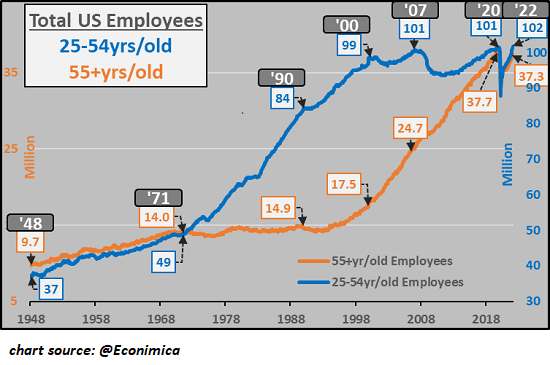
Consider these two charts of the US work force by age. (Courtesy of CH @econimica) In the first chart, Total US Employees, note that the prime working age work force (ages 25-54) has been flatlined for the past 20 years at 101-102 million. In contrast, the 55-and-older cohort of employees soared from 17 million to 37 million. This increase of 20 million accounts for virtually all growth in the employed work force.

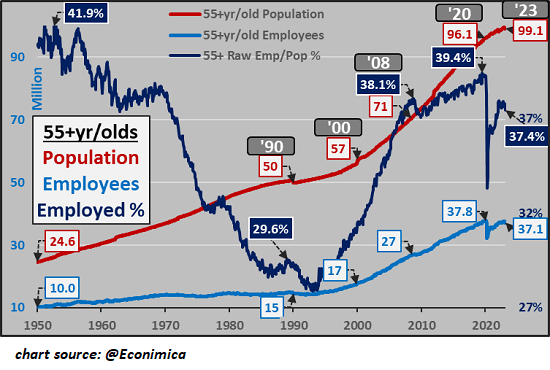
A funny thing happens as workers get old; they retire and leave the work force. Their skills and experience are no longer available to employers or the nation’s economy. The second chart shows the aging of the American populace, as the 55+ cohort increased from 57 million to 99 million since 2000, as the number of older employees skyrocketed from 17 million to 37 million.

While the total US population increased by 18% from 281 million in 2000 to 331 million today, the 55+ cohort increased 74% (from 57 million to 99 million).

The key takeaway here is the number of experienced workers who will retire in the next decade will track the explosive growth in the 55+ cohort. The general consensus is this will not be a problem because there are plenty of younger workers available to fill the vacated slots.

But this overlooks the qualitative and quantitative differences in the millions leaving the work force and those joining the work force. This is especially consequential in real-world jobs, i.e. all those jobs that require engaging real-world materials rather than staring at screens.

Though few analysts and commentators will admit to it, the implicit assumption is that the jobs that matter all involve staring at screens–processing data, finance, entertainment and shaping narrative make the world go round. All the real-world stuff (boring!) will magically get done by tax donkeys who are out of sight, out of mind.

This mindset has it backwards: it’s the real-world work of changing the industrial / energy / energy distribution foundation of the economy that matters going forward, not the staring-at-screens jobs.

What few seem to realize is the work force that’s aging and retiring is the cohort with the real-world skills. It’s a nice idea to remake the entire electrical grid of the nation to transport much larger quantities of electrical power, but who’s going to do all that work? Young people whose career goals are becoming YouTube influencers or day-traders? No. All the ChatAI bots in the world aren’t going to get the real work done, either.

In other words, there is a massive mismatch between the skills available to hire in the young-worker cohort and the skills and experience needed to rebuild the material, real-world foundations of the US economy. It’s well-known but apparently not worth worrying about that the average age of the US farmer is pushing 60 years of age. Nobody left to grow all our food? Hey, isn’t there a ChatAI bot to do all that for us? It can all be automated, right? No? Well, why not? Somebody out there, get it done! Food in super-abundance should be delivered to everyone staring at screens 24/7, it’s our birthright.

The average age of skilled tradespeople is also skewed to the aging work force. There is no easy way to quantify real-world skills gained by on-the-job experience. I suspect it follows a power-law distribution: the newly minted worker just out of school / apprenticeship can handle basic functions, but when tough problems arise, the number of workers with the requisite experience to diagnose and fix the problem diminishes rapidly.

This distribution presents an enormous problem for the economy and employers. Once the super-experienced workers who can solve any problem leave, they cannot be replaced by inexperienced workers. So when the really big problems arise, the systems will break down because those who knew how to deal with the problems are no longer available.

This is how you can have 10 million unemployed workers and 1 million unfilled positions that can’t be filled because few are truly qualified. You want to erect new electrical transmission lines? Nice, but you’re not going to get the job done with green workers accustomed to staring at screens. It takes years of hard labor to acquire even a bare minimum of the skills required. These are not assembly-line jobs that can be filled by unskilled labor, these are jobs in the messy real world, not a distribution center.

As I note in my book on Self-Reliance, individuals with a full spectrum of real-world skills are now extremely rare. Skills that were once common are now performed by specialists. We seem to have all the time in the world to stare at hundreds of cooking programs on TV but how many people actually prepare three meals a day, week in, week out, month in, month out, year in, year out? How many people know how to repair anything, build anything, or maintain a machine?

My direct experience is that many young people don’t know how to put air in the tires of the vehicle Mom and Dad gave them. Young people with graduate-level diplomas don’t know what a green bean plant looks like. (Eeew, gross, it grows in dirt?) The cultural value system that only values wealth, regardless of its source, and minting money from staring at screens has generated a fundamental mismatch between the skills that will be needed going forward and the skills being presented as oh-so-valuable.

Yes, there are many young workers with sharp real-world skills. The question is, are there enough?

This is how we’ll end up with severe shortages of truly skilled labor and high unemployment in the cohort of workers with few real-world skills and a surplus of skills for which there is limited demand. As a real-world experiment, go find a tough old rancher and ask them a series of questions about livestock, machinery, fencing, generators, etc., and then ask the average newly minted college graduate that followed the warped values embedded in our economy the same questions.

Of course the young worker can’t match the experience of the old worker, but do they have any experience at all of a spectrum of essential real-world skills? If not, do they have the requisite physical endurance and commitment needed to acquire real-world skills?

Who’s going to do all the real-world work going forward? A few people talk about it as an abstraction, but it’s not an issue to everyone focused on Federal Reserve policy or GDP. But eventually, the real world will matter more than staring at screens and day-trading, because when the systems break down due to lack of truly qualified employees, we’ll all wake up. But by then it will be too late. We’ll be staring at dead screens begging for somebody somewhere to restore power so we can continue playing with ChatAI to trade zero-day options.

The war, the separation of the world, or the end of an Empire?

All empires are mortal. So is the “American Empire ».
Painting by Alexandre Granger

By Thierry Meyssan

Source: VoltaireNet.org

Many are those who predict a World War. Indeed, some groups are preparing for it. But the States are reasonable and, in fact, consider rather an amicable separation, a division of the world into two different worlds, one unipolar and the other multipolar. Perhaps we are actually witnessing a third scenario: the “American Empire” is not struggling in the trap of Thucydides; it is collapsing like its former Soviet rival died.

The American “Straussians,” the Ukrainian “integral nationalists,” the Israeli “revisionist Zionists” and the Japanese “militarists” are calling for a generalized war. They are alone and they are not mass movements. No state has yet committed itself to this course.

Germany with 100 billion euros and Poland with much less money are rearming massively. But neither of them seems eager to take on Russia.

Australia and Japan are also investing in armaments, but neither of them has an autonomous army.

The United States is no longer able to replenish its military and is no longer able to create new weapons. They are content to reproduce the weapons of the 1980s in an assembly line fashion. However, they maintain their nuclear weapons.

Russia has already modernized its armies and is organizing itself to renew the ammunition it uses in Ukraine and to mass produce its new weapons, which no one can compete with. China, for its part, is rearming to control the Far East and, in the long term, to protect its trade routes. India thinks of itself as a maritime power.

It is therefore difficult to see who would and could start a World War.

Contrary to their speeches, French leaders are not at all preparing for a high-intensity war [1]. The military programming law, established for ten years, plans to build a nuclear aircraft carrier, but reduces the size of the army. It is a question of giving ourselves the means of projection, but not of defending our territory. Paris continues to reason as a colonial power while the world is becoming multipolar. It is a classic: the generals prepare for the previous war and ignore the reality of tomorrow.

The European Union is implementing its “Strategic Compass”. The Commission coordinates the military investments of its member states. In practice, they all play the game, but pursue different goals. The Commission, on the other hand, is trying to take control of decisions on the financing of armies, which until now have depended on their national parliaments. This would make it possible to build an empire, but not to declare a generalized war.
Clearly everyone is playing a game, but apart from Russia and China, none is preparing for a high-intensity war. Rather, we are witnessing a redistribution of the cards. This month, Washington is sending Liz Rosenberg and Brian Nelson, two specialists in unilateral coercive measures [2], to Europe with the mission of forcing the Allies to comply. In the words of former President George Bush Jr. during the war “against terrorism”: “Whoever is not with us is against us”.

Liz Rosenberg is efficient and unscrupulous. She is the one who brought the Syrian economy to its knees, condemning millions of people to poverty because they dared to resist and defeat the Empire’s surrogates.

The Hollywood western discourse a la George Bush Jr. of good guys and bad guys has failed with Türkiye, which has already experienced the 2016 coup attempt and the 2023 earthquake. Ankara knows that it has nothing good to expect from Washington and is already looking to the Shanghai Cooperation Organization. Yet the same discourse should succeed with the Europeans, who remain fascinated by the power of the United States. Of course this power is in decline, but so are the Europeans. No one has learned any lessons from the sabotage of the Russian-German-French-Dutch gas pipelines, North Stream. Not only did the victims take the blame without saying anything, but they are about to receive further punishment for crimes they did not commit.

The world should therefore be divided into two blocs, on the one hand the US hyperpower and its vassals, on the other the multipolar world. In terms of the number of states, this should be half and half, but in terms of population, only 13% for the Western bloc against 87% for the multipolar world.

The international institutions can no longer function. They should either fall into lethargy or be dissolved. The first examples that come to mind are the effective exit of Russia from the Council of Europe and the empty seats of Western Europeans in the Arctic Council during the year of the Russian presidency. Other institutions are no longer relevant, such as the Organization for Security and Cooperation in Europe (OSCE), which was supposed to organize East-West dialogue. Only the attachment of Russia and China to the United Nations should preserve them in the short term, as the United States is already thinking of transforming the Organization into a structure reserved exclusively for the Allied Nations.

The Western bloc should also reorganize itself. Until now, the European continent was dominated economically by Germany. In order to be certain that Germany would never get closer to Russia, the United States wanted Berlin to be content with the western part of the continent and leave the center in the hands of Warsaw. So Germany and Poland armed themselves to impose themselves in their respective zones of influence, but when the American star faded, they would fight against each other.

When the Soviet Empire fell, it abandoned its allies and vassals. Having seen its inability to solve the problems, the USSR first stopped supporting Cuba economically, then dropped its vassals of the Warsaw Pact, and finally collapsed on itself. The same process is beginning today.
The first U.S. Gulf War, the 9/11 attacks and their host of wars in the broader Middle East, the expansion of Nato and the Ukrainian conflict will have offered only three decades of survival to the American Empire. It was backed by its former Soviet rival. It has lost its raison d’être with its dissolution. It is time for it to disappear too.

Translation
Roger Lagassé

[1] «En 2030, l’armée française ne sera pas prête à une guerre de haute intensité», Jean-Dominique Merchet, L’Opinion, 7 avril 2023.

[2] «US sanction officials plan missions to clamp down on Russia», Fatima Hussein, Associated Press, April 7, 2023.

New York Times Is Now Telling Bigger Lies Than Iraq WMDs and More Effectively

By David Swanson

Source: War Is a Crime

The New York Times routinely tells bigger lies than the clumsy nonsense it published about weapons in Iraq. Here’s an example. This package of lies is called “Liberals Have a Blind Spot on Defense” but mentions nothing related to defense. It simply pretends that militarism is defensive by applying that word and by lying that “we face simultaneous and growing military threats from Russia and China.” Seriously? Where?

The U.S. military budget is more than those of most nations of the world combined. Only 29 nations, out of some 200 on Earth, spend even 1 percent what the U.S. does. Of those 29, a full 26 are U.S. weapons customers. Many of those receive free U.S. weapons and/or training and/or have U.S. bases in their countries. Only one non-ally, non-weapons customer (albeit a collaborator in bioweapons research labs) spends over 10% what the U.S. does, namely China, which was at 37% of U.S. spending in 2021 and likely about the same now despite the highly horrifying increases widely reported in the U.S. media and on the floor of Congress. (That’s not considering weapons for Ukraine and various other U.S. expenses.) While the U.S. has planted military bases around Russia and China, neither has a military base anywhere near the United States, and neither has threatened the United States.

Now, if you don’t want to fill the globe with U.S. weaponry and provoke Russia and China on their borders, the New York Times has some additional lies for you: “Defense spending is about as pure an application of a domestic industrial policy — with thousands of good-paying, high-skilled manufacturing jobs — as any other high-tech sector.”

No, it is not.  Just about any other way of spending public dollars, or even not taxing them in the first place, produces more and better jobs.

Here’s a doozie:

“Liberals also used to be hostile to the military on the assumption that it skewed right wing, but that’s a harder argument to make when the right is complaining about a ‘woke military.’”

What in the world would it mean to oppose organized mass murder because it skews right wing? What the hell else could it skew? I oppose militarism because it kills, destroys, damages the Earth, drives homelessness and illness and poverty, prevents global cooperation, tears down the rule of law, prevents self-governance, produces the dumbest pages of the New York Times, fuels bigotry, and militarizes police, and because there are better ways to resolve disputes and to resist the militarism of others. I’m not going to start cheering for mass killings because some general doesn’t hate enough groups.

Then there’s this lie: “The Biden administration touts the size of its $842 billion budget request, and in nominal terms it’s the largest ever. But that fails to account for inflation.”

If you look at U.S. military spending according to SIPRI in constant 2021 dollars from 1949 to now (all the years they provide, with their calculation adjusting for inflation), Obama’s 2011 record will probably fall this year. If you look at actual numbers, not adjusting for inflation, Biden has set a new record each year. If you add in the free weapons for Ukraine, then, even adjusting for inflation, the record fell this past year and will probably be broken again in the coming year.

You’ll hear all sorts of different numbers, depending on what’s included. Most used is probably $886 billion for what Biden has proposed, which includes the military, the nuclear weapons, and some of “Homeland Security.” In the absence of massive public pressure on a topic the public hardly knows exists, we can count on an increase by Congress, plus major new piles of free weapons to Ukraine. For the first time, U.S. military spending (not counting various secret spending, veterans spending, etc.) will likely top $950 billion as predicted here.

War profiteer-funded stink tankers like to view military spending as a philanthropic project to be measured as a percentage of an “economy” or GDP, as if the more money a country has, the more it should spend on organized killing. There are two more sensible ways to look at it. Both can be seen at Mapping Militarism.

One is as simple amounts per nation. In these terms, the U.S. is at a historic high and soaring far, far over the rest of the world.

The other way to look at it is per capita. As with a comparison of absolute spending, one has to travel far down the list to find any of the designated enemies of the U.S. government. But here Russia jumps to the top of that list, spending a full 20% of what the U.S. does per person, while only spending less than 9% in total dollars. In contrast, China slides down the list, spending less than 9% per person what the United States does, while spending 37% in absolute dollars. Iran, meanwhile, spends 5% per capita what the U.S. does, compared to just over 1% in total spending.

Our New York Times friend writes that the U.S. needs to spend more to dominate four oceans, while China need worry only about one.  But here the U.S. desire to treat economic competition as a form of war blinds the commentator to the fact that a lack of war facilitates economic success. As Jimmy Carter told Donald Trump, “Since 1979, do you know how many times China has been at war with anybody? None. And we have stayed at war. . . . China has not wasted a single penny on war, and that’s why they’re ahead of us. In almost every way.”

But you could drop the idiotic economic competition and still understand the benefits of investing in something other than death since tiny fractions of military spending could transform the United States and the rest of the world. Surely there would remain plenty of other things to lie about.

How Does Degrowth Apply to Our Minds?

By Erin Remblance

Source: resilience

As an Australian, it troubles me that if the whole world lived like us, we would need 4.5 planet Earths. Thanks to over-consuming nations like mine, worldwide we are living as if we have 1.75 planet Earths, a figure that has increased from 1 (that is, living within our means) since 1970. What this boils down to is that those of us in the global north are taking from both countries in the global south and future generations to fuel our lifestyles today. The ‘Earth Overshoot’ research is supported by the work of the late Earth System Scientist, Professor Will Steffen, who brought to our attention The Great Acceleration, whereby “[a]fter 1950 we can see that major Earth System changes became directly linked to changes largely related to the global economic system.” Steffen is referring to our growth-based economies, and while three percent economic growth each year might sound small, it means that within 24 years we will be consuming twice as many resources as today, and within 100 years 19 times as many. As economist Kenneth Boulding said: “[a]nyone who believes that exponential growth can go on forever in a finite world is either a madman or an economist.”

For this reason, I am a big proponent of degrowth in over-consuming nations in order to fit back within planetary boundaries. For anyone not familiar with the term, degrowth is a planned, democratic reduction in material and energy use in high-income nations while improving the well-being of people in those nations. It is more than this though. While very often the focus of degrowth is on how life can be better in a smaller economy, Federico Demaria and Serge Latouche argue that “[t]he point of degrowth is to escape from a society that is absorbed by the fetishism of growth…. It implies decolonization of the imaginary and the implementation of other possible worlds”. In this respect, the former definition of degrowth applies only to over-consuming nations, while the latter definition applies to all nations, and to all people. It is this second definition of degrowth to which this essay relates.

The concept of degrowth is powerful because it is clear that we need systemic change to avoid ecological collapse: business as usual with a “green tinge” isn’t going to be enough. It is also true that individual change drives cultural change which can be the key to unlocking political change leading to fundamental change. On this point, I find it fascinating to consider how “growth has entered our minds and souls”, and how an awareness of these “mental infrastructures of growth” might free us from growthism and help unlock the cultural changes that will bring about the necessary systemic changes.

With this in mind, here are a couple of points to consider in relation to how growth may be enshrined in the psychological structure of our collective minds, largely based on the work of Harald Welzer:

  • Our dreams for the future are centred around it being better than today, in the sense of ‘more’ (e.g., a bigger house, a larger salary, more travel).
  • We see ourselves as something to continually develop and optimise, our lives are seen as a process of creating biographies or filling curriculum vitae.
  • While we used to see paid labour as drudgery and something we did until we had met our needs, now we view it as noble, esteemed even, to be sought out and with no end. Sadly, this cultural 180° turnaround becomes a regret of many as they are dying.
  • Similarly, society views ‘hard-work’ as virtuous and thus ‘hard-work’ entitles those who undertake it to whatever their heart desires without limit or consideration of the harm caused, their purchases being the fruits of their labour.
  • We typically live by the rhythms of the industrial workday via a standardised worldwide time regime, unaware that there is a natural rhythm of time (for example, consider that in 2023 there will be 13 moons but only 12 calendar months or that, on the whole, our pace of work is unchanged by the seasons).
  • It is a collective belief that we should be able to own parcels of land, excluding others from that land. An example of this is that home (and correspondingly land) ownership in Australia is described as the ‘Great Australian Dream’, a term derived from the ‘American Dream’ of the same nature.

In various ways, these – and probably many more aspects of our modern day lives – relate back to the surpluses created by industrialisation (enabling the future to have more than today, a concept that is “historically quite recent”), the enclosure of the commons (the very foundation of growth-dependent capitalism) and the subsequent imperative to work to have our needs met (rather than simply being able to directly meet our needs). Our ability to recognise and unpick these ‘mental infrastructures’ – that is, the worldview that influences all of our actions – will be key to throwing off the shackles of growth and unlocking a culture of sufficiency, whereby we recognise when we have ‘enough’ in a material sense and from then on meet our “nonmaterial needs nonmaterially”, increasing our sense of wellbeing and contentment.

The work of Antonio Gramsci on cultural hegemony is relevant in unlocking a culture of sufficiency. Michael Mezz describes Gramsci’s theory on how the ruling class maintains power via a cultural form of dominance:

“…the ruling class creates an ideology in which its own values become common sense for the rest of society and Gramsci argued that the role of the state is to maintain institutions such as media and the education system that educate the masses on the cultural ideology of the ruling class. The goal of that education being that the working class develop a sense of freedom and a good life that serves the purposes of the people in power. In other words, the working class starts to value things like innovation and productivity and economic growth that doesn’t actually serve them.”

Gramsci tells us that the way to overcome cultural hegemony is by creating a new culture that is not based on the values of the ruling class. A counter-culture, if you like.

So, what are the counter-hegemonic narratives that we can begin to embrace? What would a mind and soul not infiltrated by growth look like? There is much to learn from indigenous cultures on this topic. As Jeff Sparrow highlights in his book, Crimes Against Nature, First Nation Australians found paid labour to be antithetical to their egalitarian lifestyles:

“Today, we take the wages system for granted. It appears normal, almost eternal, since we can barely conceive of an alternative. It did not seem normal to pre-colonial people. In Australia, as elsewhere in the world, they found capitalist practices utterly horrifying…. Indigenous people, accustomed to an egalitarian ethos and to work carried out for the collective good, saw the authority exerted by employers as tyranny. As late as 1888, a churchman complained of the difficulty he had in persuading Indigenous people that one man was innately better than another, that a certain individual, by virtue of his possessions, mandated obedience from his fellows…. Indigenous people did not despise wage labour primarily because of the effort that it entailed. Rather, they thought the work demanded by capitalists stripped life of its humanity.”

Furthermore, First Nations people lived with the rhythms of nature, not the industrial workday, and there was no private land ownership, they had the wisdom to know that “… you are undone if you once forget that the fruits of the earth belong to us all, and the earth itself to nobody” (Jean-Jacques Rousseau).

There are many examples of counter-hegemonic narratives arising more recently too. The following list is skewed more towards examples from the global North because the global North represents the vast majority of the over-consumption and is therefore where cultural change is most needed. Such examples include:

  • Those people, like the Futuresteaders and others who practice voluntary simplicity and frugal abundance, who appreciate the simple things in life, and find happiness in what they have rather than what they want. Seeking only ‘enough’ and not ‘more’ represents an affront to the dominant culture of dreams of the future being materially greater than today. This point is relevant only to those whose needs are already met. Of course, those who are living in conditions of deprivation should have access to ‘more’, until they too have ‘enough’.
  • People who choose to spend their time doing work that is traditionally undervalued and lacking in both career trajectory and pay increases, but is socially valuable, forgoing future surpluses (think of the stay-at-home parents, childcare workers, teachers, nurses, carers, small farmers, those who work part-time voluntarily, and those who volunteer their time to worthy but under-funded causes).
  • The move towards minimalism which seeks to value time and non-material items over ‘the grind’ and the accumulation of things as a reward for hard work. The Tiny House Movement shows us that it is possible to enjoy living with less, including the freedom of a smaller mortgage.
  • The tang ping (lying flat) movement in China and quiet quitting in the U.S.A. are taking back our right to be humans, not simply workers who devote more time than they would like to paid labour.
  • Anyone advocating for job guarantees, enabling anyone who wants to work to do so. Job guarantees seek to remove the artificial scarcity of employment we see today, where the threat of joblessness looms ever large and we constantly need to better ourselves so that we can compete for work. Those who advocate for a Universal Basic Income – an unconditional liveable wage for all – are fighting to remove the need for waged employment at all.
  • People organising for the community rather than the individual are prioritising others over their own interests, giving up the opportunity to build their own CVs in favour of the greater good, and there are some wonderful examples of such union building herehere and here.
  • The move towards a 4-day work week challenges the dominant narrative that more time at work is better.
  • The Nap Ministry and the related manifesto Rest Is Resistance empowers us to value rest over productivity.
  • The many activists calling out the harm caused by the carbon-intensive lifestyles revered by the dominant culture, such as Greta Thunberg (who beautifully articulated in her book, The Climate Book, that “we all have a responsibility to find quick ways of making that [extremely high-emitting] lifestyle socially unacceptable”), activists who block private jets, people promoting going flight free, and those seeking to reduce the dominance of cars on our streets. For these people, simply having the means to live a materially intensive lifestyle – regardless of the hard work involved in acquiring those means – isn’t enough to justify the harm it causes.
  • The locals of the Greek Island Ikaria, who do things in their own time, not that of the industrial workday. This fascinating paper describes “people arriving to appointments in ‘Ikarian time’, that is, a ‘few hours late’ or shopkeepers telling bewildered tourists that ‘the shop will open when it is time to open’”.
  • Co-operative housingcommunity land trusts and Vienna’s enviable form of social housing show us that there are other ways of providing a community’s housing and land needs that don’t rely on private ownership.

There are, of course, many other wonderful counter-culture examples beyond this short list – this is merely scratching the surface – but the point is that we need to advance these, and those of the same theme, until they become the leading narrative.

Unpicking the dominant, growth-based worldview will mean closely analysing the stories we have been told (and who those stories might serve), and bravely and courageously assessing whether all of this growth really does bring us ‘the good life’. We will likely find that we can achieve ‘a good life’ (that is, harmony with ourselves, our community, and the physical world) by living simpler but more meaningful lives. Perhaps we will even come to realise the very wise words of English writer, Alan Watts: “the meaning of life is just to be alive. It is so plain and so obvious and so simple. And yet, everybody rushes around in a great panic as if it were necessary to achieve something beyond themselves”. The way that growth manifests in our minds, our thoughts, our dreams, and our souls is important to consider because if we can create a culture of sufficiency, we will have found the key to systemic change and avoiding ecological catastrophe. I’m sure we can all agree that this is a worthy task indeed.

We are Closening to a Move Through the Cycle – But First Will Come Disorder

By Alastair Crooke

Source: Strategic Culture Foundation

Is the collective West nearing the end of a cycle? Or are we still in mid-cycle? And could it be an epochal point of inflection?

The question posed at this point is: Is the collective West nearing the end of a cycle? Or are we still in mid-cycle? And is this a four-generational mini-cycle, or an epochal point of inflection?

Is Russo-Chinese Entente and the global tectonic discontent with the ‘Rules Order’ – on the heels of a long trajectory of catastrophes from Viet Nam, through Iraq to Ukraine – sufficient to move the West on to the next stage of cyclical change from apex to disillusionment, retrenchment and eventual stabilisation? Or not?

A major inflection point is typically a period in history when all the negative components from the outgoing era ‘come into play’ – all at once, and all together; and when an anxious ruling class resorts to widespread repression.

Elements of such crises of inflection are today everywhere present: Deep schism in the U.S.; mass protest in France, and across Europe. A crisis in Israel. Faltering economies; and the threat of some, as yet undefined, financial crisis chilling the air.

Yet, anger erupts at the very suggestion that the West is in difficulties; that its ‘moment in the sun’ must give place to others,and to other cultures’ ways of doing things. The consequence to such a moment of epochal ‘in-betweeness’ has been characterised historically by the irruption of disorder, the breakdown of ethical norms, and the loss of a grip on what is real: Black becomes white; right becomes wrong; up becomes down.

That’s where we are – in the grip of western élite anxiety and a desperation to keep the ‘old machinery’s’ wheels spinning; its ratchets loudly opening and closing, and its levers clanging into, and out of place – all to give the impression of forward motion when, in truth, practically all of western energy is consumed in simply keeping the mechanism noisily aloft, and not crashing to an irreversible, dysfunctional stop.

So, this is the paradigm that governs western politics today: Doubling-down on the Rules Order with no strategic blueprint of what it is supposed to achieve – in fact no blueprint at all, except for ‘fingers crossed’ that something beneficial for the West will emerge, ex machina. The various foreign policy ‘narratives’ (Taiwan, Ukraine, Iran, Israel) contain little of substance. They are all clever linguistics; appeals to emotion, and with no real substance.

All this is hard to assimilate for those living in the non-West. For they do not come face-to-face with western Europe’s repeat re-anactment of the French Revolution’s iconic secular, egalitarian reform of human society – with ‘the specific timbre, flavour and ideology’ shifting, according to prevailing historic conditions.

Other nations unafflicted by this ideology (i.e., effectively the non-West) find it perplexing. The West’s culture war barely touches cultures outside its own. Yet, paradoxically, it dominates global geo-politics – for now.

Today’s ‘flavour’ is termed ‘our’ liberal democracy – the ‘our’ signifying its link to a set of precepts that defies clear definition or nomenclature; but one, that from the 1970s, has drifted into a radical enmity towards the traditional European and American cultural legacy.

What is singular about the present re-enactment is that whereas the French Revolution was about achieving class equality;ending the division between aristocracy and their vassals, liberalism today represents a modification of ideology” that U.S. writer Christopher Rufo suggests, “says that we want to categorize people based on group identity and then equalize outcomes across every axis – predominantly the economic axis, health axis, employment axis, criminal justice axis—and then formalize and enforce a general levelling”.

They want absolute democratic levelling of every societal discrepancy – reaching even, back into history, to historic discrimination and inequalities; and to have history re-written to highlight such ancient practice so that they can be routed out through enforced reverse discrimination.

What has this to do with foreign policy? Well, pretty well everything (so long as ‘our’ liberalism) retains its capture of the western institutional framework.

Bear this background in mind when thinking of the western political class’s reaction to events, say, in the Middle East, or in Ukraine. Although the cognitive élite contends that they are tolerant, inclusive, and pluralistic, they will not accept the moral legitimacy of their opponents. That is why in the U.S. – where the Cultural War is most developed – the language deployed by its foreign policy practitioners is so intemperate and inflammatory towards non-compliant states.

The point here is that, as Professor Frank Furedi has emphasised, the contemporary ‘timbre’ is one no longer merely adversarial, but unremittingly hegemonic. It is not a ‘turn’. It is a rupture: The determination to displace other sets of values by a western inspired ‘Rules-Based Order’.

Being a ‘liberal’ (in this strictly narrow sense) isn’t something you ‘do’; it is what you ‘are’. You think ‘right thoughts’ and utter ‘right speak’. Persuasion and compromise reflect only moral weakness in this vision. Ask the U.S. neocons!

We are used to hearing western officials talk about the ‘Rules-Based Order’ and the Multi-Polar System as rivals in a new global framework of intense ‘competition’. That however, would be to misconceive the nature of the ‘liberal’ project. They are not rivals: There cannot be ‘rivals’; they can only be recalcitrant other societies that have refused the analysis and the need to root out all cultural and psychological structures of inequity from their own domains. (Hence, China is hounded on its alleged deficiency in respect to the Uyghurs).

The cognitive privilege of ‘awareness’ is what lies behind the western ‘doubling-down’ on imposing a global Rules-BasedOrder: No compromise. The moral enterprise is more intent on its elevated moral station than on coming to terms with or managing, say, a defeat in Ukraine.

Just yesterday, the Bank of America in London was forced to cut short a two-day, online conference on geopolitics; and apologised to attendees following the outrage expressed at a speaker’s comments that were deemed ‘pro-Russian’ by some attendees.

What was said? Professor Nicolai Petro’s remarks at the session where he said: “Under any scenario, Ukraine would be the overwhelming loser in the war: Its industrial capacity devastated … and its population shrunk as people departed to look for employment abroad. If this is what is meant by removing Ukraine’s capacity to wage war against Russia, then it [Russia] will have won”. Professor Petro added that the U.S. government had no interest in a ceasefire, as it had the most to gain from a prolonged conflict.

No compromise is allowed. To speak thus, to inhabit the western moral high ground creating ‘villains’, clearly is more important than coming to terms with reality. Professor Petro’s comments were condemned as “rolling through Moscow’s talking points”.

Yet, these cultural revolutionaries face a pitfall, Christopher Rufo writes,

Theirs is actually, not an easy task. This is very difficult, and, in fact, I think is somewhat impossible. If you look at even the Chinese Cultural Revolution in the 1960s … They had a program of economic and social levelling that was more totalitarian and more drastic than anything that had ever happened in the past. [Yet] after the Revolution collapsed, after the period of retrenchment, social scientists looked at the data and discovered that a generation later, those initial inequalities had stabilized … The point is that forced levelling is very elusive. It’s very difficult to achieve, even when you are doing it at the tip of a spear or at the point of a gun.

The levelling project being essentially nihilistic becomes captured by the destructive side of the revolution – its authors so absorbed with dismantling structures that they do not attend to the need to think policies through, before launching into them. The latter are not adept at doing politics: at making politics ‘work’.

Thus, discontent at the welling string of western foreign policy flops grows. Crises multiply, both in number and across different societal dimensions. Perhaps, we are closening to a point of beginning to move through the cycle – toward disillusionment, retrenchment, and stabilization; the prerequisite step to catharsis and ultimate renewal. Yet, it would be a mistake to underestimate the longevity and tenacity of the western revolutionary impulse.

“The revolution does not operate as an explicit political movement. It operates laterally through the bureaucracy and it filters its revolutionary language through the language of the therapeutic, the language of the pedagogical, or the language of the corporate HR department”, Professor Furedi writes. “And then, it establishes power anti-democratically, bypassing the democratic structure: using this manipulative and soft language – to continue the revolution from within the institutions.”