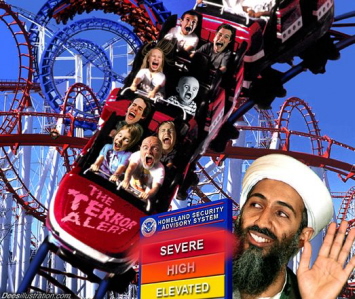
While our attention had been focused on ISIS, the new and heretofore unheard of Khorasan Group has been organizing and planning to implement a terror attack here in the United States.
Who are these people? According to U.S. officials, they are linked to al-Qaeda and consist of radical veteran fighters who are “running amok in the Middle East and bent on destruction” (primarily in the U.S.).
James Comey, head of the FBI, stated in an interview with 60 Minutes on CBS, “Khorasan was working and you know, may still be working on an effort to attack the United States and our allies, and looking to do it very, very soon.” Comey also admitted he knew the identities of those Americans fighting alongside radical groups in the Middle East.
I don’t know about you but I find this very strange. Khorasan was initially introduced to the Western world in the middle of September and just as suddenly was never mentioned for the subsequent three weeks. And now, they’re back.They are supposedly very dangerous and may attack us very, very soon. But, we know very little about them and they have successfully remained off our radar screens.
But the icing on the cake came when Comey stated that the government knows the names of these Americans who have fought with ISIL. They have American passports and if they wish to return to the U.S., they have every right to do so. But, he promised that they will be tracked very carefully.
Initially, I thought Comey was rehearsing for some stand-up comedy routine he was performing. Here we have Americans who have been fighting alongside jihadist fundamentalists in Syria, a country we are bombing, and they are members of a terrorist group who is planning to attack the U.S.; the FBI knows their identities, and we are told they have the right of return. This is something even Palestinians do not enjoy and all they want is to go home.
I may have misunderstood, but there are heavy consequences in place for those Americans who give aid and support to any organizations that have been deemed terrorists by our government.
Case in point: In May of 2013, the Obama administration targeted and killed, Awlaki, a United States citizen. What was his crime?
Mr. Awlaki was a radical Muslim cleric, born in New Mexico, and, at the time of his death, living in Yemen. Awlaki made anti-U.S. speeches to members of his congregation and encouraged Muslims to confront and fight U.S. imperialism. The crime of “imminent” threat was that sometime in the future he might be involved in a terrorist act in the U.S.
Two weeks later, Awlaki’s 16 year old son, Abdulrahman al- Awlaki, who was born in Denver, Colorado, was targeted and killed. The explanation offered by U.S. officials was that because of who his father was, he might someday grow into a terrorist and commit acts against our homeland. His crime was that he had the wrong father.
A more recent story is about Shannon Maureen Conley, 19, a certified nurse’s aid who was arrested at Denver International Airport last April. She had planned to fly to Germany and eventually an ISIS camp near the Turkish border. She was taking this long trip because she was planning on meeting her suitor, Yousr Mouelhi, whom she met online and planned to marry. Unfortunately Yousr is a member of ISIS.
Conley thought she could be helpful in Syria by using her skills as a nurse’s aide.
In a plea agreement, Conley pleaded guilty to the charge of conspiracy to provide material support to a designated foreign terrorist organization. She faces up to 5 years in federal prison and a fine of $250,000.
As part of the plea agreement, Conley must provide law enforcement agencies with information about others looking to provide help to terrorist organizations abroad.
None of those mentioned above had any active role in organizing or implementing a terrorist attack. Yet, two men have been executed and a naive young woman has been sentenced to prison.
However, the 12 or so Americans who can be identified, are welcomed back on U.S. soil, despite the fact that the FBI claims they fought alongside terrorists and have been trained to implement terrorist attacks inside the U.S.
This whole scene seems unbelievable. As Glenn Greenwald stated, “The last thing the Washington political class and the economic elites who control it want is for this war to end. Anyone who doubts that should just look at the express statements from these leading Democrats, who wasted no time at all seizing on the latest Bad Guys to justify literally decades more of this profiteering and war-making.”
“As the Obama administration prepared to bomb Syria without congressional or U.N. authorization, it faced two problems. The first was the difficulty of sustaining public support for a new years-long war against ISIS, a group that clearly posed no imminent threat to the ‘homeland.’ A second was the lack of legal justification for launching a new bombing campaign with no viable claim of self-defense or U.N. approval.
“The solution to both problems was found in the wholesale concoction of a brand new terror threat that was branded ‘The Khorasan Group.’ After spending weeks depicting ISIS as an unprecedented threat—too radical even for Al Qaeda!—administration officials suddenly began spoon-feeding their favorite media organizations and national security journalists tales of a secret group that was even scarier and more threatening than ISIS, one that posed a direct and immediate threat to the American Homeland. Seemingly out of nowhere, a new terror group was created in media lore.”
People have called me a “conspiracy nut” because I don’t accept the official 9-11 story but the government needed a “New Pearl Harbor” to gather support for military engagement in the Middle East and 9-11 ensured they got it. It may be time now for the government to stage another event to gather support for its predicted 30-year war in Syria and its fight against ISIS.
BEWARE! It’s not the Khorasan Group that worries me, it’s our own government.
The report that a healthcare worker in Dallas, Texas, one of those who treated Ebola victim Thomas Eric Duncan before his death, has herself contracted the disease, is a significant and troubling event. Dr. Thomas Frieden, director of the US Centers for Disease Control and Prevention, admitted in a television interview Sunday, “It’s deeply concerning that this infection occurred.”
While Frieden claimed that current protocols for treating Ebola patients were effective in preventing the spread of the disease, arguing that there must have been “a breach of protocol,” no actual explanation has been given for how the healthcare worker became infected. She was not one of the 48 primary contacts with Duncan who were being monitored for possible exposure, but worked in a more peripheral role. Her infection was only detected when she contracted a fever and reported it herself.
There are a growing number of such cases, including doctors and nurses in the affected regions of Liberia, Sierra Leone and Guinea, who were well aware of the procedures, and an NBC News photographer, whose infection has caused the quarantining of the entire reporting team, led by Dr. Nancy Snyderman, the network’s chief medical correspondent. These cases suggest that despite the repeated assurances from health officials, there is much that is not known about how the disease is transmitted.
What is certain is that the Ebola outbreak in West Africa is a catastrophe for the people of that region. More than 8,000 people have been infected and more than 4,000 have died, with no signs that the epidemic has been curtailed. The heroic efforts of doctors, nurses and aid workers have been sabotaged by the collapse of the healthcare systems of these countries, among the poorest in the world. Only 20 percent of the affected population in West Africa has access to a treatment center.
It is almost impossible to overstate the dimensions of the disaster. Until this year, Ebola was a disease of remote rural areas that had killed only 1,500 people in 20 previous outbreaks over 40 years. Now the disease has reached urban centers like Monrovia, capital of Liberia, a city of one million, and individuals infected with the virus have travelled from the region only to fall ill in the United States, Spain and Brazil. There are well-founded fears that Ebola could become a global plague, particularly if it reaches more densely populated countries like Nigeria, or the impoverished billions of South and East Asia.
The impotent global response to the immense tragedy in West Africa is a serious warning. The Ebola crisis has proven to be a test of the ability of capitalism, as a world system, to deal with an acute and deadly threat. The profit system has failed. A society organized on the basis of production for private gain and divided into antagonistic nation-states, with a handful of imperialist powers dominating the rest, is incapable of the systematic, energetic and humane response that this crisis requires. It is no accident that the Ebola outbreak takes place in countries that are former colonies of imperialist powers. Guinea was a French colony, Sierra Leone a British colony, and Liberia a de facto US colony since its founding by freed American slaves. Despite their nominal independence, each country remains dominated by giant corporations and banks based in the imperialist countries, which extract vast profits from the mineral wealth and other natural resources. Guinea is the world’s largest bauxite exporter, Sierra Leone depends on diamond exports, Liberia has long been the fiefdom of Firestone Rubber (now Bridgestone).
These countries are unable to provide even rudimentary healthcare services to their populations, not because they lack resources, but because they are exploited and oppressed by a global economic system controlled by Wall Street and other financial and commodity markets. This economic system is so unequal that the 85 richest individuals on the planet control more wealth than the poorest three billion people, nearly half of humanity.
Economic development, particularly over the past 40 years, has created an interconnected and globalized world. Thousands of people travel every day between West Africa and other parts of the world. The revolution in transportation and communications means that what happens in West Africa today can affect Dallas, Boston, Madrid and Rio de Janeiro tomorrow. This makes the Ebola epidemic not a regional event, but a world event.
But the response to the Ebola crisis is carried out by national governments driven by competing national interests, and concerned, not with the danger of the virus to the world’s people, but with how it affects the interests of the ruling class in each nation. Thus there are calls in the United States and Europe for imposing an embargo on travelers from Liberia, Sierra Leone and Guinea, although health experts warn that such an action would cause the economic collapse of these countries, vastly worsening the epidemic and making its global spread more rather than less likely.
Equally reactionary is the Obama administration’s decision to send 4,000 US troops to Liberia, ostensibly to build health treatment facilities. Why are heavily armed soldiers chosen for such a mission? They are not construction workers or healthcare providers. If healthcare workers and journalists have become infected, despite taking every precaution, then certainly soldiers could themselves fall victim to the disease, and bring the virus home with them. The real agenda of Washington is to secure a basis for its Africa Command (AFRICOM), up to now excluded from the continent by local opposition, thus advancing the interests of American imperialism against its rivals, particularly China.
The potential dangers of a disease like Ebola spreading from rural Africa to the world have long been understood by epidemiologists and other scientists. It has been the subject of specialized studies and best-selling books. The issue has even penetrated into popular culture through films from The Andromeda Strain to Outbreak and 28 Days. But the profit system has been incapable of generating a serious effort to forestall an entirely predictable crisis.
The detection of Ebola in the mid-1970s should have been the occasion for the launching of an intensive effort to study the virus, analyze how it is transmitted and develop antidotes and a vaccine. This did not take place, in large measure, as a report last month suggested, because the giant pharmaceutical companies that control medical research saw little profit in saving the lives of impoverished villagers in rural Africa (see “Profit motive big hurdle for Ebola drugs”).
What little research has been conducted on possible cures and vaccines was funded by the US Pentagon, for dubious reasons: at best, to protect US soldiers who might be deployed to the jungles of central Africa as an imperialist invasion force; at worst, to determine whether the virus could be weaponized for use against potential enemies.
What would a serious response to the Ebola crisis look like? It would entail a massive, internationally coordinated response which calls on vast resources on the scale necessary both to save as many as possible of those under immediate threat and to prevent the development of an outbreak on a global scale.
It would mean the mobilization of doctors, nurses, public health workers and scientists from America, Europe, Russia, China and the rest of the world to fight back against a deadly threat to the entire human race. And it would mean taking control of this response out of the hands of the national military establishments, particularly the Pentagon, and the giant pharmaceutical firms, one of the most corrupt and rapacious detachments of big business.
The strife that has engulfed Christopher Columbus’s legacy in recent years has put the concept of an Indigenous People’s Day at the forefront of discussion.
In theory, as we move forward in our lives, we should make every effort to broaden our perspective and to seek out the truth. As we mature so should our thought process. Such maturation holds true on both an individual and a societal basis. A broad understanding of history enables one to reconcile the past, comprehend the present, and reasonably theorize how future events may unfold. As truths are discovered, norms begin to shift. Such forthright thinking is necessary to fully grasp the complexities of historical events and figures. This is particularly true with respect to the legacy of Christopher Columbus. A polarizing historical figure whose life has been defined, by many, for his astonishing level of courage and intestinal fortitude; nevertheless, such impressive traits should never blur the fact that he oversaw a murderous quest for material riches that resulted in the utter demise of a people. Each year, as October 12th comes and goes, a question is raised – what are we celebrating about his life?
Christopher Columbus was an immensely talented mariner who navigated the Santa Maria and two other smaller ships across the Atlantic Ocean in search of Asia. However, he and his crew inadvertently arrived in the New World on October 12th of 1492. Their long and arduous journey was driven by one clear objective – to find and establish a long-term source of wealth, preferably gold for the King and Queen of Spain. In return Columbus would be allotted 10 percent of the profits, governorship over newfound land, and awarded the prestigious title of Admiral of the Ocean Sea. Upon arriving in the islands, which we now refer to as the Bahamas, Columbus and his crew first encountered the Arawaks. It was at that fateful juncture in human history that he made two keen observations regarding these indigenous people. Firstly, they were docile and trusting in nature; and, secondly, they wore gold jewelry. Columbus’s own words from his personal journal capture the ominous fate that awaited the Arawaks:
They do not bear arms, and do not know them, for I showed them a sword, they took it by the edge and cut themselves out of ignorance. They have no iron. Their spears are made of cane. They would make fine servants. With fifty men we could subjugate them all and make them do whatever we want.
The concept of private property and the pursuit of material riches had reached a frenzied pitch within 15th century Europe. As an independent contractor Christopher Columbus recognized the seemingly limitless economic potential of the land he had “discovered.” It was at this point in time that his bravery had begun to shift to sheer brutality. This transition within his personality was encapsulated in many of the notes that he had sent to the King and Queen of Spain to bolster expectations. In one particular note he promised “as much gold as they need and as many slaves as they ask.” Soon thereafter, he and his men kidnapped a number of the Arawaks and forced them to identify other sources of gold throughout the region. With an extensive arsenal of advanced weaponry / horses, Columbus and his men, arrived on the islands that were later named Cuba and Hispaniola (present day Dominican Republic / Haiti). Upon arrival, the sheer magnitude of gold, which was readily available, set into motion a relentless wave of murder, rape, pillaging, and slavery that would forever alter the course of human history. A young, Catholic priest named Bartolomé de las Casas transcribed Columbus’s journals and later wrote about the violence he had witnessed. The fact that such crimes could potentially go unnoticed by future generations was deeply troubling to him. He expanded upon the extent of Columbus’s reign of terror within his multivolume book entitled the History of the Indies:
There were 60,000 people living on this island, including the Indians; so that from 1494 to 1508, over 3,000,000 people had perished from war, slavery, and the mines. Who in future generations will believe this? I myself writing it as a knowledgeable eyewitness can hardly believe it.
Such words offer the reader a firsthand account of the state-sponsored genocide that the Spanish Empire had financed through Columbus. Clearly, the intent of the Spanish Empire was to eradicate the islands of indigenous people through slavery and violence. In doing so they had further established their already dominant political and economic standing within Europe. In a matter of years, Columbus and his men decimated the indigenous people of the Caribbean islands.
The fact that Columbus Day is celebrated each October is a testament to the intellectual dishonesty that has stemmed from the likes of academics, teachers, and politicians. It has become an annual ritual to sanitize history and present half-truths as absolutes. In 1937, Columbus Day was officially established as a federal holiday in the United States; however, to this day it is not observed in Hawaii, Nevada, Oregon and South Dakota. The other 46 states that observe the holiday acknowledge Christopher Columbus as a superior mariner that had unknowingly found himself in the Caribbean Sea after departing from Europe. Incidentally, in conjunction with those facts, it would also be quite fair to label Columbus as one of the “founding fathers” of the trans-Atlantic slave trade. Unfortunately such an unpleasant truth has been relegated to the background of history. For decades now we have been hearing self proclaimed “experts” espouse Columbus’s many accomplishments – particularly his “discovery” of the New World, yet, in doing so they have opted to minimize the extent of his violence or have utterly disregarded it. The shame in all of this is that people living in countries throughout the Western Hemisphere, including the United States, have been indoctrinated into believing such fallacies and have been intentionally miseducated.
In sum, history cannot be rewritten. However with information now at our fingertips we can no longer fault our teachers, politicians, etc. for being left in the dark regarding our collective histories. Thoroughly researched academic materials are readily available for those who seek the truth. In fact, it is fair to assume that as people gain a better understanding of Columbus they will begin to support other efforts to acknowledge this particular point in time. Such forthright thinking is certainly evident within the City of Denver, Colorado and within the City of Minneapolis, Minnesota whom have both taken the lead in distancing themselves from Columbus’s crimes and have acknowledged his victims with an “Indigenous People’s Day” on October 12th. Or, perhaps, we should consider an “Italian Heritage Day” – one could certainly make a valid argument for the recognition of Galileo Galilei, Saint Francis of Assisi, Dante Alighieri, or Leonardo Da Vinci’s accomplishments? Be that as it may, most Americans take pride in our collective history and it is incumbent upon us to rectify past errors through education and enlighten our young people to the rich; yet, nuanced nature of American history. By taking a moment to reflect upon the man Columbus truly was is the first step to gaining a better understanding of how far we have come as a model nation.
Owen McCormack is a teacher within the New York City Department of Education. He holds a Master of Arts degree in History from the City College of New York and a Master of Science degree in Special Education from the College of Staten Island. He enjoys analyzing the complexities of today’s social and political issues through a religious / historical prism. His writing has been featured in TRUTH-OUT.org.
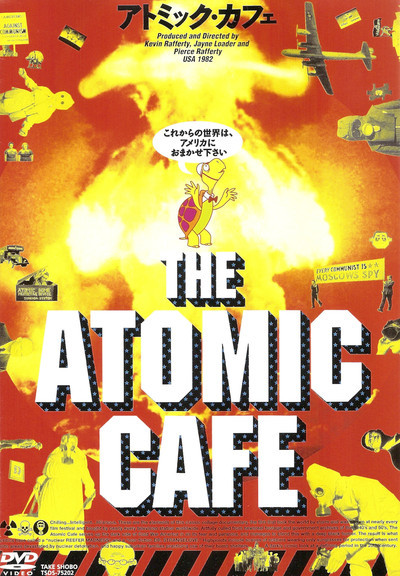
“Hearts and Minds” (1974) and “The Atomic Cafe” (1982) are two of the most chilling and persuasive anti-war documentaries ever made (at least for viewers who are not psychopaths). Though the editorial choices of both films clearly reflect an anti-war perspective, their messages are made more powerful by their lack of narration and abundance of archive footage, newsreels, and public statements from military and political officials. Both documentaries were years in the making with much time (nearly the entire time in the case of The Atomic Cafe) spent on research and editing, and the work clearly pays off by expanding the scope of the films to the political, cultural, and psychological factors behind wars. The filmmakers involved in Hearts and Minds and The Atomic Cafe, unlike most corporate news coverage of wars, both display great empathy in their inclusion of footage of “enemy” casualties of the war and “collateral damage” (ie. innocent victims caught in the crossfire). In the context of the current war-mongering from the Obama administration and corporate/government news media, Hearts and Minds and The Atomic Cafe are more relevant than ever and should be required viewing for everyone who values life.
The following essay is intended to provide a brief overview of topics addressed in a discussion graciously recorded by Julie Vivier at the offices of the Center for Research on Globalization in Montreal Canada on August 5, 2014.-JFT
Modern propaganda techniques utilized by the corporate state to enforce anti-democratic and destructive policies routinely entail the manufacture and manipulation of news events to mold public opinion and, as Edward Bernays put it, “engineer consent” toward certain ends.
Such events include not only overt political appeals, but also acts of seemingly spontaneous terrorism and militarism that traumatize the body politic into ultimately accepting false narratives as political and historical realities.
Western states’ development and utilization of propaganda closely parallels the steady decay of political enfranchisement and engagement throughout the twentieth century. Upon securing a second term in 1916, the Democratic administration of Woodrow Wilson plunged the United States into the most violent and homicidal war in human history. Wilson, a former Princeton University academician groomed for public office by Wall Street bankers, assembled a group of progressive-left journalists and publicists to “sell the war” to the American people.
George Creel, Walter Lippmann, Edward Bernays and Harold Lasswell all played influential roles in the newly-formed Committee on Public Information, and would go on to be major figures in political thought, public relations, and psychological warfare research.
The sales effort was unparalleled in its scale and sophistication. The CPI was not only able to officially censor news and information, but essentially manufacture these as well. Acting in the role of a multifaceted advertising agency, Creel’s operation “examined the different ways that information flowed to the population and flooded these channels with pro-war material.”
The Committee’s domestic organ was comprised of 19 subdivisions, each devoted to a specific type of propaganda, one of which was a Division of News that distributed over 6,000 press releases and acted as the chief avenue for war-related information. On an average week, more than 20,000 newspaper columns carried data provided through CPI propaganda. The Division of Syndicated Features enlisted the help of popular novelists, short story writers, and essayists. These mainstream American authors presented the official line in a readily accessible form reaching twelve million people every month. Similar endeavors existed for cinema, impromptu soapbox oratory (Four Minute Men), and outright advertising at home and abroad.[1]
With the experiences and observations of these war marketers variously recounted and developed throughout the 1920s (Lippmann, Public Opinion, The Phantom Public, Bernays, Propaganda, Crystallizing Public Opinion, Creel, How We Advertised America, Lasswell, Propaganda and the World War), alongside the influence of their elite colleagues and associates, the young publicists’ optimism concerning popular democracy guided by informed opinion was sobered with the realization that public sentiment was actually far more susceptible to persuasion than had been previously understood. The proposed solutions to guarantee something akin to democracy in an increasingly confusing world lay in “objective” journalism guided by organized intelligence (Lippmann) and propaganda, or what Edward Bernays termed “public relations.”
The argument laid out in Lippmann’s Public Opinion was partly motivated by the US Senate’s rejection of membership in the League of Nations. An adviser to the Wilson administration, a central figure behind intelligence gathering that informed postwar geopolitical dynamics laid out at the Paris Peace Conference, and an early member of the Council on Foreign Relations, Lippmann increasingly viewed popular democracy as plagued by a hopelessly ill-informed public opinion incapable of comprehending the growing complexities of modern society. Only experts could be entrusted with assessing, understanding, and acting on the knowledge accorded through their respective professions and fields.
Along these lines, journalism should mimic the then-fledgling social sciences by pursuing objectivity and deferring to the compartmentalized expertise of established authority figures. News and information could similarly be analyzed, edited, and coordinated to ensure accuracy by journalists exercising similar technocratic methods. Although Lippmann does not exactly specify what body would oversee such a process of “organized intelligence,” his postwar activities and ties provides a clue.
Edward Bernays’ advocacy for public opinion management is much more practical and overt. Whereas Lippmann suggests a regimented democracy via technocratic news and information processing, Bernays stresses a privileged elite’s overt manipulation of how the populace interprets reality itself. Such manipulation necessitates contrived associations, figures and events that appear authentic and spontaneous. “Any person or organization depends ultimately on public approval,” Bernays notes,
“and is therefore faced with the problem of engineering the public’s consent to a program or goal … We reject government authoritarianism or regimentation, but we are willing to be persuaded by the written or spoken word. The engineering of consent is the very essence of the democratic process, the freedom to persuade and suggest.[2]
Bernays demonstrates an affinity with Lippmann’s notion of elite expediency when pursuing prerogatives and decision-making the public at large cannot be entrusted to interpret. In such instances,
democratic leaders must play their part in leading the public through the engineering of consent to socially constructive goals and values. This role naturally imposes upon them the obligation to use educational processes, as well as other available techniques, to bring about as complete an understanding as possible.[3]
Written in the early 1950s, these observations become especially apt in the latter half of the twentieth century, where the US is typically a major aggressor in foreign (and eventually domestic) affairs. Yet what does Bernays mean by, for example, “educational processes”? An indication may be found by noting his central role in the promotion of tobacco use, municipal water fluoridation, and the overthrow of the democratically-elected Arbenz regime in Guatemala.[4]
With the advent of the national security state in 1947, secret programs emerge where the people are as a matter of course intentionally left unaware of the state’s true rationales and objectives.
Indeed, a wealth of contemporary historical examples suggest how the “engineering of consent” is wholly calculating and anti-democratic, and where the crises requiring such drastic and immediate public relations and military measures are themselves the result of the same leadership’s policies and actions. The US economic provocation of the Japanese attack on Pearl Harbor and the Tonkin Gulf incident precipitating US military occupation of Vietnam are obvious examples of such manufactured events.
Similar techniques are apparent in the major political assassinations of the 1960s, where to this day the public is prompted to partake in the false reality that Lee Harvey Oswald was the sole culprit in the murder of President John F. Kennedy, much as Sirhan Sirhan was responsible for the death of Senator Robert F. Kennedy.
In fact, in each instance overwhelming evidence points to Central Intelligence Agency involvement in orchestrating the assassinations while training and presenting Oswald and Sirhan as the would-be assassins.
The US government’s assassination of Dr. Martin Luther King Jr., probably the most influential African American public persona of the twentieth century, is not even open to debate, having been soundly proven in a court of law.[5] Yet as with the Kennedys, it is a genuine public relations achievement that much of the American population is oblivious to the deeper dynamics of these political slayings that are routinely overlooked or inaccurately recounted in public discourse.
Along these lines, in the historical context of Operation Gladio, the Oklahoma City Murrah Federal Building bombing, the events of September 11, 2001, the London 7/7/2005 bombings, and lesser episodes such as the “shoe” and “underwear” bombers, the engineering of consent has reached staggering new heights where state-orchestrated terrorism is used to mold public opinion toward acceptance of militarized policing operations, the continued erosion of civil liberties, and major sustained aggression against moderate Middle Eastern nations to cartelize scarce resources and politically reconfigure an entire region of the world.
Again, the public is essentially compelled to believe that political extremism of one form or another is the cause of each event, even in light of how the sophistication and scope of the Oklahoma City and 9/11 “attacks” suggest high-level forces at work. If one is to delve beneath the public relations narrative of each event, the recent Newtown massacre and Boston Marathon bombing likewise appear to have broader agendas where the public is again purposely misled.
Conventional journalists and academics are reluctant to publicly address such phenomena for fear of being called “conspiracy theorists.” In the case of academe this has severely curtailed serious and potentially crucial inquiry into such deep events and phenomena in lieu of what are often innocuous intellectual exchanges divorced from actually existing social and political realities that cry out for serious interrogation and critique.
The achievements of modern public relations are further evident in the Warren and 9/11 Commissions themselves, both of which have spun the fantastic myths of Allan Dulles and Peter Zelikow respectively, and that today maintain footholds in public discourse and consciousness.
Indeed, the “conspiracy theory” meme, a propaganda campaign waged by the CIA beginning in the mid-1960s to counter criticism of the Warren Commission report, is perhaps as little-known as Operation Mockingbird, the CIA program where hundreds of journalists and publishers actively devoted their services to spread Agency disinformation. The overall effect of these combined operations has been an immensely successful program continues to shape the contours of American political life and mediated reality.[6]
The present socio-political condition and suppression of popular democracy are triumphs of modern propaganda technique. So are they also manifest in the corporate state’s efforts to engineer public acquiescence toward such things as the colossal frauds of genetically modified organisms masquerading as “food,” toxic polypharmacy disguised as “medicine,” and the police state and “war on terror” seeking to preserve “national security.”
[2] Edward Bernays, Public Relations, Norman OK: University of Oklahoma Press, 1952, 159-160.
[3] Ibid. 160.
[4] “You can get practically any ideas accepted,” Bernays reflected on the campaign to fluoridate New York City’s water supply. “If doctors are in favor, the public is willing to accept it, because a doctor is an authority to most people, regardless of how much he knows, or doesn’t know … By the law of averages, you can usually find an individual in any field who will be willing to accept new ideas, and the new ideas then infiltrate the others who haven’t accepted it. Christopher Bryson, The Fluoride Deception, New York: Seven Stories Press, 2004, 159.
[5] William F. Pepper, An Act of State: The Execution of Martin Luther King, New York: Verso, 2003.
I have to confess, it’s getting more and more difficult to find ways of writing about everything going on in the world.
Not because there’s a shortage of things to write about — wars, propaganda, fraud, Ebola — but because most of the negative news and major world events we see around us are symptoms of the disease, not the disease itself.
There are only so many times you can describe the disease, before it all becomes repetitive for both the writer and the reader. It’s far more interesting to get to the root cause, because then real solutions offering real progress can be explored.
Equally troubling, in a world where the central banks have distorted, if not utterly flattened, the all important relationship between prices, risk, and reality, what good does it do to seek some sort of meaning in the new temporary arrangement of things?
When the price of money itself is distorted, then all prices are merely derivative works of that primary distortion. Some prices will be too high, some far too low, but none accurately determined by the intersection of true demand and supply.
If risk has been taken from where it belongs and instead shuffled onto central bank balance sheets, or allowed to be hidden by new and accommodating accounting tricks, has it really disappeared? In my world, risk is like energy: it can neither be created nor destroyed, only transformed or transferred.
If reality no longer has a place at the table — such as when policy makers act as if the all-too-temporary shale oil bonanza is now a new permanent constant — then the discussions happening around that table are only accidentally useful, if ever, and always delusional.
Through all of this, the big picture as described in the Crash Course grows ever more obviously clear: we are on an unsustainable course; economically, ecologically, and — most immediately worryingly — in our use of energy.
So let’s start there, with a simple grounding in the facts.
By The Numbers
Humans now number 7.1 billion on the planet and that number is on track to rise to 8 or 9 billion by 2050. Already ‘energy per capita’ is stagnant across the world and has been for a few decades. If the human population indeed grows by 15-25% over the next three and a half decades, then net energy production will have to grow by the same amount simply to remain constant on a per capita basis.
But can it? Specifically, can the net energy we derive from oil grow by another 15% to 25% from here?
Consider that, according to the EIA, the US shale oil miracle will be thirty years in the rear-view mirror by 2050 (currently projected to peak in 2020). And beyond just shale, all of the currently-operating conventional oil reservoirs will be far past peak and well into their decline. That means that the energy-rich oil from the giant fields of yesteryear will have to be replaced by an even larger volume of new oil from the energetically weaker unconventional plays just to hold things steady.
To advance oil net energy on a per capita basis between now and 2050, we’ll have to fight all of the forces of depletion with one hand, and somehow generate even more energy output from energetically parsimonious unconventional sources such as shale and tar sands with the other hand.
These new finds…they just aren’t the same as the old ones. They are deeper, require more effort per well to get oil out, and return far less per well than those of yesteryear. Those are just the facts as we now know them to be.
In 2013, total worldwide oil discoveries were just 20 billion barrels. That’s against a backdrop of 32 billion barrels of oil production and consumption. Since 1984, consuming more oil than we’re discovering has been a yearly ritual. To use an analogy: it’s as if we’re spending from a trust fund at a faster rate than the interest and dividends are accruing. Eventually, you eat through the principal balance and then it’s game over.
Meanwhile, even as the total net energy we receive from oil slips and our consumption wildly surpasses discoveries, the collective debt of the developed economies has surpassed the $100 trillion mark — which is a colossal bet that the future economy will not only be larger than it is currently, but exponentially larger.
These debts are showing no signs of slowing down. Indeed, the world’s central banks are doing everything in their considerable monetary power to goose them higher, even if this means printing money out of thin air and buying the debt themselves.
Along with this, the demographics of most developed economies will be drawing upon badly-underfunded pension and entitlement accounts — most of which are literally nothing more substantial than empty political promises made many years ago.
These trends in oil, debt and demographics are stark facts all on their own. But when we tie these to the obvious ecological strains of meeting the needs of just the world’s current 7.1 billion, any adherence to the status quo seems worse than merely delusional.
Here’s just one example from the ecological sphere. All over the globe we see regions in which ancient groundwater, in the form of underground aquifers, is being tapped to meet the local demand.
Many of these reservoirs have natural recharge rates that are measured in thousands, or even tens of thousands, of years.
Virtually all of them are being over-pumped. The ground water is being removed at a far faster rate than it naturally replenishes.
This math is simple. Each time an aquifer is over-pumped, the length of time left for that aquifer to serve human needs diminishes. Easy, simple math. Very direct.
And yet, we see cultures all over the globe continuing to build populations and living centers – very expensive investments, both economically and energetically – that are dependent for their food and water on these same over-pumped aquifers.
In most cases, you can calculate with excellent precision when those aquifers will be entirely gone and how many millions of people will be drastically impacted.
And yet, in virtually every case, the local ‘plan’ (if that’s the correct word to use here) is to use the underground water to foster additional economic/population growth today without any clear idea of what to do later on.
The ‘plan’ such as it is, seems to be to let the people of the future deal with the consequences of today’s decisions.
So if human organizations all over the globe seem unable to grasp the urgent significance of drawing down their water supplies to the point that they someday run out, what are the odds we’ll successfully address the more complex and less direct impacts like slowly falling net energy from oil, or steadily rising levels of debt? Pretty low, in my estimation.
Conclusion
Look, it’s really this simple: Anything that can’t go on forever, won’t. We know, financially speaking, that a great number of nations are utterly insolvent no matter how much the accounting is distorted. Said another way: there’s really no point in worrying about the combined $100 trillion shortfall in Social Security and Medicare, because it simply won’t be paid.
Why? It can’t, so it won’t. The promised entitlements dwarf our ability to fund them many times over. There’s really not much more to say there.
But the biggest predicament we face is that steadily-eroding net energy from oil, which will someday be married to steadily-falling output as well, can’t support billions more people and our steadily growing pile of debt.
Just as there’s no plan at all for what to do when the groundwater runs out besides ‘Let the folks in the future figure that one out,’ there’s no plan at all for reconciling the forced continuation of borrowing at a faster rate than the economy can (or likely will be able to) grow.
The phrase that comes to mind is ‘winging it.’
The wonder of it all is that people still turn to the same trusted sources for guidance and as a place to put their trust. For myself, I have absolutely no faith that the mix of DC career politicians and academic wonks in the Fed have any clue at all about such things as energy or ecological realities. Their lens only concerns itself with money, and the only tradeoff concessions they make are between various forms of economic vs. political power.
If the captains supposed to be guiding this ship are using charts that ignore what lies beneath the waterline, then you can be sure that sooner or later the ship is going to strike something hard and founder.
I’m pretty sure the Fed’s (and ECB’s and BoJ’s and BoE’s) charts resemble those of medieval times, with “Here be dragons” scrawled in the margins next to a series of charts of falling stock prices and unwinding consumer debt.
So there we are. The globe is heading from 7.1 billion to 8 or 9 billion souls, during a period of time when literally every known oil find will be well past its peak. Perhaps additional shale finds will come along on other continents to smooth things out for a bit (which is not looking likely), but it’s well past time to square up to the notion that cheap oil is gone. And with it, our prospects for the robust and widespread prosperity of times past.
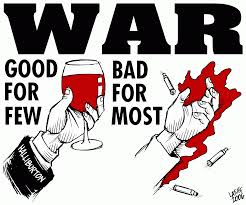
“We must declare war on war, so the outcome will be peace upon peace.”
This is what our Nobel Peace Prize Winning President said in front of the UN General Assembly on September 24, 2014 — the same day U.S. military weapons hit some 168 targets including a dozen oil refineries in Syria…
It’s as if Obama is trying to reconcile his peace prize with his legacy of war by arguing that the U.S. is not at a traditional war (because the U.S. is always at war) but just as we go to yet another war, we’re actually at a war against war in the name of peace.
So…war is peace.
Ever read a book called 1984 written by George Orwell?
Michael Hayden, the former director of the National Security Agency, has invaded America’s televisionsets in recent weeks to warn about Edward Snowden’s leaks and the continuing terrorist threat to America.
But what often goes unmentioned, as the Guardian’s Glenn Greenwald pointed out, is that Hayden has a financial stake in keeping Americans scared and on a permanent war footing against Islamist militants. And the private firm he works for, called the Chertoff Group, is not the only one making money by scaring Americans.
Post-9/11 America has witnessed a boom in private firms dedicated to the hyped-up threat of terrorism. The drive to privatize America’s national security apparatus accelerated in the aftermath of the terrorist attacks, and it’s gotten to the point where 70 percent of the national intelligence budget is now spent on private contractors, as author Tim Shorrock reported. The private intelligence contractors have profited to the tune of at least $6 billion a year. In 2010, the Washington Post revealed that there are 1,931 private firms across the country dedicated to fighting terrorism.
What it all adds up to is a massive industry profiting off government-induced fear of terrorism, even though Americans are more likely to be killed by a car crash or their own furniture than a terror attack.
Here are five private companies cashing in on keeping you afraid.
1. The Chertoff Group
On August 11, former NSA head Michael Hayden, the man at the center of the Bush administration’s 2005 surveillance scandal, was defending his former agency on CBS News in the wake of the latest NSA spying scandal. Commenting on President Obama’s half-hearted promises to reform some NSA practices, Hayden told host Bob Schieffer that “the President is trying to take some steps to make the American people more comfortable about what it is we’re doing. That’s going to be hard because, frankly, Bob, some steps to make Americans more comfortable will actually make Americans less safe.”
Former Homeland Security chief Michael Chertoff had a similar message when he appeared on ABC News August 4. Speaking about the purported threat from an Al Qaeda affiliate in Yemen that led to the closure of 19 U.S. embassies, Chertoff said that “the collection of this warning information [about Al Qaeda] came from the kinds of programs we’ve been discussing about, the ability to capture communications overseas.”
CBS and ABC did not see fit to inform viewers that both Hayden and Chertoff are employees of the Chertoff Group, a private firm created in 2009 that companies hire to consult on best practices for security and combatting terrorism. Some of the companies the firm advises go on to win government contracts. Chertoff is the founder and chairman of the group, while Hayden serves as a principal. So they profit off a war on terror they say is crucial to keeping Americans safe.
Though it’s unclear how much in total exactly the firm makes, there are some known numbers. After the failed attempt in 2010 to blow up an airliner on Christmas Day with a bomb hidden in underwear, Chertoff pushed for better airport security procedures. One of the suggestions Chertoff made was for the Transportation Security Agency to use full-body scanners like the ones Rapiscan, one of the Chertoff Group’s clients, made. And sure enough, after the Christmas Day plot, the TSA ordered 300 Rapiscan machines. The Huffington Post reported that Rapiscan made $118 million from the government between 2009-2010.
2. Booz Allen Hamilton
This private intelligence contractor has become a household name in the wake of the NSA scandal. Edward Snowden, the man responsible for leaking secret documents that exposed the breadth of NSA surveillance, was working for Booz Allen when he downloaded the documents he handed off to media outlets. As the New York Times reported in June, the company parlays its technology expertise for intelligence uses into massive government contracts. Thousands of employees of the company provide services to the NSA, like analyzing the massive amounts of data the government agency collects every day. The company is also the shining symbol of the government-private security complex’s revolving door: its vice president is the former director of national intelligence, while the current director of national intelligence is a former employee of Booz Allen.
Despite the Snowden security breach, Booz Allen continues to work with the government. And they’re making a lot of money from the U.S. In the last fiscal year, the company made $1.3 billion from working in U.S. intelligence. In total, Booz Allen Hamiltion made over $5 billion last fiscal year. And the cash keeps coming: in January, the company announced that it had won a contract with the Defense Department to provide intelligence services. The amount of money it could make from the deal is up to $5.6 billion.
And like Hayden and Chertoff, Booz Allen’s vice president Mike McConnell has publicly hyped up the threat of terrorism to blast Snowden’s leaks. McConnell told a government contracting conference in July 2013 that Snowden’s leaks have done “irrevocable damage” to the U.S.’s ability to stop terrorism. “It’s going to inhibit our ability to understand nuclear activity in North Korea, what’s going on in Syria, what might be happening with the Taliban in Afghanistan,” said McConnell.
3. Science Applications International Corporation
Sometimes referred to as “NSA West” because so many former NSA employees go on to work for the formerly California-based Science Applications International Corporation (SAIC), this firm makes a ton of cash off government contracts. And they do so by hawking their expertise in combatting the terrorist threat.
Browse through SAIC’s website and you’re constantly greeted with the words “terrorist threat” and information on how the SAIC can help the government and others battle it. SAIC developed a “Terrorism Protection Manual” for Florida law enforcement that was developed to fight “today’s national terrorist threat and implement recommended security best practices.” They boast of their “experience meeting the terrorism incident response training needs of a wide variety of customers, from training for a national Weapons of Mass Destruction (WMD) scenario, applicable at agency response levels, to lesser levels of incidents affecting a city, a military installation or a special facility.”
Back when John P. Jumper, the current CEO of SAIC, was an Air Force general, he said the threat of terrorism is “greater than Nazism, greater than communism. This threat that we have of terrorist zealots is the most dangerous because these are people who care nothing about life. They care nothing about our lives, for sure, and they care nothing about their own lives.” And Larry Prior, a U.S. intelligence veteran who used to run the company’s Intelligence and Security Group, said in an internal newsletter that “the future of the nation rests on their backs,” referring to employees in his group.
SAIC is an immensely lucrative and large company. It boasts 42,000 employees—20,000 of whom hold U.S. government security clearances. It is the NSA’s largest contractor, according to CorpWatch, and is deeply involved in the NSA’s collection of intelligence. Last year it reported a net income of $525 million.
4. Center for Counterintelligence and Security Studies
U.S. intelligence agencies aren’t the only sectors of government where the private sector has cashed in on the fear of terrorism. The post-9/11 world has seen the blossoming of a cottage industry of self-styled “experts” on Islam from private companies that market their supposedly ironclad analysis of the threat from Islamists to other federal agencies and state and local law enforcement. These companies have profited from law enforcement taking part in the “war on terror.”
Through Homeland Security grant programs like the State Homeland Security Program and the Urban Areas Security Initiative, the federal government has doled out over billions of dollars to these private companies to provide Islamophobic training. One of these companies is called the Center for Counterintelligence and Security Studies.
Based in Virginia, the center “posits radical Islam as a new global ideological menace on the order of the old communist threat from the Soviet Union,” as Political Research Associates (PRA) noted in a 2011 report on private firms doing counter-terror training. Staff members include former FBI, CIA and Defense Department personnel.
Their claim to fame is providing education and training to members of the U.S. national security community—including law enforcement agencies, according to their website. They say they have trained over 67,000 people over the past decade.
It’s unclear exactly how much this firm makes per year. But according to the PRA report, a five-day course for government employees on the “Global Jihadist Threat Doctrine” costs $39,280. The firm also lists the costs of individual courses on their website. For a 30-person class titled “Dying to Kill Us: Understanding the Mindset of Suicide Operations,” the cost is $7,856. For a three-day course for 30 people on “Informant Development for Law Enforcement to FighTerrorism,” the cost is $23,568.
The training pushes anti-Muslim ideology. On the section of their website where they list feedback from participants of the courses, one wrote: “An eye-opener. Especially how many Muslim Brotherhood front organizations there are and that the government doesn’t get it.”
5. Security Solutions International
Security Solutions International is yet another private firm hawking anti-Muslim training to law enforcement. This Miami-based company founded in 2004 uses its Israeli security connections to boost its standing in the market. They use Israeli security trainers in their courses and their president, Henry Morgenstern, is a dual Israeli-U.S. citizen who says he “developed excellent high level contacts with the Security Establishment [in Israel], making SSI the premiere training company for counter-terror related subjects.”
The company has trained over 700 law enforcement agencies since 2004. Officials from law enforcement agencies like the Massachusetts Bay Transportation Authority and the Department of Homeland Security have participated in the conferences they put on for profit. While SSI claims that they don’t cast aspersions on the whole of Islam, an examination of their trainings, conferences and the speakers they use indicate otherwise.
At a 2009 conference sponsored by Police magazine, an SSI instructor who is the company’s “expert” on Islam used a video that showed a terrorist beheading a hostage. After the course was met with criticism, the company’s CEO said “their religion got linked to terrorism a long time ago.”
The conferences they hold are usually well-attended, and this year SSI is putting on a conference in Orlando, Florida for three days. The cost for each attendee is $400. The keynote speaker this year is Steve Emerson, a well-known member of what’s been termed the “Islamophobia industry.” SSI also makes money off its Counter Terrorist magazine. A yearly subscription is $35, and the company says it has 15,000 subscribers.






 After the Crash