The Dire State of Our Nation (What You Won’t Hear from the Politicians)

Unknown-18

By John W. Whitehead

Source: The Rutherford Institute

No matter what the politicians might say about how great America is, the fact is that the nation seems to be imploding. Consider the following facts:

Our government is massively in debt. Currently, the national debt is somewhere in the vicinity of $18 trillion. More than a third of our debt is owned by foreign countries, namely China and Japan.

Our education system is abysmal. Despite the fact that we spend more than most of the world on education ($115,000 per student), we rank 36th in the world when it comes to math, reading and science, far below most of our Asian counterparts. Even so, we continue to insist on standardized programs such as Common Core, which teach students to be test-takers rather than thinkers.

Our homes provide little protection against government intrusions. Police agencies, already empowered to crash through your door if they suspect you’re up to no good, now have radars that allow them to “see” through the walls of your home.

Our prisons, housing the largest number of inmates in the world and still growing, have become money-making enterprises for private corporations that rely on the inmates for cheap labor.

We are no longer a representative republic. The U.S. has become a corporate oligarchy. As a recent survey indicates, our elected officials, especially those in the nation’s capital, represent the interests of the rich and powerful rather than the average citizen.

We’ve got the most expensive, least effective health care system in the world compared to other western, industrialized nations.

The air pollution levels are dangerously high for almost half of the U.S. population, putting Americans at greater risk of premature death, aggravated asthma, difficulty breathing and future cardiovascular problems.

Despite outlandish amounts of money being spent on the nation’s “infrastructure,” there are more than 63,000 bridges—one out of every 10 bridges in the country—in urgent need of repair. Some of these bridges are used 250 million times a day by trucks, school buses, passenger cars and other vehicles.

Americans know little to nothing about their rights or how the government is supposed to operate. This includes educators and politicians. For example, 27 percent of elected officials cannot name even one right or freedom guaranteed by the First Amendment, while 54 percent do not know the Constitution gives Congress the power to declare war.

Nearly one out of every three American children live in poverty, ranking us among the worst in the developed world.

Patrolled by police, our schools have become little more than quasi-prisons in which kids as young as age 4 are being handcuffed for “acting up,” subjected to body searches and lockdowns, and suspended for childish behavior.

We’re no longer innocent until proven guilty.  In our present surveillance state, that burden of proof has now been shifted so that we are all suspects to be spied on, searched, scanned, frisked, monitored, tracked and treated as if we’re potentially guilty of some wrongdoing or other.

Parents, no longer viewed as having an inherent right to raise their children as they see fit, are increasingly being arrested for letting their kids walk to the playground alone, or play outside alone. Similarly, parents who challenge a doctor’s finding or request a second opinion regarding their children’s health care needs are being charged with medical child abuse and, in a growing number of cases, losing custody of their children to the government.

Private property means little at a time when SWAT teams and other government agents can invade your home, break down your doors, kill your dog, wound or kill you, damage your furnishings and terrorize your family.

Court rulings undermining the Fourth Amendment and justifying invasive strip searches have left us powerless against police empowered to forcefully draw our blood, forcibly take our DNA, strip search us, and probe us intimately.

Americans have no protection against police abuse. It is no longer unusual to hear about incidents in which police shoot unarmed individuals first and ask questions later.

If there is any absolute maxim by which the federal government seems to operate, it is that the American taxpayer always gets ripped off. This is true, whether you’re talking about taxpayers being forced to fund high-priced weaponry that will be used against us, endless wars that do little for our safety or our freedoms, or bloated government agencies such as the National Security Agency with its secret budgets, covert agendas and clandestine activities.

Americans are powerless in the face of militarized police. As police forces across the country continue to be transformed into extensions of the military, Americans are finding their once-peaceful communities transformed into military outposts, complete with tanks, weaponry, and other equipment designed for the battlefield.

Now these are not problems that you can just throw money at. As I point out in my book A Government of Wolves: The Emerging American Police State, these are problems that will continue to plague our nation unless and until Americans wake up to the fact that we’re the only ones who can change things.

For starters, we’ll need to actually pay attention to what’s going on around us, and I don’t mean by turning on the TV news, which is little more than government propaganda. Pay attention to what your local city councils are enacting. Pay attention to what your school officials are teaching and not teaching. Pay attention to whom your elected officials are allowing to wine and dine them.

Most of all, stop acting like it really matters whether you vote for a Republican or Democrat, because it doesn’t, and start acting like citizens who expect the government to work for them, rather than the other way around.

While that bloated beast called the federal government may not listen to you, you can have a great impact on your local governing bodies if you’ll just take a stand. This will mean gathering together with your friends and neighbors and, for example, forcing your local city council to start opposing state and federal programs that are ripping you off. And if need be, your local city council can refuse to abide by the dictates that continue to flow from Washington, DC.

All of the signs point to something nasty up ahead. The time to act is now.

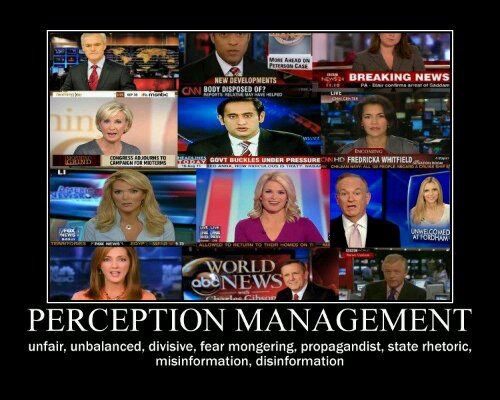
The Victory of ‘Perception Management’

wpid-facebook_-1640825551

By Robert Parry

Source: Consortium News

To understand how the American people find themselves trapped in today’s Orwellian dystopia of endless warfare against an ever-shifting collection of “evil” enemies, you have to think back to the Vietnam War and the shock to the ruling elite caused by an unprecedented popular uprising against that war.

While on the surface Official Washington pretended that the mass protests didn’t change policy, a panicky reality existed behind the scenes, a recognition that a major investment in domestic propaganda would be needed to ensure that future imperial adventures would have the public’s eager support or at least its confused acquiescence.

This commitment to what the insiders called “perception management” began in earnest with the Reagan administration in the 1980s but it would come to be the accepted practice of all subsequent administrations, including the present one of President Barack Obama.

In that sense, propaganda in pursuit of foreign policy goals would trump the democratic ideal of an informed electorate. The point would be not to honestly inform the American people about events around the world but to manage their perceptions by ramping up fear in some cases and defusing outrage in others – depending on the U.S. government’s needs.

Thus, you have the current hysteria over Russia’s supposed “aggression” in Ukraine when the crisis was actually provoked by the West, including by U.S. neocons who helped create today’s humanitarian crisis in eastern Ukraine that they now cynically blame on Russian President Vladimir Putin.

Yet, many of these same U.S. foreign policy operatives – outraged over Russia’s limited intervention to protect ethic Russians in eastern Ukraine – are demanding that President Obama launch an air war against the Syrian military as a “humanitarian” intervention there.

In other words, if the Russians act to shield ethnic Russians on their border who are being bombarded by a coup regime in Kiev that was installed with U.S. support, the Russians are the villains blamed for the thousands of civilian deaths, even though the vast majority of the casualties have been inflicted by the Kiev regime from indiscriminate bombing and from dispatching neo-Nazi militias to do the street fighting.

In Ukraine, the exigent circumstances don’t matter, including the violent overthrow of the constitutionally elected president last February. It’s all about white hats for the current Kiev regime and black hats for the ethnic Russians and especially for Putin.

But an entirely different set of standards has applied to Syria where a U.S.-backed rebellion, which included violent Sunni jihadists from the start, wore the white hats and the relatively secular Syrian government, which has responded with excessive violence of its own, wears the black hats. But a problem to that neat dichotomy arose when one of the major Sunni rebel forces, the Islamic State, started seizing Iraqi territory and beheading Westerners.

Faced with those grisly scenes, President Obama authorized bombing the Islamic State forces in both Iraq and Syria, but neocons and other U.S. hardliners have been hectoring Obama to go after their preferred target, Syria’s President Bashar al-Assad, despite the risk that destroying the Syrian military could open the gates of Damascus to the Islamic State or al-Qaeda’s Nusra Front.

Lost on the Dark Side

You might think that the American public would begin to rebel against these messy entangling alliances with the 1984-like demonizing of one new “enemy” after another. Not only have these endless wars drained trillions of dollars from the U.S. taxpayers, they have led to the deaths of thousands of U.S. troops and to the tarnishing of America’s image from the attendant evils of war, including a lengthy detour into the “dark side” of torture, assassinations and “collateral” killings of children and other innocents.

But that is where the history of “perception management” comes in, the need to keep the American people compliant and confused. In the 1980s, the Reagan administration was determined to “kick the Vietnam Syndrome,” the revulsion that many Americans felt for warfare after all those years in the blood-soaked jungles of Vietnam and all the lies that clumsily justified the war.

So, the challenge for the U.S. government became: how to present the actions of “enemies” always in the darkest light while bathing the behavior of the U.S. “side” in a rosy glow. You also had to stage this propaganda theater in an ostensibly “free country” with a supposedly “independent press.”

From documents declassified or leaked over the past several decades, including an unpublished draft chapter of the congressional Iran-Contra investigation, we now know a great deal about how this remarkable project was undertaken and who the key players were.

Perhaps not surprisingly much of the initiative came from the Central Intelligence Agency, which housed the expertise for manipulating target populations through propaganda and disinformation. The only difference this time would be that the American people would be the target population.

For this project, Ronald Reagan’s CIA Director William J. Casey sent his top propaganda specialist Walter Raymond Jr. to the National Security Council staff to manage the inter-agency task forces that would brainstorm and coordinate this “public diplomacy” strategy.

Many of the old intelligence operatives, including Casey and Raymond, are now dead, but other influential Washington figures who were deeply involved by these strategies remain, such as neocon stalwart Robert Kagan, whose first major job in Washington was as chief of Reagan’s State Department Office of Public Diplomacy for Latin America.

Now a fellow at the Brookings Institution and a columnist at the Washington Post, Kagan remains an expert in presenting foreign policy initiatives within the “good guy/bad guy” frames that he learned in the 1980s. He is also the husband of Assistant Secretary of State for European Affairs Victoria Nuland, who oversaw the overthrow of Ukraine’s elected President Viktor Yanukovych last February amid a very effective U.S. propaganda strategy.

During the Reagan years, Kagan worked closely on propaganda schemes with Elliott Abrams, then the Assistant Secretary of State for Latin America. After getting convicted and then pardoned in the Iran-Contra scandal, Abrams reemerged on President George W. Bush’s National Security Council handling Middle East issues, including the Iraq War, and later “global democracy strategy.” Abrams is now a senior fellow at the Council on Foreign Relations.

These and other neocons were among the most diligent students learning the art of “perception management” from the likes of Raymond and Casey, but those propaganda skills have spread much more widely as “public diplomacy” and “information warfare” have now become an integral part of every U.S. foreign policy initiative.

A Propaganda Bureaucracy

Declassified documents now reveal how extensive Reagan’s propaganda project became with inter-agency task forces assigned to develop “themes” that would push American “hot buttons.” Scores of documents came out during the Iran-Contra scandal in 1987 and hundreds more are now available at the Reagan presidential library in Simi Valley, California.

What the documents reveal is that at the start of the Reagan administration, CIA Director Casey faced a daunting challenge in trying to rally public opinion behind aggressive U.S. interventions, especially in Central America. Bitter memories of the Vietnam War were still fresh and many Americans were horrified at the brutality of right-wing regimes in Guatemala and El Salvador, where Salvadoran soldiers raped and murdered four American churchwomen in December 1980.

The new leftist Sandinista government in Nicaragua also was not viewed with much alarm. After all, Nicaragua was an impoverished country of only about three million people who had just cast off the brutal dictatorship of Anastasio Somoza.

So, Reagan’s initial strategy of bolstering the Salvadoran and Guatemalan armies required defusing the negative publicity about them and somehow rallying the American people into supporting a covert CIA intervention inside Nicaragua via a counterrevolutionary force known as the Contras led by Somoza’s ex-National Guard officers.

Reagan’s task was made tougher by the fact that the Cold War’s anti-communist arguments had so recently been discredited in Vietnam. As deputy assistant secretary to the Air Force, J. Michael Kelly, put it, “the most critical special operations mission we have … is to persuade the American people that the communists are out to get us.”

At the same time, the White House worked to weed out American reporters who uncovered facts that undercut the desired public images. As part of that effort, the administration attacked New York Times correspondent Raymond Bonner for disclosing the Salvadoran regime’s massacre of about 800 men, women and children in the village of El Mozote in northeast El Salvador in December 1981. Accuracy in Media and conservative news organizations, such as The Wall Street Journal’s editorial page, joined in pummeling Bonner, who was soon ousted from his job.

But these were largely ad hoc efforts. A more comprehensive “public diplomacy” operation took shape beginning in 1982 when Raymond, a 30-year veteran of CIA clandestine services, was transferred to the NSC.

A slight, soft-spoken New Yorker who reminded some of a character from a John le Carré spy novel, Raymond was an intelligence officer who “easily fades into the woodwork,” according to one acquaintance. But Raymond would become the sparkplug for this high-powered propaganda network, according to a draft chapter of the Iran-Contra report.

Though the draft chapter didn’t use Raymond’s name in its opening pages, apparently because some of the information came from classified depositions, Raymond’s name was used later in the chapter and the earlier citations matched Raymond’s known role. According to the draft report, the CIA officer who was recruited for the NSC job had served as Director of the Covert Action Staff at the CIA from 1978 to 1982 and was a “specialist in propaganda and disinformation.”

“The CIA official [Raymond] discussed the transfer with [CIA Director] Casey and NSC Advisor William Clark that he be assigned to the NSC as [Donald] Gregg’s successor [as coordinator of intelligence operations in June 1982] and received approval for his involvement in setting up the public diplomacy program along with his intelligence responsibilities,” the chapter said.

“In the early part of 1983, documents obtained by the Select [Iran-Contra] Committees indicate that the Director of the Intelligence Staff of the NSC [Raymond] successfully recommended the establishment of an inter-governmental network to promote and manage a public diplomacy plan designed to create support for Reagan Administration policies at home and abroad.”

During his Iran-Contra deposition, Raymond explained the need for this propaganda structure, saying: “We were not configured effectively to deal with the war of ideas.”

One reason for this shortcoming was that federal law forbade taxpayers’ money from being spent on domestic propaganda or grassroots lobbying to pressure congressional representatives. Of course, every president and his team had vast resources to make their case in public, but by tradition and law, they were restricted to speeches, testimony and one-on-one persuasion of lawmakers.

But things were about to change. In a Jan. 13, 1983, memo, NSC Advisor Clark foresaw the need for non-governmental money to advance this cause. “We will develop a scenario for obtaining private funding,” Clark wrote. (Just five days later, President Reagan personally welcomed media magnate Rupert Murdoch into the Oval Office for a private meeting, according to records on file at the Reagan library.)

As administration officials reached out to wealthy supporters, lines against domestic propaganda soon were crossed as the operation took aim not only at foreign audiences but at U.S. public opinion, the press and congressional Democrats who opposed funding the Nicaraguan Contras.

At the time, the Contras were earning a gruesome reputation as human rights violators and terrorists. To change this negative perception of the Contras as well as of the U.S.-backed regimes in El Salvador and Guatemala, the Reagan administration created a full-blown, clandestine propaganda network.

In January 1983, President Reagan took the first formal step to create this unprecedented peacetime propaganda bureaucracy by signing National Security Decision Directive 77, entitled “Management of Public Diplomacy Relative to National Security.” Reagan deemed it “necessary to strengthen the organization, planning and coordination of the various aspects of public diplomacy of the United States Government.”

Reagan ordered the creation of a special planning group within the National Security Council to direct these “public diplomacy” campaigns. The planning group would be headed by the CIA’s Walter Raymond Jr. and one of its principal arms would be a new Office of Public Diplomacy for Latin America, housed at the State Department but under the control of the NSC.

CIA Taint

Worried about the legal prohibition barring the CIA from engaging in domestic propaganda, Raymond formally resigned from the CIA in April 1983, so, he said, “there would be no question whatsoever of any contamination of this.” But Raymond continued to act toward the U.S. public much like a CIA officer would in directing a propaganda operation in a hostile foreign country.

Raymond fretted, too, about the legality of Casey’s ongoing involvement. Raymond confided in one memo that it was important “to get [Casey] out of the loop,” but Casey never backed off and Raymond continued to send progress reports to his old boss well into 1986. It was “the kind of thing which [Casey] had a broad catholic interest in,” Raymond shrugged during his Iran-Contra deposition. He then offered the excuse that Casey undertook this apparently illegal interference in domestic politics “not so much in his CIA hat, but in his adviser to the president hat.”

As a result of Reagan’s decision directive, “an elaborate system of inter-agency committees was eventually formed and charged with the task of working closely with private groups and individuals involved in fundraising, lobbying campaigns and propagandistic activities aimed at influencing public opinion and governmental action,” the draft Iran-Contra chapter said. “This effort resulted in the creation of the Office of Public Diplomacy for Latin America and the Caribbean in the Department of State (S/LPD), headed by Otto Reich,” a right-wing Cuban exile from Miami.

Though Secretary of State George Shultz wanted the office under his control, President Reagan insisted that Reich “report directly to the NSC,” where Raymond oversaw the operations as a special assistant to the President and the NSC’s director of international communications, the chapter said.

“Reich relied heavily on Raymond to secure personnel transfers from other government agencies to beef up the limited resources made available to S/LPD by the Department of State,” the chapter said. “Personnel made available to the new office included intelligence specialists from the U.S. Air Force and the U.S. Army. On one occasion, five intelligence experts from the Army’s 4th Psychological Operations Group at Fort Bragg, North Carolina, were assigned to work with Reich’s fast-growing operation.”

A “public diplomacy strategy paper,” dated May 5, 1983, summed up the administration’s problem. “As far as our Central American policy is concerned, the press perceives that: the USG [U.S. government] is placing too much emphasis on a military solution, as well as being allied with inept, right-wing governments and groups. …The focus on Nicaragua [is] on the alleged U.S.-backed ‘covert’ war against the Sandinistas. Moreover, the opposition … is widely perceived as being led by former Somozistas.”

The administration’s difficulty with most of these press perceptions was that they were correct. But the strategy paper recommended ways to influence various groups of Americans to “correct” the impressions anyway, removing what another planning document called “perceptional obstacles.”

“Themes will obviously have to be tailored to the target audience,” the strategy paper said.

Casey’s Hand

As the Reagan administration struggled to manage public perceptions, CIA Director Casey kept his personal hand in the effort. On one muggy day in August 1983, Casey convened a meeting of Reagan administration officials and five leading ad executives at the Old Executive Office Building next to the White House to come up with ideas for selling Reagan’s Central American policies to the American people.

Earlier that day, a national security aide had warmed the P.R. men to their task with dire predictions that leftist governments would send waves of refugees into the United States and cynically flood America with drugs. The P.R. executives jotted down some thoughts over lunch and then pitched their ideas to the CIA director in the afternoon as he sat hunched behind a desk taking notes.

“Casey was kind of spearheading a recommendation” for better public relations for Reagan’s Central America policies, recalled William I. Greener Jr., one of the ad men. Two top proposals arising from the meeting were for a high-powered communications operation inside the White House and private money for an outreach program to build support for U.S. intervention.

The results from the discussions were summed up in an Aug. 9, 1983, memo written by Raymond who described Casey’s participation in the meeting to brainstorm how “to sell a ‘new product’ – Central America – by generating interest across-the-spectrum.”

In the memo to then-U.S. Information Agency director Charles Wick, Raymond also noted that “via Murdock [sic] may be able to draw down added funds” to support pro-Reagan initiatives. Raymond’s reference to Rupert Murdoch possibly drawing down “added funds” suggests that the right-wing media mogul had been recruited to be part of the covert propaganda operation. During this period, Wick arranged at least two face-to-face meetings between Murdoch and Reagan.

In line with the clandestine nature of the operation, Raymond also suggested routing the “funding via Freedom House or some other structure that has credibility in the political center.” (Freedom House would later emerge as a principal beneficiary of funding from the National Endowment for Democracy, which was also created under the umbrella of Raymond’s operation.)

As the Reagan administration pushed the envelope on domestic propaganda, Raymond continued to worry about Casey’s involvement. In an Aug. 29, 1983, memo, Raymond recounted a call from Casey pushing his P.R. ideas. Alarmed at a CIA director participating so brazenly in domestic propaganda, Raymond wrote that “I philosophized a bit with Bill Casey (in an effort to get him out of the loop)” but with little success.

Meanwhile, Reich’s Office of Public Diplomacy for Latin America (S/LPD) proved extremely effective in selecting “hot buttons” that would anger Americans about the Sandinistas. He also browbeat news correspondents who produced stories that conflicted with the administration’s “themes.” Reich’s basic M.O. was to dispatch his propaganda teams to lobby news executives to remove or punish out-of-step reporters – with a disturbing degree of success. Reich once bragged that his office “did not give the critics of the policy any quarter in the debate.”

Another part of the office’s job was to plant “white propaganda” in the news media through op-eds secretly financed by the government. In one memo, Jonathan Miller, a senior public diplomacy official, informed White House aide Patrick Buchanan about success placing an anti-Sandinista piece in The Wall Street Journal’s friendly pages. “Officially, this office had no role in its preparation,” Miller wrote.

Other times, the administration put out “black propaganda,” outright falsehoods. In 1983, one such theme was designed to anger American Jews by portraying the Sandinistas as anti-Semitic because much of Nicaragua’s small Jewish community fled after the revolution in 1979.

However, the U.S. embassy in Managua investigated the charges and “found no verifiable ground on which to accuse the GRN [the Sandinista government] of anti-Semitism,” according to a July 28, 1983, cable. But the administration kept the cable secret and pushed the “hot button” anyway.

Black Hats/White Hats

Repeatedly, Raymond lectured his subordinates on the chief goal of the operation: “in the specific case of Nica[ragua], concentrate on gluing black hats on the Sandinistas and white hats on UNO [the Contras’ United Nicaraguan Opposition].” So Reagan’s speechwriters dutifully penned descriptions of Sandinista-ruled Nicaragua as a “totalitarian dungeon” and the Contras as the “moral equivalent of the Founding Fathers.”

As one NSC official told me, the campaign was modeled after CIA covert operations abroad where a political goal is more important than the truth. “They were trying to manipulate [U.S.] public opinion … using the tools of Walt Raymond’s trade craft which he learned from his career in the CIA covert operation shop,” the official admitted.

Another administration official gave a similar description to The Miami Herald’s Alfonso Chardy. “If you look at it as a whole, the Office of Public Diplomacy was carrying out a huge psychological operation, the kind the military conduct to influence the population in denied or enemy territory,” that official explained. [For more details, see Parry’s Lost History.]

Another important figure in the pro-Contra propaganda was NSC staffer Oliver North, who spent a great deal of his time on the Nicaraguan public diplomacy operation even though he is better known for arranging secret arms shipments to the Contras and to Iran’s radical Islamic government, leading to the Iran-Contra scandal.

The draft Iran-Contra chapter depicted a Byzantine network of contract and private operatives who handled details of the domestic propaganda while concealing the hand of the White House and the CIA. “Richard R. Miller, former head of public affairs at AID, and Francis D. Gomez, former public affairs specialist at the State Department and USIA, were hired by S/LPD through sole-source, no-bid contracts to carry out a variety of activities on behalf of the Reagan administration policies in Central America,” the chapter said.

“Supported by the State Department and White House, Miller and Gomez became the outside managers of [North operative] Spitz Channel’s fundraising and lobbying activities. They also served as the managers of Central American political figures, defectors, Nicaraguan opposition leaders and Sandinista atrocity victims who were made available to the press, the Congress and private groups, to tell the story of the Contra cause.”

Miller and Gomez facilitated transfers of money to Swiss and offshore banks at North’s direction, as they “became the key link between the State Department and the Reagan White House with the private groups and individuals engaged in a myriad of endeavors aimed at influencing the Congress, the media and public opinion,” the chapter said.

The Iran-Contra draft chapter also cited a March 10, 1985, memo from North describing his assistance to CIA Director Casey in timing disclosures of pro-Contra news “aimed at securing Congressional approval for renewed support to the Nicaraguan Resistance Forces.”

The chapter added: “Casey’s involvement in the public diplomacy effort apparently continued throughout the period under investigation by the Committees,” including a 1985 role in pressuring Congress to renew Contra aid and a 1986 hand in further shielding the Office of Public Diplomacy for Latin America from the oversight of Secretary Shultz.

A Raymond-authored memo to Casey in August 1986 described the shift of the S/LPD office – where Robert Kagan had replaced Reich – to the control of the Bureau of Inter-American Affairs, which was headed by Assistant Secretary of State Elliott Abrams, who had tapped Kagan for the public diplomacy job.

Even after the Iran-Contra scandal unraveled in 1986-87 and Casey died of brain cancer on May 6, 1987, the Republicans fought to keep secret the remarkable story of the public diplomacy apparatus. As part of a deal to get three moderate Republican senators to join Democrats in signing the Iran-Contra majority report, Democratic leaders agreed to drop the draft chapter detailing the CIA’s domestic propaganda role (although a few references were included in the executive summary). But other Republicans, including Rep. Dick Cheney, still issued a minority report defending broad presidential powers in foreign affairs.

Thus, the American people were spared the chapter’s troubling conclusion: that a secret propaganda apparatus had existed, run by “one of the CIA’s most senior specialists, sent to the NSC by Bill Casey, to create and coordinate an inter-agency public-diplomacy mechanism [which] did what a covert CIA operation in a foreign country might do. [It] attempted to manipulate the media, the Congress and public opinion to support the Reagan administration’s policies.”

Kicking the Vietnam Syndrome

The ultimate success of Reagan’s propaganda strategy was affirmed during the tenure of his successor, George H.W. Bush, when Bush ordered a 100-hour ground war on Feb. 23, 1991, to oust Iraqi troops from Kuwait, which had been invaded the previous August.

Though Iraqi dictator Saddam Hussein had long been signaling a readiness to withdraw – and Soviet President Mikhail Gorbachev had negotiated a withdrawal arrangement that even had the blessings of top U.S. commanders in the field – President Bush insisted on pressing ahead with the ground attack.

Bush’s chief reason was that he – and his Defense Secretary Dick Cheney – saw the assault against Iraq’s already decimated forces as an easy victory, one that would demonstrate America’s new military capacity for high-tech warfare and would cap the process begun a decade earlier to erase the Vietnam Syndrome from the minds of average Americans.

Those strategic aspects of Bush’s grand plan for a “new world order” began to emerge after the U.S.-led coalition started pummeling Iraq with air strikes in mid-January 1991. The bombings inflicted severe damage on Iraq’s military and civilian infrastructure and slaughtered a large number of non-combatants, including the incineration of some 400 women and children in a Baghdad bomb shelter on Feb. 13. [For details, see Consortiumnews.com’s “Recalling the Slaughter of Innocents.”]

The air war’s damage was so severe that some world leaders looked for a way to end the carnage and arrange Iraq’s departure from Kuwait. Even senior U.S. military field commanders, such as Gen. Norman Schwarzkopf, looked favorably on proposals for sparing lives.

But Bush was fixated on a ground war. Though secret from the American people at that time, Bush had long determined that a peaceful Iraqi withdrawal from Kuwait would not be allowed. Indeed, Bush was privately fearful that the Iraqis might capitulate before the United States could attack.

At the time, conservative columnists Rowland Evans and Robert Novak were among the few outsiders who described Bush’s obsession with exorcising the Vietnam Syndrome. On Feb. 25, 1991, they wrote that the Gorbachev initiative brokering Iraq’s surrender of Kuwait “stirred fears” among Bush’s advisers that the Vietnam Syndrome might survive the Gulf War.

“There was considerable relief, therefore, when the President … made clear he was having nothing to do with the deal that would enable Saddam Hussein to bring his troops out of Kuwait with flags flying,” Evans and Novak wrote. “Fear of a peace deal at the Bush White House had less to do with oil, Israel or Iraqi expansionism than with the bitter legacy of a lost war. ‘This is the chance to get rid of the Vietnam Syndrome,’ one senior aide told us.”

In the 1999 book, Shadow, author Bob Woodward confirmed that Bush was adamant about fighting a war, even as the White House pretended it would be satisfied with an unconditional Iraqi withdrawal. “We have to have a war,” Bush told his inner circle of Secretary of State James Baker, national security adviser Brent Scowcroft and Gen. Colin Powell, according to Woodward.

“Scowcroft was aware that this understanding could never be stated publicly or be permitted to leak out. An American president who declared the necessity of war would probably be thrown out of office. Americans were peacemakers, not warmongers,” Woodward wrote.

The Ground War

However, the “fear of a peace deal” resurfaced in the wake of the U.S.-led bombing campaign. Soviet diplomats met with Iraqi leaders who let it be known that they were prepared to withdraw their troops from Kuwait unconditionally.

Learning of Gorbachev’s proposed settlement, Schwarzkopf also saw little reason for U.S. soldiers to die if the Iraqis were prepared to withdraw and leave their heavy weapons behind. There was also the prospect of chemical warfare that the Iraqis might use against advancing American troops. Schwarzkopf saw the possibility of heavy U.S. casualties.

But Gorbachev’s plan was running into trouble with President Bush and his political subordinates who wanted a ground war to crown the U.S. victory. Schwarzkopf reached out to Gen. Powell, chairman of the Joint Chiefs of Staff, to make the case for peace with the President.

On Feb. 21, 1991, the two generals hammered out a cease-fire proposal for presentation to the NSC. The peace deal would give Iraqi forces one week to march out of Kuwait while leaving their armor and heavy equipment behind. Schwarzkopf thought he had Powell’s commitment to pitch the plan at the White House.

But Powell found himself caught in the middle. He wanted to please Bush while still representing the concerns of the field commanders. When Powell arrived at the White House late on the evening of Feb. 21, he found Bush angry about the Soviet peace initiative. Still, according to Woodward’s Shadow, Powell reiterated that he and Schwarzkopf “would rather see the Iraqis walk out than be driven out.”

In My American Journey, Powell expressed sympathy for Bush’s predicament. “The President’s problem was how to say no to Gorbachev without appearing to throw away a chance for peace,” Powell wrote. “I could hear the President’s growing distress in his voice. ‘I don’t want to take this deal,’ he said. ‘But I don’t want to stiff Gorbachev, not after he’s come this far with us. We’ve got to find a way out’.”

Powell sought Bush’s attention. “I raised a finger,” Powell wrote. “The President turned to me. ‘Got something, Colin?’,” Bush asked. But Powell did not outline Schwarzkopf’s one-week cease-fire plan. Instead, Powell offered a different idea intended to make the ground offensive inevitable.

“We don’t stiff Gorbachev,” Powell explained. “Let’s put a deadline on Gorby’s proposal. We say, great idea, as long as they’re completely on their way out by, say, noon Saturday,” Feb. 23, less than two days away.

Powell understood that the two-day deadline would not give the Iraqis enough time to act, especially with their command-and-control systems severely damaged by the air war. The plan was a public-relations strategy to guarantee that the White House got its ground war. “If, as I suspect, they don’t move, then the flogging begins,” Powell told a gratified president.

The next day, at 10:30 a.m., a Friday, Bush announced his ultimatum. There would be a Saturday noon deadline for the Iraqi withdrawal, as Powell had recommended. Schwarzkopf and his field commanders in Saudi Arabia watched Bush on television and immediately grasped its meaning.

“We all knew by then which it would be,” Schwarzkopf wrote. “We were marching toward a Sunday morning attack.”

When the Iraqis predictably missed the deadline, American and allied forces launched the ground offensive at 0400 on Feb. 24, Persian Gulf time.

Though Iraqi forces were soon in full retreat, the allies pursued and slaughtered tens of thousands of Iraqi soldiers in the 100-hour war. U.S. casualties were light, 147 killed in combat and another 236 killed in accidents or from other causes. “Small losses as military statistics go,” wrote Powell, “but a tragedy for each family.”

On Feb. 28, the day the war ended, Bush celebrated the victory. “By God, we’ve kicked the Vietnam Syndrome once and for all,” the President exulted, speaking to a group at the White House. [For more details, see Robert Parry’s Secrecy & Privilege.]

So as not to put a damper on the post-war happy feelings, the U.S. news media decided not to show many of the grisliest photos, such as charred Iraqi soldiers ghoulishly still seated in their burned-out trucks where they had been incinerated while trying to flee. By that point, U.S. journalists knew it wasn’t smart for their careers to present a reality that didn’t make the war look good.

Enduring Legacy

Though Reagan’s creation of a domestic propaganda bureaucracy began more than three decades ago – and Bush’s vanquishing of the Vietnam Syndrome was more than two decades ago – the legacy of those actions continue to reverberate today in how the perceptions of the American people are now routinely managed. That was true during last decade’s Iraq War and this decade’s conflicts in Libya, Syria and Ukraine as well as the economic sanctions against Iran and Russia.

Indeed, while the older generation that pioneered these domestic propaganda techniques has passed from the scene, many of their protégés are still around along with some of the same organizations. The National Endowment for Democracy, which was formed in 1983 under the supervision of Walter Raymond’s NSC operation, is still run by the same neocon, Carl Gershman, and has an even bigger budget, now exceeding $100 million a year.

Gershman and his NED played important behind-the-scenes roles in instigating the Ukraine crisis by financing activists, journalists and other operatives who supported the coup against elected President Yanukovych. The NED-backed Freedom House also beat the propaganda drums. [See Consortiumnews.com’s “A Shadow Foreign Policy.”]

Two other Reagan-era veterans, Elliott Abrams and Robert Kagan, have both provided important intellectual support for continuing U.S. interventionism around the world. Earlier this year, Kagan’s article for The New Republic, entitled “Superpowers Don’t Get to Retire,” touched such a raw nerve with President Obama that he hosted Kagan at a White House lunch and crafted the presidential commencement speech at West Point to deflect some of Kagan’s criticism of Obama’s hesitancy to use military force.

A New York Times article about Kagan’s influence over Obama reported that Kagan’s wife, Assistant Secretary of State Victoria Nuland, apparently had a hand in crafting the attack on her ostensible boss, President Obama.

According to the Times article, the husband-and-wife team share both a common world view and professional ambitions, Nuland editing Kagan’s articles and Kagan “not permitted to use any official information he overhears or picks up around the house” – a suggestion that Kagan’s thinking at least may be informed by foreign policy secrets passed on by his wife.

Though Nuland wouldn’t comment specifically on Kagan’s attack on President Obama, she indicated that she holds similar views. “But suffice to say,” Nuland said, “that nothing goes out of the house that I don’t think is worthy of his talents. Let’s put it that way.”

Misguided Media

In the three decades since Reagan’s propaganda machine was launched, the American press corps also has fallen more and more into line with an aggressive U.S. government’s foreign policy strategies. Those of us in the mainstream media who resisted the propaganda pressures mostly saw our careers suffer while those who played along moved steadily up the ranks into positions of more money and more status.

Even after the Iraq War debacle when nearly the entire mainstream media went with the pro-invasion flow, there was almost no accountability for that historic journalistic failure. Indeed, the neocon influence at major newspapers, such as the Washington Post and the New York Times, only has solidified since.

Today’s coverage of the Syrian civil war or the Ukraine crisis is so firmly in line with the State Department’s propaganda “themes” that it would put smiles on the faces of William Casey and Walter Raymond if they were around today to see how seamlessly the “perception management” now works. There’s no need any more to send out “public diplomacy” teams to bully editors and news executives. Everyone is already onboard.

Rupert Murdoch’s media empire is bigger than ever, but his neocon messaging barely stands out as distinctive, given how the neocons also have gained control of the editorial and foreign-reporting sections of the Washington Post, the New York Times and virtually every other major news outlet. For instance, the demonizing of Russian President Putin is now so total that no honest person could look at those articles and see anything approaching objective or evenhanded journalism. Yet, no one loses a job over this lack of professionalism.

The Reagan administration’s dreams of harnessing private foundations and non-governmental organizations have also come true. The Orwellian circle has been completed with many American “anti-war” groups advocating for “humanitarian” wars in Syria and other countries targeted by U.S. propaganda. [See Consortiumnews.com’s “Selling ‘Peace Groups’ on US-Led Wars.”]

Much as Reagan’s “public diplomacy” apparatus once sent around “defectors” to lambaste Nicaragua’s Sandinistas by citing hyped-up human rights violations now the work is done by NGOs with barely perceptible threads back to the U.S. government. Just as Freedom House had “credibility” in the 1980s because of its earlier reputation as a human rights group, now other groups carrying the “human rights” tag, such as Human Rights Watch, are in the forefront of urging U.S. military interventions based on murky or propagandistic claims. [See Consortiumnews.com’s “The Collapsing Syria-Sarin Case.”]

At this advanced stage of America’s quiet surrender to “perception management,” it is even hard to envision how one could retrace the many steps that would lead back to the concept of a democratic Republic based on an informed electorate. Many on the American Right remain entranced by the old propaganda theme about the “liberal media” and still embrace Reagan as their beloved icon. Meanwhile, many liberals can’t break away from their own wistful trust in the New York Times and their empty hope that the media really is “liberal.”

To confront the hard truth is not easy. Indeed, in this case, it can cause despair because there are so few voices to trust and they are easily drowned out by floods of disinformation that can come from any angle – right, left or center. Yet, for the American democratic Republic to reset its goal toward an informed electorate, there is no option other than to build institutions that are determinedly committed to the truth.

Investigative reporter Robert Parry broke many of the Iran-Contra stories for The Associated Press and Newsweek in the 1980s. You can buy his latest book, America’s Stolen Narrative, either in print here or as an e-book (from Amazon and barnesandnoble.com). You also can order Robert Parry’s trilogy on the Bush Family and its connections to various right-wing operatives for only $34. The trilogy includes America’s Stolen Narrative. For details on this offer, click here.

What They’re Not Telling You About Monsanto’s Role in Ukraine

MOnsanto-Blackwater

Will This be a Takeover of Ukraine’s Farmland?

By Christina Sarich

Source: Natural Society

The World Bank and International Monetary Fund (IMF) is helping biotech run the latest war in Ukraine. Make no mistake that what is happening in the Ukraine now is deeply tied to the interests of Monsanto, Dow, Bayer, and other big players in the poison food game.

Monsanto has an office in Ukraine. While this does not shout ‘culpability’ from every corner, it is no different than the US military’s habit to place bases in places that they want to gain political control. The opening of this office coincided with land grabs with loans from the IMF and World Bank to one of the world’s most hated corporations – all in support of their biotech takeover.

Previously, there was a ban on private sector land ownership in the country – but it was lifted ‘just in time’ for Monsanto to have its way with the Ukraine.

In fact, a bit of political maneuvering by the IMF gave the Ukraine a $17 billion loan – but only if they would open up to biotech farming and the selling of Monsanto’s poison crops and chemicals – destroying a farmland that is one of the most pristine in all of Europe. Farm equipment dealer, Deere, along with seed producers Dupont and Monsanto, will have a heyday.

In the guise of ‘aid,’ a claim has been made on Ukraine’s vast agricultural riches. It is the world’s third largest exporter of corn and fifth largest exporter of wheat. Ukraine has deep, rich, black soil that can grow almost anything, and its ability to produce high volumes of GM grain is what made biotech come rushing to take it over.

As reported by The Ecologist, according to the Oakland Institute:

“Whereas Ukraine does not allow the use of genetically modified organisms (GMOs) in agriculture, Article 404 of the EU agreement, which relates to agriculture, includes a clause that has generally gone unnoticed: it indicates, among other things, that both parties will cooperate to extend the use of biotechnologies.

There is no doubt that this provision meets the expectations of the agribusiness industry. As observed by Michael Cox, research director at the investment bank Piper Jaffray, ‘Ukraine and, to a wider extent, Eastern Europe, are among the most promising growth markets for farm-equipment giant Deere, as well as seed producers Monsanto and DuPont’.”

The nation WAS Europe’s breadbasket – and now in an act of bio-warfare, it will become the wasteland that many US farmlands have become due to copious amounts of herbicide spraying, the depletion of soil, and the overall disruption of a perfect ecosystem.

The aim of US government entities is to support the takeover of Ukraine for biotech interests (among other strategies involving the prop-up of a failing cabalistic banking system that Russia has also refused with its new alignment with BRICS and its own payment system called SWIFT). This is similar to biotech’s desired takeover of Hawaiian islands and land in Africa.

The Ukraine war has many angles that haven’t been exposed to the general public – and you can bet that biotech has their hands in the proverbial corn pie.


What the Charlie Hebdo Execution Video Really Shows

 1420643226f4e8b.-big

By Jonathan Cook

Source: Global Research

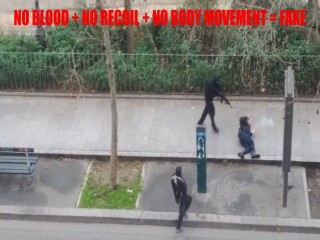
I am well aware that I’m stepping into a hornet’s nest by posting this video, which is going viral. Those who wish to silence all debate have an easy card to play here, accusing me of buying into a conspiracy theory. There’s only one problem: unlike the video-maker, I have few conclusions to draw about what the significance of this video is in relation to the official story. That is not why I am posting it.

But it does, at least to my mind and obviously a lot of other people’s, judging by how quickly it’s spreading, suggest that Ahmed Merabet, the policeman outside the Charlie Hebdo office, was not shot in the head, as all the media have been stating.

That said, it does not prove much more. It doesn’t prove that Merabet did not die at the scene. Maybe he bled to death there on the pavement from his earlier wound. It certainly doesn’t prove that the Kouachi brothers were not the gunmen or that the one who fired missed on purpose. Maybe he just missed.

Nor does the video’s removal from most websites prove that there is some sort of massive cover-up going on. Ideas of good taste, especially in the immediate aftermath of a massacre close to home (ie here in the West), can lead to a media consensus that a video is too upsetting. That can occur even if it does not show blood and gore, simply because of what it implies. Herd instinct in these instances is very strong.

But the unedited video clip does leave a sour taste: because unless someone has a good rebuttal, it does indeed seem impossible that an AK-47 bullet fired from close range would not have done something pretty dramatic to that policeman’s head. And if the video is real – and there doesn’t seem much doubt that it is – it clearly shows nothing significant happened to his head either as or after the bullet was fired.

So what points am I making?

The first one is more tentative. It seems – though I suppose there could be an explanation I have overlooked – that the authorities have lied about the cause of the policeman’s death. That could be for several probably unknowable reasons, including that his being executed was a simpler, neater story than that he bled to death on the pavement because of official incompetence (there already seems to have been plenty of that in this case).

The second point is even more troubling. Most of the senior editors of our mainstream media have watched the unedited video just as you now have. And either not one of them saw the problem raised here – that the video does not show what it is supposed to show – or some of them did see it but did not care. Either way, they simply regurgitated an official story that does not seem to fit the available evidence.

That is a cause for deep concern. Because if the media are acting as a collective mouth-piece for a dubious official narrative on this occasion, on a story of huge significance that one assumes is being carefully scrutinised for news angles, what are they doing the rest of the time?

The lesson is that we as news consumers must create our own critical distance from the “news” because we cannot trust our corporate media to do that work for us. They are far too close to power. In fact, they are power.

Official narratives are inherently suspect because power always looks out for itself. This appears to be a good example – whether what it shows is relatively harmless or sinister – to remind us of that fact.

UPDATE:

I’m still trying to imagine a plausible explanation for the video. I’m no ballistics expert, so I’m firmly in the land of conjecture. But I wonder whether, if the bullet hit the pavement close to Merabet’s head, it might have been possible for bullet fragments to hit him, possibly killing him.

This possibility (assuming it is one) does not invalidate the point of my post. If it was indeed the case, certainly no media outlet has suggested that the gunman missed Merabet and that he died from the exploding fragments.

This isn’t meant to raise technical, or gruesome, details of the case. It is to suggest that western journalists do not report fearlessly and independently when they examine events being narrated by official sources. They mostly regurgitate information on trust, because they trust the authorities to be telling the truth. They do the same when the acts of official enemies are being examined – they again turn to official sources on their side. In short, most journalists have no critical distance from the events they are reporting on our behalf.

That leaves us, ordinary news consumers, in a position of either blindly trusting our own officials too or trying to work things out for ourselves. You would hope that the issues raised by this video get aired by journalists as part of establishing greater trust in our profession and proof of our independence. Instead, I expect it will simply be consigned the “conspiracy theory” bin.


The Dark Soul of American Empire

aa-American-Empire-try-and-stop-us2-300x225

By Mark Weiser

Source: Dissident Voice

Whether or not the soul exists may depend entirely on how it’s being defined, and depending on the definition may also depend on faith, religious or otherwise. The human soul is thought by many as inherently good while the absence of a soul leaves open the possibility to commit and even delight in malicious or evil acts – these destructive actions are also interpreted in terms of being dark. Oddly enough, man’s ego enjoys taking credit for his goodness, while he regularly attributes responsibility for destructive behaviors to outside influences, including at times a supernatural consciousness of evil that influences or provokes harmful human behaviors and thereby takes the soul, either in part or in whole.

Good or evil in any combination can manifest entirely from within any individual for what sometimes are no humanly discernible reasons. At other times the soul is absolutely being influenced by outside forces, including human and the forces of nature. Our definition would not be complete without recognizing that works committed during the physical life, whether good or evil, live on after physical death by affecting those who’ll be living in the future. Even the obscure and long forgotten dead can have a profound impact on our current reality if they ultimately influenced the mind, or perhaps saved the life of someone who was or became influential at some point in history.

We begin life with a non-negotiable soul thought by some to be a blank slate at birth, but I’ll argue here that it’s not blank and certain predispositions are dictated by instincts and genetic code(s) which also affect the workings of the mind. There are studies indicating genetic makeup is a factor in experiencing empathy and compassion, and we can’t deny other differing intellectual abilities and inclinations along with given physical characteristics – all of which shape the soul through our experiences. Theoretically the natural soul uninfluenced by outside forces, could range from pure good to pure evil with most people having the potential for either, at times depending on present circumstances or what they’ve been subjected to. Due to diversity of attributes and handicaps we are all unique, but we can generalize regarding those with similar traits and beliefs which dictate the processes of reasoning and/or irrational thinking that ultimately leads to conclusions and the actions or inactions of any individual.

Because the soul is shaped by events in life, we can define it as: the sum total of all a person is given before birth, combined with the understanding acquired from personal experiences in life, while recognizing a person’s interactions with others and the physical world are determined by the soul or its absence, and will yield benevolent, malevolent or neutral actions – the human soul is alive and real, it affects our actions and interactions with others and how we feel about ourselves as well as others, including the world and life in general – and by affecting others in the immediate sense, it also affects others well into the future.

Our physical bodies and brains are the conduit between the soul and the physical world, with the emphasis being on the brain which controls the willful actions of our bodies. Whether committed or imposed by humans or nature, actions can profoundly shape and mold human souls in either direction. Because our perceptions may not be accurate, at times certain events can fill us with an unjust hatred or even the desire to commit physical violence. Because we’re all different, the same events or circumstances will not have the same impact on the souls of all people, but people do have similar and sometimes nearly universal reactions that are predictable concerning certain events or circumstances.

With no other choice, and given the opportunity, a starving person will likely commit theft and may kill to survive; relatively few would accept starvation without trying to impose on others in some way. An individual with a legitimate means of support certainly has no need, and is much less likely to resort to theft or violence for personal gain. If rising flood waters force a person to abandon their home, their soul may be imprinted with sadness as well as the realization of a destiny beyond their control. Depending on age and other circumstances such an event could be the final straw, leading to a level of despair and shock where the person no longer experiences life in the same way and no longer functions as well as they once did; though this may be defined as weakness, it’s also a sure sign the person is human, as we all have different breaking-points and tolerances. Being subjected to the same ordeal could cause profound personal growth in others, making them stronger with greater understanding and compassion going forward while giving them the real potential for helping or leading others. The essence of the soul does change over time through circumstance and experience and ultimately leads us to our understanding of life and people, and could lead to a complete lack thereof.

When speaking of souls, our understanding includes that groups of people, large and small, have a collective soul based on the same factors that make up the soul of an individual. As with catastrophes caused by nature, the ravages of war are certain to leave an imprint on the soul of emotionally conscious human beings. These imprints take on a different dimension entirely when innocent people are unjustly attacked through wanton aggression. As the most violent people on earth, Americans may have become jaded from all the violence witnessed through television entertainment and news, starting with cartoons at an early age. We’re so used to accepting violence as being justifiable, the idea of our government killing and destroying the lives of innocent others may not register with most of us – in matters of war we’re incessantly told America is always right. All of this brings into question how the collective soul of a relatively few individuals who, as a group, knowingly and unjustly deceived their own country, leading to a wholesale basis of callous, if not gleeful slaughter and mutilation of innocent and weaker members of the human race – including the annihilation of their existing culture – all without any just or legal provocation.

In the case of America attacking a weaker country we’ll look at one of the most egregious events in recent history. Destruction was unleashed by the overwhelming power of the US military in attacking a comparatively defenseless 2003 Iraq. The verdict is in, and we know there were relatively very few Americans who participated in the deceitfulness which ultimately fueled the country’s appetite for attacking without one valid or legal reason – but collectively we still made the conscious choice to destroy, displace, kill and maim while leaving emotional scars and hatred in the large majority of our victims who survived. After having committed wanton aggression, with our own blind ignorance we don’t dare ask ourselves why so many in the Mideast and around the world despise our collective soul – as the truth would be awkward and hard for many to accept or explain. For “civilized people” this post-invasion nonchalant arrogance is every bit as astounding as that which led the initial attack. To be clear, the US invasion of 2003 Iraq was never a true contest of “war”, the word “war” was used as propaganda to make wanton killing and the destruction of people and their civilization look like something other than what it was – all for the perceived benefits of those few who were ultimately responsible for misleading America to back the slaughter of Iraqi citizens among a multitude of other predicted catastrophic results. The carnage we unleashed continues to this day and will effect an untold number for generations to come – it can never be undone – as the depraved collective soul of the few asserted itself supreme over the collective American public’s right to the truth and leaves a forward cutting wake that will forever travel on into the future – at least as long as man is alive.

The influence of Israel and pro-Zionists in Washington D.C. concerning American Mideast policies cannot be overstated. In 2002 the Bush administration created the Office of Special Plans (OSP) run by neocon pro-Zionists who fed the Bush administration “raw intelligence” which proved to be nothing more than propaganda for enabling the attack on Iraq. Lieutenant Colonel Karen Kwiatkowski in the office of the Undersecretary of Defense for Policy at the time, explained how the OSP usurped real expert intelligence assessments to promote the neocon Zionist agenda as stated in the infamous 1996 PNAC policy report. The PNAC policy first advocated removing Saddam Hussein from power, then going on to Syria and Iran which they’re still trying to accomplish – this is no mere coincidence. It’s all part of Israel’s strategy to eliminate any perceived threat in the Mideast and keep everyone around them weak and fighting amongst themselves. Ironically, Israel’s threats result from its own actions beginning with the ethnic cleansing of Palestinian Arabs starting before Israel’s self-declared statehood on those Palestinian lands in 1948 – and the expulsion still continues to this day. Without the undue influence of Israel on U.S. politicians, it is extremely unlikely U.S. public support for the 2003 invasion of Iraq would have materialized. Because the dark soul of America is so influenced by Israel, taking a critical look at the soul of Israel is becoming common and it needs to be recognized for what it is.

The major “news networks” and press operating in the U.S. proved themselves as propagandists, partaking in the policy set by the Bush administration to manipulate the American public during the run-up to the invasion. So persuasive was the propaganda before and after the invasion that some people today still don’t know Iraq had no part in the 9/11/2001 attack on the U.S.; or they simply refuse to accept that our government and mass media would betray America and the world on such a large scale. As far as the press is concerned, they are guilty through aiding and abetting the crime of misleading America into an illegal war – and it was illegal as defined by U.S. and international law. The media people who took part in all of this on any level might as well have lined up all those American soldiers sacrificed and wounded along with all the Iraqi’s killed and maimed while having had the balls to pull the triggers, drop the bombs and fire the missiles to commit the slaughter and devastation themselves.

It’s no secret, huge profits were made by the military-industrial complex (MIC) with the 2003 attack, and they’re still profiting today from Iraq and the overall American Empire strategy. With their connections in Washington, it would be extremely naïve to believe the top individuals in our weapons manufacturing industries didn’t know the reasons given for attacking Iraq were absolutely without credible evidence – while much of those reasons were outright lies. There are a number of choice verbs for describing the condition of those souls among the MIC who knowingly remained silent while the US population sacrificed blood and treasure so they could profit through death and destruction unleashed at will on a relatively hapless Iraq.

Many believe the 2003 invasion was predominantly about securing oil, and it certainly was a contributing factor but no one was pushing more than the pro-Zionist crowd. The petroleum industry had been involved in the pre-war planning for the purpose of dividing the spoils of killing and destruction in terms of barrels of oil. Capitalism as practiced needs oil, and although there are alternative energies available, those making huge profits from oil use their considerable influence to thwart conversion to clean energy.

There’s no legitimate argument against the facts; an undeserved and catastrophic devastation had been levied on the Iraqi people with the 2003 U.S. invasion, conservatively resulting in over half a million Iraqi lives being lost by the time of this writing, with likely millions wounded, and over four million displaced from their homes. To put it in perspective, if it happened to the U.S. with the same percentages across the entire population it would conservatively yield over six million dead, millions more wounded, and roughly fifty million displaced from their homes. Many Americans have a vacancy where a soul should exist as they feel absolutely nothing and no American responsibility for the devastation caused. Other Americans exist with a soul as black as pitch having taken pleasure and profit through the slaughter of Iraqis and their culture. Aside from the U.S. government’s responsibility, these attitudes are largely due to the dark soul of both the U.S. government and media in keeping pertinent facts from the public eye. And if there’s been any remorse or apology from U.S. officials or media it’s been sparse and kept out of sight by the same dark forces which hide from the truth. There are a number of people who could have spoken out before the invasion, and in all fairness some did, though they did not get proportionately heard while the front pages and television news had been reserved for the neocon pro-Zionist mantras to attack Iraq and downplay the ensuing consequences. There were also a few dark traitorous souls operating to dissuade anyone who would speak out while they set an example with the Valery Plame / Scooter Libby affair.

With the invasion of Iraq the U.S. set a new precedent of destructive behavior in motion, which under the pretext of “preemptive defense” has been spread further around the Mideast and now is a matter of historical record and modus operandi. With the U.S. government wreaking havoc at will, killing more innocent civilians than “enemy combatants” – it’s become a very neat and logical self-perpetuating industry of war – creating enemies by killing innocent civilians and thereby creating more revenge-minded combatants to kill – perfect for a world being run by a country of sadistic self-masochistic psychopaths for profit at the expense of the American public and anyone else they choose to victimize. This is not the collective soul of the American people – they have been unwittingly led into the dark by the collective soul of vile depravity. This is, however, a reflection of all those dark souls and their accomplices living in fear of truth and hiding behind the concentrated power at the top of the American political body which now exists predominantly for the sake of personal greed while having unlimited power to unjustly impose on others, domestically and otherwise. It is unfortunate those making the decisions and profits while misleading the country aren’t required to put their own lives, and those that matter to them, on the very front lines; they, being afraid of truth and reality as they are, would be the very first to call an end to the madness.

Preconditions of Revolution in the USA Today

By Robert David Steele

Source: Public Intelligence Blog

Revolution-Today-USA-1.1-JPEG

SHORT URL: http://tinyurl.com/Steele-Revolution

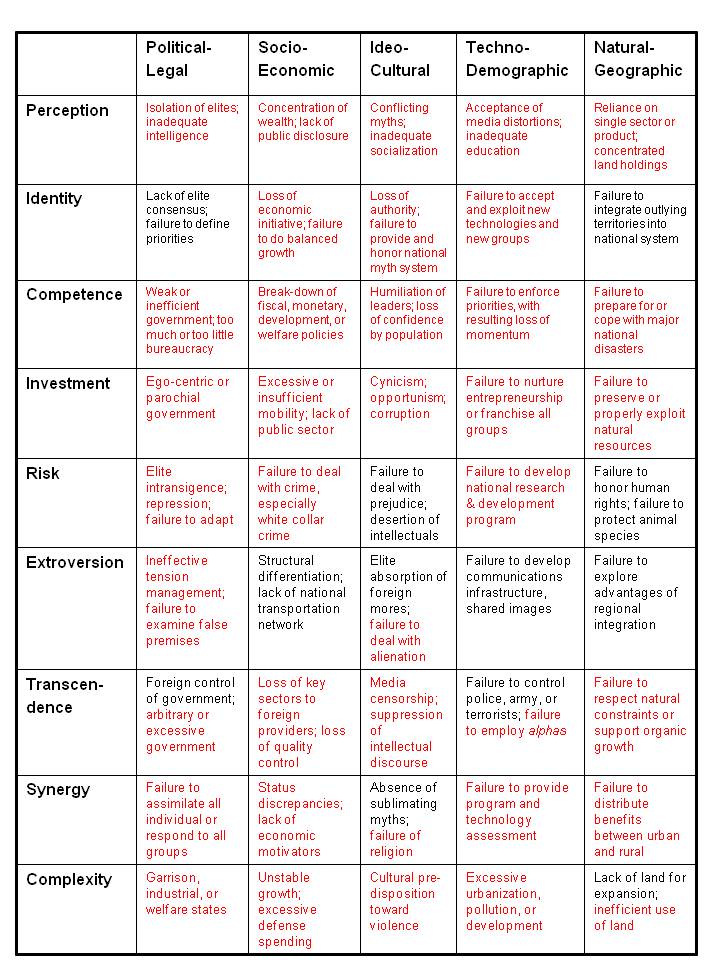
Phi Beta Iota: To those who have been leveraging the below, thank you for your interest.  It seemed like a good idea to go ahead and post a version of the chart showing in red all of the pre-conditions of revolution in the USA that are now actively present. The failure of leadership to manifest ethics and to nurture education is particularly harmful–white collar criminals do not prosper when the political leadership is ethical and upholds its responsibility to protect the public interest.  The ONLY thing–the one RIGHT thing–that needs to be done to make everything else possible is Electoral Reform (1 Page, 9 Points).  If the various parties and committees and alliances claiming to represent the public interest fail to sponsor this one simple fix, they reveal themselves for what they are: partisan quasi-criminal organizations operating in betrayal of the public trust, with no interest in restoring America the Republic, America the Beautiful.

EDIT:  For those who really do not understand the integrity of the above in today’s context, we will make this explicit:

1.  The country has been run into the ground–the bottom 98% have had their seed corn stolen and eaten by the top 2%.  There is no going back, neither revenge nor expropriation will do.  What has been done is done, get over it.

2.  There isn’t a leader or leadership team or party or “elite” network on the planet that can put the USA back together again [except perhaps We the People Reform Coalition].

3.  HOWEVER, “bottom up” collective intelligence is agile, intuitive, ethical in the aggregate, and so on.  This is REALLY SIMPLE: restore the integrity of the electoral system (local to national) and get out of the way.  This is called Epoch B Leadership.  It is also the root “good” of Advanced Information Operations  You start by empowering your own public and not lying to them.

Graphic: Pre-Conditions of Revolution

Graphic: Revolution Model Simplified

2011 Thinking About Revolution

1976 Thesis: Theory, Risk Assessment, and Internal War: A Framework for the Observation of Revolutionary Potential

Review: Theory, risk assessment, and internal war–A framework for the observation of revolutionary potential

Review: Revolutions and Revolutionary Movements

Revolution @ Phi Beta Iota

Search: davies j 1969 curve

Search: rm maciver the web of government summary

Search: smart nation intelligence reform electoral reform national security reform

We the People Reform Coalition

A Gloomy Summary of the Outgoing Year

index

By Vladimir Mashin

Source: New Eastern Outlook

The outgoing 2014 is destined, apparently, to go down in the annals of history as a special year given its share of iconic dates (note, for example, 100 years since WWI and 75 years since WWII, 25 years since the fall of the Berlin Wall), and due to abundance of events having worldwide significance.

Today the mankind is on the verge of epochal changes in its history, which will determine the course of the world development for decades to come. 2014 was a turning point in international relations, sharply denoting the main trend of our time – the reconfiguration of the entire world system, reformatting of global structures, the shift from a unipolar to a polycentric world in which decisions on key issues should be based on cooperation and agreements between states and their associations, relying on equal participation and consideration of the interests of the whole mankind. And the contours of this world are now visible.

On the surface, these processes take the form of a deep civilizational and geopolitical fault.

There is a weakening of the position of the United States and the West in general as the center of gravity of the world. Many European political scientists and world known academics speak explicitly about the decline of the Western civilization. European nations are homogeneous, and the continual rise of immigration in recent decades has in fact already changed the ethnic composition of the Old World. Europe found itself unable to integrate the Muslim minority, which is already more than 30 million people, but it is also unable, due to the declining population and its aging, to maintain the current standard of living and the rate of production growth without an influx of the young foreign workforce.

The European sub-ethnic group has entered the phase of obscuration and is on the verge of (according to the criteria of historical time) being absorbed by new, emerging and already prominently visible types (of sub-ethnic groups). This is the Asian sub-ethnic group – a synthesis of several types of cultures and religions. By 2020, experts anticipate a rise of the African sub-ethnic group. In the Western Hemisphere the Hispanic sub-ethnic group is being created on the basis of a huge diversity of ethnic groups and beliefs.

These processes are to a large extent objective: for example, the outgoing year marked the emergence of China as an economic leader (China surpassed the United States in its purchasing power parity in 2014).

If the current trend continues, the “third world”, which today by population surpasses the West five times, by 2050 will surpass it ten-fold.

The reformatting of international relations will further continue. China proposed the following definition for this process: construction of a new non-American world.

In 2014 the US administration, giving itself the status of a self-proclaimed “exceptional nation” entitled to lead world processes, in fact launched a war for the world domination using the NATO military force in conjunction with new methods of disinformation and media control. (This has already occurred in history three-quarters of a century ago, when Germany tried to become a superpower promoting the “Aryan supremacy” with a reliance on military force and Goebbels propaganda). This manifested itself in successive waves of the NATO expansion, contrary to assurances given at the highest level, and in violation of a solemn declaration on the establishment of an equal and indivisible security system in the Euro-Atlantic area. By this logic, the Anschluss of 2014 is a large-scale operation by the US State Department to subjugate the European Union, and then, with combined forces, to launch an attack on the East – stubborn, but temptingly rich with its natural resources and human potential.

The Ukrainian crisis was the result of the policy pursued by the United States and Western countries during the last quarter-century of controlled expansion of their geopolitical space, strengthening their own security at the expense of others. Washington took a line on the separation of Ukraine from Russia and dragging it into the NATO. With the support of the United States and some European countries an armed anti-constitutional coup was carried out in Ukraine. Radical nationalists put the country on the brink of a schism and pushed it into a civil war that has taken thousands of lives and led to the horrible devastation turning into a tragedy for hundreds of thousands of civilians.

In a way, the EU is solving its own problems by capturing Ukrainian markets in order to prevent the collapse of its own integration scheme which had failed the test posed by the protracted economic crisis, since Ukraine, with its 46 million people, black earth, metallurgy and engineering, can reanimate Europe going through a systemic crisis.

The Ukrainian crisis is not a simple episode – it reflects a deep civilizational fault, which has ripped across all continents. The already complex and tense situation is further aggravated, poisoned by provocative, negatively charged statements of certain Western officials.

The Western attempt to tear Ukraine away from Russia and drag it to its side has only further exacerbated the general systemic crisis of international relations.

There is a growing discrepancy between the global ambitions of the US administration and their actual capabilities. America remains the leading economic and military power; however, Washington has no real power, and especially no moral right to lecture everyone else on democracy and proper behavior. Normal people’s hair stands on end from what they see on TV and read in the detailed reports and presentations about the tortures by CIA “experts” of so-called terrorists whose guilt has not been proven. And that’s not to mention the evidence submitted by Snowden about the United States espionage around the world.

In 2014, the Western media coined the “hybrid war” term. It applies to, first of all, the United States and the American war strategy – it is truly hybrid and focused on the military defeat of the enemy, and simultaneously regime change in states pursuing policies objectionable to Washington. Financial and economic pressure is used as well as information attacks, increasing pressure by proxy along the borders of the respective state, and, of course, informational and ideological influence by relying on externally funded non-governmental organizations. Is this not what is called a war?

In 2014, the flares of the “Arab Spring”, seemingly so encouraging at the initial stages, proceeded to incinerate the Middle East which by its degree of ‘flashpoint’ tension – right now twelve different scale armed conflicts are blazing there – has moved to the forefront of world events. The main reason is the US military invasion of Iraq in 2003. The transition of control in Baghdad from the Sunnis who had been in power traditionally to the Shiite majority, with the direct complicity of the United States, has led to a breach in the balance of power in the Persian Gulf, which had existed for decades and was the basis for maintaining stability. This resultant bias towards the growing influence of Shiites and indirectly Iran immediately caused an explosion of discontent and fear within the Sunni minority in Iraq and Sunni communities as a whole in the region.

Open intervention by Western powers in the Iraqi drama, into the affairs of Libya and Syria, seriously complicates the situation and leads to the increased activity of Islamist extremists. At the core of the “Arab Spring” events was the struggle for social justice, for a way out of the vicious circle of underdevelopment and injustice – it was an arising national identity, the movement against Westernization, the desire for self-assertion and defining a decent place for Arabs in the international community. The US and some European countries have tried to turn to their advantage the rise of revolutionary action and in its wake the ascent of Islamic parties to the levers of power in a number of Arab countries. To do this, proven methods were used, such as incitement to religious and ethnic strife, the tacit support of extremist organizations. The activation of al-Qaeda, Boko Haram, the Taliban and the establishment of the Islamic Caliphate in Syria and Iraq is a direct result of the policy of the United States and other Western powers.

There is a real disintegration of state, social and civilizational structures going on in the Middle East region. ISIS terrorists have laid claim to their statehood status, and are beginning to develop the territories, setting up governmental authorities there, that are quasi-state, but, nonetheless, perform administrative functions. We cannot exclude the possibility that the actions of Islamist terrorists can also spread beyond the region.

Throughout 2014, new centers of the extremist activity in Africa (Libya, Mali, Sinai, Nigeria, Somalia, etc.) have appeared and the centers of radicalism in Afghanistan and Pakistan are expanding on the map.

Some Western leaders are still thinking in terms of the Cold War, not fully grasping the possible catastrophic consequences of current trends. But the development of some of them raises the question of the preservation of life on our planet: for example, the fact that nine states have 16,300 nuclear warheads at their disposal, which is enough to kill all life on the Earth many times over.

In the 20th century, the world repeatedly faced with the risk of weapons of mass destruction being used (UN official sources indicated thirteen such situations after 1962). In 2002, the world was in danger of the Indo-Pakistani War (note that Pakistan has the fastest growing nuclear program in the world). According to Al-Arabiya website of December 10, 2014, Israel offered to sell a nuclear bomb to the apartheid regime in South Africa. And the 2003 UN Security Council resolution number 687 declared as its goal “making the Middle East a zone free of weapons of mass destruction and missiles capable of delivering these weapons” (The Conference for the implementation of this task was scheduled for 2012, but is still delayed to this day).

The civilizational fault in today’s globalized, but very fragile world is becoming one of the forms of many contradictions. And, at their base is the question of values. Western powers are moving away from their once traditional postulates and are trying to return their former hegemony by force. This is a very painful process, because the West does not want to accept the fact of its diminishing influence and loss of ability to manage global processes. Now there is an increasingly growing tendency towards asserting the unconditional right of every civilization to choose, without pressure and pointers from the outside, a system of government, relevant government institutions, ethnic, ethical and cultural paradigms.

There is a genuine war going on between sound conservatism – for the preservation of ethical moral principles developed by the mankind over centuries of Homo sapiens’ evolvement, and rampant liberalism, the accession to power of instincts, which means degradation, offensive barbarism, leading eventually to the extinction of the human race. Our outstanding scientists – Vernadsky, Moiseev, Rauschenbach – warned us about this.

Russia consistently and firmly acts from its belief in the cultural and civilizational diversity of the modern world, where each state has the right to its own path of development and should be able to freely and independently determine its foreign policy in the framework of the goals and principles of the UN Charter. Attempts to impose a different value system, interference in the internal affairs of other countries are fraught with the danger of sliding towards chaos and unmanageability of international affairs.

Brzezinski’s famous political thriller – “The Grand Chessboard: American Primacy and Its Geostrategic Imperatives” – clearly defines the objectives of the chess game: to provide the US world domination euphemistically called “leadership”. Besides, it directly and bluntly asserts that in the twenty-first century “the chief geopolitical prize for America is Eurasia.”

And now, when the center of global processes has suddenly moved to Ukraine, where a real opposition front opened up, the United States and Western Europe have lined up openly against Russia.

Linking together the events in Ukraine, the Middle East, Southwest Asia and the Caucasus, it is possible to see strategic plans of globalists. The situation is extremely fluctuant, the balance vacillates, and there is a reason to believe that the historical time for containing Russia by the combined West has been lost.

Russia, with its unique natural resources, economic and, most importantly, human potential, a fusion of many peoples and cultures, is geographically and historically a unique independent world civilization, able to withstand the challenges of the coming epoch.

Russian President Vladimir Putin in his recent speech said that no one in history has ever been able to subjugate Russia to his will. It’s not even an assessment, but a statement of fact. Although such attempts have been made by the West for the sake of quenching its thirst for expanding the geopolitical space under its control.

The obvious fact now is that the vast majority of the states with which Russia continues its dialogue appreciate the independent role of the Russian Federation in the international arena.

American professor Samuel Huntington, a historian so often quoted recently while praising the power of the United States, nonetheless admitted that “the West conquered the world not by the superiority of its ideas, moral values or religion (few other civilizations were converted to it) but rather as a result of superiority in the use of organized violence.” In the West, this fact has been forgotten, but in the East – it will never be. The US invasion to Iraq, which in fact laid the groundwork for a chain of collisions – tragic for the peoples and endless to this day – national, ethnic, religious, economic, and social, at the same time has sucked the US deeply into the quagmire of a perpetual conflict with the Islamic world. Since the Roman Empire there has never been a situation where the tentacles of one nation’s claims stretched so far from its borders.

Ultimately, humanity can survive if it realizes that there is no real alternative to cooperation. We have so many global and regional issues, and the world is becoming so fragile that there is simply no other way out. (For example, Secretary of State Kerry, for nine long months made unilateral shuttle trips in an attempt to reach a peaceful political settlement between Israel and the Palestinians. But unilateral American efforts proved ineffective. Moreover, there has been a new outbreak of bloody clashes in Jerusalem, and tension in Israeli-Palestinian affairs is growing. Meanwhile, in another situation on the Syrian track, when Russia and the United States worked together with China, we were able to prevent a major war in the region, eliminate chemical weapons in Syria and convene the Geneva Conference).

Unfortunately, in today’s world the number of terrorist attacks and conflict situations is on the rise again. New dividing lines or the construction of new walls will not lead to the resolution of these problems.

To cope with these and other pending challenges, we can only work together on the basis of equal and mutually respectful cooperation.

Vladimir Mashin, Ph.D. in History, a political commentator, exclusively for the online magazine “New Eastern Outlook”.

False Flagging the World towards War. The CIA Weaponizes Hollywood

PROPAGANDA

By Larry Chin

Source: GlobalResearch.ca

Almost all wars begin with false flag operations.

The coming conflicts in North Korea and Russia are no exception.

Mass public hysteria is being manufactured to justify aggression against Moscow and Pyongyang, in retaliation for acts attributed to the North Korean and Russian governments, but orchestrated and carried out by the CIA and the Pentagon.

The false flagging of North Korea: CIA weaponizes Hollywood

The campaign of aggression against North Korea, from the hacking of Sony and the crescendo of noise over the film, The Interview, bears all the markings of a CIA false flag operation.

The hacking and alleged threats to moviegoers has been blamed entirely on North Korea, without a shred of credible evidence beyond unsubstantiated accusations by the FBI. Pyongyang’s responsibility has not been proven. But it has already been officially endorsed, and publicly embraced as fact.

The idea of “America under attack by North Korea” is a lie.

The actual individuals of the mysterious group responsible for the hacking remain conveniently unidentified. A multitude of possibilities—Sony insiders, hackers-for-hire, generic Internet vandalism—have not been explored in earnest. The more plausible involvement of US spying agencies—the CIA, the NSA, etc. , their overwhelming technological capability and their peerless hacking and surveillance powers—remains studiously ignored.

Who benefits? It is illogical for Pyongyang to have done it. Isolated, impoverished North Korea, which has wanted improved relations with the United States for years (to no avail), gains nothing by cyberattacking the United States with its relatively weak capabilities, and face the certainty of overwhelming cyber and military response. On the other hand, Washington benefits greatly from any action that leads to regime change in North Korea.

But discussion about Pyongyang’s involvement—or lack of—risks missing the larger point.

This project, from the creation of The Interview to the well-orchestrated international incident, has been guided by the CIA, the Pentagon, and the State Department from the start. It is propaganda. It is a weapon of psychological warfare. It is an especially perverted example of military-intelligence manipulation of popular culture for the purpose of war.

There is nothing funny about any of it.

The Interview was made with the direct and open involvement of CIA and Rand Corporation operatives for the express purpose of destabilizing North Korea. Star and co-director Seth Rogen has admitted that he worked “directly with people who work in the government as consultants, who I’m convinced are in the CIA”. Originally conceived to be a plot taking place in an “unnamed country”, Sony Pictures co-chairman Michael Lynton, who also sits on the board of the Rand Corporation, encouraged the film makers to make the movie overtly about murdering Kim Jong-Un. Bruce Bennett, the Rand Corporation’s North Korean specialist, also had an active role, expressing enthusiasm that the film would assist regime change and spark South Korean action against Pyongyang. Other government figures from the State Department, even operatives connected to Hillary Clinton, read the script.

The infantile, imbecilic, tasteless, reckless idiots involved with The Interview, including the tasteless Rogen and co-director Evan Goldberg, worked with these military-intelligence thugs for months. “Hung out” with them. They do not seem to have had any problem being the political whores for these Langley death merchants. In fact, they had fun doing it. They seem not to give a damn, or even half a damn, that the CIA and the Pentagon have used them, and co-opted the film for an agenda far bigger than the stupid movie itself. All they seem to care about was that they are getting publicity, and more publicity, and got to make a stupid movie. Idiots.

The CIA has now succeeded in setting off a wave of anti-North Korea war hysteria across America. Witness the ignorant squeals and cries from ignorant Americans about how “we can’t let North Korea blackmail us”, “we can’t let Kim take away our free speech”. Listen to the ridiculous debate over whether Sony has the “courage” to release the film to “stand up to the evil North Koreans” who would “blackmail America” and “violate the rights” of idiot filmgoers, who now see it as a “patriotic duty” to see the film.

These mental midgets—their worldviews shaped by the CIA culture ministry with its endorsed pro-war entertainment, violent video games, and gung-ho shoot ‘em ups—are hopelessly brain-curdled, irretrievably lost. Nihilistic and soulless, as well as stupid, most Americans have no problem seeing Kim Jong-Un killed, on screen or in reality. This slice of ugly America is the CIA’s finest post-9/11 army: violent, hate-filled, easily manipulated, eager to obey sheeple who march to whatever drumbeat they set.

And then there are the truly dumb, fools who are oblivious to most of reality, who would say “hey lighten up, it’s only a comedy” and “it’s only a movie”. Naïve, entitled, exceptionalist Americans think the business of the war—the murderous agenda they and their movie are helping the CIA carry out —is all just a game.

The CIA’s business is death, and that there are actual assassination plans in the files of the CIA, targeting heads of state. Kim Jong-Un is undoubtedly on a real assassination list. This is no funny, either.

The real act of war

The provocative, hostile diplomatic stance of the Obama administration speaks for itself. Washington wanted to spark an international incident. It wants regime change in Pyongyang, does not care what North Korea or China think, and does not fear anything North Korea will do about it.

On the other hand, imagine if a film were about the assassination of Benjamin Netanyahu and the toppling of the government in Tel Aviv. Such a film, if it would ever be permitted even in script form, would be stopped cold. If it made it through censors that “magically” never slowed down The Interview (and yes, there is censorship in America, a lot of it) Obama would personally fly to Tel Aviv to apologize. At the very least, Washington would issue statements distancing themselves from the film and its content.

Not so in the case of The Interview. Because American elites actually want the Kim family murdered.

Despite providing no proof of North Korean involvement, President Barack Obama promised a “proportional response”. Promptly, North Korea’s Internet was mysteriously shut down for a day.

Unless one is naïve to believe in this coincidence, all signs point to US spy agencies (CIA, NSA, etc.) or hackers working on behalf of Washington and Langley.

Given the likelihood that North Korea had nothing to do with either the hacking of Sony, the initial pulling of the movie (a big part of the publicity stunt, that was not surprisingly reversed) or the “blackmailing” of moviegoers, the shutting down of North Korea’s Internet was therefore a unilateral, unprovoked act of war. Washington has not officially taken responsibility. For reasons of plausible denial, it never will.

Perhaps it was a dry run. A message. The US got to test how easily it can take down North Korea’s grid. As we witnessed, given overwhelming technological advantage, it was very easy. And when a war against Pyongyang begins in earnest, American forces will know exactly what they will do.

The US is flexing its Asia-Pacific muscles, sending a message not only to Pyongyang, but to China, a big future target. Some of the other muscle-flexing in recent months included the anti-Beijing protests in Hong Kong (assisted by the CIA and the US State Department), ongoing provocations in the South China Sea over disputed oil, and new defense agreements that place new anti-missile systems and missile-guided naval vessels to the region.

The bottom line is that America has once again been mobilized into supporting a new war that could take place soon. The CIA and Sony have successfully weaponized a stupid movie, making it into a cause and a battle cry.

If and when bombs fall on North Korea, blood will be on the hands of the makers of The Interview, every single executive who allowed it to be made, and the hordes who paid to see it.

If America were a decent, sane society, The Interview would be exposed, roundly denounced, boycotted and shunned. Instead it is celebrated.

The CIA should be condemned. Instead, Seth Rogen hangs out with them. America, increasingly dysfunctional, loves them. Obeys them.

The false flagging of Russia

Regarding The Interview, Russian Foreign Ministry spokesman Alexander Lukashevich issued a statement in sympathy with North Korea, correctly calling the film’s concept aggressive and scandalous, and decried the US retaliatory response as counterproductive and dangerous to international relations.

Of course. Washington has no interest in improved international relations.

The Russians should know.

Like Kim Jong-Un, Vladimir Putin has been vilified, demonized and false-flagged, incessantly. If Kim is today’s object of ridicule, Putin is Evil Incarnate.

Consider the hysterical, desperate provocations by Washington in recent months.

A US-NATO coup, engineered by the CIA, toppled the government of Ukraine, planting a pro-US neo-Nazi criminal apparatus on Russia’s doorstep. The CIA and its worldwide network of propagandists pinned the blame on Putin and Russia for aggression, and for obstructing “democracy”.

The MH-17 jetliner is downed by Ukrainian operatives, with the support of the CIA, Mi-6, etc. etc. This false flag operation was blamed on Russia— “Putin’s Missile”. The US and NATO are still trying to pin these murders on Putin.

The war against the Islamic State—a massive CIA false flag operation—seeks to topple with the the Assad government as well as to militarily counter Russia. The ongoing Anglo-American conquest of regional oil and gas supplies, and energy transport routes is also aimed at checkmating Russia and China across the region.

The US and NATO have attacked the Russian federation with sanctions. The US and Saudi Arabia have collapsed oil prices, to further destroy the Russian economy. Full-scale military escalations are being planned. The US Congress is pushing new legislation tantamount to an open declaration of war against Russia.

What next? Perhaps it is time for the CIA to produce a Seth Rogen-James Franco movie about assassinating Putin. Another “parody”. Or how about a movie about killing Assad, or anyone else the United States wants to make into a Public Enemy? Don’t think Langley isn’t working on it.

The return of the Bushes (who were never gone) 

In the midst of all escalating war hysteria comes news that Jeb Bush is “actively exploring” running for president in 2016. The long predicted return of the Bush family, the kings of terrorism, the emperors of the false flag operation, back to the White House appears imminent.

The CIA will have its favorite family back in the Oval Office, with true CIA scion to manage the apocalyptic wars are likely to be launched in earnest in the next two years: Russia/Ukraine, North Korea, the Middle East.

Jeb Bush will “finish the job”.

The 2016 presidential “contest” will be a charade. It is likely to put forth two corrupt establishment political “friends” posing as adversaries, when in fact, they are longtime comrades and conspirators. On one side, Hillary (and Bill) Clinton. On the other side, Jeb Bush, with George H.W., George W. and all of the Bush cronies crawling back out of the rotten woodwork. The fact is that the Clintons and Bushes, and their intertwined networks, have run the country since the 1980s, their respective camps taking turns in power, with Obama as transitional figurehead (his administration has always been run by neoliberal elites connected to the Clintonistas, including Hillary Clinton herself).

The collective history of the Bushes stretches back to the very founding of the American intelligence state. It is the very history of modern war criminality. The resume is George H.W. Bush—the CIA operative and CIA Director—is long and bloody, and littered with cocaine dust. The entire Bush family ran the Iran-Contra/CIA drug apparatus, with the Clintons among the Bush network’s full partners in the massive drug/weapons/banking frauds of that era, the effects of which still resonate today. And we need not remind that the Bush clan and 9/11 are responsible for the world of terror and false flag foreign policy and deception that we suffer today.

While it remains too early to know which way the Establishment will go with their selection (and it depends on how world war shakes out between now and 2016), it is highly likely that Jeb

Bush would be the pick.

Hillary Clinton has already been scandalized—“Benghazi-ed”. Jeb Bush, on the other hand, has ideal Establishment/CIA pedigree. He has waited years for the stupid American public to forget the horrors that his family—Georges H.W. and W.— brought humanity. And now Americans , with their ultra-short memories, have indeed forgotten, if they had ever understood it in the first place.

And the American public does not know who Jeb Bush is, beyond the last name. Jeb Bush, whom Barbara Bush always said was the “smart one”, has been involved in Bush narco-criminal business since Iran-Contra. His criminal activities in Florida, his connection with anti-Castro Cuban terrorists and other connections are there, for those who bother to investigate them. His Latin American connections—including his ability to speak fluent Spanish, a Latin wife and a half-Latin son (George P. Bush, the next up and coming political Bush)—conveniently appeals to the fastest-growing demographic, as well as those in the southern hemisphere drug trade. Recent Obama overtures towards the Latino demographic—immigration, Cuba—appear to be a Democratic Party move to counter Jeb Bush’s known strengths in the same demographic.

Today, in the collective American mind, Kim Jong-Un and Vladimir Putin are “the bad guys”. But the mass murdering war criminal Bushes are saints. “Nice guys”.

A Jeb Bush presidency will be a pure war presidency, one that promises terror, more unspeakable than we are experiencing now, lording it over a world engulfed in holocaust.

This is not a movie.