From Chi-Town bagman to ECOWAS chairman: meet the former money launderer leading the push to invade Niger

By Alexander Rubinsteain and Kit Klarenberg

Source: The Grayzone

Since the overthrow of Niger’s US-friendly government, West African nations of the ECOWAS bloc have threatened an invasion of their neighbor.

Before leading the charge for intervention, ECOWAS chair Bola Tinubu spent years laundering millions for heroin dealers in Chicago, and has since been ensnared in numerous corruption scandals.

Hours after Niger’s Western-backed leader was detained by the country’s presidential guard on July 28, Nigerian President and chair of the Economic Community of West African States (ECOWAS) Bola Tinubu leapt into action, warning that the group of nations “will not tolerate any situation that incapacitates the democratically-elected government.”

“As the Chairperson of ECOWAS…I state without equivocation that Nigeria stands firmly with the elected government in Niger.”

Two days later, ECOWAS imposed severe sanctions on Niger, and the bloc issued a stark ultimatum: if the newly-inaugurated junta won’t reinstall the ousted president in a week’s time, the group’s pro-Western African governments will — by military means, if necessary. 

On Saturday, July 6 — one day before the deadline — ECOWAS leaders approved a plan to invade the country, with the ominous caveat that they are “not going to tell the coup plotters when and where we are going to strike.”

If ECOWAS gets its way, member states Benin, Cabo Verde, Côte d’Ivoire, The Gambia, Ghana, Guinea Bissau, Liberia, Nigeria, Sierra Leone, Sénégal and Togo will be pressured to send their soldiers to invade Niger.

These developments have thrust the typically-overlooked West African country of Niger into the Western media spotlight. But if hostilities break out, it wouldn’t just be one single impoverished African state in the crosshairs.

Neighboring Burkina Faso, Mali and Guinea, which are also governed by military administrations that recently seized power by force, have all warned that any attack on Niger will be viewed as an attack on them too. If their ECOWAS rivals make the first move, the nations which mainstream media have dubbed Africa’s “coup belt” have pledged to unleash their military forces as well — an announcement which should end any illusions that restoring the country’s previous president would be a painless process.

Leading the pro-Western coalition is the president of its most powerful country, Nigeria: Bola Tinubu. One of Nigeria’s wealthiest men, the source of the scandal-plagued president’s fortune remains unclear.

Documents reviewed by The Grayzone reveal Tinubu as a longtime US asset who was named as an accomplice in a massive drug running operation that saw him launder millions on behalf of a heroin-dealing relative. 

Bola Tinubu’s career marred by drug-trafficking, corruption allegations

For over 30 years, Bola Tinubu has been a major force in Nigeria’s political scene and the country’s economy, with local nicknames ranging from “the Mother of the Market” to “the Godfather of Lagos” and “the Lion of Bourdillon.” But his power inside Nigeria went largely unnoticed by international audiences until 2023, when he became ECOWAS chair after winning the presidency in an election closely tracked by the US government.

As president, Tinubu quickly instituted a regime of economic reforms backed by the US-controlled International Monetary Fund and the World Bank. Over the course of Tinubu’s political career in Nigeria, the African operator has cultivated a close relationship with the US embassy. According to a slew of classified State Department cables released by WikiLeaks, American officials relied heavily on Tinubu’s assessments of the domestic political landscape.

The ECOWAS chair’s early life is shrouded in mystery, and even his exact age is unknown. Nearly every detail of Tinubu’s personal history — prior to his appearance in Chicago on a student visa — is in dispute, including his legal birth name.

Records from Chicago State University show that Tinubu received a degree in Business Administration in 1979. In the following years, media reports indicate that Tinubu was employed in some capacity at a number of major US-based multinationals, including Mobil Oil Nigeria, consulting firm Deloitte, and GTE, which was the largest communication and utilities company in the US at the time.

Of the few details about the Nigerian President’s early exploits which can be confirmed, many are derived from a 1993 court docket naming Tinubu as an accomplice in a massive midwestern drug smuggling operation. 

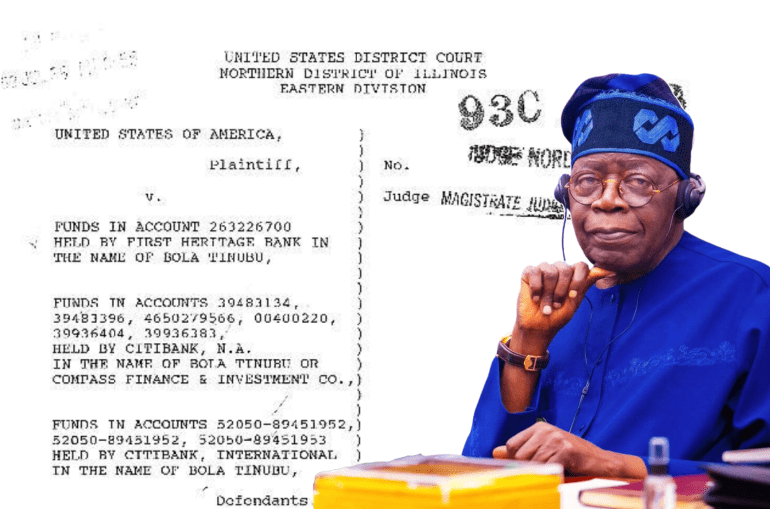
As journalist David Hundeyin has detailed, court documents from the US District Court’s Northern District of Illinois make it clear that Tinubu amassed a small fortune laundering money for a heroin-trafficking relative in Chicago, and that US government officials ultimately seized well over a million dollars from various bank accounts registered under the current Nigerian president’s name.

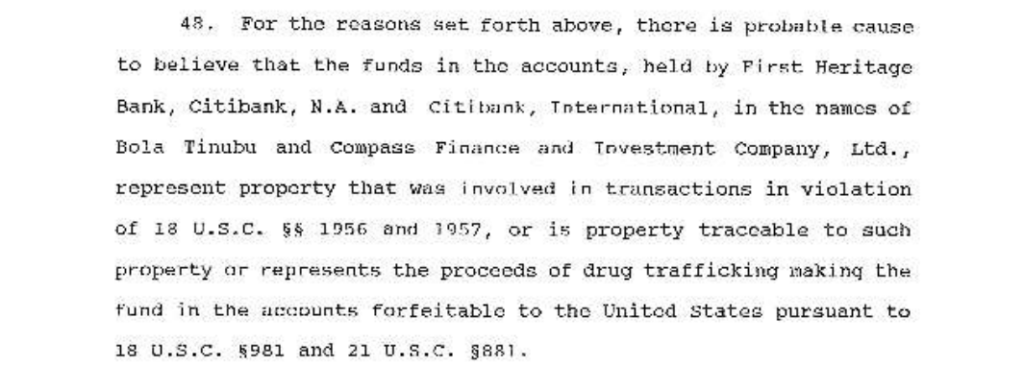
A 1993 report by IRS Special Agent Kevin Moss explained that “there is probable cause to believe that funds in certain bank accounts controlled by Bola Tinubu… represent proceeds of drug trafficking; therefore these funds are forfeitable to the United States.”

In the documents, Moss describes an extremely close working relationship between the future Nigerian president and two Nigerian heroin dealers named Abiodun Olasuyi Agbele and Adegboyega Mueez Akande, the latter of whom was listed as Tinubu’s cousin on an application for a vehicle loan.

“According to bank employees, when Bola Tinubu came to First Heritage Bank in December 1989 to open the accounts, he was introduced to them by Adegboyega Mueez Akande, who at that time maintained an account at the bank.” What’s more, bank records indicate that “Bola Tinubu also opened a joint checking account in his name and the name of his wife, Oluremi Tinubu,” who had “previously opened a joint bank account also at this bank with Audrey Akande, the wife of Adegboyega Mueez Akande,” Moss explained. In several of the applications, the addresses used by Tinubu exactly matched those previously used by Akande.
“According to bank records… Tinubu opened an individual money market account and a NOW account” at First Heritage Bank in December 1989, the special agent noted. “In the application, Tinubu stated that his address was 7504 South Stewart, Chicago, Illinois” — “the same address used previously by Akande.”
“Bank records disclosed that five days after the account was opened, on January 4, 1990, $80,000 was deposited into the NOW account at First Heritage Bank by wire transfer through First Chicago from Banc One Houston,” the report continues. According to the IRS, the money was sent by Akande.

But the Nigerian president’s financial dealings with the heroin traffickers went even further, according to the IRS special agent. He wrote that Citibank records documented “two additional corporate accounts held in the name of Compass Finance and Investment Company, Ltd. which were controlled by Bola Tinubu.”

“When Bola Tinubu opened these accounts,” he provided “a memorandum of association and articles of association” which “identified Mueez Adegboyega Akande and Abiodun Olasuyi Agbele as directors of Compass Finance and Investment Company, Ltd.,” Moss wrote.

In the end, Tinubu somehow managed to deposit over $660,000 in his First Heritage Bank account in 1990, and more than $1.2 million the next year — all while claiming to take home just $2,400 a month from his position at Mobil Oil Nigeria.

As the investigation into the money laundering scheme began to gain traction, Tinubu left the US and returned to Nigeria. Ultimately, Moss was able to speak to Tinubu by telephone on a number of occasions, and the special agent reported that the future president initially acknowledged his personal and financial dealings with the pair of drug traffickers. 

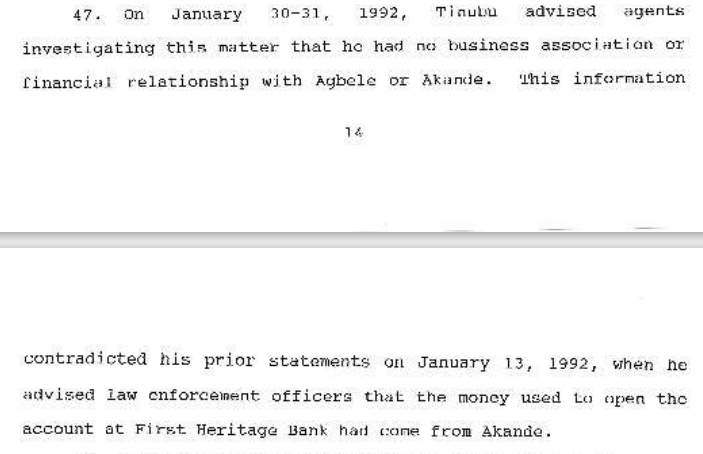
But in late January of 1992, “Tinubu advised agents investigating this matter that he had no business association or financial relationship with Abele or Akande,” Moss wrote. “This information contradicted his prior statements on January 13, 1992, when he advised law enforcement officers that the money used to open the account at First Heritage Bank had come from Akande.”

Back in Nigeria, Tinubu had already begun to transition into the political arena. By 1992, he’d been elected to the Senate, and in 1999 he became the Governor of Lagos State, a position he retained until 2007. At some point in his tenure, Tinubu established a relationship with the US Embassy which would last for years to come, according to a trove of diplomatic cables released by Wikileaks.

But even his State Department allies couldn’t help noticing Tinubu’s penchant for dishonesty. One particularly noteworthy cable pointed out that the politician was “known to play fast and loose with the facts” and “has been caught in the past embellishing his educational achievements.”

In the end, however, Tinubu’s usefulness seemed to outweigh his casual relationship with the truth, and the future Nigerian president went on to provide American officials with a near-continuous assessment of the political situation in his country. One typically intimate meeting with Tinubu ended with the US ambassador to Nigeria commenting: “as always, we found his take on the national political scene to be insightful.”

When the cables came to light in 2011, many Nigerians were shocked at the candor with which their elected officials spoke to Washington’s envoys. “The willingness of our elites to divulge unsolicited information about the nation to U.S. officials betrays an infantile thirst for a paternal dictatorship,” Nigerian-American professor and columnist Farooq Kperogi wrote.

Though Tinubu appeared to have escaped justice for his alleged role in a heroin trafficking conspiracy, accusations of corruption would continue to dog the ECOWAS chair throughout his political career in Nigeria. Since leaving office as governor of Lagos in 2007, Tinubu “picked every subsequent winning candidate,” according to German broadcaster DW, which noted earlier this year that the tycoon “is believed to be one of Nigeria’s richest politicians but the source of his wealth is unknown.”

In recent years, clues about the origins of the fortune amassed by one of Africa’s leading political players have begun to come to light.

In 2009, Tinubu came under investigation by the Metropolitan Police of London, who were probing allegations that the politician had pooled money with two other Nigerian governors to create a front company known as the “African Development Fund Incorporation.”

Investigators alleged the unusual business arrangement was actually a joint effort to illegally acquire shares of ECONET, a telecommunications firm founded by US intelligence asset and Gates Foundation trustee Strive Masiyiwa. But attempts to probe the legitimacy of the transactions in question were sidelined when the Nigerian federal government stonewalled the British investigation, which ultimately concluded without a single arrest. To this day, Nigerian authorities have yet to release the evidence requested by UK authorities.

In 2011, Tinubu was tried before the Code of Conduct Tribunal in Nigeria for illegally operating 16 foreign bank accounts. Eager to avoid the embarrassment he’d previously suffered when being photographed in court, the ECOWAS chair reportedly refused to take his place at the dock in a judicial hearing.

But the unwelcome attention appears to have done little to rein in the politician’s extravagant taste, and Tinubu once again found himself embroiled in a corruption scandal following an investigation into the luxurious 7,000-square foot mansion where the Nigerian president stays when receiving medical care in London.

According to Nigerian outlet Premium Times, the massive villa in London’s exclusive Westminster borough was picked up for a song by Tinubu’s son, who somehow managed to purchase the property at a discount of approximately $10 million from a wealthy fugitive – even though the seller’s assets, including the mansion in question, had been frozen by a Nigerian court. Photos published on social media in 2017 show Tinubu posing inside the villa alongside Nigeria’s president at the time, Muhammadu Buhari.

The current and previous president worked closely for decades, and Tinubu has publicly claimed sole credit for Buhari’s presidency while campaigning. “If it were not for me standing before you leading the army, saying ‘Buhari, go ahead, we’re behind you,’ he could never have become the president,” he told supporters at a rally last year.

But the suspicious confluence of money and influence didn’t end with the mysterious mansion in London. During Nigeria’s 2019 general election, footage of armored trucks entering Tinubu’s residence went viral on social media, and the incident was widely seen as proof that the politician was engaged in a fraudulent vote-buying scheme. But Tinubu remained defiant, telling reporters, “I keep money wherever I want.”

“Excuse me, is it my money or government money?” he asked. “If I don’t represent any agency of government and I have money to spend, if I have money, if I like, I give it to the people free of charge,” he insisted.

This January, the official explanation for the episode evolved again when one of his party’s representatives told a Nigerian TV station that the armored trucks in question had simply “missed [their] way” and arrived at the wrong address. Asked why Tinubu had seemingly admitted to dispensing cash to the public, the party’s organizing secretary in Lagos offered the bemused presenters an equally improbable explanation: “he said that jokingly.”

ECOWAS as a neocolonial weapon

While ECOWAS was officially founded via the Treaty of Lagos in 1975, its official history notes the bloc’s origins date back to the creation of the CFA Franc in 1945, which consolidated France’s West African empire into a single-currency union. Publicly, the move was described as a benevolent attempt to shield these colonies from the consequences of the French franc’s sharp devaluation in 1945, following the creation of the US-dominated Bretton Woods system. As the French finance minister said at the time:

“In a show of her generosity and selflessness, metropolitan France, wishing not to impose on her faraway daughters the consequences of her own poverty, is setting different exchange rates for their currency.”

In reality, the introduction of the CFA Franc meant that Paris was able to maintain highly unequal trading relationships with its African colonies, at a time when its economy was ravaged by World War II and its overseas empire was rapidly disintegrating. The currency made it cheap for member states to import from France and vice versa, but prohibitively expensive for them to export anything anywhere else.

This forced dependency in Francophone West Africa created a captive market for the French, and by extension the rest of Europe. That dynamic, which has stunted regional economic development for decades, persists to this day. The CFA Franc’s continued dominance ensures West African states remain under the economic and political control of France. Those African nations are powerless to enact meaningful policy changes, as they lack control over their own monetary policy.

That the currency features so prominently in the authorized history of ECOWAS is instructive, because the bloc has long-been criticized as an extension of French imperialism. It was not for nothing that in 1960, then-French President Charles de Gaulle made membership of the CFA Franc a precondition for decolonization in Africa.

Though ECOWAS is theoretically meant to maximize member states’ collective bargaining power by fostering “interstate economic and political cooperation,” such harmonization makes it easier for former imperial powers like France to exploit and enfeeble their constituent countries. The bloc imposes a strict, Western-approved legal and financial framework upon its members, and any state deviating from these rules is harshly punished.

In January 2022, ECOWAS imposed strict sanctions on Mali, prompting thousands to take to the streets in support of the military government that seized power in January the previous year. The new government’s efforts to purge the country of malign foreign influence saw a complete ban on French media imposed, a decision which was slammed by the UN but cheered by average Malians.

ECOWAS applied similar measures to Burkina Faso in response to a September 2022 military coup, which saw Paul-Henri Sandaogo Damiba removed after just eight months in power. Though Damiba himself seized via military coup, there was little condemnation from Western officials and few suggestions that ECOWAS impose sanctions — perhaps due to the ousted leader’s pro-Western orientation and status as a graduate of multiple elite US military and State Department training courses.

Since 1990, ECOWAS has waged seven separate conflicts in West Africa, in order to protect the West’s preferred despots across the region. Meanwhile, between 1960 and 2020, Paris launched 50 separate overt interventions in Africa. Figures for clandestine activities conducted during this time are unavailable, but the country’s fingerprints are plastered all over multiple rigged elections, coups, and assassinations that have sustained compliant, corrupt governments in power throughout the continent.

As President Jacques Chirac remarked in 2008, “without Africa, France will slide down into the rank of a third [world] power.” This perspective was reaffirmed in a 2013 French Senate report, Africa is Our Future. Indeed, the mere existence of anti-imperialist governments anywhere in the region is intolerable to Paris. 

Luckily for the French elite, compromised figures like Bola Tinubu are still on hand to do their dirty work for them.

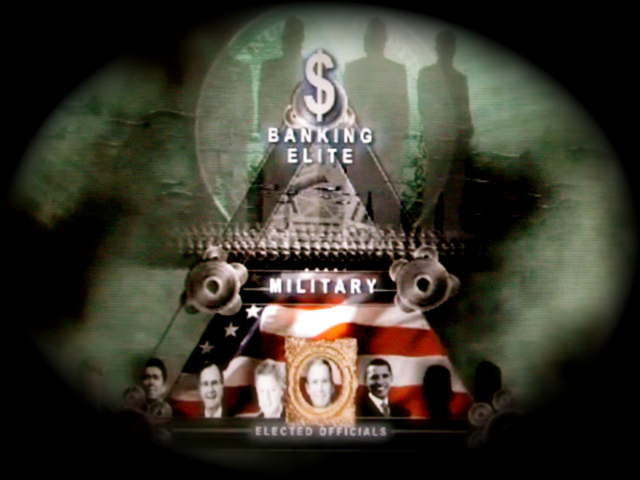
“Bidenomics” Is A Fraud Based On Deliberately Misrepresented Stats

By Brandon Smith

Source: Alt-Market.us

Economic issues are some of the most politically abused issues often because the data politicians exploit is easy to present out of context. The vast majority of the public doesn’t spend their time immersed in the intricacies of monetary policy, unemployment stats and the processes of inflation vs deflation. They hear a soundbite on the news or social media once in a while, assume it must be true and then go on with their day.

This is how economic crisis events always seem to take the population by surprise – The establishment tells people all is well and no one questions the narrative in the face of numerous warning signs. Sometimes, the populace continues to believe that everything is fine despite the financial framework burning down around them, all because the “experts” continue to convince them that recovery is “right around the corner.”

There are numerous incentives for government officials and mainstream economists to mislead the citizenry with tales of imminent prosperity in the midst of instability. Primarily, the goal is to keep the middle-class population as docile as possible so that they don’t revolt until it’s too late (the middle class being predominantly conservative, and the greatest threat to any corrupt regime). Understand that economics is the root of power, and economic perception is the key to influencing the masses.

Hidden Indicators And Rampant Money Printing

The reality is that the US was hurtling towards stagflationary disaster ever since the crash of 2008, when Barack Obama and Joe Biden (with the help of the Federal Reserve) oversaw the near doubling of the national debt from $10 trillion to almost $20 trillion – The most egregious abuse of monetary policy that the US had ever seen.

And, keep in mind this was only the officially reported cash. Because of pressure brought by people like Ron Paul in 2011, the government was forced to pursue a limited audit of the Federal Reserve bailouts at that time. This revealed at least $16 trillion created from nothing by the Fed to prop up the failing system.

In 2006, right before the derivatives collapse, the Federal Reserve conveniently and abruptly ended their M3 money supply report. They now only report the M2 money supply, which does not include the vast assets held in corporate coffers, large time deposits in banks, institutional money market funds, short-term repurchase agreements (repo), and larger liquid assets. It was as if they knew an inflationary event was about to take place and they needed to obscure the evidence.

In other words, in economics there is the “official government data” and then there is the REAL data, which is sometimes so hidden it is impossible to quantify.

Even if we only go by the M2 report, the money supply skyrocketed starting in 2020, and rose exponentially through 2021 and 2022 – It jumped by 40% in only two years. This is why the cost of most necessities has risen 25% or more.

I’m sure most readers have noticed that inflation is not going away despite Joe Biden’s claims that he has “cut inflation in half” under his “Bidenomics” plan. This is because inflation is cumulative. The CPI might fluctuate, but the effects of inflation remain as prices tend to increase and stay high perpetually.

There Is No Such Thing As “Bidenomics”

The supposed financial progress that Biden is trying to take credit for has nothing to do with Biden’s policies. Not a thing. Unless, of course, you count market manipulation as a positive.

For example, the reduction in CPI is directly related to the continuous interest rate hikes of the Federal Reserve, which Biden has zero control over. The Fed is autonomous and makes its decisions independent of the White House or government. This is a fact openly admitted by former chairman Alan Greenspan. When the fed raises rates, debt becomes more expensive, lending slows down and thus the economy slows down.

One of the only ways that Biden can influence CPI is through artificial deflation of energy prices. The Biden Administration has been dumping US strategic oil reserves on the market for the past year as a means to suppress oil prices, thereby directly and indirectly keeping the CPI numbers down. This is not progress, it’s economic fraud.

The misuse of stats extends to other sectors, such as Biden’s attempt to take credit for the recent reduction in the US deficit. Again, this has nothing to do with Biden; the Fed’s interest rate hikes make it more expensive for the government to take on debt, therefore, debt spending drops.

It’s also not a situation that signals a recovery in the economy – The Fed continues to hike rates supposedly to stall inflation, but higher rates in a debt heavy environment lead to inevitable deflationary upheaval. As I predicted a year ago, the Fed is continuing to increase interest rates until this happens.

Employment Miracle Or Employment Scam?

This issue has been brought up by many analysts but I’ll touch on it again here because Biden is relentless in his falsehoods when it comes to employment data. FACT: 72% of all “new jobs” Biden takes credit for were originally lost during the pandemic lockdowns. The very lockdowns which Democrats avidly enforced and tried to keep in place perpetually. You can’t take credit for “creating” jobs that you are responsible for destroying.

In terms of higher labor demand, the pressure is in low wage service sector jobs and these are the majority of jobs added since Biden took office. And, this rush into retail/service was purchased with $8 trillion+ in covid stimulus cash along with a moratorium on rent and student loan payments. That much extra money in circulation buys at least a few years of consumer spending, propping up jobs numbers.

Throughout history, such gains from inflationary actions and government interventions are always short term, and they always end with a dramatic plunge in employment once the effects subside.

Biden’s Fake Manufacturing Boom

Biden has recently touted a jump in US manufacturing as the latest achievement of Bidenomics, but like every other claim he makes, you have to look at the context. These are not free market manufacturing facilities built according to market demand. Rather, Biden is pumping billions of taxpayer dollars into green tech, once again artificially engineering a “manufacturing boom” through government subsidies for products that have limited demand.

Biden wants to rig the demand, too, by enforcing climate laws which make gas, oil and coal sources too expensive and solar panels and wind turbines cheaper by comparison. For example, Biden is increasing costs for oil and gas exploration on federal lands, while greatly lowering the prices for building solar farms on federal lands. In other words, the government uses your money to create factories for green tech and then creates laws which force people to use that green tech.

In the meantime, Joe’s manufacturing “boom” paid for with tax dollars also comes at the cost of America’s oil, gas and coal industries, not to mention less energy freedom for the general public. It’s socialism, not a revolution in domestic manufacturing.

For Biden, The Key Is To Create As Many Government Cash Injections As Possible Until 2025

You want to know why Democrats are so angry that the Supreme Court blocked Biden’s plan to make taxpayers cover student loan debts? It’s not because they care about naive college kids who paid too much money for garbage degrees – It’s because student debt relief would immediately add trillions more in spending in the short term to the US economy.

An interesting side effect of the college loan moratorium is the surprising credit boost – As soon as college loan payments were put on hold, millions of former students had their credit ratings increase by default. Meaning, they could now hike their credit limits and spend MORE money they don’t have. It’s an incredibly sneaky way to artificially prop up the system WITHOUT using direct stimulus measures that rely on the central bank. This false boost will disappear by October of this year.

Biden’s constant attempts to introduce infrastructure programs are another way the government can create the illusion of recovery by using debt spending as a means to mitigate the signals of greater fiscal decline. Without Fed stimulus it’s the only option Biden has, and as rates rise it becomes costly.

The bottom line is this – The US economy is on a short timetable as long as the Fed continues to raise interest rates into weakness as a means to suppress inflation. As we witnessed in the spring, higher rates are already breaking the back of mid-tier banks across the western world and the Fed’s backstop funds are only enough to stall the debt crisis for a time. I continue to predict that once the Fed Funds Rate is raised to 6% or more, we will once again see a banking calamity similar to the 2008 crash, but this time if the Fed steps in with a bailout hyperinflation will be the immediate result.

Bidenomics is a sham in every respect. Anything that could be considered an economic improvement is due to the Federal Reserve playing the odds with interest rates. A massive 40% increase in the money supply sure helps in obscuring fiscal weakness as well. Luckily, nearly 60% of Americans in recent polls say they aren’t buying the Bidenomics fairytale – They see the dangers around them every day.

The covid event was a catalyst that revealed all the weaknesses of the US system that many of us in alternative economics have been warning about for years. And now it seems as if the establishment is trying to drag things along for just a little while longer. The reason why is up for speculation, but the fact remains that a broken structure cannot be propped up with stop gaps. I’m doubtful that Biden will be able to ride the wave created by covid stimulus until the end of 2024. Something has to give.

America’s Constitutional Government Is Gone

By Eric Zuesse

Source: The Duran

The few people who benefit from the U.S. Government’s being the world’s most powerful are U.S.-and-allied billionaires, who profit from the enormous sales of U.S.-made war-weapons and from the international extraction corporations such as Exxon-Mobil which rely upon its military, but all of this comes at the expense of the publics in every country including that of America itself. Any empire serves only its aristocracy, at the expense of the public. In modern times, the publics need to be deceived by the media and by the billionaires’ other agencies, so as to become deceived to vote for the billionaires’ candidates. This requires massive censorship, notwithstanding that America’s Constitution bans such censorship.

Freedom of the press, and freedom of expression, are ‘guaranteed’ in the U.S. Constitution, but if the controlling owners of the press are a small group of people who benefit from the fact that the wealthiest 1% of the wealthiest 1% of Americans — the wealthiest ten-thousandth of Americans — donate 57.16% of all the money that funds U.S. political campaigns, and that the “Top 400 Donors” (all of whom are multi-billionaires, not merely billionaires) donate 29.86%, or virtually 30%, of all political money, in the U.S., then how likely will the ‘news’-media be to accept for publication or to broadcast news reports that threaten this status-quo from which all of them have made and keep their enormous wealth? Not only do those billionaires own or control virtually all of the ‘news’-media, but the other corporations that they also own or control advertise in them; and, so, they select to hire editors and producers who will reject job-applicants who would report the types of things that those controllers want the public not to know — things such as these. The most-important realities are thus effectively censored-out.

For an example of the most-important realities, here is an entirely truthful 10-minute-long entirely independently produced compendium video that shows the key evidences that the overthrow of Ukraine’s Government in February 2014 was definitely not the democratic revolution that all of the U.S.-and-allied press pretend it was, but was instead a U.S. coup. And here is the complete showing of the smoking-gun piece of evidence in it, so that one can now see this crucial item of evidence within its broader context, and understand how it fits into that context, to produce crucial history instead of the ‘news’-media-promulgated myth that strings together lie-upon-lie. It’s documentation of how the war inside Ukraine (and to which U.S. taxpayers donated over a hundred billion dollars last year) actually started — via this U.S. coup. And here is an even broader contextual documentation of how that U.S. coup started this war, which U.S.-and-allied Governments and their ‘news’-media blame against Russia — as-if it were the case that Russia had expanded up to NATO’s border, instead of NATO’s having expanded up to Russia’s border.

Is that evidence consistent with what has been widely reported by the ‘news’-media about the overthrow of Ukraine’s Government in February 2014 and about how the war in Ukraine started (supposedly on 24 February 2022)? Did America’s Government start this war, or did Russia’s Government start it? And how important is the answer to that question, to the public’s ability to make fact-based choices when elections are held to determine whom will be occuping seats in Congress, and in the White House? As the brilliant geostrategist who anonymously writes the “Moon of Alabama” blog headlined on July 25th, “Who Can Give Security Guarantees To Ukraine?”, and he concluded there that the U.S. Government and its stooges in its NATO military alliance against Russia now clearly have no intention of providing any such, but that Russia can — and that the longer that America’s war against Russia in the battlefields of Ukraine and killing Ukraine’s soldiers continues, the more onerous to the people of Ukraine will be the peace-terms that Russia will be able to offer to Ukraine for there to be any peace at all in Ukraine. It’s America’s war, but Russia will settle it.

Here is an interview of a very successful Asian journalist for major news-media, who had been participating in the so-called ‘democracy’ demonstrations in Hong Kong until he discovered that they had been initiated behind-the-scenes by the U.S. Government, and then he wrote a book about that, and he describes in this interview how the news-reporting that he and the rest of the press were doing had been fooled by the U.S. Government’s very elaborate and highly bribe-based operation against (i.e., to weaken) China’s Government.

The broader picture of that deeply corrupt management of ‘the news’ by America’s very wealthiest, is documented in detail here. It all started when U.S. President FDR died and his successor, Harry Truman (influenced by the advice from Winston Churchill and especially General Dwight Eisenhower), decided on 25 July 1945 for the U.S. Government to ultimately take control over all nations. This hegemonic or global-imperialist U.S. Government has made the world we live in today. But what percentage of the public know anything about this reality, of the world in which all of us are living? The ignorance and deception of the masses is the basis for these ‘democracies’.

Another key provision of the U.S. Constitution is that ONLY the U.S. Congress can authorize a war and the sending of U.S. forces abroad in order to participate in a war. However, this provision of the U.S. Constitution is likewise now being routinely violated by the U.S. Government. It has to be done because the key beneficiaries of U.S. imperialism are America’s billionaires, who control the U.S. Government. And this is the reason why after WW II, the U.S. Government has invaded and otherwise participated in 297 wars though none of them were ever declared by the U.S. Congress as the U.S. Constitution requires.

Politics is now a puppet-show in these ‘democracies’; and the ‘news’-media are merely a part of that puppet-show.

These realities are ugly, but they are real.

—————

Investigative historian Eric Zuesse’s new book, AMERICA’S EMPIRE OF EVIL: Hitler’s Posthumous Victory, and Why the Social Sciences Need to Change, is about how America took over the world after World War II in order to enslave it to U.S.-and-allied billionaires. Their cartels extract the world’s wealth by control of not only their ‘news’ media but the social ‘sciences’ — duping the public.

The decline of America is becoming an accepted fact

By Veniamin Popov

Source: New Eastern Outlook

On July 5 of this year, the New York Times published an article titled “America Lives on Borrowed Money.”

It states that borrowing is expensive. A rising portion of federal earnings, money that could be utilized to help the American people, is returned to investors who buy government bonds in the form of interest payments. Instead of collecting taxes from the rich, the government pays the rich to borrow their money.

According to the Congressional Budget Office, the government will spend more on interest than on national defense by 2029, and interest payments will account for 3.6 percent of national GDP by 2033.

The authors of the article believe that the situation is becoming more and more alarming and painful, and therefore radical decisions should be made.

However, with the growing division of US political forces, these alternatives are no longer visible, especially since “Joe Biden’s global vision is too timid and pessimistic,” according to the British-based Economist.

The fact that President Biden has been indicted with impeachment by the Republican-led House of Representatives cannot be overlooked: On June 22, the House voted 219 to 208 to send two articles of impeachment to the Homeland Security and Judiciary committees, one for abuse of power and the other for dereliction of duty.

What is interesting is the evaluation of the current scenario made not only by Americans but also by political analysts from emerging countries. For example, the Saudi-based Arab News reported on June 25 this year that the United States’ political system is in disarray and the country is extremely fragmented.

The author puts the current problem in the United States on a par with the fall of the Roman Empire: “You cannot be a world leader if your society is crumbling and your leadership is divided, indecisive, and weak.” Especially when the media, once lauded as a strong weapon of truth, has devolved into a tool of political bias motivated by profit rather than principle, and free speech is dead in America.

According to the author, American influence in South America and Africa is likewise dwindling: America has never been weaker than it is today in its relatively short history.

On June 19, this year, Marwan Bishara, a senior political analyst for Al Jazeera TV, noted that signs that the American-dominated world order was crumbling had become increasingly visible over the previous decade and that America’s political and economic decline had affected its global influence and credibility.

Attempts to resurrect US leadership through the so-called “rules-based international system,” according to the author, have failed. This system was perceived as a rigged arrangement that benefited the West over the rest of the world and violated international law.

Back in the spring, well-known American journalist Ross Douthat determined that the elites of the Middle East, Africa, and Central Asia favor Russia and China, and that public opinion in emerging countries is more sympathetic to Russia and China than to America.

Richard Haas, a respected American political analyst who led a prominent think tank, the Council on Foreign Relations, for more than 20 years, went even further in his analysis: “The collapse of the American political system means that for the first time, the internal threat has surpassed the external threat. Instead of being a reliable anchor in an unstable world, the United States has become the deepest source of instability and an unreliable model of democracy.”

In September 2022, current US President Joe Biden spoke of American democracy being on the verge of collapse, clinging by a thread.

In response to this, Gulf News, one of the UAE’s leading publications, said that America today is a house divided. More and more Americans acknowledge that the country’s current status is abnormal.

The summer of 2020’s street violence and instability revealed the actual mental state of the world’s most powerful nation. The United States has long had one of the highest rates of violent crime in the world, and deteriorating public order has expedited the spread of firearms. The United States ranks first in the number of privately owned guns. Researchers at the Small Arms Survey estimated that Americans own 393 million of the 857 million available civilian guns, about 46% of the world’s civilian gun stockpile. According to the same publication, there are 120 guns per 100 Americans. According to the Pew Research Center, 48% of Americans believe that gun violence is a major issue in the country.

According to polls, only 17% of Americans believe the US criminal justice system treats everyone fairly, according to the USA Today website.

Currently, the issue of migration in America has seriously escalated.

Of course, there will be ups and downs in American domestic politics, but one of the most notable trends in recent years has been the growing polarization of the elite, which could lead to a major split of the country.

A new presidential election will be held in 2024, and many objective observers believe that both parties, Republicans and Democrats, will protest the results. Since 2000, contesting presidential elections has been a tradition.

When Hillary Clinton lost to Trump in 2016, the Democratic Party functionaries became full-time election deniers, emphasizing that the Democratic Party leadership and journalists, its supporters, had done nothing wrong: Vladimir Putin and the Russians were to blame, having hacked the election.

In 2020, Trump claimed that his loss to Biden had been the result of election fraud: the election had been stolen. Within weeks, the Republican Party’s mantra became “stop the stealing.”

A recent study found that more than half of Americans now expect another civil war “within the next couple of years,” with numerous forecasts for the end of America.

One of them says that if Trump, or any other Republican, occupies the White House, Californians are taking serious steps toward withdrawing from the United States.

Another scenario that is being seriously studied assumes that red, or Republican states will launch an independence movement if the Democratic Party wins, including Biden’s second term.

Many analysts are debating the prospect of a significant civil conflict in the United States. Meanwhile, some political analysts have noticed a discernible strengthening of the so-called neoconservative positions among the American ruling elite, who are adamant that Washington should be in charge of the entire world and harshly punish those who disagree with them. Their stance on the Ukraine issue has the potential to push the world to the verge of a nuclear war. This group’s careless acts have already generated a sizable number of issues and fresh crises.

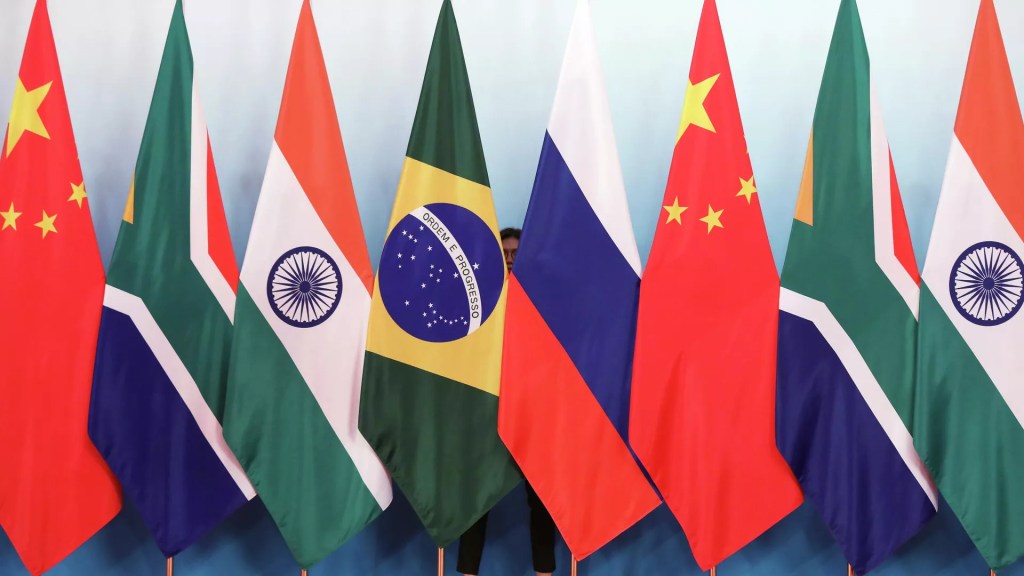
In order to find a way out of the current impasse in international affairs, more and more developing countries are turning to Russia and China. They place their expectations in this respect, above all, on the approaching BRICS conference, where the enlargement of this association may be announced.

Geopolitical Chessboard Shifts Against US Empire

By Pepe Escobar

Source: The Unz Review

The geopolitical chessboard is in perpetual shift – and never more than in our current incandescent juncture.

A fascinating consensus in discussions among Chinese scholars – including those part of the Asian and American diasporas – is that not only Germany/EU lost Russia, perhaps irretrievably, but China gained Russia, with an economy highly complementary to China’s own and with solid ties with the Global South/Global Majority that can benefit and aid Beijing.

Meanwhile, a smatter of Atlanticist foreign policy analysts are now busy trying to change the narrative on NATO vs. Russia, applying the rudiments of realpolitik.

The new spin is that it’s “strategic insanity” for Washington to expect to defeat Moscow, and that NATO is experiencing “donor fatigue” as the sweatshirt warmonger in Kiev “loses credibility”.

Translation: it’s NATO as a whole that is completely losing credibility, as its humiliation in the Ukraine battlefield is now painfully graphic for all the Global Majority to see.

Additionally, “donor fatigue” means losing a major war, badly. As military analyst Andrei Martyanov has relentlessly stressed, “NATO ‘planning’ is a joke. And they are envious, painfully envious and jealous.”

A credible path ahead is that Moscow will not negotiate with NATO – a mere Pentagon add-on – but offer individual European nations a security pact with Russia that would make their need to belong to NATO redundant. That would assure security for any participating nation and relieve pressure on it from Washington.

Bets could be made that the most relevant European powers might accept it, but certainly not Poland – the hyena of Europe – and the Baltic chihuahuas.

In parallel, China could offer peace treaties to Japan, South Korea and the Philippines, and subsequently a significant part of the US Empire of Bases might vanish.

The problem, once again, is that vassal states don’t have the authority or power to comply with any agreement ensuring peace. German businessmen, off the record, are sure that sooner or later Berlin may defy Washington and do business with the Russia-China strategic partnership because it benefits Germany.

Yet the golden rule still has not been met: if a vassal state wants to be treated as a sovereign state, the first thing to do is to shut down key branches of the Empire of Bases and expel US troops.

Iraq is trying to do it for years now, with no success. One third of Syria remains US-occupied – even as the US lost its proxy war against Damascus due to Russian intervention.

The Ukraine Project as an existential conflict

Russia has been forced to fight against a neighbor and kin that it simply can’t afford to lose; and as a nuclear and hypersonic power, it won’t.

Even if Moscow will be somewhat strategically weakened, whatever the outcome, it’s the US – in the view of Chinese scholars – that may have committed its greatest strategic blunder since the establishment of the Empire: turning the Ukraine Project into an existential conflict, and committing the entire Empire and all its vassals to a Total War against Russia.

That’s why we have no peace negotiations, and the refusal even of a cease fire; the only possible outcome devised by the Straussian neocon psychos who run US foreign policy is unconditional Russian surrender.

In the recent past, Washington could afford to lose its wars of choice against Vietnam and Afghanistan. But it simply can’t afford to lose the war on Russia. When that happens, and it’s already on the horizon, the Revolt of the Vassals will be far reaching.

It’s quite clear that from now on China and BRICS+ – with expansion starting at the summit in South Africa next month – will turbo-charge the undermining of the US dollar. With or without India.

There will be no imminent BRICS currency – as noted by some excellent points in this discussion. The scope is huge, sherpas are only in the initial debating stages, and the broad outlines have not been defined yet.

The BRICS+ approach will evolve from improved cross border settlement mechanisms – something everyone from Putin to Central Bank head Elvira Nabiullina have stressed – to eventually a new currency way further down the road.

This would probably be a trade instrument rather than a sovereign currency like the euro. It will be designed to compete against the US dollar in trade, initially among BRICS+ nations, and capable of circumventing the hegemonic US dollar ecosystem.

The key question is how long the Empire’s fake economy – clinically deconstructed by Michael Hudson – can hold out in this wide spectrum geoeconomic war.

Everything is a ‘national security threat’

On the electronic technology front, the Empire has gone no holds barred to impose global economic dependency, monopolizing intellectual property rights and as Michael Hudson notes, “extracting economic rent from charging high prices for high-technology computer chips, communications, and arms production.”

In practice, not much is happening other than the prohibition for Taiwan to supply valuable chips to China, and asking TSMC to build, as soon as possible, a chip manufacturing complex in Arizona.

However, TSMC chairman Mark Liu has remarked that the plant faced a shortage of workers with the “specialized expertise required for equipment installation in a semiconductor-grade facility.” So the much lauded TSMC chip plant in Arizona won’t start production before 2025.

The top Empire/vassal NATO demand is that Germany and the EU must impose a Trade Iron Curtain against the Russia-China strategic partnership and their allies, thus ensuring “de-risk” trade.

Predictably, US Think Tankland has gone bonkers, with American Enterprise Institute hacks rabidly stating that even economic de-risking is not enough: what the US needs is a hard break with China.

In fact that dovetails with Washington smashing international free trade rules and international law, and treating any form of trade and SWIFT and financial exchanges as “national security threats” to US economic and military control.

So the pattern ahead is not China imposing trade sanctions on the EU – which remains a top trade partner for Beijing; it’s Washington imposing a tsunami of sanctions on nations daring to break the US-led trade boycott.

Russia-DPRK meets Russia-Africa

Only this week, the chessboard went through two game-changing moves: the high-profile visit by Russian Defense Minister Sergei Shoigu to the DPRK, and the Russia-Africa summit in St. Petersburg.

Shoigu was received in Pyongyang as a rock star. He had a personal meeting with Kim Jong-Un. The mutual goodwill leads to the strong possibility of North Korea eventually joining one of the multilateral organizations carving the path towards multipolarity.

That would be, arguably, an extended Eurasian Economic Union (EAEU). It could start with an EAEU-DPRK free trade agreement, such as the ones struck with Vietnam and Cuba.

Russia is the top power in the EAEU and it can ignore sanctions on the DPRK, while BRICS+, SCO or ASEAN have too many second thoughts. A key priority for Moscow is the development of the Far East, more integration with both Koreas, and the Northern Sea Route, or Arctic Silk Road. The DPRK is then a natural partner.

Getting the DPRK into the EAEU will do wonders for BRI investment: a sort of cover which Beijing does not enjoy for the moment when it invests in the DPRK. That could become a classic case of deeper BRI-EAEU integration.

Russian diplomacy at the highest levels is going all out to relieve the pressure over the DPRK. Strategically, that’s a real game-changer; imagine the huge and quite sophisticated North Korean industrial-military complex added to the Russia-China strategic partnership and turning the whole Asia-Pacific paradigm upside down.

The Russia-Africa summit in St. Petersburg, in itself, was another game-changer that left collective West mainstream media apoplectic. That was nothing less than Russia publicly announcing, in words and deeds, a comprehensive strategic partnership with the whole of Africa even as a hostile collective West wages Hybrid War – and otherwise – against Afro-Eurasia.

Putin showed how Russia holds a 20% share of the global wheat market. In the first 6 months of 2023, it had already exported 10 million tons of grain to Africa. Now Russia will be providing Zimbabwe, Burkina Faso, Somalia and Eritrea with 25-50 thousand tons of grain each in the next 3-4 months, for free.

Putin detailed everything from approximately 30 energy projects across Africa to the expansion of oil and gas exports and “unique non-energy applications of nuclear technology, including in medicine”; the launching of a Russian industrial zone near the Suez Canal with products to be exported throughout Africa; and the development of Africa’s financial infrastructure, including connection to the Russian payment system.

Crucially, he also extolled closer ties between the EAEU and Africa. A forum panel, “EAEU-Africa: Horizons of Cooperation”, examined the possibilities, which include closer continental connection with both the BRICS and Asia. A torrent of free trade agreements may be in the pipeline.

The scope of the forum was quite impressive. There were “de-neocolonialization” panels, such as “Achieving Technological Sovereignty Through Industrial Cooperation” or “New World Order: from the Legacy of Colonialism to Sovereignty and Development.”

And of course the International North South Transportation Corridor (INSTC) was also discussed, with major players Russia, Iran and India set to promote its crucial extension to Africa, escaping NATO littorals.

Separate from the frantic action in St. Petersburg, Niger went through a military coup. Although the end-result remains to be seen, Niger is likely to join neighboring Mali in reasserting its foreign policy independence from Paris. French influence is also being at least “reset” in the Central African Republic (CAR) and Burkina Faso. Translation: France and the West are being evicted all across the Sahel, one-step at a time, in an irreversible process of decolonization.

Beware the Pale Horses of Destruction

These movements across the chessboard, from the DPRK to Africa and the chip war against China, are as crucial as the coming, shattering humiliation of NATO in Ukraine. Yet not only the Russia-China strategic partnership but also key players across the Global South/Global Majority are fully aware that Washington views Russia as a tactical enemy in preparation for the overriding Total War against China.

As it stands, the still unresolved tragedy in Donbass as it keeps the Empire busy, and away from Asia-Pacific. Yet Washington under the Straussian neocon psychos is increasingly mired in Desperation Row, making it even more dangerous.

All that while the BRICS+ “jungle” turbo-charges the necessary mechanisms capable of sidelining the unipolar Western “garden”, as a helpless Europe is being driven to an abyss, forced to split itself from China, BRICS+ and the de facto Global Majority.

It doesn’t take a seasoned weatherman to see which way the steppe wind blows – as the Pale Horses of Destruction plot the trampling of the chessboard, and the wind begins to howl.

If You Ever Start Trusting U.S. Businessmen, Remember Henry Ford

By Mickey Z.

Source: Dissident Voice

Henry Ford, the autocratic magnate who despised unions, tyrannized workers, and fired any employee caught driving a competitor’s model, was also an outspoken anti-Semite.

In 1918, he bought and ran a newspaper, The Dearborn Independent, that became an anti-Jewish forum. The May 22, 1920 headline blared, “The International Jew: The World’s Problem,” and thus began a series of ninety-two articles, including “The Jewish Associates of Benedict Arnold” and “The Gentle Art of Changing Jewish Names.”

By 1923, the Independent’s national circulation reached 500,000. Reprints of the articles were soon published in a four-volume set called The International Jew, which was translated into sixteen different languages.

The New York Times reported in 1922 that there was a widespread rumor circulating in Berlin claiming that Henry Ford was financing Adolf Hitler’s nationalist and anti-Semitic movement in Munich,” write James and Suzanne Pool in their book Who Financed Hitler. They add:

“Novelist Upton Sinclair wrote in The Flivver King, a book about Ford, that the Nazis got forty-thousand dollars from Ford to reprint anti-Jewish pamphlets in German translations, and that an additional $300,000 was later sent to Hitler through an intermediary.”

Ford’s plants in Germany adopted an Aryan-only hiring policy in 1935 before Nazi law required it. A year later, Ford fired Erich Diestel, manager of the automobile company’s German plants, simply because he had a Jewish ancestor.

An appreciative Adolf Hitler kept a large picture of the automobile pioneer beside his desk, explaining, “We look to Heinrich Ford as the leader of the growing Fascist movement in America.”

Hitler hoped to support such a movement by offering to import some shock troops to the U.S. to help Ford run for president.

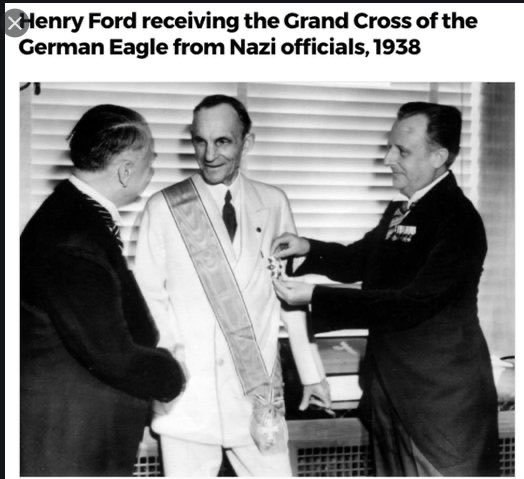
In 1938, on Henry Ford’s 75th birthday, he was awarded the Grand Cross of the Supreme Order of the German Eagle from the Führer himself.

He was the first American (General Motors’ James Mooney would be second) and only the fourth person in the world to receive the highest decoration that could be given to any non-German citizen. An earlier honoree was none other than a kindred spirit named Benito Mussolini.

When appraising history and today’s Titans of Capitalism™, keep your guard up…

A Bonfire of the Vanities

By Alastair Crooke

Source: Strategic Culture Foundation

Hubris consists in believing that a contrived narrative can, in and of itself, bring victory. It is a fantasy that has swept through the West – most emphatically since the 17th century. Recently, the Daily Telegraph published a ridiculous nine minute video purporting to show that ‘narratives win wars’, and that set-backs in the battlespace are incidentals: What matters is to have a thread of unitary narrative articulated, both vertically and horizontally, throughout the spectrum – from the special forces’ soldier in the field through to the pinnacle of the political apex.

The gist of it is that ‘we’ (the West) have compelling a narrative, whilst Russia’s is ‘clunky’ – ‘Us winning therefore, is inevitable’.

It is easy to scoff, but nonetheless we can recognise in it a certain substance (even if that substance is an invention). Narrative is now how western élites imagine the world. Whether it is the pandemic emergency, the climate or Ukraine ‘emergencies’ – all are re-defined as ‘wars’. All are ‘wars’ that are to be fought with a unitary imposed narrative of ‘winning’, against which all contrarian opinion is forbidden.

The obvious flaw to this hubris is that it requires you to be at war with reality. At first, the public are confused, but as the lies proliferate, and lie is layered upon lie, the narrative separates further and further from touched reality, even as mists of dishonesty continue to swathe themselves loosely around it. Public scepticism sets in. Narratives about the ‘why’ of inflation; whether the economy be healthy or not; or why we must go to war with Russia, begin to fray.

Western élites have ‘bet their shirts’ on maximum control of ‘media platforms’, absolute messaging conformity and ruthless repression of protest as their blueprint for a continued hold in power.

Yet, against the odds, the MSM is losing its hold over the U.S. audience. Polls show growing distrust of the U.S. MSM. When Tucker Carlson’s first ‘anti-message’ Twitter show appeared, the noise of tectonic plates grinding against each other was unmissable, as more than 100 million (one in three) Americans listened to iconoclasm.

The weakness to this new ‘liberal’ authoritarianism is that its key narrative myths can get busted. One just has; slowly, people begin to speak reality.

Ukraine: How do you win an unwinnable war? Well, the élite answer has been through narrative. By insisting against reality that Ukraine is winning, and Russia is ‘cracking’. But such hubris eventually is busted by facts on the ground. Even the western ruling classes can see their demand for a successful Ukrainian offensive has flopped. At the end, military facts are more powerful than political waffle: One side is destroyed, its many dead become the tragic ‘agency’ to upending dogma.

“We will be in a position to extend an invitation to Ukraine to join the Alliance when Allies agree and conditions are met … [however] unless Ukraine wins this war, there’s no membership issue to be discussed at all” – Jens Stoltenberg’s statement at Vilnius. Thus, after urging Kiev to throw more (hundreds of thousands) of its men into the jaws of death to justify NATO membership, the latter turns its back on its protégé. It was, after all, an unwinnable war from the beginning.

The hubris, at one level, lay in NATO’s pitting of its alleged ‘superior’ military doctrine and weapons versus that of a deprecated, Soviet-style, hide-bound, Russian military rigidity – and ‘incompetence’.

But military facts on the ground have exposed the western doctrine as hubris – with Ukrainian forces decimated, and its NATO weaponry lying in smoking ruins. It was NATO that insisted on re-enacting the Battle of 73 Easting (from the Iraqi desert, but now translated into Ukraine).

In Iraq, the ‘armoured fist’ punched easily into Iraqi tank formations: It was indeed a thrusting ‘fist’ that knocked the Iraqi opposition ‘for six’. But, as the U.S. commander at that tank battle (Colonel Macgregor), frankly admits, its outcome against a de-motivated opposition largely was fortuitous.

Nonetheless ‘73 Easting’ is a NATO myth, turned into the general doctrine for the Ukrainian forces – a doctrine structured around Iraq’s unique circumstance.

The hubris – in line with the Daily Telegraph video – however, ascends vertically to impose the unitary narrative of a coming western ‘win’ onto the Russian political sphere too. It is an old, old story that Russia is military weak, politically fragile, and prone to fissure. Conor Gallagher has shown with ample quotes that it was exactly the same story in World War 2, reflecting a similar western underestimation of Russia – combined with a gross overestimation of their own capabilities.

The fundamental problem with ‘delusion’ is that the exit from it (if it occurs at all) moves at a much slower pace than events. The mismatch can define future outcomes.

It may be in the Team Biden interest now to oversee an orderly NATO withdrawal from Ukraine – such that it avoids becoming another Kabul debacle.

For that to happen, Team Biden needs Russia to accept a ceasefire. And here lies the (the largely overlooked) flaw to that strategy: It simply is not in the Russian interest to ‘freeze’ the situation. Again, the assumption that Putin would ‘jump’ at the western offer of a ceasefire is hubristic thinking: The two adversaries are not frozen in the basic meaning of the term – as in a conflict in which neither side has been able to prevail over the other, and are stuck.

Put simply, whereas Ukraine structurally hovers at the brink of implosion, Russia, by contrast, is fully plenipotent: It has large, fresh forces; it dominates the airspace; and has near domination of the electromagnetic airspace. But the more fundamental objection to a ceasefire is that Moscow wants the present Kiev collective gone, and NATO’s weapons off the battle field.

So, here is the rub: Biden has an election, and so it would suit the Democratic campaign needs to have an ‘orderly wind-down’. The Ukraine war has exposed too many wider American logistic deficiencies. But Russia has its’ interests, too.

Europe is the party most trapped by ‘delusion’ – starting from the point at which they threw themselves unreservedly into the Biden ‘camp’. The Ukraine narrative broke at Vilnius. But the amour propre of certain EU leaders puts them at war with reality. They want to continue to feed Ukraine into the grinder – to persist in the fantasy of ‘total win’: “There is no other way than a total win – and to get rid of Putin … We have to take all risks for that. No compromise is possible, no compromise”.

The EU Political Class have made so many disastrous decisions in deference to U.S. strategy – decisions that go directly against Europeans’ own economic and security interests – that they are very afraid.

If the reaction of some of these leaders seems disproportionate and unrealistic (“There is no other way than a total win – and to get rid of Putin”) – it is because this ‘war’ touches on a deeper motivations. It reflects existential fears of an unravelling of the western meta-narrative that will take down both its hegemony, and the western financial structure with it.

The western meta-narrative “from Plato to NATO, is one of superior ideas and practices whose origins lie in ancient Greece, and have since been refined, extended, and transmitted down the ages (through the Renaissance, the scientific revolution and other supposedly uniquely western developments), so that we in the west today are the lucky inheritors of a superior cultural DNA”.

This is what the narrators of the Daily Telegraph video probably had at the back of their minds when they insist that ‘Our narrative wins wars’. Their hubris resides in the implicit presumption: that the West somehow always wins – is destined to prevail – because it is the recipient of this privileged genealogy.

Of course, outside of general understanding, it is accepted that notions of ‘a coherent West’ has been invented, repurposed and put to use in different times and places. In her new book, The West, classical archaeologist Naoíse Mac Sweeney takes issue with the ‘master myth’ by pointing out that it was only “with the expansion of European overseas imperialism over the seventeenth century, that a more coherent idea of the West began to emerge – one being deployed as a conceptual tool to draw the distinction between the type of people who could legitimately be colonised, and those who could legitimately be colonizers”.

With the invention of the West came the invention of Western history – an elevated and exclusive lineage that provided an historical justification for the Western domination. According to the English jurist and philosopher Francis Bacon, there were only three periods of learning and civilization in human history: “one among the Greeks, the second among the Romans, and the last among us, that is to say, the nations of Western Europe”.

The deeper fear of western political leaders therefore – complicit in the knowledge that the ‘Narrative’ is a fiction that we tell ourselves, despite knowing that it is factually false – is that our era has been made increasingly and dangerously contingent on this meta-myth.

They quake, not just at a ‘Russia empowered’, but rather at the prospect the new multi-polar order led by Putin and Xi that is sweeping the globe will tear down the myth of Western Civilisation.

ARE CENTRAL BANK DIGITAL CURRENCIES (CBDC) DESTINED TO FAIL?

By Timothy Alexander Guzman

Source: Silent Crow News

Since Bitcoin (BTC) was introduced to the world as an alternative to the current central bank system with a dying US dollar that is backed by nothing as its reserve currency, but now there is a plan by several governments to move ahead with implementing their own central bank digital currencies (CBDCs), which is a digital form of currency that is still backed by, you guessed it, nothing.  The Nigerian government had made the decision to be the financial guinea pig for the globalist CBDC scheme, and so far, it has failed and that’s the good news.  The bad news is that certain governments are still moving forward with the idea of using government-issued digital currencies.  In the case of Nigeria, its citizens rejected their government’s plan to issue CBDCs by restricting cash in efforts to create a cashless society and so far, it seems that it has failed in epic fashion according to an opinion piece by author Nicholas Anthony that was published by coindesk.com ‘Nigerians’ Rejection of Their CBDC Is a Cautionary Tale for Other Countries’ is a warning to governments who are willing to take the same step: 

In Nigeria, citizens have taken to the streets to protest the nation’s cash shortage, further objecting to their government’s implementation of a central bank digital currency (CBDC). The shortage came about due to cash restrictions aimed at pushing the country into a 100% cashless economy. Yet, instead of adopting the CBDC, Nigerian protesters are demanding paper money be restored.

The country’s experience strongly suggests the average citizen understands that CBDCs present a substantial risk to financial freedom while providing no unique benefit

Not only did the Nigerian people reject CBDCs, but they also demanded a return to paper currencies because they quickly found out that financial freedoms would be severely limited. 

The concerns ranged from risking financial privacy to the possibility of financial oppression by government institutions.  Anthony mentioned how “the Nigerian government has unleashed a flurry of tricks to spur adoption, but none has proven effective.”  He even gave credit to the Nigerian government in terms of using modest approaches to influence its citizens to use CBDCs and it still failed:

To its credit, the Nigerian government initially tried to encourage use through modest measures. In August 2022, it removed access restrictions so that bank accounts were no longer required to use the CBDC. Then, in October, it offered discounts if people used the CBDC to pay for cabs.  Yet, neither effort proved to be fruitful. Put simply, Nigerians prefer cash

However, the Nigerian government continued its assault on cash:

Unfortunately, the Nigerian government doubled down and moved to more drastic measures by restricting cash itself. In December the Central Bank of Nigeria began restricting cash withdrawals to 100,000 naira (US$225) per week for individuals and 500,000 naira ($1,123) for businesses.

To make matters worse, the Nigerian government also chose to redesign the currency during this time in a “move aimed at restoring the control of the Central Bank of Nigeria (CBN) over currency in circulation” and to “further deepen the push to [a] cashless economy,” according to a CBN press release

The Nigerians had a hard time adapting to the government’s restrictions on their hard earned cash, so they posted their concerns on Twitter, Tik Tok and other social media platforms to let the world know what went wrong.  Soon after, major protests erupted on the streets because of the cash shortages imposed by the Central Bank of Nigeria: 

The government decided to redesign the currency to restore control over the Central Bank of Nigeria as its governor, Godwin Emefiele claimed that “the destination, as far as I am concerned, is to achieve a 100% cashless economy in Nigeria.”  To add insult to injury, “the company that designed the Nigerian CBDC called the cash restrictions a creative use of marketing and said other countries could be expected to take similar steps.”  A top manager from a financial institutional ratings firm called Agusto and Co., Ayokunle Olumbunmi said that the central bank “doesn’t want us to be spending cash. They want us to be doing transactions electronically, but you can’t legislate a change in behavior.”  Anthony concluded that the idea of CBDCs will not go very far, “CBDCs may be popular among central bankers, but money is ultimately a tool for the people. So long as the risks outweigh the benefits, it’s unlikely any CBDC will gain traction in Africa or elsewhere.”

Nicholas Anthony was correct to point out that CBDCs will not become mainstream as several countries have already demonstrated their unwillingness to move forward with the new form of digitized currencies. 

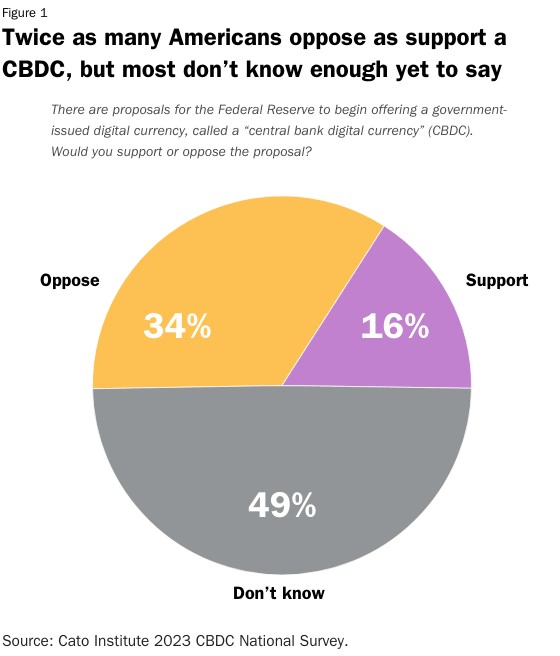
The average human being on earth understands that CBDCs is a bad idea, even in the United States where two-thirds of the population believes almost anything that their government tells them to believe are skeptical of CBDCs according to the Cato Institute, a think tank who also published an article by Nicholas Anthony on the findings of a survey that was conducted by the US federal Reserve Bank on how people view CBDCs.  Here is what they found, “Specifically, more than 66 percent of the 2,052 commenters were concerned or outright opposed to the idea of a CBDC in the United States (Figure 1).”

Bitcoin.com published an article on the GOP’s 2024 presidential candidate, Florida’s governor, Ron DeSantis who is opposed to CBDCs, ‘Ron DeSantis Vows to Prohibit CBDC, ‘Woke Politics,’ and ‘Financial Surveillance’ in Florida,’ he said “I think what the danger of the digital currency is that, one, they want to make that the sole currency, they want to get rid of crypto,” DeSantis continued, “They don’t like crypto because they can’t control crypto. So, they want to put everything in a central bank digital currency.”  There were other politicians who also have similar views on CBDCs:

DeSantis shares the view of several Republican officials who have criticized the idea of a central bank digital currency (CBDC). Minnesota congressman Tom Emmer introduced the Central Bank Digital Currency (CBDC) Anti-Surveillance State Act, while Texas senator Ted Cruz has created legislation against the government developing a CBDC. Georgia representative Marjorie Taylor Greene has also spoken out against CBDCs, and 2024 Democratic presidential candidate Robert Kennedy Jr. has warned that a central bank digital currency could lead to financial slavery

Cash is King! How the CBDC Failed in Japan and Ecuador

Cointelegraph.com, an independent digital news platform that focuses on crypto assets, blockchain technology and emerging fintech trends published an article last year written by Helen Partz based on which countries have rejected CBDCs for one reason or another titled ‘Some central banks have dropped out of the digital currency race’ mentions Japan, who is a major player in the global economy, ultimately rejected developing a CBDC scheme.  The Bank of Japan (BOJ) started testing their digital currency proof-of-concept in 2021 and had planned to finish the first phase by 2022 but in January “former BOJ official Hiromi Yamaoka advised against using the digital yen as part of the country’s monetary policy, citing risks to financial stability.” 

The BOJ issued a report in July 2022 and stated that it had no plan to establish a CBDC system since there is a “strong preference for cash and high ratio of bank account holding in Japan” and that the regulator suggested for a CBDC to be used as a “public good” and it “must complement and coexist” with “private payment services in order for Japan to achieve secure and efficient payment and settlement systems.”  However, it also said that “the fact that CBDC is being seriously considered as a realistic future option in many countries must be taken seriously,” in other words, the CBDC scheme in Japan will not move forward although several countries are still in the early stages of developing a plan for the use of CBDCs, but for Japan, cash is still and will be king well into the foreseeable future.

Ecuador is another example as its central bank, Banco Central del Ecuador (BCE) who launched its own electronic currency known as dinero electrónico (DE) in 2014 to increase some sort of financial inclusion for the public as well as to control the flow of fiat currencies.  According to Partz “As of February 2015, Ecuador managed to adopt DE as a functional means of payment, allowing qualified users to transfer money via a mobile app. The application specifically allowed citizens to open an account using a national identity number and then deposit or withdraw money via designated transaction centers.”  But industry observers were not so sure that the DE can take the form of a CBDC since Ecuador’s currency is the US dollar, and since Ecuador does not currently have its own sovereign currency, many were not so sure that they can call the DE, a form of CBDC.  “The Ecuadorian government cited the support of its dollar-based monetary system as one of the goals behind its DE platform after it started to accept U.S. dollars as legal tender in September 2000.”  It seems that Ecuador remains skeptical on any possibility that issuing CBDCs will be a success:

According to online reports, Ecuador’s DE operated from 2014 to 2018, amassing a total of 500,000 users at its peak out of a population of roughly 17 million people. The project ​​was eventually deactivated in March 2018, with the BCE reportedly citing legislation abolishing the central bank’s electronic money system. Passed in December 2021, the law stated that e-payment systems should be outsourced to private banks.

Years after dropping its central bank digital money initiative, Ecuador has apparently remained skeptical about the whole CBDC phenomenon. In August 2022, Andrés Arauz, the former general director at Ecuador’s central bank, warned eurozone policymakers that a digital euro could potentially disrupt not only privacy but also democracy

Bottom line, the CBDC will not be a standard for financial transactions for the few countries who already tried launching their versions of digital currencies. 

However, in the US, the Federal Reserve’s ‘FedNow’ was supposed to be launched sometime in July 2023.  Here is the Federal Reserve’s Press Release:

The Federal Reserve announced that the FedNow Service will start operating in July and provided details on preparations for launch.  The first week of April, the Federal Reserve will begin the formal certification of participants for launch of the service. Early adopters will complete a customer testing and certification program, informed by feedback from the FedNow Pilot Program, to prepare for sending live transactions through the system.

Certification encompasses a comprehensive testing curriculum with defined expectations for operational readiness and network experience. In June, the Federal Reserve and certified participants will conduct production validation activities to confirm readiness for the July launch.

“We couldn’t be more excited about the forthcoming FedNow launch, which will enable every participating financial institution, the smallest to the largest and from all corners of the country, to offer a modern instant payment solution,” said Ken Montgomery, first vice president of the Federal Reserve Bank of Boston and FedNow program executive. “With the launch drawing near, we urge financial institutions and their industry partners to move full steam ahead with preparations to join the FedNow Service”

For the US population, FedNow is a test that will eventually fail.  People will be skeptical about a central bank digital currency once it proves that it is used to surveil people’s spending habits and control what they spend their money on, and God forbid they are anti-war, anti-vaccine activists, homeschoolers, pro-gun supporters or conspiracy theorists, the bankers can cut them off from using CBDCs and then what happens?  Will there be riots in the streets? 

Since Bitcoin was introduced as an alternative to central bank control, the creation of the CBDC is their answer in hopes of retaining their power, but that idea is not likely to happen, it will in some way, backfire. 

When it comes to Bitcoin, it’s a different story.  In an interesting article written by Jay Speakman of beincrypto.com ‘When You Buy Bitcoin You Gain Freedom’ says that “in a world where economic and political uncertainties abound, owning Bitcoin (BTC) could provide the path toward financial freedom and autonomy. It’s no longer just about investing in a digital asset. It’s about making a revolutionary move to gain control over your finances and future.”  Speakman makes several main points on why people should own Bitcoins and one of those points is that owning sovereign cryptos such as Bitcoins, Ethereum’s and others is a step towards financial freedom:

It provides the opportunity to participate in the global economy without the limitations of traditional banking systems. Bitcoin is not subject to government regulations. At least not yet, and it is free from the inflationary policies which can erode fiat currency values. This means Bitcoin provides an alternative and potentially more secure, store of value

Another reason for owning Bitcoins is for future investment purposes:

Investing in Bitcoin is no longer simply making money. It is about investing in your future and securing your financial freedom. Bitcoin’s decentralized financial system operates independently of central authorities or governments. This means it is resistant to censorship and regulation. Bitcoin holders can make transactions without the need for banks, which are subject to government intervention

“Investment Diversification” is another reason to own Bitcoins since putting all your eggs in one basket, especially in a globalist banking system, is a bit risky:

Investing in Bitcoin can provide portfolio diversification as it is not correlated to traditional assets such as stocks and bonds. This means it may provide a hedge against inflation and market volatility, mitigating the risks associated with traditional investment portfolios

However, owning Bitcoins does have risks like everything else since the “market is notoriously volatile. Prices often fluctuate wildly based on a range of factors, from government regulations to media coverage.”  Speakman also mentions that “BTC transactions can result in a permanent loss of funds. There is also the risk of hacking and theft, as these transactions are irreversible and untraceable.” 

In conclusion, the article lays out what owning Bitcoins could mean for individuals and investors alike especially for those who do not trust the traditional banking system:

The decision to buy BTC is more than just a financial investment. It’s a move towards financial freedom, control, and security. Bitcoin’s feature of allowing individuals to act as their own banks. Providing a secure alternative to traditional banking systems which have exhibited instability and vulnerability to failures.  Furthermore, the appeal goes beyond just financial security and autonomy. The digital currency resonates with libertarians who value individual freedom and limited government intervention. Despite a torrent of dissenting voices Bitcoin continues to gain mainstream adoption. As the technology continues to mature, it may address some of the concerns raised by the dissenting voices.

Investing in digital assets may involve risks such as volatility and the potential for hacking and theft. Yet, the benefits of financial freedom outweigh the downsides. As the world becomes increasingly uncertain, owning Bitcoin could be the first step toward financial security and autonomy

When you look at the difference between CBDCs along with the system imposed by international banking cartels who still maintain some form of financial dominance versus the Bitcoin revolution, there is a difference.  CBDCs means no financial freedoms and owning Bitcoins means the exact opposite.  Even though Bitcoins are still in the early stages, there is hope in the new crypto technology.  But like everything else, you should be cautious, do not invest 100% of your net worth in just one asset, in other words, invest maybe 5% in bitcoins, and the rest? 15% in emergency preparedness (food, water filters, guns, flashlights, etc.)  20% in real estate or invest in a second passport, 20% in hard assets like gold, silver and copper, 20% in high-end watches, antiques, aged wines and liquor, collectibles etc. and the last 20% in foreign stocks especially those that are in politically stabilized environments or in gold and silver mining companies, but that’s just my opinion. 

Government-backed CBDCs will be a failure because the people already do not trust international banking cartels to totally control their finances. So, for these banks to have total control over your financial wellbeing under their CBDC scheme would be an extremely difficult task for them to manage. 

The banking cartel or the financial bureaucrats are about to discover that they will be in over their heads with an angry population.  Just imagine if the banking cartels, certain governments and their corporate conglomerates are in  control over the people’s finances, they will get to determine who eats and who will starve.  This is the ultimate power grab the globalist bankers have been dreaming about for a very long time, but will the people stop this from happening?  I’m an optimist, so I believe that they will demand their financial freedoms and that is something of value that they can hold and control in their own hands.  The case for CBDCs will be a hard sell, so central banks who are proposing this idea should think twice about what they are trying to impose on the public, if not, they will face some form of resistance just like they did in Nigeria.