Henry Ford, the autocratic magnate who despised unions, tyrannized workers, and fired any employee caught driving a competitor’s model, was also an outspoken anti-Semite.
In 1918, he bought and ran a newspaper, The Dearborn Independent, that became an anti-Jewish forum. The May 22, 1920 headline blared, “The International Jew: The World’s Problem,” and thus began a series of ninety-two articles, including “The Jewish Associates of Benedict Arnold” and “The Gentle Art of Changing Jewish Names.”
By 1923, the Independent’s national circulation reached 500,000. Reprints of the articles were soon published in a four-volume set called The International Jew, which was translated into sixteen different languages.
“The New York Times reported in 1922 that there was a widespread rumor circulating in Berlin claiming that Henry Ford was financing Adolf Hitler’s nationalist and anti-Semitic movement in Munich,” write James and Suzanne Pool in their book Who Financed Hitler. They add:
“Novelist Upton Sinclair wrote in The Flivver King, a book about Ford, that the Nazis got forty-thousand dollars from Ford to reprint anti-Jewish pamphlets in German translations, and that an additional $300,000 was later sent to Hitler through an intermediary.”
Ford’s plants in Germany adopted an Aryan-only hiring policy in 1935 before Nazi law required it. A year later, Ford fired Erich Diestel, manager of the automobile company’s German plants, simply because he had a Jewish ancestor.
An appreciative Adolf Hitler kept a large picture of the automobile pioneer beside his desk, explaining, “We look to Heinrich Ford as the leader of the growing Fascist movement in America.”
Hitler hoped to support such a movement by offering to import some shock troops to the U.S. to help Ford run for president.
In 1938, on Henry Ford’s 75th birthday, he was awarded the Grand Cross of the Supreme Order of the German Eagle from the Führer himself.
He was the first American (General Motors’ James Mooney would be second) and only the fourth person in the world to receive the highest decoration that could be given to any non-German citizen. An earlier honoree was none other than a kindred spirit named Benito Mussolini.
When appraising history and today’s Titans of Capitalism™, keep your guard up…
Since Bitcoin (BTC) was introduced to the world as an alternative to the current central bank system with a dying US dollar that is backed by nothing as its reserve currency, but now there is a plan by several governments to move ahead with implementing their own central bank digital currencies (CBDCs), which is a digital form of currency that is still backed by, you guessed it, nothing. The Nigerian government had made the decision to be the financial guinea pig for the globalist CBDC scheme, and so far, it has failed and that’s the good news. The bad news is that certain governments are still moving forward with the idea of using government-issued digital currencies. In the case of Nigeria, its citizens rejected their government’s plan to issue CBDCs by restricting cash in efforts to create a cashless society and so far, it seems that it has failed in epic fashion according to an opinion piece by author Nicholas Anthony that was published by coindesk.com ‘Nigerians’ Rejection of Their CBDC Is a Cautionary Tale for Other Countries’ is a warning to governments who are willing to take the same step:
In Nigeria, citizens have taken to the streets to protest the nation’s cash shortage, further objecting to their government’s implementation of a central bank digital currency (CBDC). The shortage came about due to cash restrictions aimed at pushing the country into a 100% cashless economy. Yet, instead of adopting the CBDC, Nigerian protesters are demanding paper money be restored.
The country’s experience strongly suggests the average citizen understands that CBDCs present a substantial risk to financial freedom while providing no unique benefit
Not only did the Nigerian people reject CBDCs, but they also demanded a return to paper currencies because they quickly found out that financial freedoms would be severely limited.
The concerns ranged from risking financial privacy to the possibility of financial oppression by government institutions. Anthony mentioned how “the Nigerian government has unleashed a flurry of tricks to spur adoption, but none has proven effective.” He even gave credit to the Nigerian government in terms of using modest approaches to influence its citizens to use CBDCs and it still failed:
To its credit, the Nigerian government initially tried to encourage use through modest measures. In August 2022, it removed access restrictions so that bank accounts were no longer required to use the CBDC. Then, in October, it offered discounts if people used the CBDC to pay for cabs. Yet, neither effort proved to be fruitful. Put simply, Nigerians prefer cash
However, the Nigerian government continued its assault on cash:
Unfortunately, the Nigerian government doubled down and moved to more drastic measures by restricting cash itself. In December the Central Bank of Nigeria began restricting cash withdrawals to 100,000 naira (US$225) per week for individuals and 500,000 naira ($1,123) for businesses.
To make matters worse, the Nigerian government also chose to redesign the currency during this time in a “move aimed at restoring the control of the Central Bank of Nigeria (CBN) over currency in circulation” and to “further deepen the push to [a] cashless economy,” according to a CBN press release
The Nigerians had a hard time adapting to the government’s restrictions on their hard earned cash, so they posted their concerns on Twitter, Tik Tok and other social media platforms to let the world know what went wrong. Soon after, major protests erupted on the streets because of the cash shortages imposed by the Central Bank of Nigeria:
NAIRA SCARCITY: Viral video shows the moment Benin protesters attempted to invade CBN office.
Protesters attempted to invade the Central Bank of Nigeria at Ring road in Benin, Edo State on Wednesday. pic.twitter.com/5sQcLfFeDo
The government decided to redesign the currency to restore control over the Central Bank of Nigeria as its governor, Godwin Emefiele claimed that “the destination, as far as I am concerned, is to achieve a 100% cashless economy in Nigeria.” To add insult to injury, “the company that designed the Nigerian CBDC called the cash restrictions a creative use of marketing and said other countries could be expected to take similar steps.” A top manager from a financial institutional ratings firm called Agusto and Co., Ayokunle Olumbunmi said that the central bank “doesn’t want us to be spending cash. They want us to be doing transactions electronically, but you can’t legislate a change in behavior.” Anthony concluded that the idea of CBDCs will not go very far, “CBDCs may be popular among central bankers, but money is ultimately a tool for the people. So long as the risks outweigh the benefits, it’s unlikely any CBDC will gain traction in Africa or elsewhere.”
Nicholas Anthony was correct to point out that CBDCs will not become mainstream as several countries have already demonstrated their unwillingness to move forward with the new form of digitized currencies.
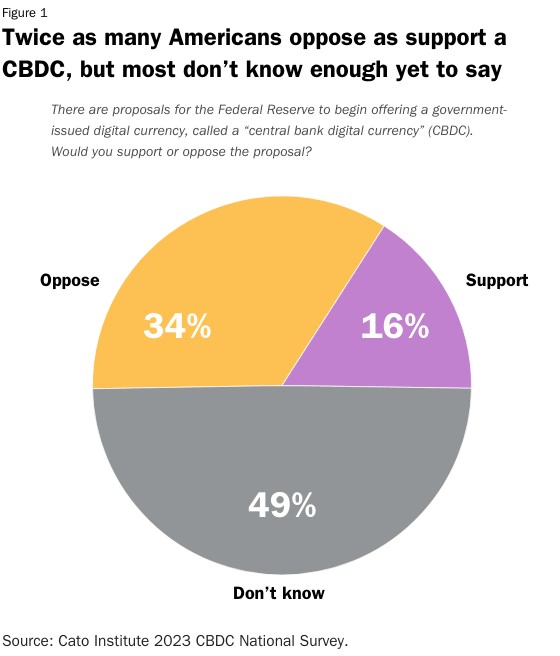
The average human being on earth understands that CBDCs is a bad idea, even in the United States where two-thirds of the population believes almost anything that their government tells them to believe are skeptical of CBDCs according to the Cato Institute, a think tank who also published an article by Nicholas Anthony on the findings of a survey that was conducted by the US federal Reserve Bank on how people view CBDCs. Here is what they found, “Specifically, more than 66 percent of the 2,052 commenters were concerned or outright opposed to the idea of a CBDC in the United States (Figure 1).”
Bitcoin.com published an article on the GOP’s 2024 presidential candidate, Florida’s governor, Ron DeSantis who is opposed to CBDCs,‘Ron DeSantis Vows to Prohibit CBDC, ‘Woke Politics,’ and ‘Financial Surveillance’ in Florida,’ he said “I think what the danger of the digital currency is that, one, they want to make that the sole currency, they want to get rid of crypto,” DeSantis continued, “They don’t like crypto because they can’t control crypto. So, they want to put everything in a central bank digital currency.” There were other politicians who also have similar views on CBDCs:
DeSantis shares the view of several Republican officials who have criticized the idea of a central bank digital currency (CBDC). Minnesota congressman Tom Emmer introduced the Central Bank Digital Currency (CBDC) Anti-Surveillance State Act, while Texas senator Ted Cruz has created legislation against the government developing a CBDC. Georgia representative Marjorie Taylor Greene has also spoken out against CBDCs, and 2024 Democratic presidential candidate Robert Kennedy Jr. has warned that a central bank digital currency could lead to financial slavery
Cash is King! How the CBDC Failed in Japan and Ecuador
Cointelegraph.com, an independent digital news platform that focuses on crypto assets, blockchain technology and emerging fintech trends published an article last year written by Helen Partz based on which countries have rejected CBDCs for one reason or another titled ‘Some central banks have dropped out of the digital currency race’ mentions Japan, who is a major player in the global economy, ultimately rejected developing a CBDC scheme. The Bank of Japan (BOJ) started testing their digital currency proof-of-concept in 2021 and had planned to finish the first phase by 2022 but in January “former BOJ official Hiromi Yamaoka advised against using the digital yen as part of the country’s monetary policy, citing risks to financial stability.”
The BOJ issued a report in July 2022 and stated that it had no plan to establish a CBDC system since there is a “strong preference for cash and high ratio of bank account holding in Japan” and that the regulator suggested for a CBDC to be used as a “public good” and it “must complement and coexist” with “private payment services in order for Japan to achieve secure and efficient payment and settlement systems.” However, it also said that “the fact that CBDC is being seriously considered as a realistic future option in many countries must be taken seriously,” in other words, the CBDC scheme in Japan will not move forward although several countries are still in the early stages of developing a plan for the use of CBDCs, but for Japan, cash is still and will be king well into the foreseeable future.
Ecuador is another example as its central bank, Banco Central del Ecuador (BCE) who launched its own electronic currency known as dinero electrónico (DE) in 2014 to increase some sort of financial inclusion for the public as well as to control the flow of fiat currencies. According to Partz “As of February 2015, Ecuador managed to adopt DE as a functional means of payment, allowing qualified users to transfer money via a mobile app. The application specifically allowed citizens to open an account using a national identity number and then deposit or withdraw money via designated transaction centers.” But industry observers were not so sure that the DE can take the form of a CBDC since Ecuador’s currency is the US dollar, and since Ecuador does not currently have its own sovereign currency, many were not so sure that they can call the DE, a form of CBDC. “The Ecuadorian government cited the support of its dollar-based monetary system as one of the goals behind its DE platform after it started to accept U.S. dollars as legal tender in September 2000.” It seems that Ecuador remains skeptical on any possibility that issuing CBDCs will be a success:
According to online reports, Ecuador’s DE operated from 2014 to 2018, amassing a total of 500,000 users at its peak out of a population of roughly 17 million people. The project was eventually deactivated in March 2018, with the BCE reportedly citing legislation abolishing the central bank’s electronic money system. Passed in December 2021, the law stated that e-payment systems should be outsourced to private banks.
Years after dropping its central bank digital money initiative, Ecuador has apparently remained skeptical about the whole CBDC phenomenon. In August 2022, Andrés Arauz, the former general director at Ecuador’s central bank, warned eurozone policymakers that a digital euro could potentially disrupt not only privacy but also democracy
Bottom line, the CBDC will not be a standard for financial transactions for the few countries who already tried launching their versions of digital currencies.
However, in the US, the Federal Reserve’s ‘FedNow’ was supposed to be launched sometime in July 2023. Here is the Federal Reserve’s Press Release:
The Federal Reserve announced that the FedNow Service will start operating in July and provided details on preparations for launch. The first week of April, the Federal Reserve will begin the formal certification of participants for launch of the service. Early adopters will complete a customer testing and certification program, informed by feedback from the FedNow Pilot Program, to prepare for sending live transactions through the system.
Certification encompasses a comprehensive testing curriculum with defined expectations for operational readiness and network experience. In June, the Federal Reserve and certified participants will conduct production validation activities to confirm readiness for the July launch.
“We couldn’t be more excited about the forthcoming FedNow launch, which will enable every participating financial institution, the smallest to the largest and from all corners of the country, to offer a modern instant payment solution,” said Ken Montgomery, first vice president of the Federal Reserve Bank of Boston and FedNow program executive. “With the launch drawing near, we urge financial institutions and their industry partners to move full steam ahead with preparations to join the FedNow Service”
For the US population, FedNow is a test that will eventually fail. People will be skeptical about a central bank digital currency once it proves that it is used to surveil people’s spending habits and control what they spend their money on, and God forbid they are anti-war, anti-vaccine activists, homeschoolers, pro-gun supporters or conspiracy theorists, the bankers can cut them off from using CBDCs and then what happens? Will there be riots in the streets?
Since Bitcoin was introduced as an alternative to central bank control, the creation of the CBDC is their answer in hopes of retaining their power, but that idea is not likely to happen, it will in some way, backfire.
When it comes to Bitcoin, it’s a different story. In an interesting article written by Jay Speakman of beincrypto.com ‘When You Buy Bitcoin You Gain Freedom’ says that “in a world where economic and political uncertainties abound, owning Bitcoin (BTC) could provide the path toward financial freedom and autonomy. It’s no longer just about investing in a digital asset. It’s about making a revolutionary move to gain control over your finances and future.” Speakman makes several main points on why people should own Bitcoins and one of those points is that owning sovereign cryptos such as Bitcoins, Ethereum’s and others is a step towards financial freedom:
It provides the opportunity to participate in the global economy without the limitations of traditional banking systems. Bitcoin is not subject to government regulations. At least not yet, and it is free from the inflationary policies which can erode fiat currency values. This means Bitcoin provides an alternative and potentially more secure, store of value
Another reason for owning Bitcoins is for future investment purposes:
Investing in Bitcoin is no longer simply making money. It is about investing in your future and securing your financial freedom. Bitcoin’s decentralized financial system operates independently of central authorities or governments. This means it is resistant to censorship and regulation. Bitcoin holders can make transactions without the need for banks, which are subject to government intervention
“Investment Diversification” is another reason to own Bitcoins since putting all your eggs in one basket, especially in a globalist banking system, is a bit risky:
Investing in Bitcoin can provide portfolio diversification as it is not correlated to traditional assets such as stocks and bonds. This means it may provide a hedge against inflation and market volatility, mitigating the risks associated with traditional investment portfolios
However, owning Bitcoins does have risks like everything else since the “market is notoriously volatile. Prices often fluctuate wildly based on a range of factors, from government regulations to media coverage.” Speakman also mentions that “BTC transactions can result in a permanent loss of funds. There is also the risk of hacking and theft, as these transactions are irreversible and untraceable.”
In conclusion, the article lays out what owning Bitcoins could mean for individuals and investors alike especially for those who do not trust the traditional banking system:
The decision to buy BTC is more than just a financial investment. It’s a move towards financial freedom, control, and security. Bitcoin’s feature of allowing individuals to act as their own banks. Providing a secure alternative to traditional banking systems which have exhibited instability and vulnerability to failures. Furthermore, the appeal goes beyond just financial security and autonomy. The digital currency resonates with libertarians who value individual freedom and limited government intervention. Despite a torrent of dissenting voices Bitcoin continues to gain mainstream adoption. As the technology continues to mature, it may address some of the concerns raised by the dissenting voices.
Investing in digital assets may involve risks such as volatility and the potential for hacking and theft. Yet, the benefits of financial freedom outweigh the downsides. As the world becomes increasingly uncertain, owning Bitcoin could be the first step toward financial security and autonomy
When you look at the difference between CBDCs along with the system imposed by international banking cartels who still maintain some form of financial dominance versus the Bitcoin revolution, there is a difference. CBDCs means no financial freedoms and owning Bitcoins means the exact opposite. Even though Bitcoins are still in the early stages, there is hope in the new crypto technology. But like everything else, you should be cautious, do not invest 100% of your net worth in just one asset, in other words, invest maybe 5% in bitcoins, and the rest? 15% in emergency preparedness (food, water filters, guns, flashlights, etc.) 20% in real estate or invest in a second passport, 20% in hard assets like gold, silver and copper, 20% in high-end watches, antiques, aged wines and liquor, collectibles etc. and the last 20% in foreign stocks especially those that are in politically stabilized environments or in gold and silver mining companies, but that’s just my opinion.
Government-backed CBDCs will be a failure because the people already do not trust international banking cartels to totally control their finances. So, for these banks to have total control over your financial wellbeing under their CBDC scheme would be an extremely difficult task for them to manage.
The banking cartel or the financial bureaucrats are about to discover that they will be in over their heads with an angry population. Just imagine if the banking cartels, certain governments and their corporate conglomerates are in control over the people’s finances, they will get to determine who eats and who will starve. This is the ultimate power grab the globalist bankers have been dreaming about for a very long time, but will the people stop this from happening? I’m an optimist, so I believe that they will demand their financial freedoms and that is something of value that they can hold and control in their own hands. The case for CBDCs will be a hard sell, so central banks who are proposing this idea should think twice about what they are trying to impose on the public, if not, they will face some form of resistance just like they did in Nigeria.
“Trust the experts,” we are constantly being told, whatever the topic of discussion. The problem with this advice is that the so-called “experts” are frequently wrong, sometimes as a result of plain incompetence and other times because it is their function to propagandize rather than to educate.
For instance, I got my start doing citizen journalism speaking out against the US government’s planned war on Iraq. In 2002 and early 2003, the government claimed that Iraq had stockpiles of chemical and biological weapons, active weapons manufacturing programs, and an active nuclear program aimed at producing a nuclear bomb. Mainstream media outlets like the New York Times uncritically parroted the government’s claims. All the “expert” analysts and commentators towed the official line.
When I would point out to people that there was no credible evidence to support the government’s claims that Iraq had weapons of mass destruction (WMD) and that the documentary record rather indicated that Iraq had been disarmed of the weapons it produced during the 1980s with the support of the US government, I was frequently confronted with the idea that we should trust the expert intelligence analysts because surely government policymakers must have classified information supporting their case that they just couldn’t share with the public.
Later, when the Central Intelligence Agency (CIA) issued its official report acknowledging that Iraq had indeed been disarmed by UN inspectors by 1991 and never restarted its weapons programs, a whole new propaganda narrative was developed to whitewash how the US government lied to the American people and the world. We were then fed the myth that there had been an “intelligence failure”, the truth being that the government had successfully waged a disinformation campaign against the public for the purpose of manufacturing consent for an illegal war of aggression that left Iraq devastated, with negative ripple effects throughout the Middle East, including the war’s precipitation of the rise of the Islamic State of Iraq and Syria (ISIS).
Another example is the housing bubble that precipitated the 2008 financial crisis. The mainstream “experts” insisted that there was no bubble, that the economy was rolling along nicely. Right up to the bubble’s peak, Federal Reserve Chairman Ben Bernanke refused to see it. In the New York Times, throughout the 2000s, Keynesian economist Paul Krugman lauded the Fed’s inflationary monetary policy that was the principal cause of the housing bubble only to ludicrously blame the bubble on the forces of the free market after it burst.
Meanwhile, free market economists schooled in the ideas of Austrian economics, so called because its founders and early luminaries hailed from Austria, were accurately warning how the Fed’s policy of maintaining artificially low interest rates—meaning rates below where they would otherwise be if determined by the market rather than by a roomful of policymakers—was fueling a housing bubble that would cause economic devastation when it inevitably burst. Congressman Ron Paul famously warned about this as early as 2001, yet we were consistently told by the mainstream “experts” that we shouldn’t listen to him or other advocates of liberty in the marketplace.
The preposterousness of the mainstream narrative was so overwhelming, it prompted me to write a book titled Ron Paul vs. Paul Krugman: Austrian vs. Keynesian Economics in the Financial Crisis, which ended up getting a rave review by none other than Barron’s. Gene Epstein, the former Economics and Books editor for Barron’s said of it:
Any work of economics that can make you laugh is at least worth a look. If in less than 100 pages it also informs you about a subject of great importance, it might just qualify as a must-read. Jeremy Hammond, a political journalist self-taught in economics and a writer of rare skill, has produced such a book…. This short work conveys more insight into the causes and cures of business cycles than most textbooks, and more about the recent business cycle than most volumes of much greater length.
Once again, we could see that there is a whole class of “experts” whose primary function was not to truly educate us about how the economy functions but to manufacture consent for the existence of central banking—the Fed being a government-legislated private monopoly over the currency supply.
That episode also once again illustrates how any non-expert willing to commit the time to self-education can easily see through the lies and deceptions propagated by the “experts”.
Arguably, there is no more perfect example of how the “experts” get things completely wrong than the governmental responses to the COVID‑19 pandemic. While I and others fervently opposed the lockdown measures from the start on the grounds that they would do more harm than good, the thought-controlling media insisted that we must trust the government’s “experts” like Dr. Anthony Fauci. We should “follow the science” we were told, while Fauci claimed to be science incarnate, deeming himself beyond reproach by proclaiming that to criticize him was to attack science itself.
While all the “experts” in the so-called “public health” establishment were proclaiming that widespread acceptance of the mRNA COVID‑19 vaccines would end the pandemic by conferring herd immunity, dissident voices like my own were being censored for telling the truth that there was no scientific evidence that the vaccines would induce durable sterilizing immunity that would prevent infection and transmission of the virus.
I was also warning since very early into the mass vaccination campaign that the policy goal of getting everyone vaccinated could prolong the pandemic and worsen outcomes in the long-term because of the immunologic phenomenon of “original antigenic sin” and the opportunity cost of superior natural immunity. These warnings, too, proved prescient as we now know from the available scientific evidence that the mRNA COVID‑19 vaccines do result in an “immune imprinting” so that vaccinated individuals are stuck generating a suboptimal immune response to circulating SARS‑CoV‑2 variants.
After it became obvious from the data that the vaccines failed to prevent infection and transmission of the virus, the media went so far in their efforts to defend the criminal regime of lockdowns and coerced mass vaccination by gaslighting us and absurdly denying that the COVID‑19 vaccines were sold to the public on the basis of lies.
We’re also supposed to trust doctors, but my own household’s experience with the medical establishment led us to the opposite conclusion. The doctors were not just unhelpful; they were less than useless. Especially in my wife’s case, listening to them caused more harm than good. In fact, it wasn’t until we learned to stop listening to the doctors and started trusting our own judgment that my wife and I both found a path to healing from the respective health problems we used to have (leaky gut in my case and mercury toxicity from dental amalgams in my wife’s).
Throughout the time that I was seeking help from the so-called “health care” system, I was repeatedly confronted by doctors whose ignorance was matched only by their arrogance and condescension. I ultimately bypassed the doctors by researching our symptoms directly in the medical literature; we diagnosed ourselves and successfully treated the root cause of our respective symptoms (taking steps to heal my gut and getting the mercury fillings safely removed followed by a two-year mercury detox regimen, respectively).
The supposed “experts” with an “MD” after their name were far more interested in lazily pushing pharmaceutical products on us to treat symptoms than in doing their job to try to figure out what the root cause was, much less in figuring out treatments aimed at addressing the underlying cause.
So, the next time you hear someone telling you to place your trust in the “experts”, emphasize the foolishness of placing blind faith in supposed authorities in lieu of doing one’s own research and thinking for oneself, and remind the person how the “experts” are frequently nothing more than professional propagandists serving a given political or financial agenda.
There are two approaches to analyzing a situation:
1. Choose the desired outcome–generally the one that doesn’t require any major changes, sacrifices or downward mobility 2. Identify the initial conditions and systemic dynamics and then follow these to a conclusion back-tested by comparisons with historical outcomes.
Our default setting as humans is 1: select the outcome we want and then find whatever bits and pieces supports that conclusion. Cherry-pick data, draw false analogies–the field is wide open.
This is why we get so upset when our “analysis” is challenged: we’re forced to ask what happens to us if our desired outcome doesn’t transpire, and since the answer might be something less than optimal, we violently reject any data or analogies that conflict with our carefully curated “analysis.”
A great deal of what passes for analysis today is cherry-picked bits and pieces that support a happy story of endlessly expanding prosperity–AI, fusion, etc.–with no mention of limits, constraints, costs or worst-case outcomes rather than best-case outcomes.
Let’s start with an historical analogy most reject: the Great Depression of 1929 to 1942. The conventional account claims that the Depression was the result of a “Federal Reserve policy error”: the Fed tightened credit when it should have loosened it.
This is nonsense. What actually happened was credit expanded rapidly in the Roaring 1920s, which is why they were Roaring. Farmers could borrow money to buy prairie land to put under the plow, speculators could borrow $9 on margin to play the stock market with $1 in cash, and so on.
In other words, what happened was a gigantic credit bubble inflated that pushed stocks and other assets to unsustainable heights of over-valuation, valuations based on the Roaring 20s expansion of credit and consumption continuing forever.
But all bubbles pop, and so the weather changed for the worse and newly plowed prairie turned into a Dust Bowl, wiping out heavily leveraged farmers. Since there was no federal bank deposit guarantee (no FDIC), the bankruptcies of overleveraged borrowers wiped out thousands of small banks, wiping out the savings of prudent depositors.
So even prudent savers got wiped out in the crash of the credit bubble.
Stock speculators gambling on margin (i.e. borrowed money) were quickly wiped out, and the selling became self-reinforcing, accelerating the cascading crash.
The real policy error was protecting the wealthy who owned the debt from a debt-clearing write-down. The wealthy own debt, the non-wealthy owe debt. When the debt is defaulted on, the lender / owner of the debt has to absorb the loss. The debtor is freed of the burden. In a debt-clearing event driven by defaults, insolvencies and bankruptcies, the wealthy are the losers and the debtors are freed of the burden of debt.
Various programs were implemented to stave off the consequences of default, as if pushing losses into the future would somehow enable the credit bubble to reinflate. That’s not how it works: the financial system is like a forest, and if the dead wood of bad debt piles up and isn’t allowed to burn, then the forest cannot foster new growth.
Economies that refuse to accept the wealth destruction that results from credit bubbles popping stagnate. This is the story of Japan from 1990 to the present: the status quo in Japan refused to accept the losses, hiding bad debt (i.e. non-performing loans) behind artifices such as new loans that covered the interest due, listing the non-performing loans in “zombie” categories, i.e. as assets that were still on the books at full value even though they were essentially worthless, and so on.
The net result was 33 years of stagnation and social decay as young people gave up on owning homes and having families.
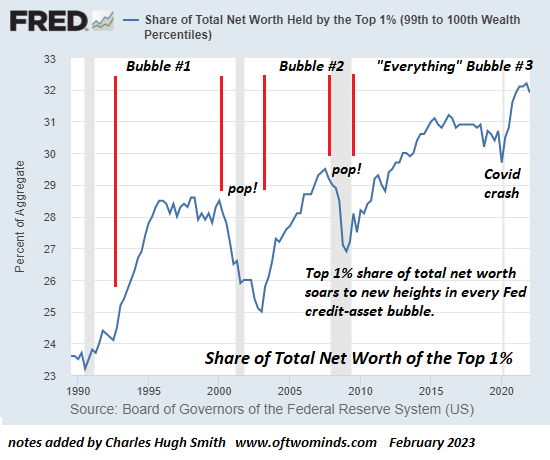
Now the US has inflated another “debt super-cycle” credit bubble that has pushed assets into over-valuation. Once again the goal is to avoid handing the wealthy owners of all this debt the enormous losses that must be accepted to clear the dead wood of bad debt, money lent to borrowers and projects that were not creditworthy except in a bubble.
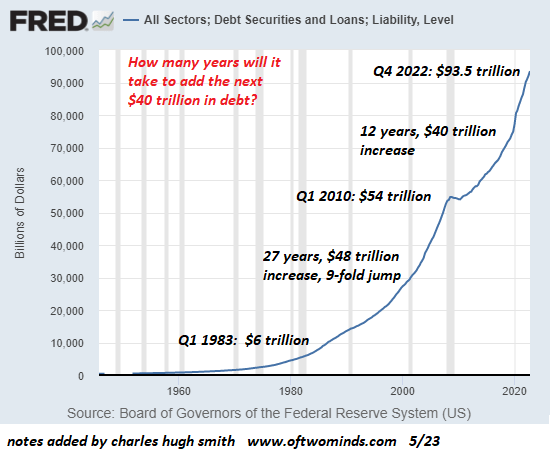
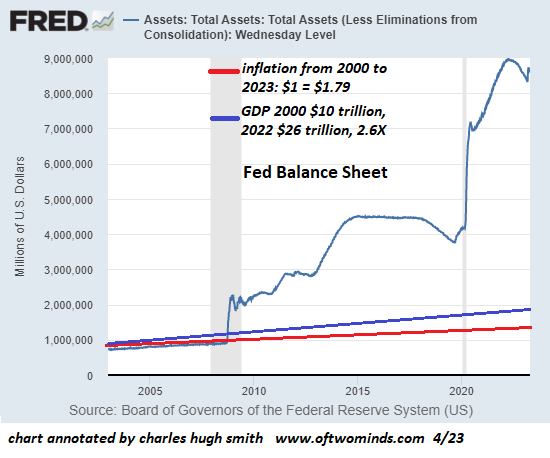
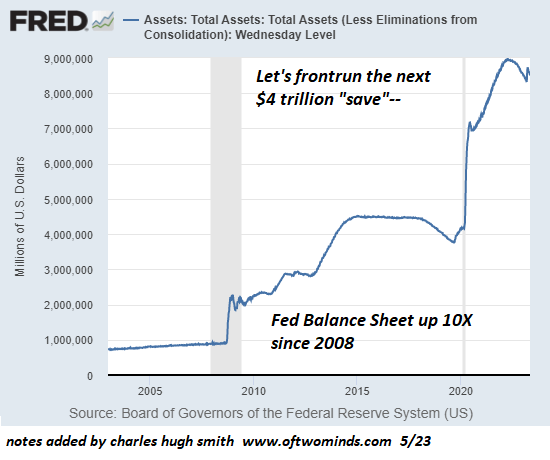
The lesson the status quo took from the Great Depression is to cover up private-sector over-valuations and bad debts with vast expansions of credit via the Federal Reserve and the federal government. Please look at these four charts below: 1. total credit (TCMDO) 2. the Federal Reserve balance sheet (2 charts) 3. federal debt
All are in visibly unsustainable parabolic ascents.
Predictably, the status quo will refuse to accept the necessity of clearing the dead wood and accepting the trillions of dollars in losses that will accrue to those who own the unpayable debts.
Consider CRE, commercial real estate. Office towers are now worth one-third of their pre-pandemic valuations, the valuations on which their mortgages were based. There is no way these properties can be magically restored to their previous over-valuation. Massive losses must be accepted by the owners of the debt. If those losses make them insolvent, so be it. That is unacceptable in a system geared to protect the wealthy at all costs.
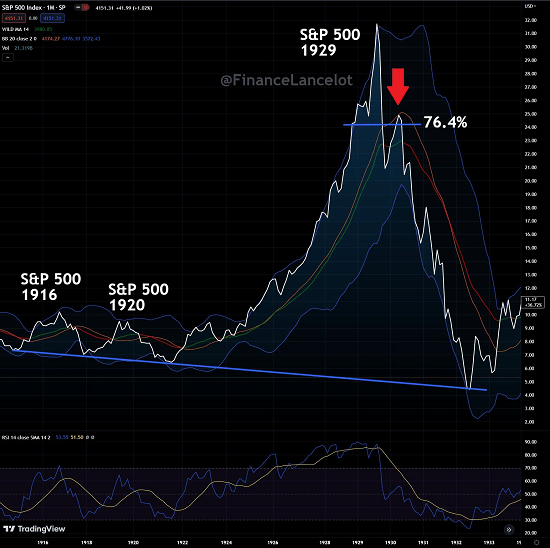
But bubbles pop anyway, regardless of policy tweaks. Consider these stock market charts of the Roaring 20s and the Great Depression and the present (below). The similarity is remarkable–possibly even eerie.
The big difference between the Great Depression of the 1930s and the Depression we’re entering is the world still had enormous reserves of resources to tap and a (by today’s standards) modest population in the resource-consuming developed nations.
Recall that a developed-world consumer uses up to 100 times more energy and resources than a poor person in a rural undeveloped nation. Recycling a few bottles doesn’t change this.
This means the planet’s “savings account” of abundant, cheap-to-access resources has been depleted. Yes, there is still oil and copper, etc., but it’s of far lower quality and much harder to get now. The rich ores have been mined and the shallow super-giant oil fields have all been tapped long ago. Now the Saudis must pump stupendous quantities of seawater into their oil wells to maintain production. All these technologies consume vast quantities of energy.
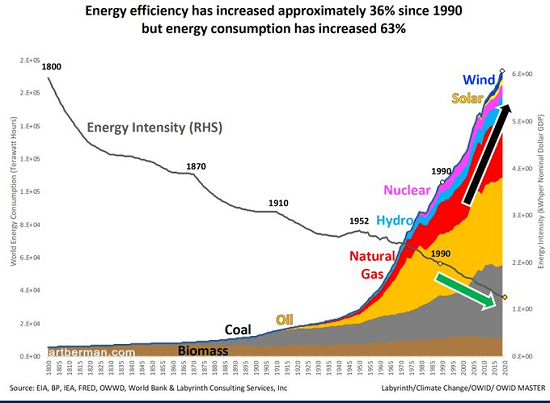
The inevitable result is the energy efficiency–how much energy is required to access, process and transport the energy–has plummeted even as consumption has soared.
The outcome many hope for is some new miraculously cheap and abundant sources of energy such as fusion. But fusion is far more complicated and tricky than pumping oil, and oil is a high-energy-density fuel that can be stored rather easily. All the electricity generated by various technologies can’t be stored easily or cheaply, and so the happy story is that a new miraculous battery technology is just around the corner.
But batteries are also complicated and resource-dense, so they’ll always be as expensive as the materials needed to fabricate them. There will never be “low-cost” batteries if the materials needed to make them are scarce and expensive to dig out of the ground, process and transport.
So the policy choices are simple: either protect the wealthy from write-downs of bad debt and the collapse of asset bubbles and usher in decades of stagnation, or force the wealthy to take the losses and clear away the dead wood.
But either choice will be constrained by the reality that humanity has already drained the easy-to-get “savings account” of global resources.
I get emails from readers who say things like “mining techniques are far more efficient now.” That’s fine, but most of these new mines are often thousands of kilometers away from railways or seaports, and thousands of kilometers away from the processing plants that turn the ore into useful metals.
Recall the enormity of the cost and effort required to build a single two-lane highway thousands of kilometers to a new mine, and the oceans of diesel fuel needed to power the mining equipment and trucks hauling the ore to railways or seaports. Recall the immense amounts of energy required to smelt / process these ores, and the near-zero percentage of lithium-ion batteries that are currently being recycled.
Batteries are difficult to recycle because they’re not manufactured to be recycled, and they’re not manufactured to be recycled because that would raise costs considerably, reducing profits.
So on the present course, the idea is to manufacture billions of batteries, throw them all in the landfill in 10 years, and then mine enough minerals to build another couple billion batteries and then repeat the cycle of throwing them away in 10 years forever.
That isn’t realistic, so the status quo will have to adjust to this unwelcome reality.
This is why I keep writing books about relocalizing, degrowth, using less rather than more to yield a higher level of well-being. The resource “savings account” won’t support fantasies of endlessly expanding consumption of hard-to-get resources.
But the status quo has much to unlearn, and it seems the only pathway to a new understanding is a Great Depression that won’t end with a new expansion of credit because the resources required for that new expansion simply won’t be available or affordable.
Reducing our exposure to avoidable risks is a key strategy of Self-Reliance.
“All across the board, illness, disability, cancer, heart, autism, fertility…WeFkdUp !!!” —The Ethical Skeptic on Twitter
What if Dr. Geert Vanden Bossche is correct? The Dutch virologist said at the outset of the Covid-19 episode in 2020 that vaccinating the world in the midst of an epidemic was insane because it would train the virus to evolve more dangerously while disabling human immune systems.
Last week he issued a warning that the world was within weeks of just such a new and deadly immune escape variant outbreak that would bring on a shocking wave of sickness and death among people who received multiple Covid-19 vaccinations. This would happen on top of an already accelerating rise in latent vaccine adverse reactions manifesting as aggressive cancers, blood disorders, cardiac injury, neurological disease, and much, much more.
To this point in the Covid-19 story, Western Civ in general, and the USA in particular, have descended into an epic group psychosis as a result of the managed mind-fuckery induced by their own governments in collusion with a pharmaceutical industry metastasizing on money the way an aggressive cancer feeds on sugar in a human body. Fearful citizens swallowed all manner of unreality foisted on them by means of propaganda and censorship.
We still don’t know for sure how, who, and why, exactly, Covid-19 was set loose on the world, and the public health agencies don’t want you to know. Perhaps the worst and most baldly dishonest act was the official suppression of effective treatments with common, safe, anti-virals that could have saved millions of lives. And all just to preserve the vaccine companies’ liability shield from the Emergency Use Authorization. In fact, governments are still militating against the sale and use of ivermectin and hydroxychloroquine, which could be taken prophylactically in anticipation of a new outbreak.
So, if these populations were driven crazy by authorities ginning up their fear and preying on it, what will happen if that fear turns to anger instead? Because that’s exactly what will happen when Americans, and perhaps even Europeans, realize they’ve been subject to history’s biggest homicidal fraud. That anger is going to seek targets, and they are going to find them very easily in their own government officials and also — get this — in the medical establishment that has betrayed its patients so unconscionably.
It’s just impossible to say exactly how that will play out on-the-ground. Governments are already falling — Spain, the Netherlands — but these were parliamentary downfalls according to regular political procedure. Our country has no such procedures for changing authority in a time of crisis. Instead, we have a president up to his neck in bribery scandal and executive agency thuggery, and political parties sunk in corruption, and no way to get rid of them except elections many months away — elections which at least half the people don’t believe are honest.
This crisis of bad faith and sickness is happening at the same time that Western Civ enters an equally vicious crisis of economy and finance. America and Europe are broke. All are playing games with their conjoined banking systems and their currencies. All are de-industrializing economies strictly based on industrial production of goods no longer being produced, and pretending to replace them with economies of computer vapor-ware. That can’t work and can only end badly in collapsing standards of living.
The past few years, an apparent coalition of global elites, functioning in orgs such as the WEF, the WHO, the EU, the IMF, the central banks, and countless NGOs, along with shadowy intel units and what remains of the old news media, have promoted ever more desperate top-down control programs to prevent a breakdown into wholesale economic and political disorder. Their efforts increasingly tilt into pretense.
Try to impose digital currencies and health passports? Fuggeddabowdit. You will only get a chaos of work-arounds, non-compliance, and probably violent opposition. Keep that stupid, dishonorable, perfidious, and unnecessary war going in Ukraine and you run the risk of turning Western Civ into a matched set of ashtrays.
As you can see, there has already been enough official mischief, crime, and malfeasance to severely piss-off the population. If Dr. Vanden Bossche is correct, we are perhaps heading into the conclusive shock of an evil era. Some kind of monumental correction will be in order. The people will need some way to regain credible self-governance, either through personnel change in every locus of power, or some revision in structure and procedure. For now, there is little faith that our institutions can manage either of those options. Better maintain situational awareness as we creep into the unknown.
The paradoxical thing is that U.S. and European sanctions against Russia while intended to cripple the Russian economy have made the stronger.
Russia’s economy is performing strongly, according to recent forecasts from the World Bank and International Monetary Fund. The outcome defies earlier predictions by the United States and its European allies which held that Western sanctions would bring the Russian economy to its knees and force it to submissively “Cry Uncle”.
When the conflict in Ukraine escalated 16 months ago (after eight years of NATO-sponsored aggression using the Kiev Neo-Nazi regime), various Western politicians and pundits were relishing the prospect of the Russian economy collapsing from “Total War” launched against its international banking and trade.
Well, it didn’t turn out like that. Far from it. As the World Bank noted above, the Western sanctions have simply helped Russia boost alternative markets in China, India, and elsewhere around the globe. A principal earner for Russia is energy exports of oil and gas. Increased sales to Asia have maintained revenues despite the loss of European markets due to Western sanctions.
The paradoxical thing is that U.S. and European sanctions against Russia while intended to cripple the Russian economy have actually made the latter stronger.
Michael Hudson, an American global economics analyst, points out: “The sanctions have obliged Russia to become self-sufficient in food production, manufacturing production and consumer goods.”
Hudson also notes that the U.S. geopolitical strategy is to use sanctions in order to make its supposed European allies more dependent and subservient to Washington.
Another respected commentator, Glenn Diesen, a Norwegian geoeconomics professor, likened the use of Western sanctions to the self-destructive behavior of “self-harm”. The United States and European Union, he says, have “handed over a huge market to the rest of the world”.
Diesen also observes that 85 percent of the world’s population lives in countries that do not comply with Western sanctions against Russia. This global majority is more than ever creating new forms of trade and finance that obviate Western control. A major impetus for this positive development is the necessity bequeathed by Washington’s systematic abuse of power and privilege.
The repercussions are more far-reaching and profound than the inadvertent benefits accruing to Russia’s national economy. What the Western sanctions are also doing is accelerating the development of a multipolar world and the demise of the U.S. dollar as a global reserve currency. The upshot of those two trends is the historic dwindling of American imperial power – albeit with outbursts of militarism and warmongering along the way down.
A significant illustration of the times a-changing was seen this week at the 25th summit of the St Petersburg International Economic Forum (SPIEF). Attending the four-day event were 17,000 delegates from some 130 nations. This year’s convocation witnessed large representations from Asia, Latin America and Africa.
The bustling event not only reflected Russia’s own economic strength but the fact that – far from being “isolated” and downtrodden – Russia is viewed by the rest of the world as an engine for growth and more prosperous multipolar relations.
Indeed, from the perspective of most nations, it looks like the United States and its Western allies are the ones who are isolated and anachronistic.
One of the attendees at SPIEF was American industrial analyst Douglas Andrew Littleton who commented: “Western sanctions against Russia have backfired.” And he added: “I’m happy that Russia has been able to bypass and skirt the sanctions in so many ways with their friends and allies.”
What’s going on here is not just merely the emergence of an alternative system, but an epochal political and perhaps moral paradigm shift. The globe wants more peaceful and mutual relations of cooperation and development. Most people on this Earth want endless warmongering, militarism and unilateral bullying by self-ordained powers to be put to an end. The planet is crying out for a world based on justice and peace.
What the world is realizing more than ever is that the unilateral use of economic sanctions by Washington is nothing but warfare and state terrorism by another, more palatable name. For decades, the U.S. has tried to use economic weapons to strangle and kill other nations. North Korea, Cuba, Iran, Iraq and many other countries come to mind where U.S. imperialism has imposed conditions of economic genocide.
The world is well aware of this fiendish legacy and has had enough of American barbarism wielded with the help of its Western lackeys in NATO and the European Union.
We should here make special mention of Syria, the Arab nation struggling to recover from 12 years of war that was inflicted upon it by Washington and its NATO partners for “regime change”. Today, Syria’s recovery is cruelly hampered by economic sanctions imposed by the U.S. and EU. How despicable is that?
There is an unerring historical sense, however, that Washington, has finally met its nemesis. By racking up sanctions against Russia and dragooning its EU lackeys to follow suit, the United States has now unleashed a historic dynamic process of its own imperial collapse.
For decades, U.S. sanctions worked to a nefarious degree on isolated, smaller nations to indeed enforce vengeful hardship.
Not anymore. Russia’s vast natural wealth and economy are too big to contain. Militarily, too, Russia will not be pushed around. Indeed, it has pushed back in Ukraine against the West’s deceptive and pernicious proxy war.
Organically and consciously, the world economy and international relations have been transformed in recent years, especially with the rise of China and Eurasia generally.
Another key development is that the Western imperialist media monopoly has also been broken. Washington and its minions in the European political class are held in contempt as liars and charlatans, even by their own populations.
By unwisely attempting to trap the Russian bear, the West has only created a scenario of revolt by the rest of the world from the West’s exploitative control. Five centuries of European and American Western parasitism have run their course.
Russia’s economic strength is galvanizing the rest of the world to shake off the chains of Western domination and subjugation. The process of dumping the dollar is gathering momentum which self-harming sanctions are precipitating. Pillars and facades are crumbling in real time.
The theme for the SPIEF event this year was “Sovereign Development – the Basis for a Just World”.
As with many other empires in the annals of history that have collapsed, arrogance and hubris often precede the fall. The American and Western elite thought they had an eternal license to wreak havoc for their own selfish gain. Their economic plunder and weaponry are now turning on their own heads. And it’s long overdue.
On June 3rd, President Joe Biden signed a bill into law that lifted the government’s debt ceiling and capped some categories of government spending. The big winner was — surprise, surprise! — the Pentagon.
Congress spared military-related programs any cuts while freezing all other categories of discretionary spending at the fiscal year 2023 level (except support for veterans). Indeed, lawmakers set the budget for the Pentagon and for other national security programs like nuclear-related work developing nuclear warheads at the Department of Energy at the level requested in the administration’s Fiscal Year 2024 budget proposal — a 3.3% increase in military spending to a whopping total of $886 billion. Consider that preferential treatment of the first order and, mind you, for the only government agency that’s failed to pass a single financial audit!
Even so, that $886 billion hike in Pentagon and related spending is likely to prove just a floor, not a ceiling, on what will be allocated for “national defense” next year. An analysis of the deal by the Wall Street Journal found that spending on the Pentagon and veterans’ care — neither of which is frozen in the agreement — is likely to pass $1 trillion next year.
Compare that to the $637 billion left for the rest of the government’s discretionary budget. In other words, public health, environmental protection, housing, transportation, and almost everything else the government undertakes will have to make do with not even 45% of the federal government’s discretionary budget, less than what would be needed to keep up with inflation. (Forget addressing unmet needs in this country.)
And count on one thing: national security spending is likely to increase even more, thanks to a huge (if little-noticed) loophole in that budget deal, one that hawks in Congress are already salivating over how best to exploit. Yes, that loophole is easy to miss, given the bureaucratese used to explain it, but its potential impact on soaring military budgets couldn’t be clearer. In its analysis of the budget deal, the Congressional Budget Office noted that “funding designated as an emergency requirement or for overseas contingency operations would not be constrained” by anything the senators and House congressional representatives had agreed to.
As we should have learned from the 20 years of all-American wars in Afghanistan and Iraq, the term “overseas contingency” can be stretched to cover almost anything the Pentagon wants to spend your tax dollars on. In fact, there was even an “Overseas Contingency Operations” (OCO) account supposedly reserved for funding this country’s seemingly never-ending post-9/11 wars. And it certainly was used to fund them, but hundreds of billions of dollars of Pentagon projects that had nothing to do with the conflicts in Iraq or Afghanistan were funded that way as well. The critics of Pentagon overspending quickly dubbed it that department’s “slush fund.”
So, prepare yourself for “Slush Fund II” (coming soon to a theater near you). This time the vehicle for padding the Pentagon budget is likely to be the next military aid package for Ukraine, which will likely be put forward as an emergency bill later this year. Expect that package to include not only aid to help Ukraine fend off Russia’s ongoing brutal invasion but tens of billions of dollars more to — yes, of course! — pump up the Pentagon’s already bloated budget.
Senator Lindsey Graham (R-SC) made just such a point in talking with reporters shortly after the debt-ceiling deal was passed by Congress. “There will be a day before too long,” he told them, “where we’ll have to deal with the Ukrainian situation. And that will create an opportunity for me and others to fill in the deficiencies that exist from this budget deal.”
Senate Majority Leader Chuck Schumer (D-NY) made a similar point in a statement on the Senate floor during the debate over that deal. “The debt ceiling deal,” he said, “does nothing to limit the Senate’s ability to appropriate emergency/supplemental funds to ensure our military capabilities are sufficient to deter China, Russia, and our other adversaries and respond to ongoing and growing national security threats.”
One potential (and surprising) snag in the future plans of those Pentagon budget boosters in both parties may be the position of House Speaker Kevin McCarthy (R-CA). He has, in fact, described efforts to increase Pentagon spending beyond the level set in the recent budget deal as “part of the problem.” For the moment at least, he openly opposes producing an emergency package to increase the Pentagon budget, saying:
“The last five audits the Department of Defense [have] failed. So there’s a lot of places for reform [where] we can have a lot of savings. We’ve plussed it up. This is the most money we’ve ever spent on defense — this is the most money anyone in the world has ever spent on defense. So I don’t think the first answer is to do a supplemental.”
The Massive Overfunding of the Pentagon
The Department of Defense is, of course, already massively overfunded. That $886 billion figure is among the highest ever — hundreds of billions of dollars more than at the peak of the Korean or Vietnam wars or during the most intensely combative years of the Cold War. It’s higher than the combined military budgets of the next 10 countries combined, most of whom are, in any case, U.S. allies. And it’s estimated to be three times what the Chinese military, the Pentagon’s “pacing threat,” receives annually. Consider it an irony that actually “keeping pace” with China would involve a massive cut in military spending, not an increase in the Pentagon’s bloated budget.
It also should go without saying that preparations to effectively defend the United States and its allies could be achieved for so much less than is currently lavished on the Pentagon. A new approach could easily save significantly more than $100 billion in fiscal year 2024, as proposed by Representatives Barbara Lee (D-CA) and Mark Pocan (D-WI) in the People Over Pentagon Act, the preeminent budget-cut proposal in Congress. An illustrative report released by the Congressional Budget Office (CBO) in late 2021 sketched out three scenarios, all involving a less interventionist, more restrained approach to defense that would include greater reliance on allies. Each option would reduce America’s 1.3-million-strong active military force (by up to one-fifth in one scenario). Total savings from the CBO’s proposed changes would, over a decade, be $1 trillion.
And a more comprehensive approach that shifted away from the current “cover the globe” strategy of being able to fight (though, as the history of this century shows, not always win) wars virtually anywhere on Earth on short notice — without allies, if necessary — could save hundreds of billions more over the next decade. Cutting bureaucracy and making other changes in defense policy could also yield yet more savings. To cite just two examples, reducing the Pentagon’s cohort of more than half-a-million private contract employees and scaling back its nuclear weapons “modernization” program would save significantly more than $300 billion extra over a decade.
But none of this is even remotely likely without concerted public pressure to, as a start, keep members of Congress from adding tens of billions of dollars in spending on parochial military projects that channel funding into their states or districts. And it would also mean pushing back against the propaganda of Pentagon contractors who claim they need ever more money to provide adequate tools to defend the country.
Contractors Crying Wolf
While demanding ever more of our tax dollars, the giant military-industrial corporations are spending all too much of their time simply stuffing the pockets of their shareholders rather than investing in the tools needed to actually defend this country. A recent Department of Defense report found that, from 2010-2019, such companies increased by 73% over the previous decade what they paid their shareholders. Meanwhile, their investment in research, development, and capital assets declined significantly. Still, such corporations claim that, without further Pentagon funding, they can’t afford to invest enough in their businesses to meet future national security challenges, which include ramping up weapons production to provide arms for Ukraine.
In reality, however, the financial data suggests that they simply chose to reward their shareholders over everything and everyone else, even as they experienced steadily improving profit margins and cash generation. In fact, the report pointed out that those companies “generate substantial amounts of cash beyond their needs for operations or capital investment.” So instead of investing further in their businesses, they choose to eat their “seed corn” by prioritizing short-term gains over long-term investments and by “investing” additional profits in their shareholders. And when you eat your seed corn, you have nothing left to plant next year.
Never fear, though, since Congress seems eternally prepared to bail them out. Their businesses, in fact, continue to thrive because Congress authorizes funding for the Pentagon to repeatedly grant them massive contracts, no matter their performance or lack of internal investment. No other industry could get away with such maximalist thinking.
Military contractors outperform similarly sized companies in non-defense industries in eight out of nine key financial metrics — including higher total returns to shareholders (a category where they leave much of the rest of the S&P 500 in the dust). They financially outshine their commercial counterparts for two obvious reasons: first, the government subsidizes so many of their costs; second, the weapons industry is so concentrated that its major firms have little or no competition.
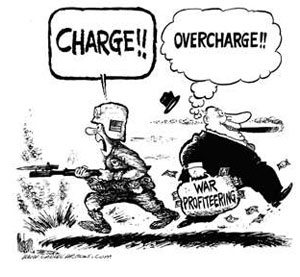
Adding insult to injury, contractors are overcharging the government for the basic weaponry they produce while they rake in cash to enrich their shareholders. In the past 15 years, the Pentagon’s internal watchdog has exposed price gouging by contractors ranging from Boeing and Lockheed Martin to lesser-known companies like TransDigm Group. In 2011, Boeing made about $13 million in excess profits by overcharging the Army for 18 spare parts used in Apache and Chinook helicopters. To put that in perspective, the Army paid $1,678.61 each for a tiny helicopter part that the Pentagon already had in stock at its own warehouse for only $7.71.
The Pentagon found Lockheed Martin and Boeing price gouging together in 2015. They overcharged the military by “hundreds of millions of dollars” for missiles. TransDigm similarly made $16 million by overcharging for spare parts between 2015 and 2017 and even more in the following two years, generating nearly $21 million in excess profits. If you can believe it, there is no legal requirement for such companies to refund the government if they’re exposed for price gouging.
Of course, there’s nothing new about such corporate price gouging, nor is it unique to the arms industry. But it’s especially egregious there, given how heavily the major military contractors depend on the government’s business. Lockheed Martin, the biggest of them, got a staggering 73% of its $66 billion in net sales from the government in 2022. Boeing, which does far more commercial business, still generated 40% of its revenue from the government that year. (Down from 51% in 2020.)
Despite their reliance on government contracts, companies like Boeing seem to be doubling down on practices that often lead to price gouging. According to Bloomberg News, between 2020 and 2021, Boeing refused to provide the Pentagon with certified cost and pricing data for nearly 11,000 spare parts on a single Air Force contract. Senator Elizabeth Warren (D-MA) and Representative John Garamendi (D-CA) have demanded that the Pentagon investigate since, without such information, the department will continue to be hard-pressed to ensure that it’s paying anything like a fair price, whatever its purchases.
Curbing the Special Interest Politics of “Defense”
Reining in rip-offs and corruption on the part of weapons contractors large and small could save the American taxpayer untold billions of dollars. And curbing special-interest politics on the part of the denizens of the military-industrial-congressional complex (MICC) could help open the way towards the development of a truly defensive global military strategy rather than the current interventionist approach that has embroiled the United States in the devastating and counterproductive wars of this century.
One modest step towards reining in the power of the arms lobby would be to revamp the campaign finance system by providing federal matching funds, thereby diluting the influential nature of the tens of millions in campaign contributions the arms industry makes every election cycle. In addition, prohibiting retiring top military officers from going to work for arms-making companies — or, at least, extending the cooling off period to at least four years before they can do so, as proposed by Senator Warren — would also help reduce the undue influence exerted by the MICC.
Last but not least, steps could be taken to prevent the military services from giving Congress their annual wish lists — officially known as “unfunded priorities lists” — of items they want added to the Pentagon budget. After all, those are but another tool allowing members of Congress to add billions more than what the Pentagon has even asked for to that department’s budget.
Whether such reforms alone, if adopted, would be enough to truly roll back excess Pentagon spending remains to be seen. Without them, however, count on one thing: the department’s budget will almost certainly continue to soar, undoubtedly reaching $1 trillion or more annually within just the next few years. Americans can’t afford to let that happen.
Thirty years ago, pluripolarity was far from a reality in a world that had been under U.S. hegemony since the collapse of the Soviet Union in 1991. Today, however, humanity is taking important steps toward forming a plural geopolitics whose protagonists are the emerging countries that challenge Western power.
The turning point towards a new form of integration, which will generate a new world political balance, occurred in 2009 when Brazil, Russia, India, and China held the first BRIC summit.
After the incorporation of South Africa to this group in 2010, the BRICS has generated such real prospects that other nations with productive capacity and diversified economies have expressed interest in joining. Among them are Saudi Arabia, Algeria, Argentina, the United Arab Emirates, and Mexico.
In the article “Can the BRICS Trump the IMF and the World Bank?,” Palestinian-American journalist Ramzy Baroud noted that “one of the biggest opportunities and challenges” the BRICS now faces is expanding its membership while maintaining its current growth.
Recent financial reports revealed that the BRICS have the world’s largest gross domestic product (GDP) and that economic bloc contributes 31.5 percent of global GDP, while the Group of Seven (G7) stuck at 30.7 percent.
The International Monetary Fund (IMF) and the World Bank (WB) are known for providing financial support to developing countries under conditions that, under the pretext of defending human rights or democracy, seek to favor the privatization of public goods and the opening of domestic markets for Western foreign investors.
Due to these politically-driven conditionalities, the struggle for alternatives to the IMF-WB mechanisms becomes a political task. The Global South requires international institutions that are not interested in indirectly manipulating or controlling national economies.
That is the call for the BRICS to evolve towards integration schemes that go beyond the exclusively economic realm, although the basis of the fight against the U.S.-controlled institutions is the formation of an alternative economy.
Recently, the BRICS placed a capital of US$50 billion for the launch of their New Development Bank (NDB), which will be chaired by former Brazilian president Dilma Rousseff.
This happened at a time when presidents Xi Jinping (China) and Lula da Silva (Brazil) showed a shared interest in influencing the peaceful solution of the Ukrainian conflict.
Under these circumstances, to argue that the BRICS are a group with purely economic interests is to ignore much of the its history.
“The timing of the BRICS expansion, the stern political discourse of its members, potential members and allies, the repeated visits by top Russian and Chinese diplomats to Africa and other regions of the Global South, etc… indicate that the BRICS have become the new geopolitical, economic and diplomatic platform for the countries of the South,” said Baroud.
Meanwhile, the Western powers, whose economies are struggling to stay afloat, are closely and suspiciously watching the changes taking place in the Global South at the hands of the BRICS.









 After the Crash