The FBI is Great at Disrupting (Its Own) “Terror Plots”

index

By Kevin Carson

Source: Center for a Stateless Society

On January 14 the US Department of Justice announced that the Joint Terrorism Task Force had disrupted the latest “domestic terrorism plot” — this time by “a Cincinnati-area man … to attack the U.S. Capital and kill government officials.” House Speaker  John Boehner immediately cited the disrupted plot as evidence that Congress should think carefully before refusing to renew the NSA’s bulk data collection powers. Only it turns out the feds had at least as much to do with hatching the plot as did the alleged plotter, Christopher Cornell.

The FBI investigator became aware of Cornell’s pro-ISIS comments on Twitter thanks to a tip-off from an unnamed informant who “began cooperating with the FBI in order to obtain favorable treatment with respect to his criminal exposure on an unrelated case.” The informant, on FBI orders, arranged two meetings with Cornell where they discussed attacks on the capital, after which the FBI arrested him to “prevent” the attacks. In other words, it identified Cornell as a suspect entirely on the basis of his expression of radical political opinions, with the help of a jailhouse snitch who rolled over in response to prosecutorial blackmail. And the actual “plot” was worked out only in subsequently arranged meetings in which one party — working for the FBI — may well have been leading Cornell. It wasn’t for nothing that ecological activist Judi Bari said “the first person to mention bringing dynamite is probably a fed.”

In this the Cornell case has a lot in common with a great many other so-called “domestic terrorism plots” federal law enforcement has “disrupted,” going back to the Lackawanna Six. A good example is the so-called “plot” of the Newburgh Four, who supposedly plotted to blow up synagogues and attack a military base. The judge commented that the government “came up with the crime, provided the means, and removed all relevant obstacles,” in the process making a terrorist out of a man “whose buffoonery is positively Shakespearean in scope” (“US: Terrorism Prosecutions Often An Illusion,” Human Rights Watch, July 21, 2014).

This reminds me of a story I read — from Dilbert cartoonist Scott Adams, I think — about a software company that offered programmers a bonus for every bug they detected in code. Predictably, creating bugs to “detect” became a major source of revenue for employees. H.L. Mencken once remarked on government’s tendency “to keep the populace alarmed (and hence clamorous to be led to safety) by menacing it with an endless series of hobgoblins, all of them imaginary.”

We see this in the dismaying, Starship Troopers-like media narrative involving any and all armed government personnel in uniform. Last weekend’s highest U.S. box office receipts came not from Selma (the story of oppressed people organizing to fight for their freedom) but from American Sniper. The latter movie glorifies a vile wretch who gloated over all the “savages” (his word for any male age 16 to 60) he murdered in Iraq, on the grounds that he was saving American troops from being shot at. Never mind that the people in Iraq were shooting back at an invading army in their own country. Domestically, we see the same phenomenon with shows like COPS, and local news coverage of police in paramilitary gear (breathlessly referred to as “the authorities” by nitwit reporters) storming alleged “meth labs.”

And remember, the very concept of a “sting operation” (also known as “entrapment”) invokes the principle that some human beings are superior to the law. The first professional police forces were justified on the grounds that they were simply being paid to exercise the same posse comitatus powers of “citizen’s arrest” possessed by any other member of society. By that standard, if it’s illegal for an ordinary citizen to solicit or instigate illegal activity, it should be illegal for anyone — including uniformed state officials.

But most importantly, this is an example of how the state mostly “solves” problems of its own making — and has an incentive to keep creating more problems to justify giving it the power and resources to “solve” them.


Fascism and War: Elite Tools to Crush and Kill Dissent

facism

By Julie Lévesque

Source: GlobalResearch.ca

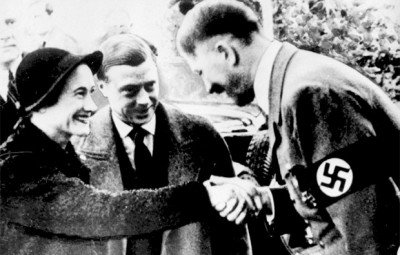
The Duke and Duchess of Windsor in 1937 with Adolf Hitler.

The Duke and Duchess of Windsor in 1937 with Adolf Hitler.

Dr. Jacques Pauwels is not the kind of historian you often hear about in the mainstream media. He’s obviously not the kind of “expert” they refer to for historical facts. Actually, one crucial propaganda method consists in excluding current events from their historical context.

Listening to Pauwels makes one realize the scope of the lies we’ve been fed about the Second World War, fascism and democracy, and how myths related to previous wars need to be upheld in the mainstream discourse to satisfy never ending war propaganda needs.

In a speech held December 15 in Montreal, he explained that World Wars I and II were all about crushing mass revolutionary movements.

The myth of the Good War

Every time Westerners’ approval for war is required, the myth of the good war surfaces: the Second World War was a good war, a necessity to quench Hitler’s blood thirst. Pauwels tears this myth apart, uncovering the vicious nature of the western elite.

The reasons for the US involvement in World War II lie in the social-economic conditions of the time, not in an outpouring of compassion destined to save humanity from fascism. The US elite was actually in favor of fascism, a very convenient tool to crush the mass revolutionary movement embodied by the Russian Revolution and the USSR.

WWII was in fact a continuity of WWI. “We are always told that WWI started with the assassination of Archduke Franz Ferdinand, but it’s not true”, Pauwels says. It is indeed a well established myth carried on by various sources, whether history is written by “thousands of eminent experts, scholars, and leaders” like in Encyclopedia Britannica, or by just about anybody, like in Wikipedia:

The outbreak of war

With Serbia already much aggrandized by the two Balkan Wars (1912–13, 1913), Serbian nationalists turned their attention back to the idea of “liberating” the South Slavs of Austria-Hungary. Colonel Dragutin Dimitrijević, head of Serbia’s military intelligence, was also, under the alias “Apis,” head of the secret society Union or Death, pledged to the pursuit of this pan-Serbian ambition. Believing that the Serbs’ cause would be served by the death of the Austrian archduke Francis Ferdinand, heir presumptive to the Austrian emperor Francis Joseph, and learning that the Archduke was about to visit Bosnia on a tour of military inspection, Apis plotted his assassination. (World War I, Encyclopedia Britannica)

The immediate trigger for war was the 28 June 1914 assassination of Archduke Franz Ferdinand of Austria, heir to the throne of Austria-Hungary, by Yugoslav nationalist Gavrilo Princip in Sarajevo. This set off a diplomatic crisis when Austria-Hungary delivered an ultimatum to the Kingdom of Serbia,[10][11] and international alliances formed over the previous decades were invoked. Within weeks, the major powers were at war and the conflict soon spread around the world. (World War I, Wikipedia)


Both WWI and WWII had two dimensions: the vertical dimension, namely the rivalry between empires, and the horizontal one, class warfare, Pauwels explains.

These wars were actually the best way for the western elite to cope with the ever growing revolutionary and democratic movements fueled by dire economic conditions and which threatened the established order.

In Nietzsche’s view for example, Pauwels says “war was the solution against revolution, since in a war, there are no discussions, like there is in a democracy. In a war, the minority, the elite, decides and the majority, the proletarians, obey.”

For members of the elite like Malthus, “the system could not be the cause of poverty since they were profiting from it. The cause of poverty was the poor: there were too many of them. Therefore the solution to poverty and threatening revolutionary movements was simply to eliminate poor people and what better solution than war to kill poor people?”

After WWI though, “revolution was no longer a simple idea but rather something concrete: the Soviet Union.” That’s when fascism came to the rescue. “Fascism was the instrument used by the elite to further the objectives of 1914, namely put an end to revolutions and communism.”

Communism and socialism were gaining worldwide momentum after WWI. “The German industrial and financial elite wished to crush the revolutionary movement and destroy the Soviet Union. Adolf Hitler was their instrument.”

According to popular belief Western leaders were defending democracy, engaged in a war against Germany to save humanity from fascism and the US involvement in the war led to the downfall of Hitler’s war machine. Nothing is further from the truth. “Hitler was supported by other European countries and the US because they wanted him to destroy the USSR, the cradle of the revolution.” The exact opposite occurred: it was the USSR that defeated Nazi Germany, losing over 20 million souls in the battle.

The US even recruited the best Nazi scientists, technicians and engineers to work for them after the war. That piece of history called Operation Paperclip (picture below) has yet to find its way in Encyclopedia Britannica.

WWII was the victory of American Imperialism, a term which is rarely used today even if it best describes the reality the world has been living in ever since.

But even more surprising is the surviving myth that we are going to war to save the world from evil dictators or terrorists and that the western world fights for freedom and democracy. Thanks to the “stenographers of power”, the tactic is still reliable and used several decades later.

Visit Jacques Pauwels’ web site at http://www.jacquespauwels.net/about/. His articles and books are available in several languages. See also Jacques Pauwels’ articles on Global Research.

Zombie Apocalypse and the Politics of Artificial Scarcity

By Colin Jenkins

Source: The Hampton Institute

cdc_zombie_attacksDystopian narratives have long been an alluring and thought-provoking form of entertainment, especially for those who take an interest in studying social and political structures. From classics like Nineteen Eighty-Four and Brave New World to the current hit, The Hunger Games, these stories play on our fears while simultaneously serving as warning signs for the future.

Their attractiveness within American society is not surprising. Our lives are driven by fear. Fear leads us to spend and consume; fear leads us to withdraw from our communities; and fear leads us to apathy regarding our own social and political processes. This fear is conditioned as much as it is natural. The ruling-class handbook, Machiavelli’s The Prince, made it clear: “Since love and fear can hardly exist together, if we must choose between them, it is far safer to be feared than loved.”

The idea of apocalypse is a central tenet of human society. We’ve been taught about Armageddon, Kali Yuga, Judgement Day, Yawm ad-Dīn, nuclear holocaust, the end times, the four horsemen, and the Sermon of the Seven Suns. Hierarchical societal arrangements leave us feeling powerless. Exploitative systems like capitalism leave us feeling hopeless. And the widespread deployment of fear ultimately keeps us in our place, and out of the business of those who own our worlds.

The last half-century has brought us the zombie apocalypse – a fictional world where the human race has largely been transformed into a brainless, subhuman hoard of flesh-eaters, with only a few random survivors left to carve out any semblance of life they can find in a barren landscape. The emergence and immense popularity of the TV show The Walking Dead is the latest, and perhaps most influential, piece in a long line of narratives centered within themes of survival, human interaction, and scarcity.
Human Nature and Interaction

Behind all political battles, social critiques, and theoretical inquiries lies the most fundamental question: when left to our own accord, how will we interact with one another? How one answers this question usually goes a long way to how one perceives the world, and how issues are viewed and opinions are formed. To our dismay, potential answers are typically presented in dualities. Are we good or evil? Competitive or cooperative? Generous or greedy? Violent or peaceful?

A common theme among religion has been that human beings are “born into sin” and heavily influenced by “evil forces” to do harmful things. One who embraces this theme will tend to have less faith in humanity than one who does not. For, if we really are engaging in a daily struggle to resist the powers of evil, it is reasonable to assume that evil will take hold of many. How can we trust anyone who, at a moment’s notice, could potentially lose the ability to act on their own conscience? The common theme of our dominant economic system – capitalism – is that human beings are inherently competitive and self-centered. When combined, it is easy to see how such ideologies may create intensely authoritative and hierarchical systems. After all, people who are influenced by strong and evil metaphysical forces while also being drawn toward callous, self-interest certainly cannot be trusted with free will.

This lesson is drilled deep into our psyches with each episode of The Walking Dead, where the potential threat of flesh-eating zombie hoards become an afterthought to the clear and present danger of “evil” humans who are out to get one another. Whether it’s a sadistic governor charming an entire town with violent gladiator events, an outlaw gang with the obligatory pedophile, or a pack of hipster cannibals salivating at the thought of eating their next visitor, the intended theme is clear – human beings are not capable of co-existing, even in a world where they rarely interact.

But is this idea accurate? Are we really drawn toward conflict? Must we compete with one another to survive? Is it appropriate to apply Darwin’s evolutionary theories in a social sense where the “fit” are meant to gain wealth and power over the “weak”? Or are we, as Peter Kropotkin theorized in his classic Mutual Aid, more inclined to mimic most other species on Earth, which have been observed over the course of centuries to exhibit “Mutual Aid and Mutual Support carried on to an extent which made me suspect in it a feature of the greatest importance for the maintenance of life, the preservation of each species, and its further evolution?”

There is ample evidence that we are drawn to cooperation. “Caring about others is part of our mammalian heritage, and humans take this ability to a high level,” explains neuroscientist Sandra Aamodt. “Helping other people seems to be our default approach, in the sense that we’re more likely to do it when we don’t have time to think a situation through before acting. After a conflict, we and other primates-including our famously aggressive relatives, the chimpanzees-have many ways to reconcile and repair relationships.” Studies have shown that in the first year of life, infants exhibit empathy toward others in distress. Evolutionary Anthropologist Michael Tomasello has put “the concept of cooperation as an evolutionary imperative to the test with very young children, to see if it holds for our nature and not just our nurture. Drop something in front of a two-year-old, he finds, and she is likely to pick it up for you. This is not just learned behavior, he argues. Young children are naturally cooperative.”

So, if we are truly inclined to cooperate with one another, why is there so much division and turmoil in the world? The answer to this question may be found by assessing not only the mechanisms of capitalism, but more importantly in the creation of artificial scarcity as a means to maintain hierarchies.
Capitalism and Artificial Scarcity

It is no secret that capitalism thrives off exploitation. It needs a large majority of people to be completely reliant on their labor power. It needs private property to be accessible to only a few, so that they may utilize it as a social relationship where the rented majority can labor and create value. It needs capital to be accessible to only a few, so that they may regenerate and reinvest said capital in a perpetual manner. And it needs a considerable population of the impoverished and unemployed – “a reserve army of labor,” as Marx put it – in order to create a “demand” for labor and thus make such exploitative positions “competitive” to those who need to partake in them to merely survive. It needs these things in order to stay intact – something that is desirable to the 85 richest people in the world who own more than half of the world’s entire population (3.6 billion people).

But wealth accumulation through alienation and exploitation is not enough in itself. The system also needs to create scarcity where it does not already exist. Even Marx admitted that capitalism has given us the productive capacity to provide all that is needed for the global population. In other words, capitalism has proven that scarcity does not exist. And, over the years, technology has confirmed this. But, in order for capitalism to survive, scarcity must exist, even if through artificial means. This is a necessary component on multiple fronts, including the pricing of commodities, the enhancement of wealth, and the need to inject a high degree of competition among people (who are naturally inclined to cooperation).

Since capitalism is based in the buying and selling of commodities, its lifeblood is production. And since production in a capitalist system is not based on need, but rather on demand, it has the tendency to produce more than it can sell. This is called overproduction. Michael Roberts explains:

Overproduction is when capitalists produce too much compared to the demand for things or services. Suddenly capitalists build up stocks of things they cannot sell, they have factories with too much capacity compared to demand and they have too many workers than they need. So they close down plant, slash the workforce and even just liquidate the whole business. That is a capitalist crisis.

When overproduction occurs, it must be addressed. There are multiple ways to do this. Marx addressed three options: “On the one hand by enforced destruction of a mass of productive forces; on the other, by the conquest of new markets, and by the more thorough exploitation of the old ones.” Another is through the destruction of excess capital and commodities. Whichever measure is taken, it is paramount that the economy must emerge from a starting point that is different from the ending point where the crisis began. This is accomplished through creating scarcity, whether in regards to labor, production capacity, or commodities and basic needs.

Maintaining scarcity is also necessary for wealth enhancement. It is not enough that accumulation flows to a very small section of the population, but more so that a considerable portion of the population is faced with the inherent struggles related to inaccessibility. For example, if millions of people are unable to access basic needs such as food, clothing, shelter, and healthcare, the commodification of those needs becomes all the more effective. On the flip side, the mere presence of accessibility – or wealth – which is enjoyed by the elite becomes all the more valuable because it is highly sought after.

In this sense, it is not the accumulation of personal wealth that creates advantageous positions on the socioeconomic ladder; it’s the impoverishment of the majority. Allowing human beings access to basic necessities would essentially destroy the allure (and thus, power) of wealth and the coercive nature of forced participation. This effect is maintained through artificial scarcity – the coordinated withholding of basic needs from the majority. These measures also seek to create a predatory landscape – something akin to a post-apocalyptic, zombie-filled world where manufactured scarcity pits poor against poor and worker against worker, all the while pulling attention away from the zombie threat.
Control through Commodification

A crucial part of this process is commodification – the “transformation of goods and services, as well as ideas or other entities that normally may not be considered goods, into commodities” that can be bought, sold, used and discarded. The most important transformation is that of the working-class majority who, without the means to sustain on their own, are left with a choice between (1) laboring to create wealth for a small minority and accepting whatever “wages” are provided, or (2) starving.

In The Socioeconomic Guardians of Scarcity, Philip Richlin tells us that:

“When society deprives any community or individual of the necessities of life, there is a form of violence happening. When society commodifies the bare necessities of life, they are commodifying human beings, whose labor can be bought and sold. Underneath the pseudo-philosophical rationalizations for capitalism is a defense of wage slavery. For, if your labor is for sale, then you are for sale.”

We are for sale, and we sell ourselves everyday – in the hopes of acquiring a wage that allows us to eat, sleep, and feed our families. In the United States, the 46 million people living in poverty haven’t been so lucky. The 2.5 million who have defaulted on their student loans have been discarded. The 49 million who suffer from food insecurity have lost hope. The 3.5 million homeless are mocked by 18.6 million vacant homes. And the 22 million who are unemployed or underemployed have been deemed “unfit commodities” and relegated to the reserve army of labor.

The control aspect of the commodification of labor comes in its dehumanizing effect – an effect that was commonly recognized among 18th and 19th century thinkers. One of those thinkers, Wilhelm Von Humboldt, when referring to the role of a wage laborer, explained “as whatever does not spring from a man’s free choice, or is only the result of instruction and guidance, does not enter into his very nature; he does not perform it with truly human energies, but merely with mechanical exactness, suggesting that “we may admire what he (the laborer) does, but we despise what he is,” because he is essentially not human.

The worker, in her or his role in the capital-labor relationship, exists in a position of constant degeneration. This is especially true with the onset of mass production lines and the division of labor – both of which are inevitable elements within this system. “As the division of labor increases, labor is simplified,” Marx tells us. “The special skill of the worker becomes worthless. He becomes transformed into a simple, monotonous productive force that does not have to use intense bodily or intellectual faculties. His labor becomes a labor that anyone can perform.” As automation and technology progress, such specialized task-mastering even seeps into what was once considered “skilled” labor, thus broadening its reach.

In this role, workers are firmly placed into positions of control within a highly authoritative and hierarchical system.
A World beyond Profit

Dystopian narratives are no longer fiction. From birth, we are corralled into a system that scoffs at free will, stymies our creative and productive capacities, and leaves us little room to carve our own paths. The constructs directed from above are designed to strip us of our inclination to care and cooperate, and make us accept the need to step over one another to get ahead. This is not our nature. Whether we’re talking about Kropotkin’s studies in “the wild” or Tomasello’s experience with children, observable evidence tells us we’ve been duped.

Another world is not just possible; it is inevitable if we are to exist in the long-term. In Post-Scarcity Anarchism, Murray Bookchin offers a glimpse into this world not constructed on labor, profit, and artificial scarcity:

“It is easy to foresee a time, by no means remote, when a rationally organized economy could automatically manufacture small “packaged” factories without human labor; parts could be produced with so little effort that most maintenance tasks would be reduced to the simple act of removing a defective unit from a machine and replacing it by another-a job no more difficult than pulling out and putting in a tray. Machines would make and repair most of the machines required to maintain such a highly industrialized economy. Such a technology, oriented entirely toward human needs and freed from all consideration of profit and loss, would eliminate the pain of want and toil-the penalty, inflicted in the form of denial, suffering and inhumanity, exacted by a society based on scarcity and labor.”

The barren landscape for which we’ve been placed has a future beyond Hershel’s overrun farm, the confines of a prison, the Governor’s creepy town of Woodbury, and the trap known as Terminus. It has a future beyond the artificial constructs of capitalism and hierarchy. Human nature is talking to us… and we’re starting to listen.

What the Charlie Hebdo Execution Video Really Shows

 1420643226f4e8b.-big

By Jonathan Cook

Source: Global Research

I am well aware that I’m stepping into a hornet’s nest by posting this video, which is going viral. Those who wish to silence all debate have an easy card to play here, accusing me of buying into a conspiracy theory. There’s only one problem: unlike the video-maker, I have few conclusions to draw about what the significance of this video is in relation to the official story. That is not why I am posting it.

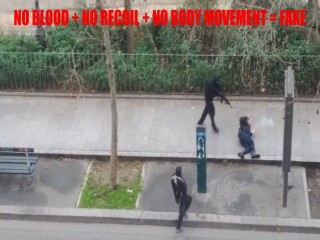
But it does, at least to my mind and obviously a lot of other people’s, judging by how quickly it’s spreading, suggest that Ahmed Merabet, the policeman outside the Charlie Hebdo office, was not shot in the head, as all the media have been stating.

That said, it does not prove much more. It doesn’t prove that Merabet did not die at the scene. Maybe he bled to death there on the pavement from his earlier wound. It certainly doesn’t prove that the Kouachi brothers were not the gunmen or that the one who fired missed on purpose. Maybe he just missed.

Nor does the video’s removal from most websites prove that there is some sort of massive cover-up going on. Ideas of good taste, especially in the immediate aftermath of a massacre close to home (ie here in the West), can lead to a media consensus that a video is too upsetting. That can occur even if it does not show blood and gore, simply because of what it implies. Herd instinct in these instances is very strong.

But the unedited video clip does leave a sour taste: because unless someone has a good rebuttal, it does indeed seem impossible that an AK-47 bullet fired from close range would not have done something pretty dramatic to that policeman’s head. And if the video is real – and there doesn’t seem much doubt that it is – it clearly shows nothing significant happened to his head either as or after the bullet was fired.

So what points am I making?

The first one is more tentative. It seems – though I suppose there could be an explanation I have overlooked – that the authorities have lied about the cause of the policeman’s death. That could be for several probably unknowable reasons, including that his being executed was a simpler, neater story than that he bled to death on the pavement because of official incompetence (there already seems to have been plenty of that in this case).

The second point is even more troubling. Most of the senior editors of our mainstream media have watched the unedited video just as you now have. And either not one of them saw the problem raised here – that the video does not show what it is supposed to show – or some of them did see it but did not care. Either way, they simply regurgitated an official story that does not seem to fit the available evidence.

That is a cause for deep concern. Because if the media are acting as a collective mouth-piece for a dubious official narrative on this occasion, on a story of huge significance that one assumes is being carefully scrutinised for news angles, what are they doing the rest of the time?

The lesson is that we as news consumers must create our own critical distance from the “news” because we cannot trust our corporate media to do that work for us. They are far too close to power. In fact, they are power.

Official narratives are inherently suspect because power always looks out for itself. This appears to be a good example – whether what it shows is relatively harmless or sinister – to remind us of that fact.

UPDATE:

I’m still trying to imagine a plausible explanation for the video. I’m no ballistics expert, so I’m firmly in the land of conjecture. But I wonder whether, if the bullet hit the pavement close to Merabet’s head, it might have been possible for bullet fragments to hit him, possibly killing him.

This possibility (assuming it is one) does not invalidate the point of my post. If it was indeed the case, certainly no media outlet has suggested that the gunman missed Merabet and that he died from the exploding fragments.

This isn’t meant to raise technical, or gruesome, details of the case. It is to suggest that western journalists do not report fearlessly and independently when they examine events being narrated by official sources. They mostly regurgitate information on trust, because they trust the authorities to be telling the truth. They do the same when the acts of official enemies are being examined – they again turn to official sources on their side. In short, most journalists have no critical distance from the events they are reporting on our behalf.

That leaves us, ordinary news consumers, in a position of either blindly trusting our own officials too or trying to work things out for ourselves. You would hope that the issues raised by this video get aired by journalists as part of establishing greater trust in our profession and proof of our independence. Instead, I expect it will simply be consigned the “conspiracy theory” bin.


The Government Killed Martin Luther King Jr.

index

Since today marks the birthday of Martin Luther King Jr. it’s an appropriate time to reflect on his life and legacy but we must also never forget the forces which sought to crush his dream. Because of the work of investigative journalists, we have a clearer idea of the scope of the government’s efforts to discredit and psychologically torment Martin Luther King Jr. such as the following excerpt from an FBI letter to MLK:

King, there is only one thing left for you to do. You know what it is. You have just 34 days in which to do it (this exact number has been selected for a specific reason, it has definite practical significance). You are done. There is but one way out for you. You better take it before your filthy, abnormal fraudulent self is bared to the nation.

Read the complete unredacted FBI letter here: https://www.eff.org/deeplinks/2014/11/fbis-suicide-letter-dr-martin-luther-king-jr-and-dangers-unchecked-surveillance

Given such psychotic threats from the government agency, it’s not much of a stretch to imagine them opting for a more direct approach than trying to bully MLK to commit suicide.

How the Government Killed Martin Luther King, Jr.

By Carl Gibson

Source: Reader Supported News

efore scoffing at this headline, you should know that in 1999, in Memphis, Tennessee, more than three decades after MLK’s death, a jury found local, state, and federal government agencies guilty of conspiring to assassinate the Nobel Peace Prize winner and civil rights leader. The same media you would expect to cover such a monumental decision was absent at the trial, because those news organizations were part of that conspiracy. William F. Pepper, who was James Earl Ray’s first attorney, called over 70 witnesses to the stand to testify on every aspect of the assassination. The panel, which consisted of an even mix of both black and white jurors, took only an hour of deliberation to find Loyd Jowers and other defendants guilty. If you’re skeptical of any factual claims made here, click here for a full transcript, broken into individual sections. Read the testimonies yourself if you don’t want to take my word for it.

It really isn’t that radical a thing to expect this government to kill someone who threatened their authority and had the power to organize millions to protest it. When MLK was killed on April 4, 1968, he was speaking to sanitation workers in Memphis, who were organizing to fight poverty wages and ruthless working conditions. He was an outspoken critic of the government’s war in Vietnam, and his power to organize threatened the moneyed corporate interests who were profiting from the war. At the time of his death, he was gearing up for the Poor People’s Campaign, an effort to get people to camp out on the National Mall to demand anti-poverty legislation – essentially the first inception of the Occupy Wall Street movement. The government perceived him as a threat, and had him killed. James Earl Ray was the designated fall guy, and a complicit media, taking its cues from a government in fear of MLK, helped sell the “official” story of the assassination. Here’s how they did it.

The Setup

The defendant in the 1999 civil trial, Loyd Jowers, had been a Memphis PD officer in the 1940s. He owned a restaurant called Jim’s Grill, a staging ground to orchestrate MLK’s assassination underneath the rooming house where the corporate media alleges James Earl Ray shot Dr. King. During the trial, William Pepper, the plaintiff’s attorney, played a tape of an incriminating 1998 conversation between Jowers, UN Ambassador Andrew Young, and Dexter King, MLK’s son. Young testified that Jowers told them he “wanted to get right with God before he died, wanted to confess it and be free of it.”

On the tape, Jowers mentions that those present at the meetings included MPD officer Marrell McCollough, Earl Clark, an MPD lieutenant and known as the department’s best marksman, another MPD officer, and two men who were unknown to Jowers but whom he assumed to be representatives of federal agencies. While Dr. King was in Memphis, he was under open or eye-to-eye federal surveillance by the 111th Military Intelligence Group based at Fort McPherson in Atlanta, Georgia. Memphis PD intelligence officer Eli Arkin even admitted to having the group in his own office. During his last visit to Memphis in late March of 1968, MLK was under covert surveillance, meaning his room at the Rivermont was bugged and wired. Even if he went out to the balcony to speak, his words were recorded via relay. William Pepper alleges in his closing argument during King v. Jowers that such covert surveillance was usually done by the Army Security Agency, implying the involvement of at least two federal agencies.

Jowers also gave an interview to Sam Donaldson on “Prime Time Live” in 1993. The transcript of the interview was read during the trial, and it was revealed that Jowers openly talked about being asked by produce warehouse owner Frank Liberto to help with MLK’s murder. Liberto had mafia connections, and sent a courier with $100,000 to Jowers, who owned a local restaurant, with instructions to hold the money at his restaurant.

John McFerren owned a store in Memphis and was making a pickup at Liberto’s warehouse at 5:15 p.m. on April 4th, roughly 45 minutes before the assassination. McFerren testified that he overheard Liberto tell someone over the phone, “Shoot the son of a bitch on the balcony.” Other witnesses who testified included café owner Lavada Addison, who was friends with Liberto in the 1970s. She recalled him confiding to her that he “had Martin Luther King killed.” Addison’s son, Nathan Whitlock, also testified. He asked Liberto if he killed MLK, and he responded, “I didn’t kill the nigger but I had it done.” When Whitlock pressed him about James Earl Ray, Liberto replied, “He wasn’t nothing but a troublemaker from Missouri. He was a front man … a setup man.”

The back door of Loyd Jowers’ establishment led to a thick crop of bushes across the street from the Lorraine Motel balcony where Dr. King was shot. On the taped confession to Andrew Young and Dexter King, Jowers says after he heard the shot, Lt. Earl Clark, who is now deceased, laid a smoking rifle at the rear of his restaurant. Jowers then disassembled the rifle, wrapped it in a tablecloth and prepared it for disposal.

The corporate media says it was James Earl Ray who shot MLK, and he did it from the 2nd floor bathroom window of the rooming house across the street from the Lorraine Motel. The official account alleges the murder weapon was dropped in a bundle and abandoned at Dan Canipe’s storefront just before he made his getaway. But even those authorities and media admit that the bullet that tore through MLK’s throat didn’t have the same metallurgical composition as the bullets in the rifle left behind by James Earl Ray. And Judge Joe Brown, a weapons expert called to testify by Pepper in the 1999 trial, said the rifle allegedly used by James Earl Ray had a scope that was never sighted in, meaning that the weapon in question would have fired far to the left and far below the target.

The actual murder weapon was disposed of by taxi driver James McCraw, a friend of Jowers. William Hamblin testified in King v. Jowers that McCraw told him this story over a 15-year period whenever he got drunk. McCraw repeatedly told Hamblin that he threw the rifle over the Memphis-Arkansas bridge, meaning that the rifle is at the bottom of the Mississippi river to this day. And according to Hamblin’s testimony, Canipe said he saw the bundle dropped in front of his store before the actual shooting occurred.

The Conspiracy

To make Dr. King vulnerable, plans had to be made to remove him from his security detail and anyone sympathetic who could be a witness or interfere with the killing. Two black firefighters, Floyd Newsum and Norvell Wallace, who were working at Fire Station #2 across the street from the Lorraine Motel, were each transferred to different fire stations. Newsum was a civil rights activist and witnessed MLK’s last speech to the striking Memphis sanitation workers, “I Have Seen the Mountaintop,” before getting the call about his transfer. Newsum testified that he wasn’t needed at his new assignment, and that his transfer meant that Fire Station #2 would be out of commission unless someone else was sent there in his stead. Newsum talked about having to make a series of inquiries before finally learning that his reassignment had been ordered by the Memphis Police Department. Wallace testified that to that very day, while the official explanation was a vague death threat, he hadn’t once received a satisfactory answer as to why he was suddenly reassigned.

Ed Redditt, a black MPD detective who was assigned to MLK’s security detail, was also removed from the scene an hour before the shooting and sent home, and the only reason given was a vague death threat. Jerry Williams, another black MPD detective, was usually tasked with assembling a security team of black police officers for Dr. King. But he testified that on the night of the assassination, he wasn’t assigned to form that team.

There was a Black Panther-inspired group called The Invaders, who were staying at the Lorraine Motel to help MLK organize a planned march with the striking garbage workers. The Invaders were ordered to leave the motel after getting into an argument with members of MLK’s entourage. The origins of the argument are unclear, though several sources affirm that The Invaders had been infiltrated by Marrell McCollough of the MPD, who later went on to work for the CIA. And finally, the Tact 10 police escort of several MPD cars that accompanied Dr. King’s security detail were pulled back the day before the shooting by Inspector Evans. With all possible obstacles out of the way, MLK was all alone just before the assassination.

The Cover-Up

Around 7 a.m. on April 5, the morning after the shooting, MPD Inspector Sam Evans called Public Works Administrator Maynard Stiles and told him to have a crew destroy the crop of bushes adjacent to the rooming house above Loyd Jowers’ restaurant. This is particularly odd coming from a policeman, since the bushes were in a crime scene area, and crime scene areas are normally roped off, not to be disturbed. The official narrative of a sniper in the bathroom at the rooming house was then reinforced, since a sniper firing from an empty clearing would be far more visible than one hidden behind a thick crop of bushes.

Normally, when a major political figure is murdered, all possible witnesses are questioned and asked to make statements. But Memphis PD neglected to conduct even a basic house-to-house investigation. Olivia Catling, a resident of nearby Mulberry Street just a block away from the shooting, testified that she saw a man leave an alley next to the rooming house across from the Lorraine, climb into a Green 1965 Chevrolet, and speed away, burning rubber right in front of several police cars without any interference. There was also no questioning of Captain Weiden, a Memphis firefighter at the fire station closest to the Lorraine, the same one from which Floyd Newsum had been transferred just a day before.

Memphis PD and the FBI also suppressed the statements of Ray Hendricks and William Reed, who said they saw James Earl Ray’s white mustang parked in front of Jowers’ restaurant, before seeing it again driving away as they crossed another street. Ray’s alibi was that he had driven away from the scene to fix a tire, and these two statements that affirmed his alibi were withheld from Ray’s guilty plea jury.

The jury present at Ray’s guilty plea hearing also wasn’t informed about the bullet that killed MLK having different striations and markings than the other bullets kept as evidence, nor that the bullet couldn’t be positively matched as coming from the alleged murder weapon. Three days after entering the guilty plea, James Earl Ray unsuccessfully attempted to retract it and demand a trial. Incredibly, James Earl Ray turned down two separate bribes, one of which was recorded by his brother Jerry Ray, where he was offered $220,000 by writer William Bradford Huey and the guarantee of a full pardon if he would just agree to have the story “Why I Killed Martin Luther King” written on his behalf.

The Deception

One of the 70 witnesses that William F. Pepper called to testify in King v. Jowers was Bill Schaap, a practicing attorney with particular experience in military law, with bar credentials in New York, Chicago, and DC. Schaap testified at great length about how the government, through the FBI and the CIA, puts people in key positions on editorial boards at influential papers like the New York Times and Washington Post. He describes that although these editorial board members and news directors at cable news outlets may be liberal in their politics, they always take the government’s side in national security-related stories. Before you write that off as conspiracy theory, remember how people like Bill Keller at the New York Times, as well as the Washington Post editorial board, all cheerfully led the march to war in Iraq ten years ago.

Another King v. Jowers witness was Earl Caldwell, a New York Times reporter who was sent to Memphis by an editor named Claude Sitton. Caldwell testified that the orders from his editor were to “nail Dr. King.” In the publication’s effort to sell the story of James Earl Ray as the murderer, the Times cited an investigation into how Ray got the money for his Mustang, rifle, and the long road trip to Tennessee from California. The Times said that according to their own findings as well as the findings of federal agencies, Ray got the money by robbing a bank in his hometown of Alton, Illinois. In Pepper’s closing argument, he says that when he or Jerry Ray talked to the chief of police in Alton, along with the bank president of the branch that was allegedly robbed, neither said they had been approached by the New York Times, or by the FBI. Essentially, the Times fabricated the entire story in order to sell a false narrative that there was no government intervention and that James Earl Ray was a lone wolf.

So for the following 31 years after King’s death, nobody dared to question the constant reiteration of James Earl Ray as the murderer of Martin Luther King. Even 13 years after a jury found the government complicit in a conspiracy to murder the civil rights leader, the complicit media continues to propagate the false narrative they sold us three decades ago and vociferously shout down any alternative theories as to what happened as “conspiracy theory,” framing those putting forth such theories as wackjobs undeserving of any credibility. It’s strikingly similar to how the Washington Post defended their warmongering in a recent editorial commenting on the invasion of Iraq, and had one of their reporters defend the media’s leading of the charge into Iraq.

As we remember Dr. King and the important work he did, we should also reject the official account of his death as loudly as the government and media shout down anyone who tries to contradict their lies. As Edward R. Murrow said, “Most truths are so naked that people feel sorry for them and cover them up, at least a little bit.”


Carl Gibson, 25, is co-founder of US Uncut, a nationwide creative direct-action movement that mobilized tens of thousands of activists against corporate tax avoidance and budget cuts in the months leading up to the Occupy Wall Street movement. Carl and other US Uncut activists are featured in the documentary “We’re Not Broke,” which premiered at the 2012 Sundance Film Festival. He currently lives in Madison, Wisconsin. You can contact him at carl@rsnorg.org, and follow him on twitter at @uncutCG.

Also read:
Who Killed Martin Luther King Jr.?

Martin Luther King assassinated by US Govt: King Family civil trial verdict

The Curtain Rises on Another Act in the Continual Global War on Terror Play

hebdo-shooters

By Wayne Madsen

Source: Strategic Culture Foundation

The attacks in Paris on the editorial offices of the weekly satirical journal Charlie Hebdo and a kosher supermarket have, once again, conveniently turned the attention of the world away from the economic turmoil in the European Union and the extreme unpopularity of its major leaders to the seemingly never-ending «global war on terror».

French President Francois Hollande announced that on January 11, he would march in solidarity on the streets of Paris along with German Chancellor Angela Merkel, British Prime Minister David Cameron, Italian Prime Minister Matteo Renzi, Spanish Prime Minister Mariano Rajoy, Belgian Prime Minister Charles Michel, Ukrainian President Pyotr Poroshenko, Irish Prime Minister Enda Kenny, and the ISIL-enabling Turkish Prime Minister, Ahmet Davitoglu. All of these leaders, facing huge popularity problems at home, were able to use the terrorist attacks in Paris to bolster their own flagging electoral profiles. In addition to the unpopular leaders, NATO Secretary General Jens Stoltenberg, European Council President Donald Tusk, and European Commission chief Jean-Claude Juncker were also scheduled to march in Paris in the grandiose «photo op» to help honor a magazine staff that often lampooned many of these leaders with cartoons that were almost always of a sexual nature.

Once again, the alleged perpetrators of the recent attacks, Franco-Algerian brothers Said and Cherif Kouachi, who were said to have murdered 12 people, including the editor-in-chief of Charlie Hebdo, and Franco-Senegalese Amedy Coulibaly, said to have killed hostages at the supermarket, were well-known to the French police and intelligence services. It was claimed by one of the supermarket customers that Coulibaly said proclaimed that he was from Mali and that he supported ISIL and Palestine. The Kouachis’ names were even included on the American «no-fly list».

The fact that the Kouachis had been involved in recruiting and training jihadist volunteers to fight for the Islamic State of Iraq and the Levant (ISIL) in Syria and had earlier been involved in recruitment efforts for jihadist armies in Iraq and Yemen should have placed a surveillance net over the two brothers. But, as in a previous case in France involving an alleged jihadist terrorist who allegedly killed people at random, the Kouachi brothers, as well as Coulibaly, who was also well-known to the police, were permitted to obtain weapons and other materials without tipping off law enforcement. Coulibaly actually met with French President Nicolas Sarkozy in 2009. Coulibaly worked at a Coca Cola plant in the poor «banlieue» of Grigny, outside of Paris. Coulibaly was one of ten workers selected to meet personally with Sarkozy at the Elysee Palace to discuss youth employment issues. As with the U.S. Secret Service and the American president, French security thoroughly vets those who meet with the French head of state, which makes Coulibaly’s selection to meet Sarkozy even more perplexing. «Le Parisien» quoted Coulibaly as being excited over his meeting with Sarkozy and hoped the French president might help him find him a good job. Coulibaly is said to have first met Cherif Kouachi in 2010. However, Coulibaly supposedly converted to radical Islam while serving time in prison in 2005 for armed robbery. It was in prison that Coulibaly became an adherent of Djamel Beghal, said to be a Franco-Algerian member of Al Qaeda who, in 2001, tried to blow up the U.S. embassy in Paris. Out of all the unemployed and under-employed youth in France, the French president’s security team decided to vet a known follower of an Al Qaeda member to enter the Elysee Palace to meet with Sarkozy. As the French say, «incroyable!»

Pre-attack knowledge by the authorities of an alleged perpetrator was certainly the case in the Merah affair in March 2012 when Mohammed Merah, a French national, was killed by French police. Merah was accused of killing three French paratroopers in Montauban and three students and a teacher at a Jewish school in Toulouse. It was later discovered that not only did the French Central Directorate of Internal Intelligence (DCRI) maintain a thick dossier on Merah, but that French intelligence tried to recruit him as an agent. Merah traveled with ease to Afghanistan and Pakistan with the foreknowledge of French intelligence. The then-governing conservatives of President Nicolas Sarkozy and the opposition, now ruling, Socialist Party conspired to cover up Merah’s links to French intelligence.

The Kouachi brothers are said to have returned from Syria this past summer, where the CIA and French intelligence have been backing Islamist guerrilla groups battling the government of President Bashar al-Assad. The similarities of the Kouachis and Coulibaly to Merah are amazing. All were known to French intelligence before they allegedly carried out their terrorist attacks and all had connections with Al Qaeda groups and affiliates.

Ever since the 1980 time-bombing of the Bologna train station that killed 85 and injured over 200, Western European «false flag» operations have become fairly standardized «boiler plate» operations. This was certainly the case with the three-man professional military assault carried out in a precision manner by the alleged Islamist terrorists on the Paris editorial offices of the satirical journal Charlie Hebdo. Although the two Kouachi brothers, killed by police at a warehouse north of Paris, are said to have carried out the attacks on the newspaper, there is still no explanation of what happened to the third gunman. A third suspect in that attack, a brother-in-law of the Kouachis named Mourad Hamyd, voluntarily turned himself in to the police after he heard his name broadcast by the media. However, Hamyd, 18, was in school at the time of the attack on Charlie Hebdo.

The attack on the Bologna train station began the age of modern false flag attacks. Although in 1980 the Italian government and media originally blamed the bombing on leftist radical Italian guerrillas, it was, in fact, carried out by an underground fascist cell that obtained the bomb materials from hidden caches belonging to the secret NATO «stay behind» paramilitary network known as «Gladio».

Gladio was intended to mobilize guerrilla forces to fight the Soviets in the event of a ground war in Europe. Weapons and materials were hidden underground and in caves throughout Western Europe for future guerrilla assaults on occupying Soviet troops. However, Italian rightists and Zionists attempted to use the discredited Mitrokhin Dossier, allegedly obtained from KGB files, to pin the blame for the Bologna attack on the Soviets acting in concert with radical Arabs, including Palestinian groups. It was later discovered that it was the CIA that funded such news stories in a psychological warfare operation against the Soviets and the Arab countries. From his Paris jail cell in 2005, Ilich Ramirez Sanchez, the famed terrorist known as «Carlos,» revealed that it was the CIA and Mossad that carried out the Bologna bombing and that the Mitrokhin Dossier was being used to «falsify history». Other independent accounts have proven Carlos’s allegation.

Ever since Bologna, the tell-tale signs of Western intelligence false flag operations are extremely evident in attack after attack. By sticking to the same doctrine for over 40 years, Western intelligence fingerprints are becoming as clear as day.

One such tell-tale sign of a false flag operation is the convenient discovery by police of evidence linking attacks to the perpetrators, be they unknowing double agents or patsies who believe in whatever cause has been dangled before them.

One sign of a false flag operation is that «evidence» linking the intended perpetrators to the crime scene is always discovered. French police claim they were able to pin the attack on Kouachis, because Said, the eldest brother, left his French identification card in a black Citroen used as a getaway car. Police would not say whose identification card they found. Some French security experts warned that the ID card may have been purposely planted in the car to confuse the police. Police also conveniently found Molotov cocktails and Islamist jihadist flags inside the getaway car. Alleged 9/11 hijacker Mohammed Atta’s passport was supposedly found in pristine condition in the rubble of the World Trade Center.

Often, the true perpetrators of false flag attacks are masked. This was the case with the three reported gunmen who killed the Charlie Hebdo staff.

There are always other attacks in the region to confuse police. For example, while French police were concentrating their search for the gunmen from northern Paris to the Belgian border, a French police woman was shot and killed in Montrouge, south of Paris. French authorities were quick to say the events south of Paris and at Charlie Hebdo were not linked. Later, it was announced that the two events were linked. Some witnesses at the warehouse and at the newspaper office were convinced that the masked men who turned out to be terrorists were actually counter-terrorism special troops. One man at the warehouse who escaped injury said he shook hands with one of the masked terrorists who he believed was a special policeman. At the same time French police launched their hostage-freeing operations at the warehouse and kosher supermarket, a hostage situation at a jewelry store in Montpellier, in the south of France, was being reported. Police soon said that situation was not connected to the events in the Paris region. Nevertheless, the Montpellier situation conveniently added to the fear factor.

The events in France have given a boost to anti-Islam immigration movements throughout Europe, from the PEGIDA movement and Alternative for Germany (AFD) party in Germany, to the National Front in France, and the UK Independence Party in Britain. Coming so soon after France’s UN Security Council vote to recognize Palestine as a state and the rising political fortunes of the pro-Israel National Front, a «price tag» attack on France, masked as a jihadist terrorist operation, cannot be ruled out.


Related Articles:

Paris Shooting Suspects Under French Radar for YEARS

Who Ordered the Attacks Against Charlie Hedbo?

Dead Men Walking? French Police Release Photos of 2 Likely Patsies

Source: 21st Century Wire

French Police are now on the move now, hoping to get today’s shooting suspects in their sights.

After today’s fatal attack in Paris – at the offices of French political magazine, Charlie Hebdo, the French police have released the  identities of 3 suspects, including photos of two.

Hamyd Mourad, 18 years old, is said to already be in custody after turning himself in to police, while the other two suspects, brothers Said Kouachi and Cherif Kouachi, are said to be at large.

DEAD MEN WALKING: French Police released photos of the brothers Cherif Kouachi, 32, and Said Kouachi, 34.

DEAD MEN WALKING: French Police released photos of the brothers Cherif Kouachi, 32, and Said Kouachi, 34.

According to French news agency AFP, police have issued arrest warrants for brothers Cherif, 32, and Said, 34. They have appealed to the public for information but warned that the men were “likely armed and dangerous”.

According to AFP, “after seeing his name circulating on social media”, 18-year-old Hamyd Mourad has since surrendered to local police at 23:00 local time and taken into custody late Wednesday evening.

Other reports reveal however, that Mourad was in fact in class while the shooting was taking place in downtown Paris. It is more likely then that student Mourad has in fact turned himself in to police in order to avoid harm. If you follow the trending French hashtag, #MouradHamydInnocent,  it is said to have been started by Mourad’s classmates who say he was with them at the time of the attack. It’s worth pointing out straight away, that if police have mixed-up their first ‘suspect’ (which it appears they have), then this lowers the likelihood that their other two ‘suspects’ are genuine.

Multiple US and European media agencies, including CNN, are now announcing that at least one of the suspects was already “under surveillance” by French anti-terror authorities, and that his file was “shared with US security officials” as well. If this is indeed the case, then it’s highly improbable that the suspect would have staged his attack so easily. Once again, official admissions practically cancel out the official narrative.

Back in late September, French security officials suffered a huge embarrassment after three male ‘terror suspects’ who were on their way back from Turkey and Syria were allowed to walk free after landing at Marseille International Airport. All three were said to be “well known to French counter-terrorism officials” and were long been “under surveillance”. Some suspect that these were working with the security services, but that their cover may have been blown.

This latest revelation with the Paris Shooter suspect also matches the modus operandi of the likely informant, Sheikh Monis from Sydney’s Siege before Christmas, and also that of FBI informant, Tamerlan Tsarnaev, of Boston Bombing fame.

If this story plays out like previous high-profile ‘terror’ scenarios, then expect that both brothers Cherif and Said will go the way of the Tsarnaev Brothers, from the 2013 Boston Bombing. The fate of older brother Tamerlan Tsarnaev, who was recruited by US security services as a federal informant before the alleged bombing took place, was tragic. It turns out that Tamerlan was alive and well while initially in police custody – a fact blacked-out by the US media, but reported here at 21WIRE. Later on it appears that he was in fact killed in police custody before his mutilated body was dumped off at the local morgue.

As 21WIRE reported at the time, younger brother Dzhokhar Tsarnaev narrowly escaped with his life during arrest, and was most likely severely injured while in custody.

Like with the Tsarnaevs, when authorities release the photos in public, it almost guarantees that the suspects will never make it out alive, and hence, will never tell their story in public.

Cherif and Said could very well be ‘dead men walking’ now, as police almost certainly be shooting to kill.

READ MORE PARIS SHOOTING NEWS AT: 21st Century Wire Paris Shooting Files

(As with most recent crimes attributed to groups or individuals before any hard evidence is presented, we need to question the official story and also ask ourselves: who benefits?)

A Gloomy Summary of the Outgoing Year

index

By Vladimir Mashin

Source: New Eastern Outlook

The outgoing 2014 is destined, apparently, to go down in the annals of history as a special year given its share of iconic dates (note, for example, 100 years since WWI and 75 years since WWII, 25 years since the fall of the Berlin Wall), and due to abundance of events having worldwide significance.

Today the mankind is on the verge of epochal changes in its history, which will determine the course of the world development for decades to come. 2014 was a turning point in international relations, sharply denoting the main trend of our time – the reconfiguration of the entire world system, reformatting of global structures, the shift from a unipolar to a polycentric world in which decisions on key issues should be based on cooperation and agreements between states and their associations, relying on equal participation and consideration of the interests of the whole mankind. And the contours of this world are now visible.

On the surface, these processes take the form of a deep civilizational and geopolitical fault.

There is a weakening of the position of the United States and the West in general as the center of gravity of the world. Many European political scientists and world known academics speak explicitly about the decline of the Western civilization. European nations are homogeneous, and the continual rise of immigration in recent decades has in fact already changed the ethnic composition of the Old World. Europe found itself unable to integrate the Muslim minority, which is already more than 30 million people, but it is also unable, due to the declining population and its aging, to maintain the current standard of living and the rate of production growth without an influx of the young foreign workforce.

The European sub-ethnic group has entered the phase of obscuration and is on the verge of (according to the criteria of historical time) being absorbed by new, emerging and already prominently visible types (of sub-ethnic groups). This is the Asian sub-ethnic group – a synthesis of several types of cultures and religions. By 2020, experts anticipate a rise of the African sub-ethnic group. In the Western Hemisphere the Hispanic sub-ethnic group is being created on the basis of a huge diversity of ethnic groups and beliefs.

These processes are to a large extent objective: for example, the outgoing year marked the emergence of China as an economic leader (China surpassed the United States in its purchasing power parity in 2014).

If the current trend continues, the “third world”, which today by population surpasses the West five times, by 2050 will surpass it ten-fold.

The reformatting of international relations will further continue. China proposed the following definition for this process: construction of a new non-American world.

In 2014 the US administration, giving itself the status of a self-proclaimed “exceptional nation” entitled to lead world processes, in fact launched a war for the world domination using the NATO military force in conjunction with new methods of disinformation and media control. (This has already occurred in history three-quarters of a century ago, when Germany tried to become a superpower promoting the “Aryan supremacy” with a reliance on military force and Goebbels propaganda). This manifested itself in successive waves of the NATO expansion, contrary to assurances given at the highest level, and in violation of a solemn declaration on the establishment of an equal and indivisible security system in the Euro-Atlantic area. By this logic, the Anschluss of 2014 is a large-scale operation by the US State Department to subjugate the European Union, and then, with combined forces, to launch an attack on the East – stubborn, but temptingly rich with its natural resources and human potential.

The Ukrainian crisis was the result of the policy pursued by the United States and Western countries during the last quarter-century of controlled expansion of their geopolitical space, strengthening their own security at the expense of others. Washington took a line on the separation of Ukraine from Russia and dragging it into the NATO. With the support of the United States and some European countries an armed anti-constitutional coup was carried out in Ukraine. Radical nationalists put the country on the brink of a schism and pushed it into a civil war that has taken thousands of lives and led to the horrible devastation turning into a tragedy for hundreds of thousands of civilians.

In a way, the EU is solving its own problems by capturing Ukrainian markets in order to prevent the collapse of its own integration scheme which had failed the test posed by the protracted economic crisis, since Ukraine, with its 46 million people, black earth, metallurgy and engineering, can reanimate Europe going through a systemic crisis.

The Ukrainian crisis is not a simple episode – it reflects a deep civilizational fault, which has ripped across all continents. The already complex and tense situation is further aggravated, poisoned by provocative, negatively charged statements of certain Western officials.

The Western attempt to tear Ukraine away from Russia and drag it to its side has only further exacerbated the general systemic crisis of international relations.

There is a growing discrepancy between the global ambitions of the US administration and their actual capabilities. America remains the leading economic and military power; however, Washington has no real power, and especially no moral right to lecture everyone else on democracy and proper behavior. Normal people’s hair stands on end from what they see on TV and read in the detailed reports and presentations about the tortures by CIA “experts” of so-called terrorists whose guilt has not been proven. And that’s not to mention the evidence submitted by Snowden about the United States espionage around the world.

In 2014, the Western media coined the “hybrid war” term. It applies to, first of all, the United States and the American war strategy – it is truly hybrid and focused on the military defeat of the enemy, and simultaneously regime change in states pursuing policies objectionable to Washington. Financial and economic pressure is used as well as information attacks, increasing pressure by proxy along the borders of the respective state, and, of course, informational and ideological influence by relying on externally funded non-governmental organizations. Is this not what is called a war?

In 2014, the flares of the “Arab Spring”, seemingly so encouraging at the initial stages, proceeded to incinerate the Middle East which by its degree of ‘flashpoint’ tension – right now twelve different scale armed conflicts are blazing there – has moved to the forefront of world events. The main reason is the US military invasion of Iraq in 2003. The transition of control in Baghdad from the Sunnis who had been in power traditionally to the Shiite majority, with the direct complicity of the United States, has led to a breach in the balance of power in the Persian Gulf, which had existed for decades and was the basis for maintaining stability. This resultant bias towards the growing influence of Shiites and indirectly Iran immediately caused an explosion of discontent and fear within the Sunni minority in Iraq and Sunni communities as a whole in the region.

Open intervention by Western powers in the Iraqi drama, into the affairs of Libya and Syria, seriously complicates the situation and leads to the increased activity of Islamist extremists. At the core of the “Arab Spring” events was the struggle for social justice, for a way out of the vicious circle of underdevelopment and injustice – it was an arising national identity, the movement against Westernization, the desire for self-assertion and defining a decent place for Arabs in the international community. The US and some European countries have tried to turn to their advantage the rise of revolutionary action and in its wake the ascent of Islamic parties to the levers of power in a number of Arab countries. To do this, proven methods were used, such as incitement to religious and ethnic strife, the tacit support of extremist organizations. The activation of al-Qaeda, Boko Haram, the Taliban and the establishment of the Islamic Caliphate in Syria and Iraq is a direct result of the policy of the United States and other Western powers.

There is a real disintegration of state, social and civilizational structures going on in the Middle East region. ISIS terrorists have laid claim to their statehood status, and are beginning to develop the territories, setting up governmental authorities there, that are quasi-state, but, nonetheless, perform administrative functions. We cannot exclude the possibility that the actions of Islamist terrorists can also spread beyond the region.

Throughout 2014, new centers of the extremist activity in Africa (Libya, Mali, Sinai, Nigeria, Somalia, etc.) have appeared and the centers of radicalism in Afghanistan and Pakistan are expanding on the map.

Some Western leaders are still thinking in terms of the Cold War, not fully grasping the possible catastrophic consequences of current trends. But the development of some of them raises the question of the preservation of life on our planet: for example, the fact that nine states have 16,300 nuclear warheads at their disposal, which is enough to kill all life on the Earth many times over.

In the 20th century, the world repeatedly faced with the risk of weapons of mass destruction being used (UN official sources indicated thirteen such situations after 1962). In 2002, the world was in danger of the Indo-Pakistani War (note that Pakistan has the fastest growing nuclear program in the world). According to Al-Arabiya website of December 10, 2014, Israel offered to sell a nuclear bomb to the apartheid regime in South Africa. And the 2003 UN Security Council resolution number 687 declared as its goal “making the Middle East a zone free of weapons of mass destruction and missiles capable of delivering these weapons” (The Conference for the implementation of this task was scheduled for 2012, but is still delayed to this day).

The civilizational fault in today’s globalized, but very fragile world is becoming one of the forms of many contradictions. And, at their base is the question of values. Western powers are moving away from their once traditional postulates and are trying to return their former hegemony by force. This is a very painful process, because the West does not want to accept the fact of its diminishing influence and loss of ability to manage global processes. Now there is an increasingly growing tendency towards asserting the unconditional right of every civilization to choose, without pressure and pointers from the outside, a system of government, relevant government institutions, ethnic, ethical and cultural paradigms.

There is a genuine war going on between sound conservatism – for the preservation of ethical moral principles developed by the mankind over centuries of Homo sapiens’ evolvement, and rampant liberalism, the accession to power of instincts, which means degradation, offensive barbarism, leading eventually to the extinction of the human race. Our outstanding scientists – Vernadsky, Moiseev, Rauschenbach – warned us about this.

Russia consistently and firmly acts from its belief in the cultural and civilizational diversity of the modern world, where each state has the right to its own path of development and should be able to freely and independently determine its foreign policy in the framework of the goals and principles of the UN Charter. Attempts to impose a different value system, interference in the internal affairs of other countries are fraught with the danger of sliding towards chaos and unmanageability of international affairs.

Brzezinski’s famous political thriller – “The Grand Chessboard: American Primacy and Its Geostrategic Imperatives” – clearly defines the objectives of the chess game: to provide the US world domination euphemistically called “leadership”. Besides, it directly and bluntly asserts that in the twenty-first century “the chief geopolitical prize for America is Eurasia.”

And now, when the center of global processes has suddenly moved to Ukraine, where a real opposition front opened up, the United States and Western Europe have lined up openly against Russia.

Linking together the events in Ukraine, the Middle East, Southwest Asia and the Caucasus, it is possible to see strategic plans of globalists. The situation is extremely fluctuant, the balance vacillates, and there is a reason to believe that the historical time for containing Russia by the combined West has been lost.

Russia, with its unique natural resources, economic and, most importantly, human potential, a fusion of many peoples and cultures, is geographically and historically a unique independent world civilization, able to withstand the challenges of the coming epoch.

Russian President Vladimir Putin in his recent speech said that no one in history has ever been able to subjugate Russia to his will. It’s not even an assessment, but a statement of fact. Although such attempts have been made by the West for the sake of quenching its thirst for expanding the geopolitical space under its control.

The obvious fact now is that the vast majority of the states with which Russia continues its dialogue appreciate the independent role of the Russian Federation in the international arena.

American professor Samuel Huntington, a historian so often quoted recently while praising the power of the United States, nonetheless admitted that “the West conquered the world not by the superiority of its ideas, moral values or religion (few other civilizations were converted to it) but rather as a result of superiority in the use of organized violence.” In the West, this fact has been forgotten, but in the East – it will never be. The US invasion to Iraq, which in fact laid the groundwork for a chain of collisions – tragic for the peoples and endless to this day – national, ethnic, religious, economic, and social, at the same time has sucked the US deeply into the quagmire of a perpetual conflict with the Islamic world. Since the Roman Empire there has never been a situation where the tentacles of one nation’s claims stretched so far from its borders.

Ultimately, humanity can survive if it realizes that there is no real alternative to cooperation. We have so many global and regional issues, and the world is becoming so fragile that there is simply no other way out. (For example, Secretary of State Kerry, for nine long months made unilateral shuttle trips in an attempt to reach a peaceful political settlement between Israel and the Palestinians. But unilateral American efforts proved ineffective. Moreover, there has been a new outbreak of bloody clashes in Jerusalem, and tension in Israeli-Palestinian affairs is growing. Meanwhile, in another situation on the Syrian track, when Russia and the United States worked together with China, we were able to prevent a major war in the region, eliminate chemical weapons in Syria and convene the Geneva Conference).

Unfortunately, in today’s world the number of terrorist attacks and conflict situations is on the rise again. New dividing lines or the construction of new walls will not lead to the resolution of these problems.

To cope with these and other pending challenges, we can only work together on the basis of equal and mutually respectful cooperation.

Vladimir Mashin, Ph.D. in History, a political commentator, exclusively for the online magazine “New Eastern Outlook”.