Neocon Warmonger Advocates Nukes to Nazis in Ukraine

Violent Russian-hating Nazis wouldn’t nuke Moscow, would they?

By Kurt Nimmo

Source: Kurt Nimmo Substack

Maybe you may remember Michael Rubin. He worked with Douglas Feith’s Office of Special Plans (OSP), a neocon pro-war outfit set-up in the Pentagon by then Secretary of Defense Donald Rumsfeld. The OSP’s objective was to create a series of false pretenses to invade Iraq in 2003.

According to Karen Kwiatkowski, a retired Air Force Lieutenant Colonel whose assignments included duties as a Pentagon desk officer, the Office of Special Plans represented a “subversion of constitutional limits on executive power and a co-option through deceit of a large segment of the Congress.”

Rumsfeld and vice president Dick Cheney used the OSP to publicize “hot garbage” from a cast of dubious characters produced by Ahmed Chalabi’s Iraqi National Congress, including “Curveball” (Rafid Ahmed Alwan al-Janabi, a German intelligence asset pretending to be an Iraqi chemical engineer).

The lies that killed over a million Iraqis were dismissed as “intelligence failures” and swept under the rug. Bush, Cheney, Rumsfeld, Feith, Rubin, and other neocons were never held responsible for the massive war crimes they perpetuated.

On June 9, Rubin, a “senior fellow” at the American Enterprise Institute (and former “fellow” at the Council on Foreign Relations), penned “Can Biden Deter a Russia Nuclear Attack on Ukraine? Yes, if He Gives Ukraine Tactical Nukes.

Rubin demands the nazified post-coup government of Ukraine receive nukes. Rubin believes the 1994 Budapest Memorandum (exchanging Soviet-era nukes deployed to Ukraine in exchange for sovereignty) was a monumental error. “The simple fact is this: United States maintains nuclear weapons because they are an effective deterrent against other nuclear states. Ukraine should have the same right,” Rubin writes.

Rubin and his neocon co-conspirators are not interested in “an effective deterrent” in Ukraine; they are interested in destroying the Russian state, the same as they destroyed the Iraqi state. However, Iraq, despite neocon lies, never had nuclear weapons (and the chemical weapons they did possess were supplied US corporations). Russia controls the largest arsenal of nukes in the world.

The non-proliferation mafia might howl with outrage, but the West must gear its nuclear policy toward reality, not wishful thinking or an empty façade of a treaty regimen by which revisionist states no longer abide.

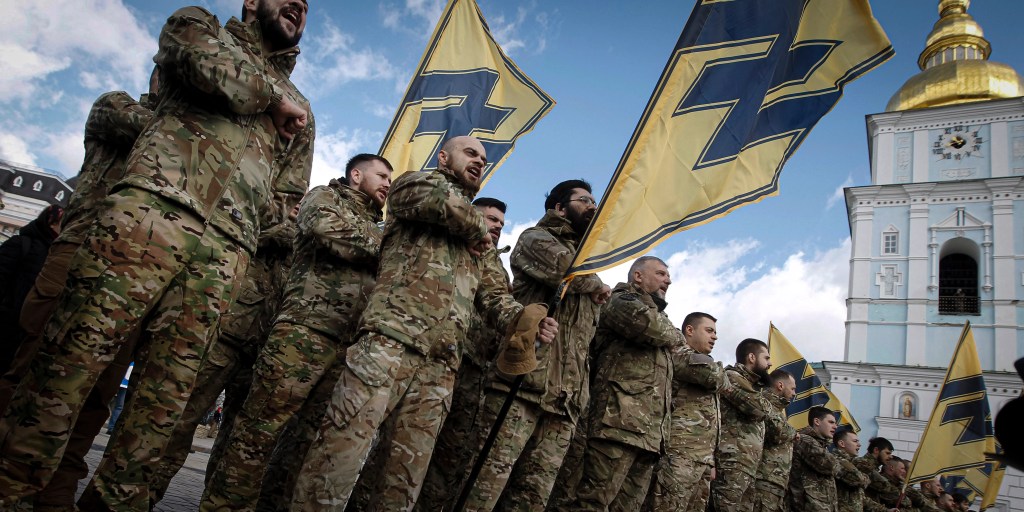
Please read between the lines. According to this entitled “senior fellow,” the neocon “reality” envisions nuclear war as the most effective way to overthrow Putin and dismember the Russian Federation. Rubin, of course, does not call directly for nuclear war. However, his demand that Ukraine be allowed to acquire nuclear weapons will result in precisely that outcome. Imagine Ukraine’s Azov Battalion neo-nazis using nukes to target the Kremlin instead of hit-or-miss drones.

Rubin’s clarion call for nuclear destruction was crossposted on 19FortyFive, a “center-right” website that has produced neocon propaganda subsequently picked up by The New York Times, Newsweek, The Washington Post, The Hill, Reuters, and Voice of America (CIA propaganda), among others. It should be noted that 19FortyFive was until very recently a “regional defense publication.”

With the Ukrainian counter-offensive underway, the threat that Russia might use tactical nuclear weapons is increasingly a likelihood. It would be unfair to blame Kyiv. There is no moral equivalence. Russia invaded Ukraine; not the other way around. So long as Ukraine was on the verge of victory, Putin would arrive at this point of nuclear retaliation.

Nonsense. Zelenskyy’s “counter-offensive” has thus far failed miserably, a fact even the war propaganda media is obliged to admit. Thus, Russia does not need to use nuclear weapons. Rubin, however, is able to make his bogus claim thanks to the fiction of Russian desperation over defeat, a false narrative telegraphed daily by a mendacious and cynically fantasist corporate propaganda media.

As should be expected, Rubin completely ignores the fact Russia went into eastern Ukraine to prevent the ethnic cleansing and slaughter of ethnic Russians. For the neocons, responsible for massive war crimes in the Middle East (Iraq, Syria, Libya), human life is expendable. Disease, malnutrition, infant mortality, DU-produced cancer—these are the preferred tools for regime change and the destruction of targeted societies resistant to neoliberal serfdom.

Rubin believes the prospect of USG nukes handed over to Russian-hating neo-nazi ultranationalists in Ukraine will save the day and prevent military action “not only against Ukraine but also against Moldova and the Baltic States,” a claim that is utter BS.

Meanwhile, more rational Americans, while small in number, are increasingly concerned about the escalatory behavior of the USG, under the sway of vicious and murderous neocons, which will put an end to not only civilization but all life on planet Earth.

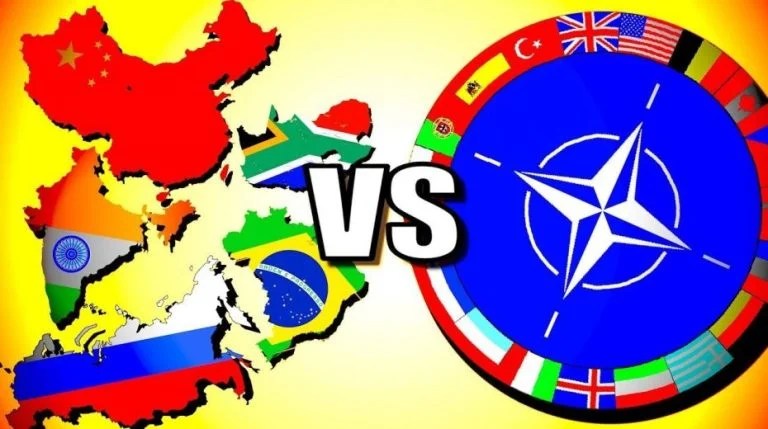
The BRICS Reshape the Global Geopolitical Map

By Manuel F. Diaz

Source: InfoBrics.org

Thirty years ago, pluripolarity was far from a reality in a world that had been under U.S. hegemony since the collapse of the Soviet Union in 1991. Today, however, humanity is taking important steps toward forming a plural geopolitics whose protagonists are the emerging countries that challenge Western power.

The turning point towards a new form of integration, which will generate a new world political balance, occurred in 2009 when Brazil, Russia, India, and China held the first BRIC summit.

After the incorporation of South Africa to this group in 2010, the BRICS has generated such real prospects that other nations with productive capacity and diversified economies have expressed interest in joining. Among them are Saudi Arabia, Algeria, Argentina, the United Arab Emirates, and Mexico.

In the article “Can the BRICS Trump the IMF and the World Bank?,” Palestinian-American journalist Ramzy Baroud noted that “one of the biggest opportunities and challenges” the BRICS now faces is expanding its membership while maintaining its current growth.

Recent financial reports revealed that the BRICS have the world’s largest gross domestic product (GDP) and that economic bloc contributes 31.5 percent of global GDP, while the Group of Seven (G7) stuck at 30.7 percent.

The International Monetary Fund (IMF) and the World Bank (WB) are known for providing financial support to developing countries under conditions that, under the pretext of defending human rights or democracy, seek to favor the privatization of public goods and the opening of domestic markets for Western foreign investors.

Due to these politically-driven conditionalities, the struggle for alternatives to the IMF-WB mechanisms becomes a political task. The Global South requires international institutions that are not interested in indirectly manipulating or controlling national economies.

That is the call for the BRICS to evolve towards integration schemes that go beyond the exclusively economic realm, although the basis of the fight against the U.S.-controlled institutions is the formation of an alternative economy.

Recently, the BRICS placed a capital of US$50 billion for the launch of their New Development Bank (NDB), which will be chaired by former Brazilian president Dilma Rousseff.

This happened at a time when presidents Xi Jinping (China) and Lula da Silva (Brazil) showed a shared interest in influencing the peaceful solution of the Ukrainian conflict.

Under these circumstances, to argue that the BRICS are a group with purely economic interests is to ignore much of the its history.

“The timing of the BRICS expansion, the stern political discourse of its members, potential members and allies, the repeated visits by top Russian and Chinese diplomats to Africa and other regions of the Global South, etc… indicate that the BRICS have become the new geopolitical, economic and diplomatic platform for the countries of the South,” said Baroud.

Meanwhile, the Western powers, whose economies are struggling to stay afloat, are closely and suspiciously watching the changes taking place in the Global South at the hands of the BRICS.

The Hegemon Will Go Full Hybrid War Against BRICS+

The Hybrid War 2.0 against the Global South has not even started. Swing states, you have all been warned.

By Pepe Escobar

Source: Global Research

U.S. Think Tank Land hacks are not exactly familiar with Montaigne: “On the highest throne in the world, we still sit only on our own bottom.”

Hubris leads these specimens to presume their flaccid bottoms are placed high above anyone else’s. The result is that a trademark mix of arrogance and ignorance always ends up unmasking the predictability of their forecasts.

U.S. Think Tank Land – inebriated by their self-created aura of power – always telegraphs in advance what they’re up to. That was the case with Project 9/11 (“We need a new Pearl Harbor”). That was the case with the RAND report on over-extending and unbalancing Russia. And now that’s the case with the incoming

American War on BRICS as outlined by the chairman of the New York-based Eurasia Group.

It’s always painful to suffer through the intellectually shallow Think Thank Land wet dreams masquerading as “analyses” but in this particular case key Global South players need to be firmly aware of what awaits them.

Predictably, the whole “analysis” revolves around the imminent, devastating humiliation to the Hegemon and its vassals: what happens next in country 404, also known – for now – as Ukraine.

Brazil, India, Indonesia and Saudi Arabia are dismissed as “four major fence-sitters” when it comes to the U.S./NATO proxy war against Russia. It’s the same old “you’re with us or against us” trope.

But then we are presented with the six major Global South culprits: Brazil, India, Indonesia, Saudi Arabia, South Africa and Turkey.

In yet another crude, parochial remix of a catch phrase referring to the American elections, these are qualified as the key swing states the Hegemon will need to seduce, cajole, intimidate and threaten to assure its dominance of the “rules-based international order”.

Saudi Arabia and South Africa are added to a previous report focused on the “four major fence sitters”.

The swing state manifesto notes that all of them are G-20 members and “active in both geopolitics and geoeconomics” (Oh really? Now that’s some breaking news). What it does not say is that three of them are BRICS members (Brazil, India, South Africa) and the other three are serious candidates to join BRICS+: deliberations will be turbo-charged in the upcoming BRICS summit in South Africa in August.

So it’s clear what the swing state manifesto is all about: a call to arms for the American war against the BRICS.

So BRICS packs no punch

The swing state manifesto harbors wet dreams of near-shoring and friend-shoring moving away from China. Nonsense: enhanced intra-BRICS+ trade will be the order of the day from now on, especially with the expanded practice of trade in national currencies (see Brazil-China or within ASEAN), the first step towards widespread de-dollarization.

The swing states are characterized as “not a new incarnation” of the Non-Aligned Movement (NAM), or “other groupings dominated by the Global South, such as the G-77 and BRICS.”

Talk about exponential nonsense. This is all about BRICS+ – which now has the tools (including the NDB, the BRICS bank) to do what NAM could never accomplish during the Cold War: establish the framework of a new system bypassing Bretton Woods and the interlocking coercion mechanisms of the Hegemon.

As for stating that BRICS has not “packed much punch” that only reveals U.S. Think Tank Land’s cosmic ignorance of what BRICS + is all about.

The position of India is only considered in terms of being a Quad member – defined as a “U.S.-led effort to balance China”. Correction: contain China.

As for the “choice” of swing states of choosing between the U.S. and China on semiconductors, AI, quantum technology, 5G and biotechnology, that’s not about “choice”, but to what level they are able to sustain Hegemon pressure to demonize Chinese technology.

Pressure on Brazil, for instance, is much heavier than on Saudi Arabia or Indonesia.

In the end though, it all comes back to the Straussian neocon obsession: Ukraine. The swing states, in varying degrees, are guilty of opposing and/or undermining the sanctions dementia. Turkey, for instance, is accused of channeling “dual-use” items to Russia. Not a word on the U.S. financial system viciously forcing Turkish banks to stop accepting Russian MIR payment cards.

On the wishful thinking front, this pearl stands out among many: “The Kremlin seems to believe it can make a living by turning its trade south and east.”

Well, Russia is already making excellent living all across Eurasia and a vast expanse of the Global South.

The economy has re-started (drivers are domestic tourism, machine building and the metals industry); inflation is at only 2.5% (lower than anywhere in the EU); unemployment is at only 3.5%; and head of the Central Bank Elvira Nabiullina said that by 2024 growth will be back to pre-SMO levels.

U.S. Think Tankland is congenitally incapable of understanding that even if BRICS+ nations may still have some serious trade credit issues to iron out, Moscow has already shown how even an implied hard backing of a currency can turn out to be an instant game changer. Russia is at the same time backing not only the ruble but also the yuan.

Meanwhile, the Global South de-dollarization caravan moves on relentlessly – as much as the proxy war hyenas may keep howling in the dark. When the full – staggering – scale of NATO’s humiliation in Ukraine unfolds, arguably by mid-summer, the de-dollarization high-speed train will be fully booked, non-stop.

“Offer you can’t refuse” rides again

If all of the above was not already silly enough, the swing state manifesto doubles down on the nuclear front, accusing them of “future (nuclear) proliferation risks”: especially – who else – Iran.

By the way, Russia is defined as a “middle power, but one in decline”. And “hyper-revisionist” to boot. Oh dear: with “experts” like this, the Americans don’t even need enemies.

And yes, by now you may be excused to roar with laughter: China is accused of attempting to direct and co-opt BRICS. The “suggestion” – or “offer you can’t refuse”, Mafia-style – to the swing states is that you cannot join a “Chinese-directed, Russian-assisted body actively opposing the United States.”

The message is unmistakable: “The threat of a Sino-Russian co-optation of an expanded BRICS—and through it, of the global south—is real, and it needs to be addressed.”

And here are the recipes to address it. Invite most swing states to the G-7 (that was a miserable failure). “More high-level visits by key U.S. diplomats” (welcome to cookie distributor Vicky Nuland). And last but not least, Mafia tactics, as in a “nimbler trade strategy that begins to crack the nut of access to the U.S. market.”

The swing state manifesto could not but let the Top Cat out of the bag, predicting, rather praying that “U.S.-China tensions rise dramatically and turn into a Cold War-style confrontation.” That’s already happening – unleashed by the Hegemon.

So what would be the follow-up? The much sought after and spun-to-death “decoupling”, forcing the swing states to “align more closely with one side or the other”. It’s “you’re with us or against us” all over again.

So there you go. Raw, in the flesh – with inbuilt veiled threats. The Hybrid War 2.0 against the Global South has not even started. Swing states, you have all been warned.

Schrödinger’s War – And Orwell’s

By Raúl Ilargi Meijer

Source: The Automatic Earth

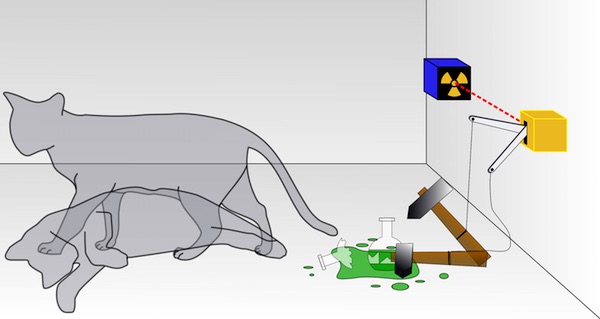
Physicist Erwin Schrödinger in 1935 tried to explain the (consequences of the) uncertainty principle, defined by Werner Heisenberg as a core theme of Albert Einstein’s view of quantum mechanics, to … Albert Einstein. The latter must have been thrilled. Even though he did not like the uncertainty principle (God does not play dice). The thought experiment became known as “Schrödinger’s cat”. Since you cannot know both a particle’s position and its speed -and that’s just one example-, you have to assume all possible outcomes are valid (superposition). Only when you “look” does one particular outcome become the “reality”. It’s all part of the subatomic “world”

Wikipedia: “In Schrödinger’s original formulation, a cat, a flask of poison, and a radioactive source are placed in a sealed box. If an internal monitor (e.g. a Geiger counter) detects radioactivity (i.e. a single atom decaying), the flask is shattered, releasing the poison, which kills the cat. The Copenhagen interpretation implies that, after a while, the cat is simultaneously alive and dead. Yet, when one looks in the box, one sees the cat either alive or dead, not both alive and dead. This poses the question of when exactly quantum superposition ends and reality resolves into one possibility or the other.”

As I’m trying to explain this, I very much have to wonder if I get it right. And I always thought that follows the uncertainty principle too: I can understand it and not understand it both at the same time. A physicist might fare a bit better, but it won’t come easy.

This is what I was thinking of with regards to the war in Ukraine. Before the fighting started, all possible outcomes seemed equally possible. If you did not look too closely at numbers of soldiers and weaponry, that is. But once it did start (when Schrödinger’s box was opened), it became clear very rapidly that Ukraine had no chance of winning. So why are we still acting as if the box remains closed? Because that way we get to spend billions more on armory, and we get western people to support Zelensky and his neo-nazis as those same people suffer from high prices for everything. Any outcome is still possible!

Take the Kakhovka dam narrative, or Nord Stream or any of the numerous other examples. When both sides accuse each other of perpetrating a certain event, Schrödinger’s box remains closed. Which is exactly what our politicians and arms makers desire. They don’t want us to know that they’ve been beaten by Russia, because you would no longer support their policies and their arms purchases. They want “superposition”. They can’t very well declare victory -though they try-, but they don’t need to either. They need uncertainty. Politicians, arms makers and media. They all profit from keeping you in the dark.

The best comment on Kakhovka I’ve seen perhaps comes from @CheburekiMan on Twitter: “Restoring water flow to the North Crimean Canal was top priority for Russia, the very first act of the SMO. Before Kiev shut off the flow in 2014, the canal was supplying 85% of Crimea’s water. So much depended on it, from crops to industry to drinking water, that’s how important it is. Now the pro-Ukraine bleating sheep want people to believe that Russia would wreck the dam, empty the reservoir and cause serious harm to its own people by running the canal dry. It’s so bonkers that one has to seriously consider such ideas are the result of brain damage, or perhaps fetal alcohol syndrome.”

Where Orwell comes in is in the terminology. Where “War equals Peace”. The EU pays its member states for the second hand weapons they “donate” to Kiev, through something called the European Peace Fund (aka Facility). Mass weapons deliveries that get huge numbers of people killed, are labeled “Peace”. Zelensky touts a plan labeled a Peace Plan, which demands Russia give back all territories, pay war reparations, deliver Putin et al to some international criminal court etc. The chance of that happening is of course zero, but as long as Schrödinger’s box remains closed, anything is possible. Still, it is a War Plan, not a Peace Plan.

Similarly, Zelensky and his international backers are organizing a Peace Summit, where everybody is invited except Russia. That makes it a War Summit. The suggestion made to westerners is that this is a globally supported initiative, but it is only a small part of the world population (10%?) that supports it. NATO+Japan+Australia. Did I leave anyone out? New Zealand? Ha ha ha, I read that Jacinda Ardern was made a dame. If you know a better illustration of how deep we’ve sunk, I’m game.

All the rest of the world is much more interested in the economic developments that involve BRICS+. 31 and counting nations have expressed interest in joining. And they’re not going to risk their potential role in that over a local fight far away that they know is long decided. US/NATO, in provoking this war, have lost not only the fight, but much more importantly, their economic power. Recently, the G7 were talking about what they were going to do in Central Asia. Which is basically all the “-Stans” left over after the Soviet Union dissolved. But the G7 is not going to do anything, it has no power there anymore. All these countries want to join the BRICS+. Why would you join a waning power if you have a shot at joining a power in its ascendancy, that all your neighbors are also joining?

The same attitude is prevalent in Africa, South America, East Asia, etc. Full of countries that remember how they were treated through the years by first Europe and then the US. The world has changed beyond recognition since the start of Russia’s SMO, and the “globalist west” is the only “region” that doesn’t recognize this. The USD won’t be replaced tomorrow as the reserve currency, but it doesn’t have to be. The process goes step by step, and is unstoppable. Hemingway’s famous words about how you go bankrupt (first gradually, then suddenly) have us on the wrong foot here. We only look at the “suddenly” part when it comes to the reserve currency, and ignore all the “gradually” steps. And then one day we will wake up and everything’s changed.

The rest of the world sees Schrödinger’s box as open. Only the west thinks that it’s still closed, and all possible outcomes are still viable.

Saturday Matinee: Possessor

By Norman Gidney

Source: Film Threat

In just his second feature, Brandon Cronenberg, son of David, has delivered the first great sci-fi horror movie of the decade with Possessor. In the future, corporations use internal agents to inhabit innocent people’s bodies to carry out high-profile assassinations for strategic gains. Tanya Vos (Andrea Riseborough) is one such agent. In fact, she’s the star player at her secretive killing firm. But when the brain implant process takes its toll during an assignment, she begins to lose a grip on her own identity. Exploring self and identity, Cronenberg deftly explores heady material in a sci-fi horror candy coating, delivering a challenging ferocious film.

The action and concept are presented straight away with a bloody assassination in a nightclub. Miles away, Tanya lays on a white leather chaise with her head in a contraption guiding the host body from afar. After the assassination, she is to kill the host body with a shot to the head. Yet with this latest contract, her boss, Girder (Jennifer Jason Leigh), notices that Tanya is losing her grip on her true identity. Hesitant, Tanya accepts one last job in the form of Colin (Christopher Abbott), a coked-out rich boy with access to the CEO of a major tech company. The goal is to inhabit Colin’s body and have it murder Colin’s soon-to-be father in law John Parse (Sean Bean).

After going home to visit her estranged husband and 7-year-old son, Tanya returns to the facility to complete her final assassination. After the transfer, trouble ensues as various glitches in the technology are creating artifacts, hallucinations, and unpredictable behavior. Worse still, Colin’s hijacked personality begins fighting its way back to the surface. Will Tanya get the job done? Will Colin take over and trap Tanya in his body forever?

Cronenberg’s script for Possessor deftly convinces the audience that its world is real. It sprinkles random details of the technology in context rather than laboriously over-explaining all of it. We watch the process and hear just enough technobabble to believe it, and then we are off and running. To this end, Leigh’s understated performance as the calm puppetmaster at the firm is grounded and unsettling.

After kidnapping Colin and implanting the device in his brain, Tanya transfers into Colin’s body and assumes his life. In a brilliant pair of performances, Abbot and Riseborough make us believe that Tanya is inhabiting a very alien male body. Standing before a mirror just after the transfer, Abbot portrays Tanya exploring her new host, lightly feeling the skin, looking at the odd genitalia in the front, and trying to act as normal. The two create a seamless illusion of a single personality.

Possessor explores all of the existential dilemmas this idea can afford to a frightening degree while telling an absorbing tale of corporate espionage. Cronenberg has created a mind-bending trip of a movie with more to say than your average actioner and is supported by spectacular performances and make-up and practical effects that seal the deal. Brace yourself. The film is brilliant.

____________________

Watch Possessor on Kanopy here: https://www.kanopy.com/en/product/13106284

Clinging Bitterly to Guns and Religion

The End Stage of American Empire

By William J. Astore

Source: TomDispatch.com

All around us things are falling apart. Collectively, Americans are experiencing national and imperial decline. Can America save itself? Is this country, as presently constituted, even worth saving?

For me, that last question is radical indeed. From my early years, I believed deeply in the idea of America. I knew this country wasn’t perfect, of course, not even close. Long before the 1619 Project, I was aware of the “original sin” of slavery and how central it was to our history. I also knew about the genocide of Native Americans. (As a teenager, my favorite movie — and so it remains — was Little Big Man, which pulled no punches when it came to the white man and his insatiably murderous greed.)

Nevertheless, America still promised much, or so I believed in the 1970s and 1980s. Life here was simply better, hands down, than in places like the Soviet Union and Mao Zedong’s China. That’s why we had to “contain” communism — to keep them over there, so they could never invade our country and extinguish our lamp of liberty. And that’s why I joined America’s Cold War military, serving in the Air Force from the presidency of Ronald Reagan to that of George W. Bush and Dick Cheney. And believe me, it proved quite a ride. It taught this retired lieutenant colonel that the sky’s anything but the limit.

In the end, 20 years in the Air Force led me to turn away from empire, militarism, and nationalism. I found myself seeking instead some antidote to the mainstream media’s celebrations of American exceptionalism and the exaggerated version of victory culture that went with it (long after victory itself was in short supply). I started writing against the empire and its disastrous wars and found likeminded people at TomDispatch — former imperial operatives turned incisive critics like Chalmers Johnson and Andrew Bacevich, along with sharp-eyed journalist Nick Turse and, of course, the irreplaceable Tom Engelhardt, the founder of those “tomgrams” meant to alert America and the world to the dangerous folly of repeated U.S. global military interventions.

But this isn’t a plug for TomDispatch. It’s a plug for freeing your mind as much as possible from the thoroughly militarized matrix that pervades America. That matrix drives imperialism, waste, war, and global instability to the point where, in the context of the conflict in Ukraine, the risk of nuclear Armageddon could imaginably approach that of the 1962 Cuban Missile Crisis. As wars — proxy or otherwise — continue, America’s global network of 750-odd military bases never seems to decline. Despite upcoming cuts to domestic spending, just about no one in Washington imagines Pentagon budgets doing anything but growing, even soaring toward the trillion-dollar level, with militarized programs accounting for 62% of federal discretionary spending in 2023.

Indeed, an engorged Pentagon — its budget for 2024 is expected to rise to $886 billion in the bipartisan debt-ceiling deal reached by President Joe Biden and House Speaker Kevin McCarthy — guarantees one thing: a speedier fall for the American empire. Chalmers Johnson predicted it; Andrew Bacevich analyzed it. The biggest reason is simple enough: incessant, repetitive, disastrous wars and costly preparations for more of the same have been sapping America’s physical and mental reserves, as past wars did the reserves of previous empires throughout history. (Think of the short-lived Napoleonic empire, for example.)

Known as “the arsenal of democracy” during World War II, America has now simply become an arsenal, with a military-industrial-congressional complex intent on forging and feeding wars rather than seeking to starve and stop them. The result: a precipitous decline in the country’s standing globally, while at home Americans pay a steep price of accelerating violence (2023 will easily set a record for mass shootings) and “carnage” (Donald Trump’s word) in a once proud but now much-bloodied “homeland.”

Lessons from History on Imperial Decline

I’m a historian, so please allow me to share a few basic lessons I’ve learned. When I taught World War I to cadets at the Air Force Academy, I would explain how the horrific costs of that war contributed to the collapse of four empires: Czarist Russia, the German Second Reich, the Ottoman empire, and the Austro-Hungarian empire of the Habsburgs. Yet even the “winners,” like the French and British empires, were also weakened by the enormity of what was, above all, a brutal European civil war, even if it spilled over into Africa, Asia, and indeed the Americas.

And yet after that war ended in 1918, peace proved elusive indeed, despite the Treaty of Versailles, among other abortive agreements. There was too much unfinished business, too much belief in the power of militarism, especially in an emergent Third Reich in Germany and in Japan, which had embraced ruthless European military methods to create its own Asiatic sphere of dominance. Scores needed to be settled, so the Germans and Japanese believed, and military offensives were the way to do it.

As a result, civil war in Europe continued with World War II, even as Japan showed that Asiatic powers could similarly embrace and deploy the unwisdom of unchecked militarism and war. The result: 75 million dead and more empires shattered, including Mussolini’s “New Rome,” a “thousand-year” German Reich that barely lasted 12 of them before being utterly destroyed, and an Imperial Japan that was starved, burnt out, and finally nuked. China, devastated by war with Japan, also found itself ripped apart by internal struggles between nationalists and communists.

As with its prequel, even most of the “winners” of World War II emerged in a weakened state. In defeating Nazi Germany, the Soviet Union had lost 25 to 30 million people. Its response was to erect, in Winston Churchill’s phrase, an “Iron Curtain” behind which it could exploit the peoples of Eastern Europe in a militarized empire that ultimately collapsed due to its wars and its own internal divisions. Yet the USSR lasted longer than the post-war French and British empires. France, humiliated by its rapid capitulation to the Germans in 1940, fought to reclaim wealth and glory in “French” Indochina, only to be severely humbled at Dien Bien Phu. Great Britain, exhausted from its victory, quickly lost India, that “jewel” in its imperial crown, and then Egypt in the Suez debacle.

There was, in fact, only one country, one empire, that truly “won” World War II: the United States, which had been the least touched (Pearl Harbor aside) by war and all its horrors. That seemingly never-ending European civil war from 1914 to 1945, along with Japan’s immolation and China’s implosion, left the U.S. virtually unchallenged globally. America emerged from those wars as a superpower precisely because its government had astutely backed the winning side twice, tipping the scales in the process, while paying a relatively low price in blood and treasure compared to allies like the Soviet Union, France, and Britain.

History’s lesson for America’s leaders should have been all too clear: when you wage war long, especially when you devote significant parts of your resources — financial, material, and especially personal — to it, you wage it wrong. Not for nothing is war depicted in the Bible as one of the four horsemen of the apocalypse. France had lost its empire in World War II; it just took later military catastrophes in Algeria and Indochina to make it obvious. That was similarly true of Britain’s humiliations in India, Egypt, and elsewhere, while the Soviet Union, which had lost much of its imperial vigor in that war, would take decades of slow rot and overstretch in places like Afghanistan to implode.

Meanwhile, the United States hummed along, denying it was an empire at all, even as it adopted so many of the trappings of one. In fact, in the wake of the implosion of the Soviet Union in 1991, Washington’s leaders would declare America the exceptional “superpower,” a new and far more enlightened Rome and “the indispensable nation” on planet Earth. In the wake of the 9/11 attacks, its leaders would confidently launch what they termed a Global War on Terror and begin waging wars in Afghanistan, Iraq, and elsewhere, as in the previous century they had in Vietnam. (No learning curve there, it seems.) In the process, its leaders imagined a country that would remain untouched by war’s ravages, which was we now know — or do we? — the height of imperial hubris and folly.

For whether you call it fascism, as with Nazi Germany, communism, as with Stalin’s Soviet Union, or democracy, as with the United States, empires built on dominance achieved through a powerful, expansionist military necessarily become ever more authoritarian, corrupt, and dysfunctional. Ultimately, they are fated to fail. No surprise there, since whatever else such empires may serve, they don’t serve their own people. Their operatives protect themselves at any cost, while attacking efforts at retrenchment or demilitarization as dangerously misguided, if not seditiously disloyal.

That’s why those like Chelsea ManningEdward Snowden, and Daniel Hale, who shined a light on the empire’s militarized crimes and corruption, found themselves imprisoned, forced into exile, or otherwise silenced. Even foreign journalists like Julian Assange can be caught up in the empire’s dragnet and imprisoned if they dare expose its war crimes. The empire knows how to strike back and will readily betray its own justice system (most notably in the case of Assange), including the hallowed principles of free speech and the press, to do so.

Perhaps he will eventually be freed, likely as not when the empire judges he’s approaching death’s door. His jailing and torture have already served their purpose. Journalists know that to expose America’s bloodied tools of empire brings only harsh punishment, not plush rewards. Best to look away or mince one’s words rather than risk prison — or worse.

Yet you can’t fully hide the reality that this country’s failed wars have added trillions of dollars to its national debt, even as military spending continues to explode in the most wasteful ways imaginable, while the social infrastructure crumbles.

Clinging Bitterly to Guns and Religion

Today, America clings ever more bitterly to guns and religion. If that phrase sounds familiar, it might be because Barack Obama used it in the 2008 presidential campaign to describe the reactionary conservatism of mostly rural voters in Pennsylvania. Disillusioned by politics, betrayed by their putative betters, those voters, claimed the then-presidential candidate, clung to their guns and religion for solace. I lived in rural Pennsylvania at the time and recall a response from a fellow resident who basically agreed with Obama, for what else was there left to cling to in an empire that had abandoned its own rural working-class citizens?

Something similar is true of America writ large today. As an imperial power, we cling bitterly to guns and religion. By “guns,” I mean all the weaponry America’s merchants of death sell to the Pentagon and across the world. Indeed, weaponry is perhaps this country’s most influential global export, devastatingly so. From 2018 to 2022, the U.S. alone accounted for 40% of global arms exports, a figure that’s only risen dramatically with military aid to Ukraine. And by “religion,” I mean a persistent belief in American exceptionalism (despite all evidence to the contrary), which increasingly draws sustenance from a militant Christianity that denies the very spirit of Christ and His teachings.

Yet history appears to confirm that empires, in their dying stages, do exactly that: they exalt violence, continue to pursue war, and insist on their own greatness until their fall can neither be denied nor reversed. It’s a tragic reality that the journalist Chris Hedges has written about with considerable urgency.

The problem suggests its own solution (not that any powerful figure in Washington is likely to pursue it). America must stop clinging bitterly to its guns — and here I don’t even mean the nearly 400 million weapons in private hands in this country, including all those AR-15 semi-automatic rifles. By “guns,” I mean all the militarized trappings of empire, including America’s vast structure of overseas military bases and its staggering commitments to weaponry of all sorts, including world-ending nuclear ones. As for clinging bitterly to religion — and by “religion” I mean the belief in America’s own righteousness, regardless of the millions of people it’s killed globally from the Vietnam era to the present moment — that, too, would have to stop.

History’s lessons can be brutal. Empires rarely die well. After it became an empire, Rome never returned to being a republic and eventually fell to barbarian invasions. The collapse of Germany’s Second Reich bred a third one of greater virulence, even if it was of shorter duration. Only its utter defeat in 1945 finally convinced Germans that God didn’t march with their soldiers into battle.

What will it take to convince Americans to turn their backs on empire and war before it’s too late? When will we conclude that Christ wasn’t joking when He blessed the peacemakers rather than the warmongers?

As an iron curtain descends on a failing American imperial state, one thing we won’t be able to say is that we weren’t warned.

First There Were Neo-Nazis, Then There Were No Nazis, Then There Were

By Patrick Lawrence

Source: Scheerpost

I tell you, serving as a New York Times correspondent these days cannot be easy. You have to convey utter nonsense to your readers while maintaining a straight face and a serious demeanor. You have to suggest the Russians may have exploded a drone over the Kremlin, that they may have blown up their own gas pipeline, that their president is an out-of-touch psychotic, that their soldiers in Ukraine are drunkards using faulty equipment, that they attack with “human hordes” (Orientalism, anyone?) and on and on—all the while affecting the gravitas once associated with the traditional “Timesman.” You try it sometime.

I am reminded of that pithy passage in Daniel Boorstin’s regrettably overlooked book, The Image. “The reporter’s task,” Boorstin wrote in 1962, “is to find a way of weaving these threads of unreality into a fabric that the reader will not recognize as entirely unreal.”

Boorstin reflected on America’s resort to imagery, illusion, and distortion as Washington geared up its gruesome follies in Vietnam. The reporter’s task is a whole lot harder now, given how much farther we have wandered into illusion and distortion since Boorstin’s day.  

And now we have the case of Thomas Gibbons–Neff, a square-jawed former Marine covering the Ukraine war for The Times—strictly to the extent the Kyiv regime permits him to do so, as he explains with admirable honesty. This guy is serious times 10, he and his newspaper want us to know.  

Tom’s job this week is to persuade us that all those Ukrainian soldiers wearing Nazi insignia, idolizing Jew-murdering, Russophobic collaborators with the Third Reich, gathering ritually in Nazi-inspired cabals, marching through Kyiv in Klan-like torch parades are not what you think. Nah, our Tom tells us. They look like neo–Nazis, they act like neo–Nazis, they dress like neo–Nazis, they profess Fascist and neo–Nazi ideologies, they wage this war with the Wehrmacht’s visceral hatred of Russians—O.K., but whyever would you think they are neo–Nazis? 

They are just regular guys. They wear the Wolfsangel, the Schwarze sonne, the black sun, the Totenkopf, or Death’s Head—all Nazi symbols—because they are proud of themselves, and these are the kinds of things proud people wear. I was just wearing mine the other day. 

The slipping and sliding starts early in “Nazi Symbols on Ukraine’s Front Lines Highlight Thorny Issues of History,” the piece Gibbons–Neff published in Monday’s editions. He begins with three photographs of neo–Nazi Ukrainian soldiers, SS insignia plainly visible, that the Kyiv regime has posted on social media, “then quietly deleted,” since the Russian intervention began last year. “The photographs, and their deletions,” Gibbons–Neff writes, “highlight the Ukrainian military’s complicated relationship with Nazi imagery, a relationship forged under both Soviet and German occupation during World War II.”

Complicated relationship with Nazi imagery? Stop right there, Mr. Semper fi.  Ukraine’s neo–Nazi problem is not about a few indiscreetly displayed images. Sorry. The Ukrainian army’s “complicated relationship” is with a century of ultra-right ideology drawn from Mussolini’s Fascism and then the German Reich. As is well-known and documented, the neo–Nazis who infest the Armed Forces of Ukraine, the AFU—among many other national institutions—have made idols of such figures as Stepan Bandera, the freakishly murderous nationalist who allied with the Nazi regime during the war.

This history is a matter of record, as briefly outlined here, but Gibbons–Neff alludes to none of it. It’s merely a matter of poor image-making, you see. In support of this offensive whitewash, Gibbons–Neff has the nerve to quote a source from none other than Bellingcat, which was long, long back exposed as a CIA and MI6 cutout and which is now supported by the Atlantic Council, the NATO–funded, spook-infested think tank based in Washington. 

“What worries me, in the Ukrainian context, is that people in Ukraine who are in leadership positions, either they don’t or they’re not willing to acknowledge and understand how these symbols are viewed outside of Ukraine,” a Bellingcat “researcher” named Michael Colborne tells Gibbons–Neff. “I think Ukrainians need to increasingly realize that these images undermine support for the country.”

Think about that. The presence of Nazi elements in the AFU is not a worry. The worry is merely whether clear signs of Nazi sympathies might cause some members of the Western alliance to decide they no longer want to support Nazi elements in the AFU. I am reminded of that Public Broadcasting news segment last year, wherein a provincial governor is featured with a portrait of Bandera behind him. PBS simply blurred the photograph and ran the interview with another of the courageous, admirable Ukrainians to which we are regularly treated.

I hardly need remind paying-attention readers that the neo–Nazis-who-are-not-neo–Nazis were for years well-reported as simply neo–Nazis in the years after the U.S.–cultivated coup in 2014. The Times, The Washington Post, PBS, CNN—the whole sorry lot—ran pieces on neo–Nazi elements in the AFU and elsewhere. In March 2018, Reuters published a commentary by Jeff Cohen under the headline “Ukraine’s Neo–Nazi Problem.” Three months later The Atlantic Council, for heaven’s sake, published a paper, also written by Cohen, titled, “Ukraine’s Got a Real Problem with Far–Right Violence (And no, RT Didn’t Write This Headline).” I recall, because it was so surprising coming from the council, that the original head on that paper was “Ukraine’s Got a Neo–Nazi Problem,” but that version now seems lost to the blur of stealth editing. 

Then came the Russian intervention, and Poof! There are no more neo–Nazis in Ukraine. There are only these errant images that are of no special account. And to assert there are neo–Nazis in Ukraine—to have some semblance of memory and a capacity to judge what is before one’s eyes—“plays into Russian propaganda,” Gibbons–Neff warns us. It is to “give fuel to his”—Vladimir Putin’s—“false claims that Ukraine must be de–Nazified.” For good measure Gibbons–Neff gets out the old Volodymyr-Zelensky-is-Jewish chestnut, as if this is proof of… of something or other.

My mind goes to that lovely Donovan lyric from the Scottish singer’s Zen enlightenment phase. Remember “There Is a Mountain?” The famous lines went, “First there is a mountain/ Then there is no mountain/ Then there is.” There were neo–Nazis in Ukraine, then there were no neo–Nazis, and now there are neo–Nazis but they aren’t neo–Nazis after all. 

There are a few things to think about as we consider Thomas Gibbons–Neff’s story, other than the fact that it is horse-droppings as a piece of journalism. For one thing, nowhere in it does he quote or reference any member of the AFU—no one wearing a uniform, no one sporting one of these troubling insignia. Various image-managing officials speak to him about the neo–Nazis who-are-not-neo–Nazis, but we never hear from any neo–Nazi-who-is-not-a-neo–Nazi to explain things as a primary source, so to say. I wager Gibbons–Neff never got within 20 miles of one: He wouldn’t dare, for then he would have to quote one of these insignia-sporting people saying that of course he was a neo–Nazi. Can’t you read, son? 

For another, Gibbons–Neff resolutely avoids dilating his lens such that the larger phenomenon comes into view. It all comes down to those three unfortunate insignia in those three deleted photographs. The parades, the corridors of neo–Nazi flags, the ever-present swastikas, the reenactments of all-night SS rituals, the glorification of Nazis and Nazi collaborators, the Russophobic blood lust: Sure, it can all be explained, except that our Timesman does not go anywhere near any of this.

Gibbons–Neff’s story follows by 10 days an even more contorted piece of pretzel-like rubbish published in The Kyiv Independent, a not-independent daily that has been supported by various Western governments. This is by one Illia Ponomarenko, a reporter much-lionized in the West, and appeared under the headline, “Why some Ukrainian soldiers use Nazi-related insignia.”

This is the kind of piece that is so bad it tips into fun. “No, Ukraine does not have ‘a Nazi problem,’” Ponomarenko states flatly, and this is the last flat sentence we get in this piece. “Just like in many places around the world, people with far-right and neo–Nazi views, driven by their ideology, are prone to joining the military and participating in conflicts,” he writes. And then this doozy, where begins a riot of irrationality:

It is, of course, true that, for instance, the Azov Battalion was originally founded by neo–Nazi and far-right groups (as well as many soccer ultra-fans), which brought along with it the typical aesthetics—not only neo–Nazi insignia but also things like Pagan rituals or names like “The Black Corps,” the official newspaper of Nazi Germany’s major paramilitary organization Schutzstaffel (SS).

But worry not, readers. It is merely an aesthetic, part of a harmless, misunderstood “subculture”: 

In the oversimplified memory of some around the world, particularly within various militaristic subcultures, symbols representing the Wehrmacht, Nazi Germany’s Armed Forces, and the SS are seen to reflect a super-effective war machine, not the perpetrators of one of the greatest crimes against humanity in human history.

But of course. SS insignia, Wehrmacht iconography: Seen it everywhere people admire super-effective war machines. Remember this logic next time some liberal flamer proposes to persecute a MAGA supporter who partakes of this “subculture.”

Has Tom Gibbons–Neff given us a rewrite job? Having been around the block for a good long time, I have seen this kind of thing often enough—correspondents scoring off the local dailies to look deep and penetrating back on the foreign desk. It is also possible, assuming for a moment Gibbons–Neff’s editors still read other newspapers, that they asked him for just such a piece after seeing Ponomarenko’s. Either way, we get this in Ponomarenko’s recognizably illogical style:

Questions over how to interpret such symbols are as divisive as they are persistent, and not just in Ukraine. In the American South, some have insisted that today, the Confederate flag symbolizes pride, not its history of racism and secession. The swastika was an important Hindu symbol before it was co-opted by the Nazis. 

If you are going to reach, Tom, may as well reach for the stars.

We have a New York Times correspondent quoting Ukraine’s Defense Ministry and Bellingcat, an intel cutout that is part of a NATO think tank, and then rather too closely, I would say, aping a Western-supported newspaper in Kyiv. Yes, Virginia, I believe we all got ourselves one of them there echo chambers, just the way the Deep State likes ’em.

Last March, Gibbons–Neff was interviewed by The New York Times. Yes, they do this sort of thing down there on Eighth Avenue, where they simply cannot get enough of themselves. It is enlightening. The unfortunate Times reporter assigned as the straight man asked, as our intrepid correspondent self-aggrandized, “What have been the biggest challenges in covering the war?” Gibbons–Neff’s reply is pricelessly revealing. 

“Wrestling with access and being allowed to go certain places to see things that you need the press officer for, or permission from the military unit,” the fearless ex–Marine explains. “Ukrainians know how to manage the press fairly well. So navigating those parameters and not rubbing anyone the wrong way has always been tough.”

Forget about bombs, missiles, gore, the fog of war, courageous sergeants, trench stench, grenades, or any of the other horrors of battle. Gibbons–Neff’s big problems as he pretends to cover the Ukraine war are maintaining access, getting the Kyiv gatekeepers’ permission to go someplace, and avoiding annoying the regime’s authorities. 

Does this tell you everything you want to know about our Timesman or what? 

It is always interesting to ask why a piece such as this appears when it does. Dead silence for months on the neo–Nazi question, and then suddenly a long explainer that does its best to avoid explaining anything. Always interesting to ask, never easy to answer. 

It could be that a lot of stuff on these awful people is sifting out from under the carpet. Or maybe something big is on the way and this piece is preemptive. Or maybe either Gibbons–Neff or his editors saw the Ponomarenko piece as an opportunity to dispose of one of the Kyiv regime’s most embarrassing features. 

Or maybe the larger context counts here. As mentioned in this space last week, The Times’s Steve Erlanger recently suggested from Brussels that NATO might do a postwar Germany job with Ukraine: Welcome the west of the country to the alliance and let the eastern provinces go for an indefinite period, unification the long-term objective. Late last week Foreign Affairs ran a fantastical piece by Andriy Zagorodnyuk, formerly a Ukrainian defense minister and now, yes indeedy, a distinguished fellow at the Atlantic Council. It appeared under the headline, “To Protect Europe, Let Ukraine Join NATO—Right Now.” 

Zagorodnyuk’s argument is as loopy as his subhead, “No Country Is Better at Stopping Russia.” But these kinds of assertions, dreamily hyperbolic as they may be, have a purpose. They serve to enlarge the field of acceptable discourse. They inch us closer to normalizing the thought that Ukraine must be accepted in the North Atlantic alliance for our sake, the sake of the West, no matter how provocative such a move will prove.

This suggest that Gibbons–Neff’s piece, along with the one he followed in the Kyiv paper, are by way of a cleanup job. The Western press, working closely with intelligence agencies, did its best to prettify the savage jihadists attempting to bring down the Assad government in Damascus, you will recall. Remember the “moderate rebels?” Maybe Gibbons–Neff is on an equally dishonorable errand. 

Semper fi, huh? Always faithful to what?