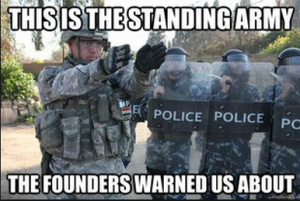
#ACAB: Why the Institution of Policing Makes All Cops Bastards

police-state-founders-warning

By PM Beers

Source: AntiMedia

All cops are bastards because all cops, if ordered to, will enforce laws that oppress poor people.

Many people would like to believe that there are good cops and bad cops. I’m going to explain why this is simply not true. When we are children, we are ingrained with the belief that police officers are good people who want to help us. Children are taught that if they need help, they should ask a police officer. These early beliefs are so deeply ingrained that it is very hard to shake them off. For me, it took over two years to finally understand the concept of ACAB—all cops really ARE bastards, even if they believe themselves to be good people.

When you learn the history of policing, you will better understand the need to dismantle the inherently racist institution. When we were new to the anti-police brutality movement, we all thought there were good cops and bad cops. As with most binary thinking, this is incorrect. All cops are indeed bastards as they blindly enforce laws which were written to oppress poor people, such as laws against feeding the homeless. The primary role of the first police departments was to catch runaway slaves. Racism is ingrained in policing. Racism is the root cause of police brutality.

There are no good cops. Laws and ethics are not the same thing. Laws don’t prevent crime from happening—people having their needs met does. One cannot be a good person and enforce unjust laws.

Someone once asked me, “But how is the statement ‘ALL cops are bastards’ any different from ‘ALL priests are pedophiles,’ or ‘All women are lousy drivers?’“ Another friend replied,  “Nobody is born a cop. Joining that institution is a choice. It’s more akin to saying ‘all KKK are bastards.” Priests are not required to molest children, but cops are required to follow orders which oppress poor people and target people of color.

Every cop must obey orders without question. They are required to enforce unethical laws or risk losing a job that provides them with a comfortable income if they refuse. In the rare occasion that a cop does blow the whistle on an injustice, the thin blue line is immediately invoked and the seemingly well-intentioned cops are ostracized by their peers, almost always neutralizing their intentions.

Some cops think they are actually good people. Of course, they have to think they are good to rationalize what they are doing since in our society, one’s occupation is one’s identity.

We all know that many cops have done horrible things. They have abused their power, murdered people, and attempted to cover up those murders with lies. I’m not going to talk about those obvious injustices that we are already so aware of. I’m going to talk about more subtle ways that cops do unethical things under the color of law. The job of the police is not to protect people but to protect corporate assets.

When a person becomes a police officer, their job is to enforce the laws. Not all laws are good. Police are unthinking, unquestioning robots protecting a corrupt, unjust state. They simply do as they are told without question. The institution of policing is inherently corrupt because they enforce laws which have nothing to do with ethics and everything to do with serving corporate interests.

If your job requires you to do unethical things and you continue to do that job for a paycheck, you have sold out and can no longer consider yourself an ethical person.  Every cop has sold their soul for a middle class income. Their price is low.

But wait…what about that one cop who bought groceries for a mom who stole food for her kids?

Yes, that cop did a good thing. That doesn’t erase the unethical things the cop does or would do if given the order. I like to call these types of news stories #copaganda because they are often played by mainstream media to try to get us to think that cops are good people, when in reality, the news stations want to appease police departments so that they can keep access to information for their news stories. TV news folks do unethical things for money, as well, and that’s a whole other rant for another day. If cops did these kinds of things on a daily basis, they wouldn’t be newsworthy. Cops are not as lovely as the TV would have us think they are.

When protests are held, police say they are there to make sure no one gets hurt. Yet on most occasions, they are the ones hurting protesters with batons, “less lethal” bullets, and tear gas.  Sometimes, undercover cops are placed into crowds and are sometimes suspected by protesters of being the ones agitating the police. They use actions, such as throwing bottles, in order to give the police an excuse to become violent with the protesters.

Police have to enforce other unjust laws, like the criminalization of the medical use a cannabis. Smoking cannabis harms no one and is a victimless crime. Is it even a crime at all? Filling up jails with pot smokers only has negative consequences on society, as taxpayers are burdened and people prosecuted for drug offenses often have a difficult time finding employment after being released from prison. Children also suffer under the burden of having one less parent to care for them. This lack of need fulfillment leads to more crime as children mature.

Further, according to the LAPD, all cars are now under investigation. License plate scanners mounted on police cars and on light poles track drivers all over Los Angeles. The ACLU and the Electronic Frontier Foundation are currently suing the LAPD to find out how the technology is being used.  There is no probable cause to collect such data, making this practice a violation of our civil rights.

Police enforce unjust laws that harass and criminalize people who have no home. Sleep is a primary human need like air, food, and water. Is it ethically permissible to wake someone up at six AM because the only place they can afford to sleep is the sidewalk? Would a good cop do that?

In the summer of 2012, I participated in a sleepful protest in downtown Los Angeles in support of rights for people who didn’t have homes. Every morning, Officer Massey would come honk his horn to wake us up at 6 AM.  He was baffled at why I would scream at him every morning. He thought he was a good cop. He had no clue that waking up unhoused people at 6 AM is an unethical thing to do. In his mind, he was just doing his job—just following orders. Officer Massey tried his best to be polite, but what he was doing was still wrong. Is he going to quit his job?  What other job is he even qualified to do that can  still provide him such a comfortable middle-class income?  He is not going to quit his job. Instead, he will rationalize in his mind that he is a good cop. He never once kicked an unhoused person, so isn’t he lovely?

The police are an inherently violent institution where force is used to extort money from poor people and property is stolen. The racism and bias against the oppressed and poor is pervasive. The entire institution is so corrupt and violent that participating in it makes one corrupt and violent by silent consent. It is impossible to be a good person and participate in violence and oppression.

For example, a person unable to pay $150 for a car registration will have that car stolen from them with the assistance of the police. The car will then be held for ransom. If the person who was too poor to pay the $150 can’t pay the ransom, then the car, which has a value of thousands of dollars, will be sold and the state will profit off of the backs of the poor. Anyone willingly accepting money from such an institution that extorts poor people is by default not a good person.

People want to believe they are good without challenging their false beliefs. There are no good cops. Ethical and legal are completely separate things—therefore, there are no good cops as they are required to enforce unethical laws.

Are there decent individuals that become cops? Of course. However, the institution of policing means police officers, by default, are oppressors by occupation—meaning there truly are no good active-duty cops.

What is the alternative to policing? Community policing by the people who live in the community is a viable solution. Further, the situation will be improved by legalizing victimless crimes, making sure everyone’s needs are met, and reducing income inequality.

A conscious cop would think about quitting, realize they are not qualified for any other job that pays anything even close to what they currently get, and would quickly adjust their thinking back into justifying what they are doing.

All cops oppress poor people and are therefore evil. All cops make threats of death and are therefore evil.

Dismantling the institution of policing does not mean anarchy in the context of chaos. The word “anarchy” is a beautiful thing when used in certain contexts where people understand what the word actually means.  For me, anarchy means equality, horizontalism, and no false authority. Communities can and should police themselves.


This article (#ACAB: Why the Institution of Policing Makes All Cops Bastards) is free and open source. You have permission to republish this article under a Creative Commons license with attribution to the author and theAntiMedia.org. Tune in! Anti-Media Radio airs Monday through Friday @ 11pm Eastern/8pm Pacific. Help us fix our typos:edits@theantimedia.org.

PM Beers joined Anti-Media as an independent journalist in April of 2014. Her topics of interest include mental illness, neurology, quantum physics, Tourette’s, Autism, compassionate parenting, horizontal democracy, activism, and art. Born in Long Beach, California, she currently resides in Los Angeles, California. Learn more about Beers here!
Five Studies: The Psychology of the Ultra-Rich, According to the Research

OLIGARCHY

Bernie Sanders says that billionaires have “psychiatric issues.” He’s not entirely incorrect.

By Livia Gershon

Source: Pacific Standard

“Let me tell you about the very rich. They are different from you and me. They possess and enjoy early, and it does something to them, makes them soft where we are hard, and cynical where we are trustful, in a way that, unless you were born rich, it is very difficult to understand. They think, deep in their hearts, that they are better than we are because we had to discover the compensations and refuges of life for ourselves. Even when they enter deep into our world or sink below us, they still think that they are better than we are. They are different.”
—F. Scott Fitzgerald

Bernie Sanders’ unexpectedly popular presidential campaign features a lot of rhetoric that we don’t usually hear in mainstream politics. One striking example is the Vermont senator’s contention that the ultra-rich suffer from “psychiatric issues” that manifest in an addiction to money and a worldview divorced from reality.

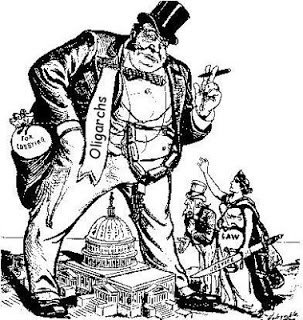
When we talk about inequality, we often spend lot of time considering poor people’s attitudes and behaviors, from whether they get married to how they talk to their kids. We’re less likely to stop and look at how the rich are different. But extremely wealthy people play a huge role in increasing inequality. With their heavy political clout, they help shape government economic policies, supporting very different positions from those of average Americans. From their perches on corporate boards and compensation committees they also give direct raises to their fellow oligarchs.

As inequality grows, in the United States and in the world, the shape of the wealthiest classes is also changing. The significance of inherited wealth fell rapidly in the mid-20th century, making way for the “self-made” rich. Now, though, there’s growing evidence that, as Thomas Piketty has famously argued, dynasties are making a comeback.

So there’s good reason to pay at least as much attention to the behaviors and beliefs of the rich as we do to those of the poor. But what does research tell us about the nature of wealth? How does it affect those who have it? Studies suggest the wealthy really do have significant psychological differences from the middle class in how they view money, and how they look at their relationship with society.

1. MONEY BUYS HAPPINESS—KIND OF

Richer people tend to be happier, but not by all that much. And it’s not really right to say money makes them happy. Wealth only makes affluent people more satisfied to the extent that it gives them more control over their own lives, making them feel richer. (Anyone who feels financially and personally stable because they’ve got a steady job, enough money to get them through an emergency, and a nicer house than their neighbor is likely to be happier than the poorest multi-millionaire in a hyper-rich enclave they can’t really afford.) Still, holding everything else equal, people who have more money have more stability. Of course, they also usually know they’re well off. And those two factors make them happier.

—”How Money Buys Happiness: Genetic and Environmental Processes Linking Finances and Life Satisfaction,” Wendy Johnson and Robert F. Krueger, Journal of Personality and Social Psychology, Vol 90(4), Apr 2006

 2. BUT RICH PEOPLE HAVE DIFFERENT CRITERIA FOR HAPPINESS

Asked about what makes people happy, extremely rich Americans, just like average Americans, typically put love first. But the ultra-wealthy are more likely than everyone else to say happiness depends on winning the appreciation and respect of others. They’re also more likely to cite the realization of personal potential as a key to happiness. But they’re much less likely than non-wealthy people to say that physical health is most important. (Perhaps because they’ve never been uninsured?) Rich people are also a bit more likely than the rest of us to say having a lot of money can occasionally present an obstacle to happiness.

—”Happiness of the Very Wealthy,” Ed Diener, Jeff Horwitz, and Robert A. Emmons, Social Indicators Research, April 1985

3. THE WEALTHY ARE MORE AND MORE LIKELY TO IDENTIFY WITH AN INTERNATIONAL ECONOMIC ELITE

Board members of the world’s largest corporations—a significant and influential segment of the ultra-rich—are increasingly likely to serve on the boards of foreign and multinational companies. Even directors who don’t serve on the boards of foreign companies usually interact with others who do. In other words, modern corporate elites are likely to be part of cosmopolitan, global social networks, whereas most poor and middle-class people are more likely to identify with their home populations.

—”Transnationalists and National Networkers in the Global Corporate Elite,” William K. Carroll, Global Networks, June 2009

4. AS A RESULT, THEY’RE NOT GREAT AT EMPATHY

People from higher socioeconomic classes do worse on a test where they’re asked to identify emotions in photographs of human faces. They’re also less accurate at perceiving the emotional states of others in real-life interactions. In fact, researchers can reduce people’s empathy just by prompting them to think of themselves as relatively high-status. Test subjects who are asked to imagine an interaction with someone from a lower social rung get worse at understanding other people’s emotions. The trouble higher-status people have recognizing emotions is tied to the fact that they tend to think about themselves and others in terms of fixed traits (“She’s a nervous person.”) In contrast, people from lower social classes are more likely to use contextual explanations for people’s behavior (“This interview is making her uncomfortable.”)

—”Social Class, Contextualism, and Empathic Accuracy,” Michael W. Kraus, Stéphane Côté, and Dacher Keltner, Psychological Science, October 25, 2010

5. AND THEY THINK DOMESTIC INEQUALITY REPRESENTS JUST DESSERTS

Americans are known for our trust in an ideal of meritocracy. When you ask the general public to assess statements like “most people who want to get ahead can make it if they’re willing to work hard,” well over 70 percent of us agree. But what happens when people see high levels of income inequality in their daily lives? It turns out that low-income Americans are less likely to believe in meritocracy if they live in counties with extreme economic inequality—places where they’re likely to run into much richer people a lot. For high-income people, the effect is exactly the opposite. The study’s authors suggest that rich people could be using a defense mechanism to stave off guilt and justify their relatively privileged position within a visibly unequal system. But, for whatever reason, the more inequality rich people see in their home county, they more likely they are to believe that meritocracy is working.

—”False Consciousness or Class Awareness? Local Income Inequality, Personal Economic Position, and Belief in American Meritocracy,” Benjamin J. Newman, Christopher D. Johnston, and Patrick L. Lown, American Journal of Political Science, April 2015


America: Dangerous Curve Ahead

dangerous-curve

By Helaine Olen

Source: The Baffler

At some point in the early 1980s, a large yellow placard began turning up in the back window of cars proclaiming “Baby on Board.” At first it seemed a joke, an inadvertent high-sign that the driver was someone who took this parenthood thing a little too seriously. Even as the shiny placards became omnipresent, a lot of us dismissed them as yet another badge of Baby Boomer self-importance.

Of course we were wrong. It’s now conventional wisdom that the Baby on Board sign was one of the precursors to a more widespread change in parenting from a time when, to us, children appear to have been neglected to our present situation in which doting over children is every parent’s self-congratulatory purpose in life. But those Baby on Board announcements dovetailed with something else too, something we don’t normally connect them with: the decline in the United States’ spending on infrastructure. As we were begging people to give special consideration to this babied-up car or that screaming station wagon, even as we were increasingly crazed with protecting our own individual children, we were not exactly securing their future.

According to a report released last year by the Council on Foreign Relations, spending on transportation went from more than one percent of the gross national product in the 1960s to just under one percent by 1980. That latter percentage point, which would have seemed at the time to be low, is now considered a 35-year high point. If you are looking for a common point of reference for our nation’s crumbling bridges—which received a C+ for maintenance from the American Society of Civil Engineers for 2013—or train derailments, like last week’s fatal Amtrak wreck outside of Philadelphia, look hard at that number. The most recent grade for our overall infrastructure? A D+.

The collapse in public funding for our transportation needs did not lead to anger by the vast majority of the population, however. While our leaders ran the country off the road and into the ditch, we coped. And truly, no one seemed to want to pay the tax bill to fill potholes, but we were happy to spend more and more of our money on things ranging from ridiculous bright yellow signs begging other drivers to take care of our children to purchasing ever larger cars and trucks that we thought would keep us personally safe, and damn everyone else.

Those driving SUVs certainly thought they would receive a safety boost, and didn’t seem to care that it came at the cost of driving a weaponized car known for a design that actively and provably caused disproportionate damages in collisions. As New York Times Hong Kong bureau chief Keith Bradsher noted in his 2003 book High and Mighty: The Dangerous Rise of the SUV, market research showed many consumers buying the behemoth automobile were “self-centered,” willing to “endanger other motorists so as to achieve small improvements in their personal safety,” adding “the public perception that SUVs provide considerable protection in a crash has been an important factor in their sales for many years.”

And if something did go wrong in an SUV? Well, the sad tale of Ellen Brody, the suburban New York City woman who drove her Mercedes SUV onto the tracks at a notorious Westchester County Metro-North crossing this past winter during a massive traffic jam, is instructive. Six people—including Brody—died when the safety gates came down and, apparently discombobulated, she drove onto the tracks instead of backing up.

But inquiries into how and why Ellen Brody ended up making her fatal wrong move seem almost designed to obfuscate the fact that if it hadn’t been this luckless woman, then it would have been someone else on those tracks eventually. As it turns out, there have been transportation reports going back to 1970 begging for investment in the area and recommending sane reforms such as eliminating the crossing entirely or at least adding gates and lights to make the sight lines significantly safer for drivers. None of it happened.

The Amtrak derailment last week is bringing us more of the same blame game. There’s the open question of why the train’s engineer permitted the train to reach 106 miles-per-hour as it approached a curve with a speed limit of 50 miles-per-hour, for example. And the accident exposes the political lobbying that persistently enervates our society, possibly preventing the installation of a safety system that would have slowed this train automatically. These are all legitimate and important lines of inquiry to pursue. But the search for individual villains and lunge toward stop-gap safety solves is also a wreckage clearance and scrubbing operation, allowing us to forget that the number one cause of the Amtrak accident is the United States’ tax and spending policies and priorities that have left us with transportation system falling apart a little more every day. The kids grow up, the world spins in reverse.

Hmm. What about those goddamn Baby on Board signs? A survey from 2012 found they might have contributed to an increase in car accidents by blocking driver sight lines. Self-absorption left too many of us blind to the curve ahead.

Helaine Olen is the author of Pound Foolish: Exposing the Dark Side of the Personal Finance Industry, a contributing editor for Pacific Standard, and a regular Slate contributor.

Life Imitates “Black Mirror”

images
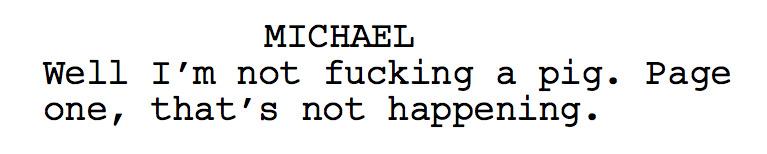
Fans of the superb dystopian series “Black Mirror” (including myself) had our collective minds blown by recent claims (first widely reported by the Daily Mail) that British Prime Minister David Cameron performed a sexual act with a pig carcass as part of a depraved initiation ritual. The story would be very bizarre even had it not mirrored a key plot point of the premiere episode of Dark Mirror. No doubt besieged by questions about the recent news, Dark Mirror creator Charlie Brooker took to Twitter to state: “Just to clear it up: nope, I’d never heard anything about Cameron and a pig when coming up with that story. So this weirds me out.”

These are the most recent statements on the topic from Brooker’s Twitter feed (as of 9/21/15):

  1. Perhaps the least prescient line from the script.

    Embedded image permalink
    2,262 retweets 2,519 favorites


    I hope White Bear doesn’t come true next.

    1,280 retweets 1,563 favorites


    Just to clear it up: nope, I’d never heard anything about Cameron and a pig when coming up with that story. So this weirds me out.


Read more about David Cameron’s days of elitist debauchery at Oxford.

Was this a case of insider knowledge, extra sensory perception, retrocausality, premonition, intuition or coincidence? Watch the full episode and judge for yourself.

Are Neocons an Existential Threat?

1-kagan-NEOCON

By Robert Parry

Source: Consortium News

The neoconservatives arguably have damaged American national interests more than any group in modern history. They have done more harm than the marginal Communists pursued by Sen. Joe McCarthy in the 1950s, more than the Yippies of the 1960s, more than Richard Nixon’s Watergate burglars in the 1970s or the Iran-Contra conspirators in the 1980s.

The neocons have plunged the U.S. government into extraordinarily ill-considered wars wasting trillions of dollars, killing hundreds of thousands if not millions of people, anddestabilizing large swaths of the planet including the Middle East, much of Africa and now Europe. Those costs include a swelling hatred against America and a deformed U.S. foreign policy elite that is no longer capable of formulating coherent strategies.

Yet, the neocons have remained immune from the consequences of their catastrophes. They still dominate Washington’s major think tanks as well as the op-ed pages of virtually all the leading newspapers, including The Washington Post, Wall Street Journal and New York Times. They hold down key positions in the State Department, and their “liberal interventionist” pals have the ear of President Barack Obama.

Clearly, the neocons are skilled operatives, knowing how to arrange a steady stream of funding for themselves, from military contractors donating to think tanks, from U.S. taxpayers footing the bill for organizations like the National Endowment for Democracy, and from ideological billionaires set on aligning U.S. foreign policy with hard-line Israeli desires.

The neocons are adept at writing op-ed articles that twist any set of facts into support for their ideological cause; they supply just the right quote that fits into the news cycle’s latest narrative; and they host policy conferences that attract powerful politicians and fawning media coverage.

But are the neocons a force that can coexist with the American Republic? Have they become an existential threat not only to the constitutional structure crafted in 1787 but to continued life on the planet? Are they locked on a course of action that could lead to a nuclear holocaust?

Clearly, the neocons’ commitment to Israeli interests violates a key principle established by the nation’s early presidents who all warned against “foreign entangling alliances” as a fundamental threat to a citizens’ republic that would transform America into a warrior state that would inevitably sap the nation’s liberties.

That loss of liberty has surely happened. Not only is there now bipartisan support for a surveillance state that can spy on the personal lives of American citizens, but the U.S. government has wedded itself to the concept of “strategic communications,” a catch-phrase that merges psychological operations, propaganda and P.R. into a seamless approach toward managing public perceptions at home and abroad.

When information is systematically pushed through a filter designed to ensure consent, the core democratic concept of an informed electorate has been turned on its head: The people no longer oversee the government; the government manipulates the people.

Neocon Tactics

All this has been part of the neocon approach dating back to the 1980s when key operatives, such as Robert Kagan and Elliott Abrams, were part of inter-agency task forces designed to whip the American people into line behind the government’s aggressive war policies. Guided by seasoned CIA propagandists, such as Walter Raymond Jr., the neocons learned their lessons well.

But the neocons are no longer just threatening the existence of the Republic; they are now endangering the continuation of life itself. They have decided to launch a new Cold War against Russia that will push the world toward the brink of thermo-nuclear war.

Of course, the neocons will frame their doomsday strategy as all Vladimir Putin’s fault. They will insist that they are just standing up to “Russian aggression” and that anyone who doesn’t join them is a “stooge of Moscow” or “weak.” They will dictate the shape of the debate just as they have in countless other situations, such as guiding Americans to war in Iraq over non-existent WMD stockpiles.

The neocon pundits will write seemingly authoritative op-eds about devious Kremlin strategies which will glue black hats on the Russians and white hats on whomever is on the other side, whether the neo-Nazis in Ukraine or the Islamic State/Al Qaeda terrorists in Syria. Americans will be whipped up into a frenzy that will demand a direct clash with the “Russ-kies” or “regime change” in Moscow.

There will be little or no concern about the risks. With the neocons, there never is. The assumption is that if “Amur-ika” is tough, the other side will back down. Then, with U.S.-led economic sanctions from the outside and U.S.-funded NGOs stirring up trouble from the inside, “regime change” becomes the cure-all.

Everyone who’s important in Official Washington – everyone on the talk shows and op-ed pages – knows that these disruptive situations always play out just the way they’re diagramed inside the top think tanks. A hand-picked “democratic reformer” who’s traveled the think-tank circuit and gotten the seal of approval – the likes of Iraq’s Ahmed Chalabi – will easily be installed and then the target country will do whatever the neocons dictate. After all, that approach worked so well in Iraq. The neocons always know best.

Raising the Stakes

Yet, with Russia, the stakes are even higher than with Iraq. Yes, it’s easy to find fault with Vladimir Putin. I myself have a personal rule that men over 40 should keep their shirts on when out in public (unless maybe they’re actors in a Bond film or going for a swim at the beach).

But Putin at least is a rational player in global affairs. Indeed, he has tried to cooperate with President Obama on a variety of key issues, including convincing Syria to surrender its chemical weapons and getting Iran to make concessions in the nuclear deal – two contributions to world peace that infuriated the neocons who favored bomb-bomb-bombing both Syria and Iran.

At a dinner party in Europe this summer, I was asked by a well-informed British woman what should be done with Putin. My answer was that Putin doesn’t frighten me; it’s the guy who comes after Putin who frightens me – because despite the neocons’ confidence that their “regime change” plans for Moscow will install a malleable moderate, the more likely result would be a much harder-line Russian nationalist than Putin.

The idea of the nuclear codes being handed to someone determined to defend the honor of Mother Russia is what scares me. Then, the clumsily aggressive neocons in Washington would have their reckless counterpart in Moscow, with neither side having the wisdom of a John F. Kennedy or a Nikita Khrushchev as displayed during the Cuban Missile Crisis in 1962.

Would American neocons or a Russian super-nationalist have the wisdom and courage to back down, to compromise, to make the concessions necessary to avoid plunging over the edge? Or would they assume that the other guy would blink first and that they would “win” the showdown?

I recall what William R. Polk, one of Kennedy’s mid-level aides during the Cuban Missile Crisis,wrote recently about what happens to the human mind under such stress.

“Since human beings make the decisions, we must be aware of decision makers’ vulnerabilities,” Polk wrote. “During the Cuban Missile Crisis, I was one of about 25 civilians fully engaged in the events. I was not at the center but in the second or third ‘echelon.’ So I did not feel the full strain, but by the Thursday of the Crisis, I was thoroughly exhausted. My judgment must have been impaired even though I was not aware of it.

“I do remember, however, a terrible episode – fortunately lasting only a few minutes – at which I thought to myself, ‘let’s just get it over with.’ When later I met with my Soviet counterparts, I got the impression, although they denied it, that my feelings were not unique. How the strain impacted on the inner group I can only guess.”

If someone as stable and serious as Bill Polk had such thoughts – “let’s just get it over with” – what might happen when American neocons or hyped-up Russian nationalists are inserted into the decision process? That is an existential question that I don’t want to even contemplate.

Endless Putin-Bashing

And, if you doubt that the neocons will engage in over-the-top Cold War-style Putin bashing, you should read the op-ed by The Washington Post’s neocon deputy editorial page editor Jackson Diehl on Monday, entitled “Putin shifts fronts: With a move into Syria, he continues his in-your-face maneuvers.”

Diehl delves into Putin’s psyche – a process that is so much easier than doing real reporting – and concludes that Putin’s decision to join the fight in Syria against the Islamic State and Al Qaeda is just another attempt to stick his finger in the eye of the righteous but clueless United States.

Diehl, of course, starts off with the neocon-approved narrative of the Ukraine crisis, ignoring the key role of neocon Assistant Secretary of State Victoria Nuland (Robert Kagan’s wife) in midwifing the Feb. 22, 2014 coup that overthrew democratically elected President Viktor Yanukovych and installed an intensely anti-Russian regime on Russia’s border. Nuland even handpicked the new Prime Minister Arseniy Yatsenyuk, telling U.S. Ambassador Geoffrey Pyatt in a phone call several weeks before the coup that “Yats is the guy.”

The coup-makers then dispatched neo-Nazi militias (and Islamist militants) to wage a bloody “anti-terrorism operation” against ethnic Russian Ukrainians who resisted the “regime change.” [See Consortiumnews.com’s “Ukraine Merges Nazis and Islamists.”]

But all that complexity is neatly boiled down by American neocons and the mainstream U.S. media as “Russian aggression.” Regarding the Syrian civil war, some neocons have even joined with senior Israeli officials in claiming that a victory by Al Qaeda is preferable to the continuation of Assad’s secular regime. [See Consortiumnews.com’s “Syria’s Nightmarish Narrative.”]

Yet, however the story goes, the biggest bad guy is Putin, always with sinister motives and evil intent. So, in explaining the situation in Ukraine and Syria, Diehl writes:

“Throughout the summer, Russia’s forces in eastern Ukraine kept up a daily drumbeat of attacks on the Ukrainian army, inflicting significant casualties while avoiding a response by Western governments. On Sept. 1, following a new cease-fire, the guns suddenly fell silent. Optimists speculated that Vladi­mir Putin was backing down.

“Then came the reports from Syria: Russian warplanes were overflying the rebel-held province of Idlib. Barracks were under construction at a new base. Ships were unloading new armored vehicles. Putin, it turns out, wasn’t retreating, but shifting fronts — and executing another of the in-your-face maneuvers that have repeatedly caught the Obama administration flat-footed.”

The rest of the op-ed is similarly didactic and one-sided: Putin is the villain and Obama is the rube. In Diehl’s world, only he and other neocons have what it takes to take on Putin and put Russia down.

Any alternative explanation for Russia’s action in Syria is brushed aside, such as Putin deciding that a victory by either Al Qaeda’s Nusra Front – as favored by Israel – or the even more bloodthirsty Islamic State is unacceptable and thus Assad’s regime must be stabilized to avert a major geopolitical catastrophe.

Typically, the neocons breeze past the frightening logic of what the collapse of Assad’s military would mean for the Middle East, Europe and the world. After all, once Israeli leaders decided to throw in their lot with Al Qaeda in Syria, the die was cast as far as the neocons were concerned.

But the notion that the neocons can micromanage the outcome in Syria, with “moderate” Al Qaeda taking Damascus rather than the more “radical” Islamic State, reflects the arrogant know-nothing-ism of these U.S. opinion leaders. More likely, Al Qaeda’s Nusra Front would coordinate with their former allies in the Islamic State and share in the Sunni revenge against Syria’s Christian, Alawite, Shiite and other minorities.

So, while the Islamic State would busy itself chopping off heads of “heretics,” Al Qaeda could use its new headquarters in Damascus to plot the next round of terror attacks against the West. And, as destabilizing as the current refugee flow into Europe has been, it would multiply astronomically as the survivors of the Islamic State/Al Qaeda bloodletting flee Syria.

With Europe in chaos and the neocons still insisting that the real enemy is Russia, the possible consequences would be frightening to contemplate. Yet, this is the course that the neocons have set for the world – and nearly all the Republican candidates for president have signed on for the journey along with Democratic frontrunner Hillary Clinton.

In 2014, arch-neocon Robert Kagan, whom Secretary of State Clinton selected as one of her advisers while also promoting his wife, Victoria Nuland, told The New York Times that he could embrace a Clinton presidency: “If she pursues a policy which we think she will pursue … it’s something that might have been called neocon, but clearly her supporters are not going to call it that; they are going to call it something else.” [For more, see Consortiumnews.com’s “Is Hillary Clinton a Neocon-Lite?” and “Obama’s True Foreign Policy ‘Weakness.’“]

So far, virtually no one in the 2016 presidential race or in the mainstream U.S. news media is seriously addressing the reality of the neocons’ “regime change” chaos spreading across the Middle East and the prospect of a destabilized Europe. What limited discussion there is on the campaign trail mostly echoes Jackson Diehl’s Putin-bashing.

No one dares confront the existential question of whether the United States and the world can continue to tolerate and accommodate the neoconservatives.

Investigative reporter Robert Parry broke many of the Iran-Contra stories for The Associated Press and Newsweek in the 1980s. You can buy his latest book, America’s Stolen Narrative, either in print here or as an e-book (from Amazon andbarnesandnoble.com). You also can order Robert Parry’s trilogy on the Bush Family and its connections to various right-wing operatives for only $34. The trilogy includesAmerica’s Stolen Narrative. For details on this offer, click here.

Drop the Rope

8583170_f520

By Zen Gardner

Source: ZenGardner.com

It’s interesting how we get entangled in compromising situations and interactions, often unwittingly. We all face this challenge continually. So often the very encounter itself is predestined to failure without our even knowing it and results in a sense of energy sapping futility.

If you find yourself in such a tug of war, it’s time to rethink your entire stance. In fact, it might be time to drop the connection all together. Winning ain’t what it’s cracked up to be, nor to your benefit in most cases in these circumstances.

This happens because we get snared into lower level thinking on a preset playing field designed to do just that. Ensnare and entrap. This societal mechanism is designed to set the parameters and disguise the real solution which is way outside this constructed paradigm. When we join into the “contest” we subject ourselves to the win-lose dialectic, the pitting of one versus another paradigm that has beset humanity for eons.

That’s not to say there isn’t a time to attempt to illuminate ignorance or expose manipulative mechanisms, we just can’t expect to “win” in an arena built for pointless conflict that distracts from seeing the essential and empowering reality that blows their entire construct to bits.

If we’re too busy fighting amongst ourselves, physically or intellectually, we’ll never see that bigger picture where the true problem truly lies.

The conscious conclusion to draw on such encounters is clear. If you don’t want to play their insidious, pointless, draining and distracting games of tug of war, simply drop the rope and walk away.

The Conflict Dialectic

Society has been manipulated to such a degree that the easiest way to control us is through simple distraction. Bread and circus competitive sports and similar mind-stinting entertainment, right-left paradigm political charades and society dividing issues such as race, immigration and social, economic and class status are furiously alive trigger points of distraction running rampant in this seriously dysfunctional world mind.

We help define and reinforce these memes ourselves by our participation. Without rising above this imposed playing field and understanding the world we’re already living in we certainly cannot find the way to change it, never mind the way out into a new paradigm without their constrictions.

Simply said, if you don’t want to play their insidious, pointless, draining and distracting games of tug of war, simply drop the rope and move on. Let them fall in their own devices.

Dropping the Rope

When dealing with this seeming “conflict resolution” we appear to be confronting on many levels, “dropping the rope” is a very interesting way to break this sycophantic relationship with our oppressors. What invariably surfaces in our left brain human response in these sorts of circumstances is a sort of contest between people or situations. One side opposes the other in some form, and one or the other or both sides express umbrage at what the other is saying.

It’s a programmed and mass entranced conflict, the “strategy of tension” as they call it, utilized by the media and military with very successful abandon.

When we find ourselves in these situations it can be quite stressful. Reflexive thinking usually kicks in and we take sides, concentrating on the “issues” at hand while ignoring the overall. Even in a personal heated exchange, subtle or obvious, no one wins. They can’t. The overarching truth is being missed in this morass of “logical” confined thought subscribed to by the perspective of the participants.

Overall social psychosis perhaps, or the left brained reptilian mind going to work, who knows. It’s just futile in that type of paradigm. These types of conflicts are an exercise in futility. Oh, we may bring some light of truth to the conversation or situation but the problem is that we’re buying into their boxing ring. Someone has to come out the “victor” and the game goes on, without addressing the underlying reality outside the ring, or imposed and deliberately created stadium of conflict.

This realization is a blow to the egoic mind set and, while essentially counter intuitive, it’s only destined to be repeated. And the pointless game goes on. Don’t fall for it. You’re well above all this.

Spiritual Scoliosis and Letting Go of the Unchangeable

The application of this realization can get quite personal.  Those we’re closest to can often display usage of this dialectic and it’s not easy to discern up close and personal, nor know how to respond to it.

There’s often an embedded agenda to what is being said or proposed, as exemplified by news outlets, or as we usually see it by people around us, that is much more profound than the surface argument. You’ll often hear sweeping language with generalities that appear to be true in such contests of mind but these can have a much more insidious nature.

People, as well as social engineers, often use this technique.

It’s usually very cleverly embedded, be it by an individual or ideology. But on an individual basis it can get pretty dicey.

The Personal Touch

It’s naive to think we could correct spiritual scoliosis or perform some kind of exorcism or somehow overwhelm this mechanism to get it into its proper place and perspective when dealing with an infected individual with such a mindset. In fact, those are the things and persons that conscious people sidestep until the subject really wants help and starts to see the light of day and fully lets go of their petty shibboleths.

These are issues that really aren’t so petty when you get down to the spiritual nature of it and difficult to discern as well as confront.

But when you’re awake to these traits you don’t argue with them or plea with them to let go. They either do when confronted with conscious awareness or they don’t. Otherwise you leave them alone until there’s a change, and move on to those open to real dialogue. This kind of conscious awareness is sadly thin in today’s world but people are catching on.

No players, no game is a great default setting.

Their approach has a lot to do with posturing, as if they’re authoritative on some subject. Unthinking people often submit to that. When someone comes on pretending to be an authority on anything and speaks in that tone and posture it’s time to sit up and take notice – carefully. Not sit back in acquiescence. Real truth sharers propose and entreat. Remember, words, which carry spirit, can eventually overpower you if you keep listening to where you sense it’s empowering rooted in truth and love, or isn’t healthy.

It’ll be clear. Just listen.

Be Like Water

Avoiding these kinds of obstacles is a bit of an an acquired art, but it can be learned. This has to do with the nature of on going change. Water just goes around the rock, or over it, or both. Sometimes rocks move with the water a little but never fully. Like those set in their ways.

They’re rocks. That’s the attached baggage people won’t let go of in their hearts and it clogs up the works and infects anything it embeds in. They’re fine, or should I say less dangerous, on their own and they have their place despite their issues. But they’re not water; and if you expect them to come along like water it’s going to be a long and arduous journey that pretty much is playing the rock’s game.

Water moves on to where its welcomed. Go with the flow. Let the rocks be, i.e; let go of the rope.

Conclusion

It’s important to not get caught up in futile and ultimately destructive contests of any sort, be they relationships or unconscious dialogue as they can have very deceitful and disempowering consequences.

That’s how the system works. Getting everyone caught up in lower vibrational interactions that muffle the call to conscious awareness and activism in avenues that have real meaning. It’s something to which they are clearly diametrically opposed. They’re more than happy to entangle you in anything petty to keep you from realizing that.

You can’t win on their level. Don’t even go there. But if you do and find yourself in a tug of war with ignorance, egos or manipulating entities…..just drop the rope. It’s that simple.

Let ’em fall on their asses and you go merrily on your way.

And go take a nice walk in our majestic freedom and glory in your independent magnificence! Then turn and do and say what’s right – in every situation you come up against.

Screw the programming. We’re free.

That’s how truth wins out.

Much love,

Zen

ZenGardner.com


One dog’s solution to overcoming lower vibrational conflicts:

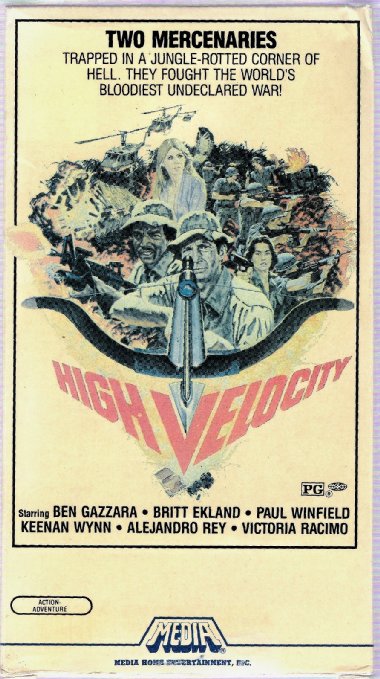
Saturday Matinee: High Velocity

91y4encjnjL._SY679_

“High Velocity” (1976) is an obscure b-movie starring Ben Gazzara and Paul Winfield as Vietnam vets hired by a corporation to rescue a CEO kidnapped by an underground resistance group in the Philippines. On one level, it’s an early version of the heroic mercenary film which had a resurgence in the 80s after the success of Rambo and Missing in Action, but it’s also unrelentingly cynical with a surprisingly astute depiction of colonialism, government/corporate corruption and the power elite. The film is further elevated by a great lead performance by Ben Gazzara and atmospheric soundtrack by Jerry Goldsmith (famous for his work on Star Trek). Interestingly, High Velocity was the first film produced by Takafumi Ohashi, who later produced tons of great (and not-so-great) Japanese genre features.