On the Violence in the Middle East…

By Doug “Uncola” Lynn

Source: The Burning Platform

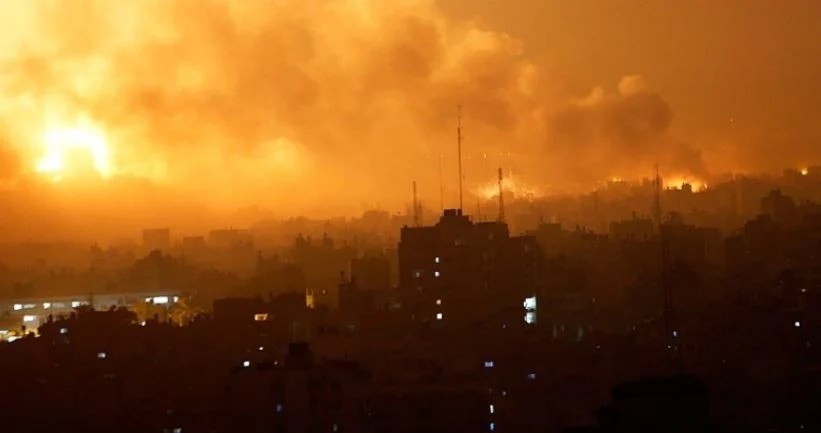
Like most of the world, I have been considering the Israel / Gaza slaughter with fascination and a sense of dread.   Did Israel allow the events of October 7, 2023 to happen? It appears so. Were the savage acts of Hamas sickening? It appears so. Have the ensuing actions of Israel in Gaza been devastating? Yes.

Have the reactions of the general public in nations around the world, and on the internet, become increasingly polarized? Definitely.

Geopolitical expert and former U.N. weapons inspector Scott Ritter has predicted Israel will lose this war, and deservedly so.

At the height of the hysteria during the build-up to Operation Desert Storm®, and in the jingoistic fever of the newly coined War on Terror®, Ritter claimed Saddam Hussein had zero Weapons of Mass Destruction®.  Ritter was right back then, so, now, I pay attention whenever he addresses global tensions.

However, there are many others, including especially some Christians, who believe Israel cannot lose; and, today, as of this writing, The Jerusalem Post has predicted a truce.

Who is right?

I recently viewed a video posted on the Lew Rockwell website entitled: “Bad Theology: Israel, the “Rapture,” and the End Times” and the Bible scholar in that interview claimed modern Israel is a secular nation having nothing to do with Biblical Eschatology.

Of course, other Christians disagree with that conclusion and believe the God of Abraham, Isaac, and Jacob is still dealing with the nations of the world through Israel – and just before the return of Christ.

Apocalyptical interpretations, and misinterpretations, regarding modern Israel are concerning because people act upon what they believe… one way, or another.  Hence the great divide today, as derived from historically ancient faiths; and why supporters of both Israel and Palestine/Gaza are protesting and rallying around the world.

In February 2019, I considered some of the potential interpretations of possible events in an article entitled “As the Games Begin…”:

Some… Christian Zionists believe the entire world would embrace the Psalm 83 war as the Book of Revelation’s “Armageddon” thus setting the stage for planet earth to accept a false messiah; like Islam’s Twelfth Imam, a Talmudic strongman, a fake return of Christ, or possibly even an outer-space alien (i.e. metaphysical demon / fallen angel) as all of the above – and delivering a false peace and prosperity thus fulfilling the “strong delusion” or “great deception” or “falling away” of the Bible’s 2nd Thessalonians, chapter 2, verses 3-12…

…Other Christians claim the Psalm 83 prophecy is credible because none of those nations are named in the Ezekiel 38 and 39 war when Russia, Iran, Turkey and other countries come against Israel or, even later, in the Sixth Trumpet War of Revelation 9 when the Kings of the East (China?) march up the Euphrates river to Israel in the battle just prior to Armageddon.

Crazy, no? Again, don’t kill the messenger. All of this is on the internet and, as some claim, in the Bible.

On the other side of the debate… many folks, including several bloggers and online commenters, believe modern Israel is the de facto “Synagogue of Satan” as referenced in the Bible’s Book of Revelation (Rev 2:9 and Rev 3:9). These verses refer to those “who say they are Jews but are not”.

Correspondingly, a video at StopWorldControl.com about modern Israel, its early formation and sinister benefactors, is quite compelling – just not to those who believe a Psalms 83 War (paired with other Biblical prophecies) will result in the complete destruction of the following nations:

– Gaza (Philistia)

– Egypt (Edom, Ishmaelites, Moab, Hagrites + Isaiah 19:1-25)

– Jordan (Ammon & Amalek + Ezekiel 25 & Jerimiah 49:1-2)

– Iraq (Ammon & Amalek + Babylon in Jeremiah 50 & 51)

– Syria (Assyria & Hagrites + Isaiah 17:1 & Jeremiah 49:23-27)

– And, as some claim:  “Gebal” and “Tyre” will be decimated prior to the conclusion of the Psalm 83 war – with these referring to modern Lebanon and southern Lebanon (Hezbollah), respectively, as well as Turkey.

But others argue Turkey (i.e. “Gomer”, “Meshek”, “Tubal”, & “Beth Togarmah”) won’t meet its fate until the later Ezekiel Chapters 38-39 War involving Russia (Rosh), Iran (Persia), Libya (Put),  Ethiopia (Cush), and the Central Asian nations (Magog) including…but perhaps not limited to… Kazakhstan, Kirghizia, Uzbekistan, Turkmenistan, and Tajikistan.   I say “not limited to” because some interpreters include Afghanistan in the latter group and I’ve also seen Ukraine, the Baltics, and Eastern Europe included under “Gomer” as well.

Anyway, here is the point: Many Bible “scholars” believe ancient scriptures have predicted that modern Israel would defeat wave after wave of military attacks by other countries. First, the surrounding Psalm 83 nations, then, later, the Ezekiel 38-39 war, until, finally, the Sixth Trumpet War of Revelation 9 when the Kings of the East (China?) march up the Euphrates river to Israel in the battle just prior to Armageddon.

All of this, in accordance with other prophecies in the Bible, such as…

… I will make Jerusalem a cup of trembling unto all the people round about, when they shall be in the siege both against Judah and against Jerusalem.

And in that day will I make Jerusalem a burdensome stone for all people: all that burden themselves with it shall be cut in pieces, though all the people of the earth be gathered together against it.

– Zechariah 12:2-3

And

And I will bring again the captivity of my people of Israel, and they shall build the waste cities, and inhabit them; and they shall plant vineyards, and drink the wine thereof; they shall also make gardens, and eat the fruit of them.

And I will plant them upon their land, and they shall no more be pulled up out of their land which I have given them, saith the Lord thy God.

– Amos 9:14-15

Around two weeks ago (as of this writing), Israel’s Prime Minister, Benjamin Netanyahu, referenced Hamas in relation to an ancient tribe of people called “Amalek” in scripture.  He said: “You must remember what Amalek has done to you, says our Holy Bible. And we do remember.

In the Bible’s book of 1st Samuel, in chapter 15, God  commanded (Israel’s) King Saul to “go and smite Amalek, and utterly destroy all that they have, and spare them not; but slay both man and woman, infant and suckling, ox and sheep, camel and ass 

But, not wanting to be overly cruel, King Saul disobeyed God’s command and Israel was eventually given cause to kill others who didn’t deserve to die.  This story, in fact, is said to have inspired the concept of “cruel to be kind”  – thereby instilling this maxim into Jewish culture:

To be lenient when you should be firm is to be cruel when you could be kind.

Or, in other words:  “He who is compassionate to the cruel will ultimately become cruel to the compassionate”.

Or, stated another way: “Destroying evil is perhaps the greatest act of kindness possible.”

Nonetheless, non-Zionist Christians (such as the Bible scholar in the above-embedded “Bad Theology” video/link), as well as pretty much all non-Christians, consider this type of Biblical parsing and cherry-picking of scripture to be completely ludicrous, if not insane; especially as the headlines rage:

Israeli Troops Fighting “In The Heart” Of Gaza City, Hamas Leader Surrounded In A Bunker

Turkey’s Erdogan: Whoever is on Israel’s side, we are against them

Iran Warns Of ‘Inevitable Expansion’ Of War After IDF Conducts Flag-Raising Ceremony In Gaza

US & Israel Poised to Open Lebanon Front:

Israel’s best chance of survival lies in expanding the scope of the war in Gaza into Lebanon — and possibly even into Syria — shoulder-to-shoulder with the Americans.

Will Israel defeat all challengers? Will Iran and the U.S. escalate the war in the Middle East?  Will the Psalm 83 nations of “Gebal”, “the inhabitants of Tyre”, the “Hagrites” (i.e. Lebanon, South Lebanon / Hezbollah, and Syria, respectively), and the nation of Turkey, join the war?

Turkey is a member of NATO. How would that work?

I don’t have the answers to these questions. Yet.  I am just a blogger sharing what I’ve read and viewed online.

But even if the Psalm 83 War came to pass in the days ahead, most of the world would surely call it a coincidence… or Armageddon… or claim it occurred as the result of a deceptive conspiracy using the Bible as a script.

Conversely, if peace suddenly broke out in the Middle East and World War III was narrowly averted, the prophecy experts will likely claim that Armageddon was delayed… but only for a while.

For how long?  I guess we’ll see.  Hence this time-stamped post.

West Admits Ukraine is Losing Proxy War

By Brian Berletic

Source: New Eastern Outlook

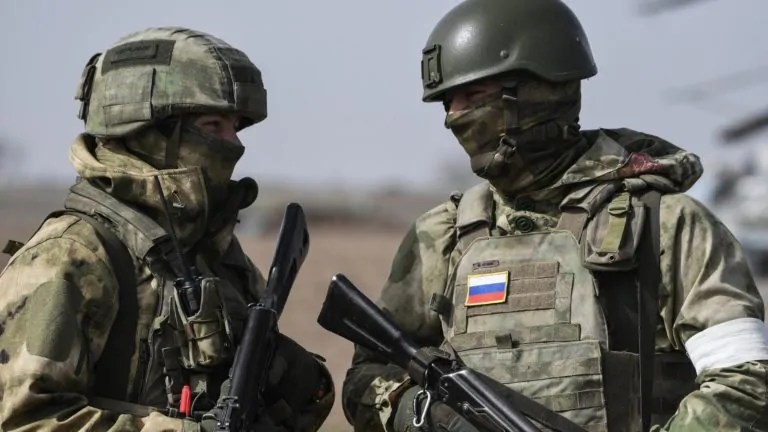
After nearly 2 years of portraying the ongoing conflict in Ukraine as unfolding in Kiev and the collective West’s favor, a sudden deluge of admissions have begun saturating Western headlines noting that Ukraine is not only losing, but that there is little or nothing its Western backers can do to change this fact.

What had been a narrative of Ukraine’s steady gains and indomitable fighting spirit has now been replaced by the reality of Ukraine’s catastrophic losses (as well as net territorial losses) and a steady collapse of morale among troops. What had been narratives of Russian forces poorly trained and led, equipped with inadequate quantities of antiquated weapons and dwindling ammunition stockpiles, have now been replaced by admissions that Russia’s military industrial base is out-producing the US and Europe combined while fielding weapon systems either on par with their Western counterparts, or able to surpass Western capabilities entirely.

Ukraine’s Catastrophic Losses 

Ukrainian losses, especially after 5 full months of failed offensive operations, are almost impossible to hide now.

The London Telegraph in its article, “Ukraine’s army is running out of men to recruit, and time to win,” published as far back as August of this year admitted:

The war in Ukraine is now one of attrition, fought on terms that increasingly favour Moscow. Kyiv has dealt admirably with shortages of Western equipment so far, but a shortage of manpower – which it is already having to confront – may prove fatal.

The article also claimed:

It’s a brutal but simple calculation: Kyiv is running out of men. US sources have calculated that its armed forces have lost as many as 70,000 killed in action, with another 100,000 injured. While Russian casualties are higher still, the ratio nevertheless favours Moscow, as Ukraine struggles to replace soldiers in the face of a seemingly endless supply of conscripts.

The article paints a bleak picture of continued Ukrainian military operations that are almost certainly unsustainable.

The claim of 70,000 killed in action among Ukrainian troops is a gross underestimate, while claims that “Russian casualties are higher still” are not only unsubstantiated, but contradicted elsewhere among Western sources.

Mediazona, a media platform maintained by US government-backed Russian opposition figures, has tracked Russian casualties from February 2022 onward by allegedly tracking public information regarding the death of Russian soldiers.

Its numbers cannot be entirely verified, but on the few occasions the Russian Ministry of Defense released Russian casualty numbers, they were relatively close to Mediazona’s claims versus the cartoonish claims made by Ukraine’s General Staff – claims that are often unquestionably repeated by Western governments and media organizations.

A more recent article published by Business Insider in late October titled, “Ukraine official says it can’t properly use its Western kit because it has so few soldiers left, report says,” confirms that Ukraine’s losses and resulting manpower crisis is only getting worse.

The article reports:

A Ukrainian official said Ukraine’s army is suffering a manpower shortage that is hampering its ability to use Western-donated weapons, Time magazine reported. Since the start of the war, several Ukrainian officials have blamed their difficulty repelling Russia’s invasion on the slow pace of deliveries by its allies. 

However, in the Time report, an unnamed source identified as a close aide to President Volodymyr Zelenskyy highlighted a different problem. “We don’t have the men to use them,” the aide said in reference to the Western weapons. Although Ukraine doesn’t give public figures, Western estimates suggest it has suffered in excess of 100,000 casualties.

In addition to irreversible losses in manpower, Ukraine is also losing territory despite 5 months of intensive offensive operations and the fact that the Russian military leadership has repeatedly stated Russia’s goal is to eliminate Ukraine’s military, not take territory.

The New York Times in a September article titled, “Who’s Gaining Ground in Ukraine? This Year, No One,” would note:

Ukraine’s counteroffensive has struggled to push forward across the wide-open fields in the south. It is facing extensive minefields and hundreds of miles of fortifications — trenches, anti-tank ditches and concrete obstacles — that Russia built last winter to slow Ukrainian vehicles and force them into positions where they could be more easily targeted. When both sides’ gains are added up, Russia now controls nearly 200 square miles more territory in Ukraine compared with the start of the year.

Along with steep losses in manpower and a net loss in territory, Ukraine suffers from an equally damaging loss of equipment. Compounding materiel losses is the fact Western military industrial production is incapable of replacing these losses.

Military Industrial Production: West Running Out as Russia Ramps Up 

Last year, Western politicians and the Western media promoted the idea that superior Western military equipment would easily sweep aside Russia’s dwindling numbers of supposedly antiquated weapon systems. One article published by the London Telegraph in early June of this year was even titled, “British-made tanks are about to sweep Putin’s conscripts aside.”

Nothing could have been further from the truth.

Instead, Russian military equipment has proven itself capable if not superior to Western weapon systems and, together with Russia’s massive military industrial base, it has both outnumbered and outfought Ukrainians trained and equipped by the West.

This was admitted in the New York Times’ September article, Russia Overcomes Sanctions to Expand Missile Production, Officials Say,” which noted:

Russia is now producing more ammunition than the United States and Europe. Overall, Kusti Salm, a senior Estonian defense ministry official, estimated that Russia’s current ammunition production is seven times greater than that of the West.

The article admits that Russia has doubled tank production, increased missile production, and is producing at least as many as 2 million artillery shells a year – more than the US and Europe combined currently produce and more than the US and Europe combined if and when they meet increased production targets between 2025-2027.

A more recent article published by The Economist titled, “Russia is starting to make its superiority in electronic warfare count,” admits that Russia has developed an “impressive range of EW [electronic warfare] capabilities to counter NATO’s highly networked systems.” It explains how Russian EW capabilities have rendered precision-guided weapons provided by NATO to Ukraine ineffective, including GPS-guided Excalibur 155mm artillery shells, JDAM guided bombs, and HIMARS-launched GPS-guided rockets.

The article also discusses the impact Russian EW capabilities have on Ukrainian drones which are lost by the thousands week-to-week. And as Russian EW capabilities disrupt Ukraine’s ability to use guided weapons and drones on and over the battlefield, the article admits Russia is able to produce at least twice as many drones as Ukraine giving Russia yet another quantitative and qualitative advantage.

Despite much of the hype surrounding talk of equipping Ukraine with NATO-provided F-16 fighter aircraft, more sober Western analysts have gradually admitted that between Russia’s vast and growing aerospace forces and its superior integrated air defense systems, NATO-provided F-16s will fare no better than the Soviet-era aircraft Ukraine had and lost throughout the duration of the Special Military Operation.

After months, even years of “game-changers” sent to Ukraine only to prove incapable of matching let alone exceeding Russian military capabilities, the game is indeed revealed to have been changed – in favor of Russia and a military doctrine built on vast military industrial production, cheap-but-effective weapon systems, and most importantly, a doctrine built to fight and win against a peer or near-peer adversary.

This stands in stark contrast to a West who has shaped its military for decades to push over developing or failed states around the globe in military-mismatches, atrophying the technological, industrial, and strategic capabilities the US and its allies would have needed to put in place years ahead of time to “win” their proxy war against Russia in Ukraine.

The “solution” to Russia’s now admitted advantage in terms of quality and quantity on and over the battlefield is to “increase production” and “collect data” on Russian capabilities to then “develop counters to them.” However, these are processes that could take years to yield results, all while Russia continues expanding its capabilities to maintain this qualitative and quantitative edge.

And as this process continues to unfold, the US continues simultaneously seeking a similar conflict with China, which possesses an even larger industrial base than Russia.

One wonders how many lives could have been spared had these recent admissions across the Western media regarding Russia’s actual military capabilities been presented long before provoking conflict with Russia in the first place through Washington and Brussels’ long-standing policy of encroaching upon Russia’s borders. One wonders how many lives may yet be saved if the collective West learns from its current mistakes before repeating them all over again in a senseless conflict triggered by efforts to likewise encroach upon and provoke China.

Gaza War Crimes Make a Mockery of Western “Democracy”

By Margaret Kimberley

Source: Black Agenda Report

The term “free world” was a mainstay of the cold war lexicon for decades. Although the United States and its NATO allies still portray themselves as paragons of free thought and action and declare anyone they don’t like as laggards in regard to human rights. They make quite a show of bragging about being democracies but their actions prove otherwise. 

The U.S. and Israel continue their killing spree in Gaza which now totals 11,000 fatalities of men, women, and children. While the President of the United States claimed to have seen confirmation that Hamas beheaded children, Palestinians in their sorrow display the broken bodies of their children, some of them headless or limbless as Israel bombs homes, hospitals, and ambulances. The U.S. and the European Union are steadfast in their support of the bloodletting.

Of course most of the world has unambiguously condemned the ongoing crime. Millions of people have protested on every continent to express their outrage and revulsion as the sick plot to kill Palestinians en masse and force the survivors to leave their homes intensifies by the day.

Eight nations, including South Africa, Bolivia, and Colombia have cut diplomatic ties with Israel. In Washington DC, headquarters of the aiders and abettors of the genocide, an estimated 300,000 people took to the streets in just one protest. Similar numbers were seen in London and other European capitals.

But these displays of empathy and solidarity pose a problem for the nations known as the collective west. The U.S. and its friends in NATO are committed to imposing their will on the rest of the world and they don’t want to hear from pesky citizens who point out their wrongdoing.

France and Germany both banned pro-Palestinian demonstrations and yet thousands marched anyway. The United Kingdom actually charged two young women with a terrorism offense for wearing images of a Hamas hang glider on their jackets as they marched in London. In the U.S., doxing, job termination, and even the censure of a member of Congress, Representative Rashida Tlaib, are all used to silence anyone who strays from official narratives. 

Lest anyone think this assessment is overly harsh, consider that Joe Biden is proposing that any additional military aid to Israel be discussed in secret without any congressional oversight. Biden has little reason to fear rejection when even many “progressives” join in giving billions of dollars to the military industrial complex. Clearly something else is afoot that the people don’t want. Perhaps they want to put more U.S. boots on the ground in Israel and attack another nation. No one knows for sure but something very serious is in the offing. The desire to keep what ought to be public under very tight wraps ought to give everyone pause.

It must be pointed out that the repression of protests on Palestine is not occurring in a vacuum. The “democratic” nations are nothing of the sort. They are under the rule of capital which means that the popular will must be subverted. NATO nations are obligated to spend at least 2% of GDP on military spending, which means that people’s needs are not met in the way that they want. The European Union also demands austerity as a condition of membership. 

The U.S. oligarchy is quite clear that even minor efforts to do what people want will be rejected. There is no Build Back Better, no minimum wage increase, no student loan debt relief. All of these options are off the table. Of course it has been proven that the U.S. electoral system provides smoke and mirrors but little else. Americans are harangued into voting but the results rarely result in the changes they seek

The same is true in the rest of the collective west. The last thing they want is an energized citizenry making political demands they have no intention of fulfilling.

Palestine is the flashpoint now, but it is not the only crisis facing the fake democracies. Joe Biden’s re-election prospects are diminished as long as he is Israel’s genocide co-conspirator. He may churn out blather about Bidenomics but he has failed to live up to the phony “most progressive since FDR” trope and he can’t live down his role in perpetrating a slaughter that most Americans want to end. The fact that it hasn’t ended is further proof that political leadership are committed to ignoring whatever the people want.

The repression will only intensify as conditions worsen. Protesters in Atlanta who oppose the Cop City militarized policing project have been shot and killed by police, and charged as RICO conspirators. That heavy hand is a harbinger of what is potentially in store for everyone who dares to speak up. The repression isn’t fake, but any claims of true democracy are.

When Shelter Becomes a Speculative Asset, Society Unravels

By Charles Hugh Smith

Source: Of Two Minds

Does anyone really believe that the renunciation of massive, sustained stimulus of speculation in housing would leave housing valuations unchanged because valuations are solely the result of “shortages”?

Let’s begin by stipulating that speculation (i.e. gambling) is part of human nature. The role of regulations and policy is to limit the damage that gambling inevitably inflicts when “sure things” cliff-dive into losses.

In other words, where the speculative frenzy and money flows matters. When the South Sea Bubble expanded circa 1713-1720, this flood tide of speculative capital did not distort the cost of shelter and bread in England; it was limited to a purely financial marketplace of shares in the company. When the bubble imploded in 1720, the losses fell mostly on wealthy investors like Isaac Newton.

The same can be said of the speculative mania of the dot-com era: the bubble and collapse were limited to the tech sector and those participating in the sector and the speculative frenzy. The cost of rent and bread did not double due to the speculative bubble’s inflation or bursting.

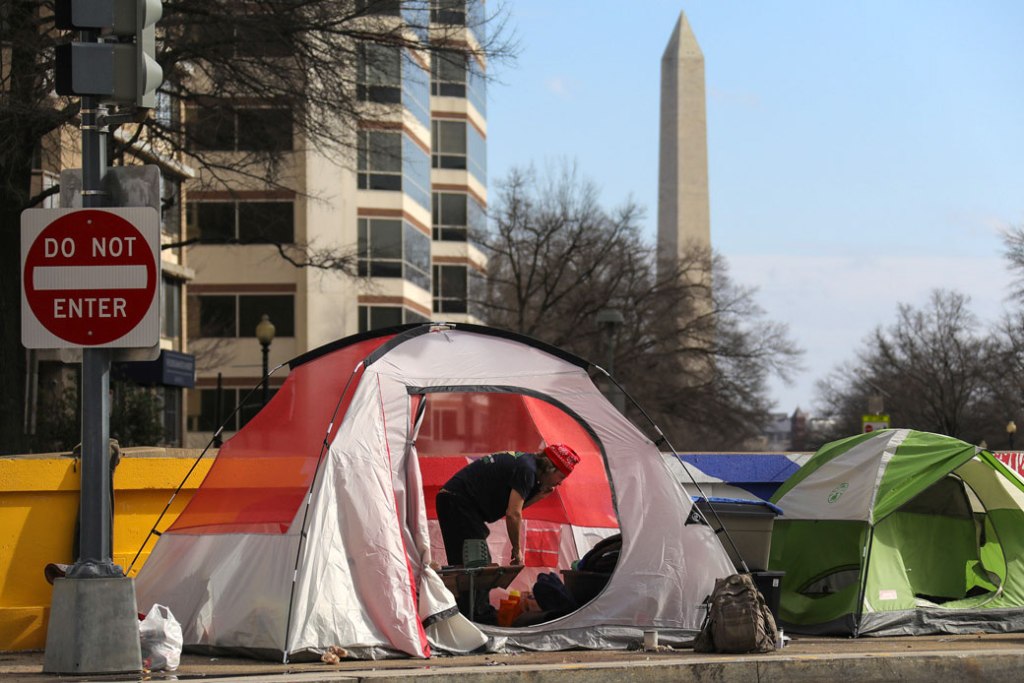
In contrast, when speculation floods into shelter / housing, it fatally distorts the cost of housing non-speculators must pay. I say fatally because shelter, along with food, energy and water (the FEW resources), are essential to life. These are not discretionary things we can decide not to have. When the price of essentials soars due to speculation that only rewards the speculators at the expense of non-speculators, the fuse of social disorder is lit.

Anyone who believes policies that encourage the wealthy to hoard housing to the point that the bottom 80% (or the bottom 95% in some areas) cannot afford to buy a home are just peachy is overdosing Delusionol. The social consequences are severe and uncontainable once the worm turns.

Exhibit #1 in Shelter Becoming a Speculative Asset is a modest house in the San Francisco Bay Area that sold for $135,000 in mid-1996. By modest I mean small, old, and on a small lot in a neighborhood of other small lots and homes. (A screenshot of the Zillow history is below.)

Today the home’s value is estimated to be about ten times higher: $1.35 million. Let’s do some basic math to understand just how distorted this market has become.

The median household income in 1996 was about $39,000. For a house costing $135,000, this represents 3.5 ratio of income to housing, well within the traditional ratio of 4 to 1 (4 X income = cost of the home).

Median household income has almost doubled to $75,000, roughly in line with inflation according to the Bureau of Labor Statistics. According to the BLS, the house that cost $135,000 in July 1996 would now cost $264,000 when adjusted for inflation, and the $39,000 median income would be $76,000.

Let’s say the house appreciated above the rate of inflation to $300,000 today. That’s still within the 4 to 1 ratio of income to house cost (4 X $75,000 = $300,000.) So even though the house rose 2.2X in cost, it would still be affordable to a median household.

At a value of $1.35 million, a household would need to make $337,500 annually–an income that is in the top 5% of households–to buy the house today. In other words, an income that is 4.5 times the median household income is the minimum needed to buy this modest house.

The house is now worth 4.5 times what it would have been worth if it had appreciated well above inflation.

The conventional argument holds that this four-fold increase in housing costs is due solely to a shortage of housing. Let’s consider some data before concluding this is the only dynamic in play.

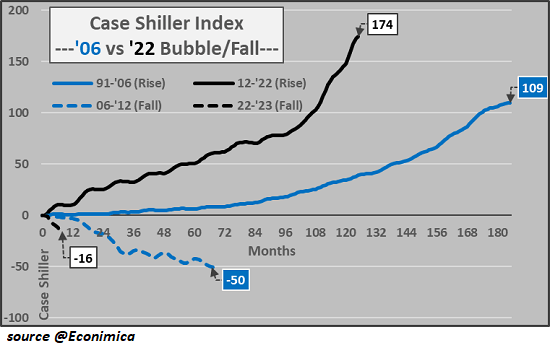
Chart #1: Case Shiller housing index: this chart shows two massive housing bubbles in the past 20 years.

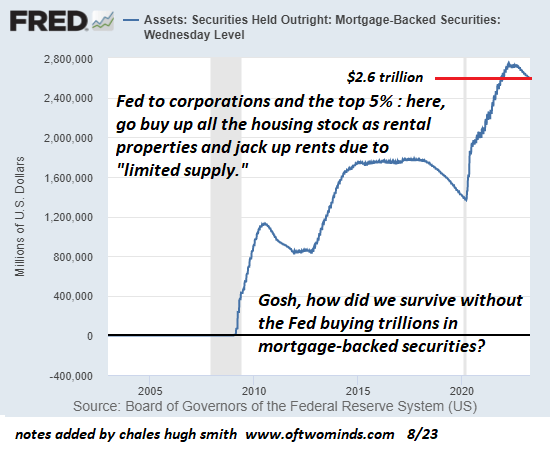
Chart #2: Federal Reserve’s purchases of mortgage backed securities (MBS) to goose the housing market. The “housing shortage” argument claims the unprecedented Fed purchases of trillions of dollars of MBS is not correlated to the housing bubble, but this claim makes no sense: dropping mortgage rates to unprecedented lows while soaking up trillions of dollars in securitized mortgages was like injecting speculative crack cocaine into the housing market. Gosh, how did we survive without the Fed buying $2.5 trillion in mortgages?

Chart #3: the current housing bubble compared to the 2000-2006 housing bubble: today’s bubble is even more extreme than housing bubble #1.

Chart #4: housing per capita (per person) has reached a new high: if there’s such a severe shortage of housing, how can the housing per capita be at an all-time high? Population rose 4 million in the past 4 years while 5 million housing units were added–plus a pig-in-a-python of housing in the pipeline.

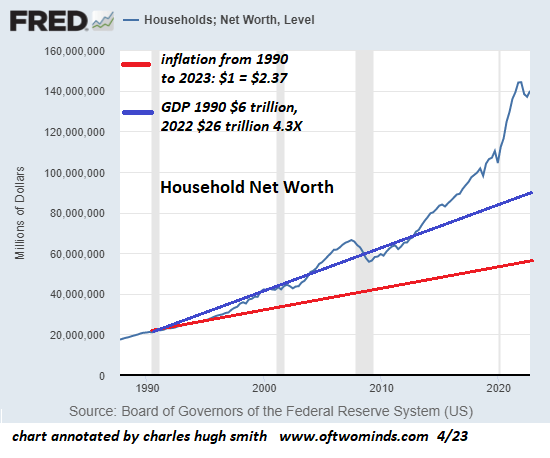
Chart #5: household net worth is $50 trillion above trend, the direct result of massive monetary and fiscal stimulus. Tens of trillions of dollars were borrowed into existence and pumped into so-called risk assets–assets such as housing that the wealthy buy for speculative appreciation.

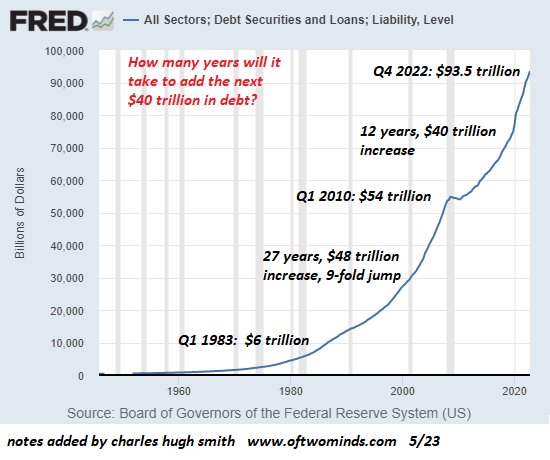
Chart #6: total debt–private and public–soared from $20 trillion in 1996 to $95 trillion now. Is it merely coincidental that this is $55 trillion above the trendline of inflation, which would have placed total debt at $40 trillion today?

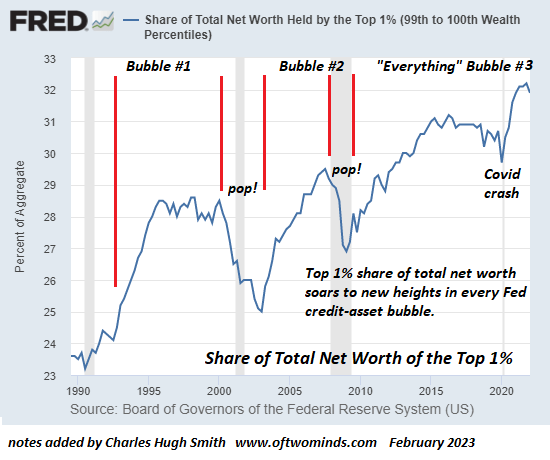
Chart #7: net worth of the top 1% households, which soared from 23% of all net worth to 32%: this 9% gain in the percentage of all household net worth represents a gain of $14 trillion above and beyond the $28.7 trillion in gains registered by the 23% they owned in 1990.

1990 total net worth: $21 trillion, 23% = $4.8 trillion; 2023 total net worth: $146 trillion, 23% = $33.5 trillion; $33.5 trillion – $4.8 trillion = $28.7 trillion.

This unprecedented bubble in housing valuations is due not to shortages but to decades of massive financial stimulus that incentivized speculative capital to flood into housing as a low-risk way to skim stupendous gains for creating zero gains in productivity. If you doubt this, then run this scenario and tell us what happens:

The Fed dumps its entire portfolio of mortgage backed securities and stipulates it will never buy any again. It also renounces all the other stimulus gimmicks that incentivized expansions of debt and speculation.

Does anyone really believe that the renunciation of massive, sustained stimulus of speculation in housing would leave housing valuations unchanged because valuations are solely the result of “shortages”? If so, there’s a little shack under the Brooklyn Bridge I’ll let you have for a couple of million. I’m sure the Airbnb rent will mint you millions.

Why the US needs this war in Gaza

By Pepe Escobar

The Global South was expecting the Dawn of a New Arabian Reality. 

After all, the Arab street – even while repressed in their home nations – has pulsed with protests expressing ferocious rage against Israel’s wholesale massacre of Palestinians in the Gaza Strip. 

Arab leaders were forced to take some sort of action beyond suspending a few ambassadorships with Israel, and called for a special Organization of Islamic Cooperation (OIC) summit to discuss the ongoing Israeli War Against Palestinian Children. 

Representatives of 57 Muslim states convened in Riyadh on 11 November to deliver a serious, practical blow against genocidal practitioners and enablers. But in the end, nothing was offered, not even solace.  

The OIC’s final statement will always be enshrined in the Gilded Palace of Cowardice. Highlights of the tawdry rhetorical show: we oppose Israel’s “self-defense;” we condemn the attack on Gaza; we ask (who?) not to sell weapons to Israel; we request the kangaroo ICC to “investigate” war crimes; we request a UN resolution condemning Israel.  

For the record, that’s the best 57 Muslim-majority countries could drum up in response to this 21st-century genocide.  

History, even if written by victors, tends to be unforgiving towards cowards.

The Top Four Cowards, in this instance, are Saudi Arabia, the UAE, Bahrain, and Morrocco – the latter three having normalized relations with Israel under a heavy US hand in 2020. These are the ones that consistently blocked serious measures from being adopted at the OIC summit, such as the Algerian draft proposal for an oil ban on Israel, plus banning the use of Arab airspace to deliver weapons to the occupation state.

Egypt and Jordan – longtime Arab vassals – were also non-committal, as well as Sudan, which is in the middle of a civil war. Turkiye, under Sultan Recep Tayyip Erdogan, once again showed it is all talk and no action; a neo-Ottoman parody of the Texan “all hat, no cattle.” 

BRICS or IMEC? 

The Top Four Cowards deserve some scrutiny. Bahrain is a lowly vassal hosting a key branch of the US Empire of Bases. Morocco has close relations with Tel Aviv – it sold out quickly after an Israeli promise to recognize Rabat’s claim on Western Sahara. Moreover, Morocco heavily depends on tourism, mainly from the collective west.  

Then we have the big dogs, Saudi Arabia and the UAE. Both are stacked to the rafters with American weaponry, and, like Bahrain, also host US military bases. Saudi Crown Prince Mohammad bin Salman (MbS) and his old mentor, Emirati ruler Mohammad bin Zayed (MbZ), do factor in the threat of color revolutions tearing through their regal domains if they deviate too much from the accepted imperial script.  

But in a few weeks, starting on 1 January, 2024, under a Russian presidency, both Riyadh and Abu Dhabi will expand their horizons big-time by officially becoming members of the BRICS 11

Saudi Arabia and UAE were only admitted into the expanded BRICS because of careful geopolitical and geoeconomic calculations by the Russia-China strategic partnership.

Along with Iran – which happens to have its own strategic partnership with both Russia and China – Riyadh and Abu Dhabi are supposed to reinforce the energy clout of the BRICS sphere and be key players, further on down the road, in the de-dollarization drive whose ultimate aim is to bypass the petrodollar.  

Yet, at the same time, Riyadh and Abu Dhabi also stand to benefit immensely from the not-so-secret 1963 plan to build the Ben Gurion canal, from the Gulf of Aqaba to the Eastern Mediterranean, arriving – what a coincidence – very close to now devastated northern Gaza. 

The canal would allow Israel to become a key energy transit hub, dislodging Egypt’s Suez Canal, and that happens to dovetail nicely with Israel’s role as the de facto key node in the latest chapter of the War of Economic Corridors: the US-concocted India-MidEast Corridor (IMEC).

IMEC is a quite perverse acronym, as is the whole logic behind this fantastical corridor, which is to position international law-breaking Israel as a critical trade hub and even energy provider between Europe, part of the Arab world, and India.  

That was also the logic behind Israeli Prime Minister Benjamin Netanyahu’s UN charade in September, where he flashed the whole “international community” a map of the “New Middle East” in which Palestine had been totally erased. 

All of the above assumes that IMEC and the Ben Gurion Canal will be built – which is not a given by any realistic standards.  

Back to the vote at the OIC, US minions Egypt and Jordan – two countries on Israel’s western and eastern borders, respectively – were in the toughest position of them all. The occupation state wished to push approximately 4.5 million Palestinians into their borders for good. But Cairo and Amman, also awash in US weapons and financially bankrupt as they come, would never survive US sanctions if they lean too unacceptably towards Palestine.

So, in the end, too many Muslim states choosing humiliation over righteousness were thinking in very narrow, pragmatic, national interest terms. Geopolitics is pitiless. It is all about natural resources and markets. If you don’t have one, you need the other, and if you have none, a Hegemon dictates what you’re allowed to have. 

The Arab and Muslim street – and the Global Majority – may rightfully feel dejected when they see how these “leaders” are not ready to turn the Islamic world into a real power pole within emerging multipolarity. 

It wouldn’t happen any other way. Many key Arab states are not Sovereign entities. They are all boxed in, victims of a vassal mentality. They’re not ready – yet – for their close-up facing History. And sadly, they still remain hostage to their own “century of humiliation.”

The humiliating coup de grace was dispatched by none other than the Tel Aviv genocidal maniac himself: he threatened everyone in the Arab world if they don’t shut up – which they already did.

Of course, there are very important Arab and Muslim brave-hearts in Iran, Syria, Palestine, Iraq, Lebanon, and Yemen. While not a majority by any means, these Resistance actors reflect the sentiment on the Street like no other. And with Israel’s war expanding each day, their regional and global clout is set to increase immeasurably, just as in all of the Hegemon’s other regional wars.

Strangling a new century in the cradle 

The catastrophic debacle of Project Ukraine and the revival of an intractable West Asian war are deeply intertwined. 

Beyond the fog of Washington’s “worry” about Tel Aviv’s genocidal rampage, the crucial fact is that we are right in the thick of a war against BRICS 11.      

The Empire does not do strategy; at best, it does tactical business plans on the fly. There are two immediate tactics in play: a US Armada deployed in the Eastern Mediterranean – in a failed effort to intimidate Resistance Axis behemoths Iran and Hezbollah – and a possible Milei election in Argentina tied to his avowed promise to break Brazil-Argentina relations. 

So this is a simultaneous attack on BRICS 11 on two fronts: West Asia and South America. There will be no American efforts spared to prevent BRICS 11 from getting close to OPEC+. A key aim is to instill fear in Riyadh and Abu Dhabi – as confirmed by Persian Gulf business sources.  

Even vassal leaders at the OIC show would have been aware that we are now deep into The Empire Strikes Back. That also largely explains their cowardice. 

They know that for the Hegemon, multipolarity equals “chaos,” unipolarity equals “order,” and malign actors equal   “autocrats” – such as the new Russian-Chinese-Iranian “Axis of Evil” and anyone, especially vassals, that opposes the “rules-based international order.” 

And that brings us to a tale of two ceasefires. Tens of millions across the Global Majority are asking why the Hegemon is desperate for a ceasefire in Ukraine while flatly refusing a ceasefire in Palestine. 
Freezing Project Ukraine preserves the Ghost of Hegemony just a little bit longer. Let’s assume Moscow would take the bait (it won’t). But to freeze Ukraine in Europe, the Hegemon will need an Israeli win in Gaza – perhaps at any and all costs – to maintain even a vestige of its former glory. 

But can Israel achieve victory any more than Ukraine can? Tel Aviv may have already lost the war on 7 October as it can never regain its facade of invincibility. And if this transforms into a regional war that Israel loses, the US will lose its Arab vassals overnight, who today have a Chinese and Russian option waiting in the wings. 

The Roar of the Street is getting louder – demanding that the Biden administration, now seen as complicit with Tel Aviv, halt the Israeli genocide that may lead to a World War. But Washington will not comply. Wars in Europe and West Asia may be its last chance (it will lose) to subvert the emergence of a prosperous, connected, peaceful Eurasia Century.

The Roots of Radicalism and the Structure of Evil

By Edward Curtin

Source: Behind the Curtain

My title is redundant for a reason, since the root of the word radical is the Latin word, radix, meaning root.  For I mean to show how the use and misuse of language, its history or etymology, and ours as etymological animals as the Spanish philosopher José Ortega y Gassett called us, is crucial for understanding our world, a world once again teetering on the edge of a world war that will almost inexorably turn nuclear as events are proceeding.  If our language is corrupted, as it surely is, and political propaganda flourishes as a result, the correct use of our language and the meaning of words becomes an obligation of anyone who uses them – that is, everyone, especially writers.

The United States government exists to wage war.  In its present form, it would crumble without it; and in its present form, it will crumble with it.  Only a radical structural change will prevent this.  For war-making is at the core of its budget, its raison d’être – 816.7 billion for the Fiscal 2023 National Defense Authorization Act alone – a deficit-financed sum that tells only part of the story.  This amount that finances the military-industrial complex and its blood money is for a country that has never been invaded, is bordered by friendly neighbors, and is oceans away from the multitude of countries its leaders attack and call our enemies.  The U.S. wages wars around the world because killing is its lifeblood, its structural essence.

In writing of the misuse of language, George Orwell wrote, “It becomes ugly and inaccurate because our thoughts are foolish, but the slovenliness of our language makes it easier for us to have foolish thoughts.”  So with these words Orwell slyly places us within the enigma of the chicken and the egg, a conundrum or paradox that relates to my theme in a weird way, but which I will directly ignore.

By radical I do not mean the widespread political usage as in radical-right or radical-left or radical meaning one who plays the role through dress or demeanor.  I am using the word in its primary meaning – a radical is one who is rooted in the earth, which means everyone.  Everyone therefore is mortal, human not a god, and comes from the earth and returns to it.  Everyone is radical in this sense, although they may try to deny it.  And the more one feels alive the more one senses one will die and doesn’t like the thought, therefore many tamp down their aliveness in order to reduce their fear of death.  The best way to do this is to disappear into the crowd, to become a conventional person.  To act as if one didn’t know that one’s political leaders were in love with death and killing and were not obedient cogs in a vast systemic killing machine.  Maybe the unconscious assumption is that these “leaders” can kill death for you by killing vast numbers of people and make you feel someone has control of this thing called death.

Rabbi Abraham Joshua Heschel, who stood strongly against the Vietnam War and marched with Dr. Martin Luther King, Jr., put the basic sense of radical well when he said:

Our goal should be to live life in radical amazement. . . . get up in the morning and look at the world in a way that takes nothing for granted. Everything is phenomenal; everything is incredible; never treat life casually. To be spiritual is to be amazed.

To be radically amazed that we exist is to be equally amazed that we will die.  And there’s the rub.

Yesterday I got in our car and drove away to meet a journalist friend.  It was evening and my wife had previously used the car.  I had just spent time following all the dreadful news about the massive slaughter by Israel of Palestinians in Gaza, including the death of more than 3,000 children whose numbers are climbing fast.  Visions of those children and babies played havoc with my spirits, and I kept thinking of my own children and the love and tenderness that comes with being a  parent.  A musical cd that my wife had been listening to started playing.  The case was on the console.  It was Sacred Arias by Andrea Bocelli.  He of the majestic voice was singing Silent Night.  I was overwhelmed with tears by his passionate words:

Silent night! Holy night!
All is calm, all is bright
round yon Virgin Mother and Child,
Holy infant so tender and mild,
sleep in Heavenly peace!

I saw nights in Gaza as Israeli bombs burst and shattered everyone and everything to bits, all the holy infants, the children and adults.

I felt beside myself with grief, a U.S. citizen driving down a safe country road contemplating the savagery of my nation and its support for the Israeli government’s brutality and mass killings of Palestinians for all the world to see on screens everywhere.

I felt ashamed to live in a land where justice is a game reserved for rhetoric alone as it joins in the massacre of the innocent, as it always has, now together with the apartheid Israeli regime.

I thought of all the compromised politicians who pledge their allegiance to the killers, Biden and all his presidential predecessors, now including the aspirant Robert F. Kennedy, Jr., a man with a conscience on many important issues whom I have supported in his quest for the presidency, but a man whose conscience has abandoned him when it comes to the Palestinians, as Scott Ritter has recently documented.  I have privately urged Kennedy to reconsider his “unwavering, resolute, and practical” support for the Israeli government following the Gaza breakout of October 7, but to no avail.  In fact, I have been trying to get him to withdraw his unconditional support for Israel since the summer when he withdrew his support for Roger Waters, marched with Rabbi Shmuley Boteach in the Israel parade in NYC, and allowed Boteach to say that Sirhan Sirhan had killed his father without correcting him since he knew it was an egregious lie.  My failure in this regard deeply saddens me.

I felt betrayed again – perhaps you will call me naïve – as when I was young and last put my trust in voting for a US presidential candidate in 1972.  I thought I had learned to radically grasp the systematically corrupt nature of the U.S. warfare state.  Now more than three weeks have passed and Bobby Kennedy has remained silent, only to ask for our prayers for the victims of the mass shooting in Maine.  For the Palestinians, not a word. Although he considers the Israeli-Palestinian situation complicated, there is nothing complicated about genocide; it doesn’t necessitate long analyses and discussions with advisers.  The facts of the Israeli slaughter of Palestinians in Gaza are evident for all to see, if they wish.  Bobby Kennedy has turned away.  And I have now sadly turned away from him.

I remembered the Gospel words I heard long ago about the fulfillment of the words of the prophet Jeremiah: “A voice was heard in Ramah, sobbing and loudly lamenting: it was Rachel weeping for her children, refusing to be comforted because they were no more.”  But this time it is not the Jewish Rachel, for Herod has assumed the name Netanyahu and his U.S. allies, and the weeping ones are Palestinian mothers and fathers.  Nothing can justify such slaughter, not the terrible killings of innocent Israelis on October 7 that I denounce; not the fear that the birth of messengers of peace might strike into Herod/Netanyahu’s heart – nothing!  Seventy-five years of ethnic cleansing of Palestinians continues apace. The Jewish child Jesus, the radical preacher of love and peace for all people, didn’t die on a private cross, nor do the Palestinians.  So it goes.

I thought of the indescribable sweet wonder of holding your baby in your arms while realizing how many Palestinian parents have been holding their dead children in theirs.  Rage welled up in me at the obscenity of those who support this and those who shut their eyes to it and those who remain silent.

I realized that as a Christian I am baptized into the human family, not some special in-group, which is the opposite of Jesus’s message.  Every child is holy and innocent and to massacre them is evil.  And to remain silent as it happens is to be complicit in evil.

I remembered how these many ongoing weeks of terror started and thought of a poem that is succinctly apposite: Harlem by Langston Hughes:

What happens to a dream deferred?

Does it dry up
like a raisin in the sun?
Or fester like a sore-
and then run?
Does it stink like rotten meat?
Or crust and sugar over-
like a syrupy sweet?

Maybe it just sags
like a heavy load.

Or does it explode?

And I thought that he could have omitted that final question mark because we have our answer, then and now.

Then the music stopped and I arrived at my destination to meet my friend.

Yes, to be radical is to be rooted in the earth and to realize all people are part of the human family, each of us made of flesh and blood and therefore sisters and brothers deserving of justice, peace, and dignity.  But this is just a first step in the grasping of the full dimension of the radical vision.  It can end in fluff if a second step is not taken: to use our freedom to uproot ourselves from the conventional government and mass media propaganda and mind control that clouds our understanding of how the world works. This takes study and work and an understanding of the historical and systemic roots of all the alleged “unprovoked” violence that ravages our world.

Thus the existential and socio-historical merge in the radical vision that allows us to grasp the structures of evil and our personal responsibility.

Today that obligation is clear: To oppose the Israeli genocide of the Palestinians.

Otherwise we are guilty bystanders.

Saturday Matinee: JFK

By Brian Eggert

Source: Deep Focus Review

Just moments after President John F. Kennedy’s assassination on November 22, 1963, the press and government officials assigned blame to a lone gunman. The popular theory: Lee Harvey Oswald, a bad man working alone, shot the young and handsome President with three bullets fired from the sixth floor of the Texas School Book Depository in Dallas. Shortly thereafter, Oswald was arrested, and then later killed by seemingly patriotic vigilante Jack Ruby. In the aftermath, Supreme Court Chief Justice Earl Warren was tasked to investigate the assassination in 1964 and, along with seven committee members of the Warren Commission, concluded the assassination was the work of Oswald and Oswald alone. Meanwhile, Lyndon B. Johnson took over the country. Several years passed before the United States House Select Committee on Assassinations carried out the second investigation into the events. The HSCA stated, among many other conclusions that contradicted the Warren Commission report, that recorded police radio evidence proves at least two shooters fired that day, and there was probable cause to believe Kennedy’s assassination was a conspiracy. Throughout this period and beginning in 1966, District Attorney Jim Garrison of Orleans Parish, New Orleans, had his own ideas, and many of them are explored by Oliver Stone in his incredible film, JFK.

Hope for a factual and true account of the events surrounding Kennedy’s assassination remains improbable, if not impossible. Contradictory evidence and assessments have clashed since the Warren Commission report, including countless books and analyses written about the subject. Few other historical events have been debated so passionately by both the public and private spheres. By synthesizing these debates, Stone’s film takes considerable liberties with the facts and history surrounding the incident, using Garrison’s investigation as a lens through which his screenplay scrutinizes this watershed moment in American history, marking the loss of so-called “American Innocence”. JFK is not fact. Through bravura filmmaking, Stone fabricates a narrative out of truth, belief, and supposition. He breaks down a conspiracy so elaborate that anyone could get lost in its intricacies. He puts forth a singular filmic examination of the previous thirty years of theories, and in some cases exposes lies that were told surrounding Kennedy’s assassination. Where Stone’s 1993 picture remains a landmark is how it recapitulates varied assassination theories and commentary into a singular source, through which his audience can once again ask questions about what happened and why. And when those questions are inevitably given unsatisfactory or contradictory answers from official sources, Stone hopes we get angry and demand the truth.

If JFK serves another purpose beyond fulfilling the needs of rousing, electric cinema, the picture creates an intense and undeniable metaphor for how American culture reacted to and feared the truth of the JFK assassination. Stone embeds enough facts into his fiction that the audience cannot help but question the official story and, in turn, realize the federal government’s claims about what happened were either incompetent or intentionally false. Stone once admitted, “No one really knows what exactly happened on November 22, 1963, or who did it, but there sure are an abundance of flaws in the official investigation.” Stone’s film sets out to challenge the Warren Commission by creating a blueprint of JFK conspiracy theories of merit and packaging those ideas in the form of a detective story unlike any other. The film’s goals are simple, but its details are byzantine. Several ongoing strains in JFK force us to question the official story: the film puts Oswald’s life under the microscope, suggesting he could not have been the lone gunman; it examines the details of the assassination in Dealey Plaza; it considers Garrison’s government informant Mr. X; it entertains notions that the CIA and mafia played roles in a conspiracy; and, in perhaps its most famous sequence, the film rebukes the so-called “magic-bullet theory” introduced by the Warren Commission. Primarily, Stone wants his audiences to believe that forces conspired to carry out a political coup d’état. He compared the notion to Hamlet, saying, “It’s the untold story of a murder that occurred at the dawn of our adulthood… The real king was killed, and a fake king was put on the throne.”

Stone’s choice and depiction of his protagonist only further complicate matters. He represents Jim Garrison as an American hero—the driving force behind the only criminal trial ever to stem from the assassination. Garrison maintained a most fervent hypothesis that supposed businessman Clay Shaw, a suspected CIA agent, somehow took part in a CIA plot to carry out a coup d’état against Kennedy. Garrison eventually brought Shaw to trial and lost. However, Garrison’s investigative methods and accusations that he used JFK’s assassination for media attention and professional gain have been washed over by the filmmaker in order to provide his film with a stalwart heroic figure to dramatize the proceedings. Stone makes a conscious choice to avoid many of the actual hardships and ugly truths in Garrison’s personal life, such as how Garrison’s investigation and his subsequent criticism lead to his personal ruin through alcohol and womanizing. What’s more, Garrison was not present at much of the trial because of a double hernia, leaving Assistant D.A. James Alcock to address the courtroom. Stone made these decisions as an artist assembling a drama with real-life significance, as opposed to a historical documentary or exposé. As a result, the director’s artistic choices surrounding Garrison are often the ammunition his film’s detractors use against the factual integrity of his coup d’état hypothesis.

Indeed, Stone’s method of delivery contains expressive, if not sensationalist moments of cinematic flair. He’s unopposed to exaggerating for effect, using every device in his faculty to distribute a firm wallop to the viewer’s gut. The purpose behind his three-hour-and-twenty-six-minute (the Director’s Cut length) drama is to convince his audience, on an emotional level, that Kennedy was assassinated as part of a conspiracy. Stone sought to study the assassination through the eyes of multiple witnesses, though each perspective would be represented with conflicting details, like the characters in Akira Kurosawa’s Rashomon (1950). Stone also culled influence from Costa-Gavras’ feverish thriller (1969), which depicts a political assassination early on, and then through the course of the film reexamines what happened through eyewitness accounts and video footage. To achieve this approach, cinematographer Robert Richardson used multiple film stocks (35mm, 16mm, even Super 8) and aspect ratios, sometimes requiring several cameras with different stocks for a single scene, such as the film’s recreation of the assassination in Dealey Plaza. Editors Joe Hutshing and Pietro Scalia jump between these film stocks, creating JFK’s intense rhythm, the pace that makes over three hours of runtime feel like ninety minutes. The editors freely cut between real and recreated newsreel footage, black-and-white photography, overexposed flashbacks, and Richardson’s clean lensing on then-modern-day scenes. The entire film looks and feels like a triumph of montage (of JFK’s eight Academy Award nominations, it won for Best Cinematography and Best Editing).

Craft aside, development on JFK began in 1988 when Stone met Ellen Ray, a publisher for Sheridan Square Press, who had just published Garrison’s second book, On the Trail of the Assassins. She gave Stone a copy and, after reading it, he purchased the film rights. Garrison had many critics throughout the government, among historians, and even conspiracy theorists. But much of what Garrison wrote about—the extent of the alleged conspiracy—had extensive consequences in the American government. Regardless of Garrison’s oft-condemned methods or conclusions, for Stone the man epitomized his own passion to keep searching for the truth, no matter what. “I feel you have to keep digging into history to understand what happened to us and our generation,” Stone noted.  He took the same approach to Garrison himself and, before he ever considered making a film based on Garrison’s book, he met a sixty-eight-year-old who had spent twenty-three years in the military, flew planes in World War II, was a former FBI agent, co-commanded his regional National Guard, and served three terms as a District Attorney. Stone’s mission: determine if Garrison had in fact used JFK’s assassination for media attention and professional gain, or if he was a crusader whose aim was true, even if his methods were at times flawed. Ultimately, Stone determined Garrison’s preliminary investigation went out on a limb and he trusted people he shouldn’t have; but after Garrison wrote a second book, he focused his theories more, because he cared about the truth, not political gain.

Garrison was never intended to be the subject of JFK; Stone used Garrison’s case against Clay Shaw as a catalyst to expose the inconsistencies in the Warren Commission and further explore the wealth of theories surrounding the assassination. Stone realized that placing Garrison at the center of his film would earn criticisms from Garrison’s detractors, but the director felt exposing truths that had been mired in lies for thirty years was more important. After all, Garrison’s presence within the film was not biographical; the character was merely a metaphor who represented the work of several key investigations. In addition to Garrison’s book, Stone purchased the rights to Jim Marrs’ 1989 text Crossfire: The Plot That Killed Kennedy; he also hired a group of independent researchers that would assist in compiling theories. The filmmaker kept his efforts secret, as he was just finishing work on Born on the Fourth of July (1989) and would next shoot The Doors (1991). He learned filming Salvador and Platoon (both released in 1986) that, when shooting potentially controversial subject matter, the fewer people aware of his plans in the preliminary stages meant fewer obstructions once the production was moving forward. And once he had fully delved into the evidence available to his team, he became more convinced of an elaborate cover-up from positions of power within the U.S. government. “When you begin to sift through it,” he said, “there’s no escaping the thread.” Only after Warner Bros. became involved did Stone’s wife at the time stop worrying that he would end up dead, as so many key witnesses had, for poking his nose where it didn’t belong.

In spite of the contentious subject matter, Warner Bros.’ top brass embraced Stone’s idea, particularly chairman and CEO Terry Semel, who oversaw All the President’s Men (1976), The Parallax View (1974), and The Killing Fields (1984) during his time at the studio. After the production had a home and an estimated $20 million budget, Stone worked on the script with his primary collaborators: Yale graduate Jane Rusconi headed his research team; Columbia School of Journalism professor Zachary Sklar, who had served as editor on Garrison’s second book, served as co-writer. At times, Stone’s proclivities as a dramatist and seeker of historical truth were at odds. Stone used composite characters that would later earn him criticisms among the press, who viewed JFK as an historical treatise instead of a motion picture. For example, there were two gay men who saw David Ferrie and Clay Shaw together, but Stone combined them into a single role played by Kevin Bacon. Stone also combined two essential meetings Garrison had in Washington D.C. into a single meeting with Mr. X, chillingly played by Donald Sutherland. The first of Garrison’s meetings was with Fletcher Prouty, a former Air Force colonel and Pentagon contact for the CIA; the second was Richard Case Nagell, an alleged CIA agent. Stone himself met with Prouty and incorporated much of what was said into the script. Regardless of his creative streamlining of the facts, Stone’s screenplay was becoming monumental and his budget was now double what he originally estimated.

Producer Arnon Milchan was there to smooth over studio roadblocks. Milchan sought out Stone and had to convince the director to allow him to produce. The producer was drawn to Quixotic projects such as Martin Scorsese’s The King of Comedy (1982) and Terry Gilliam’s Brazil (1985), or later David Fincher’s Fight Club (1999) and Alejandro G. Iñárritu’s Birdman or (The Unexpected Virtue of Ignorance) (2014). Milchan is a maverick, much like Stone, and the producer’s appreciation of film as an art form meant he seeks to align with rare nonconformist filmmakers. Fortunately, he was the kind of producer who could convince Warner Bros. and European investors to double Stone’s originally quoted budget to $40 million; he persuaded the Dallas City Council to allow Stone to shoot in Dealey Plaza, which no one had ever done before; and he convinced the distributors to release an epic-length picture into theaters. Milchan also played a major role in the film’s casting, which includes many of Hollywood’s most well-respected performers of the 1990s. Foremost was Kevin Costner as Jim Garrison, who beat out dozens of other actors who were considered (Harrison Ford, Robin Williams, Willem Dafoe, Tom Berenger, Alec Baldwin, and so on). When the director was getting closer to casting Costner, he wrote a note to himself saying, simply, “Kevin Costner—Jim Garrison, all-American quality.” Nevertheless, Costner originally turned down the role and required some finagling. Stone heard a rumor that Costner promised his wife Cindy that he would take a year off after shooting Robin Hood: Prince of Thieves (1991); and so, Stone sent Cindy a copy of Garrison’s books. She read them and, according to Costner, told him, “You have to do this.”

The production itself presented a challenge for Stone both physically and psychologically, since he was starting with a 156-page script. However, the script was actually longer, since pages were filled with notes, scribbles of dialogue, and arrows in the margins. While shooting, the director was methodical and detail oriented, keeping track of the film’s multiple strains, including what wasn’t even in the script. Frequent cutaways to documentary footage or black-and-white video, and half a dozen other video processes, rattled around in Stone’s brain. “I thought I might really go down on this one,” Stone said. “This could be a movie that totally misses it. Too talky, too difficult, too much information… Maybe this will be Heaven’s Gate. But goddamnit, it’s worth it. Because this is one I believe in. No doubt.” Indeed, long before reading Garrison’s book, Stone’s life was shaped by the JFK assassination. He was at the formative age of seventeen in 1963, and what’s more his parents were divorcing at the time. “It left me feeling that there was a mask on everything,” he once said. In subsequent years, Stone’s perception of his government continued to be shaped by “Vietnam, then the bombing of Cambodia and Laos, the Pentagon Papers, the Chile affair, Watergate, going up to the Iran-Contra in the eighties. We’ve had a series of major shocks.” These events shaped Stone and would deeply influence several of his projects, including PlatoonWall Street (1987), Born on the Fourth of JulyThe Doors, and Nixon (1995). These films would provide a veritable catalog of his feelings during their respective periods. It almost goes without saying that JFK would become Stone’s passion project.

Perhaps due to the subject matter or simply Stone’s radical approach to all his films, most of mainstream Hollywood and the media was hoping the wildly ambitious, controversial film would overwhelm Stone and spin out of control, taking the director with him. Before shooting even began, George Lardner of The Washington Post arrived on-set uninvited, snooping around, and later published a 5,000-word reaction to his visit entitled “On the Set: Dallas in Wonderland: How Oliver Stone’s Version of the Kennedy Assassination Exploits the Edge of Paranoia”. Amid his censures, Lardner critiqued a stolen first draft of the JFK script as a series of “absurdities and palpable untruths” in what seemed like a preemptive smear campaign. Given Lardner’s history as a CIA investigator with contacts in the agency still, Stone began to feel like Garrison, as if forces in the government were trying to stop him. Likewise, Garrison had tried to subpoena various members of the CIA, governors, and crucial witnesses, but his requests were unreasonably denied. In the meantime, Garrison’s offices were bugged, his files copied and given to the defense, and attempts were made to bribe Garrison to stop his investigation. Similarly, various editorials in The Washington PostChicago Tribune, and Time magazine picked apart Stone’s production and the early draft of his script, forming opinions about a film that had not yet been shot.

The screen story unfolds with Garrison’s investigation into Lee Harvey Oswald’s alleged friend David Ferrie (Joe Pesci), following a lead from witness Willie O’Keefe (Kevin Bacon), a convicted male prostitute, that Ferrie and Clay Shaw (Tommy Lee Jones) had discussed killing Kennedy. At the same time, Garrison’s team investigates how the shooting from the Book Depository could not have been carried out for a number of reasons. They also investigate Oswald (played by Gary Oldman, but also two other actors), a former Marine who defected to the Soviet Union, and yet suspiciously was able to return to U.S. soil during the Cold War without much hassle. As Garrison’s team learns more about Oswald, it seems he was indeed a “patsy” as he claimed to be, having become a low-level member of various anti-Castro Free Cuba Committee rallies, some held by former FBI agent-turned-private-investigator Guy Bannister (Ed Asner), as attested to by Bannister’s employee Jack Martin (Jack Lemmon). Or consider Jack Ruby (Brian Doyle-Murray), Oswald’s killer, who later called Kennedy’s assassination “an act of overthrowing the government”. These loose strains and leads discovered by the investigating team congeal into something more cohesive after Garrison meets with the so-called Mr. X (Sutherland), a colonel in the U.S. Air Force who suggests a vast governmental conspiracy conceived by the CIA and the U.S. military to maintain a thriving military industrial complex under Lyndon B. Johnson. Garrison finally takes aim at Shaw, hoping to shed light on the coup d’état conspiracy in open court. Though changing testimonies and dead witnesses weaken his arguments and he loses the case, he brings a new awareness to the facts by showing the footage shot by witness Abraham Zapruder for the first time in public, and detailing the absurdity of the Warren Commission’s “magic-bullet theory”.

When JFK was released on December 20, 1991, the polarized response from critics called Stone’s picture everything from “an insult to the intelligence” to “dubious” to “seditiously enthralling”. Discussions put Stone’s approach under the microscope for his blend of fact and tabloid-worthy fiction. Scenes of Clay Bertrand and David Ferrie donning costume attire—the former gilded to look like Mercury, the latter even more absurd-looking than his usual crooked wig and painted eyebrows—slapping and pinching each other’s nipples in the presence of the boyish male prostitutes hardly boasts credibility. Though the gay community recoiled at such scenes, moments like this show Stone at his frenzied best, using his hyperbolic style to wrangle his audience into hysterics over the official story. A few critics such as Roger Ebert or Time magazine’s Richard Corliss realized what Stone was trying to do. Corliss put it best: “Part history book, part comic book, the movie rushes toward judgment for three breathless hours, lassoing facts and factoids by the thousands, then bundling them together into an incendiary device that would frag any viewer’s complacency.” Elsewhere, MPAA president Jack Valenti compared JFK to Leni Riefenstahl’s Nazi propaganda documentary, Triumph of the Will (1941). Likewise, an attorney for the Warren Commission, David Belin called the film “a big lie that would make Adolf Hitler proud.” Others missed the point entirely. Anthony Lewis of New York Times described the film with incredulity, writing it “tells us that our government cannot be trusted to give an honest account of a Presidential assassination”—as if no government had ever betrayed the trust of its people before. By the time the dust settled around JFK, most agreed that, formally speaking, JFK was an amazement, but as history it was nothing more than a three-hour conspiracy theory.

However, the term “conspiracy theory” comes with its own negative associations that, quite unjustly, dismiss all integrity of the associated claim as paranoia. Theories about the U.S. government faking the first moon landing or the Holocaust being an elaborate setup remain laughable examples embraced by crackpots. And yet, instances of relevant and true conspiracy theories exist throughout history, confirmed long after the fervor of their origination has passed. Accusations from the Martin Luther King Jr. camp that he was being monitored by the FBI may have sounded paranoid at the time, but J. Edgar Hoover’s COINTELPRO initiative speaks to the contrary: Hoover wanted “to pinpoint potential troublemakers and neutralize them before they exercise their potential for violence.” This included feminist organizations, anti-Vietnam protesters, and civil rights movements. Elsewhere, those who consider The Manchurian Candidate (1962) to be far-fetched would find the CIA’s secret mind control experiments (codenamed MK-Ultra) alarming. Information on the Top Secret project was unveiled in 1977 when the Freedom of Information Act exposed the existence of the project, the details of which remain in question after CIA director Richard Helms destroyed many of the files on the program in 1973. Nevertheless, President Bill Clinton gave a speech in 1995 on a Bioethics Report that detailed the CIA’s mind control experiments conducted at U.S. hospitals, universities, and military facilities during the Cold War. (It should be noted that the former CIA director Helms later admitted Clay Shaw was indeed in the CIA, an admission that can only moderately validate Garrison’s in-court claims so many years after the fact.)

The point is, a conspiracy theory should not be disregarded simply because of its association by name with other, more fantastic conspiracy theories. Nor should JFK be disregarded as a work of pure fiction. Even looking at a few details within the film that happen to be true, unanswerable questions arise that contradict the Warren Commission and any lone gunman theory. Some would argue that any measure of fiction implanted into fact results in a work of fiction, but the degree to which JFK is fact or fiction is ultimately up to the viewer. Of course, not every detail in the film is clean and untarnished. But there’s a lot of truth in JFK, leading to a log of questions. The lingering questions Stone raises: “Why didn’t Oswald shoot when Kennedy was coming straight at him instead of waiting for a worse shot from the rear through a tree? What was Oswald’s history? How come he knew these people in New Orleans [Bannister, Ferrie, Shaw, etc.]? What about Ruby’s history? Oswald’s connections to Cuba? Ferrie’s connections to Oswald? Oswald’s military history, which seems to border on intelligence work? What about all the dead witnesses?” The answers to these questions, and the implications of those answers, are almost too big to contemplate.

JFK gets swept up in these questions and brings the viewer along for the journey. Some of these questions lead nowhere and cannot be supported by facts. Consider the scene where Pesci’s fervent David Ferrie raves to Garrison and his team in a hotel room about his involvement with Oswald and the CIA, plainly under the influence of multiple substances. “This is too fuckin’ big for you, you know that? Who did the president, who killed Kennedy, fuck man! It’s a mystery! It’s a mystery wrapped in a riddle inside an enigma! The fuckin’ shooters don’t even know!” But his guard is down, and in his ravings he confesses to helping carry out Kennedy’s assassination. Garrison’s own books admit that Ferrie never made such an outright admission, even though Garrison believed Ferrie and Oswald were indeed associates. Though the scene never occurred in real life, it illustrates for the viewer the level of unbridled paranoia Garrison saw in his witnesses, and the general feeling of suspicion and terror in the wake of the assassination. To be sure, for every erroneous fact in JFK, there’s a measure of undeniable truth the film’s harshest critics are quick to overlook. Stone takes what Garrison believed and propels it into a drama, which in turn leads to an open discussion about the facts and suppositions of Kennedy’s assassination.

Along the way, Stone sets out to establish a number of facts, or truths. First, he establishes that Oswald did not act alone. He comes to this conclusion by forming a concrete argument against the Warren Commission’s belief that only three bullets were fired, largely using the Zapruder film combined with the topography of the bullet’s trajectory. Herein, we see with our own eyes how three bullets from behind could not have caused the damage inflicted on both Governor Connolly and Kennedy, whose head follows the trajectory of a bullet back and to the left, as though his shooter was in front of him to the right. Furthermore, Stone supposes that an organized assassination could not be pulled off by amateurs. There are less factual suppositions about the events leading up to the assassination, and less tangible evidence, largely based in accusation and suspicion. But Stone suggests that the CIA found an enemy in Kennedy, who fired three major CIA players at the time (Charles Cabell, Richard Bissell, and Alan Dulles) and tried to restrict CIA paramilitary activities to the Pentagon, giving them motive to conspire against their leader. Who else but the government could arrange for Kennedy’s Secret Service and military escorts to be so skeletal in Dallas? The facts after the assassination are also suspect, specifically in how LBJ ran the country. He did not follow Kennedy’s policies, and instead aligned his policies with those of the Joint Chiefs, who clashed with Kennedy on virtually every major political issue of the time. Kennedy wanted to ban nuclear testing; to end the Cold War; to avoid violent confrontations with Cuba, Laos, and Vietnam. And then there were the hours after the shooting, when the press’ wire stories circulated around the globe in locations like New Zealand. The media was quickly provided with complete profiles on Oswald, despite there being utter chaos amid authorities in the aftermath of the shooting and no announcements made by those interviewing Oswald. This suggests a carefully prepared cover story.

Because Oswald had not yet been convicted or properly interviewed for his accused crime, the nation’s opinion on the subject was already set by the press, which pinned Oswald as the lone shooter—not the alleged shooter. History was already made for the media and American people. No investigation needed. Those who still believe the lone gunman theory (a mere 30% of Americans, based on a 2013 Gallup poll) harbor an alarming disregard for the facts. But the reactions among many of those who believe there was some manner of conspiracy, governmental or otherwise, have an even more alarming response: apathy. Which is to say, the majority people (81% of Americans at its highest rate, according to the same Gallup poll) accept that Kennedy’s assassination was a conspiracy. Most accept this theory without anger or action. After all, Americans aren’t demanding the declassification of unreleased documents from the Warren Commission in any great number. How frightening and, to put it mildly, saddening, that Americans would believe in a conspiracy to assassinate their supposedly beloved President Kennedy, but then refuse to act in response or demand the truth. Regardless of how Americans feel about the false conclusions and their seemingly ingrained belief that a conspiracy did indeed take place, apathy takes over as history becomes almost mythologized into a distant bedtime story. Anger over the lies and the crime itself is subdued by the acceptance that we will probably never learn the truth about what happened. And once our anger is curbed to a mild grumble, whether it was a lone gunman or a conspiracy, the conclusion elicits the same defeated, unsatisfied response.

In many ways, Stone creates a Capra-esque story, a dreamy sort of tale set to John Williams’ classicized score, about a noble man who served in WWII and Korea, but sees the assassination as the death of an idyll. A servant of his country, Garrison begins to investigate when he suspects something is amiss with the Kennedy assassination. The bulk of his investigation, conducted after 1966, leads him into dark territory, shattering his ideals and perceptions about his own country. And for seeking the truth, he is finally accused, disgraced, and beaten by the opposition. On these basic levels, the story of Stone’s version of Jim Garrison has an almost Mr. Smith Goes to Washington quality that devolves with the hero’s disillusionment—recounting the death of American idealism. How appropriate that Stone wrote in his original casting notes for Garrison, “Find a real person—new Gary Cooper, create him yourself. A James Stewart, like old days.” Elsewhere, Stone was well aware that Garrison’s evidence was sometimes questionable, his conclusions broad, and his personal life troubled (as shown in squabbles with his wife, played by Sissy Spacek). On the job, he was accused of using truth serums, bribing witnesses, and making promises for reduced sentences. But throughout JFK, Stone transforms him into a metaphor for American idealism, depicting Garrison as an American hero so devoted to his cause that he occasionally overlooks his wife and child, while certain members of Garrison’s team (namely District Attorney Bill Broussard, played by Michael Rooker) refuse to believe the all-encompassing nature of his conspiracy theory. Costner, who had already played iconic (actual and otherwise) heroes like Elliot Ness, Ray Kinsella, Lt. John J. Dunbar, and Robin Hood, was perfectly suited for Stone’s intentions for the role.

As Garrison’s delusions about American innocence are crushed by the end of JFK, we see before us the end of idealism, the destruction of hope for America. The glory of Stone’s intensely subjective film is that it remains angry. “Sure, we are showing you our theories and saying that we believe them to be true,” Stone remarked, “but we clearly differentiate between fact and theory in the film.” Working in such theory, JFK reminds viewers, most successfully during the film’s analysis of the “magic-bullet theory”, that inconsistencies run rampant in the Warren Commission—and not only regarding Lee Harvey Oswald. Stone assigns varied measures of culpability to the Pentagon, the CIA, the FBI, and the soon-to-be-sworn-in President Johnson—all to maintain and grow the economic viability of the military industrial complex by continuing a prolonged conflict in Vietnam, largely in response to Kennedy’s determination to pull troops out of Vietnam, and not to invade Cuba. Today, as the U.S. continues to find convenient reasons to invade or police other countries for oil and other natural resources, the potential of an elaborate scheme to perform a coup seems not so unlikely. If indeed Kennedy wanted to put an end to Vietnam, the dollar value attached to such a proposition would be catastrophic. Only after a tragic amount of death, and a now-unfathomable degree of stateside civil unrest and protest, was the conflict finally put to an end by the U.S. in 1973—just in time to prevent the country from falling apart at the seams.

Not having answers has instituted new characteristics into the American consciousness that remain alive and well today, which are: apathy and the dismissal of healthy paranoia, and their combined toxicity. Consider how reactions to JFK focused on everything unverifiable, but refused to deal with the facts put forth by Stone’s film, perhaps because they represent an uncertainty. People despise uncertainty, and they will believe just about anything in place of it. The populace feels a sense of apathy because they have long since accepted they will never know what really happened behind Kennedy’s assassination. Such apathy is noxious, poisoning Americans with the defeatist notion that The Powers That Be are all-powerful, undoubtedly duplicitous in one way or another, and therefore “What am I supposed to do about it?—after all, it’s not as though the government is breaking down my door.” So as long as we can live our quiet lives in peace, what does history matter? And besides, most of the people associated with the original investigation are either dead or too aged to be considered reliable. But all hope is not lost. Answers may still come, someday. The JFK Act of 1992, instilled in large part as a response to Stone’s film, demands all government records pertaining to JFK’s assassination to be made public by October 2017. But there’s a caveat. The President at the time, no doubt receiving briefings from the intelligence community, has the power to keep the records sealed.

Two statues welcome visitors to the National Archives building in Washington D.C., personifications of the Past and Future. The Past statue placard asks that you “Study the Past,” while the Future tells you “Past is Prologue”. Oliver Stone wants his audience to remember that, historically, the U.S. is not above carrying out an action that supplants one government for another. And so, JFK cannot be thought of as just a motion picture—though, what a fine motion picture it is on purely cinematic terms. Rather, it must also be regarded as an urgent and aggressive reflector of American culture’s distrust for its government, since most viewers walk away from the film believing, at the very least, that the lone gunman theory is either too simple or has been entirely fabricated to cover-up a coup d’état. Whether the viewer embraces one of the countless conspiracy theories, or merely accepts that the Warren Commission remains negligent (or worse, a series of lies), the film taps into our subdued anger, reignites it, and asks that we demand to know what actually happened. There’s a moment at the end of Garrison’s closing arguments where Costner looks directly into the camera, seemingly breaking the fourth wall, and he says, “It’s up to you.” Ella Wheeler Wilcox’s quote from the opening of the film, also used in JFK marketing materials, comes to mind: “To sin by silence when we should protest makes cowards out of men.” JFK does not stand as a historical document or marker of fact; rather, with an incredible degree of formal audacity and skill, it compels us on an undeniable emotional level and asks that we continue to search for the truth.


Bibliography:

Hamburg, Eric. JFK, Nixon, Oliver Stone and Me: An Idealist’s Journey from Capitol Hill to Hollywood Hell. PublicAffairs, 2002.

Riordan, James. Stone: A Biography of Oliver Stone. New York: Aurum Press, 1996.

Salewicz, Chris. Oliver Stone: Close Up: The Making of His Movies. Thunder’s Mouth Press, 1998.

Stone, Oliver. JFK: The Book of the Film. New York: Applause Books, 2000.

Toplin, Robert Brent. History by Hollywood “JFK: Fact, Fiction, and Supposition,” pp. 45–78. University of Illinois Press, 1996.

____________________

Watch JFK on Tubi here: https://tubitv.com/movies/602256/jfk