A Stock Market Primer, in Six Easy Steps

By

Source: CounterPunch

What is the stock market?

1) It’s not real economic activity—it’s a form of mass hysteria or mass psychosis.

2) Stock prices reflect a mass-hysteria impression of the worth of a piece of paper you hold—a stock certificate. The worth of that piece of paper is sometimes tethered to some economic reality of some corporation—at least partially—but sometimes not. Often a stock price bears little relation to the economic health of a company, as illustrated in the wildly gyrating stock price-to-earnings ratios through the decades. Hence the stock price is often a matter of caprice, covert manipulation, and/or unfathomable crowd psychology, not necessarily real economic “health” or productivity.

If, say, you are fortunate enough to own a stock that has doubled or tripled in price, this does not mean that you have accrued new wealth—that stock valuation is meaningless as long as you still own the piece of paper (the stock certificate); you realize that wealth only by selling the stock. And if you do cash out—sell the piece of paper—to someone else, you are transferring to another person the hazard of seeing that valuation drop or evaporate—an opportune fobbing off of risk to someone else, a transfer of cash to you, but no real creation of wealth—just the passing on of a piece of paper in exchange for currency. Eventually, down the road, your gain will be someone else’s loss when the music stops playing and the last holder of the piece of paper finds there is no chair for him to land on—the stock market as Ponzi scheme.

If everyone or most people decide to sell their pieces of paper—to take their profits—all at once, then the stock prices tumble, so the idea that everyone can cash out and realize this imaginary wealth equally and universally is a mirage: if everyone tried to access it at once, it would evaporate. Hence the common notion that rising stock prices indicate a general increase in wealth or national prosperity is delusional. A stock crash does not erase billions or trillions in “wealth” overnight, as we are commonly told. There was never any “wealth” there to begin with, in the sense that a stock price rationally or measurably reflects the worth of tangible goods or services; that price is just a mass fever dream, a collective, chaotic, bidding war about the worth of pieces of paper.

3) The stock market is a swindle.

Much of the movement of these equities markets originates in the decisions of large funds or high-speed traders who have access to esoteric information, advanced algorithms, or trading networks from which Joe Trader, playing the market at home on his laptop, is excluded. Hence Joe Trader inevitably gets screwed. The author Michael Lewis draws the veil from this complicated high-tech rigging in a 2014 interview with CBS’s 60 Minutes:

Steve Kroft: What’s the headline here?

Michael Lewis: Stock market’s rigged. The United States stock market, the most iconic market in global capitalism is rigged.

Steve Kroft: By whom?

Michael Lewis: By a combination of these stock exchanges, the big Wall Street banks and high-frequency traders.

Steve Kroft: Who are the victims?

Michael Lewis: Everybody who has an investment in the stock market. . . .

Steve Kroft: And this is all being done by computers?

Michael Lewis: All being done by computers. It’s too fast to be done by humans. Humans have been completely removed from the marketplace. “Fast” is the operative word. Machines with secret programs are now trading stocks in tiny fractions of a second, way too fast to be seen or recorded on a stock ticker or computer screen. Faster than the market itself. High-frequency traders, big Wall Street firms and stock exchanges have spent billions to gain an advantage of a millisecond for themselves and their customers, just to get a peek at stock market prices and orders a flash before everyone else, along with the opportunity to act on it. . . . The insiders are able to move faster than you. They’re able to see your order and play it against other orders in ways that you don’t understand. They’re able to front run your order.

Steve Kroft: What do you mean front run?

Michael Lewis: Means they’re able to identify your desire to, to buy shares in Microsoft and buy ‘em in front of you and sell ‘em back to you at a higher price. It all happens in infinitesimally small periods of time. There’s speed advantage that the faster traders have is milliseconds, some of it is fractions of milliseconds. But it’s enough for them to identify what you’re gonna do and do it before you do it at your expense.

4) The MSM commentators on the markets are all industry touts.

Their unvarying counsel, under all circumstances, is this: Get into the market. Get in if you’re not in already. Stay in if you’re already in. A plunge is a buying opportunity. A surge is a buying opportunity. A buying opportunity is that which puts a commission in their pockets. A mass exit from the stock market is the end of their livelihood. I don’t know the Latin term for the logical fallacy at work here, but I think the English translation is something like this: bullshit being slung by greedy con artists. These are people with no more conscience or expertise than the barking guy with the Australian accent on the three a.m. informercial raving about a miracle degreaser or stain remover.

5) This market, more than most, is a big fat bubble, ready to pop.

This bubble is a cloistered biosphere of Teslas and beach houses, of con artists, kleptocrats, and financial sorcerers. It is rigorously insulated from the dolorous real economy inhabited by the 99 percent: declining living standards; stagnant real hourly wages; lousy service-industry jobs; debilitating consumer and student debt peonage; soaring medical insurance premiums and deductibles that render many people’s swiss-cheese policies unusable; crumbling cities and infrastructure; climate disasters of biblical proportions; and toxic food, water, and air. This stock-market bubble has been artificially inflated by historically low interest rates (so the suckers have to go into the market to get a return on their money) and Fed “quantitative easing,” a technocratic euphemism for a novel form of welfare for the one percent that has left untold trillions of “liquidity” sloshing around among the financial elites with which to play Monopoly with one another and pad their net worth by buying back shares of their own companies to inflate stock prices. Moreover, this bubble is even more perilous and tenuous than previous ones because the “air” inside is being pumped by unprecedented levels of consumer and institutional debt that will cause a deafening “pop” when some of the key players start to lose their shirts, and suddenly all the Peters start calling in the debts of all the Pauls who can’t pay.

6) The end game is near. We can console ourselves that these latest innovations in financial prestidigitation and fraud are stretched about as far as they can go. The financial elites are out of three-card monte scams to suck the wealth out of the economy. The heroic productivist heyday of capitalism, celebrated by Marx himself, is over in this country—no more driven visionary builders of railroads, factories, skyscrapers, and highways to a better tomorrow: just endless financial skullduggery and hoarding at the top, and for the rest of us the cold comforts of cell phones, smart televisions, and the endless streams of plastic consumer junk circulating through Amazon and Walmart. What Baudrillard called “the mirror of production” is a prison for the planet earth and every species on it. All that is left for the bipartisan predator class of the United States is scavenging: massive tax breaks for the rich today and tomorrow, perhaps, no more Medicare, no more Social Security, no more public schools—if they have their way, and they probably will. Pop goes the stock market, the illusion of prosperity, the whole unsustainable carbon-poison “economy,” and pop goes the planet and the human race. But look at it this way: it’s a buying opportunity.

$21 Trillion of Unauthorized Spending by US Govt Discovered by Economics Professor

Source: Covert Geopolitics

he US government may have misspent $21 trillion, a professor at Michigan State University has found. Papers supporting the study briefly went missing just as an audit was announced.

Two departments of the US federal government may have spent as much as $21 trillion on things they can’t account for between 1998 and 2015. At least that’s what Mark Skidmore, a Professor of Economics at MSU specializing in public finance, and his team have found.

They came up with the figure after digging the websites of departments of Defense (DoD) and Housing and Urban Development (HUD) as well as repots of the Office of the Inspector General (OIG) over summer.

The research was triggered by Skidmore hearing Catherine Austin Fitts, a former Assistant Secretary in the HUD in the first Bush administration, saying the Inspector General found $6.5 trillion worth of military spending that the DoD couldn’t account for. She was referring to a July 2016 report by the OIG, but Skidmore thought she must be mistaking billion for trillion. Based on his previous experience with public finances, he thought the figure was too big even for an organization as large as the US military.

“Sometimes you have an adjustment just because you don’t have adequate transactions… so an auditor would just recede. Usually it’s just a small portion of authorized spending, maybe one percent at most. So for the Army one percent would be $1.2 billion of transactions that you just can’t account for,” he explained in an interview with USAWatchdog.com earlier this month.

After discovering that the figure was accurate, he and Fitts collaborated with a pair of graduate students to comb through thousands of reports of the OIG dating back to 1998, when new rules of public accountability for the federal government were set and all the way to 2015, the time of the latest reports available at the time. The research was only for the DoD and the HUD.

“This is incomplete, but we have found $21 trillion in adjustments over that period. The biggest chunk is for the Army. We were able to find 13 of the 17 years and we found about $11.5 trillion just for the Army,” Skidmore said.

The professor would not suggest whether the missing trillions went to some legitimate undisclosed projects, wasted or misappropriated, but believes his find indicates that there is something profoundly wrong with the budgeting process in the US federal government. Such lack of transparency goes against the due process of authorizing federal spending through the US Congress, he said.

Skidmore also co-authored a column on Forbes, explaining his research.

The same week the interview took place the DoD announced that it will conduct its first-ever audit. “It is important that the Congress and the American people have confidence in DoD’s management of every taxpayer dollar,” Comptroller David Norquist told reporters as he explained that the OIG has hired independent auditors to dig through the military finances.

“While we can’t know for sure what role our efforts to compile original government documents and share them with the public has played, we believe it may have made a difference,” Skidmore commented.

Interestingly, in early December the authors of the research discovered that the links to key document they used, including the 2016 report, had been disabled. Days later the documents were reposted under different addresses, they say.

This is probably where the Deep State government called CIA and State Department took their extra fund to topple uncooperative governments around the world. The bulk, of course, may have gone to the military industrial complex.

The United States has double the military budget of the combined military spending of Russia, China and G7 countries. Said military spending remains unauditable due to “widespread material internal control weaknesses, significant uncertainties, and other limitations” according to a GAO report in 2010.

So, how can a government spread its wings beyond its own borders, and demand democratic ideals elsewhere when it is not practicing the same values at home?

Are Profit and Healthcare Incompatible?

By Charles Hugh Smith

Source: Of Two Minds

The only way to systemically lower costs is to make prevention and transparency the top priorities.

As I have been noting for a decade, the broken U.S. healthcare system will bankrupt the nation all by itself. We all know the basic facts: the system delivers uneven results in terms of improving health and life expectancy while costing two or three times more per person compared to our advanced-economy global competitors.

U.S. Lifestyle + “Healthcare” = Bankruptcy (June 19, 2008)

Sickcare Will Bankrupt the Nation–And Soon (March 21, 2011)

How Healthcare Is Dooming the U.S. Economy (Three Charts) (May 2015)

You Want to Fix the Economy? Then First Fix Healthcare (September 29, 2016)

This chart says it all: the global outlier in low life expectancy and exorbitant cost is the U.S.

The profit motive is supposed to lower costs, not increase them. In the idealized model of a completely free market, the profit motive is supposed to lower costs as customers are free to choose the best product/service for the lowest price.

In U.S. healthcare, the profits are stupendous, yet the costs are even more stupendous. Rather than lower costs, the U.S. system of for-profit healthcare has sent costs spiraling into the stratosphere, to the point that the system’s costs are threatening to bankrupt the government and the nation.

Why is this so? Karl Marx provided the answer in the 19th century. In the idealized model of free-market capitalism, those who provide superior services for the lowest price reap more profit than their less agile/productive competitors.

But as Marx observed, in real-world capitalism, open competition drives profits to zero. Every attempt to gain a competitive advantage in price increases supply and further commoditizes the product/service. This dynamic pushes prices down to the point that nobody can make a profit until competitors are driven out of business and a cartel or monopoly secures the market and controls supply, price and profit.

The most profitable structures in real-world capitalism are monopolies or cartels– which is precisely what characterizes U.S. healthcare. The only way to maximize profits is to ruthlessly eliminate competition in the marketplace–which is exactly how the U.S. healthcare system operates: the pharmaceutical industry is a cartel, hospital chains are a cartel, insurance companies are a cartel, and so on.

In the real world of state-cartel-capitalism, competition is eliminated so cartels can maximize profits.

Do-gooders are always claiming that the system could be fixed by re-introducing competition– this was the core idea behind Obamacare’s insurance exchanges–but the do-gooders are blind to the core dynamic of state-cartel-capitalism, which is cartels own the machinery of governance via lobbying and campaign contributions. The state creates and protects the cartels, period.

In state-cartel-capitalism, there is no way to maintain real competition, as the cartels instruct the state to protect their monopolies/cartels. State reformers can try all sorts of complex reform schemes (ObamaCare) but they fail to lower costs because they all leave the cartel structure and cartel ownership of governance intact.

In the good old days of the 1950s and 1960s, U.S. healthcare was more localized, and the central state (federal government) wasn’t the Sugar Daddy for the cartels. Hospitals were community hospitals (what a quaint idea in today’s hyper-cartelized system) managed by physicians and administrators who saw their role as serving the community rather than arranging for $20 million annual salaries and millions of dollars in stock options.

This is why the cartels love Medicare For All proposals: the federal government–protector and funder of the cartels–will give the cartels a blank check not just for the 120 million people currently drawing benefits from Medicare/Medicaid but for all 325 million Americans.

Fast facts on Medicare and Medicaid (Center for Medicare and Medicaid Services)

Medicare Beneficiaries: 57.7 million
Medicaid Beneficiaries: 72.3 million
estimated dual Beneficiaries (drawing benefits from both programs): 10 million

Total Beneficiaries: 120 million

Medicare/Medicaid budget, 2015: $1.2 trillion

Total U.S. healthcare costs: $3.2 trillion, 18% of GDP

Department of Defense budget, 2015: $575 billion
source

Are profit and healthcare incompatible? In the real world of state-cartel-capitalism, the answer is yes: a profit-maximizing system fails to deliver prevention while pushing costs higher, eventually bankrupting the Sugar Daddy government and the nation.

Prevention, like a bag of carrots, is intrinsically low-profit. Illness, especially chronic illness, is highly profitable because the profits flow continuously from treatments, medications, procedures, tests, visits, hospitalization, home care, a constant churn of billing, etc.

The only way to systemically lower costs is to make prevention and transparency the top priorities. Prevention, community ownership of healthcare services, transparency and unfettered competition kill profits, period. Yet these are the only way to lower costs to be in line with our competitors.

You can reconfigure the system any way you want, but you have to eliminate cartels, cartel ownership of governance, opaque pricing, government blank checks and incentives for profiteering from chronic illness. If you don’t eliminate all these, you’ve fixed nothing.


Gaslighting: State Mind Control and Abusive Narcissism

By Vanessa Beeley

Source: 21st Century Wire

Exceptionalism: the condition of being different from the norm; also:  a theory expounding the exceptionalism especially of a nation or region.

There are many theories surrounding the origin of American exceptionalism. The most popular in US folklore, being that it describes America’s unique character as a “free” nation founded on democratic ideals and civil liberties. The Declaration of Independence from British colonial rule is the foundation of this theory and has persevered throughout the often violent history of the US since its birth as a free nation.

Over time, exceptionalism has come to represent superiority in the minds and hearts of Americans. Belief in their economic, military and ideological supremacy is what has motivated successive US governments to invest in shaping the world in their superior image with little or no regard for the destruction left in the wake of their exceptional hegemony.

In considering itself, exceptional, the US has extricated itself from any legal obligation to adhere to either International law or even the common moral laws that should govern Humanity.  The US has become exceptionally lawless and authoritarian particularly in its intolerant neo-colonialist foreign policy.  The colonized have become the colonialists, concealing their brutal savagery behind a veneer of missionary zeal that they are converting the world to their form of exceptionalist Utopia.

Such is the media & marketing apparatus that supports this superiority complex, the majority of US congress exist within its echo chamber and are willing victims of its indoctrination. The power of the propaganda vortex pulls them in and then radiates outwards, infecting all in its path.  Self-extraction from this oligarchical perspective is perceived as a revolutionary act that challenges the core of US security so exceptionalism becomes the modus vivendi.

Just as Israel considers itself ‘the chosen people’ from a religious perspective, the US considers itself the chosen nation to impose its version of Democratic reform and capitalist hegemony the world over. One can see why Israel and the US make such symbiotic bedfellows.

“The fatal war for humanity is the war with Russia and China toward which Washington is driving the US and Washington’s NATO and Asian puppet states.  The bigotry of the US power elite is rooted in its self-righteous doctrine that stipulates America as the “indispensable country” ~ Paul Craig Roberts: Washington Drives the World Towards War.

So why do the American people accept US criminal hegemony, domestic and foreign brutal tyranny & neo-colonialist blood-letting with scant protest? Why do the European vassal states not rise up against this authoritarian regime that flaunts international law and drags its NATO allies down the path to complete lawlessness and diplomatic ignominy?

What is Gaslighting?

The psychological term “Gaslighting” comes from a 1944 Hollywood classic movie called Gaslight.  Gaslighting describes the abuse employed by a narcissist to instil in their victim’s mind, an extreme anxiety and confusion to the extent where they no longer have faith in their own powers of logic, reason and judgement. These gaslighting techniques were adopted by central intelligence agencies in the US and Europe as part of their psychological warfare methods, used primarily during torture or interrogation.

Gaslighting as an abuser’s modus operandi, involves, specifically, the withholding of factual information and its replacement with false or fictional information designed to confuse and disorientate. This subtle and Machiavellian process eventually undermines the mental stability of its victims reducing them to such a depth of insecurity and identity crisis that they become entirely dependent upon their abuser for their sense of reality and even identity.

Gaslighting involves a step by step psychological process to manipulate and destabilize its victim.  It is built up over time and consists of repetitive information feeds that enter the victim’s subconscious over a period of time, until it is fully registered on the subconscious “hard disk” and cannot be overridden by the conscious floppy disk.  Put more simply, it is brainwashing.

Overall, the main reason for gaslighting is to create a dynamic where the abuser has complete control over their victim so that they are so weak that they are very easy to manipulate.” ~ Alex Myles

Three Stages of Gaslighting: Stage One

The first stage depends upon trust in the integrity and unimpeachable intentions of the abuser, a state of reliance that has been engendered by the abuser’s artful self-promotion and ingratiating propaganda.  Once this trust is gained, the abuser will begin to subtly undermine it, creating situations and environments where the victim will begin to doubt their own judgement.  Eventually the victim will rely entirely upon the abuser to alleviate their uncertainty and to restore their sense of reality which is in fact that of the abuser.

Stage Two

The second stage, defence, is a process by which the abuser isolates the victim, not only from their own sense of identity but from the validation of their peers.  They are made to feel that their opinion is worthless, discredited, down-right weird.  In political circles they would be labelled a conspiracy theorist, a dissident, a terror apologist.  As a consequence, the victim will withdraw from society and cease to express themselves for fear of ridicule, judgement or punishment.

This stage can also be compared to Stockholm Syndrome where a hostage or captive is reduced,by psychological mind games, back to infantile dependency upon their captor.  Narcissistic abuse bonds the victim to the aggressor via trauma.  Stockholm Syndrome bonds the victim to the aggressor via regression to an infantile state where the abuser/aggressor becomes the “parent” who will rescue the victim from imminent annihilation.  Both methods tap into the victim’s survival mechanisms to gain and maintain control.

Stage Three

The final stage is depression.  A life under the tyrannical rule of a narcissist drives the victim into a state of extreme confusion.  They are stripped of dignity & self-reliance.  They, ultimately exist in an information vacuum which is only filled by that which the abuser deems suitable or relevant.  This can eventually invoke symptoms of PTSD [Post Traumatic Stress Disorder]. Flashbacks, constant apprehension, hyper vigilance, mind paralysis, rage and even violence.  The process is complete and the victim has been reduced to a willing accomplice in the abusers creation of a very distorted reality.

Exceptionalism or Narcissism?

We are currently seeing the transformation of US exceptionalism into an abusive Narcissism.

The gargantuan apparatus of mind bending and controlling is being put into hyper drive by the ruling elite.  We are inundated with propaganda that challenges our sense of reality but only after being “tenderized” by the fear factor.  Fear of “terror”, fear of war, fear of financial insecurity, fear of gun violence, fear of our own shadow.  Once we are suitably quaking in our boots, in comes the rendition of reality that relieves our anxiety.  If we challenge this version of events we are labelled a conspiracy theorist, a threat to security. We are hounded, discredited, slandered and ridiculed.  We are isolated and threatened.

Wars are started in the same way.  Despite the hindsight that should enable us to see it coming, the process swings into motion with resounding success. The ubiquitous dictator, the oligarch who threatens to destroy all that the US and her allies represent which of course is, freedom, equality & civil liberty all wrapped up in the Democracy shiny paper and tied with the exceptionalist ribbon.

Next the false flag to engender fear, terror and to foment sectarian strife. The support of a “legitimate” organic, indigenous “revolution” conveniently emerging in tandem with US ambitions for imposing their model of governance upon a target nation. The arming of “freedom fighters”, the securing of mercenary additions to these manufactured proxy forces.  All this is sold in the name of freedom and democracy to a public that is already in a state of anxiety and insecurity, lacking in judgement or insight into any other reality but that of their “abuser”.

The NGO Complex Deployment

Finally, the Humanitarians are deployed.  The forces for “good”, the vanguard of integrity and ethical intervention.  The power that offers all lost souls a stake-holding in the salvation of sovereign nations that have lost their way and need rescuing.  A balm for a damaged soul, to know they can leave their doubts and fears in such trustworthy hands as HRW, Amnesty International, they can assuage their deep sense of guilt at the suffering being endured by the people of far flung nations because they can depend upon the NGOs to provide absolution with minimal effort on their part.  They don’t realise that NGOs are an integral part of their abuser’s apparatus, operating on the leash of neo-colonialist financing and influence.  NGOs provide the optic through which the abuser will allow the victim to perceive their world and once absorbed into this flawed prism the victim’s own cognitive dissonance will ensure they do not attempt a jail break.

In this state of oppressed consciousness the victim accepts what they are told.  They accept that the US can sell cluster bombs to Saudi Arabia that obliterate human beings and lay waste to essential civilian infrastructure in Yemen.  They accept that the US financially, ideologically & militarily supports the illegal state of Israel and provides the arsenal of experimental weapons that maim and mutilate children and civilians on a scale that is unimaginable.  They accept that a crippling blockade of the already impoverished and starving nation of Yemen is “necessary” to resolve the issues of sectarian divisions that only exist in the minds of their Congressional abusers.

The majority of Americans accept mass murder under the pretext of the right to protect, because their ability to form rational and reasoned opinions has been engineered out of them.  This is now the definition of US exceptionalism.  It is their ability to manipulate the world into accepting their lawlessness and global hegemony agenda.  In seeking to impose its own image upon our world the US has drifted so far from its founding principles, one wonders how they will ever return to them.  They have employed a recognised form of torture to ensure capitulation to their mission of world domination which entails the mental, physical and spiritual torture of target civilian populations.

In conclusion, the US has indeed achieved exceptionalism.  The US has become an exceptional global executioner and persecutor of Humanity.  Imperialism is a euphemism for the depths of abuse the US is inflicting upon the people of this world.

Our only hope is to break the cycle of abuse with empathy for the victim and with appreciation for the years of brainwashing that precedes their agonizing passive-aggressive apathy towards crimes being committed in “their name”.

This was an email I received recently from one courageous young American girl whose epiphany is testament to the resilience and survival instinct of the human spirit.

My name is Caroline and I am a 22 year old US citizen. I only fairly recently discovered the truth about Empire/NATO’s activities in Syria and Libya and so many other countries (thanks to writers like Andre Vltchek, Cory Morningstar, Forrest Palmer). I am sickened when I remember that I signed some of those Avaaz petitions and I feel horrified at knowing that I have Syrian and Libyan blood on my hands. I want to believe that I’m not “really” guilty because I really thought (as I had been told) that I was not doing something bad at the time, but still, what I did contributed to the suffering of those people and I want to do something to atone in at least some small way, even though I probably can’t “make up” for what I did or erase my crime.

If it’s not too much trouble, could you please tell me what you think I should do, if there is anything?” 

She deserves an answer…


***

Author Vanessa Beeley is a contributor to 21WIRE, and since 2011, she has spent most of her time in the Middle East reporting on events there – as a independent researcher, writer, photographer and peace activist. She is also a member of the Steering Committee of the Syria Solidarity Movement, and a volunteer with the Global Campaign to Return to Palestine. See more of her work at her blog The Wall Will Fall.


Related Podcast:

Who Controls The Government?

By Scott Lazarowitz

Source: Activist Post

It is quite ironic that the previous Drone-Bomber-in-Chief, Barack H. Obama, has been given the “profile in courage” award, which is being presented to him this week by the JFK Library Foundation. But how much courage did it take for Obama to order the bombings of several different countries, killing mostly innocent civilians, when those countries were of no threat to us?

How insulting to President John F. Kennedy, who promoted peace after recognizing that the post-World War II Cold War and national security state were destructive and unnecessary, and who wanted to “splinter the CIA in a thousand pieces and scatter it to the winds.”

In a June, 1963 speech promoting peace, nuclear disarmament, and diplomacy, Kennedy stated, “No government or social system is so evil that its people must be considered as lacking in virtue. As Americans, we find Communism profoundly repugnant as a negation of personal freedom and dignity. But we can still hail the Russian people for their many achievements — in science and space, in economic and industrial growth, in culture, in acts of courage.”

The hard-core Cold Warriors probably didn’t like that. Their existence as “security” bureaucrats and their little fiefdoms in Washington were dependent on the fear and paranoia of those “commies,” just as the modern day bureaucrats are dependent on post-9/11 fear-mongering.

And the corporatist cronies back then also probably didn’t like Kennedy’s assertion that “the expenditure of billions of dollars every year on weapons acquired for the purpose of making sure we never need them is essential to the keeping of peace. But surely the acquisition of such idle stockpiles — which can only destroy and never create — is not the only, much less the most efficient, means of assuring peace.”

The hard-core Cold Warriors probably didn’t like that. Their existence as “security” bureaucrats and their little fiefdoms in Washington were dependent on the fear and paranoia of those “commies,” just as the modern day bureaucrats are dependent on post-9/11 fear-mongering.

And the corporatist cronies back then also probably didn’t like Kennedy’s assertion that “the expenditure of billions of dollars every year on weapons acquired for the purpose of making sure we never need them is essential to the keeping of peace. But surely the acquisition of such idle stockpiles — which can only destroy and never create — is not the only, much less the most efficient, means of assuring peace.”

The narcissistic arrogance could be seen in the military bureaucrats when they consciously and knowingly pursued continued aggressions in Vietnam despite their knowing by the mid-1960s that the war could not be won, as revealed by the Pentagon Papers. Those “leaders” contributed to the deaths of a million innocents and tens of thousands of American soldiers who died for no good reason but to serve the deranged egos of the military bureaucrats.

And Iraq in 1990-91, the decision by President George H.W. Bush to start a whole new war and bombing campaign against a country, Iraq, that didn’t attack us and was of no threat to us, was not just an act of incompetence, but a criminal act.

Bush approved of the U.S. military’s bombings of civilian water and sewage treatment centers and electric service facilities, followed by sanctions and no-fly zones that were continued by President Bill Clinton throughout the 1990s which led to the deaths of hundreds of thousands of innocent civilian Iraqis. It was an intentional policy of sadism and psychopathic cruelty, that perhaps involved more sinister long-term goals than just to do with oil.

Who would purposely cause a whole population to be vulnerable to disease and death? Who would do that?

But now we have President Donald Trump, who campaigned with anti-war, anti-imperialism rhetoric, but is now the Happy Warmonger. And Trump’s civilian cabinet advisors include military general graduates from West Point or other top military academies but they aren’t exactly trained in the ideas of restraint, diplomacy, the rule of law, and the U.S. Constitution.

No, post-World War II  military people are trained to suppress their consciences, their moral scruples, in order to rationalize their invasions of other territories and the deaths of innocents they cause.

And oh how happy the Trump-advising generals and the other higher-ups in the military must be that Donald Trump is so easily manipulable and spongy. Their psy-ops are working on him like a charm.

It used to be that psy-ops were used by the military and CIA on foreign agents, to manipulate the enemy’s emotions and their decisions. And then the military saw how useful such a technique had been on their own U.S. senators, as reported by the late Michael Hastings in Rolling Stone.

Which is apparently illegal, under U.S. law. Unless they view their own fellow Americans as the “enemy.” Hmm.

Foreign policy analyst Gareth Porter recently tweeted: “Military now seeking permanent US military presence in Iraq and Afghanistan. Time to say loud ‘No’ to permanent war.”

So it’s getting worse now.

Some theorists believe the zealous bureaucrats of the military need permanent war and occupation abroad in order to achieve such a takeover at home. (There may be other reasons, however.)

When the military controls the government, and then there is some kind of emergency or economic collapse, of course they will not think twice about imposing martial law, legal or not, constitutional or not. They will also not think twice about disarming law-abiding Americans.

In Revolutionary times, the early Americans were rightfully wary of militarism, because they knew that would lead to tyranny. But the immoral and incompetent bureaucrats of the modern U.S. government long ago abandoned any concern for the rule of law and the U.S. Constitution.


Scott Lazarowitz is a libertarian writer and commentator. please visit his blog.


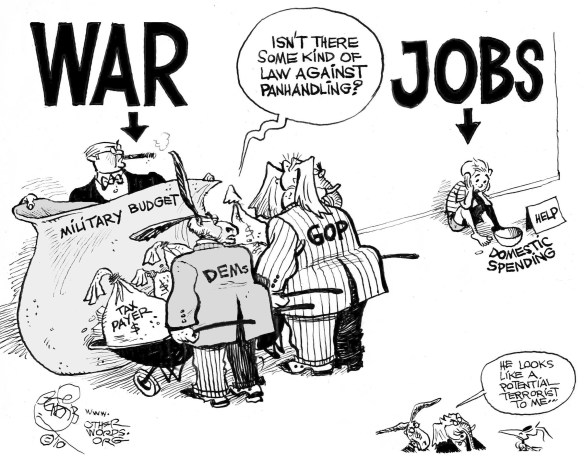
Trump proposes huge hike in military and police spending

discretionary_spending_pie_2015_enacted

By Patrick Martin

Source: WSWS.org

The Trump administration sent instructions to federal agencies Monday proposing a $54 billion increase in spending for the Pentagon, the intelligence agencies and the Department of Homeland Security, to be offset by $54 billion in cuts for other agencies, mainly those involved in domestic social services and regulation of business.

Trump’s budget outline sets the stage for his first address to Congress on Tuesday. It provides further evidence that the Trump administration will be dedicated to radically rolling back social spending to finance a dramatic escalation of military operations, both in the neo-colonial wars in the Middle East and against the United States’ ‘great power’ rivals: China and Russia.

Federal departments are being told to file budget requests for the fiscal year that begins October 1, 2017 based on the numbers they were given by the Office of Management and Budget. Each agency will be responsible for working out the cuts required to meet proposed reductions, while the Pentagon, CIA and DHS will propose expanded operations with the additional funds they are to be awarded.

There were no details made public about the exact budget ceilings given to each federal department, but White House officials made it clear that foreign aid programs in the State Department and anti-pollution regulation through the Environmental Protection Agency (EPA) would suffer some of the largest cuts.

The total budget of the EPA is only $9 billion, so many other domestic programs are certain to be hard-hit, involving such departments as Education, Labor, Transportation, Agriculture (which includes food stamps), Housing and Urban Development and Health and Human Services.

The biggest federal social programs, Social Security, Medicare and Medicaid, are not affected by the budget order, which involves only funding for so-called discretionary programs, those financed through annual congressional appropriations. Entitlement programs, where benefits are paid out automatically to those who establish their eligibility, are covered by a separate budget process.

OMB Director Mick Mulvaney appeared at the White House press briefing Monday afternoon to explain the action taken by the Trump administration. He emphasized that setting what he called the “top-line budget number” for each department was only the start of a protracted process.

The OMB will use the figures from each department and agency to prepare a budget outline to be submitted to Congress on March 16. A full budget will not be ready until sometime in May, Mulvaney said. He also indicated that while spending on Social Security, Medicare and Medicaid were not addressed in the action taken Monday, “entitlement reform”—i.e., cuts in these critical programs—would be a subject of discussion with congressional leaders later in the budget process.

Press reports identified the three White House officials who have played the main roles in the initial budgeting: Mulvaney, who was confirmed on February 16 as budget director; National Economic Council Director Gary Cohn, the former president of Goldman Sachs, the huge investment bank; and Stephen K. Bannon, Trump’s chief strategist, the former chief executive of the fascistic Breitbart News site, who exercises increasingly broad sway over all White House policy decisions.

While no details have yet been released of what the $54 billion increase in military-police spending will pay for, the scale of the increase, in and of itself, shows the real character of the Trump administration. This is to be a government of war abroad and mass repression at home.

Trump himself touched on this theme in typically rambling and unfocused remarks to a meeting of the National Governors Association Monday. “We never win a war,” he said. “We never win. And we don’t fight to win. We don’t fight to win. So we either got to win, or don’t fight at all.”

He continued, telling the governors, “My first budget will be submitted to the Congress next month. This budget will be a public safety and national security budget, very much based on those two with plenty of other things, but very strong. And it will include a historic increase in defense spending to rebuild the depleted military of the United States of America at a time we most need it.”

Additional money for the Pentagon is likely to go to a dramatically increased tempo of operations in Iraq and Syria. Defense Secretary James Mattis delivered proposals to the White House Monday for an offensive against Islamic State in Iraq and Syria (ISIS), as required by an executive order issued by Trump last month. No details are available yet, but any acceleration of the bombing campaign, let alone the deployment of significant numbers of the US ground troops, would increase the cost of that war by many billions.

The $54 billion increase would also presumably include funds for the construction of Trump’s planned wall on the US-Mexico border, as well as a massive increase in spending on detention facilities for the hundreds of thousands of immigrants to be rounded up under the executive orders already issued by the White House.

The federal budget is operating under the constraints imposed by the 2011 Budget Control Act, the bipartisan legislation negotiated by the Obama White House, the Republican-controlled House of Representatives, and a Democratic-controlled Senate. This set up the so-called sequester process, under which all discretionary spending is subject to a budget freeze, for both domestic and military programs.

Each year, increased spending for programs under the sequester has been worked out on the basis of roughly equal increases for domestic and military programs. Last year, for fiscal year 2016, Congress approved $543 billion for domestic discretionary programs and $607 billion for the military. The Trump White House plan would thus represent a cut of about 10 percent for domestic programs, and an increase of nearly that amount for the military.

Any significant change in the sequester process would require support from congressional Democrats, particularly in the Senate, where the Republican party holds only a narrow 52-48 edge, and any major legislation would require a 60-vote majority to pass.

Several congressional Republican leaders criticized the White House plan as insufficiently skewed to the military. House Armed Services Committee Chairman Mac Thornberry of Texas issued a statement criticizing the “low budget number” and adding, “The administration will have to make clear which problems facing our military they are choosing not to fix.”

Senator John McCain of Arizona, chairman of the Senate Armed Services Committee, declared that the Trump plan is “a mere 3 percent above President Obama’s defense budget, which has left our military underfunded, undersized and unready.”

For all the statements by Trump and the Republicans bemoaning the supposedly “depleted” state of the US military, the United States spends more on its armed forces than the next 15 countries in the world combined. The military budget is only inadequate if the mission of the US military is assumed to be the conquest of the entire planet and the subduing of all armed resistance from any quarter—which is actually the perspective of the American ruling elite.

Fuck Work

 tumblr_mkr6eleomu1qiyurho1_r2_500

Economists believe in full employment. Americans think that work builds character. But what if jobs aren’t working anymore?

By James Livingston

Source: aeon

Work means everything to us Americans. For centuries – since, say, 1650 – we’ve believed that it builds character (punctuality, initiative, honesty, self-discipline, and so forth). We’ve also believed that the market in labour, where we go to find work, has been relatively efficient in allocating opportunities and incomes. And we’ve believed that, even if it sucks, a job gives meaning, purpose and structure to our everyday lives – at any rate, we’re pretty sure that it gets us out of bed, pays the bills, makes us feel responsible, and keeps us away from daytime TV.

These beliefs are no longer plausible. In fact, they’ve become ridiculous, because there’s not enough work to go around, and what there is of it won’t pay the bills – unless of course you’ve landed a job as a drug dealer or a Wall Street banker, becoming a gangster either way.

These days, everybody from Left to Right – from the economist Dean Baker to the social scientist Arthur C Brooks, from Bernie Sanders to Donald Trump – addresses this breakdown of the labour market by advocating ‘full employment’, as if having a job is self-evidently a good thing, no matter how dangerous, demanding or demeaning it is. But ‘full employment’ is not the way to restore our faith in hard work, or in playing by the rules, or in whatever else sounds good. The official unemployment rate in the United States is already below 6 per cent, which is pretty close to what economists used to call ‘full employment’, but income inequality hasn’t changed a bit. Shitty jobs for everyone won’t solve any social problems we now face.

Don’t take my word for it, look at the numbers. Already a fourth of the adults actually employed in the US are paid wages lower than would lift them above the official poverty line – and so a fifth of American children live in poverty. Almost half of employed adults in this country are eligible for food stamps (most of those who are eligible don’t apply). The market in labour has broken down, along with most others.

Those jobs that disappeared in the Great Recession just aren’t coming back, regardless of what the unemployment rate tells you – the net gain in jobs since 2000 still stands at zero – and if they do return from the dead, they’ll be zombies, those contingent, part-time or minimum-wage jobs where the bosses shuffle your shift from week to week: welcome to Wal-Mart, where food stamps are a benefit.

And don’t tell me that raising the minimum wage to $15 an hour solves the problem. No one can doubt the moral significance of the movement. But at this rate of pay, you pass the official poverty line only after working 29 hours a week. The current federal minimum wage is $7.25. Working a 40-hour week, you would have to make $10 an hour to reach the official poverty line. What, exactly, is the point of earning a paycheck that isn’t a living wage, except to prove that you have a work ethic?

But, wait, isn’t our present dilemma just a passing phase of the business cycle? What about the job market of the future? Haven’t the doomsayers, those damn Malthusians, always been proved wrong by rising productivity, new fields of enterprise, new economic opportunities? Well, yeah – until now, these times. The measurable trends of the past half-century, and the plausible projections for the next half-century, are just too empirically grounded to dismiss as dismal science or ideological hokum. They look like the data on climate change – you can deny them if you like, but you’ll sound like a moron when you do.

For example, the Oxford economists who study employment trends tell us that almost half of existing jobs, including those involving ‘non-routine cognitive tasks’ – you know, like thinking – are at risk of death by computerisation within 20 years. They’re elaborating on conclusions reached by two MIT economists in the book Race Against the Machine (2011). Meanwhile, the Silicon Valley types who give TED talks have started speaking of ‘surplus humans’ as a result of the same process – cybernated production. Rise of the Robots, a new book that cites these very sources, is social science, not science fiction.

So this Great Recession of ours – don’t kid yourself, it ain’t over – is a moral crisis as well as an economic catastrophe. You might even say it’s a spiritual impasse, because it makes us ask what social scaffolding other than work will permit the construction of character – or whether character itself is something we must aspire to. But that is why it’s also an intellectual opportunity: it forces us to imagine a world in which the job no longer builds our character, determines our incomes or dominates our daily lives.

In short, it lets us say: enough already. Fuck work.

Certainly this crisis makes us ask: what comes after work? What would you do without your job as the external discipline that organises your waking life – as the social imperative that gets you up and on your way to the factory, the office, the store, the warehouse, the restaurant, wherever you work and, no matter how much you hate it, keeps you coming back? What would you do if you didn’t have to work to receive an income?

And what would society and civilisation be like if we didn’t have to ‘earn’ a living – if leisure was not our choice but our lot? Would we hang out at the local Starbucks, laptops open? Or volunteer to teach children in less-developed places, such as Mississippi? Or smoke weed and watch reality TV all day?

I’m not proposing a fancy thought experiment here. By now these are practical questions because there aren’t enough jobs. So it’s time we asked even more practical questions. How do you make a living without a job – can you receive income without working for it? Is it possible, to begin with and then, the hard part, is it ethical? If you were raised to believe that work is the index of your value to society – as most of us were – would it feel like cheating to get something for nothing?

We already have some provisional answers because we’re all on the dole, more or less. The fastest growing component of household income since 1959 has been ‘transfer payments’ from government. By the turn of the 21st century, 20 per cent of all household income came from this source – from what is otherwise known as welfare or ‘entitlements’. Without this income supplement, half of the adults with full-time jobs would live below the poverty line, and most working Americans would be eligible for food stamps.

But are these transfer payments and ‘entitlements’ affordable, in either economic or moral terms? By continuing and enlarging them, do we subsidise sloth, or do we enrich a debate on the rudiments of the good life?

Transfer payments or ‘entitlements’, not to mention Wall Street bonuses (talk about getting something for nothing) have taught us how to detach the receipt of income from the production of goods, but now, in plain view of the end of work, the lesson needs rethinking. No matter how you calculate the federal budget, we can afford to be our brother’s keeper. The real question is not whether but how we choose to be.

I know what you’re thinking – we can’t afford this! But yeah, we can, very easily. We raise the arbitrary lid on the Social Security contribution, which now stands at $127,200, and we raise taxes on corporate income, reversing the Reagan Revolution. These two steps solve a fake fiscal problem and create an economic surplus where we now can measure a moral deficit.

Of course, you will say – along with every economist from Dean Baker to Greg Mankiw, Left to Right – that raising taxes on corporate income is a disincentive to investment and thus job creation. Or that it will drive corporations overseas, where taxes are lower.

But in fact raising taxes on corporate income can’t have these effects.

Let’s work backward. Corporations have been ‘multinational’ for quite some time. In the 1970s and ’80s, before Ronald Reagan’s signature tax cuts took effect, approximately 60 per cent of manufactured imported goods were produced offshore, overseas, by US companies. That percentage has risen since then, but not by much.

Chinese workers aren’t the problem – the homeless, aimless idiocy of corporate accounting is. That is why the Citizens United decision of 2010 applying freedom of speech regulations to campaign spending is hilarious. Money isn’t speech, any more than noise is. The Supreme Court has conjured a living being, a new person, from the remains of the common law, creating a real world more frightening than its cinematic equivalent: say, Frankenstein, Blade Runner or, more recently, Transformers.

But the bottom line is this. Most jobs aren’t created by private, corporate investment, so raising taxes on corporate income won’t affect employment. You heard me right. Since the 1920s, economic growth has happened even though net private investment has atrophied. What does that mean? It means that profits are pointless except as a way of announcing to your stockholders (and hostile takeover specialists) that your company is a going concern, a thriving business. You don’t need profits to ‘reinvest’, to finance the expansion of your company’s workforce or output, as the recent history of Apple and most other corporations has amply demonstrated.

So investment decisions by CEOs have only a marginal effect on employment. Taxing the profits of corporations to finance a welfare state that permits us to love our neighbours and to be our brothers’ keeper is not an economic problem. It’s something else – it’s an intellectual issue, a moral conundrum.

When we place our faith in hard work, we’re wishing for the creation of character; but we’re also hoping, or expecting, that the labour market will allocate incomes fairly and rationally. And there’s the rub, they do go together. Character can be created on the job only when we can see that there’s an intelligible, justifiable relation between past effort, learned skills and present reward. When I see that your income is completely out of proportion to your production of real value, of durable goods the rest of us can use and appreciate (and by ‘durable’ I don’t mean just material things), I begin to doubt that character is a consequence of hard work.

When I see, for example, that you’re making millions by laundering drug-cartel money (HSBC), or pushing bad paper on mutual fund managers (AIG, Bear Stearns, Morgan Stanley, Citibank), or preying on low-income borrowers (Bank of America), or buying votes in Congress (all of the above) – just business as usual on Wall Street – while I’m barely making ends meet from the earnings of my full-time job, I realise that my participation in the labour market is irrational. I know that building my character through work is stupid because crime pays. I might as well become a gangster like you.

That’s why an economic crisis such as the Great Recession is also a moral problem, a spiritual impasse – and an intellectual opportunity. We’ve placed so many bets on the social, cultural and ethical import of work that when the labour market fails, as it so spectacularly has, we’re at a loss to explain what happened, or to orient ourselves to a different set of meanings for work and for markets.

And by ‘we’ I mean pretty much all of us, Left to Right, because everybody wants to put Americans back to work, one way or another – ‘full employment’ is the goal of Right-wing politicians no less than Left-wing economists. The differences between them are over means, not ends, and those ends include intangibles such as the acquisition of character.

Which is to say that everybody has doubled down on the benefits of work just as it reaches a vanishing point. Securing ‘full employment’ has become a bipartisan goal at the very moment it has become both impossible and unnecessary. Sort of like securing slavery in the 1850s or segregation in the 1950s.

Why?

Because work means everything to us inhabitants of modern market societies – regardless of whether it still produces solid character and allocates incomes rationally, and quite apart from the need to make a living. It’s been the medium of most of our thinking about the good life since Plato correlated craftsmanship and the possibility of ideas as such. It’s been our way of defying death, by making and repairing the durable things, the significant things we know will last beyond our allotted time on earth because they teach us, as we make or repair them, that the world beyond us – the world before and after us – has its own reality principles.

Think about the scope of this idea. Work has been a way of demonstrating differences between males and females, for example by merging the meanings of fatherhood and ‘breadwinner’, and then, more recently, prying them apart. Since the 17th century, masculinity and femininity have been defined – not necessarily achieved – by their places in a moral economy, as working men who got paid wages for their production of value on the job, or as working women who got paid nothing for their production and maintenance of families. Of course, these definitions are now changing, as the meaning of ‘family’ changes, along with profound and parallel changes in the labour market – the entry of women is just one of those – and in attitudes toward sexuality.

When work disappears, the genders produced by the labour market are blurred. When socially necessary labour declines, what we once called women’s work – education, healthcare, service – becomes our basic industry, not a ‘tertiary’ dimension of the measurable economy. The labour of love, caring for one another and learning how to be our brother’s keeper – socially beneficial labour – becomes not merely possible but eminently necessary, and not just within families, where affection is routinely available. No, I mean out there, in the wide, wide world.

Work has also been the American way of producing ‘racial capitalism’, as the historians now call it, by means of slave labour, convict labour, sharecropping, then segregated labour markets – in other words, a ‘free enterprise system’ built on the ruins of black bodies, an economic edifice animated, saturated and determined by racism. There never was a free market in labour in these united states. Like every other market, it was always hedged by lawful, systematic discrimination against black folk. You might even say that this hedged market produced the still-deployed stereotypes of African-American laziness, by excluding black workers from remunerative employment, confining them to the ghettos of the eight-hour day.

And yet, and yet. Though work has often entailed subjugation, obedience and hierarchy (see above), it’s also where many of us, probably most of us, have consistently expressed our deepest human desire, to be free of externally imposed authority or obligation, to be self-sufficient. We have defined ourselves for centuries by what we do, by what we produce.

But by now we must know that this definition of ourselves entails the principle of productivity – from each according to his abilities, to each according to his creation of real value through work – and commits us to the inane idea that we’re worth only as much as the labour market can register, as a price. By now we must also know that this principle plots a certain course to endless growth and its faithful attendant, environmental degradation.

Until now, the principle of productivity has functioned as the reality principle that made the American Dream seem plausible. ‘Work hard, play by the rules, get ahead’, or, ‘You get what you pay for, you make your own way, you rightly receive what you’ve honestly earned’ – such homilies and exhortations used to make sense of the world. At any rate they didn’t sound delusional. By now they do.

Adherence to the principle of productivity therefore threatens public health as well as the planet (actually, these are the same thing). By committing us to what is impossible, it makes for madness. The Nobel Prize-winning economist Angus Deaton said something like this when he explained anomalous mortality rates among white people in the Bible Belt by claiming that they’ve ‘lost the narrative of their lives’ – by suggesting that they’ve lost faith in the American Dream. For them, the work ethic is a death sentence because they can’t live by it.

So the impending end of work raises the most fundamental questions about what it means to be human. To begin with, what purposes could we choose if the job – economic necessity – didn’t consume most of our waking hours and creative energies? What evident yet unknown possibilities would then appear? How would human nature itself change as the ancient, aristocratic privilege of leisure becomes the birthright of human beings as such?

Sigmund Freud insisted that love and work were the essential ingredients of healthy human being. Of course he was right. But can love survive the end of work as the willing partner of the good life? Can we let people get something for nothing and still treat them as our brothers and sisters – as members of a beloved community? Can you imagine the moment when you’ve just met an attractive stranger at a party, or you’re online looking for someone, anyone, but you don’t ask: ‘So, what do you do?’

We won’t have any answers until we acknowledge that work now means everything to us – and that hereafter it can’t.

Either Reverse All the Perverse Incentives or the System Will Implode

By Charles Hugh Smith

Source: Of Two Minds

Every perverse incentive is the cash cow for a vested interest or cartel.

I hope it’s not a great shock to discover all the incentives in our status quo are perverse: those who rig the financial system while creating zero real value, jobs, goods or services reap all the big profits; those who take near-zero responsibility for their own health are subsidized by those who take responsibility for their own health; those who try to start enterprises and hire workers are saddled with endless regulations, junk fees and taxes while those who game the system to get welfare (household or corporate) skim the cream for doing nothing for their community or for the nation.

Systems in which all the incentives are perverse implode under their own weight. Those who struggle to pay the mounting costs of Imperial Over-Reach, crony-capitalism and all the skimmers and scammers eventually go bankrupt or quit in disgust, while the army of state dependents and cronies explodes higher.

It has taken decades for the incentives to become so perverse, so we no longer notice the perversity or the pathological consequences.

High-frequency traders and financiers with the ready ear of well-paid political lackeys, stooges, toadies and sycophants run never-lose skimming operations and pay lower tax rates than self-employed and small business owners.

Corporations have increased their share prices not by earning more money by producing more goods and services but by borrowing cheap money from the Federal Reserve and buying back outstanding shares.

Corporations pay less tax if they move production overseas and keep their profits in other countries.

If I wreck one vehicle after another due to reckless irresponsibility, what happens to my insurance premiums? They skyrocket, of course, reflecting the higher risks that result from my behavior and poor choices. Nobody thinks safe drivers should subsidize irresponsible drivers.

But if I wreck my health by recklessly pursuing risky behaviors, I pay the same as people who are careful “drivers” of their health. What sort of incentives does this system generate?

If I want to buy an over-priced home, the system is loaded with incentives to encourage that potentially poor financial decision. But if I want to launch a small enterprise, the incentives are all perverse: steep upfront fees, taxes from the first dollar, and in many cases, fees and taxes on revenues, regardless of whether I am making a profit or losing my shirt.

Corporate profits have soared as financialization and rigging the system have paid much higher returns than risking capital in new goods and services.

corp-profits3-16d

The incentives for home ownership have turned the bottom 90% into debt-serfs in servitude to banks while the top 5% own income-producing assets and businesses.

ownership-assets2-16

Larded with the most perverse incentives possible, the U.S. healthcare system in the final stages of maximum costs, just before it implodes:

US-healthcare4

It’s not hard to design positive incentives. For example:

1. Make preventative care essentially free to everyone ($5 co-pay) but weight the risks and costs created by irresponsible behaviors that ruin health. Reward those who take responsibility for their health by reducing the premiums they pay.

2. Tax all profits on securities held less than a day at 95%. Raise corporate taxes generated by financial activities to 50%, and lower the corporate tax rate on profits earned from producing domestic goods and services to zero.

3. Lower the tax for the first $25,000 earned by small enterprises to zero. Limit total government fees to 5% of revenues for all businesses up to $10 million in annual revenues.

4. Phase out the mortgage interest deduction. Limit mortgage interest deductions to the first $100,000 of mortgage debt.

5. Eliminate the personal income tax (and the need to file a return) for every household with income of $100,000 or less.

6. Automatically sunset every government regulation. Make city, county, state and federal governments renew every regulation every few years via a majority vote or it vanishes from the law books.

7. Make every politician wear a NASCAR-style jacket plastered with the names and logos of their corporate, union and financier contributors. The California Initiative to make this a reality is seeking signatures of registered California voters. Since politicians are owned, let’s make the ownership transparent.

8. Treat drug abuse and addiction as medical conditions rather than crimes.

9. Eliminate the Federal Reserve and its free-money for financiers perverse incentives for debt-serfdom and financial plundering.

10. Eliminate all student loans and debts. Make colleges compete for students on a cash-only basis.

As you no doubt noticed, every perverse incentive is the cash cow for a vested interest or cartel. That’s why the perverse incentives will endure until the system implodes under their pathological weight.