
On the Slow Kill of the World’s Oceans

images

By Aaron Dames

Originally posted at Divided Core on November 1, 2013

It is probable that every major ecological pillar however tenuously stabilizing the structure of the oceans is crumbling. Although some endangered fish populations and coral reef systems are being protected and restored, the seas overall are in deep shit. Overfishing and pollution are reducing biodiversity by killing-off large swaths of ocean life. The destruction of vast marine habitats will have catastrophic repercussions for humanity. [According to some earth scientists, oceanic ecocide poses a greater threat to the existence of humanity than climate change. Higher global temperature averages which melt icecaps and glaciers will lead to higher sea levels and the inundation of a plethora of coastal industries, cities, and urban centers that are responsible for contributing to environmental destruction and the mass production of excessive, heat-trapping, carbon-dioxide emissions. As in times of major economic depressions or financial stagnation, the inundation of coastal megalopolises will result in a decrease of industrial activity which may subsequently benefit nature as a whole (until industrial activity is resumed), but would have horrible consequences for humanity, especially for those hundreds of millions of impoverished coastal inhabitants who already live in deprivation, and who would become environmental refugees in the event of a significant increase in sea levels. (Click here to view an interactive map from National Geographic which depicts how coastlines would change if all glaciers and icecaps on Earth were to melt.)]

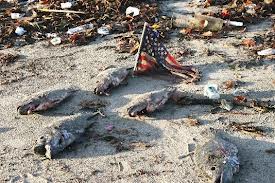
Not that there’s anything wrong with them, but human beings have caused a lot of trouble for life in the world’s oceans. The process in which the destruction of sea life occurs is largely two-fold. Large-scale destructive events like oil spills (Deepwater Horizon) and nuclear power plant disasters (Fukushima) can cause serious damage to the affected aquatic areas. Damage from such disasters is often immediately evident, such as the deformed and eyeless fish and shrimp that appeared in the Gulf of Mexico after the Deepwater Horizon oil spill, or the dying sea lions pups and seals with bleeding lesions that have washed up on beaches in California and Alaska the wake of the Fukushima Daiichi Nuclear Power Plant meltdown. Yet as grave and harmful as they are, explosive, headline-making disasters are less deleterious to life in the seas than the cumulative, synergistic effects of routine human activities such as oceanic commerce, commercial fishing, and pollution. For example, a 2002 study by the National Academy of the Sciences found that the 85 percent of the 29 million gallons of marine oil pollution originating from North America derives from runoff from cars and oil-based machines and accessories (like lawnmowers and household robots) – and the sum of these tiny releases of oil, carried into the ocean by streams and storm drains, is equivalent to an Exxon Valdez oil spill every eight months. [As additional food for thought: there are apparently 90,000 cargo ships in the world. (Incidentally, there are also roughly 760 million vehicles and 30,000 commercial airplanes.) Many of these vessels run off of “bunker fuel,” a byproduct of the oil refining process. The burning of bunker fuels in cargo ships may be responsible for 3.5 – 4% of all carbon-dioxide emissions; and particulate pollution (such as sulphur-dioxide fumes) from cargo ships may contribute to as many as 60,000 human deaths a year. These chemical emission-related figures exclude the effects of pollution produced by navy vessels, cruise ships, and fishing fleets. Also, often overlooked are the human costs involved in the process of shipbreaking, where wretched working conditions plague extremely low-paid laborers, mainly on the Indian subcontinent. For a glimpse into their lives, check out the film Ironeaters.]

Daily activities which contribute to ocean pollution and the depletion of fish stocks are decimating underwater habitats, driving down biodiversity, and have the potential to reduce the populations of certain marine species to irrecoverable extents or down to zero. The elimination of any species from an ecological network could have devastating and unforeseen impacts on the rest of the planet. According to the Monterey Bay Aquarium, “Overfishing may be the single biggest threat to ocean ecosystems. Today, 85 percent of the world’s fisheries are either fully exploited, overexploited or have collapsed. The global fishing fleet is operating at 2.5 times the sustainable level – there are simply too many boats chasing a dwindling number of fish.” Commercial, illegal, and game fishing operations are wiping-out the populations of major fish species, such as bluefin tuna and blue and white marlin; both of which species are likely to be overfished to extinction within the century. Dolphins and small whales are facing extinction off the coast of Japan, where over a million such creatures have been hunted and killed over the past seventy years. 100 million sharks are estimated to be killed by humans every year. (Click here to view a picture that was taken earlier this year and shows thousands of shark fins drying on a rooftop in Hong Kong.) It is unlikely that the current rate of exploitation and depletion can be sufficiently curbed in order to allow time for the dwindling populations of many fish species to recover. For those more interested in the subject of overfishing, I highly recommend watching the film End of the Line.

Pollution is another major force contributing to the demise of life in the oceans. Over the last century immense volumes of trash and industrial chemicals have contaminated whole cross-sections of the oceans. Toxins that enter the oceans are spread throughout food chains, and varying degrees of visible and microscopic waste accumulate in the water and on shores. One diabolical clusterfuck that highlights the deleterious effects of pollution on the marine environment is the Great Pacific Garbage Patch. Like other ocean regions, the North Pacific Ocean has immense gyre-like convergence zones which are formed by wind and rotating currents. The Pacific convergence zones currently contain astronomical quantities of accumulated rubbish, much of which has been or is being broken down into tiny particles of microplastic. Subsisting in the gyres and consuming the plastic are around 260 species of fish, sea turtles, birds, and other sea creatures. These animals often die from the consumption of plastic, which may also end-up in the bodies of the predators that feed off them, or, as in the case of the Laysan albatross, in their young. On the Midway Atoll, where twenty tons of plastic wash up every year, as many as one-third of all albatross chicks die due to eating plastic inadvertently fed to them by their parents.

In addition to plastic, a broad range of manufactured organic and toxic chemicals have made their way into the oceans. Many of these contaminants lodge themselves in the tissues of fish and bioaccumulate as the fish are ingested up the food chain. Studies have found high levels of mercury and industrial chemicals like polychlorinated biphenyls (PCBs) in dolphin and whale meat. What the hell are PCBs? Allow Cathy Britt to explain:

PCBs are manufactured organic chemicals that were primarily used as insulating liquids, such as coolants and lubricants in electrical equipment, but were also used in other common materials such as paints, cement, adhesives, and even the flame retardants used in some children’s clothing…Though production of PCBs was banned in the 1970s because of its harmful effects to the environment, the chemical still presents a significant environmental threat today.

Orcas have accumulated such high concentrations of PCBs that when female orcas breast feed their young, the firstborn calf usually dies as a result of receiving a toxic overdose of PCBs contained in its mother’s fatty-rich breast milk. PCBs and other toxins are also known to cause health problems in other large Artic animals, like polar bears and seals. Although PCBs, some pesticides, and other persistent organic pollutants have been phased out and banned, many industrial chemicals (such as brominated flame-retardants) are still widely used and find their way into the oceans. Humans are not immune to this process of bioaccumulation, and toxins are accruing in the bodies of people as a result of eating fish. But perhaps the real blow will come later, when there are no more fish to eat.

Human beings are carrying out a slow kill of the world’s seas, as well as on much of the planet’s other ecosystems. Modern man finds himself in living in a paradox where he knows more than ever about how the natural world functions, and nevertheless the natural world is in its worst shape yet due to how modern man mistreats it. How is that we can care so much about ourselves and our friends and family, but so little about others and the natural systems that we depend on to survive? The Earth revolves through day and night, and it seems that billions of people are clocking-in and out of shifts to partake in the wholesale destruction of the world on their side of the planet. If the day arrives when the seas have become polluted dead zones void of great shoals of fish – assuming there will be humans to witness it, they’ll look out across the grey and desolate tides toward the bleak horizon and ask, “How did we let this happen?” And this is the answer: We let it happen through stupidity, laziness, arrogance, apathy, and greed. We couldn’t stop gorging ourselves, we couldn’t control our insatiable appetite, and we didn’t think to heed the warnings we were given (though we saw them); we didn’t think to step back, to slow down, and to stop ourselves and each other. It was a free for all, and we didn’t care enough about our world and Mother Nature to make a difference and to save her oceans from death. We are like addicts, and we only take; we always take, and we never give back. And in her darkest hour, when nature desperately needed a hand – when her battered reefs became bleached and white like bones, when her bays became choked with smog and clogged with oil, when the whales and dolphins were beaching themselves in mass die-offs along the shores, when the nets that we cast came back with less and less until there was nothing – when she needed us most, we refused to reach out and instead we looked the other way in betrayal. But it doesn’t have to be that way. You can leave this planet in better shape than you found it. You can try to make a difference and stand up for those creatures on this planet that can’t stand up for themselves; even if it doesn’t work, they’ll appreciate that you tried. And you’ll also feel a lot better about yourself that you did.

The Ocean is Broken

Pacific-garbage-patch-map_2010_noaamdp

A recent article from Australia’s Newcastle Herald has been going viral, and for good reason. It’s a chilling and heartbreaking first-hand account of the state of the Pacific Ocean. These observations in particular depict a hellish scenario:

“After we left Japan, it felt as if the ocean itself was dead,” Macfadyen said.

“We hardly saw any living things. We saw one whale, sort of rolling helplessly on the surface with what looked like a big tumour on its head. It was pretty sickening.

“I’ve done a lot of miles on the ocean in my life and I’m used to seeing turtles, dolphins, sharks and big flurries of feeding birds. But this time, for 3000 nautical miles there was nothing alive to be seen.”

In place of the missing life was garbage in astounding volumes.

“Part of it was the aftermath of the tsunami that hit Japan a couple of years ago. The wave came in over the land, picked up an unbelievable load of stuff and carried it out to sea. And it’s still out there, everywhere you look.”

Ivan’s brother, Glenn, who boarded at Hawaii for the run into the United States, marvelled at the “thousands on thousands” of yellow plastic buoys. The huge tangles of synthetic rope, fishing lines and nets. Pieces of polystyrene foam by the million. And slicks of oil and petrol, everywhere.

Countless hundreds of wooden power poles are out there, snapped off by the killer wave and still trailing their wires in the middle of the sea.

“In years gone by, when you were becalmed by lack of wind, you’d just start your engine and motor on,” Ivan said.

Not this time.

“In a lot of places we couldn’t start our motor for fear of entangling the propeller in the mass of pieces of rope and cable. That’s an unheard of situation, out in the ocean.

“If we did decide to motor we couldn’t do it at night, only in the daytime with a lookout on the bow, watching for rubbish.

“On the bow, in the waters above Hawaii, you could see right down into the depths. I could see that the debris isn’t just on the surface, it’s all the way down. And it’s all sizes, from a soft-drink bottle to pieces the size of a big car or truck.

“We saw a factory chimney sticking out of the water, with some kind of boiler thing still attached below the surface. We saw a big container-type thing, just rolling over and over on the waves.

“We were weaving around these pieces of debris. It was like sailing through a garbage tip.

“Below decks you were constantly hearing things hitting against the hull, and you were constantly afraid of hitting something really big. As it was, the hull was scratched and dented all over the place from bits and pieces we never saw.”

Plastic was ubiquitous. Bottles, bags and every kind of throwaway domestic item you can imagine, from broken chairs to dustpans, toys and utensils.

And something else. The boat’s vivid yellow paint job, never faded by sun or sea in years gone past, reacted with something in the water off Japan, losing its sheen in a strange and unprecedented way.

BACK in Newcastle, Ivan Macfadyen is still coming to terms with the shock and horror of the voyage.

“The ocean is broken,” he said, shaking his head in stunned disbelief.

Read the full article here: http://www.theherald.com.au/story/1848433/the-ocean-is-broken/

Large-scale human over-consumption and toxic waste are undoubtedly major factors contributing to a rash of unusual die-offs of Salmon, Herring, Sardines, Starfish, Dolphins, and others.

Rushkoff on the Economy

pyramid_of_power

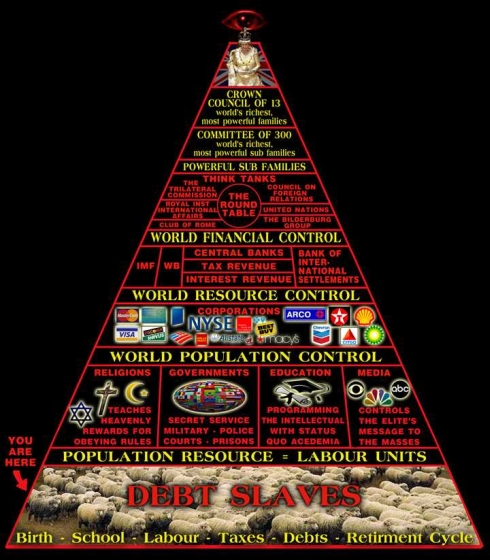
I’ve been reading Douglas Rushkoff’s “Present Shock: When Everything Happens Now” and have by coincidence just reached a chapter of the book covering the topic of currencies and the economy as Washington D.C. attempts to avoid another default. I found similar writings from Rushkoff on the same topic in two articles published by Arthur Magazine. As can be seen from these excerpts, they’re helpful for understanding our current situation:

Local currencies favored local transactions, and worked against the interests of large corporations working from far away. In order to secure their own position as well as that of their chartered monopolies, monarchs began to make local currencies illegal, and force locals to instead use “coin of the realm.” These centralized currencies worked the opposite way. They were not earned into existence, they were lent into existence by a central bank. This meant any money issued to a person or business had to be paid back to the central bank, with interest.

What does that do to an economy? It bankrupts it. Think of it this way: A business borrows 1000 dollars from the bank to get started. In ten years, say, it is supposed to pay back 2000 to the bank. Where does the other 1000 come from? Some other business that has borrowed 1000 from the bank. For one business to pay back what it owes, another must go bankrupt. That, or borrow yet another 1000, and so on.

An economy based on an interest-bearing centralized currency must grow to survive, and this means extracting more, producing more and consuming more. Interest-bearing currency favors the redistribution of wealth from the periphery (the people) to the center (the corporations and their owners). Just sitting on money—capital—is the most assured way of increasing wealth. By the very mechanics of the system, the rich get richer on an absolute and relative basis.

The biggest wealth generator of all was banking itself. By lending money at interest to people and businesses who had no other way to conduct transactions or make investments, banks put themselves at the center of the extraction equation. The longer the economy survived, the more money would have to be borrowed, and the more interest earned by the bank.

[…]Commerce is good. Commerce is not the problem. Monopolies are.

Except in a few rare cases, corporate charters and centralized currency were never intended to promote commerce. They were intended to prevent locals and non-chartered entities from creating and exchanging value. They are not extensions of the free market, but efforts at extracting value from the free market. Corporate monopoly charters were extended to a king’s favorite companies in return for shares. Then, no one else was allowed to do business in that industry. Centralized currency forced businesses to run their revenue through the king’s coffers. Likewise, in its current form, centralized currency is more akin to a ponzi scheme of interest rates, each borrower paying up to the banker above him.

Both of these innovations—corporate charters and centralized currency—tend towards resource exploitation rather than innovation. They are extractive in nature, not productive. And, more importantly, these particular innovations cause wealth to end up being generated through speculation rather than creation. They cause scarcity, not abundance. Over time, it becomes easier to make money by having money than by doing anything. And this was the pure, stated intent of centralized currency and banking in the early Renaissance: to keep the wealthy wealthy, in the face of a rising merchant class.

This isn’t some extremist perspective. It’s just historical fact, though largely forgotten and seemingly refuted by our collective false memory of the Renaissance’s greatness. If you’re interested in finding out more about this, or seeing the evidence on which my research is based, take a look at the best historians writing about the era: Fernand Braudel (The Wheels of Commerce: Civilization and Capitalism: 15th-18th Century, Volume 2, Univ. of California Press, 1992), Carlo M. Cipolla (Before the Industrial Revolution: European Society and Economy, 1000-1700, WW Norton, 1994) or Bernard A. Lietaer, whose book On Human Wealth used to be available for free download off his site, but doesn’t seem to be anymore. In these books, you can find out about the sustainable local economic systems of the Late Middle Ages, learn that the Black Plague actually began after mandated centralized currency had impoverished Europe, and find support of my contention that cathedrals were built with local money before the Renaissance, not Vatican money during the Renaissance.

I highly recommend checking out both articles here (as well as his most recent book “Present Shock”):

http://arthurmag.com/2009/03/16/let-it-die-rushkoff-on-the-economy/

http://arthurmag.com/2009/03/23/hack-money-hack-banking-rushkoff-on-the-economy/

More voices of sanity (Nicole Voss and Laurence Boomert) calling for an overhaul of the monetary system can be heard on the C-Realm podcast :

Getting Out of the Matrix

-The-Matrix-the-matrix-23939751-1360-768

The “government shutdown” may have a silver lining for average citizens after all, it could potentially introduce to the minds of many the possibility that governments can shut down and to get people thinking about what to do if or when it happens for real. Even if you don’t believe it can happen, there’s plenty of reasons to expect a worsening financial crisis,  environmental chaos due to natural and man-made disasters, energy shortages, etc. In short, now is a good time to start seeking alternatives to the current system, finding ways to live off the grid (or at least be less in the grid), and taking basic steps for preparedness.

As important as it is to be aware of the myriad problems affecting our lives, it’s just as important to seek solutions and inspiration to help each other in personal and collective journeys towards a better path. Two podcasts I’ve heard recently may do just that through interviews with creative and iconoclastic individuals who are well on their way on a better path and are encouraging others to join along.

The first is from Kevin Barrett’s Truth Jihad Radio program with author/activist Sander Hicks:

You can read about Hicks’ interests and writings here.

The second was on the latest episode of Greg Carlwood’s The Higherside Chats podcast with author Wendy Tremayne, who gave up a high paying position in New York for a more frugal, sustainable and fulfilling existence in New Mexico:

Both shows cover an interesting mix of information and views on politics, spirituality economics and lifestyle.

Even if one is not ready or able to immediately attempt such a leap, don’t assume it’s not possible. It’s difficult by design to survive within much less escape a system so dominated by corporations and power-mad political bureaucracy without some sacrifice or compromise. However, everyone can take big or small actions everyday to offset compromises, contribute towards positive change and improve one’s situation, whether it’s conscious consumer and lifestyle choices, inner work, learning, communicating, supporting, creating, organizing, resisting and whistleblowing as just a few examples. As Gil Scott-Heron said in his song “Work For Peace”, nobody can do everything but everyone can do something. What one does might depend on personality, passion, skills, knowledge, creativity, and life situation. You might not see immediate results but sometimes change can occur through long-term cumulative efforts.