
Chicago’s Abu Ghraib

Chicago-Homan-Square-police-torture-2

By Andre Damon

Source: WSWS.org

In April 2004, the world was shocked and horrified by the release of photographs of sadistic torture carried out by US military personnel at the Abu Ghraib prison in Iraq. Detainees at the prison, most of them locked up for opposing the US military occupation, were beaten, tortured, sexually assaulted and killed.

At the time, the World Socialist Web Site explained that the crimes revealed in the photos and the psychology underlying them could be understood only in relation to the brutality of social relations in the United States, together with the dirty colonial aims of the war itself.

The WSWS further warned that “such a military, accompanied by a growing army of professional ‘civilian’ mercenaries, represents a danger not only to oppressed peoples in the Middle East, Central Asia and elsewhere, but to the democratic rights of the population in the US.”

A decade later, this assessment has been fully borne out. On Tuesday, the Guardian newspaper revealed the existence of what it describes as a “black site” on the West Side of Chicago, where police detain, beat and torture prisoners, while keeping their whereabouts secret from their families and attorneys.

The newspaper writes: “The Chicago police department operates an off-the-books interrogation compound, rendering Americans unable to be found by family or attorneys while locked inside what lawyers say is the domestic equivalent of a CIA black site.”

Among those detained at the facility was Brian Jacob Church, one of the “NATO 3” who were entrapped by Chicago police in 2012 in connection with protests against the US-led military alliance, which was meeting in Chicago.

Church was taken to the secret facility and handcuffed to a bench for 17 hours. Along with two other protestors, he was set up by police on terrorism charges and subsequently sentenced to five years in prison.

Vic Suter, another participant in the protests, said that she was taken to the facility and interrogated while shackled to a bench for eighteen hours before she was allowed to see a lawyer.

The Guardian writes that detainees taken to the facility report having been beaten and otherwise tortured by police. In 2013, one detainee was found unconscious in an interview room at the facility. He later died.

On Thursday, the Intercept corroborated the Guardian’s account, interviewing another torture victim at the facility who was handcuffed across a bench and hit in the face and groin until he agreed to provide false testimony to police.

The revelations follow the report last week by the Guardian that Richard Zuley, one of the lead torturers at the Guantanamo detention center, used similar techniques to secure false confessions from murder suspects when he was a detective with the Chicago Police Department.

Chicago has a long history of police violence. It is also the political home of Barack Obama and has been run since 2011 by Rahm Emanuel, Obama’s former White House chief of staff.

The Obama administration, far from repudiating the horrific and criminal actions of its predecessor, has deployed the apparatus of police violence ever more directly against the American people. A series of events has marked the increasingly open application within the borders of the United States of the murderous methods of the “war on terror” tested out and perfected in Afghanistan, Pakistan, Iraq, Libya, Syria, Somalia and Yemen.

· In September 2010, the Obama administration ordered raids on the homes of leaders of the Anti-War Committee and the Freedom Road Socialist Organization in Minneapolis and Chicago on charges of “providing material support to terrorism.”

· In May 2012, Chicago police arrested the “NATO 3,” charging them with conspiracy to commit terrorism.

· In March 2013, US Attorney General Eric Holder declared that the president had the right to kill American citizens without a trial or any legal due process, including within the borders of the United States.

· Just one month later, in April 2013, the city of Boston was placed under de facto martial law following the Boston Marathon bombings, with residents told to “shelter in place” while armored vehicles and helicopters patrolled the streets and police carried out warrantless house-to-house searches.

· In June 2014, the American Civil Liberties Union released a report entitled “War Comes Home: The Excessive Militarization of American Policing.” The ACLU reported that the Defense Department had transferred $4.3 billion in military hardware, including armored vehicles, helicopters, and belt-fed machine guns, to local police departments.

· In August 2014, the authorities responded to protests against the police murder of unarmed teenager Michael Brown with a military/police crackdown. Hundreds of peaceful protesters were arrested, shot with rubber bullets or exposed to tear gas, and over a dozen members of the press were detained.

The Obama administration is presently seeking a new Authorization for Use of Military Force, nominally to fight the Islamic State of Iraq and Syria (ISIS), but with no geographical boundaries defined. On Wednesday, three Brooklyn residents were arrested in connection with this new war on ISIS, clearly raising the potential for this second “war on terror” to become an occasion for police-military operations within the US “homeland.”

These developments express the growing convergence of militarism abroad with the attack on democratic rights within the US. What ties these two processes together are the class interests of the financial aristocracy and the criminal methods it employs in the defense of its wealth and power.

In pursuit of these aims, the ruling class seeks to mobilize the most backward and reactionary sections of the population, including sadistic prison guards and fascist-minded police detectives. But the ultimate responsibility for these crimes rests with forces at the highest levels of the state.

It is worth recalling that late last year the Senate released a report implicating the Bush administration in a brutal torture regime carried out at Guantanamo and CIA “black site” torture centers throughout the world. Far from anyone being held accountable for these crimes, those who ordered and carried them out have defended their actions, while the Obama administration has sought to block any prosecution of those responsible.

The actions of the ruling class express the character of American capitalism, which is based on parasitism, fraud, criminality and an economic order in deep decline. The American ruling class has no response to the crisis of its system and the inevitable growth of social opposition other than violence and repression.

Related Article:

Total Mainstream Media Blackout of Chicago Secret ‘Black Site’ at Homan Square (By Nick Bernabe, Antimedia.org)

Never Before Has Our Approach to Drugs Improved So Much, So Fast

Hemp_for_victory_1942

We’re winning: More progress has been made toward enlightened drug policies and treatment in the past five years than in the previous 25. Here’s an advocacy agenda to take us even closer to the future we need.

By Maia Szalavitz

Source: Substance.com

There has never been a more exciting time to be writing and thinking about drugs and addiction. For most of the ‘80s through the ‘00s, policy and treatment debates were stagnant, with all sides taking hardened positions and often repeating the same tired talking points. But now change is in the air and those who would like to see reform have a chance to make a real difference. By looking at where we’ve come from, we can see where we need to go.

Until 2011 or 2012, the war on drugs, while much bemoaned, was simply a fact of life, with pretty much everyone agreeing both about its failure and, simultaneously, about the impossibility of doing anything significantly different because of the “tough on crime” arms race between the Republicans and Democrats.

The science didn’t matter: No one seemed to care that marijuana was objectively less harmful than alcohol or tobacco or that our drug laws originated both in the time of Jim Crow and, quite explicitly, as a way of oppressing people of color by other means. In fact, merely stating these facts, as I did many times, would often get me in trouble with editors who wanted to “balance” them with a prohibitionist claim to prove that the publication was “objective”! No one ever seemed to consider balance when a drug warrior made a demonstrably untrue statement.

It didn’t matter that the data on needle exchange was overwhelmingly in favor—and that no study had ever found that it encouraged drug use or prolonged addiction. A quote by someone who was ideologically opposed had to be obtained, even though they had no data to back their concerns about these programs to prevent infection with HIV and hepatitis C “sending the wrong message.”

The failure of drug enforcement either to prevent or to reduce “drug epidemics” and the ineffectiveness of incarceration at fighting addiction was irrelevant, too, even as the necessity of such punitive efforts was simply accepted without question.

Nor did it matter that harsh, confrontational treatment was known both to backfire and to be incredibly common—Dr. Drew, Intervention, Beyond Scared Straight and similar shows even portrayed it as exemplary.

At the same time, 12-step supporters were adamant that their way was the only way—or at least the best way. Drug warriors were convinced that criminalization of both possession and sales was the only way to avoid addiction Armageddon—and even many people in recovery bought into the idea that law enforcement must always play a role in policies related to illegal drugs.

In 2000, for instance, during the fight over California’s Proposition 36, which gives drug users three chances at treatment before jail becomes a sentencing option, the Betty Ford Center was among the opponents. Speaking for a coalition that included the rehab, actor and sobriety advocate Martin Sheen wrote in an op-ed, “Without accountability and consequences, drug abusers have little incentive to change their behavior or take treatment seriously.” (He didn’t explain how Betty Ford gets alcoholics, whose drug is legal, to comply with care.) But Prop 36 passed anyway, an early sign of the drug war’s waning hold.

And so, even when reforms would actually send patients to rehabs, treatment providers remained firmly aligned with drug warriors on the necessity of harsh criminalization, while they begged for crumbs of financing from the abundant table of law enforcement and argued that treatment is better than jail.

Now, though, the winds have shifted. Four states and Washington, DC, have legalized recreational use of marijuana. President Obama has directed the justice department not to interfere with these experiments and said last week, “My suspicion is that you are going to see other states start looking at this.” California, which rejected recreational legalization as recently as 2010, may pass it in an expected 2016 ballot initiative. National polls show majority support for legalization.

Neither Colorado nor Washington—the first two states to legalize—has seen anything near the predicted disaster in the first year after the passage of the law. In fact, in Colorado, crime is down, auto fatalities are down and teen use is stable or declining. (Because Washington took longer to implement its regime, good statistics aren’t yet available).

All of this is excellent news for reformers. So what should be next on the agenda? Here are a few things I’d like to see, which I think could build on the increased openness to more effective policy:

1. Over-the-counter naloxone

Naloxone, an opioid antagonist that can reverse opioid overdose, is now widely available to first responders and, through many harm reduction agencies, to friends and families of people at risk. No adverse effects have been reported; just more and more lives saved. The FDA should make naloxone available over the counter, and sales should be subsidized or prices capped to make it affordable. This safe, effective lifesaver should be in every first-aid kit.

2. Expand access to medication-assisted treatment

As I noted recently, it’s outrageous that any doctor who discovers that a patient has an opioid problem can’t simply prescribe the most effective treatment: maintenance with Suboxone or methadone. Federal limits on the number of patients a doctor can have on maintenance and laws that literally ghettoize methadone treatment should be repealed. Insurance limits on prescribing also should be challenged: These exist for no other medical condition.

3. Decriminalize personal possession of all drugs

Now that even once-staunch prohibitionists like Kevin Sabet no longer argue strongly for arrest and incarceration of those who possess marijuana, why does it still make sense for heroin, cocaine or other illegal drugs?

82% of all drug arrests are for possession, and half of these are for marijuana. According to the ACLU, the US spends $3.1 billion annually arresting and adjudicating marijuana possession cases, and at least as much is likely to be spent on the other half of possession arrests for all other drugs. And yet no data suggests that arresting drug users for possession fights addiction or reduces crime: In fact, addicted people often get worse due to incarceration, with very little treatment available in jail.

Moreover, Portugal’s 10-plus-year experience of complete decriminalization has found it to be associated with less crime, more treatment and less disease. What’s not to like? The World Health Organization recently came out in favor of decriminalization. Drug reformers should not make marijuana arrests the only focus of their abolition campaign. Arrests for use are expensive, harmful and ineffective: They need to stop.

5. Reform treatment

People with addiction and their loved ones are often shocked at what occurs in treatment: Evidence-based care is so hard to find that even leading addiction researcher and former deputy drug czar Tom McLellan didn’t know where to turn when his son needed help in 2009. Anne Fletcher’s Inside Rehab, David Sheff’s Clean and this 2012 report from the Center on Addiction and Substance Abuse all demonstrate the need for better accountability from treatment providers.

To start, private and public insurers should simply refuse to pay for treatment that is little more than indoctrination into 12-step groups, which can be had for free at many church basements. Instead, treatment time should be devoted to evidence-based therapies like motivational interviewing and cognitive behavioral therapy, which aren’t free—and provider reimbursement should be based on results, respectful and empathetic care and genuine fidelity to evidence-based therapies.

And this isn’t a change that only opponents of 12-step programs should favor. Even those who are helped by the steps know that such treatment clearly violates the Eighth Tradition, which states that AA should be “forever nonprofessional” and that the 12th-step work of trying to bring others into the program should be unpaid. Both 12-step groups and treatment will ultimately be better off disentangled.

5. Reframe addiction

As I’ve argued here before, addiction is better characterized as a learning or developmental disorder than as a brain disease. While those who support the brain disease concept see it as a way of reducing stigma, in actual fact, this idea can increase fear and hatred of addicts because the notion of “brain damage” suggests permanence and poor odds for recovery.

What addiction actually does in the brain is similar to what love does—it strongly wires in new memories and pushes us to seek certain experiences. This is not “damage” or “destruction.” When we understand addiction as one more type of neurodiversity—not always a disability, sometimes even a source of strength—we’ll really cut stigma.

Also, it’s impossible to fight stigma while the legal system enforces it: The whole point of criminalizing drug possession is to stigmatize it. Without changing both criminalization and the view of addiction as the only disease treated by prayer and repentance, stigma reduction won’t get very far.

There’s much more, of course, but these are areas where real progress can be made. Never before have I seen more openness in this area: Now people who used to blanch at the words “harm reduction” are singing its praises and those who were once horrified by needle exchange are calling for naloxone. We still have a long way to go—and there’s always the chance of backlash—but as Martin Luther King, Jr., put it, “The arc of the moral universe is long, but it bends towards justice.”

Maia Szalavitz is the nation’s leading neuroscience and addiction journalist, and a columnist at Substance.com. She has contributed to Time, The New York Times, Scientific American Mind, the Washington Post and many other publications. She has also published five books, including Help at Any Cost: How the Troubled-Teen Industry Cons Parents and Hurts Kids (Riverhead, 2006), and is currently finishing her sixth, Unbroken Brain, which examines why seeing addiction as a developmental or learning disorder can help us better understand, prevent and treat it. Her previous column for Substance.com was about how to treat people who need, but misuse, opiate painkillers in a more helpful and enlightened way.

After Legalization, Why Can’t People’s Prior Pot Convictions Be Wiped Clean?

marijuana_legal_gavel_620x350

In states where marijuana is now legal, many people still have small-scale possession convictions on their records. Advocates for “expungement” face uphill battles, from Washington state to Washington, DC

By Jake Thomas

Source: Substance.com

Marijuana won in November’s midterm elections, with Oregon, Alaska and the District of Columbia joining Colorado and Washington in legalizing it. But it’s a bittersweet victory for people who have a prior cannabis conviction for doing something that is now legal in their state. For now, efforts to clear pot marks from people’s records in states that have legalized the drug are facing uphill battles.

“It’s pretty much ruined my life at this point,” Aaron Pickel (below), who was busted in Oregon for carrying two to three pounds of pot-infused edibles, told the Oregonian. “I’ve tried pretty hard to find work, and when you’re going against people who have nothing on their record and you do, you’re not going to get it.” Pickel’s California medical marijuana card didn’t get him out of the charges. Although he was slapped with only a $200 fine and no jail time, the 33-year-old now has a felony rap—and stays in his mother’s spare bedroom.

People who have been convicted of misdemeanor and lesser charges for possessing the drug often have a hard time securing housing, jobs and education. Proponents of “expungement”—wiping records clean—argue that the voters of these states made it clear that possessing small amounts of marijuana should not be illegal and therefore people who have prior convictions should get a second chance. Opponents argue that people should abide by laws until they are changed.

The expungement debate does not address the plight of people currently serving time for nonviolent cannabis crimes, however. The ballot measures that legalized pot allow people to carry only small amounts—in the case of Oregon’s Measure 91, up to an ounce. Before the passage of these measures, these amounts wouldn’t be cause to lock someone up in prison—in Oregon, it resulted in a violation and a fine. Someone would need to possess up to four ounces to be charged with a felony. Carrying four ounces is still illegal under Measure 91.

“I’ve tried pretty hard to find work, and when you’re going against people who have nothing on their record and you do, you’re not going to get it,” said Aaron Pickel, who was busted in Oregon for carrying several cookies and other pot-infused edibles.

There were 8 million marijuana-related arrests in the US between 2001 and 2010, according to a 2013 American Civil Liberties Union report. Nearly 36,000 people were arrested in 2010 alone in states and jurisdictions that have recently legalized pot. What’s worse, African-Americans, who already face discrimination in housing, employment and education, make up a disproportionate number of arrests. Nationally, they were 3.7 times as likely to be arrested for marijuana possession than whites in 2010, even though they used marijuana at similar rates.

“There are thousands of people in Washington state who have a misdemeanor marijuana conviction, and it hangs over their head when they apply for jobs or housing or education, and giving them a second chance will remove that obstacle,” says Washington state Rep. Joe Fitzgibbon, a Democrat, who introduced a bill in 2013 that would have cleared the records of people with misdemeanor marijuana convictions.

Fitzgibbon’s legislation ended up stuck in committee. He says that lawmakers apparently want to let the dust settle from pot becoming legal two years ago before further tinkering with marijuana laws. But he got pushback from the state prosecutors’ association, which opposes prior-conviction expungement.

A similar bill failed in the state legislature in Colorado, where pot was also legalized in 2012. But a ruling by the Colorado court of appeals in March could provide limited relief for people with pot convictions. The ruling stemmed from a 2010 court case that involved a woman who was charged with child abuse along with possessing methamphetamine and marijuana. Her lawyer, Brian Emeson, says that he was in the process of appealing her methamphetamine charge when the state legalized marijuana, so he appealed her pot charge as well. The court granted the appeal on the pot charge, removing it from her record.

“Thousands of people in Washington state have a misdemeanor marijuana conviction, and it hangs over their head when they apply for jobs or housing or education, and giving them a second chance will remove that obstacle,” said state Rep. Joe Fitzgibbon.

The ruling only affects people who have an active appeal for a pot possession charge, Emeson says. He estimates that number is anywhere from about a dozen to a hundred. He expects the Colorado supreme court to take up the issue next year and possibly reverse the appeals court ruling.

Emeson says that he was able to separate the marijuana charge from the others in his case, characterizing them as “relatively not that bad.” Emeson acknowledges that child abuse is a serious charge, but he says that courts often see much worse. “It’s impossible for people to ignore really, really bad facts in a case.”

Efforts to provide relief to people with prior pot convictions are likely to be complicated by other crimes on their records. “Most people convicted of marijuana are convicted of other things that are still illegal,” says Sam Kamin, a professor of constitutional law at the University of Denver and one of the nation’s leading experts in marijuana regulation. Their crimes, not surprisingly, often involve possession or trafficking of large amounts of pot or other drugs.

Oregon lawmakers will begin grappling with this problem when they meet in the new year to discuss the implementation of the state’s pot legalization measure, says state Sen. Floyd Prozanski, a Democrat who chairs the senate’s judiciary committee. Prozanski says he does not expect any “blanket bills” that will provide automatic expungement.

People convicted of certain felonies and misdemeanors in Oregon can already petition to have their records expunged after a certain period of time has lapsed. Prozanski says that any effort to provide relief to people with pot convictions will rely on the state’s existing expungement process. Lawmakers may update the expungement process in response to marijuana becoming legal.

However, as in Colorado and Washington state, lawmakers will be mainly focused on implementing legal marijuana, Prozanski says. “[Expungement] is sort of secondary issue to the implementation of Measure 91.”

The situation for people with prior convictions is different in Washington, DC, says Mason Tvert, communications director for the Marijuana Policy Project. In October, the city council passed a bill that would allow people convicted of all crimes and misdemeanors that have become legal to have their records sealed.

“It’s astonishing that some congressional members are so concerned about blocking DC from enacting [its legalization measure]. If cartels and gangs had lobbyists on the Hill, preventing marijuana regulation would be their top legislative priority,” said  the Marijuana Policy Project‘s Mason Tvert.

The District of Columbia had the highest overall marijuana possession arrest rate in the country in 2010. African-Americans are eight times more likely to be arrested for pot than their white counterparts, according to the ACLU.

However, both this bill and the measure that legalized marijuana require approval by the incoming Republican Congress, which has not been sympathetic to marijuana legalization or people convicted of pot crimes. Some have already said they will oppose DC’s legalization measure. “I will consider using all resources available to a member of Congress to stop this action,” Rep. Andy Harris, a Maryland Republican, told the Washington Post.

Making good on that threat, congressional Republicans and Democrats struck a deal on Tuesday to fund the federal government through September that includes provisions upending Initiative 71’s legalization of pot, according to the Washington Post. At press time, advocates were debating whether or not the language in the bill offers a loophole allowing the will of DC voters to go forward.

How this mess will ensnare efforts of people to expunge their prior pot convictions remains to be seen. “There’s some uncertainty surrounding the effect the provision will have on the measure. It could end up being a situation in which the courts will decide,” Tvert wrote in an email. “With all of the issues facing the country, it’s astonishing that some congressional members are so concerned about blocking DC from enacting a widely supported local policy. If cartels and gangs had lobbyists on the Hill, preventing marijuana regulation would be their top legislative priority.”

Pro-pot politicians in a few other states are already taking steps to expunge peoples’ old marijuana convictions should the drug be legalized. One Maryland lawmaker has proposed legislation that would erase any prior marijuana-related offense that becomes legal. A candidate in last year’s Democratic primary for Pennsylvania governor called for legalizing pot and expunging records of people convicted of possessing it.

But one of the biggest victories for advocates of expunging peoples’ past drug records came in the 2014 midterm election in a state where pot legalization wasn’t even on the ballot. California voters approved Measure 47, which automatically and retroactively downgraded some nonviolent felonies, many of them drug-related, to misdemeanors. Some 10,000 people are eligible for immediate release, including many who have been jailed for drug misdemeanors—and, once again, a disproportionate number are African-Americans.

Jake Thomas is a reporter in Spokane, Washington. He has written for the Portland MercuryStreet Roots and numerous other publications. His website is here. He tweets at @jakethomas2009. This is his first piece for Substance.com.

Life in the Algorithm

images

By Douglas Haddow

Source: Adbusters

The searches we make, the news we read, the dates we go on, the advertisements we see, the products we buy and the music we listen to. The stock market. The surveillance society. The police state, and the drones. All guided by a force we never see and few understand.

A series of calculation procedures that come together to constitute capitalism’s secret ingredient — the all holy algorithm, that which binds and optimizes. Those strange numerical gods who decide whether or not you’re a terrorist and what kids’ toy is going to set the market on fire this Christmas. But what are they, where did they come from and how did they get so powerful?

Algorithms are not new. You can trace their origin all the way back to a 9th century Persian mathematician by the name of Muhammad ibn Musa al–Khwarizmi (Algoritmi in Latin) from whom the word derives its name. Then there was Abu Yusaf Ya’qub ibn Ishaq al–Kindi, a contemporary of al–Khwarizmi’s at Baghdad’s House of Wisdom. He discovered and developed the science of frequency analysis, or code–breaking, providing a basis for code breaker Alan Turing to develop his Turing Machine, the theoretical prototype for the 9 billion devices currently sending and receiving signals through the Internet.

When we talk about algorithms, when they come up in conversation, often tied to latent and emerging fears, we’re not talking about the mathematical models behind them, we’re talking about the models that the models were modeled on. Most people have never heard of a polytope, Boolean Logic or the Hirsch Conjecture. But everyone has a credit score, whether they like it or not.

If we want to interrogate the true nature of these numbers, the wizard behind the ghost in the machine, we need to look no further than Adam Smith, that dour Scot who lived with his mum and accidentally created the modern world.

Smith was neither a modernist nor a cosmopolitan. He was an absent’minded hermit who never married, had few friends, suffered from alternating fits of depression and hypochondria, travelled outside Britain on just one occasion and demanded that all his personal writing be burned upon his death. He was the supreme king of unintended consequences, a humble and misunderstood moral philosopher who became the patron saint of greed.

Most famously, and most tragically, Smith was an ambitious writer who got a bit flowery with his language on occasion, and, as a result, his entire legacy was reduced to two words: invisible and hand. As in, the Invisible Hand — that mysterious market force that secretly and surreptitiously guides all our actions and decisions. Or so we’ve been told.

In The Wealth of Nations, the blueprint for what became known as capitalism, Smith drops the phrase but once. It’s situated in a rather dry discussion on trade policy and is used as a metaphor in a straightforward critique of mercantilism’s excessive restrictions.

And that’s it. Just a cursory metaphor used for poetic flourish in an otherwise obscure and forgettable passage. And for the 150 years that followed the book’s publication, that’s exactly what it was — obscure and forgotten. Smith didn’t mention it, his contemporaries didn’t mention it, nor did his critics. Nary a soul on Earth repeated those two words or paid them any heed.

That is, until 1948, when everything changes.

If you look at a Google NGRAM chart of “invisible hand,” you’ll see that there was little to no interest in the phrase up until the 1930s and ’40s, at which point it begins to bubble up a bit, gaining traction in a few peripheral spheres here and there. Then in ’48, Chicago School economist Paul Samuelson writes a book called Economics: An Introductory Analysis, which would go on to become the best–selling economics book of all time.

In his book, Samuelson grabs hold of Smith’s wordplay and freebases meaning from it until a mere metaphor mutates into the economic doctrine that would define the shape and form of global finance for the remainder of the century, and beyond.

“Every individual, in pursuing only his own selfish good, was led, as if by an invisible hand, to achieve the best good for all, so that any interference with free competition by government was almost certain to be injurious,” writes Samuelson. And with that, not only is it justifiable to be callous in the pursuit of wealth, your callousness will somehow, vis–à–vis the invisible hand, uplift those you trample on your way to the top.

Picture Gordon Gekko, hair trickling with high–end product, walking with the gait of limitless sprezzatura, saying, “Greed is right, greed works. Greed clarifies, cuts through and captures the essence of the evolutionary spirit. Greed, in all of its forms; greed for life, for money, for love, knowledge has marked the upward surge of mankind.”

Samuelson would later go on to regret the liberties he took with Smith’s words, but the meme had already been injected into the passive hive mind of economics. What followed was a long and tangled game of economic telephone wherein Smith’s fatalistic conceit gradually took on mythical qualities. From turn of phrase to doctrine, from doctrine to dogma, from dogma to metaphysical law. The invisible hand became the celestial justification of the free market and the economic rationalist’s negation of anything that stood in its way.

Austrian economist Friedrich Hayek even went so far as to develop an entire theory of human interaction based on the myth. It was called Catallactics, and proposed that we did not live within an economy, but rather, a Catallaxy — a complex and self–organizing system in which every individual sent out a constant stream of complex signals that mixed to create overall market behavior.

Knowledge, Hayek argued, was distributed on an individual level, each person containing their own fraction of the whole.

The vast repository of human knowledge was inherently decentralized. Because of this, no central body or government agency could ever hope to contain enough of it to know what was really going on. But if allowed to move freely without meddling, these messages would come together to create order and equilibrium in the market.

This, he argued, is why the government should never meddle in the market. And why order could never be “planned,” and was instead “brought about by the mutual adjustment of many individual economies in a market.” As long as the signals, our private info–snowflakes, could float freely, the market would reach equilibrium.

Through Hayek, dogma became revelation — the invisible hand was not merely a magical presence promising equilibrium, it was also pointing us toward a not–too–distant utopia. And if we didn’t follow the hand? Oppression and despair would follow mankind into a dark hole of tyranny.

Hayek’s ideas spread swiftly through a series of think tanks connected to his economic clique, The Mont Pelerin Society, which counted Karl Popper, Ludwig von Mises and, of course, who else but Milton Friedman among its members. Together they successfully launched what we now call “neoliberalism” into the political consciousness.

Neoliberalism found its champions in Margaret Thatcher and Ronald Reagan. Thatcher regularly corresponded with Hayek and used the slogan There Is No Alternative (TINA) to explain her affection for its concepts. Reagan hired Friedman to be his economic advisor. And together they carried out an economic revolution that smashed trade unions and deregulated and privatized anything and everything that could be guillotined. From this axis of Anglos, it spread to other parts of the Commonwealth, then to Europe, Asia, South America and beyond.

But no matter how much they stripped away government meddling, somehow the “abstract signals” still weren’t getting through. The hand remained clenched and crises endemic. Asia, Argentina, the Eurozone, the 2008 meltdown, the flash crash. The market continually failing to magically self–correct and achieve equilibrium.

The faithful kept their faith and stuck to the program. The crisis, both economic and existential, were met with a recommitment to the faith in the form of austerity and technology and the dream persisted.

The problem was obvious to anyone outside the neoliberal thought–bubble: the invisible hand wasn’t real and it didn’t exist. It never had existed. It wasn’t just invisible, but immaterial, made from the twisted fantasies of economists obsessed with achieving an impossible “equilibrium.” You couldn’t touch it, and it couldn’t touch you.
Until now.

In 2010, when the Dow Jones Industrial dropped 1000 points in under a minute, the biggest one–day point decline in history, it received far less attention then it deserved, because everything returned to normal a few seconds later. Now, miniature flash crashes occur constantly throughout the day. But this crash was a turning point, demonstrating that something had changed. That something was that the neoliberals had achieved what communists, socialists and Christians never could: they made their god real, and in doing so, achieved their utopia. They just didn’t let the rest of us in on it.

The critical flaw in Hayek’s vision of the hand was that a “central body” could never gather enough information. We know this to be untrue, and with big data and the analysis and manipulation of that data through algorithmic equation, the missing link between money and the machine was discovered.

The searches we make, the news we read, the dates we go on, the advertisements we see, the products we buy and the music we listen to. The stock market … All informed by this marriage between mathematics and capital, all working together in perfect harmony to achieve a singular goal — equilibrium. But it’s a curious sort of equilibrium. Less to do with the relationship between supply and demand, and more about the man and the market.

All these algorithms we encounter throughout the day, they’re working toward a greater goal: solving problems and learning how to think. Like the advent and rise of high–frequency trading, they’re part of an optimization trend that leads to a strange brand of perfection: automated profit.

And their current day use, no matter how impressive the specs, is still rooted in 7th century code–breaking. Only now it’s about breaking our individual codes. Throughout the day we send out thousands of our own individual abstract signals and the algorithms figure out how best to streamline our existence into the market’s needs. We’re all just cyphers waiting to get cracked.

This is not the stuff of Orwell and Huxley, but Amazon and the NSA.

There is an overwhelming feeling of inevitability surrounding all of this. With computational capacity still threatening to double every two years, the algorithmic estate will continue to expand and become more sophisticated. All of this development, testing and research is leading to a predictable outcome. Given that they are leading investment and research in the sector, Wall Street financiers will develop the world’s first fully functioning Artificial Intelligence.

If any of this feels inevitable, it’s because it was designed to make us feel that way. If the algorithms that organize the world of money were turned on their head and used to analyze the defects in their guiding philosophy, they would shred it all on one razor sharp fact: the world beyond the market is still a real one. And no matter how sophisticated the math, how brilliant the AI, we will always be living in it.

Outside of The Wealth of Nations, Smith employed the Invisible Hand concept on only two other occasions. Once in his Theory of Moral Sentiments, where he slags off the rich, and the other in the History of Astronomy, where he says:

For it may be observed, that in all Polytheistic religions, among savages, as well as in the early ages of Heathen antiquity, it is the irregular events of nature only that are ascribed to the agency and power of their gods. Fire burns, and water refreshes; heavy bodies descend, and lighter substances fly upwards, by the necessity of their own nature; the invisible hand of Jupiter was never apprehended to be employed in those matters.

These days, the “savages” kick back, polish their yachts and let the machines do their thinking for them. Their god is a primitive and cruel one. Worse yet, it lacks imagination. The future it sees is just an optimized version of the present. Everything that falls within its gaze is predictable, because mathematical sequences are predictable. What remains to be seen is whether or not human beings are as predictable as the machines think we are.

French comedian convicted of ‘supporting terror’

ENQUETE-JUIFS-HISTOIRE-CULTURE

By Ramin Mazaheri

Source: PressTV

Popular French humorist Dieudonné Mbala Mbala has been convicted and fined 30,000 euros for “supporting terrorism speech” in a decision which many say exemplifies the often discriminatory and two-tiered nature of France’s legal system. 

Following the recent terrorist attacks in France, Dieudonné, as he is widely known, posted on Facebook that “Je me sens Charlie Coulibaly” (I feel like Charlie Coulibaly), an apparent reworking of the global “Je suis Charlie” campaign. Coulibaly refers to Amedy Coulibaly, the terrorist responsible for four deaths at a Kosher supermarket in Paris.

The court rejected Dieudonné’s claim that he is a satirist in the same vein as Charlie Hebdo, the French weekly which has sparked worldwide protests on multiple occasions by publishing sacrilegious pictures of Prophet Mohammed.

Both Dieudonné and Charlie Hebdo defend their actions by saying they insult any and all religions, ethnicities and politicians, with plenty of evidence available on the Internet to support their claims.

While Charlie Hebdo has been exonerated for its previous cartoons of Prophet Mohammed, as well as for insulting  former French President Nicolas Sarkozy and the neo-fascist National Front Party, Dieudonné has been repeatedly fined for remarks deemed to incite racial hatred and anti-Semitism, both of which are explicitly banned by French law. Dieudonné and his entourage have been taken to court some 80 times in recent years, and just this week Dieudonné was convicted and forced to pay a fine of 4,000 euros for calling current Prime Minster Manuel Valls a “Mussolini with half Down’s Syndrome”.

Many claim that the lack of a law to ban Islamophobic speeches or the insulting of Islam reflects a state-sanctioned double-standard, and there is little political support apparent to create such laws. That has led to widespread complaints from France’s Muslim community, estimated at 5 to 10 percent of the overall population.

Where Dieudonné and Charlie Hebdo differ greatly is in their favored target: For more than a decade Charlie Hebdo has been openly anti-Palestinian and Islamophobic, while Dieudonné is openly anti-Zionist. Many also believe that Dieudonné satirizes France’s politicians much more forcefully, as Charlie Hebdo’s editors have increased their ties to the conservative UMP party in recent years.

This helps explain Dieudonné’s vast popularity among the youth, Muslim and immigrant communities, as reflected by the hundreds of Dieudonné supporters present at the Palais de Justice in Paris.

“Dieudonné is the same as Charlie Hebdo, except that Dieudonné attacks our society’s ‘untouchables’,” said Enzo Columba, 23, outside Dieudonné’s trial. “In France, you can attack the Blacks, the Arabs, the Muslims, but not the ‘untouchables’, and that’s why Dieudonné is treated differently by the media and the law,’” said Columba.

“He is so popular because he is like us: He is the son of immigrants, he grew up around Paris, and, like so many French youth, he is anti-Zionist,” added Columba.

France has not released updated arrest totals for “supporting terrorism speech” since January 20, when 117 arrests were acknowledged. People have been accused, tried, convicted and sentenced to multi-year prison terms in just 3 days, causing widespread accusations of “hysteria” and “witch-hunts”.

Among the convicted have been alcoholics, homeless people and the mentally ill. Critics contend that the wave of arrests is intended to have a “chilling effect” on all criticism of the government’s policies, as well as to intimidate the Muslim community.

“I’m here to support the liberty of expression, like we had in the past,” said Madame Lamarque, an interested citizen who also awaited the verdict outside the courtroom.

“I think we are losing this freedom, and I don’t understand why,” said Lamarque. “I do not think Dieudonné has been treated like other humorists.”

France made global news this week when an 8-year-old boy was interrogated for 30 minutes by police for allegedly making remarks supporting terrorism. Ahmed, whose last name has not been released, could not even explain what “terrorism” was, and his teachers and school principal have been sharply criticized for involving the police.

“The manner in which this was handled and became so overblown is totally unbelievable,” the head of the French Communist Party, Pierre Laurent, told Press TV.

“We cannot expose a child of 8 years to such a trauma,” said Laurent. “It’s the opposite of the mission of education: To care for and protect children, not to place them under the media’s glare and render them fodder for the public’s judgment.”

Ahmed is in the third grade in the southeastern city of Nice, an affluent region which is also a stronghold of the neo-fascist National Front party.

Related article: https://desultoryheroics.com/2014/01/14/comedian-dieudonne-censored-throughout-france/

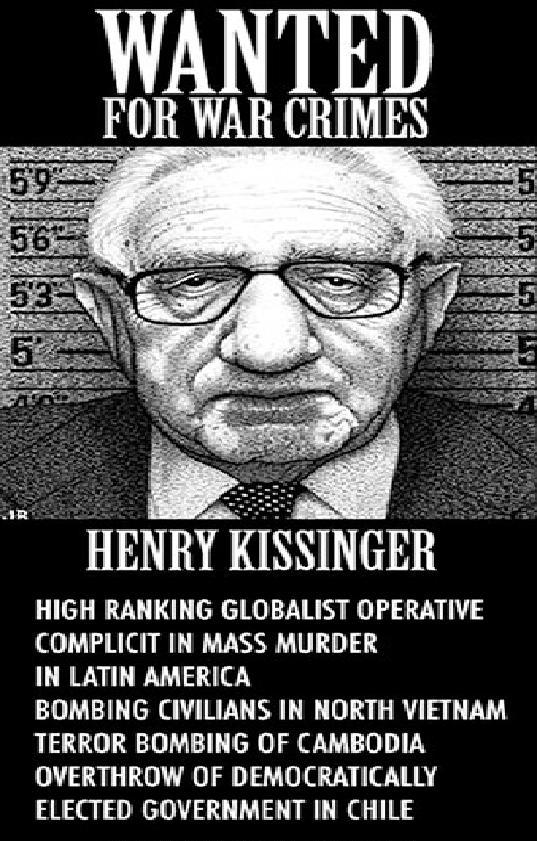
Who’s the “Low Life Scum:” Kissinger or CODEPINK?

kissinger-wanted

By Medea Benjamin

Source: Information Clearing House

A very angry Senator John McCain denounced CodePink activists as “low-life scum” for holding up signs reading “Arrest Kissinger for War Crimes” and dangling handcuffs next to Henry Kissinger’s head during a Senate hearing on January 29. McCain called the demonstration “disgraceful, outrageous and despicable,” accused the protesters of “physically intimidating” Kissinger and apologized profusely to his friend for this “deeply troubling incident.”

But if Senator McCain was really concerned about physical intimidation, perhaps he should have conjured up the memory of the gentle Chilean singer/songwriter Victor Jara. After Kissinger facilitated the September 11, 1973 coup against Salvador Allende that brought the ruthless Augusto Pinochet to power, Victor Jara and 5,000 others were rounded up in Chile’s National Stadium. Jara’s hands were smashed and his nails torn off; the sadistic guards then ordered him to play his guitar. Jara was later found dumped on the street, his dead body riddled with gunshot wounds and signs of torture.

Despite warnings by senior US officials that thousands of Chileans were being tortured and slaughtered, then Secretary of State Kissinger told Pinochet, “You did a great service to the West in overthrowing Allende.”

Rather than calling peaceful protesters “despicable,” perhaps Senator McCain should have used that term to describe Kissinger’s role in the brutal 1975 Indonesian invasion of East Timor, which took place just hours after Kissinger and President Ford visited Indonesia. They had given the Indonesian strongman the US green light—and the weapons—for an invasion that led to a 25-year occupation in which over 100,000 soldiers and civilians were killed or starved to death. The UN’s Commission for Reception, Truth and Reconciliation in East Timor (CAVR) stated that U.S. “political and military support were fundamental to the Indonesian invasion and occupation” of East Timor.

If McCain could stomach it, he could have read the report by the UN Commission on Human Rights describing the horrific consequences of that invasion. It includes gang rape of female detainees following periods of prolonged sexual torture; placing women in tanks of water for prolonged periods, including submerging their heads, before being raped; the use of snakes to instill terror during sexual torture; and the mutilation of women’s sexual organs, including insertion of batteries into vaginas and burning nipples and genitals with cigarettes. Talk about physical intimidation, Senator McCain!

You might think that McCain, who suffered tremendously in Vietnam, might be more sensitive to Kissinger’s role in prolonging that war. From 1969 through 1973, it was Kissinger, along with President Nixon, who oversaw the slaughter in Vietnam, Cambodia and Laos—killing perhaps one million during this period. He gave the order for the secret bombing of Cambodia. Kissinger is heard on tape saying, “[Nixon] wants a massive bombing campaign in Cambodia. He doesn’t want to hear anything about it. It’s an order, to be done. Anything that flies or anything that moves.”

Senator McCain could have taken the easy route by simply reading the meticulously researched book by the late Christopher Hitchens, The Trial of Henry Kissinger. Writing as a prosecutor before an international court of law, Hitchens skewers Kissinger for ordering or sanctioning the destruction of civilian populations, the assassination of “unfriendly” politicians and the kidnapping and disappearance of soldiers, journalists and clerics who got in his way. He holds Kissinger responsible for war crimes that range from the deliberate mass killings of civilian populations in Indochina, to collusion in mass murder and assassination in Bangladesh, the overthrow of the democratically elected government in Chile, and the incitement and enabling of genocide in East Timor.

McCain could have also perused the warrant issued by French Judge Roger Le Loire to have Kissinger appear before his court. When the French served Kissinger with summons in 2001 at the Ritz Hotel in Paris, Kissinger fled the country. More indictments followed from Spain, Argentina, Uruguay—even a civil suit in Washington DC.

Hitchens was disgusted by the way Henry Kissinger was treated as a respected statesman. He would have been appalled by Senator McCain’s obsequious attitude. “Kissinger should have the door shut in his face by every decent person and should be shamed, ostracized, and excluded,” Hitchens said. “No more dinners in his honor; no more respectful audiences for his absurdly overpriced public appearances; no more smirking photographs with hostesses and celebrities; no more soliciting of his worthless opinions by sycophantic editors and producers.”

Rather than fawning on him, Hitchens suggested, “why don’t you arrest him?”

Hitchens’ words were lost on Senator McCain, who preferred fawning to accountability. That’s where CodePink comes in. If we can’t get Kissinger before a court of law, at least we can show—with words and banners—that there are Americans who remember, Americans who empathize with the man’s many victims, Americans who have a conscience.

While McCain called us disgraceful, what is really disgraceful is the Senate calling in a tired old war criminal to testify about “Global Challenges and the U.S. National Security Strategy.” After horribly tragic failed wars, not just in Vietnam but over the last decade in Iraq and Afghanistan, it’s time for the US leaders like John McCain to bring in fresh faces and fresh ideas. We owe it to the next generation that will be cleaning up the bloody legacy left behind by Kissinger for years to come.


The Dire State of Our Nation (What You Won’t Hear from the Politicians)

Unknown-18

By John W. Whitehead

Source: The Rutherford Institute

No matter what the politicians might say about how great America is, the fact is that the nation seems to be imploding. Consider the following facts:

Our government is massively in debt. Currently, the national debt is somewhere in the vicinity of $18 trillion. More than a third of our debt is owned by foreign countries, namely China and Japan.

Our education system is abysmal. Despite the fact that we spend more than most of the world on education ($115,000 per student), we rank 36th in the world when it comes to math, reading and science, far below most of our Asian counterparts. Even so, we continue to insist on standardized programs such as Common Core, which teach students to be test-takers rather than thinkers.

Our homes provide little protection against government intrusions. Police agencies, already empowered to crash through your door if they suspect you’re up to no good, now have radars that allow them to “see” through the walls of your home.

Our prisons, housing the largest number of inmates in the world and still growing, have become money-making enterprises for private corporations that rely on the inmates for cheap labor.

We are no longer a representative republic. The U.S. has become a corporate oligarchy. As a recent survey indicates, our elected officials, especially those in the nation’s capital, represent the interests of the rich and powerful rather than the average citizen.

We’ve got the most expensive, least effective health care system in the world compared to other western, industrialized nations.

The air pollution levels are dangerously high for almost half of the U.S. population, putting Americans at greater risk of premature death, aggravated asthma, difficulty breathing and future cardiovascular problems.

Despite outlandish amounts of money being spent on the nation’s “infrastructure,” there are more than 63,000 bridges—one out of every 10 bridges in the country—in urgent need of repair. Some of these bridges are used 250 million times a day by trucks, school buses, passenger cars and other vehicles.

Americans know little to nothing about their rights or how the government is supposed to operate. This includes educators and politicians. For example, 27 percent of elected officials cannot name even one right or freedom guaranteed by the First Amendment, while 54 percent do not know the Constitution gives Congress the power to declare war.

Nearly one out of every three American children live in poverty, ranking us among the worst in the developed world.

Patrolled by police, our schools have become little more than quasi-prisons in which kids as young as age 4 are being handcuffed for “acting up,” subjected to body searches and lockdowns, and suspended for childish behavior.

We’re no longer innocent until proven guilty.  In our present surveillance state, that burden of proof has now been shifted so that we are all suspects to be spied on, searched, scanned, frisked, monitored, tracked and treated as if we’re potentially guilty of some wrongdoing or other.

Parents, no longer viewed as having an inherent right to raise their children as they see fit, are increasingly being arrested for letting their kids walk to the playground alone, or play outside alone. Similarly, parents who challenge a doctor’s finding or request a second opinion regarding their children’s health care needs are being charged with medical child abuse and, in a growing number of cases, losing custody of their children to the government.

Private property means little at a time when SWAT teams and other government agents can invade your home, break down your doors, kill your dog, wound or kill you, damage your furnishings and terrorize your family.

Court rulings undermining the Fourth Amendment and justifying invasive strip searches have left us powerless against police empowered to forcefully draw our blood, forcibly take our DNA, strip search us, and probe us intimately.

Americans have no protection against police abuse. It is no longer unusual to hear about incidents in which police shoot unarmed individuals first and ask questions later.

If there is any absolute maxim by which the federal government seems to operate, it is that the American taxpayer always gets ripped off. This is true, whether you’re talking about taxpayers being forced to fund high-priced weaponry that will be used against us, endless wars that do little for our safety or our freedoms, or bloated government agencies such as the National Security Agency with its secret budgets, covert agendas and clandestine activities.

Americans are powerless in the face of militarized police. As police forces across the country continue to be transformed into extensions of the military, Americans are finding their once-peaceful communities transformed into military outposts, complete with tanks, weaponry, and other equipment designed for the battlefield.

Now these are not problems that you can just throw money at. As I point out in my book A Government of Wolves: The Emerging American Police State, these are problems that will continue to plague our nation unless and until Americans wake up to the fact that we’re the only ones who can change things.

For starters, we’ll need to actually pay attention to what’s going on around us, and I don’t mean by turning on the TV news, which is little more than government propaganda. Pay attention to what your local city councils are enacting. Pay attention to what your school officials are teaching and not teaching. Pay attention to whom your elected officials are allowing to wine and dine them.

Most of all, stop acting like it really matters whether you vote for a Republican or Democrat, because it doesn’t, and start acting like citizens who expect the government to work for them, rather than the other way around.

While that bloated beast called the federal government may not listen to you, you can have a great impact on your local governing bodies if you’ll just take a stand. This will mean gathering together with your friends and neighbors and, for example, forcing your local city council to start opposing state and federal programs that are ripping you off. And if need be, your local city council can refuse to abide by the dictates that continue to flow from Washington, DC.

All of the signs point to something nasty up ahead. The time to act is now.

The Government Killed Martin Luther King Jr.

index

Since today marks the birthday of Martin Luther King Jr. it’s an appropriate time to reflect on his life and legacy but we must also never forget the forces which sought to crush his dream. Because of the work of investigative journalists, we have a clearer idea of the scope of the government’s efforts to discredit and psychologically torment Martin Luther King Jr. such as the following excerpt from an FBI letter to MLK:

King, there is only one thing left for you to do. You know what it is. You have just 34 days in which to do it (this exact number has been selected for a specific reason, it has definite practical significance). You are done. There is but one way out for you. You better take it before your filthy, abnormal fraudulent self is bared to the nation.

Read the complete unredacted FBI letter here: https://www.eff.org/deeplinks/2014/11/fbis-suicide-letter-dr-martin-luther-king-jr-and-dangers-unchecked-surveillance

Given such psychotic threats from the government agency, it’s not much of a stretch to imagine them opting for a more direct approach than trying to bully MLK to commit suicide.

How the Government Killed Martin Luther King, Jr.

By Carl Gibson

Source: Reader Supported News

efore scoffing at this headline, you should know that in 1999, in Memphis, Tennessee, more than three decades after MLK’s death, a jury found local, state, and federal government agencies guilty of conspiring to assassinate the Nobel Peace Prize winner and civil rights leader. The same media you would expect to cover such a monumental decision was absent at the trial, because those news organizations were part of that conspiracy. William F. Pepper, who was James Earl Ray’s first attorney, called over 70 witnesses to the stand to testify on every aspect of the assassination. The panel, which consisted of an even mix of both black and white jurors, took only an hour of deliberation to find Loyd Jowers and other defendants guilty. If you’re skeptical of any factual claims made here, click here for a full transcript, broken into individual sections. Read the testimonies yourself if you don’t want to take my word for it.

It really isn’t that radical a thing to expect this government to kill someone who threatened their authority and had the power to organize millions to protest it. When MLK was killed on April 4, 1968, he was speaking to sanitation workers in Memphis, who were organizing to fight poverty wages and ruthless working conditions. He was an outspoken critic of the government’s war in Vietnam, and his power to organize threatened the moneyed corporate interests who were profiting from the war. At the time of his death, he was gearing up for the Poor People’s Campaign, an effort to get people to camp out on the National Mall to demand anti-poverty legislation – essentially the first inception of the Occupy Wall Street movement. The government perceived him as a threat, and had him killed. James Earl Ray was the designated fall guy, and a complicit media, taking its cues from a government in fear of MLK, helped sell the “official” story of the assassination. Here’s how they did it.

The Setup

The defendant in the 1999 civil trial, Loyd Jowers, had been a Memphis PD officer in the 1940s. He owned a restaurant called Jim’s Grill, a staging ground to orchestrate MLK’s assassination underneath the rooming house where the corporate media alleges James Earl Ray shot Dr. King. During the trial, William Pepper, the plaintiff’s attorney, played a tape of an incriminating 1998 conversation between Jowers, UN Ambassador Andrew Young, and Dexter King, MLK’s son. Young testified that Jowers told them he “wanted to get right with God before he died, wanted to confess it and be free of it.”

On the tape, Jowers mentions that those present at the meetings included MPD officer Marrell McCollough, Earl Clark, an MPD lieutenant and known as the department’s best marksman, another MPD officer, and two men who were unknown to Jowers but whom he assumed to be representatives of federal agencies. While Dr. King was in Memphis, he was under open or eye-to-eye federal surveillance by the 111th Military Intelligence Group based at Fort McPherson in Atlanta, Georgia. Memphis PD intelligence officer Eli Arkin even admitted to having the group in his own office. During his last visit to Memphis in late March of 1968, MLK was under covert surveillance, meaning his room at the Rivermont was bugged and wired. Even if he went out to the balcony to speak, his words were recorded via relay. William Pepper alleges in his closing argument during King v. Jowers that such covert surveillance was usually done by the Army Security Agency, implying the involvement of at least two federal agencies.

Jowers also gave an interview to Sam Donaldson on “Prime Time Live” in 1993. The transcript of the interview was read during the trial, and it was revealed that Jowers openly talked about being asked by produce warehouse owner Frank Liberto to help with MLK’s murder. Liberto had mafia connections, and sent a courier with $100,000 to Jowers, who owned a local restaurant, with instructions to hold the money at his restaurant.

John McFerren owned a store in Memphis and was making a pickup at Liberto’s warehouse at 5:15 p.m. on April 4th, roughly 45 minutes before the assassination. McFerren testified that he overheard Liberto tell someone over the phone, “Shoot the son of a bitch on the balcony.” Other witnesses who testified included café owner Lavada Addison, who was friends with Liberto in the 1970s. She recalled him confiding to her that he “had Martin Luther King killed.” Addison’s son, Nathan Whitlock, also testified. He asked Liberto if he killed MLK, and he responded, “I didn’t kill the nigger but I had it done.” When Whitlock pressed him about James Earl Ray, Liberto replied, “He wasn’t nothing but a troublemaker from Missouri. He was a front man … a setup man.”

The back door of Loyd Jowers’ establishment led to a thick crop of bushes across the street from the Lorraine Motel balcony where Dr. King was shot. On the taped confession to Andrew Young and Dexter King, Jowers says after he heard the shot, Lt. Earl Clark, who is now deceased, laid a smoking rifle at the rear of his restaurant. Jowers then disassembled the rifle, wrapped it in a tablecloth and prepared it for disposal.

The corporate media says it was James Earl Ray who shot MLK, and he did it from the 2nd floor bathroom window of the rooming house across the street from the Lorraine Motel. The official account alleges the murder weapon was dropped in a bundle and abandoned at Dan Canipe’s storefront just before he made his getaway. But even those authorities and media admit that the bullet that tore through MLK’s throat didn’t have the same metallurgical composition as the bullets in the rifle left behind by James Earl Ray. And Judge Joe Brown, a weapons expert called to testify by Pepper in the 1999 trial, said the rifle allegedly used by James Earl Ray had a scope that was never sighted in, meaning that the weapon in question would have fired far to the left and far below the target.

The actual murder weapon was disposed of by taxi driver James McCraw, a friend of Jowers. William Hamblin testified in King v. Jowers that McCraw told him this story over a 15-year period whenever he got drunk. McCraw repeatedly told Hamblin that he threw the rifle over the Memphis-Arkansas bridge, meaning that the rifle is at the bottom of the Mississippi river to this day. And according to Hamblin’s testimony, Canipe said he saw the bundle dropped in front of his store before the actual shooting occurred.

The Conspiracy

To make Dr. King vulnerable, plans had to be made to remove him from his security detail and anyone sympathetic who could be a witness or interfere with the killing. Two black firefighters, Floyd Newsum and Norvell Wallace, who were working at Fire Station #2 across the street from the Lorraine Motel, were each transferred to different fire stations. Newsum was a civil rights activist and witnessed MLK’s last speech to the striking Memphis sanitation workers, “I Have Seen the Mountaintop,” before getting the call about his transfer. Newsum testified that he wasn’t needed at his new assignment, and that his transfer meant that Fire Station #2 would be out of commission unless someone else was sent there in his stead. Newsum talked about having to make a series of inquiries before finally learning that his reassignment had been ordered by the Memphis Police Department. Wallace testified that to that very day, while the official explanation was a vague death threat, he hadn’t once received a satisfactory answer as to why he was suddenly reassigned.

Ed Redditt, a black MPD detective who was assigned to MLK’s security detail, was also removed from the scene an hour before the shooting and sent home, and the only reason given was a vague death threat. Jerry Williams, another black MPD detective, was usually tasked with assembling a security team of black police officers for Dr. King. But he testified that on the night of the assassination, he wasn’t assigned to form that team.

There was a Black Panther-inspired group called The Invaders, who were staying at the Lorraine Motel to help MLK organize a planned march with the striking garbage workers. The Invaders were ordered to leave the motel after getting into an argument with members of MLK’s entourage. The origins of the argument are unclear, though several sources affirm that The Invaders had been infiltrated by Marrell McCollough of the MPD, who later went on to work for the CIA. And finally, the Tact 10 police escort of several MPD cars that accompanied Dr. King’s security detail were pulled back the day before the shooting by Inspector Evans. With all possible obstacles out of the way, MLK was all alone just before the assassination.

The Cover-Up

Around 7 a.m. on April 5, the morning after the shooting, MPD Inspector Sam Evans called Public Works Administrator Maynard Stiles and told him to have a crew destroy the crop of bushes adjacent to the rooming house above Loyd Jowers’ restaurant. This is particularly odd coming from a policeman, since the bushes were in a crime scene area, and crime scene areas are normally roped off, not to be disturbed. The official narrative of a sniper in the bathroom at the rooming house was then reinforced, since a sniper firing from an empty clearing would be far more visible than one hidden behind a thick crop of bushes.

Normally, when a major political figure is murdered, all possible witnesses are questioned and asked to make statements. But Memphis PD neglected to conduct even a basic house-to-house investigation. Olivia Catling, a resident of nearby Mulberry Street just a block away from the shooting, testified that she saw a man leave an alley next to the rooming house across from the Lorraine, climb into a Green 1965 Chevrolet, and speed away, burning rubber right in front of several police cars without any interference. There was also no questioning of Captain Weiden, a Memphis firefighter at the fire station closest to the Lorraine, the same one from which Floyd Newsum had been transferred just a day before.

Memphis PD and the FBI also suppressed the statements of Ray Hendricks and William Reed, who said they saw James Earl Ray’s white mustang parked in front of Jowers’ restaurant, before seeing it again driving away as they crossed another street. Ray’s alibi was that he had driven away from the scene to fix a tire, and these two statements that affirmed his alibi were withheld from Ray’s guilty plea jury.

The jury present at Ray’s guilty plea hearing also wasn’t informed about the bullet that killed MLK having different striations and markings than the other bullets kept as evidence, nor that the bullet couldn’t be positively matched as coming from the alleged murder weapon. Three days after entering the guilty plea, James Earl Ray unsuccessfully attempted to retract it and demand a trial. Incredibly, James Earl Ray turned down two separate bribes, one of which was recorded by his brother Jerry Ray, where he was offered $220,000 by writer William Bradford Huey and the guarantee of a full pardon if he would just agree to have the story “Why I Killed Martin Luther King” written on his behalf.

The Deception

One of the 70 witnesses that William F. Pepper called to testify in King v. Jowers was Bill Schaap, a practicing attorney with particular experience in military law, with bar credentials in New York, Chicago, and DC. Schaap testified at great length about how the government, through the FBI and the CIA, puts people in key positions on editorial boards at influential papers like the New York Times and Washington Post. He describes that although these editorial board members and news directors at cable news outlets may be liberal in their politics, they always take the government’s side in national security-related stories. Before you write that off as conspiracy theory, remember how people like Bill Keller at the New York Times, as well as the Washington Post editorial board, all cheerfully led the march to war in Iraq ten years ago.

Another King v. Jowers witness was Earl Caldwell, a New York Times reporter who was sent to Memphis by an editor named Claude Sitton. Caldwell testified that the orders from his editor were to “nail Dr. King.” In the publication’s effort to sell the story of James Earl Ray as the murderer, the Times cited an investigation into how Ray got the money for his Mustang, rifle, and the long road trip to Tennessee from California. The Times said that according to their own findings as well as the findings of federal agencies, Ray got the money by robbing a bank in his hometown of Alton, Illinois. In Pepper’s closing argument, he says that when he or Jerry Ray talked to the chief of police in Alton, along with the bank president of the branch that was allegedly robbed, neither said they had been approached by the New York Times, or by the FBI. Essentially, the Times fabricated the entire story in order to sell a false narrative that there was no government intervention and that James Earl Ray was a lone wolf.

So for the following 31 years after King’s death, nobody dared to question the constant reiteration of James Earl Ray as the murderer of Martin Luther King. Even 13 years after a jury found the government complicit in a conspiracy to murder the civil rights leader, the complicit media continues to propagate the false narrative they sold us three decades ago and vociferously shout down any alternative theories as to what happened as “conspiracy theory,” framing those putting forth such theories as wackjobs undeserving of any credibility. It’s strikingly similar to how the Washington Post defended their warmongering in a recent editorial commenting on the invasion of Iraq, and had one of their reporters defend the media’s leading of the charge into Iraq.

As we remember Dr. King and the important work he did, we should also reject the official account of his death as loudly as the government and media shout down anyone who tries to contradict their lies. As Edward R. Murrow said, “Most truths are so naked that people feel sorry for them and cover them up, at least a little bit.”


Carl Gibson, 25, is co-founder of US Uncut, a nationwide creative direct-action movement that mobilized tens of thousands of activists against corporate tax avoidance and budget cuts in the months leading up to the Occupy Wall Street movement. Carl and other US Uncut activists are featured in the documentary “We’re Not Broke,” which premiered at the 2012 Sundance Film Festival. He currently lives in Madison, Wisconsin. You can contact him at carl@rsnorg.org, and follow him on twitter at @uncutCG.

Also read:
Who Killed Martin Luther King Jr.?

Martin Luther King assassinated by US Govt: King Family civil trial verdict