Baltimoreans Pushed to Their Limits

Suspect_Dies_Baltimore.JPEG-01b3c_c0-199-4709-2943_s561x327

By David S. D’Amato

Source: Center for a Stateless Society

We speak of the blowback that results from American foreign policy, the senseless, heinous acts of terror that represent an unfocused and irrational rebellion against American imperialism. We understand that calling it what it is, blowback — pointing out the causal relationship between American foreign policy and terrorism — is not an attempt to exculpate the people who commit these crimes. Looking for a motive that may aid in explaining these horrors is not looking for an excuse.

Similarly, the Baltimore rioters have found themselves on the losing end of a set of government policies that have consolidated wealth and foreclosed economic opportunities for independence and self-sufficiency. While so many Americans have been railing against welfare recipients, worried about the effects of food stamps on the federal budget, top American companies have worked closely with government for generations, guaranteeing the corporate welfare and special privileges that define the U.S. economic system.

The truth is that corporate capitalism has hung these rioting Baltimoreans out to dry, the American Dream being to them no more than a cruelly sarcastic joke, forever out of reach, mocking them. The prevailing story depicts the urban poor largely as the victims of “the free market,” dependent on a helping hand from government, be it education, job training, or just the bare necessities. In this story, government intervenes to file the sharp edges off of unbridled free market competition.

The problem with this story is that is recasts government in a role it has never actually played for poor and working class people — least of all black Americans. In real life, the state has intervened not to protect the economically powerless and penniless, but to serve to the needs of capital, to fence off resources and restrict opportunities in order to subject people to the control of a few giant employers. This coercive, state-driven process has nothing to do with a principled, libertarian free market today, and it never has in the past.

The result has been a permanent underclass, condemned to live in ghettos under quasi-military occupation, surrounded by violent crime that is the direct product of a failed war on drugs. And while the people who live in these communities are demonstrably no more likely to possess contraband than anyone else, they are far more likely to be stopped and frisked, arrested, and even murdered by increasingly militarized police officers.

The problems in Baltimore are historical and systemic. Everyone agrees that rioting, looting, and the wanton destruction of private property are senseless acts that ultimately can’t help anyone or create positive social change. We must nevertheless ask why these people in Baltimore feel so helpless, so abandoned and frustrated by the “proper channels,” that they find it is necessary to lash out and express themselves in this way.

Systematic state violence has left Baltimore communities barren, crying out for justice and opportunity. Anarchists believe that the dormant power of self-organization, cooperation and trade, once truly freed from aggression and meddling, is all the poor need to thrive. Through the anger and sadness coming out of Baltimore, it’s important not to lose sight of the larger, underlying issues.

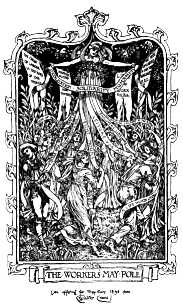
MAY DAY – The International Labor Day

crane13

Source: The Anarchist International

May 1st, International Workers’ Day, commemorates the historic struggle of working people throughout the world, and is recognized in most countries. The United States of America and Canada are among the exceptions. This despite the fact that the holiday began in the 1880s in the USA, linked to the battle for the eight-hour day, and the Chicago anarchists.

The struggle for the eight-hour day began in the 1860s. In 1884, the Federation of Organized Trades and Labor Unions of the United States and Canada, organized in 1881 (and changing its name in 1886 to American Federation of Labor ) passed a resolution which asserted that “eight hours shall constitute a legal day’s work from and after May 1, 1886, and that we recommend to labor organizations throughout this district that they so direct their laws as to conform to this resolution”. The following year the Federation repeated the declaration that an eight-hour system was to go into effect on May 1, 1886. With workers being forced to work ten, twelve, and fourteen hours a day, support for the eight-hour movement grew rapidly. In the months prior to May 1, 1886, thousands of workers, organized and unorganized, members of the organization Knights of Labor and of the federation, were drawn into the struggle. Chicago was the main center of the agitation for a shorter day. The anarchists were in the forefront of the Central Labor Union of Chicago, which consisted of 22 unions in 1886, among them the seven largest in the city.

During the Railroad strikes of 1877, the workers had been violently attacked by the police and the United States Army. A similar tactic of state terrorism was prepared by the bureaucracy to fight the eight-hour movement. The police and National Guard were increased in size and received new and powerful weapons financed by local business leaders. Chicago’s Commercial Club purchased a $2000 machine gun for the Illinois National Guard to be used against strikers. Nevertheless, by May 1st, the movement had already won gains for many Chicago workers. But on May 3, 1886, police fired into a crowd of strikers at the McCormick Harvester Machine Company, killing at least one striker, seriously wounding five or six others, and injuring an undetermined number. Anarchists called for a mass meeting the next day in Haymarket Square to protest the brutality.

The meeting proceeded without incident, and by the time the last speaker was on the platform, the rainy gathering was already breaking up, with only about two hundred people remaining. It was then a police column of 180 men marched into the square and ordered the meeting to disperse. At the end of the meeting a bomb was thrown at the police, killing one instantly, six others died later. About seventy police officers were wounded. Police responded by firing into the crowd. How many civilians were wounded or killed from police bullits never was ascertained exactly. Although it was never determined who threw the bomb, the incident was used as an excuse to attack anarchists and the labor movement in general. Police ransacked the homes and offices of suspected radicals, and hundreds were arrested without charge. A reign of police terror swept over Chicago. Staging “raids” in the working-class districts, the police rounded up all known anarchists and other socialists. “Make the raids first and look up the law afterward!” publicly counseled the state’s attorney.

Anarchists in particular were harassed, and eight of Chicago’s most active were charged with conspiracy to murder in connection with the Haymarket bombing. A kangaroo court found all eight guilty, despite a lack of evidence connecting any of them to the bomb-thrower, and they were sentenced to die. In October 9, 1886, the weekly journal Knights of Labor published in Chicago, carried on page 1 the following announcement: “Next week we begin the publication of the lives of the anarchists advertised in another column.”

The advertisement, carried on page 14, read: The story of the anarchists, told by themselves; Parsons, Spies, Fielden, Schwab, Fischer, Lingg, Engle, Neebe. The only true history of the men who claim that they are condemned to suffer death for exercising the right of Free Speech: Their association with Labor, Socialistic and Anarchistic Societies, their views as to the aims and objects of these organizations, and how they expect to accomplish them; also their connection with the Chicago Haymarket Affair. Each man is the author of his own story, which will appear only in the “Knights of Labor” during the next three months, – the great labor paper of the United States, a 16-page weekly paper, containing all the latest foreign and domestic labor news of the day, stories, household hints, etc. A co-operative paper owned and controlled by members of the Knights of Labor, and furnished for the small sum of $1.00 per annum. Adress all communications to Knights of Labor Publishing Company, 163 Washington St., Chicago, Ill. Later this journal and the paper Alarm published the autobiographies of the Haymarket men.

Albert Parsons, August Spies, Adolf Fischer and George Engel were hanged on November 11, 1887. Louis Lingg committed suicide in prison. The authorities turned over the bodies to friends for burial, and one of the largest funeral processions in Chicago history was held. It was estimated that between 150,000 to 500,000 persons lined the route taken by the funeral cortege of the Haymarket martyrs. A monument to the executed men was unveiled June 25, 1893 at Waldheim Cemetery in Chicago. The remaining three, Samuel Fielden, Oscar Neebe and Michael Schwab, were finally pardoned in 1893.

On June 26, 1893, the governor of Illinois, John Peter Altgeld, issued the pardon message in which he made it clear that he was not granting the pardon because he believed that the men had suffered enough, but because they were innocent of the crime for which they had been tried, and that they and the hanged men had been the victims of hysteria, packed juries and a biased judge. He noted that the defendants were not proven guilty because the state “has never discovered who it was that threw the bomb which killed the policeman, and the evidence does not show any connection whatsoever between the defendants and the man who threw it.”

International Workers’ Day is the commemoration of the Haymarket Event in Chicago in 1886. In 1889, the first congress of the Second International, meeting in Paris for the centennial of the French Revolution and the Exposition Universelle (1889), following an initiative from the American Federation of Labor, called for international demonstrations on the 1890 anniversary of the Chicago protests. These were so successful that May Day was formally recognized as an annual event at the International’s second congress in 1891.

It is not surprising that the state, business leaders, mainstream union officials, and the media would want to hide the true history of May Day. In its attempt to erase the history and significance of May Day, the United States government declared May 1st to be “Law Day”, and gave the workers instead Labor Day, the first Monday of September – a holiday devoid of any historical significance.

Nevertheless, rather than suppressing the labor and anarchist movements, the events of 1886 and the execution of the Chicago anarchists, spokesmen of the movement for the eight-hour day, mobilized many generations of radicals. Emma Goldman, a young immigrant at the time, later pointed to the Haymarket affair as her political birth. Instead of disappearing, the anarchist movement only grew in the wake of Haymarket.

As workers, we must recognize and commemorate May Day not only for it’s historical significance, but also as a time to organize around issues of vital importance of today for the working-class broadly defined, i.e. the grassroots – the people seen as a class in contrast to the superiors in income and/or rank – economically and/or political/administrative.

The May Day Manifestos of the International Workers of the World affiliated to the Anarchist International, from the latest years are published on its Webpage, click here!

Infuriating Video Shows City Official Calling Vietnam Vet “The Enemy” for His Use of Medical Pot

images

By Matt Agorist

Source: The Free Thought Project

Maricopa County, AZ — A video was submitted to the Free Thought Project Sunday, which illustrates the brutal insanity of the state’s War on Drugs.

The video was taken during a heated debate on whether or not to legalize marijuana in Arizona. Maricopa County Attorney, Bill Montgomery, and Attorney Marc Victor went head to head on the topic of prohibition. Victor advocated to end prohibition and Montgomery held the position to continue locking people in cages for a plant.

At the end of the nearly 2 hour long debate, the two debaters took questions from the audience. That is when Vietnam veteran Don Ream stood up to explain to Montgomery how calling people who use marijuana for medicine, “Pot Heads,” was offensive.

Ream explained how he has been a patient for four years, and he is off all of his pharmaceutical medicine. All he uses for his symptoms is his medical marijuana. He then politely invited Mr. Montgomery to come and learn about the benefits of the substance and how safe marijuana actually is.

As Ream began to close his statement, Montgomery took to the podium ready to fire back.

“There is a difference between medical application of marijuana and recreational use of the substance,” said Montgomery, who is an attorney, not a doctor.

Ream then admitted that he uses his marijuana recreationally as well.

“Well, then you’re violating the law, and I have no respect for you,” Montgomery said. “I have no respect for someone who would try to claim that you served this country and took an oath to uphold the Constitution and protect against all enemies foreign and domestic – because you’re an enemy.”

Montgomery was then met with several “Boos” from the audience.

How exactly does ingesting a plant make you an enemy?

The person who wants to ingest a substance for medical or recreational reasons is not the criminal. However, the person that would kidnap, cage, or kill someone because they have a different lifestyle is a villain on many fronts.

The only “enemy” in the interchange below is the person who would deprive someone of their freedom by using government violence to enforce their personal preference. Shame on you Bill Montgomery.

When It Becomes Serious, First They Lie–When That Fails, They Arrest You

ost2

By Charles Hugh Smith

Source: Of Two Minds

When lying is no longer enough to gain compliance, then the organs of security are unleashed on dissent and resistance.

“When it becomes serious, you have to lie.” Jean-Claude Juncker simply gave voice to what the world’s leaders practice on a daily basis, because now it’s always serious.


And why is it now serious? Persuading tax donkeys and debt serfs that everything is going their way is now impossible without lies. Persuading the populace that the leadership is working on their behalf was jettisoned in the wake of the 2008 bailout of bankers and parasites.

Stripped of the artifice that they care about anything other than preserving the wealth of their cronies, global political leaders now rely on propaganda: narratives designed to manage expectations and perceptions, bolstered by carefully tailored official statistics.

Reliance on lies erodes legitimacy. As the rich get richer and the burdens on tax donkeys and debt serfs increase, the gulf between the official happy-story narrative and reality widens to the breaking point, and faith in the narrative and the leadership espousing it declines.

When 20% of the populace no longer believe the lies and begins questioning the state’s enforcement of the status quo, the government devotes its resources to punishing dissenters and resisters. Whistleblowers are charged with trumped-up crimes; those publicly refuting the status quo’s narrative of lies are harassed and discredited, and those who resist state enforcement of parasitic cronyism are set up, beaten, entrapped, investigated, interrogated and arrested once suitably Kafkaesque charges can be conjured up by the apparatchiks of enforcement.

Why 20%? It’s the Pareto Distribution (the 80/20 rule): the 20% of any populace that accepts a new trend, technology or narrative has an outsized influence over the other 80%.

Governments operate on the premise that propaganda and threats will always be enough to cow their populaces into compliance and bribes will induce complicity. When lies, bribes and threats no long work, the state unleashes its full pathological powers on dissent.

The last mass campaign of political suppression in the U.S. occurred in the late 1960s and early 1970s, when resistance to the war of choice in Vietnam reached mainstream proportions.

The U.S. government was accustomed to manipulating and managing the populace with very simple propaganda: Communism is our deadly enemy, we must fight it everywhere on the planet, etc. But when thousands of American service personnel started coming home in body bags from the latest “we must fight Communism everywhere because it’s dangerous to us” war in East Asia, this simplistic justification made no sense: what existential threat to the U.S. did a Communist Vietnam pose?

The U.S. has faced only two existential threats to its sovereignty since 1860: World War II (1941-45) and the potential for a nation-destroying nuclear war with the Soviet Union. The idea that the U.S. was existentially threatened by falling dominoes in East Asia was always ludicrous, and the U.S. status quo (the political leadership, the Deep State, private industry profiting from war, etc.) soon abandoned the absurd justification.

Vietnam was always more of a domestic-politics issue than a geopolitical one: the Democrats feared being perceived as being “weak on Communism” because that impacted the results of elections. Throwing treasure and American lives away in Vietnam was pure domestic politics from 1961-68 (once mired, Democrats feared being tagged as the party that “lost Vietnam”), and thereafter the treasure and lives were sacrificed on the equally contrived Nixon-Kissinger policy of avoiding losing geopolitical face with a withdrawal that amounted to surrender.

Though it is not well known, the Federal Bureau of Investigation (FBI) was ordered to devote essentially all its resources to suppressing dissent in these years. Teams assigned to organized crime were reassigned to track down draft resisters and other political malcontents. COINTELPRO was a vast program devoted to illegally entrapping, beating up and undermining any and all political resistance to the war and the government’s increasingly heavy-handed oppression of dissent.

For more on COINTELPRO, please read War at Home: Covert action against U.S. activists and what we can do about it.

Simply put: when lies no longer work, governments freak out and devote their resources not to eliminating wars of choice, cronyism and corruption but to suppressing dissent and resistance to those policies.

The U.S. government has always been free to pursue wars of choice with its professional military, with little risk of widespread political blowback. A variety of “splendid little wars” have been waged, generally for conquest or enforcement of hemispheric hegemony. The government’s success in rallying the nation during World War II instilled a false confidence that merely raising the flag of existential threat would be enough to eliminate dissent and elicit compliance in the masses.

Vietnam was the first time the American public went through the process of buying the usual “threat” justification for war, questioning the threat and eventually rejecting the state’s narrative. The government responded by lashing out at its own citizenry, engaging in a full spectrum of illegal and blatantly immoral actions designed not to right wrongs or fix broken policies, but to suppress dissent and resistance to destructive policies and broken systems.

The U.S. government is not unique in this; on the contrary, all governments, by their very nature as concentrations of coercive power, will pursue the same path. Rather than confess the government is operated by cronies, for cronies, the machinery of the state will increasingly be turned on its citizenry.

Rendering unto Caesar that which is Caesar’s is no longer enough; abiding by the laws of the land are no longer enough. What the state demands is not just compliance with its countless laws and regulations, but absolute obedience to its narratives and policies.


Anyone who withholds obedience is quickly deemed a traitor–not to the nation or its Constitution, but to the state itself, which is ultimately a collection of cronies and self-serving vested interests protecting their fiefdoms at the expense of the citizenry.

When lying is no longer enough to gain compliance, then the organs of security are unleashed on dissent and resistance. This process is well under way in nation-states around the world.

If I had to pick the two key operative dynamics of the next 20 years, I would choose:

1. The over-expansion and implosion of credit/debt bubbles.

2. The over-reach of the central state as it seeks to win the hearts and minds of its people by ruthlessly suppressing dissent.

The two dynamics are of course causally connected. Central states depend entirely on credit bubbles for their financial survival, and on enforcing increasingly untenable official narratives for their legitimacy.

Both are unraveling, and will continue to unravel, no matter how many state resources are thrown at the symptoms of political illegitimacy, rather than at the root causes of that illegitimacy.


Ferguson and the Logic of Neoliberalism

Ferguson-RiotA Political Economy Premised on Exploitation and Social Repression

By Rob Urie

Source: Counterpunch.org

While the U.S. Department of Justice report on racist policing practices in Ferguson, Missouri provides direct evidence for skeptical Whites that institutional racism is fact, limiting the investigation to Ferguson implausibly delimits the scope of race based repression in the U.S. Additionally, from slavery to convict leasing to funding the Ferguson city budget with fines and penalties overwhelmingly extracted from poor and middle class Blacks, the economic basis of police repression is isolated in an improbable present. And in fact, the ‘tricks and traps’ used by the Ferguson police for economic extraction closely resembles corporate practices of using contract law, state institutions and monopoly power to take economic resources from those who lack the social power to resist.

A cognitive challenge for White Americans (and ‘conservative’ Blacks) is the distance between facts like police repression in Ferguson and the mythology of capitalist democracy that we live by. Use of the police for economic extraction in Ferguson, for funding the town budget through racial repression, ties state power to economic power within the particular circumstances of American racial and economic history. In a most basic sense this integration reframes state-market relations claimed to relate capitalism to democracy. More broadly, the TPP and TIPP ‘trade’ deals being pushed by President Obama are a variation on the racist shakedown in Ferguson. Their intent is to replace state power with corporate power while leaving Western states intact to provide state services for the benefit of corporations and the illusion of democratic control.

Discovery of a police ‘black site’ in Chicago, the prevalence of racist violence by the police across the U.S., the return of debtor’s prisons and ‘civil forfeiture’ laws that allow the police to take belongings without evidence of a crime illustrate the growing lawlessness of the police. When tied to illegal surveillance carried out by the NSA, DEA and FBI against citizens and non-citizens alike and the extra-judicial powers claimed by Mr. Obama a picture of widespread state lawlessness emerges. When considered in the context of no criminal prosecutions for war crimes against the (George W) Bush administration or against prominent bankers in the financial and economic debacle of the last decade a picture of widespread elite lawlessness emerges. Clearly the state, including local police departments, exists for purposes other than enforcing fealty to the law.

Based on supporting economic theories it is superficially ironic that the resurgence of neo-liberalism since the 1970s is coincident with this growing integration of state and ‘private’ power. Premised on clearly delineated state and market roles, neo-liberalism was / is in theory the economic realm unhindered by state restrictions. This state-market delineation facilitates the facade that capitalism is related to democracy— political freedom in the realm of the political and economic freedom in the realm of the economic. As fact and metaphor the role of the Ferguson police using asymmetrical social power to take economic wealth from vulnerable citizens demonstrates the implausibility of this theorized differentiation in the realm of the political. And new debtor’s prisons (link above) have police and the prison system acting as collection agents for Payday Lenders.

The TPP and TTIP trade deals being pushed by Mr. Obama are designed with analogous levers for extorting wealth. The investor resolution clauses in TTIP have a supranational judiciary ruling on ‘investor’ lawsuits against governments for hypothetical lost profits and taxpayers on the hook for adverse rulings. The relative absence of remaining trade restrictions and tariffs is well covered territory. What remains to be accomplished with these ‘agreements’ is the consolidation of economic power as the power to extract wealth. As with proposals for tradable carbon credits, the ‘product’ of the agreements combines the right to extort by putting forward projects never intended to be built with guarantees against adverse economic developments.

The police in Ferguson used a particular social lever, the residual of slavery, for gratuitous racial repression and for economic extraction. Slavery is a social institution, but it most particularly is an economic institution. It is a social mechanism for accruing the product of slave labor to the slave master. And slavery in the U.S. was ‘legal’ until it wasn’t. Convict leasing was explicit use of ‘the law’ and the judicial system to force poor Blacks to work for little or no pay. ‘The law’ was used as an instrument of economic exploitation and extraction. The push back from Whites and conservative Blacks that the murdered Mike Brown was a criminal because he likely stole a box of cigars takes this same law at face value. This view of the law depends on a similarly improbable separation of political and economic realms as neo-liberal theory.

As political theory might have it, if all of the citizens of Ferguson were intended to benefit from city resources while poor and middle class Blacks were disproportionately forced to pay for them that represents economic taking by some citizens for the benefit of others. The racial character of this taking places it in history. The history of Western colonialism, neo-colonialism and imperialism places it in broader internal and external context. And this history is evidence that distinct realms of the economic and the political never described existing circumstance. The practical relevance is that it places the actions of the police in Ferguson, past and pending ‘trade’ agreements and global economic relations in the space where economic and political power act in an integrated social dimension.

The effect is to reframe ‘the law’ in terms of who is committing particular acts rather than the acts being committed. The police in Ferguson can murder with impunity and shake down citizens at their discretion to fund the city budget (and their paychecks) while poor and middle class Blacks are disproportionately murdered and sent to prison for similar acts. What is legal and what isn’t is determined by who has social power, not by the acts themselves. In a racist and classist society the law is codification of class and race interests. If a black citizen of Ferguson puts a gun to someone’s head and demands their valuables they are a criminal but if the same act is committed by a cop it is within the law. Here events in Ferguson are fact and metaphor— overwhelming evidence (links above) suggests that similar social relations exist across much of the country.

This view of the law has precedence in Richard Nixon’s contention that “when the President does it that means that it is not illegal.” Earlier precedence can be found in Nazi law and in the laws of fascist Italy in the 1930s and 1940s. This isn’t to call anyone who isn’t a self-proclaimed Nazi a Nazi. The precedence lies in the view that the law is the will of a leadership class, be it the Nazi leadership in Germany or city government in Ferguson. One problem with this theory is that it makes the law capricious and ultimately impossible to follow. Race based law enforcement criminalizes race, not nominally proscribed acts. Stories of the Chicago police department’s black site (link above) have political protesters and poor Blacks accused of no crimes taken there. If people can be arrested without evidence that a crime was committed then what is the difference in outcomes between committing and not committing crimes?

A relation of neo-liberalism to fascism can be made through replacement of civil governance with corporate governance that subordinates the rights and privileges of civil society to corporate interests. The investor-state dispute mechanisms (link above) being broadened and formally codified in the TTIP trade deal will be used to demand compensation for environmental regulations that keep drinking water safe and limit greenhouse gas emissions, the metaphorical equivalent of threatening to end the planet if we don’t pay up. Civil forfeiture has the police taking valuables they might want at the point of a gun if necessary. The Ferguson police shake down poor Blacks using the law as a weapon. At the same time a ruling elite has immunity from prosecution for well documented crimes.

Much of what is written here was well understood in the 1950s, 1960s and 1970s. It hardly seems an accident that this collective memory was lost to narrow ideological dogma. Across the country property taxes are being cut with partial differences made up through regressive fees and penalties. This fits the neo-liberal preference for property over labor incomes. And neo-liberal theory has no place for history because all acts within it take place in a temporally isolated present. This dissociates racist policing in Ferguson, Chicago, New York, Detroit and Philadelphia from the roles of the legislature, judiciary, police and prisons in reconstituting the economic exploitation of slavery under the guise of free choice in capitalist democracy. Race is the particular case in America; class is the broader expression of economic power.

The tension between the DOJ report (link above) on racist policing in Ferguson and the Obama administration’s broad support for neo-liberal policies will likely produce a tight circle drawn around events in Ferguson. Already supporters of police repression are raising the argument that the words “hands up, don’t shoot” never transpired. What bearing does precise wording have on a Black child being murdered by the police? And why wouldn’t Black youth have a right to be hostile to police who, as the DOJ reports concludes, are running a racist shakedown operation to force poor and middle class Blacks to fund city government? How would White readers react to being harassed, intimidated, disproportionately jailed and forced to pay for the privilege? Ultimately the problem is larger than Ferguson and social accountability should address political economy premised in exploitation and social repression.

Rob Urie is an artist and political economist. His book Zen Economics is written and awaiting publication.


Podcast Roundup

3/11: Srini Rao has an interesting conversation with animal rights activist Peter Young covering community activism, communication, survival tips, and his former life as a fugitive on the “Unmistakable Creative” podcast.

https://sitebuilderio.s3.amazonaws.com/unmistakablecreative/audios/012b5fac-3695-42b3-9a2d-ffd7d4d7f213/lessons-in-communication-from-a-fugitive-peter-young.mp3

3/11: On the latest “Guns and Butter”, Bonnie Faulkner interviews John Whitehead of  the Rutherford Institute. They discuss aspects of  “Police State America” including the Corporate State, American Legislative Exchange Council (ALEC), Offices of Inspector General (OIG), SWAT Teams, No-Knock Raids, the Schoolhouse to Jailhouse Track, the New York Prototype, MRAPs, Operation Vigilant Eagle, Atlas Four Androids, TSA and VIPR Teams, the Google/NSA connection and Fusion Centers.

http://archives.kpfa.org/data/20150311-Wed1300.mp3

3/11: Host Dave Lindorff discusses the recent coup plan disrupted by police in Venezuela with veteran journalist Alfredo Lopez — a story largely blacked out or mocked as bogus by the US corporate media despite solid evidence of a plot, and of US involvement in that plot on “This Can’t Be Happening”. Lindorff and Lopez, who are colleagues on the news site thiscantbehappening.net, also talk about why President Obama on Tuesday declared Venezuela an “unusual and extraordinary national security threat” to the US, and what that declaration means to Venezuela and Latin America.

http://s36.podbean.com/pb/0c1337348a3a2a92b0bdb73308121756/5503328c/data1/blogs18/661545/uploads/ThisCantBeHappening_031115.mp3

3/12: On the first of their recent “Media Roots” podcasts, Robbie and Abby Martin discuss the ending of the RT program “Breaking the Set”, the establishment’s Cold War resurrection, and the splintering of the left over Obama’s military policies. The second program features an interview with Mark Weisbrot, co-director of the Center for Economic and Policy Research, on current U.S. government actions against Venezuela.

From White Sheets to Spreadsheets

DieboldKeys

By Greg Palast

Source: GregPalast.com

I hate to spoil a happy ending.

The movie “Selma,” like this week’s commemorations of Martin Luther King Jr.’s march from Selma, Ala., 50 years ago, celebrates America’s giant leap from apartheid.

Half a century ago Alabama state troopers and a mob of racist thugs beat African-Americans and others as they marched across the Edmund Pettus Bridge, demanding no more than the right to vote. By the time King led 25,000 demonstrators singing “We Shall Overcome” into Montgomery, the state capital, on March 24, the president of the United States had introduced the Voting Rights Act. Free at last—to vote. Roll credits.

Yet, just a few months ago, Martin Luther King asked me, “How long until African-American citizens of Alabama—and Mississippi and Georgia—get the unimpeded right to vote?”

Obviously I was not speaking with King Jr.—a bullet stole him from us in 1968. The question was posed by his son, Martin Luther King III. I spent an afternoon at his home in Atlanta, where we pored over the latest evidence that Americans of color were blocked at the doors to the polls in the 2014 midterm elections—by the hundreds of thousands.

As King’s 6-year-old daughter serenaded us with her toy drum set, we dived into a massive, secretive database used by elections officials—almost all of them Republicans—in 28 states. The scheme, called “Interstate Crosscheck,” threatens to disqualify the ballots of over a million voters, overwhelmingly citizens of color.

It took six months for my investigations team, in coordination with Al-Jazeera America, to get its hands on the names of those tagged for the voting rights slaughter.

According to the GOP officials, these citizens had voted twice in the same election, in two different states—a federal crime. As punishment, their mail-in ballots would be junked and their registrations annulled. But no reporters had seen (or, for that matter, asked for) the lists. State officials, the modern-day equivalents of Bull Connor, refused our requests on grounds that these Americans were all suspects in a criminal investigation and therefore the files were confidential.

Nevertheless, we managed to get hunks of the lists—2.1 million names of a total 3.5 million “suspected double voters.”

Who are these criminal voters? A typical example: Kevin Antonio Hayes of Durham, N.C., allegedly voted a second time in Virginia as Kevin Thomas Hayes. The Durham Hayes, however, swears to me that he has never used the alias Thomas or set foot in Virginia. Another: James Elmer Barnes Jr. of Georgia allegedly voted a second time as James Cross Barnes III of Arlington, VA.

The lists go on like that: huge numbers accused solely on the basis of sharing a first and last name with a voter in another state.

It is clear what attracts Republican Katherine Harris wannabes to this absurd method of identifying fraudulent voters. The prevalence of name-sharing among black Americans is a legacy of slavery. The “Crosscheck” name-match game is also a darn good way of knocking off Hispanic voters. (According to the national census, at least 91.5 percent of Americans named Aguirre are Hispanic and, according to Gallup, two out of three vote Democratic).

I was suspicious—if Kevin Hayes really voted twice, authorities should have arrested him. They should have arrested 589,393 “criminal double voters” in North Carolina alone. But they busted none. Nevertheless, the officials got what they wanted: For example, enough voters of color were blocked, purged and disqualified to help knock a Democrat out of the U.S. Senate this past November.

This situation deeply concerns Martin Luther King III, founder of the Realizing the Dream Foundation. Fifty years after Bloody Sunday and the Voting Rights Act, he said, “The irony is that when you look at Mississippi, Georgia, Alabama, North Carolina, South Carolina, where you have significant African-American populations—Mississippi close to 50 percent—those states still have leadership that is totally Republican.”

The black vote should have turned those states solid Democratic blue. What happened?

Meet the New Jim Crow. Fifty years ago, African-Americans were kept from the polls by the threat of beatings and lynchings. Today, Jim Crow has traded in his white sheets for spreadsheets. He’s Dr. James Crow, systems analyst. His method is lynching by laptop.

At the end of the film “Selma” we are told that the brutal, racist county sheriff was tossed out of office by newly enfranchised black voters. True. But today, Dr. James Crow has a magic machine that can reverse the Voting Rights Act.

Here’s one example uncovered by Robert F. Kennedy Jr.: On the night of Nov. 5, 2002, it appeared that Democrat Gov. Don Siegelman, the favorite of the African-American voters, had won re-election. But at 11 p.m., the white, Republican elections officials of Baldwin County declared they needed to recount the ballots. The county courthouse doors were locked. No press (or black Democrats) were allowed inside. By dawn, the white officials announced they had corrected a “glitch” in the count. Upon recounting, the tally for Siegelman dropped miraculously by 6,334 votes, handing the race to his opponent.

Could we see the ballots? Of course not; they were simply tallies on computer files. The files had been “corrected”—and Siegelman, the choice of the black voter, was gone.

(Siegelman was warned not to complain. He did—and before long he was imprisoned on corruption charges that Kennedy dismisses as “laughable, ginned up by a cast of crooked GOP attorneys.”)

Purging phantasmagorical “double voters” and finding thousands of votes in magical computer systems are but two of the methods at Dr. James Crow’s disposal. Working with Kennedy, I’ve counted nine sophisticated, racially dubious methods for blocking the black vote, costing—by a conservative estimate—5.9 million Americans their voting rights.

Despite the glorious story of the Selma march, the truth is that the USA and Old Dixie in particular are marching backward over the bridge. Disenfranchisement—a fancy word for ballot-box apartheid—is worsening, especially since June 2013 when the U.S. Supreme Court nullified key provisions of the Voting Rights Act.

It would be wrong and demeaning to the memories of those who gave their lives to this cause—including the fathers of King and Kennedy—to say that we’ve won no voting rights victories. This weekend we can congratulate ourselves on America’s great strides against racism at the ballot box. But let’s remember that Dr. King had to lead a dangerous march from Selma for voting rights that were supposedly guaranteed a century earlier by the 15th Amendment to the Constitution—rights won after 600,000 Americans fought to their deaths between Bull Run and Gettysburg.

The struggle for civil and human rights did not begin 50 years ago, and it will not end in another 50. It is a centuries-long story of advance and retreat.

And that’s the lesson. The movie’s over, but not The Movement. It is left to us to march over the bridge again. And again. And again.

*   *   *   *   *

Greg Palast is the author of the New York Times bestsellers Billionaires & Ballot Bandits, The Best Democracy Money Can Buy, Armed Madhouse and Vultures’ Picnic. Palast’s writings on racially-biased vote suppression tactics received the December 2014 Sidney Hillman award for investigative reporting.

Support Palast’s renewed investigation into the return of Jim Crow voting tactics.

 

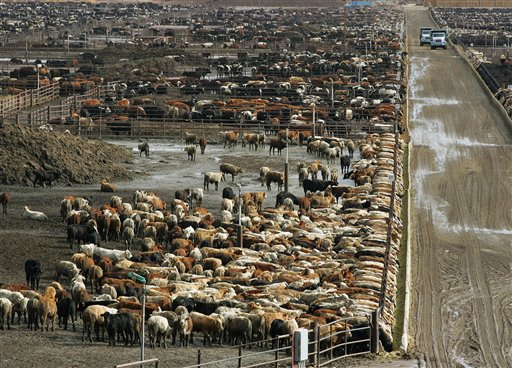
People as Livestock: The Cult of Fundamentalist Materialism and the Cheapening Life

Farm to Fork

I first encountered the term “Fundamentalist-Materialism” in the work of Robert Anton Wilson; it appears in several of his non-fiction works, including “The Cosmic Triggger” series. As far as I know R.A.W. was the originator of this philosophical designation.”

Is there any inherent value to an individual human life? 

By Dan Mage

Source: OpEdNews.com

Authoritarians of the left, libertarians of the right, objectivists, conservatives and even liberals and progressives fixated on “jobs” and “rehabilitation” of the socioeconomically dysfunctional give the answer “no; ” sometimes directly (as in the case of the Stalinist and the American conservative) and other times through actions, policies, and preferences (as in the case of elements of the “occupation” movement distancing themselves from “homeless bums,” “drug users,” and “ex-cons”).

Most of all, those with the power to set wages, prices, working conditions and societal expectation for those who have nothing left but their time and “docile bodies”*(Foucault) to sell, control and trade in human lives as commodities. While most of the supposedly civilized world frowns on chattel slavery (although a good bit of it goes on, especially in the sex trade, where prosecution of traffickers is the exception rather than the rule), the legal technicality of ownership is superfluous to the trade in human lives, time, labor, and in Reichian terms orgones.

What do Stalinism, objectivism, authoritarian capitalism, and global corporatism all have in common ? They are in my opinion fundamentalist-materialist cults that value the inanimate over the living, the concrete over the abstract and have effectively reduced the vast majority of the human race to livestock, or wild beasts to be hunted down, captured, contained, broken, or in the alternative, simply slaughtered and destroyed.

I have been told that it has always been thus, and perhaps in terms of humanity’s historical failings this is true. There is however no historical precedent for the establishment of a global value system through electronic multi-sensory media. Even the best efforts of the Catholic Church, Protestant missionaries and Islamic holy-warriors do not equal the technology and level of sophistication in the application of “industrial psychology.”

The message remains the same though, as it has been throughout history: “Obey or suffer.” Individual disobedience or even mere failure to “produce” in spite of the individual’s best efforts will result in stigmatization, marginalization, a degrading dependency on the state and, as state support for the economically disengaged is cut back and removed, starvation, homelessness and imprisonment; even the fact of homelessness is defined as a criminal offense by more local jurisdictions with each passing year.

The fact is that life is cheap; the idealistic visions of humanitarians are swept aside by those advocates of “austerity” and “tough choices,” whose calculations in service of usury on a global scale will determine the level of human suffering in each nation up to and including death by starvation, disease, and the inevitable outcome of manufactured scarcity, war.

The blurry and dim imagery of the concretes of suffering fades from vision in the glare of the deadly abstractions; political ideologies, religions, money that does not exist anywhere other than in the record keeping of the money lenders remains in clear focus. The conclusion returns stark, glaring and obvious: human life is a commodity, the value of which is consistently decreasing. The devaluation of an individual human life to a unit of production and consumption, which therefore can be discarded if determined to have no economic value, is all that is required for the machinery of mass exterminations and genocide to be set in motion.

Arguing about wages, prices, social systems and ways of arranging economies, even in cases where “progress” is made, will be useless. The dominance of the fundamentalist-materialist cults, as well as the authoritarian religions that create legitimacy for them in the eyes of the masses (and even Stalin, the ultimate fundamentalist-materialist, allowed for the return of religion as an adjunct of the state when he realized its value) will continue to crush and compress human life, until the perverted and inverted values themselves are overthrown, shattered, burned and buried.

When will the biocentric (life centered) ethos replace the thanatocentric (death centered) ethos as the dominant culture’s value system? I cannot answer even the “if” of this question, let alone the question itself. The fact that the power to collect interest on nonexistent money and the lifestyles that such usury on a global scale supports is presented, and apparently accepted, as an immutable law of nature rather than as an imposition of culture’s order on the true nature of humanity seems by way of this very acceptance to be a “natural law.” Images of vultures waiting for starving children to crawl to their deaths and mothers weeping over infants at the bottoms of pits do not move the master manipulators of numbers. If anything, only the fact that the die-offs are not more extensive is cause for lamentation.

Do we care anymore? I’m not speaking of our little “jobs” and “futures,” and relative degree of comfort/discomfort in oppression that seems to be everyone’s primary concern. I’m demanding of myself, of you and above all of those who have declared themselves to be “leaders;” what is it that matters to you? Do you feel anything at all? Can we set aside all calculations save for those needed to ease human suffering? The primary demand of all protests, occupations, strikes, boycotts and further actions of increasing effect and extremity will be “Life First!”

The life of one human being hanging on the edge of death, in suffering, is too high a price to pay, for all the glorious achievements of the fundamentalist-materialist cults, their leaders and their adherents. The cult of power, authority, war, and property as a weapon of coercion has, for all its trillions of dollars and stockpiled weapons of mass destruction, a single and fatal vulnerability; to function it depends on obedience. For obedience to be guaranteed, the “obey or suffer” directive must be enforceable. This directive is only enforceable if the doctrine of fundamentalist-materialism enjoys continued acceptance as a “fact of life,” rather than the monstrous fraud that it is.

*The term “docile bodies” is a chapter title in Michel Foucault’s “Discipline and Punish: The Birth of the Prison” 1977, Random House, NY, NY.