
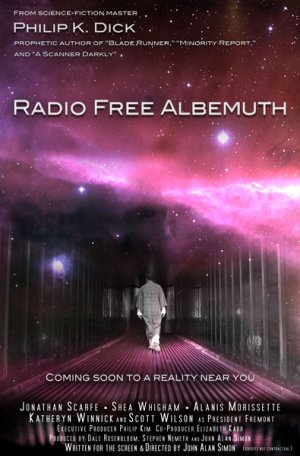
In light of Philip K. Dick’s birthday tomorrow (he would have been 90), it’s an appropriate time to visit (or revisit) the film adaptation of his posthumously published novel “Radio Free Albemuth”. Being a longtime PKD fan and one of the film’s Kickstarter contributors, I admittedly wouldn’t be a completely objective critic, but after having seen it a few times its achievements and shortcomings become more apparent.
Like the novel it’s based on, Radio Free Albemuth is one of the most personal of Philip K. Dick’s narratives, featuring the most faithful retelling of his 2-3-74 experiences. Filmed on a shoestring budget by John Alan Simon the movie has a fitting late 70s/early 80s aesthetic. Much of the dialogue is straight out of the novel but I personally would have wanted a more streamlined and nuanced script with less tangential details and exposition, though the actors across the board do a commendable job delivering their lines as naturally and believably as possible. The many dream sequences could have benefited from a higher budget and better visual consistency, but were able to accomplish what was needed for the plot. The prison scenes near the end seemed a bit rushed and not reflective of the oppressiveness of actual prisons, though that was probably largely due to budgetary reasons as well.
Despite its flaws, I still find the film engaging and worth recommending. Aspects of the story may come across to modern audiences as cheesy but still works on a meta level. In our sophisticated real life corporate techno-dystopia, the idea of individuals trying to incite revolution through subliminal messaging embedded in pop songs requires a suspension of disbelief. However in a more general general sense, countless creators through history (including writers and filmmakers) have made attempts to subvert society and culture with varying and impossible to quantify results.
Watch the full film on Hoopla here: https://www.hoopladigital.com/title/11350683


 After the Crash