

Still of Charlie Chaplin [b. April 16, 1889] from “Modern Times”
Source: CounterPunch
Acrobat, musician, composer, clown, mime, movie star, director and producer, Academy Award winner for lifetime achievement, but still driven from the United States for his backing of the Soviet Union, Charlie Chaplin should need little introduction, except perhaps for Millennials and other late alphabet generations. He was the global star in the crossover from silent films to talkies, making an astonishing $10,000 a week during the Depression, with $150,000 in signing bonuses. Knighted by the Queen, Charlot was universally loved and admired.
But is he relevant today beyond his reputation as a comic icon?
During a recent visit to the magnificent Manoir de Ban near Lausanne, Switzerland, which was his home from 1952 until his death in 1977 and now houses a museum in his honor, I was impressed how his films were political, and how they speak to today’s human rights agenda.
In 1954 Chaplin was awarded the International Peace Prize by the World Peace Council for his outstanding contribution to the cause of peace and friendship among nations. Who can forget his mocking of Hitler in The Dictator when he spins a globe and dances with the world at his fingertips?)
Two examples from his classics show how his films relate to human rights:
The 1921 production The Kid is the story of an unwed, down-and-out mother who abandons her child because she cannot afford to look after him. She places him in an expensive car with a note to the owner to take care of him. After some intrigue, a tramp, Charlie Chaplin, finds the boy and raises and loves him like his own, cementing the idea of the kindness of the fellow impoverished. The tramp and the kid work together against the moneyed class; the kid breaking windows and the tramp repairing them.
The kid is eventually taken away from the tramp by the authorities – border police separating children from their loved ones on the U.S. southern border? – to be returned to his mother. In the end, the kid, the tramp and the mother are re-united.
The Kid was chosen to be preserved in the Library of Congress’s National Film Registry in 2011. It was praised as “an artful melding of touching drama, social commentary and inventive comedy.” The social commentary is what today we would call human rights: the right to a decent life for the mother when she is poor; the right for the mother to have minimum support to raise her boy and not to have to abandon him; the right of the tramp to have a decent wage for his job so he would be able to live properly without having to use illegal means to earn a living; the right to have proper housing for the tramp and the kid; the right to have affordable medical care; the right for the boy to stay with the tramp instead of being sent to an orphanage.
All of these we would call basic social, economic and cultural rights. They are at the heart of Chaplin’s advocacy; they are what make the film so endearing and why we are so relieved when the tramp, kid and mother unite at the end to live happily together. According to Chaplin, and The Kid, there is justice in this world. The good guys overcome injustices and the cruel indifference of the rich with their expensive cars (a foreboding of the 1%?). Although the mother became a rich actress, she takes in the tramp to form a supportive family for the kid, re-uniting him with her son (without the son’s losing the support of the foster father who had raised him, a win-win situation that no family judge could have better decided).
And how does Modern Times, Chaplin’s critique of industrialization, relate to human rights and our modern times of numeric technology? The tramp in Modern Times is a factory worker slaving away on mechanical assembly line. Is this different from today’s information workers tied to their computer screens, forced to work at accelerated speeds as the information flow gets faster and faster, like the quickening assembly line? The hero suffers a nervous breakdown after which he is unemployed, again suffering from having no unemployment insurance or other benefits to carry him over. He is mistakenly arrested with no legal recourse but wishes to stay in jail since he has had no vocational training and is living better in jail than in the street.
The remainder of the film deals with his romance with a fellow hobo who is fleeing punishment because she stole a single loaf of bread (proportional justice?). The film recounts the couple’s various adventures to escape poverty and the desperation of those with no guaranteed income, no right to food or right to housing. Whenever authorities are presented, they are unsympathetic. The poor have no recourse to representation and are left to their own devices to survive. The police – the authorities – are constantly trying to arrest the downtrodden who must seek refuge outside the authoritative system. There is no hope for them within the system; they are left to their own devices in a world with no guaranteed rights.
There is little justice in Modern Times in terms of a happy ending where the heroes overcome injustices. At the end, there is only the love between Chaplin and Ellen. But in the film, as in The Kid, struggles of the underclass represent all the injustices that the 99% of the world today must endure. While economic inequality continues to grow, Chaplin’s films have an important lesson of the struggles of the disenfranchised if one can view the horrors of industrialization and the Depression in our modern context. When 26 individuals are worth as much as 50% of the world’s population, Chaplin’s comic/tragic hero is a pertinent reminder of what it means to live in poverty.
The Manoir de Ban is a beautiful domaine with a lovely park and spectacular view of Lake Geneva. Chaplin died a very rich man. His vision of and advocacy for the poor should remain his greatest legacy. A visit to his museum is a reminder of the schism between the haves and have nots and how a talented, rich genius was able to give such a profound representation of all those who couldn’t afford to live in Vevey and to have the human rights he and many of us enjoy.
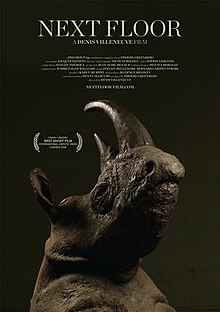
“Next Floor” (2008) is a Canadian short directed by Denis Villeneuve. The mostly wordless film depicts a decadent banquet attended by servers and valets, with eleven gluttonous guests endlessly engorging themselves until they reach a sudden limit to their apparent abundance.
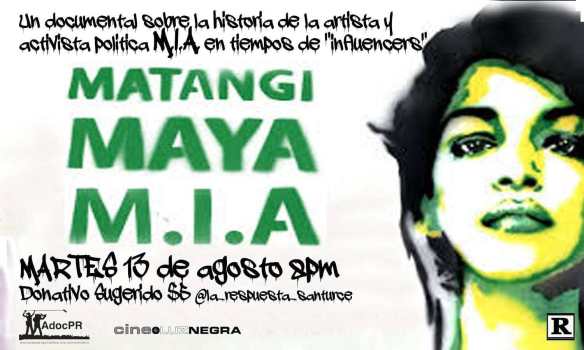
Synopsis from MIADocumentary.com
Drawn from a cache of personal video recordings from the past 22 years, director Steve Loveridge’s Sundance award winning MATANGI / MAYA / M.I.A. is a startlingly personal profile of the critically acclaimed artist, chronicling her remarkable journey from refugee immigrant to pop star.
She began as Matangi. Daughter of the founder of Sri Lanka’s armed Tamil resistance, she hid from the government in the face of a vicious and bloody civil war. When her family fled to the UK, she became Maya, a precocious and creative immigrant teenager in London. Finally, the world met her as M.I.A. when she emerged on the global stage, having created a mashup, cut-and-paste identity that pulled from every corner of her journey along the way; a sonic sketchbook that blended Tamil politics, art school punk, hip-hop beats and the unwavering, ultra-confident voice of a burgeoning multicultural youth.
Never one to compromise on her vision, Maya kept her camera rolling throughout. MATANGI / MAYA / M.I.A. provides unparalleled, intimate access to the artist in her battles with the music industry and mainstream media as her success and fame explodes, becoming one of the most recognizable, outspoken and provocative voices in music today.
Watch the full film on Kanopy here: https://www.kanopy.com/product/matangi-maya-mia-0

By John Cottingham
Source: aeon
What is the point of gaining the whole world if you lose your soul? Today, far fewer people are likely to catch the scriptural echoes of this question than would have been the case 50 years ago. But the question retains its urgency. We might not quite know what we mean by the soul any more, but intuitively we grasp what is meant by the loss in question – the kind of moral disorientation and collapse where what is true and good slips from sight, and we find we have wasted our lives on some specious gain that is ultimately worthless.
It used to be thought that science and technology would gain us the world. But it now looks as though they are allowing us to destroy it. The fault lies not with scientific knowledge itself, which is among humanity’s finest achievements, but with our greed and short-sightedness in exploiting that knowledge. There’s a real danger we might end up with the worst of all possible scenarios – we’ve lost the world, and lost our souls as well.
But what is the soul? The modern scientific impulse is to dispense with supposedly occult or ‘spooky’ notions such as souls and spirits, and to understand ourselves instead as wholly and completely part of the natural world, existing and operating through the same physical, chemical and biological processes that we find anywhere else in the environment.
We need not deny the value of the scientific perspective. But there are many aspects of human experience that cannot adequately be captured in the impersonal, quantitatively based terminology of scientific enquiry. The concept of the soul might not be part of the language of science; but we immediately recognise and respond to what is meant in poetry, novels and ordinary speech, when the term ‘soul’ is used in that it alerts us to certain powerful and transformative experiences that give meaning to our lives. Such experiences include the joy that arises from loving another human being, or the exaltation when we surrender to the beauty of a great artistic or musical work, or, as in William Wordsworth’s poem ‘Tintern Abbey’ (1798), the ‘serene and blessed mood’ where we feel at one with the natural world around us.
Such precious experiences depend on certain characteristic human sensibilities that we would not wish to lose at any price. In using the term ‘soul’ to refer to them, we don’t have to think of ourselves as ghostly immaterial substances. We can think of ‘soul’ as referring, instead, to a set of attributes – of cognition, feeling and reflective awareness – that might depend on the biological processes that underpin them, and yet enable us to enter a world of meaning and value that transcends our biological nature.
Entering this world requires distinctively human qualities of thought and rationality. But we’re not abstract intellects, detached from the physical world, contemplating it and manipulating it from a distance. To realise what makes us most fully human, we need to pay attention to the richness and depth of the emotional responses that connect us to the world. Bringing our emotional lives into harmony with our rationally chosen goals and projects is a vital part of the healing and integration of the human soul.
In his richly evocative book The Hungry Soul (1994), the American author Leon Kass argues that all our human activities, even seemingly mundane ones, such as gathering around a table to eat, can play their part in the overall ‘perfecting of our nature’. In the more recent book Places of the Soul (3rd ed, 2014), the ecologically minded architect Christopher Day speaks of the need for humans to live, and to design and build their dwellings, in ways that harmonise with the shapes and rhythms of the natural world, providing nourishment for our deepest needs and longings.
The language of ‘soul’ found here and in many other contexts, ancient and modern, speaks ultimately of the human longing for transcendence. The object of this yearning is not well-captured in the abstract language of theological doctrine or philosophical theory. It is best approached through praxis, or how that theory is enacted. Traditional spiritual practices – the often simple acts of devotion and commitment found in rites of passage marking the birth or death of a loved one, say, or such rituals as the giving and receiving of rings – provide a powerful vehicle for the expression of such longings. Part of their power and resonance is that they operate on many levels, reaching deeper layers of moral, emotional and spiritual response than can be accessed by the intellect alone.
The search for ways to express the longing for a deeper meaning in our lives seems to be an ineradicable part of our nature, whether we identify as religious believers or not. If we were content to structure our lives wholly within a fixed and unquestioned set of parameters, we would cease to be truly human. There is something within us that is always reaching forward, that refuses to rest content with the utilitarian routines of our daily existence, and yearns for something not yet achieved that will bring healing and completion.
Not least, the idea of the soul is bound up with our search for identity or selfhood. The French philosopher René Descartes, writing in 1637, spoke of ‘this me, that is to say the soul by which I am what I am’. He went on to argue that this soul is something entirely nonphysical, but there are now very few people, given our modern knowledge of the brain and its workings, who would wish to follow him here. But even if we reject Descartes’s immaterialist account of the soul, each of us retains a strong sense of ‘this me’, this self that makes me what I am. We are all engaged in the task of trying to understand the ‘soul’ in this sense.
But this core self that we seek to understand, and whose growth and maturity we seek to foster in ourselves and encourage in others, is not a static or closed phenomenon. Each of us is on a journey, to grow and to learn, and to reach towards the best that we can become. So the terminology of ‘soul’ is not just descriptive, but is what philosophers sometimes call ‘normative’: using the language of ‘soul’ alerts us not just to the way we happen to be at present, but to the better selves we have it in our power to become.
To say we have a soul is partly to say that we humans, despite all our flaws, are fundamentally oriented towards the good. We yearn to rise above the waste and futility that can so easily drag us down and, in the transformative human experiences and practices we call ‘spiritual’, we glimpse something of transcendent value and importance that draws us forward. In responding to this call, we aim to realise our true selves, the selves we were meant to be. This is what the search for the soul amounts to; and it is here, if there is a meaning to human life, that such meaning must be sought.
INDIAN COUNTRY NEWS
"It is the duty of every man, as far as his ability extends, to detect and expose delusion and error"..Thomas Paine
Human in Algorithms
From the Roof Top
I See This
blog of the post capitalist transition.. Read or download the novel here + latest relevant posts
अध्ययन-अनुसन्धानको सार
 After the Crash