Saturday Matinee: Kingpin

Why I love Kingpin – A crude comedy about horrible people

The Farrelly brothers’ reached their vulgar, freewheeling peak with this 1996 bowling comedy.

By James Oddy

Source: Single White Lies

Irecently bombed a job interview that seemed a sure thing. It was a job I wanted and, even worse, a job I needed. I got the rejection call, then I missed my bus and had to wait in the rain. Then I lost my wallet. I felt like a real Munson. A born loser. Give me a wide berth.

So I went home and (re)watched the Farrelly brothers’ 1996 film Kingpin. I know what you’re thinking, it’s not the most obvious candidate for a feel good film. Actually, it may be one of the scuzziest films ever produced by a major studio. For the uninitiated, it tells the story of former “man-child” bowling prodigy Roy Munson (Woody Harrelson). An alcoholic, and devoid of his bowling hand after an unfortunate incident involving nemesis Ernie “Big Ern” McCraken (Bill Murray), Munson believes he’s found his ticket out of poverty with Ishmael (Randy Quaid), an Amish man hailing from rural Pennsylvania.

Subtlety isn’t this film’s strong point – most of the jokes concern some bodily function or another, or slapstick violence involving someone’s testicles, sometimes at the same time. What really sets it apart from other ’90s gross out comedies is how genuinely nasty the characters are. At the time of its release many critics, even the ones that liked it, described it as tasteless, vulgar and crude. In one of his most underrated performances, Harrelson is simply hilarious as the stupid, lazy and self-serving Munson.

Meanwhile, Bill Murray ad-libs almost every time he is on screen, giving a masterclass in smart arse performance as the womanising sleaze ball Ernie. Farrelly bros’ regular Rob Moran somehow manages to be even more unpleasant as a domestically abusive “bowling enthusiast” and sometime gangster called Stanley. Vanessa Angel’s Claudia is a born grifter and a bowling groupie. Even Ishmael is all too eager to abandon his Amish ways to enjoy the earthly pleasures of coffee and cigarettes. Along with a colourful supporting cast, this is one of the most glorious collections of freaks and weirdoes you’re ever likely to see on screen.

Kingpin also has a refreshing, freewheeling approach to genre. It’s a romantic comedy, a clash of cultures played for laughs, a buddy movie, a road movie and a underdog sports story all rolled into one 113-minute caper. It should also be noted that this is very much a film for adults, with explicitly adult themes. Yet it’s undercut with the universal message that, just maybe, everything will be okay in the end.

Ultimately, this is a story of redemption. A film that says you can always turn things around, that it’s always worth persevering. The 1990s and early 2000s saw a rise in “adult genres”, allowing filmmakers to take greater risks on mid-sized studio films. Kingpin is one of the finest examples of that trend, a film in which nobody involved is particularly interested in focus groups or target markets. It is what it is, warts and all.

After Kingpin, the Farrelly brothers began to scale back the sleaze, retreating to the safer shores of more formulaic rom-coms like There’s Something About Mary and Shallow Hal. But we’ll always have Munson to remind us that you never know when an Amish bowling prodigy might walk into your life and change everything.

George Orwell’s 1984 Has Become a Blueprint for Our Dystopian Reality

By John W. Whitehead & Nisha Whitehead

Source: The Rutherford Institute

“If you want a picture of the future, imagine a boot stamping on a human face—for ever.” George Orwell, 1984

Tread cautiously: the fiction of George Orwell (Jun. 25, 1903-Jan. 21, 1950) has become an operation manual for the omnipresent, modern-day surveillance state.

It’s been more than 70 years since Orwell—dying, beset by fever and bloody coughing fits, and driven to warn against the rise of a society in which rampant abuse of power and mass manipulation are the norm—depicted the ominous rise of ubiquitous technology, fascism and totalitarianism in 1984.

Who could have predicted that so many years after Orwell typed the final words to his dystopian novel, “He loved Big Brother,” we would come to love Big Brother.

“To the future or to the past, to a time when thought is free, when men are different from one another and do not live alone— to a time when truth exists and what is done cannot be undone: From the age of uniformity, from the age of solitude, from the age of Big Brother, from the age of doublethink — greetings!”—George Orwell

1984 portrays a global society of total control in which people are not allowed to have thoughts that in any way disagree with the corporate state. There is no personal freedom, and advanced technology has become the driving force behind a surveillance-driven society. Snitches and cameras are everywhere. People are subject to the Thought Police, who deal with anyone guilty of thought crimes. The government, or “Party,” is headed by Big Brother who appears on posters everywhere with the words: “Big Brother is watching you.”

We have arrived, way ahead of schedule, into the dystopian future dreamed up by not only Orwell but also such fiction writers as Aldous Huxley, Margaret Atwood and Philip K. Dick.

“If liberty means anything at all, it means the right to tell people what they do not want to hear.”―George Orwell

Much like Orwell’s Big Brother in 1984, the government and its corporate spies now watch our every move. Much like Huxley’s A Brave New World, we are churning out a society of watchers who “have their liberties taken away from them, but … rather enjoy it, because they [are] distracted from any desire to rebel by propaganda or brainwashing.” Much like Atwood’s The Handmaid’s Tale, the populace is now taught to “know their place and their duties, to understand that they have no real rights but will be protected up to a point if they conform, and to think so poorly of themselves that they will accept their assigned fate and not rebel or run away.”

And in keeping with Philip K. Dick’s darkly prophetic vision of a dystopian police state—which became the basis for Steven Spielberg’s futuristic thriller Minority Report—we are now trapped in a world in which the government is all-seeing, all-knowing and all-powerful, and if you dare to step out of line, dark-clad police SWAT teams and pre-crime units will crack a few skulls to bring the populace under control.

What once seemed futuristic no longer occupies the realm of science fiction.

Incredibly, as the various nascent technologies employed and shared by the government and corporations alike—facial recognition, iris scanners, massive databases, behavior prediction software, and so on—are incorporated into a complex, interwoven cyber network aimed at tracking our movements, predicting our thoughts and controlling our behavior, the dystopian visions of past writers is fast becoming our reality.

Our world is characterized by widespread surveillance, behavior prediction technologies, data mining, fusion centers, driverless cars, voice-controlled homes, facial recognition systems, cybugs and drones, and predictive policing (pre-crime) aimed at capturing would-be criminals before they can do any damage.

Surveillance cameras are everywhere. Government agents listen in on our telephone calls and read our emails. Political correctness—a philosophy that discourages diversity—has become a guiding principle of modern society.

“People sleep peaceably in their beds at night only because rough men stand ready to do violence on their behalf.”―George Orwell

The courts have shredded the Fourth Amendment’s protections against unreasonable searches and seizures. In fact, SWAT teams battering down doors without search warrants and FBI agents acting as a secret police that investigate dissenting citizens are common occurrences in contemporary America. And bodily privacy and integrity have been utterly eviscerated by a prevailing view that Americans have no rights over what happens to their bodies during an encounter with government officials, who are allowed to search, seize, strip, scan, spy on, probe, pat down, taser, and arrest any individual at any time and for the slightest provocation.

“The creatures outside looked from pig to man, and from man to pig, and from pig to man again; but already it was impossible to say which was which.”―George Orwell, Animal Farm

We are increasingly ruled by multi-corporations wedded to the police state.

What many fail to realize is that the government is not operating alone. It cannot. The government requires an accomplice. Thus, the increasingly complex security needs of the massive federal government, especially in the areas of defense, surveillance and data management, have been met within the corporate sector, which has shown itself to be a powerful ally that both depends on and feeds the growth of governmental overreach.

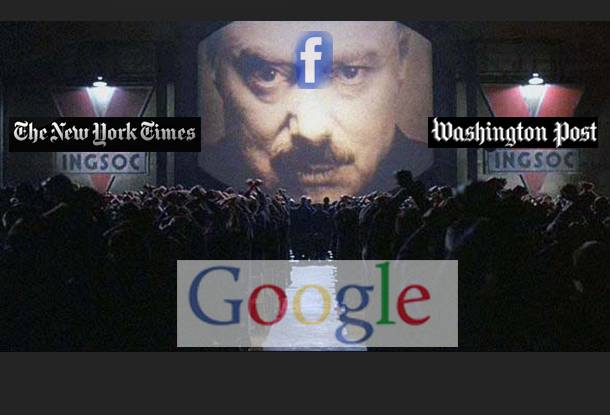
In fact, Big Tech wedded to Big Government has become Big Brother, and we are now ruled by the Corporate Elite whose tentacles have spread worldwide. The government now has at its disposal technological arsenals so sophisticated and invasive as to render any constitutional protections null and void. Spearheaded by the NSA, which has shown itself to care little to nothing for constitutional limits or privacy, the “security/industrial complex”—a marriage of government, military and corporate interests aimed at keeping Americans under constant surveillance—has come to dominate the government and our lives.

Money, power, control. There is no shortage of motives fueling the convergence of mega-corporations and government. But who is paying the price? The American people, of course.

Orwell understood what many Americans are still struggling to come to terms with: that there is no such thing as a government organized for the good of the people. Even the best intentions among those in government inevitably give way to the desire to maintain power and control over the citizenry at all costs.

“The further a society drifts from truth the more it will hate those who speak it.” ― George Orwell

Even our ability to speak and think freely is being regulated.

In totalitarian regimes—a.k.a. police states—where conformity and compliance are enforced at the end of a loaded gun, the government dictates what words can and cannot be used. In countries where the police state hides behind a benevolent mask and disguises itself as tolerance, the citizens censor themselves, policing their words and thoughts to conform to the dictates of the mass mind.

Dystopian literature shows what happens when the populace is transformed into mindless automatons.

In Ray Bradbury’s Fahrenheit 451, reading is banned and books are burned in order to suppress dissenting ideas, while televised entertainment is used to anesthetize the populace and render them easily pacified, distracted and controlled.

In Huxley’s Brave New World, serious literature, scientific thinking and experimentation are banned as subversive, while critical thinking is discouraged through the use of conditioning, social taboos and inferior education. Likewise, expressions of individuality, independence and morality are viewed as vulgar and abnormal.

In my debut novel The Erik Blair Diaries, the dystopian future that George Orwell predicted for 1984 has finally arrived, 100 years late and ten times as brutal. In this post-apocalyptic world where everyone marches to the beat of the same drummer and words like “freedom” are taboo, Erik Blair—Orwell’s descendant and unwitting heir to his legacy—isn’t volunteering to be anyone’s hero. Unfortunately, life doesn’t always go according to plan. To save all that he loves, Orwell will have to travel between his future self and the past.

And in Orwell’s 1984, Big Brother does away with all undesirable and unnecessary words and meanings, even going so far as to routinely rewrite history and punish “thoughtcrimes.” Orwell’s Big Brother relies on Newspeak to eliminate undesirable words, strip such words as remained of unorthodox meanings and make independent, non-government-approved thought altogether unnecessary.

Where we stand now is at the juncture of OldSpeak (where words have meanings, and ideas can be dangerous) and Newspeak (where only that which is “safe” and “accepted” by the majority is permitted). The power elite has made their intentions clear: they will pursue and prosecute any and all words, thoughts and expressions that challenge their authority.

This is the final link in the police state chain.

“Until they became conscious they will never rebel, and until after they have rebelled they cannot become conscious.”—George Orwell

Having been reduced to a cowering citizenry—mute in the face of elected officials who refuse to represent us, helpless in the face of police brutality, powerless in the face of militarized tactics and technology that treat us like enemy combatants on a battlefield, and naked in the face of government surveillance that sees and hears all—we have nowhere left to go.

We have, so to speak, gone from being a nation where privacy is king to one where nothing is safe from the prying eyes of government.

“Big Brother is Watching You.”―George Orwell

Wherever you go and whatever you do, you are now being watched, especially if you leave behind an electronic footprint. When you use your cell phone, you leave a record of when the call was placed, who you called, how long it lasted and even where you were at the time. When you use your ATM card, you leave a record of where and when you used the card. There is even a video camera at most locations equipped with facial recognition software. When you use a cell phone or drive a car enabled with GPS, you can be tracked by satellite. Such information is shared with government agents, including local police. And all of this once-private information about your consumer habits, your whereabouts and your activities is now being fed to the government.

The government has nearly inexhaustible resources when it comes to tracking our movements, from electronic wiretapping devices, traffic cameras and biometrics to radio-frequency identification cards, satellites and Internet surveillance.

In such a climate, everyone is a suspect. And you’re guilty until you can prove yourself innocent. To underscore this shift in how the government now views its citizens, the FBI uses its wide-ranging authority to investigate individuals or groups, regardless of whether they are suspected of criminal activity. 

“Nothing was your own except the few cubic centimetres inside your skull.” ― George Orwell

Here’s what a lot of people fail to understand, however: it’s not just what you say or do that is being monitored, but how you think that is being tracked and targeted. We’ve already seen this play out on the state and federal level with hate crime legislation that cracks down on so-called “hateful” thoughts and expression, encourages self-censoring and reduces free debate on various subject matter. 

Say hello to the new Thought Police.

Total Internet surveillance by the Corporate State, as omnipresent as God, is used by the government to predict and, more importantly, control the populace, and it’s not as far-fetched as you might think. For example, the NSA has been working on an artificial intelligence system designed to anticipate your every move. Aquaint (the acronym stands for Advanced QUestion Answering for INTelligence) has been designed to detect patterns and predict behavior.

No information is sacred or spared.

Everything from cell phone recordings and logs, to emails, to text messages, to personal information posted on social networking sites, to credit card statements, to library circulation records, to credit card histories, etc., is collected by the NSA and shared freely with its agents in crime: the CIA, FBI and DHS.

What we are witnessing, in the so-called name of security and efficiency, is the creation of a new class system comprised of the watched (average Americans such as you and me) and the watchers (government bureaucrats, technicians and private corporations).

Clearly, the age of privacy in America is at an end.

So where does that leave us?

We now find ourselves in the unenviable position of being monitored, managed and controlled by our technology, which answers not to us but to our government and corporate rulers. This is the fact-is-stranger-than-fiction lesson that is being pounded into us on a daily basis.

It won’t be long before we find ourselves looking back on the past with longing, back to an age where we could speak to whom we wanted, buy what we wanted, think what we wanted without those thoughts, words and activities being tracked, processed and stored by corporate giants such as Google, sold to government agencies such as the NSA and CIA, and used against us by militarized police with their army of futuristic technologies.

To be an individual today, to not conform, to have even a shred of privacy, and to live beyond the reach of the government’s roaming eyes and technological spies, one must not only be a rebel but rebel.

Even when you rebel and take your stand, there is rarely a happy ending awaiting you. You are rendered an outlaw. Just look at what happened to Julian Assange.

So how do you survive in the American surveillance state?

We’re running out of options.

Whether you’re dealing with fact or fiction, as I make clear in Battlefield America: The War on the American People and in my new novel The Erik Blair Diaries, we’ll soon have to choose between self-indulgence (the bread-and-circus distractions offered up by the news media, politicians, sports conglomerates, entertainment industry, etc.) and self-preservation in the form of renewed vigilance about threats to our freedoms and active engagement in self-governance.

Saturday Matinee: Split!

Fractal Accidents: Attachment and Agency in Chris Shaw’s ‘Split’

By Jonathan Lukens

Source: We Are the Mutants

As a young man, I felt that most people conceived of memory differently than I did, believing that failures of memory were errors of playback more than of recording. This idea, that memory works like a vinyl record in which everything we experience has its groove, supposes that it’s just a matter of knowing precisely where to put the needle down to replay the experience. In contrast, my younger self operated with the also erroneous belief that our memories are only hazy recordings of what we have somehow deemed worthy of recalling—that memory is like finding old semi-legible notes to ourselves written in an old notebook and trying to  figure out what they mean.

It was with this theory of memory in mind that I had begun to consider Split, a movie that I thought I remembered renting from a video store up the street from my childhood home sometime around 1990. For over a decade, my occasional recollections of the film, often spaced years apart, might prompt a web search with no results, which would then introduce a sense of disorientation: I could not experience the instant gratification of finding some online mention that might confirm that what I remembered was real. Was Split (that was the name, right?) just an Easter Egg written into the script of my past—some sort of Berenstain (sic?) Bears thing? After all, and with all due respect to the films’ creators: if my adolescent mind was going to fabricate a memory, this is the sort of thing it would have come up with. 

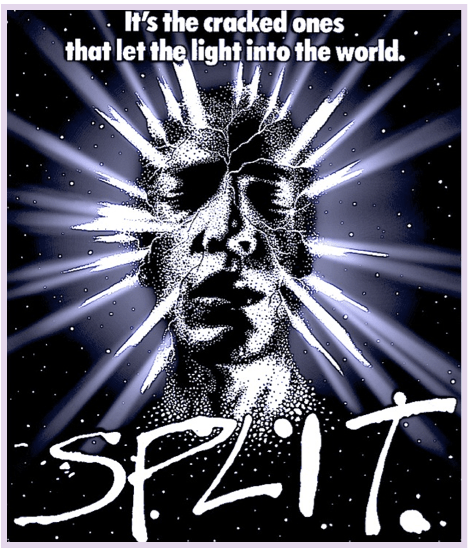
Originally released theatrically in 1989, and subsequently on VHS in 1991 by Futura Home Video, Split was reissued on DVD in 2018 by Verboden Video and is also available through Alamo Drafthouse’s streaming app, which is how I was able to confirm its existence and watch it again. Spoilers of the film follow, but only insofar as my synopsis is veridical to the plot—a nested disclaimer I wouldn’t need to make if the film were less fractured. Whether its cracked mirror nature is a deliberate mindfuck, the result of freshman filmmaking hamfistedness, or both, is not something I can tell you. 

The film opens with Starker, our hero, wandering the streets of San Francisco. His ripped jeans show his bare rear end, and he’s wearing the sort of jagged and discolored false teeth that might have been advertised in old comic books alongside fake vomit and squirting flowers. He walks through a parking lot full of city buses, suddenly looking directly at the camera and yelling, “Stop following me. Leave me alone.” At first, we believe he is addressing us, the viewers, and breaking the fourth wall, but the camera cuts to two men dressed in a mid-‘80s Ivy League casual style—like they just walked out of a JC Penny catalog shoot. One sits at a computer; the other, older and mustachioed, is framed over his right shoulder. The younger man was surveilling Starker, and, as the dialogue reveals, the populace more broadly. He rewinds a recording of Starker’s camera-facing monologue and consults with the older agent, who says Starker is just crazy, but capitulates to the younger agent’s desire for further observation.

They run a face recognition program, presented as a musical montage, in which we see Starker’s head rendered as a 3D model as the camera hops around a black and white grid of similar hairless heads looking for a match. The sequence is still enthralling and somewhat hypnotic after 30 years. This isn’t a real 3D scan of a human head; rather it’s a painstakingly created proof of concept showing us what the technology that would soon become ubiquitous might look like. It dances. We hear pitch-shifted human voices of the sort we might associate with Laurie Anderson’s “O Superman,” and they create a synthetic and escalating harmonic pattern as the facial recognition nears completion.

This is the first of a few similarly rendered and soundtracked scenes that make Split worth more attention than it will ever receive. Analog processes are used to pre-mediate future digital operations, and there is a lo-fi poetry to them. These skies are the color of the ancestors of our flat-screen TVs, their saturations and frequency roll-off the stuff of a time when there really were dead channels, and tuned-in heads bobbed to the tangible yet barely audible click that the phone made just before it rang. Different media have different dispositions, and I explain these in the hope of being descriptive, while mindful of any argument about the veracity of concepts of authenticity.

Jittering a bit and mumbling, Starker heads into a diner and has a seat at a booth. He orders coffee from a waitress we’ll meet again later while speaking in a hybrid of fake European accents. Making a mess while examining a ketchup bottle, then pouring a packet of artificial sweetener onto the table and snorting it up his nose like cocaine, he talks to himself as the surrounding patrons begin to grow nervous. One of them gets up, takes him by the shoulder and leads him outside. At one point the camera lingers for a moment—letting us know that a brightly colored fabric pouch that Starker has left behind means something. 

As the film progresses, we watch Starker give the agents surveilling him the slip. After being knocked out and having his jacket tagged with a tracking device, he discovers the device, removes his jacket, and changes clothes to elude his pursuers. To illustrate the process of his being tracked we are treated to a primitive color representation of a 3D vector map of the city. It’s like an isomorphic video game built of an extruded and pastel colored De Stijl painting that says, “Welcome to the control society. Now you’re playing with power.” The whole sequence provides a taste of the ‘90s to come, bringing to mind critiques of the automatic production of space and tactical media projects like the Institute for Applied Autonomy’s iSee and the performances of the Surveillance Camera Players.

Starker retrieves the brightly colored fabric pouch from the trash outside the diner. He dons a new—and more ridiculous—disguise: a stick-on mustache and goatee paired with wire-rimmed glasses, a brown turtleneck, and a beige corduroy sports coat. Setting the scene for an art gallery opening, a lovingly blocked shot of Starker creates the sort of recursion we would associate with a Magritte or Escher through a row of champagne flutes. The camera lingers over a series of paintings reminiscent of Basil Wolverton’s or Erol Otus’s more psychedelic work. Gallery patrons talk trash about the paintings and each other while Starker shoves food in his pockets—John Belushi in Animal House style—as a lovely minimal synth piece by Robert Shaw, the director’s brother and creator of the computer generated effects seen through the film, begins to warble and flutter.

Conversing with the fictional creator of these paintings (in reality those of writer/director Chris Shaw himself), a flat-topped New Waver wearing a mustard yellow dinner jacket over a t-shirt, our ludicrously costumed hero mentions preparing to “wake people up.” As they discuss the artwork hanging on the gallery walls, they stop to look at a storyboard—which we realize is the storyboard of the current scene. As the artist begins to realize the same truth, he becomes enraged. He screams, but none of the patrons seem to notice or care.

The film meanders for a while, if it was not already meandering. We see the junior and senior agents discuss an analysis that reveals no discernible patterns in Starker’s behavior, and they escalate their attempts to find him. Now at the artist’s apartment after the art opening, Starker is coaxed into revealing his plan: “All we have to do is change the program!” he says, later addressing the painter’s skepticism with, “I have the way. The way is here—in my package!” Removing the pouch from an inside coat pocket, Starker then opens it to reveal a white plastic disc approximately the size of his hand. The artist remarks that it resembles a urinal deodorizer.

Starker goes on a tear: “Science is a jealous god.” The mystical “separates us from robots.” “What I am holding is a mutant biological organism.” He almost immediately contradicts himself and says the substance is just a placebo because people require a scientific reason to believe in something and that that is necessary for “the dream” to have power. He explains that he is going to dose the city’s water supply with this substance and then it will spread around the world as people excrete it through their urine. Sort of an Amanita muscaria re-trip meets infrastructural schwerpunkt: The MacGuffin is Elan Vital as urinal cake.

A few meaning-laden but plot-insignificant scenes later, Starker heads back to the diner. After a scuffle in which he startles Susan (the waitress we saw earlier) and she kicks him to the ground, he pressures her to let him hide out at her place. Reasonably viewing him as a crazy and potentially dangerous creep, she declines his offer. But, after following her to her car, he convinces her to relent by claiming that he used to be a veterinarian and that he may be able to explain the lethargy of the cat in a carrier in her back seat. The absurdity of this caged animal suddenly appearing to move the plot along is rendered even more absurd when Susan later explains that she already understood that the cat was lethargic because she had had it sterilized earlier in the day. There is something so metaphorically overt about this detail that I can’t tell if it’s a bad joke or a catastrophic mistake. In any event, Starker seems no less concerned about going home with a woman that left a post-op feline in the back of a car all day than Susan is about bringing home a man who claimed he was being followed and sat in her place of business snorting Sweet and Low through a straw while ranting in a fake French accent.

I will omit a lot of interpersonal awkwardness, strange dialogue, and things that may be significant to alternate interpretations in revealing that Starker crashes at Susan’s place (Pop Tarts and chill). The time they spend together only serves to make her subsequent death at the hands of the Starker’s pursuers insufficiently tragic to motivate his subsequent attempt at revenge. Discovering her murder at the hands of the Izod-clad archons, Starker—now in drag and blackface—follows the agents back to their bosses’ HQ. They enter through a large circular metal door, and Starker, who they don’t realize is following behind, is unable to enter.

Their boss, perhaps too obviously referred to as the “Agency Director” in a film about agency panic, laments his “monstrous” newly installed cybernetic arm. In an abrupt spasm of the plot that seems to indicate that the Director’s body is deteriorating, a lab-coated flunky soothes him by explaining that he has created that ultimate mad-scientist expression of mind-body dualism: a machine that can transfer a mind into another body. The camera cuts to Starker, unseen on the Agency Director’s CCTV, who is loading a pistol. He tries to find a way to open the door while the minions inside hurry to find a body to receive the Agency Director’s mind. The agents open the door and grab Starker, having seemingly no idea that they have apprehended the very person they were relentlessly pursuing earlier. Starker drops his gun in the struggle, and they strap him to a chair and lower a brain transfer apparatus over his head.

“Let me out! It worked!” Starker says, but it’s not clear if the process was successful or if Starker is trying to convince the agents that it was. We’re left to wonder if this Camp Concentration-style mind transfer worked at all. It’s set up as a techgnostic climax that never happens, as if this cyberpunk yacht rock anthem makes it to the guitar solo just as the amp blows. The enraged Agency Director yells and tells his minions to get rid of “her.” They throw Starker out, not seeming to care that this random person just entered their secret bunker, and still not realizing that it was Starker himself. 

The final quarter of the film involves agents pursuing Starker while the Agency Director’s body is gradually replaced with a mechanical one. The music is great here and evokes both a sort of period instrumental soft rock call-center hold music and early Chrome. Someone with disposable income should release a proper soundtrack.

Now looking like a lo-fi Robocop or a reject from a Shinya Tsukamoto film, the Agency Director’s cybernetic augmentations (or too on-the-nose self-amputations) have endowed him with new powers. He accesses satellites while issuing abrasively vocoded directives that also appear on a camera-facing screen, perhaps to ensure intelligibility to the audience. Starker’s location is revealed on a map as crescendoing lo-bit sound effects accompany synth pads and drums. “Eradicate!” The Agency Director yells in a Davros-like moment. The camera cuts to Starker hopping over fences and traversing a roadside embankment, while the Agency Director seems to glitch out as he installs one last bionic eye into his head. 

Now fully metal-skinned and ambulatory, he walks over to a pool of water inside headquarters. Elsewhere in a meadow, Starker stumbles into a pool himself, grabbing the white disc he revealed earlier. Somehow, both pools have become a sort of fold in space—the Agency Director reaches through and grabs Starker. They struggle, each remaining primarily in their own physical location while their arms bend through each others’ space. Starker breaks free and releases the chemical in the white disc. White dust floats in the air.

The end credits roll (well, melt, actually) and no further explanation is given.

***

Ultimately, outside of the beauty of the graphics and soundtrack, the joy and frustration of Split is that we are confronted with something that we can’t quite classify. Foregrounds and backgrounds of plot and image oscillate and change places, but so do the cues we’d typically use to determine whether or not we approached the material as comic or tragic, accidental or deliberate, high brow or trash stratum.

Watching Split (had I really seen it before?) left me with the distinct feeling that I just missed five minutes of it without leaving my seat. Shaw never really makes it clear what we should focus on, and the director’s commentary on the DVD doesn’t provide much help. There Shaw describes the film as “a dream that doesn’t really explain itself.” He does, however, talk a bit about chaos—not just disorder, but the branch of mathematics we might associate with Lorenz, Mandelbrot, the butterfly effect, and fractals. While history might provide examples of minor perturbations in complex systems causing them to collapse or toggle into alternate states, it seems here that chaos is really just used as a sort of “magic” (in the same way that “science” is used in superhero comics) to attempt to explain how Starker has a capacity for action that exceeds that of the archons that surveil him.

Really thinking about agency as contingent and distributed means something quite different and perhaps far more unsettling. I’d like to tell you that Split reveals a negotiation between ideas of cowboy individualism on one end, and on the other an appreciation of the behavior of complex adaptive systems of which human “individuals” are both composed of and parts of. In reality, the film presents 20th century ideas of autonomy and individuality taken to such an extreme that they become a bit goofy. The film presents an inverse relationship between attachment and individuality. Take, for example, this dialogue between the two primary agents who discover and begin tracking Starker, in which the frustrated junior agent asks:

How can he make it? We all have something: our family, our friends, something, but he… he gets by on nothing. How can he be that free? No human needs, no weaknesses, no feelings, nothing.

As they discuss their pending report to the Agency Director, the senior agent explains that they will just have to tell it like it is:

       No recurrent behavior, no attachments, no soft spots: superman.

So, the superman, the “free” man, is the man who cares about no one and has no routine. Attachment to others is presented in the same way that an ascetic might present an attachment to material things, but also as a commodity that the system of surveillance capitalism depicted in the film exploits. In the world of Split, one can either be “free” and thus detached from social forces one can’t actually detach from, or part of some sort of winkingly self-aware Matrix.

Many of the characters, including Susan, the painter, some street crazies, and the pursuing agents, seem to have some awareness that by participating in society they are being had. It’s as if they are wearing the glasses from They Live (1988) but realize that if they call attention to their alien overlords they will just be ignored anyway.

Shaw’s broader argument seems to be that as an “individual” who is truly “free,” Starker exists without a data-body; he’s an Übermensch who cannot be profiled or reduced to his so-called statistical self. As such, Starker stands outside of culture—the infrastructure of shared social and material substrates that both the one and the many call upon to act. But he still has the magic urinal cake, the fulcrum and lever by which he is super empowered.

Like a bad haircut, dosing the water supply with mutagenic hallucinogens seems cool in high school, when we are naive enough to dream that control is simply a matter of centralization and that shocking the dupes out of their somnambulism is something they will high five us for afterwards. But while portrayed as some sort of systems-disrupting black swan herald of a “new age,” maybe Starker—and the film itself—just represents a dance around the collapse of any sort of shared systems of meaning. After all, at the climactic moment when Starker releases the mutagen, the end credits roll. Were not shown what comes next—just the end of the now.  

Saturday Matinee: Shadow Puppets

“Shadow Puppets” (1994) is black and white animated dystopian short by Chuck Gamble and was featured at the Human Rights Watch Film Festival. The at times bleak and hopeful story depicts a button-pushing drone’s existence in a totalitarian world where his only escape is through making shadow puppets with his hands. When he tragically loses this ability he finds a way to persevere.