Two for Tuesday
Reply

By Brian Eggert
Source: Deep Focus Review
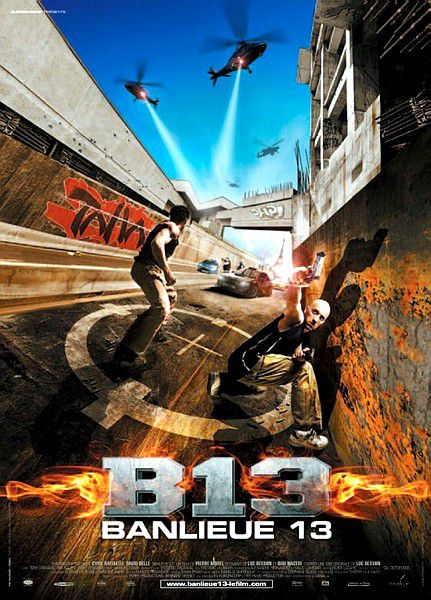
If the movies from French producer Luc Besson’s factory of B-grade actioners, District 13 (Banlieue 13, 2004) stands among the best. This is your typical martial arts-laden action extravaganza, filled with thumping techno music, a thin plot, and impressive stunts. But the increasingly prosaic clichés evident in Besson’s other films, which are also evident here, electrify with an uncommon kinetic energy. The action feels and looks real thanks to its stuntmen stars. The plot seems to have a social resonance behind it. And indeed the French soundtrack of techno and rap augments the no-holds-barred attitude of the movie.
The setting is Paris, 2010, which upon the release of this movie in 2004 was the future. Use your imagination. The city is plagued by unruly slums, and to isolate the problem areas, the government has erected a wall around a particular neighborhood known as District 13. The walls create a makeshift ghetto wherein all schools, all civil servants, and all hope has been evacuated. Inside, two million people are divided into various gangs and the police have no say, except that no one can leave through the guarded checkpoints. Drugs and crime run rampant on the streets within. Meanwhile, Elitist politicians would prefer to wipe this blotch off their maps entirely and start over.
Two heroes ban together to fight both a crime boss polluting the inside and political corruption stewing from outside the walls. One hero, Leïto (David Belle), comes from the slums. After being double-crossed by the local police, Leïto watches as his sister, Lola (Dany Verissimo), is taken hostage by the seedy gangster Taha (Bibi Naceri), and then he’s put in jail for 6 months to rot. Enter the other hero, supercop Damien (Cyril Raffaelli), who is commissioned by his superiors to go undercover, befriend Leïto, stage a prison break, and then use Leïto to sneak into District 13 to defuse a deadly bomb. The bomb was supposedly stolen from the government by the District 13 gangs, but this McGuffin proves to be slightly more complicated. And of course, Damien has only 24 hours to complete his mission.
Nevermind the plot, though. You’re not watching to find out what happens with Leïto, Damien, and the bomb. You’re watching to see the physical bravado of the two leads, as they demonstrate some of the most impressive stunts you’ve ever seen in any action movie. Belle and Raffaelli run across rooftops, leaping from building to building with ease. They scale obstacles and scuttle across walls like Spider-man. Whenever surrounded by a horde of goons, the heroes take them down without a minimum of fuss, exacting fisticuffs with a seemingly effortless precision. Through it all, they keep up a light banter that keeps the tone chummy and enjoyable.
Belle and Raffaelli are actual stuntmen and practitioners of a street-born, pseudo-martial art known as Parkour. According to the definition of those who practice it, “Parkour is the physical discipline of training to overcome any obstacle within one’s path by adapting one’s movements to the environment.” As opposed to a direct defensive strategy such as karate or jujitsu, Parkour involves running and jumping with fluidity, dodging obstructions with competence and speed through a complete awareness of one’s surroundings. But all you need to understand Parkour exists within this movie. The most amazing scenes aren’t those brimming with violence, they’re the chase scenes where Parkour skills are used to escape.
Director Pierre Morel, who would later helm Taken and From Paris with Love for the American market, exhibits clear and decisive action. The editing captures all the movements of Belle and Raffaelli with amazing clarity, whereas action movies nowadays so often rely on shaky-cam to disguise the stuntmen standing in for big-name stars. There’s nothing to hide in District 13, however, as Belle and Raffaelli complete the stunts and the fights themselves. Comparable to Jackie Chan in his heyday, these actors have the charisma, humor, and ability to advance themselves from stuntmen to stars, and they advance this movie from another dull actioner to must-see entertainment.
Watch District B13 on Tubi here: https://tubitv.com/movies/439503/district-b13

By Roger Ebert
Source: RogerEbert.com
One day, many years ago, an ancestor of Fiona spied a beautiful creature sunning by the sea. She was both woman and seal. We would call her a mermaid, but on that western coast of Ireland such creatures were well-known as Selkies.
The ancestor trapped the creature and married her, and they had children together and lived happily, although she seemed to long for the sea. One day she learned where her husband had hidden her sealskin, up under the roof, and she put it back on, and returned to the sea.
Fiona (Jeni Courtney), who is 12 or 13 years old, is told this story by a relative. It is not told as a “fairy tale” but as an account of family history, to be taken quite seriously. And well might Fiona believe it, because ever since there have been dark-haired children in her family who were said to throw back to the Selkie, and whose eyes turned yearningly to the sea.
The year is about 1946. Fiona’s mother has died, and her father can barely be budged from his mourning in the pub. She is sent to live with her grandparents, on a sea coast across from the island of Roan Inish, where the whole family once lived. There she learns the story of her little brother Jamie, whose cradle was carried off by the waves. And there, with her grandparents and her cousin Eamon (Richard Sheridan), she first explores Roan Inish, which means, in Gaelic, “island of the seals.” The secret of John Sayles‘ “The Secret of Roan Inish” is that it tells of this young girl with perfect seriousness. This is not a children’s movie, not a fantasy, not cute, not fanciful. It is the exhilarating account of the way Fiona rediscovers her family’s history and reclaims their island. If by any chance you do not believe in Selkies, please at least keep an open mind, because in this film Selkies exist in the real world, just like you and me.
On Roan Inish, the girl sees a child’s footprint. Then she sees the child – Jamie! – running on the sand. She calls to him, but he gets back into his cradle, which is borne out to sea by friendly seals. Of course it is hard to convince grownups of what she has seen.
In the meantime, her grandparents face eviction from their cottage, which is to be sold to rich folks from the city. They may have to move inland. “To move off of Roan Inish was bad enough,” Fiona’s grandmother says, “but to move out of sight of the sea . . .” She shakes her head, making it clear that it would kill the grandfather, who thinks of the city as “nothing but noise and dirt and people that’s lost their senses!” Can Fiona and Eamon, her young cousin, restore the family’s old cottages on Roan Inish? Can she reclaim Jamie from the sea? I found myself actually caring. John Sayles and Haskell Wexler, who has photographed this movie with great beauty and precision, have ennobled the material. There is a scene where a person numbed by the cold sea is warmed between two cows, and we feel close to the earth, and protected.
One can easily guess how this legend could have been simplified and jollied up in other hands – how it could have been about cute little Selkies. But legends are, after all, told by adults, not children, and usually they record something essential to the culture that produces them. What this legend says, I think, is that the people who tell it live on the land but live from the sea, so that their loyalties are forever divided.
Of course this is a wonderful “family film,” if that term has not been corrupted to mean simpleminded and shallow. Children deserve not lesser films but greater ones, because their imaginations can take in larger truths and bigger ideas. “The Secret of Roan Inish” is a film for children and teenagers like Fiona, who can envision changing their family’s fate. It is also for adults, of course, except for those who think they do not want to see a film about anything so preposterous as a seal-woman, and who will get what they deserve.
The Matrix, resurrected
By John Semley
Source: The Baffler
MIDWAY THROUGH 1999’S THE MATRIX, Keanu Reeves’s hacker-cum-cyberpunk-messiah Neo sees a black cat shivering in a doorway. Then, he sees it again. “Woah,” he utters, in that trademark, flat Keanu Reeves way. “Déjà vu . . . ” The phenomenon, Trinity (Carrie-Anne Moss) tells him, means big trouble. In the titular world-scale digital simulation in which the bulk of the film unfolds, déjà vu signals a computer glitch: a case of the simulation tweaking its code in real time.
One can’t help but be reminded of this idea watching The Matrix Resurrections, a long-gap sequel to the original sci-fi trilogy, which ended with Reeves’s Neo striking a détente between the machine overlords that enslaved mankind within a counterfeit reality and the fleshy human resistors who opposed them. The new film opens as the original does, following a heavily-armed SWAT team as they swarm a seedy motel room where a leather-clad hacker is plonking away at a computer terminal. The scene expands to introduce a new character, Bugs (Jessica Henwick), who notes to her compatriot that this familiar scene is a training module, designed to hone the skills of the digital heavies who patrol the parameters of the matrix. Or rather, a version of it that exists within the original matrix. It’s sixty years after the events of the last film, and nearly twenty years after its release. Things have gotten deeper—if only slightly.
The simulation now includes a popular video game trilogy—called, of course, The Matrix—that re-stages the events of the original films. Neo, too, is back, in his guise as Thomas Anderson. This time he’s not a computer programmer but a video game designer, whose “great ambition was to make a game indistinguishable from reality.” He’s the chief architect of the Matrix game trilogy, which has just seen a sequel green-lit within the fiction of both the matrix and The Matrix. (Matrix Resurrections was itself promoted with a tie-in video game demo, The Matrix Awakens.) Like William James’s image of our world resting on an infinite regress of rocks, it seems like it’s matrixes all the way down.
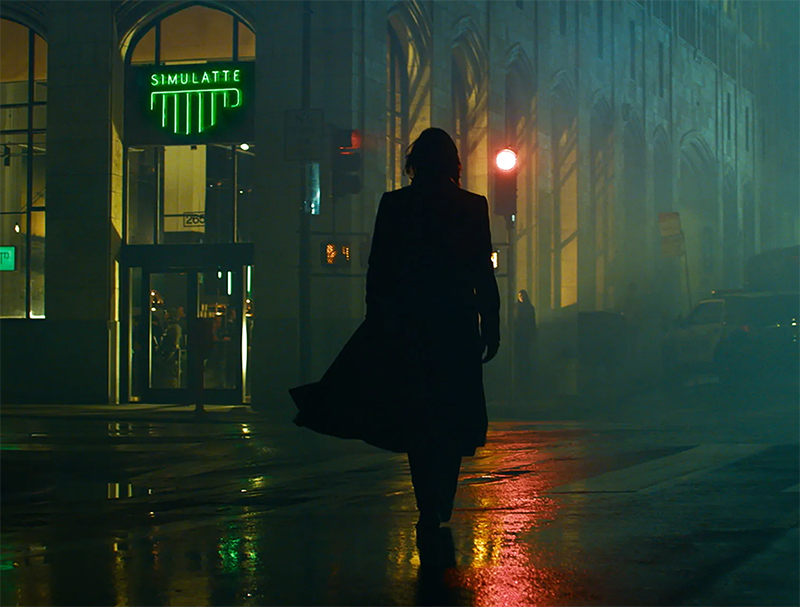
The planned game sequel prompts much hand-wringing. Characters bat ideas back and forth in an open-concept office, trying to get to the heart of what made the original Matrix work. Resurrections abounds with this sort of dorky meta-humor. There are jokes about the game design firm’s parent company being Warner Bros. (the actual film’s producer) and jokes about déjà vu. A fourth-wave coffee shop is called “Simulatte.” That kind of thing. It’s the sort of stuff that elicits barking, staccato guffaws from in-the-know audience members that quickly fade into barely bemused titters. It’s meant to be cute, but it’s mostly annoying.
Still, the film is not without its charms. Some of the early action scenes crack along reliably, playing with inversions of gravity and time, like a fleeter Christopher Nolan flick. And the notion of revisiting the world of the matrix is not without appeal. After all, the original film forecasted a world of digital disenfranchisement that is now, under the auspices of our current Silicon Valley overlords, regarded as aspirational. (In a telling touch, Resurrections moves the action from an implied Chicago to the Bay Area, explicitly marked by familiar landmarks and San Francisco PD cruisers.) And with its image of two pills representing diverging ideological bents, The Matrix provided a ready-made vocabulary that has been embraced in our real world, where everyone is redpilled, blackpilled, Danpilled, or Tedpilled. But Resurrections never manages to meaningfully intervene in the very conditions it seems to be diagnosing—and which the series had already diagnosed, decades ago. Like postmodernity itself, the state of digital dependency dramatized by The Matrix cannot be alleviated. It can only be mediated, with increasing levels of irony and winking self-awareness.
To wit: Resurrections is not about digitization, or the metaphysics of reality, or the broken promise of the cyberpunk genre. It is about movie reboots. Here, Neo must be liberated again, literally remaking his quest from the original film, with the obstacles re-skinned and old foes appearing in new guises (Jonathan Groff, playing the meddling computer program Smith, is a hunkier, paler imitation of the menacing Hugo Weaving). Characters snipe about how humanity is merely reframing the same handful of archetypal themes and ideas. “We’re still telling the same stories we’ve always told,” says one game designer, sounding like he’s been watching too many Jordan Peterson YouTubes. “Just with different names, different faces.” This may well be true. But it also feels like a cop-out. Especially because the original Matrix, as imagined by sororal duo Lilly and Lana Wachowski, felt genuinely inventive. It blended Terminator-styled dystopian sci-fi with Hong Kong wire-fu action and state-of-the-art special effects, all draped in the industrial liveries of a turn-of-the-millennium goth club. It may not have been wholly new. But it was thrilling remix. It spoke to the ennui of America at the “end of history.” It captured the soul-deadening, Dilbert-esque daily doldrums explored in films like Fight Club and Office Space. It also played straight to the anxiety around “Y2K” and the mounting cultural panic that home computers and toaster ovens might break down or turn against their owners. The Matrix felt like it was speaking to its time. Now, movies seem to chatter only among themselves.
There’s plenty of precedent here, of course: Ready Player One; the recent Space Jam sequel; and the new Spider-Man movie, which draws together two decades worth of sticky narrative threads spun across three distinct franchises. Corporate wheeling-and-dealing is increasingly allegorized onscreen, to the point that many blockbusters are now about their own production. Within ten years, we’ll see Aaron Sorkin hoisting an Oscar overhead, rewarded by his peers for helming a chatty drama about the backroom legal finagling that saw a Star Wars-branded lightsaber licensed to the movie Free Guy. Hollywood is already lodged in the post-postmodern rabbit hole, with little to show for it. The culture is glitching, looping, stuck in some long, static interregnum, like a radio drifting between channels. If a new Matrix movie felt grimly inevitable in such a climate, it also had great potential.
And I suppose it’s nice that director Lana Wachowski (going solo this time) returned to wield some control over a story that would otherwise be expropriated however-which-way by the studio. But she has only a passing interest in the new convolutions of the simulation itself. Wachowski is more invested in revisiting Neo and Trinity’s wrenching, realities-spanning romance. Rather than the heady ideas at play in the premise—which have been by-and-large replaced by geeky in-jokes—she wants to explore (again) the profound power of love as some supernatural force. At its worst, the Wachowski worldview recalls that classic Simpsons joke: the secret ingredient is always capital-l Love.
This strain of touchy-feely sci-fi certainly has its admirers, and I sometimes count myself among them. But I find the Wachowskis’ sappiness (however earnest) more tolerable when enlivened by their stylistic and technical inventiveness. The rote, underdog rhythms of Speed Racer (2008) only work because they unfold within an aesthetic landscape that splits the difference between La Chinoise and Paper Mario. The Matrix’s heavy hooey about fate and choice and freeing one’s mind is leavened because, well, the movie is entertaining as hell. But now, the ideas are stale (2003’s The Matrix Reloaded already introduced the concept of its story being a remake), and the action settles into tedium: graceful bullet-time ballets are replaced by crunchy, John Wick-style fights and repetitive CGI set pieces that see Neo stopping hails of bullets with his hands, over and over and over again.
Perhaps there’s something modestly clever in the major meta-gesture of this newest Matrix—in its idea of the matrix reproducing its own destruction in the form of an interactive video game. After all, the notion that the very systems that delude us offer self-contained safe spaces for relieving those delusions is apt. Like capital, the matrix survives by evolving quicker than the forces that oppose it. If we take this message seriously, then the goodly thing to do is to ignore The Matrix Resurrections and all corporatized entertainments. To put down Twitter and TikTok and smooch our spouses; build a snowman with the kiddies; clink some beers with a gaggle of good buddies.
That we should all invest not in our virtual existences, but the fleshy, loving, contingent relationships of real life, is a perfectly decent message. That the Wachowskis have been repeating this tired line for two decades speaks despairingly to the conditions of our own, present-day dystopia. Resurrections is suspended between cyberpunk trappings that were already shopworn circa 1999 and the intellectual prison of high-concept meta-mongering. It is a movie of the interregnum, one that could have been auto-generated by it. In this way, The Matrix does manage to speak to the times. Again.

By Andrew Skeates
Source: Far East Films
Tsui Hark returns for a third go around in his fantasy blockbuster franchise, sending the titular Dee on another eye-boggling, mind-warping, wuxia-infused adventure. While the first instalment saw Andy Lau take on the title character, the first follow up, ‘Rise of the Sea Dragon’, saw a younger version of Dee (now played by Mark Chao) muddle his way through an assortment of fanatical situations. ‘The Four Heavenly Kings’ is a direct follow on from ‘Rise of the Sea Dragon’, with Chao and many of the core cast returning for another adventure which may just be the best in the series.
Due to his exploits in ‘Rise of the Sea Dragon’, Dee is rewarded the coveted Dragon Taming Mace: a near mythical and indestructible weapon. So coveted it is, that many a nefarious foe want to get their hands on it including Empress Wu (Carina Lau) who hatches a plan to steal it and discredit Dee using a band of mystical warriors. Coupled with the resurgence of a once deadly spiritual tribe, Dee soon finds all is not what it seems as sorcery weaves it evil way, and he and his fellow Bureau colleagues attempt to uncover the conspiracy and battle an ever increasing assortment of fantastical creatures and foes.
Much like the first two Dee flicks, ‘The Four Heavenly Kings’ is an often breathless fantasy blockbuster that doesn’t skimp on the wuxia action, CGI wonderment and imaginative scenarios. These days Tsui Hark is happy to play in the big budget, CGI sandbox and while his recent films have been a bit hit or miss, the ‘Detective Dee’ flicks have arguably been his most enjoyable blockbusters of late. While ‘Mystery of the Phantom Flame’ and ‘Rise of the Sea Dragon’ could be all over the place in tone and plotting ‘The Four Heavenly Kings’ finds Hark on more assured ground. Sure there is still a fair amount of convoluted plotting and subplot/secondary character development a-go-go which takes a while to digest as the narrative often rockets along, but on the whole this entry flows coherently.
Dee’s cohorts (Lin Gengxin and Feng Shaofeng) get fully fleshed character arcs and are just as integral to the plot and action as the lead, with Feng Shaofeng (as General Yuchi) all but stealing the film. This unfortunately means Dee feels somewhat like a supporting character in his own film but the team dynamic is a nice approach to this threequel and keeps the viewer guessing and often surprised as to where the narrative is going. While the film is packed with playful energy, energetic set-pieces and a good amount of silliness, ‘The Four Heavenly Kings’ also packs in a fair bit of menace, not least when the vicious Wind Warriors show up. A truly threatening foe, they add menace and bite to what is essentially a cartoon blockbuster, Hark wringing out some genuine tension every time they appear on screen.
As with the other Dee instalments (and most of Hark’s recent output), this entry is packed with CGI ingenuity which leads to some truly creative scenarios and characters. For the most part the CGI works (save for the odd wonky bit here and there) and blends into the environment and practical action well. Hark certainly can’t resist packing in as much CGI inventiveness as he can but come the finale it certainly works to deliver some truly eye frazzling action: complete with giant gorillas, squids and some sort of colossal demon made up of eyeballs!
If one isn’t a fan of this type of CGI laced, fantasy blockbuster then one is probably not going to get along with ‘The Four Heavenly Kings’ but if one is (and enjoyed the previous jaunts with Dee) then there is a lot of fun to be had here. Tsui Hark delivers a wickedly fun fantasy romp full of wondrous fight action and flights of fancy.
Watch the film on Tubi here: https://tubitv.com/movies/619638/detective-dee-the-four-heavenly-king
INDIAN COUNTRY NEWS
"It is the duty of every man, as far as his ability extends, to detect and expose delusion and error"..Thomas Paine
Human in Algorithms
From the Roof Top
I See This
blog of the post capitalist transition.. Read or download the novel here + latest relevant posts
अध्ययन-अनुसन्धानको सार
 After the Crash