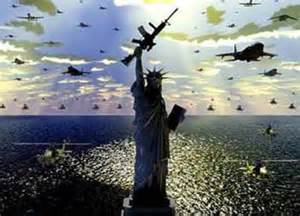
Ukraine and the great revival of American empire

By Andrew J. Bacevich

Source: Information Clearing House

Amidst the dross that clutters the New York Times op-ed page on most days, glimmers of enlightenment occasionally appear. A recent guest column by Grey Anderson and Thomas Meaney offers a case in point.

“NATO Isn’t What It Says It Is,” declares the headline. Contrary to the claims of its architects and defenders, Anderson and Meaney argue persuasively that the central purpose of the alliance from its founding was not to deter aggression from the East and certainly not to promote democracy, but to “bind Western Europe to a far vaster project of a U.S.-led world order.” In return for Cold War-era security guarantees, America’s European allies offered deference and concessions on issues like trade and monetary policy. “In that mission,” they write, NATO “has proved remarkably successful.” A plot of real estate especially valued by members of the American elite, Europe thereby became the centerpiece of the postwar American imperium.

The end of the Cold War called these arrangements into question. Desperate to preserve NATO’s viability, proponents claimed that the alliance needed to go “out of area or out of business.” NATO embraced an activist posture, leading to reckless state building interventions in Libya and Afghanistan. The results were not favorable. Acceding to U.S. pressure to venture out of area proved to be costly and served chiefly to undermine NATO’s credibility as a militarily capable enterprise.

Enter Vladimir Putin to save the day. Just as Russia’s invasion of Ukraine provided the U.S. with an excuse to forget its own post-9/11 military failures, so too it has enabled NATO to once more constitute itself as the chief instrument for defending the West—and, crucially, to do so without actually exacting a blood sacrifice from either Americans or Europeans.

In this context, the actual fate of Ukraine itself figures as something of an afterthought. The real issue centers on reviving damaged aspirations of American global primacy. With something like unanimity, the U.S. national security establishment is devoted to the proposition that the United States must remain the world’s sole superpower, even if this requires ignoring a vast accumulation of contrary evidence suggesting the emergence of a multipolar order. On that score, Putin’s recklessness came as an impeccably timed gift.

There is an element of genius at work here. Defeating Russia without having to do any actual fighting becomes the means to restore the image of American indispensability squandered during the decades that followed the fall of the Berlin Wall. For Washington, as Anderson and Meaney appreciate, the true stakes in Ukraine go far beyond the question of whose flag flies over Crimea. If Ukraine “wins” its war with Russia—however “winning” is defined and however great the price Ukrainians must pay—NATO itself (and the NATO lobby in Washington) will claim vindication.

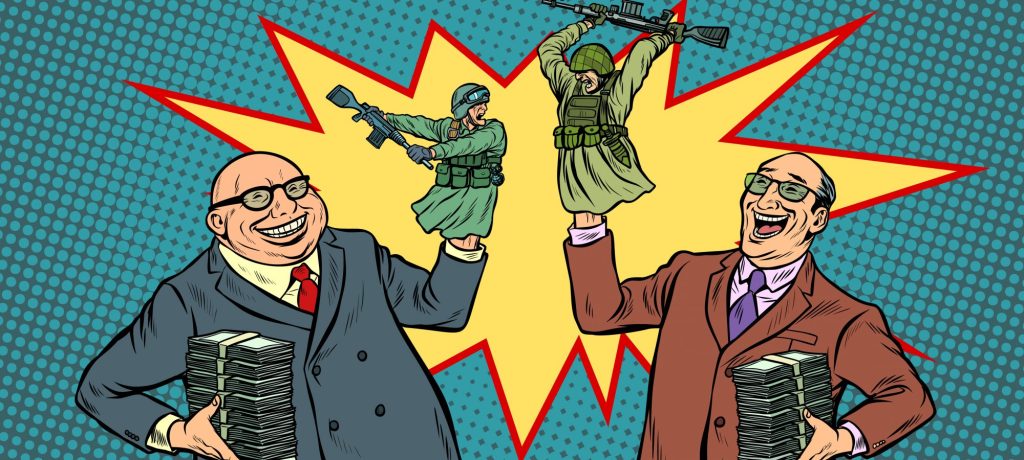
Rest assured that major European nations will then quietly renege on promises to boost their military spending, with actual responsibility for European security once more falling to the United States. With the centennial of World War II now within hailing distance, U.S. troops will remain permanently garrisoned in Europe. This will serve as cause for celebration throughout the U.S. military industrial complex, which will prosper.

Flexing its muscles, the United States will inevitably prod a greatly expanded NATO into turning its attention to enforcing the “rules-based international order” in the Asia-Pacific, with China as the chosen adversary. Ukraine will thereby serve as a template of sorts as the U.S. and its allies throw their weight around many thousands of miles from Europe proper.

The U.S. global military footprint will expand. U.S. efforts to put its house in order domestically will founder. Pressing global problems like the climate crisis will be treated as afterthoughts. But the empire that has no name will persist, which ultimately is the purpose of the game.

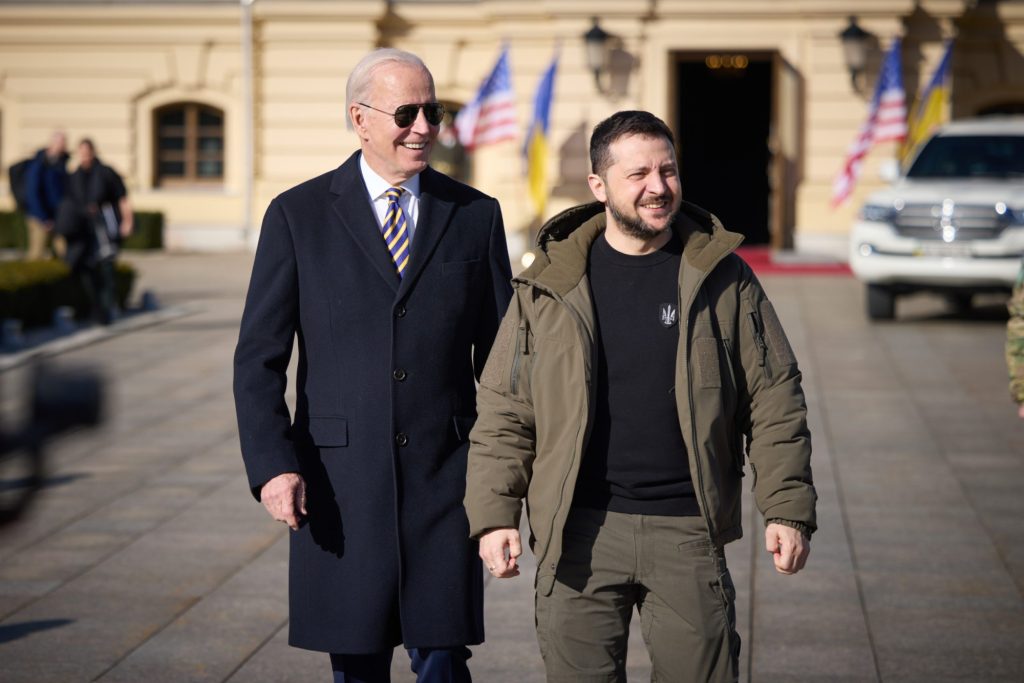
President Biden is fond of saying that the world has arrived at an “inflection point,” implying the need to change directions. Yet the overarching theme of his approach to foreign policy is stasis. He clings to the geopolitical logic that prompted NATO’s founding in 1949.

Back then, when Europe was weak and Stalin ruled the Soviet Union, that logic may have possessed some merit. But today the importance attributed to NATO testifies chiefly to the bankruptcy of American strategic thought and an inability to prioritize actually existing U.S. national interests, both foreign and domestic.

A sound revision of U.S. national security strategy would begin with announcing a timeline for withdrawing from NATO, converting it into an arrangement wholly owned and operated by Europe. The near impossibility of even imagining such an action by the United States testifies to the dearth of imagination that prevails in Washington.

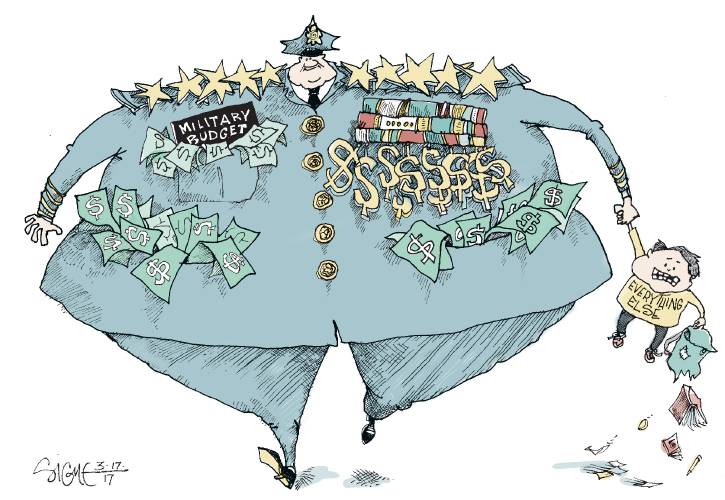
$850 Billion Chicken Comes Home to Roost.

War Reveals U.S. Military’s Longtime Disinterest in War.

Signe’s second toon du jour SIGN17e Military

By Andrew Cockburn

Source: Spoils of War

Watching a recent video of Ukrainian troops scrambling out of a U.S.-supplied Bradley armored fighting vehicle just after it hit a mine, I remembered how hard the U.S. Army bureaucrats and contractors who developed the weapon had fought to keep this vehicle a death trap for anyone riding inside. As originally designed, Bradleys promptly burst into flame when hit with anything much more powerful than a BB pellet, incinerating anyone riding inside. The armor bureaucrats were well aware of this defect, but pausing development for a redesign might have hurt their budget, so they delayed and cheated on tests to keep the program on track. Prior to one test, they covertly substituted water-tanks for the ammunition that would otherwise explode. Only when Jim Burton, a courageous air force lieutenant colonel from the Pentagon’s testing office, enlisted Congress to mandate a proper live fire test were the army’s malign subterfuges exposed and corrected. His principled stand cost him his career, but the Bradley was redesigned, rendering it less potentially lethal for passengers. Hence, forty years on, the survival of those lucky Ukrainians.

This largely forgotten episode serves as a vivid example of an essential truth about our military machine: it is not interested in war.

How else to understand the lack of concern for the lives of troops, or producing a functioning weapon system? As Burton observed in his instructive 1993 memoir Pentagon Wars, the U.S. defense system is “a corrupt business — ethically and morally corrupt from top to bottom.”

Nothing has happened in the intervening years to contradict this assessment, with potentially grim consequences for men and women on the front line. Today, for example, the U.S. Air Force is abandoning its traditional role of protecting and coordinating with troops on the ground, otherwise known as Close Air Support, or CAS. Given its time-honored record of bombing campaigns that had little or no effect on the course of wars, CAS has probably been the only useful function (grudgingly) performed by the service.

The Air Force has always resented the close support mission, accepting the role only because handing it to the Army would entail losing budget share. Thus the A-10 “Warthog” aircraft, specifically dedicated to CAS, was developed by the air force only to ward off a threat from the Army to steal the mission with a new helicopter. As it turned out, the A-10, thanks to the dedicated genius of its creators, notably the late Pierre Sprey, was supremely suited to the mission. But its successful record cuts no ice with the air force, which has worked with might and main to get rid of the A-10 ever since the threat of an army competitor in the eternal battle for budget share had been eliminated.

That campaign is now entering its final stages. The air force is not only getting rid of its remaining fleet of A-10s, it is also eliminating the capability to perform the close air support mission by phasing out the training for pilots and ground controllers essential for this highly specialized task. True, the service claims that the infamously deficient F-35 “fighter” can and will undertake the mission, but that is a laughable notion for many reasons, including the fact that the plane’s 25 mm cannon cannot shoot straight. The consequences for American troops on the ground in future wars will be dire, but their fate apparently carries little weight when set against the unquenchable urge of the air force to assert its independence from the messy realities of ground combat, where wars are won or lost. Thus its hopes and budget plans are focussed on costly systems of dubious relevance to warfare such as the new B-21 bomber, the new Sentinel ICBM, and the Next Generation Air Dominance fighter, none of which will fly for years to come, except in the form of cash out of our pockets.

Pentagon spending this year is projected to nudge $850 billion. (The total national security bill is already way past a trillion, but that’s another story.) Yet, even when endowed with such a gigantic pile of cash, the system is apparently incapable of furnishing the wherewithal for even a limited war, such as the one currently underway in Ukraine. The conflict has been marked by successive announcements that progressively more potent weapon systems are being shipped to the Ukrainians -Javelins anti-tank missiles, 155 mm Howitzers, HIMARS precision long range missiles, Patriots air defense missiles, Abrams tanks, with F-16 fighters in the offing. A U.S. military intelligence officer pointed out to me recently the actual basis on which these systems are selected: “when we run out of the last system we were sending.”

Now Biden has generated global outrage by promising to send cluster bombs, known for their ability to kill and maim children fifty years after the relevant war has ended, as any Laotian farmer could tell you. The military rationale for their use is their supposed utility against “soft” targets such as dismounted infantry, radars, and wheeled vehicles. However, a former armor officer and veteran of the 1991 Gulf war recalled to me that “we disliked them intensely and pleaded with the artillery and Air Force not to employ them. They simply damaged support elements and wheels that followed us into action. After the war we treated numerous people wounded by them including our own soldiers, as well as civilians (children).”

Biden has admitted that these devices are being sent only because the U.S. is running out of the artillery ammunition that the Ukrainians actually require. “This is a war relating to munitions. And they’re running out of that ammunition, and we’re low on it,” he told a TV interviewer. So off go the cluster bombs, their passage lubricated by crocodile tears from administration officials: “I’m not going to stand up here and say it was easy…It’s a decision that required a real hard look at the potential harm to civilians” National Security Adviser Jake Sullivan told reporters. (Back when it was reported that the Russians were using cluster bombs in Ukraine, then-White House Press Secretary Jen Psaki denounced such action as “a war crime.”)

So, the richest war machine in history, having scraped its cupboard bare, is now reduced to fielding a device of dubious military utility deemed illegal by over a hundred countries. That’s what we get for our $850 billion.

House Passes $886 Billion National Defense Authorization Act

The bill narrowly passed in a vote of 219-210 due to a partisan divide over amendments included by Republicans

By Dave DeCamp

Source: AntiWar.com

The House on Friday passed its version 2024 National Defense Authorization Act in a vote of 219-210, which largely fell along partisan lines due to amendments added by Republicans relating to social policies in the military.

The Republican amendments covered abortion, transgender surgery, and diversity initiatives. Only four Democrats voted in favor of the bill, and four Republicans voted against it. The four Republicans who opposed the NDAA are Reps. Thomas Massie (KY), Eli Crane (AZ), Andy Biggs (AZ), and Ken Buck (CO).

The Senate still needs to pass its version of the NDAA, then the two chambers will negotiate the final version that will go to President Biden’s desk. The Republican amendments packed into the House version will set up a fight between the two chambers as Senate Majority Leader Chuck Schumer (D-NY) and other Democrats will reject them.

The 2024 NDAA is for a record $886 billion, the same amount President Biden requested. The debt ceiling deal reached between House Republicans in the White House did not limit military spending and put no caps on emergency supplemental funds, which is how the US has been spending on the war in Ukraine.

As the House was debating the NDAA, several amendments introduced by Republicans looking to rein in US support for Ukraine were voted down. One amendment sponsored by Rep. Warren Davidson (R-OH) would have required the Biden administration to develop a strategy for the war in Ukraine. It was rejected in a vote of 129-301, with only Republicans supporting it.

One amendment introduced by Rep. Marjorie Taylor Greene would have cut $300 million in military aid for Ukraine that’s packed into the NDAA, but it failed in a vote of 89-341. Rep. Matt Gaetz (R-FL) put forward an amendment to cut off all military assistance for Ukraine, which failed in a vote of 70-358. Only Republicans supported the two amendments.

Greene sponsored another amendment that would have prohibited the transfer of cluster munitions to Ukraine, although US cluster bombs have already arrived in the country. The effort failed in a vote of 147-276. It received support from 98 Republicans and 49 Democrats.

A War Like No Other in Ukraine

By Peter Van Buren

Source: WeMeantWell.com

Joe Biden created for the U.S. a war like no other, one where others die and the U.S. simply sits back and pays the bills on a gargantuan scale. No attempts are made at diplomacy by the Americans, and the diplomatic efforts of others like the Chinese are dismissed as evil attempts to gain influence in the area (similar for Chinese diplomatic work in the Yemen war.) Biden is coming close to achieving 1984‘s goal of perpetual warfare while only putting a handful of American lives at risk. He has learned lessons from the Cold War, and already put them into play. Can we call it the Biden Doctrine yet?

Biden’s strategy is clear enough now after well more than a year of conflict; what he has been sending to Ukraine jumped from helmets and uniforms to F-16s in only 15 months and shows no signs of stopping. The problem is U.S. weapons are never enough for victory and always “just enough” to allow the battle to go on until then next round. If the Ukrainians think they are playing the U.S. for suckers for free arms they best check who is really paying for everything, in blood.

Putin is playing this game himself in a way, careful not to introduce anything too powerful, such as strategic bombers, and upset the balance and offer Biden the chance to intervene in the war directly (one can hear old man Biden on TV now, explaining American airstrikes are needed to prevent a genocide, the go-to excuse he learned at Obama’s knee.) That’s what the current escalation holds, airpower. Ukraine will find even with the promise of the F-16 it can’t acquire aircraft and train up pilots fast enough (minimum training time is 18-24 months), and next will be begging the U.S. to serve as its air force. As it is the planes are likely to be based out of Poland and Romania, suggesting NATO will pick up the high-skilled tasks of maintaining and repairing them. Left unclear is the NATO role in required aerial refueling to keep the planes over the battlefield. F-16s aside, a spin off bonus to all these weapons gifts is that the vast majority of transfers to date have been “presidential drawdowns.” This means the U.S. sends used or older weapons to Ukraine, after which the Pentagon can use the Congressionally-authorized funds to replenish their stocks by purchasing new arms. The irony that war machines once in Iraq are now on the ground in Ukraine can’t be missed.

The U.S. strategy seems based on creating a ghastly tie of sorts, two sides lined up across a field shooting at each other until one side called it quits for the day. Same as in 1865, same as in 1914, but the new factor is today those armies face off across those fields with 21st-century HIMARS artillery, machine guns, and other tools of killing far more effective than a musket. It is unsustainable, literally chewing up men, albeit not Americans. The question meanwhile of how many more Ukrainians have to die is answered privately by Joe Biden as “potentially all of them.” Anything else requires you to cynically believe Biden thinks he can simply purchase victory,

Up until now this has all been the Cold War playbook. Fighting to the last Afghan was a strategy perfected in Soviet-held Afghanistan in the 1980s. Yet what is different is the scale — since Russia invaded Ukraine, the United States sent over $37 billion worth of military aid to support Kiev’s war effort, the single largest arms transfer in U.S. history and one with no signs of stopping. A single F-16 costs up to $350 million a copy if bought with weapons, maintenance equipment, and spare parts kits.

Yet despite the similarities to Cold War Strategy 101, some lessons have been learned over the intervening years. One of America’s fail-points throughout the Cold War and the War on Terror was the use of puppet governments largely imposed or direly supported by American money and muscle. Because these governments lacked the support of the people (see Vietnam, Iraq, and Afghanistan) they were non-starters with the lifespan of fruit flies. Ukraine is different; the puppet government is the government, beholden to the U.S. for its very survival but more or less supported directly by the people for now.

The other lesson learned has to do with nation building, or rebuilding or reconstruction, whatever the vast post-war expenditures will be called in this conflict. No more straight-up governmental efforts as in Vietnam, Iraq, and Afghanistan. This time it will be all private enterprise. “It is obvious that American business can become the locomotive that will once again push forward global economic growth,” President Zelensky said, boasting that BlackRock, JP Morgan, and Goldman Sachs, and others “have already become part of our Ukrainian way.”

The NYT calls Ukraine “the world’s largest construction site” and predicts projects there in the multi-billions, as high in some estimates as $750 billion. It will be, says the Times, a “gold rush: the reconstruction of Ukraine once the war is over. Russia is stepping up its offensive heading into the second year of the war, but already the staggering rebuilding task is evident. Hundreds of thousands of homes, schools, hospitals and factories have been obliterated along with critical energy facilities and miles of roads, rail tracks and seaports. The profound human tragedy is unavoidably also a huge economic opportunity.” Earlier this year JP Morgan and Zelensky signed a memorandum of understanding stipulating Morgan would assist Ukraine in its reconstruction.

And maybe those large American companies have learned the lessons of Iraq and Afghanistan. Of the billions spent, much money was wasted on dead ends and much was siphoned off due to corruption. But success or failure, the contractors always got paid in our Wars of Terror. With that in mind, more than 300 companies from 22 countries signed up for a Rebuild Ukraine exhibition and conference in Warsaw. At the World Economic Forum in Davos, Switzerland, a standing-room-only crowd packed Ukraine House to discuss investment opportunities.

The eventual gold rush in rebuilding makes for an interesting addendum to the Biden strategy of fighting to the last Ukrainian. The more that is destroyed the more that needs to be rebuilt, and the potential for more money to pour into U.S. companies smart enough to wait by the trough for the killing to subside. But why wait? Drones operated by Danish companies have already mapped every bombed-out structure in the Mykolaiv Oblast region, with an eye toward using the data to help decide what reconstruction contracts should be issued.

So let’s put some lipstick on this pig of a strategy and call it the Biden Doctrine. Part I is to limit direct U.S. combat involvement while fanning the flames for others. Part II is to provide massive amounts of arms to enable a fight to the last local person. Part III is to transform the home government into a puppet instead of creating an unpopular one afresh. Part IV is to turn the reconstruction process into a profit center for American companies. How long the war lasts and how many die are cynically not part of the strategy. The off ramp in Ukraine, a diplomatic outcome that resets the map to pre-invasion 2022 levels, is clear enough to Washington. The Biden administration seems content, shamefully, not to call forcefully for diplomatic efforts but instead to bleed out the Russians as if this was Afghanistan 1980, albeit in the heart of Europe.

The patriotism of killing and being killed

Why are patriotism and war so intertwined in U.S. media and politics?

By Norman Solomon

Source: Nation of Change

The Fourth of July—the ultimate patriotic holiday—is approaching again. Politicians orate, American Flags proliferate and, even more than usual, many windows on the world are tinted red, white and blue. But an important question remains unasked: Why are patriotism and war so intertwined in U.S. media and politics?

The highest accolades often go to those who died for their country. But when a war is based on deception with horrific results, as became clear during the massive bloodshed in Vietnam, realism and cynicism are apt to undermine credulity. “War’s good business so give your son,” said a Jefferson Airplane song in 1967. “And I’d rather have my country die for me.”

Government leaders often assert that participating in war is the most laudable of patriotic services rendered. And even if the fighters don’t know what they’re fighting for, the pretense from leadership is that they do. When President Lyndon Johnson delivered a speech to U.S. troops at Cam Ranh Bay in South Vietnam, he proclaimed that “you know what you are doing, and you know why you are doing it—and you are doing it.”

Five decades later, long after sending U.S. troops to invade Panama in 1989 and fight the 1991 Gulf War, former President George H.W. Bush tweeted that he was “forever grateful not only to those patriots who made the ultimate sacrifice for our Nation—but also the Gold Star families whose heritage is imbued with their honor and heroism.” Such lofty rhetoric is routine.

Official flattery elevates the warriors and the war, no matter how terrible the consequences. In March 2010, making his first presidential visit to Afghanistan, Barack Obama told the assembled troops at Bagram Air Base that they “represent the virtues and the values that America so desperately needs right now: sacrifice and selflessness, honor and decency.”

From there, Obama went on to a theme of patriotic glory in death: “I’ve been humbled by your sacrifice in the solemn homecoming of flag-draped coffins at Dover, to the headstones in section 60 at Arlington, where the fallen from this war rest in peace alongside the fellow heroes of America’s story.” Implicit in such oratory is the assumption that “America’s story” is most heroic and patriotic on military battlefields.

A notable lack of civic imagination seems to assume that there is no higher calling for patriotism than to kill and be killed. It would be an extremely dubious notion even if U.S. wars from Vietnam to Afghanistan and Iraq had not been based on deception—underscoring just how destructive the conflation of patriotism and war can be.

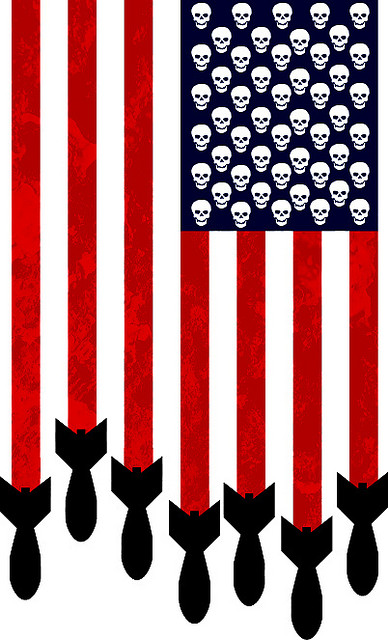
From Vietnam to Iraq and beyond, the patriotism of U.S. troops—and their loved ones as well as the general public back home—has been exploited and manipulated by what outgoing President Dwight Eisenhower called the “military-industrial complex.” Whether illuminated by the Pentagon Papers in 1971 or the absence of the proclaimed Iraqi weapons of mass destruction three decades later, the falsehoods provided by the White House, State Department and Pentagon have been lethal forms of bait-and-switch.

Often lured by genuine love of country and eagerness to defend the United States of America, many young people have been drawn into oiling the gears of a war machine—vastly profitable for Pentagon contractors and vastly harmful to human beings trapped in warfare.

Yet, according to top officials in Washington and compliant media, fighting and dying in U.S. wars are the utmost proof of great patriotism.

We’re encouraged to closely associate America’s wars with American patriotism in large part because of elite interest in glorifying militarism as central to U.S. foreign policy. Given the destructiveness of that militarism, a strong argument can be made that true patriotism involves preventing and stopping wars instead of starting and continuing them.

If such patriotism can ever prevail, the Fourth of July will truly be a holiday to celebrate.

America At War-Provoking The Consequences

By Christopher Black

Source: New Eastern Outlook

The United States of America is at war with Russia. There is not much point in using terms such as “proxy war” to describe the situation. If a belligerent in a war is acting as a proxy for another power and that power is not engaged directly in the war, the term can be useful. But when the power, for which the “proxy” engages in the war, is directly involved in the war itself, then it is a co-belligerent, a party to the war directly, not simply by proxy.

The issue is whether each state is pursuing its own interests and has its own independent means of doing so, or whether the interests and forces of the allied powers are subordinate to the interests and forces of a leader.  In such a case, the enemy being attacked can regard all its opponents as a single entity.

In this regard, Clausewitz said that, “if you can vanquish all your enemies by defeating one of them, that defeat must be the main objective of the war. In this one enemy, we strike at the centre of gravity of the entire conflict.”

If we analyse the war in the Ukraine theatre of operations in these terms, it becomes clear that the Ukrainian military forces are in fact forces of the United States of America. They have been created, armed, trained, supplied, financed, and are directed and commanded by the Americans, for American interests. The government for whom they nominally fight is a puppet state, installed in power by the United States and its NATO allies in a coup d’etat in 2014. It has no independent interests outside of American ones, and no control over the war or the forces nominally under its command.

The United States of America is the leader of a hostile military alliance, the purpose of which, since its inception, has been to isolate, threaten, attack and destroy Russia, has conspired with its alliance for years to achieve this end, has spent vast resources to prepare the attack, and has, with malice and determination, sabotaged any proposals for peace.  It insists on war.  It is the centre of gravity of the entire conflict.

The American government claims that it is not engaged even in a proxy war with Russia, that they are merely assisting an independent nation suffering aggression from another, that this does not put them at war with Russia, a war which, they claim, they are trying to avoid despite their actions and daily propaganda.

But, like the British, and the rest, the truth is the United States of America is a party to the war directly, according to all accepted criteria under international law. It supplies money to conduct the war, tanks, armoured vehicles, aircraft, arms, ammunition, military provisions and other war materials, engages its own military forces-military advisors and combatants, provides military intelligence, obtained on a real-time basis from its spy networks, satellite observations and electronic data collection, engages in an intense propaganda war against Russia, has attempted, through “sanctions,” to impose a blockade on Russia and its economy and people, blew up the Nord Stream gas pipeline, sends, on a regular basis, senior government and military officials, including the American President, Congressional bigwigs and the leaders of other members of the military alliance, to meet with and direct the actions of their lieutenant Zelensky, and conducts constant military exercises further threatening attacks against Russia. The NATO Air Defender military exercises begin in Europe on June 12, the day I write this, involving hundreds of NATO aircraft.

Make no mistake. The United States of America is at war with Russia. No amount of rhetoric can hide that fact and what the consequences for the United States will be. To quote Clausewitz again,

 “Danger is part of the friction of war. Without an accurate conception of danger, we cannot understand war.”

The problem is that the neither the Americans nor the other members of its unholy alliance, seem to realise the danger they are in, neither their leaders nor their citizens. Like the British, they suffer from the delusion that they are insulated from the consequences of their war, that they are invulnerable, that Russia will not dare to respond to the attacks upon its territory and people by attacking their territories. This shared delusion makes them ever more dangerous, since they think, they can keep escalating their actions in the war without any limits.  They cannot-not without consequences.

On June 8th Tass reported, following the statement by the former head of NATO, Fogh Rasmussen, that NATO countries may send their forces into the conflict directly, that Dmitry Medvedev stated,

“Fogh Rasmussen wasn’t a very smart man before. And now he has sunk into a doctrinaire’s dementia. In an interview with The Guardian, he stated that even if Banderavite Ukraine doesn’t receive an invitation to join NATO in Vilnius, the countries of the alliance will be able to send their troops there. Sort of on their own.”

“Well, have the people of these countries been asked? Who among them wants war with Russia? Do they really want hypersonic strikes on Europe? And what does Uncle Sam think about this? It would affect him too, wouldn’t it?”

Again, on June 1, TASS reported that Dmitry Medvedev stated, in connection with the attack on Russians in the Belgorod region by NATO-Ukrainian forces,

“The aim was simple – to cause damage, to harm to the civilian population somehow, And the fact that our enemy is already behaving as a terrorist characterizes in a very specific way both the Ukrainian regime and those who are behind it – first of all the Americans and the Europeans, who, in fact, have got on the warpath with us. Terrorist acts must entail the harshest retaliation possible.”

Medvedev’s views have been stated by other members of the government, by members of the Duma and by President Putin when he referred to Russian strikes on command and decision centres wherever they may be.

The Americans can whistle in the dark, lie to their people, try to fool the world, but what matters is what the Russian government thinks and knows, and it thinks, because it knows, that the United States of America is at war with Russia and seeks Russia’s complete defeat and subjugation. The campaign in Ukraine is just a phase of this war, is the current geographical space for this war, so for the United States and its allies to assume that they can carry out attacks on Russia and not suffer being dealt with in kind or worse, that war cannot be waged on their territories, is a serious mistake.

Indeed, on May 31, Dmitry Medvedev stated with respect to Britain,

“London is, in fact, waging an undeclared war on Moscow, which means that any British official can be viewed as a legitimate military target.

“Today, Great Britain is acting as an ally of Ukraine, by providing it with equipment and personnel as military assistance, that is de facto waging an undeclared war against Russia. Therefore, any of its officials, both military and civilian ones, who are making a contribution to the war effort, can be viewed as a legitimate military target,”

Medvedev was commenting on a remark by British Foreign Secretary James Cleverly who had justified the drone attacks on Moscow, saying that Ukraine had the right to attack targets on Russian territory for self-defense.

He added,

“Foolish officials in the UK, our eternal enemy, should remember that under universally recognized international law governing the conduct of war in modern conditions, including the Hague and Geneva Conventions with their additional protocols, their situation can also be qualified as being at war.”

The same analysis applies in spades to the United States of America.

An interesting comment in this regard was made by the Kremlin spokesman Dmitry Peskov on June 3rd when, according to Tass, he stated in an interview on the Rossiya-1 TV channel, that,

“Ukraine has simply become a tool of the West’s ‘hybrid war’ against Russia, and therefore it is futile to deal with it in resolving the conflict. Now, Ukraine is actually a tool of conflict. The conflict has indeed become broader, as the collective West is waging a hybrid war against our country. It is futile to deal with this tool in order to resolve the conflict, and this must be understood too.”

All the rhetoric from NATO about whether or not Ukraine can become a member of NATO is just a smokescreen to hide from their people the fact that Ukraine is already de facto part of NATO.  Whether or not the formalities of signing pieces of paper, of getting the approval of NATO states is followed through, is irrelevant.

Remember that on March 26, 2022, in Warsaw, President Biden stated,

“We have a sacred obligation under Article 5 to defend each and every inch of NATO territory with the full force of our collective power.”

He was referring not only to Poland but to Ukraine as well. What Russia feared is now the reality. Ukraine is de facto a NATO state.  And all the rhetoric from the West and commentators about whether or not NATO will invoke Article 5 is another smokescreen designed to mask what is really happening, for NATO has already activated Article 5 of the NATO Treaty.

The talk about invoking it in the future is an attempt to hide NATO’s weakness, its defeats on the military, economic and political fronts, even as they throw one weapon system after another at Russia, and inject NATO forces into the fighting only to have their equipment and forces destroyed.

 They have nothing left to throw at Russia that can defeat it.  So, they pretend NATO is not yet really engaged. But these facts make the USA even more dangerous as it becomes clear that the combined West cannot defeat Russia, a nuclear power, using conventional means.

Remember also that the United States has a first strike nuclear arms policy, and they have already placed, in Romania and Poland, land-based versions of the Aegis Air Defence System, which can be used to launch nuclear-armed missiles at Russia. These systems have been tested.  The one in Poland is reported to be fully operational as of June 30.  The danger to Russia is immediate and existential. Those systems are one of the reasons Russia activated its military operations.  Russia has further responded to this, and to the attacks on Russia, clearly planned and ordered by the US and UK, by placing tactical nuclear weapons in Belarus which are to be made operational after July 7, when the facilities to store and use them will be completed.

Those tactical nuclear weapons are designed for battlefield use. We hope it never comes to that, but Russia faces a direct threat from people bent on its destruction that think they are untouchable. So, Russia faces very difficult choices on what to do and how to prevent an escalation to all our nuclear war while ensuring its own security.

On May 23, during his visit to Laos, Deputy Head of the Russian Security Council Dmitry Medvedev issued a warning on the day Russian security forces destroyed the Ukrainian raiding force that attacked civilians in the Belgorod region.

“The North Atlantic alliance does not take the threat of nuclear war seriously enough, thus making a big mistake. NATO is not serious about this scenario. Otherwise, NATO would not have supplied such dangerous weapons to the Ukrainian regime. Apparently, they think that a nuclear conflict, or a nuclear apocalypse, is never ever possible. NATO is wrong, and at some point, events may take a completely unpredictable turn. The responsibility will be placed squarely on the North Atlantic Alliance,”

Medvedev pointed out that no one knows whether the point of no return has been passed,

“No one knows this. This is the main danger. Because as soon as they provide something, they say: let’s supply this, too. Long-range missiles or planes. Everything will be all right. But nothing will be fine. We will be able to cope with it. But only more and more serious types of weapons will be used. That’s what the current trend is.”

So, we come back to Clausewitz. The American government and people cannot understand the war they are engaged in unless they understand the danger, they are in.  They have to understand their country is the centre of gravity in this war, whose defeat will mean the defeat of all its minions in NATO. The Russian people know the danger they are in. The Americans, through NATO, through their NATO puppets in Ukraine, have attacked Russians in Russia. It is logical to expect that Russia will decide to bring home to the Americans what war means, what danger they are in, and they do not need to use nuclear weapons to achieve this.

Russia can strike using its conventional hypersonic weapons as well, against which the USA has no defence whatsoever, as has been established with the destruction of the Patriot Air defence complexes in Ukraine which could not stop Russian missiles. They have no other air defence systems operational in the United States territory or on its naval forces that can stop them either.  Russia has not decided to take this step yet. But it can and the Americans can do nothing about it except bluster about using nuclear weapons against Russia, But Russia took that possibility into account when the special military operation began.

The American people have not directly experienced war in their own territory for a long time. They have no idea what it is. They have no idea of the danger they are in so long as their government continues its aggressive policies, not only against Russia, but China as well.  The American people, misled and misinformed, have no conception of the dangers of this war anymore than the British people and the peoples of the other NATO countries do. The American people must be warned.  The United States of America is at war, and no amount of bluffing and lying can protect them from the consequences their government is provoking. To repeat what I said in my warning to the people of Britain, the consequences are predictable and they will be catastrophic.

Saturday Matinee: Catch-22

Classic Film Review: So was “Catch-22” the failure we remember it to be?

By Roger Moore

Source: Movie Nation

Perhaps it took a humorless, career-crippling George Clooney TV version of Joseph Heller’s novel to make us better appreciate Mike Nichols’ daring, infamously-expensive version of “Catch-22.”

Released at the height of the Vietnam War, suffering in comparison to Robert Altman’s equally anti-war dramedy “M*A*S*H,” seemingly more on a par with with equally cynical action comedy “Kelly’s Heroes,” which has had the benefit of a lot more TV exposure, “Catch” still plays the way it did way back in 1970 — as a pricey, “difficult” satire with a “difficult” shoot as baggage.

But wipe away the “Catch-22 lore,”the people cast and cast-aside, the fact that Nichols wanted the more age-appropriate Al Pacino as Yossarian, the young bombardier/anti-hero, and grapple with the film’s disordered narrative, the nightmarish focus of the story — an active-duty combat airman flying through and ranting through what we now call Post Traumatic Stress Syndrome, coupled with a tinge of guilt.

It’s amazing to see now. And considering how our war movies, from “300” to “Midway,” “Greyhound” to “Flyboys” and even at times, “Dunkirk,” are made now — with digital planes and ships and sometimes tanks — they really don’t make’em like this any more.

Nichols made the most of his coastal Mexican location, showing off all 17 WWII vintage B-25s taking off and landing every chance he got. You couldn’t do that today.

And that cast. Alan Arkin makes a fine, perplexed and outraged Yossarian, a sane man trapped in the insanity of war, an actor who never hits a punchline too hard, never takes the character’s exasperation into parody.

“Let me see if I’ve got this straight. In order to be grounded, I’ve got to be crazy. And I must be crazy to keep flying. But if I ask to be grounded, that means I’m not crazy anymore, and I have to keep flying.”

“You got it,” Doc Daneeka (Jack Gilford) tells him. “That’s Catch-22.

“Whoo… That’s some catch, that Catch-22.”

Orson Welles as a grumpy general, Tony Perkins as a put-upon chaplain, Martin Balsam as the murderously vain Col. Cathcart, Buck Henry as his venal sidekick, Col. Corn (screenwriter Henry was never better, as an actor), baby-faced Bob Balaban as the always-crashing, always-tinkering, even-tempered Orr, it’s a dazzling corps.

Bob Newhart half-stammering through Major Major Major, a very young Martin Sheen raging as the pilot Dobbs, Art Garfunkel as the innocent co-pilot Nately who falls for an Italian hooker, Charles Grodin as an upper-class twit navigator, a smarmy, befuddlingly upbeat Richard Benjamin (cast, with his wife Paula Prentiss as a nurse Yossarian chases), the famous French star who fled to Hollywood Marcel Dalio is the wizened old Italian who figures Italy has already won the war, since it has surrendered and Americans are still fighting and dying. And there’s a sea of actors we’d come to recognize on TV (“The Bob Newhart Show” is over-represented) in the years that followed.

Jon Voight stands out, just enough, as the grinning opportunist Milo Minderbender, a stand-in for every war profiteer you’ve ever read about, working the angles, an impersonal unpatriotic multinational corporation who wins no matter who loses.

Like its two contemporaries, “M*A*S*H” and “Kelly’s Heroes,” it’s a guy’s movie with a dated leering quality about the opposite sex. It’s heavy-handed, here and there, betraying Nichols — feeling his oats after “The Graduate” — indulging in some serious “blank check” filmmaking.

And reading, over the years, of all the people Nichols wanted to cast, or cast and then replaced, you kind of wish he’d moved on from Gilford, a future Oscar nominee who doesn’t bring enough cowardly sniveling to the good doc.

“Catch-22” was popular enough that they did a pilot for a sitcom based on it, as was the case with “M*A*S*H.” Richard Dreyfuss had the lead in that.

Over the years, I’ve interviewed half a dozen actors from that all-star cast, and often, without prompting, they’d bring it up. It took half a year of their lives, most of them, and burned itself into their memories, even if it wasn’t the blockbuster Paramount expected it to be.

Watching it again, outside of the academic settings where it turned up in “film as satire” classes and the like, it feels more cinematic than the scruffy, Altmanesque “M*A*S*H,” a movie marred by that stupid screen-time-chewing football game. It’s less fun than the more-watchable “Patton” and even “Kelly’s Heroes” (which is FAR longer).

But as a darker-than-dark comedy about the futility and insanity of war, it towers above its contemporaries in ways that should have scared-off George Clooney. It’s the best film of a seemingly-unfilmmable classic novel we’re ever going to get.

MPAA Rating: R, graphic violence, blood, nudity, profanity

Cast: Alan Arkin, Martin Balsam, Buck Henry, Tony Perkins, Bob Newhart, Paula Prentiss, Richard Benjamin, Marcel Dalio, Bob Balaban, Art Garfunkel, Martin Sheen, Jack Gilford, Peter Bonerz, Norman Fell, Austin Pendleton, Jon Voight and Orson Welles.

Credits: Directed by Mike Nichols, script by Buck Henry, based on the Joseph Heller novel. A Paramount release.

Running time: 2:02

____________________

Watch Catch-22 on Kanopy here: https://www.kanopy.com/en/product/3216674

The Twilight of Freedom

By Craig Murray

Source: CraigMurray.org.uk

Three British journalists I know personally – Johanna Ross, Vanessa Beeley and Kit Klarenberg – have each in the last two years been detained at immigration for hours on re-entering their own country, and questioned by police under anti-terrorist legislation.

This is plainly an abuse of the power to detain at port of entry, because in each case they could have been questioned at any time in the UK were there legitimate cause, and the questioning was not focused on their travels.

They were in fact detained and interrogated simply for holding and publishing dissident opinion on foreign policy, and in particular for supporting a more collaborative approach to Russia – with which, lest we forget, the UK is not at war.

These detentions have taken place over the period of a couple of years. All were targeted for journalism and this is plainly a continuing policy of harassment of dissident British journalists.

I have three times in that same period been questioned by police in my own home in Edinburgh for journalism, over three separate matters. I spent four months in jail for publicising essential information to show that a high level conspiracy was behind the false accusations against Scottish Independence leader Alex Salmond.

Julian Assange remains in maximum security jail for publicising the truth about war crimes. Meanwhile a new National Security Bill goes through the Westminster parliament, which will make it illegal for a journalist possess or publish classified information.

This has never been illegal. The responsibility has always lain with the whistleblower or leaker, not the journalist or publisher. It seeks to enshrine in UK law precisely what the US Government is seeking to achieve against Assange using the US 1917 Espionage Act. This is a huge threat to journalism.

It is also worth pointing out that, if Evan Gershkovich was indeed doing nothing more than he has claimed to have been doing in Russia, that action would land him a long jail sentence in either the USA or the UK under the provisions which both governments are attempting to enforce.

On top of that, you have the Online Safety Bill, which under the excuse of protecting against paedophilia, will require social media gatekeepers to remove any kind of content the government deems as illegal.

When you put all this together with the new Public Order Act, which effectively gives the police authority to ban any protest they wish to ban, there is a fundamental change happening.

This is not just a theoretical restriction on liberty. Active enforcement against non-approved speech is already underway, as shown by those detentions and, most strongly of all, by Julian’s continued and appalling incarceration.

To complete the horror, there is no longer a genuine opposition within the political class. Keir Starmer’s Labour Party opposes none of this wave of attacks on civil liberties. The SNP has been sending out identical stock replies from its MPs on Julian Assange, 100% backing the UK government line on his extradition and imprisonment.

I feel this very personally. I know all of these people affected – Julian, Alex, Kit, Vanessa, Johanna, and view them as colleagues whose rights I defend, even though I do not always agree with all of their disparate views.

Two other people I know personally and admire are under attack. The campaign of lies and innuendo against Roger Waters this last few weeks has been astonishing in both its viciousness and its mendacity, recalling the dreadful attacks on Jeremy Corbyn.

More mundane but also part of the same phenomenon, my friend Randy Credico has had his Twitter account cancelled.

To be a dissident in the UK, or indeed the “West”, today is to see, every single day, your friends persecuted and to see the walls close in upon yourself.

A unified political class, controlled by billionaires, is hurtling us towards fascism. That now seems to me undeniable.